ADOLESCENCE: BETWEEN
CHILDHOOD AND
ADULTHOOD
Personal Development
LESSON 3
1. Clarify and manage the demands of teen years
and its challenges;
2. Express feelings on the expectations of the
significant people around them; and
3. Demonstrate adolescence’s capability through
affirmations.
Objectives
DEVELOPMENTAL STAGES
Human Development focuses on human growth and
changes across the lifespan, including physical, cognitive,
social, intellectual, perpetual, personality and emotional
growth. The study of human developmental stages is
essential to understanding how humans learn, mature and
adapt. Throughout their lives, humans go through various
stages of development. The human being is either in a
state of growth or decline, but either condition imparts
change. Some aspects of our life change very little over
time, and are consistent. Other aspects change
dramatically. By understanding these changes, we can
better respond and plan ahead effectively.
As adolescents
develop physically, they
also develop cognitively,
psychologically socially
and spiritually. The ages
during adolescence may
be bracketed as follows
(Corpus et al. 2010).
• Early adolescence-
ages around 10 to 13
• Middle
adolescence- ages
14 to 16
• Late adolescence-
ages from 17 to 20
Erikson maintained that
personality develops in a
predetermined order through eight
stages of psychosocial
development, from infancy to
adulthood.
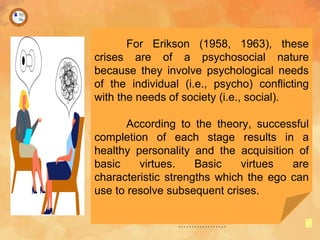
During each stage, the
person experiences a
psychosocial crisis which could
have a positive or negative
outcome for personality
development.
For Erikson (1958, 1963), these
crises are of a psychosocial nature
because they involve psychological needs
of the individual (i.e., psycho) conflicting
with the needs of society (i.e., social).
According to the theory, successful
completion of each stage results in a
healthy personality and the acquisition of
basic virtues. Basic virtues are
characteristic strengths which the ego can
use to resolve subsequent crises.
According to the theory,
successful completion of each stage
results in a healthy personality and
the acquisition of basic virtues.
Basic virtues are characteristic
strengths which the ego can use to
resolve subsequent crises.
Developmental
Stages
Developmental Stages
O1
Pre-natal
(Conception to birth)
Age when hereditary
endowments and sex are fixed
and all body features, both
external are developed
Developmental Stages
O2
Infancy
( Birth to 2 years)
Foundation age when basic
behavior are organized and
many ontogenetic maturation
Developmental Stages
O3
Early Childhood
(2 to 6 years)
Pre-gang age, exploratory, and
questioning. Language and
Elementary reasoning are required
and initial socialization is
experienced
Developmental Stages
O4
Late Childhood
(6 to 12 years)
Gang and creativity age when self-
help skills, social skills, school
skills, and play are developed
Developmental Stages
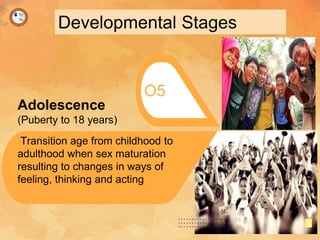
O5
Adolescence
(Puberty to 18 years)
Transition age from childhood to
adulthood when sex maturation
resulting to changes in ways of
feeling, thinking and acting
Developmental Stages
O6
Early
Adulthood
(18 to 40 years)
Age of Adjustment to new pattern
of life and roles such as spouse,
parent, and breadwinner.
Developmental Stages
O7
Middle age
(40 years to
retirement)
Transition age when adjustments
to initial physical and mental
decline are experienced.
Developmental Stages
O8
Old Age
(Retirement to
death)
Retirement age when
increasingly rapid physical
and mental decline are
experienced.
Robert J. Havighurst elaborated on the
Developmental Tasks Theory in the most
systematic and extensive manner. His main
assertion is that development is continuous
throughout the entire lifespan, occurring in stages,
where the individual moves from one stage to the
next by means of successful resolution of problems
or performance of developmental tasks. These
tasks are those that are typically encountered by
most people in the culture where the individual
belongs.
If the person successfully accomplishes
and masters the developmental task, he feels
pride and satisfaction, and consequently earns
his community or society’s approval. This
success provides a sound foundation which
allows the individual to accomplish tasks to be
encountered at later stages. Conversely, if the
individual is not successful at accomplishing a
task, he is unhappy and is not accorded the
desired approval by society, resulting in the
subsequent experience of difficulty when faced
with succeeding developmental tasks.
Infancy and
Early Childhood
(0-5)
Middle Childhood (6-12) Adolescence (13-18)
● Learning to walk
● Learning to take solid
foods
● Learning to talk
● Learning to control the
elimination of body
● wastes
● Learning sex
differences and sexual
modesty
● Acquiring concepts
and language to
describe social and
physical reality
● Readiness for reading
● Learning to distinguish
right from wrong and
developing a
conscience
 Learning physical skills
necessary for ordinary games
 Building a wholesome
attitude toward oneself
 Learning to get along with age-
mates
 Learning an appropriate sex
role
 Developing fundamental skills
in reading, writing, and
calculating
 Developing concepts necessary
for everyday living
 Developing conscience,
morality, and a scale of values
 Achieving personal
independence
 Developing acceptable attitudes
toward society
 Achieving mature
relations with both
sexes
 Achieving a masculine
 or feminine social role
 Accepting one’s
physique
 Achieving emotional
independence of
adults
 Preparing for marriage
and family life
 Preparing for an
economic career
 Acquiring values and
an ethical system to
guide behavior
 Desiring and
achieving socially
responsibility behavior
Early Adulthood (19-30) Middle Adulthood (30-60) Later Maturity (61-)
● Selecting a mate
● Learning to live with a
partner
● Starting a family
● Rearing children
● Managing a home
● Starting an occupation
● Assuming civic
responsibility
● Helping teenage children
to become happy and
● responsible adults
● Achieving adult social
and civic responsibility
● Satisfactory career
achievement
● Developing adult
leisure time activities
● Relating to one’s spouse
as a person
● Accepting the
physiological changes of
middle age
● Adjusting to aging parent
● Adjusting to decreasing
strength and health
● Adjusting to retirement and
reduced income
● Adjusting to death of
spouse
● Establishing relations with
one’s own age group
● Meeting social and civic
obligations
● Establishing satisfactory
living quarters
Adolescence is a period of life during which peers play
a pivotal role in decision-making.
The study enumerated ten desirable developmental tasks
every adolescent in America should develop:
1. Adjust to sexually maturing bodies and feelings.
2. Develop and apply abstract thinking skills
3. Develop and apply a new perspective on human
relationships.
4. Develop and apply new coping skills in areas such as
decision making, problem solving, and conflict
resolution.
5. Identifying meaningful moral standards, values and
belief systems
Filipino authors Corpus et al. (20100 in
their book, Child and Adolescent
Development, identified similar
developmental tasks a Filipino adolescent
need to learn. These are:
• Developing occupational skills
• Self-reliance
• Ability to manage their finance
• Social responsibility
• Mature work orientation
• Personal responsibility
• Positive attitude toward work
Here is an additional list of developmental
tasks and skills a Filipino adolescent should
acquire: Being courageous in standing up and
being different from your friends.
• Developing self-esteem
• Being true to yourself and avoiding the tendency
to please others.
• Learning how media and advertising are trying to
influence your thinking and feelings.
• Becoming aware, critical, and being involved with
social issues
• Embracing a healthy lifestyle
• Developing your spirituality

PerDev_Week_3_pdf for grade 11 second sem.pdf

  • 1.
  • 2.
    1. Clarify andmanage the demands of teen years and its challenges; 2. Express feelings on the expectations of the significant people around them; and 3. Demonstrate adolescence’s capability through affirmations. Objectives
  • 3.
    DEVELOPMENTAL STAGES Human Developmentfocuses on human growth and changes across the lifespan, including physical, cognitive, social, intellectual, perpetual, personality and emotional growth. The study of human developmental stages is essential to understanding how humans learn, mature and adapt. Throughout their lives, humans go through various stages of development. The human being is either in a state of growth or decline, but either condition imparts change. Some aspects of our life change very little over time, and are consistent. Other aspects change dramatically. By understanding these changes, we can better respond and plan ahead effectively.
  • 4.
    As adolescents develop physically,they also develop cognitively, psychologically socially and spiritually. The ages during adolescence may be bracketed as follows (Corpus et al. 2010).
  • 5.
    • Early adolescence- agesaround 10 to 13 • Middle adolescence- ages 14 to 16 • Late adolescence- ages from 17 to 20
  • 6.
    Erikson maintained that personalitydevelops in a predetermined order through eight stages of psychosocial development, from infancy to adulthood. During each stage, the person experiences a psychosocial crisis which could have a positive or negative outcome for personality development.
  • 7.
    For Erikson (1958,1963), these crises are of a psychosocial nature because they involve psychological needs of the individual (i.e., psycho) conflicting with the needs of society (i.e., social). According to the theory, successful completion of each stage results in a healthy personality and the acquisition of basic virtues. Basic virtues are characteristic strengths which the ego can use to resolve subsequent crises.
  • 8.
    According to thetheory, successful completion of each stage results in a healthy personality and the acquisition of basic virtues. Basic virtues are characteristic strengths which the ego can use to resolve subsequent crises.
  • 9.
  • 10.
    Developmental Stages O1 Pre-natal (Conception tobirth) Age when hereditary endowments and sex are fixed and all body features, both external are developed
  • 11.
    Developmental Stages O2 Infancy ( Birthto 2 years) Foundation age when basic behavior are organized and many ontogenetic maturation
  • 12.
    Developmental Stages O3 Early Childhood (2to 6 years) Pre-gang age, exploratory, and questioning. Language and Elementary reasoning are required and initial socialization is experienced
  • 13.
    Developmental Stages O4 Late Childhood (6to 12 years) Gang and creativity age when self- help skills, social skills, school skills, and play are developed
  • 14.
    Developmental Stages O5 Adolescence (Puberty to18 years) Transition age from childhood to adulthood when sex maturation resulting to changes in ways of feeling, thinking and acting
  • 15.
    Developmental Stages O6 Early Adulthood (18 to40 years) Age of Adjustment to new pattern of life and roles such as spouse, parent, and breadwinner.
  • 16.
    Developmental Stages O7 Middle age (40years to retirement) Transition age when adjustments to initial physical and mental decline are experienced.
  • 17.
    Developmental Stages O8 Old Age (Retirementto death) Retirement age when increasingly rapid physical and mental decline are experienced.
  • 18.
    Robert J. Havighurstelaborated on the Developmental Tasks Theory in the most systematic and extensive manner. His main assertion is that development is continuous throughout the entire lifespan, occurring in stages, where the individual moves from one stage to the next by means of successful resolution of problems or performance of developmental tasks. These tasks are those that are typically encountered by most people in the culture where the individual belongs.
  • 19.
    If the personsuccessfully accomplishes and masters the developmental task, he feels pride and satisfaction, and consequently earns his community or society’s approval. This success provides a sound foundation which allows the individual to accomplish tasks to be encountered at later stages. Conversely, if the individual is not successful at accomplishing a task, he is unhappy and is not accorded the desired approval by society, resulting in the subsequent experience of difficulty when faced with succeeding developmental tasks.
  • 20.
    Infancy and Early Childhood (0-5) MiddleChildhood (6-12) Adolescence (13-18) ● Learning to walk ● Learning to take solid foods ● Learning to talk ● Learning to control the elimination of body ● wastes ● Learning sex differences and sexual modesty ● Acquiring concepts and language to describe social and physical reality ● Readiness for reading ● Learning to distinguish right from wrong and developing a conscience  Learning physical skills necessary for ordinary games  Building a wholesome attitude toward oneself  Learning to get along with age- mates  Learning an appropriate sex role  Developing fundamental skills in reading, writing, and calculating  Developing concepts necessary for everyday living  Developing conscience, morality, and a scale of values  Achieving personal independence  Developing acceptable attitudes toward society  Achieving mature relations with both sexes  Achieving a masculine  or feminine social role  Accepting one’s physique  Achieving emotional independence of adults  Preparing for marriage and family life  Preparing for an economic career  Acquiring values and an ethical system to guide behavior  Desiring and achieving socially responsibility behavior
  • 21.
    Early Adulthood (19-30)Middle Adulthood (30-60) Later Maturity (61-) ● Selecting a mate ● Learning to live with a partner ● Starting a family ● Rearing children ● Managing a home ● Starting an occupation ● Assuming civic responsibility ● Helping teenage children to become happy and ● responsible adults ● Achieving adult social and civic responsibility ● Satisfactory career achievement ● Developing adult leisure time activities ● Relating to one’s spouse as a person ● Accepting the physiological changes of middle age ● Adjusting to aging parent ● Adjusting to decreasing strength and health ● Adjusting to retirement and reduced income ● Adjusting to death of spouse ● Establishing relations with one’s own age group ● Meeting social and civic obligations ● Establishing satisfactory living quarters
  • 22.
    Adolescence is aperiod of life during which peers play a pivotal role in decision-making. The study enumerated ten desirable developmental tasks every adolescent in America should develop: 1. Adjust to sexually maturing bodies and feelings. 2. Develop and apply abstract thinking skills 3. Develop and apply a new perspective on human relationships. 4. Develop and apply new coping skills in areas such as decision making, problem solving, and conflict resolution. 5. Identifying meaningful moral standards, values and belief systems
  • 23.
    Filipino authors Corpuset al. (20100 in their book, Child and Adolescent Development, identified similar developmental tasks a Filipino adolescent need to learn. These are: • Developing occupational skills • Self-reliance • Ability to manage their finance • Social responsibility • Mature work orientation • Personal responsibility • Positive attitude toward work
  • 24.
    Here is anadditional list of developmental tasks and skills a Filipino adolescent should acquire: Being courageous in standing up and being different from your friends. • Developing self-esteem • Being true to yourself and avoiding the tendency to please others. • Learning how media and advertising are trying to influence your thinking and feelings. • Becoming aware, critical, and being involved with social issues • Embracing a healthy lifestyle • Developing your spirituality