Module 2 Stage Development and Developmental Task.pptx
1.
MODULE 2
THE STAGESOF
DEVELOPMENT AND
DEVELOPMENTAL TASKS
Mark John O. Bellen &
Benedict Lotino
BPED 1
Discussants
ProfEd1
2.
For every developmentalstage,
there is an expected developmental
task. What happens when the
expected developmental task are
not achieved at the corresponding
developmental stage? How can you
help children achieve these
developmental tasks?
3.
John Santrock's researchfocuses
on family processes and children's
socio-emotional development. He
conducted the first major research
study on comparisons of children
in mother and father custody
families.
5.
ACTIVITY .
LOOK ATTHE PICTURES
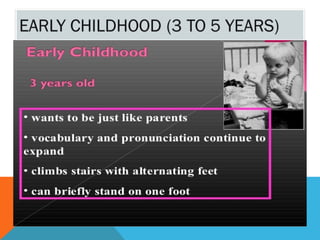
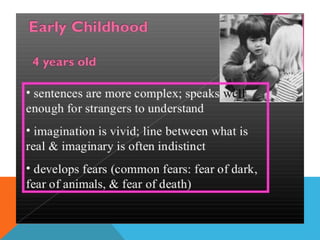
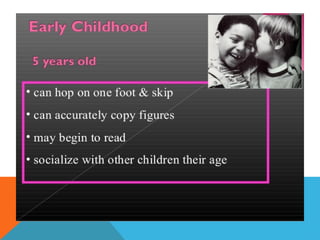
AND THE DESCRIPTIONS
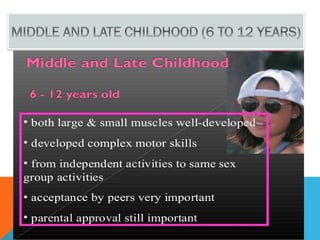
BELOW EACH SET OF
PICTURES, THEN
ANSWER THE
FOLLOWING QUESTIONS.
7.
1. Do thepictures suggest the
respective developmental stages?
2. Symbolize each developmental
stage. Give a symbol that stands for
the developmental task for each
stage.
3. If you were given a chance, which
developmental stage would you like
to be in? Why? Share your answers
with your small group?
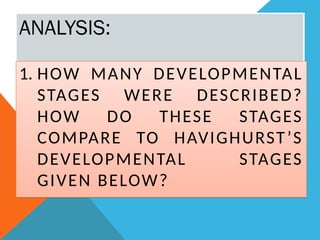
ANALYSIS:
1. HOW MANYDEVELOPMENTAL
STAGES WERE DESCRIBED?
HOW DO THESE STAGES
COMPARE TO HAVIGHURST’S
DEVELOPMENTAL STAGES
GIVEN BELOW?
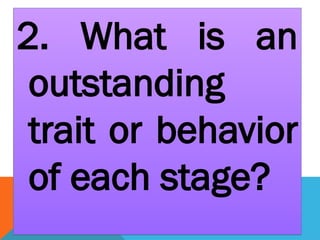
22.
2. What isan
outstanding
trait or behavior
of each stage?
23.
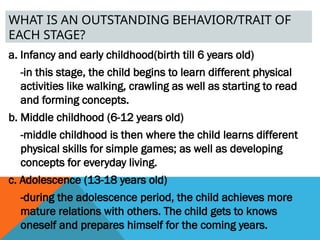
WHAT IS ANOUTSTANDING BEHAVIOR/TRAIT OF
EACH STAGE?
a. Infancy and early childhood(birth till 6 years old)
-in this stage, the child begins to learn different physical
activities like walking, crawling as well as starting to read
and forming concepts.
b. Middle childhood (6-12 years old)
-middle childhood is then where the child learns different
physical skills for simple games; as well as developing
concepts for everyday living.
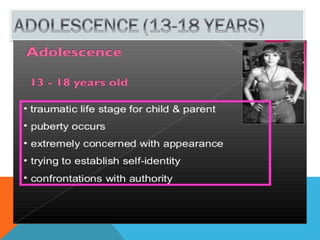
c. Adolescence (13-18 years old)
-during the adolescence period, the child achieves more
mature relations with others. The child gets to knows
oneself and prepares himself for the coming years.
24.
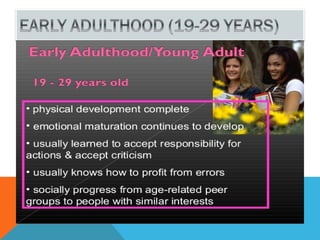
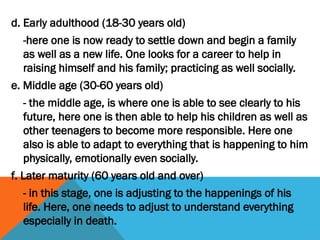
d. Early adulthood(18-30 years old)
-here one is now ready to settle down and begin a family
as well as a new life. One looks for a career to help in
raising himself and his family; practicing as well socially.
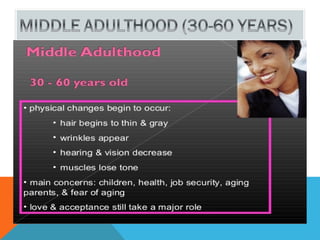
e. Middle age (30-60 years old)
- the middle age, is where one is able to see clearly to his
future, here one is then able to help his children as well as
other teenagers to become more responsible. Here one
also is able to adapt to everything that is happening to him
physically, emotionally even socially.
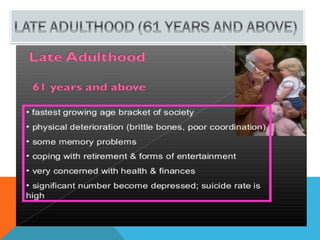
f. Later maturity (60 years old and over)
- in this stage, one is adjusting to the happenings of his
life. Here, one needs to adjust to understand everything
especially in death.
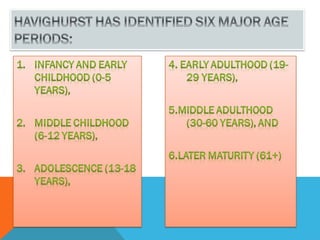
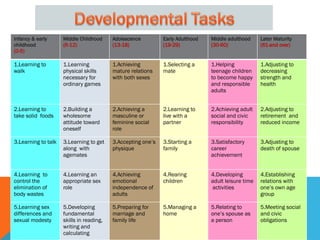
Infancy & early
childhood
(0-5)
MiddleChildhood
(6-12)
Adolescence
(13-18)
Early Adulthood
(19-29)
Middle adulthood
(30-60)
Later Maturity
(61-and over)
1.Learning to
walk
1.Learning
physical skills
necessary for
ordinary games
1.Achieving
mature relations
with both sexes
1.Selecting a
mate
1.Helping
teenage children
to become happy
and responsible
adults
1.Adjusting to
decreasing
strength and
health
2.Learning to
take solid foods
2.Building a
wholesome
attitude toward
oneself
2.Achieving a
masculine or
feminine social
role
2.Learning to
live with a
partner
2.Achieving adult
social and civic
responsibility
2.Adjusting to
retirement and
reduced income
3.Learning to talk 3.Learning to get
along with
agemates
3.Accepting one’s
physique
3.Starting a
family
3.Satisfactory
career
achievement
3.Adjusting to
death of spouse
4.Learning to
control the
elimination of
body wastes
4.Learning an
appropriate sex
role
4.Achieving
emotional
independence of
adults
4.Rearing
children
4.Developing
adult leisure time
activities
4.Establishing
relations with
one’s own age
group
5.Learning sex
differences and
sexual modesty
5.Developing
fundamental
skills in reading,
writing and
calculating
5.Preparing for
marriage and
family life
5.Managing a
home
5.Relating to
one’s spouse as
a person
5.Meeting social
and civic
obligations
27.
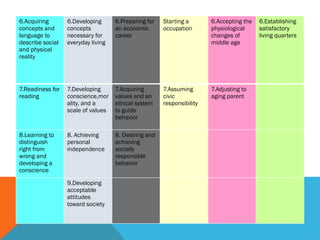
6.Acquiring
concepts and
language to
describesocial
and physical
reality
6.Developing
concepts
necessary for
everyday living
6.Preparing for
an economic
career
Starting a
occupation
6.Accepting the
physiological
changes of
middle age
6.Establishing
satisfactory
living quarters
7.Readiness for
reading
7.Developing
conscience,mor
ality, and a
scale of values
7.Acquiring
values and an
ethical system
to guide
behavior
7.Assuming
civic
responsibility
7.Adjusting to
aging parent
8.Learning to
distinguish
right from
wrong and
developing a
conscience
8. Achieving
personal
independence
8. Desiring and
achieving
socially
responsible
behavior
9.Developing
acceptable
attitudes
toward society
28.
Robert Havighurst defines
developmentaltask as one that “
arises at certain period in our life,
the successful achievement of
which leads to happiness and
success with later tasks while failure
leads to unhappiness, social
disapproval, and difficulty with later
tasks”. (Havighurst,1972).
29.
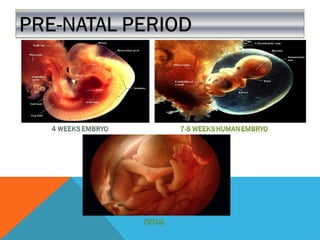
DEVELOPMENTAL TASKS (SANTROCK,2002)
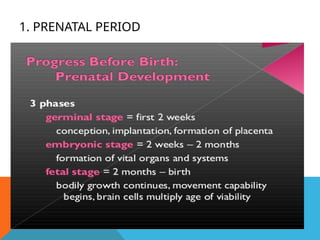
1. Prenatal period (from
conception to birth) - it
involves tremendous growth
from a single cell to an
organism complete with brain
and behavioural capabilities.
30.
DEVELOPMENTAL TASKS (SANTROCK,2002)
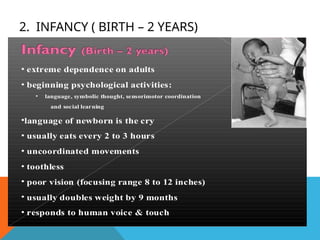
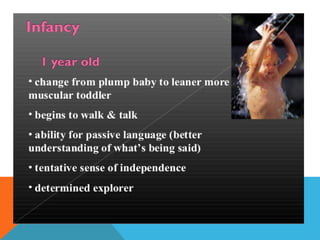
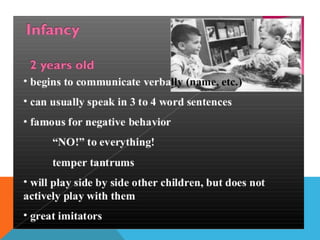
2.Infancy (from birth to 18-24
months )- a time of extreme
dependence on adults. Many
psychological activities are just
beginning – language , symbolic
thought , sensorimotor
coordination and social learning.
31.
3.Early Childhood (endof infancy
to 5-6 years ( grade 1) – these
are the preschool years. Young
children learn to become more
self- sufficient and to care for
themselves, develop school
readiness skills and spend many
hours in play with peers.
32.
4.Middle and latechildhood (6-11
years of age, the elementary school
years)- the fundamental skills of
reading, writing and arithmetic are
mastered.
The child is formally exposed to the
larger world and its culture.
Achievements become a more
central theme of child’s world and
self control increases.
33.
5.Adolescence (10-12 yearsof age ending
up to 18-22 years of age)- Begins with
rapid physical changes-dramatic gains in
height and weight, changes in body
contour, and the development of sexual
characteristics such as enlargement of
the breasts, development of pubic and
facial hair, and deepening of the voice.
Pursuit of independence and identity are
prominent. Thought is more logical,
abstract and idealistic. More time is spent
outside of the family.
34.
6.Early adulthood(from lateteens
or early 20s lasting through the
30’s – it is a time of establishing
personal and economic
independence, career
development, selecting a mate,
learning to live with someone in
an intimate way, starting a
family and rearing children.
35.
7. Middle adulhood(40-60 years
of age) – It is a time of
expanding personal and social
involvement and responsibility;
of assisting the next generation
in becoming competent and
mature individuals; and of
reaching and maintaining
satisfaction in a career.
36.
8. Late Adulthood(60s and
above)- It is time for
adjustment to decreasing
strength and health. Life
review, retirement, and
adjustment to new social
roles.
37.
Answer this questionswith a learning
partner.
1.What are the implication of these
developmental tasks to your role as a
facilitator of learning?
2.What are preschool teachers
supposed to do with pre-schoolers?
38.
Middle and LateChildhood
Elementary school teachers ought to help their pupils by
__________________________________________________
__________________________________________________
__________________________________________________
__________________________________________________
_________________________________________________
Adolescence
High-school teachers ought to help their students by
__________________________________________________
__________________________________________________
__________________________________________________
__________________________________________________
39.
2. ALLOW SMALLGROUPS TO DO EACH OF THE
FOLLOWING:
a. Cover up with an object to symbolize
each period or stage of development.
b. Create a collage of pictures presenting
an outstanding characteristics and
developmental tasks each
developmental stage.
c. Sing an appropriate song for each
developmental stage.
40.
3. Discuss themeaning of the quotation
beneath the title of the lesson. Relate it to
the stages of development.
BIG IDEAS:
1.Complete this unfinished sentence.
Developmental task are_______________.
2. Show the developmental stages by means
of a diagram inclusive of the ages. Write also
the outstanding characteristics trait and
developmental task of each developmental
stage.
41.
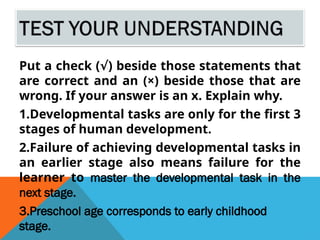
Put a check( ) beside those statements that
√
are correct and an (×) beside those that are
wrong. If your answer is an x. Explain why.
1.Developmental tasks are only for the first 3
stages of human development.
2.Failure of achieving developmental tasks in
an earlier stage also means failure for the
learner to master the developmental task in the
next stage.
3.Preschool age corresponds to early childhood
stage.
42.
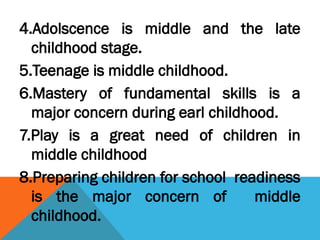
4.Adolscence is middleand the late
childhood stage.
5.Teenage is middle childhood.
6.Mastery of fundamental skills is a
major concern during earl childhood.
7.Play is a great need of children in
middle childhood
8.Preparing children for school readiness
is the major concern of middle
childhood.
43.
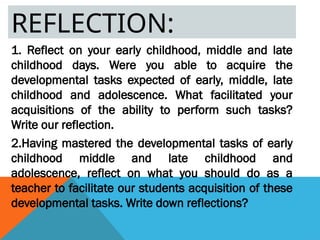
REFLECTION:
1. Reflect onyour early childhood, middle and late
childhood days. Were you able to acquire the
developmental tasks expected of early, middle, late
childhood and adolescence. What facilitated your
acquisitions of the ability to perform such tasks?
Write our reflection.
2.Having mastered the developmental tasks of early
childhood middle and late childhood and
adolescence, reflect on what you should do as a
teacher to facilitate our students acquisition of these
developmental tasks. Write down reflections?