VS.
Course : Business Strategy
Professor: Alexandros Papalexandris


Live free
or die tryin'

The Easy Riders:
Andreou Anastasios
Athanasiou Ioannis
Kakavoulis Anastasios
Kallis Nikolaos
Mehta Arjun
Introduction
Video
Harley-Davidson
from birth to maturity

•

By 1953 Harley is #1 American manufacturer of motorcycles.

•

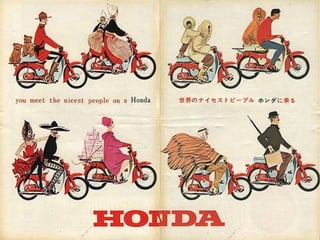
In 1959, Honda entered the US market => rebirth of motorcycling in the US.

•

Japanese producers soon
moved up-market in the
heavyweight sector.

•

In 1969, Harley-Davidson was
acquired by AMF.

•

End of 1970s Honda became the
market leader in the heavyweight
motorcycles in the US.
Harley-Davidson rebirth

In 1981, the then CEO ,
organized a leverage buyout.

●

The new management team
brought a revolution.

●

US government imposed
49% temporary tariff.

●

The 1990s saw year-on-year uninterrupted growth in the
heavyweight motorcycle market and a continued increase in
Harley’s market share.
●
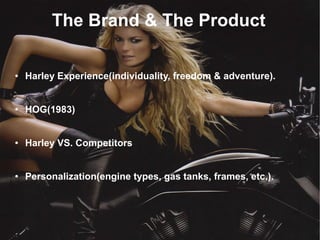
The Brand & The Product
●

Harley Experience(individuality, freedom & adventure).

●

HOG(1983)

●

Harley VS. Competitors

●

Personalization(engine types, gas tanks, frames, etc.).
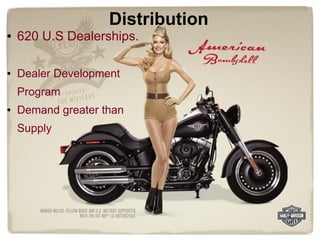
Distribution
●

620 U.S Dealerships.

●

Dealer Development
Program

●

Demand greater than
Supply
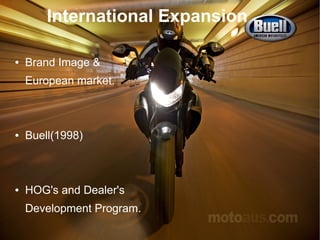
International Expansion
●

Brand Image &
European market.

●

Buell(1998)

●

HOG's and Dealer's
Development Program.
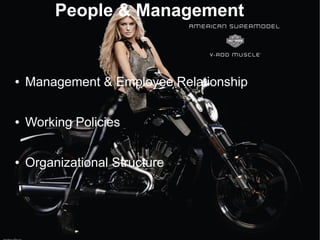
People & Management

●

Management & Employee Relationship

●

Working Policies

●

Organizational Structure
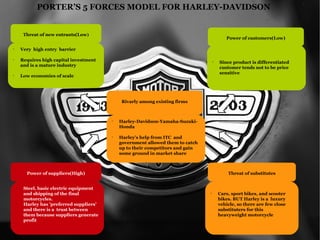
PORTER’S 5 FORCES MODEL FOR HARLEY-DAVIDSON

Threat of new entrants(Low)

Power of customers(Low)

Very high entry barrier

§

Requires high capital investment
and is a mature industry

§

§

Low economies of scale

§

Since product is differentiated
customer tends not to be price
sensitive

Rivarly among existing firms

§

§

Harley-Davidson-Yamaha-SuzukiHonda
Harley’s help from ITC and
government allowed them to catch
up to their competitors and gain
some ground in market share

Power of suppliers(High)

§

§

Steel, basic electric equipment
and shipping of the final
motorcycles.
Harley has ’preferred suppliers’
and there is a trust between
them because suppliers generate
profit

Threat of substitutes

§

Cars, sport bikes, and scooter
bikes. BUT Harley is a luxury
vehicle, so there are few close
substituters for this
heavyweight motorcycle
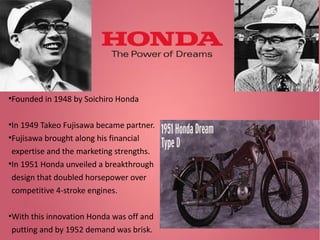
Founded in 1948 by Soichiro Honda

●

In 1949 Takeo Fujisawa became partner.
●
Fujisawa brought along his financial
expertise and the marketing strengths.
●
In 1951 Honda unveiled a breakthrough
design that doubled horsepower over
competitive 4-stroke engines.
●

With this innovation Honda was off and
putting and by 1952 demand was brisk.

●
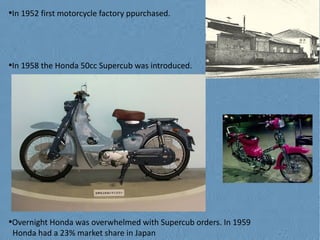
In 1952 first motorcycle factory ppurchased.

●

In 1958 the Honda 50cc Supercub was introduced.

●

Overnight Honda was overwhelmed with Supercub orders. In 1959
Honda had a 23% market share in Japan

●
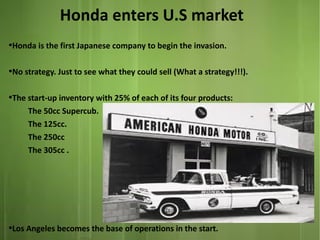
Honda enters U.S market
●

Honda is the first Japanese company to begin the invasion.

●

No strategy. Just to see what they could sell (What a strategy!!!).

●

●

The start-up inventory with 25% of each of its four products:
The 50cc Supercub.
The 125cc.
The 250cc
The 305cc .

Los Angeles becomes the base of operations in the start.
●

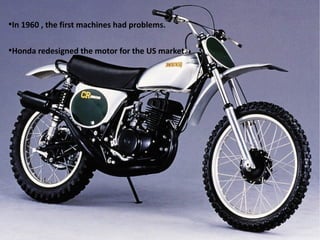
In 1960 , the first machines had problems.

●

Honda redesigned the motor for the US market.
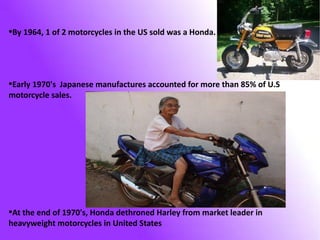
By 1964, 1 of 2 motorcycles in the US sold was a Honda.

●

Early 1970's Japanese manufactures accounted for more than 85% of U.S
motorcycle sales.
●

At the end of 1970's, Honda dethroned Harley from market leader in
heavyweight motorcycles in United States
●
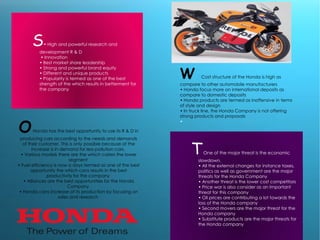
S

• High and powerful research and

development R & D 
• Innovation 
• Best market share leadership 
• Strong and powerful brand equity 
• Different and unique products  
• Popularity is termed as one of the best
strength of the which results in betterment for
the company

O

W

Cost structure of the Honda is high as

compare to other automobile manufacturers 
• Honda focus more on international deposits as
compare to domestic deposits  
• Honda products are termed as inoffensive in terms
of style and design 
• In truck line, the Honda Company is not offering
strong products and proposals
•

Honda has the best opportunity to use its R & D in

producing cars according to the needs and demands
of their customer. This is only possible because of the
increase is in demand for less pollution cars. 
• Various models there are the which caters the lower
segment 
• Fuel efficiency is now a days termed as one of the best
opportunity the which cans results in the best
productivity for the company 
• Alliances are the best opportunities for the Honda
Company 
• Honda cans increase of its production by focusing on
sales and research 

T

One of the major threat is the economic

slowdown.
• All the external changes for instance taxes,
politics as well as government are the major
threats for the Honda Company 
• Another threat is the lower cost competitors 
• Price war is also consider as an Important
threat for this company 
• Oil prices are contributing a lot towards the
loss of the Honda company 
• Second movers are the major threat for the
Honda company 
• Substitute products are the major threats for
the Honda company 
Thank you .!.

Harley VS Honda presentation

  • 1.
    VS. Course : BusinessStrategy Professor: Alexandros Papalexandris     Live free or die tryin' The Easy Riders: Andreou Anastasios Athanasiou Ioannis Kakavoulis Anastasios Kallis Nikolaos Mehta Arjun
  • 2.
  • 3.
  • 4.
    Harley-Davidson from birth tomaturity • By 1953 Harley is #1 American manufacturer of motorcycles. • In 1959, Honda entered the US market => rebirth of motorcycling in the US. • Japanese producers soon moved up-market in the heavyweight sector. • In 1969, Harley-Davidson was acquired by AMF. • End of 1970s Honda became the market leader in the heavyweight motorcycles in the US.
  • 5.
    Harley-Davidson rebirth In 1981,the then CEO , organized a leverage buyout. ● The new management team brought a revolution. ● US government imposed 49% temporary tariff. ● The 1990s saw year-on-year uninterrupted growth in the heavyweight motorcycle market and a continued increase in Harley’s market share. ●
  • 6.
    The Brand &The Product ● Harley Experience(individuality, freedom & adventure). ● HOG(1983) ● Harley VS. Competitors ● Personalization(engine types, gas tanks, frames, etc.).
  • 7.
    Distribution ● 620 U.S Dealerships. ● DealerDevelopment Program ● Demand greater than Supply
  • 8.
    International Expansion ● Brand Image& European market. ● Buell(1998) ● HOG's and Dealer's Development Program.
  • 9.
    People & Management ● Management& Employee Relationship ● Working Policies ● Organizational Structure
  • 10.
    PORTER’S 5 FORCESMODEL FOR HARLEY-DAVIDSON Threat of new entrants(Low) Power of customers(Low) Very high entry barrier § Requires high capital investment and is a mature industry § § Low economies of scale § Since product is differentiated customer tends not to be price sensitive Rivarly among existing firms § § Harley-Davidson-Yamaha-SuzukiHonda Harley’s help from ITC and government allowed them to catch up to their competitors and gain some ground in market share Power of suppliers(High) § § Steel, basic electric equipment and shipping of the final motorcycles. Harley has ’preferred suppliers’ and there is a trust between them because suppliers generate profit Threat of substitutes § Cars, sport bikes, and scooter bikes. BUT Harley is a luxury vehicle, so there are few close substituters for this heavyweight motorcycle
  • 11.
    Founded in 1948by Soichiro Honda ● In 1949 Takeo Fujisawa became partner. ● Fujisawa brought along his financial expertise and the marketing strengths. ● In 1951 Honda unveiled a breakthrough design that doubled horsepower over competitive 4-stroke engines. ● With this innovation Honda was off and putting and by 1952 demand was brisk. ●
  • 12.
    In 1952 firstmotorcycle factory ppurchased. ● In 1958 the Honda 50cc Supercub was introduced. ● Overnight Honda was overwhelmed with Supercub orders. In 1959 Honda had a 23% market share in Japan ●
  • 13.
    Honda enters U.Smarket ● Honda is the first Japanese company to begin the invasion. ● No strategy. Just to see what they could sell (What a strategy!!!). ● ● The start-up inventory with 25% of each of its four products: The 50cc Supercub. The 125cc. The 250cc The 305cc . Los Angeles becomes the base of operations in the start.
  • 14.
    ● In 1960 ,the first machines had problems. ● Honda redesigned the motor for the US market.
  • 16.
    By 1964, 1of 2 motorcycles in the US sold was a Honda. ● Early 1970's Japanese manufactures accounted for more than 85% of U.S motorcycle sales. ● At the end of 1970's, Honda dethroned Harley from market leader in heavyweight motorcycles in United States ●
  • 17.
    S • High andpowerful research and development R & D  • Innovation  • Best market share leadership  • Strong and powerful brand equity  • Different and unique products   • Popularity is termed as one of the best strength of the which results in betterment for the company O W Cost structure of the Honda is high as compare to other automobile manufacturers  • Honda focus more on international deposits as compare to domestic deposits   • Honda products are termed as inoffensive in terms of style and design  • In truck line, the Honda Company is not offering strong products and proposals • Honda has the best opportunity to use its R & D in producing cars according to the needs and demands of their customer. This is only possible because of the increase is in demand for less pollution cars.  • Various models there are the which caters the lower segment  • Fuel efficiency is now a days termed as one of the best opportunity the which cans results in the best productivity for the company  • Alliances are the best opportunities for the Honda Company  • Honda cans increase of its production by focusing on sales and research  T One of the major threat is the economic slowdown. • All the external changes for instance taxes, politics as well as government are the major threats for the Honda Company  • Another threat is the lower cost competitors  • Price war is also consider as an Important threat for this company  • Oil prices are contributing a lot towards the loss of the Honda company  • Second movers are the major threat for the Honda company  • Substitute products are the major threats for the Honda company 
  • 18.