TOTAL QUALITY
 MANAGEMENT
introduction
Honda Motor Company, Ltd is a Japanese public
multinational corporation primarily known as a
manufacturer of automobiles and motorcycles.
Honda has been the world's largest motorcycle
manufacturer since 1959, as well as the world's largest
manufacturer of internal combustion engines
 Honda surpassed Nissan in 2001 to become the
second-largest Japanese automobile manufacturer.
Honda is the sixth largest automobile manufacturer in
the world.
The company achieved the number one position among
all mass production cars sold in the USA
Type: Public company

Industry: Automotive, Aviation

Founded on 24 September 1948

Founder(s): Soichiro Honda, Takeo Fujisawa

Headquarters: Minato, Tokyo, Japan

Key people: Takanobu Ito (President, CEO, &
Representative Director)
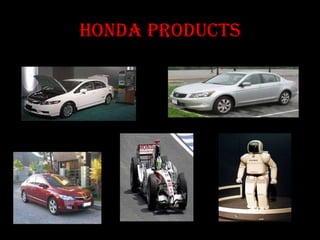
products
Automobiles,
Motorcycles
Scooters ,
ATVs,
 Electrical Generators,
 Water pumps,
Lawn and Garden Equipments ,
 Tillers,
Outboard motors,
Robotics,
Jets,
Jet Engines,
Thin-film solar cells
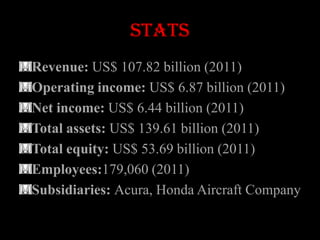
stats
Revenue: US$ 107.82 billion (2011)
Operating income: US$ 6.87 billion (2011)
Net income: US$ 6.44 billion (2011)
Total assets: US$ 139.61 billion (2011)
Total equity: US$ 53.69 billion (2011)
Employees:179,060 (2011)
Subsidiaries: Acura, Honda Aircraft Company
Current market position
With high fuel prices and a weak U.S. economy in June
2008, Honda reported a 1% sales increase while its rivals, including
the Detroit Big Three and Toyota, have reported double-digit losses.
Honda's sales were up almost 20 percent from the same month last
year. The Civic and the Accord were in the top five list of sales.
 Analysts have attributed this to two main factors. First, Honda's
product lineup consists of mostly small to mid-size, highly fuel-
efficient vehicles.
 Secondly, over the last ten years, Honda has designed its factories
to be flexible, in that they can be easily retooled to produce any
Honda model that may be in-demand at the moment.
At the 2008 Beijing Auto Show, Honda announced that they were
looking to develop an entry-level brand exclusively for the Chinese
market similar to Toyota's Scion brand in the USA
Cutting-edge technology
  Their fundamental design philosophy seeks to maximise
  space and comfort for people, while minimising the space
  required for mechanical components. With this aim in
  mind, Honda's R&D activities include product-specific
  development and fundamental research.

  Some of the technologies include,
 Combi Break System
 HondaMatic Transmission
 Fuel Injection System
 Idle Stop System
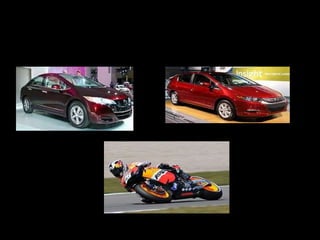
 Honda Fuel Cell Vehicle, Honda FCX
Management policy
Honda works to ensure that the products and
services result in 3 joys:

Joy for people who buy them.
Joy for those who sell them and
Joy for people who produce them.
QUALITY OBJECTIVE
Maintain an international viewpoint , we are
dedicated to supplying products of the highest
efficiency yet at a reasonable price for
worldwide customer satisfaction.
Honda products
TOTAL QUALITY MANAGEMENT
Total quality management or TQM is an integrative
philosophy of management for continuously improving
the quality of products and processes.
TQM functions on the premise that the quality of
products and processes is the responsibility of everyone
who is involved with the creation or consumption of the
products or services offered by an organization.
In other words, TQM capitalizes on the involvement of
management, workforce, suppliers, and even
customers, in order to meet or exceed customer
expectations
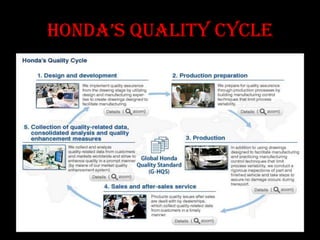
Honda’s quality cycle
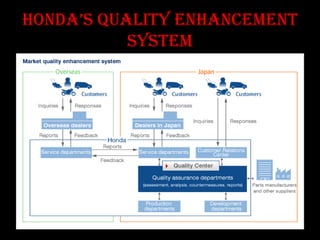
Honda’s quality enHancement
           system
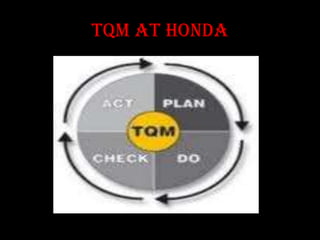
TQM AT HONDA
TQM METHODOLOGY AT HONDA
To implement TQM, the CEO has strengthened :
  Customer focused viewpoint.
  Increased efficiency.
  Cost cutting efforts.
  Delegation of authority.
  Expediting daily operations.
  New product development.
PDCA CYCLE
Basic principle of TQM is to bridge the gap
between ―Target‖ and ―Status quo‖.
PDCA cycle to bridge the gap :
Make initial plan.
Implement the plan.
Analyse the outcome.
Recognise new problems and improve the
process of operation.
Repeat process till target is achieved.
Implementing quality
   management education
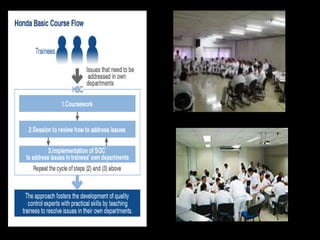
In Japan, Honda offers a training curriculum
divided into four courses according to in-house
qualifications and the extent of individual
workers' quality control responsibilities in order
to improve associates' quality assurance skills.

The Honda QC Basic Course (HBC), which was
first offered 40 years ago, provides an example of
how Honda is working to train its personnel to be
leaders in improving quality.
CONCLUSION
Honda operates a TQM system. Its philosophy is to push quality
back to the supplier, expecting the products to arrive defect free to
Honda’s defined level. But this won’t ever stop the company from
checking.

―With the tolerances and the complexity of some of the
components, we’ve found that some suppliers are not always able to
guarantee meeting our specs – so we rely heavily on inspection. For
the more critical components, particularly safety critical
components, we carry out 100% inspection,‖ says Honda.

Operations Director, Professor Gary Savage, adds: ―Last season
Honda recorded zero stoppages due to reliability of the chassis. The
TQM system clearly contributed significantly to this. Our aim now
is to maintain this record as we move forward – and the system and
processes will develop in order to facilitate this aim.‖
TOKYO—Honda Motor Co. said it would voluntarily
recall 962,000 cars world-wide to repair problems with
power window.

The car maker said no serious injuries or fatal accidents
have been reported as a result of the problems. The
company estimated it would spend ¥1.29 billion ($16.8
million) in Japan for the recall.

Honda, Japan's third-biggest car maker by
volume, recalled more than 2.3 million vehicles in early
August, citing problems with automatic transmissions.
A Honda spokeswoman said there were nine reported
cases of vehicles catching on fire in Japan and China
because of the power-window problem. She also said
two people reported light burns after touching
overheated switches.

Honda presentation

  • 1.
  • 2.
    introduction Honda Motor Company,Ltd is a Japanese public multinational corporation primarily known as a manufacturer of automobiles and motorcycles. Honda has been the world's largest motorcycle manufacturer since 1959, as well as the world's largest manufacturer of internal combustion engines Honda surpassed Nissan in 2001 to become the second-largest Japanese automobile manufacturer. Honda is the sixth largest automobile manufacturer in the world. The company achieved the number one position among all mass production cars sold in the USA
  • 3.
    Type: Public company Industry:Automotive, Aviation Founded on 24 September 1948 Founder(s): Soichiro Honda, Takeo Fujisawa Headquarters: Minato, Tokyo, Japan Key people: Takanobu Ito (President, CEO, & Representative Director)
  • 4.
    products Automobiles, Motorcycles Scooters , ATVs, ElectricalGenerators, Water pumps, Lawn and Garden Equipments , Tillers, Outboard motors, Robotics, Jets, Jet Engines, Thin-film solar cells
  • 5.
    stats Revenue: US$ 107.82billion (2011) Operating income: US$ 6.87 billion (2011) Net income: US$ 6.44 billion (2011) Total assets: US$ 139.61 billion (2011) Total equity: US$ 53.69 billion (2011) Employees:179,060 (2011) Subsidiaries: Acura, Honda Aircraft Company
  • 6.
    Current market position Withhigh fuel prices and a weak U.S. economy in June 2008, Honda reported a 1% sales increase while its rivals, including the Detroit Big Three and Toyota, have reported double-digit losses. Honda's sales were up almost 20 percent from the same month last year. The Civic and the Accord were in the top five list of sales. Analysts have attributed this to two main factors. First, Honda's product lineup consists of mostly small to mid-size, highly fuel- efficient vehicles. Secondly, over the last ten years, Honda has designed its factories to be flexible, in that they can be easily retooled to produce any Honda model that may be in-demand at the moment. At the 2008 Beijing Auto Show, Honda announced that they were looking to develop an entry-level brand exclusively for the Chinese market similar to Toyota's Scion brand in the USA
  • 7.
    Cutting-edge technology Their fundamental design philosophy seeks to maximise space and comfort for people, while minimising the space required for mechanical components. With this aim in mind, Honda's R&D activities include product-specific development and fundamental research. Some of the technologies include,  Combi Break System  HondaMatic Transmission  Fuel Injection System  Idle Stop System  Honda Fuel Cell Vehicle, Honda FCX
  • 8.
    Management policy Honda worksto ensure that the products and services result in 3 joys: Joy for people who buy them. Joy for those who sell them and Joy for people who produce them.
  • 9.
    QUALITY OBJECTIVE Maintain aninternational viewpoint , we are dedicated to supplying products of the highest efficiency yet at a reasonable price for worldwide customer satisfaction.
  • 10.
  • 12.
    TOTAL QUALITY MANAGEMENT Totalquality management or TQM is an integrative philosophy of management for continuously improving the quality of products and processes. TQM functions on the premise that the quality of products and processes is the responsibility of everyone who is involved with the creation or consumption of the products or services offered by an organization. In other words, TQM capitalizes on the involvement of management, workforce, suppliers, and even customers, in order to meet or exceed customer expectations
  • 13.
  • 14.
  • 15.
  • 16.
    TQM METHODOLOGY ATHONDA To implement TQM, the CEO has strengthened : Customer focused viewpoint. Increased efficiency. Cost cutting efforts. Delegation of authority. Expediting daily operations. New product development.
  • 17.
    PDCA CYCLE Basic principleof TQM is to bridge the gap between ―Target‖ and ―Status quo‖. PDCA cycle to bridge the gap : Make initial plan. Implement the plan. Analyse the outcome. Recognise new problems and improve the process of operation. Repeat process till target is achieved.
  • 18.
    Implementing quality management education In Japan, Honda offers a training curriculum divided into four courses according to in-house qualifications and the extent of individual workers' quality control responsibilities in order to improve associates' quality assurance skills. The Honda QC Basic Course (HBC), which was first offered 40 years ago, provides an example of how Honda is working to train its personnel to be leaders in improving quality.
  • 20.
    CONCLUSION Honda operates aTQM system. Its philosophy is to push quality back to the supplier, expecting the products to arrive defect free to Honda’s defined level. But this won’t ever stop the company from checking. ―With the tolerances and the complexity of some of the components, we’ve found that some suppliers are not always able to guarantee meeting our specs – so we rely heavily on inspection. For the more critical components, particularly safety critical components, we carry out 100% inspection,‖ says Honda. Operations Director, Professor Gary Savage, adds: ―Last season Honda recorded zero stoppages due to reliability of the chassis. The TQM system clearly contributed significantly to this. Our aim now is to maintain this record as we move forward – and the system and processes will develop in order to facilitate this aim.‖
  • 21.
    TOKYO—Honda Motor Co.said it would voluntarily recall 962,000 cars world-wide to repair problems with power window. The car maker said no serious injuries or fatal accidents have been reported as a result of the problems. The company estimated it would spend ¥1.29 billion ($16.8 million) in Japan for the recall. Honda, Japan's third-biggest car maker by volume, recalled more than 2.3 million vehicles in early August, citing problems with automatic transmissions. A Honda spokeswoman said there were nine reported cases of vehicles catching on fire in Japan and China because of the power-window problem. She also said two people reported light burns after touching overheated switches.