CASE 14: Harley-Davidson: Strategic Competitiveness that
Spans Decades
Guriqbal Cheema
Joel Cunningham
Pallavi Daliparthi
John Klostermann
Brian Rabe
Texas A&M University
“It’s more than a brand. It’s a culture.”1
Kent Grayson
Professor of Marketing, Northwestern University
Introduction
Harley-Davidson is an American cultural and business icon on
the level of Levi Strauss and Coca-Cola. Often imitated, but
never duplicated, Harley-Davidson has managed to survive, and
has, at times, thrived for many decades. Through depression,
recessions, world wars, high technology developments, Japanese
competition, and increasing government regulation, Harley-
Davidson has maintained operations where over a dozen other
U.S. motorcycle firms have failed. Harley-Davidson has even
survived over a decade as a subsidiary of a bowling alley
service firm. It has achieved this by essentially relying on
designing, manufacturing, selling, and servicing a relatively
static product: two wheels, a 45° V-Twin engine, and a set of
handlebars.
How has Harley-Davidson managed to survive through these
and other hardships in a motorcycle market that is dominated by
leisure riders? How has it kept the doors open while its historic
U.S. rival, Indian Motorcycles, is currently in its fourth
incarnation? How has it maintained its attractiveness with
outlaw bikers, investment bankers, and those who appear to be
experiencing a “mid-life crisis” and who sometimes turn to the
firm’s products as a result? More importantly, what is this firm
selling that keeps it as the industry leader in full-size
motorcycles? The answer to these questions is not a 526-pound
batch of steel with 250 feet of wiring, but rather the fact that
Harley-Davidson is selling the American dream of freedom.
How it is able to do this is a fascinating story.
The Challenge
With over 6,000 employees, 1,400 franchises, and nine
production facilities, Harley-Davidson has managed to survive
the economic downturn that was in full force in late 2007 and
for the next few years; but the firm is not out of the woods yet.
In fact, Harley-Davidson is struggling with three pivotal issues,
the first of which is that the firm’s products are viewed as
leisure items. The other two issues are similar in nature in that
they deal with the fact that managing the firm’s target market is
challenging, particularly as demand for its products is changing.
Individually and collectively these issues pose a real challenge
to the company’s long-term success. Without addressing these
issues, Harley-Davidson may lose its ability to create value for
customers and to serve stakeholders’ needs as a result.
As noted, the first issue Harley-Davidson must successfully
address is the fact that consumers see the firm’s products
primarily as leisure items. This means that in many consumers’
eyes, purchasing motorcycles, performance parts, and high-
dollar apparel is a luxury rather than a necessity. Because of
this, Harley’s products must compete for funds from what at
least sometimes can be volatile discretionary budgets for
consumers. When economic conditions are challenging, the
motorcycle market tends to experience difficulties in terms of
generating adequate sales. While Harley-Davidson’s revenue
streams originate from several sources, very few of them appeal
to a cost-sensitive consumer base.
© Vividfour / Shutterstock.com
Second, Harley-Davidson is challenged to effectively specify its
target market as a first step to appropriately serving that
market’s needs. Historically, the firm’s target market has been
males between the ages of 29 and 55. However, in the last
decade, Harley-Davidson has pursued younger riders and
women as a means of expanding its target customer segments.
But expanding the segments the firm serves with its products is
not a risk-free decision or choice for the firm to make in that
serving others might cause the firm to lose its ability to
effectively serve the specific needs of the 29- to 55-year-old
male (again, the historical target customer). This matter is
considered more fully later in the case.
Third, demands and cost drivers for the motorcycle market are
ever changing. Overseas competitors have shifted their focus
from being the least expensive to being affordable and to
providing a wider variety of motorcycles to customers as
options to purchase. This competitive shift has put pressure on
Harley-Davidson’s key markets and has forced the firm to
respond. With over 12 percent and 55 percent of the European
and U.S. heavyweight motorcycle market respectively, Harley-
Davidson has a substantial territory to defend.
History.2
Harley-Davidson, Inc. has been a publicly traded firm since
1987. It has two primary divisions: Motorcycles and Related
Products and Financial Services. The Financial Services
Division provides credit to motorcycle buyers and dealerships
as well as risk management and insurance services for all parts
of the firm. The Motorcycles and Related Products Division
currently operates through eight primary segments:
· Parts & Accessories (17.5 percent of net revenue in 2011)
· General Merchandise (5.9 percent of net revenue in 2011)
· Licensing ($43.2 million of net revenue in 2011)
· Harley-Davidson Museum
· International Sales (32 percent of net motorcycle revenue in
2011)
· Patents and Trademarks
· Other Services
· Marketing
In 1903, William S. Harley and Arthur Davidson founded
Harley-Davidson Motor Company, known by enthusiasts as “the
Motor Company,” in order to fund their racing pursuits.
Accordingly, their first motorcycles were merely contemporary
bicycles with small engines retrofitted to the frame. It was
Harley-Davidson’s early success in motorcycle racing that
fueled the demand for its early models, which were sold in
dealerships as early as 1904. Because these turn of the century
races were as much about endurance as speed, Harley-Davidson
acquired invaluable knowledge pertinent to practicality and
robust design. After significant success in road and endurance
races, Harley-Davidson broke fresh ground with the
introduction of the V-Twin engine design. Superior to large
single-cylinder engines, the lighter V-Twin design allowed
similar displacement in a lighter package with a shape that fit
naturally into the bicycle-inspired frames of the early 1900s.
Few suspected that this design would become so integral to
modern motorcycles.
Having dedicated over a third of its production to the U.S.
Army, Harley-Davidson sales exploded during World War I.
With the advent of motorized warfare, the motorcycle proved
itself to be far more than just a novel invention. In addition to
proving itself to the Army, Harley-Davidson also proved itself
to soldiers. After the war, soldiers returned home and became a
loyal customer base for the young firm. Through the 1920s,
Harley-Davidson continued to focus on design improvement and
racing. It spent much of this decade fighting for market share
with multiple medium and small competitors. During this time,
firms producing automobiles, airplanes, bicycles, and industrial
machinery also tried their hand at building motorcycles.
The 1930s were a unique time for the motorcycle industry. In
the wake of the Great Depression, the public was looking for
inexpensive, simple transportation. At the same time,
unemployment and inflation shrank potential customers’
purchasing power. It was during this time that many of the
smaller motorcycle manufacturers dropped out of the industry.
Most of these firms were subsidiaries of companies in related
industries. These failed motorcycle firms had many of the
capabilities needed to produce motorcycles, but lacked the
corporate focus and support to continue production during such
a difficult economic time. It was during this time that the U.S.
domestic market shrank, with only Indian and Harley-Davidson
remaining. With the market divided between only two domestic
producers, Harley-Davidson’s production held steady.
With the onset of World War II, Harley-Davidson found itself to
be a major supplier for the Allied war effort. Again, war vaulted
Harley-Davidson into a position of higher volume, improved
reputation, and deeper loyalty with owners and soldiers. As the
war came to an end, the United States was flooded with a
surplus of Army WL45 motorcycles. Suddenly, this country was
full of prospective riders who understood Harley-
Davidson’s product and appreciated how motorcycles could
provide inexpensive, dependable transportation. At this point,
only Indian Motorcycles was a competitor for Harley-Davidson.
But in 1956, at the height of an economic recession, Indian
Motorcycles declared bankruptcy and stopped producing
motorcycles altogether, leaving only Harley as a major producer
and seller of motorcycles.
As the sole U.S.-based motorcycle power, Harley-Davidson
enjoyed great success. Nevertheless, the lack of competition
nearly became its undoing. This market condition allowed
Harley-Davidson to take more risk in the form of acquisitions,
causing the firm to lose its tight focus on a single market. It
began branching out to other leisure and motorized products
such as off-road motorcycles, ski boats, and golf carts. At the
same time, the bulk of Harley-Davidson’s revenue stream was
still coming from the sale of its heavy motorcycles. Many of the
acquisitions the firm completed in the latter part of the 1950s
and the early 1960s, such as the Tomahawk Boat Manufacturing
Company in 1962, were in similar industries, but a poor fit with
Harley nonetheless. The acquired companies were often in deep
trouble when Harley-Davidson purchased them. In the end,
Harley-Davidson was hobbled with losing ventures that diluted
its focus and did not fit well with its core competencies. In
1969, the American Machine and Foundry Company (AMF – a
longtime producer of leisure products such as tile bowling pins
and ball returns) purchased the financially distressed Harley-
Davidson.3
Most enthusiasts consider the AMF years as the “dark ages” of
Harley-Davidson’s history. AMF operated Harley-Davidson as a
profit center, reducing allocations to the unit’s marketing and
research and development (R&D) functions as a result. For the
next 13 years, Harley’s aging product line remained essentially
unchanged. In fact, its line was so static over the years that
many of the parts from a 1937 model fit on the 1969 design.
Harley-Davidson had just two motorcycles with different trim
packages: the low-budget sportster, the sport bike of its day,
and a full-size motorcycle available in two different models. In
light of Honda and Kawasaki’s entrance into the U.S. market,
Harley-Davidson’s stale product line was even more
disappointing. Many did not see these imports as a threat given
the prestige and heritage of the Harley-Davidson name.
However, the Harley-Davidson image was deteriorating. Even
with its products in desperate need of a facelift, AMF relied on
Harley-Davidson’s reputation to defend its competitive
position; AMF plastered Harley-Davidson’s name on products
like snowmobiles and golf carts. While trying to capitalize on
the value of Harley-Davidson’s brand name, quality became a
serious problem; customers would have to return new
motorcycles to a dealership multiple times to fix manufacturing
problems. It was during this time that owners coined the saying
“a Harley always marks its spot,” a phrase referring to the
machine’s nearly universal oil leaks. This turned off many
prospective customers, as they believed a Harley-Davidson
would require constant owner maintenance. All the while,
Japanese motorcycle companies enticed more and more riders
looking for inexpensive, dependable transportation.
By 1981, Japanese motorcycles were established in the U.S.
market not only as dependable transportation, but also as
performance machines. Harley-Davidson’s sales were in free-
fall as its tired designs appealed to a narrowing market segment.
It was selling to customers who liked classic style and dated
functionality, and all for a high price. Finally, the employees
and management of Harley-Davidson led a managed buyout of
the company from AMF.4 The new owners immediately took
stock of the firm’s strengths and vulnerabilities and increased
its R&D and marketing budgets significantly. Because negative
effects of AMF’s past business decisions still hampered the new
management team, sales remained low. In 1985, Harley-
Davidson’s top management team struggled to restructure the
firm and divested itself of most of its unrelated assets. In 1987,
Harley-Davidson became a publicly traded company, and none
too soon as Harley-Davidson had revamped its product line into
four motorcycle styles that were united by the introduction of a
new engine. This was the turning point for Harley-Davidson.
From this point forward, the firm’s quality control was
exponentially more effective. In addition, Harley-Davidson
focused more on efforts to operate efficiently and effectively.
Following the precepts of just-in-time techniques and
enhancement to the logistics function were critical to the firm’s
attempts to enhance efficiency and effectiveness. At the same
time, Harley shifted to three major initiatives:5
· Improved manufacturing process, leveraging technology,
robotics, and employee involvement
· Restructuring business management to a modern system
· Aggressive management of its brand name through dealership
management, patenting activities, and careful licensing of
related products
The modern Harley-Davidson fought back from the brink
several times, each time seeming to evolve and adapt. What
appears to be universal to each evolution of the company is that
quality, promotion, and market focus have always been a
priority.
How Harley Does It6
Harley-Davidson focuses on a subset of the motorcycle market
featuring customers who value heritage, style, reputation,
durability, and adaptability. Until 2000, Harley-Davidson’s
motorcycles sold at nearly a 25 percent premium. In the last
decade, that premium has dropped to 5 to 10 percent, depending
on the class of motorcycle. This is due to Japanese motorcycle
manufacturers shifting to marketing and selling somewhat
unique motorcycles for a better than average price. In
comparison, Harley-Davidson uses the Sportster© line as an
introductory product, but most of its motorcycles sell for over
$15,000, with the average sale price of just over
$16,893.7 Harley-Davidson motorcycles provide a unique
product at a price that its target customers deem acceptable or
reasonable. While its competitors may have attempted to cut
costs, Harley-Davidson has continued to invest in its products
in ways that protect the quality of its brand image. Harley-
Davidson’s market focus is primarily males between the ages of
29 and 55. However, this has been changing.8Recently, it has
targeted female customers.
What It Does Best9
In its modern incarnation (1987 to present), Harley-Davidson
achieved success by doing what it does best. Granted, multiple
firms make great motorcycles, and many of these firms have a
dedicated following. However, through the actions the firm has
taken over the years, Harley-Davidson has developed and
maintained what is a unique position in the U.S. motorcycle
market. Effectively managing its brand name, production or
manufacturing simplicity, and a dedicated product following are
the key sources of the firm’s competitive strength.
Harley-Davidson’s brand name is its most important asset.
Cultivated through good times and bad, its brand name is a
powerful motivator for current and prospective customers. For
many Americans, Harley-Davidson is the American motorcycle.
This belief is no accident. After being separated from AMF,
Harley-Davidson’s top management team decided to
significantly increase the amount of resources being allocated to
marketing and R&D. This appears to have been a wise decision
in that Harley-Davidson now holds 55 percent of the entire U.S.
motorcycle market, and an even higher share in the U.S. heavy
motorcycle market. Strict protection of its brand name
permeates every decision the firm makes. Its motorcycles, while
occasionally deviating in style, generally follow traditional
themes. Harley-Davidson only makes a design change after
witnessing a strong market trend.10 For example, the custom
portion of the motorcycle market has been designing machines
with wide rear tires for nearly two decades; in 2007, Harley-
Davidson launched a single model with a wide rear tire.
Harley-Davidson is also very selective about its franchise
(dealership) opportunities, another method through which the
firm protects its brand. Due to free-trade laws, Harley-Davidson
is no longer able to insist that its dealerships sell only Harley
products. However, it utilizes price incentives to encourage
dealerships to stay “Pure-Harley.”11 Harley-Davidson is
especially protective of its name and logo when it comes to
licensed products, most of which are sold in its dealerships. If it
is not the best quality, the product’s license is revoked.
Retailers can sell ladies’ shirts at a 100 percent premium
because they are of excellent quality and cannot be found
anywhere. This aura of exclusivity is embedded in the very
DNA of Harley-Davidson Inc., from the headquarters to the
dealerships. This aspect of culture is an asset in that the notion
of wanting to be seen as providing products that are somewhat
“exclusive” in nature permeates the firm’s decision processes as
it seeks to serve its target customers’ needs.
Harley-Davidson’s production process is another important
firm-specific asset. The key elements of the process are the
melding of a JIT supply chain with team production
management and part interchange-ability.12 When combined,
the elements of Harley’s production process are unique.
Japanese manufacturers have used the same JIT concept for
years, but have not stressed a limitation of key components.
After 1987, Harley-Davidson updated its production facilities
and design process. Its production facilities in Kansas City,
Missouri and York, Pennsylvania are the best examples of
modern robotics combined with team enablement.
Interchangeable parts are the most important component of this
asset. This concept simplifies all areas of the motorcycle
production process; but it is perhaps most evident in the
production of Harley’s frames and engines. Harley-Davidson
produces five unique frames for each motorcycle family:
Sportster©, Dyna, Softail©, V-Rod©, and Touring. Even with
28 different models and seemingly limitless options, Harley-
Davidson produces only three engines. Internal machining,
displacement, and color coating are the only differences across
the engines. The Sportster© line comes in two displacements:
883 and 1204 cubic inches. The Dyna, Softail©, and Touring
lines all share the same Twincam© engine, available in 96 and
103 cubic inches. The V-Rod’s© engine is only produced in one
version.13 This production approach with respect to
interchangeable parts appears to be a competitive advantage in
that it allows Harley to produce several models, subdividing its
target market segments even further, while keeping production
costs lower than if it produced 28 different frames and engines.
Loyalty to the brand is another important asset for Harley-
Davidson. While its brand name protection applies primarily to
prospective customers, its product following centers on existing
customers, many of whom are repeat buyers of the firm’s
products. There are multiple examples of Harley’s dedicated
following. At the extreme for example, consider the fact that
some private riding clubs only grant membership to those
willing to tattoo the bar and shield logo on multiple locations of
their body. For others, remaining committed to the firm’s
mantra that owning a Harley “is a journey, not a destination”
and participating in company-sponsored events with others
sharing this belief accounts for their loyalty. Regardless of the
reason for it, customer loyalty to the Harley brand appears to
influence these individuals to purchase Harley products other
than motorcycles such as clothing and a wide range of product
accessories. Historically, loyalty to the brand has resulted in a
large percentage of Harley customers choosing to buy another
Harley when it is time for a new motorcycle. However, the
“graying” of Harley’s customer base is potentially a problem as
at some point, this group of customers will no longer be
purchasing new products.14
Keeping It Simple15
In 2011, Harley-Davidson generated 88 percent of its revenues
from a single business area (Motorcycles and Related Products)
and 12 percent from its second primary segment (Financial
Services). This composition of sales revenue is consistent with
previous years and suggests that Harley may continue business
as usual to help the firm reduce its idiosyncratic risk. It will
also try to expand its business in other countries with a primary
focus on providing quality product and services. Harley-
Davidson has been able to earn positive returns while focusing
on just two businesses because it has developed strengths that
allow it to create value for customers. Moreover, there are
fewer challenges in managing only two businesses. This
approach allows Harley-Davidson to not only gain economies of
scale, but also use its resources efficiently.
Marketing
Historically, males between the ages of 29 and 55 have been
Harley-Davidson’s target customer. However, this is
changing.16 Recently for example, the firm is also targeting
female customers with motorcycle models that have a lower seat
height and pink, purple, and light blue color schemes. Its
marketing has also reflected an effort to attract more female
riders. It has even tailored its riding classes (the Riders Edge
Program©) to have all-female sessions and to make new women
riders feel more comfortable. A woman could walk into a
Harley-Davidson dealership having never sat on a motorcycle
and within an hour purchase a motorcycle for as little as $8,000.
She could then join a riding class that would grant a motorcycle
endorsement on her driver’s license.
Thus, Harley-Davidson is beginning to market to a multi-
generational and multi-cultural audience. In this regard, the
firm is working to attract a more diversified audience in terms
of age, gender, and ethnicity.17 Harley-Davidson is a market
leader in the U.S. heavyweight segment. The average median
household income of a Harley-Davidson purchaser is
$89,000.18 Harley-Davidson primarily uses advertising and
promotional activities via television, print, radio, direct
mailings, electronic advertising, and social media to market its
product. Moreover, local marketing efforts in conjunction with
dealers are highly encouraged. Harley-Davidson uses its
customers’ experience to continuously develop and introduce
innovative products. The market is flooded with high quality,
low price Japanese bikes. However, Harley-Davidson does not
seek to imitate these bikes. Instead, it uses direct input from its
customers to improve its product. Harley-Davidson modifies its
product based on input generated through customer surveys,
interviews, and focus groups. Thus, some believe that “The real
power of Harley-Davidson is the power to market to consumers
who love the product.”19
In 2010, the company introduced “Creative Model” – a Web-
based method for marketing its product. In this model,
passionate fans are enabled for the purpose of helping Harley
develop creative approaches for targeting new customers.
Customer experience has traditionally been the main source of
Harley-Davidson’s marketing strategy. It all started in 1983,
when the company introduced Harley Owners Group
(H.O.G),20 which has now grown to more than 1 million
members worldwide.21
Harley-Davidson distributes its products through an independent
dealer network that almost exclusively sells Harley-Davidson
motorcycles. These dealerships are licensed dealers and fully
authorized to sell and service new motorcycles. They can have
secondary locations to provide additional service to the
customers. These non-traditional outlets are an extension of the
main dealership and consist of Alternate Retail Outlets (ARO)
and Seasonal Retail Outlets (SRO). AROs aregenerally located
in high traffic areas such as airports, vacation destinations,
tourism spots, and malls and only sell parts, accessories, and
general merchandise. SROs are also located in high traffic
areas, but operate only on a seasonal basis. AROs and SROs are
not allowed to sell new motorcycles. The parts and apparel
orders from the dealer are not taken at face value. Harley-
Davidson’s forward-looking, market-driven allocation system
restricts the number of units a particular dealer is able to order.
In Canada, the company sells its products to one wholesale
dealer, Deeley Harley-Davidson Canada/Fred Deeley Imports
Ltd., which in turn sells to independent dealers.22
The European, the Middle Eastern and African (EMEA) region
is managed from regional headquarters in Oxford, England.
Harley-Davidson distributes its products through subsidiaries
located in Austria, Dubai, Czech Republic, France, Germany,
and Italy. In the EMEA region, Harley-Davidson distributes all
products sold to independent dealers through its subsidiaries
located in Austria, Czech Republic, United Arab Emirates,
France, Germany, Italy, South Africa, Spain, Switzerland,
Netherlands, Russia, and United Kingdom. A headquarters in
Singapore manages the Asia Pacific regions with the company
distributing its product to independent dealers in China, India,
Australia, and Japan. The rest of Asia Pacific is managed
through the U.S. operations.
Financial Services Segment
Harley believes that its Harley-Davidson Financial Services unit
(HDFS) provides sufficient financing to independent
distributors, dealers, and retail customers. HDFS provides
financing to dealers and retail customer’s in the U.S. and
Canada, but not in the EMEA, Asia-Pacific, and Latin America
regions, although these regions do have access to financing
through other financial services companies.
Competition
As is the case for many leisure and transportation industries, the
U.S. motorcycle market is extremely competitive. Currently,
Harley-Davidson competes with four classes of competitors
with each group competing in a different market and in different
ways. The four competing groups are commonly classified as
Metric Cruiser, Metric Sport, U.S. Cruisers, and Custom
Cruisers.
Metric Cruiser Competitors.
The industry uses the term Metric Cruiser to denote motorcycles
made outside the United States with traditional styling.
Traditional styling is commonly reflected through an exposed
engine and non-integrated body panels. Japanese motorcycle
makers such as Honda, Star (Yamaha), Suzuki, and Kawasaki
dominate these models. It is important to note that not all metric
cruiser competitors are considered to be heavy motorcycles
(over 650 cubic centimeter displacement). These competitors
compete with Harley-Davidson on price, but also use the
individual model’s unique features to garner a competitive
advantage. Honda introduced the Fury©,23 a regular production
chopper based on the 1300 VTX power plant in 2009. In 2004,
Kawasaki introduced the Vulcan©200024 with a 2,053 cubic
centimeter engine, the largest mass-produced V-Twin
motorcycle ever. Most of these competitor models of similar
size are comparable in features to Harley-Davidson models. The
presence of smaller competitor models forces Harley-Davidson
to keep entry-level models like the 883 cubic centimeter
Sportster©. Smaller metric cruisers like the Suzuki Boulevard
40©, retailing at $2,600 less25 than Harley-Davidson’s least
expensive model, keep downward pressure on introductory
model prices.
Metric Sport Competitors.
Metric Sport motorcycles are made outside the United States,
mostly in Japan, and are race-inspired, high performance
motorcycles with full body panels and excellent aerodynamic
characteristics. Motorcycles like the Suzuki Hayabusa© and the
Kawasaki Ninja© are examples of this competitor class. While
these motorcycles do not directly compete with most Harley-
Davidson models, they do appeal to younger prospective
customers because of their breathtaking performance and
relatively low prices. In general, metric sport customers are not
attracted to most Harley-Davidson models.
Harley-Davidson has taken two key actions to attract young,
performance-oriented riders from its sport motorcycle
competitors. It introduced the V-Rod© line in 2002 with a high
performance, liquid-cooled motor. Harley-Davidson also
purchased Buell,26 a sport motorcycle company using Harley-
Davidson motors, in 1993. In 2003, Buell sport motorcycles
became a full subsidiary with its models being sold through
Harley-Davidson dealerships. Neither of these actions has
resonated with the younger riders Harley sought to reach by
taking them. As a result, Harley-Davidson opted to discontinue
Buell in 2009 after slumping sales.27 The V-Rod© still exists,
but with a median price tag of $15,300 it has not done much to
lower the age of the average Harley-Davidson rider.
U.S. Cruiser Competitors.
Victory Motorcycles and Indian Motorcycle are the only U.S.
Cruiser style motorcycle manufacturers. Victory, a subsidiary of
Polaris and a relative newcomer to the motorcycle market,
started production in 1998.28 Polaris is best known for its high
quality all-terrain vehicles and personal watercraft. In the last
five years, Victory models have been selling at prices more
closely comparable with Harley-Davidson. At the same time,
Victory increased the number of models and styles; it even
brought in famous motorcycle customizers Arlen and Corey
Ness29 to add style and street credibility to its entire product
line. In 2009, Indian Motorcycle began its fourth incarnation in
an effort to leverage its famous name and art-deco styling. After
a shaky start, Indian was recently purchased by Polaris. This
move is likely part of a strategy to position Victory and Indian
in separate parts of the U.S. motorcycle market and to fulfill the
needs of different types of customers. This approach is similar
to the strategy General Motors used for decades of offering
different products to different types of customers. The median
price for an Indian motorcycle is $28,000. Its current tag line is,
“Your great grandfather would be proud. Jealous, but
proud.”30Indian is targeting high-income earners with a love
for classic motorcycle styling.
Custom Cruiser Competitors.
This class of competitors is comprised of small and medium
firms that build highly customized motorcycles with large
displacement motors. Firms such as Big Dog
Motorcycles,31 Big Bear Choppers,32 and American IronHorse
are the dominant competitors in this space.33 These competitors
have become far less of an issue for Harley-Davidson since the
economic downturn of 2008. With their high levels of
customization, these competitors’ models come with a high
price tag. As their target market shrunk in the recession, these
firms thinned significantly; an estimated 60 percent have gone
out of business or changed their core function to components
production. Others, such as Darwin Motorcycles, now offer
custom motorcycles for as little as $18,600.34 These
competitors will always pose a threat to Harley-Davidson. They
force Harley-Davidson to continually innovate and customize its
product. It is ironic that most of these motorcycle manufacturers
use Harley-Davidson style or actual Harley-Davidson
components in their production.
Strategic Leaders
“No one can accurately predict the future. What I can predict
with the utmost confidence are the things that won’t change at
Harley-Davidson – namely, our commitment to providing more
great motorcycles; to enhancing the unparalleled Harley
lifestyle experience, and to continuing to provide excellent
financial performance.”
– Jeff Bleustein
Annual Report 199735
Although the strategic intent of Harley-Davidson has not
changed much since 1997, the way it operates and leads has
certainly adapted to reflect new ways of doing business.
Keith Wandell–Chairman and CEO.
When Keith Wandell joined Harley-Davidson in 2009, many
people were skeptical of his leadership due to his lack of
motorcycle experience. However, his fresh perspective has
allowed Wandell the opportunities and relationships needed to
steer the company toward a sales gain for the first time in
nearly five years. Wandell attributes this success to his dear
colleague and now CEO at Ford, Alan Mulally. Wandell took
some tough measures such as cutting labor contracts, closing
plants, and overall “trimming the fat.”36 He has sold old
investments and is trying to making Harley-Davidson more
attractive to women and the younger generation. And, of course,
Wandell is now an avid Harley-Davidson rider.
Executive Suite.
Each member of the C-suite is highly qualified for his role.
Each leader serves multiple roles within the organization and is
an individual contributor as well as a team leader.37 The CFO
and Senior VP, John A. Olin, joined Harley-Davidson in May
2009 with over 25 years of leadership experience in finance.
President and COO of Buell Motorcycle Company, Jon R.
Flickinger, has grown within Harley-Davidson where he began
his leadership role as a Director of Field Operations in January
1995. With over 30 years of experience in the commercial
finance industry, it is appropriate that Lawrence G. Hund should
serve as the President and COO of the Harley-Davidson
Financial Services division. At 46, nearly 10 years younger than
the other executive members, President and COO of Harley-
Davidson Motor Company, Matthew S. Levatich, has made
significant contributions at Harley-Davidson for the past 15
years.
Board of Directors.
Each member of Harley-Davidson’s board brings different
experiences to the boardroom. This eclectic set of experiences
facilitates the firm’s efforts to position itself in the ever-
growing market of the motorcycle business. Information
regarding the age, title, and other boards each member serves on
is provided in Exhibit 1.
Exhibit 1: Board of Directors
Board Member
Age
Title
Other Boards
Barry K. Allen
62
Senior Advisor to Providence Equity Partners President, Allen
Enterprises, LLC
Fiduciary Management
BCE Inc.
John Anderson
60
Former President and CEO, Levi Strauss & Co.
Richard L. Beattie
71
Chairman of Simpson Thacher & Bartlett LLP
Heidrick & Struggles International Inc.
Evercore Partners Inc.
Martha F. Brooks
51
Former President and COO, Novelis Inc.
Bombardier Inc.
George H. Conrades
73
Chairman, Akamai Technologies, Inc.
Akamai Technologies, Inc.
Oracle Corporation
Ironwood Pharmaceuticals, Inc.
Donald A. James
67
Co-founder, equity owner, Chairman and CEO of Deeley
Harley-Davidson Canada/Fred Deeley Imports Ltd.
Sara L. Levinson
60
Former Non-Executive Chairman of ClubMom, Inc.
Macy’s Inc.
Thomas Linebarger
48
Chairman and CEO, Cummins Inc.
Cummins Inc.
George L. Miles Jr.
69
Executive Chair, Chester Engineers, Inc.
American International Group Inc.
EQT Corporation
HFF, Inc.
WESCO International, Inc.
James A. Norling
69
Chairman of the Board, GlobalFoundries Inc.
Keith Wandell
60
Chairman, President and CEO, Harley-Davidson, Inc.
Constellation Brands, Inc.
Dana Holding Corporation
Jochen Zeitz
48
Chairman of PUMA CEO of PPR Sport & Lifestyle Group and
Chief Security Officer of PPR
Puma AG PPR
Source: Harley-Davidson Inc (HOG: New York). Insiders at
Harley Davidson Inc. Bloomberg
Businessweek.http://investing.businessweek.com/research/stock
s/people/board.asp?ticker=HOG.
The current size of the Harley-Davidson board is slightly large
when compared to the advised board size of six to
seven.38 However, each member brings significant diversity
and experience to the board meetings.
Richard Beattie provides Harley-Davidson with several years of
legal and military experience. His background helps Harley-
Davidson deal with any corporate law or governance issues.
Barry Allen serves the role of financial advisor at Harley-
Davidson as well as that of a decision-maker at other
corporations. Other board members incorporate their knowledge
from the financial, retail, and technological boards they serve
on to help the company gain strategic competitiveness in the
industry.
International Growth
Any discussion of Harley-Davidson’s future would not be
complete without examining its expansion into India and China,
the two BRIC economies with a strong history of motorcycle
ownership and enough income growth to ensure viable target
markets.39 After all, moving from Harley-Davidson’s current
position of 32 percent of revenue from international sales to its
stated goal of 40 percent by 201440,41 will be challenging.
Doing so will require a delicate balance in order to maintain the
ethos of Harley-Davidson while simultaneously adapting to
local customs and consumer preferences. Nevertheless, it could
be argued that Harley-Davidson is already well on its way in
this regard.
For example, just four months after officially entering the
Indian market in July 2010, Harley announced it would build an
assembly plant in northern India in order to reduce import
tariffs by as much as 80 percent.42 Previously, high tariffs
resulted in its models costing twice as much as their U.S.
equivalents.43 By only assembling the motorcycles in India,
Harley-Davidson is able to satisfy the desire of its customers in
India to purchase an “American” motorcycle by sourcing all the
parts from the United States while significantly increasing its
competitive position through lower pricing.
Time will be required to see if Harley-Davidson’s approach in
India will achieve the success the firm seeks. Indeed, Harley-
Davidson sold only about 1,000 bikes in India in its first 18
months of operations.44 This level of sales should be
considered though within the context of the fact that Harley’s
local assembly plant in India has only been operational for the
past 12 months.45Accordingly, the Indian market has not been
exposed to the lower pricing model for very long and may need
some time to overcome the stigma associated with previously
higher prices. For example a mid-level bike used to cost
$27,000, prior to tariff reduction; now, the cost of this product
is around $20,000.46, 47 These prices, while still high by local
standards, show that Harley-Davidson is making a concerted
effort to cater to the needs of customers located in developing
countries. Such a strategy is essential for long-term viability
given global growth trends and the inevitable shift of income
away from Harley-Davidson’s more traditional western markets.
In response to such growth, it has even committed to opening
dealerships in cities like Jaipur and Kochi – cities outside the
larger Indian metropolises.48 In this manner, Harley-Davidson
will be able to appeal to India’s rural landowners who would
like to ride Harley-Davidson’s in the countryside.49
Unfortunately, Harley-Davidson’s venture into China, the
world’s largest motorcycle market, has been less smooth and
illustrates what can happen when a company enters a foreign
market without sufficient background preparation. For example,
China currently restricts the use of motorcycles on elevated
highways and major thoroughfares in about 100 cities.50 Import
duties can also add as much as 30 percent to the price of a
Harley-Davidson, resulting in high-end models costing the
equivalent of a luxury sedan such as the Audi A4.51 Perhaps
more troubling is the admission by most in China that
motorcycles are associated with utilitarian tasks like
transportation to work, not leisure riding as is the case in
developed economies such as the United States.52 These
realities increase the difficulty Harley-Davidson faces as the
firm seeks to establish the level of success in China that is
similar to what the firm has been able to accomplish in India.53
Regulation
Safety must always be at the forefront of Harley-Davidson’s
mind to avoid any unwanted attention. For example, when
taking Harley-Davidson’s “Rider’s Edge” operation courses, all
riders are required to wear protective gear, including a helmet,
that meets Department of Transportation (DOT)
regulations.54 Skeptics might say that Harley-Davidson is
merely trying to minimize its liability. However, most would
agree that increased injury rates from not wearing protective
gear only serve to vilify motorcycle use. Indeed, Harley-
Davidson even periodically issues communications to its
customers encouraging riders to check the condition of their
helmets.55 Still, motorcycle riders in general have been
affected by the recent loosening of helmet laws throughout the
United States. “Two decades ago, 47 states required helmets for
all riders. Today, 20 do. Twenty-seven states require helmets
only for younger riders. Three — Illinois, Iowa and New
Hampshire — don’t require helmets at all.”56 Another safety-
related concern is the fact that “in 1996, 5.6 motorcyclists were
killed for every 10,000 registered motorcycles,” according to
DOT statistics. However, by 2006, the most recent data
available, the rate had risen to 7.3…”57 To be fair, such a study
does not prove causality. Still, such studies can bring unwanted
negative attention to the motorcycle industry and reinforce
cultural stereotypes that motorcycle riders are risk-seeking
freewheelers. To make its motorcycles appealing to a broader
target market, Harley-Davidson must continue to espouse a
culture of safety,58 even in the face of decreasing safety
regulations.
New EPA emission regulations could also affect Harley-
Davidson’s growth. Still, the last revision of motorcycle
emission standards in 2003 did little to alter Harley-Davidson’s
growth trajectory and prompted the following promise.
Jim McCaslin, President of Harley-Davidson Motor Company,
has stated that Harley-Davidson “plans to meet the requirements
of the proposed EPA standards and still make the motorcycles
true to the look, sound, and feel that you know and love” and
that “the air-cooled V-Twin will continue to be the core of the
Harley-Davidson motorcycle lineup for many years to come.”59
The latter was especially welcome news to Harley-Davidson
purists, but nevertheless is indicative of the regulation
challenges facing Harley-Davidson’s predominately air-cooled
(as opposed to cleaner burning water-cooled) engines. If
Harley-Davidson wishes to continue to operate in an
increasingly environmentally sensitive market, it must continue
to hone its ability to meet stricter pollutant regulations.
Financial Analysis
Harley-Davidson is currently climbing its way out of what were
likely the worst financial times the company had faced since its
inception in 1903. It peaked with nearly $6.2 billion in revenue
in 2006, and then witnessed its revenue fall nearly 30 percent
between 2007 and 2009.60, 61 Harley-Davidson is in the
recreation vehicles industry, making its products arguably
among the most expensive of consumer discretionary items. As
noted earlier, individuals find it difficult to justify purchases of
these types of products when encountering challenging
economic conditions. To compound the financial crisis in the
United States between 2007 and 2010, Harley-Davidson’s units-
sold figures peaked at over 349,000 in 2006. Does the reduced
number of units sold since 2006 potentially suggest that the
overall demand for Harley-Davidson’s products is
declining?62 Right now in its rebound, Harley-Davidson has
managed to grow its revenue over 11 percent from its 2009 lows
and bring its operating margin back up to 16 percent from a
disappointing 4 percent in 2009.63
Going forward, work remains for Harley-Davidson to return to a
strong financial position. To start, Harley-Davidson is currently
highly leveraged as suggested by the firm’s debt-to-equity ratio
of 1.6. Historically, it has operated with this ratio well below
0.5.64 Much of this new debt resulted from a decision to create
capital for the firm’s financing division. More specifically, this
capital was to be used as a way of helping customers purchase a
Harley-Davidson motorcycle. Because most of this debt is in the
form of medium-term notes that do not require repayment until
after 2014, and because Harley-Davidson has the necessary
current free cash flow to pay its current liabilities, this debt is
not a huge immediate concern. Even so, it is something the
firm’s leaders should monitor to make sure it does not get out of
control.65
Furthermore, Harley-Davidson will have to make a concerted
effort to control costs to get back to the 25+ percent operating
margins it experienced during the boom years of 2004-2007. It
is the case that part of the difference between Harley’s current
operating margin of 16 percent and the highly desirable
operating margin of 25 or more percent is a factor of its fixed
costs being allocated across fewer sales units. Nonetheless,
keeping variable costs under control will be crucial to the firm’s
efforts to strengthen its operating margin until the number of
units sold increases. Detailed financial data concerning Harley-
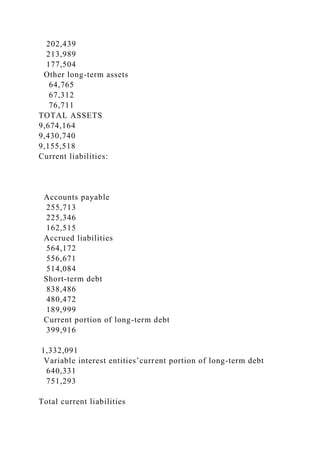
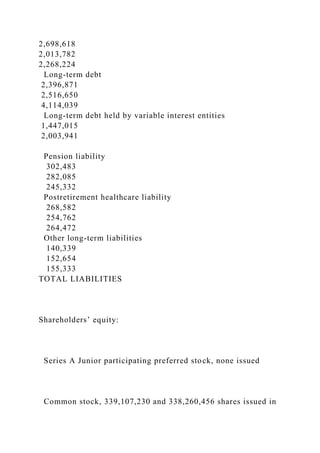
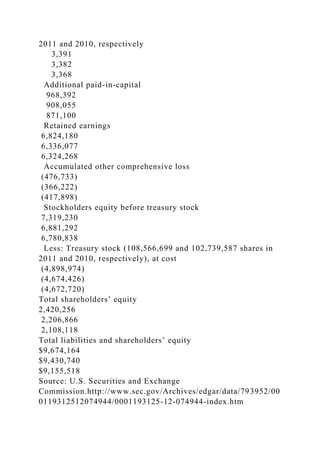
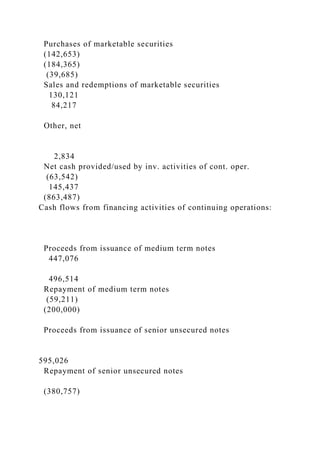
Davidson is shown in Exhibits 2 through 6.
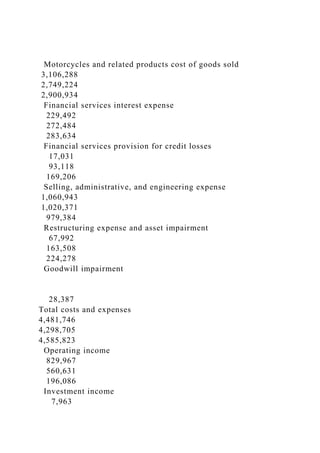
Exhibit 2: HOG Income Statement
Consolidated Statements of Operations (USD $)
12 Months Ended
In Thousands, except Per Share data, unless otherwise specified
Dec. 31, 2011
Dec. 31, 2010
Dec. 31, 2009
Revenue:
Motorcycles and related products
$4,662,264[ii]
$4,176,627[ii]
$4,287,130[ii]
Financial services
649,449
682,709
494,779
Total revenue
5,311,713
4,859,336
4,781,909
Costs and expenses:
Motorcycles and related products cost of goods sold
3,106,288
2,749,224
2,900,934
Financial services interest expense
229,492
272,484
283,634
Financial services provision for credit losses
17,031
93,118
169,206
Selling, administrative, and engineering expense
1,060,943
1,020,371
979,384
Restructuring expense and asset impairment
67,992
163,508
224,278
Goodwill impairment
28,387
Total costs and expenses
4,481,746
4,298,705
4,585,823
Operating income
829,967
560,631
196,086
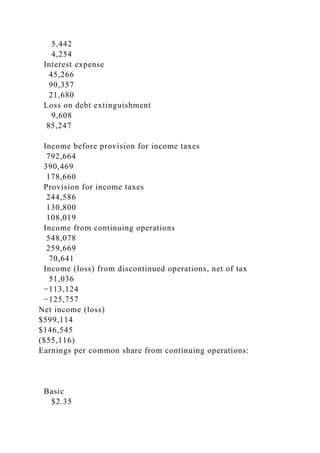
Investment income
7,963
5,442
4,254
Interest expense
45,266
90,357
21,680
Loss on debt extinguishment
9,608
85,247
Income before provision for income taxes
792,664
390,469
178,660
Provision for income taxes
244,586
130,800
108,019
Income from continuing operations
548,078
259,669
70,641
Income (loss) from discontinued operations, net of tax
51,036
−113,124
−125,757
Net income (loss)
$599,114
$146,545
($55,116)
Earnings per common share from continuing operations:
Basic
$2.35
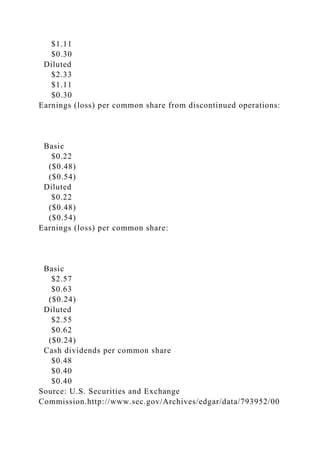
$1.11
$0.30
Diluted
$2.33
$1.11
$0.30
Earnings (loss) per common share from discontinued operations:
Basic
$0.22
($0.48)
($0.54)
Diluted
$0.22
($0.48)
($0.54)
Earnings (loss) per common share:
Basic
$2.57
$0.63
($0.24)
Diluted
$2.55
$0.62
($0.24)
Cash dividends per common share
$0.48
$0.40
$0.40
Source: U.S. Securities and Exchange
Commission.http://www.sec.gov/Archives/edgar/data/793952/00
0119312512074944/0001193125-12-074944-index.htm
[ii]
Revenue is attributed to geographic regions based on location of
customer.
Exhibit 3: HOG Balance Sheet
Consolidated Balance Sheets (USD $)
In Thousands, unless otherwise specified
Dec. 31, 2011
Dec. 31, 2010
Dec. 31, 2009
Current assets:
Cash and cash equivalents
$1,526,950
$1,021,933
$1,630,433
Marketable securities
153,380
140,118
39,685
Accounts receivable, net
219,039
262,382
269,371
Finance receivables, net
1,168,603
1,080,432
1,436,114
Variable interest entities’ restricted finance receivables, net
591,864
699,026
Inventories
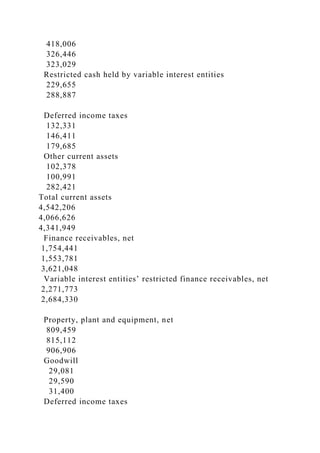
418,006
326,446
323,029
Restricted cash held by variable interest entities
229,655
288,887
Deferred income taxes
132,331
146,411
179,685
Other current assets
102,378
100,991
282,421
Total current assets
4,542,206
4,066,626
4,341,949
Finance receivables, net
1,754,441
1,553,781
3,621,048
Variable interest entities’ restricted finance receivables, net
2,271,773
2,684,330
Property, plant and equipment, net
809,459
815,112
906,906
Goodwill
29,081
29,590
31,400
Deferred income taxes
202,439
213,989
177,504
Other long-term assets
64,765
67,312
76,711
TOTAL ASSETS
9,674,164
9,430,740
9,155,518
Current liabilities:
Accounts payable
255,713
225,346
162,515
Accrued liabilities
564,172
556,671
514,084
Short-term debt
838,486
480,472
189,999
Current portion of long-term debt
399,916
1,332,091
Variable interest entities’current portion of long-term debt
640,331
751,293
Total current liabilities
2,698,618
2,013,782
2,268,224
Long-term debt
2,396,871
2,516,650
4,114,039
Long-term debt held by variable interest entities
1,447,015
2,003,941
Pension liability
302,483
282,085
245,332
Postretirement healthcare liability
268,582
254,762
264,472
Other long-term liabilities
140,339
152,654
155,333
TOTAL LIABILITIES
Shareholders’ equity:
Series A Junior participating preferred stock, none issued
Common stock, 339,107,230 and 338,260,456 shares issued in
2011 and 2010, respectively
3,391
3,382
3,368
Additional paid-in-capital
968,392
908,055
871,100
Retained earnings
6,824,180
6,336,077
6,324,268
Accumulated other comprehensive loss
(476,733)
(366,222)
(417,898)
Stockholders equity before treasury stock
7,319,230
6,881,292
6,780,838
Less: Treasury stock (108,566,699 and 102,739,587 shares in
2011 and 2010, respectively), at cost
(4,898,974)
(4,674,426)
(4,672,720)
Total shareholders’ equity
2,420,256
2,206,866
2,108,118
Total liabilities and shareholders’ equity
$9,674,164
$9,430,740
$9,155,518
Source: U.S. Securities and Exchange
Commission.http://www.sec.gov/Archives/edgar/data/793952/00
0119312512074944/0001193125-12-074944-index.htm
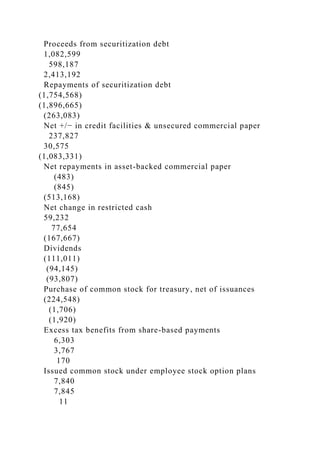
Exhibit 4: HOG Statement of Cash Flows
Consolidated Statements Of Cash Flows (USD $)
12 Months Ended
In Thousands, unless otherwise specified
Dec. 31, 2011
Dec. 31, 2010
Dec. 31, 2009
Consolidated Statements Of Cash Flows [Abstract]
Net cash provided by operating activities of continuing
operations (Note 2)
$885,291
$1,163,418
$609,010
Cash flows from investing activities of continuing operations:
Capital expenditures
(189,035)
(170,845)
(116,748)
Origination of finance receivables
(2,622,024)
(2,252,532)
(1,378,226)
Collections on finance receivables
2,760,049
2,668,962
607,168
Collection of retained securitization interests
61,170
Purchases of marketable securities
(142,653)
(184,365)
(39,685)
Sales and redemptions of marketable securities
130,121
84,217
Other, net
2,834
Net cash provided/used by inv. activities of cont. oper.
(63,542)
145,437
(863,487)
Cash flows from financing activities of continuing operations:
Proceeds from issuance of medium term notes
447,076
496,514
Repayment of medium term notes
(59,211)
(200,000)
Proceeds from issuance of senior unsecured notes
595,026
Repayment of senior unsecured notes
(380,757)
Proceeds from securitization debt
1,082,599
598,187
2,413,192
Repayments of securitization debt
(1,754,568)
(1,896,665)
(263,083)
Net +/− in credit facilities & unsecured commercial paper
237,827
30,575
(1,083,331)
Net repayments in asset-backed commercial paper
(483)
(845)
(513,168)
Net change in restricted cash
59,232
77,654
(167,667)
Dividends
(111,011)
(94,145)
(93,807)
Purchase of common stock for treasury, net of issuances
(224,548)
(1,706)
(1,920)
Excess tax benefits from share-based payments
6,303
3,767
170
Issued common stock under employee stock option plans
7,840
7,845
11
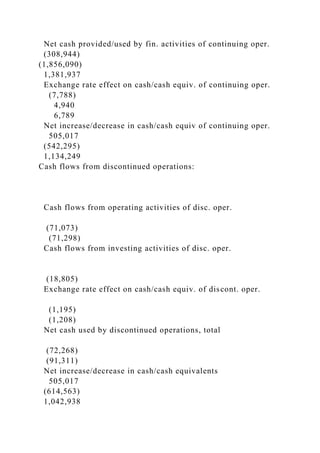
Net cash provided/used by fin. activities of continuing oper.
(308,944)
(1,856,090)
1,381,937
Exchange rate effect on cash/cash equiv. of continuing oper.
(7,788)
4,940
6,789
Net increase/decrease in cash/cash equiv of continuing oper.
505,017
(542,295)
1,134,249
Cash flows from discontinued operations:
Cash flows from operating activities of disc. oper.
(71,073)
(71,298)
Cash flows from investing activities of disc. oper.
(18,805)
Exchange rate effect on cash/cash equiv. of discont. oper.
(1,195)
(1,208)
Net cash used by discontinued operations, total
(72,268)
(91,311)
Net increase/decrease in cash/cash equivalents
505,017
(614,563)
1,042,938
Cash and cash equivalents.
Cash and cash equivalents – beginning of period
1,021,933
1,630,433
568,894
Cash and cash equivalents of disc. oper. - period end
6,063
24,664
Net increase (decrease) in cash and cash equivalents
505,017
(614,563)
1,042,938
Less: Cash and cash equivalents of disc. oper. – period end
(6,063)
Cash and cash equivalents – end of period
$1,526,950
$1,021,933
$1,630,433
Source: U.S. Securities and Exchange
Commission.http://www.sec.gov/Archives/edgar/data/793952/00
0119312512074944/0001193125-12-074944-index.htm
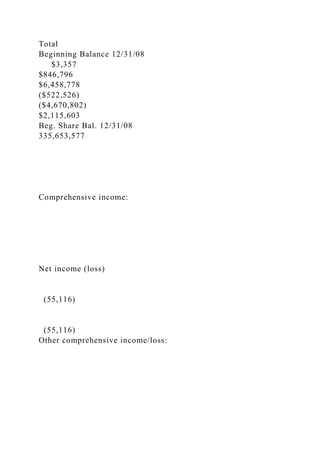
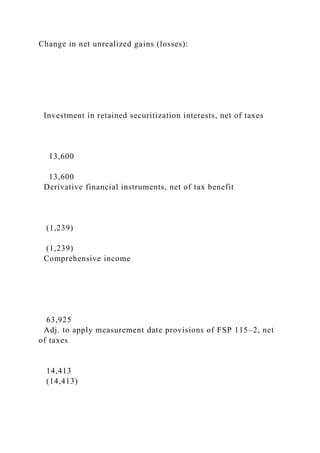
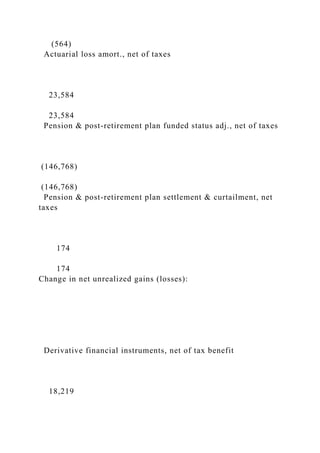
Exhibit 5: HOG Statement of Stockholder’s Equity
Consolidated Statements Of Shareholders’ Equity (USD $)
In Thousands, except Share data, unless otherwise specified
Common Stock [Member]
Additional Paid-in Capital [Member]
Retained Earnings [Member]
Accumulated Other Comp. Income (Loss)[Member]
Treasury Balance [Member]
Total
Beginning Balance 12/31/08
$3,357
$846,796
$6,458,778
($522,526)
($4,670,802)
$2,115,603
Beg. Share Bal. 12/31/08
335,653,577
Comprehensive income:
Net income (loss)
(55,116)
(55,116)
Other comprehensive income/loss:
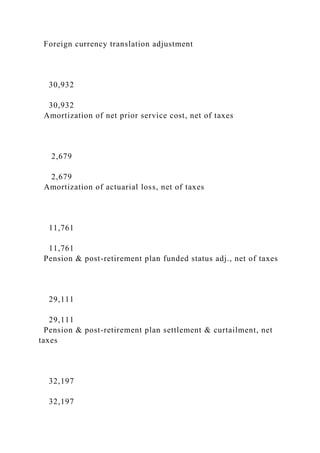
Foreign currency translation adjustment
30,932
30,932
Amortization of net prior service cost, net of taxes
2,679
2,679
Amortization of actuarial loss, net of taxes
11,761
11,761
Pension & post-retirement plan funded status adj., net of taxes
29,111
29,111
Pension & post-retirement plan settlement & curtailment, net
taxes
32,197
32,197
Change in net unrealized gains (losses):
Investment in retained securitization interests, net of taxes
13,600
13,600
Derivative financial instruments, net of tax benefit
(1,239)
(1,239)
Comprehensive income
63,925
Adj. to apply measurement date provisions of FSP 115–2, net
of taxes
14,413
(14,413)
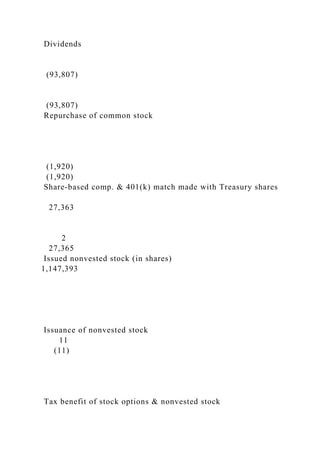
Dividends
(93,807)
(93,807)
Repurchase of common stock
(1,920)
(1,920)
Share-based comp. & 401(k) match made with Treasury shares
27,363
2
27,365
Issued nonvested stock (in shares)
1,147,393
Issuance of nonvested stock
11
(11)
Tax benefit of stock options & nonvested stock
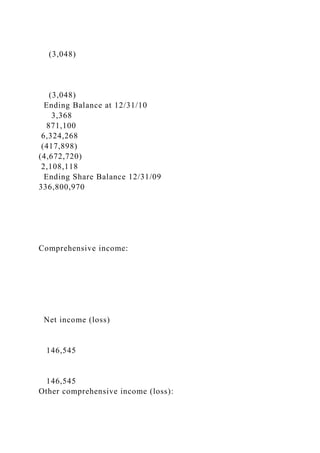
(3,048)
(3,048)
Ending Balance at 12/31/10
3,368
871,100
6,324,268
(417,898)
(4,672,720)
2,108,118
Ending Share Balance 12/31/09
336,800,970
Comprehensive income:
Net income (loss)
146,545
146,545
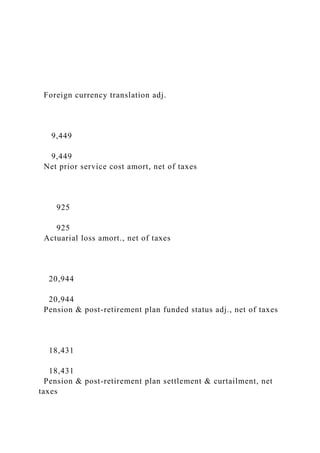
Other comprehensive income (loss):
Foreign currency translation adj.
9,449
9,449
Net prior service cost amort, net of taxes
925
925
Actuarial loss amort., net of taxes
20,944
20,944
Pension & post-retirement plan funded status adj., net of taxes
18,431
18,431
Pension & post-retirement plan settlement & curtailment, net
taxes
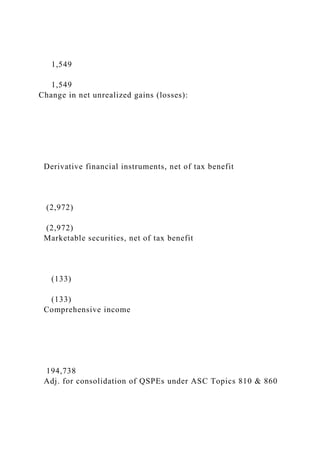
1,549
1,549
Change in net unrealized gains (losses):
Derivative financial instruments, net of tax benefit
(2,972)
(2,972)
Marketable securities, net of tax benefit
(133)
(133)
Comprehensive income
194,738
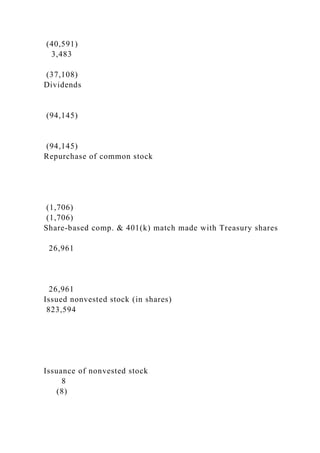
Adj. for consolidation of QSPEs under ASC Topics 810 & 860
(40,591)
3,483
(37,108)
Dividends
(94,145)
(94,145)
Repurchase of common stock
(1,706)
(1,706)
Share-based comp. & 401(k) match made with Treasury shares
26,961
26,961
Issued nonvested stock (in shares)
823,594
Issuance of nonvested stock
8
(8)
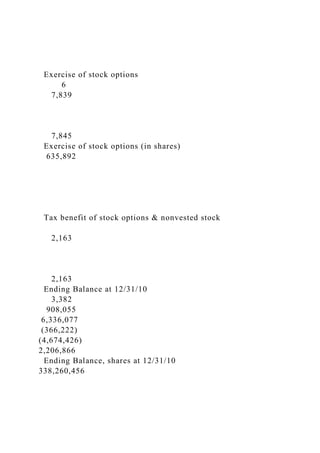
Exercise of stock options
6
7,839
7,845
Exercise of stock options (in shares)
635,892
Tax benefit of stock options & nonvested stock
2,163
2,163
Ending Balance at 12/31/10
3,382
908,055
6,336,077
(366,222)
(4,674,426)
2,206,866
Ending Balance, shares at 12/31/10
338,260,456
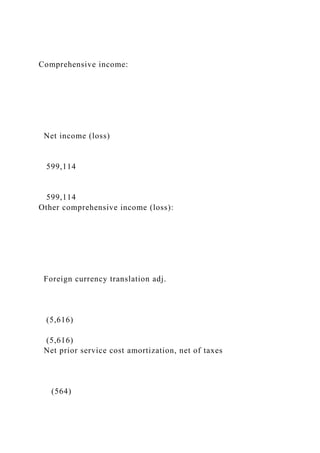
Comprehensive income:
Net income (loss)
599,114
599,114
Other comprehensive income (loss):
Foreign currency translation adj.
(5,616)
(5,616)
Net prior service cost amortization, net of taxes
(564)
(564)
Actuarial loss amort., net of taxes
23,584
23,584
Pension & post-retirement plan funded status adj., net of taxes
(146,768)
(146,768)
Pension & post-retirement plan settlement & curtailment, net
taxes
174
174
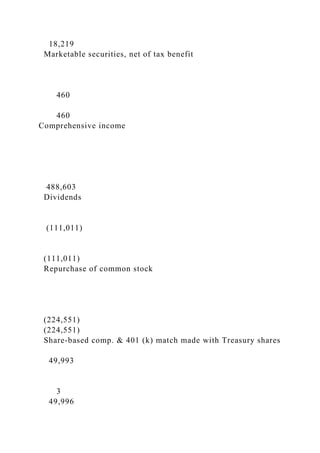
Change in net unrealized gains (losses):
Derivative financial instruments, net of tax benefit
18,219
18,219
Marketable securities, net of tax benefit
460
460
Comprehensive income
488,603
Dividends
(111,011)
(111,011)
Repurchase of common stock
(224,551)
(224,551)
Share-based comp. & 401 (k) match made with Treasury shares
49,993
3
49,996
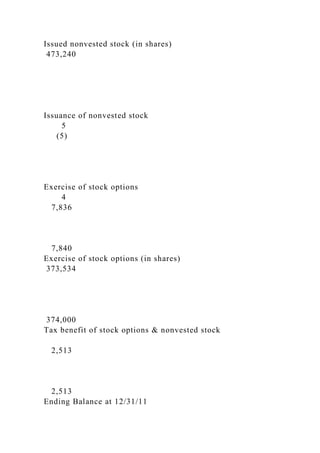
Issued nonvested stock (in shares)
473,240
Issuance of nonvested stock
5
(5)
Exercise of stock options
4
7,836
7,840
Exercise of stock options (in shares)
373,534
374,000
Tax benefit of stock options & nonvested stock
2,513
2,513
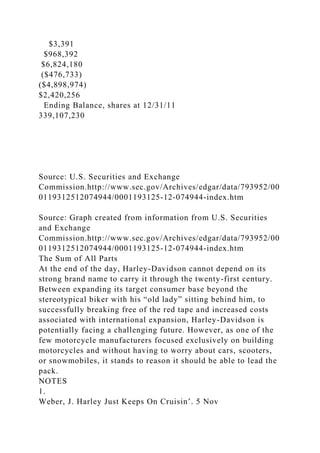
Ending Balance at 12/31/11
$3,391
$968,392
$6,824,180
($476,733)
($4,898,974)
$2,420,256
Ending Balance, shares at 12/31/11
339,107,230
Source: U.S. Securities and Exchange
Commission.http://www.sec.gov/Archives/edgar/data/793952/00
0119312512074944/0001193125-12-074944-index.htm
Source: Graph created from information from U.S. Securities
and Exchange
Commission.http://www.sec.gov/Archives/edgar/data/793952/00
0119312512074944/0001193125-12-074944-index.htm
The Sum of All Parts
At the end of the day, Harley-Davidson cannot depend on its
strong brand name to carry it through the twenty-first century.
Between expanding its target consumer base beyond the
stereotypical biker with his “old lady” sitting behind him, to
successfully breaking free of the red tape and increased costs
associated with international expansion, Harley-Davidson is
potentially facing a challenging future. However, as one of the
few motorcycle manufacturers focused exclusively on building
motorcycles and without having to worry about cars, scooters,
or snowmobiles, it stands to reason it should be able to lead the
pack.
NOTES
1.
Weber, J. Harley Just Keeps On Cruisin’. 5 Nov
2006. BloombergBusinessweek. Web. 24 Apr
2012.http://www.businessweek.com/magazine/content/06_45/b4
008069.htm
2.
Various sources including 1) Barkley, M. K. A Business Plan
for a Harley-Davidson Motorcycle.
Web.http://ocls.cmich.edu/msa/projects/mbarkley06-05.pdf. 2)
Harley-Davidson USA: History. Web. 22 Apr
2012 http://www.harley-davidson.com/en_US/Content/Pages/H-
D_History/history.html. 3) P3naz89. History of Harley
Davidson-Part 1. 17 Aug 2009. YouTube. Web. 22 Apr
2012.http://www.youtube.com/watch?v=79twzhOXIJQ. 4)
Harley-Davidson History. HowStoffWorks. Web. 22 Apr
2012. http://auto.howstuffworks.com/harley-davidson-
history1.htm. 5) Harley Davidson History Time
Line. Harley. Munising.com.Web. 22 Apr
2012. http://harley.munising.com/.
3.
Ibid.
4.
Ibid.
5.
Bruce, R. The Harley-Davidson
Story.http://cobweb2.louisville.edu/faculty/regbruce/bruce/cases
/harley/harley.htm.
6.
Various sources including op. cit.
7.
Harley-Davidson USA. Harley-Davidson USA. Web. 22 Apr
2012. http://www.harley-
davidson.com/en_US/Content/Pages/home.html.
8.
Harley Defies Stereotypes. 7 Mar 2012. Dennis Kirk
Powersports Blog. Web. 22 Apr 2012.http://powersports-
blog.denniskirk.com/1842/harley-davidson/harley-defies-
stereotypes/.
9.
Various sources including op. cit.
10.
Weber, J. op. cit.
11.
Harley-Davidson USA. Harley-Davidson USA. op. cit.
12.
Gardiner, M. Harley-Davidson Motorcycle History. op. cit.
13.
Harley-Davidson USA. Harley-Davidson USA. op. cit.
14.
Hamner, S. 2009. Harley, you’re not getting any younger. New
York Times Online, March 22.
15.
Various sources II including: 1) Harley-Davidson USA. Harley-
Davidson USA. op. cit. 2) Hitt, M. A., Ireland, R. D., &
Hoskisson, R. E. (2011). Strategic Management –
Competitiveness & Globalization - 10th Edition. Mason, OH:
South-Western CENGAGE Learning. 3) Bruce, R. op. cit. 4)
Gamble, J. E., Schäfer, R. Case 21 Harley-
Davidson. Scribd. Web. 22 Apr
2012.http://www.scribd.com/doc/19943405/Harley-Davidson-
Case-Study. 5) Harley-Davidson. Wikipedia.Wikimedia
Foundation. Web. 22 Apr
2012. http://en.wikipedia.org/wiki/Harley-Davidson. 6) Harley-
Davidson 2011: Annual Report. Harley-Davidson
Website.http://www.harley-
davidson.com/en_US/Media/downloads/Annual_Reports/2011/H
D_Annual2011.pdf.
16.
Harley Defies Stereotypes. 7 Mar 2012. Dennis Kirk
Powersports Blog. Web. 22 Apr 2012.http://powersports-
blog.denniskirk.com/1842/harley-davidson/harley-defies-
stereotypes/.
17.
Demographic Headwinds Hitting Harley-Davidson. 17 Jul
2009. Seeking Alpha. Web. 22 Apr
2012.http://seekingalpha.com/article/149478-demographic-
headwinds-hitting-harley-davidson.
18.
Harley-Davidson USA. Harley-Davidson USA. op. cit.
19.
Hitt, M. A., Ireland, R. D., & Hoskisson, R. E. 2011. op. cit.
20.
Gardiner, M. Harley-Davidson Motorcycle History. op. cit.
21.
Harley-Davidson USA: Harley Owner’s Group. Harley-
Davidson Website. Web. http://www.harley-
davidson.com/en_US/Content/Pages/HOG/HOG.html.
22.
Harley-Davidson USA: Who Can be a Dealer. Harley-Davidson
Website. Web. 22 Apr 2012.http://www.harley-
davidson.com/en_US/Content/Pages/Becoming_a_Dealer/Who_
Can_Become_A_Dealer.html?locale=en_US
23.
Honda: Street:
Chopper. Powersports. Honda.com. Web.http://powersports.hon
da.com/street/chopper.aspx.
24.
Korfhage, B. 2004 Kawasaki Vulcan 2000. 5 Dec
2003. MotorcycleUSA.com.http://www.motorcycle-
usa.com/163/949/Motorcycle-Article/2004-Kawasaki-Vulcan-
2000.aspx.
25.
Suzuki: Motorcycles. Suzuki Cycles. Web. 22 Apr
2012.http://www.suzukicycles.com/Product%20Lines/Cycles.as
px?sc_lang=en.
26.
Gardiner, M. Harley-Davidson Motorcycle History. op. cit.
27.
Harley-Davidson to Discontinue Buell Sport Bikes. 15 Oct
2009. New York Times – Wheels. Web. 22 Apr
2012. http://wheels.blogs.nytimes.com/2009/10/15/harley-
davidson-to-discontinue-buell-sport-bikes/.
28.
American Motorcycles. Victory Motorcycles: Touring, Cruiser,
Muscle, V-Twin & Wide-Tire. Web. 22 Apr
2012. http://www.polarisindustries.com/en-us/victory-
motorcycles/Pages/Home.aspx.
29.
Duke, K. 2004 Victory Vegas Comparison. 26 Nov
2003. MotorcycleUSA.com.http://www.motorcycle-
usa.com/267/1040/Motorcycle-Article/2004-Victory-Vegas-
Comparison.aspx.
30.
Indian Motorcycles. Web. http://www.indianmotorcycle.com/en-
us/pages/home.aspx.
31.
Big Dog Motorcycles - Custom Motorcycles & Choppers,
Motorcycle Apparel & Accessories - Homepage. Big Dog
Motorcycles. Web. 22 Apr
2012. http://www.bigdogmotorcycles.com/.
32.
Big Bear Choppers | Custom Chopper Motorcycles | Bike Kits |
Kit Bikes. Big Bear Choppers. Web. 22 Apr
2012. http://www.bigbearchoppers.com/.
33.
American IronHorse Motorcycles of Huntsville. American
IronHorse Motorcycles of Huntsville.Web. 22 Apr
2012. http://www.americanironhorsehuntsville.com/.
34.
Darwin Motorcycles. Darwin Motorcycles. Web. 22 Apr
2012. http://www.brassballsbobbers.com/.
35.
Bleustein, J. L. Letter to Shareholders. Harley-Davidson USA:
Investor Relations.http://www.harley-
davidson.com/company/investor/ar/1997/leadership.htm.
36.
Bhasin, K. Harley-Davidson’s CEO is Trying to Save His
Company by Copying Ford. 21 Nov 2011.Business Insider –
War Room.http://articles.businessinsider.com/2011-11-
21/strategy/30424435_1_harley-davidson-keith-wandell-fbrd-
ceo.
37.
Harley-davidson In (HOG: New York). Bloomberg
Businessweek.investing.businessweek.com/research/stocks/peop
le/people.asp?ticker=HOG:US.
38.
Pozen, Robert C. The Case of Professional Boards. Harvard
Business Review. 2010.
39.
Lakshmi, R. Harley-Davidson Coming to India to Test a New
Market. 31 Aug 2009. Washington Post.Web. 22 Apr
2012. http://www.washingtonpost.com/wp-
dyn/content/article/2009/08/30/AR2009083002250.html.
40.
Harley-Davidson Demographics. Update. 18 Feb 2011. Cyril
Huze Blog: World’s Number One Magazine For Custom
Motorcycle News. Web. 22 Apr
2012.http://www.cyrilhuzeblog.com/2011/02/18/harley-
davidson-demographics-update/.
41.
Harley-Davidson looking beyond Indian metros for growth. 3
Jan 2012. IBN Live. Web. 22 Apr
2012.http://ibnlive.in.com/news/harleydavidson-looking-
beyond-indian-metros-for-growth/218921-25-162.html.
42.
Sidner, S. Harley-Davidson to Build Bikes in India. 4 Nov
2010. CNN World. Web. 22 Apr
2012.http://articles.cnn.com/2010-11-
04/world/india.bikes_1_india-market-harley-davidsons-
haryana?_s=PM:WORLD.
43.
Bellman, E. Harley to Ride Indian Growth. 28 Aug 2009. Wall
Street
Journal.http://online.wsj.com/article/SB125135162394762877.ht
ml.
44.
Harley-Davidson looking beyond Indian metros for growth. op.
cit.
45.
Harley-Davidson Introduces Two Bikes at Lower Price. 5 Jan
2012. NDTV.com. Web. 22 Apr
2012.http://www.ndtv.com/article/business/harley-davidson-
introduces-two-bikes-at-lower-price-163887.
46.
Ibid.
47.
Currency Converter Widget. XE: (—/—) — to — Rate. Web. 22
Apr 2012.http://www.xe.com/ucc/convert/?Amount=1400000.
48.
Harley-Davidson looking beyond Indian metros for growth. op.
cit.
49.
Our Motorcycles. Harley-Davidson India. Web. 22 Apr
2012. http://www.harley-davidson.in/harley-davidson-india-our-
motorcycles.html
50.
Harley-Davidson in China Encounters Barriers of Entry for Two
Wheels: Cars. 18 Sep 2011.Bloomberg. Web. 22 Apr
2012. http://www.bloomberg.com/news/2011-09-18/harley-
davidson-finds-milwaukee-beats-china-as-leisure-motorcycle-
market.html.
51.
Ibid.
52.
Ibid.
53.
Ibid.
54.
Harley-Davidson USA: New Rider Course. Harley-Davidson
Web Site. Web. 22 Apr 2012.http://www.harley-
davidson.com/en_US/Content/Pages/learn-to-ride/new-rider-
course.html?locale=en_US.
55.
Harley-Davidson Press Release. Motorcyclists! Harley-
Davidson encourages all to check their helmets. 2 Apr
2008. Cycle Matters. Web. 22 Apr
2012. http://www.cyclematters.com/motorcycle-blog/safety-
training/harley-davidson-proclaims-april-check-your-helmet-
month-2008.cfm
56.
Yaukey, J., Benincasa, R. Motorcyclist deaths spike as helmet
laws loosen. 27 Mar 2008. USA Today.Web. 22 Apr
2012. http://www.usatoday.com/news/nation/2008-03-26-
bikehelmets_N.htm.
57.
Ibid.
58.
Johnson, R. When Heaven Is a Harley. 19 Dec 2011. Wall Street
Journal.
Web.http://online.wsj.com/article/SB1000142405297020353730
4577030113224587198.html
59.
Summary and Analysis of Comments: Control of Emissions
from Highway Motorcycles. Dec 2003. U.S. EPA: Office of
Transportation and Air Quality. EPA420-R-03-016.
Web.http://www.epa.gov/otaq/regs/roadbike/420r03016.pdf
60.
Harley-Davidson Downshifts Profit Forecast. 7 Sep
2007. Market Watch. Web. 22 Apr
2012.http://articles.marketwatch.com/2007-09-
07/news/30806235_1_harley-davidson-harley-davidson-shares-
retail-sales.
61.
Morningstar Analyst Report. 27 Feb 2012.
62.
Harley-Davidson USA: Harley Owner’s Group. op. cit.
63.
Morningstar Analyst Report. op. cit
64.
Ibid.
65.
Harley-Davidson 2011: Annual Report. op. cit.

CASE 14 Harley-Davidson Strategic Competitiveness that Spans Dec.docx

  • 1.
    CASE 14: Harley-Davidson:Strategic Competitiveness that Spans Decades Guriqbal Cheema Joel Cunningham Pallavi Daliparthi John Klostermann Brian Rabe Texas A&M University “It’s more than a brand. It’s a culture.”1 Kent Grayson Professor of Marketing, Northwestern University Introduction Harley-Davidson is an American cultural and business icon on the level of Levi Strauss and Coca-Cola. Often imitated, but never duplicated, Harley-Davidson has managed to survive, and has, at times, thrived for many decades. Through depression, recessions, world wars, high technology developments, Japanese competition, and increasing government regulation, Harley- Davidson has maintained operations where over a dozen other U.S. motorcycle firms have failed. Harley-Davidson has even survived over a decade as a subsidiary of a bowling alley service firm. It has achieved this by essentially relying on designing, manufacturing, selling, and servicing a relatively static product: two wheels, a 45° V-Twin engine, and a set of handlebars. How has Harley-Davidson managed to survive through these and other hardships in a motorcycle market that is dominated by leisure riders? How has it kept the doors open while its historic U.S. rival, Indian Motorcycles, is currently in its fourth incarnation? How has it maintained its attractiveness with outlaw bikers, investment bankers, and those who appear to be experiencing a “mid-life crisis” and who sometimes turn to the firm’s products as a result? More importantly, what is this firm selling that keeps it as the industry leader in full-size
  • 2.
    motorcycles? The answerto these questions is not a 526-pound batch of steel with 250 feet of wiring, but rather the fact that Harley-Davidson is selling the American dream of freedom. How it is able to do this is a fascinating story. The Challenge With over 6,000 employees, 1,400 franchises, and nine production facilities, Harley-Davidson has managed to survive the economic downturn that was in full force in late 2007 and for the next few years; but the firm is not out of the woods yet. In fact, Harley-Davidson is struggling with three pivotal issues, the first of which is that the firm’s products are viewed as leisure items. The other two issues are similar in nature in that they deal with the fact that managing the firm’s target market is challenging, particularly as demand for its products is changing. Individually and collectively these issues pose a real challenge to the company’s long-term success. Without addressing these issues, Harley-Davidson may lose its ability to create value for customers and to serve stakeholders’ needs as a result. As noted, the first issue Harley-Davidson must successfully address is the fact that consumers see the firm’s products primarily as leisure items. This means that in many consumers’ eyes, purchasing motorcycles, performance parts, and high- dollar apparel is a luxury rather than a necessity. Because of this, Harley’s products must compete for funds from what at least sometimes can be volatile discretionary budgets for consumers. When economic conditions are challenging, the motorcycle market tends to experience difficulties in terms of generating adequate sales. While Harley-Davidson’s revenue streams originate from several sources, very few of them appeal to a cost-sensitive consumer base. © Vividfour / Shutterstock.com Second, Harley-Davidson is challenged to effectively specify its target market as a first step to appropriately serving that market’s needs. Historically, the firm’s target market has been males between the ages of 29 and 55. However, in the last decade, Harley-Davidson has pursued younger riders and
  • 3.
    women as ameans of expanding its target customer segments. But expanding the segments the firm serves with its products is not a risk-free decision or choice for the firm to make in that serving others might cause the firm to lose its ability to effectively serve the specific needs of the 29- to 55-year-old male (again, the historical target customer). This matter is considered more fully later in the case. Third, demands and cost drivers for the motorcycle market are ever changing. Overseas competitors have shifted their focus from being the least expensive to being affordable and to providing a wider variety of motorcycles to customers as options to purchase. This competitive shift has put pressure on Harley-Davidson’s key markets and has forced the firm to respond. With over 12 percent and 55 percent of the European and U.S. heavyweight motorcycle market respectively, Harley- Davidson has a substantial territory to defend. History.2 Harley-Davidson, Inc. has been a publicly traded firm since 1987. It has two primary divisions: Motorcycles and Related Products and Financial Services. The Financial Services Division provides credit to motorcycle buyers and dealerships as well as risk management and insurance services for all parts of the firm. The Motorcycles and Related Products Division currently operates through eight primary segments: · Parts & Accessories (17.5 percent of net revenue in 2011) · General Merchandise (5.9 percent of net revenue in 2011) · Licensing ($43.2 million of net revenue in 2011) · Harley-Davidson Museum · International Sales (32 percent of net motorcycle revenue in 2011) · Patents and Trademarks · Other Services · Marketing In 1903, William S. Harley and Arthur Davidson founded Harley-Davidson Motor Company, known by enthusiasts as “the Motor Company,” in order to fund their racing pursuits.
  • 4.
    Accordingly, their firstmotorcycles were merely contemporary bicycles with small engines retrofitted to the frame. It was Harley-Davidson’s early success in motorcycle racing that fueled the demand for its early models, which were sold in dealerships as early as 1904. Because these turn of the century races were as much about endurance as speed, Harley-Davidson acquired invaluable knowledge pertinent to practicality and robust design. After significant success in road and endurance races, Harley-Davidson broke fresh ground with the introduction of the V-Twin engine design. Superior to large single-cylinder engines, the lighter V-Twin design allowed similar displacement in a lighter package with a shape that fit naturally into the bicycle-inspired frames of the early 1900s. Few suspected that this design would become so integral to modern motorcycles. Having dedicated over a third of its production to the U.S. Army, Harley-Davidson sales exploded during World War I. With the advent of motorized warfare, the motorcycle proved itself to be far more than just a novel invention. In addition to proving itself to the Army, Harley-Davidson also proved itself to soldiers. After the war, soldiers returned home and became a loyal customer base for the young firm. Through the 1920s, Harley-Davidson continued to focus on design improvement and racing. It spent much of this decade fighting for market share with multiple medium and small competitors. During this time, firms producing automobiles, airplanes, bicycles, and industrial machinery also tried their hand at building motorcycles. The 1930s were a unique time for the motorcycle industry. In the wake of the Great Depression, the public was looking for inexpensive, simple transportation. At the same time, unemployment and inflation shrank potential customers’ purchasing power. It was during this time that many of the smaller motorcycle manufacturers dropped out of the industry. Most of these firms were subsidiaries of companies in related industries. These failed motorcycle firms had many of the capabilities needed to produce motorcycles, but lacked the
  • 5.
    corporate focus andsupport to continue production during such a difficult economic time. It was during this time that the U.S. domestic market shrank, with only Indian and Harley-Davidson remaining. With the market divided between only two domestic producers, Harley-Davidson’s production held steady. With the onset of World War II, Harley-Davidson found itself to be a major supplier for the Allied war effort. Again, war vaulted Harley-Davidson into a position of higher volume, improved reputation, and deeper loyalty with owners and soldiers. As the war came to an end, the United States was flooded with a surplus of Army WL45 motorcycles. Suddenly, this country was full of prospective riders who understood Harley- Davidson’s product and appreciated how motorcycles could provide inexpensive, dependable transportation. At this point, only Indian Motorcycles was a competitor for Harley-Davidson. But in 1956, at the height of an economic recession, Indian Motorcycles declared bankruptcy and stopped producing motorcycles altogether, leaving only Harley as a major producer and seller of motorcycles. As the sole U.S.-based motorcycle power, Harley-Davidson enjoyed great success. Nevertheless, the lack of competition nearly became its undoing. This market condition allowed Harley-Davidson to take more risk in the form of acquisitions, causing the firm to lose its tight focus on a single market. It began branching out to other leisure and motorized products such as off-road motorcycles, ski boats, and golf carts. At the same time, the bulk of Harley-Davidson’s revenue stream was still coming from the sale of its heavy motorcycles. Many of the acquisitions the firm completed in the latter part of the 1950s and the early 1960s, such as the Tomahawk Boat Manufacturing Company in 1962, were in similar industries, but a poor fit with Harley nonetheless. The acquired companies were often in deep trouble when Harley-Davidson purchased them. In the end, Harley-Davidson was hobbled with losing ventures that diluted its focus and did not fit well with its core competencies. In 1969, the American Machine and Foundry Company (AMF – a
  • 6.
    longtime producer ofleisure products such as tile bowling pins and ball returns) purchased the financially distressed Harley- Davidson.3 Most enthusiasts consider the AMF years as the “dark ages” of Harley-Davidson’s history. AMF operated Harley-Davidson as a profit center, reducing allocations to the unit’s marketing and research and development (R&D) functions as a result. For the next 13 years, Harley’s aging product line remained essentially unchanged. In fact, its line was so static over the years that many of the parts from a 1937 model fit on the 1969 design. Harley-Davidson had just two motorcycles with different trim packages: the low-budget sportster, the sport bike of its day, and a full-size motorcycle available in two different models. In light of Honda and Kawasaki’s entrance into the U.S. market, Harley-Davidson’s stale product line was even more disappointing. Many did not see these imports as a threat given the prestige and heritage of the Harley-Davidson name. However, the Harley-Davidson image was deteriorating. Even with its products in desperate need of a facelift, AMF relied on Harley-Davidson’s reputation to defend its competitive position; AMF plastered Harley-Davidson’s name on products like snowmobiles and golf carts. While trying to capitalize on the value of Harley-Davidson’s brand name, quality became a serious problem; customers would have to return new motorcycles to a dealership multiple times to fix manufacturing problems. It was during this time that owners coined the saying “a Harley always marks its spot,” a phrase referring to the machine’s nearly universal oil leaks. This turned off many prospective customers, as they believed a Harley-Davidson would require constant owner maintenance. All the while, Japanese motorcycle companies enticed more and more riders looking for inexpensive, dependable transportation. By 1981, Japanese motorcycles were established in the U.S. market not only as dependable transportation, but also as performance machines. Harley-Davidson’s sales were in free- fall as its tired designs appealed to a narrowing market segment.
  • 7.
    It was sellingto customers who liked classic style and dated functionality, and all for a high price. Finally, the employees and management of Harley-Davidson led a managed buyout of the company from AMF.4 The new owners immediately took stock of the firm’s strengths and vulnerabilities and increased its R&D and marketing budgets significantly. Because negative effects of AMF’s past business decisions still hampered the new management team, sales remained low. In 1985, Harley- Davidson’s top management team struggled to restructure the firm and divested itself of most of its unrelated assets. In 1987, Harley-Davidson became a publicly traded company, and none too soon as Harley-Davidson had revamped its product line into four motorcycle styles that were united by the introduction of a new engine. This was the turning point for Harley-Davidson. From this point forward, the firm’s quality control was exponentially more effective. In addition, Harley-Davidson focused more on efforts to operate efficiently and effectively. Following the precepts of just-in-time techniques and enhancement to the logistics function were critical to the firm’s attempts to enhance efficiency and effectiveness. At the same time, Harley shifted to three major initiatives:5 · Improved manufacturing process, leveraging technology, robotics, and employee involvement · Restructuring business management to a modern system · Aggressive management of its brand name through dealership management, patenting activities, and careful licensing of related products The modern Harley-Davidson fought back from the brink several times, each time seeming to evolve and adapt. What appears to be universal to each evolution of the company is that quality, promotion, and market focus have always been a priority. How Harley Does It6 Harley-Davidson focuses on a subset of the motorcycle market featuring customers who value heritage, style, reputation, durability, and adaptability. Until 2000, Harley-Davidson’s
  • 8.
    motorcycles sold atnearly a 25 percent premium. In the last decade, that premium has dropped to 5 to 10 percent, depending on the class of motorcycle. This is due to Japanese motorcycle manufacturers shifting to marketing and selling somewhat unique motorcycles for a better than average price. In comparison, Harley-Davidson uses the Sportster© line as an introductory product, but most of its motorcycles sell for over $15,000, with the average sale price of just over $16,893.7 Harley-Davidson motorcycles provide a unique product at a price that its target customers deem acceptable or reasonable. While its competitors may have attempted to cut costs, Harley-Davidson has continued to invest in its products in ways that protect the quality of its brand image. Harley- Davidson’s market focus is primarily males between the ages of 29 and 55. However, this has been changing.8Recently, it has targeted female customers. What It Does Best9 In its modern incarnation (1987 to present), Harley-Davidson achieved success by doing what it does best. Granted, multiple firms make great motorcycles, and many of these firms have a dedicated following. However, through the actions the firm has taken over the years, Harley-Davidson has developed and maintained what is a unique position in the U.S. motorcycle market. Effectively managing its brand name, production or manufacturing simplicity, and a dedicated product following are the key sources of the firm’s competitive strength. Harley-Davidson’s brand name is its most important asset. Cultivated through good times and bad, its brand name is a powerful motivator for current and prospective customers. For many Americans, Harley-Davidson is the American motorcycle. This belief is no accident. After being separated from AMF, Harley-Davidson’s top management team decided to significantly increase the amount of resources being allocated to marketing and R&D. This appears to have been a wise decision in that Harley-Davidson now holds 55 percent of the entire U.S. motorcycle market, and an even higher share in the U.S. heavy
  • 9.
    motorcycle market. Strictprotection of its brand name permeates every decision the firm makes. Its motorcycles, while occasionally deviating in style, generally follow traditional themes. Harley-Davidson only makes a design change after witnessing a strong market trend.10 For example, the custom portion of the motorcycle market has been designing machines with wide rear tires for nearly two decades; in 2007, Harley- Davidson launched a single model with a wide rear tire. Harley-Davidson is also very selective about its franchise (dealership) opportunities, another method through which the firm protects its brand. Due to free-trade laws, Harley-Davidson is no longer able to insist that its dealerships sell only Harley products. However, it utilizes price incentives to encourage dealerships to stay “Pure-Harley.”11 Harley-Davidson is especially protective of its name and logo when it comes to licensed products, most of which are sold in its dealerships. If it is not the best quality, the product’s license is revoked. Retailers can sell ladies’ shirts at a 100 percent premium because they are of excellent quality and cannot be found anywhere. This aura of exclusivity is embedded in the very DNA of Harley-Davidson Inc., from the headquarters to the dealerships. This aspect of culture is an asset in that the notion of wanting to be seen as providing products that are somewhat “exclusive” in nature permeates the firm’s decision processes as it seeks to serve its target customers’ needs. Harley-Davidson’s production process is another important firm-specific asset. The key elements of the process are the melding of a JIT supply chain with team production management and part interchange-ability.12 When combined, the elements of Harley’s production process are unique. Japanese manufacturers have used the same JIT concept for years, but have not stressed a limitation of key components. After 1987, Harley-Davidson updated its production facilities and design process. Its production facilities in Kansas City, Missouri and York, Pennsylvania are the best examples of modern robotics combined with team enablement.
  • 10.
    Interchangeable parts arethe most important component of this asset. This concept simplifies all areas of the motorcycle production process; but it is perhaps most evident in the production of Harley’s frames and engines. Harley-Davidson produces five unique frames for each motorcycle family: Sportster©, Dyna, Softail©, V-Rod©, and Touring. Even with 28 different models and seemingly limitless options, Harley- Davidson produces only three engines. Internal machining, displacement, and color coating are the only differences across the engines. The Sportster© line comes in two displacements: 883 and 1204 cubic inches. The Dyna, Softail©, and Touring lines all share the same Twincam© engine, available in 96 and 103 cubic inches. The V-Rod’s© engine is only produced in one version.13 This production approach with respect to interchangeable parts appears to be a competitive advantage in that it allows Harley to produce several models, subdividing its target market segments even further, while keeping production costs lower than if it produced 28 different frames and engines. Loyalty to the brand is another important asset for Harley- Davidson. While its brand name protection applies primarily to prospective customers, its product following centers on existing customers, many of whom are repeat buyers of the firm’s products. There are multiple examples of Harley’s dedicated following. At the extreme for example, consider the fact that some private riding clubs only grant membership to those willing to tattoo the bar and shield logo on multiple locations of their body. For others, remaining committed to the firm’s mantra that owning a Harley “is a journey, not a destination” and participating in company-sponsored events with others sharing this belief accounts for their loyalty. Regardless of the reason for it, customer loyalty to the Harley brand appears to influence these individuals to purchase Harley products other than motorcycles such as clothing and a wide range of product accessories. Historically, loyalty to the brand has resulted in a large percentage of Harley customers choosing to buy another Harley when it is time for a new motorcycle. However, the
  • 11.
    “graying” of Harley’scustomer base is potentially a problem as at some point, this group of customers will no longer be purchasing new products.14 Keeping It Simple15 In 2011, Harley-Davidson generated 88 percent of its revenues from a single business area (Motorcycles and Related Products) and 12 percent from its second primary segment (Financial Services). This composition of sales revenue is consistent with previous years and suggests that Harley may continue business as usual to help the firm reduce its idiosyncratic risk. It will also try to expand its business in other countries with a primary focus on providing quality product and services. Harley- Davidson has been able to earn positive returns while focusing on just two businesses because it has developed strengths that allow it to create value for customers. Moreover, there are fewer challenges in managing only two businesses. This approach allows Harley-Davidson to not only gain economies of scale, but also use its resources efficiently. Marketing Historically, males between the ages of 29 and 55 have been Harley-Davidson’s target customer. However, this is changing.16 Recently for example, the firm is also targeting female customers with motorcycle models that have a lower seat height and pink, purple, and light blue color schemes. Its marketing has also reflected an effort to attract more female riders. It has even tailored its riding classes (the Riders Edge Program©) to have all-female sessions and to make new women riders feel more comfortable. A woman could walk into a Harley-Davidson dealership having never sat on a motorcycle and within an hour purchase a motorcycle for as little as $8,000. She could then join a riding class that would grant a motorcycle endorsement on her driver’s license. Thus, Harley-Davidson is beginning to market to a multi- generational and multi-cultural audience. In this regard, the firm is working to attract a more diversified audience in terms of age, gender, and ethnicity.17 Harley-Davidson is a market
  • 12.
    leader in theU.S. heavyweight segment. The average median household income of a Harley-Davidson purchaser is $89,000.18 Harley-Davidson primarily uses advertising and promotional activities via television, print, radio, direct mailings, electronic advertising, and social media to market its product. Moreover, local marketing efforts in conjunction with dealers are highly encouraged. Harley-Davidson uses its customers’ experience to continuously develop and introduce innovative products. The market is flooded with high quality, low price Japanese bikes. However, Harley-Davidson does not seek to imitate these bikes. Instead, it uses direct input from its customers to improve its product. Harley-Davidson modifies its product based on input generated through customer surveys, interviews, and focus groups. Thus, some believe that “The real power of Harley-Davidson is the power to market to consumers who love the product.”19 In 2010, the company introduced “Creative Model” – a Web- based method for marketing its product. In this model, passionate fans are enabled for the purpose of helping Harley develop creative approaches for targeting new customers. Customer experience has traditionally been the main source of Harley-Davidson’s marketing strategy. It all started in 1983, when the company introduced Harley Owners Group (H.O.G),20 which has now grown to more than 1 million members worldwide.21 Harley-Davidson distributes its products through an independent dealer network that almost exclusively sells Harley-Davidson motorcycles. These dealerships are licensed dealers and fully authorized to sell and service new motorcycles. They can have secondary locations to provide additional service to the customers. These non-traditional outlets are an extension of the main dealership and consist of Alternate Retail Outlets (ARO) and Seasonal Retail Outlets (SRO). AROs aregenerally located in high traffic areas such as airports, vacation destinations, tourism spots, and malls and only sell parts, accessories, and general merchandise. SROs are also located in high traffic
  • 13.
    areas, but operateonly on a seasonal basis. AROs and SROs are not allowed to sell new motorcycles. The parts and apparel orders from the dealer are not taken at face value. Harley- Davidson’s forward-looking, market-driven allocation system restricts the number of units a particular dealer is able to order. In Canada, the company sells its products to one wholesale dealer, Deeley Harley-Davidson Canada/Fred Deeley Imports Ltd., which in turn sells to independent dealers.22 The European, the Middle Eastern and African (EMEA) region is managed from regional headquarters in Oxford, England. Harley-Davidson distributes its products through subsidiaries located in Austria, Dubai, Czech Republic, France, Germany, and Italy. In the EMEA region, Harley-Davidson distributes all products sold to independent dealers through its subsidiaries located in Austria, Czech Republic, United Arab Emirates, France, Germany, Italy, South Africa, Spain, Switzerland, Netherlands, Russia, and United Kingdom. A headquarters in Singapore manages the Asia Pacific regions with the company distributing its product to independent dealers in China, India, Australia, and Japan. The rest of Asia Pacific is managed through the U.S. operations. Financial Services Segment Harley believes that its Harley-Davidson Financial Services unit (HDFS) provides sufficient financing to independent distributors, dealers, and retail customers. HDFS provides financing to dealers and retail customer’s in the U.S. and Canada, but not in the EMEA, Asia-Pacific, and Latin America regions, although these regions do have access to financing through other financial services companies. Competition As is the case for many leisure and transportation industries, the U.S. motorcycle market is extremely competitive. Currently, Harley-Davidson competes with four classes of competitors with each group competing in a different market and in different ways. The four competing groups are commonly classified as Metric Cruiser, Metric Sport, U.S. Cruisers, and Custom
  • 14.
    Cruisers. Metric Cruiser Competitors. Theindustry uses the term Metric Cruiser to denote motorcycles made outside the United States with traditional styling. Traditional styling is commonly reflected through an exposed engine and non-integrated body panels. Japanese motorcycle makers such as Honda, Star (Yamaha), Suzuki, and Kawasaki dominate these models. It is important to note that not all metric cruiser competitors are considered to be heavy motorcycles (over 650 cubic centimeter displacement). These competitors compete with Harley-Davidson on price, but also use the individual model’s unique features to garner a competitive advantage. Honda introduced the Fury©,23 a regular production chopper based on the 1300 VTX power plant in 2009. In 2004, Kawasaki introduced the Vulcan©200024 with a 2,053 cubic centimeter engine, the largest mass-produced V-Twin motorcycle ever. Most of these competitor models of similar size are comparable in features to Harley-Davidson models. The presence of smaller competitor models forces Harley-Davidson to keep entry-level models like the 883 cubic centimeter Sportster©. Smaller metric cruisers like the Suzuki Boulevard 40©, retailing at $2,600 less25 than Harley-Davidson’s least expensive model, keep downward pressure on introductory model prices. Metric Sport Competitors. Metric Sport motorcycles are made outside the United States, mostly in Japan, and are race-inspired, high performance motorcycles with full body panels and excellent aerodynamic characteristics. Motorcycles like the Suzuki Hayabusa© and the Kawasaki Ninja© are examples of this competitor class. While these motorcycles do not directly compete with most Harley- Davidson models, they do appeal to younger prospective customers because of their breathtaking performance and relatively low prices. In general, metric sport customers are not attracted to most Harley-Davidson models. Harley-Davidson has taken two key actions to attract young,
  • 15.
    performance-oriented riders fromits sport motorcycle competitors. It introduced the V-Rod© line in 2002 with a high performance, liquid-cooled motor. Harley-Davidson also purchased Buell,26 a sport motorcycle company using Harley- Davidson motors, in 1993. In 2003, Buell sport motorcycles became a full subsidiary with its models being sold through Harley-Davidson dealerships. Neither of these actions has resonated with the younger riders Harley sought to reach by taking them. As a result, Harley-Davidson opted to discontinue Buell in 2009 after slumping sales.27 The V-Rod© still exists, but with a median price tag of $15,300 it has not done much to lower the age of the average Harley-Davidson rider. U.S. Cruiser Competitors. Victory Motorcycles and Indian Motorcycle are the only U.S. Cruiser style motorcycle manufacturers. Victory, a subsidiary of Polaris and a relative newcomer to the motorcycle market, started production in 1998.28 Polaris is best known for its high quality all-terrain vehicles and personal watercraft. In the last five years, Victory models have been selling at prices more closely comparable with Harley-Davidson. At the same time, Victory increased the number of models and styles; it even brought in famous motorcycle customizers Arlen and Corey Ness29 to add style and street credibility to its entire product line. In 2009, Indian Motorcycle began its fourth incarnation in an effort to leverage its famous name and art-deco styling. After a shaky start, Indian was recently purchased by Polaris. This move is likely part of a strategy to position Victory and Indian in separate parts of the U.S. motorcycle market and to fulfill the needs of different types of customers. This approach is similar to the strategy General Motors used for decades of offering different products to different types of customers. The median price for an Indian motorcycle is $28,000. Its current tag line is, “Your great grandfather would be proud. Jealous, but proud.”30Indian is targeting high-income earners with a love for classic motorcycle styling. Custom Cruiser Competitors.
  • 16.
    This class ofcompetitors is comprised of small and medium firms that build highly customized motorcycles with large displacement motors. Firms such as Big Dog Motorcycles,31 Big Bear Choppers,32 and American IronHorse are the dominant competitors in this space.33 These competitors have become far less of an issue for Harley-Davidson since the economic downturn of 2008. With their high levels of customization, these competitors’ models come with a high price tag. As their target market shrunk in the recession, these firms thinned significantly; an estimated 60 percent have gone out of business or changed their core function to components production. Others, such as Darwin Motorcycles, now offer custom motorcycles for as little as $18,600.34 These competitors will always pose a threat to Harley-Davidson. They force Harley-Davidson to continually innovate and customize its product. It is ironic that most of these motorcycle manufacturers use Harley-Davidson style or actual Harley-Davidson components in their production. Strategic Leaders “No one can accurately predict the future. What I can predict with the utmost confidence are the things that won’t change at Harley-Davidson – namely, our commitment to providing more great motorcycles; to enhancing the unparalleled Harley lifestyle experience, and to continuing to provide excellent financial performance.” – Jeff Bleustein Annual Report 199735 Although the strategic intent of Harley-Davidson has not changed much since 1997, the way it operates and leads has certainly adapted to reflect new ways of doing business. Keith Wandell–Chairman and CEO. When Keith Wandell joined Harley-Davidson in 2009, many people were skeptical of his leadership due to his lack of motorcycle experience. However, his fresh perspective has allowed Wandell the opportunities and relationships needed to steer the company toward a sales gain for the first time in
  • 17.
    nearly five years.Wandell attributes this success to his dear colleague and now CEO at Ford, Alan Mulally. Wandell took some tough measures such as cutting labor contracts, closing plants, and overall “trimming the fat.”36 He has sold old investments and is trying to making Harley-Davidson more attractive to women and the younger generation. And, of course, Wandell is now an avid Harley-Davidson rider. Executive Suite. Each member of the C-suite is highly qualified for his role. Each leader serves multiple roles within the organization and is an individual contributor as well as a team leader.37 The CFO and Senior VP, John A. Olin, joined Harley-Davidson in May 2009 with over 25 years of leadership experience in finance. President and COO of Buell Motorcycle Company, Jon R. Flickinger, has grown within Harley-Davidson where he began his leadership role as a Director of Field Operations in January 1995. With over 30 years of experience in the commercial finance industry, it is appropriate that Lawrence G. Hund should serve as the President and COO of the Harley-Davidson Financial Services division. At 46, nearly 10 years younger than the other executive members, President and COO of Harley- Davidson Motor Company, Matthew S. Levatich, has made significant contributions at Harley-Davidson for the past 15 years. Board of Directors. Each member of Harley-Davidson’s board brings different experiences to the boardroom. This eclectic set of experiences facilitates the firm’s efforts to position itself in the ever- growing market of the motorcycle business. Information regarding the age, title, and other boards each member serves on is provided in Exhibit 1. Exhibit 1: Board of Directors Board Member Age Title Other Boards
  • 18.
    Barry K. Allen 62 SeniorAdvisor to Providence Equity Partners President, Allen Enterprises, LLC Fiduciary Management BCE Inc. John Anderson 60 Former President and CEO, Levi Strauss & Co. Richard L. Beattie 71 Chairman of Simpson Thacher & Bartlett LLP Heidrick & Struggles International Inc. Evercore Partners Inc. Martha F. Brooks 51 Former President and COO, Novelis Inc. Bombardier Inc. George H. Conrades 73 Chairman, Akamai Technologies, Inc. Akamai Technologies, Inc. Oracle Corporation Ironwood Pharmaceuticals, Inc. Donald A. James 67 Co-founder, equity owner, Chairman and CEO of Deeley Harley-Davidson Canada/Fred Deeley Imports Ltd. Sara L. Levinson 60 Former Non-Executive Chairman of ClubMom, Inc. Macy’s Inc. Thomas Linebarger 48
  • 19.
    Chairman and CEO,Cummins Inc. Cummins Inc. George L. Miles Jr. 69 Executive Chair, Chester Engineers, Inc. American International Group Inc. EQT Corporation HFF, Inc. WESCO International, Inc. James A. Norling 69 Chairman of the Board, GlobalFoundries Inc. Keith Wandell 60 Chairman, President and CEO, Harley-Davidson, Inc. Constellation Brands, Inc. Dana Holding Corporation Jochen Zeitz 48 Chairman of PUMA CEO of PPR Sport & Lifestyle Group and Chief Security Officer of PPR Puma AG PPR Source: Harley-Davidson Inc (HOG: New York). Insiders at Harley Davidson Inc. Bloomberg Businessweek.http://investing.businessweek.com/research/stock s/people/board.asp?ticker=HOG. The current size of the Harley-Davidson board is slightly large when compared to the advised board size of six to seven.38 However, each member brings significant diversity and experience to the board meetings. Richard Beattie provides Harley-Davidson with several years of legal and military experience. His background helps Harley- Davidson deal with any corporate law or governance issues. Barry Allen serves the role of financial advisor at Harley- Davidson as well as that of a decision-maker at other
  • 20.
    corporations. Other boardmembers incorporate their knowledge from the financial, retail, and technological boards they serve on to help the company gain strategic competitiveness in the industry. International Growth Any discussion of Harley-Davidson’s future would not be complete without examining its expansion into India and China, the two BRIC economies with a strong history of motorcycle ownership and enough income growth to ensure viable target markets.39 After all, moving from Harley-Davidson’s current position of 32 percent of revenue from international sales to its stated goal of 40 percent by 201440,41 will be challenging. Doing so will require a delicate balance in order to maintain the ethos of Harley-Davidson while simultaneously adapting to local customs and consumer preferences. Nevertheless, it could be argued that Harley-Davidson is already well on its way in this regard. For example, just four months after officially entering the Indian market in July 2010, Harley announced it would build an assembly plant in northern India in order to reduce import tariffs by as much as 80 percent.42 Previously, high tariffs resulted in its models costing twice as much as their U.S. equivalents.43 By only assembling the motorcycles in India, Harley-Davidson is able to satisfy the desire of its customers in India to purchase an “American” motorcycle by sourcing all the parts from the United States while significantly increasing its competitive position through lower pricing. Time will be required to see if Harley-Davidson’s approach in India will achieve the success the firm seeks. Indeed, Harley- Davidson sold only about 1,000 bikes in India in its first 18 months of operations.44 This level of sales should be considered though within the context of the fact that Harley’s local assembly plant in India has only been operational for the past 12 months.45Accordingly, the Indian market has not been exposed to the lower pricing model for very long and may need some time to overcome the stigma associated with previously
  • 21.
    higher prices. Forexample a mid-level bike used to cost $27,000, prior to tariff reduction; now, the cost of this product is around $20,000.46, 47 These prices, while still high by local standards, show that Harley-Davidson is making a concerted effort to cater to the needs of customers located in developing countries. Such a strategy is essential for long-term viability given global growth trends and the inevitable shift of income away from Harley-Davidson’s more traditional western markets. In response to such growth, it has even committed to opening dealerships in cities like Jaipur and Kochi – cities outside the larger Indian metropolises.48 In this manner, Harley-Davidson will be able to appeal to India’s rural landowners who would like to ride Harley-Davidson’s in the countryside.49 Unfortunately, Harley-Davidson’s venture into China, the world’s largest motorcycle market, has been less smooth and illustrates what can happen when a company enters a foreign market without sufficient background preparation. For example, China currently restricts the use of motorcycles on elevated highways and major thoroughfares in about 100 cities.50 Import duties can also add as much as 30 percent to the price of a Harley-Davidson, resulting in high-end models costing the equivalent of a luxury sedan such as the Audi A4.51 Perhaps more troubling is the admission by most in China that motorcycles are associated with utilitarian tasks like transportation to work, not leisure riding as is the case in developed economies such as the United States.52 These realities increase the difficulty Harley-Davidson faces as the firm seeks to establish the level of success in China that is similar to what the firm has been able to accomplish in India.53 Regulation Safety must always be at the forefront of Harley-Davidson’s mind to avoid any unwanted attention. For example, when taking Harley-Davidson’s “Rider’s Edge” operation courses, all riders are required to wear protective gear, including a helmet, that meets Department of Transportation (DOT) regulations.54 Skeptics might say that Harley-Davidson is
  • 22.
    merely trying tominimize its liability. However, most would agree that increased injury rates from not wearing protective gear only serve to vilify motorcycle use. Indeed, Harley- Davidson even periodically issues communications to its customers encouraging riders to check the condition of their helmets.55 Still, motorcycle riders in general have been affected by the recent loosening of helmet laws throughout the United States. “Two decades ago, 47 states required helmets for all riders. Today, 20 do. Twenty-seven states require helmets only for younger riders. Three — Illinois, Iowa and New Hampshire — don’t require helmets at all.”56 Another safety- related concern is the fact that “in 1996, 5.6 motorcyclists were killed for every 10,000 registered motorcycles,” according to DOT statistics. However, by 2006, the most recent data available, the rate had risen to 7.3…”57 To be fair, such a study does not prove causality. Still, such studies can bring unwanted negative attention to the motorcycle industry and reinforce cultural stereotypes that motorcycle riders are risk-seeking freewheelers. To make its motorcycles appealing to a broader target market, Harley-Davidson must continue to espouse a culture of safety,58 even in the face of decreasing safety regulations. New EPA emission regulations could also affect Harley- Davidson’s growth. Still, the last revision of motorcycle emission standards in 2003 did little to alter Harley-Davidson’s growth trajectory and prompted the following promise. Jim McCaslin, President of Harley-Davidson Motor Company, has stated that Harley-Davidson “plans to meet the requirements of the proposed EPA standards and still make the motorcycles true to the look, sound, and feel that you know and love” and that “the air-cooled V-Twin will continue to be the core of the Harley-Davidson motorcycle lineup for many years to come.”59 The latter was especially welcome news to Harley-Davidson purists, but nevertheless is indicative of the regulation challenges facing Harley-Davidson’s predominately air-cooled (as opposed to cleaner burning water-cooled) engines. If
  • 23.
    Harley-Davidson wishes tocontinue to operate in an increasingly environmentally sensitive market, it must continue to hone its ability to meet stricter pollutant regulations. Financial Analysis Harley-Davidson is currently climbing its way out of what were likely the worst financial times the company had faced since its inception in 1903. It peaked with nearly $6.2 billion in revenue in 2006, and then witnessed its revenue fall nearly 30 percent between 2007 and 2009.60, 61 Harley-Davidson is in the recreation vehicles industry, making its products arguably among the most expensive of consumer discretionary items. As noted earlier, individuals find it difficult to justify purchases of these types of products when encountering challenging economic conditions. To compound the financial crisis in the United States between 2007 and 2010, Harley-Davidson’s units- sold figures peaked at over 349,000 in 2006. Does the reduced number of units sold since 2006 potentially suggest that the overall demand for Harley-Davidson’s products is declining?62 Right now in its rebound, Harley-Davidson has managed to grow its revenue over 11 percent from its 2009 lows and bring its operating margin back up to 16 percent from a disappointing 4 percent in 2009.63 Going forward, work remains for Harley-Davidson to return to a strong financial position. To start, Harley-Davidson is currently highly leveraged as suggested by the firm’s debt-to-equity ratio of 1.6. Historically, it has operated with this ratio well below 0.5.64 Much of this new debt resulted from a decision to create capital for the firm’s financing division. More specifically, this capital was to be used as a way of helping customers purchase a Harley-Davidson motorcycle. Because most of this debt is in the form of medium-term notes that do not require repayment until after 2014, and because Harley-Davidson has the necessary current free cash flow to pay its current liabilities, this debt is not a huge immediate concern. Even so, it is something the firm’s leaders should monitor to make sure it does not get out of control.65
  • 24.
    Furthermore, Harley-Davidson willhave to make a concerted effort to control costs to get back to the 25+ percent operating margins it experienced during the boom years of 2004-2007. It is the case that part of the difference between Harley’s current operating margin of 16 percent and the highly desirable operating margin of 25 or more percent is a factor of its fixed costs being allocated across fewer sales units. Nonetheless, keeping variable costs under control will be crucial to the firm’s efforts to strengthen its operating margin until the number of units sold increases. Detailed financial data concerning Harley- Davidson is shown in Exhibits 2 through 6. Exhibit 2: HOG Income Statement Consolidated Statements of Operations (USD $) 12 Months Ended In Thousands, except Per Share data, unless otherwise specified Dec. 31, 2011 Dec. 31, 2010 Dec. 31, 2009 Revenue: Motorcycles and related products $4,662,264[ii] $4,176,627[ii] $4,287,130[ii] Financial services 649,449 682,709 494,779 Total revenue 5,311,713 4,859,336 4,781,909 Costs and expenses:
  • 25.
    Motorcycles and relatedproducts cost of goods sold 3,106,288 2,749,224 2,900,934 Financial services interest expense 229,492 272,484 283,634 Financial services provision for credit losses 17,031 93,118 169,206 Selling, administrative, and engineering expense 1,060,943 1,020,371 979,384 Restructuring expense and asset impairment 67,992 163,508 224,278 Goodwill impairment 28,387 Total costs and expenses 4,481,746 4,298,705 4,585,823 Operating income 829,967 560,631 196,086 Investment income 7,963
  • 26.
    5,442 4,254 Interest expense 45,266 90,357 21,680 Loss ondebt extinguishment 9,608 85,247 Income before provision for income taxes 792,664 390,469 178,660 Provision for income taxes 244,586 130,800 108,019 Income from continuing operations 548,078 259,669 70,641 Income (loss) from discontinued operations, net of tax 51,036 −113,124 −125,757 Net income (loss) $599,114 $146,545 ($55,116) Earnings per common share from continuing operations: Basic $2.35
  • 27.
    $1.11 $0.30 Diluted $2.33 $1.11 $0.30 Earnings (loss) percommon share from discontinued operations: Basic $0.22 ($0.48) ($0.54) Diluted $0.22 ($0.48) ($0.54) Earnings (loss) per common share: Basic $2.57 $0.63 ($0.24) Diluted $2.55 $0.62 ($0.24) Cash dividends per common share $0.48 $0.40 $0.40 Source: U.S. Securities and Exchange Commission.http://www.sec.gov/Archives/edgar/data/793952/00
  • 28.
    0119312512074944/0001193125-12-074944-index.htm [ii] Revenue is attributedto geographic regions based on location of customer. Exhibit 3: HOG Balance Sheet Consolidated Balance Sheets (USD $) In Thousands, unless otherwise specified Dec. 31, 2011 Dec. 31, 2010 Dec. 31, 2009 Current assets: Cash and cash equivalents $1,526,950 $1,021,933 $1,630,433 Marketable securities 153,380 140,118 39,685 Accounts receivable, net 219,039 262,382 269,371 Finance receivables, net 1,168,603 1,080,432 1,436,114 Variable interest entities’ restricted finance receivables, net 591,864 699,026 Inventories
  • 29.
    418,006 326,446 323,029 Restricted cash heldby variable interest entities 229,655 288,887 Deferred income taxes 132,331 146,411 179,685 Other current assets 102,378 100,991 282,421 Total current assets 4,542,206 4,066,626 4,341,949 Finance receivables, net 1,754,441 1,553,781 3,621,048 Variable interest entities’ restricted finance receivables, net 2,271,773 2,684,330 Property, plant and equipment, net 809,459 815,112 906,906 Goodwill 29,081 29,590 31,400 Deferred income taxes
  • 30.
    202,439 213,989 177,504 Other long-term assets 64,765 67,312 76,711 TOTALASSETS 9,674,164 9,430,740 9,155,518 Current liabilities: Accounts payable 255,713 225,346 162,515 Accrued liabilities 564,172 556,671 514,084 Short-term debt 838,486 480,472 189,999 Current portion of long-term debt 399,916 1,332,091 Variable interest entities’current portion of long-term debt 640,331 751,293 Total current liabilities
  • 31.
    2,698,618 2,013,782 2,268,224 Long-term debt 2,396,871 2,516,650 4,114,039 Long-term debtheld by variable interest entities 1,447,015 2,003,941 Pension liability 302,483 282,085 245,332 Postretirement healthcare liability 268,582 254,762 264,472 Other long-term liabilities 140,339 152,654 155,333 TOTAL LIABILITIES Shareholders’ equity: Series A Junior participating preferred stock, none issued Common stock, 339,107,230 and 338,260,456 shares issued in
  • 32.
    2011 and 2010,respectively 3,391 3,382 3,368 Additional paid-in-capital 968,392 908,055 871,100 Retained earnings 6,824,180 6,336,077 6,324,268 Accumulated other comprehensive loss (476,733) (366,222) (417,898) Stockholders equity before treasury stock 7,319,230 6,881,292 6,780,838 Less: Treasury stock (108,566,699 and 102,739,587 shares in 2011 and 2010, respectively), at cost (4,898,974) (4,674,426) (4,672,720) Total shareholders’ equity 2,420,256 2,206,866 2,108,118 Total liabilities and shareholders’ equity $9,674,164 $9,430,740 $9,155,518 Source: U.S. Securities and Exchange Commission.http://www.sec.gov/Archives/edgar/data/793952/00 0119312512074944/0001193125-12-074944-index.htm
  • 33.
    Exhibit 4: HOGStatement of Cash Flows Consolidated Statements Of Cash Flows (USD $) 12 Months Ended In Thousands, unless otherwise specified Dec. 31, 2011 Dec. 31, 2010 Dec. 31, 2009 Consolidated Statements Of Cash Flows [Abstract] Net cash provided by operating activities of continuing operations (Note 2) $885,291 $1,163,418 $609,010 Cash flows from investing activities of continuing operations: Capital expenditures (189,035) (170,845) (116,748) Origination of finance receivables (2,622,024) (2,252,532) (1,378,226) Collections on finance receivables 2,760,049 2,668,962 607,168 Collection of retained securitization interests 61,170
  • 34.
    Purchases of marketablesecurities (142,653) (184,365) (39,685) Sales and redemptions of marketable securities 130,121 84,217 Other, net 2,834 Net cash provided/used by inv. activities of cont. oper. (63,542) 145,437 (863,487) Cash flows from financing activities of continuing operations: Proceeds from issuance of medium term notes 447,076 496,514 Repayment of medium term notes (59,211) (200,000) Proceeds from issuance of senior unsecured notes 595,026 Repayment of senior unsecured notes (380,757)
  • 35.
    Proceeds from securitizationdebt 1,082,599 598,187 2,413,192 Repayments of securitization debt (1,754,568) (1,896,665) (263,083) Net +/− in credit facilities & unsecured commercial paper 237,827 30,575 (1,083,331) Net repayments in asset-backed commercial paper (483) (845) (513,168) Net change in restricted cash 59,232 77,654 (167,667) Dividends (111,011) (94,145) (93,807) Purchase of common stock for treasury, net of issuances (224,548) (1,706) (1,920) Excess tax benefits from share-based payments 6,303 3,767 170 Issued common stock under employee stock option plans 7,840 7,845 11
  • 36.
    Net cash provided/usedby fin. activities of continuing oper. (308,944) (1,856,090) 1,381,937 Exchange rate effect on cash/cash equiv. of continuing oper. (7,788) 4,940 6,789 Net increase/decrease in cash/cash equiv of continuing oper. 505,017 (542,295) 1,134,249 Cash flows from discontinued operations: Cash flows from operating activities of disc. oper. (71,073) (71,298) Cash flows from investing activities of disc. oper. (18,805) Exchange rate effect on cash/cash equiv. of discont. oper. (1,195) (1,208) Net cash used by discontinued operations, total (72,268) (91,311) Net increase/decrease in cash/cash equivalents 505,017 (614,563) 1,042,938
  • 37.
    Cash and cashequivalents. Cash and cash equivalents – beginning of period 1,021,933 1,630,433 568,894 Cash and cash equivalents of disc. oper. - period end 6,063 24,664 Net increase (decrease) in cash and cash equivalents 505,017 (614,563) 1,042,938 Less: Cash and cash equivalents of disc. oper. – period end (6,063) Cash and cash equivalents – end of period $1,526,950 $1,021,933 $1,630,433 Source: U.S. Securities and Exchange Commission.http://www.sec.gov/Archives/edgar/data/793952/00 0119312512074944/0001193125-12-074944-index.htm Exhibit 5: HOG Statement of Stockholder’s Equity Consolidated Statements Of Shareholders’ Equity (USD $) In Thousands, except Share data, unless otherwise specified Common Stock [Member] Additional Paid-in Capital [Member] Retained Earnings [Member] Accumulated Other Comp. Income (Loss)[Member] Treasury Balance [Member]
  • 38.
    Total Beginning Balance 12/31/08 $3,357 $846,796 $6,458,778 ($522,526) ($4,670,802) $2,115,603 Beg.Share Bal. 12/31/08 335,653,577 Comprehensive income: Net income (loss) (55,116) (55,116) Other comprehensive income/loss:
  • 39.
    Foreign currency translationadjustment 30,932 30,932 Amortization of net prior service cost, net of taxes 2,679 2,679 Amortization of actuarial loss, net of taxes 11,761 11,761 Pension & post-retirement plan funded status adj., net of taxes 29,111 29,111 Pension & post-retirement plan settlement & curtailment, net taxes 32,197 32,197
  • 40.
    Change in netunrealized gains (losses): Investment in retained securitization interests, net of taxes 13,600 13,600 Derivative financial instruments, net of tax benefit (1,239) (1,239) Comprehensive income 63,925 Adj. to apply measurement date provisions of FSP 115–2, net of taxes 14,413 (14,413)
  • 41.
    Dividends (93,807) (93,807) Repurchase of commonstock (1,920) (1,920) Share-based comp. & 401(k) match made with Treasury shares 27,363 2 27,365 Issued nonvested stock (in shares) 1,147,393 Issuance of nonvested stock 11 (11) Tax benefit of stock options & nonvested stock
  • 42.
    (3,048) (3,048) Ending Balance at12/31/10 3,368 871,100 6,324,268 (417,898) (4,672,720) 2,108,118 Ending Share Balance 12/31/09 336,800,970 Comprehensive income: Net income (loss) 146,545 146,545 Other comprehensive income (loss):
  • 43.
    Foreign currency translationadj. 9,449 9,449 Net prior service cost amort, net of taxes 925 925 Actuarial loss amort., net of taxes 20,944 20,944 Pension & post-retirement plan funded status adj., net of taxes 18,431 18,431 Pension & post-retirement plan settlement & curtailment, net taxes
  • 44.
    1,549 1,549 Change in netunrealized gains (losses): Derivative financial instruments, net of tax benefit (2,972) (2,972) Marketable securities, net of tax benefit (133) (133) Comprehensive income 194,738 Adj. for consolidation of QSPEs under ASC Topics 810 & 860
  • 45.
    (40,591) 3,483 (37,108) Dividends (94,145) (94,145) Repurchase of commonstock (1,706) (1,706) Share-based comp. & 401(k) match made with Treasury shares 26,961 26,961 Issued nonvested stock (in shares) 823,594 Issuance of nonvested stock 8 (8)
  • 46.
    Exercise of stockoptions 6 7,839 7,845 Exercise of stock options (in shares) 635,892 Tax benefit of stock options & nonvested stock 2,163 2,163 Ending Balance at 12/31/10 3,382 908,055 6,336,077 (366,222) (4,674,426) 2,206,866 Ending Balance, shares at 12/31/10 338,260,456
  • 47.
    Comprehensive income: Net income(loss) 599,114 599,114 Other comprehensive income (loss): Foreign currency translation adj. (5,616) (5,616) Net prior service cost amortization, net of taxes (564)
  • 48.
    (564) Actuarial loss amort.,net of taxes 23,584 23,584 Pension & post-retirement plan funded status adj., net of taxes (146,768) (146,768) Pension & post-retirement plan settlement & curtailment, net taxes 174 174 Change in net unrealized gains (losses): Derivative financial instruments, net of tax benefit 18,219
  • 49.
    18,219 Marketable securities, netof tax benefit 460 460 Comprehensive income 488,603 Dividends (111,011) (111,011) Repurchase of common stock (224,551) (224,551) Share-based comp. & 401 (k) match made with Treasury shares 49,993 3 49,996
  • 50.
    Issued nonvested stock(in shares) 473,240 Issuance of nonvested stock 5 (5) Exercise of stock options 4 7,836 7,840 Exercise of stock options (in shares) 373,534 374,000 Tax benefit of stock options & nonvested stock 2,513 2,513 Ending Balance at 12/31/11
  • 51.
    $3,391 $968,392 $6,824,180 ($476,733) ($4,898,974) $2,420,256 Ending Balance, sharesat 12/31/11 339,107,230 Source: U.S. Securities and Exchange Commission.http://www.sec.gov/Archives/edgar/data/793952/00 0119312512074944/0001193125-12-074944-index.htm Source: Graph created from information from U.S. Securities and Exchange Commission.http://www.sec.gov/Archives/edgar/data/793952/00 0119312512074944/0001193125-12-074944-index.htm The Sum of All Parts At the end of the day, Harley-Davidson cannot depend on its strong brand name to carry it through the twenty-first century. Between expanding its target consumer base beyond the stereotypical biker with his “old lady” sitting behind him, to successfully breaking free of the red tape and increased costs associated with international expansion, Harley-Davidson is potentially facing a challenging future. However, as one of the few motorcycle manufacturers focused exclusively on building motorcycles and without having to worry about cars, scooters, or snowmobiles, it stands to reason it should be able to lead the pack. NOTES 1. Weber, J. Harley Just Keeps On Cruisin’. 5 Nov
  • 52.
    2006. BloombergBusinessweek. Web.24 Apr 2012.http://www.businessweek.com/magazine/content/06_45/b4 008069.htm 2. Various sources including 1) Barkley, M. K. A Business Plan for a Harley-Davidson Motorcycle. Web.http://ocls.cmich.edu/msa/projects/mbarkley06-05.pdf. 2) Harley-Davidson USA: History. Web. 22 Apr 2012 http://www.harley-davidson.com/en_US/Content/Pages/H- D_History/history.html. 3) P3naz89. History of Harley Davidson-Part 1. 17 Aug 2009. YouTube. Web. 22 Apr 2012.http://www.youtube.com/watch?v=79twzhOXIJQ. 4) Harley-Davidson History. HowStoffWorks. Web. 22 Apr 2012. http://auto.howstuffworks.com/harley-davidson- history1.htm. 5) Harley Davidson History Time Line. Harley. Munising.com.Web. 22 Apr 2012. http://harley.munising.com/. 3. Ibid. 4. Ibid. 5. Bruce, R. The Harley-Davidson Story.http://cobweb2.louisville.edu/faculty/regbruce/bruce/cases /harley/harley.htm. 6. Various sources including op. cit. 7. Harley-Davidson USA. Harley-Davidson USA. Web. 22 Apr 2012. http://www.harley- davidson.com/en_US/Content/Pages/home.html. 8. Harley Defies Stereotypes. 7 Mar 2012. Dennis Kirk Powersports Blog. Web. 22 Apr 2012.http://powersports- blog.denniskirk.com/1842/harley-davidson/harley-defies- stereotypes/.
  • 53.
    9. Various sources includingop. cit. 10. Weber, J. op. cit. 11. Harley-Davidson USA. Harley-Davidson USA. op. cit. 12. Gardiner, M. Harley-Davidson Motorcycle History. op. cit. 13. Harley-Davidson USA. Harley-Davidson USA. op. cit. 14. Hamner, S. 2009. Harley, you’re not getting any younger. New York Times Online, March 22. 15. Various sources II including: 1) Harley-Davidson USA. Harley- Davidson USA. op. cit. 2) Hitt, M. A., Ireland, R. D., & Hoskisson, R. E. (2011). Strategic Management – Competitiveness & Globalization - 10th Edition. Mason, OH: South-Western CENGAGE Learning. 3) Bruce, R. op. cit. 4) Gamble, J. E., Schäfer, R. Case 21 Harley- Davidson. Scribd. Web. 22 Apr 2012.http://www.scribd.com/doc/19943405/Harley-Davidson- Case-Study. 5) Harley-Davidson. Wikipedia.Wikimedia Foundation. Web. 22 Apr 2012. http://en.wikipedia.org/wiki/Harley-Davidson. 6) Harley- Davidson 2011: Annual Report. Harley-Davidson Website.http://www.harley- davidson.com/en_US/Media/downloads/Annual_Reports/2011/H D_Annual2011.pdf. 16. Harley Defies Stereotypes. 7 Mar 2012. Dennis Kirk Powersports Blog. Web. 22 Apr 2012.http://powersports- blog.denniskirk.com/1842/harley-davidson/harley-defies- stereotypes/. 17. Demographic Headwinds Hitting Harley-Davidson. 17 Jul
  • 54.
    2009. Seeking Alpha.Web. 22 Apr 2012.http://seekingalpha.com/article/149478-demographic- headwinds-hitting-harley-davidson. 18. Harley-Davidson USA. Harley-Davidson USA. op. cit. 19. Hitt, M. A., Ireland, R. D., & Hoskisson, R. E. 2011. op. cit. 20. Gardiner, M. Harley-Davidson Motorcycle History. op. cit. 21. Harley-Davidson USA: Harley Owner’s Group. Harley- Davidson Website. Web. http://www.harley- davidson.com/en_US/Content/Pages/HOG/HOG.html. 22. Harley-Davidson USA: Who Can be a Dealer. Harley-Davidson Website. Web. 22 Apr 2012.http://www.harley- davidson.com/en_US/Content/Pages/Becoming_a_Dealer/Who_ Can_Become_A_Dealer.html?locale=en_US 23. Honda: Street: Chopper. Powersports. Honda.com. Web.http://powersports.hon da.com/street/chopper.aspx. 24. Korfhage, B. 2004 Kawasaki Vulcan 2000. 5 Dec 2003. MotorcycleUSA.com.http://www.motorcycle- usa.com/163/949/Motorcycle-Article/2004-Kawasaki-Vulcan- 2000.aspx. 25. Suzuki: Motorcycles. Suzuki Cycles. Web. 22 Apr 2012.http://www.suzukicycles.com/Product%20Lines/Cycles.as px?sc_lang=en. 26. Gardiner, M. Harley-Davidson Motorcycle History. op. cit. 27. Harley-Davidson to Discontinue Buell Sport Bikes. 15 Oct 2009. New York Times – Wheels. Web. 22 Apr
  • 55.
    2012. http://wheels.blogs.nytimes.com/2009/10/15/harley- davidson-to-discontinue-buell-sport-bikes/. 28. American Motorcycles.Victory Motorcycles: Touring, Cruiser, Muscle, V-Twin & Wide-Tire. Web. 22 Apr 2012. http://www.polarisindustries.com/en-us/victory- motorcycles/Pages/Home.aspx. 29. Duke, K. 2004 Victory Vegas Comparison. 26 Nov 2003. MotorcycleUSA.com.http://www.motorcycle- usa.com/267/1040/Motorcycle-Article/2004-Victory-Vegas- Comparison.aspx. 30. Indian Motorcycles. Web. http://www.indianmotorcycle.com/en- us/pages/home.aspx. 31. Big Dog Motorcycles - Custom Motorcycles & Choppers, Motorcycle Apparel & Accessories - Homepage. Big Dog Motorcycles. Web. 22 Apr 2012. http://www.bigdogmotorcycles.com/. 32. Big Bear Choppers | Custom Chopper Motorcycles | Bike Kits | Kit Bikes. Big Bear Choppers. Web. 22 Apr 2012. http://www.bigbearchoppers.com/. 33. American IronHorse Motorcycles of Huntsville. American IronHorse Motorcycles of Huntsville.Web. 22 Apr 2012. http://www.americanironhorsehuntsville.com/. 34. Darwin Motorcycles. Darwin Motorcycles. Web. 22 Apr 2012. http://www.brassballsbobbers.com/. 35. Bleustein, J. L. Letter to Shareholders. Harley-Davidson USA: Investor Relations.http://www.harley- davidson.com/company/investor/ar/1997/leadership.htm. 36.
  • 56.
    Bhasin, K. Harley-Davidson’sCEO is Trying to Save His Company by Copying Ford. 21 Nov 2011.Business Insider – War Room.http://articles.businessinsider.com/2011-11- 21/strategy/30424435_1_harley-davidson-keith-wandell-fbrd- ceo. 37. Harley-davidson In (HOG: New York). Bloomberg Businessweek.investing.businessweek.com/research/stocks/peop le/people.asp?ticker=HOG:US. 38. Pozen, Robert C. The Case of Professional Boards. Harvard Business Review. 2010. 39. Lakshmi, R. Harley-Davidson Coming to India to Test a New Market. 31 Aug 2009. Washington Post.Web. 22 Apr 2012. http://www.washingtonpost.com/wp- dyn/content/article/2009/08/30/AR2009083002250.html. 40. Harley-Davidson Demographics. Update. 18 Feb 2011. Cyril Huze Blog: World’s Number One Magazine For Custom Motorcycle News. Web. 22 Apr 2012.http://www.cyrilhuzeblog.com/2011/02/18/harley- davidson-demographics-update/. 41. Harley-Davidson looking beyond Indian metros for growth. 3 Jan 2012. IBN Live. Web. 22 Apr 2012.http://ibnlive.in.com/news/harleydavidson-looking- beyond-indian-metros-for-growth/218921-25-162.html. 42. Sidner, S. Harley-Davidson to Build Bikes in India. 4 Nov 2010. CNN World. Web. 22 Apr 2012.http://articles.cnn.com/2010-11- 04/world/india.bikes_1_india-market-harley-davidsons- haryana?_s=PM:WORLD. 43. Bellman, E. Harley to Ride Indian Growth. 28 Aug 2009. Wall
  • 57.
    Street Journal.http://online.wsj.com/article/SB125135162394762877.ht ml. 44. Harley-Davidson looking beyondIndian metros for growth. op. cit. 45. Harley-Davidson Introduces Two Bikes at Lower Price. 5 Jan 2012. NDTV.com. Web. 22 Apr 2012.http://www.ndtv.com/article/business/harley-davidson- introduces-two-bikes-at-lower-price-163887. 46. Ibid. 47. Currency Converter Widget. XE: (—/—) — to — Rate. Web. 22 Apr 2012.http://www.xe.com/ucc/convert/?Amount=1400000. 48. Harley-Davidson looking beyond Indian metros for growth. op. cit. 49. Our Motorcycles. Harley-Davidson India. Web. 22 Apr 2012. http://www.harley-davidson.in/harley-davidson-india-our- motorcycles.html 50. Harley-Davidson in China Encounters Barriers of Entry for Two Wheels: Cars. 18 Sep 2011.Bloomberg. Web. 22 Apr 2012. http://www.bloomberg.com/news/2011-09-18/harley- davidson-finds-milwaukee-beats-china-as-leisure-motorcycle- market.html. 51. Ibid. 52. Ibid. 53. Ibid. 54.
  • 58.
    Harley-Davidson USA: NewRider Course. Harley-Davidson Web Site. Web. 22 Apr 2012.http://www.harley- davidson.com/en_US/Content/Pages/learn-to-ride/new-rider- course.html?locale=en_US. 55. Harley-Davidson Press Release. Motorcyclists! Harley- Davidson encourages all to check their helmets. 2 Apr 2008. Cycle Matters. Web. 22 Apr 2012. http://www.cyclematters.com/motorcycle-blog/safety- training/harley-davidson-proclaims-april-check-your-helmet- month-2008.cfm 56. Yaukey, J., Benincasa, R. Motorcyclist deaths spike as helmet laws loosen. 27 Mar 2008. USA Today.Web. 22 Apr 2012. http://www.usatoday.com/news/nation/2008-03-26- bikehelmets_N.htm. 57. Ibid. 58. Johnson, R. When Heaven Is a Harley. 19 Dec 2011. Wall Street Journal. Web.http://online.wsj.com/article/SB1000142405297020353730 4577030113224587198.html 59. Summary and Analysis of Comments: Control of Emissions from Highway Motorcycles. Dec 2003. U.S. EPA: Office of Transportation and Air Quality. EPA420-R-03-016. Web.http://www.epa.gov/otaq/regs/roadbike/420r03016.pdf 60. Harley-Davidson Downshifts Profit Forecast. 7 Sep 2007. Market Watch. Web. 22 Apr 2012.http://articles.marketwatch.com/2007-09- 07/news/30806235_1_harley-davidson-harley-davidson-shares- retail-sales. 61. Morningstar Analyst Report. 27 Feb 2012.
  • 59.
    62. Harley-Davidson USA: HarleyOwner’s Group. op. cit. 63. Morningstar Analyst Report. op. cit 64. Ibid. 65. Harley-Davidson 2011: Annual Report. op. cit.