Submitted By : Roll No. :
Rahul Katti E1M - 53
Omkar Temghare E1M - 46
Payal Marathe E1M - 48
Tanuja Jadhav E1M - 35
Kishan Kumar E1M - 38
Submitted to : Dr. Mahesh Mangaonkar
History
• Founded in 1903: William Harley and Davidson brothers.
• Represents a tradition of US engineering and manufacturing.
• Harley-Davidson is a lifestyle people choose.
• One of the leading manufacturer in all over world and after world
war II , they grabbed opportunity of monopoly.
• They had monopoly in motorbikes market due to closure of its main
rivals.
Harley Davidson’s Strategy
According to Porter’s Generic Strategies:
Harley Davidson’s has a Focus - Differentiation Strategy: differentiate
within just one or a small number of target segments
Differentiation
Focus
Focus on Heavyweight market
with customers who consider
their motorcycle a luxury
product.
Differentiation Strategy
• Differentiation based on customers‘ social and psychologial needs
Harley-Davidson is in the business of selling lifestyle, not
transportation
• Internal and external product integrity – critical factor in such
differentiation:
Ability of employees and customers to identify with one another
e.g.management wearing biking leathers
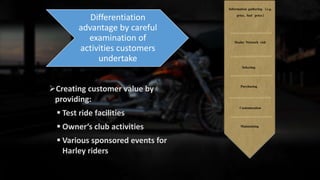
Differentiation
advantage by careful
examination of
activities customers
undertake
Creating customer value by
providing:
 Test ride facilities
 Owner‘s club activities
 Various sponsored events for
Harley riders
Information gathering (e.g.
price, fuel price)
Dealer Network visit
Selecting
Maintaining
Customization
Purchasing
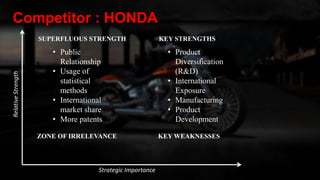
Strategic Importance
RelativeStrength
SUPERFLUOUS STRENGTH KEY STRENGTHS
ZONE OF IRRELEVANCE KEY WEAKNESSES
• Product
Diversification
(R&D)
• International
Exposure
• Manufacturing
• Product
Development
• Public
Relationship
• Usage of
statistical
methods
• International
market share
• More patents
Competitor : HONDA
Establishing competitive advantage
• Harley-Davidson lacks in their resources and capabilities to have cost
advantage over Honda
 low economies of scale and learning curve due to low production
• Differentiation advantage is obtained through brand recognition and
the Harley experience
 providing the customers a unique motorcycle
• However, Harley’s international exposure as a key weakness
demonstrates the inefficient sales in order to sustain their other
resources such as R&D and product diversification.
Mistakes
• Cause of monopoly they became overconfident and they choose
QUALITY of the product became a secondary consideration.
• Harley was aware they would no longer be able to continue their
business at their current production level and operating cost.
• Not able to compete with competitors like Honda cause of their
preference on only cost advantage.
• They were less practical to statistical methods like JIT,KAIZEN.
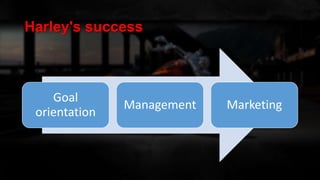
Harley's success
Goal
orientation
Management Marketing
Goal orientation
• Implementation of Umbrella term
• Managers were so focused on their goal of quality of their product,
fostering a climate of continuous improvement without financial
justification.
• One of the important decision was to avoid rigid rules and regulations
to their multiple facilities with diverse manufacturing environment.
• They gave freedom on way of work and principles to everyone which
was drastic shift from white collar to blue collar discrimination in the
American companies at that time.
Continued…
• Employee Involvement Groups (EIG),to solve quality problems
regarding to quality of their products.
• Full-fledged EIG in which training to the employees in problem solving
and also they mainly focused the term quality cause company does
not want to shift the company’s focus from quality to cost reduction.
• Just-In-Time(JIT) , Statistical Operator Control (SOC)-
Quality-improvement program, operate with lower and lower
inventories, concentrating on "setup reduction, focus flow
processing, containerization, parts control and operator preventive
maintenance.
Management
• Harley was very profitable during World War I and World War II, this
status quickly changed during the 1970's.
• Following list of practices which were main contributors to the
problems previously experienced:
 Corporate management focused mostly on short term returns.
 Management did not listen to its employees or give them
responsibility for the quality of what they made.
 Management that woke up too late to the threat of foreign
competition because of the "it can't happen here" syndrome.
• Strong relationships with workers.
Marketing
• Image-
The real power of Harley-Davidson is the power to market to
consumers who love the product.
• Customer Relations-
1 year free membership with Harley Owners Group (HOG),which was
developed in 1983.
They conduct four US national rallies, two touring rallies and 44 state
rallies.
Harley recorded impressive improvements:
1. Inventory turns up from 5 to 20.
2. Inventory levels down 75 %.
3. Percentage of motorcycles coming off the line completed up from 76
% to 99 %.
4. Scrap and rework reduced by 68 %.
5. Productivity up by 50 %.
6. Space requirements down by 25 %.
Presentation on Harley Davidson

Presentation on Harley Davidson

  • 2.
    Submitted By :Roll No. : Rahul Katti E1M - 53 Omkar Temghare E1M - 46 Payal Marathe E1M - 48 Tanuja Jadhav E1M - 35 Kishan Kumar E1M - 38 Submitted to : Dr. Mahesh Mangaonkar
  • 3.
    History • Founded in1903: William Harley and Davidson brothers. • Represents a tradition of US engineering and manufacturing. • Harley-Davidson is a lifestyle people choose. • One of the leading manufacturer in all over world and after world war II , they grabbed opportunity of monopoly. • They had monopoly in motorbikes market due to closure of its main rivals.
  • 4.
    Harley Davidson’s Strategy Accordingto Porter’s Generic Strategies: Harley Davidson’s has a Focus - Differentiation Strategy: differentiate within just one or a small number of target segments Differentiation Focus Focus on Heavyweight market with customers who consider their motorcycle a luxury product.
  • 5.
    Differentiation Strategy • Differentiationbased on customers‘ social and psychologial needs Harley-Davidson is in the business of selling lifestyle, not transportation • Internal and external product integrity – critical factor in such differentiation: Ability of employees and customers to identify with one another e.g.management wearing biking leathers
  • 6.
    Differentiation advantage by careful examinationof activities customers undertake Creating customer value by providing:  Test ride facilities  Owner‘s club activities  Various sponsored events for Harley riders Information gathering (e.g. price, fuel price) Dealer Network visit Selecting Maintaining Customization Purchasing
  • 7.
    Strategic Importance RelativeStrength SUPERFLUOUS STRENGTHKEY STRENGTHS ZONE OF IRRELEVANCE KEY WEAKNESSES • Product Diversification (R&D) • International Exposure • Manufacturing • Product Development • Public Relationship • Usage of statistical methods • International market share • More patents Competitor : HONDA
  • 8.
    Establishing competitive advantage •Harley-Davidson lacks in their resources and capabilities to have cost advantage over Honda  low economies of scale and learning curve due to low production • Differentiation advantage is obtained through brand recognition and the Harley experience  providing the customers a unique motorcycle • However, Harley’s international exposure as a key weakness demonstrates the inefficient sales in order to sustain their other resources such as R&D and product diversification.
  • 9.
    Mistakes • Cause ofmonopoly they became overconfident and they choose QUALITY of the product became a secondary consideration. • Harley was aware they would no longer be able to continue their business at their current production level and operating cost. • Not able to compete with competitors like Honda cause of their preference on only cost advantage. • They were less practical to statistical methods like JIT,KAIZEN.
  • 10.
  • 11.
    Goal orientation • Implementationof Umbrella term • Managers were so focused on their goal of quality of their product, fostering a climate of continuous improvement without financial justification. • One of the important decision was to avoid rigid rules and regulations to their multiple facilities with diverse manufacturing environment. • They gave freedom on way of work and principles to everyone which was drastic shift from white collar to blue collar discrimination in the American companies at that time.
  • 12.
    Continued… • Employee InvolvementGroups (EIG),to solve quality problems regarding to quality of their products. • Full-fledged EIG in which training to the employees in problem solving and also they mainly focused the term quality cause company does not want to shift the company’s focus from quality to cost reduction. • Just-In-Time(JIT) , Statistical Operator Control (SOC)- Quality-improvement program, operate with lower and lower inventories, concentrating on "setup reduction, focus flow processing, containerization, parts control and operator preventive maintenance.
  • 13.
    Management • Harley wasvery profitable during World War I and World War II, this status quickly changed during the 1970's. • Following list of practices which were main contributors to the problems previously experienced:  Corporate management focused mostly on short term returns.  Management did not listen to its employees or give them responsibility for the quality of what they made.  Management that woke up too late to the threat of foreign competition because of the "it can't happen here" syndrome. • Strong relationships with workers.
  • 14.
    Marketing • Image- The realpower of Harley-Davidson is the power to market to consumers who love the product. • Customer Relations- 1 year free membership with Harley Owners Group (HOG),which was developed in 1983. They conduct four US national rallies, two touring rallies and 44 state rallies.
  • 15.
    Harley recorded impressiveimprovements: 1. Inventory turns up from 5 to 20. 2. Inventory levels down 75 %. 3. Percentage of motorcycles coming off the line completed up from 76 % to 99 %. 4. Scrap and rework reduced by 68 %. 5. Productivity up by 50 %. 6. Space requirements down by 25 %.

Editor's Notes

  • #4 So we begin with the History As Harley Davidson Founded in 1903: by William Harley and Davidson brothers. It Represented a tradition of US engineering and manufacturing. Folks, Harley-Davidson known for a lifestyle people choose. As it was One of the leading manufacturer in all over the world and especially after world war II , they grabbed opportunity of monopoly in US. And the reason behind They had monopoly in motorbikes market due to closure of its main rivals.
  • #5 Here is couple of Harley Davidson’s Strategies which leads them to success According to Porter’s Generic Strategies: Harley Davidson’s follows Differentiation Strategy: As They differentiate within just one or a small number of target segments And they also Focus on Heavyweight market with customers who consider their motorcycle a luxury product.
  • #6 Talking more about Differentiation Strategy Their Differentiation actuly based on customers‘ social and psychologial needs As it was considered at that time that Harley-Davidson is in the business of selling lifestyle, not transportation And they had also Internal and external product integrity – which was really a critical factor in such differentiation: And under this they worked on the Ability of employees and customers to identify with one another
  • #12 An umbrella term is a word or phrase that covers a broad interval or set of functions or items that all fall under a single common category. Management must be firmly committed to the people-building philosophy-that is, the belief that employees are thinking, rational human beings and therefore should be encouraged to develop and grow. . Individual employees must help each other develop and grow. Employees must attack problems, not each other-that is, there must be no finger-pointing when things go wrong. Creativity must continuously be encouraged through a free, non-threatening atmosphere.
  • #13 All management must be totally committed to the EI program and by demonstrating that commitment foster a mutual trust between employees and management. Employees must be thoroughly trained in specific problem-solving and quality-control techniques Managers must encourage participation from everyone. Employees must be given responsibility and authority for production, quality, preventive maintenance, and other aspects of their jobs.