Prior to 1920
0 Post-Civil War: waves of South-to-North immigration
   0 especially after Plessy v. Ferguson (1896)
   0 The Great Migration
0 African Americans were already living in NYC:
   0 Mid-1800s: SoHo area
   0 Late 1800s: Greenwich Village
   0 1890s: West 20s and 30s
   0 1900s: West 50s, begin move into Harlem
0 Harlem in 1900:
   0 Overzealous housing development (for white workers)
   0 Subway hasn’t fully arrived, especially on the east side
   0 African-American migration begins on the east side, moves west
   0 From 1900-1920, the number of blacks living in Harlem doubles
Harlem in 1920
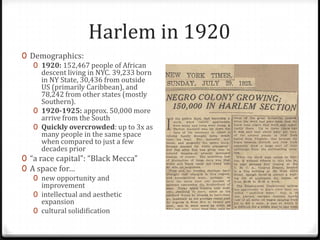
0 Demographics:
   0 1920: 152,467 people of African
     descent living in NYC. 39,233 born
     in NY State, 30,436 from outside
     US (primarily Caribbean), and
     78,242 from other states (mostly
     Southern).
   0 1920-1925: approx. 50,000 more
     arrive from the South
   0 Quickly overcrowded: up to 3x as
     many people in the same space
     when compared to just a few
     decades prior
0 “a race capital”: “Black Mecca”
0 A space for…
   0 new opportunity and
     improvement
   0 intellectual and aesthetic
     expansion
   0 cultural solidification
Segregation in 1920s Harlem
0 “Irrational distinctions” in terms of
  employment
0 one-drop rule
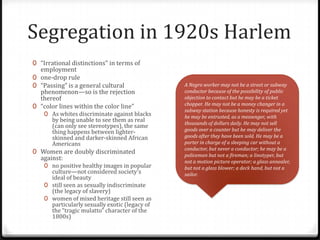
0 “Passing” is a general cultural               A Negro worker may not be a street or subway
  phenomenon—so is the rejection                conductor because of the possibility of public
  thereof                                       objection to contact but he may be a ticket
                                                chopper. He may not be a money changer in a
0 “color lines within the color line”
                                                subway station because honesty is required yet
    0 As whites discriminate against blacks     he may be entrusted, as a messenger, with
       by being unable to see them as real      thousands of dollars daily. He may not sell
       (can only see stereotypes), the same
       thing happens between lighter-           goods over a counter but he may deliver the
       skinned and darker-skinned African       goods after they have been sold. He may be a
       Americans                                porter in charge of a sleeping car without a
                                                conductor, but never a conductor; he may be a
0 Women are doubly discriminated
                                                policeman but not a fireman; a linotyper, but
  against:                                      not a motion picture operator; a glass annealer,
    0 no positive healthy images in popular     but not a glass blower; a deck hand, but not a
      culture—not considered society’s          sailor.
      ideal of beauty
    0 still seen as sexually indiscriminate
      (the legacy of slavery)
    0 women of mixed heritage still seen as
      particularly sexually exotic (legacy of
      the “tragic mulatto” character of the
      1800s)
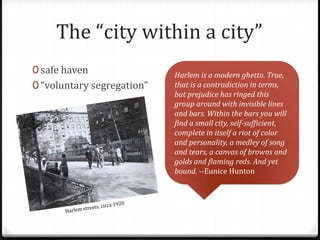
The “city within a city”
0 safe haven                Harlem is a modern ghetto. True,
0 “voluntary segregation”   that is a contradiction in terms,
                            but prejudice has ringed this
                            group around with invisible lines
                            and bars. Within the bars you will
                            find a small city, self-sufficient,
                            complete in itself a riot of color
                            and personality, a medley of song
                            and tears, a canvas of browns and
                            golds and flaming reds. And yet
                            bound. --Eunice Hunton
Talking About Race in the 1920s
0 Race as a global idea
   0 West Indians had historically played a big role in
     cultural development
   0 Cultural divide between Southern migrants and
     Caribbean immigrants
   0 The question of Africa: how to relate to that land and its
     peoples
0 Reestablishing an African-American past
   0 Schomburg: “reclaimed background”
0 Art, Music, Performance: a means of agitating for
  equality, progress (ex: Paul Robeson)
How can we fix the social and
economic damages of slavery?
 0 “Each one teach one”
 0 Being a breakthrough person, a “first,” doesn’t guarantee a
   sustained future for others (will there be a “second”?)
 0 Booker T. Washington—industrial education/skills
   development
 0 W.E.B. DuBois—“Talented Tenth”: (essay, 1903) 1 in 10
   black men may become leaders. Should have a classical
   (not industrial) education in order to ensure that they do.
 0 Marcus Garvey, “Back to Africa” movement. Reunite all
   people of African ancestry into one community with one
   absolute government
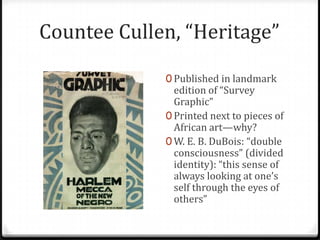
Countee Cullen, “Heritage”

             0 Published in landmark
               edition of “Survey
               Graphic”
             0 Printed next to pieces of
               African art—why?
             0 W. E. B. DuBois: “double
               consciousness” (divided
               identity): “this sense of
               always looking at one’s
               self through the eyes of
               others”
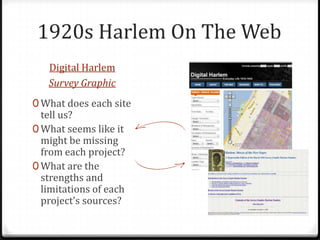
1920s Harlem On The Web
   Digital Harlem
   Survey Graphic
0 What does each site
  tell us?
0 What seems like it
  might be missing
  from each project?
0 What are the
  strengths and
  limitations of each
  project’s sources?
Jazz
0 Divisive new sound
   0 as culturally disruptive as Modernism was
   0 musically fragmented, draws upon primitivism
0 Prohibition + segregation results in some very strange
  combinations:
   0 Cotton Club: African-American performers, white patrons
      0 Going to jazz clubs in Harlem was the “hip” thing to do—“edgy”
0 1st unique American musical sound for export
   0 Roots in African-American folk culture, Creole culture of New
      Orleans, city sounds
   0 Risqué, explicitly sexual
   0 Rogers: Musically jazz has a great future. It is rapidly being
      sublimated.
Theorizing Jazz
                                          Jazz is a good barometer of
The jazz spirit, being primitive,
                                          freedom. In its beginnings, the
demands more frankness and
                                          United States spawned certain
sincerity. Just as it already has
                                          ideals of freedom and independence
done in art and music, so
                                          through which, eventually, jazz was
eventually in human relations
                                          evolved, and the music is so free
and social manners, it will no
                                          that many people say it is the only
doubt have the effect of putting
                                          unhampered, unhindered
more reality in life by taking
                                          expression of complete freedom yet
some of the needless artificiality
                                          produced in this country. —
out. —Rogers
                                          Ellington


                     Duke Ellington and His Cotton Club
                     Orchestra, 1928: “The Mooche”

Harlem Renaissance (Revised Spring 2013)

  • 2.
    Prior to 1920 0Post-Civil War: waves of South-to-North immigration 0 especially after Plessy v. Ferguson (1896) 0 The Great Migration 0 African Americans were already living in NYC: 0 Mid-1800s: SoHo area 0 Late 1800s: Greenwich Village 0 1890s: West 20s and 30s 0 1900s: West 50s, begin move into Harlem 0 Harlem in 1900: 0 Overzealous housing development (for white workers) 0 Subway hasn’t fully arrived, especially on the east side 0 African-American migration begins on the east side, moves west 0 From 1900-1920, the number of blacks living in Harlem doubles
  • 3.
    Harlem in 1920 0Demographics: 0 1920: 152,467 people of African descent living in NYC. 39,233 born in NY State, 30,436 from outside US (primarily Caribbean), and 78,242 from other states (mostly Southern). 0 1920-1925: approx. 50,000 more arrive from the South 0 Quickly overcrowded: up to 3x as many people in the same space when compared to just a few decades prior 0 “a race capital”: “Black Mecca” 0 A space for… 0 new opportunity and improvement 0 intellectual and aesthetic expansion 0 cultural solidification
  • 4.
    Segregation in 1920sHarlem 0 “Irrational distinctions” in terms of employment 0 one-drop rule 0 “Passing” is a general cultural A Negro worker may not be a street or subway phenomenon—so is the rejection conductor because of the possibility of public thereof objection to contact but he may be a ticket chopper. He may not be a money changer in a 0 “color lines within the color line” subway station because honesty is required yet 0 As whites discriminate against blacks he may be entrusted, as a messenger, with by being unable to see them as real thousands of dollars daily. He may not sell (can only see stereotypes), the same thing happens between lighter- goods over a counter but he may deliver the skinned and darker-skinned African goods after they have been sold. He may be a Americans porter in charge of a sleeping car without a conductor, but never a conductor; he may be a 0 Women are doubly discriminated policeman but not a fireman; a linotyper, but against: not a motion picture operator; a glass annealer, 0 no positive healthy images in popular but not a glass blower; a deck hand, but not a culture—not considered society’s sailor. ideal of beauty 0 still seen as sexually indiscriminate (the legacy of slavery) 0 women of mixed heritage still seen as particularly sexually exotic (legacy of the “tragic mulatto” character of the 1800s)
  • 5.
    The “city withina city” 0 safe haven Harlem is a modern ghetto. True, 0 “voluntary segregation” that is a contradiction in terms, but prejudice has ringed this group around with invisible lines and bars. Within the bars you will find a small city, self-sufficient, complete in itself a riot of color and personality, a medley of song and tears, a canvas of browns and golds and flaming reds. And yet bound. --Eunice Hunton
  • 6.
    Talking About Racein the 1920s 0 Race as a global idea 0 West Indians had historically played a big role in cultural development 0 Cultural divide between Southern migrants and Caribbean immigrants 0 The question of Africa: how to relate to that land and its peoples 0 Reestablishing an African-American past 0 Schomburg: “reclaimed background” 0 Art, Music, Performance: a means of agitating for equality, progress (ex: Paul Robeson)
  • 7.
    How can wefix the social and economic damages of slavery? 0 “Each one teach one” 0 Being a breakthrough person, a “first,” doesn’t guarantee a sustained future for others (will there be a “second”?) 0 Booker T. Washington—industrial education/skills development 0 W.E.B. DuBois—“Talented Tenth”: (essay, 1903) 1 in 10 black men may become leaders. Should have a classical (not industrial) education in order to ensure that they do. 0 Marcus Garvey, “Back to Africa” movement. Reunite all people of African ancestry into one community with one absolute government
  • 8.
    Countee Cullen, “Heritage” 0 Published in landmark edition of “Survey Graphic” 0 Printed next to pieces of African art—why? 0 W. E. B. DuBois: “double consciousness” (divided identity): “this sense of always looking at one’s self through the eyes of others”
  • 9.
    1920s Harlem OnThe Web Digital Harlem Survey Graphic 0 What does each site tell us? 0 What seems like it might be missing from each project? 0 What are the strengths and limitations of each project’s sources?
  • 10.
    Jazz 0 Divisive newsound 0 as culturally disruptive as Modernism was 0 musically fragmented, draws upon primitivism 0 Prohibition + segregation results in some very strange combinations: 0 Cotton Club: African-American performers, white patrons 0 Going to jazz clubs in Harlem was the “hip” thing to do—“edgy” 0 1st unique American musical sound for export 0 Roots in African-American folk culture, Creole culture of New Orleans, city sounds 0 Risqué, explicitly sexual 0 Rogers: Musically jazz has a great future. It is rapidly being sublimated.
  • 11.
    Theorizing Jazz Jazz is a good barometer of The jazz spirit, being primitive, freedom. In its beginnings, the demands more frankness and United States spawned certain sincerity. Just as it already has ideals of freedom and independence done in art and music, so through which, eventually, jazz was eventually in human relations evolved, and the music is so free and social manners, it will no that many people say it is the only doubt have the effect of putting unhampered, unhindered more reality in life by taking expression of complete freedom yet some of the needless artificiality produced in this country. — out. —Rogers Ellington Duke Ellington and His Cotton Club Orchestra, 1928: “The Mooche”