Lindsey M. Freer
The City University of NewYork
May 2014
1. Intro: Making InstructionalTechWork For A
Decentralized Urban University
2. Establishing A Campus-Wide Presence
a) Cross-campus collaboration
b) Awareness of technological change
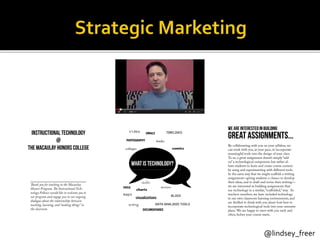
c) Strategic marketing
3. Collaborating With Faculty
a) Assessing faculty requests
b) Facilitating connections
3. Making InTRO Sustainable
a) What success looks like
b) Data collection, evaluation, reporting
4. Conclusion:TransferrableValues
@lindsey_freer
Part 1 of 5 @lindsey_freer
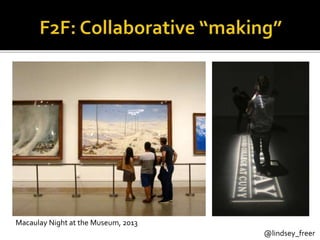
Macaulay Night at the Museum, 2013
Part 1 of 5 @lindsey_freer
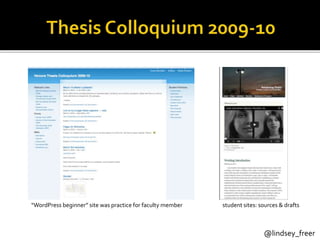
“WordPress beginner” site was practice for faculty member student sites: sources & drafts
2009 2010
Part 1 of 5 @lindsey_freer
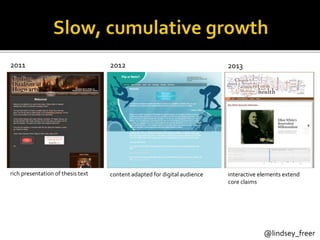
201320122011
rich presentation of thesis text content adapted for digital audience interactive elements extend
core claims
Part 1 of 5 @lindsey_freer
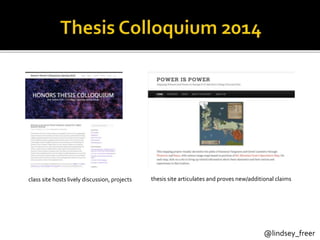
class site hosts lively discussion, projects thesis site articulates and proves new/additional claims
Part 1 of 5 @lindsey_freer
• Use open-source & open
access tools
• Focus on UX & process-
oriented pedagogy
• Success is iterative
• Collaboration is
essential
• Be willing to experiment
STAY INTOUCH
 lindsey.freer@gmail.com
 @lindsey_freer
 http://lfreer.net/
ACKNOWLEDGEMENTS
 Past and present colleagues at the
Macaulay Honors College, CUNY, with
special thanks to Jill Belli, Jen Corby,
Jeff Drouin, Karen Gregory, Jenny
Kijowski, Lauren Klein, Ben Miller,
Emily Sherwood, John Sorrentino, and
KaraVan Cleaf
 Mentors AmmielAlcalay, Lee Quinby,
Joseph Ugoretz, and Margaret
Vandenburg
 Faculty and fellow students of the
English PhD Program at theCUNY
Graduate Center
 All my wonderful undergraduate
students!

InTRO Program Manager Presentation

  • 1.
    Lindsey M. Freer TheCity University of NewYork May 2014
  • 2.
    1. Intro: MakingInstructionalTechWork For A Decentralized Urban University 2. Establishing A Campus-Wide Presence a) Cross-campus collaboration b) Awareness of technological change c) Strategic marketing 3. Collaborating With Faculty a) Assessing faculty requests b) Facilitating connections 3. Making InTRO Sustainable a) What success looks like b) Data collection, evaluation, reporting 4. Conclusion:TransferrableValues
  • 3.
  • 4.
    Part 1 of5 @lindsey_freer Macaulay Night at the Museum, 2013
  • 5.
    Part 1 of5 @lindsey_freer
  • 6.
    Part 1 of5 @lindsey_freer
  • 7.
    Part 1 of5 @lindsey_freer
  • 8.
    Part 1 of5 @lindsey_freer
  • 9.
    Part 1 of5 @lindsey_freer
  • 10.
    Part 1 of5 @lindsey_freer
  • 11.
    Part 1 of5 @lindsey_freer
  • 12.
    Part 1 of5 @lindsey_freer “WordPress beginner” site was practice for faculty member student sites: sources & drafts 2009 2010
  • 13.
    Part 1 of5 @lindsey_freer 201320122011 rich presentation of thesis text content adapted for digital audience interactive elements extend core claims
  • 14.
    Part 1 of5 @lindsey_freer class site hosts lively discussion, projects thesis site articulates and proves new/additional claims
  • 15.
    Part 1 of5 @lindsey_freer
  • 16.
    Part 1 of5 @lindsey_freer • Use open-source & open access tools • Focus on UX & process- oriented pedagogy • Success is iterative • Collaboration is essential • Be willing to experiment
  • 17.
    STAY INTOUCH  lindsey.freer@gmail.com @lindsey_freer  http://lfreer.net/ ACKNOWLEDGEMENTS  Past and present colleagues at the Macaulay Honors College, CUNY, with special thanks to Jill Belli, Jen Corby, Jeff Drouin, Karen Gregory, Jenny Kijowski, Lauren Klein, Ben Miller, Emily Sherwood, John Sorrentino, and KaraVan Cleaf  Mentors AmmielAlcalay, Lee Quinby, Joseph Ugoretz, and Margaret Vandenburg  Faculty and fellow students of the English PhD Program at theCUNY Graduate Center  All my wonderful undergraduate students!

Editor's Notes

  • #3 First two pieces of this talk are broad, meant to generate a cultural context in which the final three pieces can be discussed.
  • #4 Working hypothesis: Present-day mainstream American understanding of “failure” as a concept is more personal than institutional. This perpetuates a misunderstanding of the nation as meritocratic. Experiment: 2 keyword searches in the Books section of Amazon.com, “fail” and “failure” Why Amazon.com? Digital Wal-Mart: ubiquitous presence, panoply of items In favor among the upwardly mobile, largely employs the working poor Emphasis on economy—price of item always compared to (generally lower) than retail price, sense that you “got a bargain” In both searches, I compared the first twenty-five results Sorted those results by “relevance” (presence of keyword) and “popularity,” but there wasn’t a significant difference in what items showed up.
  • #5 Working hypothesis: Present-day mainstream American understanding of “failure” as a concept is more personal than institutional. This perpetuates a misunderstanding of the nation as meritocratic. Experiment: 2 keyword searches in the Books section of Amazon.com, “fail” and “failure” Why Amazon.com? Digital Wal-Mart: ubiquitous presence, panoply of items In favor among the upwardly mobile, largely employs the working poor Emphasis on economy—price of item always compared to (generally lower) than retail price, sense that you “got a bargain” In both searches, I compared the first twenty-five results Sorted those results by “relevance” (presence of keyword) and “popularity,” but there wasn’t a significant difference in what items showed up.
  • #6 Working hypothesis: Present-day mainstream American understanding of “failure” as a concept is more personal than institutional. This perpetuates a misunderstanding of the nation as meritocratic. Experiment: 2 keyword searches in the Books section of Amazon.com, “fail” and “failure” Why Amazon.com? Digital Wal-Mart: ubiquitous presence, panoply of items In favor among the upwardly mobile, largely employs the working poor Emphasis on economy—price of item always compared to (generally lower) than retail price, sense that you “got a bargain” In both searches, I compared the first twenty-five results Sorted those results by “relevance” (presence of keyword) and “popularity,” but there wasn’t a significant difference in what items showed up.
  • #7 Working hypothesis: Present-day mainstream American understanding of “failure” as a concept is more personal than institutional. This perpetuates a misunderstanding of the nation as meritocratic. Experiment: 2 keyword searches in the Books section of Amazon.com, “fail” and “failure” Why Amazon.com? Digital Wal-Mart: ubiquitous presence, panoply of items In favor among the upwardly mobile, largely employs the working poor Emphasis on economy—price of item always compared to (generally lower) than retail price, sense that you “got a bargain” In both searches, I compared the first twenty-five results Sorted those results by “relevance” (presence of keyword) and “popularity,” but there wasn’t a significant difference in what items showed up.
  • #8 Working hypothesis: Present-day mainstream American understanding of “failure” as a concept is more personal than institutional. This perpetuates a misunderstanding of the nation as meritocratic. Experiment: 2 keyword searches in the Books section of Amazon.com, “fail” and “failure” Why Amazon.com? Digital Wal-Mart: ubiquitous presence, panoply of items In favor among the upwardly mobile, largely employs the working poor Emphasis on economy—price of item always compared to (generally lower) than retail price, sense that you “got a bargain” In both searches, I compared the first twenty-five results Sorted those results by “relevance” (presence of keyword) and “popularity,” but there wasn’t a significant difference in what items showed up.
  • #9 Working hypothesis: Present-day mainstream American understanding of “failure” as a concept is more personal than institutional. This perpetuates a misunderstanding of the nation as meritocratic. Experiment: 2 keyword searches in the Books section of Amazon.com, “fail” and “failure” Why Amazon.com? Digital Wal-Mart: ubiquitous presence, panoply of items In favor among the upwardly mobile, largely employs the working poor Emphasis on economy—price of item always compared to (generally lower) than retail price, sense that you “got a bargain” In both searches, I compared the first twenty-five results Sorted those results by “relevance” (presence of keyword) and “popularity,” but there wasn’t a significant difference in what items showed up.
  • #10 Working hypothesis: Present-day mainstream American understanding of “failure” as a concept is more personal than institutional. This perpetuates a misunderstanding of the nation as meritocratic. Experiment: 2 keyword searches in the Books section of Amazon.com, “fail” and “failure” Why Amazon.com? Digital Wal-Mart: ubiquitous presence, panoply of items In favor among the upwardly mobile, largely employs the working poor Emphasis on economy—price of item always compared to (generally lower) than retail price, sense that you “got a bargain” In both searches, I compared the first twenty-five results Sorted those results by “relevance” (presence of keyword) and “popularity,” but there wasn’t a significant difference in what items showed up.
  • #11 Working hypothesis: Present-day mainstream American understanding of “failure” as a concept is more personal than institutional. This perpetuates a misunderstanding of the nation as meritocratic. Experiment: 2 keyword searches in the Books section of Amazon.com, “fail” and “failure” Why Amazon.com? Digital Wal-Mart: ubiquitous presence, panoply of items In favor among the upwardly mobile, largely employs the working poor Emphasis on economy—price of item always compared to (generally lower) than retail price, sense that you “got a bargain” In both searches, I compared the first twenty-five results Sorted those results by “relevance” (presence of keyword) and “popularity,” but there wasn’t a significant difference in what items showed up.
  • #12 Working hypothesis: Present-day mainstream American understanding of “failure” as a concept is more personal than institutional. This perpetuates a misunderstanding of the nation as meritocratic. Experiment: 2 keyword searches in the Books section of Amazon.com, “fail” and “failure” Why Amazon.com? Digital Wal-Mart: ubiquitous presence, panoply of items In favor among the upwardly mobile, largely employs the working poor Emphasis on economy—price of item always compared to (generally lower) than retail price, sense that you “got a bargain” In both searches, I compared the first twenty-five results Sorted those results by “relevance” (presence of keyword) and “popularity,” but there wasn’t a significant difference in what items showed up.
  • #13 Working hypothesis: Present-day mainstream American understanding of “failure” as a concept is more personal than institutional. This perpetuates a misunderstanding of the nation as meritocratic. Experiment: 2 keyword searches in the Books section of Amazon.com, “fail” and “failure” Why Amazon.com? Digital Wal-Mart: ubiquitous presence, panoply of items In favor among the upwardly mobile, largely employs the working poor Emphasis on economy—price of item always compared to (generally lower) than retail price, sense that you “got a bargain” In both searches, I compared the first twenty-five results Sorted those results by “relevance” (presence of keyword) and “popularity,” but there wasn’t a significant difference in what items showed up.
  • #14 Working hypothesis: Present-day mainstream American understanding of “failure” as a concept is more personal than institutional. This perpetuates a misunderstanding of the nation as meritocratic. Experiment: 2 keyword searches in the Books section of Amazon.com, “fail” and “failure” Why Amazon.com? Digital Wal-Mart: ubiquitous presence, panoply of items In favor among the upwardly mobile, largely employs the working poor Emphasis on economy—price of item always compared to (generally lower) than retail price, sense that you “got a bargain” In both searches, I compared the first twenty-five results Sorted those results by “relevance” (presence of keyword) and “popularity,” but there wasn’t a significant difference in what items showed up.
  • #15 Working hypothesis: Present-day mainstream American understanding of “failure” as a concept is more personal than institutional. This perpetuates a misunderstanding of the nation as meritocratic. Experiment: 2 keyword searches in the Books section of Amazon.com, “fail” and “failure” Why Amazon.com? Digital Wal-Mart: ubiquitous presence, panoply of items In favor among the upwardly mobile, largely employs the working poor Emphasis on economy—price of item always compared to (generally lower) than retail price, sense that you “got a bargain” In both searches, I compared the first twenty-five results Sorted those results by “relevance” (presence of keyword) and “popularity,” but there wasn’t a significant difference in what items showed up.
  • #16 Working hypothesis: Present-day mainstream American understanding of “failure” as a concept is more personal than institutional. This perpetuates a misunderstanding of the nation as meritocratic. Experiment: 2 keyword searches in the Books section of Amazon.com, “fail” and “failure” Why Amazon.com? Digital Wal-Mart: ubiquitous presence, panoply of items In favor among the upwardly mobile, largely employs the working poor Emphasis on economy—price of item always compared to (generally lower) than retail price, sense that you “got a bargain” In both searches, I compared the first twenty-five results Sorted those results by “relevance” (presence of keyword) and “popularity,” but there wasn’t a significant difference in what items showed up.
  • #17 Working hypothesis: Present-day mainstream American understanding of “failure” as a concept is more personal than institutional. This perpetuates a misunderstanding of the nation as meritocratic. Experiment: 2 keyword searches in the Books section of Amazon.com, “fail” and “failure” Why Amazon.com? Digital Wal-Mart: ubiquitous presence, panoply of items In favor among the upwardly mobile, largely employs the working poor Emphasis on economy—price of item always compared to (generally lower) than retail price, sense that you “got a bargain” In both searches, I compared the first twenty-five results Sorted those results by “relevance” (presence of keyword) and “popularity,” but there wasn’t a significant difference in what items showed up.