HUM16 Arts &
Ideas: American
Culture
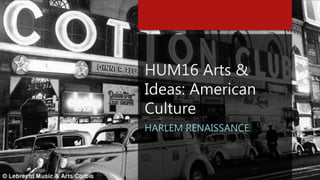
HARLEM RENAISSANCE
1. What is the Harlem Renaissance?
 When: 1920s-1930s
 I.e., End of WWI – mid-Depression
era
 Where: Harlem (neighborhood in
Manhattan – New York City)
 Had become primarily Af.-Am.
 What: burgeoning art culture among
Af-Am community in Harlem
 Why: Great Migration; Red Summer
Great Migration: period of time when many Af-Am
people from the South moved North to escape Jim
Crow, gain economic opportunities in cities like
New York, Detroit, & Chicago
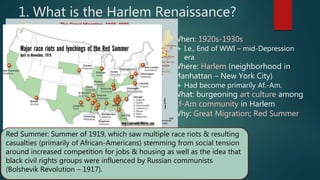
Red Summer: Summer of 1919, which saw multiple race riots & resulting
casualties (primarily of African-Americans) stemming from social tension
around increased competition for jobs & housing as well as the idea that
black civil rights groups were influenced by Russian communists
(Bolshevik Revolution – 1917).
2. Characteristics & Scope
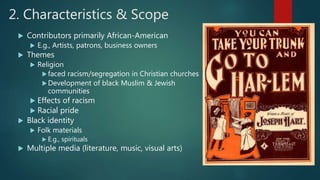
 Contributors primarily African-American
 E.g., Artists, patrons, business owners
 Themes
 Religion
faced racism/segregation in Christian churches
Development of black Muslim & Jewish
communities
 Effects of racism
 Racial pride
 Black identity
 Folk materials
 E.g., spirituals
 Multiple media (literature, music, visual arts)
 Innovation
 Development & popularity of jazz:
integration of blues, strong brass
instrumentation (Southern – New
Orleans); swing notes / syncopated
rhythm
 Redefinition of what it meant to be African-
American
Self-determination
 "Sometimes I feel discriminated against, but it
does not make me angry. It merely astonishes
me. How can anyone deny themselves the
pleasure of my company? It's beyond me.” –
Zora Neale Hurston
3. Lasting Influence
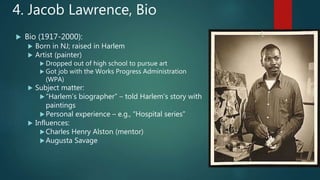
4. Jacob Lawrence, Bio
 Bio (1917-2000):
 Born in NJ; raised in Harlem
 Artist (painter)
 Dropped out of high school to pursue art
 Got job with the Works Progress Administration
(WPA)
 Subject matter:
“Harlem’s biographer” – told Harlem’s story with
paintings
Personal experience – e.g., “Hospital series”
 Influences:
Charles Henry Alston (mentor)
Augusta Savage
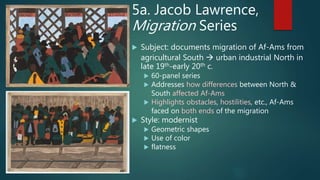
5a. Jacob Lawrence,
Migration Series
 Subject: documents migration of Af-Ams from
agricultural South  urban industrial North in
late 19th-early 20th c.
 60-panel series
 Addresses how differences between North &
South affected Af-Ams
 Highlights obstacles, hostilities, etc., Af-Ams
faced on both ends of the migration
 Style: modernist
 Geometric shapes
 Use of color
 flatness
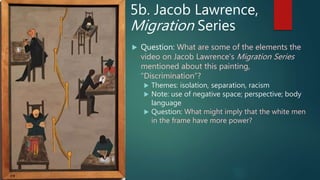
5b. Jacob Lawrence,
Migration Series
 Question: What are some of the elements the
video on Jacob Lawrence’s Migration Series
mentioned about this painting,
“Discrimination”?
 Themes: isolation, separation, racism
 Note: use of negative space; perspective; body
language
 Question: What might imply that the white men
in the frame have more power?
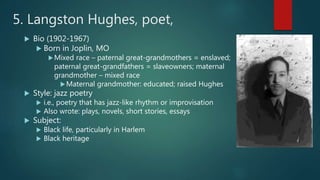
5. Langston Hughes, poet,
 Bio (1902-1967)
 Born in Joplin, MO
Mixed race – paternal great-grandmothers = enslaved;
paternal great-grandfathers = slaveowners; maternal
grandmother – mixed race
Maternal grandmother: educated; raised Hughes
 Style: jazz poetry
 i.e., poetry that has jazz-like rhythm or improvisation
 Also wrote: plays, novels, short stories, essays
 Subject:
 Black life, particularly in Harlem
 Black heritage
6. “The Negro Speaks
of Rivers” (1919)
To listen to Langston Hughes read his
poem, click here.
I've known rivers:
I've known rivers ancient as the world and older
than the
flow of human blood in human veins.
My soul has grown deep like the rivers.
I bathed in the Euphrates when dawns were
young.
I built my hut near the Congo and it lulled me to
sleep.
I looked upon the Nile and raised the pyramids
above it.
I heard the singing of the Mississippi when Abe
Lincoln
went down to New Orleans, and I've seen its
muddy
bosom turn all golden in the sunset.
I've known rivers:
Ancient, dusky rivers.
My soul has grown deep like the rivers.
Questions:
•What is the tone or mood of
this poem?
•Why do you think the poem
was written and for what
audience?
•List two things in this poem
that tell you about life in the
United States at the time.
I, too, sing America.
I am the darker brother.
They send me to eat in the kitchen
When company comes,
But I laugh,
And eat well,
And grow strong.
Tomorrow,
I'll be at the table
When company comes.
Nobody'll dare
Say to me,
"Eat in the kitchen,“
Then.
Besides,
They'll see how beautiful I am
And be ashamed--
I, too, am America.
7. I, too, sing America
(1920s)
To listen to Langston Hughes read his
poem, click here.
Questions:
•What is the tone or mood of
this poem?
•Why do you think the poem
was written and for what
audience?
•List two things in this poem
that tell you about life in the
United States at the time.
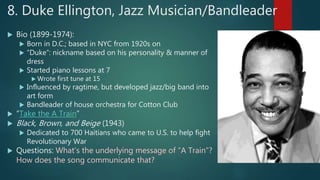
8. Duke Ellington, Jazz Musician/Bandleader
 Bio (1899-1974):
 Born in D.C.; based in NYC from 1920s on
 “Duke”: nickname based on his personality & manner of
dress
 Started piano lessons at 7
 Wrote first tune at 15
 Influenced by ragtime, but developed jazz/big band into
art form
 Bandleader of house orchestra for Cotton Club
 “Take the A Train”
 Black, Brown, and Beige (1943)
 Dedicated to 700 Haitians who came to U.S. to help fight
Revolutionary War
 Questions: What’s the underlying message of “A Train”?
How does the song communicate that?
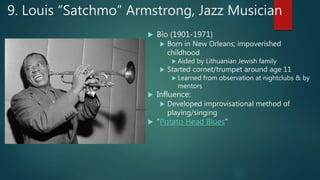
9. Louis “Satchmo” Armstrong, Jazz Musician
 Bio (1901-1971)
 Born in New Orleans; impoverished
childhood
 Aided by Lithuanian Jewish family
 Started cornet/trumpet around age 11
 Learned from observation at nightclubs & by
mentors
 Influence:
 Developed improvisational method of
playing/singing
 “Potato Head Blues”
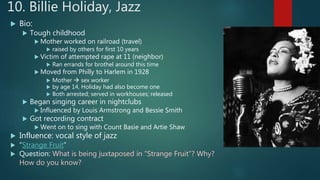
10. Billie Holiday, Jazz
 Bio:
 Tough childhood
 Mother worked on railroad (travel)
 raised by others for first 10 years
 Victim of attempted rape at 11 (neighbor)
 Ran errands for brothel around this time
 Moved from Philly to Harlem in 1928
 Mother  sex worker
 by age 14, Holiday had also become one
 Both arrested; served in workhouses; released
 Began singing career in nightclubs
 Influenced by Louis Armstrong and Bessie Smith
 Got recording contract
 Went on to sing with Count Basie and Artie Shaw
 Influence: vocal style of jazz
 “Strange Fruit”
 Question: What is being juxtaposed in “Strange Fruit”? Why?
How do you know?
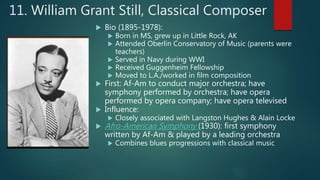
11. William Grant Still, Classical Composer
 Bio (1895-1978):
 Born in MS, grew up in Little Rock, AK
 Attended Oberlin Conservatory of Music (parents were
teachers)
 Served in Navy during WWI
 Received Guggenheim Fellowship
 Moved to L.A./worked in film composition
 First: Af-Am to conduct major orchestra; have
symphony performed by orchestra; have opera
performed by opera company; have opera televised
 Influence:
 Closely associated with Langston Hughes & Alain Locke
 Afro-American Symphony (1930): first symphony
written by Af-Am & played by a leading orchestra
 Combines blues progressions with classical music
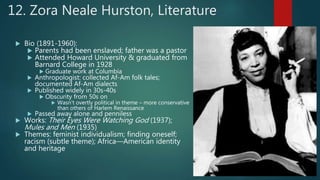
12. Zora Neale Hurston, Literature
 Bio (1891-1960):
 Parents had been enslaved; father was a pastor
 Attended Howard University & graduated from
Barnard College in 1928
 Graduate work at Columbia
 Anthropologist: collected Af-Am folk tales;
documented Af-Am dialects
 Published widely in 30s-40s
 Obscurity from 50s on
 Wasn’t overtly political in theme – more conservative
than others of Harlem Renaissance
 Passed away alone and penniless
 Works: Their Eyes Were Watching God (1937);
Mules and Men (1935)
 Themes: feminist individualism; finding oneself;
racism (subtle theme); Africa—American identity
and heritage
13. Augusta Savage, Sculptor
 Bio (1892-1962):
 Born in Florida to large family; father = Methodist
minister
 Started sculpting with local clay when she was a child
 Father didn’t approve
 Attended Cooper Union (NYC)
 Remained in NYC  Harlem
 Applied for art program in France (1923)
 Rejected because of her race  call to action
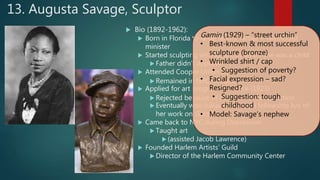
 Eventually won Julius Rosenwald fellowship b/c of
her work on Gamin
 Came back to NYC during Depression
 Taught art
 (assisted Jacob Lawrence)
 Founded Harlem Artists’ Guild
 Director of the Harlem Community Center
Gamin (1929) – “street urchin”
• Best-known & most successful
sculpture (bronze)
• Wrinkled shirt / cap
• Suggestion of poverty?
• Facial expression – sad?
Resigned?
• Suggestion: tough
childhood
• Model: Savage’s nephew

HUM16: Harlem Renaissance

  • 1.
    HUM16 Arts & Ideas:American Culture HARLEM RENAISSANCE
  • 2.
    1. What isthe Harlem Renaissance?  When: 1920s-1930s  I.e., End of WWI – mid-Depression era  Where: Harlem (neighborhood in Manhattan – New York City)  Had become primarily Af.-Am.  What: burgeoning art culture among Af-Am community in Harlem  Why: Great Migration; Red Summer Great Migration: period of time when many Af-Am people from the South moved North to escape Jim Crow, gain economic opportunities in cities like New York, Detroit, & Chicago Red Summer: Summer of 1919, which saw multiple race riots & resulting casualties (primarily of African-Americans) stemming from social tension around increased competition for jobs & housing as well as the idea that black civil rights groups were influenced by Russian communists (Bolshevik Revolution – 1917).
  • 3.
    2. Characteristics &Scope  Contributors primarily African-American  E.g., Artists, patrons, business owners  Themes  Religion faced racism/segregation in Christian churches Development of black Muslim & Jewish communities  Effects of racism  Racial pride  Black identity  Folk materials  E.g., spirituals  Multiple media (literature, music, visual arts)
  • 4.
     Innovation  Development& popularity of jazz: integration of blues, strong brass instrumentation (Southern – New Orleans); swing notes / syncopated rhythm  Redefinition of what it meant to be African- American Self-determination  "Sometimes I feel discriminated against, but it does not make me angry. It merely astonishes me. How can anyone deny themselves the pleasure of my company? It's beyond me.” – Zora Neale Hurston 3. Lasting Influence
  • 5.
    4. Jacob Lawrence,Bio  Bio (1917-2000):  Born in NJ; raised in Harlem  Artist (painter)  Dropped out of high school to pursue art  Got job with the Works Progress Administration (WPA)  Subject matter: “Harlem’s biographer” – told Harlem’s story with paintings Personal experience – e.g., “Hospital series”  Influences: Charles Henry Alston (mentor) Augusta Savage
  • 6.
    5a. Jacob Lawrence, MigrationSeries  Subject: documents migration of Af-Ams from agricultural South  urban industrial North in late 19th-early 20th c.  60-panel series  Addresses how differences between North & South affected Af-Ams  Highlights obstacles, hostilities, etc., Af-Ams faced on both ends of the migration  Style: modernist  Geometric shapes  Use of color  flatness
  • 7.
    5b. Jacob Lawrence, MigrationSeries  Question: What are some of the elements the video on Jacob Lawrence’s Migration Series mentioned about this painting, “Discrimination”?  Themes: isolation, separation, racism  Note: use of negative space; perspective; body language  Question: What might imply that the white men in the frame have more power?
  • 8.
    5. Langston Hughes,poet,  Bio (1902-1967)  Born in Joplin, MO Mixed race – paternal great-grandmothers = enslaved; paternal great-grandfathers = slaveowners; maternal grandmother – mixed race Maternal grandmother: educated; raised Hughes  Style: jazz poetry  i.e., poetry that has jazz-like rhythm or improvisation  Also wrote: plays, novels, short stories, essays  Subject:  Black life, particularly in Harlem  Black heritage
  • 9.
    6. “The NegroSpeaks of Rivers” (1919) To listen to Langston Hughes read his poem, click here. I've known rivers: I've known rivers ancient as the world and older than the flow of human blood in human veins. My soul has grown deep like the rivers. I bathed in the Euphrates when dawns were young. I built my hut near the Congo and it lulled me to sleep. I looked upon the Nile and raised the pyramids above it. I heard the singing of the Mississippi when Abe Lincoln went down to New Orleans, and I've seen its muddy bosom turn all golden in the sunset. I've known rivers: Ancient, dusky rivers. My soul has grown deep like the rivers. Questions: •What is the tone or mood of this poem? •Why do you think the poem was written and for what audience? •List two things in this poem that tell you about life in the United States at the time.
  • 10.
    I, too, singAmerica. I am the darker brother. They send me to eat in the kitchen When company comes, But I laugh, And eat well, And grow strong. Tomorrow, I'll be at the table When company comes. Nobody'll dare Say to me, "Eat in the kitchen,“ Then. Besides, They'll see how beautiful I am And be ashamed-- I, too, am America. 7. I, too, sing America (1920s) To listen to Langston Hughes read his poem, click here. Questions: •What is the tone or mood of this poem? •Why do you think the poem was written and for what audience? •List two things in this poem that tell you about life in the United States at the time.
  • 11.
    8. Duke Ellington,Jazz Musician/Bandleader  Bio (1899-1974):  Born in D.C.; based in NYC from 1920s on  “Duke”: nickname based on his personality & manner of dress  Started piano lessons at 7  Wrote first tune at 15  Influenced by ragtime, but developed jazz/big band into art form  Bandleader of house orchestra for Cotton Club  “Take the A Train”  Black, Brown, and Beige (1943)  Dedicated to 700 Haitians who came to U.S. to help fight Revolutionary War  Questions: What’s the underlying message of “A Train”? How does the song communicate that?
  • 12.
    9. Louis “Satchmo”Armstrong, Jazz Musician  Bio (1901-1971)  Born in New Orleans; impoverished childhood  Aided by Lithuanian Jewish family  Started cornet/trumpet around age 11  Learned from observation at nightclubs & by mentors  Influence:  Developed improvisational method of playing/singing  “Potato Head Blues”
  • 13.
    10. Billie Holiday,Jazz  Bio:  Tough childhood  Mother worked on railroad (travel)  raised by others for first 10 years  Victim of attempted rape at 11 (neighbor)  Ran errands for brothel around this time  Moved from Philly to Harlem in 1928  Mother  sex worker  by age 14, Holiday had also become one  Both arrested; served in workhouses; released  Began singing career in nightclubs  Influenced by Louis Armstrong and Bessie Smith  Got recording contract  Went on to sing with Count Basie and Artie Shaw  Influence: vocal style of jazz  “Strange Fruit”  Question: What is being juxtaposed in “Strange Fruit”? Why? How do you know?
  • 14.
    11. William GrantStill, Classical Composer  Bio (1895-1978):  Born in MS, grew up in Little Rock, AK  Attended Oberlin Conservatory of Music (parents were teachers)  Served in Navy during WWI  Received Guggenheim Fellowship  Moved to L.A./worked in film composition  First: Af-Am to conduct major orchestra; have symphony performed by orchestra; have opera performed by opera company; have opera televised  Influence:  Closely associated with Langston Hughes & Alain Locke  Afro-American Symphony (1930): first symphony written by Af-Am & played by a leading orchestra  Combines blues progressions with classical music
  • 15.
    12. Zora NealeHurston, Literature  Bio (1891-1960):  Parents had been enslaved; father was a pastor  Attended Howard University & graduated from Barnard College in 1928  Graduate work at Columbia  Anthropologist: collected Af-Am folk tales; documented Af-Am dialects  Published widely in 30s-40s  Obscurity from 50s on  Wasn’t overtly political in theme – more conservative than others of Harlem Renaissance  Passed away alone and penniless  Works: Their Eyes Were Watching God (1937); Mules and Men (1935)  Themes: feminist individualism; finding oneself; racism (subtle theme); Africa—American identity and heritage
  • 16.
    13. Augusta Savage,Sculptor  Bio (1892-1962):  Born in Florida to large family; father = Methodist minister  Started sculpting with local clay when she was a child  Father didn’t approve  Attended Cooper Union (NYC)  Remained in NYC  Harlem  Applied for art program in France (1923)  Rejected because of her race  call to action  Eventually won Julius Rosenwald fellowship b/c of her work on Gamin  Came back to NYC during Depression  Taught art  (assisted Jacob Lawrence)  Founded Harlem Artists’ Guild  Director of the Harlem Community Center Gamin (1929) – “street urchin” • Best-known & most successful sculpture (bronze) • Wrinkled shirt / cap • Suggestion of poverty? • Facial expression – sad? Resigned? • Suggestion: tough childhood • Model: Savage’s nephew