Victorian Literature
What is Victorian Literature?
• Victorian literature refers to the literary works
written during the reign of Queen Victoria (1837-
1901).
• It was the transition between the Romantic period
and 20th century literature.
It can be divided into two periods:
• High Victorian Literature (1830-1870)
• Late Victorian Literature (1870-1901)
Common Themes
• Critique of industrialization
• Critique of the deterioration of the rural lifestyle
• Celebration of the past (including chivalry)
• Conflicts between classes
• Women´s rights
Morality
• Most works were written to teach moral lessons
to readers.
• Hard work and strong virtue are always
romanticized and rewarded, and poor behavior is
punished at the end.
• Literary works are full of passion and characters
are often tempted by evil, but they show restraint
against wild emotions (as opposed as during the
Romantic Period).
Genres
• Poetry
• Novel
• Theater
• Nonfiction
• Gothic and supernatural literature
• Children‘s literature
• New genres:
- detective novels
- science fiction
Novels
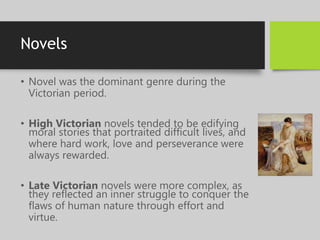
• Novel was the dominant genre during the
Victorian period.
• High Victorian novels tended to be edifying
moral stories that portraited difficult lives, and
where hard work, love and perseverance were
always rewarded.
• Late Victorian novels were more complex, as
they reflected an inner struggle to conquer the
flaws of human nature through effort and
virtue.
Major Novelists
• Charles Dickens is probably the most widely
read author from this time.
• His novels achieved immense popularity
during his lifetime and there were even spin-
offs and merchandise made of them.
• Most novels criticized society and
its poorest, but in line with the literature of
era, there was a very strong moral element to
the tales.
• Charlotte, Emily and Anne Brontë
• The sisters published their works under the male pseudonyms Currer, Ellis
Ashton Bell, as it was common practice for female writers that wanted to be
taken more seriously.
• Their novels include some unconventional themes for this era, such as
violence, a deep desire for freedom, a wilderness of spirit, feminism and
the supernatural.
• Their work was considered controversial but they eventually achieved the
success they deserved.
• Some of their works:
• Charlotte: Jane Eyre
• Emily: Wuthering Heights
• Anne: The Tennant of Wildfell Hall
Major Novelists
• William Makepeace Thackeray
• He began as a parodist and satirist but later started
to write novels with a very strong satiric component.
• He enjoyed great success during his lifetime but
his best known work is Vanity Fair.
• In it, he satirizes British society of the 19th century,
although it is set during the Napoleonic Wars.
• There have been several film adaptations of this
and it is still one of the best loved by the British
public.
Major Novelists
Poetry
• The most famous poet of the Victorian period was
Alfred, Lord Tennyson.
• His poetry mostly retells classical myths, but it also
covers religious dilemmas and scientific discoveries.
• Although he experimented with metric,
he mostly followed a strict pattern,
a reflection of the formality of the era.
• Robert and Elizabeth Barrett Browning
• Husband and wife, they enjoyed great
popularity because of their love poems to
each other.
• Elizabeth Barrett was already a successful
author before she met her husband, and
was also an involved activist in social issues.
• Her prolific work made her a rival to
Tennyson as a candidate for poet laureate
1850 after the death of Wordsworth.
Poetry
• It was also a group of writers and artists, of which Dante Gabriel
Rossetti and his sister Christina were part.
• Their aim was to replace the academic approach to art with the
more natural approach taken before the Italian Renaissance.
• Several writers joined this movement, echoing a simpler, less
formal approach to literature. The Rossettis are the greatest
poets of this movement.
The Pre-Raphaelites
Theater
• Theater became an extremely popular form of
entertainment for all social classes during this era and
Queen Victoria promoted it.
• Plays usually had a strong comedic element, both high
and low, and the plots were full of mistaken identities,
coincidences and mistiming.
• Oscar Wilde was the leading dramatist of the late
Victorian period and his comic masterpiece The
Importance of Being Earnest is a satiric reflection of the
time.
Nonfiction
• The Victorian era was a period of great scientific
discovery and the Victorians tried to describe and classify
the world they lived in.
• Among others, Charles Darwin with On the Origin of
Species, Friedrich Engels with his Condition of the
Working Classes in England and John Stuart Mill with
his philosophical works, changed the way the Victorians
thought about themselves and about the world.
Supernatural and Gothic Literature
• Gothic literature combines romance and
horror in attempt to thrill and terrify the
reader.
• Possible features in a gothic novel are
monsters, ghosts, curses, hidden rooms,
mad women in the attic and witchcraft.
• The plot usually takes place in monasteries,
castles and cemeteries.
• They were hugely popular but panned by
critics.
Children‘s Literature
• The Victorian period was the first one in history
where children were targeted as readers.
• This was a consequence of the evolution of
social attitudes towards childhood.
• Literature became a popular way to teach
children lessons and morals. They were only
rarely enjoyable works.
• Later, when reading for pleasure became socially
accepted, folk and fairy-tale compilations
became very popular
• There were different types of publications
written for boys and girls. Girls stories were
domestic and focused on family life, whereas
boys stories were about adventures.
New Genres: Detective Stories
• Edgar Allen Poe’s The Murders in the Rue
Morgue is generally considered to be the first
detective story. The protagonist is Monsieur C.
Auguste Dupin.
• English novelist Wilkie Collins published a
detective novel, The Moonstone, in 1868.
• The greatest fictional detective, Sherlock
Holmes, first appeared in 1887, in Sir Arthur
Conan Doyle’s novel A Study in Scarlet,
New Genres: Science Fiction
• Early examples: Johannes Kepler’s Somnium (1620-
1630). Cyrano de Bergerac’s Comical History of the
States and Empires of the Moon (1657) and States
and Empires of the Sun (1662). Jonathan Swift’s
Gulliver’s Travels (1726). Voltaire’s Micromégas.
• With the dawn of new technologies such as
electricity, the telegraph, and new forms of
transportation, writers including
H.G. Wells and Jules Verne created a body of work
that became popular across broad cross-sections
society. Wells‘ The War of the Worlds (1898)
describes an invasion of late Victorian England by
Martians using tripod fighting machines equipped
with advanced weaponry. It is a seminal depiction
an alien invasion of Earth.
Victorian Literature Today
• Many view it with skepticism because of the stereotypes of
the era: current readers may see it as prudish, rigid and
excessively formal.
• However, many contemporary authors criticized these
same trends, and there were many brilliant works that
were considered unconventional even then.
• Those works have passed the test of time and are today
considered masterpieces of classic literature.

Victorian Literature

  • 1.
  • 2.
    What is VictorianLiterature? • Victorian literature refers to the literary works written during the reign of Queen Victoria (1837- 1901). • It was the transition between the Romantic period and 20th century literature.
  • 3.
    It can bedivided into two periods: • High Victorian Literature (1830-1870) • Late Victorian Literature (1870-1901)
  • 4.
    Common Themes • Critiqueof industrialization • Critique of the deterioration of the rural lifestyle • Celebration of the past (including chivalry) • Conflicts between classes • Women´s rights
  • 5.
    Morality • Most workswere written to teach moral lessons to readers. • Hard work and strong virtue are always romanticized and rewarded, and poor behavior is punished at the end. • Literary works are full of passion and characters are often tempted by evil, but they show restraint against wild emotions (as opposed as during the Romantic Period).
  • 6.
    Genres • Poetry • Novel •Theater • Nonfiction • Gothic and supernatural literature • Children‘s literature • New genres: - detective novels - science fiction
  • 7.
    Novels • Novel wasthe dominant genre during the Victorian period. • High Victorian novels tended to be edifying moral stories that portraited difficult lives, and where hard work, love and perseverance were always rewarded. • Late Victorian novels were more complex, as they reflected an inner struggle to conquer the flaws of human nature through effort and virtue.
  • 8.
    Major Novelists • CharlesDickens is probably the most widely read author from this time. • His novels achieved immense popularity during his lifetime and there were even spin- offs and merchandise made of them. • Most novels criticized society and its poorest, but in line with the literature of era, there was a very strong moral element to the tales.
  • 9.
    • Charlotte, Emilyand Anne Brontë • The sisters published their works under the male pseudonyms Currer, Ellis Ashton Bell, as it was common practice for female writers that wanted to be taken more seriously. • Their novels include some unconventional themes for this era, such as violence, a deep desire for freedom, a wilderness of spirit, feminism and the supernatural. • Their work was considered controversial but they eventually achieved the success they deserved. • Some of their works: • Charlotte: Jane Eyre • Emily: Wuthering Heights • Anne: The Tennant of Wildfell Hall Major Novelists
  • 10.
    • William MakepeaceThackeray • He began as a parodist and satirist but later started to write novels with a very strong satiric component. • He enjoyed great success during his lifetime but his best known work is Vanity Fair. • In it, he satirizes British society of the 19th century, although it is set during the Napoleonic Wars. • There have been several film adaptations of this and it is still one of the best loved by the British public. Major Novelists
  • 11.
    Poetry • The mostfamous poet of the Victorian period was Alfred, Lord Tennyson. • His poetry mostly retells classical myths, but it also covers religious dilemmas and scientific discoveries. • Although he experimented with metric, he mostly followed a strict pattern, a reflection of the formality of the era.
  • 12.
    • Robert andElizabeth Barrett Browning • Husband and wife, they enjoyed great popularity because of their love poems to each other. • Elizabeth Barrett was already a successful author before she met her husband, and was also an involved activist in social issues. • Her prolific work made her a rival to Tennyson as a candidate for poet laureate 1850 after the death of Wordsworth. Poetry
  • 13.
    • It wasalso a group of writers and artists, of which Dante Gabriel Rossetti and his sister Christina were part. • Their aim was to replace the academic approach to art with the more natural approach taken before the Italian Renaissance. • Several writers joined this movement, echoing a simpler, less formal approach to literature. The Rossettis are the greatest poets of this movement. The Pre-Raphaelites
  • 14.
    Theater • Theater becamean extremely popular form of entertainment for all social classes during this era and Queen Victoria promoted it. • Plays usually had a strong comedic element, both high and low, and the plots were full of mistaken identities, coincidences and mistiming. • Oscar Wilde was the leading dramatist of the late Victorian period and his comic masterpiece The Importance of Being Earnest is a satiric reflection of the time.
  • 15.
    Nonfiction • The Victorianera was a period of great scientific discovery and the Victorians tried to describe and classify the world they lived in. • Among others, Charles Darwin with On the Origin of Species, Friedrich Engels with his Condition of the Working Classes in England and John Stuart Mill with his philosophical works, changed the way the Victorians thought about themselves and about the world.
  • 16.
    Supernatural and GothicLiterature • Gothic literature combines romance and horror in attempt to thrill and terrify the reader. • Possible features in a gothic novel are monsters, ghosts, curses, hidden rooms, mad women in the attic and witchcraft. • The plot usually takes place in monasteries, castles and cemeteries. • They were hugely popular but panned by critics.
  • 17.
    Children‘s Literature • TheVictorian period was the first one in history where children were targeted as readers. • This was a consequence of the evolution of social attitudes towards childhood. • Literature became a popular way to teach children lessons and morals. They were only rarely enjoyable works. • Later, when reading for pleasure became socially accepted, folk and fairy-tale compilations became very popular • There were different types of publications written for boys and girls. Girls stories were domestic and focused on family life, whereas boys stories were about adventures.
  • 18.
    New Genres: DetectiveStories • Edgar Allen Poe’s The Murders in the Rue Morgue is generally considered to be the first detective story. The protagonist is Monsieur C. Auguste Dupin. • English novelist Wilkie Collins published a detective novel, The Moonstone, in 1868. • The greatest fictional detective, Sherlock Holmes, first appeared in 1887, in Sir Arthur Conan Doyle’s novel A Study in Scarlet,
  • 19.
    New Genres: ScienceFiction • Early examples: Johannes Kepler’s Somnium (1620- 1630). Cyrano de Bergerac’s Comical History of the States and Empires of the Moon (1657) and States and Empires of the Sun (1662). Jonathan Swift’s Gulliver’s Travels (1726). Voltaire’s Micromégas. • With the dawn of new technologies such as electricity, the telegraph, and new forms of transportation, writers including H.G. Wells and Jules Verne created a body of work that became popular across broad cross-sections society. Wells‘ The War of the Worlds (1898) describes an invasion of late Victorian England by Martians using tripod fighting machines equipped with advanced weaponry. It is a seminal depiction an alien invasion of Earth.
  • 20.
    Victorian Literature Today •Many view it with skepticism because of the stereotypes of the era: current readers may see it as prudish, rigid and excessively formal. • However, many contemporary authors criticized these same trends, and there were many brilliant works that were considered unconventional even then. • Those works have passed the test of time and are today considered masterpieces of classic literature.