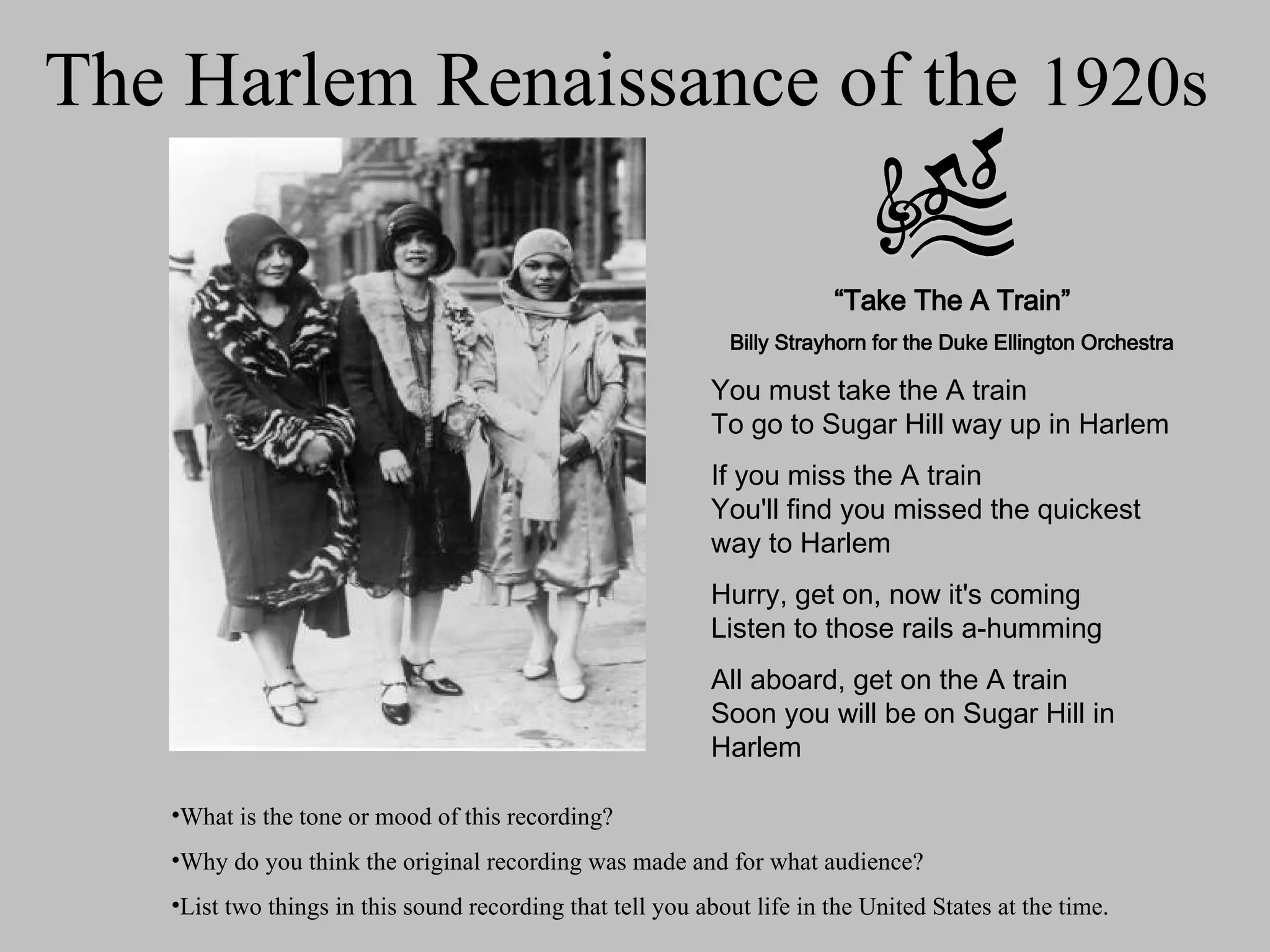
The Harlem Renaissanceof the 1920s
“Take The A Train”
Billy Strayhorn for the Duke Ellington Orchestra
You must take the A train
To go to Sugar Hill way up in Harlem
If you miss the A train
You'll find you missed the quickest
way to Harlem
Hurry, get on, now it's coming
Listen to those rails a-humming
All aboard, get on the A train
Soon you will be on Sugar Hill in
Harlem
•What is the tone or mood of this recording?
•Why do you think the original recording was made and for what audience?
•List two things in this sound recording that tell you about life in the United States at the time.
2.
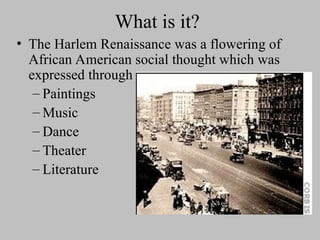
What is it?
•The Harlem Renaissance was a flowering of
African American social thought which was
expressed through
– Paintings
– Music
– Dance
– Theater
– Literature
3.
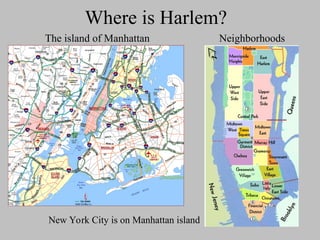
Where is Harlem?
Theisland of Manhattan
New York City is on Manhattan island
Neighborhoods
4.
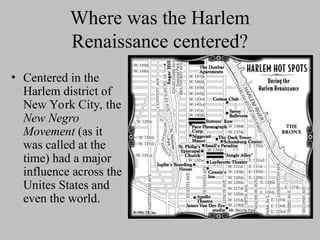
Where was theHarlem
Renaissance centered?
• Centered in the
Harlem district of
New York City, the
New Negro
Movement (as it
was called at the
time) had a major
influence across the
Unites States and
even the world.
5.
How does theHarlem
Renaissance connect to
the Great Migration?
• The economic opportunities of the era triggered a
widespread migration of black Americans from the
rural south to the industrial centers of the north - and
especially to New York City.
• In New York and other cities, black Americans
explored new opportunities for intellectual and social
freedom.
• Black American artists, writers, and musicians began
to use their talents to work for civil rights and obtain
equality.
6.
How did itimpact history?
• The Harlem Renaissance helped to redefine how
Americans and the world understood African
American culture. It integrated black and white
cultures, and marked the beginning of a black urban
society.
• The Harlem Renaissance set the stage for the Civil
Rights Movement of the 1950s and 60s.
7.
Who coined theHarlem Renaissance?
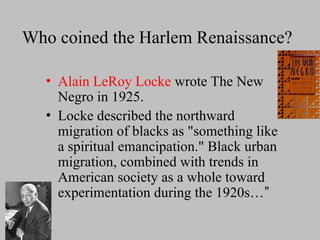
• Alain LeRoy Locke wrote The New
Negro in 1925.
• Locke described the northward
migration of blacks as "something like
a spiritual emancipation." Black urban
migration, combined with trends in
American society as a whole toward
experimentation during the 1920s…”
8.
According to AlainLocke, who
contributed to the
Harlem Renaissance?
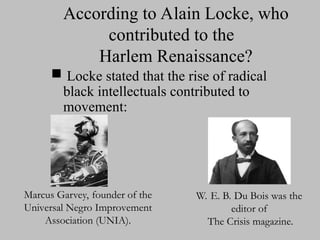
Locke stated that the rise of radical
black intellectuals contributed to
movement:
Marcus Garvey, founder of the
Marcus Garvey, founder of the
Universal Negro Improvement
Universal Negro Improvement
Association (UNIA).
Association (UNIA).
W. E. B. Du Bois was the
W. E. B. Du Bois was the
editor of
editor of
The Crisis magazine.
The Crisis magazine.
9.
According to AlainLocke, who
contributed to the
Harlem Renaissance?
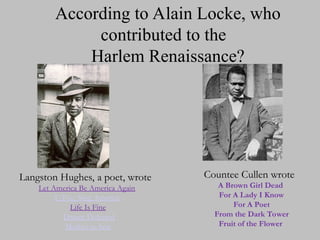
Langston Hughes, a poet, wrote
Langston Hughes, a poet, wrote
Let America Be America Again
I, Too, Sing America
Life Is Fine
Dream Deferred
Mother to Son
Countee Cullen wrote
Countee Cullen wrote
A Brown Girl Dead
For A Lady I Know
For A Poet
From the Dark Tower
Fruit of the Flower
10.
According to AlainLocke, who
contributed to the
Harlem Renaissance?
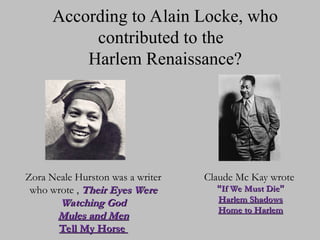
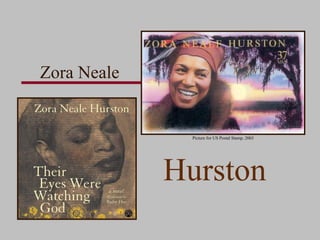
Zora Neale Hurston was a writer
Zora Neale Hurston was a writer
who wrote ,
who wrote , Their Eyes Were
Their Eyes Were
Watching God
Watching God
Mules and Men
Mules and Men
Tell My Horse
Tell My Horse
Claude Mc Kay wrote
Claude Mc Kay wrote
“
“If We Must Die
If We Must Die”
”
Harlem Shadows
Harlem Shadows
Home to Harlem
Home to Harlem
11.
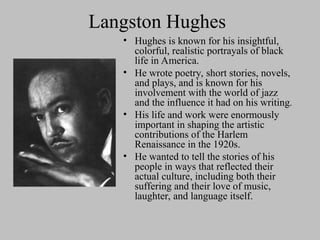
Langston Hughes
• Hughesis known for his insightful,
colorful, realistic portrayals of black
life in America.
• He wrote poetry, short stories, novels,
and plays, and is known for his
involvement with the world of jazz
and the influence it had on his writing.
• His life and work were enormously
important in shaping the artistic
contributions of the Harlem
Renaissance in the 1920s.
• He wanted to tell the stories of his
people in ways that reflected their
actual culture, including both their
suffering and their love of music,
laughter, and language itself.
12.
One of Hughes'spoetic innovations was to draw on
the rhythms of black musical traditions such as jazz
and blues, but in 'The Negro Speaks of Rivers' it's
the heritage of Negro spirituals which is recalled by
the poem's majestic imagery and sonorous
repetitions. Written when Hughes was only
seventeen as he traveled by train across the
Mississippi, 'The Negro Speaks of Rivers' is a
beautiful statement of strength in the history of
black people, which Hughes imagines stretching as
far back as ancient Egypt and further into Africa and
the cradle of civilization. The poem returns at the
end to America in a moment of optimistic alchemy
when he sees the "muddy bosom" of the Mississippi
"turn all golden in the sunset".
From PoetryArchive.org
The Negro Speaks of Rivers
To listen to Langston Hughes read
his poem, click here.
I've known rivers:
I've known rivers ancient as the
world and older than the
flow of human blood in human
veins.
My soul has grown deep like the
rivers.
I bathed in the Euphrates when
dawns were young.
I built my hut near the Congo
and it lulled me to sleep.
I looked upon the Nile and raised
the pyramids above it.
I heard the singing of the
Mississippi when Abe Lincoln
went down to New Orleans, and
I've seen its muddy
bosom turn all golden in the
sunset.
I've known rivers:
Ancient, dusky rivers.
My soul has
grown deep like
the rivers.
(1919)
•What is the tone or mood of this poem?
•Why do you think the poem was written and for what audience?
•List two things in this poem that tell you about life in the United States at the time.
13.
I, too, singAmerica.
I am the darker brother.
They send me to eat in the kitchen
When company comes,
But I laugh,
And eat well,
And grow strong.
Tomorrow,
I'll be at the table
When company comes.
Nobody'll dare
Say to me,
"Eat in the kitchen,“
Then.
Besides,
They'll see how beautiful I am
And be ashamed--
I, too, am America.
I, too, sing America
To listen to Langston Hughes read
his poem, click here.
(1920s)
'I, Too' written just before Hughes’ return to the
States from Europe and after he'd been denied
passage on a ship because of his color, has a
contemporary feel in contrast to the mythical
dimension of 'The Negro Speaks of Rivers'. It is
no less powerful however, in its expression of
social injustice. The calm clear statements of the
'I' have an unstoppable force like the progress the
poem envisages. Hughes's dignified introductions
to these poems and his beautiful speaking voice
render them all the more moving.
From PoetryArchive.org
•What is the tone or mood of this poem?
•Why do you think the poem was written and for what audience?
•List two things in this poem that tell you about life in the United States at the time.
14.
Langston Hughes Poetand Author
Wrote poetry, short stories,
novels, and plays.
Known for his colorful,
realistic portrayals of black
life in America.
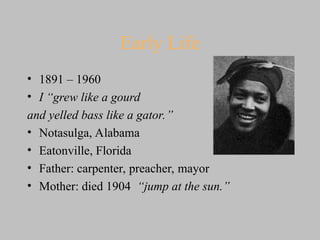
Early Life
• 1891– 1960
• I “grew like a gourd
and yelled bass like a gator.”
• Notasulga, Alabama
• Eatonville, Florida
• Father: carpenter, preacher, mayor
• Mother: died 1904 “jump at the sun.”
17.
Out in theWorld
• At 13: taken out of school
• At 16: traveling theater company
18.
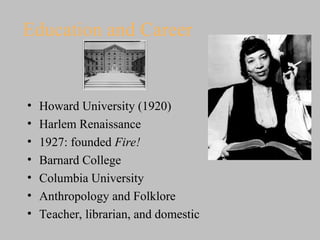
Education and Career
•Howard University (1920)
• Harlem Renaissance
• 1927: founded Fire!
• Barnard College
• Columbia University
• Anthropology and Folklore
• Teacher, librarian, and domestic
19.
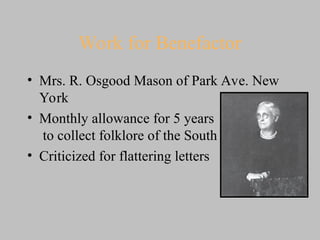
Work for Benefactor
•Mrs. R. Osgood Mason of Park Ave. New
York
• Monthly allowance for 5 years
to collect folklore of the South
• Criticized for flattering letters
20.
Other Works
• Jonah’sGourd Vine, 1934 [1991]
• Mules and Men, 1935
• Their Eyes Were Watching God 1937
• Tell My Horse, 1938
• Moses, Man of the Mountain, 1939
• Dust Tracks on a Road, 1942
• Seraph on the Suwanee, 1948
21.
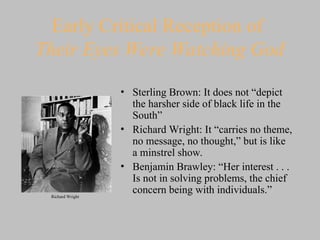
Early Critical Receptionof
Their Eyes Were Watching God
• Sterling Brown: It does not “depict
the harsher side of black life in the
South”
• Richard Wright: It “carries no theme,
no message, no thought,” but is like
a minstrel show.
• Benjamin Brawley: “Her interest . . .
Is not in solving problems, the chief
concern being with individuals.”
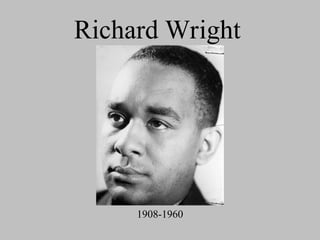
Richard Wright
22.
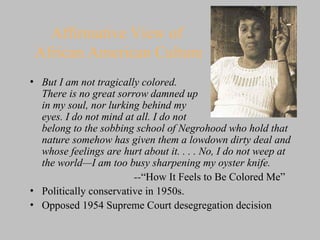
Affirmative View of
AfricanAmerican Culture
• But I am not tragically colored.
There is no great sorrow damned up
in my soul, nor lurking behind my
eyes. I do not mind at all. I do not
belong to the sobbing school of Negrohood who hold that
nature somehow has given them a lowdown dirty deal and
whose feelings are hurt about it. . . . No, I do not weep at
the world—I am too busy sharpening my oyster knife.
--“How It Feels to Be Colored Me”
• Politically conservative in 1950s.
• Opposed 1954 Supreme Court desegregation decision
23.
Last Years
• Arrestedin 1948
• Solitary retirement in Florida
• Died in a welfare home
• Buried in an unmarked grave
• A Genius of the South: 1901 [sic]---1960. Novelist,
Folklorist, Anthropologist
24.
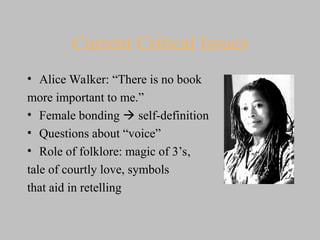
Current Critical Issues
•Alice Walker: “There is no book
more important to me.”
• Female bonding self-definition
• Questions about “voice”
• Role of folklore: magic of 3’s,
tale of courtly love, symbols
that aid in retelling
Biography
• Born ona plantation near Natchez,
Mississippi, on September 4, 1908.
• Son of a sharecropper who deserted his family
when Wright was 5.
• His mother became ill, and the family moved
to Jackson, Mississippi with his grandmother.
– Grandmother tried to stop Wright from writing.
• His grandmother attempted to crush his imagination.
27.
Biography
• Wright andhis brother lived in an orphanage
for a short time because of family problems.
• He would recall his childhood as a “time of
hunger.”
– For food, but also for affection, understanding,
and education.
• Although a very good student, Wright never
graduated from high school.
28.
Biography
• Wright’s jobsin the South were marked by
harassment by whites and by his own disdain for
what segregation and racism had done to distort
the humanity of his fellow blacks, as he saw it.
• The harsh conditions of the South pushed Wright
to his first exposure with Urban Naturalism.
– Wright said he “could not read enough of them.”
29.
Urban Naturalism
• Theterm naturalism describes a type of
literature that attempts to apply scientific
principles of objectivity and detachment to its
study of human beings.
– Unlike realism, which focuses on literary technique,
naturalism implies a philosophical position:
• For naturalistic writers, since human beings are, in Emile
Zola's phrase, "human beasts," characters can be studied
through their relationships to their surroundings.
30.
Urban Naturalism
• Keythemes of Urban Naturalism:
– Survival, determinism, violence, and taboo.
– The "brute within" each individual,
• composed of strong and often warring emotions:
– passions, such as lust, greed, or the desire for dominance or
pleasure;
– and the fight for survival in an amoral, indifferent universe.
• The conflict in naturalistic novels is often "man against nature"
or "man against himself"
– Characters struggle to retain a "veneer of civilization" despite
external pressures that threaten to release the "brute within.“
– Example: Bigger Thomas
– The forces of heredity and environment as they affect,
and afflict, individual lives.
31.
Biography
• After movingto Paris in 1946, Wright became friends with
Jean-Paul Sartre and Albert Camus while going through an
Existentialist phase best depicted by his second novel, The
Outsiders (1953).
• In his last years, he was plagued by illness (aerobic
dysentary) and financial hardship.
• Throughout this period he wrote approximately 4,000 English
Haikus (some of which were recently published for the first
time) and another novel, The Long Dream, in 1958.
• After his death on November 28, 1960, another of his
collections of short stories, Eight Men, was published.
• His most famous work is still his autobiographical work,
Black Boy (1945).
32.
Themes and Goalsof Native Son
• Major goal of Wright’s writing:
– The exposure of the starkest realities of American
life where race was concerned.
• Themes:
– The effects of racism on the individual
– Communism
– Naturalism
– Justice
– The comforts of Religion
33.
Native Son
• Thiswas meant to be America’s guide in confronting
the danger of facing the profound consequences of
more than two centuries of the enslavement and
segregation of blacks in North America.
• Slavery and neo-slavery had led not simply to the
development of a psychology of timidity, passivity,
and even cowardice among African American
masses.
• Wright suggests that it also gives rise to characters
like Bigger Thomas.
34.
Bigger Thomas
– Thesecharacters are estranged from both black
and white culture through their hatred of both
cultures, which gives rise to acts of violence.
– These acts of violence were most often aimed at
other African Americans, but Wright warned
that one day it would be aimed at whites.
35.
Intellectual Forces
• Otherthan naturalism, two other intellectual
forces came together to shape Native Son;
communism and existentialism.
• Communism:
– the political and economic doctrine that aims to replace
private property and a profit-based economy with
public ownership and communal control of at least the
major means of production and the natural resources of
a society.
36.
Existentialism
• Existentialism:
– TheExistentialist conceptions of freedom and
value arise from their view of the individual.
Since we are all ultimately alone, isolated
islands of subjectivity in an objective world, we
have absolute freedom over our internal nature,
and the source of our value can only be internal.
– Main principle:
• Existence precedes Essence.
37.
Existentialism
• To reviewthe essential beliefs of French
existentialists, consider the following ideas:
1. Existentialists believe in free will.
2. Existentialists do not recognize any human or immortal
authority.
– Denied God’s existence in a cruel world, full of suffering.
– No Faith because no hope.
3. Existentialists believe that they are responsible for all
the consequences of their actions.
4. Existentialists do not believe in an afterlife.
5. Sartre stated that we "are condemned to be free."
6. Camus stated that "life is absurd."
Editor's Notes
#16 Eatonville--self-chosen birthplace (also chose a new birthdate: 1901)
family moved there--all black town like in novel
father was a mayor like Joe Starks, Janie’s second husband--a “big voice” in the town
#18 At Howard Univ: Hurston was flamboyant and shocking--cocked hat, smoking in public
Studied under renowned anthropology scholar, Franz Boas
Fire! --Literary magazine of black culture---folded after first publication
field work--interviewing storytellers in Florida and hoodoo/voodoo doctors in New Orleans
#20 Mule Bone--PLAY with Langston Hughes: argument over ownership; African American comedy of rural life--not using black sterotypes
Jonah’s Gourd Vine--about a Florida couple very like H’s parents
Mules and Men--Short Stories --southern culture: historically important as the “first book of African American folklore collected by a black American to be presented by a major publisher for a general reading audience.”
Tell My Horse--scholarly anthropological work; also published as Voodoo Gods: An Inquiry into Native Myths and Magic in Jamaica and Haiti
Moses, Man of the Mountain--3rd novel--rewriting of Exodus in style of southern African-American
Dust Tracks on a Road--autobiography--bothers some critics becaise down plays race as significant factor in her life
Seraph on the Suwanee--focuses on marriage of a white couple
#21 Note that all these critics were male. Quite possibly offended by the portrayal of black men in the novel.
Richard Wright’s criticism was very damaging to Hurston’s reputation.
#23 Alice Walker found H’s grave and provided stone and epitaph
#24 Alice Walker: Hurston is her literary mother and sister
Subjugation of black race = subjugation of women within marriage



![Other Works
• Jonah’s Gourd Vine, 1934 [1991]
• Mules and Men, 1935
• Their Eyes Were Watching God 1937
• Tell My Horse, 1938
• Moses, Man of the Mountain, 1939
• Dust Tracks on a Road, 1942
• Seraph on the Suwanee, 1948](https://image.slidesharecdn.com/harlem-renaissance-presentation-250418041538-3d01b22f/85/harlem-renaissance-presentatijdsbdsjbhdchbson-ppt-20-320.jpg)
![Last Years
• Arrested in 1948
• Solitary retirement in Florida
• Died in a welfare home
• Buried in an unmarked grave
• A Genius of the South: 1901 [sic]---1960. Novelist,
Folklorist, Anthropologist](https://image.slidesharecdn.com/harlem-renaissance-presentation-250418041538-3d01b22f/85/harlem-renaissance-presentatijdsbdsjbhdchbson-ppt-23-320.jpg)