WHO WAS WILLIAM 
WORDSWORTH ? 
Presented by:-Agnee
Where It All Began 
WHO WAS HE ??? 
William Wordsworth is one of the most important English 
poets and a founder of the Romantic Movement of English 
literature, a style of writing that focuses on emotion and 
imagination . Wordsworth became known as a 'Lakeland 
Poet' because of the area where he lived, which is 
renowned for its beautiful, wild landscapes, charming 
pastures, and countless lakes. He was often called a 'nature 
poet' because of his emphasis on the connection between 
humans and the natural world. He became widely successful 
and was named poet laureate of England in 1843.
HIS LIFE 
William Wordsworth was the second of five children born 
to John Wordsworth and Ann Cookson, William 
Wordsworth was born on 7 April 1770 in Wordsworth 
House in Cockermouth, Cumberland, part of the scenic 
region in northwestern England known as the Lake District. 
His sister, the poet and diarist Dorothy Wordsworth, to 
whom he was close all his life, was born the following year, 
and the two were baptised together. They had three other 
siblings: Richard, the eldest, who became a lawyer; John, 
born after Dorothy, who went to sea and died in 1805 when 
the ship of which he was Master, the Earl of Abergavenny, 
was wrecked off the south coast of England; and 
Christopher, the youngest, who entered the Church and 
rose to be Master of Trinity College, Cambridge.
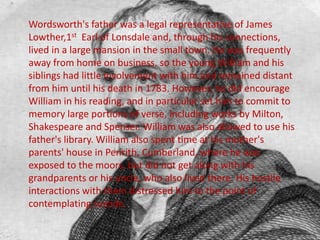
Wordsworth's father was a legal representative of James 
Lowther,1st Earl of Lonsdale and, through his connections, 
lived in a large mansion in the small town. He was frequently 
away from home on business, so the young William and his 
siblings had little involvement with him and remained distant 
from him until his death in 1783. However, he did encourage 
William in his reading, and in particular set him to commit to 
memory large portions of verse, including works by Milton, 
Shakespeare and Spenser. William was also allowed to use his 
father's library. William also spent time at his mother's 
parents' house in Penrith, Cumberland, where he was 
exposed to the moors, but did not get along with his 
grandparents or his uncle, who also lived there. His hostile 
interactions with them distressed him to the point of 
contemplating suicide.
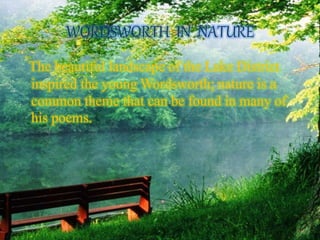
WORDSWORTH IN NATURE 
The beautiful landscape of the Lake District 
inspired the young Wordsworth; nature is a 
common theme that can be found in many of 
his poems.
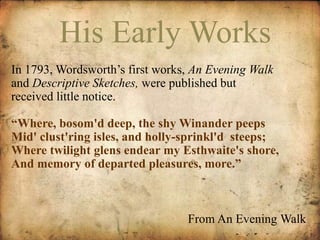
HisE AERaLYr lWyO WRKSorks 
In 1793, Wordsworth’s first works, An Evening Walk 
and Descriptive Sketches, were published but 
received little notice. 
“Where, bosom'd deep, the shy Winander peeps 
Mid' clust'ring isles, and holly-sprinkl'd steeps; 
Where twilight glens endear my Esthwaite's shore, 
And memory of departed pleasures, more.” 
From An Evening Walk
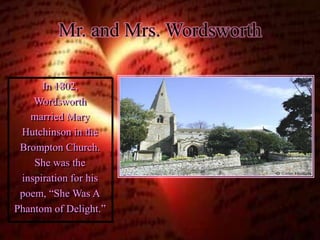
Mr. and Mrs. Wordsworth 
In 1802, 
Wordsworth 
married Mary 
Hutchinson in the 
Brompton Church. 
She was the 
inspiration for his 
poem, “She Was A 
Phantom of Delight.”
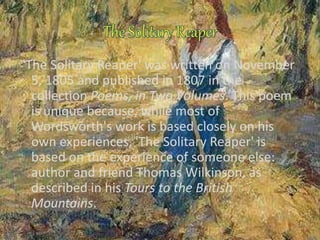
'The Solitary Reaper' was written on November 
5, 1805 and published in 1807 in the 
collection Poems, in Two Volumes. This poem 
is unique because, while most of 
Wordsworth's work is based closely on his 
own experiences, 'The Solitary Reaper' is 
based on the experience of someone else: 
author and friend Thomas Wilkinson, as 
described in his Tours to the British 
Mountains.
The poem, like most of Wordsworth's poetry, is 
distinguished by its straightforward use of 
language and meter as well as its natural theme 
and imagery. It reflects Wordsworth's belief in the 
importance of the natural world, the power of 
memory and the human mind, and his first 
principle of poetry: that poetry should be written 
to provide pleasure through a rhythmic and 
powerful expression of emotion and leave readers 
with 'a spontaneous overflow of powerful 
feelings' long after it is read.
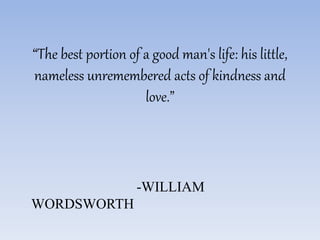
“The best portion of a good man's life: his little, 
nameless unremembered acts of kindness and 
love.” 
-WILLIAM 
WORDSWORTH
It was Wordsworth's emotional power, rather than 
his range of intellect, that made him famous and 
influential. He defined poetry as "the spontaneous 
overflow of powerful feelings arising from "emotion 
recollected in tranquility." To him, poetry was an 
overflowing of emotion onto paper backed up by 
the refusal to conform to the “rules” of society. This 
belief, along with his inspirations, allowed his 
talent and emotions to run free.
William wordsworth

William wordsworth

  • 1.
    WHO WAS WILLIAM WORDSWORTH ? Presented by:-Agnee
  • 2.
    Where It AllBegan WHO WAS HE ??? William Wordsworth is one of the most important English poets and a founder of the Romantic Movement of English literature, a style of writing that focuses on emotion and imagination . Wordsworth became known as a 'Lakeland Poet' because of the area where he lived, which is renowned for its beautiful, wild landscapes, charming pastures, and countless lakes. He was often called a 'nature poet' because of his emphasis on the connection between humans and the natural world. He became widely successful and was named poet laureate of England in 1843.
  • 3.
    HIS LIFE WilliamWordsworth was the second of five children born to John Wordsworth and Ann Cookson, William Wordsworth was born on 7 April 1770 in Wordsworth House in Cockermouth, Cumberland, part of the scenic region in northwestern England known as the Lake District. His sister, the poet and diarist Dorothy Wordsworth, to whom he was close all his life, was born the following year, and the two were baptised together. They had three other siblings: Richard, the eldest, who became a lawyer; John, born after Dorothy, who went to sea and died in 1805 when the ship of which he was Master, the Earl of Abergavenny, was wrecked off the south coast of England; and Christopher, the youngest, who entered the Church and rose to be Master of Trinity College, Cambridge.
  • 4.
    Wordsworth's father wasa legal representative of James Lowther,1st Earl of Lonsdale and, through his connections, lived in a large mansion in the small town. He was frequently away from home on business, so the young William and his siblings had little involvement with him and remained distant from him until his death in 1783. However, he did encourage William in his reading, and in particular set him to commit to memory large portions of verse, including works by Milton, Shakespeare and Spenser. William was also allowed to use his father's library. William also spent time at his mother's parents' house in Penrith, Cumberland, where he was exposed to the moors, but did not get along with his grandparents or his uncle, who also lived there. His hostile interactions with them distressed him to the point of contemplating suicide.
  • 5.
    WORDSWORTH IN NATURE The beautiful landscape of the Lake District inspired the young Wordsworth; nature is a common theme that can be found in many of his poems.
  • 6.
    HisE AERaLYr lWyOWRKSorks In 1793, Wordsworth’s first works, An Evening Walk and Descriptive Sketches, were published but received little notice. “Where, bosom'd deep, the shy Winander peeps Mid' clust'ring isles, and holly-sprinkl'd steeps; Where twilight glens endear my Esthwaite's shore, And memory of departed pleasures, more.” From An Evening Walk
  • 7.
    Mr. and Mrs.Wordsworth In 1802, Wordsworth married Mary Hutchinson in the Brompton Church. She was the inspiration for his poem, “She Was A Phantom of Delight.”
  • 8.
    'The Solitary Reaper'was written on November 5, 1805 and published in 1807 in the collection Poems, in Two Volumes. This poem is unique because, while most of Wordsworth's work is based closely on his own experiences, 'The Solitary Reaper' is based on the experience of someone else: author and friend Thomas Wilkinson, as described in his Tours to the British Mountains.
  • 9.
    The poem, likemost of Wordsworth's poetry, is distinguished by its straightforward use of language and meter as well as its natural theme and imagery. It reflects Wordsworth's belief in the importance of the natural world, the power of memory and the human mind, and his first principle of poetry: that poetry should be written to provide pleasure through a rhythmic and powerful expression of emotion and leave readers with 'a spontaneous overflow of powerful feelings' long after it is read.
  • 11.
    “The best portionof a good man's life: his little, nameless unremembered acts of kindness and love.” -WILLIAM WORDSWORTH
  • 12.
    It was Wordsworth'semotional power, rather than his range of intellect, that made him famous and influential. He defined poetry as "the spontaneous overflow of powerful feelings arising from "emotion recollected in tranquility." To him, poetry was an overflowing of emotion onto paper backed up by the refusal to conform to the “rules” of society. This belief, along with his inspirations, allowed his talent and emotions to run free.