Computer Hardware
Backing Storage  Devices
Input  Devices
Output  Devices
Hardware   and  Software Hardware refers to all the parts of the Computer System that we can touch. Examples of hardware are monitors, joysticks, printers, processors etc. Software refers to all the programs and data that we use with the computer.
A computer is an information processing machine. A computer only follows the instructions it is given. Data is Input, Processed and then Output. What is a Computer? I’m ONLY a  machine!
Sizes of Computers Microprocessor A small chip programmed with instructions. Microcomputer The most common type of computer.  The IBM PC is a microcomputer Mini Computer Medium to Large computers - mainly used to process business information. Mainframe Computer Very powerful computers able to process 1000’s of times more information a second than PCs Smallest Biggest
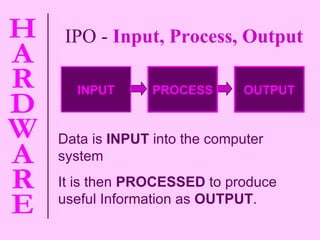
IPO -   Input, Process, Output INPUT PROCESS OUTPUT Data is  INPUT  into the computer system It is then  PROCESSED  to produce useful Information as  OUTPUT .
Data and Information Data has no meaning Data is made up of symbols e.g. 871652; H789 IOS; £76.91 Information has a meaning We understand what a piece of information is about e.g Telephone Number: 871652 Car License Plate: H789 IOS
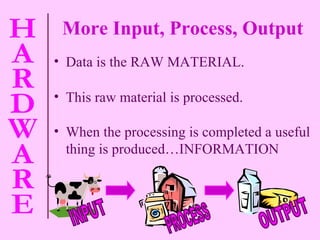
More Input, Process, Output Data is the RAW MATERIAL. This raw material is processed. When the processing is completed a useful thing is produced…INFORMATION INPUT PROCESS OUTPUT
Computer - Block Diagram The Computer System consists of four parts. Input, Processor [CPU], Output, Backing Storage Backing Storage  Devices Input  Devices Central Processing  Unit (CPU) Output  Devices
The central processing  unit (CPU) This is the part of the computer where the searching and sorting of data, calculating and decision-making goes on.  The CPU contains the processor [ Control Unit  and the  Arithmetic and Logic Unit (ALU) ] and the  Main Memory
The Processor The  CONTROL UNIT  fetches program instructions from the memory storage locations, decodes and then executes them. The  ALU (Arithmetic/Logic Unit)  carries out all the calculations as instructed by the control unit.
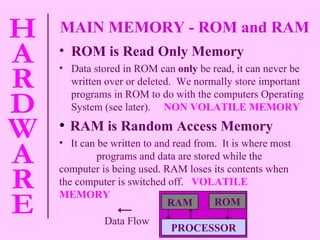
MAIN MEMORY - ROM and RAM  ROM is Read Only Memory Data stored in ROM can  only  be read, it can never be written over or deleted.  We normally store important programs in ROM to do with the computers Operating System (see later).   NON VOLATILE MEMORY RAM is Random Access Memory It can be written to and read from.  It is where most  programs and data are stored while the computer is being used. RAM loses its contents when the computer is switched off.   VOLATILE MEMORY RAM ROM PROCESSOR Data Flow
Memory Computers store blocks of data called   ‘words’  in memory  (A 32 bit computer has words that are 32 bits long). Each place that can store a word is called a   storage location. Each storage location has a unique   address   that identifies it from all the other locations.
Machine Code Computers only understand binary!!! All programs have to end up in binary language in order work. The binary language that the computer understands is called   MACHINE CODE Machine code looks like this… 00100111,01110100,10010001
Bits and Bytes [BINARY] Each 1 or 0 is called a   BIT   (short for Binary Digit). Eight bits are called a   BYTE. 1024 bytes is a   KILOBYTE (Kb for short) 1024 kilobytes is a   MEGABYTE (Mb for short) 1024 megabytes is a   GIGABYTE (Gb for short) These units are used to measure the size of storage or storage requirements e.g. the available memory, hard disk space, program size.
Bits and Bytes [BINARY]
Binary Everywhere! Binary is used to store all the data and programs in a computer system. We use binary to store: Graphics, Text, Numbers,   Video, Sound and   Programs. Binary is just the code used to store the data.
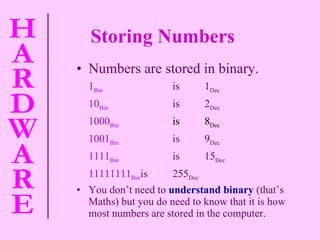
Storing Numbers Numbers are stored in binary. 1 Bin  is  1 Dec 10 Bin  is   2 Dec 1000 Bin  is  8 Dec 1001 Bin  is 9 Dec 1111 Bin is 15 Dec 11111111 Bin is 255 Dec You don’t need to  understand binary   (that’s Maths) but you do need to know that it is how most numbers are stored in the computer.
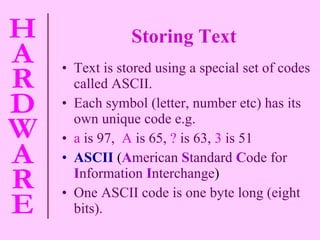
Storing Text Text is stored using a special set of codes called ASCII. Each symbol (letter, number etc) has its own unique code e.g.  a   is 97,   A   is 65,   ?   is 63,   3   is 51 ASCII  ( A merican   S tandard   C ode for   I nformation   I nterchange ) One ASCII code is one byte long (eight bits).
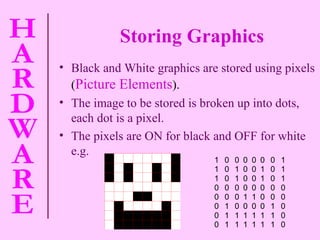
Storing Graphics Black and White graphics are stored using pixels  ( Picture Elements ). The image to be stored is broken up into dots, each dot is a pixel. The pixels are ON for black and OFF for white e.g. 1 0 0 0 0 0 0 1 1 0 1 0 0 1 0 1 1 0 1 0 0 1 0 1 0 0 0 0 0 0 0 0 0 0 0 1 1 0 0 0 0 1 0 0 0 0 1 0 0 1 1 1 1 1 1 0 0 1 1 1 1 1 1 0
Hardware Devices
Hardware  Devices Devices are either   INPUT ,   OUTPUT   or   BACKING STORAGE . Input devices allow us to enter data into the computer system   (mouse, microphone etc). Output devices allow us to receive information from the computer system   (monitor, speakers, robot). Backing storage devices allow us to store programs and data so that we can use them later   (floppy disc, magnetic tape, CD-ROM).
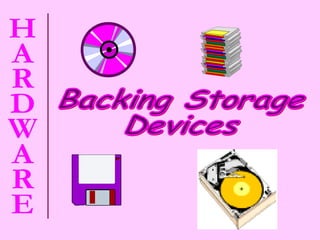
Backing Storage  Devices
Backing storage is used to store programs and data when they are not being used or when a computer is switched off.  When programs and data are needed they are copied into main memory but also still remain on backing storage.  Magnetic tape drives, floppy disk drives and hard disk drives are all examples of backing storage devices.  Backing Storage  Devices
WORM - Write Once Read Many A WORM is a  writable optical disc. An optical disc is any disc that can be read using light (normally laser light).  WORM drives use a high powered laser to burn the data into the disc.  This can then be read in the same way that CD-ROM's are read.  Because the data is burnt onto the disc each disc can only be written once and the data written is permanent. Magnetic tape, floppy disc, hard disc and CD-ROM are all types of backing storage. Backing Storage Devices ?
PROM and EPROM PROM  and  EPROM   are both special types of programmable read only memory.  PROM stands for  P rogrammable  R ead  O nly  M emory. This type of memory can be programmed once but can’t be changed again afterwards.  EPROM stands for  E rasable  P rogrammable  R ead  O nly  M emory. This type of memory can be programmed and then changed whenever necessary.
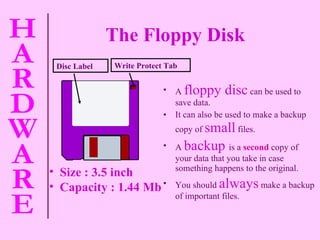
A   floppy disc   can be used to save data. It can also be used to make a backup copy of   small   files. A   backup  is a   second   copy of your data that you take in case something happens to the original. You should   always   make a backup of important files. Write Protect Tab Disc Label The Floppy Disk   Size : 3.5 inch Capacity : 1.44 Mb
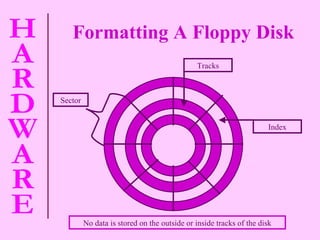
Formatting A Floppy Disk   The formatting process involves: Dividing the surface of the disk into invisible circles called  tracks  and  sectors .  Setting up a  root directory  where the list of files that are on the disk will be kept .  Data on a magnetic disk is located by finding the  address  of its location from an  index  in the root directory.  Each address in the index contains a track and sector number for an individual data segment.
Formatting A Floppy Disk   No data is stored on the outside or inside tracks of the disk Tracks Index Sector
The Hard Disc and Drive A  hard disk is a circular metal disk coated with magnetic material and usually sealed in a hard disk drive inside the computer.  Some hard disk drives are not permanently fixed inside the computer but are  removable .  Data stored on a hard disk can be accessed much more quickly than data stored on a floppy disk.  Hard disks can store much more data  than a floppy disk. A typical hard disk inside a personal computer can hold many gigabytes of data.
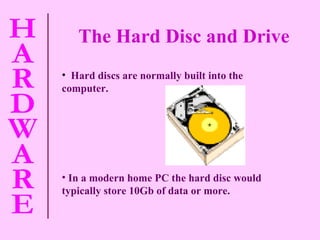
The Hard Disc and Drive Hard discs are normally built into the computer. In a modern home PC the hard disc would typically store 10Gb of data or more.
Non-magnetic storage Non-magnetic storage involves the use of media not coated in magnetic material. Examples of this are: CD-ROM, Video Disc, Digital Video Disc (DVD) and WORM. These use pits and bumps (lands) on the disc to store digital data and use laser light to write and read them.
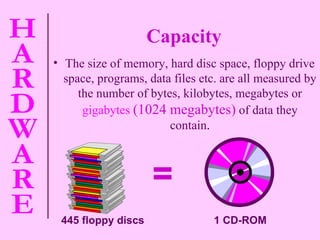
Capacity The size of memory, hard disc space, floppy drive space, programs, data files etc. are all measured by the number of bytes, kilobytes, megabytes or   gigabytes   (1024 megabytes)   of data they contain . 445 floppy discs = 1 CD-ROM
File compression File compression software   can be used to make files smaller so that more data can be stored in the same amount of space on backing store.  When a compressed file on backing store needs to be used it must be  decompressed.   This can be done using  decompression software   or by setting files up to be  self-extracting  which means that they can automatically decompress themselves.  Winzip   is an example of software that can be used to compress and decompress files.
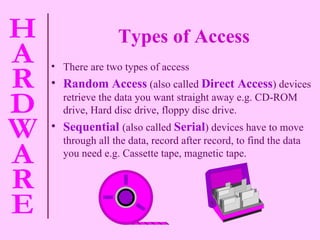
Types of Access There are two types of access Random Access   (also called   Direct Access )   devices retrieve the data you want straight away e.g. CD-ROM drive, Hard disc drive, floppy disc drive. Sequential   (also called   Serial ) devices have to move through all the data, record after record, to find the data you need e.g. Cassette tape, magnetic tape.
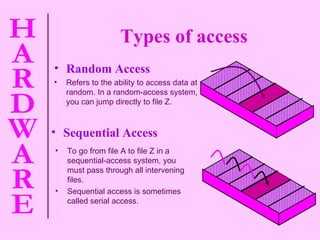
Types of access Sequential Access To go from file A to file Z in a sequential-access system, you must pass through all intervening files.  Sequential access is sometimes called serial access. Random Access Refers to the ability to access data at random. In a random-access system, you can jump directly to file Z.
Input  Devices
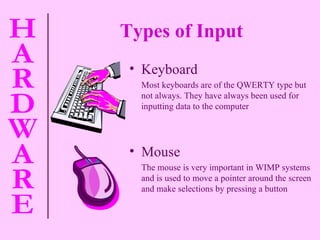
Types of Input   Keyboard Most keyboards are of the QWERTY type but not always. They have always been used for inputting data to the computer Mouse The mouse is very important in WIMP systems and is used to move a pointer around the screen and make selections by pressing a button
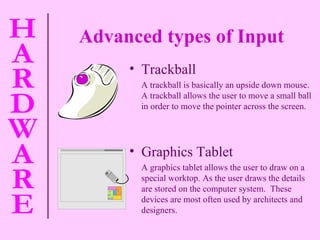
Advanced types of Input   Trackball A trackball is basically an upside down mouse.  A trackball allows the user to move a small ball in order to move the pointer across the screen. Graphics Tablet A graphics tablet allows the user to draw on a special worktop. As the user draws the details are stored on the computer system.  These devices are most often used by architects and designers.
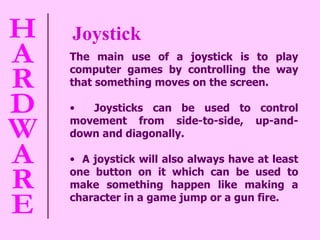
Joystick The main use of a joystick is to play computer games by controlling the way that something moves on the screen.  Joysticks can be used to control movement from side-to-side, up-and-down and diagonally.  A joystick will also always have at least one button on it which can be used to make something happen like making a character in a game jump or a gun fire.
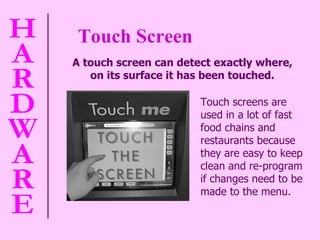
Touch Screen A touch screen can detect exactly where,  on its surface it has been touched.   Touch screens are used in a lot of fast food chains and restaurants because they are easy to keep clean and re-program if changes need to be made to the menu.
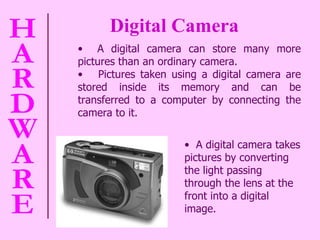
Digital Camera A digital camera can store many more pictures than an ordinary camera. Pictures taken using a digital camera are stored inside its memory and can be transferred to a computer by connecting the camera to it.  A digital camera takes pictures by converting the light passing through the lens at the front into a digital image.
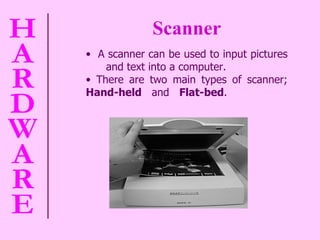
Scanner A scanner can be used to input pictures  and text into a computer. There are two main types of scanner;  Hand-held   and  Flat-bed .
Voice Recognition  With voice recognition systems the computer can understand the words spoken to it and can carry out commands associated with the words.  Using voice recognition a letter can be dictated instead of being typed at the keyboard. Handwriting Recognition Handwriting can be  recognised  and the computer can convert the written text into typed text for storing.
Optical Character Recognition OCR Is used to convert paper typed documents into text files that can be edited and stored on a computer system. OCR software can search a scanned image for the shapes of letters, numbers etc.  When it finds shapes that match it converts them to the correct text and stores them in a file.
Output  Devices
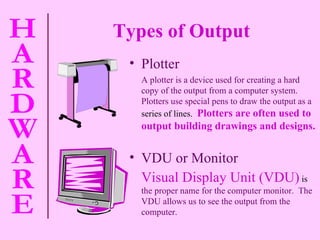
Types of Output   VDU or Monitor Visual Display Unit (VDU)  is  the proper name for the computer monitor.  The VDU allows us to see the output from the computer. Plotter A plotter is a device used for creating a hard copy of the output from a computer system.  Plotters use special pens to draw the output as a  series of lines.  Plotters are often used to output building drawings and designs.
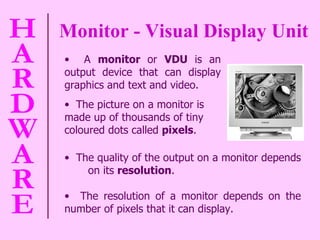
Monitor - Visual Display Unit The quality of the output on a monitor depends  on its  resolution . The resolution of a monitor depends on the number of pixels that it can display.  A  monitor  or  VDU  is an output device that can display graphics and text and video.  The picture on a monitor is made up of thousands of tiny coloured dots called  pixels .
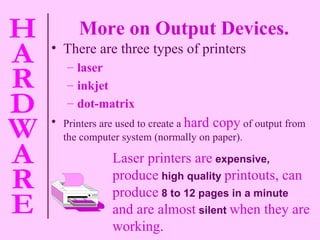
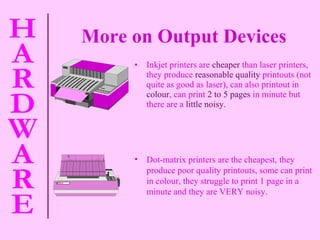
More on Output Devices. There are three types of printers  laser  inkjet dot-matrix Printers are used to create a   hard copy   of output from the computer system (normally on paper). Laser printers are   expensive,   produce   high quality   printouts, can produce   8 to 12 pages in a minute   and are almost   silent   when they are working.
More on Output Devices Inkjet printers are   cheaper   than laser printers, they produce   reasonable quality   printouts (not quite as good as laser), can also printout in   colour , can print   2 to 5 pages   in minute but there are a   little noisy. Dot-matrix printers are the cheapest, they produce poor quality printouts, some can print in colour, they struggle to print 1 page in a minute and they are VERY noisy.
More on Output Devices Voice Output Voice output from a computer system is also known as speech synthesis.  Some voice output programs are know as text readers.  They take a text file and recite it to the user. Other speech synthesis programs can tell the user what they are doing (for example floor announcements in a speaking elevator). Hello,  I am Hal!
Types of Media Media is the material used in devices. Examples of media are Floppy disc and  CD-ROM. If CD-ROM is the   MEDIA   then the CD-ROM drive is the   DEVICE . Media Device
Multimedia Multimedia systems combine   graphics ,  text ,  sound ,  video  and  animation   to provide a rich experience for the user. Many interactive multimedia software titles are available now. Often these are stored on CD-ROM e.g. Microsoft Encarta.
Virtual Reality Virtual Reality involves the user entering a 3D world generated by the computer. To be immersed in a 3D VR world requires special hardware e.g. A   headset   (containing   goggles, headphones   and a   position tracker ) A  data glove   or   data suit   so that the users body can interact with the VR world.
It consists of at least one input device, a processor and one output device. A standalone computer system is a computer system that is NOT connected to other computers. A computer system is a collection of parts that work together. What is a Computer System ?
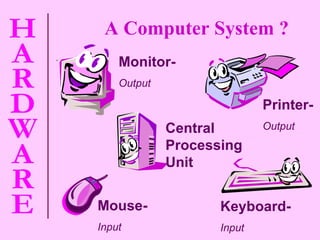
Monitor- Output Printer- Output Central Processing Unit Mouse- Input Keyboard- Input A Computer System ?
A network is made up of two or more computers linked together. Advantages are: Share devices between computers Share data between computers Share programs between computers Saves time Computer Networks
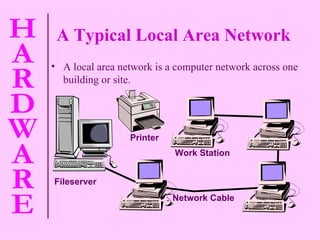
A local area network is a computer network across one building or site. Fileserver Printer Work Station Network Cable A Typical Local Area Network

Hardware

  • 1.
  • 2.
  • 3.
  • 4.
  • 5.
    Hardware and Software Hardware refers to all the parts of the Computer System that we can touch. Examples of hardware are monitors, joysticks, printers, processors etc. Software refers to all the programs and data that we use with the computer.
  • 6.
    A computer isan information processing machine. A computer only follows the instructions it is given. Data is Input, Processed and then Output. What is a Computer? I’m ONLY a machine!
  • 7.
    Sizes of ComputersMicroprocessor A small chip programmed with instructions. Microcomputer The most common type of computer. The IBM PC is a microcomputer Mini Computer Medium to Large computers - mainly used to process business information. Mainframe Computer Very powerful computers able to process 1000’s of times more information a second than PCs Smallest Biggest
  • 8.
    IPO - Input, Process, Output INPUT PROCESS OUTPUT Data is INPUT into the computer system It is then PROCESSED to produce useful Information as OUTPUT .
  • 9.
    Data and InformationData has no meaning Data is made up of symbols e.g. 871652; H789 IOS; £76.91 Information has a meaning We understand what a piece of information is about e.g Telephone Number: 871652 Car License Plate: H789 IOS
  • 10.
    More Input, Process,Output Data is the RAW MATERIAL. This raw material is processed. When the processing is completed a useful thing is produced…INFORMATION INPUT PROCESS OUTPUT
  • 11.
    Computer - BlockDiagram The Computer System consists of four parts. Input, Processor [CPU], Output, Backing Storage Backing Storage Devices Input Devices Central Processing Unit (CPU) Output Devices
  • 12.
    The central processing unit (CPU) This is the part of the computer where the searching and sorting of data, calculating and decision-making goes on. The CPU contains the processor [ Control Unit and the Arithmetic and Logic Unit (ALU) ] and the Main Memory
  • 13.
    The Processor The CONTROL UNIT fetches program instructions from the memory storage locations, decodes and then executes them. The ALU (Arithmetic/Logic Unit) carries out all the calculations as instructed by the control unit.
  • 14.
    MAIN MEMORY -ROM and RAM ROM is Read Only Memory Data stored in ROM can only be read, it can never be written over or deleted. We normally store important programs in ROM to do with the computers Operating System (see later). NON VOLATILE MEMORY RAM is Random Access Memory It can be written to and read from. It is where most programs and data are stored while the computer is being used. RAM loses its contents when the computer is switched off. VOLATILE MEMORY RAM ROM PROCESSOR Data Flow
  • 15.
    Memory Computers storeblocks of data called ‘words’ in memory (A 32 bit computer has words that are 32 bits long). Each place that can store a word is called a storage location. Each storage location has a unique address that identifies it from all the other locations.
  • 16.
    Machine Code Computersonly understand binary!!! All programs have to end up in binary language in order work. The binary language that the computer understands is called MACHINE CODE Machine code looks like this… 00100111,01110100,10010001
  • 17.
    Bits and Bytes[BINARY] Each 1 or 0 is called a BIT (short for Binary Digit). Eight bits are called a BYTE. 1024 bytes is a KILOBYTE (Kb for short) 1024 kilobytes is a MEGABYTE (Mb for short) 1024 megabytes is a GIGABYTE (Gb for short) These units are used to measure the size of storage or storage requirements e.g. the available memory, hard disk space, program size.
  • 18.
  • 19.
    Binary Everywhere! Binaryis used to store all the data and programs in a computer system. We use binary to store: Graphics, Text, Numbers, Video, Sound and Programs. Binary is just the code used to store the data.
  • 20.
    Storing Numbers Numbersare stored in binary. 1 Bin is 1 Dec 10 Bin is 2 Dec 1000 Bin is 8 Dec 1001 Bin is 9 Dec 1111 Bin is 15 Dec 11111111 Bin is 255 Dec You don’t need to understand binary (that’s Maths) but you do need to know that it is how most numbers are stored in the computer.
  • 21.
    Storing Text Textis stored using a special set of codes called ASCII. Each symbol (letter, number etc) has its own unique code e.g. a is 97, A is 65, ? is 63, 3 is 51 ASCII ( A merican S tandard C ode for I nformation I nterchange ) One ASCII code is one byte long (eight bits).
  • 22.
    Storing Graphics Blackand White graphics are stored using pixels ( Picture Elements ). The image to be stored is broken up into dots, each dot is a pixel. The pixels are ON for black and OFF for white e.g. 1 0 0 0 0 0 0 1 1 0 1 0 0 1 0 1 1 0 1 0 0 1 0 1 0 0 0 0 0 0 0 0 0 0 0 1 1 0 0 0 0 1 0 0 0 0 1 0 0 1 1 1 1 1 1 0 0 1 1 1 1 1 1 0
  • 23.
  • 24.
    Hardware DevicesDevices are either INPUT , OUTPUT or BACKING STORAGE . Input devices allow us to enter data into the computer system (mouse, microphone etc). Output devices allow us to receive information from the computer system (monitor, speakers, robot). Backing storage devices allow us to store programs and data so that we can use them later (floppy disc, magnetic tape, CD-ROM).
  • 25.
  • 26.
    Backing storage isused to store programs and data when they are not being used or when a computer is switched off. When programs and data are needed they are copied into main memory but also still remain on backing storage. Magnetic tape drives, floppy disk drives and hard disk drives are all examples of backing storage devices. Backing Storage Devices
  • 27.
    WORM - WriteOnce Read Many A WORM is a writable optical disc. An optical disc is any disc that can be read using light (normally laser light). WORM drives use a high powered laser to burn the data into the disc. This can then be read in the same way that CD-ROM's are read. Because the data is burnt onto the disc each disc can only be written once and the data written is permanent. Magnetic tape, floppy disc, hard disc and CD-ROM are all types of backing storage. Backing Storage Devices ?
  • 28.
    PROM and EPROMPROM and EPROM are both special types of programmable read only memory. PROM stands for P rogrammable R ead O nly M emory. This type of memory can be programmed once but can’t be changed again afterwards. EPROM stands for E rasable P rogrammable R ead O nly M emory. This type of memory can be programmed and then changed whenever necessary.
  • 29.
    A floppy disc can be used to save data. It can also be used to make a backup copy of small files. A backup is a second copy of your data that you take in case something happens to the original. You should always make a backup of important files. Write Protect Tab Disc Label The Floppy Disk Size : 3.5 inch Capacity : 1.44 Mb
  • 30.
    Formatting A FloppyDisk The formatting process involves: Dividing the surface of the disk into invisible circles called tracks and sectors . Setting up a root directory where the list of files that are on the disk will be kept . Data on a magnetic disk is located by finding the address of its location from an index in the root directory. Each address in the index contains a track and sector number for an individual data segment.
  • 31.
    Formatting A FloppyDisk No data is stored on the outside or inside tracks of the disk Tracks Index Sector
  • 32.
    The Hard Discand Drive A hard disk is a circular metal disk coated with magnetic material and usually sealed in a hard disk drive inside the computer. Some hard disk drives are not permanently fixed inside the computer but are removable . Data stored on a hard disk can be accessed much more quickly than data stored on a floppy disk. Hard disks can store much more data than a floppy disk. A typical hard disk inside a personal computer can hold many gigabytes of data.
  • 33.
    The Hard Discand Drive Hard discs are normally built into the computer. In a modern home PC the hard disc would typically store 10Gb of data or more.
  • 34.
    Non-magnetic storage Non-magneticstorage involves the use of media not coated in magnetic material. Examples of this are: CD-ROM, Video Disc, Digital Video Disc (DVD) and WORM. These use pits and bumps (lands) on the disc to store digital data and use laser light to write and read them.
  • 35.
    Capacity The sizeof memory, hard disc space, floppy drive space, programs, data files etc. are all measured by the number of bytes, kilobytes, megabytes or gigabytes (1024 megabytes) of data they contain . 445 floppy discs = 1 CD-ROM
  • 36.
    File compression Filecompression software can be used to make files smaller so that more data can be stored in the same amount of space on backing store. When a compressed file on backing store needs to be used it must be decompressed. This can be done using decompression software or by setting files up to be self-extracting which means that they can automatically decompress themselves. Winzip is an example of software that can be used to compress and decompress files.
  • 37.
    Types of AccessThere are two types of access Random Access (also called Direct Access ) devices retrieve the data you want straight away e.g. CD-ROM drive, Hard disc drive, floppy disc drive. Sequential (also called Serial ) devices have to move through all the data, record after record, to find the data you need e.g. Cassette tape, magnetic tape.
  • 38.
    Types of accessSequential Access To go from file A to file Z in a sequential-access system, you must pass through all intervening files. Sequential access is sometimes called serial access. Random Access Refers to the ability to access data at random. In a random-access system, you can jump directly to file Z.
  • 39.
  • 40.
    Types of Input Keyboard Most keyboards are of the QWERTY type but not always. They have always been used for inputting data to the computer Mouse The mouse is very important in WIMP systems and is used to move a pointer around the screen and make selections by pressing a button
  • 41.
    Advanced types ofInput Trackball A trackball is basically an upside down mouse. A trackball allows the user to move a small ball in order to move the pointer across the screen. Graphics Tablet A graphics tablet allows the user to draw on a special worktop. As the user draws the details are stored on the computer system. These devices are most often used by architects and designers.
  • 42.
    Joystick The mainuse of a joystick is to play computer games by controlling the way that something moves on the screen. Joysticks can be used to control movement from side-to-side, up-and-down and diagonally. A joystick will also always have at least one button on it which can be used to make something happen like making a character in a game jump or a gun fire.
  • 43.
    Touch Screen Atouch screen can detect exactly where, on its surface it has been touched. Touch screens are used in a lot of fast food chains and restaurants because they are easy to keep clean and re-program if changes need to be made to the menu.
  • 44.
    Digital Camera Adigital camera can store many more pictures than an ordinary camera. Pictures taken using a digital camera are stored inside its memory and can be transferred to a computer by connecting the camera to it. A digital camera takes pictures by converting the light passing through the lens at the front into a digital image.
  • 45.
    Scanner A scannercan be used to input pictures and text into a computer. There are two main types of scanner; Hand-held and Flat-bed .
  • 46.
    Voice Recognition With voice recognition systems the computer can understand the words spoken to it and can carry out commands associated with the words. Using voice recognition a letter can be dictated instead of being typed at the keyboard. Handwriting Recognition Handwriting can be recognised and the computer can convert the written text into typed text for storing.
  • 47.
    Optical Character RecognitionOCR Is used to convert paper typed documents into text files that can be edited and stored on a computer system. OCR software can search a scanned image for the shapes of letters, numbers etc. When it finds shapes that match it converts them to the correct text and stores them in a file.
  • 48.
  • 49.
    Types of Output VDU or Monitor Visual Display Unit (VDU) is the proper name for the computer monitor. The VDU allows us to see the output from the computer. Plotter A plotter is a device used for creating a hard copy of the output from a computer system. Plotters use special pens to draw the output as a series of lines. Plotters are often used to output building drawings and designs.
  • 50.
    Monitor - VisualDisplay Unit The quality of the output on a monitor depends on its resolution . The resolution of a monitor depends on the number of pixels that it can display. A monitor or VDU is an output device that can display graphics and text and video. The picture on a monitor is made up of thousands of tiny coloured dots called pixels .
  • 51.
    More on OutputDevices. There are three types of printers laser inkjet dot-matrix Printers are used to create a hard copy of output from the computer system (normally on paper). Laser printers are expensive, produce high quality printouts, can produce 8 to 12 pages in a minute and are almost silent when they are working.
  • 52.
    More on OutputDevices Inkjet printers are cheaper than laser printers, they produce reasonable quality printouts (not quite as good as laser), can also printout in colour , can print 2 to 5 pages in minute but there are a little noisy. Dot-matrix printers are the cheapest, they produce poor quality printouts, some can print in colour, they struggle to print 1 page in a minute and they are VERY noisy.
  • 53.
    More on OutputDevices Voice Output Voice output from a computer system is also known as speech synthesis. Some voice output programs are know as text readers. They take a text file and recite it to the user. Other speech synthesis programs can tell the user what they are doing (for example floor announcements in a speaking elevator). Hello, I am Hal!
  • 54.
    Types of MediaMedia is the material used in devices. Examples of media are Floppy disc and CD-ROM. If CD-ROM is the MEDIA then the CD-ROM drive is the DEVICE . Media Device
  • 55.
    Multimedia Multimedia systemscombine graphics , text , sound , video and animation to provide a rich experience for the user. Many interactive multimedia software titles are available now. Often these are stored on CD-ROM e.g. Microsoft Encarta.
  • 56.
    Virtual Reality VirtualReality involves the user entering a 3D world generated by the computer. To be immersed in a 3D VR world requires special hardware e.g. A headset (containing goggles, headphones and a position tracker ) A data glove or data suit so that the users body can interact with the VR world.
  • 57.
    It consists ofat least one input device, a processor and one output device. A standalone computer system is a computer system that is NOT connected to other computers. A computer system is a collection of parts that work together. What is a Computer System ?
  • 58.
    Monitor- Output Printer-Output Central Processing Unit Mouse- Input Keyboard- Input A Computer System ?
  • 59.
    A network ismade up of two or more computers linked together. Advantages are: Share devices between computers Share data between computers Share programs between computers Saves time Computer Networks
  • 60.
    A local areanetwork is a computer network across one building or site. Fileserver Printer Work Station Network Cable A Typical Local Area Network