




©2013 LHST sarl
Happiness and
Well Being
February 1 2017
Introduction
©2016 L. SCHLENKER
Managerial Decision Making
http://Dsign4.biz
©2013 LHST sarl
Introduction
©2016 L. SCHLENKER
Introduction
Approaches
Considerations
Exercises
Indexes
Conclusion
©2013 LHST sarl
Introduction
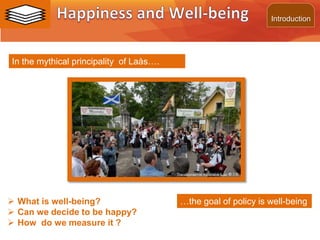
In the mythical principality of Laàs….
 What is well-being?
 Can we decide to be happy?
 How do we measure it ?
…the goal of policy is well-being
©2013 LHST sarl
Introduction
©2016 L. SCHLENKER
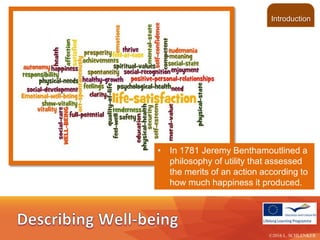
• In 1781 Jeremy Benthamoutlined a
philosophy of utility that assessed
the merits of an action according to
how much happiness it produced.
©2013 LHST sarl
• The Freudian perspective,
we are seen as captive in
the “hands” of forces
unknown to us
• In the Behavioral Approach,
we are seen as being
manipulated without being
fully aware by classical and
operant conditioning
• The Humanistic approach
explores the meaning of our
existence, the role of free
will, and the uniqueness of
each individual
Introduction
©2013 LHST sarl
Models
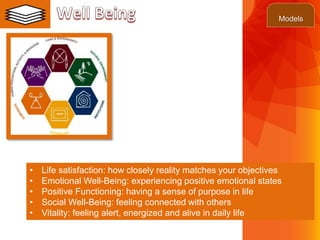
• Life satisfaction: how closely reality matches your objectives
• Emotional Well-Being: experiencing positive emotional states
• Positive Functioning: having a sense of purpose in life
• ​Social Well-Being: feeling connected with others
• ​Vitality: feeling alert, energized and alive in daily life
©2013 LHST sarl
• Mary works well in your public relations
office.
• A new employee, Jane, turns out to be a
born talent.
• Mary’s direct boss just quit, and you’re
looking for someone for the job. Jane
seems a great fit.
• But it may be awkward to promote Jane and
make Mary her subordinate.
Exercises
©2013 LHST sarl
• Robert and John went to school together,
and they got married roughly at the same
time.
• Robert and his wife have not had any
children.
• John and his wife had a first child after
one year, and, two years later, they had
the second one, now eight months old.
• Robert is on a ski vacation with his wife,
while John can’t even dream of a ski
vacation with the two children
• Do you think that Robert is happier than
John?
Exercises
©2013 LHST sarl
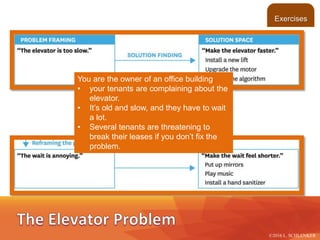
You are the owner of an office building
• your tenants are complaining about the
elevator.
• It’s old and slow, and they have to wait
a lot.
• Several tenants are threatening to
break their leases if you don’t fix the
problem.
©2016 L. SCHLENKER
Exercises
©2013 LHST sarl
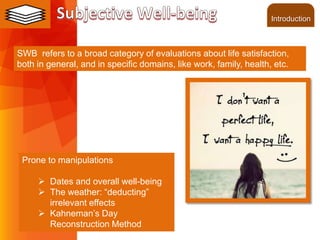
Prone to manipulations
 Dates and overall well-being
 The weather: “deducting”
irrelevant effects
 Kahneman’s Day
Reconstruction Method
SWB refers to a broad category of evaluations about life satisfaction,
both in general, and in specific domains, like work, family, health, etc.
Introduction
©2013 LHST sarl
11
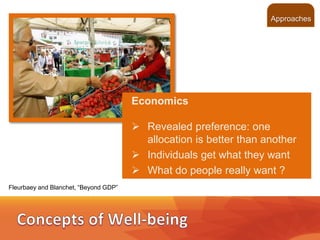
Economics
 Revealed preference: one
allocation is better than another
 Individuals get what they want
 What do people really want ?
Fleurbaey and Blanchet, “Beyond GDP”
Approaches
©2013 LHST sarl
12
Sociology
 These lists include the
elements of success
 Which elements matter?
 How do we determine
preferences?
Approaches
©2013 LHST sarl
13
Psychology
Expected utility: how you feel at
one point in time
These accounts provided by
individual can be
evaluative/cognitive
 Subjective well-being- are we
talking about the same thing ?
Approaches
©2013 LHST sarl
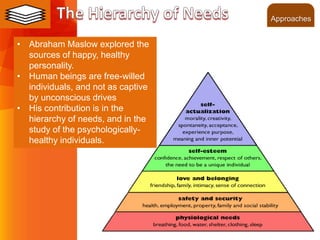
• Abraham Maslow explored the
sources of happy, healthy
personality.
• Human beings are free-willed
individuals, and not as captive
by unconscious drives
• His contribution is in the
hierarchy of needs, and in the
study of the psychologically-
healthy individuals.
Approaches
©2013 LHST sarl
15
We strive to obtain a list of
worthwhile pursuits
• Careers
• Friendship
• Health
• Material comfort
• Education
• Love
• Knowledge….
Considerations
©2013 LHST sarl
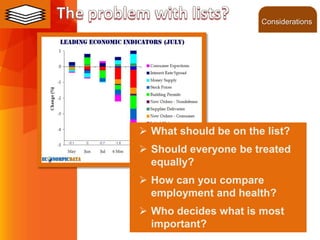
 What should be on the list?
 Should everyone be treated
equally?
 How can you compare
employment and health?
 Who decides what is most
important?
MoelsConsiderations
©2013 LHST sarl
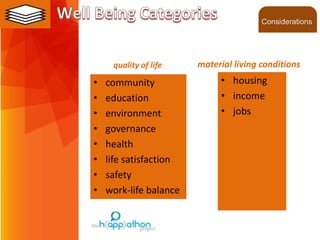
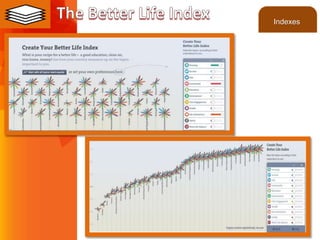
material living conditions
• housing
• income
• jobs
quality of life
• community
• education
• environment
• governance
• health
• life satisfaction
• safety
• work-life balance
Considerations
©2013 LHST sarl
• Concerns:
 Do people know what is good for
them?
 How do treat “anti-social”
preferences?
 What if what you want is bad for
me?
Well-being is a question of satisfying your preferences and
fulfilling your desires
Considerations
©2013 LHST sarl
Well-being is a question of how people feel
 How satisfied are you with your life?
 Sad, happy, exited, bored
• Concerns:
 Adaptation and changing
aspirations: hedonic treadmill
 Personality traits (an individual
fixed effect)
 Objective and subjective may not
“match”.
Considerations
©2013 LHST sarl
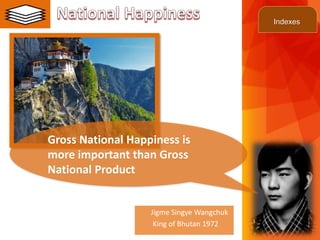
Gross National Happiness is
more important than Gross
National Product
Jigme Singye Wangchuk
King of Bhutan 1972
Indexes
©2013 LHST sarlDomain icons by Joumana Medlej at majnouna.com
Indexes
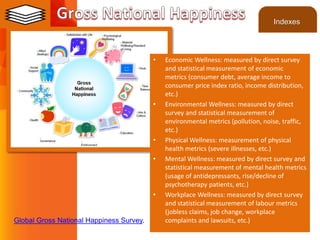
• Economic Wellness: measured by direct survey
and statistical measurement of economic
metrics (consumer debt, average income to
consumer price index ratio, income distribution,
etc.)
• Environmental Wellness: measured by direct
survey and statistical measurement of
environmental metrics (pollution, noise, traffic,
etc.)
• Physical Wellness: measurement of physical
health metrics (severe illnesses, etc.)
• Mental Wellness: measured by direct survey and
statistical measurement of mental health metrics
(usage of antidepressants, rise/decline of
psychotherapy patients, etc.)
• Workplace Wellness: measured by direct survey
and statistical measurement of labour metrics
(jobless claims, job change, workplace
complaints and lawsuits, etc.)Global Gross National Happiness Survey.
©2013 LHST sarl
Indexes
©2013 LHST sarl
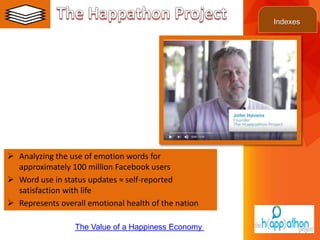
 Analyzing the use of emotion words for
approximately 100 million Facebook users
 Word use in status updates ≈ self-reported
satisfaction with life
 Represents overall emotional health of the nation
The Value of a Happiness Economy
Indexes
©2013 LHST sarl
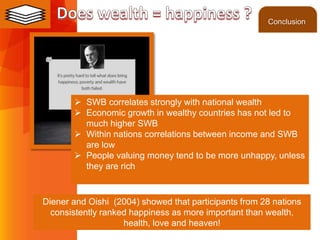
 SWB correlates strongly with national wealth
 Economic growth in wealthy countries has not led to
much higher SWB
 Within nations correlations between income and SWB
are low
 People valuing money tend to be more unhappy, unless
they are rich
Diener and Oishi (2004) showed that participants from 28 nations
consistently ranked happiness as more important than wealth,
health, love and heaven!
Conclusion
©2013 LHST sarl
 Income: The correlation between individual income
and happiness tends to fall between .17 and .21.
 Health: In a meta-analysis of over 200 studies
correlations were around .30
 Personality: neuroticism is strongly related to
negative affect and extraversion is strongly related to
positive affect
 Social relationships: have a powerful effect on well-
being, and are perhaps the single greatest single
cause (Argyle, 2001)
Conclusion
©2013 LHST sarl©2016 L. SCHLENKER
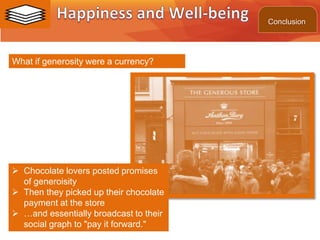
What if generosity were a currency?
 Chocolate lovers posted promises
of generoisity
 Then they picked up their chocolate
payment at the store
 …and essentially broadcast to their
social graph to "pay it forward."
Conclusion
©2013 LHST sarl©2016 L. SCHLENKER
Conclusion
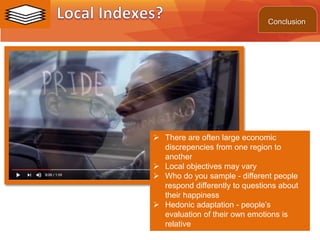
 There are often large economic
discrepencies from one region to
another
 Local objectives may vary
 Who do you sample - different people
respond differently to questions about
their happiness
 Hedonic adaptation - people’s
evaluation of their own emotions is
relative
©2013 LHST sarl
Introduction
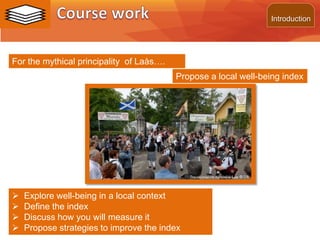
For the mythical principality of Laàs….
 Explore well-being in a local context
 Define the index
 Discuss how you will measure it
 Propose strategies to improve the index
Propose a local well-being index

Happiness and Well-being

  • 1.
    ©2013 LHST sarl Happinessand Well Being February 1 2017 Introduction ©2016 L. SCHLENKER Managerial Decision Making http://Dsign4.biz
  • 2.
    ©2013 LHST sarl Introduction ©2016L. SCHLENKER Introduction Approaches Considerations Exercises Indexes Conclusion
  • 3.
    ©2013 LHST sarl Introduction Inthe mythical principality of Laàs….  What is well-being?  Can we decide to be happy?  How do we measure it ? …the goal of policy is well-being
  • 4.
    ©2013 LHST sarl Introduction ©2016L. SCHLENKER • In 1781 Jeremy Benthamoutlined a philosophy of utility that assessed the merits of an action according to how much happiness it produced.
  • 5.
    ©2013 LHST sarl •The Freudian perspective, we are seen as captive in the “hands” of forces unknown to us • In the Behavioral Approach, we are seen as being manipulated without being fully aware by classical and operant conditioning • The Humanistic approach explores the meaning of our existence, the role of free will, and the uniqueness of each individual Introduction
  • 6.
    ©2013 LHST sarl Models •Life satisfaction: how closely reality matches your objectives • Emotional Well-Being: experiencing positive emotional states • Positive Functioning: having a sense of purpose in life • ​Social Well-Being: feeling connected with others • ​Vitality: feeling alert, energized and alive in daily life
  • 7.
    ©2013 LHST sarl •Mary works well in your public relations office. • A new employee, Jane, turns out to be a born talent. • Mary’s direct boss just quit, and you’re looking for someone for the job. Jane seems a great fit. • But it may be awkward to promote Jane and make Mary her subordinate. Exercises
  • 8.
    ©2013 LHST sarl •Robert and John went to school together, and they got married roughly at the same time. • Robert and his wife have not had any children. • John and his wife had a first child after one year, and, two years later, they had the second one, now eight months old. • Robert is on a ski vacation with his wife, while John can’t even dream of a ski vacation with the two children • Do you think that Robert is happier than John? Exercises
  • 9.
    ©2013 LHST sarl Youare the owner of an office building • your tenants are complaining about the elevator. • It’s old and slow, and they have to wait a lot. • Several tenants are threatening to break their leases if you don’t fix the problem. ©2016 L. SCHLENKER Exercises
  • 10.
    ©2013 LHST sarl Proneto manipulations  Dates and overall well-being  The weather: “deducting” irrelevant effects  Kahneman’s Day Reconstruction Method SWB refers to a broad category of evaluations about life satisfaction, both in general, and in specific domains, like work, family, health, etc. Introduction
  • 11.
    ©2013 LHST sarl 11 Economics Revealed preference: one allocation is better than another  Individuals get what they want  What do people really want ? Fleurbaey and Blanchet, “Beyond GDP” Approaches
  • 12.
    ©2013 LHST sarl 12 Sociology These lists include the elements of success  Which elements matter?  How do we determine preferences? Approaches
  • 13.
    ©2013 LHST sarl 13 Psychology Expectedutility: how you feel at one point in time These accounts provided by individual can be evaluative/cognitive  Subjective well-being- are we talking about the same thing ? Approaches
  • 14.
    ©2013 LHST sarl •Abraham Maslow explored the sources of happy, healthy personality. • Human beings are free-willed individuals, and not as captive by unconscious drives • His contribution is in the hierarchy of needs, and in the study of the psychologically- healthy individuals. Approaches
  • 15.
    ©2013 LHST sarl 15 Westrive to obtain a list of worthwhile pursuits • Careers • Friendship • Health • Material comfort • Education • Love • Knowledge…. Considerations
  • 16.
    ©2013 LHST sarl What should be on the list?  Should everyone be treated equally?  How can you compare employment and health?  Who decides what is most important? MoelsConsiderations
  • 17.
    ©2013 LHST sarl materialliving conditions • housing • income • jobs quality of life • community • education • environment • governance • health • life satisfaction • safety • work-life balance Considerations
  • 18.
    ©2013 LHST sarl •Concerns:  Do people know what is good for them?  How do treat “anti-social” preferences?  What if what you want is bad for me? Well-being is a question of satisfying your preferences and fulfilling your desires Considerations
  • 19.
    ©2013 LHST sarl Well-beingis a question of how people feel  How satisfied are you with your life?  Sad, happy, exited, bored • Concerns:  Adaptation and changing aspirations: hedonic treadmill  Personality traits (an individual fixed effect)  Objective and subjective may not “match”. Considerations
  • 20.
    ©2013 LHST sarl GrossNational Happiness is more important than Gross National Product Jigme Singye Wangchuk King of Bhutan 1972 Indexes
  • 21.
    ©2013 LHST sarlDomainicons by Joumana Medlej at majnouna.com Indexes • Economic Wellness: measured by direct survey and statistical measurement of economic metrics (consumer debt, average income to consumer price index ratio, income distribution, etc.) • Environmental Wellness: measured by direct survey and statistical measurement of environmental metrics (pollution, noise, traffic, etc.) • Physical Wellness: measurement of physical health metrics (severe illnesses, etc.) • Mental Wellness: measured by direct survey and statistical measurement of mental health metrics (usage of antidepressants, rise/decline of psychotherapy patients, etc.) • Workplace Wellness: measured by direct survey and statistical measurement of labour metrics (jobless claims, job change, workplace complaints and lawsuits, etc.)Global Gross National Happiness Survey.
  • 22.
  • 23.
    ©2013 LHST sarl Analyzing the use of emotion words for approximately 100 million Facebook users  Word use in status updates ≈ self-reported satisfaction with life  Represents overall emotional health of the nation The Value of a Happiness Economy Indexes
  • 24.
    ©2013 LHST sarl SWB correlates strongly with national wealth  Economic growth in wealthy countries has not led to much higher SWB  Within nations correlations between income and SWB are low  People valuing money tend to be more unhappy, unless they are rich Diener and Oishi (2004) showed that participants from 28 nations consistently ranked happiness as more important than wealth, health, love and heaven! Conclusion
  • 25.
    ©2013 LHST sarl Income: The correlation between individual income and happiness tends to fall between .17 and .21.  Health: In a meta-analysis of over 200 studies correlations were around .30  Personality: neuroticism is strongly related to negative affect and extraversion is strongly related to positive affect  Social relationships: have a powerful effect on well- being, and are perhaps the single greatest single cause (Argyle, 2001) Conclusion
  • 26.
    ©2013 LHST sarl©2016L. SCHLENKER What if generosity were a currency?  Chocolate lovers posted promises of generoisity  Then they picked up their chocolate payment at the store  …and essentially broadcast to their social graph to "pay it forward." Conclusion
  • 27.
    ©2013 LHST sarl©2016L. SCHLENKER Conclusion  There are often large economic discrepencies from one region to another  Local objectives may vary  Who do you sample - different people respond differently to questions about their happiness  Hedonic adaptation - people’s evaluation of their own emotions is relative
  • 28.
    ©2013 LHST sarl Introduction Forthe mythical principality of Laàs….  Explore well-being in a local context  Define the index  Discuss how you will measure it  Propose strategies to improve the index Propose a local well-being index