WELLBEING AND HAPPINESS Prioritising the things that really matter Mark Williamson Director, Action for Happiness
Agenda 1. Why wellbeing matters 2. What the science tells us 3. What we need to do about it
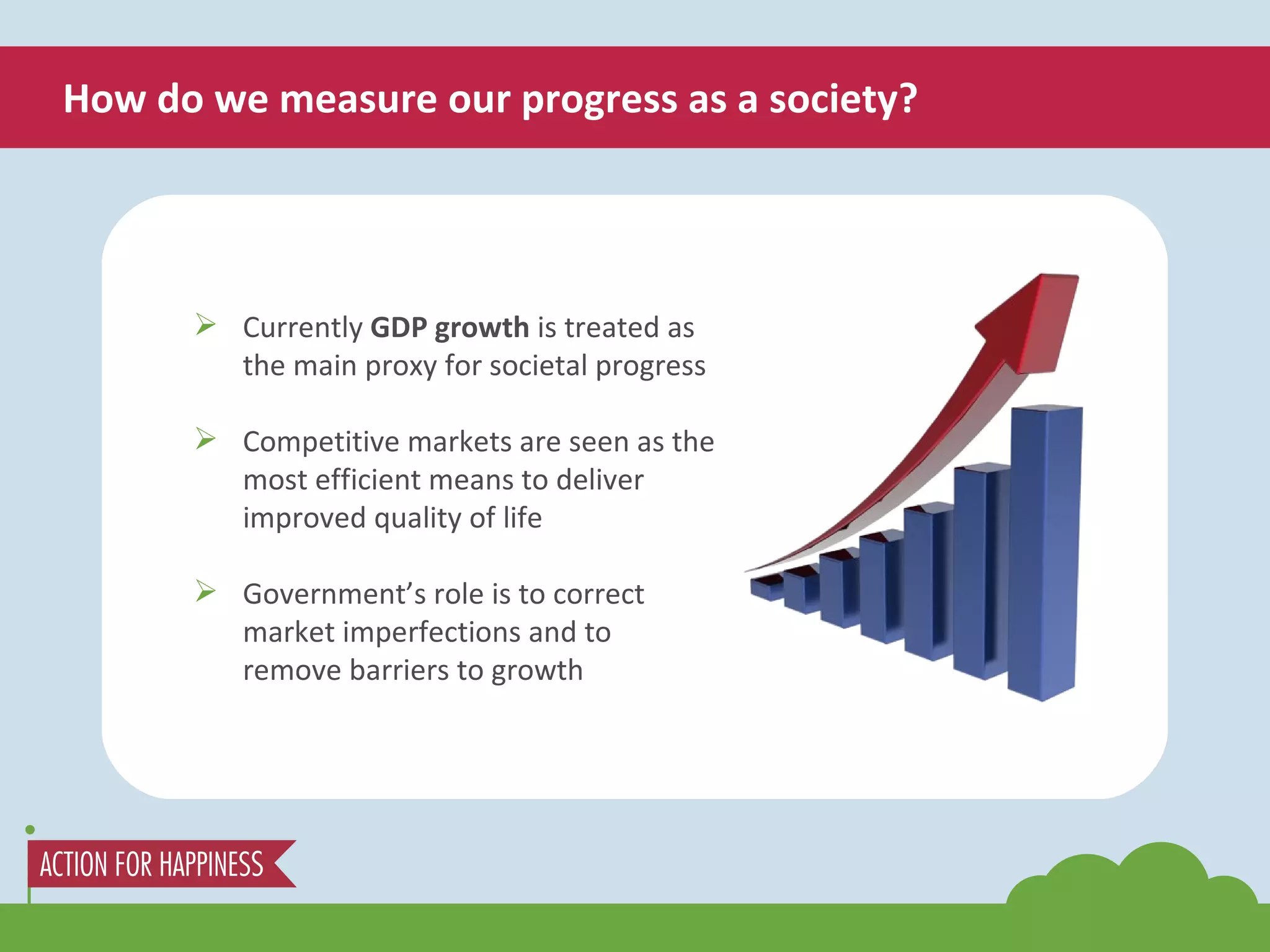
How do we measure our progress as a society? Currently  GDP growth  is treated as the main proxy for societal progress Competitive markets are seen as the most efficient means to deliver improved quality of life Government’s role is to correct market imperfections and to remove barriers to growth
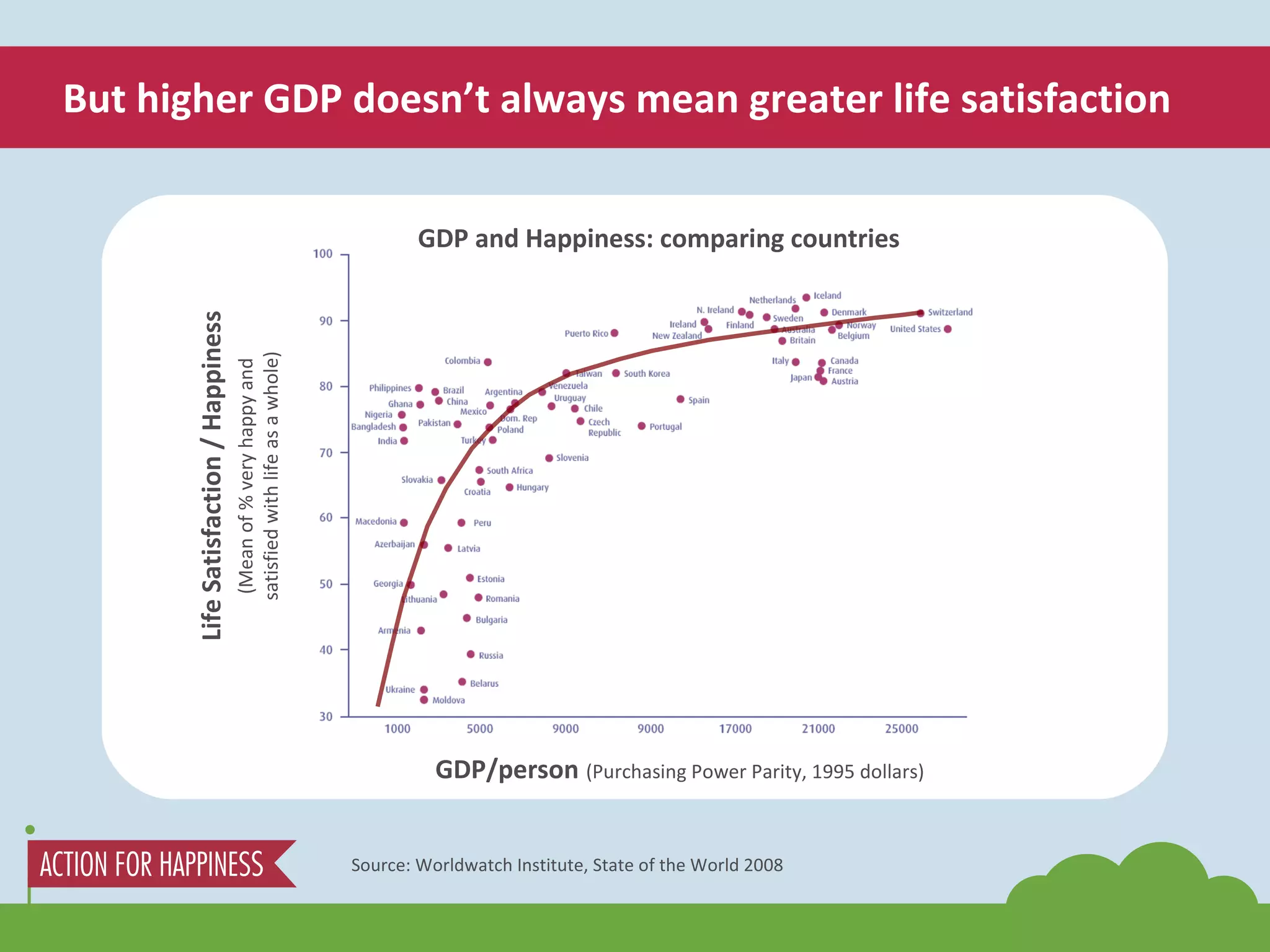
But higher GDP doesn’t always mean greater life satisfaction Source: Worldwatch Institute, State of the World 2008 GDP/person   (Purchasing Power Parity, 1995 dollars) Life Satisfaction / Happiness (Mean of % very happy and satisfied with life as a whole) GDP and Happiness: comparing countries
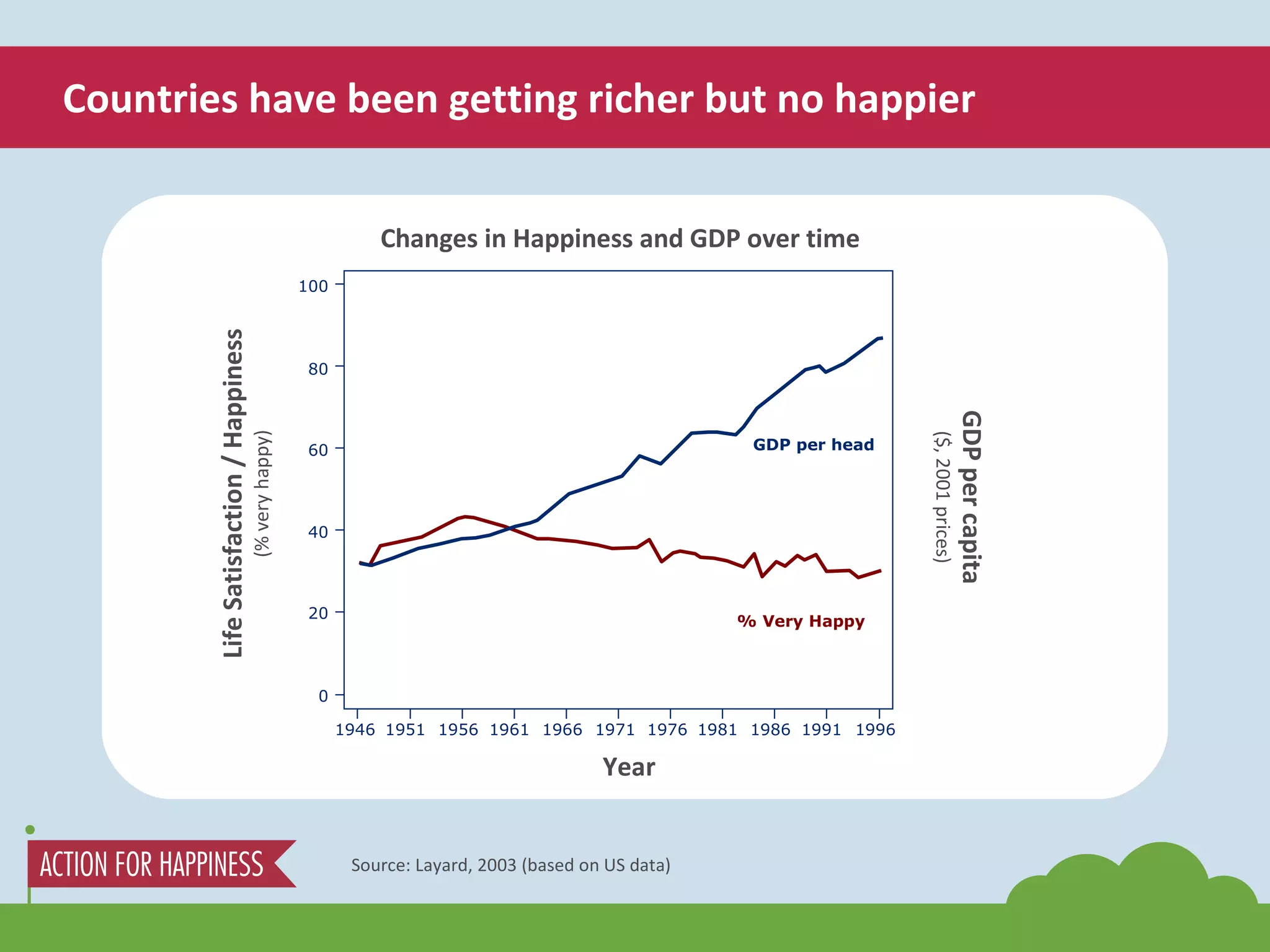
Countries have been getting richer but no happier Source: Layard, 2003 (based on US data) GDP per capita ($, 2001 prices) Year Life Satisfaction / Happiness (% very happy) Changes in Happiness and GDP over time 100 80 60 40 20 0 1946 1951 1956 1961 1966 1971 1976 1981 1986 1991 1996 % Very Happy GDP per head
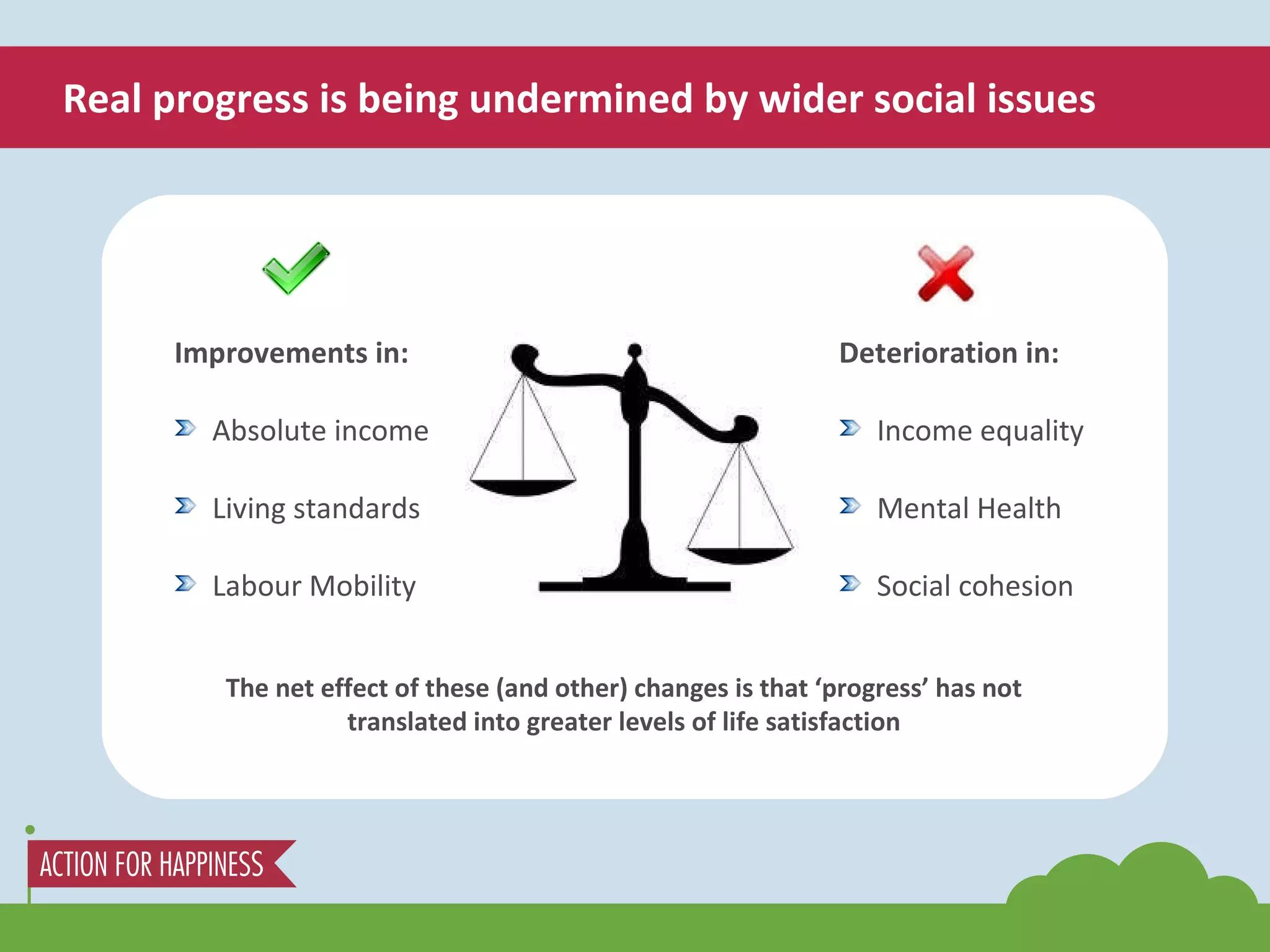
Real progress is being undermined by wider social issues Improvements in: Absolute income Living standards Labour Mobility Deterioration in: Income equality Mental Health Social cohesion The net effect of these (and other) changes is that ‘progress’ has not translated into greater levels of life satisfaction
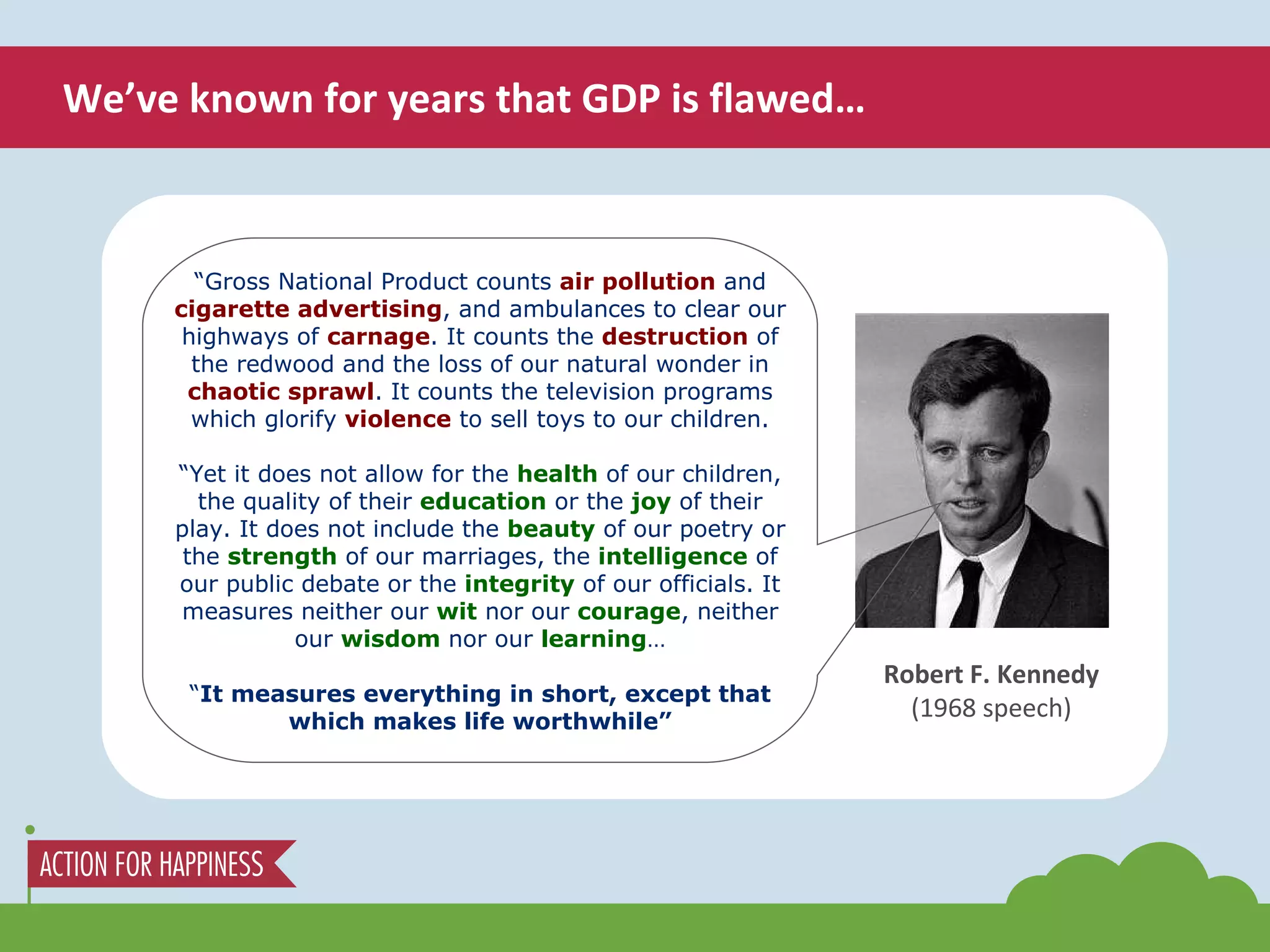
We’ve known for years that GDP is flawed… Robert F. Kennedy (1968 speech) “ Gross National Product counts  air pollution  and  cigarette advertising , and ambulances to clear our highways of  carnage . It counts the  destruction  of the redwood and the loss of our natural wonder in  chaotic sprawl . It counts the television programs which glorify  violence  to sell toys to our children. “ Yet it does not allow for the  health  of our children, the quality of their  education  or the  joy  of their play. It does not include the  beauty  of our poetry or the  strength  of our marriages, the  intelligence  of our public debate or the  integrity  of our officials. It measures neither our  wit  nor our  courage , neither our  wisdom  nor our  learning … “ It measures everything in short, except that which makes life worthwhile”
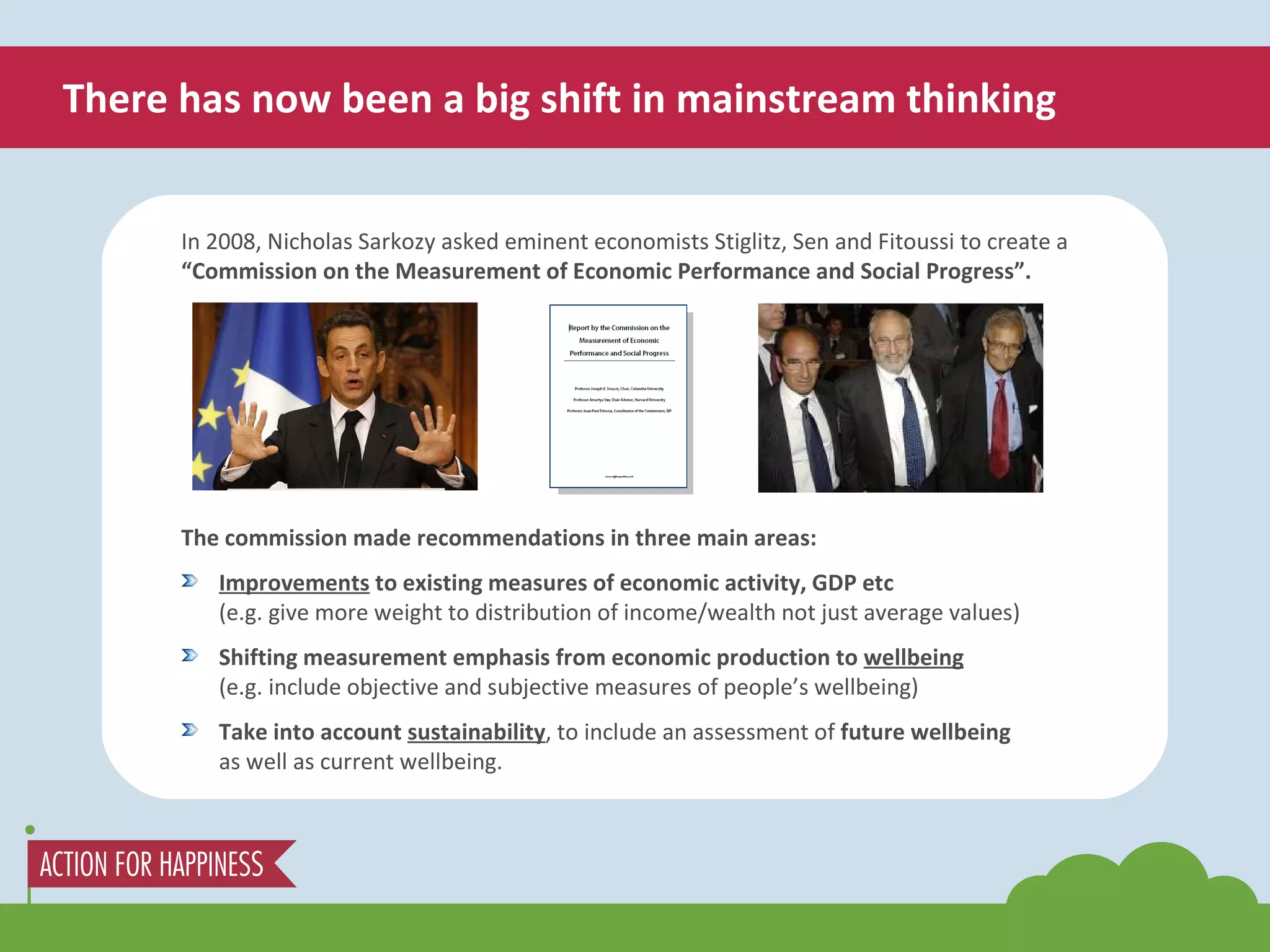
There has now been a big shift in mainstream thinking In 2008, Nicholas Sarkozy asked eminent economists Stiglitz, Sen and Fitoussi to create a  “Commission on the Measurement of Economic Performance and Social Progress”. The commission made recommendations in three main areas: Improvements  to existing measures of economic activity, GDP etc (e.g. give more weight to distribution of income/wealth not just average values) Shifting measurement emphasis from economic production to  wellbeing (e.g. include objective and subjective measures of people’s wellbeing) Take into account  sustainability , to include an assessment of  future wellbeing  as well as current wellbeing.
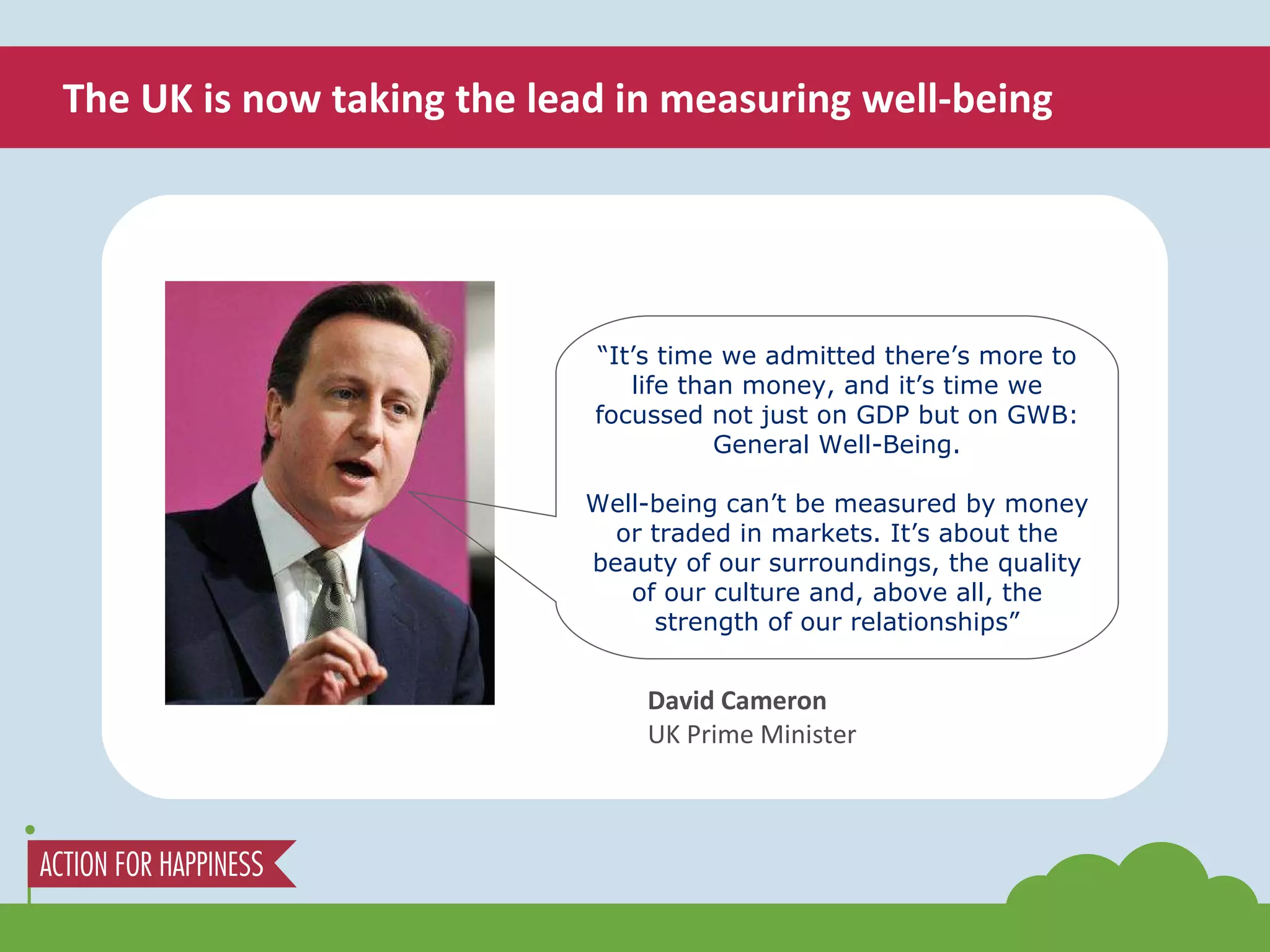
The UK is now taking the lead in measuring well-being “ It’s time we admitted there’s more to life than money, and it’s time we focussed not just on GDP but on GWB: General Well-Being. Well-being can’t be measured by money or traded in markets. It’s about the beauty of our surroundings, the quality of our culture and, above all, the strength of our relationships” David Cameron UK Prime Minister
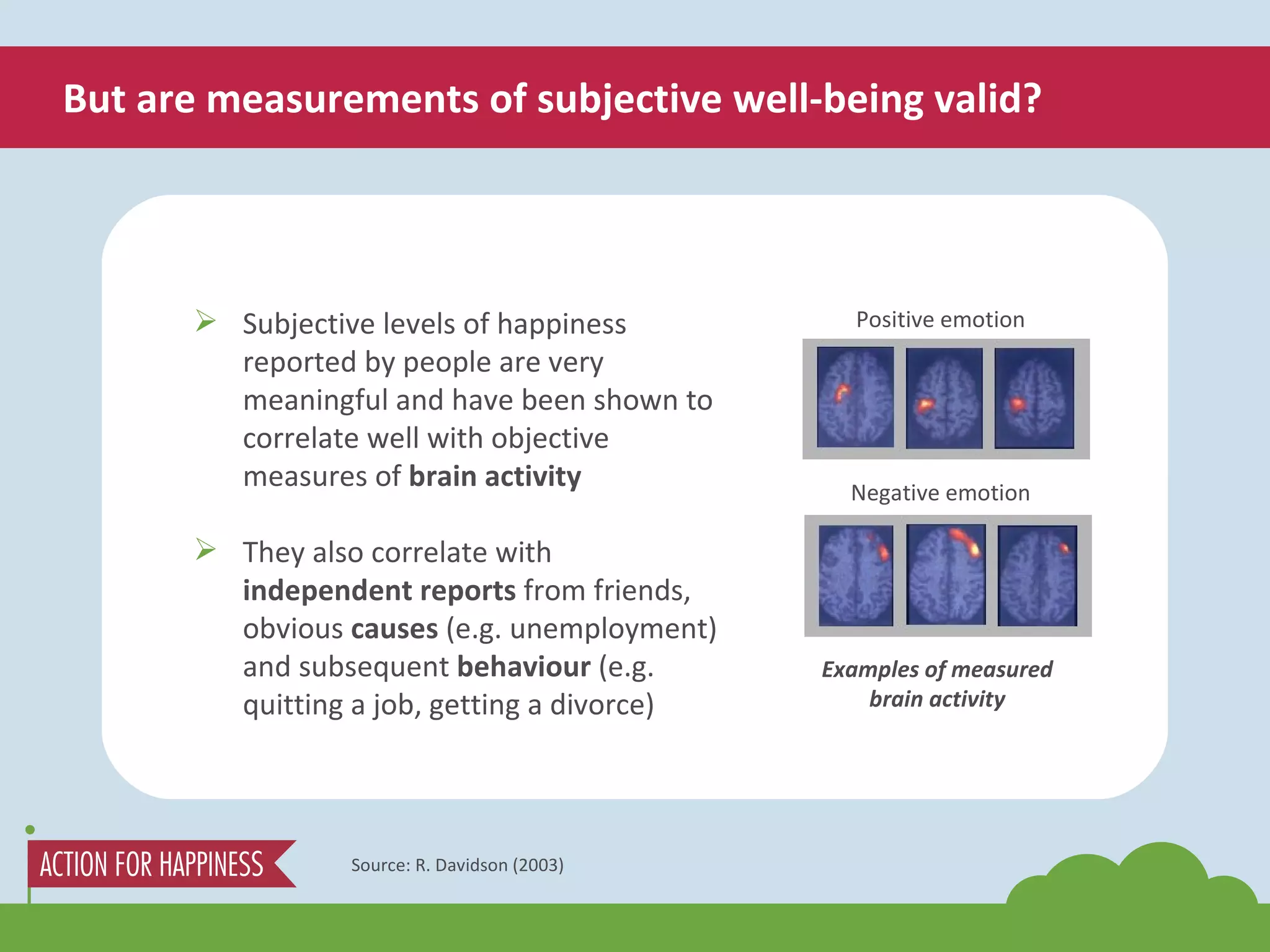
But are measurements of subjective well-being valid? Source: R. Davidson (2003) Subjective levels of happiness reported by people are very meaningful and have been shown to correlate well with objective measures of  brain activity They also correlate with  independent reports  from friends, obvious  causes  (e.g. unemployment) and subsequent  behaviour  (e.g. quitting a job, getting a divorce) Examples of measured brain activity Positive emotion Negative emotion
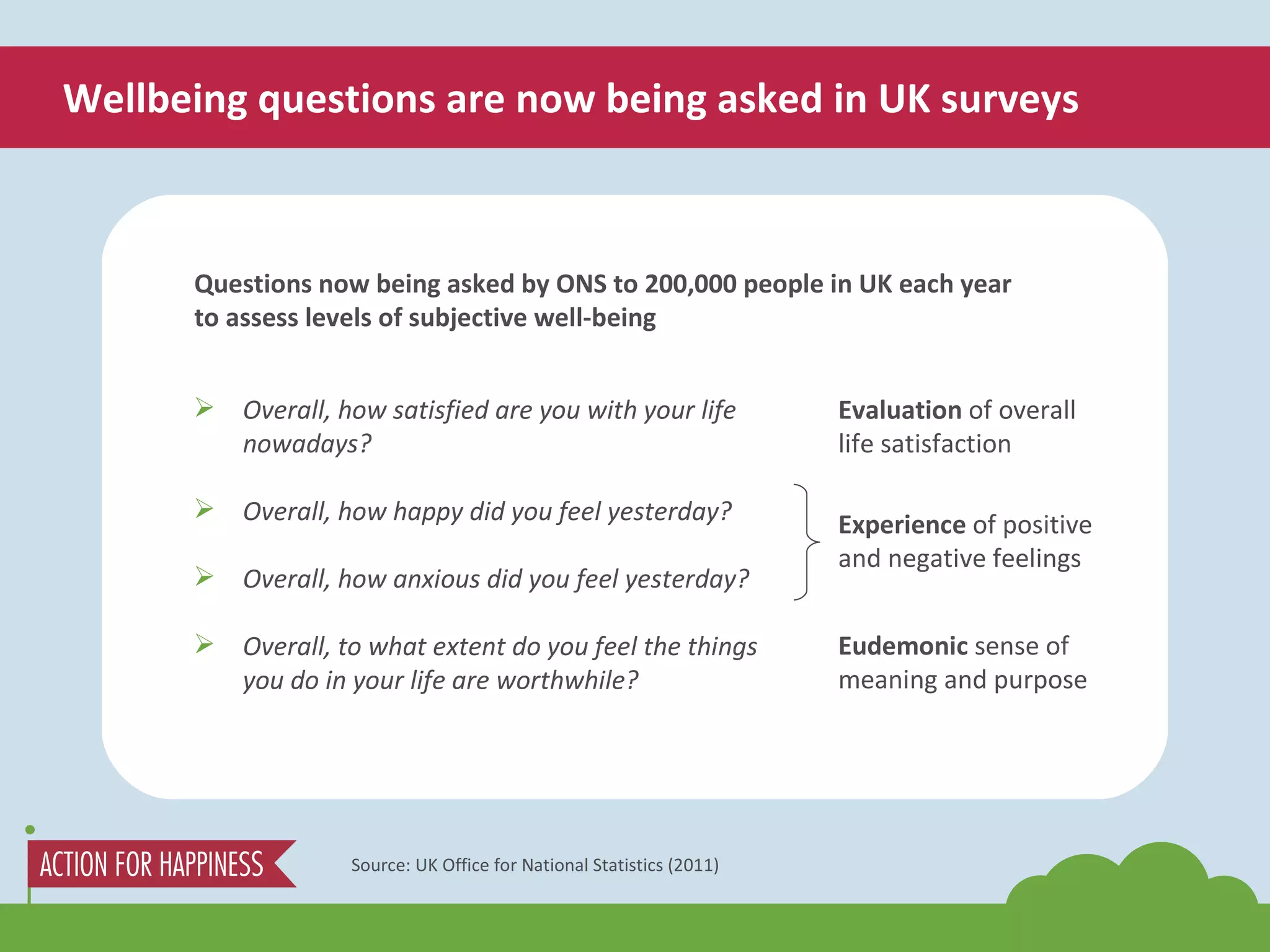
Wellbeing questions are now being asked in UK surveys Overall, how satisfied are you with your life nowadays? Overall, how happy did you feel yesterday? Overall, how anxious did you feel yesterday? Overall, to what extent do you feel the things you do in your life are worthwhile? Questions now being asked by ONS to 200,000 people in UK each year to assess levels of subjective well-being Evaluation  of overall life satisfaction Experience  of positive and negative feelings Eudemonic  sense of meaning and purpose Source: UK Office for National Statistics (2011)
Agenda 1. Why wellbeing matters 3. What we need to do about it 2. What the science tells us
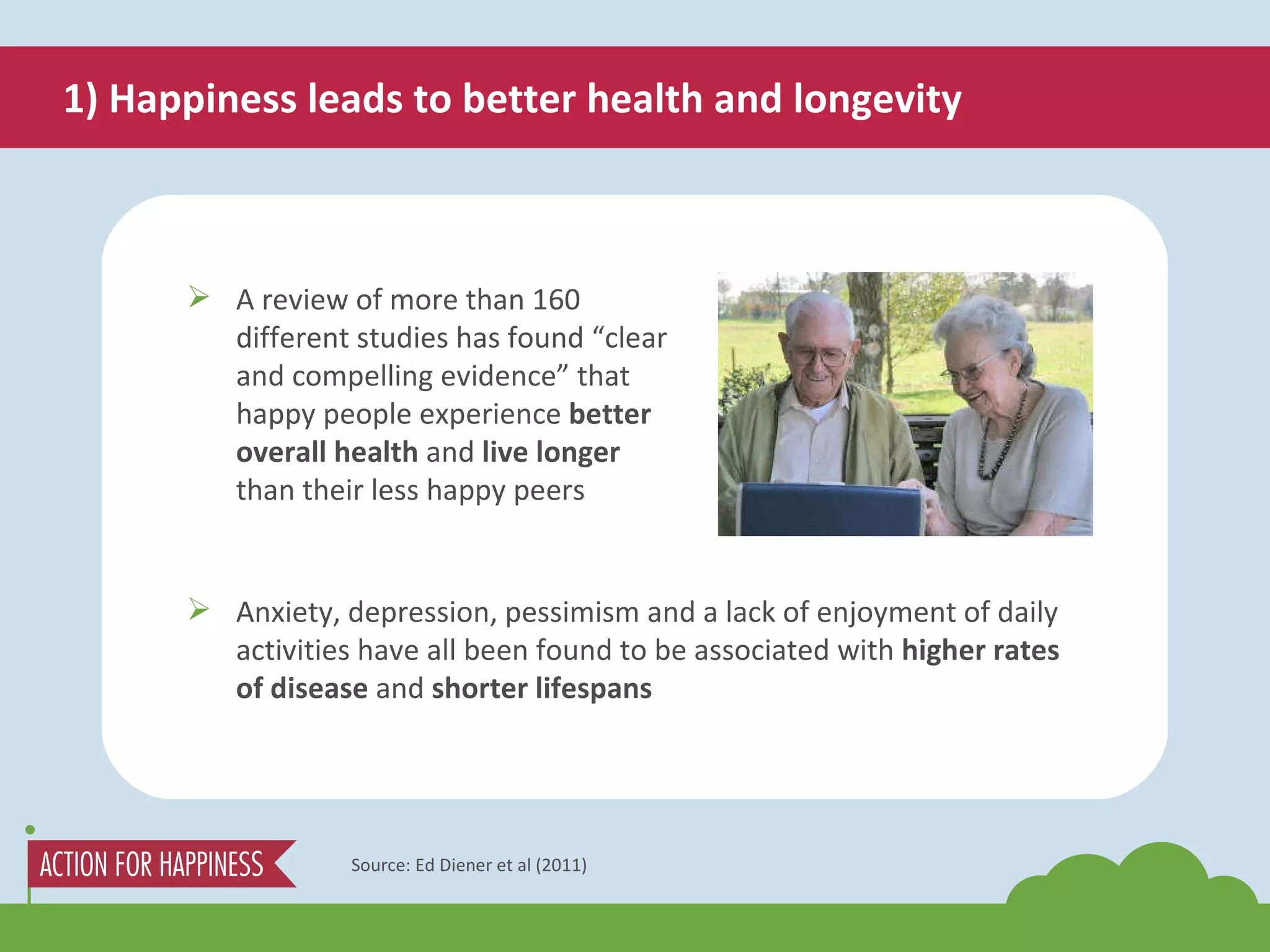
1) Happiness leads to better health and longevity Source: Ed Diener et al (2011) A review of more than 160 different studies has found “clear and compelling evidence” that happy people experience  better overall health  and  live longer  than their less happy peers Anxiety, depression, pessimism and a lack of enjoyment of daily activities have all been found to be associated with  higher rates of disease  and  shorter lifespans
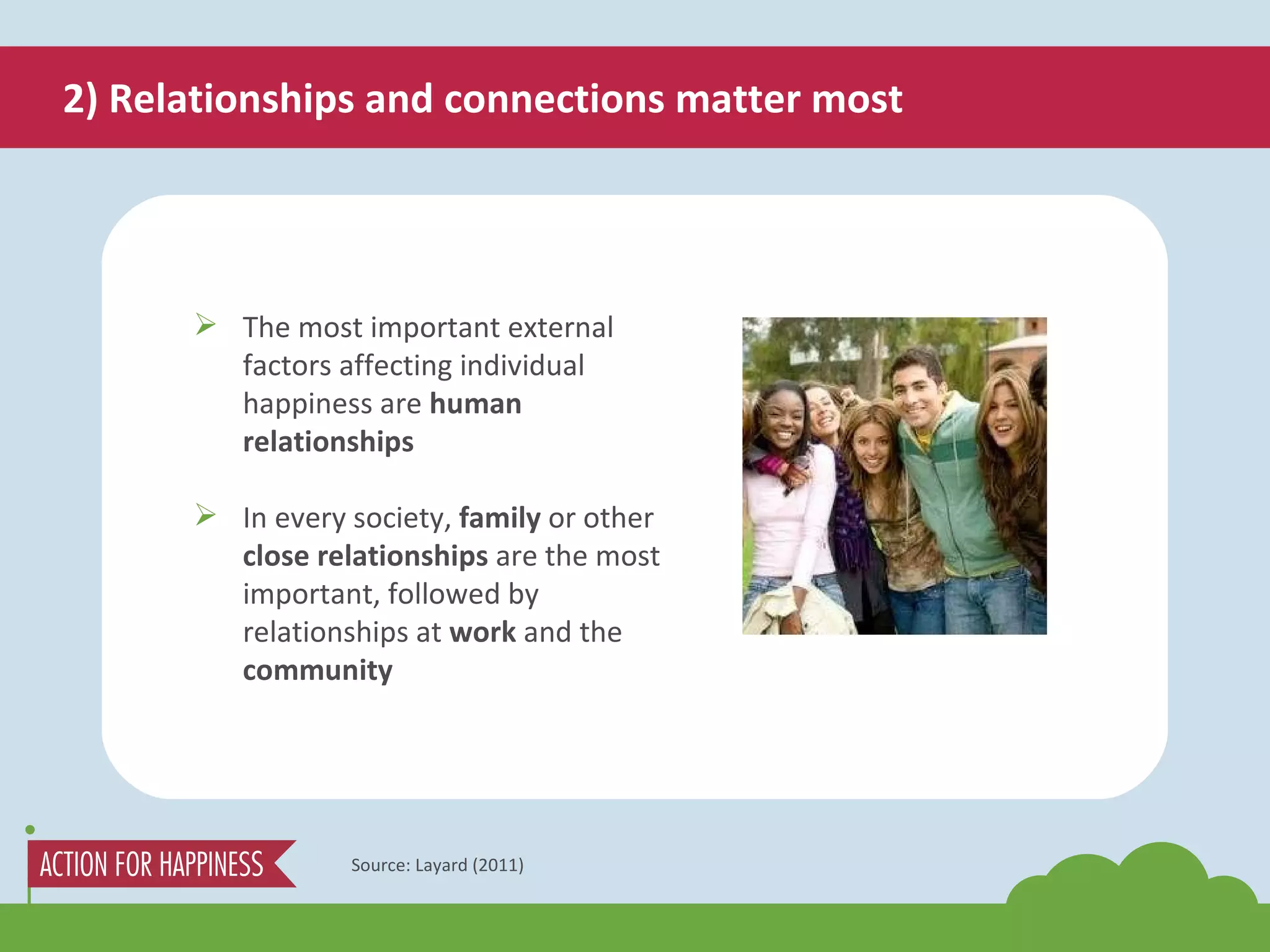
2) Relationships and connections matter most Source: Layard (2011) The most important external factors affecting individual happiness are  human relationships In every society,  family  or other  close relationships  are the most important, followed by relationships at  work  and the  community
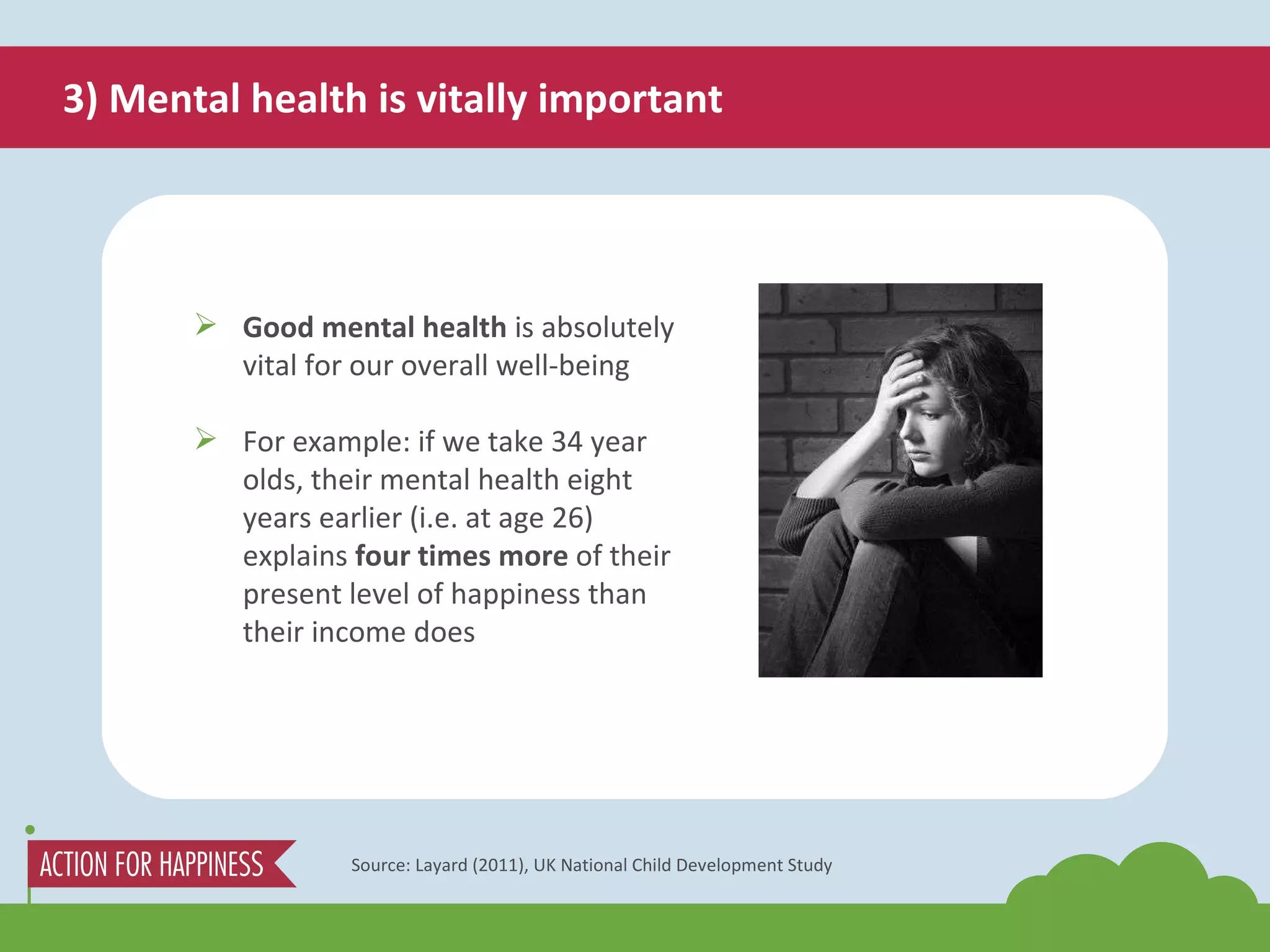
3) Mental health is vitally important Source: Layard (2011), UK National Child Development Study Good mental health  is absolutely vital for our overall well-being For example: if we take 34 year olds, their mental health eight years earlier (i.e. at age 26) explains  four times more  of their present level of happiness than their income does
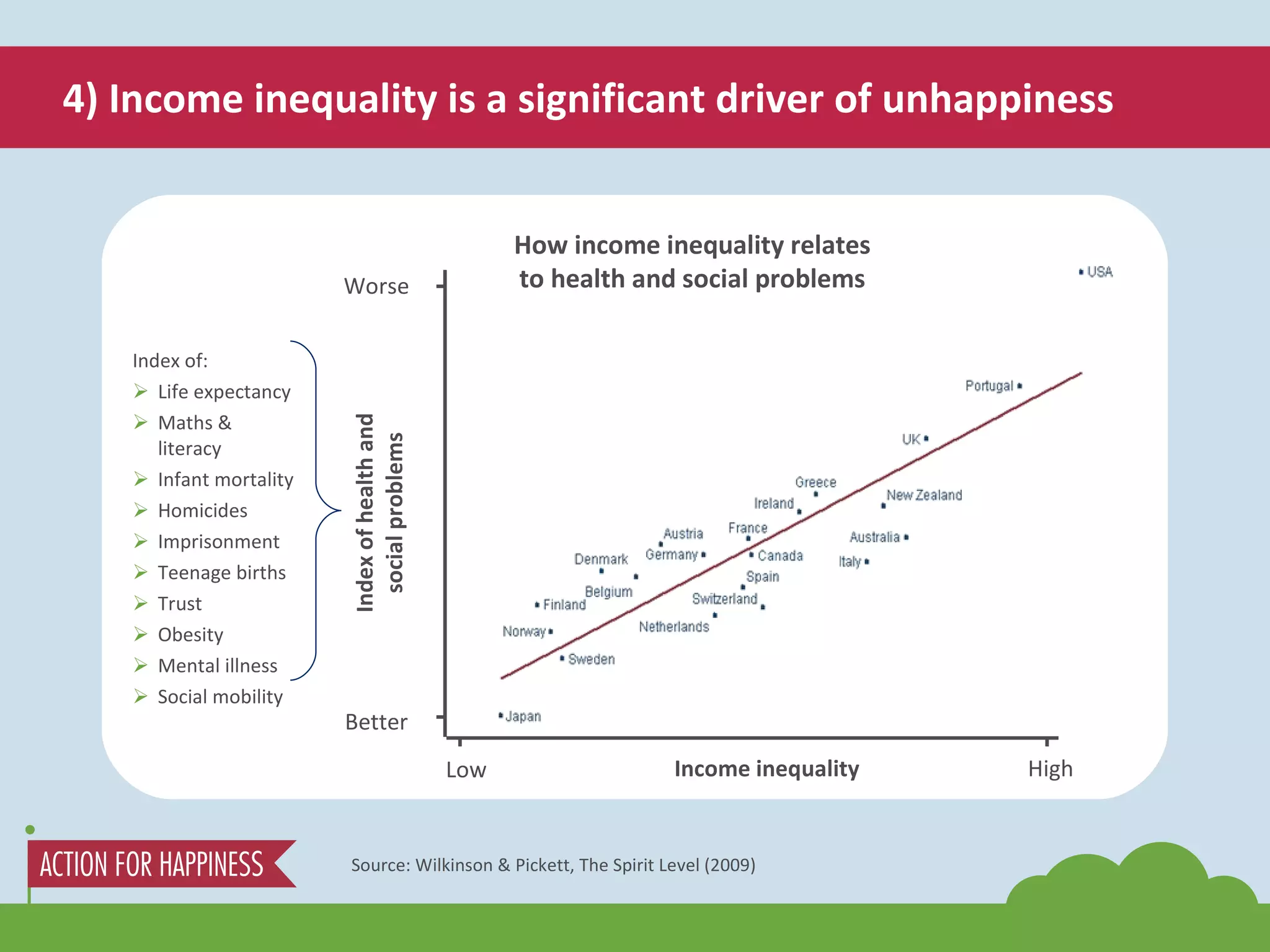
4) Income inequality is a significant driver of unhappiness Index of: Life expectancy Maths & literacy Infant mortality Homicides Imprisonment Teenage births Trust Obesity Mental illness Social mobility Source: Wilkinson & Pickett, The Spirit Level (2009) How income inequality relates to health and social problems Income inequality High Low Worse Better Index of health and social problems
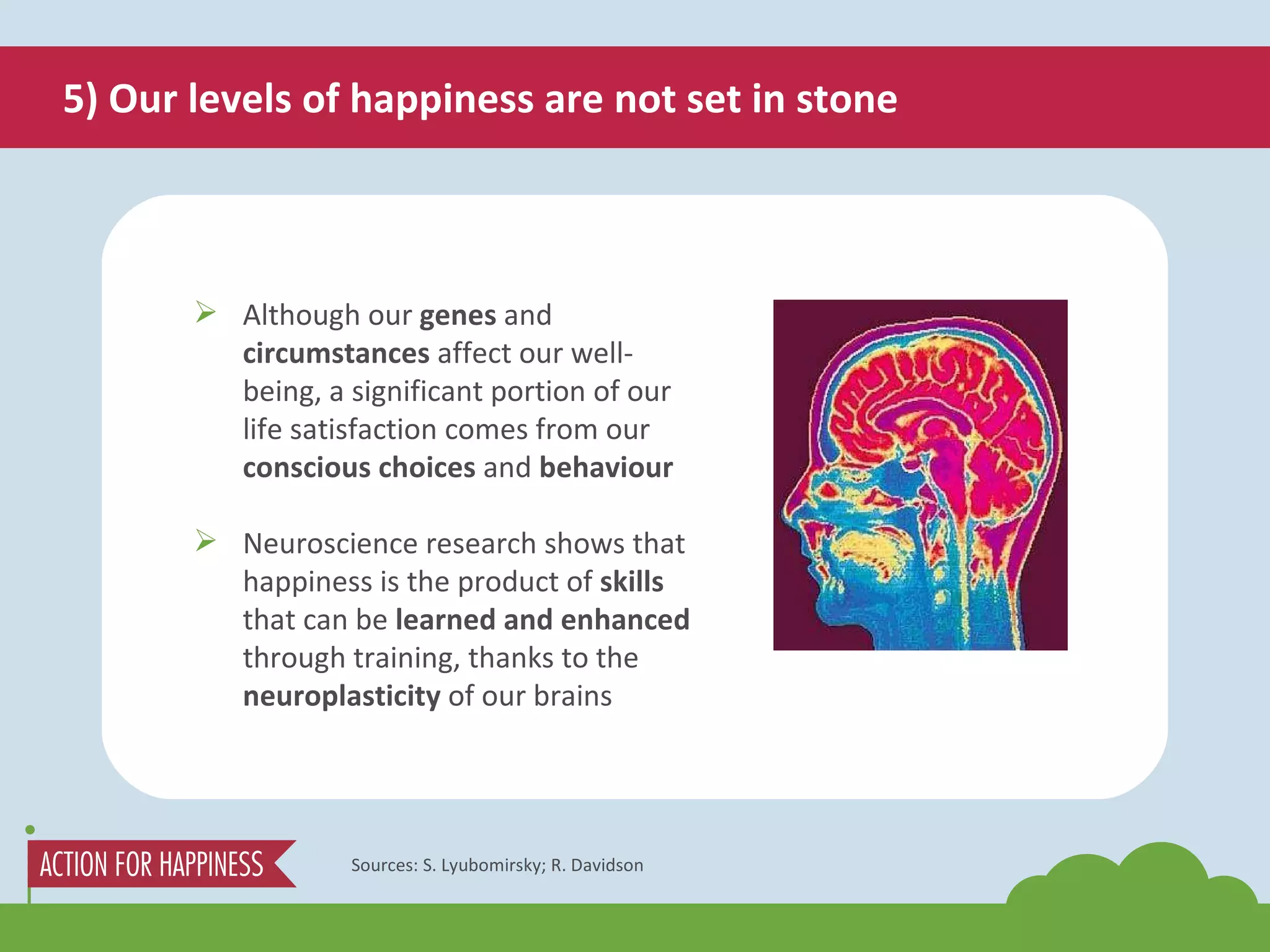
5) Our levels of happiness are not set in stone Sources: S. Lyubomirsky; R. Davidson Although our  genes  and  circumstances  affect our well-being, a significant portion of our life satisfaction comes from our  conscious choices  and  behaviour Neuroscience research shows that happiness is the product of  skills  that can be  learned and enhanced  through training, thanks to the  neuroplasticity  of our brains
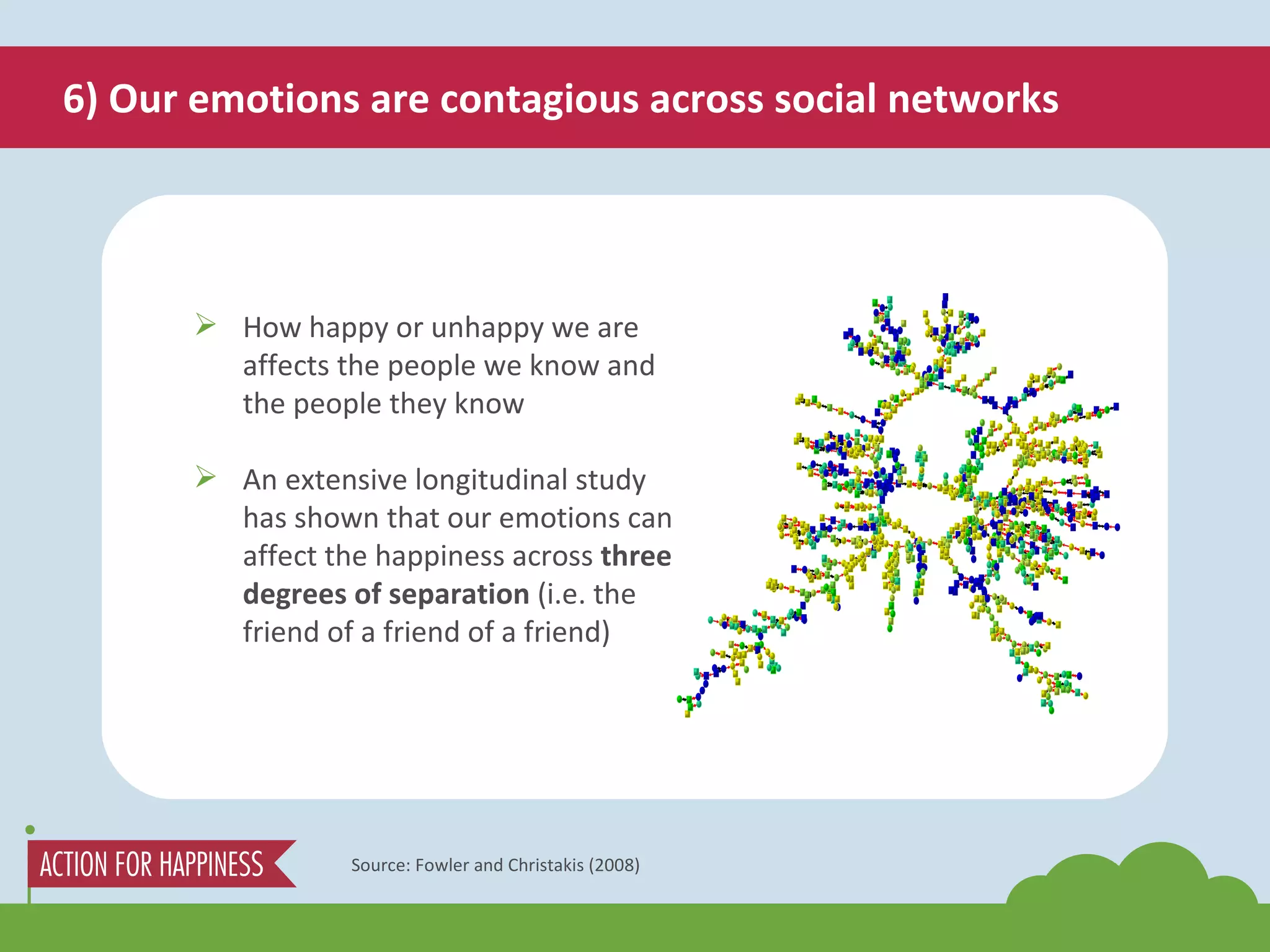
6) Our emotions are contagious across social networks Source: Fowler and Christakis (2008) How happy or unhappy we are affects the people we know and the people they know An extensive longitudinal study has shown that our emotions can affect the happiness across  three degrees of separation  (i.e. the friend of a friend of a friend)
Agenda 1. Why wellbeing matters 2. What the science tells us 3. What we need to do about it
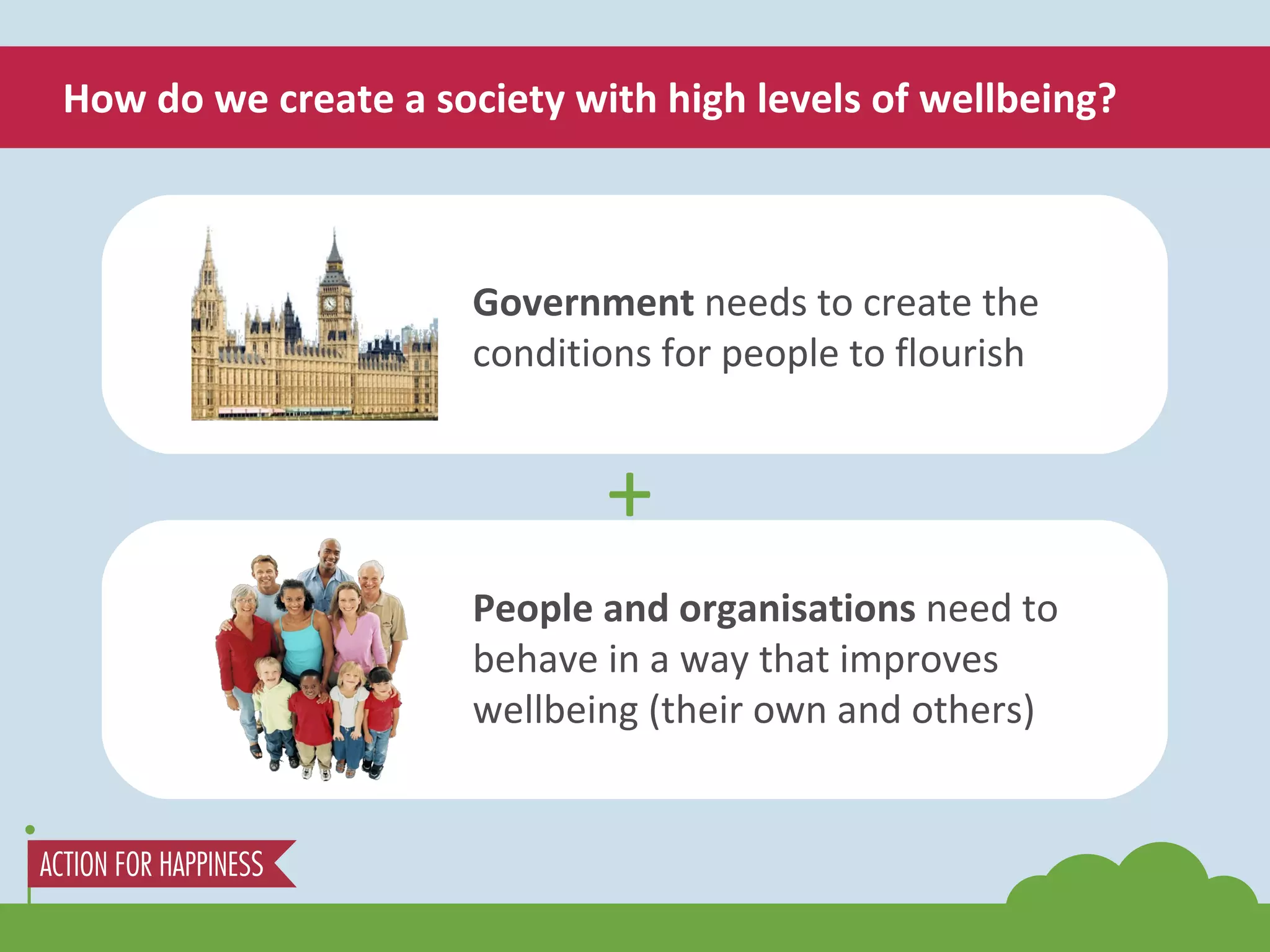
How do we create a society with high levels of wellbeing? People and organisations  need to behave in a way that improves wellbeing (their own and others) Government  needs to create the conditions for people to flourish +
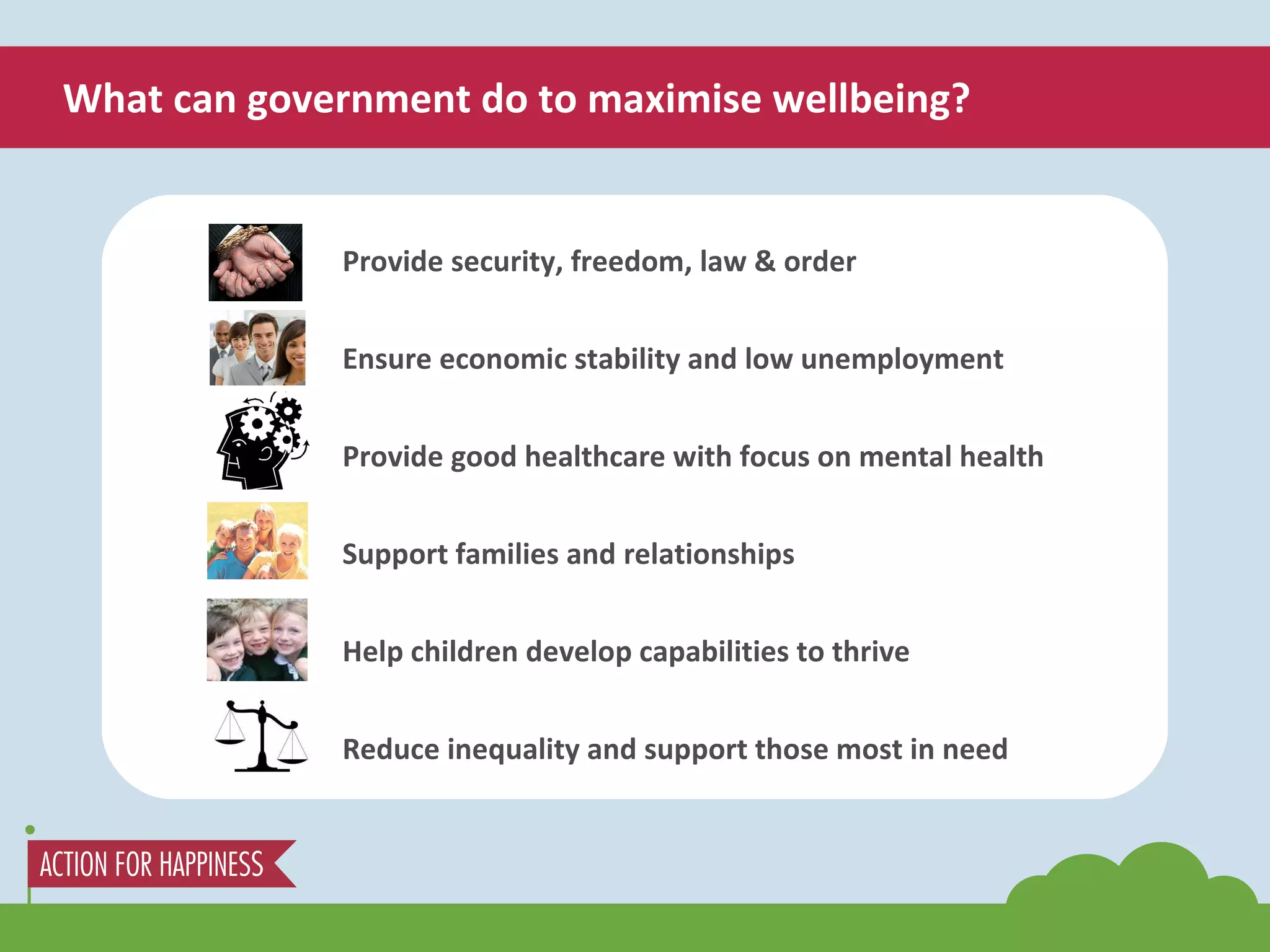
What can government do to maximise wellbeing? Provide security, freedom, law & order Ensure economic stability and low unemployment Provide good healthcare with focus on mental health Support families and relationships Help children develop capabilities to thrive Reduce inequality and support those most in need
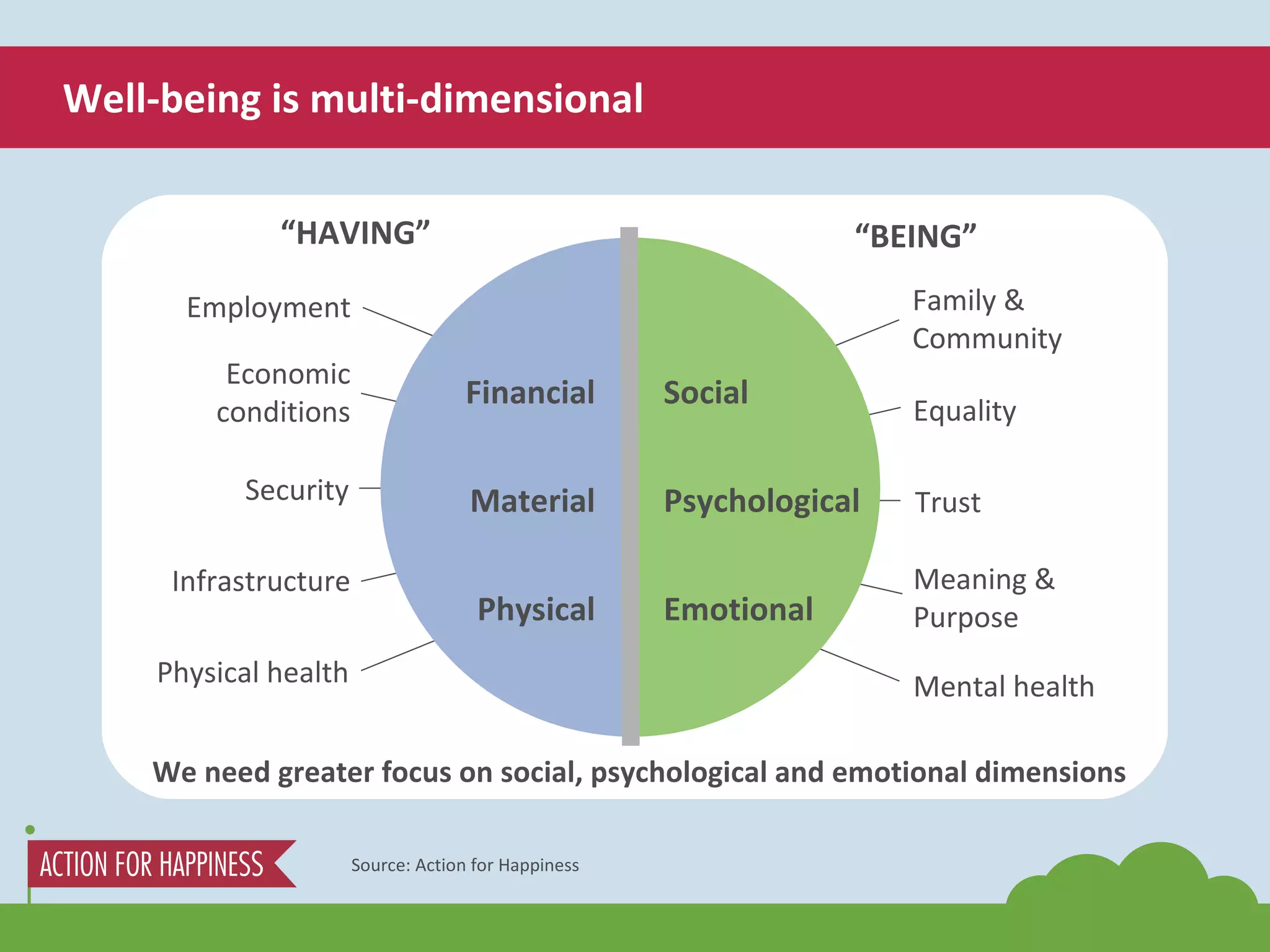
Well-being is multi-dimensional “ HAVING” “ BEING” Trust Security Equality Economic conditions Family & Community Employment Mental health Physical health Meaning & Purpose Infrastructure Financial Material Physical Social Psychological Emotional Source: Action for Happiness We need greater focus on social, psychological and emotional dimensions
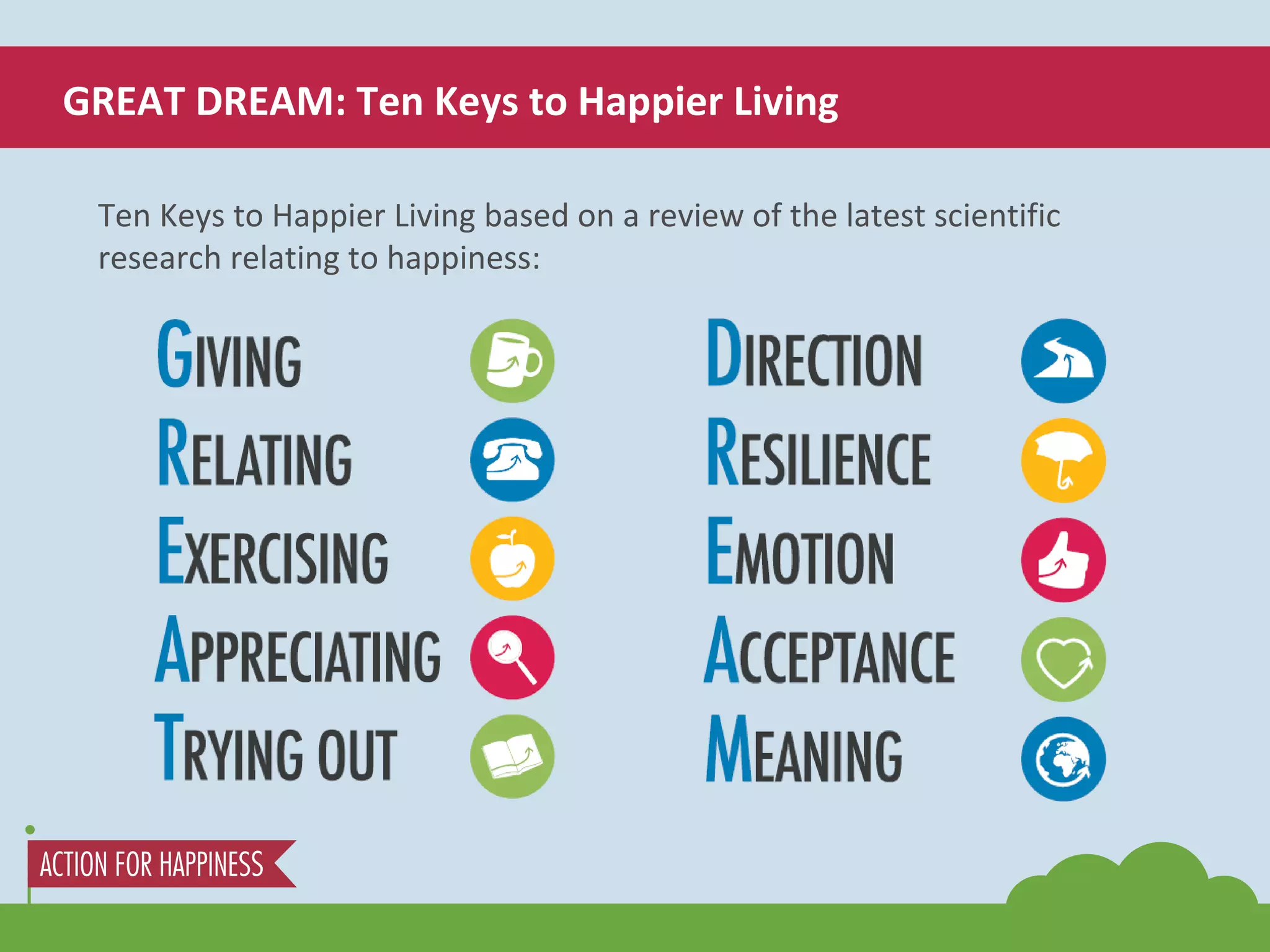
GREAT DREAM: Ten Keys to Happier Living Ten Keys to Happier Living based on a review of the latest scientific research relating to happiness:
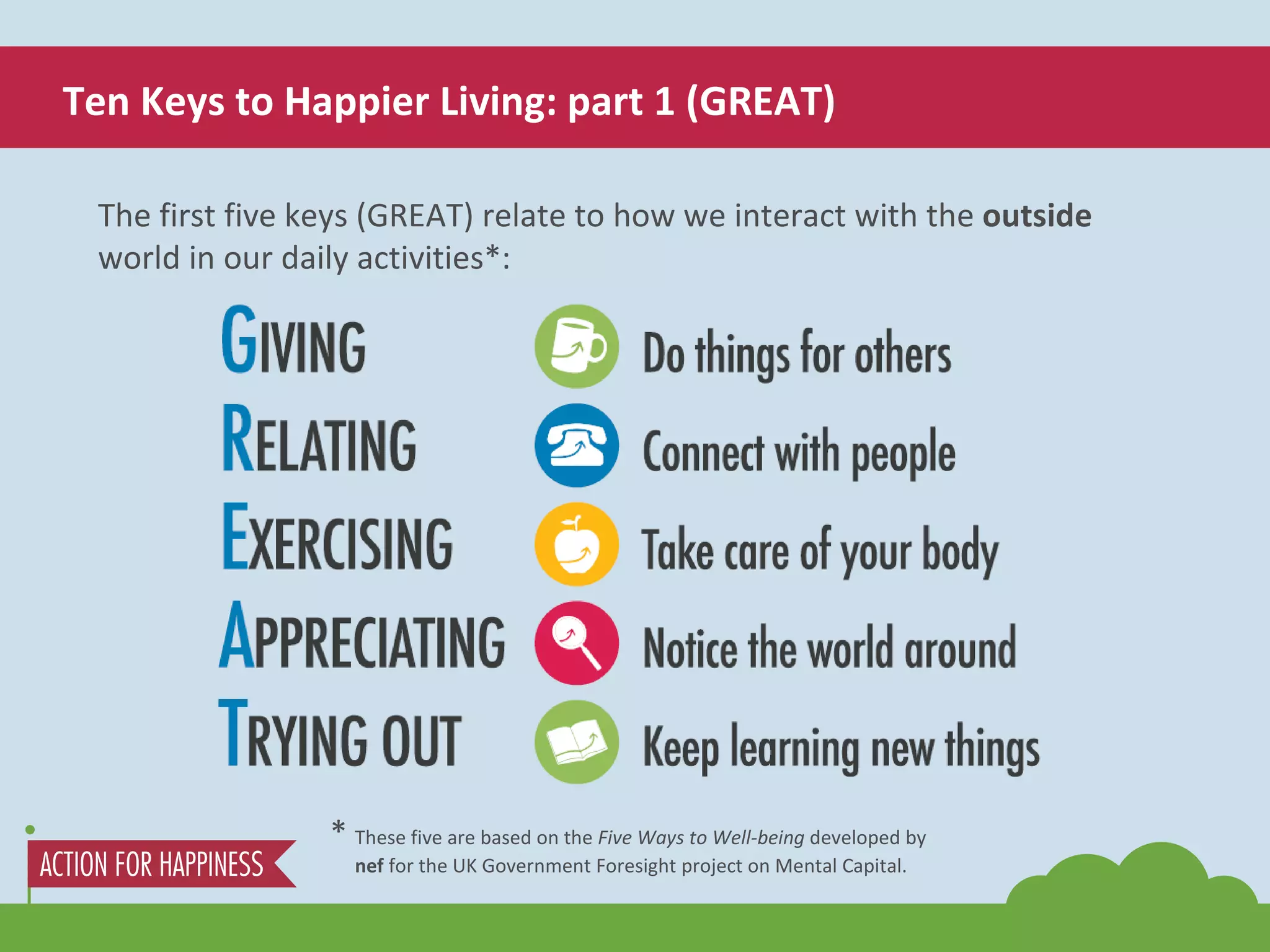
Ten Keys to Happier Living: part 1 (GREAT) * These five are based on the  Five Ways to Well-being  developed by  nef  for the UK Government Foresight project on Mental Capital. The first five keys (GREAT) relate to how we interact with the  outside  world in our daily activities*:
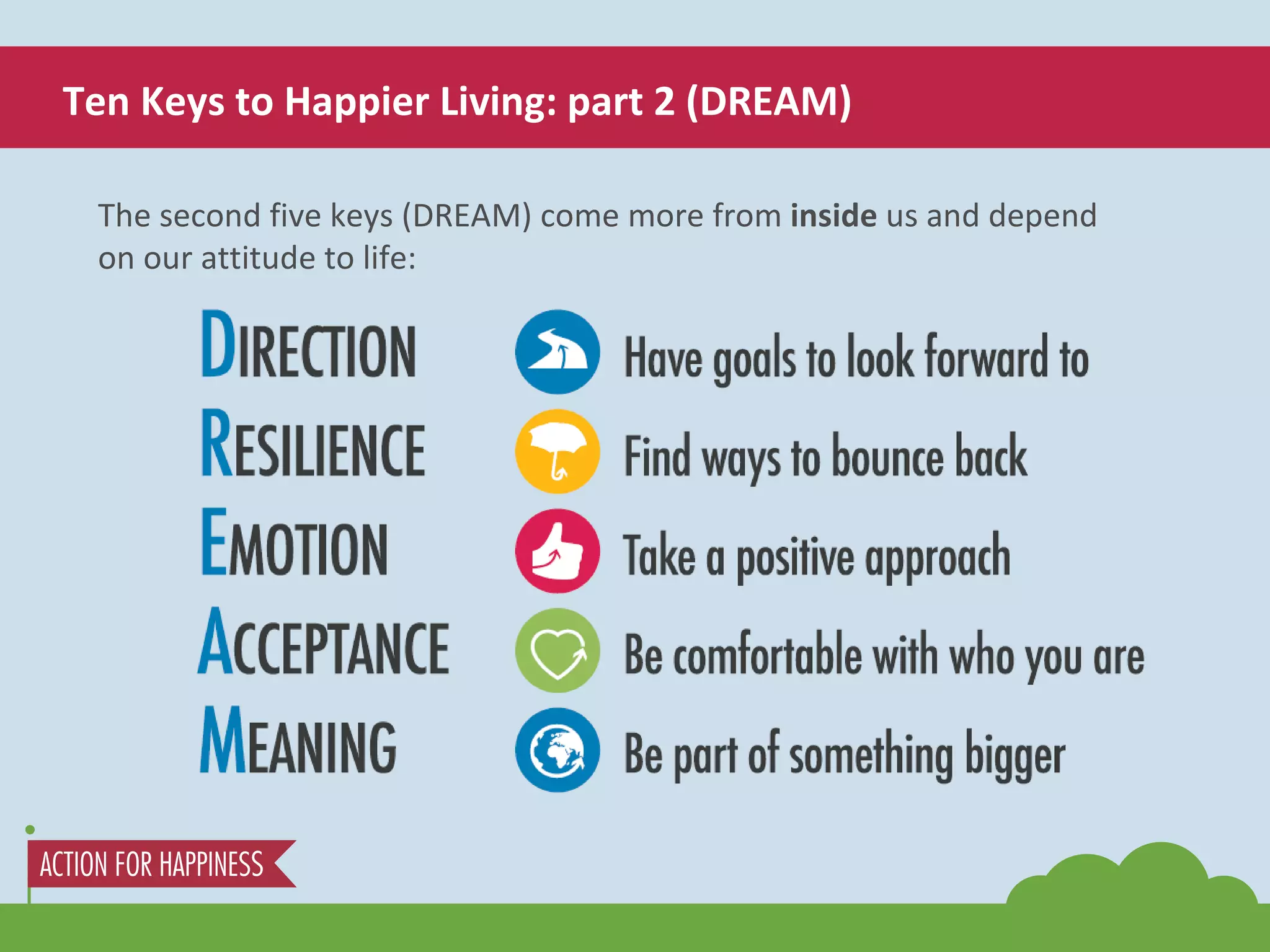
The second five keys (DREAM) come more from  inside  us and depend on our attitude to life: Ten Keys to Happier Living: part 2 (DREAM)
About Action for Happiness Action for Happiness is a  movement  for positive social change, made up of people and organisations committed to building a happier society The movement aims to trigger a  cultural shift  where people care more about each other and prioritise the things that really matter It was launched in April 2011 and already have  over 17,000 members  from over  100  countries
Join us at:  www.actionforhappiness.org facebook.com/actionforhappiness @actionhappiness youtube.com/actionforhappiness Please get in touch if you want to find out more  [email_address]

Wellbeing and Happiness - an introduction

  • 1.
    WELLBEING AND HAPPINESSPrioritising the things that really matter Mark Williamson Director, Action for Happiness
  • 2.
    Agenda 1. Whywellbeing matters 2. What the science tells us 3. What we need to do about it
  • 3.
    How do wemeasure our progress as a society? Currently GDP growth is treated as the main proxy for societal progress Competitive markets are seen as the most efficient means to deliver improved quality of life Government’s role is to correct market imperfections and to remove barriers to growth
  • 4.
    But higher GDPdoesn’t always mean greater life satisfaction Source: Worldwatch Institute, State of the World 2008 GDP/person (Purchasing Power Parity, 1995 dollars) Life Satisfaction / Happiness (Mean of % very happy and satisfied with life as a whole) GDP and Happiness: comparing countries
  • 5.
    Countries have beengetting richer but no happier Source: Layard, 2003 (based on US data) GDP per capita ($, 2001 prices) Year Life Satisfaction / Happiness (% very happy) Changes in Happiness and GDP over time 100 80 60 40 20 0 1946 1951 1956 1961 1966 1971 1976 1981 1986 1991 1996 % Very Happy GDP per head
  • 6.
    Real progress isbeing undermined by wider social issues Improvements in: Absolute income Living standards Labour Mobility Deterioration in: Income equality Mental Health Social cohesion The net effect of these (and other) changes is that ‘progress’ has not translated into greater levels of life satisfaction
  • 7.
    We’ve known foryears that GDP is flawed… Robert F. Kennedy (1968 speech) “ Gross National Product counts air pollution and cigarette advertising , and ambulances to clear our highways of carnage . It counts the destruction of the redwood and the loss of our natural wonder in chaotic sprawl . It counts the television programs which glorify violence to sell toys to our children. “ Yet it does not allow for the health of our children, the quality of their education or the joy of their play. It does not include the beauty of our poetry or the strength of our marriages, the intelligence of our public debate or the integrity of our officials. It measures neither our wit nor our courage , neither our wisdom nor our learning … “ It measures everything in short, except that which makes life worthwhile”
  • 8.
    There has nowbeen a big shift in mainstream thinking In 2008, Nicholas Sarkozy asked eminent economists Stiglitz, Sen and Fitoussi to create a “Commission on the Measurement of Economic Performance and Social Progress”. The commission made recommendations in three main areas: Improvements to existing measures of economic activity, GDP etc (e.g. give more weight to distribution of income/wealth not just average values) Shifting measurement emphasis from economic production to wellbeing (e.g. include objective and subjective measures of people’s wellbeing) Take into account sustainability , to include an assessment of future wellbeing as well as current wellbeing.
  • 9.
    The UK isnow taking the lead in measuring well-being “ It’s time we admitted there’s more to life than money, and it’s time we focussed not just on GDP but on GWB: General Well-Being. Well-being can’t be measured by money or traded in markets. It’s about the beauty of our surroundings, the quality of our culture and, above all, the strength of our relationships” David Cameron UK Prime Minister
  • 10.
    But are measurementsof subjective well-being valid? Source: R. Davidson (2003) Subjective levels of happiness reported by people are very meaningful and have been shown to correlate well with objective measures of brain activity They also correlate with independent reports from friends, obvious causes (e.g. unemployment) and subsequent behaviour (e.g. quitting a job, getting a divorce) Examples of measured brain activity Positive emotion Negative emotion
  • 11.
    Wellbeing questions arenow being asked in UK surveys Overall, how satisfied are you with your life nowadays? Overall, how happy did you feel yesterday? Overall, how anxious did you feel yesterday? Overall, to what extent do you feel the things you do in your life are worthwhile? Questions now being asked by ONS to 200,000 people in UK each year to assess levels of subjective well-being Evaluation of overall life satisfaction Experience of positive and negative feelings Eudemonic sense of meaning and purpose Source: UK Office for National Statistics (2011)
  • 12.
    Agenda 1. Whywellbeing matters 3. What we need to do about it 2. What the science tells us
  • 13.
    1) Happiness leadsto better health and longevity Source: Ed Diener et al (2011) A review of more than 160 different studies has found “clear and compelling evidence” that happy people experience better overall health and live longer than their less happy peers Anxiety, depression, pessimism and a lack of enjoyment of daily activities have all been found to be associated with higher rates of disease and shorter lifespans
  • 14.
    2) Relationships andconnections matter most Source: Layard (2011) The most important external factors affecting individual happiness are human relationships In every society, family or other close relationships are the most important, followed by relationships at work and the community
  • 15.
    3) Mental healthis vitally important Source: Layard (2011), UK National Child Development Study Good mental health is absolutely vital for our overall well-being For example: if we take 34 year olds, their mental health eight years earlier (i.e. at age 26) explains four times more of their present level of happiness than their income does
  • 16.
    4) Income inequalityis a significant driver of unhappiness Index of: Life expectancy Maths & literacy Infant mortality Homicides Imprisonment Teenage births Trust Obesity Mental illness Social mobility Source: Wilkinson & Pickett, The Spirit Level (2009) How income inequality relates to health and social problems Income inequality High Low Worse Better Index of health and social problems
  • 17.
    5) Our levelsof happiness are not set in stone Sources: S. Lyubomirsky; R. Davidson Although our genes and circumstances affect our well-being, a significant portion of our life satisfaction comes from our conscious choices and behaviour Neuroscience research shows that happiness is the product of skills that can be learned and enhanced through training, thanks to the neuroplasticity of our brains
  • 18.
    6) Our emotionsare contagious across social networks Source: Fowler and Christakis (2008) How happy or unhappy we are affects the people we know and the people they know An extensive longitudinal study has shown that our emotions can affect the happiness across three degrees of separation (i.e. the friend of a friend of a friend)
  • 19.
    Agenda 1. Whywellbeing matters 2. What the science tells us 3. What we need to do about it
  • 20.
    How do wecreate a society with high levels of wellbeing? People and organisations need to behave in a way that improves wellbeing (their own and others) Government needs to create the conditions for people to flourish +
  • 21.
    What can governmentdo to maximise wellbeing? Provide security, freedom, law & order Ensure economic stability and low unemployment Provide good healthcare with focus on mental health Support families and relationships Help children develop capabilities to thrive Reduce inequality and support those most in need
  • 22.
    Well-being is multi-dimensional“ HAVING” “ BEING” Trust Security Equality Economic conditions Family & Community Employment Mental health Physical health Meaning & Purpose Infrastructure Financial Material Physical Social Psychological Emotional Source: Action for Happiness We need greater focus on social, psychological and emotional dimensions
  • 23.
    GREAT DREAM: TenKeys to Happier Living Ten Keys to Happier Living based on a review of the latest scientific research relating to happiness:
  • 24.
    Ten Keys toHappier Living: part 1 (GREAT) * These five are based on the Five Ways to Well-being developed by nef for the UK Government Foresight project on Mental Capital. The first five keys (GREAT) relate to how we interact with the outside world in our daily activities*:
  • 25.
    The second fivekeys (DREAM) come more from inside us and depend on our attitude to life: Ten Keys to Happier Living: part 2 (DREAM)
  • 26.
    About Action forHappiness Action for Happiness is a movement for positive social change, made up of people and organisations committed to building a happier society The movement aims to trigger a cultural shift where people care more about each other and prioritise the things that really matter It was launched in April 2011 and already have over 17,000 members from over 100 countries
  • 27.
    Join us at: www.actionforhappiness.org facebook.com/actionforhappiness @actionhappiness youtube.com/actionforhappiness Please get in touch if you want to find out more [email_address]