Project Presentation
Cost
Accounting
Group Members:
1. Azeem Khan
2. M. Raheel
3. Furqan Gaba
Traditional
VS
Activity Based
Costing
Traditional costing
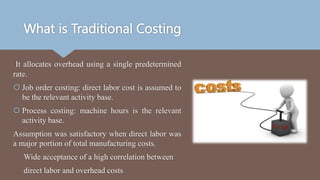
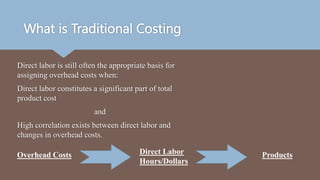
What is Traditional Costing
It allocates overhead using a single predetermined
rate.
 Job order costing: direct labor cost is assumed to
be the relevant activity base.
 Process costing: machine hours is the relevant
activity base.
Assumption was satisfactory when direct labor was
a major portion of total manufacturing costs.
Wide acceptance of a high correlation between
direct labor and overhead costs
What is Traditional Costing
Direct labor is still often the appropriate basis for
assigning overhead costs when:
Direct labor constitutes a significant part of total
product cost
and
High correlation exists between direct labor and
changes in overhead costs.
Overhead Costs Direct Labor
Hours/Dollars
Products
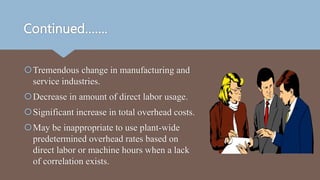
Continued…….
Tremendous change in manufacturing and
service industries.
Decrease in amount of direct labor usage.
Significant increase in total overhead costs.
May be inappropriate to use plant-wide
predetermined overhead rates based on
direct labor or machine hours when a lack
of correlation exists.
Activity-Based Costing
(ABC)
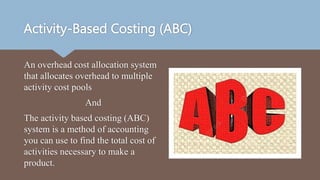
Activity-Based Costing (ABC)
An overhead cost allocation system
that allocates overhead to multiple
activity cost pools
And
The activity based costing (ABC)
system is a method of accounting
you can use to find the total cost of
activities necessary to make a
product.
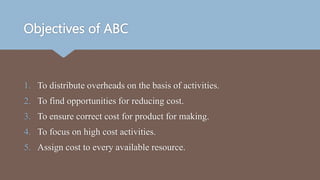
Objectives of ABC
1. To distribute overheads on the basis of activities.
2. To find opportunities for reducing cost.
3. To ensure correct cost for product for making.
4. To focus on high cost activities.
5. Assign cost to every available resource.
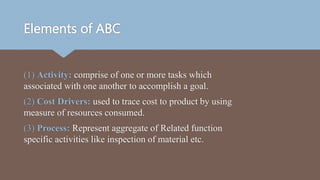
Elements of ABC
(1) Activity: comprise of one or more tasks which
associated with one another to accomplish a goal.
(2) Cost Drivers: used to trace cost to product by using
measure of resources consumed.
(3) Process: Represent aggregate of Related function
specific activities like inspection of material etc.
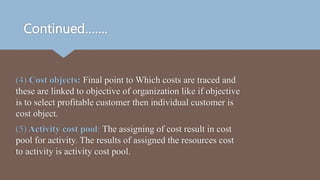
Continued…….
(4) Cost objects: Final point to Which costs are traced and
these are linked to objective of organization like if objective
is to select profitable customer then individual customer is
cost object.
(5) Activity cost pool: The assigning of cost result in cost
pool for activity. The results of assigned the resources cost
to activity is activity cost pool.
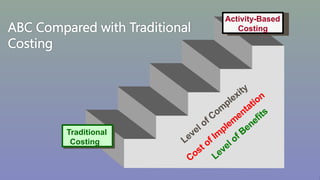
What is difference between
Traditional Costing
and
Activity Based Costing
Traditional
Costing
Activity-Based
Costing
ABC Compared with Traditional
Costing
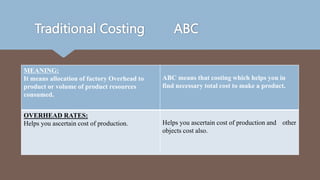
Traditional Costing ABC
MEANING:
It means allocation of factory Overhead to
product or volume of product resources
consumed.
ABC means that costing which helps you in
find necessary total cost to make a product.
OVERHEAD RATES:
Helps you ascertain cost of production. Helps you ascertain cost of production and other
objects cost also.
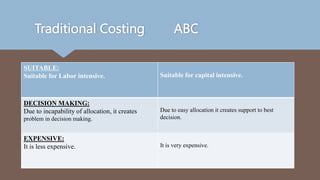
Traditional Costing ABC
SUITABLE:
Suitable for Labor intensive. Suitable for capital intensive.
DECISION MAKING:
Due to incapability of allocation, it creates
problem in decision making.
Due to easy allocation it creates support to best
decision.
EXPENSIVE:
It is less expensive. It is very expensive.
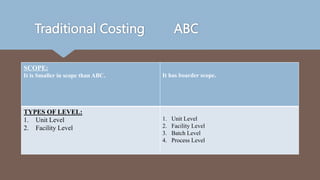
Traditional Costing ABC
SCOPE:
It is Smaller in scope than ABC. It has boarder scope.
TYPES OF LEVEL:
1. Unit Level
2. Facility Level
1. Unit Level
2. Facility Level
3. Batch Level
4. Process Level
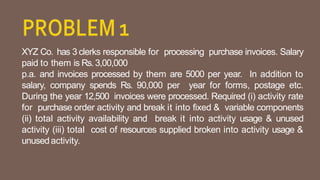
XYZ Co. has 3 clerks responsible for processing purchase invoices. Salary
paid to them is Rs. 3,00,000
p.a. and invoices processed by them are 5000 per year. In addition to
salary, company spends Rs. 90,000 per year for forms, postage etc.
During the year 12,500 invoices were processed. Required (i) activity rate
for purchase order activity and break it into fixed & variable components
(ii) total activity availability and break it into activity usage & unused
activity (iii) total cost of resources supplied broken into activity usage &
unusedactivity.
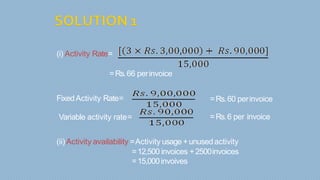
(i) Activity Rate=
=Rs.66 perinvoice
FixedActivity Rate= =Rs.60 perinvoice
Variable activity rate= =Rs.6 per invoice
(ii)Activity availability =Activity usage +unusedactivity
=12,500 invoices +2500invoices
=15,000invoives
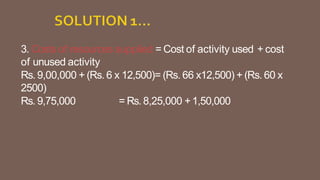
3. Costs of resources supplied = Cost of activity used + cost
of unused activity
Rs. 9,00,000 + (Rs. 6 x 12,500)= (Rs. 66 x12,500) + (Rs. 60 x
2500)
Rs. 9,75,000 = Rs.8,25,000 +1,50,000
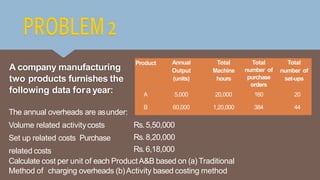
A company manufacturing
two products furnishes the
following data forayear:
Product Annual
Output
(units)
Total
Machine
hours
Total
number of
purchase
orders
Total
number of
set-ups
A 5,000 20,000 160 20
B 60,000 1,20,000 384 44
The annual overheads are asunder:
Volume related activitycosts
Set up related costs Purchase
related costs
Rs.5,50,000
Rs.8,20,000
Rs.6,18,000
Calculate cost per unit of each ProductA&B based on (a) Traditional
Method of charging overheads (b)Activity based costing method
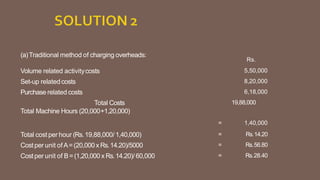
(a)Traditional method of charging overheads:
Rs.
Volume related activitycosts 5,50,000
Set-up relatedcosts 8,20,000
Purchase related costs 6,18,000
Total Costs 19,88,000
Total Machine Hours (20,000+1,20,000)
= 1,40,000
Total cost per hour (Rs.19,88,000/1,40,000) = Rs.14.20
Costper unit ofA=(20,000 x Rs.14.20)/5000 = Rs.56.80
Costper unit of B=(1,20,000 x Rs.14.20)/ 60,000 = Rs.28.40
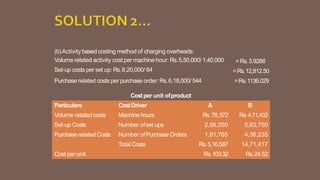
(b)Activity basedcosting method of charging overheads:
Volume related activity cost per machine hour: Rs.5,50,000/ 1,40,000
Set-up costs per set up: Rs.8,20,000/ 64
Purchase related costs per purchase order: Rs.6,18,000/ 544
=Rs.3.9286
=Rs.12,812.50
=Rs.1136.029
Costper unit ofproduct
Particulars CostDriver A B
Volume relatedcosts Machine hours Rs.78,572 Rs.4,71,432
Set-up Costs Number ofset ups 2,56,250 5,63,750
Purchase related Costs Number ofPurchase Orders 1,81,765 4,36,235
Total Costs Rs.5,16,587 14,71,417
Cost perunit Rs.103.32 Rs.24.52
THE END

16-02-2023 accounting presentation.pptx

  • 1.
    Project Presentation Cost Accounting Group Members: 1.Azeem Khan 2. M. Raheel 3. Furqan Gaba
  • 2.
  • 3.
  • 4.
    What is TraditionalCosting It allocates overhead using a single predetermined rate.  Job order costing: direct labor cost is assumed to be the relevant activity base.  Process costing: machine hours is the relevant activity base. Assumption was satisfactory when direct labor was a major portion of total manufacturing costs. Wide acceptance of a high correlation between direct labor and overhead costs
  • 5.
    What is TraditionalCosting Direct labor is still often the appropriate basis for assigning overhead costs when: Direct labor constitutes a significant part of total product cost and High correlation exists between direct labor and changes in overhead costs. Overhead Costs Direct Labor Hours/Dollars Products
  • 6.
    Continued……. Tremendous change inmanufacturing and service industries. Decrease in amount of direct labor usage. Significant increase in total overhead costs. May be inappropriate to use plant-wide predetermined overhead rates based on direct labor or machine hours when a lack of correlation exists.
  • 7.
  • 8.
    Activity-Based Costing (ABC) Anoverhead cost allocation system that allocates overhead to multiple activity cost pools And The activity based costing (ABC) system is a method of accounting you can use to find the total cost of activities necessary to make a product.
  • 9.
    Objectives of ABC 1.To distribute overheads on the basis of activities. 2. To find opportunities for reducing cost. 3. To ensure correct cost for product for making. 4. To focus on high cost activities. 5. Assign cost to every available resource.
  • 10.
    Elements of ABC (1)Activity: comprise of one or more tasks which associated with one another to accomplish a goal. (2) Cost Drivers: used to trace cost to product by using measure of resources consumed. (3) Process: Represent aggregate of Related function specific activities like inspection of material etc.
  • 11.
    Continued……. (4) Cost objects:Final point to Which costs are traced and these are linked to objective of organization like if objective is to select profitable customer then individual customer is cost object. (5) Activity cost pool: The assigning of cost result in cost pool for activity. The results of assigned the resources cost to activity is activity cost pool.
  • 12.
    What is differencebetween Traditional Costing and Activity Based Costing
  • 13.
  • 14.
    Traditional Costing ABC MEANING: Itmeans allocation of factory Overhead to product or volume of product resources consumed. ABC means that costing which helps you in find necessary total cost to make a product. OVERHEAD RATES: Helps you ascertain cost of production. Helps you ascertain cost of production and other objects cost also.
  • 15.
    Traditional Costing ABC SUITABLE: Suitablefor Labor intensive. Suitable for capital intensive. DECISION MAKING: Due to incapability of allocation, it creates problem in decision making. Due to easy allocation it creates support to best decision. EXPENSIVE: It is less expensive. It is very expensive.
  • 16.
    Traditional Costing ABC SCOPE: Itis Smaller in scope than ABC. It has boarder scope. TYPES OF LEVEL: 1. Unit Level 2. Facility Level 1. Unit Level 2. Facility Level 3. Batch Level 4. Process Level
  • 18.
    XYZ Co. has3 clerks responsible for processing purchase invoices. Salary paid to them is Rs. 3,00,000 p.a. and invoices processed by them are 5000 per year. In addition to salary, company spends Rs. 90,000 per year for forms, postage etc. During the year 12,500 invoices were processed. Required (i) activity rate for purchase order activity and break it into fixed & variable components (ii) total activity availability and break it into activity usage & unused activity (iii) total cost of resources supplied broken into activity usage & unusedactivity.
  • 19.
    (i) Activity Rate= =Rs.66perinvoice FixedActivity Rate= =Rs.60 perinvoice Variable activity rate= =Rs.6 per invoice (ii)Activity availability =Activity usage +unusedactivity =12,500 invoices +2500invoices =15,000invoives
  • 20.
    3. Costs ofresources supplied = Cost of activity used + cost of unused activity Rs. 9,00,000 + (Rs. 6 x 12,500)= (Rs. 66 x12,500) + (Rs. 60 x 2500) Rs. 9,75,000 = Rs.8,25,000 +1,50,000
  • 21.
    A company manufacturing twoproducts furnishes the following data forayear: Product Annual Output (units) Total Machine hours Total number of purchase orders Total number of set-ups A 5,000 20,000 160 20 B 60,000 1,20,000 384 44 The annual overheads are asunder: Volume related activitycosts Set up related costs Purchase related costs Rs.5,50,000 Rs.8,20,000 Rs.6,18,000 Calculate cost per unit of each ProductA&B based on (a) Traditional Method of charging overheads (b)Activity based costing method
  • 22.
    (a)Traditional method ofcharging overheads: Rs. Volume related activitycosts 5,50,000 Set-up relatedcosts 8,20,000 Purchase related costs 6,18,000 Total Costs 19,88,000 Total Machine Hours (20,000+1,20,000) = 1,40,000 Total cost per hour (Rs.19,88,000/1,40,000) = Rs.14.20 Costper unit ofA=(20,000 x Rs.14.20)/5000 = Rs.56.80 Costper unit of B=(1,20,000 x Rs.14.20)/ 60,000 = Rs.28.40
  • 23.
    (b)Activity basedcosting methodof charging overheads: Volume related activity cost per machine hour: Rs.5,50,000/ 1,40,000 Set-up costs per set up: Rs.8,20,000/ 64 Purchase related costs per purchase order: Rs.6,18,000/ 544 =Rs.3.9286 =Rs.12,812.50 =Rs.1136.029 Costper unit ofproduct Particulars CostDriver A B Volume relatedcosts Machine hours Rs.78,572 Rs.4,71,432 Set-up Costs Number ofset ups 2,56,250 5,63,750 Purchase related Costs Number ofPurchase Orders 1,81,765 4,36,235 Total Costs Rs.5,16,587 14,71,417 Cost perunit Rs.103.32 Rs.24.52
  • 24.