Prepared by Ms Lena Teo Teacher’s copy
EDGEFIELD SECONDARY SCHOOL
SECONDARY THREE SOCIAL STUDIES
CHAPTER FIVE: BONDING SINGAPORE
Name: _____________________________________ ( ) Class: 3 ____________________ Date: _________________
MANAGING ETHNIC DIVERSITY
Refer to your textbook pages 141 to 151 to help you complete the tables below.
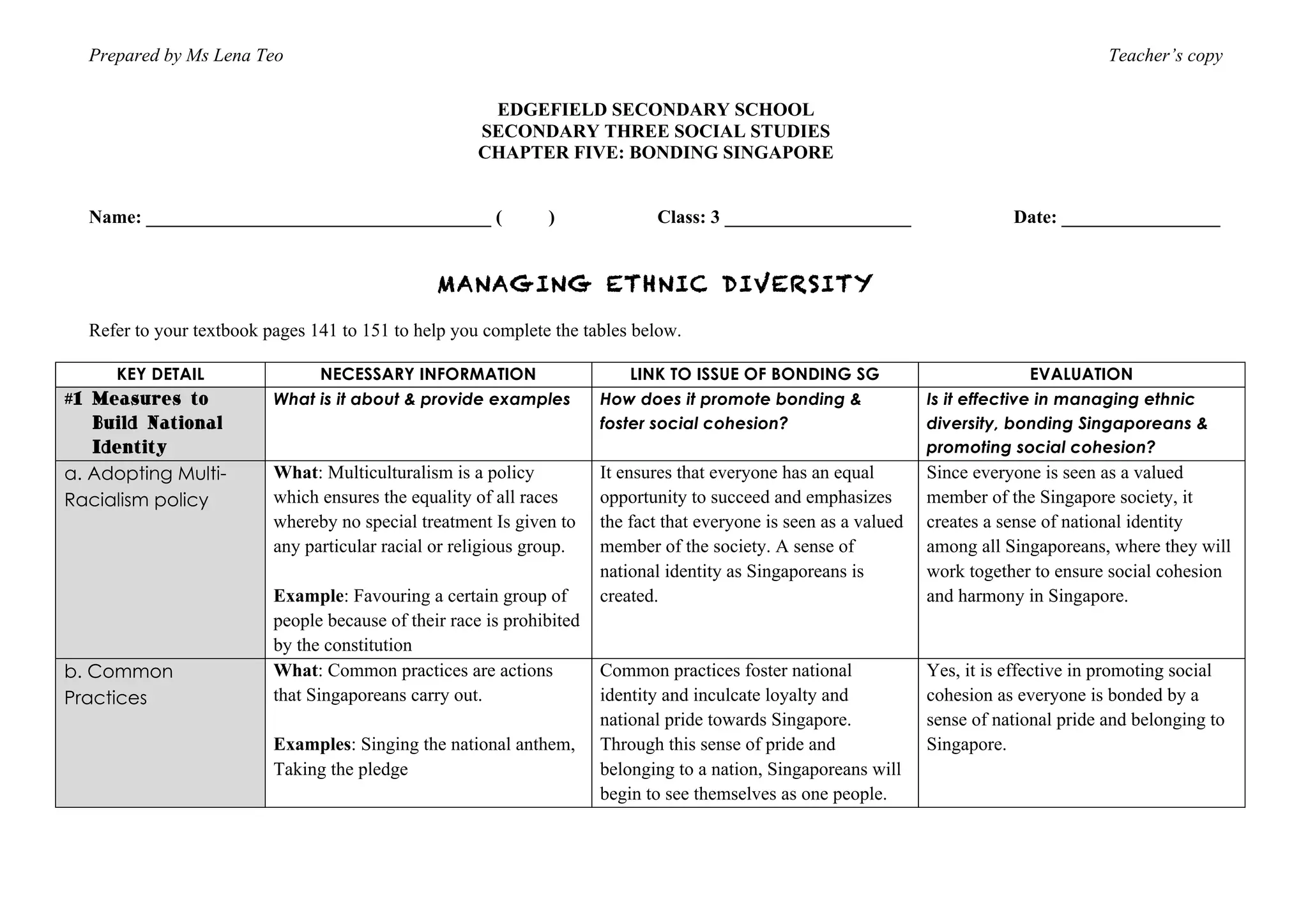
KEY DETAIL NECESSARY INFORMATION LINK TO ISSUE OF BONDING SG EVALUATION
#1 Measures to
Build National
Identity
What is it about & provide examples How does it promote bonding &
foster social cohesion?
Is it effective in managing ethnic
diversity, bonding Singaporeans &
promoting social cohesion?
a. Adopting Multi-
Racialism policy
What: Multiculturalism is a policy
which ensures the equality of all races
whereby no special treatment Is given to
any particular racial or religious group.
Example: Favouring a certain group of
people because of their race is prohibited
by the constitution
It ensures that everyone has an equal
opportunity to succeed and emphasizes
the fact that everyone is seen as a valued
member of the society. A sense of
national identity as Singaporeans is
created.
Since everyone is seen as a valued
member of the Singapore society, it
creates a sense of national identity
among all Singaporeans, where they will
work together to ensure social cohesion
and harmony in Singapore.
b. Common
Practices
What: Common practices are actions
that Singaporeans carry out.
Examples: Singing the national anthem,
Taking the pledge
Common practices foster national
identity and inculcate loyalty and
national pride towards Singapore.
Through this sense of pride and
belonging to a nation, Singaporeans will
begin to see themselves as one people.
Yes, it is effective in promoting social
cohesion as everyone is bonded by a
sense of national pride and belonging to
Singapore.
Prepared by Ms Lena Teo Teacher’s copy
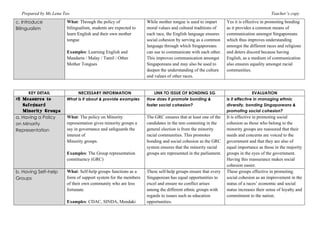
c. Introduce
Bilingualism
What: Through the policy of
bilingualism, students are expected to
learn English and their own mother
tongue
Examples: Learning English and
Mandarin / Malay / Tamil / Other
Mother Tongues
While mother tongue is used to impart
moral values and cultural traditions of
each race, the English language ensures
social cohesion by serving as a common
language through which Singaporeans
can use to communicate with each other.
This improves communication amongst
Singaporeans and may also be used to
deepen the understanding of the culture
and values of other races.
Yes it is effective in promoting bonding
as it provides a common means of
communication amongst Singaporeans
which thus improves understanding
amongst the different races and religions
and deters discord because having
English, as a medium of communication
also ensures equality amongst racial
communities.
KEY DETAIL NECESSARY INFORMATION LINK TO ISSUE OF BONDING SG EVALUATION
#2 Measures to
Safeguard
Minority Groups
What is it about & provide examples How does it promote bonding &
foster social cohesion?
Is it effective in managing ethnic
diversity, bonding Singaporeans &
promoting social cohesion?
a. Having a Policy
on Minority
Representation
What: The policy on Minority
representation gives minority groups a
say in governance and safeguards the
interest of
Minority groups.
Examples: The Group representation
constituency (GRC)
The GRC ensures that at least one of the
candidates in the tem contesting in the
general election is from the minority
racial communities. This promotes
bonding and social cohesion as the GRC
system ensures that the minority racial
groups are represented in the parliament.
It is effective in promoting social
cohesion as those who belong to the
minority groups are reassured that their
needs and concerns are voiced to the
government and that they are also of
equal importance as those in the majority
groups in the eyes of the government.
Having this reassurance makes social
cohesion easier.
b. Having Self–help
Groups
What: Self-help groups functions as a
form of support system for the members
of their own community who are less
fortunate.
Examples: CDAC, SINDA, Mendaki
These self-help groups ensure that every
Singaporean has equal opportunities to
excel and ensure no conflict arises
among the different ethnic groups with
regards to issues such as education
opportunities.
These groups effective in promoting
social cohesion as an improvement in the
status of a races’ economic and social
status increases their sense of loyalty and
commitment to the nation.
Prepared by Ms Lena Teo Teacher’s copy
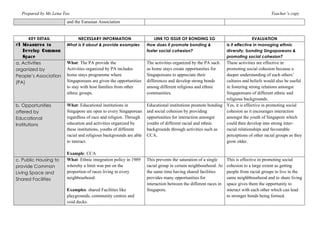
and the Eurasian Association
KEY DETAIL NECESSARY INFORMATION LINK TO ISSUE OF BONDING SG EVALUATION
#3 Measures to
Develop Common
Space
What is it about & provide examples How does it promote bonding &
foster social cohesion?
Is it effective in managing ethnic
diversity, bonding Singaporeans &
promoting social cohesion?
a. Activities
organized by
People’s Association
(PA)
What: The PA provide the
Activities organized by PA includes
home stays programme where
Singaporeans are given the opportunities
to stay with host families from other
ethnic groups.
The activities organized by the PA such
as home stays create opportunities for
Singaporeans to appreciate their
differences and develop strong bonds
among different religious and ethnic
communities.
These activities are effective in
promoting social cohesion because a
deeper understanding of each others’
cultures and beliefs would also be useful
in fostering strong relations amongst
Singaporeans of different ethnic and
religious backgrounds.
b. Opportunities
offered by
Educational
Institutions
What: Educational institutions in
Singapore are open to every Singaporean
regardless of race and religion. Through
education and activities organized by
these institutions, youths of different
racial and religious backgrounds are able
to interact.
Example: CCA
Educational institutions promote bonding
and social cohesion by providing
opportunities for interaction amongst
youths of different racial and ethnic
backgrounds through activities such as
CCA.
Yes, it is effective in promoting social
cohesion as it encourages interaction
amongst the youth of Singapore which
could then develop into strong inter-
racial relationships and favourable
perceptions of other racial groups as they
grow older.
c. Public Housing to
provide Common
Living Space and
Shared Facilities
What: Ethnic integration policy in 1989
whereby a limit was put on the
proportion of races living in every
neighbourhood.
Examples: shared Facilities like
playgrounds, community centres and
void decks.
This prevents the saturation of a single
racial group in certain neighbourhood. At
the same time having shared facilities
provides many opportunities for
interaction between the different races in
Singapore.
This is effective in promoting social
cohesion to a large extent as getting
people from racial groups to live in the
same neighbbourhood and to share living
space gives them the opportunity to
interact with each other which can lead
to stronger bonds being formed.
Prepared by Ms Lena Teo Teacher’s copy
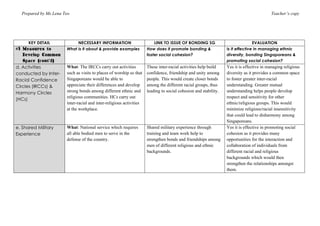
KEY DETAIL NECESSARY INFORMATION LINK TO ISSUE OF BONDING SG EVALUATION
#3 Measures to
Develop Common
Space (cont’d)
What is it about & provide examples How does it promote bonding &
foster social cohesion?
Is it effective in managing ethnic
diversity, bonding Singaporeans &
promoting social cohesion?
d. Activities
conducted by Inter-
Racial Confidence
Circles (IRCCs) &
Harmony Circles
(HCs)
What: The IRCCs carry out activities
such as visits to places of worship so that
Singaporeans would be able to
appreciate their differences and develop
strong bonds among different ethnic and
religious communities. HCs carry out
inter-racial and inter-religious activities
at the workplace.
These inter-racial activities help build
confidence, friendship and unity among
people. This would create closer bonds
among the different racial groups, thus
leading to social cohesion and stability.
Yes it is effective in managing religious
diversity as it provides a common space
to foster greater inter-racial
understanding. Greater mutual
understanding helps people develop
respect and sensitivity for other
ethnic/religious groups. This would
minimize religious/racial insensitivity
that could lead to disharmony among
Singaporeans.
e. Shared Military
Experience
What: National service which requires
all able bodied men to serve in the
defense of the country.
Shared military experience through
training and team work help to
strengthen bonds and friendships among
men of different religious and ethnic
backgrounds.
Yes it is effective in promoting social
cohesion as it provides many
opportunities for the interaction and
collaboration of individuals from
different racial and religious
backgrounds which would then
strengthen the relationships amongst
them.
Prepared by Ms Lena Teo Teacher’s copy

S3 SS Handout 2 - Bonding Singapore (Teacher)

  • 1.
    Prepared by MsLena Teo Teacher’s copy EDGEFIELD SECONDARY SCHOOL SECONDARY THREE SOCIAL STUDIES CHAPTER FIVE: BONDING SINGAPORE Name: _____________________________________ ( ) Class: 3 ____________________ Date: _________________ MANAGING ETHNIC DIVERSITY Refer to your textbook pages 141 to 151 to help you complete the tables below. KEY DETAIL NECESSARY INFORMATION LINK TO ISSUE OF BONDING SG EVALUATION #1 Measures to Build National Identity What is it about & provide examples How does it promote bonding & foster social cohesion? Is it effective in managing ethnic diversity, bonding Singaporeans & promoting social cohesion? a. Adopting Multi- Racialism policy What: Multiculturalism is a policy which ensures the equality of all races whereby no special treatment Is given to any particular racial or religious group. Example: Favouring a certain group of people because of their race is prohibited by the constitution It ensures that everyone has an equal opportunity to succeed and emphasizes the fact that everyone is seen as a valued member of the society. A sense of national identity as Singaporeans is created. Since everyone is seen as a valued member of the Singapore society, it creates a sense of national identity among all Singaporeans, where they will work together to ensure social cohesion and harmony in Singapore. b. Common Practices What: Common practices are actions that Singaporeans carry out. Examples: Singing the national anthem, Taking the pledge Common practices foster national identity and inculcate loyalty and national pride towards Singapore. Through this sense of pride and belonging to a nation, Singaporeans will begin to see themselves as one people. Yes, it is effective in promoting social cohesion as everyone is bonded by a sense of national pride and belonging to Singapore.
  • 2.
    Prepared by MsLena Teo Teacher’s copy c. Introduce Bilingualism What: Through the policy of bilingualism, students are expected to learn English and their own mother tongue Examples: Learning English and Mandarin / Malay / Tamil / Other Mother Tongues While mother tongue is used to impart moral values and cultural traditions of each race, the English language ensures social cohesion by serving as a common language through which Singaporeans can use to communicate with each other. This improves communication amongst Singaporeans and may also be used to deepen the understanding of the culture and values of other races. Yes it is effective in promoting bonding as it provides a common means of communication amongst Singaporeans which thus improves understanding amongst the different races and religions and deters discord because having English, as a medium of communication also ensures equality amongst racial communities. KEY DETAIL NECESSARY INFORMATION LINK TO ISSUE OF BONDING SG EVALUATION #2 Measures to Safeguard Minority Groups What is it about & provide examples How does it promote bonding & foster social cohesion? Is it effective in managing ethnic diversity, bonding Singaporeans & promoting social cohesion? a. Having a Policy on Minority Representation What: The policy on Minority representation gives minority groups a say in governance and safeguards the interest of Minority groups. Examples: The Group representation constituency (GRC) The GRC ensures that at least one of the candidates in the tem contesting in the general election is from the minority racial communities. This promotes bonding and social cohesion as the GRC system ensures that the minority racial groups are represented in the parliament. It is effective in promoting social cohesion as those who belong to the minority groups are reassured that their needs and concerns are voiced to the government and that they are also of equal importance as those in the majority groups in the eyes of the government. Having this reassurance makes social cohesion easier. b. Having Self–help Groups What: Self-help groups functions as a form of support system for the members of their own community who are less fortunate. Examples: CDAC, SINDA, Mendaki These self-help groups ensure that every Singaporean has equal opportunities to excel and ensure no conflict arises among the different ethnic groups with regards to issues such as education opportunities. These groups effective in promoting social cohesion as an improvement in the status of a races’ economic and social status increases their sense of loyalty and commitment to the nation.
  • 3.
    Prepared by MsLena Teo Teacher’s copy and the Eurasian Association KEY DETAIL NECESSARY INFORMATION LINK TO ISSUE OF BONDING SG EVALUATION #3 Measures to Develop Common Space What is it about & provide examples How does it promote bonding & foster social cohesion? Is it effective in managing ethnic diversity, bonding Singaporeans & promoting social cohesion? a. Activities organized by People’s Association (PA) What: The PA provide the Activities organized by PA includes home stays programme where Singaporeans are given the opportunities to stay with host families from other ethnic groups. The activities organized by the PA such as home stays create opportunities for Singaporeans to appreciate their differences and develop strong bonds among different religious and ethnic communities. These activities are effective in promoting social cohesion because a deeper understanding of each others’ cultures and beliefs would also be useful in fostering strong relations amongst Singaporeans of different ethnic and religious backgrounds. b. Opportunities offered by Educational Institutions What: Educational institutions in Singapore are open to every Singaporean regardless of race and religion. Through education and activities organized by these institutions, youths of different racial and religious backgrounds are able to interact. Example: CCA Educational institutions promote bonding and social cohesion by providing opportunities for interaction amongst youths of different racial and ethnic backgrounds through activities such as CCA. Yes, it is effective in promoting social cohesion as it encourages interaction amongst the youth of Singapore which could then develop into strong inter- racial relationships and favourable perceptions of other racial groups as they grow older. c. Public Housing to provide Common Living Space and Shared Facilities What: Ethnic integration policy in 1989 whereby a limit was put on the proportion of races living in every neighbourhood. Examples: shared Facilities like playgrounds, community centres and void decks. This prevents the saturation of a single racial group in certain neighbourhood. At the same time having shared facilities provides many opportunities for interaction between the different races in Singapore. This is effective in promoting social cohesion to a large extent as getting people from racial groups to live in the same neighbbourhood and to share living space gives them the opportunity to interact with each other which can lead to stronger bonds being formed.
  • 4.
    Prepared by MsLena Teo Teacher’s copy KEY DETAIL NECESSARY INFORMATION LINK TO ISSUE OF BONDING SG EVALUATION #3 Measures to Develop Common Space (cont’d) What is it about & provide examples How does it promote bonding & foster social cohesion? Is it effective in managing ethnic diversity, bonding Singaporeans & promoting social cohesion? d. Activities conducted by Inter- Racial Confidence Circles (IRCCs) & Harmony Circles (HCs) What: The IRCCs carry out activities such as visits to places of worship so that Singaporeans would be able to appreciate their differences and develop strong bonds among different ethnic and religious communities. HCs carry out inter-racial and inter-religious activities at the workplace. These inter-racial activities help build confidence, friendship and unity among people. This would create closer bonds among the different racial groups, thus leading to social cohesion and stability. Yes it is effective in managing religious diversity as it provides a common space to foster greater inter-racial understanding. Greater mutual understanding helps people develop respect and sensitivity for other ethnic/religious groups. This would minimize religious/racial insensitivity that could lead to disharmony among Singaporeans. e. Shared Military Experience What: National service which requires all able bodied men to serve in the defense of the country. Shared military experience through training and team work help to strengthen bonds and friendships among men of different religious and ethnic backgrounds. Yes it is effective in promoting social cohesion as it provides many opportunities for the interaction and collaboration of individuals from different racial and religious backgrounds which would then strengthen the relationships amongst them.
  • 5.
    Prepared by MsLena Teo Teacher’s copy