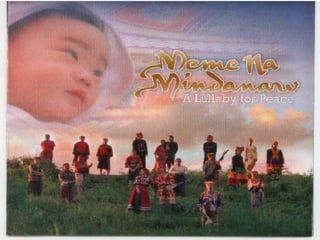
Paz
Peace
Kalinaw!
Kapayapaan
CHATECHESIS,CHATECHESIS,
DIALOGUE and theDIALOGUE and the
BANGSAMOROBANGSAMORO
Points for Reflection
FR. ALBERT E. ALEJO, SJ
7 August 2013
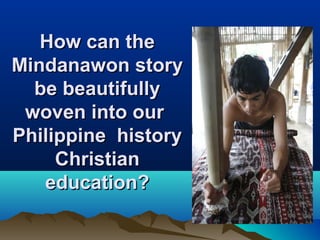
How can theHow can the
Mindanawon storyMindanawon story
be beautifullybe beautifully
woven into ourwoven into our
Philippine historyPhilippine history
ChristianChristian
education?education?
“Tayo, ano ang koneksyon
natin sa Mindanao?
Sa mga Moro?
Sa mga Lumad?
Paano natin napag-uusapan
ang hindi natin karehiyon o
karelihiyon?”
PERSONAL NOTEPERSONAL NOTE
• My Lolo is from Salimbalan,
Imbatug, Baungon, Bukidnon.
• My Tatay, from Obando met my Mama in
Wao, Lanao. I was born in Cagayan de Oro.
Grew up in Bulacan.
• Two years regency in Davao during Martial
Law. Five months parish priest in Camp
Philips. !8 months in Mount Apo for my
research. Ten years in Davao. Now in
Zamboanga.
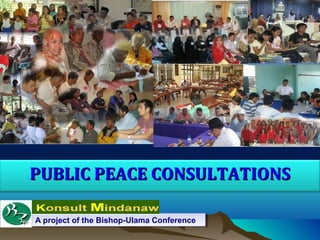
PUBLIC PEACE CONSULTATIONSPUBLIC PEACE CONSULTATIONS
A project of the Bishop-Ulama ConferenceA project of the Bishop-Ulama Conference
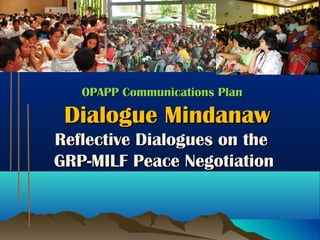
OPAPP Communications PlanOPAPP Communications Plan
Dialogue MindanawDialogue Mindanaw
Reflective Dialogues on theReflective Dialogues on the
GRP-MILF Peace NegotiationGRP-MILF Peace Negotiation
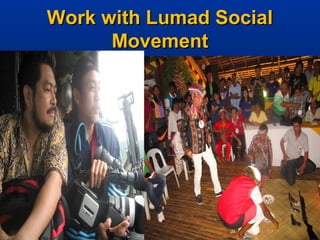
Work with Lumad SocialWork with Lumad Social
MovementMovement
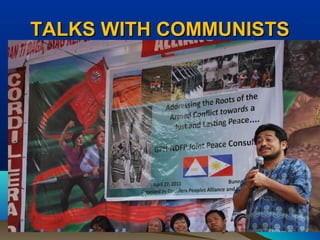
TALKS WITH COMMUNISTSTALKS WITH COMMUNISTS
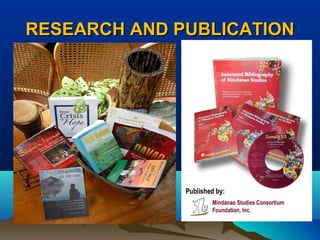
RESEARCH AND PUBLICATIONRESEARCH AND PUBLICATION
SEC. LUWALHATI R. ANTONINO
Chairperson
Mindanao Development Authority
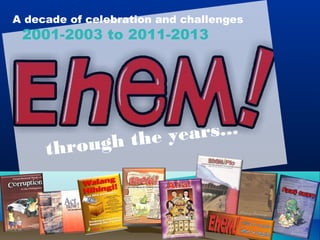
through the years...
A decade of celebration and challenges
2001-2003 to 2011-2013
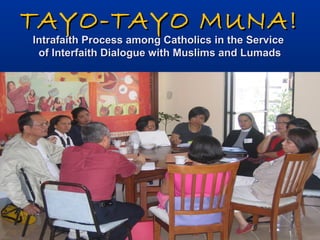
TAYO-TAYO MUNA!TAYO-TAYO MUNA!
Intrafaith Process among Catholics in the ServiceIntrafaith Process among Catholics in the Service
of Interfaith Dialogue with Muslims and Lumadsof Interfaith Dialogue with Muslims and Lumads
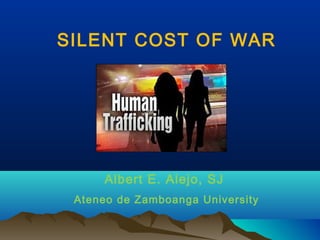
SILENT COST OF WAR
Albert E. Alejo, SJ
Ateneo de Zamboanga University
LET’S HAVE A
SHORT QUIZ!
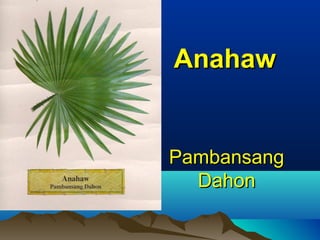
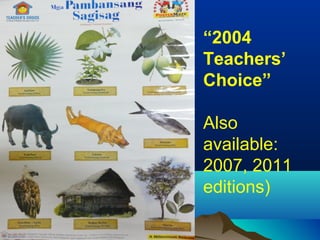
PambansangPambansang
DahonDahon
AnahawAnahaw
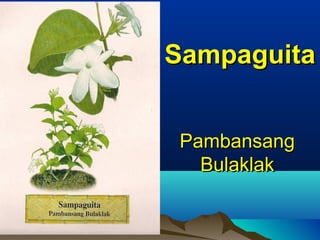
PambansangPambansang
BulaklakBulaklak
SampaguitaSampaguita
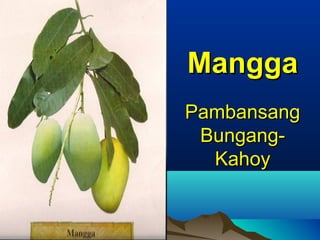
PambansangPambansang
Bungang-Bungang-
KahoyKahoy
ManggaMangga
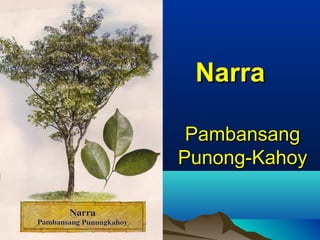
NarraNarra
PambansangPambansang
Punong-KahoyPunong-Kahoy
PambansangPambansang
TirahanTirahan
KuboKubo
PambansangPambansang
IbonIbon
AgilaAgila
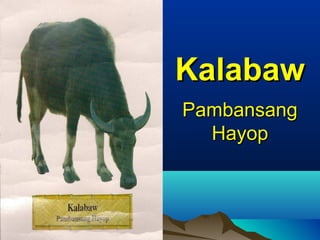
PambansangPambansang
HayopHayop
KalabawKalabaw
PambansangPambansang
IsdaIsda
BangusBangus
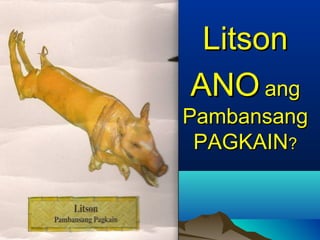
ANOANO angang
PambansangPambansang
PAGKAINPAGKAIN??
LitsonLitson
“2004
Teachers’
Choice”
Also
available:
2007, 2011
editions)
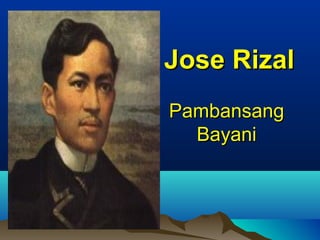
PambansangPambansang
BayaniBayani
Jose RizalJose Rizal
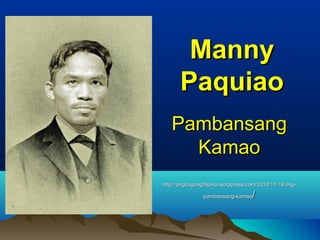
PambansangPambansang
KamaoKamao
http://angbagongfilipino.wordpress.com/2010/11/14/ang-http://angbagongfilipino.wordpress.com/2010/11/14/ang-
pambansang-kamaopambansang-kamao//
MannyManny
PaquiaoPaquiao
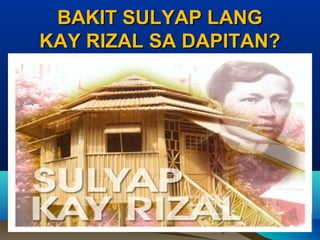
BAKIT SULYAP LANGBAKIT SULYAP LANG
KAY RIZAL SA DAPITAN?KAY RIZAL SA DAPITAN?
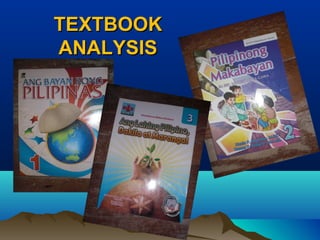
TEXTBOOKTEXTBOOK
ANALYSISANALYSIS
ContentContent
AnalysisAnalysis
Source:Source:
Cagayan deCagayan de
Oro ClusterOro Cluster
byby Gail de laGail de la
RitaRita
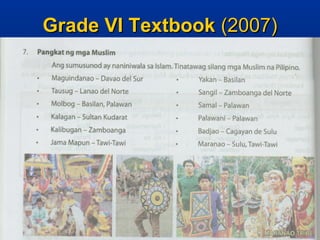
Grade VI TextbookGrade VI Textbook (2007)(2007)
Grade SchoolGrade School
TextsTexts
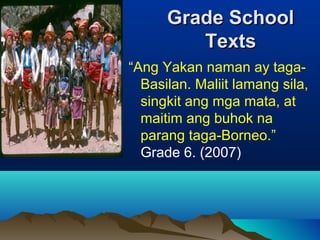
“Ang Yakan naman ay taga-
Basilan. Maliit lamang sila,
singkit ang mga mata, at
maitim ang buhok na
parang taga-Borneo.”
Grade 6. (2007)
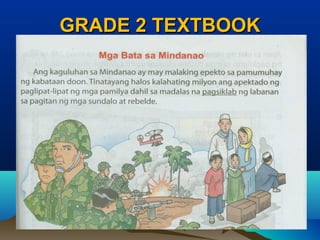
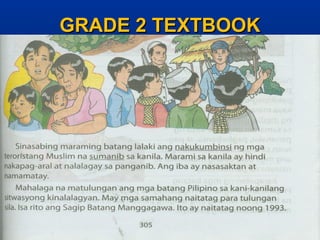
GRADE 2 TEXTBOOKGRADE 2 TEXTBOOK
 In most of the Sibika and
Social Studies Textbooks that
our basic education institution
make use today, MINDANAO is
either, underrepresented,
misrepresented or not
represented at all as shown in
some of the sample slides.
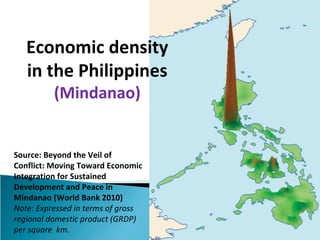
 The problem is: this attitude
seems reflected in the economy
of Mindanao.
Source: Beyond the Veil of
Conflict: Moving Toward Economic
Integration for Sustained
Development and Peace in
Mindanao (World Bank 2010)
Note: Expressed in terms of gross
regional domestic product (GRDP)
per square km.
Economic density
in the Philippines
(Mindanao)
LET’S REFLECT ON
OUR PARTICIPATION
IN UNPEACE…
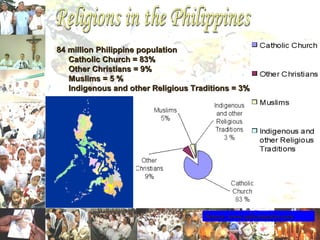
84 million Philippine population84 million Philippine population
Catholic Church = 83%Catholic Church = 83%
Other Christians = 9%Other Christians = 9%
Muslims = 5 %Muslims = 5 %
Indigenous and other Religious Traditions = 3%Indigenous and other Religious Traditions = 3%
Source: www.nationmaster.comSource: www.nationmaster.com
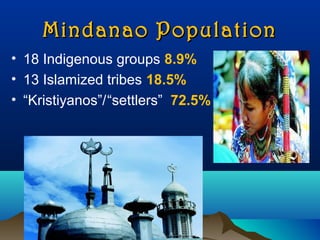
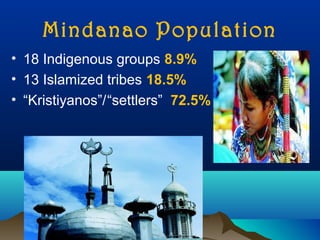
Mindanao PopulationMindanao Population
• 18 Indigenous groups 8.9%
• 13 Islamized tribes 18.5%
• “Kristiyanos”/“settlers” 72.5%
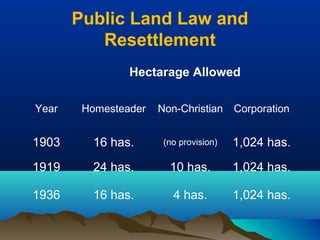
Public Land Law and
Resettlement
Hectarage Allowed
Year Homesteader Non-Christian Corporation
1903 16 has. (no provision) 1,024 has.
1919 24 has. 10 has. 1,024 has.
1936 16 has. 4 has. 1,024 has.
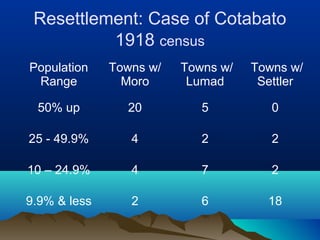
Resettlement: Case of Cotabato
1918 census
Population
Range
Towns w/
Moro
Towns w/
Lumad
Towns w/
Settler
50% up 20 5 0
25 - 49.9% 4 2 2
10 – 24.9% 4 7 2
9.9% & less 2 6 18
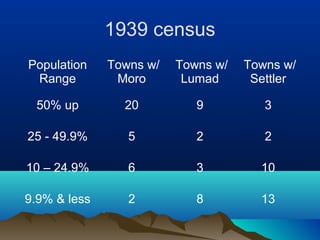
1939 census
Population
Range
Towns w/
Moro
Towns w/
Lumad
Towns w/
Settler
50% up 20 9 3
25 - 49.9% 5 2 2
10 – 24.9% 6 3 10
9.9% & less 2 8 13
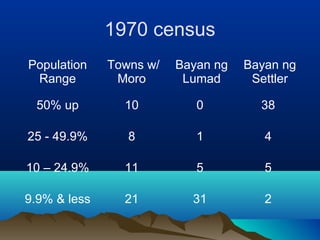
1970 census
Population
Range
Towns w/
Moro
Bayan ng
Lumad
Bayan ng
Settler
50% up 10 0 38
25 - 49.9% 8 1 4
10 – 24.9% 11 5 5
9.9% & less 21 31 2
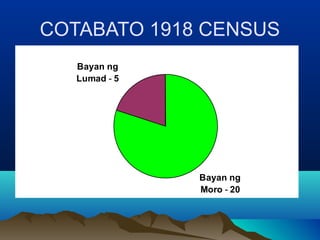
COTABATO 1918 CENSUS
Bayan ng
Lumad - 5
Bayan ng
Moro - 20
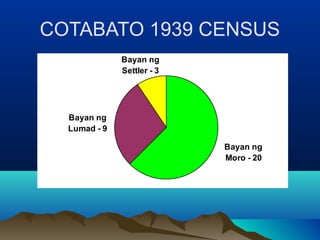
COTABATO 1939 CENSUS
Bayan ng
Moro - 20
Bayan ng
Lumad - 9
Bayan ng
Settler - 3
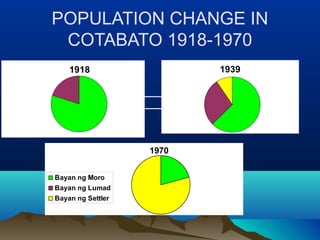
POPULATION CHANGE IN
COTABATO 1918-1970
1918 1939
1970
Bayan ng Moro
Bayan ng Lumad
Bayan ng Settler
Mindanao Population
• 18 Indigenous groups 8.9%
• 13 Islamized tribes 18.5%
• “Kristiyanos”/“settlers” 72.5%
Challenging “Majority-
Minority” Habit of Thinking
1. The majority now has not been the
majority in the beginning.
2. Christians form the majority in the
Philippines, but we are minority in the
rest of Asia.
3. While Christians feel we are the majority
in the country, actually, in some places
like Basilan, Christians are a minority.
VENEER OF BENEVOLENCE?
“A nationalistic educational policy formulated from
within the cultural, religious and political
worldviews of a Manila-centered elite…was widely
experienced as a homogenisation of Filipino
identity hostile to Muslim Filipino identities,
regardless of that bureaucracy’s benevolent
intentions.
Pursued within the conceptual framework of
civilisation-development, state educational policies
gave integration a veneer of benevolence…”
EDUCATION’S POSSIBLE FAILURE
OF INTEGRATION
• “The Manila-centered educational elite continued to
hold the power to define national identity in terms of
colonial borders and their own historical
experience…
• “While 50 years of the policy of integration through
education no doubt contributed to the social mobility
of individual Muslims…it largely failed to achieve
the goal of mitigating Muslim-Christian tensions in
Mindanao” ---Milligan (2005),
Biases and Prejudices…
“…the perceptions and understandings that
Muslims and Christians have of each
other lack objectivity and are coloured by
strong biases and prejudices; but
especially strong are the biases Christians
have against Muslims.”
Rosalita Tolibas-Nunez, 1997. Roots of conflict: Muslims,
Christians, and the Mindanao struggle. Makati City: Asian
Institute of Management. P. 84.
Biases and Prejudices…
“A majority of Filipinos (still) think that Muslims
are probably more prone to run amok (55
percent) although probably not oppressive to
women (59 percent). A plurality believes that
Muslims are probably terrorists or extremists (47
percent) and that they probably consider
themselves as Filipinos (49 percent). There are
equal percentages (44 percent) of those who
believe that Muslims probably secretlyt hate all
non-Muslims and those who do not.”---Appendix
1.1. “Measuring the bias against Muslims,” (Manila: Human
Development Network, 2005).
The Role of Catholic Schools
in Mindanao Peace Building
“Schools, colleges and universities, acknowledged as
neutral agents of change, can play a strategic and
leadership role in helping craft a Mindanao peace
roadmap, build broad support around it, and
provide timely assessments and inputs as to its
implementation.
The conventional notion that education is the long-
term solution to peacelessness “self-limits” the
vast potentials of educational institutions as
credible and effective platforms for peace-building
and peace-making in the short and medium term.”
--- (Atty. Beny Bacani)
“The Catholic Church in general and Catholic
educational institutions in particular are weighed
down by “baggages” as a repository of
confessional and historical biases against Muslims
and Lumads.
The success of peace-building programs of
Catholic educational institutions must be gauged
among others on how they move Christians into
admitting that they play a part in the historical
marginalization of minority groups and that there
can be no just resolution to the Mindanao conflicts
without their support.” ---Benny Bacani
Is it possible that in opening many schools
in Mindanao, we have not just shared faith
and civilization, but have also extended
the colonial project?
To what extent can the story of Catholic
schools and catechetical instructions in
Mindanao be considered “good news” to
the Mindanawons, especially the Moros
and the Lumads?
How can we become instruments of peace?
LET’S DEAL WITH A
PARTICULAR CHALLENGE
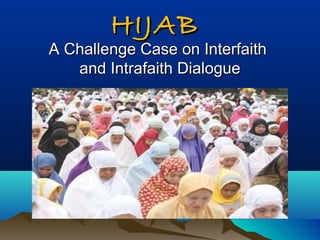
HIJABHIJAB
A Challenge Case on InterfaithA Challenge Case on Interfaith
and Intrafaith Dialogueand Intrafaith Dialogue
The Hijab MomentThe Hijab Moment
The hijab issue in Pilar College in
Zamboanga may be seen as a learning
moment for all sectors, including school
administrators, Muslim groups,
government officials, academic
researchers, media and law practitioners,
and peace advocates, and individual
Facebook and Twitter likers and sharers.
But we need to handle this very carefully.
COMPLAINTCOMPLAINT
• “The policy is a violation of our religious
freedom. It even violates the very mission
of Pilar College stated in its handbook that
‘it must respect and understand all
Christians, Muslims and lumads.’ Many of
us felt that this violation should not be
taken lightly and needs to be acted upon
immediately,” stresses Estino, a 1990
graduate of Pilar College.
AGAINST THE LAWAGAINST THE LAW
• NCMF Secretary Atty. Sadain, on the other
hand, defended the Muslim community and
maintained that the wearing of the hijab is
fully supported by law and state policies such
as Section 28 (e) of the Magna Carta of
Women; Department of Education Order No.
53, series of 2001 issued on Oct. 29, 2001;
Commission on Higher Education
Memorandum dated Aug. 26, 2008; and
Department of Health Memorandum No.
2009-0107.
ACADEMIC FREEDOMACADEMIC FREEDOM
• Our own Supreme Court decisions have
hewed closely to this line of thought; to cite
only one out of many rulings upholding
academic freedom, the high court asserted
in 2001, in University of the Philippines et
al. vs Civil Service Commission: “We have
held time and again that the University has
the academic freedom to determine for
itself on academic grounds who may teach,
what may be taught, how it shall be taught,
and who may be admitted to study.”--PDI
PILAR COLLEGE INITIALPILAR COLLEGE INITIAL
POSITIONPOSITION
“Such a policy does not intend to
discriminate but rather to democratize or
to equalize all students regardless of their
religion. The way I look at it, it is even Pilar
College now that is being discriminated
against because it is being mandated to
conform to something that will suit the
Muslim enrollees despite the fact that the
school has the Catholic identity.
From the consultationsFrom the consultations……
(a) Pilar faculty is almost unanimous in
preferring “no hijab” policy; and this is
something the RVM sisters are strongly
considering in their decision.
(b) Among the students, high school girls
would prefer wearing hijab, because “they
are not yet spiritually ready.”
(c) Christian parents and alumni tend to be
heavily in favour of retaining the present
no-hijab policy; they do not like the “the
other side to win”. But some Christian
Clarification:Clarification:
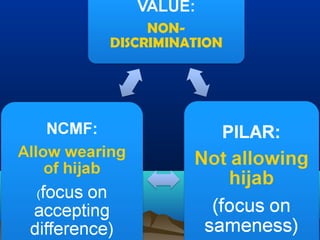
POSITION AND VALUES
Pilar College wants to avoid discrimination
by removing difference. (No hijab makes
everyone equal, meaning similar.)
NCMF wants to avoid discrimination by
accepting difference. (Wearing hijab
makes Muslim feel accepted as they are.)
Pilar and NCMF share the same value:
avoiding discrimination.
RESULTING AGREEMENTRESULTING AGREEMENT
1. Pilar College will allow the wearing of hijab,
not immediately as demanded by the
NCMF;
2. But after a robust “social preparation”---a
series of seminars on the meaning of hijab,
individual freedom, academic freedom, etc.
3. This is the result of both a dialogue between
Pilar College and NCMF, as well as internal
processing among RVM schools, and
statekeholders.
LET’S CONSIDER THE
CHURCH’S EXAMINATION
OF CONSCIENCE
HEALING FORHEALING FOR
SOLIDARITYSOLIDARITY
Learning fromLearning from
CBCP Reflecting on IndigenousCBCP Reflecting on Indigenous
Peoples MinistryPeoples Ministry
January 2010January 2010
Albert E. Alejo, SJ
Episcopal Commission on Indigenous Peoples (ECIP)
6-9 September 2010
CONFESSION OF SINS COMMITTED IN ACTIONS AGAINST LOVE,
PEACE, THE RIGHTS OF PEOPLES, AND RESPECT FOR
CULTURES AND RELIGIONS
(POPE JOHN PAUL II, DAY OF PARDON, MARCH 12, 2000
• “Lord of the world, Father of all,
through your Son
you asked us to love our enemies,
to do good to those who hate us
and to pray for those who persecute us.
Yet Christians have often denied the Gospel;
yielding to a mentalíty of power,
they have violated the rights of ethnic groups and
peoples, and shown contempt for their cultures
and religious traditions: be patient and merciful
towards us, and grant us your forgiveness!
We ask this through Christ our Lord.”
WORKSHOP QUESTIONSWORKSHOP QUESTIONS
1. What do we reaffirm in the Church’s history, life and
mission, especially to the IPs?
2. What do we regret in our history, attitude and practice
in relationship with IPs in our region or country?
3. What are we ready to do now as bishops in the
Philippines? (Choose at least two topics.)
* Direction of evangelization with the IPs
* Journey toward reconciliation
* Changes in our formation program
* Support for the advocacy of the IPs
* Strengthening of the ECIP, IPAs, and related ministries
* Drafting a Pastoral Statement on the IPs
RE-AFFIRMATIONRE-AFFIRMATION
What do we reaffirm in the Church’s life and mission,
especially to the IPs?
1. Work, witness, scholarship of missionaries
2. Pastoral work of the dioceses with the IPs
3. Humanitarian work responding to their needs
4. Overt preaching of Jesus, direct evangelization
5. Involvement in the education of IPs
6. Shared belief in God, extra-biblical revelation
7. Collaboration of the laity and NGOs
8. Cultural “preservation”
REGRETREGRET
What do we regret in our history, attitude and practice
in relationship with IPs in our region or country?
1. Lack of understanding; distance from them
2. Loss of writing and other cultural treasures
3. Discriminatory practices and attitudes
4. Failure to stress social teachings of the Church
5. Lack of coordination among Church ministries
6. Pressure on IPs, pushing them afar
7. Acquisition of lands, thru the datus
8. Paternalism and dole-outs
9. Cultural exploitation
READY TO DOREADY TO DO
What are we ready to do now as bishops in the
Philippines?
1. Revise our catechesis and evangelization ways
2. Establish IP desks, empowering IP pastoral workers
3. Institutional and financial support for IP ministry
4. Integral evangelization, mission ad gentes
5. Clarify links between ECIP, NASSA, Culture Com
6. Closer collaboration
7. Formation of seminarians on IPA
8. Overt preaching of Jesus, direct evangelization
CANADIAN OBLATES OF MARYCANADIAN OBLATES OF MARY
IMMACULATE (1991)IMMACULATE (1991)
• “We apologize for the part we played in the
cultural, ethnic, linguistic, religious imperialism
that was part of the mentality within which the
peoples of Europe first met the aboriginal
peoples and which consistently has lurked
behind the way the Native peoples of Canada
have been treated by civil governments and by
the Churches. We were, naively, part of this
mentality and were, in fact, often a key player in
its implementation.”
Jesuits confession in GC 34:
Intuition and alienation
“Our intuition is that the Gospel resonates with what
is good in each culture. At the same time, we
acknowledge that we have not always followed
this intuition.
We have not always recognized that aggression and
coercion have no place in the preaching of the
Gospel of freedom, especially in cultures which
are vulnerable to manipulation by more powerful
forces.
We have often contributed to the alienation of the
very people we wanted to serve” (90-92)
RECONCILIATION WALK OF ABOUTRECONCILIATION WALK OF ABOUT
2,000 CHRISTIANS TRACING THE ROUTE2,000 CHRISTIANS TRACING THE ROUTE
OF THE FIRST CRUSADE (1996)OF THE FIRST CRUSADE (1996)
"The Reconciliation Walk is an interdenominational
grassroots movement of Western
Christians...retracing the route of the First
Crusade, apologizing to Muslims, Jews and
Eastern Christians for the atrocities of the
Crusades -- foremost among them, the misuse
of the name and message of Jesus."
FRANCISCAN PROVINCE OF SANFRANCISCAN PROVINCE OF SAN
FELIPE DE JESUS TO THE MAYANFELIPE DE JESUS TO THE MAYAN
PEOPLE (MANI, YUCATAN 2009)PEOPLE (MANI, YUCATAN 2009)
We ask forgiveness of the Mayan people for not having
understood your world view and your religion and for
having denied your deities; for not having respected
your culture and for having imposed upon you for
many centuries a religion that you did not
understand; for having demonized your religious
practices and for having declared in word and writing
that they were works of the devil and that your idols
were Satan incarnate…
We Friars Minor commit ourselves: To help ourselves
and those brothers who will come after us to
understand the culture from which we come forth, to
promote it, and to incarnate the message of Jesus to
the point of having a Mayan Christianity.
Anglican Church to the NativesAnglican Church to the Natives
of Canada (1993)of Canada (1993)
“I have felt shame and humiliation as I have
heard of suffering inflicted by my people,
and as I think of the part our church
played in that suffering.
I accept and I confess before God and you,
our failures in the residential schools. We
failed you. We failed ourselves. We failed
God.” –Archbp. Michael Peers, Ontario
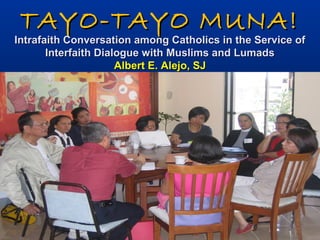
TAYO-TAYO MUNA!TAYO-TAYO MUNA!
Intrafaith Conversation among Catholics in the Service ofIntrafaith Conversation among Catholics in the Service of
Interfaith Dialogue with Muslims and LumadsInterfaith Dialogue with Muslims and Lumads
Albert E. Alejo, SJAlbert E. Alejo, SJ
Trigger:Trigger:
How do religionsHow do religions
get into conflict?get into conflict?
Islam is a religion of peace. Christianity is a religion of
love. But why do we witness so much fighting among
Muslims and Christians? Why the deep and persistent
prejudices hurled against each other? And this despite
the many interreligious and interfaith dialogues?
Presuming that religion is not the main culprit, how is
religion “recruited” as it were into this friction? And to
what extent are we part of this?
Could it be theCould it be the
link betweenlink between
religion, culture,religion, culture,
and history?and history?
Faith-based peace activists must understand the
dynamics of religion, culture and conflict. E.g. Religion
initiates individuals into a community. Community
building, however, builds not just identity but
boundary. Identity markers both define who is in and
who is out. Formation of identity involves oppositional
identity. This distinction, when taken too sharply, or
too exclusively, can lead to fundamentalism or
chauvinism.
We need to engage inWe need to engage in
Intra-FaithIntra-Faith DialogueDialogue
Existing peace initiatives are closing the gap
between “dialogue Christians” and
“dialogue Muslims”. But it is not clear
whether we are closing the gap between
the “dialogue Christians” and the
“prejudiced Christians”, or between the
“dialogue Muslims” and the “armed
Muslims.”
Bishops-Ulama Conference, 35th GeneralBishops-Ulama Conference, 35th General
Assembly, Jolo, Sulu, November 18-21,Assembly, Jolo, Sulu, November 18-21,
20082008
• While we continue with interfaith activities,
we shall also pursue authentic intrafaith
dialogues among our own communities.
We hope that through this open
communication, we will find a way to face
our own share in the prolonged problem in
Mindanao as well as discover how we
could go beyond our hurts and biases.
Perhaps this holds a key to more creative
solutions to the impasse in our peace
process.
Consider ForgivenessConsider Forgiveness
During a number of sessions on clan conflict
and interfaith dialogue, forgiveness was
mentioned both by Muslims and
Christians. While nobody thought it was
easy, nobody seems to claim that it was
impossible. A few testimonies proved it
was necessary.
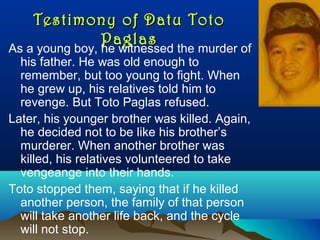
Testimony of Datu TotoTestimony of Datu Toto
PaglasPaglas
As a young boy, he witnessed the murder of
his father. He was old enough to
remember, but too young to fight. When
he grew up, his relatives told him to
revenge. But Toto Paglas refused.
Later, his younger brother was killed. Again,
he decided not to be like his brother’s
murderer. When another brother was
killed, his relatives volunteered to take
vengeange into their hands.
Toto stopped them, saying that if he killed
another person, the family of that person
will take another life back, and the cycle
will not stop.
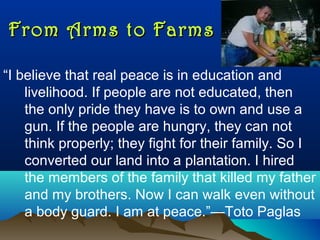
From Arms to FarmsFrom Arms to Farms
“I believe that real peace is in education and
livelihood. If people are not educated, then
the only pride they have is to own and use a
gun. If the people are hungry, they can not
think properly; they fight for their family. So I
converted our land into a plantation. I hired
the members of the family that killed my father
and my brothers. Now I can walk even without
a body guard. I am at peace.”—Toto Paglas
RECOMMENDATION:
Teach in our catechesis and
religious education
the value and the process of
dialogue, including both interfaith
and intrafaith dialogue.
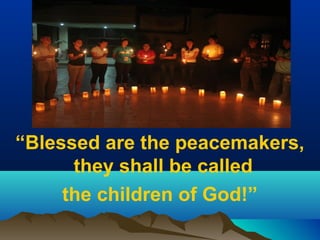
SIGN OF PEACESIGN OF PEACE
“Blessed are the peacemakers,
they shall be called
the children of God!”
SIGN OF PEACESIGN OF PEACE
Lord, Jesus Christ, you said to your apostles: I
leave you peace, my peace I give you. Look not
on our sins, but on the faith of your Church, and
grant us the peace and unity of your kingdom
where you live for ever and ever.
Amen.
The peace of the Lord be always with you.
And also with you.
Let’s give each other a sign of peace.
““Be humble toward one another,Be humble toward one another,
always considering others better thanalways considering others better than
yourselves. And look out for oneyourselves. And look out for one
another’s interests, not just your own.”another’s interests, not just your own.”
---Philippians 2:2-4---Philippians 2:2-4
www.konsultmindanaw.phwww.konsultmindanaw.ph
Learning from ScripturesLearning from Scriptures
Peace.mindanao.catechist.2013

Peace.mindanao.catechist.2013

  • 1.
  • 2.
    CHATECHESIS,CHATECHESIS, DIALOGUE and theDIALOGUEand the BANGSAMOROBANGSAMORO Points for Reflection FR. ALBERT E. ALEJO, SJ 7 August 2013
  • 3.
    How can theHowcan the Mindanawon storyMindanawon story be beautifullybe beautifully woven into ourwoven into our Philippine historyPhilippine history ChristianChristian education?education?
  • 4.
    “Tayo, ano angkoneksyon natin sa Mindanao? Sa mga Moro? Sa mga Lumad? Paano natin napag-uusapan ang hindi natin karehiyon o karelihiyon?”
  • 5.
    PERSONAL NOTEPERSONAL NOTE •My Lolo is from Salimbalan, Imbatug, Baungon, Bukidnon. • My Tatay, from Obando met my Mama in Wao, Lanao. I was born in Cagayan de Oro. Grew up in Bulacan. • Two years regency in Davao during Martial Law. Five months parish priest in Camp Philips. !8 months in Mount Apo for my research. Ten years in Davao. Now in Zamboanga.
  • 6.
    PUBLIC PEACE CONSULTATIONSPUBLICPEACE CONSULTATIONS A project of the Bishop-Ulama ConferenceA project of the Bishop-Ulama Conference
  • 7.
    OPAPP Communications PlanOPAPPCommunications Plan Dialogue MindanawDialogue Mindanaw Reflective Dialogues on theReflective Dialogues on the GRP-MILF Peace NegotiationGRP-MILF Peace Negotiation
  • 8.
    Work with LumadSocialWork with Lumad Social MovementMovement
  • 9.
  • 10.
  • 11.
    SEC. LUWALHATI R.ANTONINO Chairperson Mindanao Development Authority
  • 12.
    through the years... Adecade of celebration and challenges 2001-2003 to 2011-2013
  • 13.
    TAYO-TAYO MUNA!TAYO-TAYO MUNA! IntrafaithProcess among Catholics in the ServiceIntrafaith Process among Catholics in the Service of Interfaith Dialogue with Muslims and Lumadsof Interfaith Dialogue with Muslims and Lumads
  • 14.
    SILENT COST OFWAR Albert E. Alejo, SJ Ateneo de Zamboanga University
  • 16.
  • 17.
  • 18.
  • 19.
  • 20.
  • 21.
  • 22.
  • 23.
  • 24.
  • 25.
  • 26.
  • 27.
  • 28.
  • 29.
    BAKIT SULYAP LANGBAKITSULYAP LANG KAY RIZAL SA DAPITAN?KAY RIZAL SA DAPITAN?
  • 30.
  • 31.
    ContentContent AnalysisAnalysis Source:Source: Cagayan deCagayan de OroClusterOro Cluster byby Gail de laGail de la RitaRita
  • 32.
    Grade VI TextbookGradeVI Textbook (2007)(2007)
  • 33.
    Grade SchoolGrade School TextsTexts “AngYakan naman ay taga- Basilan. Maliit lamang sila, singkit ang mga mata, at maitim ang buhok na parang taga-Borneo.” Grade 6. (2007)
  • 34.
  • 35.
  • 36.
     In mostof the Sibika and Social Studies Textbooks that our basic education institution make use today, MINDANAO is either, underrepresented, misrepresented or not represented at all as shown in some of the sample slides.  The problem is: this attitude seems reflected in the economy of Mindanao.
  • 37.
    Source: Beyond theVeil of Conflict: Moving Toward Economic Integration for Sustained Development and Peace in Mindanao (World Bank 2010) Note: Expressed in terms of gross regional domestic product (GRDP) per square km. Economic density in the Philippines (Mindanao)
  • 38.
    LET’S REFLECT ON OURPARTICIPATION IN UNPEACE…
  • 39.
    84 million Philippinepopulation84 million Philippine population Catholic Church = 83%Catholic Church = 83% Other Christians = 9%Other Christians = 9% Muslims = 5 %Muslims = 5 % Indigenous and other Religious Traditions = 3%Indigenous and other Religious Traditions = 3% Source: www.nationmaster.comSource: www.nationmaster.com
  • 40.
    Mindanao PopulationMindanao Population •18 Indigenous groups 8.9% • 13 Islamized tribes 18.5% • “Kristiyanos”/“settlers” 72.5%
  • 41.
    Public Land Lawand Resettlement Hectarage Allowed Year Homesteader Non-Christian Corporation 1903 16 has. (no provision) 1,024 has. 1919 24 has. 10 has. 1,024 has. 1936 16 has. 4 has. 1,024 has.
  • 42.
    Resettlement: Case ofCotabato 1918 census Population Range Towns w/ Moro Towns w/ Lumad Towns w/ Settler 50% up 20 5 0 25 - 49.9% 4 2 2 10 – 24.9% 4 7 2 9.9% & less 2 6 18
  • 43.
    1939 census Population Range Towns w/ Moro Townsw/ Lumad Towns w/ Settler 50% up 20 9 3 25 - 49.9% 5 2 2 10 – 24.9% 6 3 10 9.9% & less 2 8 13
  • 44.
    1970 census Population Range Towns w/ Moro Bayanng Lumad Bayan ng Settler 50% up 10 0 38 25 - 49.9% 8 1 4 10 – 24.9% 11 5 5 9.9% & less 21 31 2
  • 45.
    COTABATO 1918 CENSUS Bayanng Lumad - 5 Bayan ng Moro - 20
  • 46.
    COTABATO 1939 CENSUS Bayanng Moro - 20 Bayan ng Lumad - 9 Bayan ng Settler - 3
  • 47.
    POPULATION CHANGE IN COTABATO1918-1970 1918 1939 1970 Bayan ng Moro Bayan ng Lumad Bayan ng Settler
  • 48.
    Mindanao Population • 18Indigenous groups 8.9% • 13 Islamized tribes 18.5% • “Kristiyanos”/“settlers” 72.5%
  • 49.
    Challenging “Majority- Minority” Habitof Thinking 1. The majority now has not been the majority in the beginning. 2. Christians form the majority in the Philippines, but we are minority in the rest of Asia. 3. While Christians feel we are the majority in the country, actually, in some places like Basilan, Christians are a minority.
  • 50.
    VENEER OF BENEVOLENCE? “Anationalistic educational policy formulated from within the cultural, religious and political worldviews of a Manila-centered elite…was widely experienced as a homogenisation of Filipino identity hostile to Muslim Filipino identities, regardless of that bureaucracy’s benevolent intentions. Pursued within the conceptual framework of civilisation-development, state educational policies gave integration a veneer of benevolence…”
  • 51.
    EDUCATION’S POSSIBLE FAILURE OFINTEGRATION • “The Manila-centered educational elite continued to hold the power to define national identity in terms of colonial borders and their own historical experience… • “While 50 years of the policy of integration through education no doubt contributed to the social mobility of individual Muslims…it largely failed to achieve the goal of mitigating Muslim-Christian tensions in Mindanao” ---Milligan (2005),
  • 52.
    Biases and Prejudices… “…theperceptions and understandings that Muslims and Christians have of each other lack objectivity and are coloured by strong biases and prejudices; but especially strong are the biases Christians have against Muslims.” Rosalita Tolibas-Nunez, 1997. Roots of conflict: Muslims, Christians, and the Mindanao struggle. Makati City: Asian Institute of Management. P. 84.
  • 53.
    Biases and Prejudices… “Amajority of Filipinos (still) think that Muslims are probably more prone to run amok (55 percent) although probably not oppressive to women (59 percent). A plurality believes that Muslims are probably terrorists or extremists (47 percent) and that they probably consider themselves as Filipinos (49 percent). There are equal percentages (44 percent) of those who believe that Muslims probably secretlyt hate all non-Muslims and those who do not.”---Appendix 1.1. “Measuring the bias against Muslims,” (Manila: Human Development Network, 2005).
  • 54.
    The Role ofCatholic Schools in Mindanao Peace Building “Schools, colleges and universities, acknowledged as neutral agents of change, can play a strategic and leadership role in helping craft a Mindanao peace roadmap, build broad support around it, and provide timely assessments and inputs as to its implementation. The conventional notion that education is the long- term solution to peacelessness “self-limits” the vast potentials of educational institutions as credible and effective platforms for peace-building and peace-making in the short and medium term.” --- (Atty. Beny Bacani)
  • 55.
    “The Catholic Churchin general and Catholic educational institutions in particular are weighed down by “baggages” as a repository of confessional and historical biases against Muslims and Lumads. The success of peace-building programs of Catholic educational institutions must be gauged among others on how they move Christians into admitting that they play a part in the historical marginalization of minority groups and that there can be no just resolution to the Mindanao conflicts without their support.” ---Benny Bacani
  • 56.
    Is it possiblethat in opening many schools in Mindanao, we have not just shared faith and civilization, but have also extended the colonial project? To what extent can the story of Catholic schools and catechetical instructions in Mindanao be considered “good news” to the Mindanawons, especially the Moros and the Lumads? How can we become instruments of peace?
  • 57.
    LET’S DEAL WITHA PARTICULAR CHALLENGE
  • 58.
    HIJABHIJAB A Challenge Caseon InterfaithA Challenge Case on Interfaith and Intrafaith Dialogueand Intrafaith Dialogue
  • 59.
    The Hijab MomentTheHijab Moment The hijab issue in Pilar College in Zamboanga may be seen as a learning moment for all sectors, including school administrators, Muslim groups, government officials, academic researchers, media and law practitioners, and peace advocates, and individual Facebook and Twitter likers and sharers. But we need to handle this very carefully.
  • 60.
    COMPLAINTCOMPLAINT • “The policyis a violation of our religious freedom. It even violates the very mission of Pilar College stated in its handbook that ‘it must respect and understand all Christians, Muslims and lumads.’ Many of us felt that this violation should not be taken lightly and needs to be acted upon immediately,” stresses Estino, a 1990 graduate of Pilar College.
  • 61.
    AGAINST THE LAWAGAINSTTHE LAW • NCMF Secretary Atty. Sadain, on the other hand, defended the Muslim community and maintained that the wearing of the hijab is fully supported by law and state policies such as Section 28 (e) of the Magna Carta of Women; Department of Education Order No. 53, series of 2001 issued on Oct. 29, 2001; Commission on Higher Education Memorandum dated Aug. 26, 2008; and Department of Health Memorandum No. 2009-0107.
  • 62.
    ACADEMIC FREEDOMACADEMIC FREEDOM •Our own Supreme Court decisions have hewed closely to this line of thought; to cite only one out of many rulings upholding academic freedom, the high court asserted in 2001, in University of the Philippines et al. vs Civil Service Commission: “We have held time and again that the University has the academic freedom to determine for itself on academic grounds who may teach, what may be taught, how it shall be taught, and who may be admitted to study.”--PDI
  • 63.
    PILAR COLLEGE INITIALPILARCOLLEGE INITIAL POSITIONPOSITION “Such a policy does not intend to discriminate but rather to democratize or to equalize all students regardless of their religion. The way I look at it, it is even Pilar College now that is being discriminated against because it is being mandated to conform to something that will suit the Muslim enrollees despite the fact that the school has the Catholic identity.
  • 64.
    From the consultationsFromthe consultations…… (a) Pilar faculty is almost unanimous in preferring “no hijab” policy; and this is something the RVM sisters are strongly considering in their decision. (b) Among the students, high school girls would prefer wearing hijab, because “they are not yet spiritually ready.” (c) Christian parents and alumni tend to be heavily in favour of retaining the present no-hijab policy; they do not like the “the other side to win”. But some Christian
  • 65.
    Clarification:Clarification: POSITION AND VALUES PilarCollege wants to avoid discrimination by removing difference. (No hijab makes everyone equal, meaning similar.) NCMF wants to avoid discrimination by accepting difference. (Wearing hijab makes Muslim feel accepted as they are.) Pilar and NCMF share the same value: avoiding discrimination.

  • 67.
    RESULTING AGREEMENTRESULTING AGREEMENT 1.Pilar College will allow the wearing of hijab, not immediately as demanded by the NCMF; 2. But after a robust “social preparation”---a series of seminars on the meaning of hijab, individual freedom, academic freedom, etc. 3. This is the result of both a dialogue between Pilar College and NCMF, as well as internal processing among RVM schools, and statekeholders.
  • 68.
    LET’S CONSIDER THE CHURCH’SEXAMINATION OF CONSCIENCE
  • 69.
    HEALING FORHEALING FOR SOLIDARITYSOLIDARITY LearningfromLearning from CBCP Reflecting on IndigenousCBCP Reflecting on Indigenous Peoples MinistryPeoples Ministry January 2010January 2010 Albert E. Alejo, SJ Episcopal Commission on Indigenous Peoples (ECIP) 6-9 September 2010
  • 70.
    CONFESSION OF SINSCOMMITTED IN ACTIONS AGAINST LOVE, PEACE, THE RIGHTS OF PEOPLES, AND RESPECT FOR CULTURES AND RELIGIONS (POPE JOHN PAUL II, DAY OF PARDON, MARCH 12, 2000 • “Lord of the world, Father of all, through your Son you asked us to love our enemies, to do good to those who hate us and to pray for those who persecute us. Yet Christians have often denied the Gospel; yielding to a mentalíty of power, they have violated the rights of ethnic groups and peoples, and shown contempt for their cultures and religious traditions: be patient and merciful towards us, and grant us your forgiveness! We ask this through Christ our Lord.”
  • 71.
    WORKSHOP QUESTIONSWORKSHOP QUESTIONS 1.What do we reaffirm in the Church’s history, life and mission, especially to the IPs? 2. What do we regret in our history, attitude and practice in relationship with IPs in our region or country? 3. What are we ready to do now as bishops in the Philippines? (Choose at least two topics.) * Direction of evangelization with the IPs * Journey toward reconciliation * Changes in our formation program * Support for the advocacy of the IPs * Strengthening of the ECIP, IPAs, and related ministries * Drafting a Pastoral Statement on the IPs
  • 72.
    RE-AFFIRMATIONRE-AFFIRMATION What do wereaffirm in the Church’s life and mission, especially to the IPs? 1. Work, witness, scholarship of missionaries 2. Pastoral work of the dioceses with the IPs 3. Humanitarian work responding to their needs 4. Overt preaching of Jesus, direct evangelization 5. Involvement in the education of IPs 6. Shared belief in God, extra-biblical revelation 7. Collaboration of the laity and NGOs 8. Cultural “preservation”
  • 73.
    REGRETREGRET What do weregret in our history, attitude and practice in relationship with IPs in our region or country? 1. Lack of understanding; distance from them 2. Loss of writing and other cultural treasures 3. Discriminatory practices and attitudes 4. Failure to stress social teachings of the Church 5. Lack of coordination among Church ministries 6. Pressure on IPs, pushing them afar 7. Acquisition of lands, thru the datus 8. Paternalism and dole-outs 9. Cultural exploitation
  • 74.
    READY TO DOREADYTO DO What are we ready to do now as bishops in the Philippines? 1. Revise our catechesis and evangelization ways 2. Establish IP desks, empowering IP pastoral workers 3. Institutional and financial support for IP ministry 4. Integral evangelization, mission ad gentes 5. Clarify links between ECIP, NASSA, Culture Com 6. Closer collaboration 7. Formation of seminarians on IPA 8. Overt preaching of Jesus, direct evangelization
  • 75.
    CANADIAN OBLATES OFMARYCANADIAN OBLATES OF MARY IMMACULATE (1991)IMMACULATE (1991) • “We apologize for the part we played in the cultural, ethnic, linguistic, religious imperialism that was part of the mentality within which the peoples of Europe first met the aboriginal peoples and which consistently has lurked behind the way the Native peoples of Canada have been treated by civil governments and by the Churches. We were, naively, part of this mentality and were, in fact, often a key player in its implementation.”
  • 76.
    Jesuits confession inGC 34: Intuition and alienation “Our intuition is that the Gospel resonates with what is good in each culture. At the same time, we acknowledge that we have not always followed this intuition. We have not always recognized that aggression and coercion have no place in the preaching of the Gospel of freedom, especially in cultures which are vulnerable to manipulation by more powerful forces. We have often contributed to the alienation of the very people we wanted to serve” (90-92)
  • 77.
    RECONCILIATION WALK OFABOUTRECONCILIATION WALK OF ABOUT 2,000 CHRISTIANS TRACING THE ROUTE2,000 CHRISTIANS TRACING THE ROUTE OF THE FIRST CRUSADE (1996)OF THE FIRST CRUSADE (1996) "The Reconciliation Walk is an interdenominational grassroots movement of Western Christians...retracing the route of the First Crusade, apologizing to Muslims, Jews and Eastern Christians for the atrocities of the Crusades -- foremost among them, the misuse of the name and message of Jesus."
  • 78.
    FRANCISCAN PROVINCE OFSANFRANCISCAN PROVINCE OF SAN FELIPE DE JESUS TO THE MAYANFELIPE DE JESUS TO THE MAYAN PEOPLE (MANI, YUCATAN 2009)PEOPLE (MANI, YUCATAN 2009) We ask forgiveness of the Mayan people for not having understood your world view and your religion and for having denied your deities; for not having respected your culture and for having imposed upon you for many centuries a religion that you did not understand; for having demonized your religious practices and for having declared in word and writing that they were works of the devil and that your idols were Satan incarnate… We Friars Minor commit ourselves: To help ourselves and those brothers who will come after us to understand the culture from which we come forth, to promote it, and to incarnate the message of Jesus to the point of having a Mayan Christianity.
  • 79.
    Anglican Church tothe NativesAnglican Church to the Natives of Canada (1993)of Canada (1993) “I have felt shame and humiliation as I have heard of suffering inflicted by my people, and as I think of the part our church played in that suffering. I accept and I confess before God and you, our failures in the residential schools. We failed you. We failed ourselves. We failed God.” –Archbp. Michael Peers, Ontario
  • 80.
    TAYO-TAYO MUNA!TAYO-TAYO MUNA! IntrafaithConversation among Catholics in the Service ofIntrafaith Conversation among Catholics in the Service of Interfaith Dialogue with Muslims and LumadsInterfaith Dialogue with Muslims and Lumads Albert E. Alejo, SJAlbert E. Alejo, SJ
  • 81.
    Trigger:Trigger: How do religionsHowdo religions get into conflict?get into conflict? Islam is a religion of peace. Christianity is a religion of love. But why do we witness so much fighting among Muslims and Christians? Why the deep and persistent prejudices hurled against each other? And this despite the many interreligious and interfaith dialogues? Presuming that religion is not the main culprit, how is religion “recruited” as it were into this friction? And to what extent are we part of this?
  • 82.
    Could it betheCould it be the link betweenlink between religion, culture,religion, culture, and history?and history? Faith-based peace activists must understand the dynamics of religion, culture and conflict. E.g. Religion initiates individuals into a community. Community building, however, builds not just identity but boundary. Identity markers both define who is in and who is out. Formation of identity involves oppositional identity. This distinction, when taken too sharply, or too exclusively, can lead to fundamentalism or chauvinism.
  • 83.
    We need toengage inWe need to engage in Intra-FaithIntra-Faith DialogueDialogue Existing peace initiatives are closing the gap between “dialogue Christians” and “dialogue Muslims”. But it is not clear whether we are closing the gap between the “dialogue Christians” and the “prejudiced Christians”, or between the “dialogue Muslims” and the “armed Muslims.”
  • 84.
    Bishops-Ulama Conference, 35thGeneralBishops-Ulama Conference, 35th General Assembly, Jolo, Sulu, November 18-21,Assembly, Jolo, Sulu, November 18-21, 20082008 • While we continue with interfaith activities, we shall also pursue authentic intrafaith dialogues among our own communities. We hope that through this open communication, we will find a way to face our own share in the prolonged problem in Mindanao as well as discover how we could go beyond our hurts and biases. Perhaps this holds a key to more creative solutions to the impasse in our peace process.
  • 85.
    Consider ForgivenessConsider Forgiveness Duringa number of sessions on clan conflict and interfaith dialogue, forgiveness was mentioned both by Muslims and Christians. While nobody thought it was easy, nobody seems to claim that it was impossible. A few testimonies proved it was necessary.
  • 86.
    Testimony of DatuTotoTestimony of Datu Toto PaglasPaglas As a young boy, he witnessed the murder of his father. He was old enough to remember, but too young to fight. When he grew up, his relatives told him to revenge. But Toto Paglas refused. Later, his younger brother was killed. Again, he decided not to be like his brother’s murderer. When another brother was killed, his relatives volunteered to take vengeange into their hands. Toto stopped them, saying that if he killed another person, the family of that person will take another life back, and the cycle will not stop.
  • 87.
    From Arms toFarmsFrom Arms to Farms “I believe that real peace is in education and livelihood. If people are not educated, then the only pride they have is to own and use a gun. If the people are hungry, they can not think properly; they fight for their family. So I converted our land into a plantation. I hired the members of the family that killed my father and my brothers. Now I can walk even without a body guard. I am at peace.”—Toto Paglas
  • 88.
    RECOMMENDATION: Teach in ourcatechesis and religious education the value and the process of dialogue, including both interfaith and intrafaith dialogue.
  • 89.
    SIGN OF PEACESIGNOF PEACE “Blessed are the peacemakers, they shall be called the children of God!”
  • 90.
    SIGN OF PEACESIGNOF PEACE Lord, Jesus Christ, you said to your apostles: I leave you peace, my peace I give you. Look not on our sins, but on the faith of your Church, and grant us the peace and unity of your kingdom where you live for ever and ever. Amen. The peace of the Lord be always with you. And also with you. Let’s give each other a sign of peace.
  • 91.
    ““Be humble towardone another,Be humble toward one another, always considering others better thanalways considering others better than yourselves. And look out for oneyourselves. And look out for one another’s interests, not just your own.”another’s interests, not just your own.” ---Philippians 2:2-4---Philippians 2:2-4 www.konsultmindanaw.phwww.konsultmindanaw.ph Learning from ScripturesLearning from Scriptures

Editor's Notes

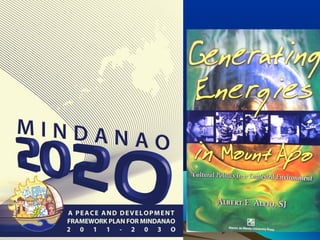
  • #12 GREETINGS/INTRODUCTION I am pleased to present to you today the M indanao 2020 Peace and Development Framework Plan. This is the result of a wide consultative process, crafted by Mindanawons, and done in partnership with CONFED, MLA, the regional development councils (RDCS) in mindanao, and the regional economic and development planning board (REDPB) of ARMM. This undertaking was also made possible with the assistance of a team of experts from Mindanao who helped us facilitate the process, led by no less than former neda director-general Dr. Cielito Habito. As a framework plan, it is not intended to be a detailed blueprint, but rather a guide that sets general directions.  As such, it should serve as basis for more detailed plans and budgets of shorter duration within its 20-year time frame.  It should also help guide more geographically specific (i.e., regional or local) and sector-level plans to ensure consistency and coherence within an overall and mindanao-wide perspective.  However,let me congratulate our resource speakers for coming to Davao and for committing themselves to this task of sharing their time and expertise (even in the midst of the yuletide season) as we try to achieve our goal of establishing Mindanao’s integrated multi-modal transport and logistics system.