Hand Tumours
Most common hand tumours
• 95% hand tumours comprised of:
  – Ganglion
  – Giant Cell Tumour of tendon sheath
  – Epidermoid Inclusion Cysts
  – Haemangioma
  – Lipoma
• Other tumours arise from bone & cartilage,
  muscle, nerve, skin & adnexae, subcutaneous
  tissue, tendon and synovium, vessel
Mankin’s Hand
       Tumour Axioms
•   Primary bone tumours are usually
    benign
•   The most common bone tumours are
    enchondroma and osteocartilaginous
    exostosis, except in distal phalanx which
    is epidermal inclusion cyst
•   Deep soft tissue tumours (other than
    ganglion, lipoma, GCT) are often
    malignant
•   Epithelioid sarcoma, synovial sarcoma
    and clear cell sarcoma are common
    malignancies in hand/forearm. They are
    highly malignant and may metastasize
    to lymph nodes
•   Synovial chrondromatosis, synovial
    sarcoma and liposarcoma may show
    calcification on radiology
•   Metastatic carcinoma, except lung,
    lymphoma and myeloma are rarely seen
    in the hand
•   Age
          •   Duration
History   •
          •
              Pain
              Neurological effects
          •   Nature of onset
          •   Variation in size
          •   Previous similar swellings
          •   Similar swellings elsewhere
          •   Symptoms related to other sites
Examination – S3, C2, M (NI)
•   Size
•   Site
•   Shape
•   Colour
•   Consistency
•   Mobility

• Nodes
• Imaging
Investigations
• Plain Xray
    –   Calcification
    –   Anatomical location
    –   Changes in bony architecture
    –   Response of host bone
    –   Internal contents
•   Xeroradiography
•   Bone scans, CT, MRI, Angiogram
•   CXR
•   FBC, EUC, U/A
    – Also ESR, BSL, CMP, LFT, TFT, PTH
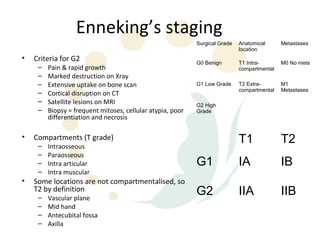
Enneking’s staging
                                                            Surgical Grade   Anatomical      Metastases
                                                                             location
•   Criteria for G2                                         G0 Benign        T1 Intra-       M0 No mets
     –   Pain & rapid growth                                                 compartmental
     –   Marked destruction on Xray
     –   Extensive uptake on bone scan                      G1 Low Grade     T2 Extra-       M1
                                                                             compartmental   Metastases
     –   Cortical disruption on CT
     –   Satellite lesions on MRI                           G2 High
     –   Biopsy = frequent mitoses, cellular atypia, poor   Grade
         differentiation and necrosis

•   Compartments (T grade)
     –   Intraosseous
                                                                             T1              T2
     –   Paraosseous
     –   Intra articular                                    G1               IA              IB
     –   Intra muscular
•   Some locations are not compartmentalised, so
    T2 by definition
     –   Vascular plane
                                                            G2               IIA             IIB
     –   Mid hand
     –   Antecubital fossa
     –   Axilla
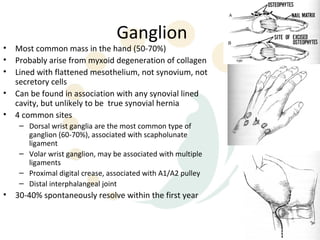
Ganglion
•   Most common mass in the hand (50-70%)
•   Probably arise from myxoid degeneration of collagen
•   Lined with flattened mesothelium, not synovium, not
    secretory cells
•   Can be found in association with any synovial lined
    cavity, but unlikely to be true synovial hernia
•   4 common sites
     – Dorsal wrist ganglia are the most common type of
       ganglion (60-70%), associated with scapholunate
       ligament
     – Volar wrist ganglion, may be associated with multiple
       ligaments
     – Proximal digital crease, associated with A1/A2 pulley
     – Distal interphalangeal joint
•   30-40% spontaneously resolve within the first year
Giant cell tumour of flexor sheath
• Second most common swelling in hand
• Arises in presence of synovial tissue (flexor
  sheath, IPJs)
• Usually asymptomatic
• Characteristic yellow brown colour from
  haemosiderin
• High recurrence rate due to perforations in
  macroscopic capsule
• Recurrence rates associated with multiple
  lesions, thumb lesions, presence of bony
  erosion, nm23 gene
Inclusion cyst
•   Minor skin wound drives basal skin cells
    beneath skin surface
•   Forms smooth, spherical tumour
    attached to skin but mobile over deep
    structures
•   Almost exclusively palmar surface, most
    common around fingertips and
    amputation stumps
•   Smooth lytic lesion, no calcification,
    mildly expansile, marginal sclerosis,
    cortex intact, no periosteal reaction
Glomus tumour
•   Benign growth of cells of normal glomus
    apparatus, an a-v anastomosis in dermis
    used to control skin circulation
•   Essentially a hamartoma
•   Triad of symptoms – paroxysmal pain, pin
    point tenderness (Love’s test) and
    temperature sensitivity to cold
•   Usually solitary, most commonly subungal
•   Presents due to symptoms rather than
    mass
•   Can precipitate pain with ethyl chloride
    spray
•   If found can be seen as a small purplish
    patch
•   MRI can detect 5mm lesions, U/S 2mm
Enchondroma
•   90% bone tumours of hand
•   35% enchondromas occur in hand
•   Benign hyaline cartilaginous growth within medullary
    cavity
•   Peaks in 3rd and 4th decades, M=F
•   May degenerate into chondrosarcoma (<1%) heralded
    by unremitting pain, rapid growth and cortical
    disruption
•   Painless swelling, often incidental finding or
    pathological fracture
•   Central, usually in tubular bones, lytic with
    calcifications, expansile, margins well defined, cortex
    intact but often very thin
•   Multiple enchondromatosis is found in Ollier’s disease
    and Maffuci syndrome
     – Rate of malignant degeneration is much higher, 30% in
       Ollier’s and up to 100% in Maffuci
Chondrosarcoma
•   Most common malignant primary bone
    tumour in hand (60%), but still rare hand
    swelling
•   25% arise secondary to degenerative change
    of multiple enchondromatosis
•   Peak incidence in 7th – 8th decades
•   Pain
•   Lies in subchondral bone, epiphyseal
    equivalent of tubular bones
•   Central, scattered lysis with punctate
    calcifications, no expansile, no marginal
    sclerosis, late cortical disruption
•   Associated soft tissue shadow with radiating
    spicules (flattened at ends unlike
    osteosarcoma), Codman’s triangle
•   Requires wide margins, no role for
    radiotherapy or chemotherapy
•   Histopath can be difficult
•   5 year survival 70%, 10 year survival 60-70%
Osteosarcoma
•   Heterogenous group of malignant neoplasms
•   Primary osteosarcoma peaks in 10-25yo,
    secondary (to Paget’s, radiation etc) peaks in 5th
    – 6th decades
•   Aching, constant pain, worse at night
•   Metaphyseal, destructive lytic lesion associated
    with widely variable amount of new bone
    formation
•   Cortical disruption, spiculation, Codman’s
    triangle
•   Skip lesions and metastases
•   Bone scan + MRI to define lesion and skip
    lesions
•   Staging Chest CT, and staging biopsy advisable
•   Poor prognosis, dependent on duration,
    location (proximal worse), size, histological
    grade and presence of metastases
     – 10 year survival up to 70%
Rhabdomyosarcoma
 •   Embryonal form peaks in infancy,
     adult form peaks in young adults
 •   Actively growing soft tissue
     masses
 •   Routine Xrays show spread to
     bone, but better assessed by
     bone scan
 •   MRI and angiogram are
     important investigations
 •   Radical extracompartmental
     excision
      – Later generations of
        chemotherapy and radiotherapy
        may allow some limb sparing
 •   5 year survival 50% embryonal,
     30% adult
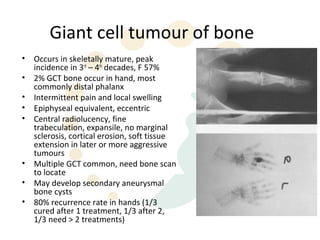
Giant cell tumour of bone
•   Occurs in skeletally mature, peak
    incidence in 3rd – 4th decades, F 57%
•   2% GCT bone occur in hand, most
    commonly distal phalanx
•   Intermittent pain and local swelling
•   Epiphyseal equivalent, eccentric
•   Central radiolucency, fine
    trabeculation, expansile, no marginal
    sclerosis, cortical erosion, soft tissue
    extension in later or more aggressive
    tumours
•   Multiple GCT common, need bone scan
    to locate
•   May develop secondary aneurysmal
    bone cysts
•   80% recurrence rate in hands (1/3
    cured after 1 treatment, 1/3 after 2,
    1/3 need > 2 treatments)

Hand tumoursw

  • 2.
  • 3.
    Most common handtumours • 95% hand tumours comprised of: – Ganglion – Giant Cell Tumour of tendon sheath – Epidermoid Inclusion Cysts – Haemangioma – Lipoma • Other tumours arise from bone & cartilage, muscle, nerve, skin & adnexae, subcutaneous tissue, tendon and synovium, vessel
  • 4.
    Mankin’s Hand Tumour Axioms • Primary bone tumours are usually benign • The most common bone tumours are enchondroma and osteocartilaginous exostosis, except in distal phalanx which is epidermal inclusion cyst • Deep soft tissue tumours (other than ganglion, lipoma, GCT) are often malignant • Epithelioid sarcoma, synovial sarcoma and clear cell sarcoma are common malignancies in hand/forearm. They are highly malignant and may metastasize to lymph nodes • Synovial chrondromatosis, synovial sarcoma and liposarcoma may show calcification on radiology • Metastatic carcinoma, except lung, lymphoma and myeloma are rarely seen in the hand
  • 5.
    Age • Duration History • • Pain Neurological effects • Nature of onset • Variation in size • Previous similar swellings • Similar swellings elsewhere • Symptoms related to other sites
  • 6.
    Examination – S3,C2, M (NI) • Size • Site • Shape • Colour • Consistency • Mobility • Nodes • Imaging
  • 7.
    Investigations • Plain Xray – Calcification – Anatomical location – Changes in bony architecture – Response of host bone – Internal contents • Xeroradiography • Bone scans, CT, MRI, Angiogram • CXR • FBC, EUC, U/A – Also ESR, BSL, CMP, LFT, TFT, PTH
  • 8.
    Enneking’s staging Surgical Grade Anatomical Metastases location • Criteria for G2 G0 Benign T1 Intra- M0 No mets – Pain & rapid growth compartmental – Marked destruction on Xray – Extensive uptake on bone scan G1 Low Grade T2 Extra- M1 compartmental Metastases – Cortical disruption on CT – Satellite lesions on MRI G2 High – Biopsy = frequent mitoses, cellular atypia, poor Grade differentiation and necrosis • Compartments (T grade) – Intraosseous T1 T2 – Paraosseous – Intra articular G1 IA IB – Intra muscular • Some locations are not compartmentalised, so T2 by definition – Vascular plane G2 IIA IIB – Mid hand – Antecubital fossa – Axilla
  • 9.
    Ganglion • Most common mass in the hand (50-70%) • Probably arise from myxoid degeneration of collagen • Lined with flattened mesothelium, not synovium, not secretory cells • Can be found in association with any synovial lined cavity, but unlikely to be true synovial hernia • 4 common sites – Dorsal wrist ganglia are the most common type of ganglion (60-70%), associated with scapholunate ligament – Volar wrist ganglion, may be associated with multiple ligaments – Proximal digital crease, associated with A1/A2 pulley – Distal interphalangeal joint • 30-40% spontaneously resolve within the first year
  • 10.
    Giant cell tumourof flexor sheath • Second most common swelling in hand • Arises in presence of synovial tissue (flexor sheath, IPJs) • Usually asymptomatic • Characteristic yellow brown colour from haemosiderin • High recurrence rate due to perforations in macroscopic capsule • Recurrence rates associated with multiple lesions, thumb lesions, presence of bony erosion, nm23 gene
  • 11.
    Inclusion cyst • Minor skin wound drives basal skin cells beneath skin surface • Forms smooth, spherical tumour attached to skin but mobile over deep structures • Almost exclusively palmar surface, most common around fingertips and amputation stumps • Smooth lytic lesion, no calcification, mildly expansile, marginal sclerosis, cortex intact, no periosteal reaction
  • 12.
    Glomus tumour • Benign growth of cells of normal glomus apparatus, an a-v anastomosis in dermis used to control skin circulation • Essentially a hamartoma • Triad of symptoms – paroxysmal pain, pin point tenderness (Love’s test) and temperature sensitivity to cold • Usually solitary, most commonly subungal • Presents due to symptoms rather than mass • Can precipitate pain with ethyl chloride spray • If found can be seen as a small purplish patch • MRI can detect 5mm lesions, U/S 2mm
  • 13.
    Enchondroma • 90% bone tumours of hand • 35% enchondromas occur in hand • Benign hyaline cartilaginous growth within medullary cavity • Peaks in 3rd and 4th decades, M=F • May degenerate into chondrosarcoma (<1%) heralded by unremitting pain, rapid growth and cortical disruption • Painless swelling, often incidental finding or pathological fracture • Central, usually in tubular bones, lytic with calcifications, expansile, margins well defined, cortex intact but often very thin • Multiple enchondromatosis is found in Ollier’s disease and Maffuci syndrome – Rate of malignant degeneration is much higher, 30% in Ollier’s and up to 100% in Maffuci
  • 14.
    Chondrosarcoma • Most common malignant primary bone tumour in hand (60%), but still rare hand swelling • 25% arise secondary to degenerative change of multiple enchondromatosis • Peak incidence in 7th – 8th decades • Pain • Lies in subchondral bone, epiphyseal equivalent of tubular bones • Central, scattered lysis with punctate calcifications, no expansile, no marginal sclerosis, late cortical disruption • Associated soft tissue shadow with radiating spicules (flattened at ends unlike osteosarcoma), Codman’s triangle • Requires wide margins, no role for radiotherapy or chemotherapy • Histopath can be difficult • 5 year survival 70%, 10 year survival 60-70%
  • 15.
    Osteosarcoma • Heterogenous group of malignant neoplasms • Primary osteosarcoma peaks in 10-25yo, secondary (to Paget’s, radiation etc) peaks in 5th – 6th decades • Aching, constant pain, worse at night • Metaphyseal, destructive lytic lesion associated with widely variable amount of new bone formation • Cortical disruption, spiculation, Codman’s triangle • Skip lesions and metastases • Bone scan + MRI to define lesion and skip lesions • Staging Chest CT, and staging biopsy advisable • Poor prognosis, dependent on duration, location (proximal worse), size, histological grade and presence of metastases – 10 year survival up to 70%
  • 16.
    Rhabdomyosarcoma • Embryonal form peaks in infancy, adult form peaks in young adults • Actively growing soft tissue masses • Routine Xrays show spread to bone, but better assessed by bone scan • MRI and angiogram are important investigations • Radical extracompartmental excision – Later generations of chemotherapy and radiotherapy may allow some limb sparing • 5 year survival 50% embryonal, 30% adult
  • 17.
    Giant cell tumourof bone • Occurs in skeletally mature, peak incidence in 3rd – 4th decades, F 57% • 2% GCT bone occur in hand, most commonly distal phalanx • Intermittent pain and local swelling • Epiphyseal equivalent, eccentric • Central radiolucency, fine trabeculation, expansile, no marginal sclerosis, cortical erosion, soft tissue extension in later or more aggressive tumours • Multiple GCT common, need bone scan to locate • May develop secondary aneurysmal bone cysts • 80% recurrence rate in hands (1/3 cured after 1 treatment, 1/3 after 2, 1/3 need > 2 treatments)