OSTEOID OSTEOMA


19 Yr old male with
pain in in the dorsal
aspect of the medial
 aspect of left mid
 foot . o/e there is
    pain over the       FREE LANCE RADIOLOGY
mentioned part of the     Basic approach for
   left mid foot .           continuation of
                          Diagnostic Radiology
                                education
General considerations/ Incidence /Clinical features


       •   :


• First described by Henry jaffe ( 1925). Not accepted for several
  decades and was considered as variant of osteomyelitis .
• 2.6% of all excised bone tumors and 11 % of all benign bone
  tumors .
• Young patients ( 10 to 25 years) . youngest patient reported
  was 8 month old patient with lesion in tibia . Male : female
  ratio is 2:1 .
• Clinical profile :
       • Pain +_ vasomotor disturbance ( profuse sweating / increased
         skin temperature) . Classical description is of gradual onset of
         increasingly deep / severe / aching pain ( 65% will have night
         pain relieved by aspirin) . CAN BE CONFUSED WITH : septic
         arthritis , inflammatory , rheumatoid arthritis so patient may
         end up with rheumatology opinion.
General considerations /Incidence
           /Clinical features
• Localized swelling ,point tenderness , limitation of the
  motion, painful limp, stiffness , weakness of nearby
  joint , muscle atrophy may be noted. Painful scoliosis
  (lesion located in the concave side of the curve in
  thoracic / lumbar spine) . In cervical spine : torticollis /
  secondary contracture of the sternocleidomastoid
  muscle may be noted .Lesion in the spinous processs
  lead to localized pain and spinal stiffness .
• 50% occur in proximal femur / tibia ( predilection for
  upper end of the femur , particularly the neck /
  trochanteric region) .In spine : most of the lesions are
  in neural arch .
Pathological features /Radiologic features/Differential
          diagnosis /Treatment and prognosis:

• Lesion : Nidus ( reddish brown vascularised tumor <= 10mm) .
  Significant reactive sclerosis with cortical thickening / solid periosteal
  reaction encasing the nidus . Nidus is initially uncalcified and with
  maturity speck of calcification is seen in it . Bone expansion may be
  noted at the lesion site .
• Three anatomic locations of the osteoid osteoma :
  Cortical ( most common)
  ,                                                 Cancellous (
  intramedullary )
  Subperiosteal . Histological and radiological appearance varies .
• Well developed lesion has lucent nidus with surrounding florid perifocal
  reactive sclerosis/appositional periosteal new bone formation ( typical
  of cortically placed osteoid osteoma ).The sclerosis is maximally seen
  caudal to the nidus . Nidus size is, <=1cm in diameter . Single
  roengenographic view may not be sufficient to demonstrate the nidus
  . central fleck of calcification is seen in the nidus with maturity .
• Intramedullary lesion that are intracapsular provoke much less reactive
  sclerosis because of low rate of bone production from intracapsular
Pathological features /Radiologic features/Differential
        diagnosis /Treatment and prognosis:

• Spinal osteoma’s are elusive lesions . lumbosacral strain
  , psychogenic back pain , cervical strain , herniated nucleus
  pulposus , biomechanical back pain are frequent prior
  diagnosis .Most spinal lesions are seen in the neural arch .
  Reactive sclerosis may give appearance of dense ivory pedicle
  or lamina . This appearance must be differentiated from
  stress response opposite a unilateral spondylosis,congenital
  agenesis of the contralateral pedicle , osteoblastoma
  , osteoblastic metastatic carcinoma .
• Angiography shows vascular blush in the arterial phase persisting late into
  the venous phase. This definitely differentiates the osteoid osteoma from
  brodies abscess which shows no such vascular blush in it’s necrotic cavity .
  On bone scan there is regional increase in the uptake ( double density
   sign)
D/D AND TREATMENT
• D/D :
   – Garre’s chronic sclerosing osteomyelitis : This entity has
     been disregarded as singular / distinct disease process.
   – Brodies abscess : Lucent nidus in brodies abscess is >1cm
     often close to 2 cm ).Halo rim of sclerosis surrounding the
     nidus is more thick / irregular . Vascular blush seen in the
     angiographic phase in the osteoidosteoma is absent in the
     necrotic core of the osteoid osteoma . Note :Night pain
     relieved by aspirin is seen in brodies abscess and osteoid
     osteoma .
   – Stress fracture : lesion may mimic osteoid osteoma .
     Sequential studies over time and images usually
     demonstrate the healing of the fracture .
D/D AND TREATMENT
• T/T :
     1. Natural history of the disease is self limiting .
     2. Radiotherapy / thermocoagulation
     3. Wide enbloc excision of the nidus and
        sclerotic bone. (surgery may be delayed
        unless nidus of adequate size is seen) .
     4. Recurrence is rare.
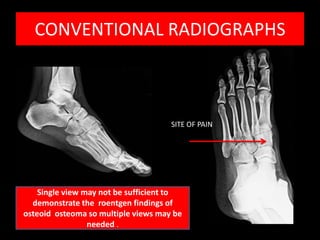
CONVENTIONAL RADIOGRAPHS


                                     SITE OF PAIN


    Single view may not be sufficient to
  demonstrate the roentgen findings of
osteoid osteoma so multiple views may be
                 needed .
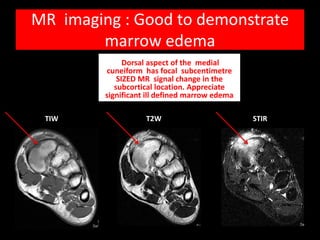
MR imaging : Good to demonstrate
        marrow edema
               Dorsal aspect of the medial
         cuneiform has focal subcentimetre
             SIZED MR signal change in the
            subcortical location. Appreciate
         significant ill defined marrow edema

 TIW                T2W                         STIR
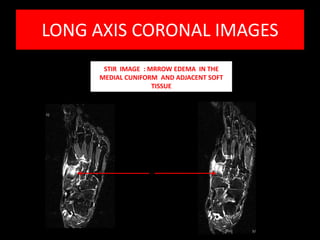
LONG AXIS CORONAL IMAGES
      STIR IMAGE : MRROW EDEMA IN THE
     MEDIAL CUNIFORM AND ADJACENT SOFT
                    TISSUE
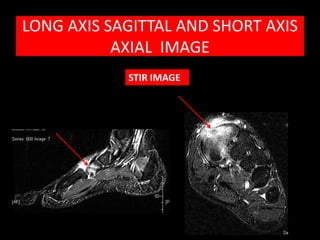
LONG AXIS SAGITTAL AND SHORT AXIS
           AXIAL IMAGE
            STIR IMAGE
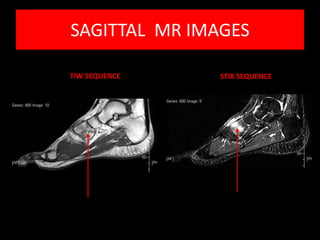
SAGITTAL MR IMAGES

TIW SEQUENCE   STIR SEQUENCE
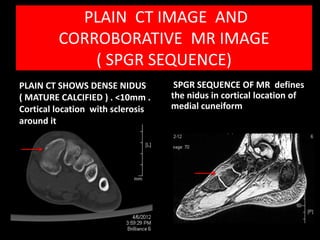
PLAIN CT IMAGE AND
         CORROBORATIVE MR IMAGE
             ( SPGR SEQUENCE)
PLAIN CT SHOWS DENSE NIDUS          SPGR SEQUENCE OF MR defines
( MATURE CALCIFIED ) . <10mm .     the nidus in cortical location of
Cortical location with sclerosis   medial cuneiform
around it
CARRY HOME MESSAGE
1. HISTORY ( pain worse at night )
2. CLINICAL EXAMINATION
3. CONVENTIONAL RADIOGRAPH
   ( multiple views)
4. CT ( for nidus)
5. MRI ( for marrow edema)
6. ANGIOGRAM ( to differentiate from brodies
   abscess)
  All these modalities play important role to
      define the fetaures of osteoid osteoma

Osteoid osteoma

  • 1.
    OSTEOID OSTEOMA 19 Yrold male with pain in in the dorsal aspect of the medial aspect of left mid foot . o/e there is pain over the FREE LANCE RADIOLOGY mentioned part of the Basic approach for left mid foot . continuation of Diagnostic Radiology education
  • 2.
    General considerations/ Incidence/Clinical features • : • First described by Henry jaffe ( 1925). Not accepted for several decades and was considered as variant of osteomyelitis . • 2.6% of all excised bone tumors and 11 % of all benign bone tumors . • Young patients ( 10 to 25 years) . youngest patient reported was 8 month old patient with lesion in tibia . Male : female ratio is 2:1 . • Clinical profile : • Pain +_ vasomotor disturbance ( profuse sweating / increased skin temperature) . Classical description is of gradual onset of increasingly deep / severe / aching pain ( 65% will have night pain relieved by aspirin) . CAN BE CONFUSED WITH : septic arthritis , inflammatory , rheumatoid arthritis so patient may end up with rheumatology opinion.
  • 3.
    General considerations /Incidence /Clinical features • Localized swelling ,point tenderness , limitation of the motion, painful limp, stiffness , weakness of nearby joint , muscle atrophy may be noted. Painful scoliosis (lesion located in the concave side of the curve in thoracic / lumbar spine) . In cervical spine : torticollis / secondary contracture of the sternocleidomastoid muscle may be noted .Lesion in the spinous processs lead to localized pain and spinal stiffness . • 50% occur in proximal femur / tibia ( predilection for upper end of the femur , particularly the neck / trochanteric region) .In spine : most of the lesions are in neural arch .
  • 4.
    Pathological features /Radiologicfeatures/Differential diagnosis /Treatment and prognosis: • Lesion : Nidus ( reddish brown vascularised tumor <= 10mm) . Significant reactive sclerosis with cortical thickening / solid periosteal reaction encasing the nidus . Nidus is initially uncalcified and with maturity speck of calcification is seen in it . Bone expansion may be noted at the lesion site . • Three anatomic locations of the osteoid osteoma : Cortical ( most common) , Cancellous ( intramedullary ) Subperiosteal . Histological and radiological appearance varies . • Well developed lesion has lucent nidus with surrounding florid perifocal reactive sclerosis/appositional periosteal new bone formation ( typical of cortically placed osteoid osteoma ).The sclerosis is maximally seen caudal to the nidus . Nidus size is, <=1cm in diameter . Single roengenographic view may not be sufficient to demonstrate the nidus . central fleck of calcification is seen in the nidus with maturity . • Intramedullary lesion that are intracapsular provoke much less reactive sclerosis because of low rate of bone production from intracapsular
  • 5.
    Pathological features /Radiologicfeatures/Differential diagnosis /Treatment and prognosis: • Spinal osteoma’s are elusive lesions . lumbosacral strain , psychogenic back pain , cervical strain , herniated nucleus pulposus , biomechanical back pain are frequent prior diagnosis .Most spinal lesions are seen in the neural arch . Reactive sclerosis may give appearance of dense ivory pedicle or lamina . This appearance must be differentiated from stress response opposite a unilateral spondylosis,congenital agenesis of the contralateral pedicle , osteoblastoma , osteoblastic metastatic carcinoma . • Angiography shows vascular blush in the arterial phase persisting late into the venous phase. This definitely differentiates the osteoid osteoma from brodies abscess which shows no such vascular blush in it’s necrotic cavity . On bone scan there is regional increase in the uptake ( double density sign)
  • 6.
    D/D AND TREATMENT •D/D : – Garre’s chronic sclerosing osteomyelitis : This entity has been disregarded as singular / distinct disease process. – Brodies abscess : Lucent nidus in brodies abscess is >1cm often close to 2 cm ).Halo rim of sclerosis surrounding the nidus is more thick / irregular . Vascular blush seen in the angiographic phase in the osteoidosteoma is absent in the necrotic core of the osteoid osteoma . Note :Night pain relieved by aspirin is seen in brodies abscess and osteoid osteoma . – Stress fracture : lesion may mimic osteoid osteoma . Sequential studies over time and images usually demonstrate the healing of the fracture .
  • 7.
    D/D AND TREATMENT •T/T : 1. Natural history of the disease is self limiting . 2. Radiotherapy / thermocoagulation 3. Wide enbloc excision of the nidus and sclerotic bone. (surgery may be delayed unless nidus of adequate size is seen) . 4. Recurrence is rare.
  • 8.
    CONVENTIONAL RADIOGRAPHS SITE OF PAIN Single view may not be sufficient to demonstrate the roentgen findings of osteoid osteoma so multiple views may be needed .
  • 9.
    MR imaging :Good to demonstrate marrow edema Dorsal aspect of the medial cuneiform has focal subcentimetre SIZED MR signal change in the subcortical location. Appreciate significant ill defined marrow edema TIW T2W STIR
  • 10.
    LONG AXIS CORONALIMAGES STIR IMAGE : MRROW EDEMA IN THE MEDIAL CUNIFORM AND ADJACENT SOFT TISSUE
  • 11.
    LONG AXIS SAGITTALAND SHORT AXIS AXIAL IMAGE STIR IMAGE
  • 12.
    SAGITTAL MR IMAGES TIWSEQUENCE STIR SEQUENCE
  • 13.
    PLAIN CT IMAGEAND CORROBORATIVE MR IMAGE ( SPGR SEQUENCE) PLAIN CT SHOWS DENSE NIDUS SPGR SEQUENCE OF MR defines ( MATURE CALCIFIED ) . <10mm . the nidus in cortical location of Cortical location with sclerosis medial cuneiform around it
  • 14.
    CARRY HOME MESSAGE 1.HISTORY ( pain worse at night ) 2. CLINICAL EXAMINATION 3. CONVENTIONAL RADIOGRAPH ( multiple views) 4. CT ( for nidus) 5. MRI ( for marrow edema) 6. ANGIOGRAM ( to differentiate from brodies abscess) All these modalities play important role to define the fetaures of osteoid osteoma