

Tackling Bifurcations: What Can and
Cannot Be Done
Alaide Chieffo, MD
San Raffaele Scientific Institute,
Milan, Italy
Nothing to disclose related to this
presentation
• It is current practise in our center to
select radial access as the access of
choice even in complex cases and
bifurcations.
• However there is still a 5-10% of
procedures performed through
femoral access.
• Most of the bifurcation lesions are
currently treated through radial access,
both provisional or 2 stent techniques
• However, we still perform femoral access
in case of a not optimal back up or need for
simultaneous implantation of 2 stents or
trifurcations
What We Do through a Radial Access
1. Bifurcations with Provisional Approach
• 82 yrs, female, dyslipidemia, hypertensive,
prior smoker, PVD
• Recent history of GI bleeding
• Euroscore 15
• Presenting with NSTEMI
• At echo in ER LVEF 25%
• Preloaded with clopidrogel+ASA
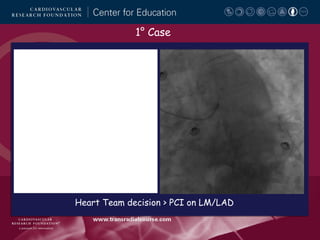
1° Case

Heart Team decision > PCI on LM/LAD
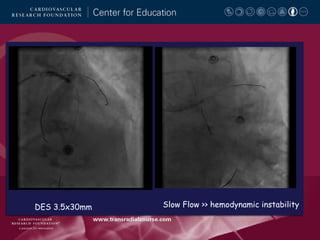
DES 3.5x30mm

Slow Flow >> hemodynamic instability
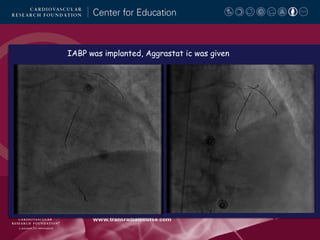
IABP was implanted, Aggrastat ic was given
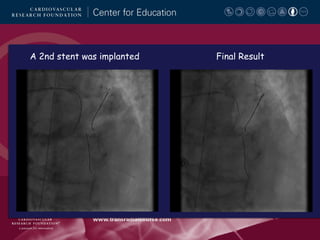
A 2nd stent was implanted

Final Result
What We Do through Radial Access
2. Bifurcation with 2 stent technique
• 78 yrs, male, hypertensive
• Prior (2003) PCI with stent on LAD and
diagonal on LAD> NSTEMI on 2010
• Euroscore 5
• Positive Scintigraphy in inferolateral wall and
pt symptomatyc for angina CCS 2.
PP

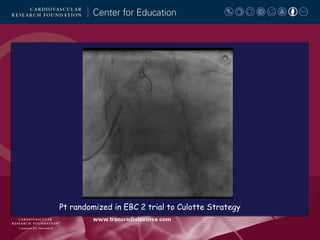
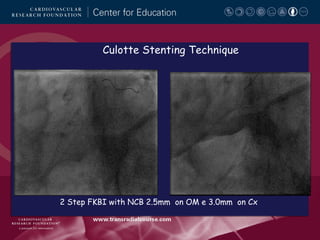
Pt randomized in EBC 2 trial to Culotte Strategy
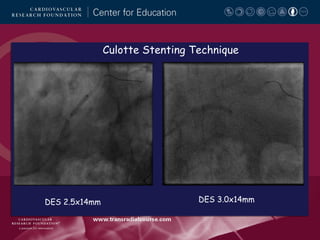
Culotte Stenting Technique

DES 2.5x14mm

DES 3.0x14mm
Culotte Stenting Technique

2 Step FKBI with NCB 2.5mm on OM e 3.0mm on Cx
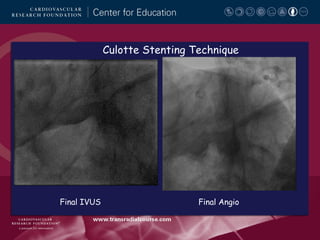
Culotte Stenting Technique

Final IVUS

Final Angio
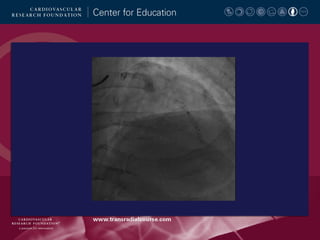
• 58 yrs, male, dislipidemia, hypertensive,
positive family history for CAD
• Prior multiple PCI with DES on LAD and OM>>
pt strongly refused CABG
• Euroscore 2
• Pt asymptomatic but at 2 year fup coronary
CT scan : occlusion of LAD mid
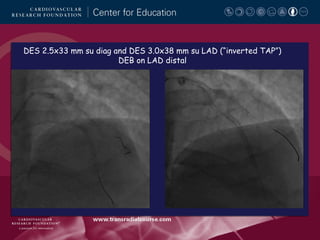
DES 2.5x33 mm su diag and DES 3.0x38 mm su LAD (“inverted TAP”)
DEB on LAD distal
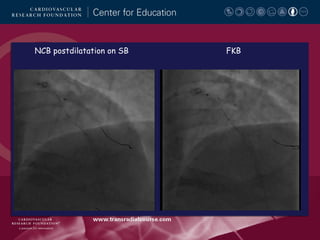
NCB postdilatation on SB

FKB
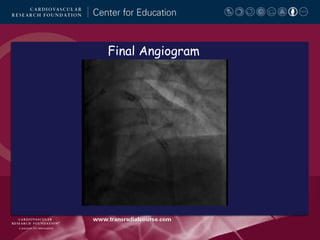
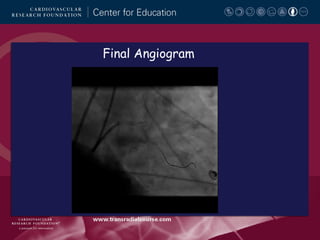
Final Angiogram
• Cross Over Radial to Femoral.. Bad
Back up
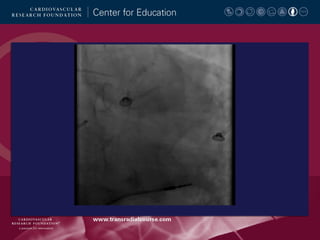
• 85 yrs, male, dislipidemia, hypertensive, prior
TIA
• Recent history of GI bleeding, baseline Hb
9.5 mg dL
• Euroscore 12
• Presenting with NSTEMI
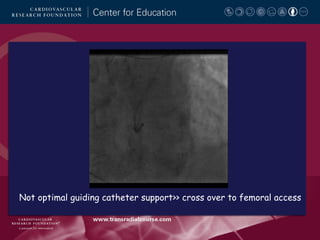
Not optimal guiding catheter support>> cross over to femoral access
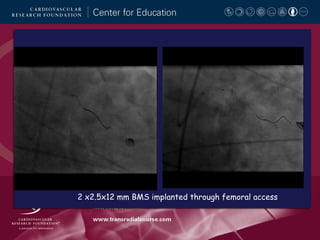
2 x2.5x12 mm BMS implanted through femoral access
Final Angiogram
Conclusions
• Most of bifurcation lesions can be
safely done through radial access
either with provisional or 2 stent
technique approach
• Consider femoral approach in case of
not optimal guiding catheter support
or bad back up or in case of
simultaneous 2 stent implantation
needed (conventional minicrush or V
stenting)

Chieffo A - Tackling bifurcations

  • 1.
    Tackling Bifurcations: WhatCan and Cannot Be Done Alaide Chieffo, MD San Raffaele Scientific Institute, Milan, Italy
  • 2.
    Nothing to discloserelated to this presentation
  • 3.
    • It iscurrent practise in our center to select radial access as the access of choice even in complex cases and bifurcations. • However there is still a 5-10% of procedures performed through femoral access.
  • 4.
    • Most ofthe bifurcation lesions are currently treated through radial access, both provisional or 2 stent techniques • However, we still perform femoral access in case of a not optimal back up or need for simultaneous implantation of 2 stents or trifurcations
  • 5.
    What We Dothrough a Radial Access 1. Bifurcations with Provisional Approach
  • 6.
    • 82 yrs,female, dyslipidemia, hypertensive, prior smoker, PVD • Recent history of GI bleeding • Euroscore 15 • Presenting with NSTEMI • At echo in ER LVEF 25% • Preloaded with clopidrogel+ASA
  • 7.
    1° Case Heart Teamdecision > PCI on LM/LAD
  • 8.
    DES 3.5x30mm Slow Flow>> hemodynamic instability
  • 9.
    IABP was implanted,Aggrastat ic was given
  • 10.
    A 2nd stentwas implanted Final Result
  • 11.
    What We Dothrough Radial Access 2. Bifurcation with 2 stent technique
  • 12.
    • 78 yrs,male, hypertensive • Prior (2003) PCI with stent on LAD and diagonal on LAD> NSTEMI on 2010 • Euroscore 5 • Positive Scintigraphy in inferolateral wall and pt symptomatyc for angina CCS 2.
  • 13.
    PP Pt randomized inEBC 2 trial to Culotte Strategy
  • 14.
    Culotte Stenting Technique DES2.5x14mm DES 3.0x14mm
  • 15.
    Culotte Stenting Technique 2Step FKBI with NCB 2.5mm on OM e 3.0mm on Cx
  • 16.
  • 17.
    • 58 yrs,male, dislipidemia, hypertensive, positive family history for CAD • Prior multiple PCI with DES on LAD and OM>> pt strongly refused CABG • Euroscore 2 • Pt asymptomatic but at 2 year fup coronary CT scan : occlusion of LAD mid
  • 19.
    DES 2.5x33 mmsu diag and DES 3.0x38 mm su LAD (“inverted TAP”) DEB on LAD distal
  • 20.
  • 21.
  • 22.
    • Cross OverRadial to Femoral.. Bad Back up
  • 23.
    • 85 yrs,male, dislipidemia, hypertensive, prior TIA • Recent history of GI bleeding, baseline Hb 9.5 mg dL • Euroscore 12 • Presenting with NSTEMI
  • 25.
    Not optimal guidingcatheter support>> cross over to femoral access
  • 26.
    2 x2.5x12 mmBMS implanted through femoral access
  • 27.
  • 28.
    Conclusions • Most ofbifurcation lesions can be safely done through radial access either with provisional or 2 stent technique approach • Consider femoral approach in case of not optimal guiding catheter support or bad back up or in case of simultaneous 2 stent implantation needed (conventional minicrush or V stenting)