 Name : Upadhyay Devangana s.

 Paper : literary theory & Criticism
 M.A Sem-1 /Roll No-07
 Guide : Dr. Dilip barad
 Submitted to : M.K. Bhavnagar University
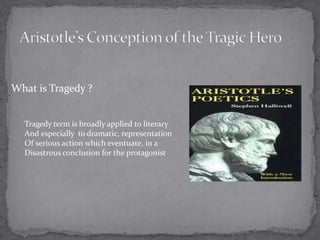
What is Tragedy ?
Tragedy term is broadly applied to literary
And especially to dramatic, representation
Of serious action which eventuate, in a
Disastrous conclusion for the protagonist
 What is Tragic Hero?

Accordingly, Aristotle says that the Tragic Hero
Will most effectively evoke both our pity and terror
if he is neither thoroughly good nor thoroughly
bad but a mixture of both
 An Aristotelian tragic hero must have four







characteristics:
Nobleness (of a noble birth) or wisdom (by virtue of
birth).
Hamartia (translated as tragic flaw, somewhat related
to hubris, but denoting excess in behavior or
mistakes).
A reversal of fortune (peripetia) brought about
because of the hero's tragic error.
The discovery or recognition that the reversal was
brought about by the hero's own actions
 Some other common traits characteristic of a tragic

hero:
 Hero must suffer more than he deserves.
 Hero must be noble in nature, but imperfect so that
the Hero must have discovered his fate by his own
actions, not by things happening to himaudience can
see themselves in him
 Hero must see and understand his doom, as well as the







fact that his fate was discovered by his own actions.
Hero's story should arouse fear and empathy.
Hero must be physically or spiritually wounded by his
experiences, often resulting in his death.
Ideally, the hero should be a king or leader of men, so
that his people experience his fall with him
The hero must be intelligent so he may learn from his
mistakes.
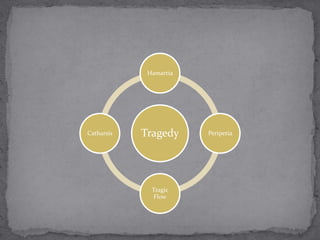
Hamartia

Catharsis

Tragedy

Tragic
Flow

Peripetia
 Aristotle'[s view on Tragic Hero

Aristotle'[s view on Tragic Hero

  • 1.
     Name :Upadhyay Devangana s.  Paper : literary theory & Criticism  M.A Sem-1 /Roll No-07  Guide : Dr. Dilip barad  Submitted to : M.K. Bhavnagar University
  • 2.
    What is Tragedy? Tragedy term is broadly applied to literary And especially to dramatic, representation Of serious action which eventuate, in a Disastrous conclusion for the protagonist
  • 3.
     What isTragic Hero? Accordingly, Aristotle says that the Tragic Hero Will most effectively evoke both our pity and terror if he is neither thoroughly good nor thoroughly bad but a mixture of both
  • 4.
     An Aristoteliantragic hero must have four     characteristics: Nobleness (of a noble birth) or wisdom (by virtue of birth). Hamartia (translated as tragic flaw, somewhat related to hubris, but denoting excess in behavior or mistakes). A reversal of fortune (peripetia) brought about because of the hero's tragic error. The discovery or recognition that the reversal was brought about by the hero's own actions
  • 5.
     Some othercommon traits characteristic of a tragic hero:  Hero must suffer more than he deserves.  Hero must be noble in nature, but imperfect so that the Hero must have discovered his fate by his own actions, not by things happening to himaudience can see themselves in him
  • 6.
     Hero mustsee and understand his doom, as well as the      fact that his fate was discovered by his own actions. Hero's story should arouse fear and empathy. Hero must be physically or spiritually wounded by his experiences, often resulting in his death. Ideally, the hero should be a king or leader of men, so that his people experience his fall with him The hero must be intelligent so he may learn from his mistakes.
  • 7.