Teaching Social Studies
(Araling Panlipunan)
in
Elementary Grades
•The Nature of Araling
Panlipunan
• Araling Panlipunan (Social Studies) is
a subject that helps students acquire
and learn knowledge, skills and values
that will prepare them to be competent
and responsible citizens throughout
their lives.
BATAYAN NG K to 12 AP KURIKULUM
( k to 12 Gabay Pangkurikulum sa AP:
Dec.,2013)
• Naging batayan ng K to 12 Araling
Pnlipunan Kurikulum ang “Edukasyon
para sa lahat 2015” (Education for all
2015) at ang K to 12 Philippine Basic
Education Curriculum Framework.
Layon ng mga ito na magkaroon ng
mga kinakailangan sa siglo 21
upang makalinang ng “functionally
literate and developed Filipino.”
Nilalayon na makalinang ng
kabataan na may tiyak na
pagkakakilanlan at papel bilang
Pilipinong lumalahok sa buhay
ng lipunan, bansa at daigdig.
Kasabay ng paglinang ng identidad at
kakayanang pansibiko ay ang pag-
unawa sa nakaraan at kasalukuyan at sa
ugnayan sa loob ng lipunan, at
kalikasan , at sa mundo, kung paano
nagbago at nagbabago ang mga ito,
upang makahubog ng indibidwal at
kolektibong kinabukasan.
Mga Kakayahan sa Bagong AP Kurikulum
1. Pagsisiyasat
2. Pagsusuri at interpretasyon ng datos
3. Pagsusuri at interpretasyon ng impormasyon
4. Pagsasaliksik
5. Komunikasyon
6. Pagtupad sa pamantayang pang- etika
•Content of K to 12
Araling Panlipunan
•Core Area Standard
• Naipamamalas ang mga pag-unawa sa
mga konsepto at isyung
pangkasaysayan, Pangheograpiya,
Pang- ekonomiya, pangkultura,
pampamahalaan, pansibiko, at
panlipunan gamit ang mga kasanayang
nalinang sa pag-aaral ng iba’t ibang
disiplina at larangan ng araling
panlipunan
• Kabilang ang pananaliksik ,
pagsisiyasat, mapanuring pag-iisip,
matalinong pagpapasiya,
pagkamalikhain, pakikipagkapwa,
likas-kayang paggamit ng
pinagkukunang yaman,
pakikipagtalastasan, at pagpapalawak
ng pandaigdig na pananaw
• Upang maging mapanuri,
mapagnilay, mapanagutan,
produktibo, makakalikasan,
makabansa at makatao na papanday
sa kinabukasan ng mamayan ng
bansa at daigdig.
•LEARNING
STRATEGIES
•The foregoing strategies are
suggested for teaching
Araling Panlipunan.
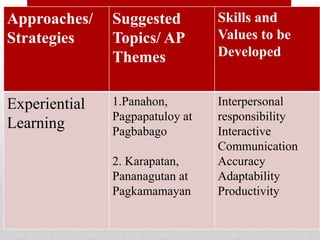
1. Experiential Learning
• Is a process through which learners
develop knowledge, skills and value
from direct experiences. It helps to
motivate learners because it involves
them more deeply in the learning
process.
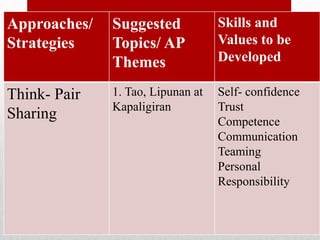
2. Think-pair sharing
• Is a strategy where learners pair
up and discuss the topic by giving
their own ideas and resolve issues.
3. Role Playing
• Provides the learners the opportunity
to feel the real situation to a given
event or circumstance. It develops the
feeling of understanding and empathy
which could possibly prepare them
both cognitive and affective learning.
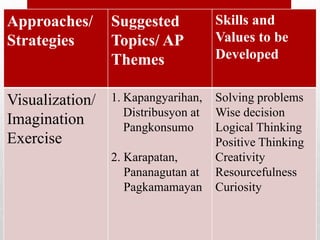
4. Visualization/
Imagination Exercise
• Is a mental technique where learners
use their imaginations to visualize
and create images. It arouses
learners’ mental and emotional being
for it gives them the chance to feel
that they are part particular event.
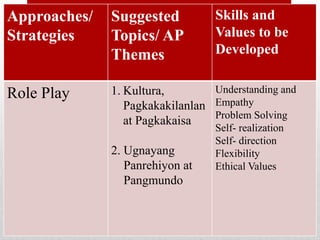
Approaches/
Strategies
Suggested
Topics/ AP
Themes
Skills and
Values to be
Developed
Role Play 1. Kultura,
Pagkakakilanlan
at Pagkakaisa
2. Ugnayang
Panrehiyon at
Pangmundo
Understanding and
Empathy
Problem Solving
Self- realization
Self- direction
Flexibility
Ethical Values
Approaches/
Strategies
Suggested
Topics/ AP
Themes
Skills and
Values to be
Developed
Visualization/
Imagination
Exercise
1. Kapangyarihan,
Distribusyon at
Pangkonsumo
2. Karapatan,
Pananagutan at
Pagkamamayan
Solving problems
Wise decision
Logical Thinking
Positive Thinking
Creativity
Resourcefulness
Curiosity
Approaches/
Strategies
Suggested
Topics/ AP
Themes
Skills and
Values to be
Developed
Think- Pair
Sharing
1. Tao, Lipunan at
Kapaligiran
Self- confidence
Trust
Competence
Communication
Teaming
Personal
Responsibility
Approaches/
Strategies
Suggested
Topics/ AP
Themes
Skills and
Values to be
Developed
Experiential
Learning
1.Panahon,
Pagpapatuloy at
Pagbabago
2. Karapatan,
Pananagutan at
Pagkamamayan
Interpersonal
responsibility
Interactive
Communication
Accuracy
Adaptability
Productivity
• ASSESSMENT TECHNIQUES
1. Performance
Assessment
• This requires learners perform a
task using their own creativity and
critical mind.
2. Authentic Assessment
• This aims to evaluate learners’
abilities in “real- world” context. It
focuses on their ability to integrate
what they-have learned. It can also be
used to solve problems that have real-
world applications
3. Graphic Organizers
• These are visual symbols to express
knowledge, concept or idea to
demonstrate relationship between
facts. These help learners organize
their ideas and to communicate them
through concept mapping.
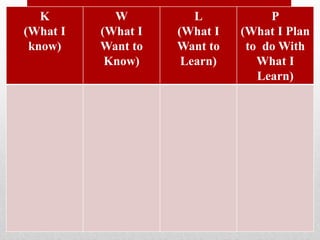
• Example: KWLP matrix
K
(What I
know)
W
(What I
Want to
Know)
L
(What I
Want to
Learn)
P
(What I Plan
to do With
What I
Learn)
4. Journal Writing
• Learners write their insights, reflections
and reactions to what have been taken
during the learning instruction. This can
be used by the teacher to achieve
specific goal on enhancing the learners’
skills of reflective inquiry.
5. Portfolio Assessment
• This contains sample of students work
and related materials on their activities,
accomplishments and achievements. It
can be used in measuring performance
based on students’ work.
6. Rubrics
• It is a tool that represents the
performance expectations for an
assignment or work. This can also be
utilized in the assessment of
performance objective.
• Selecting Appropriate
Instructional Materials for AP
• Criteria that can be used in
Selection and Preparation of
Instructional Materials
1. Authenticity
• Establishes genuine information to
develop critical thinking and
critical analysis.
2. Appropriateness
• Represents suitable or proper
point of views about the lesson
objectives.
3. Interest
• Able to arouse and sustain
learners’ interest.
4. Cost
• Less expense of money, time and
effort.
• Araling Panlipunan teachers are
encouraged to use audio-visual and
computer based instructional materials
in presenting lesson.
• These materials makes learners more
curious and explorative which
enhance their active participation.
• On the other hand, books, journals,
periodicals and other print materials
serve as reference and reinforcement of
the lesson.
• Aside from these, the teacher should
utilize varied instructional materials to
give learners opportunity to broaden
their acquired knowledge from
textbooks.
• As such, the following instructional
aides can be used as an auxiliary tools
in text, visual or audio media both in
print and digital format.
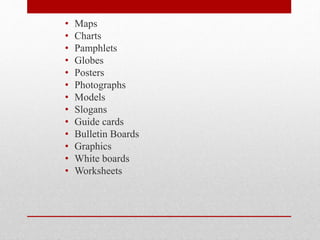
• Maps
• Charts
• Pamphlets
• Globes
• Posters
• Photographs
• Models
• Slogans
• Guide cards
• Bulletin Boards
• Graphics
• White boards
• Worksheets
• The use of computer, powerpoint
presentations, projectors, videos and
films are effective in teaching Araling
Panlipunan.
• What appropriate multisensory
materials are you going to use for
the following lesson objectives?
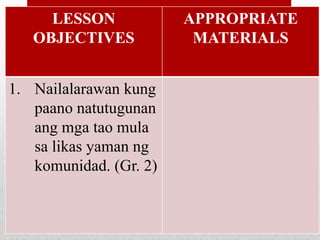
LESSON
OBJECTIVES
APPROPRIATE
MATERIALS
1. Nailalarawan kung
paano natutugunan
ang mga tao mula
sa likas yaman ng
komunidad. (Gr. 2)
LESSON
OBJECTIVES
APPROPRIATE
MATERIALS
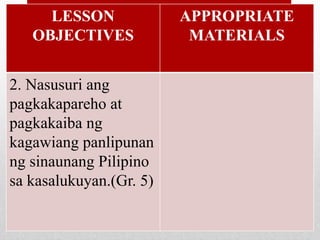
2. Nasusuri ang
pagkakapareho at
pagkakaiba ng
kagawiang panlipunan
ng sinaunang Pilipino
sa kasalukuyan.(Gr. 5)
LESSON
OBJECTIVES
APPROPRIATE
MATERIALS
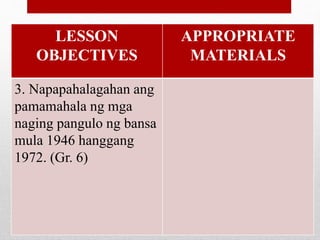
3. Napapahalagahan ang
pamamahala ng mga
naging pangulo ng bansa
mula 1946 hanggang
1972. (Gr. 6)
LESSON
OBJECTIVES
APPROPRIATE
MATERIALS
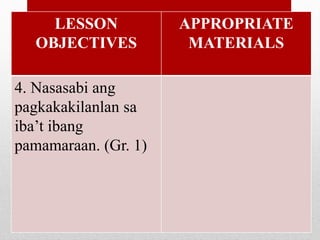
4. Nasasabi ang
pagkakakilanlan sa
iba’t ibang
pamamaraan. (Gr. 1)
LESSON
OBJECTIVES
APPROPRIATE
MATERIALS
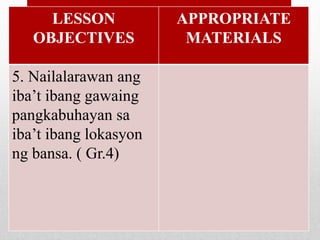
5. Nailalarawan ang
iba’t ibang gawaing
pangkabuhayan sa
iba’t ibang lokasyon
ng bansa. ( Gr.4)
•Thank You!
•God Bless Student
Teachers 

Teaching Social Studies in.pptx

  • 1.
    Teaching Social Studies (AralingPanlipunan) in Elementary Grades
  • 2.
    •The Nature ofAraling Panlipunan
  • 3.
    • Araling Panlipunan(Social Studies) is a subject that helps students acquire and learn knowledge, skills and values that will prepare them to be competent and responsible citizens throughout their lives.
  • 4.
    BATAYAN NG Kto 12 AP KURIKULUM ( k to 12 Gabay Pangkurikulum sa AP: Dec.,2013) • Naging batayan ng K to 12 Araling Pnlipunan Kurikulum ang “Edukasyon para sa lahat 2015” (Education for all 2015) at ang K to 12 Philippine Basic Education Curriculum Framework.
  • 5.
    Layon ng mgaito na magkaroon ng mga kinakailangan sa siglo 21 upang makalinang ng “functionally literate and developed Filipino.”
  • 6.
    Nilalayon na makalinangng kabataan na may tiyak na pagkakakilanlan at papel bilang Pilipinong lumalahok sa buhay ng lipunan, bansa at daigdig.
  • 7.
    Kasabay ng paglinangng identidad at kakayanang pansibiko ay ang pag- unawa sa nakaraan at kasalukuyan at sa ugnayan sa loob ng lipunan, at kalikasan , at sa mundo, kung paano nagbago at nagbabago ang mga ito, upang makahubog ng indibidwal at kolektibong kinabukasan.
  • 8.
    Mga Kakayahan saBagong AP Kurikulum 1. Pagsisiyasat 2. Pagsusuri at interpretasyon ng datos 3. Pagsusuri at interpretasyon ng impormasyon 4. Pagsasaliksik 5. Komunikasyon 6. Pagtupad sa pamantayang pang- etika
  • 9.
    •Content of Kto 12 Araling Panlipunan
  • 10.
  • 11.
    • Naipamamalas angmga pag-unawa sa mga konsepto at isyung pangkasaysayan, Pangheograpiya, Pang- ekonomiya, pangkultura, pampamahalaan, pansibiko, at panlipunan gamit ang mga kasanayang nalinang sa pag-aaral ng iba’t ibang disiplina at larangan ng araling panlipunan
  • 12.
    • Kabilang angpananaliksik , pagsisiyasat, mapanuring pag-iisip, matalinong pagpapasiya, pagkamalikhain, pakikipagkapwa, likas-kayang paggamit ng pinagkukunang yaman, pakikipagtalastasan, at pagpapalawak ng pandaigdig na pananaw
  • 13.
    • Upang magingmapanuri, mapagnilay, mapanagutan, produktibo, makakalikasan, makabansa at makatao na papanday sa kinabukasan ng mamayan ng bansa at daigdig.
  • 14.
  • 15.
    •The foregoing strategiesare suggested for teaching Araling Panlipunan.
  • 16.
    1. Experiential Learning •Is a process through which learners develop knowledge, skills and value from direct experiences. It helps to motivate learners because it involves them more deeply in the learning process.
  • 17.
    2. Think-pair sharing •Is a strategy where learners pair up and discuss the topic by giving their own ideas and resolve issues.
  • 18.
    3. Role Playing •Provides the learners the opportunity to feel the real situation to a given event or circumstance. It develops the feeling of understanding and empathy which could possibly prepare them both cognitive and affective learning.
  • 19.
    4. Visualization/ Imagination Exercise •Is a mental technique where learners use their imaginations to visualize and create images. It arouses learners’ mental and emotional being for it gives them the chance to feel that they are part particular event.
  • 20.
    Approaches/ Strategies Suggested Topics/ AP Themes Skills and Valuesto be Developed Role Play 1. Kultura, Pagkakakilanlan at Pagkakaisa 2. Ugnayang Panrehiyon at Pangmundo Understanding and Empathy Problem Solving Self- realization Self- direction Flexibility Ethical Values
  • 21.
    Approaches/ Strategies Suggested Topics/ AP Themes Skills and Valuesto be Developed Visualization/ Imagination Exercise 1. Kapangyarihan, Distribusyon at Pangkonsumo 2. Karapatan, Pananagutan at Pagkamamayan Solving problems Wise decision Logical Thinking Positive Thinking Creativity Resourcefulness Curiosity
  • 22.
    Approaches/ Strategies Suggested Topics/ AP Themes Skills and Valuesto be Developed Think- Pair Sharing 1. Tao, Lipunan at Kapaligiran Self- confidence Trust Competence Communication Teaming Personal Responsibility
  • 23.
    Approaches/ Strategies Suggested Topics/ AP Themes Skills and Valuesto be Developed Experiential Learning 1.Panahon, Pagpapatuloy at Pagbabago 2. Karapatan, Pananagutan at Pagkamamayan Interpersonal responsibility Interactive Communication Accuracy Adaptability Productivity
  • 24.
  • 25.
    1. Performance Assessment • Thisrequires learners perform a task using their own creativity and critical mind.
  • 26.
    2. Authentic Assessment •This aims to evaluate learners’ abilities in “real- world” context. It focuses on their ability to integrate what they-have learned. It can also be used to solve problems that have real- world applications
  • 27.
    3. Graphic Organizers •These are visual symbols to express knowledge, concept or idea to demonstrate relationship between facts. These help learners organize their ideas and to communicate them through concept mapping. • Example: KWLP matrix
  • 28.
    K (What I know) W (What I Wantto Know) L (What I Want to Learn) P (What I Plan to do With What I Learn)
  • 29.
    4. Journal Writing •Learners write their insights, reflections and reactions to what have been taken during the learning instruction. This can be used by the teacher to achieve specific goal on enhancing the learners’ skills of reflective inquiry.
  • 30.
    5. Portfolio Assessment •This contains sample of students work and related materials on their activities, accomplishments and achievements. It can be used in measuring performance based on students’ work.
  • 31.
    6. Rubrics • Itis a tool that represents the performance expectations for an assignment or work. This can also be utilized in the assessment of performance objective.
  • 32.
  • 33.
    • Criteria thatcan be used in Selection and Preparation of Instructional Materials
  • 34.
    1. Authenticity • Establishesgenuine information to develop critical thinking and critical analysis.
  • 35.
    2. Appropriateness • Representssuitable or proper point of views about the lesson objectives.
  • 36.
    3. Interest • Ableto arouse and sustain learners’ interest.
  • 37.
    4. Cost • Lessexpense of money, time and effort.
  • 38.
    • Araling Panlipunanteachers are encouraged to use audio-visual and computer based instructional materials in presenting lesson. • These materials makes learners more curious and explorative which enhance their active participation.
  • 39.
    • On theother hand, books, journals, periodicals and other print materials serve as reference and reinforcement of the lesson. • Aside from these, the teacher should utilize varied instructional materials to give learners opportunity to broaden their acquired knowledge from textbooks.
  • 40.
    • As such,the following instructional aides can be used as an auxiliary tools in text, visual or audio media both in print and digital format.
  • 41.
    • Maps • Charts •Pamphlets • Globes • Posters • Photographs • Models • Slogans • Guide cards • Bulletin Boards • Graphics • White boards • Worksheets
  • 42.
    • The useof computer, powerpoint presentations, projectors, videos and films are effective in teaching Araling Panlipunan.
  • 43.
    • What appropriatemultisensory materials are you going to use for the following lesson objectives?
  • 44.
    LESSON OBJECTIVES APPROPRIATE MATERIALS 1. Nailalarawan kung paanonatutugunan ang mga tao mula sa likas yaman ng komunidad. (Gr. 2)
  • 45.
    LESSON OBJECTIVES APPROPRIATE MATERIALS 2. Nasusuri ang pagkakaparehoat pagkakaiba ng kagawiang panlipunan ng sinaunang Pilipino sa kasalukuyan.(Gr. 5)
  • 46.
    LESSON OBJECTIVES APPROPRIATE MATERIALS 3. Napapahalagahan ang pamamahalang mga naging pangulo ng bansa mula 1946 hanggang 1972. (Gr. 6)
  • 47.
  • 48.
    LESSON OBJECTIVES APPROPRIATE MATERIALS 5. Nailalarawan ang iba’tibang gawaing pangkabuhayan sa iba’t ibang lokasyon ng bansa. ( Gr.4)
  • 49.
    •Thank You! •God BlessStudent Teachers 