Problem Management: What Happens
            When Risks Become Problems?


         Pamela F. Richardson               Michele T. King
Aeronautics Mission Assurance Manager     Engineer/Risk Analyst
Office of Safety and Mission Assurance,
                                           Futron Corporation
          NASA Headquarters
Introduction
Outline
• Introduction of Presenters

• History of Problem Management Effort

• Other Current Efforts in this Area

• Process for Writing the Document

• Approach for Creating Problem Management Process

• Status of Draft Problem Management Document

                                                          • 3
Presenters
•   Who we are
       Pamela F. Richardson
         • Currently serving as Aeronautics Mission Assurance Manager at NASA HQ
       Michele T. King
         • Engineer/Risk Analyst at Futron Corporation


•   How we tie in
       With funding from the NESC, Futron was tasked to work with John Tinsley to create a
       document to respond to Diaz Action #19
       Pam Richardson works under the direction of John Tinsley and was tasked to collaborate
       with Futron on the writing of this document


•   What we were doing during this effort
       Developing a Problem Management process to assist Program and Project Managers in
       managing problems, nonconformances, and anomalies
       Writing a guidance document entitled “Procedural Guidebook for NASA Program and
       Project Management of Problems, Nonconformances, and Anomalies”
                                                                                                • 4
History
•   March 20, 2004
       NASA Deputy Administrator, Fred Gregory, released “The Implementation of the NASA Agency-
       Wide Application of the Columbia Accident Investigation Board Report: Our Renewed Commitment
       to Excellence.” The plan established an approach for implementing Agency-wide actions defined by
       the Diaz Team. Page 23 of the plan states “Review and consider reinstituting post-Challenger policies
       and processes for problem reporting and trend analysis.”

•   Collaboration
       NESC tasked Futron to collaborate with NASA HQ in order to develop a NASA guidance document
       Received input from NESC-SMA Working Group members, the NESC SEO office, OSMA and
       others

•   Progress
       Topics: problem identification, significant problem reporting, problem resolution, trend analysis, and
       recurrence control
       Initially proposed to be included in the rewrite of NPR 8000.4, “Risk Management Procedures and
       Guidelines”
       Later proposed to be a stand-alone guidebook

•   Requirements
       Incorporate heritage trends analysis techniques from previous NASA guidance and new techniques
       developed over the last 15 years
       Include data mining techniques in order to make the trending activities more efficient

                                                                                                                • 5
Collaboration in Writing the Document
• Ken Cameron (NESC)

• Vicky Parsons (Data Mining and Trending Working Group, NESC)

• Bob Biel (Data Mining and Trending Working Group, NESC)

• Pam Richardson (OSMA)

• John Tinsley (OSMA)

• Mike Canga (IPAO)

• Dale Huls (MSFC Problem Reporting and Corrective Action, JSC)

• Working Group at NASA Headquarters, August 16, 2005

                                                                  • 6
NESC
• Objective
     To improve safety by performing in-depth engineering assessments, testing,
     and analysis to uncover technical vulnerabilities and to determine appropriate
     preventative and corrective actions for problems, trends or issues within
     NASA’s programs, projects and institutions

• When
     Created in the aftermath of the Space Shuttle Columbia accident
     Became operational in November 2003

• Where
     Located at Langley Research Center, Hampton, Virginia
     NASA Headquarters Function

• Why
     To serve as an independent technical resource for NASA managers and
     employees

                                                                                      • 7
Key Efforts and Activities
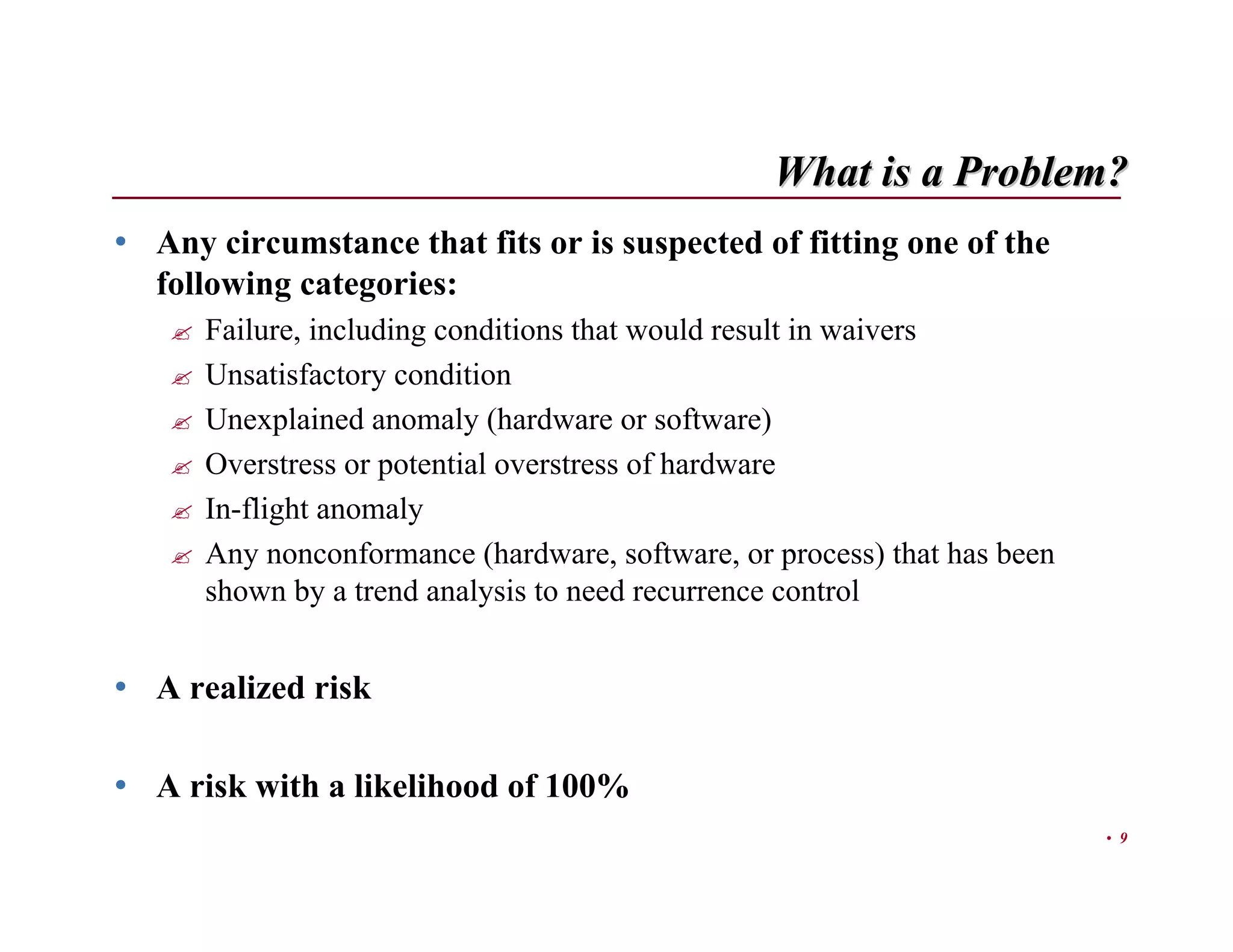
What is a Problem?
• Any circumstance that fits or is suspected of fitting one of the
  following categories:
      Failure, including conditions that would result in waivers
      Unsatisfactory condition
      Unexplained anomaly (hardware or software)
      Overstress or potential overstress of hardware
      In-flight anomaly
      Any nonconformance (hardware, software, or process) that has been
      shown by a trend analysis to need recurrence control


• A realized risk

• A risk with a likelihood of 100%
                                                                          • 9
Framework
• The problem management
  process began with a
  framework, more specifically
  with a flow diagram:


                                        • 10
Two Parts
• The overall process was split into two sections:
      Technical Data Management
      Support Processes


                                                            • 11
Technical Data Management
• This section includes the key
   steps for problem,
   nonconformance, and anomaly
   management

• It describes procedures and
   actions to be followed when a
   problem arises

• It includes elements of three of
   the seventeen process
   requirements outlined in NASA
   Systems Engineering Processes
   and Requirements, NPR 7123.1

                                                            • 12
Problem Identification
• This step involves gathering
   information from the
   projects so that problems can
   be described and measured

• Early identification of
   problems leads to improved
   safety and quality, as well as
   a substantial savings of
   resources, such as cost,
   schedule, and performance


                                                        • 13
Problem Assessment/ Investigation Analysis
•   In this process, problems are
    examined in further detail to
    determine their extent

•   Problem assessment may reveal
    how problems relate to each
    other

•   Problems are classified or
    grouped with similar problems

•   After they are classified, it is
    important to prioritize problems
    in order to determine which
    ones should be dealt with first

•   The guidebook offers methods
    of prioritization, as well as
    examples of investigation
    analysis and failure analysis
                                                            • 14
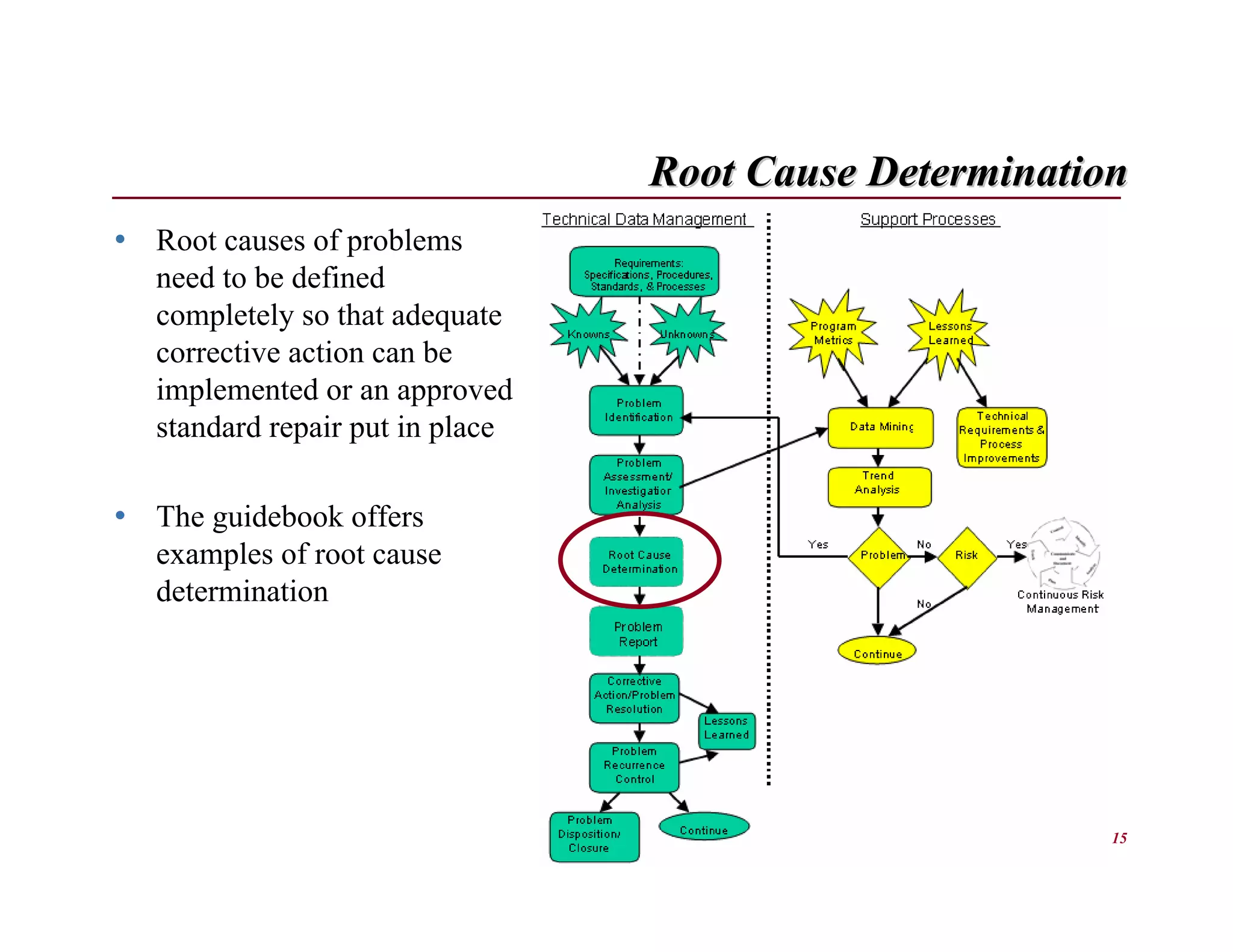
Root Cause Determination
• Root causes of problems
   need to be defined
   completely so that adequate
   corrective action can be
   implemented or an approved
   standard repair put in place

• The guidebook offers
   examples of root cause
   determination


                                                        • 15
Problem Report
• Problem reporting can take
   any of several forms:
      Formal reports
      Presentations
      Memos
      Other

• One example of a problem
   reporting system used within
   the Agency is Problem
   Reporting and Corrective
   Action (PRACA)

• The guidebook offers
   guidance for a problem
   report
                                              • 16
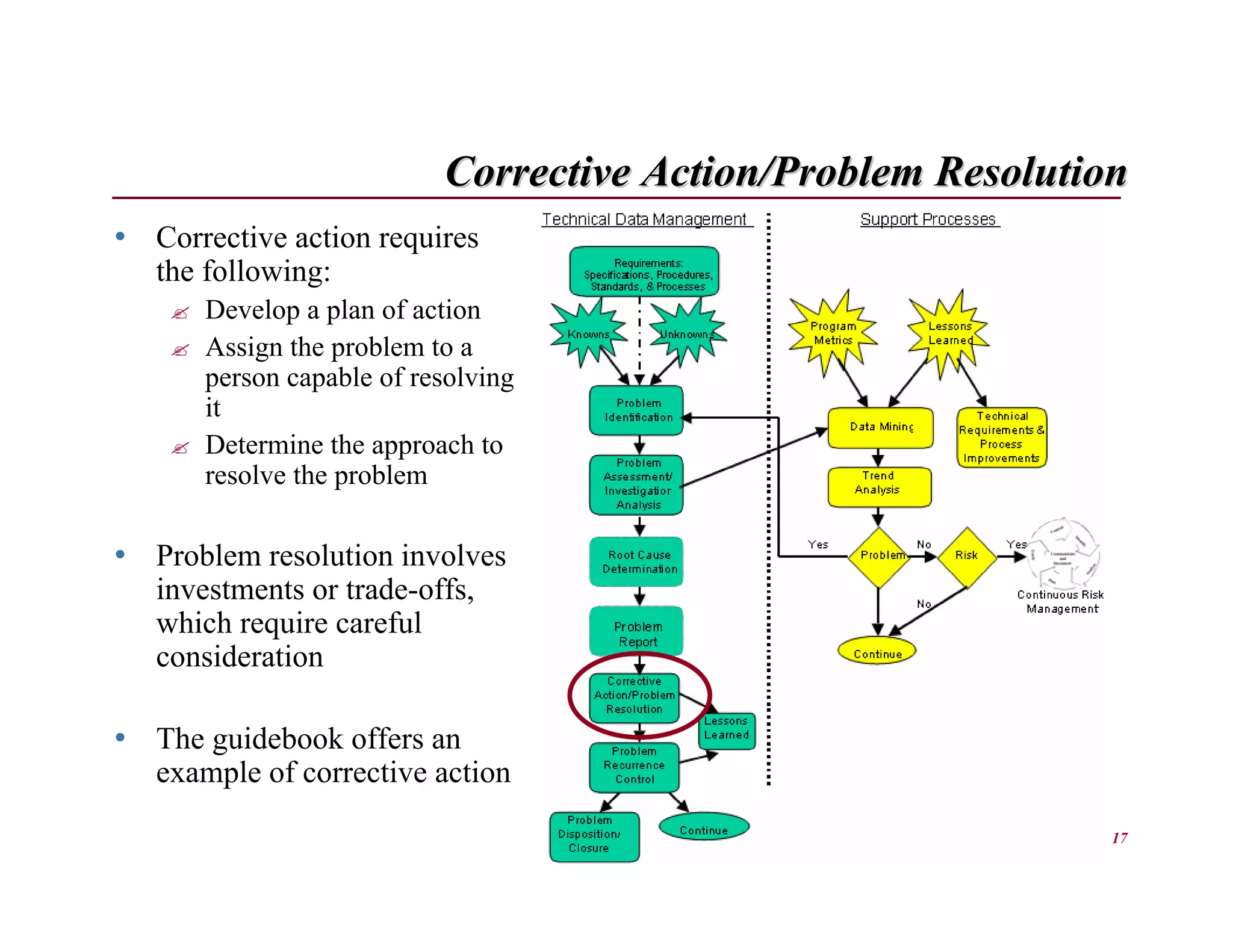
Corrective Action/Problem Resolution
• Corrective action requires
   the following:
       Develop a plan of action
       Assign the problem to a
       person capable of resolving
       it
       Determine the approach to
       resolve the problem

• Problem resolution involves
   investments or trade-offs,
   which require careful
   consideration

• The guidebook offers an
   example of corrective action
                                                             • 17
Problem Recurrence Control
• Recurrence control is
   preventative action beyond
   remedial action taken to
   preclude or minimize the
   recurrence of a problem

• The guidebook offers
   guidance for problem
   recurrence control


                                                        • 18
Problem Recurrence Control and Lessons Learned
• Problem recurrence control
   involves capturing lessons
   learned during the process of
   problem resolution, ensuring
   the communication of these
   lessons across the entire
   Agency and implementing
   corrective actions to ensure
   recurrence control

• Lessons learned are captured
   in the Agency’s Lessons
   Learned Information System
   (LLIS)

                                                   • 19
Problem Disposition/Closure
• After appropriate steps have
   been taken to resolve the
   problem, it is important to
   properly disposition the
   problem

• Proper disposition aids in
   tracking the problem through
   its lifecycle to completion

• The guidebook offers
   guidance for the disposition
   and closure of problems


                                                           • 20
Support Processes
• This section includes the
   implementation of analysis
   tools and techniques for
   problem management

• Analyses assist decision makers
   in making better and more
   informed decisions in complex
   situations under a high degree
   of uncertainty

• The quality of decision is
   measured by:
       Their expected consequences
       The uncertainty of the
       consequences
       The stated preferences of the
                                                      • 21
       decision makers
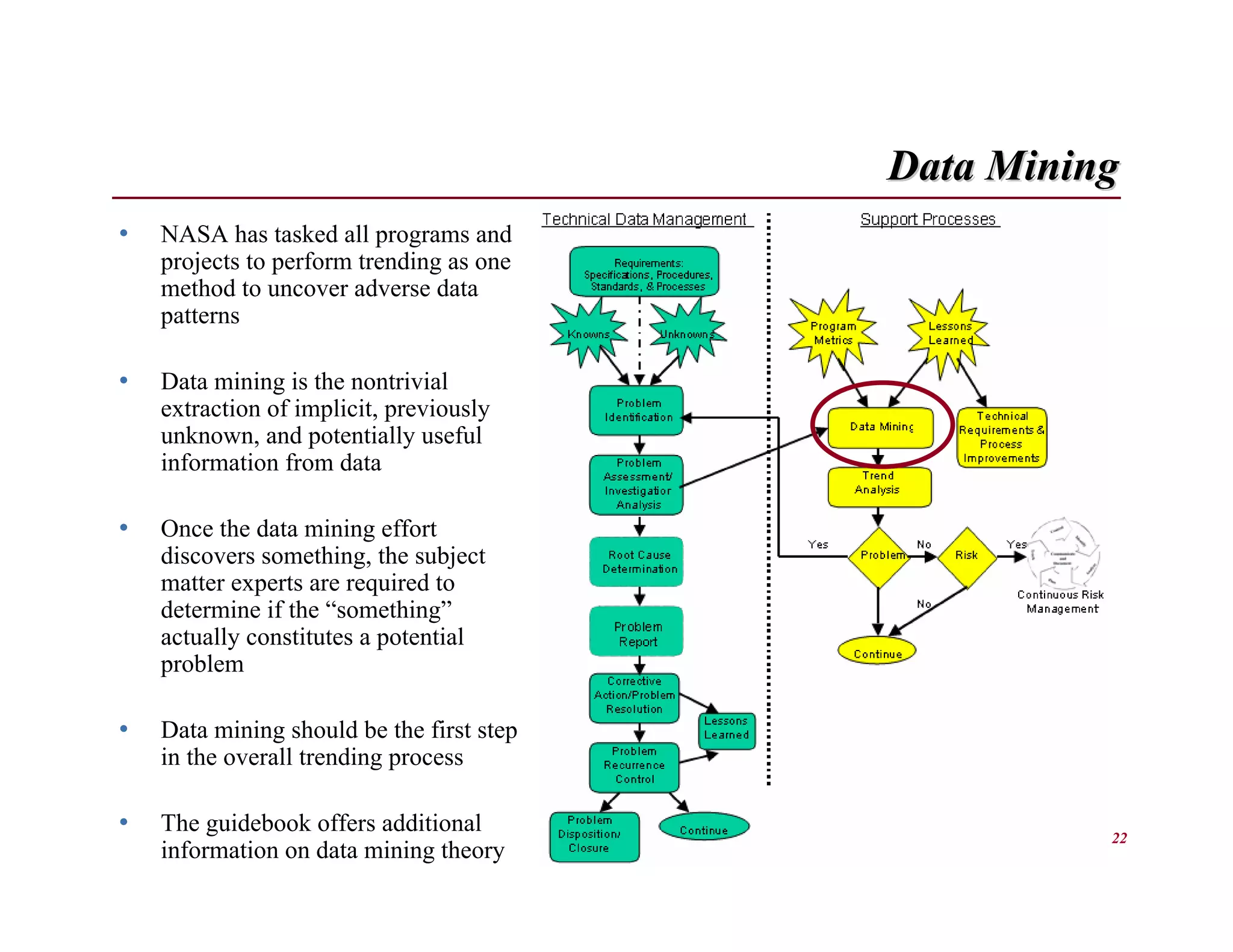
Data Mining
•   NASA has tasked all programs and
    projects to perform trending as one
    method to uncover adverse data
    patterns

•   Data mining is the nontrivial
    extraction of implicit, previously
    unknown, and potentially useful
    information from data

•   Once the data mining effort
    discovers something, the subject
    matter experts are required to
    determine if the “something”
    actually constitutes a potential
    problem

•   Data mining should be the first step
    in the overall trending process

•   The guidebook offers additional                 • 22
    information on data mining theory
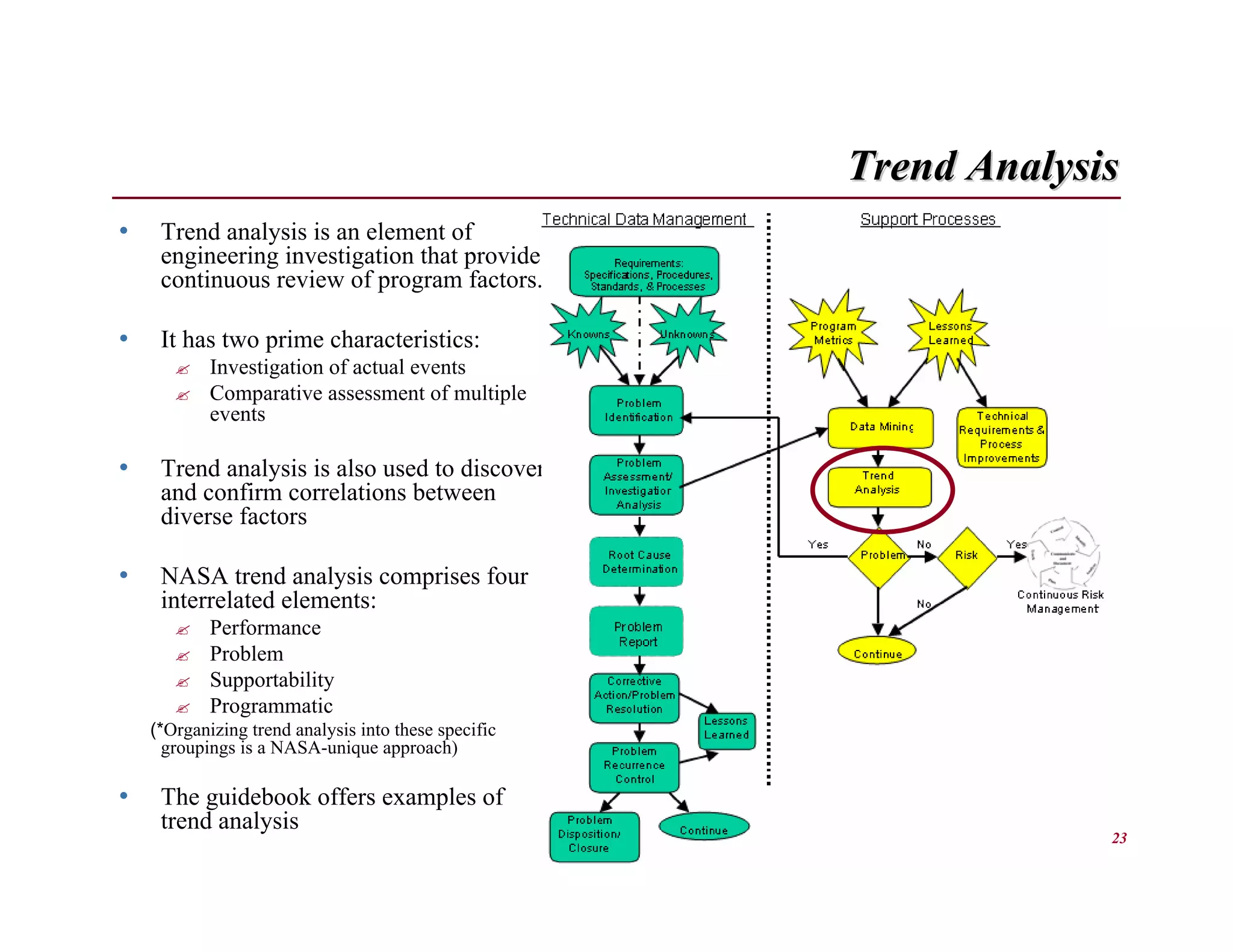
Trend Analysis
•    Trend analysis is an element of
     engineering investigation that provides
     continuous review of program factors.

•    It has two prime characteristics:
            Investigation of actual events
            Comparative assessment of multiple
            events

•    Trend analysis is also used to discover
     and confirm correlations between
     diverse factors

•    NASA trend analysis comprises four
     interrelated elements:
            Performance
            Problem
            Supportability
            Programmatic
    (*Organizing trend analysis into these specific
      groupings is a NASA-unique approach)

•    The guidebook offers examples of
     trend analysis
                                                                  • 23
Current Efforts in Problem Management
• Data Mining and Trending Working Group NESC
      Team members include NASA, contractors, and students
      Aeronautics and Space Systems have vast data stores; the goal is to develop a
      system that will automatically discover recurring anomalies, given a stack of
      100,000+ reports

• Problem Reporting and Corrective Action (PRACA)
      PRACA is used at several NASA centers
       • Marshall Space Flight Center PRACA was established to assure accurate tracking of
         problems and problem resolution for shuttle-related MSFC hardware elements. It is
         used to record significant problem information used for problem tracking and
         resolution analysis; for assurance of problem disposition or closure as required for
         Space Shuttle mission risk control; and for problem trending to assure adequacy of
         problem closure and to highlight areas needing attention for increased research and
         possible redesign. It is also used as a data source for transfer of MSFC problem
         information to the Shuttle Program Office Program Compliance Assurance and
         Status System (PCASS) Integrated Problem Assessment System (IPAS)

                                                                                                • 24
Status of Draft Guidebook
• Comments to the draft guidebook by the NASA Centers are
  currently undergoing review by Pamela Richardson at NASA
  Headquarters


                                                             • 25
Summary and Conclusions
Summary
• The document will act as a guidebook to assist program and project
  managers in dealing with problems when they arise

• The information provided in the document is an overview of the
  steps that a program or project manager should take

• The appendices provide examples and an overview of mathematical
  models to help manage and learn from problems


                                                                       • 27
Acknowledgments
• The National Aeronautics and Space Administration Engineering
  and Safety Center under Award NNL04AA88T provided funding
  for this study


                                                                  • 28

King richardson

  • 1.
    Problem Management: WhatHappens When Risks Become Problems? Pamela F. Richardson Michele T. King Aeronautics Mission Assurance Manager Engineer/Risk Analyst Office of Safety and Mission Assurance, Futron Corporation NASA Headquarters
  • 2.
  • 3.
    Outline • Introduction ofPresenters • History of Problem Management Effort • Other Current Efforts in this Area • Process for Writing the Document • Approach for Creating Problem Management Process • Status of Draft Problem Management Document • 3
  • 4.
    Presenters • Who we are Pamela F. Richardson • Currently serving as Aeronautics Mission Assurance Manager at NASA HQ Michele T. King • Engineer/Risk Analyst at Futron Corporation • How we tie in With funding from the NESC, Futron was tasked to work with John Tinsley to create a document to respond to Diaz Action #19 Pam Richardson works under the direction of John Tinsley and was tasked to collaborate with Futron on the writing of this document • What we were doing during this effort Developing a Problem Management process to assist Program and Project Managers in managing problems, nonconformances, and anomalies Writing a guidance document entitled “Procedural Guidebook for NASA Program and Project Management of Problems, Nonconformances, and Anomalies” • 4
  • 5.
    History • March 20, 2004 NASA Deputy Administrator, Fred Gregory, released “The Implementation of the NASA Agency- Wide Application of the Columbia Accident Investigation Board Report: Our Renewed Commitment to Excellence.” The plan established an approach for implementing Agency-wide actions defined by the Diaz Team. Page 23 of the plan states “Review and consider reinstituting post-Challenger policies and processes for problem reporting and trend analysis.” • Collaboration NESC tasked Futron to collaborate with NASA HQ in order to develop a NASA guidance document Received input from NESC-SMA Working Group members, the NESC SEO office, OSMA and others • Progress Topics: problem identification, significant problem reporting, problem resolution, trend analysis, and recurrence control Initially proposed to be included in the rewrite of NPR 8000.4, “Risk Management Procedures and Guidelines” Later proposed to be a stand-alone guidebook • Requirements Incorporate heritage trends analysis techniques from previous NASA guidance and new techniques developed over the last 15 years Include data mining techniques in order to make the trending activities more efficient • 5
  • 6.
    Collaboration in Writingthe Document • Ken Cameron (NESC) • Vicky Parsons (Data Mining and Trending Working Group, NESC) • Bob Biel (Data Mining and Trending Working Group, NESC) • Pam Richardson (OSMA) • John Tinsley (OSMA) • Mike Canga (IPAO) • Dale Huls (MSFC Problem Reporting and Corrective Action, JSC) • Working Group at NASA Headquarters, August 16, 2005 • 6
  • 7.
    NESC • Objective To improve safety by performing in-depth engineering assessments, testing, and analysis to uncover technical vulnerabilities and to determine appropriate preventative and corrective actions for problems, trends or issues within NASA’s programs, projects and institutions • When Created in the aftermath of the Space Shuttle Columbia accident Became operational in November 2003 • Where Located at Langley Research Center, Hampton, Virginia NASA Headquarters Function • Why To serve as an independent technical resource for NASA managers and employees • 7
  • 8.
    Key Efforts andActivities
  • 9.
    What is aProblem? • Any circumstance that fits or is suspected of fitting one of the following categories: Failure, including conditions that would result in waivers Unsatisfactory condition Unexplained anomaly (hardware or software) Overstress or potential overstress of hardware In-flight anomaly Any nonconformance (hardware, software, or process) that has been shown by a trend analysis to need recurrence control • A realized risk • A risk with a likelihood of 100% • 9
  • 10.
    Framework • The problemmanagement process began with a framework, more specifically with a flow diagram: • 10
  • 11.
    Two Parts • Theoverall process was split into two sections: Technical Data Management Support Processes • 11
  • 12.
    Technical Data Management •This section includes the key steps for problem, nonconformance, and anomaly management • It describes procedures and actions to be followed when a problem arises • It includes elements of three of the seventeen process requirements outlined in NASA Systems Engineering Processes and Requirements, NPR 7123.1 • 12
  • 13.
    Problem Identification • Thisstep involves gathering information from the projects so that problems can be described and measured • Early identification of problems leads to improved safety and quality, as well as a substantial savings of resources, such as cost, schedule, and performance • 13
  • 14.
    Problem Assessment/ InvestigationAnalysis • In this process, problems are examined in further detail to determine their extent • Problem assessment may reveal how problems relate to each other • Problems are classified or grouped with similar problems • After they are classified, it is important to prioritize problems in order to determine which ones should be dealt with first • The guidebook offers methods of prioritization, as well as examples of investigation analysis and failure analysis • 14
  • 15.
    Root Cause Determination •Root causes of problems need to be defined completely so that adequate corrective action can be implemented or an approved standard repair put in place • The guidebook offers examples of root cause determination • 15
  • 16.
    Problem Report • Problemreporting can take any of several forms: Formal reports Presentations Memos Other • One example of a problem reporting system used within the Agency is Problem Reporting and Corrective Action (PRACA) • The guidebook offers guidance for a problem report • 16
  • 17.
    Corrective Action/Problem Resolution •Corrective action requires the following: Develop a plan of action Assign the problem to a person capable of resolving it Determine the approach to resolve the problem • Problem resolution involves investments or trade-offs, which require careful consideration • The guidebook offers an example of corrective action • 17
  • 18.
    Problem Recurrence Control •Recurrence control is preventative action beyond remedial action taken to preclude or minimize the recurrence of a problem • The guidebook offers guidance for problem recurrence control • 18
  • 19.
    Problem Recurrence Controland Lessons Learned • Problem recurrence control involves capturing lessons learned during the process of problem resolution, ensuring the communication of these lessons across the entire Agency and implementing corrective actions to ensure recurrence control • Lessons learned are captured in the Agency’s Lessons Learned Information System (LLIS) • 19
  • 20.
    Problem Disposition/Closure • Afterappropriate steps have been taken to resolve the problem, it is important to properly disposition the problem • Proper disposition aids in tracking the problem through its lifecycle to completion • The guidebook offers guidance for the disposition and closure of problems • 20
  • 21.
    Support Processes • Thissection includes the implementation of analysis tools and techniques for problem management • Analyses assist decision makers in making better and more informed decisions in complex situations under a high degree of uncertainty • The quality of decision is measured by: Their expected consequences The uncertainty of the consequences The stated preferences of the • 21 decision makers
  • 22.
    Data Mining • NASA has tasked all programs and projects to perform trending as one method to uncover adverse data patterns • Data mining is the nontrivial extraction of implicit, previously unknown, and potentially useful information from data • Once the data mining effort discovers something, the subject matter experts are required to determine if the “something” actually constitutes a potential problem • Data mining should be the first step in the overall trending process • The guidebook offers additional • 22 information on data mining theory
  • 23.
    Trend Analysis • Trend analysis is an element of engineering investigation that provides continuous review of program factors. • It has two prime characteristics: Investigation of actual events Comparative assessment of multiple events • Trend analysis is also used to discover and confirm correlations between diverse factors • NASA trend analysis comprises four interrelated elements: Performance Problem Supportability Programmatic (*Organizing trend analysis into these specific groupings is a NASA-unique approach) • The guidebook offers examples of trend analysis • 23
  • 24.
    Current Efforts inProblem Management • Data Mining and Trending Working Group NESC Team members include NASA, contractors, and students Aeronautics and Space Systems have vast data stores; the goal is to develop a system that will automatically discover recurring anomalies, given a stack of 100,000+ reports • Problem Reporting and Corrective Action (PRACA) PRACA is used at several NASA centers • Marshall Space Flight Center PRACA was established to assure accurate tracking of problems and problem resolution for shuttle-related MSFC hardware elements. It is used to record significant problem information used for problem tracking and resolution analysis; for assurance of problem disposition or closure as required for Space Shuttle mission risk control; and for problem trending to assure adequacy of problem closure and to highlight areas needing attention for increased research and possible redesign. It is also used as a data source for transfer of MSFC problem information to the Shuttle Program Office Program Compliance Assurance and Status System (PCASS) Integrated Problem Assessment System (IPAS) • 24
  • 25.
    Status of DraftGuidebook • Comments to the draft guidebook by the NASA Centers are currently undergoing review by Pamela Richardson at NASA Headquarters • 25
  • 26.
  • 27.
    Summary • The documentwill act as a guidebook to assist program and project managers in dealing with problems when they arise • The information provided in the document is an overview of the steps that a program or project manager should take • The appendices provide examples and an overview of mathematical models to help manage and learn from problems • 27
  • 28.
    Acknowledgments • The NationalAeronautics and Space Administration Engineering and Safety Center under Award NNL04AA88T provided funding for this study • 28