Academy Sharing Knowledge
The NASA Source for Project Management and Engineering Excellence | APPEL S U M M E R | 2 0 0 6
National Aeronautics and Space Administration
Inside
HENRY PETROSKI ON SUCCESS THROUGH FAILURE
INTERVIEW WITH REX GEVEDEN
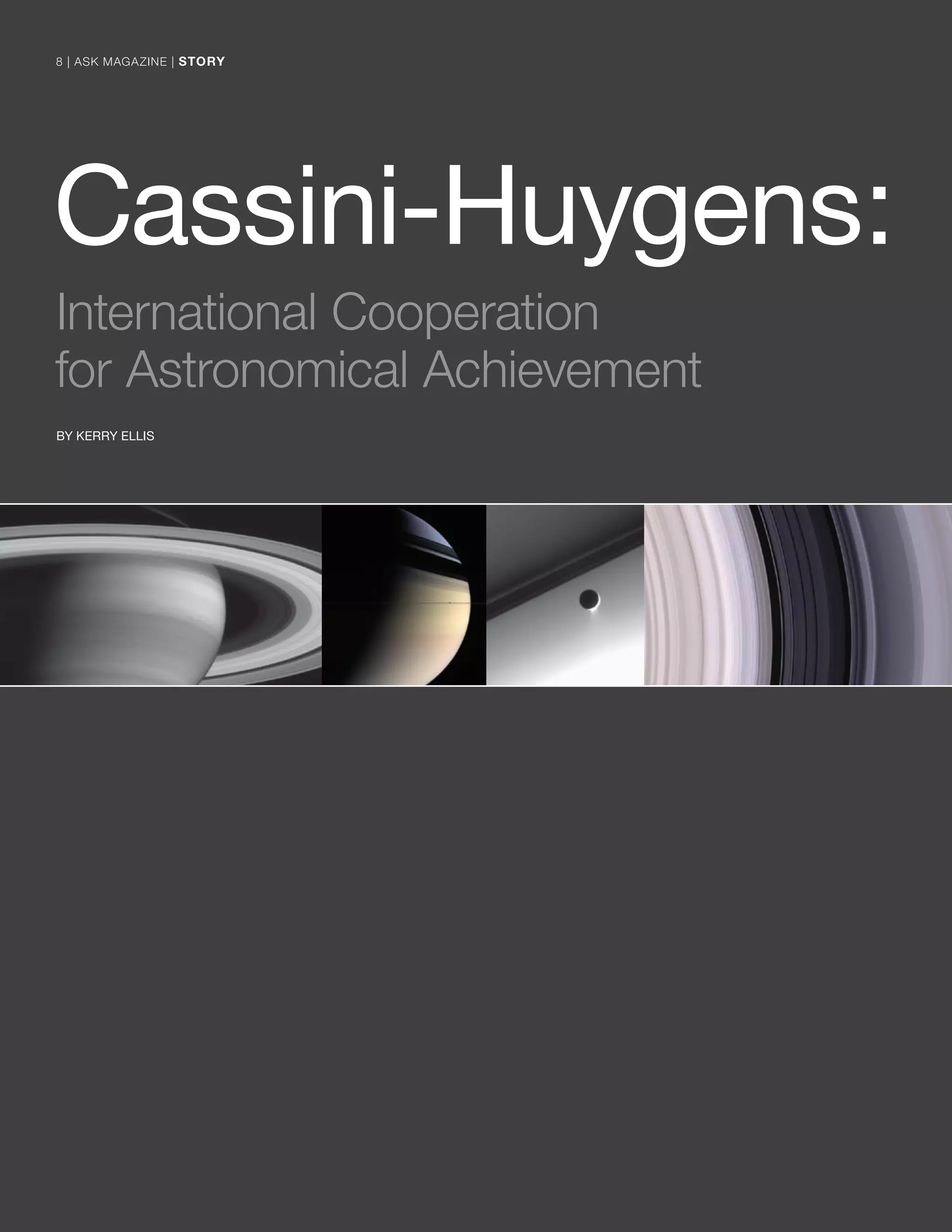
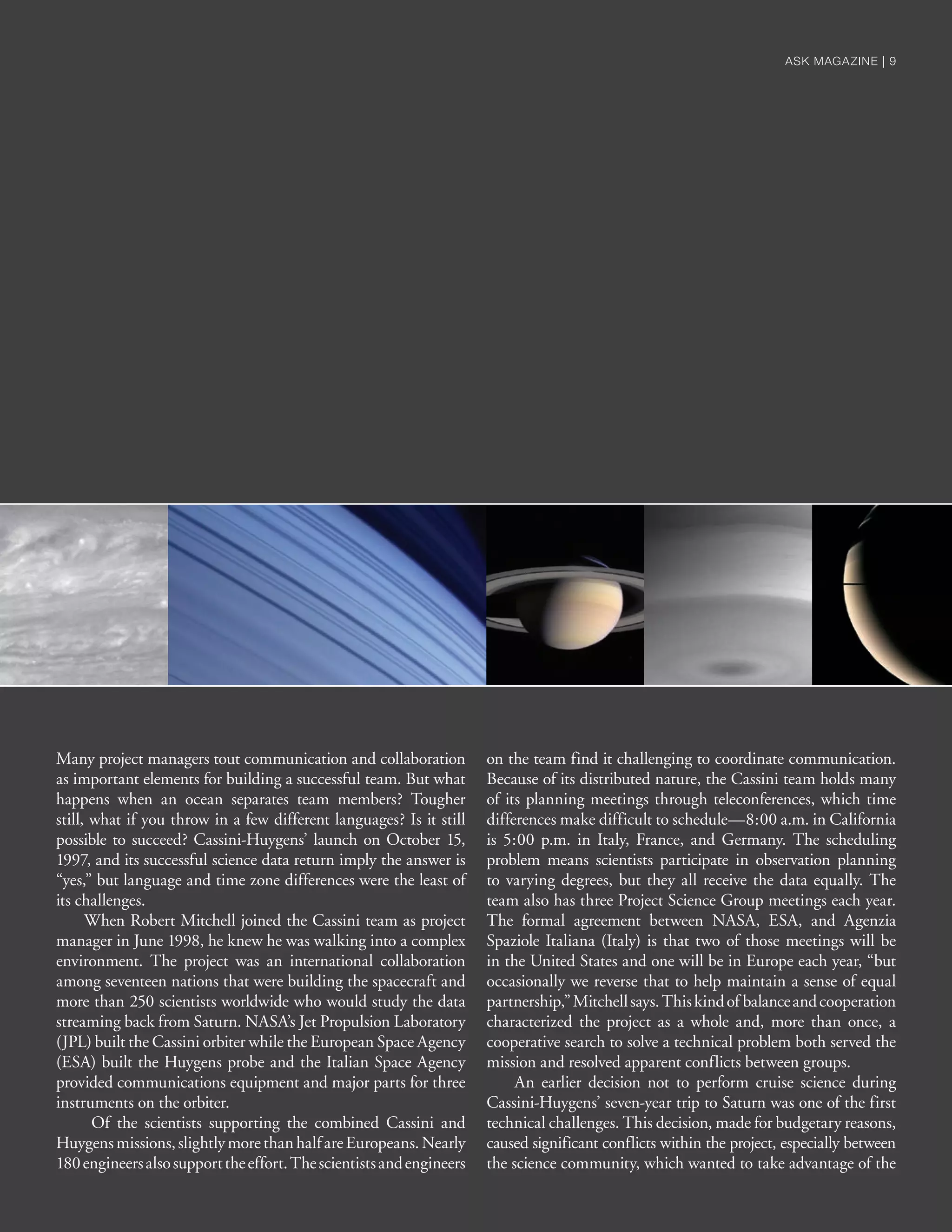
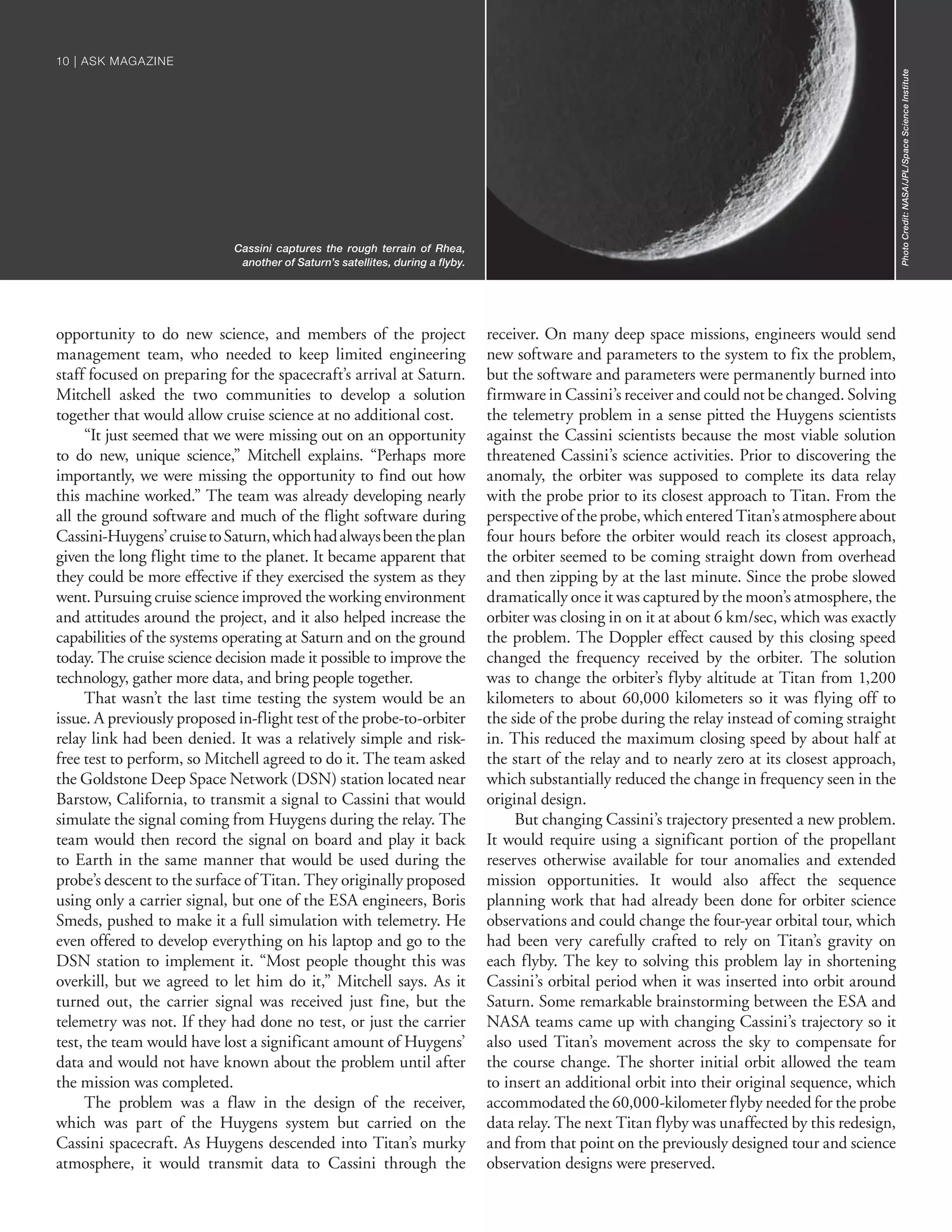
* INTERNATIONAL COLLABORATION ON CASSINI-HUYGENS
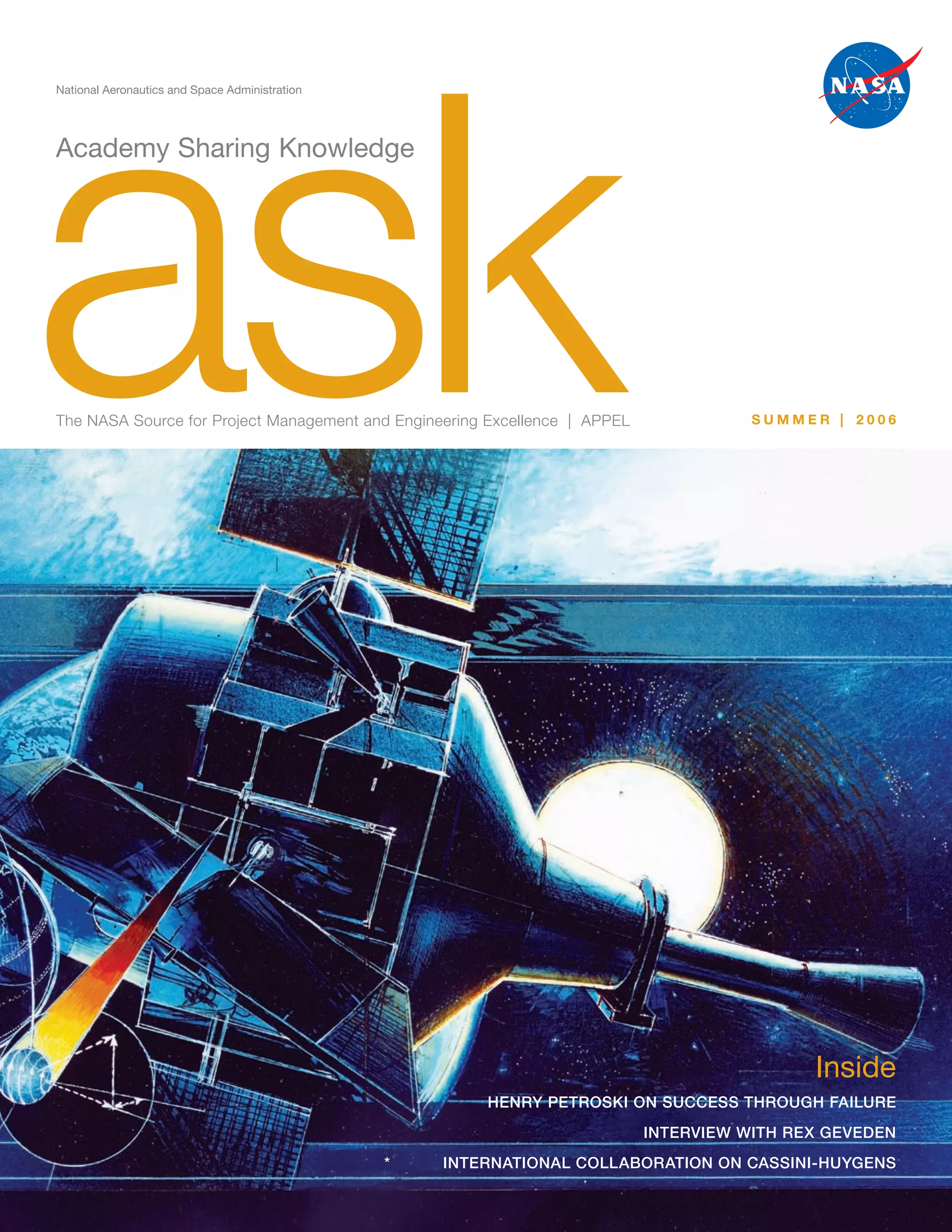
ON THE COVER
In 1987, Ross Barron Storey was approached by Stanford University and asked to create a series of art pieces
for Gravity Probe B. This drawing shows the satellite that was built to house and transport four highly sensitive
gyroscopes and a heavy lead dewar that dampens magnetic forces. NASA and Stanford University developed
Gravity Probe B to test two predictions of Albert Einstein’s general theory of relativity. Precise measurements of
tiny changes in the direction of spin of Gravity Probe B’s gyroscopes as it orbits the Earth will show how space
and time are warped by the presence of our planet.
23 815
DEPARTMENTS
3
In This Issue
4
From the Director
48
Knowledge in Brief
49
ASK Bookshelf
50
The Knowledge Notebook
52
ASK Interactive
INSIGHTS
12
Leaders’ Responsibility
to Develop Future Leaders
BY GUS GUASTAFERRO Project leaders need
to ensure project success and provide
career development opportunities for
promising team members.
15
Interview with Rex Geveden
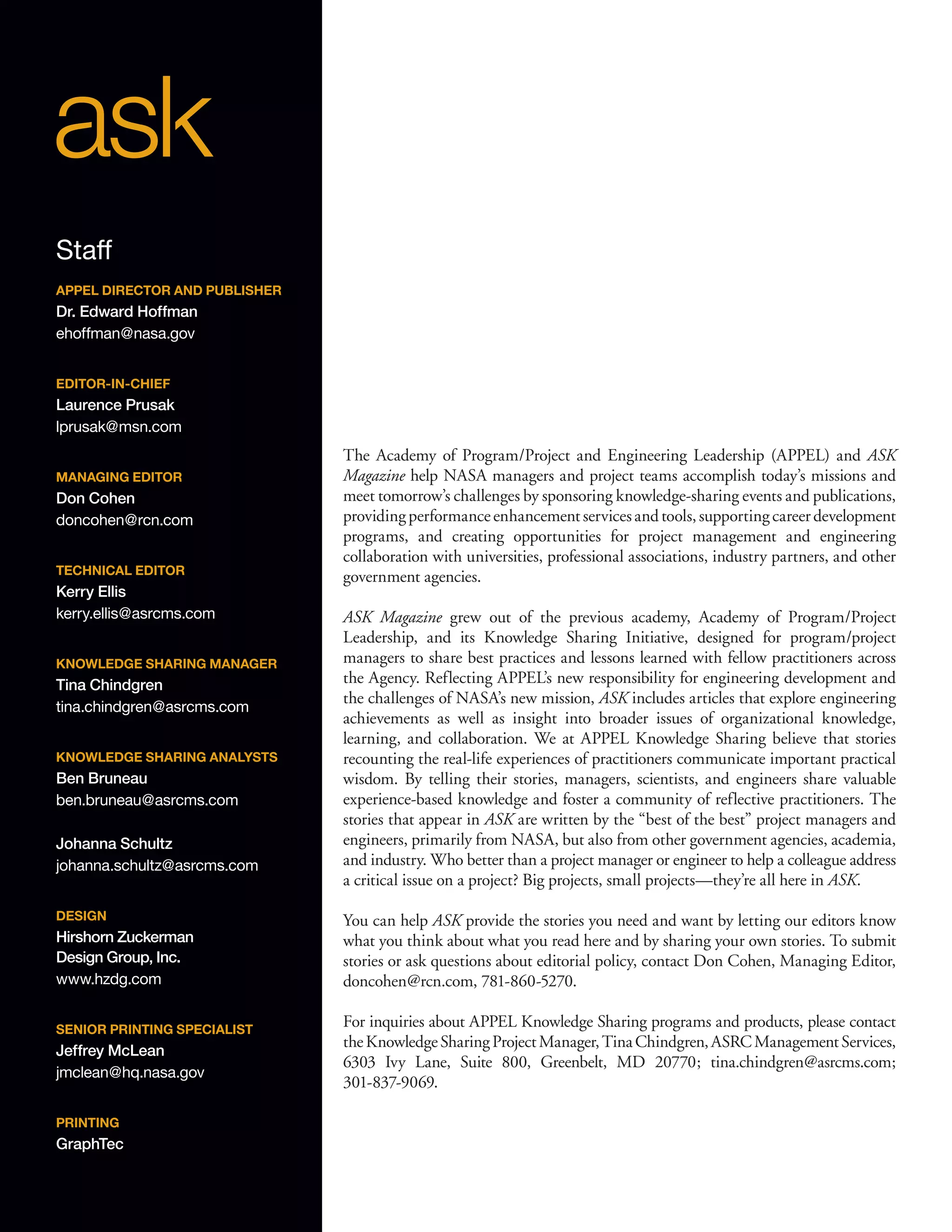
BY DON COHEN In conversation with
Cohen and Ed Hoffman, NASA’s Associate
Administrator talks about the importance
of clear technical authority in the Agency
and about how project managers develop
their skills.
23
Success Through Failure
BY HENRY PETROSKI The noted engineering
writer discusses how failure shapes good
design and repeated success can ultimately
lead to disaster.
30
Sharing Responsibility for Risk
BY BRENT ROBERTSON AND JERRY KLEIN
One project takes risk management a step
further by creating metrics to measure how
successful risk management efforts have
been.
35
The “Fifth Dimension” of Program
and Project Management
BY WILLIAM H. GERSTENMAIER A candid look
at how politics and people’s perceptions
can influence a project’s outcome.
42
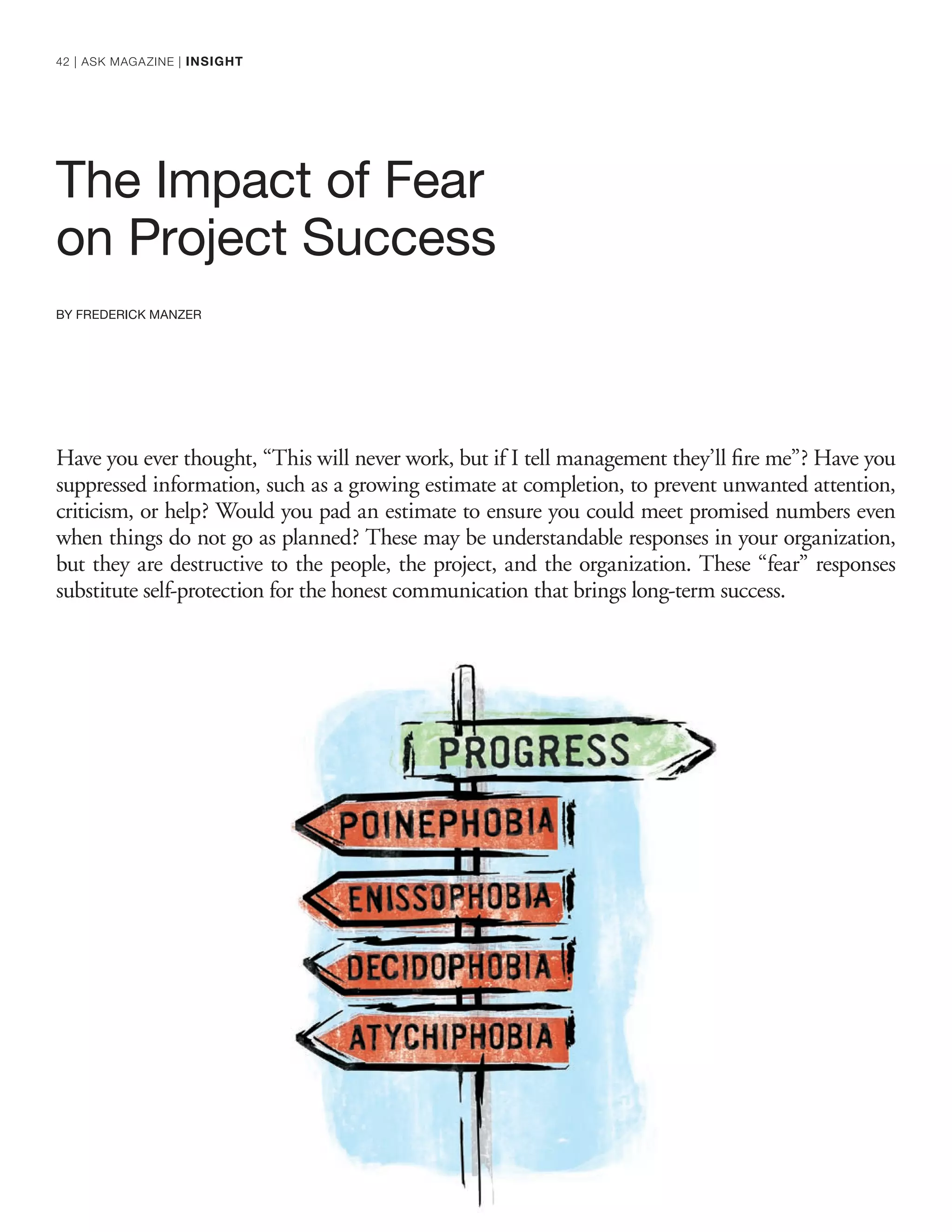
The Impact of Fear
on Project Success
BY FREDERICK MANZER Fear may not make
your employees work harder; it may actually
cause them to hide the truth, which can
lead to project failure.
STORIES
5
Goddard’s SEED Program:
Growing Systems Engineers
BY THE SEED TEAM WITH DON COHEN
The Goddard Systems Engineering
Education Development program uses
hands-on project experience to teach
systems engineering expertise.
8
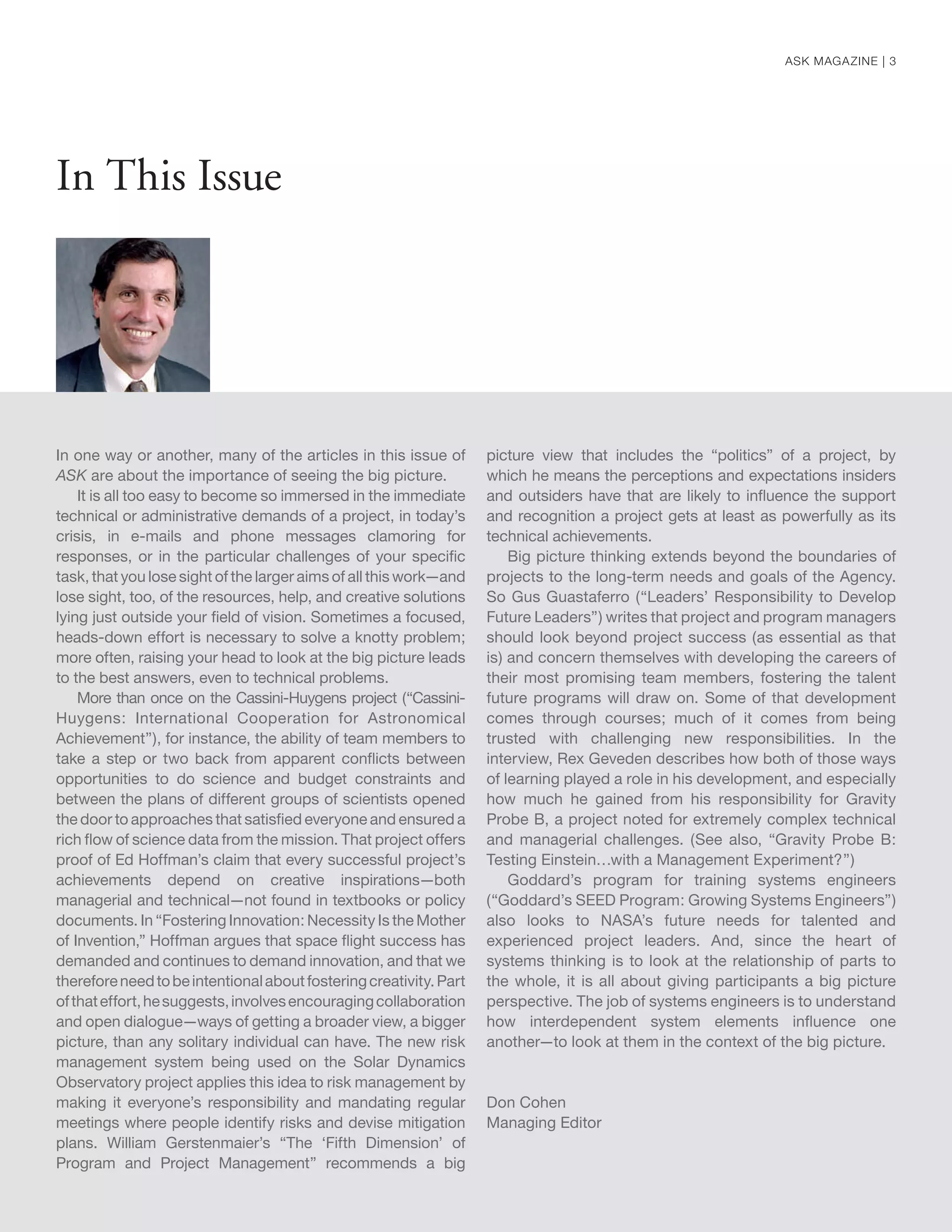
Cassini-Huygens: International
Cooperation for Astronomical
Achievement
BY KERRY ELLIS Collaborating with foreign
space agencies has its own unique challenges.
20
Unexpected Delays Equal
a Chance to Innovate
BY HUGH WOODWARD When a priority
project suddenly faces cancellation, a team
avoids discouragement and uses the delay
to test their ideas and improve the design.
26
A Powerful Communication Tool:
The Engineering White Paper
BY JAMES WOOD A chief engineer uses
a white paper to test his logic and
communicate effectively with other
members of a technical review team.
33
Featured Invention:
Langley Soluble Imide
BY BEN BRUNEAU A happy accident creates
one of the most versatile polymers available,
and its uses are growing—even in the
medical field.
38
Gravity Probe B: Testing Einstein…
with a Management Experiment?
BY EDWARD S. CALDER AND BRADLEY T. JONES
Giving Stanford University management
responsibility for the complex Gravity Probe B
project was an experiment that uncovered
important lessons about NASA collaborations
with university prime contractors.
45
University Collaborations:
Teaching and Learning
BY KEVIN VIPAVETZ One NASA project
manager learns some of the dos and don’ts
of working with university students.
Contents
ASK MAGAZINE | 1
The Academy of Program/Project and Engineering Leadership (APPEL) and ASK
Magazine help NASA managers and project teams accomplish today’s missions and
meet tomorrow’s challenges by sponsoring knowledge-sharing events and publications,
providingperformanceenhancementservicesandtools,supportingcareerdevelopment
programs, and creating opportunities for project management and engineering
collaboration with universities, professional associations, industry partners, and other
government agencies.
ASK Magazine grew out of the previous academy, Academy of Program/Project
Leadership, and its Knowledge Sharing Initiative, designed for program/project
managers to share best practices and lessons learned with fellow practitioners across
the Agency. Reflecting APPEL’s new responsibility for engineering development and
the challenges of NASA’s new mission, ASK includes articles that explore engineering
achievements as well as insight into broader issues of organizational knowledge,
learning, and collaboration. We at APPEL Knowledge Sharing believe that stories
recounting the real-life experiences of practitioners communicate important practical
wisdom. By telling their stories, managers, scientists, and engineers share valuable
experience-based knowledge and foster a community of reflective practitioners. The
stories that appear in ASK are written by the “best of the best” project managers and
engineers, primarily from NASA, but also from other government agencies, academia,
and industry. Who better than a project manager or engineer to help a colleague address
a critical issue on a project? Big projects, small projects—they’re all here in ASK.
You can help ASK provide the stories you need and want by letting our editors know
what you think about what you read here and by sharing your own stories. To submit
stories or ask questions about editorial policy, contact Don Cohen, Managing Editor,
doncohen@rcn.com, 781-860-5270.
For inquiries about APPEL Knowledge Sharing programs and products, please contact
theKnowledgeSharingProjectManager,TinaChindgren,ASRCManagementServices,
6303 Ivy Lane, Suite 800, Greenbelt, MD 20770; tina.chindgren@asrcms.com;
301-837-9069.
Staff
APPEL DIRECTOR AND PUBLISHER
Dr. Edward Hoffman
ehoffman@nasa.gov
EDITOR-IN-CHIEF
Laurence Prusak
lprusak@msn.com
MANAGING EDITOR
Don Cohen
doncohen@rcn.com
TECHNICAL EDITOR
Kerry Ellis
kerry.ellis@asrcms.com
KNOWLEDGE SHARING MANAGER
Tina Chindgren
tina.chindgren@asrcms.com
KNOWLEDGE SHARING ANALYSTS
Ben Bruneau
ben.bruneau@asrcms.com
Johanna Schultz
johanna.schultz@asrcms.com
DESIGN
Hirshorn Zuckerman
Design Group, Inc.
www.hzdg.com
SENIOR PRINTING SPECIALIST
Jeffrey McLean
jmclean@hq.nasa.gov
PRINTING
GraphTec
In one way or another, many of the articles in this issue of
ASK are about the importance of seeing the big picture.
It is all too easy to become so immersed in the immediate
technical or administrative demands of a project, in today’s
crisis, in e-mails and phone messages clamoring for
responses, or in the particular challenges of your specific
task, that you lose sight of the larger aims of all this work—and
lose sight, too, of the resources, help, and creative solutions
lying just outside your field of vision. Sometimes a focused,
heads-down effort is necessary to solve a knotty problem;
more often, raising your head to look at the big picture leads
to the best answers, even to technical problems.
More than once on the Cassini-Huygens project (“Cassini-
Huygens: International Cooperation for Astronomical
Achievement”), for instance, the ability of team members to
take a step or two back from apparent conflicts between
opportunities to do science and budget constraints and
between the plans of different groups of scientists opened
the door to approaches that satisfied everyone and ensured a
rich flow of science data from the mission. That project offers
proof of Ed Hoffman’s claim that every successful project’s
achievements depend on creative inspirations—both
managerial and technical—not found in textbooks or policy
documents. In “Fostering Innovation: Necessity Is the Mother
of Invention,” Hoffman argues that space flight success has
demanded and continues to demand innovation, and that we
thereforeneedtobeintentionalaboutfosteringcreativity.Part
ofthateffort,hesuggests,involvesencouragingcollaboration
and open dialogue—ways of getting a broader view, a bigger
picture, than any solitary individual can have. The new risk
management system being used on the Solar Dynamics
Observatory project applies this idea to risk management by
making it everyone’s responsibility and mandating regular
meetings where people identify risks and devise mitigation
plans. William Gerstenmaier’s “The ‘Fifth Dimension’ of
Program and Project Management” recommends a big
picture view that includes the “politics” of a project, by
which he means the perceptions and expectations insiders
and outsiders have that are likely to influence the support
and recognition a project gets at least as powerfully as its
technical achievements.
Big picture thinking extends beyond the boundaries of
projects to the long-term needs and goals of the Agency.
So Gus Guastaferro (“Leaders’ Responsibility to Develop
Future Leaders”) writes that project and program managers
should look beyond project success (as essential as that
is) and concern themselves with developing the careers of
their most promising team members, fostering the talent
future programs will draw on. Some of that development
comes through courses; much of it comes from being
trusted with challenging new responsibilities. In the
interview, Rex Geveden describes how both of those ways
of learning played a role in his development, and especially
how much he gained from his responsibility for Gravity
Probe B, a project noted for extremely complex technical
and managerial challenges. (See also, “Gravity Probe B:
Testing Einstein…with a Management Experiment?”)
Goddard’s program for training systems engineers
(“Goddard’s SEED Program: Growing Systems Engineers”)
also looks to NASA’s future needs for talented and
experienced project leaders. And, since the heart of
systems thinking is to look at the relationship of parts to
the whole, it is all about giving participants a big picture
perspective. The job of systems engineers is to understand
how interdependent system elements influence one
another—to look at them in the context of the big picture.
Don Cohen
Managing Editor
In This Issue
ASK MAGAZINE | 3
“Rocket science” has become a catchphrase for
anythingthatisextremelydifficult,andthepopular
understanding is right: rocket science deals with
technological marvels and the daunting challenges
of complex systems. It wrestles with problems that
have never been solved before and faces issues that
demand groundbreaking approaches.
Innovation and creativity have been at the
heart of space flight history. At the beginning of the
Apollo era, Wernher von Braun collected informal,
yet disciplined, one-page weekly notes on important
events from engineers and technicians two levels
below him. This system of “Monday Notes”
provided open communication about problems
and creative solutions unfiltered by bureaucracy.
Before and during Apollo, NASA relied on ad
hoc committees to identify problems and generate
solutions. Robert Gilruth, Langley Assistant
Director at the time, established the Space Task
Group to develop early concepts of space flight. He
emphasized strong discipline expertise coupled with
a collaborative approach for generating solutions to
technical problems. There were no blueprints for
going to the moon, so problems had to be solved
through open, creative, and disciplined dialogue.
Cooperative creative approaches were the norm
during this period of space flight development.
The outcome of every great endeavor has been
determined by individuals able to create new answers
to previously unanswerable questions, who were
forcedtoinnovatebecausedoingthingstheusualway
would have meant failure. Most experienced project
managers will tell you how their teams found new
ways to be successful—stories of creative inspirations
not found in policy documents or textbooks on
project management. Most of those stories describe
creative responses to technological challenges, but
the unending organizational and management
challenges of space flight also demand innovation.
As important as they are, innovation and
creativity are often treated as an afterthought—
essential but not amenable to planning or
nurturing. Many tend to think that putting the
right governance structure in place and the right
people on the team will automatically generate
leadership, high performance, and creativity. Some
believe that you either have leadership ability
or creativity or you don’t, so there is no point in
trying to foster those qualities. As a result, a lot of
energy and discussionare devoted to organizational
design, requirements definition, risk management,
and earned value, and very little to creativity.
The early focus of our exploration mission has
been to establish the best governance model, the
rightleadership,andmissionrequirements.Charting
the best path involves searching for lessons learned
from our past and relying on the best technical and
programmatic practices we can find. The process
has been rigorous and thoughtful, but we may be
neglecting the need to design for innovation.
Perhaps, having succeeded before, we think
we only have to follow past practice to succeed
again. That is a recipe for failure. Every important
technologicalleapand,Iwouldsay,everysuccessful
project is a story of new approaches, unimagined at
the beginning, that led to breakthroughs necessary
for mission success.
If history is any indicator, our ability to
innovate will determine our success, or lack of
it. Since that is the case, we need more dialogue
on fostering innovation and valuing the creative
process. We can’t leave creativity to chance. ●
From the Director
Fostering Innovation:
Necessity Is the Mother of Invention
BY ED HOFFMAN
4 | ASK MAGAZINE
Goddard’s
SEED Program:
Growing Systems Engineers
BY THE SEED TEAM WITH DON COHEN
I
n 1999, Becky Derro had been a mechanical engineer
at Goddard Space Flight Center for seven years
and was lead mechanical engineer on COR-1, a
coronagraph that is part of the Solar Terrestrial
Relations Observatory (STEREO) mission,
when she decided that she wanted to try
something different. “I do better in a new,
scary situation,” she says. “I think it keeps
you sharp.” As someone always interested
in what other members of the project team
were doing, she wanted to understand more
about the “big picture”—how the various
parts of a project fit together. Her desire
for a new challenge and curiosity about the
many technical aspects of a project made her a
good candidate for Goddard’s newly established
Systems Engineering Education Development
program, known as SEED.
STORY | ASK MAGAZINE | 5
A “big picture” approach is the essence of systems thinking
and systems engineering. Jamie Britt, a current SEED participant,
explains that systems engineering looks at the interdependence
of project elements, “how changes in one part of a mission ripple
through to the others.” A good systems engineer, he adds, “keeps
the big picture in his head.” He or she understands the technical
requirements of the project as a whole and the connections or
interfaces between technical elements.
Carolyn Casey, who used her knowledge of applied
behavioral science to help create SEED, wanted a program that
would provide the real-life expertise and experience effective
systems engineers need. “There are a lot of leadership programs
out there,” she says, “but not a lot of good leaders.” To make sure
that the SEED curriculum would offer the learning that really
matters, the program’s designers gathered a group of experts—
people who actually do the job—and asked them to describe
what they do and explain what is important to doing the work
well. The program addresses a broad range of skills and the
connections between them. “We took a systems approach to
leadership development,” says Casey.
The heart of SEED is the series of hands-on project
assignments participants take on during the program’s two-
year span. These rotations typically last no more than six
months and give participants some of the varied experience
that effective systems engineers must have. This kind of
learning is hard to come by if one is not in the program, since
so many NASA project assignments last for years. Outside
SEED, leaving a project after six months is usually a sign of
failure or incompatibility.
SEED participants on these brief assignments are not just
observers. “We look for great development opportunities,” says
Jennifer Bracken, SEED’s program manager. The cost of the
rotations comes out of project budgets, and project managers
agree to them because they expect to get productive work from
these able and highly motivated people, not just to provide an
educational opportunity. A mentor on the project team helps
SEEDlings (as they are sometimes called) quickly understand
project aims and requirements and reflects with them on their
experience.Mentoringisanessentialpartoftheprogram,deputy
program manager Carl Wales notes. Sometimes, Britt admits,
you “flounder around a bit” at the beginning of a rotation until a
member of the project team has time to help you, but when that
help comes, you get the “aha moment” that makes it possible for
you to understand what the project is about and contribute to it.
At the end of each rotation, participants debrief with the SEED
Advisory Board, describing what they have learned and what, in
retrospect, they would have done differently.
Like Becky Derro, Evan Webb knew in the late nineties
that he wanted to enlarge his experience and learn about project
elements beyond his expertise in command and data handling.
Before SEED existed, he was trying to find a way to rotate
among projects to get that broader perspective. He was among
the first to apply to the program and also became a member of
the first group of SEEDlings.
These hands-on experiences teach lessons about the real-
life complexities, problems, and satisfactions of project work
that can never be duplicated in the classroom, and they build
the kind of confidence that only comes from doing real work
well. But formal classes have an important, if secondary, role
in SEED. Participants take Academy of Program/Project and
Engineering Leadership (APPEL) courses, locally developed
classes, and university courses that teach skills essential to
good systems engineering. Britt notes, “The program acts as a
guidance counselor for APPEL courses,” directing SEEDlings to
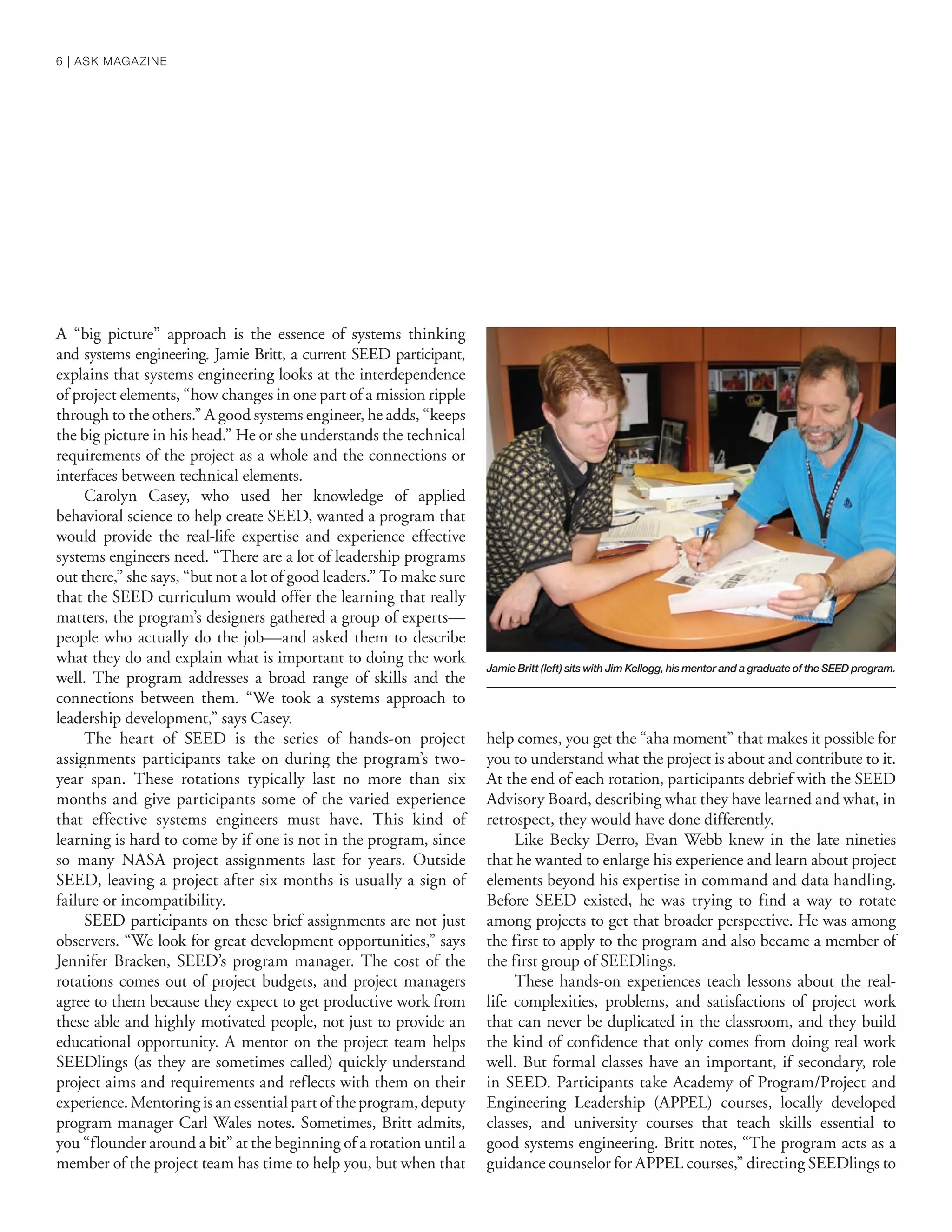
Jamie Britt (left) sits with Jim Kellogg, his mentor and a graduate of the SEED program.
6 | ASK MAGAZINE
the ones they need. And, he says, “part of your job description is
to take courses,” so you avoid the danger of becoming so buried
in project responsibilities that you have no time for courses.
Derro and Webb single out a nuts-and-bolts course in how
to write technical requirements as especially valuable. Webb
quickly had a chance to put this skill to work as the spacecraft
systems engineer on Space Technology 5 (ST-5), a project
to develop and test three micro-satellites. ST-5 undertook a
significant mission redesign—switching from a large to a smaller
launch vehicle—in the middle of Phase C (normally the final
design stage). Webb was responsible for the requirements for
the constellation of three spacecraft and the science validation
requirements.Theinsightshehadreceivedintowritingtechnical
requirements, especially about what to change and what to leave
alone, made it possible to meet this redesign challenge. Many
of the classroom elements of SEED also emphasize real-world
know-how, featuring advice and stories of life “in the trenches”
told by respected NASA veterans.
Human systems and communication skills are also an
important part of the SEED program. Derro and Webb agree
that the human element is the main source of project success
or failure and, says Webb, “You have to deal with the different
expectations of people on the team. This means effective
communication, and communication is both talking and
listening. You have to listen carefully to subsystems people
to understand their viewpoints,” he adds. “You have to read
between the lines and then ask the right questions.” Derro
describes a situation in which her communications training
prepared her to deal with a conflict between bickering team
members. She learned that simply changing the way she
talked—adjusting her voice and posture—communicated a
seriousness that earned respect and made it possible for her
to help resolve the problem. Dealing effectively with people
means engaging with the subtle and messy human dimension
of projects. Part of being a good systems engineer, says Carolyn
Casey, leadership and career development manager, is knowing
you cannot reduce everything to the clear-cut engineering
choices and being comfortable with that ambiguity.
A technical background that gains the respect of the team
andhelpsthesystemsengineerunderstandandevaluatetechnical
issues is important, but the ability to ask good questions,
communicate clearly, and—as always—focus on the big picture
is what defines successful systems engineering. Before entering
the SEED program, Derro thought a systems engineer needed
to be an expert on everything, but duplicating the specialized
knowledge of team members is neither possible nor desirable.
In fact, Webb says, even suggesting faulty technical solutions
has its value. “I come up with a lot of ideas that are wrong,” he
says. In the process of explaining to the systems engineer why
his proposed approach won’t work, specialized engineers clarify
their own thinking. Occasionally, while trying to explain why
the solution is flawed, they discover that it is possible after all
and a good choice.
SEED has advanced Webb and Derro’s careers more
quickly than either expected. Evan Webb was on his last
rotation, on ST-5, when the mission systems engineer left
for other work and Webb successfully competed to take
the job. Becky Derro was at the end of her two-year SEED
program when a friend and branch manager encouraged her
to apply for a senior systems engineer position on a program to
develop an international instrument in cooperation with the
European Space Agency. Although she was younger and less
experienced than other candidates, she got the job, thanks, in
part, to the confidence and competence she gained from the
program. A member of the selecting panel who had known
her before SEED commented on how dramatically she had
matured, saying, “She impressed all the interviewers with her
poise, knowledge, and leadership qualities. You could really
see that the SEED program had been a major influence in her
development.” Derro herself has said, “SEED gave me the kick
in the pants I needed to look at career development. I thought
it just happened, but you have to steer it somewhere.”
Derro and Webb consider it part of their job to identify
other people who they believe would be good systems
engineers and encourage them to apply to the program. Not
all SEED participants become systems engineers, of course.
Some choose to return to their work on subsystems. Even in
those cases, Carl Wales says, the program is a success, both
because it helps those individuals discover that they really do
prefer more focused work and because knowledge of systems
engineering principles has value for every member of a project
team—being aware of how a particular component relates to
the whole helps ensure that the subsystem and the project will
be successful. ●
THESE HANDS-ON EXPERIENCES TEACH LESSONS ABOUT THE REAL-LIFE COMPLEXITIES,
PROBLEMS, AND SATISFACTIONS OF PROJECT WORK THAT CAN NEVER BE DUPLICATED IN
THE CLASSROOM, AND THEY BUILD THE KIND OF CONFIDENCE THAT ONLY COMES FROM
DOING REAL WORK WELL.
ASK MAGAZINE | 7
Cassini-Huygens:
International Cooperation
for Astronomical Achievement
BY KERRY ELLIS
8 | ASK MAGAZINE | STORY8 | ASK MAGAZINE | STORY
Many project managers tout communication and collaboration
as important elements for building a successful team. But what
happens when an ocean separates team members? Tougher
still, what if you throw in a few different languages? Is it still
possible to succeed? Cassini-Huygens’ launch on October 15,
1997, and its successful science data return imply the answer is
“yes,” but language and time zone differences were the least of
its challenges.
When Robert Mitchell joined the Cassini team as project
manager in June 1998, he knew he was walking into a complex
environment. The project was an international collaboration
among seventeen nations that were building the spacecraft and
more than 250 scientists worldwide who would study the data
streaming back from Saturn. NASA’s Jet Propulsion Laboratory
(JPL) built the Cassini orbiter while the European Space Agency
(ESA) built the Huygens probe and the Italian Space Agency
provided communications equipment and major parts for three
instruments on the orbiter.
Of the scientists supporting the combined Cassini and
Huygensmissions,slightlymorethanhalfareEuropeans.Nearly
180engineersalsosupporttheeffort.Thescientistsandengineers
on the team find it challenging to coordinate communication.
Because of its distributed nature, the Cassini team holds many
of its planning meetings through teleconferences, which time
differences make difficult to schedule—8:00 a.m. in California
is 5:00 p.m. in Italy, France, and Germany. The scheduling
problem means scientists participate in observation planning
to varying degrees, but they all receive the data equally. The
team also has three Project Science Group meetings each year.
The formal agreement between NASA, ESA, and Agenzia
Spaziole Italiana (Italy) is that two of those meetings will be
in the United States and one will be in Europe each year, “but
occasionally we reverse that to help maintain a sense of equal
partnership,”Mitchellsays.Thiskindof balanceandcooperation
characterized the project as a whole and, more than once, a
cooperative search to solve a technical problem both served the
mission and resolved apparent conflicts between groups.
An earlier decision not to perform cruise science during
Cassini-Huygens’ seven-year trip to Saturn was one of the first
technical challenges. This decision, made for budgetary reasons,
caused significant conflicts within the project, especially between
the science community, which wanted to take advantage of the
ASK MAGAZINE | 9ASK MAGAZINE | 9
opportunity to do new science, and members of the project
management team, who needed to keep limited engineering
staff focused on preparing for the spacecraft’s arrival at Saturn.
Mitchell asked the two communities to develop a solution
together that would allow cruise science at no additional cost.
“It just seemed that we were missing out on an opportunity
to do new, unique science,” Mitchell explains. “Perhaps more
importantly, we were missing the opportunity to find out how
this machine worked.” The team was already developing nearly
all the ground software and much of the flight software during
Cassini-Huygens’cruisetoSaturn,whichhadalwaysbeentheplan
given the long flight time to the planet. It became apparent that
they could be more effective if they exercised the system as they
went. Pursuing cruise science improved the working environment
and attitudes around the project, and it also helped increase the
capabilities of the systems operating at Saturn and on the ground
today. The cruise science decision made it possible to improve the
technology, gather more data, and bring people together.
That wasn’t the last time testing the system would be an
issue. A previously proposed in-flight test of the probe-to-orbiter
relay link had been denied. It was a relatively simple and risk-
free test to perform, so Mitchell agreed to do it. The team asked
the Goldstone Deep Space Network (DSN) station located near
Barstow, California, to transmit a signal to Cassini that would
simulate the signal coming from Huygens during the relay. The
team would then record the signal on board and play it back
to Earth in the same manner that would be used during the
probe’s descent to the surface of Titan. They originally proposed
using only a carrier signal, but one of the ESA engineers, Boris
Smeds, pushed to make it a full simulation with telemetry. He
even offered to develop everything on his laptop and go to the
DSN station to implement it. “Most people thought this was
overkill, but we agreed to let him do it,” Mitchell says. As it
turned out, the carrier signal was received just fine, but the
telemetry was not. If they had done no test, or just the carrier
test, the team would have lost a significant amount of Huygens’
data and would not have known about the problem until after
the mission was completed.
The problem was a flaw in the design of the receiver,
which was part of the Huygens system but carried on the
Cassini spacecraft. As Huygens descended into Titan’s murky
atmosphere, it would transmit data to Cassini through the
receiver. On many deep space missions, engineers would send
new software and parameters to the system to fix the problem,
but the software and parameters were permanently burned into
firmware in Cassini’s receiver and could not be changed. Solving
the telemetry problem in a sense pitted the Huygens scientists
against the Cassini scientists because the most viable solution
threatened Cassini’s science activities. Prior to discovering the
anomaly, the orbiter was supposed to complete its data relay
with the probe prior to its closest approach to Titan. From the
perspective of the probe, which entered Titan’s atmosphere about
four hours before the orbiter would reach its closest approach,
the orbiter seemed to be coming straight down from overhead
and then zipping by at the last minute. Since the probe slowed
dramatically once it was captured by the moon’s atmosphere, the
orbiter was closing in on it at about 6 km/sec, which was exactly
the problem. The Doppler effect caused by this closing speed
changed the frequency received by the orbiter. The solution
was to change the orbiter’s flyby altitude at Titan from 1,200
kilometers to about 60,000 kilometers so it was flying off to
the side of the probe during the relay instead of coming straight
in. This reduced the maximum closing speed by about half at
the start of the relay and to nearly zero at its closest approach,
which substantially reduced the change in frequency seen in the
original design.
But changing Cassini’s trajectory presented a new problem.
It would require using a significant portion of the propellant
reserves otherwise available for tour anomalies and extended
mission opportunities. It would also affect the sequence
planning work that had already been done for orbiter science
observations and could change the four-year orbital tour, which
had been very carefully crafted to rely on Titan’s gravity on
each flyby. The key to solving this problem lay in shortening
Cassini’s orbital period when it was inserted into orbit around
Saturn. Some remarkable brainstorming between the ESA and
NASA teams came up with changing Cassini’s trajectory so it
also used Titan’s movement across the sky to compensate for
the course change. The shorter initial orbit allowed the team
to insert an additional orbit into their original sequence, which
accommodated the 60,000-kilometer flyby needed for the probe
data relay. The next Titan flyby was unaffected by this redesign,
and from that point on the previously designed tour and science
observation designs were preserved.
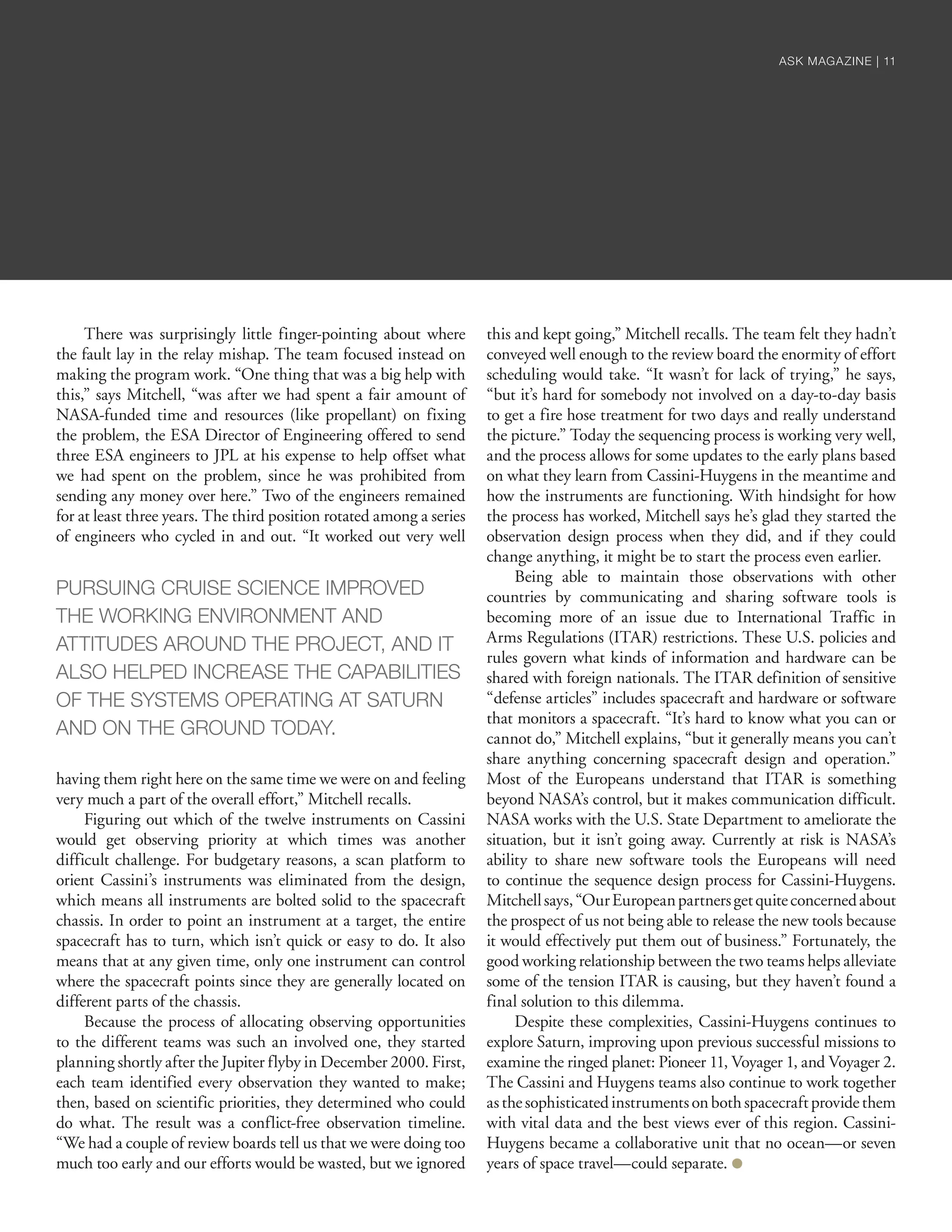
PhotoCredit:NASA/JPL/SpaceScienceInstitute
Cassini captures the rough terrain of Rhea,
another of Saturn’s satellites, during a flyby.
10 | ASK MAGAZINE10 | ASK MAGAZINE
There was surprisingly little finger-pointing about where
the fault lay in the relay mishap. The team focused instead on
making the program work. “One thing that was a big help with
this,” says Mitchell, “was after we had spent a fair amount of
NASA-funded time and resources (like propellant) on fixing
the problem, the ESA Director of Engineering offered to send
three ESA engineers to JPL at his expense to help offset what
we had spent on the problem, since he was prohibited from
sending any money over here.” Two of the engineers remained
for at least three years. The third position rotated among a series
of engineers who cycled in and out. “It worked out very well
having them right here on the same time we were on and feeling
very much a part of the overall effort,” Mitchell recalls.
Figuring out which of the twelve instruments on Cassini
would get observing priority at which times was another
difficult challenge. For budgetary reasons, a scan platform to
orient Cassini’s instruments was eliminated from the design,
which means all instruments are bolted solid to the spacecraft
chassis. In order to point an instrument at a target, the entire
spacecraft has to turn, which isn’t quick or easy to do. It also
means that at any given time, only one instrument can control
where the spacecraft points since they are generally located on
different parts of the chassis.
Because the process of allocating observing opportunities
to the different teams was such an involved one, they started
planning shortly after the Jupiter flyby in December 2000. First,
each team identified every observation they wanted to make;
then, based on scientific priorities, they determined who could
do what. The result was a conflict-free observation timeline.
“We had a couple of review boards tell us that we were doing too
much too early and our efforts would be wasted, but we ignored
this and kept going,” Mitchell recalls. The team felt they hadn’t
conveyed well enough to the review board the enormity of effort
scheduling would take. “It wasn’t for lack of trying,” he says,
“but it’s hard for somebody not involved on a day-to-day basis
to get a fire hose treatment for two days and really understand
the picture.” Today the sequencing process is working very well,
and the process allows for some updates to the early plans based
on what they learn from Cassini-Huygens in the meantime and
how the instruments are functioning. With hindsight for how
the process has worked, Mitchell says he’s glad they started the
observation design process when they did, and if they could
change anything, it might be to start the process even earlier.
Being able to maintain those observations with other
countries by communicating and sharing software tools is
becoming more of an issue due to International Traffic in
Arms Regulations (ITAR) restrictions. These U.S. policies and
rules govern what kinds of information and hardware can be
shared with foreign nationals. The ITAR definition of sensitive
“defense articles” includes spacecraft and hardware or software
that monitors a spacecraft. “It’s hard to know what you can or
cannot do,” Mitchell explains, “but it generally means you can’t
share anything concerning spacecraft design and operation.”
Most of the Europeans understand that ITAR is something
beyond NASA’s control, but it makes communication difficult.
NASA works with the U.S. State Department to ameliorate the
situation, but it isn’t going away. Currently at risk is NASA’s
ability to share new software tools the Europeans will need
to continue the sequence design process for Cassini-Huygens.
Mitchellsays,“OurEuropeanpartnersgetquiteconcernedabout
the prospect of us not being able to release the new tools because
it would effectively put them out of business.” Fortunately, the
good working relationship between the two teams helps alleviate
some of the tension ITAR is causing, but they haven’t found a
final solution to this dilemma.
Despite these complexities, Cassini-Huygens continues to
explore Saturn, improving upon previous successful missions to
examine the ringed planet: Pioneer 11, Voyager 1, and Voyager 2.
The Cassini and Huygens teams also continue to work together
asthesophisticatedinstrumentsonbothspacecraftprovidethem
with vital data and the best views ever of this region. Cassini-
Huygens became a collaborative unit that no ocean—or seven
years of space travel—could separate. ●
PURSUING CRUISE SCIENCE IMPROVED
THE WORKING ENVIRONMENT AND
ATTITUDES AROUND THE PROJECT, AND IT
ALSO HELPED INCREASE THE CAPABILITIES
OF THE SYSTEMS OPERATING AT SATURN
AND ON THE GROUND TODAY.
ASK MAGAZINE | 11ASK MAGAZINE | 11
Leaders’ Responsibility
to Develop Future Leaders
BY GUS GUASTAFERRO
Early in my career, just after I completed a special task on the development of the gas chromatograph
mass spectrometer for the Viking lander, Viking project manager Jim Martin asked me to go to
Denver to manage the day-to-day activities of the all-up systems test on the entire lander. This meant
I needed to find a replacement to carry out the final stages of the spectrometer instrument testing.
I assigned the lead systems engineer, Al Diaz, as the spectrometer project manager, giving him the
opportunity to take on responsibility for the instrument through launch and flight operations. He
met the challenge outstandingly and went on to a strong thirty-year career in NASA executive
leadership. The new responsibility Jim gave me helped both me and Al develop our skills and
advance our careers.
12 | ASK MAGAZINE | INSIGHT
Looking back on my NASA and industry career in project
management and executive leadership, I am struck by the
opportunities I was given by supervisors who cared about
developing future leaders for the Agency. They made a point
of providing growth opportunities and on-the-job mentoring
that helped me realize my leadership potential. While meeting
the mission objectives of a program or enterprise task, I had
opportunities to take on responsibilities and make decisions at a
level that helped me grow as a manager.
Project and program management focuses—as it should—
on getting the job done, but managers are also responsible for
helping promising individuals on their teams develop their skills
and their careers. That attention is important to their futures
and the future of the Agency.
The Challenge
Project and program leaders must accomplish their mission
objectives by using assigned resources effectively. This
challenging responsibility includes assigning key technical and
administrative personnel to roles that can last a decade or more,
assignments often made during the formative part of a career. So
project leads must recognize team members’ career development
needs as well as their direct contributions to the success of the
enterprise. Good leaders devote a significant amount of time
to devising career development plans with each high-potential
person and establishing formal practices for finding program
opportunities that promote career growth.
The project leader and the individual team member should
enter into an agreement that directs primary attention to mission
success but includes a specific plan for individual development.
The agreement should provide a framework for rewarding
performance and dedication to the mission with a commitment
to provide increased responsibilities that lead to career growth
opportunities. I suggest that the project leader and the team
member maintain a mentor relationship and continuously assess
overall performance.
Resources and Responsibilities
for Leadership Development
NASA’s strong training and certification programs are an
important developmental resource, and every opportunity
should be taken to send promising members of a project team
to the project management and advanced project management
courses at Wallops and other NASA facilities. At the same time,
supervisors need to design and structure opportunities within
projects to expose high-potential team members to greater
responsibilities on the job, giving them hands-on challenges
that stretch individuals and promote learning and confidence.
These assignments need to be carefully monitored for progress
and possible adjustment, preferably by continuous mentoring
during the on-the-job training experience. Here, too, the Academy
of Program/Project and Engineering Leadership’s pool of specialists
in project leadership can be helpful, providing mentoring that
includes elements of the soft side of technical leadership—skills
including listening, exhibiting vision, recognizing others, ethics,
and time management. The project leader’s responsibility is to
recognize the need and request the support.
Lessons from Viking
During work on a high-visibility project, day-to-day problems
tend to take priority over career development, but an apparently
hopeless problem within a project can be turned into an
opportunity to achieve career development goals.
In early 1973 for instance, during the Viking Project
developmentphase,itbecamecleartoJimMartinthatchallenges
in manufacturing and testing were delaying development of
a critical science instrument designed to measure the organic
chemistry on the surface of Mars. It seemed almost certain that
this compact, sophisticated instrument would not make the
1975 launch target. Martin’s solution both satisfied mission
objectives and created a career development opportunity.
He requested that I accept the challenge of completing the
instrument development and use it as an opportunity to develop
my project management skills.
At the time of the reassignment, I was Martin’s Deputy
Project Manager for Management Operations. My new
assignment gave me direct authority over the three hardware
contractors and a technical interface with the assigned scientist.
I temporarily relocated to Southern California so I could spend
enoughtimeatthecontractor’sfacilitiestounderstandeveryone’s
role in the project and develop a list of the top technical and
operational issues. I redefined assignments with each member
of the team and set up a daily meeting to assess progress against
plans.IalsofoundthatgivingLittonIndustriessystemintegration
responsibilities over Perkin Elmer and Beckman Industries was
critical to tying the three major hardware elements together.
Becoming a knowledgeable customer and adding frequent
PROJECT AND PROGRAM MANAGEMENT
FOCUSES—AS IT SHOULD—ON GETTING
THE JOB DONE, BUT MANAGERS ARE ALSO
RESPONSIBLE FOR HELPING PROMISING
INDIVIDUALS ON THEIR TEAMS DEVELOP
THEIR SKILLS AND THEIR CAREERS.
ASK MAGAZINE | 13
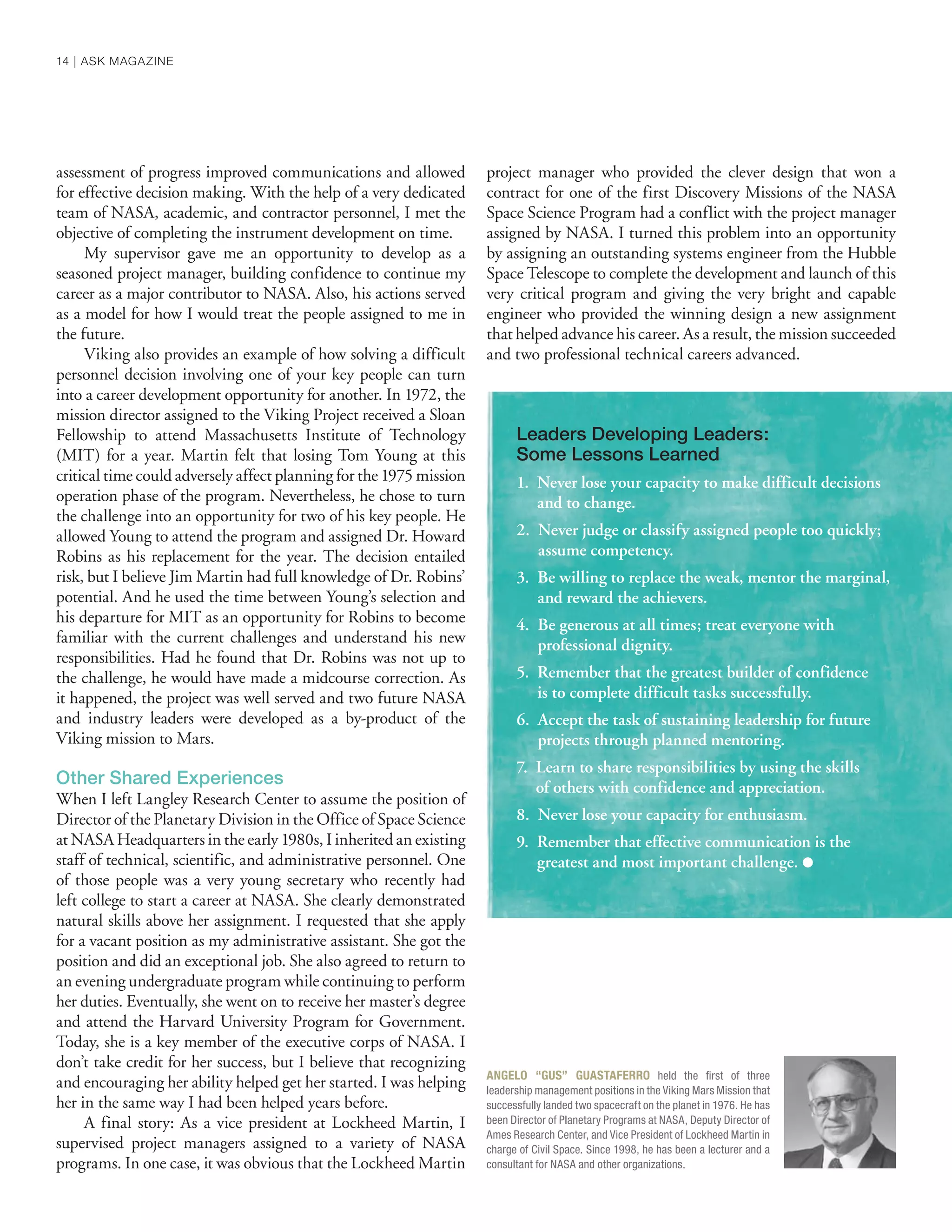
ANGELO “GUS” GUASTAFERRO held the first of three
leadership management positions in the Viking Mars Mission that
successfully landed two spacecraft on the planet in 1976. He has
been Director of Planetary Programs at NASA, Deputy Director of
Ames Research Center, and Vice President of Lockheed Martin in
charge of Civil Space. Since 1998, he has been a lecturer and a
consultant for NASA and other organizations.
assessment of progress improved communications and allowed
for effective decision making. With the help of a very dedicated
team of NASA, academic, and contractor personnel, I met the
objective of completing the instrument development on time.
My supervisor gave me an opportunity to develop as a
seasoned project manager, building confidence to continue my
career as a major contributor to NASA. Also, his actions served
as a model for how I would treat the people assigned to me in
the future.
Viking also provides an example of how solving a difficult
personnel decision involving one of your key people can turn
into a career development opportunity for another. In 1972, the
mission director assigned to the Viking Project received a Sloan
Fellowship to attend Massachusetts Institute of Technology
(MIT) for a year. Martin felt that losing Tom Young at this
critical time could adversely affect planning for the 1975 mission
operation phase of the program. Nevertheless, he chose to turn
the challenge into an opportunity for two of his key people. He
allowed Young to attend the program and assigned Dr. Howard
Robins as his replacement for the year. The decision entailed
risk, but I believe Jim Martin had full knowledge of Dr. Robins’
potential. And he used the time between Young’s selection and
his departure for MIT as an opportunity for Robins to become
familiar with the current challenges and understand his new
responsibilities. Had he found that Dr. Robins was not up to
the challenge, he would have made a midcourse correction. As
it happened, the project was well served and two future NASA
and industry leaders were developed as a by-product of the
Viking mission to Mars.
Other Shared Experiences
When I left Langley Research Center to assume the position of
Director of the Planetary Division in the Office of Space Science
at NASA Headquarters in the early 1980s, I inherited an existing
staff of technical, scientific, and administrative personnel. One
of those people was a very young secretary who recently had
left college to start a career at NASA. She clearly demonstrated
natural skills above her assignment. I requested that she apply
for a vacant position as my administrative assistant. She got the
position and did an exceptional job. She also agreed to return to
an evening undergraduate program while continuing to perform
her duties. Eventually, she went on to receive her master’s degree
and attend the Harvard University Program for Government.
Today, she is a key member of the executive corps of NASA. I
don’t take credit for her success, but I believe that recognizing
and encouraging her ability helped get her started. I was helping
her in the same way I had been helped years before.
A final story: As a vice president at Lockheed Martin, I
supervised project managers assigned to a variety of NASA
programs. In one case, it was obvious that the Lockheed Martin
project manager who provided the clever design that won a
contract for one of the first Discovery Missions of the NASA
Space Science Program had a conflict with the project manager
assigned by NASA. I turned this problem into an opportunity
by assigning an outstanding systems engineer from the Hubble
Space Telescope to complete the development and launch of this
very critical program and giving the very bright and capable
engineer who provided the winning design a new assignment
that helped advance his career. As a result, the mission succeeded
and two professional technical careers advanced.
Leaders Developing Leaders:
Some Lessons Learned
1. Never lose your capacity to make difficult decisions
and to change.
2. Never judge or classify assigned people too quickly;
assume competency.
3. Be willing to replace the weak, mentor the marginal,
and reward the achievers.
4. Be generous at all times; treat everyone with
professional dignity.
5. Remember that the greatest builder of confidence
is to complete difficult tasks successfully.
6. Accept the task of sustaining leadership for future
projects through planned mentoring.
7. Learn to share responsibilities by using the skills
of others with confidence and appreciation.
8. Never lose your capacity for enthusiasm.
9. Remember that effective communication is the
greatest and most important challenge. ●
14 | ASK MAGAZINE
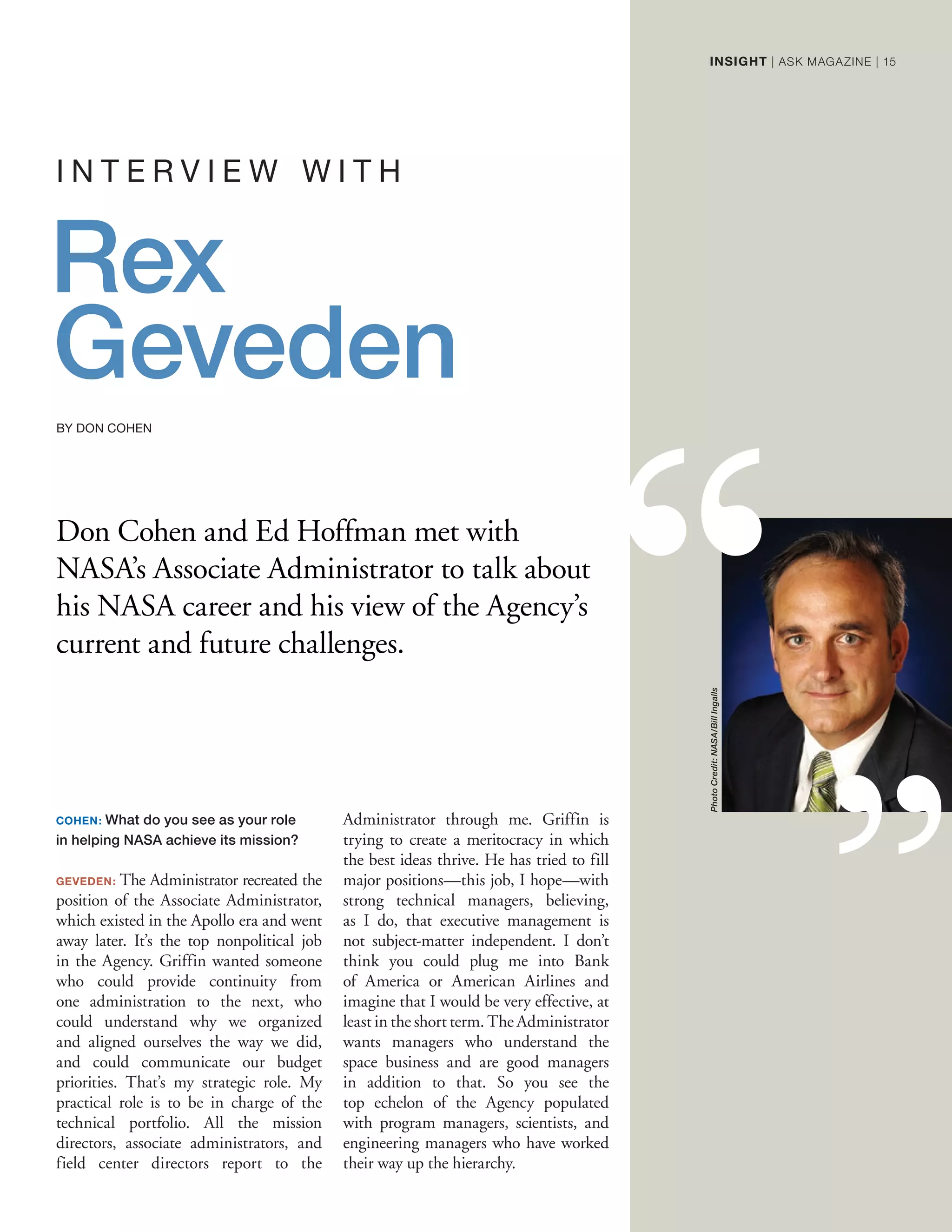
Don Cohen and Ed Hoffman met with
NASA’s Associate Administrator to talk about
his NASA career and his view of the Agency’s
current and future challenges.
I N T E R V I E W W I T H
COHEN: What do you see as your role
in helping NASA achieve its mission?
GEVEDEN: The Administrator recreated the
position of the Associate Administrator,
which existed in the Apollo era and went
away later. It’s the top nonpolitical job
in the Agency. Griffin wanted someone
who could provide continuity from
one administration to the next, who
could understand why we organized
and aligned ourselves the way we did,
and could communicate our budget
priorities. That’s my strategic role. My
practical role is to be in charge of the
technical portfolio. All the mission
directors, associate administrators, and
field center directors report to the
Administrator through me. Griffin is
trying to create a meritocracy in which
the best ideas thrive. He has tried to fill
major positions—this job, I hope—with
strong technical managers, believing,
as I do, that executive management is
not subject-matter independent. I don’t
think you could plug me into Bank
of America or American Airlines and
imagine that I would be very effective, at
least in the short term. The Administrator
wants managers who understand the
space business and are good managers
in addition to that. So you see the
top echelon of the Agency populated
with program managers, scientists, and
engineering managers who have worked
their way up the hierarchy.
Rex
Geveden
BY DON COHEN
PhotoCredit:NASA/BillIngalls
INSIGHT | ASK MAGAZINE | 15
COHEN: Can you describe a specific
instance where your technical background
made an important difference?
GEVEDEN: The Pluto New Horizons
program was scheduled to launch—and,
in fact, did launch—in January this year.
It had a nuclear component on board,
and there were significant problems
with the nuclear launch approval.
There also turned out to be qualification
issues having to do with structural
problems on the RP-1 tank of the Atlas V
rocket that was launching the system.
The Administrator asked me to get
personally involved in the nuclear launch
approval, which was both a technical
and an organizational issue. The RP-1
tank was technical. I was involved in
getting both of those issues resolved
so we could make the launch window.
Launching this January gave us a
Jupiter gravity assist—a slingshot effect
around Jupiter that gets us to Pluto
five years faster. Had we delayed the
launch a year, it would have cost the
Agency another $100 million and the
spacecraft would have had to run another
five years. So it was important to launch
successfully on time.
COHEN: What kind of action did you take
to help resolve these problems?
GEVEDEN: The effort to clear the
radiological health hurdles and get
approval for this launch was disorganized
and politically fractious; I helped pull
that team together so we could submit
a nuclear launch request to the White
House. For the RP-1 tank, I was involved
at the top levels of the engineering review
of the resolution of that problem.
HOFFMAN: When engineers are concerned
about some issue about the rocket that
could affect the launch, you deal with the
question of risk in the context of a tight
launch window. If you don’t have a strong
technical background, how can you make
that decision?
GEVEDEN: We’ve been driving for a clear
separationbetweeninstitutionalauthority
and program authority in the Agency.
The authority has been muddled in the
past. When Griffin came to the Agency,
he said, “We’re going to have a clear chain
of command all the way to the top of the
Agency for technical authority and a clear
chain of command all the way to the top
AN INTERESTING THING about project management IS THAT
YOU FIGURE OUT all the things THAT SHOULD HAVE been done
WHEN YOU GET ABOUT HALFWAY THROUGH.
16 | ASK MAGAZINE
for programmatic authority. That’s the
way we’ll get technical independence.”
COHEN: You’re the point where they
connect.
GEVEDEN: Yes, which means having
the ability to adjudicate a technical or
programmatic issue at the top of the
Agency. That’s what happened in the case
of the RP-1 tank.
HOFFMAN: To me, the new governance
model makes sure you have a strong,
technically independent engineering
capabilitythatcanraiseissuesthatarecore
to engineering and strong, independent
project management that reports to the
mission organizations and ultimately, if
there are differences, to your position.
GEVEDEN: Overtheyears,ourprogramand
project management became almost too
muscular. I think the CAIB [Columbia
Accident Investigation Board] was right
insayingprogramauthoritywasexcessive.
We’ve had a program-dominant culture.
If the program manager said, “I’d like
to improve the factor of safety on that
structure, but I don’t have time,” that
was the end of the discussion. We want
sufficient strength on the engineering
side to hear the other argument, whatever
the eventual outcome. That technical
independence is part of technical
excellence. The other part has to do
with the selection of engineering fellows,
who are thought leaders in the Agency
in certain technical disciplines, and the
ones who approve deviations to NASA-
wide standards when deviations need to
be approved. It’s a whole package that has
to do with reemphasizing the importance
of engineering in the Agency.
COHEN: Do you think NASA has been
effective at getting support from the
public and government?
GEVEDEN: The Agency’s biggest successes
in the last decade or two have tended to
be in the science side of our business.
Everyone recognizes the importance of
the Hubble Space Telescope. To a lesser
extent, people recognize Chandra and
Spitzer for doing x-ray and infrared
images of the universe. Almost everyone
knows about the Mars rovers that are on
the Martian surface right now, or Galileo
and the Huygens probe that we dropped
onto Titan this past year. The science-
attentive public has been excited about
that part of NASA’s business for years.
The other part of the business—human
space flight—has not generated as much
excitement because we’ve basically been
in low Earth orbit for thirty years. The
building of the International Space
Station has been an amazing thing. But
I think we could have done better things
with the money we’ve spent on human
space flight. Having said that, I don’t
think it’s NASA’s job to sell. We’re an
executive branch of the government and
execute the priorities of the president
and Congress. We never will and never
should have an advertising budget. We’re
precluded from lobbying. It is our mission
to communicate what we’re doing and
communicate the knowledge we acquire.
We do the business of the government
in civil space, and we hope that we have
a compelling vision that the people and
Congress support.
COHEN: You’ve talked elsewhere about
watching the first shuttle launch on
television as an inspiring, career-
turning moment for you. Is there
some equivalent inspiration for young
technically minded people today?
GEVEDEN: Yes. Our vision for exploration.
The president of the United States came
to this building and announced a new
vision for space exploration. We have a
compelling vision for the human space
flight program for the first time in forty
years. We’ll launch an exciting robotic
mission to the moon in ’08. We’ll test
launch our new crew vehicle by the
beginning of the next decade. We will be
buildinganoutpostonthemoon—itwon’t
be a flags-and-footprints campaign; we’ll
be doing exciting things on the surface.
Then we’ll be planning for Mars. I think
people who want to study engineering will
rally around the program.
COHEN: In conversations I’ve been
having within NASA, people emphasize
the importance of collaboration and
knowledge sharing across the Agency
to achieve the mission. Do you see
collaboration as especially important?
GEVEDEN: Absolutely, and I believe
collaboration is ultimately a human
undertaking. A lot of people imagine that
the solution to collaboration is a great
software tool, but the idea that someone
is going to log on to their computer in
the morning and be in their community
sharing information is a pipe dream. This
is where I think Ed Hoffman got it right.
The way to make collaboration work is
partly technical but primarily a human
ASK MAGAZINE | 17
endeavor. That’s one of the reasons I’ve
liked the stories in ASK Magazine. I also
like face-to-face human contact. In a
Q&A at a risk management conference,
somebody asked me, “How are we going
to capture the knowledge of Apollo and
Spacelab and the shuttle people who are
retiring from the Agency?” I think the
speaker imagined a knowledge system,
but my answer was, “Go get the people.”
For the Exploration Systems Architecture
Study—done primarily by in-house
peopleandsomeverysmartconsultants—
we put together a graybeard review team
that had the likes of Bob Seamans and
Jay Greene on it. Bob had my job in the
sixties. Jay Greene, who was the chief
engineer on the space station and had
been launch director on Challenger, is
a famous technical curmudgeon in the
Agency. I think this computer [the brain]
is a lot more complex than that one [the
machine on the desk]. Unless people
understand that, they’re going to keep
going down the wrong path.
COHEN: Some corporate efforts to
capture retirees’ knowledge result in
videos and documents no one looks at.
GEVEDEN: That’s a common story. Years
ago, someone briefed me on all the
great lessons stored in NASA’s Lessons
Learned Information System. How many
times have I logged on to it in my career?
Zero. It may work for some people, but it
doesn’t for me.
HOFFMAN: A study we did found that
23 percent of project managers used that
kind of system. Project complexity means
that you’re going to call an expert if you
have a problem. You have to go to the
tacit knowledge of experts who’ve dealt
with the same problem.
COHEN: Are there other things NASA
might do to support knowledge sharing?
GEVEDEN: The other day we met with
some folks from Northrop Grumman
who said that some old-timers at the
Grumman New York operation are
voluntarily archiving design drawings,
organizing them so they’d be useful to
the present generation of lunar explorers.
It occurred to me that we might pull
together a mentoring program pairing
retired smart people with younger people
now in the system. That could be a low-
cost way to bring in people who don’t
want to be consultants or full-time
employees but want to give something
back. Eighty percent of the people at
NASA are here because of the vision, the
missions. People will do extraordinary,
unexpected things because they love the
space program deeply.
HOFFMAN: You should talk about how
your career evolved. I think Rex has
proven the value of hands-on experience
combined with the tools that have been
available—the mentoring support and
training experience.
GEVEDEN: I have invested a lot in career
development over the years. I’m a goal
setter. I write down and track goals
related to career, family, and other areas
at least on an annual basis in a pretty
detailed way. When I wrote my first set
of NASA-related goals, I said I wanted
to be a project manager and a program
manager. Then I wanted to manage
people who manage projects and
programs. It was about that time that I
first ran into Ed, who was the leader in
NASA in figuring out that it was going to
be important for the Agency to develop
a project management career path.
He understood that NASA was about
programs and projects: mission success
notjustintermsofflightsuccess—which
was the biggest thing—but delivering
projects on cost and on schedule. We
were entering an era in which budgets
were not unconstrained like they were
in Apollo; they required more discipline
andmoreprojectmanagementcapability.
NASA eventually developed a Project
Management Development Process—
PMDP. I was a guinea pig, one of the
four at my field center to get involved,
and went through the certification
efforts about ten years ago. I took the
requisite training and tried to check off
the experiential boxes that would get me
certified to level four, the top level in
our system. I ended up being the first
person certified level four and featured
that prominently in my job applications
and in my résumé. General Dailey, who
was the deputy of the Agency, gave my
certificate to me in a public setting and
created a lot of buzz.
HOFFMAN: Some people wait for the
organization to take care of them. But
if you wait at the bus stop, the bus may
not be going where you want. Rex is an
example of taking personal responsibility
for using organizational resources. NASA
is blessed with resources, but people need
to take responsibility for figuring out
what is right for them.
18 | ASK MAGAZINE
GEVEDEN: I happened to be coming along
when the Agency was clamoring for
project and program managers with any
amount of experience. I went from doing
projects that you could put on a chair to
running an observatory-size spacecraft—
Gravity Probe B, which was a 7,000-
lb. engineering marvel, an amazingly
complex spacecraft. It was a baptism of
fire for me. It was the best way for me to
learn, but it was not without some risk to
the Agency.
COHEN: What were some of the
challenges?
GEVEDEN: I had never worked with a large
prime contractor before. I hadn’t had
experience interfacing launch vehicles
to spacecraft, not in a big way. I dealt
with senior-grade people from university
and industry, and it was hard for me to
understand and exercise my authority
when I was so outranked. An interesting
thing about project management is that
you figure out all the things that should
have been done when you get about
halfway through. Some you can fix and
some you can’t. Gravity Probe B was
a management experiment—that was
the way it was described in the program
commitment agreement. The idea was
that NASA would stand back and let the
contractor, Stanford University, succeed
or fail. But there’s no tolerance for
programmatic failure or mission failure
in the Agency, and there shouldn’t be.
COHEN: So you couldn’t step back?
GEVEDEN: Growing our authority over
time and trying to do it in a way that
wouldn’t disrupt the program and the
stakeholder relationships was a balancing
act that helped me develop as a manager.
One of the miracles of the program was
how the Stanford team grew. Some young
Ph.D.s and post-docs developed technical
program management skills very quickly.
Itwasamazingtowatchthoseguysmature
and blossom. There were something like
seventy-nine Ph.D.s awarded at Stanford
on the Gravity B program.
COHEN: Should program and project
managers coming up now take on
projects that are a stretch?
GEVEDEN: Yes. Pick your energetic,
talented, ambitious folks and give them
a stretch. I would rather do that than be
safe and give the program to someone
with more experience but less drive and
less reach.
HOFFMAN: One last question: What do
you hope to accomplish in this position
in the next five years?
GEVEDEN: One thing, because I believe
so strongly in the program, is to make
sure we have a thoroughgoing, highly
supported exploration program. Space
exploration is one of the ways that great
nations assert their leadership. It’s an
expression of our autonomy, our culture,
our way of life. Another thing I’d like
to do is to see that processes around
governance and technical authority
become so good and so embedded that
they can survive the transition from
one administrator to the next. I believe
that we’re organized and executing now
better than I’ve ever seen before. I would
like to help preserve that legacy. ●
I BELIEVE THAT WE’RE organized and executing NOW
BETTER THAN I’VE ever seen before. I WOULD LIKE TO
HELP preserve THAT LEGACY.
ASK MAGAZINE | 19
Unexpected Delays
Equal a Chance
to Innovate
BY HUGH WOODWARD
20 | ASK MAGAZINE | STORY
It started like any other project. We had a scope statement, a
diverse team, a list of interested contractors, and the enthusiastic
support of management. We even had binders with an indexed
list of the techniques deemed essential for successful projects:
communication, change management, risk management, and
all the others. Although we had challenging cost and schedule
requirements, we knew we had an excellent plan. Nothing
could prevent us from delivering this project on time and under
budget. At least, that is what we thought!
The first hint of a problem came in the form of questions
about our spending curve. The company was concerned about
its overall capital spending and was looking for opportunities
to delay major expenditures into the next fiscal year. We were
able to oblige initially. We reassessed our schedule and proudly
offered a new plan with the most expensive work deferred to late
in the project. The best news was that we would still meet our
original cost and schedule commitments.
Ourexcitementwasshortlived.Nosoonerhadwesubmitted
our new plan than we were asked to reduce early spending even
more. In fact, each new plan drew the same request. Eventually,
we had to admit we could no longer complete the project on
time. That is when the second blow hit us. We were informed
the project was no longer a top priority. In fact, some members
of management wanted to cancel it. Morale within the project
team plummeted. Just a few short weeks earlier, our project had
been priority number one. Success was guaranteed. Now we
were on the verge of being shut down.
Our project was intended to increase production by
modifying twenty-one paper machines at four manufacturing
plants located throughout the United States. We planned to
install control devices designed to reduce defects and allow us to
speed up the machines. Some of the technology was new, even
unproven, but our technical experts assured us it would work.
A “no brainer,” they called it. We probably should have known
better, but we didn’t, and confidently developed a list of which
devices were to be installed on which machines and how much
additional production we could expect from each.
However,oursalesvolumewasnotdevelopingasanticipated.
Asdisappointingmonthlysalesreportscontinuedtoaccumulate,
management became increasingly reluctant to spend money on
increasing production. Eventually we were ordered to put the
project on hold but to be ready to restart at any moment.
It was time for a new strategy. Since we were no longer
under a time constraint, we decided to reduce our risk by
prototyping each of the technologies included in the original
scope. We installed and tested each device on a different paper
machine. To our surprise, some did not work as intended.
Some produced unintended side effects that actually decreased
production. But fortunately, not all were failures. Some
worked much better than we expected, enabling us to increase
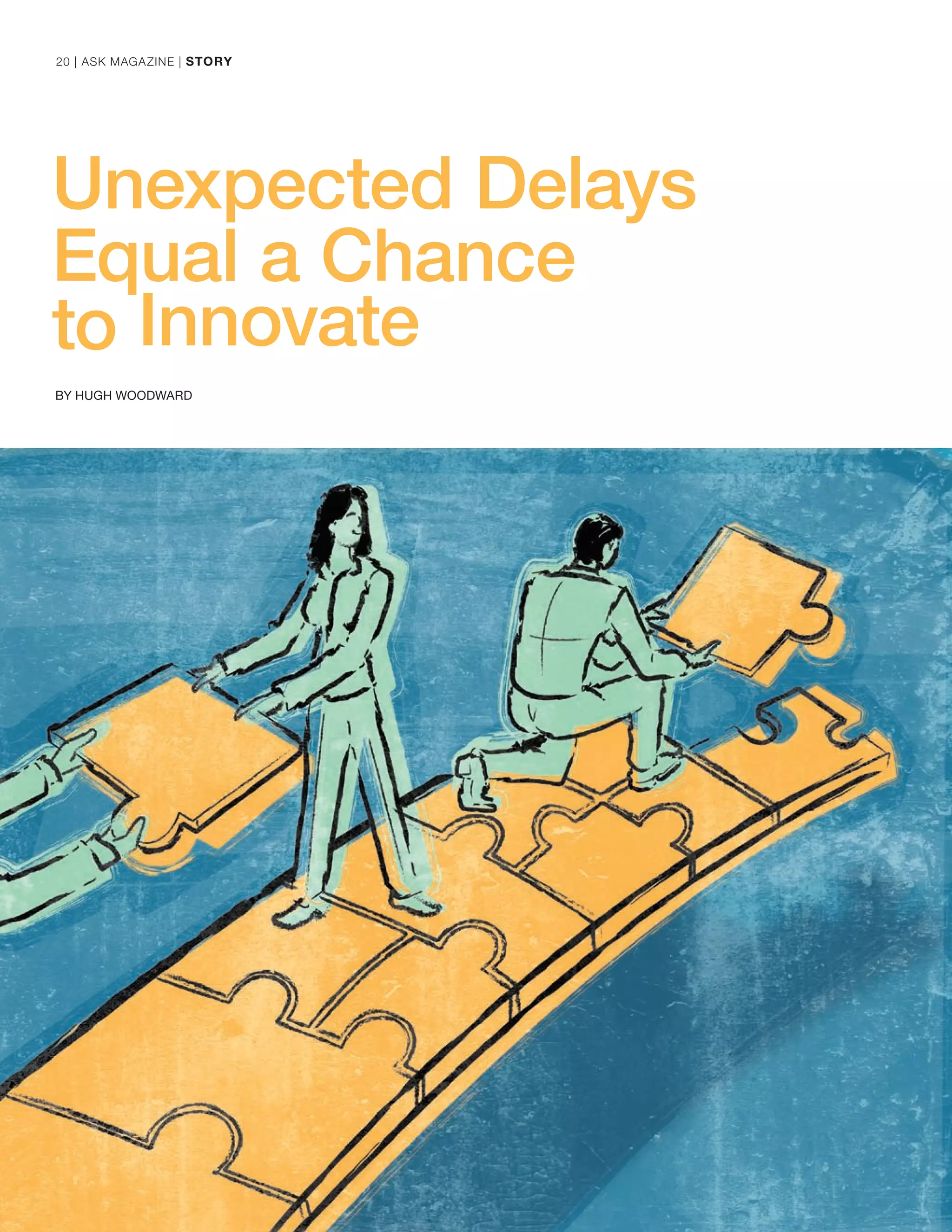
Sometimes a delay is the best thing that can happen to a project. While I was program
manager, funding problems that slowed and threatened to cancel our plans to improve the
efficiency of our paper manufacturing processes gave us time to prototype and test new
technologies repeatedly. As a result, we developed solutions that were even better than our
initial overconfident estimates of how well untried improvements would work.
ASK MAGAZINE | 21
the production rate by two or three times the amount we had
initially estimated.
The obvious solution at this point was to modify our scope.
Clearly, we could achieve the same overall production increase
by just installing the devices that worked best and abandoning
the others. But an even better strategy began to emerge. As the
technical experts analyzed the results of our prototypes, they
came up with new ideas. The experts identified modifications
that could work even better than the devices that had proven
successful. So we prototyped these ideas, too. It no longer
surprised us that some worked and some did not. The results
prompted even more ideas.
To help generate more new ideas, we looked to the
manufacturing plants. These plants have process engineers who
continually work to improve efficiency. They collect loss data
and then look for ways to reduce the most prevalent losses. In
tissue manufacturing, for instance, the most significant loss
almost always comes from “sheet breaks.” The dry paper comes
off the end of a paper machine at 4,000 feet per minute or more;
when it breaks, the machine has to be shut down for several
minutes while the mess is cleaned up. The process engineers try
to identify and eliminate the causes of sheet breaks.
To encourage the development and propagation of
successful ideas, my project team conducted its meetings at each
of the manufacturing sites in turn. Our agenda at each meeting
included presentations by the local process engineers of their
problems and the ways they were solving them. Invariably, the
visitors from other plants saw opportunities to apply the ideas at
their plants, and we adopted them as part of our project.
Eventually, the company’s sales began to recover and
management started asking for increased production. By
this time, we had a menu of proven technologies ready for
installation. We were therefore able to quickly reapply the
modifications that provided the best return on investment. We
now had a proven strategy, and we resisted the temptation to
deviate. We continued to encourage new ideas, but insisted on
testing them on a single paper machine before declaring them
ready for reapplication.
We eventually ran out of money five years after the project
was initially authorized, and more than three years after our
original completion date. But by that time, we had achieved
three times the production increase we had initially promised.
We still had to complete the paperwork to explain why we
changed the scope and missed our completion date, of course,
but nobody really cared. The real project objective was to
increase production at an affordable cost, and we had succeeded
beyond our wildest dreams.
Real evidence of success came when the company asked us
to submit paperwork for a new project. This time, we admitted
our scope was a guess and sure to be wrong. But management did
not care. They just told us to continue with the same approach
and gave us the amount we requested. It was the easiest project
approval I ever experienced.
If our project had not been delayed by funding problems, we
would have fulfilled our initial cost and schedule commitments
but produced only a fraction of the production increase we
promised. Fortunately, we were able to turn those problems
into an opportunity to develop and test innovative technology
that far outperformed our initial expectations. And we delivered
what the company really wanted: additional production at an
affordable cost. ●
WE EVENTUALLY RAN OUT OF MONEY FIVE YEARS AFTER THE PROJECT WAS INITIALLY
AUTHORIZED, AND MORE THAN THREE YEARS AFTER OUR ORIGINAL COMPLETION DATE.
BUT BY THAT TIME, WE HAD ACHIEVED THREE TIMES THE PRODUCTION INCREASE WE HAD
INITIALLY PROMISED.
HUGHWOODWARDpracticedprojectandprogrammanagement
formorethantwenty-fiveyearsattheProcter&GambleCompany.
He is a former Chair of the Project Management Institute and now
helps companies eliminate unproductive effort and unnecessary
costs as President of Macquarie Business Concepts.
22 | ASK MAGAZINE22 | ASK MAGAZINE
Success Through Failure
BY HENRY PETROSKI
“Nothing succeeds like success” is an old saw with many different teeth—some still sharp and
incising, some worn down from overuse, some entirely broken off from abuse. In fact, the saying
borders on tautology, for who would deny that a success is a success is a success? We know success
when we see it, and nothing is quite like it. Successful products, people, and business models are
the stuff of best sellers and motivational speeches, but success is, in fact, a dangerous guide to follow
too closely.
INSIGHT | ASK MAGAZINE | 23
Imagine what would have happened if the Titanic had not
struck an iceberg and sunk on her maiden voyage. Her
reputation as an “unsinkable” ship would have been reinforced.
Imagine further that she had returned to England and
continued to cross and recross the North Atlantic without
incident. Her success would have been evident to everyone, and
competing steamship companies would have wanted to model
their new ships after her.
Indeed, they would have wanted to build even larger ships—
and they would have wanted to build them more cheaply and
sleekly. There would have been a natural trend toward lighter
and lighter hulls, and fewer and fewer lifeboats. Of course, the
latent weakness of the Titanic’s design would have remained, in
her and her imitators. It would have been only a matter of time
before the position of one of them coincided with an iceberg and
the theretofore unimaginable occurred.
ThetragedyoftheTitanicpreventedallthatfromhappening.
It was her failure that revealed the weakness of her design. The
tragic failure also made clear what should have been obvious—
that a ship should carry enough lifeboats to save all the lives
on board. Titanic’s sinking also pointed out the foolishness of
turning off radios overnight, for had that not been common
practice with the new technology, nearby ships may have sped
to the rescue.
A success is just that—a success. It is something that works
well for a variety of reasons, not the least of which may be luck.
But a true success often works precisely because its designers
thought first about failure. Indeed, one simple definition of
success might be the obviation of failure.
Engineers are often called upon to design and build
something that has never been tried before. Because of its
novelty,thestructurecannotsimplybemodeledafterasuccessful
example, for there is none. This was certainly the case in the
mid-nineteenth century when the railroads were still relatively
new and there were no bridges capable of carrying them over
great waterways and gorges. Existing bridges had been designed
for much lighter traffic, like pedestrians and carriages.
The suspension bridge seemed to be the logical choice for
the railroads, but suspension-bridge roadways were light and
flexible, and many had been blown down in the wind. British
engineers took this lack of successful models as the reason to
come up with radically new bridge designs, which were often
prohibitively expensive to build and technologically obsolete
almost before they were completed.
The German-born American engineer John Roebling, the
bicentennial of whose birth is being celebrated this year, looked
at the history of suspension-bridge failures in a different way. He
studied them and distilled from them principles for a successful
design. He took as his starting point the incontrovertible fact that
wind was the greatest enemy of such bridges, and he devised ways
to keep the bridge decks from being moved to failure by the wind.
Among his methods were employing heavy decks that did
not move easily in the wind, stiffening trusswork to minimize
deflections,andsteadyingcablestocheckanymotionsthatmight
develop. He applied these principles to his 1854 bridge across the
Niagara Gorge, and it provided a dramatic counterexample to
the British hypothesis that a suspension bridge could not carry
railroad trains and survive heavy winds. The diagonal cables
of Roebling’s subsequent masterpiece, the Brooklyn Bridge,
symbolize the lessons he learned from studying failures.
Ironically,theBrooklynBridge,completedin1883,servednot
as a model of how to learn from failure but as one to be emulated
as a success. Subsequent suspension bridges, designed by other
engineers over the next half century, successively did away with
the stay cables, the trusswork, and finally the deck weight that
Roebling had so deliberately used to fend off failure.
At first, the size of the main span of the suspended structures
increased in small increments. The 1,600-foot inter-tower span
of the Williamsburg Bridge, completed in 1903, was only a
few feet longer than that of the Brooklyn Bridge, but like all
subsequent record-setting suspension bridges it was designed
without stays. However, it did have an extremely deep truss,
which made it look ungainly.
Over the next two decades, the main span of suspension
bridges was increased only gradually. When the Benjamin
Franklin Bridge opened in 1926, its world-record 1,750-foot
span was less than 10 percent greater than that of the Brooklyn
Bridge, which was then more than forty years old. But bridges
like the Williamsburg, Manhattan, and Ben Franklin, serving
the traffic of large cities and carrying mass transit tracks, were
necessarily wide and consequently heavy, and they all had very
visible stiffening trusses.
The next dramatic departure from Roebling’s recipe for
failure-based success was achieved in the George Washington
24 | ASK MAGAZINE
Bridge, which was completed in 1931. This enormous structure,
with a main span of 3,500 feet, almost doubled the record,
representing an amazing 95 percent increase over the previous
record holder, the Ambassador Bridge in Detroit.
However, the George Washington Bridge not only represented
a great reach beyond the envelope of experience, it also represented
a new direction in the design of suspension bridges. In having
no stiffening truss at all, it did away with another of Roebling’s
specificationsfordealingwiththewind.ButtheGeorgeWashington
Bridge was an enormous success, in large part because its cables and
deck were so massive that their inertia ensured that the wind would
not move them to any appreciable extent.
The success of the George Washington Bridge ushered in a
new era of suspension bridge design, one that was characterized
by an aesthetic of slenderness. This soon became the goal
for virtually all suspension bridges designed and built in the
1930s, including the Golden Gate Bridge, which opened in
1937. At 4,200 feet between towers, that San Francisco bridge
represented another 20 percent leap in length. And even though
it incorporated a deck truss, it furthered the aesthetic of lightness
and slenderness of appearance.
The culmination of this steady paring down of Roebling’s
design principles was reached in the late 1930s, when bridges
were increasingly being built longer, lighter, and more slender.
However, unlike the George Washington and the Golden Gate,
which were designed to carry a relatively large number of lanes of
traffic, many of the newer bridges were designed for remote areas
wheretrafficprojectionscalledforasfewastwolanesandvirtually
no sidewalks, which made for spans that were not only long but
also exceedingly narrow. And, in keeping with the new aesthetic,
the roadways were also very shallow, making for structures that
provided little stiffness against bending and twisting.
The deck of the Bronx-Whitestone Bridge, completed in
1939 just in time to carry traffic to the World’s Fair in Flushing
Meadows, began to undulate in the wind, as did that of the
Deer Isle Bridge in Maine, which opened that same year. Other
contemporary bridges also proved to be susceptible to the wind
and exhibited excessive movement of their roadways. Engineers
disagreed on the cause and remedy of the unexpected motion,
and also on exactly how to retrofit the bridges with cables to
check it. Still, no one appears to have feared that the bridges
were in imminent danger of collapse.
The Tacoma Narrows Bridge, completed in 1940, at
first behaved in much the same way, with its deck rising and
falling in great undulations. The fun of driving over it actually
increased beyond all expectations the amount of traffic using
the bridge, which had come to be nicknamed Galloping
Gertie. The fun lasted for only four months, however, at the
end of which the bridge deck began to move in a new way. It
started to twist with great amplitude, and after only hours of
such motion its deck collapsed into the arm of Puget Sound
that it had been designed to cross.
The story of suspension bridges from the Brooklyn to the
Tacoma Narrows provides a classic case history in the value
of designing against failure and the danger of gaining undue
confidence from successful achievements. Today, there is a new
type of bridge whose evolution may be following all too closely
more recent models of success.
A cable-stayed bridge may be thought of as a Brooklyn
Bridge without the swooping suspension cables. The new form
lends itself to considerable aesthetic variation in how its cables
are arranged, and so it has become the bridge type of choice
for signature spans. The cable-stayed Leonard P. Zakim Bunker
Hill Bridge crowned Boston’s Big Dig, and Charleston’s new
cable-stayed Ravenel Bridge has already become that city’s
new symbol.
But as cable-stayed bridges have grown in length and
daring, their cables have been stubbornly difficult to control
in the wind. Many such bridges have had to be retrofitted
with damping devices to check the cable motion. Even though
the aerodynamic phenomena involved are not completely
understood, longer and sleeker cable-stayed bridges continue to
be designed and built around the world. It is as if the history
of suspension bridges was being repeated. Let us hope that the
precursors to failure become understood before the models of
success are pushed too far. ●
...A TRUE SUCCESS OFTEN WORKS PRECISELY BECAUSE ITS DESIGNERS THOUGHT
FIRST ABOUT FAILURE. INDEED, ONE SIMPLE DEFINITION OF SUCCESS MIGHT BE
THE OBVIATION OF FAILURE.
HENRY PETROSKI is the Aleksandar S. Vesic Professor of Civil
Engineering and a professor of history at Duke University. He is
the author of Pushing the Limits: New Adventures in Engineering
and other books on engineering and design. His latest, Success
Through Failure: The Paradox of Design, has just been published
by Princeton University Press.
ASK MAGAZINE | 25
On Launch Complex 41 at Cape Canaveral
Air Force Station in Florida, the fifth and
final solid rocket booster nears the top of
the Lockheed Martin Atlas V rocket in the
Vertical Integration Facility.
Photo Credit: NASA
THE
ENGINEERING
WHITEPAPER
BY JAMES WOOD
26 | ASK MAGAZINE | STORY26 | ASK MAGAZINE | STORY
The New Horizons mission encountered an issue with the Atlas V booster RP-1 fuel
tank four months before launch—a remarkably complex problem that involved
NASA Headquarters, Safety and Mission Assurance, NASA Engineering and
Safety Center, and the folks at Lockheed Martin who designed the system. We
needed a way to communicate the facts and logic of the situation in greater
detail than a typical briefing package provided. PowerPoint was not going to
cut it. Engineers have a terrible rap for not being able to write and, to be fair,
most aren’t asked to do so. If I’m not asked to do something and I don’t push
myself to do it on my own, I won’t ever cultivate the skill, and writing a clear,
complete white paper is a skill worth cultivating.
PhotoCredit:NASA
(Left to right) David Kusnierkiewicz, New Horizons mission system engineer;
Glen Fountain, Applied Physics Lab project manager; and Alan Stern, principal
investigator from Southwest Research Institute, take part in a dress rehearsal for
the New Horizons launch at their consoles in the Atlas V Space Flight Operations
Center on Cape Canaveral Air Force Station.
ASK MAGAZINE | 27
I wrote a lengthy paper describing the Atlas V RP-1 qualification
tank failure and our resolution for the Pluto New Horizons
missionbecauseIrealizedweneededabetterwaytocommunicate
our approach for acquiring and evaluating the data required
to make a very tough flightworthiness decision. We needed
to articulate specific details and our logical framework in a
manner that people who had to come to grips with the issue on
multiple levels—technical, management, mission assurance—
could understand.
Writing out the logic that leads to a conclusion is a great
way to clarify your reasoning to yourself and others. When I
write things down, I’m forced to tighten my logic. Many of us
think well “on our feet,” but there’s always a danger that the
logic developed during a rapid interchange of ideas and solutions
has crucial defects that aren’t immediately apparent. Darren
Bedell and I, the chief engineers in the Kennedy Space Center
Launch Services Program, subscribe to the rule that our logic
for resolving a problem has to make sense when written down.
I might have something of a preconceived opinion (admit it,
most of us do), but when I start writing it out, I find that, wait
a minute…this piece of evidence fits here, that fits there, and
then, you know, something else might not fit at all anymore.
That’s when we realize the logic has a flaw, and we need new
logic, or more data, or fresh input—and often all three.
Putting the details and logic in a form that can be read, re-
read, and studied also communicates complex problems better
thana setofPowerPointchartsaccompaniedbyaverbalbriefing.
The specifics of the New Horizons problem were difficult to
communicate. You could explain them with spoken words and
charts to a manager or stakeholder who then might say, “OK, I
get it, this makes sense.” But when that person talks to the next
person, who talks to the next person, and so on up the chain,
you end up playing the telephone game. Even with the best of
intentions, things get lost or distorted. Especially for a complex
issue like this one, a single wrong or missing detail can be worse
than knowing nothing. In addition to testing our reasoning, the
white paper helped accurately communicate all the important
information to everyone involved.
Managers of technical review processes have to keep in
mind that many people don’t process information very well in a
meeting. And people miss meetings or parts of meetings. Before
starting the white paper, I had already been convening eight-hour
Engineering Review Boards (ERBs) where we hammered out
decisions one after another. We can do it—we’re used to doing
it, we’re capable of doing it, and practice has schooled our minds
to think reasonably well in those forums. But that doesn’t mean
Technicians install strips of the New Horizons mission decal on the spacecraft
fairing in the Payload Hazardous Servicing Facility.
PhotoCredit:NASA
28 | ASK MAGAZINE
that somebody who wasn’t schooled in those forums won’t have
a valid point. So I asked myself, “What’s another way I could
communicate what we developed in that forum?” We write down
our recommendations and rationale from ERBs, but usually not
in the kind of detail that would help someone understand what
led to our conclusions. The paper for the New Horizons booster
RP-1 tank ended up being forty pages long, because that’s what it
took to convey the important thoughts clearly.
You simply can’t hand somebody a briefing package and
expect him or her to understand the rationale for a decision if
they haven’t been exposed to the meeting where the material was
presented and discussed. I see that mistake made over and over
again. Sometimes you can get the gist of a discussion from the
package, and sometimes you can’t. The RP-1 problem was an
issue where the briefing package couldn’t tell you the real story.
A white paper allows you to communicate to a wider
audience, so people don’t fall victim to the telephone game, and
you reach people who are technically capable of criticizing your
logic and your data but could not attend your review boards.
Ralph Roe of the NASA Engineering and Safety Center couldn’t
attend a single one of my review boards, but he provided very
effective and useful input through criticism of the white paper
and offered recommendations for strengthening our logic. One
of his immediate observations after reading an early draft was
we had failed to provide a rationale for adequate fatigue life,
which is the amount of strain our parts can take before they fail.
We had discussed our fatigue life rationale in many forums, but
it didn’t appear on any charts. Neither had we done a thorough
job of writing that rationale down. I ended up writing another
ten pages to express our logic and, in the process, found that our
rationale was actually stronger than we’d originally thought.
Providing folks an opportunity to offer constructive, informed
input outside the lengthy and intense technical meetings adds
considerable strength to the technical approach to a complex
problem. I run forums open to everyone as long as they don’t
bring up cost and schedule, but not everybody can engage
verbally or devote time to those forums. That’s an important
lesson learned for me.
After New Horizons, Darren Bedell, our other chief
engineer, said, “You know, that worked exceptionally well. I’ve
got another problem—it’s not similar, but it’s complex. People
are being victimized by the telephone game, and we’ve held
these awful, lengthy ERBs. Let me write down what we did and
why and try that out for people to review and criticize and offer
their comments.” It worked beautifully. I understand that the
folks working to resolve the shuttle external tank foam issues
have also made excellent use of this strategy.
The white paper tool was always in our toolbox, but I think
we now know better how to use it effectively. You don’t often see
NASA technical managers writing long narratives explaining
why they did what they did and how all the details fit together,
but that may be the best way to capture the logic and context
of complex decisions. It can be useful both to people at the
management level who have not been directly involved in the
work and to somebody who’s down deep in the mud with me
and my team. White papers are a labor-intensive tool best used
when no other will do the job. Writing a twenty- to forty-page
white paper for every decision you make is not possible or
necessary, and not everyone is used to writing, but we should
use it more. Sometimes it’s the only way to go. ●
ASK Magazine would like to extend special thanks to Matt Kohut,
member of the APPEL team and editor of the ASK OCE newsletter,
for his assistance.
JAMES WOOD is one of the two chief engineers for NASA’s
Launch Services Program. After receiving a B.S. in physics,
he worked in the industry as a guidance and control systems
engineer for several years before joining NASA in 1995. He has
been the chief engineer for thirty-five missions since joining the
Launch Services Program in 1999.
YOU SIMPLY CAN’T HAND SOMEBODY A BRIEFING PACKAGE AND EXPECT HIM OR HER TO
UNDERSTAND THE RATIONALE FOR A DECISION IF THEY HAVEN’T BEEN EXPOSED TO THE
MEETING WHERE THE MATERIAL WAS PRESENTED AND DISCUSSED. I SEE THAT MISTAKE
MADE OVER AND OVER AGAIN.
ASK MAGAZINE | 29
Sharing Responsibility
for Risk
BY BRENT ROBERTSON AND JERRY KLEIN
The Solar Dynamics Observatory (SDO) mission will help
us better understand the dynamic structure of the sun and
what drives solar processes and space weather. Goddard is
building the spacecraft in house, managing and integrating
the instruments, developing the ground system and mission
operations, and will perform observatory environmental testing.
We have a compelling mission with well-defined requirements,
adequate funding, a seasoned project management team, a
resources staff capable of miracles, experienced instrument
teams, strong systems and quality assurance engineering, top-
notch engineers, and Center management eager to help with
problems. It’s what I consider a dream team for anticipating
and correcting problems. But would this expertise really
matter when we were using a risk management process none
of us had used before?
SDO is one of the first Goddard in-house flight projects
to use the formal continuous risk management process now
required by NASA Headquarters. Our risk management plan
required approval from the Goddard Office of System Safety
and Mission Assurance to ensure that all the elements in the
NASA standards and guidelines were adequately addressed.
Since we know that communication is critical to managing
risk successfully, we included a risk management coordinator
in our plan to solicit potential risks from project personnel and
help disseminate risk data throughout the project.
Unlike risk management tools used only by the project
manager, our risk management system is integrated into the
SDO project culture. Everyone is responsible for identifying
and mitigating risks. Each month, we solicit new risks through
an interview process and discover others in meetings, vendor
status reports, hallway discussions, voicemails, and e-mails.
We collaboratively develop mitigation plans for each risk, then
discuss the risk and our plan to alleviate it at a monthly risk
meeting with project senior staff. We are uncovering more
potential risks because we have a group instead of one person
looking for them. Because everyone has their special areas of
expertise, they are better able to point out issues within their
subsystems than an outsider would.
Many NASA accident investigations point to poor
communication as an important factor: someone in the project’s
rank and file sees a problem but does not successfully report
it to the top. Our risk management system, which makes risk
everyone’s business, improves communication, giving people
permission—in fact requiring them—to report perceived
problems up the chain. For example, special meetings with our
subsystem teams have not turned up any additional risks because
their concerns have already been successfully communicated.
Working as a team to manage risk also helps create a common
vision across the project, giving people a better idea of the shared
goal and helping them see beyond their own part of the project
at the subsystem or component level.
So we believed our new risk management system worked
well, but I wanted to measure its effectiveness, if possible. I
did a quick search that turned up a lot of material about risk
Wouldn’t it be nice to have a project management crystal ball that revealed all problems before they
occurred? Then they could be anticipated, mitigated, and dealt with before they affected technical
performance, schedule, or cost. As the Observatory Manager for a large space science mission at
NASA’s Goddard Space Flight Center, I didn’t have a crystal ball, so I wondered how good our team
was at preventing problems before they occur.
30 | ASK MAGAZINE | INSIGHT
management systems but little information on their metrics. I
realized we could measure effectiveness by how many active,
retired, or accepted risks we had and how long it took us to
mitigate them and at what cost. Active risks are reviewed
regularly at the monthly risk management meetings. Retired
risks are those whose likelihood has been reduced to zero.
Accepted risks are those we accept with process controls to
mitigate single-point failures, where a single component failure
could end the mission (for instance, premature deployment
of solar arrays, structural failure, propellant leaks) or those
we think are beyond our project control (for example, new
launch vehicle certification or contractor/vendor internal
infrastructure issues).
A review of SDO risks from the project formulation to the
implementation phase revealed that by the time of the Critical
Design Review roughly 50 percent of all risks had been retired.
The number of active risks decreased slightly over the same
period of time, and the number of accepted risks remained a
relatively small percentage (about 15 percent). A closer look
at our retired risks showed that approximately 80 percent of
retired risks had been retired within a year of being entered
into the system. If a project is able to retire risks faster than
new risks are generated, it allows the team to concentrate on
a manageable number of active risks. Retiring risks quickly
assures our team members that management is serious
about mitigating their risks, which improves the working
environment and encourages everyone to bring problems to
light. And as our active risks continue to decrease with time,
we are decreasing our risk exposure.
Project contingency spending is another measurable
indicator of risk management system performance. Forty-five
percent of our contingency fund expenditures were used to
deal with risks our system had identified. If we had found
that funds were being spent on issues our system missed, we
would know it needed improvement. When we uncovered
manufacturing issues with the Ka-Band Transmitter, a new
technology our in-house engineers were developing to meet
SDO’s high data volume requirements, the project brought on
an experienced vendor in a parallel effort to build the Ka-Band
Transmitter engineering test unit and flight unit and mitigate
Team members monitor the observatory’s integration at Goddard Space
Flight Center.
ASK MAGAZINE | 31
the potential delay we would face if we fixed the problems by
ourselves. Because we prioritized risks effectively and identified
them early, we spent most of our contingency money on what
could have become more serious problems later. We were not
blindsided by as many big, expensive problems as we would
have been without the system.
Until an effective crystal ball comes along, some
unforeseen problems will always occur, even with the best
risk management process. We discovered an error in a flight
dynamics model months after the Critical Design Review. Our
engineers had assumed that the term “solar north celestial pole”
in commercial off-the-shelf software was solar north when, in
fact, it was Earth north. When we corrected the model, the
spacecraft blocked the high gain antenna field of view during
certain times of the year. The good news was we caught the
error prior to launch, but design changes and operational
workarounds were required to fix the problem. Our team put
out the word to verify all other engineering models to ensure
this didn’t happen again (lesson learned).
A look back over the past three years revealed that we
have reported a total of fifteen issues to our Goddard Program
Management Council. Of these, about 70 percent were
identified and tracked as risks before they became issues. Our
team was finding nearly three-quarters of all cost, schedule, or
technical risks before they could affect the project with major
delays or mechanical failure—an impressive result. That kind
of statistic and outstanding teamwork and communication
suggest that our risk management system is a success. ●
OUR RISK MANAGEMENT SYSTEM,
WHICH MAKES RISK EVERYONE’S
BUSINESS, IMPROVES COMMUNICATION,
GIVING PEOPLE PERMISSION—IN FACT
REQUIRING THEM—TO REPORT
PERCEIVED PROBLEMS UP THE CHAIN.
JERRY KLEIN is the Risk Management Coordinator for the Solar
Dynamics Observatory Project at Goddard Space Flight Center.
gerald.a.klein.1@gsfc.nasa.gov
BRENT ROBERTSON is the Observatory Manager for the Solar
Dynamics Observatory Project at Goddard Space Flight Center. He
is responsible for managing the overall Observatory development
effort, including the Goddard in-house spacecraft. Prior to this
position, Brent held a number of positions at Goddard, including
Associate Division Chief, Branch Head, and Lead Engineer.
brent.robertson@nasa.gov
32 | ASK MAGAZINE
Featured Invention:
Langley Soluble Imide
BY BEN BRUNEAU
The Inventions and Contributions Board works closely with
the NASA General Counsel each year to help determine and
fund the NASA Invention of the Year. The 2005 winning team
is from the Kennedy Space Center for their invention, Emulsified
Zero-Valent Iron (EZVI). More information about EZVI and
past NASA Invention of the Year technology can be found at
http://icb.nasa.gov/invention.html.
In this issue of ASK Magazine, we will review a past invention
from the Langley Research Center, LaRC Soluble Imide, which
is an extremely tough, lightweight thermoplastic that is not only
solvent-resistant but also has the ability to withstand temperature
ranges from cryogenic levels to 200 degrees Celsius.
Ifyouwouldlikeanymoreinformationaboutthesetechnologies,
or any technologies listed on our Web site, please feel free to contact
me at roger.forsgren@nasa.gov.
–Roger Forsgren, Director of the Inventions
and Contributions Board
Langley Research Center’s Soluble Imide, a high-performance
polymer resin, was discovered while working on a project that
never flew, a mach 2.2 aircraft. Robert Bryant was working
with a team whose assignment was to develop adhesives and
composites that would be required for the primary structural
pieces of the high-speed aircraft. The soluble imide, known as
LaRC-SI, was discovered in the laboratory by accident. After
putting the components for a high-performance polymer into
a reactor, a device for creating a controlled chemical reaction,
Bryant expected to see the polymer precipitate as a powder once
the two-stage reaction was complete, but it didn’t. Thinking
he had messed something up, he repeated the reactor process
with the same, unexpected results, then went down the hall to
have a colleague run the reaction and double-check Bryant’s
conclusions. His colleague got the same reaction.
“What is unique about SI is the way that it lends itself to
ease in processing,” Bryant says. Most polyimides can only be
solution processed after the
first stage of their chemical reaction,
requiring complex curing cycles to complete the last
reaction sequence. LaRC-SI remains soluble in its final
form, so no further chemical processing is required to produce
final articles, like thin films and varnishes. Since producing SI
does not require complex manufacturing techniques, it can
be processed into useful forms for a variety of applications—
mechanical parts, magnetic components, ceramics, highly filled
parts, adhesives, composites, flexible circuits, multilayer printed
circuits, and coatings on fiber-optics, wires, and metals.
The team Bryant was working with was too busy with the
aircraft project to further develop the polymer resin. But Bryant
thought it was worth developing, so he created a scenario for
funding development and submitted it to the chief scientist at
Langley. He received full funding and left the high-speed civil
transport project to develop LaRC-SI.
Once he knew he had a product with many important
applications, Bryant realized he needed to make potential users
aware of it. He contacted a small company that agreed to make
the base resin solution and dry powder of his new polymer,
which saved him the time and cost of making a new polymer
for each potential user. Then he needed to demonstrate the
advantages his material could provide to industry. “I set out to
prove how this could be used in different fabrication processes
by making and testing the polymer using a variety of processes,”
Bryant explains. But gaining people’s attention involved more
than proof; it required promotion and samples.
“We put together a data sheet and articles so people could
read about the polymer if they were interested,” Bryant says. He
believed that providing a key application would also help create
enough interest for LaRC-SI to really take off. “The personal
computer didn’t go anywhere until somebody developed a killer
application, which was the spreadsheet. So we had to develop a
One of the invention’s many benefits is in its use as a flexible coating
for electronic circuits.
STORY | ASK MAGAZINE | 33
killer application,” he says. “That application was using this to
laminate metals and ceramics to make actuators [a mechanical
device for moving or controlling something].” There are many
applications for an actuator with no traditional moving parts:
valves, switches, speakers, force sensors, and accelerometers.
For Bryant’s team, the first application was a familiar product:
a valve. LaRC-SI’s performance in this application led to
customers asking where they could get their hands on the new
material or new device and experiment with them, which led to
new items being developed.
Bryant observed how important marketing his new product
was in getting people to see the value of using it in their own
applications and products. He noted that many useful ideas
and inventions never take off because they are not promoted or
demonstrated enough to become well known. “People come up
with different things every day,” he says. “In my case, and what
I feel applies to all cases, you eventually have to say, ‘OK, you’ve
developed something a little bit different. How can you show its
advantage over what’s already out there?’” NASA’s name helped
tremendously in creating this recognition and respect for the SI
polymer. “People really recognize the NASA logo and NASA
as a preeminent center for scientific development,” Bryant says.
“Without that recognition, my invention may not have gone
where it has gone. The fact that I work for NASA is an important
part of this equation.”
Bryant also sees the importance of letting customers develop
the invented product or materials further. He noted that some
inventors can become too wrapped up in creating the perfect
product for their newly invented material when they should be
concentrating on getting it into as many different customers’
hands as possible. These customers are key to developing new
uses for the material. Bryant explains, “When you invent
something, you really have to get the stuff moving because the
only way people benefit from it is by having access to it. A journal
paper is nice, but it doesn’t give anybody access. It only gives
them knowledge to go off and hopefully develop something
themselves.” He said he learned this lesson the hard way by
observing senior colleagues go through similar experiences.
Because of Bryant’s efforts, the polymer resin’s use has taken
off in many different areas. Langley, Jet Propulsion Laboratory,
and Glenn Research Center engineers are working on using the
SI polymer in electronic applications, including experiments to
use the new material to replace circuit boards. Bryant explains,
“The idea is to eliminate the circuit board and use the actual
structure of the satellite as the circuit board instead. I think the
actualapplicationsofthisarestillafewyearsaway,butwe’vebeen
able to demonstrate it’s possible.” By prefabricating the polymer
boards, bonding them to the structure during fabrication, and
then soldering or gluing the electrical components to the LaRC-
SI circuit board, the need for a separate support structure, circuit
board mounting hanger, and heat sink is eliminated. The new
configuration still carries the load, but it also serves as a heat sink
and an electrical panel, so more can fit into a smaller space.
In the commercial sector, the polymer resin is being used
to make ceramic actuators. These are used in machine tools,
wireless switching applications, transformers, and many other
devices. The largest and most valuable application is in wire
coating. Several medical products, including pacemakers, plan
to use this polymer resin to coat wires, which is the first big
change in this system in twenty years. LaRC-SI, in addition to
being physically durable, is also biologically inert, so it is not
readily attacked by the body’s immune system or degraded by
biological fluids.
The SI polymer resin was never used in the high-speed
aircraft program for which it was developed, but this is not
uncommon. “You meet the milestones and goals of a program,
and while you are doing that, you spin off so much other
relevant technology,” Bryant says. “The trick is letting other
people know what you’ve discovered after you’ve stumbled
upon it. In my case, if I hadn’t pursued developing and
marketing the polymer, this innovation would have died with
the original program.” ●
34 | ASK MAGAZINE
The “Fifth Dimension” of Program
and Project Management
BY WILLIAM H. GERSTENMAIER
A lot of tools and techniques exist to control these four dimensions.
Earned value management and similar tools can be used to look at
cost and schedule performance and evaluate the project’s chances
of coming in on time and on budget. A slew of cost-estimating
tools and techniques can do modeling at all stages of project
design and implementation. Managers are known to wake up in
cold sweats in the middle of the night with visions of S-curves,
Gantt charts, and PERT charts dancing in their heads. Risk
analysis is a big part of what managers do nowadays, especially for
us in space operations, and tools like probabilistic risk assessment
help managers get a handle on their risk exposure. These tools
let managers do rigorous “what if?” analyses that lead to a good
understanding of all the risks facing the project and developing
contingency plans to offset those risks.
Obviously, no project will succeed unless the manager
understands and thoroughly masters these four dimensions
Any project or program manager will tell you
that the key to successful execution lies in
mastering a toolkit of basic techniques. No one
will be surprised (I hope!) to know that these
techniques involve learning how to measure and
manipulate the dimensions of cost, schedule,
performance or technical capability, and risk.
Basically, these are the standard-issue dials that
the manager is able to monitor and the knobs
that can be tuned to get the hardware out the
door, doing what it’s supposed to do, on time
and on budget. The good managers can do this
reliably, over and over again, for a wide variety of
different missions.
(Clockwise from upper left) The Hubble Space Telescope; the Bug Nebula as seen
by Hubble; Dr. Peter Tsou handles the Stardust sample return; Mars rover Spirit
modeled on images of “Husband Hill”; Jupiter and Io photographed by Cassini.
Each of these projects has been perceived as a success.
INSIGHT | ASK MAGAZINE | 35
of project management. They are the bread and butter of the
profession. However, as projects and programs get bigger, more
complex, and more visible, the manager is forced to realize that
understanding these four dimensions represents a necessary, but
notsufficient,foundationforsuccess.Thereisa“fifthdimension”
of project and program management: politics. Now, by “politics”
I mean the set of expectations and perceptions that people inside
and outside the organization develop, both in their own minds
and collectively, about what the project is really all about, and the
methods by which they seek to influence the process.
Politics in this context are forces not directly related to cost,
schedule, and performance and that cannot be controlled using
the classical tools of project and program management. But
because your project or program is embedded within the context
of a larger effort, these political forces can play a big role in
overall mission success. Your project or program may be part of
the vision of the company or the government, or be aligned with
the corporate goals of skills development not directly related to
the publicly stated technical goals. Every stakeholder (literally,
anyone who has an interest in an enterprise or outcome) may
have different, even conflicting, reasons for pursuing a project.
Expectations and perceptions about the project develop even
before the project begins. These perceptions may have limited
basis in actual fact and can come from media reports, other
external sources, or even from overzealous proponents within
the project itself. The media in particular is often structured
to respond more readily to something new or different, and
differences in expectations, perceptions, and the reality on
the shop floor or in mission control can make great news. For
example, an external stakeholder can perceive that your project
may be “easy” or “hard,” depending upon his or her comparison
of this project with similar projects in the past. This expectation
may be either accurate or inaccurate, but it is very real in the
mind of the evaluator and can be difficult, if not impossible, to
change. Space flight projects, for instance, are often expected to
be like aircraft projects, even though the amount of energy that
needs to be controlled for space flight is an order of magnitude
higher. And while NASA is expected to deliver excellent
technical results, the perception of NASA’s ability to control
cost and schedule performance is often quite poor.
Because these political issues of expectations are so important,
care must be exercised in managing these expectations and
perceptions in the early stages of the project. For example, the
early justifications for the Space Shuttle in the 1970s assumed
that the system would operate like an airline, flying up to sixty
times per year and at a cost of $100 per pound of payload,
thereby making all other launch vehicles obsolete. Obviously,
even in our best years when commercial operations were heavily
subsidized by the government, the shuttle ended up pushing far
too much technology in terms of thermal protection, engine
performance, materials science, etc., to ever realize these sorts
of mission tempos. Because the shuttle was originally pitched
as a low-cost space “truck,” its incredible capabilities and its
role as a versatile work platform are often discounted or ignored
by skeptical stakeholders. Similarly, the International Space
Station was going to be a “world-class” research facility, while
the actual design and assembly of this—the largest complex
ever flown in space—was pitched as easy and inexpensive.
This pitch completely understated the fact that, while the basic
technology used in the construction of the space station was
well understood, the sheer scale of the assembly challenge and
the complexities of managing a fully international project were
greatly underappreciated by many stakeholders. These kinds of
misleadinginitialexpectationscanhauntaprojectthroughoutits
life and make the job of a project manager extremely difficult.
Big projects and programs, of course, mean more stakeholders.
The politically astute manager will have an almost instinctive
grasp of what this growing circle of stakeholders will find most
compelling about the project and how to use that innate sense of
excitement to build support for the mission. Think about some
of the biggest space successes in recent history: the Hubble Space
Telescope; the rovers Spirit and Opportunity on Mars; Stardust;
Cassini-Huygens. Not only were these projects hugely successful
from a technical standpoint, but they have also become widely
perceived as being hugely successful. It’s tough to say exactly what
it is about a successful technical project that will resonate with
people. Maybe it was the fact that Hubble returned pictures in
visible light rather than some other wavelength. Maybe it was
bringing primordial samples of the sun back to Earth for people
to actually touch. Maybe it’s the cool factor of driving around
the deserts of another planet, or hearing the wind whistle past as
a probe screams through the atmosphere of a distant moon. One
way or another, every successful effort has involved nurturing
the kinds of personal connections between stakeholders and
36 | ASK MAGAZINE
the project that build long-term support. Managing the biggest,
most visible projects means always being aware of why the project
is important, why people should or would care, and what the
manager can do to share their own sense of excitement as broadly
and effectively as possible.
Perceptions can change over time as the benefits of a project
becomeclearer.ThiswascertainlythecaseintheLewisandClark
expedition,whichendedupcostingmorethantentimesitsinitial
Congressional appropriation. That expedition, or the Hubble
Space Telescope in our own time, proves that astute managers
can overcome a project’s early problems if the fundamentals
of good project and program management are observed and
mission success trumps the initial set of negative perceptions.
By being aware of the effect that external stakeholders’ negative
perceptions can have on mission execution, the politically savvy
project manager can avoid inadvertently reinforcing these
perceptions and better communicate with target audiences.
The problem with trying to manage the political dimension
to minimize the negative effects on mission success is that
communication technology does not stand still. The Internet,
in particular, is changing the way big projects are perceived and
evaluated by external stakeholders and the public in two ways:
(1) by providing anyone with a computer a huge volume of data
upon which to form opinions and (2) by providing alternative
avenues for well-intentioned personnel within a project to
“leak” information outside the normal internal channels of
communication. Leaks, in particular, can turn a very technical,
nuanced discussion within the community into a public
debate where people with vastly differing agendas are given
the opportunity to pursue diverging interests at the expense of
intelligent and logical decision making. Even traditional news
sourcesarebeingradicallychangedbyWeblogsor“blogs.”While
traditional news sources typically have a number of policies that
address issues like source citation, collaboration, and editorial
review, blogs are not so restricted. Information on such blogs can
therefore be put out very quickly, but the quality and accuracy of
that information can be proportionally diminished.
The immediate reaction of the manager might be to attempt
to intercept and stop these external lines of communication from
taking place. I think this approach is wrong, both on practical
and philosophical grounds. Attempting to impose draconian
communication requirements on a team is at best an example
of attacking the symptoms while leaving the underlying cause
unaddressed; at worst, heavy-handed tactics demonstrate better
than anything else that there are systemic communication
problems within the project that will eventually lead to mission
failure. Instead, rapid advances in alternative communication
avenues mean that managers should work harder than ever
to improve the internal lines of communication within their
organizations. Employees must trust that they will quickly get
the best information on decisions from their own organization
and managers. This trust must be built on strong and mutually
respected lines of communication both within the organization
and between the organization and the outside world.
Successful organizations understand that all stakeholders,
internal and external, have a legitimate interest in project
information. These demands mean that managers operating in
the fifth dimension must become communication experts adept
at tailoring style and context for specific audiences. For example,
an engineering team demands precision and technical accuracy
to come up with the best technical decisions possible, but a
Congressional staffer who is responsible for overseeing literally
dozens of different federal agencies naturally has very different
data requirements. Understanding the role of communication
inside and outside the engineering organization therefore
becomes the sine qua non for managers of highly visible projects
operating in the fifth dimension.
Just as an athlete cannot make it to the Olympics without
extraordinary physical ability, a good manager must master the
first four dimensions of project and program management to be
successful. However, mastering the tools and techniques of cost,
schedule, performance, and risk management is not enough to
guarantee the gold medal. To win the gold, Olympians must
possess other characteristics that give them a slight edge over the
competition. Being aware of the fifth dimension of project and
program management and learning to operate effectively in this
dimension can lead you to become a gold medal manager. ●
BY BEING AWARE OF THE EFFECT THAT EXTERNAL STAKEHOLDERS’ NEGATIVE
PERCEPTIONS CAN HAVE ON MISSION EXECUTION, THE POLITICALLY SAVVY
PROJECT MANAGER CAN AVOID INADVERTENTLY REINFORCING THESE PERCEPTIONS
AND BETTER COMMUNICATE WITH TARGET AUDIENCES.
WILLIAM H. GERSTENMAIER is the Associate Administrator
for Space Operations. In this position, he directs NASA’s human
exploration of space. He also has programmatic oversight
for the International Space Station, Space Shuttle, space
communications, and space launch vehicles.
PhotoCredit:NASA/BillIngalls
ASK MAGAZINE | 37
Gravity Probe B:
Testing Einstein…
with a Management Experiment?
BY EDWARD S. CALDER AND BRADLEY T. JONES
The completed space vehicle undergoing thermal vacuum environment testing.
PhotoCredit:LockheedMartinCorporation/RussUnderwood
38 | ASK MAGAZINE | STORY
Gravity Probe B (GP-B) has been called the most sophisticated object ever placed in space. Whether this is
true or not, it is certainly one of NASA’s most complex missions and occupies a unique place in space science
history. GP-B embodies all aspects of an ideal NASA mission: advancing science (testing Einstein’s general
theory of relativity), meeting daunting technological challenges (gyroscopes that required an environment
with no drag and near absolute zero temperatures), teamwork (Stanford University–NASA–Lockheed
Martin), and public value (more than ninety Ph.D.s were earned on GP-B-related projects). While the
scientific value and technological achievements have been well documented, relatively little attention
has been given to the management of this extraordinarily complex mission. How was its management
structured? How was the balance between radical innovation and reliability achieved? What practices can
be extracted from the GP-B program that might be applied to other missions?
Management Story
GP-B began like many other NASA–university collaborations:
a group of scientists conceive an important scientific experiment
that requires a space environment. In the case of GP-B, the idea
emerged from a 1959 discussion at Stanford between Professors
Leonard Schiff and William Fairbank of the physics department
and Professor Robert Cannon of the aero/astro department.
The experiment they envisioned would measure the relativistic
precessionofanorbitinggyroscope(thatis,themotionofitsaxis),
thereby testing two aspects of the general theory of relativity:
the warping of space-time caused by the Earth’s mass (geodetic
effect) and by the Earth’s rotation (frame-dragging). In 1964,
NASA decided to fund a small group of Stanford researchers to
develop the basic science requirements and technology. Stanford
and Marshall Space Flight Center collaborated on some
technologies, including oversight assistance on subcontracts to
industry for gyroscope and telescope hardware, development of
the insulating container or dewar, and testing of many basic
features of the final design.
In 1985 GP-B entered a new phase that became known as
the management experiment when then-NASA Administrator
James Beggs commented that GP-B was to be an interesting
management experiment in addition to an interesting scientific
experiment. The management experiment was an agreement
between NASA Headquarters, Marshall, and Stanford
University that made Stanford the prime contractor, responsible
for managing the entire program with minimal NASA oversight.
ThedecisionfollowedarecommendationfromtheSpaceStudies
Board to NASA HQ in mid-1983 that in a mission such as GP-B,
where the science instrument (payload) and spacecraft are
much more closely integrated than in typical space programs,
separating the two would be gravely detrimental. The agreement
was predicated on Stanford’s intent to set up a much stronger
management structure than is typical at universities.
In the following years, Stanford made substantial progress
on the novel technologies needed to achieve the precision
required for GP-B’s demanding objectives. In order to measure
geodetic and frame-dragging effects, extremely small angle
changes (forty-two milli-arc seconds) needed to be detected and
measured. (One milli-arc second is equal to the width of one
human hair as seen from ten miles away.) This precision placed
extremely tight tolerances on much of the GP-B hardware. The
gyroscopes, for instance, are the most perfectly spherical objects
known to mankind.
ASK MAGAZINE | 39
To assist Stanford with development, Lockheed Martin was
awardedthesubcontractforthespacecraftandsomecomponents
of the payload. This contract was under Stanford’s control and
represented a substantial increase in the university’s managerial
responsibilities. During this phase, GP-B also began a process of
incremental prototyping—that is, developing an initial system
design and then building actual hardware, while recognizing
that a process of redesign and rebuilding would be necessary.
The advantage to this approach lies in the learning derived
from building hardware, both in terms of process and concept
evolution. Given the complex and radical innovation necessary
for GP-B’s technology, incremental prototyping contributed
crucially to the ultimate success of the program.
Around 1998, the management experiment was terminated
when the GP-B team encountered two significant technical
problems involving the payload system: one necessitated the
removal and replacement of one of the four gyroscopes and the
other repairing a broken thermal contact between the probe and
dewar. While the GP-B team resolved both issues skillfully, the
associated delays to schedule and cost contributed to a growing
feeling among NASA personnel that the Stanford team had
entered a stage of development for which it didn’t have sufficient
experience.Thisviewwasmadeexplicitbyanindependentreview
team that went so far as to recommend that Lockheed Martin
be made the prime contractor. NASA concluded that Stanford
would remain the prime to preserve the scientific integrity and
coherence of the mission, but additional NASA personnel would
be needed to help run the program. NASA took a much more
proactive approach to GP-B, involving many NASA employees
at various levels of decision making and oversight. Gravity Probe
B increasingly resembled a typical NASA program.
Management Lessons Learned
Was the management experiment a success, or does the fact that
NASA intervened at the end indicate that a university is not
capable of being the prime contractor? The remarkable progress
made while the program was under Stanford’s direction shows
the value of making a university the prime contractor. At the
same time, the fact that NASA needed to step in and mitigate
a perceived growing risk indicates that some improvements are
necessary for this type of collaboration to work.
Universities and government/industry operate in vastly
different environments and have distinct capabilities and
cultures to address their different challenges. Universities are
flat organizations with little in the way of standardized processes
(at the project level); they excel at radical innovation. The
government and private industry mainly comprise hierarchical
organizations with strong institutionalized processes that excel
at incremental innovation. University projects generally involve
small teams and therefore have little need for collaboration
management. Government/industry projects are usually
large collaborations that require rigorous boundary and
collaboration management. These differences have significant
implications for collaborative projects such as GP-B. In order
for collaborative research to become valuable and successful, the
program leadership must strategically leverage these differences
in capability while managing the differences in culture.
Managing organizational differences is one of NASA’s most
important responsibilities in collaborating with universities. It
can be done by recognizing and managing contextual transitions
and establishing an appropriate risk management system. A
contextual transition is a change in the requirements, processes,
and even the nature of the program. These transformations are
not clear and sudden. They can last months or years, making
them difficult for NASA or the university to recognize. While
the standard NASA five-phase classification scheme is a
comprehensive and convenient way to look at program evolution,
a more fundamental change for NASA–university collaborations
is the beginning of flight hardware development. Moving from
researchandprototypingtobuildingflighthardwareisashiftthat
requires traditional aerospace processes like quality assurance,
operations procedures, and configuration management. These
processes, which ensure reliability and reduce programmatic
risk, generally impair creative research and development, which
thrives in an environment with fewer constraints and more
freedom to quickly try new ideas. NASA can help universities
recognize the point at which they should begin incorporating
PhotoCredit:LockheedMartinCorporation/RussUnderwood
The space vehicle during the encapsulation process atop the Delta II launch vehicle.
40 | ASK MAGAZINE
aerospace processes and aerospace-experienced managers in
their teams. It must be done early enough to give university
researchers competence in such practices when appropriate,
but not so early that NASA hinders the innovation gained by
working with universities. Gradual implementation achieves the
best results.
In addition to recognizing when this transition should
take place, NASA should help implement these aerospace
processes. The GP-B program showed that universities are
indeed capable of adopting aerospace processes; by the end
of the program, GP-B produced a number of researchers who
were highly skilled at building flight hardware, in addition to
being technically creative. NASA has a clear role in ensuring
that universities provide the training and experience their young
researchers need to mature into able aerospace researchers. Clear
guidelines and one-off training sessions can help, but important
tacit knowledge is more effectively transferred by embedding
experienced NASA or industry personnel in university teams.
For instance, one individual who originally came to Stanford
as an undergraduate and remained to pursue a graduate degree
had no aerospace program experience prior to GP-B. The project
gave him an opportunity to apply his deep classroom knowledge
to flight hardware design and development processes. Working
with his Lockheed Martin colleagues, he developed an expert
knowledge of the requirements and skills necessary to design
and build flight hardware. Eventually he completed his Ph.D. at
Stanford and became the team lead for one of the most critical
components of the space vehicle. He has proved an extremely
able program manager.
Another component of managing the gradual transition
from research to flight hardware development is ensuring
the university’s management team has the relevant skills and
experience for each stage. For a long time, Stanford had a
program manager who possessed a strong technical background
and aerospace management experience. After his departure,
Stanford promoted a number of its senior scientists to program
manager; they were technically excellent but didn’t have the
experience necessary to manage a full-scale aerospace program
or the practical knowledge of how to develop a flightworthy
spacecraft. Eventually a program management team was put
in place that possessed the appropriate experience—depth
in aerospace management and a sufficient understanding of
the science—which allowed the program to run smoothly up
through launch and mission operations. In this kind of case,
NASA can help the university recognize the need for a shift in
its management team’s competencies and identify appropriate
external candidates or ensure the university is cultivating
appropriate personnel internally.
NASA should also take an active role in instituting a risk
management system and helping mitigate risks that stem from
university inexperience in flight programs. Initially, GP-B suffered
from an inadequate system for assessing and alleviating risk.
NASA oversight was often misplaced, focusing too much effort
on non-issues and not enough on the more serious problems. For
example, while moving the payload from Stanford to Lockheed
Martin, the wrong type of gas was connected to the dewar. The
reason for the mishap became obvious after the fact: different
gasses were stored in the same color bottle. NASA brought in a
large team to analyze the failure and provide corrective action,
but this added little value; the Stanford team understood the
mistake and easily provided corrective measures. It would have
been much more valuable to seek out similar process problems
instead of dwelling on ones for which the solution was evident.
NASA’s motivation was correct, but an ineffective risk system
makes it difficult to properly judge perceived risks and increases
the danger of overreacting to minor risks and underreacting to
major risks. Before a more structured risk system was put in
place, Stanford’s fear of NASA overreaction to such problems
limited communication. Much of the university team’s time was
spent providing status briefings to NASA rather than solving
the issue at hand. After helping establish a new risk management
system that scaled the reaction to the risk, Marshall was able to
provide appropriate and more effective oversight and improved
the character of the collaboration dramatically. With the tension
of uncertainty and inappropriate responses removed, a sense of
partnership and respect increased and contributed to improved
program performance.
The goal of any true experiment is to learn something.
GP-B proved to be not only a great science experiment but a
great management experiment. The successful launch and on-
orbit operation of Gravity Probe B is a testament to the value
of working with universities. The management lessons that
emerged put NASA in a better position to take advantage of this
potent resource for challenging future missions. ●
EDWARD S. CALDER spent five years on GP-B as a member
of the Cryogenics Team and was the Cryogenics Operations
Lead at the launch site. He is currently a consultant, focusing
on organizational behavior, management, and emerging
technologies. Edward received a Bachelor of Science in Physics
from Northwestern University and a Master of Science in
Technology and Policy from MIT. ncalder@mit.edu
BRADLEY T. JONES spent three and a half years on GP-B as the
Launch Team Lead and a Flight Director. He is currently a NASA
employee at the Johnson Space Center and a part-time master’s
student at Stanford University in aeronautics and astronautics.
Bradley received a Bachelor of Science in Civil Engineering from
Texas A&M in 1999 and a Master of Engineering in Management
and Systems Engineering from Cornell University in 2002.
bradley.t.jones@nasa.gov
ASK MAGAZINE | 41
The Impact of Fear
on Project Success
BY FREDERICK MANZER
Have you ever thought, “This will never work, but if I tell management they’ll fire me”? Have you
suppressed information, such as a growing estimate at completion, to prevent unwanted attention,
criticism, or help? Would you pad an estimate to ensure you could meet promised numbers even
when things do not go as planned? These may be understandable responses in your organization,
but they are destructive to the people, the project, and the organization. These “fear” responses
substitute self-protection for the honest communication that brings long-term success.
42 | ASK MAGAZINE | INSIGHT
You may be in a fear-based environment if one or more
of the following are true:
• Assignment of blame begins the problem resolution
process.
• Bullying or making threats is part of task assignment.
• “Real” numbers require significant scrubbing or
cutting.
• Unpleasant surprises typically accompany final project
activities.
• Problems always show up first as history.
• Excuses are not authorized.
• Personal objectives tie to project results the individual
does not control.
• Avoiding blame for failure equals success.
Changing the performance focus from “avoiding failure”
to “achieving success” requires attention to behaviors as well as
results. Results are the product of correct behaviors.
Fear and Management
Some managers use fear as a tool to force action. They set tough
goals (usually around cost or schedule) and pressure people to meet
them. Some of the common fears that affect project work are
• Criticism—Enissophobia
• Making decisions—Decidophobia
• Neglecting duty or responsibility—Paralipophobia
• Failure—Atychiphobia or kakorrhaphiophobia
• Imperfection—Atelophobia
• Punishment—Poinephobia
• Being ridiculed—Catagelophobia or katagelophobia
Fear-based management can motivate people to work
hard, especially in the short run, but it often leads to protective
behaviors that undermine projects. Projects proceed without
reported problems and continue to forecast success even when
failure becomes certain. One software development project I
reviewed suffered from poinephobia, the fear of punishment.
The team reported performance as exactly on cost and
schedule until the customer discovered only 70 percent of the
requirements were addressed. Once the problem was identified,
the team admitted it had manipulated the performance data
to show good performance and avoid punishment from the
project manager. This misinformation caused a delivery delay
of nine months while the required functionality was added.
Fear-driven self-protective behaviors include
• Hidden reserves—Individuals pad their estimates to
ensure they do not fail for reasons beyond their control or
to insulate against reduced budgets (atychiphobia);
• Manipulated performance—When variance from
the baseline causes penalties, then data manipulation
becomes the approach (enissophobia);
• Hidden problems—Shooting the messenger creates
a lack of messengers, not a reduction in problems
(poinephobia);
• Ignoring risk—If the risk identifier becomes the owner or
is branded as “negative,” then risks remain unidentified
(atelophobia).
These phobias often originate in the popular objective-
or results-oriented management approach. Managers increase
pressure and determine whom to blame instead of finding
solutions. The individuals, meanwhile, focus on avoiding
blame and creating good performance reviews. The outcome
is continuous suboptimization of the projects, high stress, and
unnecessary project failure.
A Wiser Alternative
This management-by-objectives process holds individuals
accountable for results beyond their control. Once individuals
ASK MAGAZINE | 43
cannot control their results, fear takes over. It’s better to focus
on what they can control: Are people doing the best they can?
Can they provide you with better data and better decisions
sooner? Creating inspiration instead of fear to challenge your
team’s performance requires an alternative approach based on
two changes.
Responsibility Assignment
Every stakeholder contributes to achieving project outcomes.
A customer who sets unreasonable objectives, a salesperson
who accepts them, a manager who fails to recognize problems,
and a worker who does not make his best effort become equal
participantsinfailure.Ratherthanholdingtheworkerultimately
responsible for the failings of all, each stakeholder must accept
and correct his or her share of the cause.
• If the customer objective is unattainable, tell the
customer.
• If marketing makes undeliverable promises, hold them
responsible, not the performers.
• If development requires special tools or people, assign
them or do not expect the required results.
• If integration and testing requires six weeks, it will still
require six weeks even if inputs are late. Cutting time
results in a poorly tested product.
Solving difficult problems requires open and honest
communication, a frank—and fearless—discussion of the
problems and alternatives available under the circumstances.
By focusing on the inhibitors—the things that will prevent
success—and getting the right people to remove them, success
becomes possible.
Behavior Management
Success requires identifying and measuring desired behaviors as
well as results. Known as process management when managing
the quality of products, whether hardware or software, the same
rules apply when managing people. Inspiring the right behaviors
produces the best possible results. Challenge people to find
solutions by asking, “What can we do to make this happen?”
instead of reiterating that the deadline is important. Reward
innovation and imagination. Never punish honesty. When
the fear of failure is removed, individuals will accept greater
challenges and managers will receive better information. In the
end, it’s important to remember that people can give their best
effort, but they cannot always guarantee results.
More Than Outcomes
It’s important to set performance goals based on effort, not on
how a project turns out. Changing the environment requires
trust and communication. People should feel safe in identifying
their fears, concerns, and risks and asking for help. This will
not only inspire your team to focus on prevention rather than
correction and speak up early if they foresee problems, but it
can also lead to personal growth and organizational success.
Removing fear removes limits and challenges your team to
think outside the box instead of locking themselves inside it. ●
FREDERICK MANZER is currently a senior consultant
at Strategy Bridge International, Inc., and has been the
lead project management consultant and instructor since
2005. He has taught and developed more than 200 project
management courses for Strategy Bridge International, Center
for Systems Management, and the National Reconnaissance
Office Acquisition Center of Excellence.
44 | ASK MAGAZINE
UNIVERSITY
COLLABORATIONS:
Teaching and Learning
BY KEVIN VIPAVETZ
When Tom Shull, my supervisor, told me the Virginia Space Grant Consortium (VSGC) might ask
for project management and communications support for a university research balloon project,
I thought about how I was already juggling four projects and didn’t have time to volunteer. I also
realized I wouldn’t be here today without the help and mentorship of many others at Langley Research
Center. When Anne Pierce, the Program and Development Specialist from VSGC, called and said,
“I heard that you are an expert in best project management practices and can help us develop the
communication system for the project, and that you are the best of the best. We really need your
help,” she knew how to butter a person up. I heard myself say, “Sure, I’d be glad to help.”
Photo Credit: NASA
STORY | ASK MAGAZINE | 45
Virginia Student Balloon Launch Program
The Virginia Student Balloon Launch Program focused on
mentorshipandproviding“real-world”experienceforstudents—
anexcellentidea.ItinvolvedacoalitionoffiveVirginiauniversities
and built on a prior balloon research project. As an atmospheric
science experiment, it would measure products of combustion
concentrations in the stratosphere (hydrocarbons and sulfur
dioxide). The balloon would be launched from NASA Wallops
Flight Facility between July and August, which, I learned
later, was not the best choice when working with students near
graduation.
Universities provide important basic research and innovative
ideas that can be developed into cutting-edge technologies for
NASA. They are also our main source for future scientists,
engineers, technicians, and managers. So projects like this are
important. You deal mostly with students who are book savvy
but need project management skills and guidance. That’s what
the projects are for—providing hands-on experience—but
it can mean you need to fix things you had not originally
anticipated. By realizing what experience the students needed
and adjusting my expectations (these were not, after all, my
seasoned Langley colleagues), I might have foreseen more of
the unexpected challenges we faced during this project.
At the kickoff meeting, I learned that total funding for
the project was $35,000, far too little to support the dozen
or so NASA personnel who would be involved from Langley
and Wallops and to procure hardware. I also learned that we
needed to provide an additional mission control room for
back-up telemetry to launch site operations (a decision that
proved essential for gathering our data on launch day). The
project Critical Design Review (CDR) was a month away,
which seemed like good news. I thought I was coming in at
the beginning of the project, but a successful CDR means that
design drawings are near completion, interfaces are understood,
much of the software code is done, and the project is ready to
build and procure the hardware. During the meeting, I was
asked to participate and help assess the CDR. Then I didn’t
hear from anyone for a month.
The Critical Design Review
Of the 100 or so students who were involved in the project, six
seniors had been assigned to me. I didn’t have any luck reaching
them after the kickoff meeting and began to wonder if the CDR
was still scheduled. A couple days prior to the CDR, I started
receiving requests for help. Though the students had a camera and
adatainstrument,theydidnotknowhowtogetthevideoanddata
sent from the balloon to the ground stations. I asked how we had
already procured hardware when we hadn’t yet passed the CDR
because these reviews are meant to help develop an end-to-end
design for a compatibly integrated working system. What should
have been—and I assumed had been—done up front was gather
the stakeholders and put a complete concept together. I now push
for this crucial step at the beginning of any project I am on.
Since the CDR was only a couple of days away, we
didn’t have time to put a detailed design together. Instead, I
recommended we look for off-the-shelf university equipment
or compatible government hardware we could borrow. Because
we didn’t have funding for a telemetry system, we would
have to use one of Langley’s. I told the students to build and
interface their hardware around this, then put together a CDR
presentation showing how this would be integrated with the
science instrument and ground operations. For a project of
this size, we could get away with putting a working subsystem
together without going through a full CDR process, but this
would not produce detailed reports that could transfer the
knowledge to the next balloon research team.
A couple of hundred people from the participating
universities and members of the Aerospace Business Roundtable
attended the CDR. The Roundtable provided further
mentorship and assistance to the students and monitored the
NASA–university collaboration. In addition, an Education
Outreach Program was developing an interactive Web site to
involve students from kindergarten to college across the globe
in the program. Tom, my supervisor, accompanied me, and we
sat next to a group of local newspaper reporters. I was starting
to get a headache.
When my group presented, their chart showed a box
diagram depicting a video camera, digital camera, controls,
and global positioning system with a magical line connected
to an unnamed box and then to a balloon antenna. On the
ground, the chart showed a receiving antenna connected by
more magical lines to two unnamed boxes connected to a
monitor, network, and receiving computer. Well, I knew they
were inexperienced. Afterward, my supervisor said to me,
UNIVERSITIES PROVIDE IMPORTANT BASIC RESEARCH AND INNOVATIVE IDEAS THAT CAN
BE DEVELOPED INTO CUTTING-EDGE TECHNOLOGIES FOR NASA. THEY ARE ALSO OUR
MAIN SOURCE FOR FUTURE SCIENTISTS, ENGINEERS, TECHNICIANS, AND MANAGERS.
46 | ASK MAGAZINE
KEVIN VIPAVETZ is a systems engineer and the Center Spectrum
Manager at Langley Research Center. During the last twenty-
three years, he has managed and provided engineering expertise
for numerous instruments and subsystems in aeronautics,
atmospheric science, the International Space Station, and the
Space Shuttle.
“Looks like you have a lot of work to do, but I’m sure that you
can take care of it.”
Since everyone was there, I asked for a copy of the
presentation and contact information for the faculty members
in charge of the students, and I scheduled a meeting with
the program manager. Then I asked for a copy of the system
requirements. There were no requirement documents. I
assigned one of the students to collect what he thought the
requirements were and send them to me.
Getting It Done
When I got back to Langley, I immediately set up a schedule
and several meetings. The next day I received a fax with a page
of goals on the mission; these were the students’ requirements.
I could see this was going to take some major work. I began
putting together several requirement documents by using the
students’ CDR presentation and contacting the university
professors, who were very helpful, to develop the rationales and
understand the objectives of the mission. This process played
a big role in my seeing what needed to be done to achieve the
project’s goals, and it set me on a path to understand industry
best practices in this area.
The students did good work on a quick turnaround. They
provided the hardware structure that held all the communication
components for the gondola design, the electronics, command
and control interfaces, cameras and video, global positioning
system integration, and power distribution. They determined
how the telemetry data would be acquired and transmitted and
developed a simulation system to test the hardware and software.
Once we had all the pieces, I wrote up a ground operations
checklist and coordinated with our ground station at Wallops.
With a strong process in place, our team moved rapidly
to meet our development goals. Over the next several months,
the telemetry subsystem took shape and our spirits rose. By
June the subsystem had completed its tests and was integrated
with the rest of the payload. The payload passed environmental
testing. We were ready to go. We were also ahead of schedule.
A Funny Thing About Seniors
For a month and a half we were on standby until the weather
was right for the launch. About mid-August, we got the go
ahead. Our team needed to be operating by 5:00 a.m. the next
morning. I got in early and set up the ground telemetry with the
Langley Mission Control Room operators. I could see from the
Web site that we were getting visits from as far away as Australia;
the project was generating a lot of interest. It was getting close to
launch time, but none of the students had arrived. Time passed.
Launch time was only a few minutes away. I called Wallops
Mission Control and notified them that the students were not
here. They asked if I could set up their computer at Langley,
and it was then that I realized two things: one, I had incorrectly
assumed that the students had procedures for operating the
ground data processing computer (there were no computer
procedures in the control room, and no one had the password
to get computer access) and two, launching in the summer time
may not have been a good idea. The seniors had graduated and
moved on, and I had no way of getting data from the computer.
I sat quietly over the next several hours and watched the
flight on the video screen. The balloon soared to around 90,000
feet. It followed a vertical circular pattern, first going over
the Atlantic Ocean then coming back to Wallops. When the
balloon was in the right flight position, the payload separated
and parachuted down. I watched the payload descend until it
went behind the horizon. Then I heard quite a bit of buzz on
the intercom. A vehicle had hit the payload as it crossed over
a road. Despite these difficulties, the instruments worked and
the data was recovered.
This was not the easiest or most satisfying project I’ve ever
worked on, but I think the students learned from their hands-
on experience and gained some sense of what work like this
requires. And I learned some important lessons: never assume;
communicate early and often; and make sure your operation
documents are complete so someone can fill in for an absent
team member and you preserve project knowledge. ●
ASK MAGAZINE | 47
Knowledge in Brief
Documents or Dialogue?
Early knowledge management projects usually focused either
on collecting and sharing documents or connecting people. As
these examples suggest, neither of those strategies is always the
right one—the choice should depend partly on what you are
trying to communicate. And sometimes combining collection
and connection enhances the value of both approaches.
British Petroleum: Access to Experts
British Petroleum’s Virtual Teamwork program, developed in
the mid-nineties, used videoconferencing and shared computer
applications to connect engineers responsible for developing
and maintaining drilling projects. In some cases, off-site experts
who could talk to and see their on-site colleagues (and be shown
a diagram or a faulty part) helped fix problems that stumped
less experienced engineers and were too complex or unusual for
“textbook” solutions.
BP’s Peer Assist program, which encourages teams about to
embark on a new project to invite people who have done similar
work to meet and talk with them, is based on the same belief
that bringing people together communicates richer and subtler
understanding than documents and databases ever can. It’s a
way to acquire know-how, not just information.
Recently, though, the company has begun to give attention
to documenting some of what its engineers have learned from
experience in an effort to lengthen corporate “memory” and
capture some of what soon-to-retire employees know.
Partners HealthCare’s Decision-Support System
Partners HealthCare, a group of hospitals and other health care
facilities in the Boston area, has been developing a system that
captures and combines patient histories and the latest information
on treatments, drug uses, and interactions. When physicians use
the system to write prescriptions or order tests, it alerts them to
potential problems and recommended treatments.
The creators of the system say that it is not meant to replace
the diagnostic skills or judgments of experienced doctors. It does
draw from the vast and growing stock of medical information
to give doctors what they need at the moment. And it reminds
them of some of the basics of “apple pie” medicine—the standard
procedures that all doctors know but sometimes forget to apply.
Collect and Connect at McKinsey and MITRE
McKinsey, the highly respected consulting company, and
MITRE Corporation have both invested in online systems
that combine document collection with sophisticated expertise
locators that help people connect with colleagues who have
knowledge they need. Unlike so-called self-reporting expertise
locators, which depend on people’s own descriptions of their
skills, the McKinsey and MITRE locators use time spent on
projects and documents submitted to determine who knows
what about a given subject. This approach seems to give more
useful and current results than self-reporting systems.
Users have described the benefits of having easy access to
both documents and people. In some cases, a call to the expert
helps explain and expand on information in a document.
Sometimes studying a document before calling the author makes
it possible to ask smarter, more productive questions when that
person-to-person connection is made. ●
48 | ASK MAGAZINE
ASK Bookshelf
Inside NASA: High Technology and Organizational
Change in the U.S. Space Program, by Howard E.
McCurdy (Baltimore: The Johns Hopkins University
Press, 1993)
Howard McCurdy’s Inside NASA describes how and why
NASA’s strong technical culture changed as the Agency
grew older. The agencies brought together to form NASA
were proponents of outsanding technical capability, which
allowed innovation to flourish. According to McCurdy, some
of the cultural beliefs NASA began with and lost or lessened
along the way include in-house technical capability, the
importance of hands-on work, and the ability to attract an
exceptional workforce.
In its early years, NASA recognized that risk and failure
were inherent in its ambitious projects and goals. The early
culture sought situations where failure could occur and worked
to solve problems through the sharing of ideas and viewpoints.
By normalizing risk, accepting failure, and anticipating
trouble, NASA created an atmosphere in which these things
could be discussed openly. Handling risk required open
discussions in which midlevel managers and engineers could
voice warnings and dissent without restraint. This openness
was crucial for success.
McCurdy argues that much of NASA’s strong technical
culture was lost during the budget scale-back that occurred after
reaching the moon. The Agency let trade, craft, and technical
supportemployeesgoandwrotecontractsforthesameservicesas
a way of adjusting to descending personnel ceilings. Relying on
contracting diminished the importance of in-house personnel,
reduced the opportunity for hands-on work, and turned NASA
scientists and engineers into contract administrators. According
to McCurdy, no single factor affected NASA’s technical culture
more than the increased use of contractors.
McCurdy explains that cultures consist—at a minimum—
of practices, beliefs, and assumptions. “Practices in NASA
changed considerably,” he writes. “Beliefs changed some.
Assumptions changed hardly at all. The overall culture changed
in the sense that the remaining beliefs and assumptions lost
their power to elicit appropriate practices.”
Space Race: The Epic Battle Between America
and the Soviet Union for Dominion of Space, by
Deborah Cadbury (New York: HarperCollins, 2006)
TotellthestoryoftheColdWarcompetitionbetweentheUnited
States and USSR for space flight achievement that culminated
in Neil Armstrong’s “small step” onto the surface of the moon,
Deborah Cadbury focuses on two figures: Wernher von Braun
and Sergei Korolev, the chief Soviet rocket designer. Shifting
back and forth between them, she dramatizes their efforts to
win support for their similar visions of space exploration and the
technical, political, and personal challenges they wrestled with
in pursuit of their goal.
This is not the book to go to for a clear and careful analysis
of the technology of Vostok or Apollo. Rocket science is not
Cadbury’s strong suit. There are technical errors in the book
and sentences that read like faulty transcriptions of technical
explanations the author didn’t quite understand.
But there are good reasons to read this book. Foremost
among them is how vividly it portrays the factors other than
technologythatinfluencedandeventuallydecidedthespacerace.
American and Soviet engineers accomplished great things, but
the technological challenges they overcame were in some ways
easier to deal with than the political pressures, organizational
difficulties, and institutional and personal rivalries that
sometimes threatened the programs. Cadbury shows just how
complex and complexly human the space race was. And she
doesn’t shy away from the moral implications of von Braun’s
work in Nazi Germany and the intertwining of the noble goal
of space exploration and the desire for military supremacy. But
the book’s novelistic evocation of the first manned flights and
the lunar landing remind us just how thrilling those events were
and how great an accomplishment it was to touch the moon. ●
From time to time, the editors will offer brief reviews of books they believe will especially interest
ASK readers. Here are descriptions of two books, very different from one another, that we admire.
ASK MAGAZINE | 49
The Knowledge Notebook
Don’t Neglect Social Knowledge
BY LAURENCE PRUSAK
During the last decade or so, journalists and
executives of many organizations have talked a lot
aboutasetofrelatedwordsthatincludesknowledge,
expertise, talent, human capital, know-how,
capabilities and capacities, skills, and intelligence.
I’m sure readers of this column have heard some
of that talk. This focus on terms associated with
knowledge is not particularly surprising. In the
past few years, organizations in the United States
spent as much on knowledge and knowledge-
supporting tools and activities as they do on capital
goods. This is a first for an advanced industrial (or
what used to be an industrial) nation. Although
the event wasn’t much noted in the popular press,
it is a significant milestone on the road to a twenty-
first century knowledge-based economy.
So those words are undoubtedly important, but
there is no real consensus about what we mean by
them and, even more disturbing, I don’t think leaders
of organizations have a precise idea of why they spend
so much time and money hunting for employees with
the elusive qualities those words represent.
Well, one answer is obvious. You just can’t
do some tasks, and especially complex project-
like tasks, without people who have the expertise
needed to do them—and by “expertise” I mean
know-how based on experience, not just technical
information available in books and manuals.
This kind of know-how accounts for much of the
efficiency in project work, since it relies on “rules
of thumb” (or, to use a fancier word, heuristics)
developed over time that make it possible to make
good decisions and choices quickly and avoid
pitfalls that experience teaches people to expect
and recognize. The undeniable importance of this
kind of expertise is one reason organizations spend
so much on what, for lack of a better word, we can
call “knowledge.”
And yet, all this scurrying about after
knowledge and intelligence misses something
important. Is an organization’s value and
effectiveness merely a function of its brainpower
and its expertise at particular tasks, even in an
economy that works more and more with ideas
and less and less with things? Would you want
to invest all your savings in a company that was
a pure meritocracy of skill? I suspect many of you
would answer no, possibly without being especially
clear on why you feel that way. But you’d be right.
Winning the war for talent is no guarantee at all
that an organization will thrive, if talent is defined
too narrowly as technical skill and knowledge. In
fact, you might want to bet against it.
What these equations of individual expertise
with effectiveness leave out is the simple fact that
knowledge, however we define it, is profoundly
social, both in its origins and in its use. It is not
a stand-alone entity—a Spock-like brain ready to
give brilliant answers to any question or implant all
its knowledge in someone else by way of a Vulcan
mind meld. Terms like “human capital” suggest
that the value of knowledge resides in individual
brains but, in real life, knowledge needs just as
much coordination as logistics or manufacturing.
How does this coordination happen? Not
necessarily through leadership (though that isn’t a
bad thing) but thanks to the social skills of people
who help generate, develop, translate, encourage,
transfer, and distribute knowledge throughout an
organization. Being smart is important, but so are
different mental skills like empathy, articulateness,
imagination, cooperativeness, and patience. I’m
50 | ASK MAGAZINE
not saying that people with those qualities aren’t very bright;
often they are. But those social skills are different from what
we usually think of as knowledge. Without them, though,
knowledge is unlikely to thrive or be put to productive use
in complex organizations or in teams working on challenging
projects. I have heard people at NASA say that they know
within the first week or two whether their project will succeed.
Almost always, that judgment has to do with whether the team
has the right mix of social skills, not whether it has the requisite
technical knowledge.
Many of the articles in ASK illustrate the importance of
social knowledge to project work—in fact, to any situation where
two or more people work together toward a common goal. Social
knowledge tells people how to earn and build trust, encourage
cooperation, inspire commitment, communicate openly and
clearly, and deal creatively with conflict and disappointment. It
creates the conditions that make it possible for groups to pool
their technical knowledge to solve problems together.
I know of organizations that refused to hire very skilled
individuals, people renowned in their fields of expertise, because
they were solo acts, operating in isolation. While they might
accomplish some demanding tasks, employing them would be
sendingadestructivemessagetootheremployees:“Wedon’tcare
about social values or cooperation—only individual talent.” In
the long run (and probably sooner rather than later), this would
be a disaster for collaboration and overall success.
The sort of employees that knowledge-intensive organizations
should hire need to balance expert knowledge and high social
skills that support knowledge coordination. In fact, it’s possible
that knowledge about knowledge and about how people share
and use knowledge will prove to be the resource organizations
will need most in our ever more complex world. ●
YOU JUST CAN’T DO SOME TASKS, AND
ESPECIALLY COMPLEX PROJECT-LIKE
TASKS, WITHOUT PEOPLE WHO HAVE
THE EXPERTISE NEEDED TO DO THEM—
AND BY “EXPERTISE” I MEAN KNOW-
HOW BASED ON EXPERIENCE, NOT JUST
TECHNICAL INFORMATION AVAILABLE IN
BOOKS AND MANUALS.
ASK MAGAZINE | 51
ASKinteractive
For More on Our Stories
Additional information pertaining to articles featured in
this issue can be found by visiting the following Web sites:
Gravity Probe B
http://www.gravityprobeb.com/
Gravity Probe B: A Management Study
http://web.mit.edu/ncalder/www/GPB_Final.pdf
Solar Dynamics Observatory
http://sdo.gsfc.nasa.gov/
We welcome your comments on what you’ve read in this issue of ASK and your suggestions for articles you
would like to see in future issues. Share your thoughts with us at ASKmagazine@asrcms.com.
Web of Knowledge
Listen to best practices in project/program management
and engineering from the practitioners themselves. Watch
videos of the best of the best from this year’s Masters
Forum 12 online at http://appel.nasa.gov/node/424 and
search among the 305 video nuggets from Process Based
Mission Assurance within the Office of Safety and Mission
Assurance at http://pbma.hq.nasa.gov/videolibrary_main.
Find specific video clips by speaker, text within the title,
text within the video transcript, by framework sections,
or any combination of these search parameters.
NASA in the News
NASA’s PM Challenge 2007, the Agency’s fourth annual project management conference, will be
held February 6–7, 2007, in Galveston, Texas, near the Johnson Space Center. This year’s theme is
“Knowledge Sharing.” As a mission-driven organization, NASA continuously strives for improvement
in program and project management. By sharing knowledge, project teams enhance the likelihood
of mission success with more effective, efficient, and innovative ways to manage programs and
projects. PM Challenge 2006 included nearly 1,000 attendees and more than 100 speakers. The
2007 conference will feature twelve tracks, including Spotlight on Systems Engineering, Mission
Success Stories, Risky Business, Knowledge Works, and much more!
For more information, including the “Call for Speakers,” visit http://pmchallenge.gsfc.nasa.gov.
To be placed on the distribution list, contact Niloo Naderi at niloofar.naderi.1@gsfc.nasa.gov.
To read more about the 2006 conference and its outstanding rating, view PM Perspectives
magazine online: http://pmperspectives.gsfc.nasa.gov.
feedback
52 | ASK MAGAZINE
National Aeronautics and Space Administration
NASA Headquarters
300 E Street SW
Washington, DC 20546
www.nasa.gov
NP-2006-07-438-HQ

ASK Magazine_24_Summer_2006

  • 1.
    Academy Sharing Knowledge TheNASA Source for Project Management and Engineering Excellence | APPEL S U M M E R | 2 0 0 6 National Aeronautics and Space Administration Inside HENRY PETROSKI ON SUCCESS THROUGH FAILURE INTERVIEW WITH REX GEVEDEN * INTERNATIONAL COLLABORATION ON CASSINI-HUYGENS
  • 2.
    ON THE COVER In1987, Ross Barron Storey was approached by Stanford University and asked to create a series of art pieces for Gravity Probe B. This drawing shows the satellite that was built to house and transport four highly sensitive gyroscopes and a heavy lead dewar that dampens magnetic forces. NASA and Stanford University developed Gravity Probe B to test two predictions of Albert Einstein’s general theory of relativity. Precise measurements of tiny changes in the direction of spin of Gravity Probe B’s gyroscopes as it orbits the Earth will show how space and time are warped by the presence of our planet.
  • 3.
    23 815 DEPARTMENTS 3 In ThisIssue 4 From the Director 48 Knowledge in Brief 49 ASK Bookshelf 50 The Knowledge Notebook 52 ASK Interactive INSIGHTS 12 Leaders’ Responsibility to Develop Future Leaders BY GUS GUASTAFERRO Project leaders need to ensure project success and provide career development opportunities for promising team members. 15 Interview with Rex Geveden BY DON COHEN In conversation with Cohen and Ed Hoffman, NASA’s Associate Administrator talks about the importance of clear technical authority in the Agency and about how project managers develop their skills. 23 Success Through Failure BY HENRY PETROSKI The noted engineering writer discusses how failure shapes good design and repeated success can ultimately lead to disaster. 30 Sharing Responsibility for Risk BY BRENT ROBERTSON AND JERRY KLEIN One project takes risk management a step further by creating metrics to measure how successful risk management efforts have been. 35 The “Fifth Dimension” of Program and Project Management BY WILLIAM H. GERSTENMAIER A candid look at how politics and people’s perceptions can influence a project’s outcome. 42 The Impact of Fear on Project Success BY FREDERICK MANZER Fear may not make your employees work harder; it may actually cause them to hide the truth, which can lead to project failure. STORIES 5 Goddard’s SEED Program: Growing Systems Engineers BY THE SEED TEAM WITH DON COHEN The Goddard Systems Engineering Education Development program uses hands-on project experience to teach systems engineering expertise. 8 Cassini-Huygens: International Cooperation for Astronomical Achievement BY KERRY ELLIS Collaborating with foreign space agencies has its own unique challenges. 20 Unexpected Delays Equal a Chance to Innovate BY HUGH WOODWARD When a priority project suddenly faces cancellation, a team avoids discouragement and uses the delay to test their ideas and improve the design. 26 A Powerful Communication Tool: The Engineering White Paper BY JAMES WOOD A chief engineer uses a white paper to test his logic and communicate effectively with other members of a technical review team. 33 Featured Invention: Langley Soluble Imide BY BEN BRUNEAU A happy accident creates one of the most versatile polymers available, and its uses are growing—even in the medical field. 38 Gravity Probe B: Testing Einstein… with a Management Experiment? BY EDWARD S. CALDER AND BRADLEY T. JONES Giving Stanford University management responsibility for the complex Gravity Probe B project was an experiment that uncovered important lessons about NASA collaborations with university prime contractors. 45 University Collaborations: Teaching and Learning BY KEVIN VIPAVETZ One NASA project manager learns some of the dos and don’ts of working with university students. Contents ASK MAGAZINE | 1
  • 4.
    The Academy ofProgram/Project and Engineering Leadership (APPEL) and ASK Magazine help NASA managers and project teams accomplish today’s missions and meet tomorrow’s challenges by sponsoring knowledge-sharing events and publications, providingperformanceenhancementservicesandtools,supportingcareerdevelopment programs, and creating opportunities for project management and engineering collaboration with universities, professional associations, industry partners, and other government agencies. ASK Magazine grew out of the previous academy, Academy of Program/Project Leadership, and its Knowledge Sharing Initiative, designed for program/project managers to share best practices and lessons learned with fellow practitioners across the Agency. Reflecting APPEL’s new responsibility for engineering development and the challenges of NASA’s new mission, ASK includes articles that explore engineering achievements as well as insight into broader issues of organizational knowledge, learning, and collaboration. We at APPEL Knowledge Sharing believe that stories recounting the real-life experiences of practitioners communicate important practical wisdom. By telling their stories, managers, scientists, and engineers share valuable experience-based knowledge and foster a community of reflective practitioners. The stories that appear in ASK are written by the “best of the best” project managers and engineers, primarily from NASA, but also from other government agencies, academia, and industry. Who better than a project manager or engineer to help a colleague address a critical issue on a project? Big projects, small projects—they’re all here in ASK. You can help ASK provide the stories you need and want by letting our editors know what you think about what you read here and by sharing your own stories. To submit stories or ask questions about editorial policy, contact Don Cohen, Managing Editor, doncohen@rcn.com, 781-860-5270. For inquiries about APPEL Knowledge Sharing programs and products, please contact theKnowledgeSharingProjectManager,TinaChindgren,ASRCManagementServices, 6303 Ivy Lane, Suite 800, Greenbelt, MD 20770; tina.chindgren@asrcms.com; 301-837-9069. Staff APPEL DIRECTOR AND PUBLISHER Dr. Edward Hoffman ehoffman@nasa.gov EDITOR-IN-CHIEF Laurence Prusak lprusak@msn.com MANAGING EDITOR Don Cohen doncohen@rcn.com TECHNICAL EDITOR Kerry Ellis kerry.ellis@asrcms.com KNOWLEDGE SHARING MANAGER Tina Chindgren tina.chindgren@asrcms.com KNOWLEDGE SHARING ANALYSTS Ben Bruneau ben.bruneau@asrcms.com Johanna Schultz johanna.schultz@asrcms.com DESIGN Hirshorn Zuckerman Design Group, Inc. www.hzdg.com SENIOR PRINTING SPECIALIST Jeffrey McLean jmclean@hq.nasa.gov PRINTING GraphTec
  • 5.
    In one wayor another, many of the articles in this issue of ASK are about the importance of seeing the big picture. It is all too easy to become so immersed in the immediate technical or administrative demands of a project, in today’s crisis, in e-mails and phone messages clamoring for responses, or in the particular challenges of your specific task, that you lose sight of the larger aims of all this work—and lose sight, too, of the resources, help, and creative solutions lying just outside your field of vision. Sometimes a focused, heads-down effort is necessary to solve a knotty problem; more often, raising your head to look at the big picture leads to the best answers, even to technical problems. More than once on the Cassini-Huygens project (“Cassini- Huygens: International Cooperation for Astronomical Achievement”), for instance, the ability of team members to take a step or two back from apparent conflicts between opportunities to do science and budget constraints and between the plans of different groups of scientists opened the door to approaches that satisfied everyone and ensured a rich flow of science data from the mission. That project offers proof of Ed Hoffman’s claim that every successful project’s achievements depend on creative inspirations—both managerial and technical—not found in textbooks or policy documents. In “Fostering Innovation: Necessity Is the Mother of Invention,” Hoffman argues that space flight success has demanded and continues to demand innovation, and that we thereforeneedtobeintentionalaboutfosteringcreativity.Part ofthateffort,hesuggests,involvesencouragingcollaboration and open dialogue—ways of getting a broader view, a bigger picture, than any solitary individual can have. The new risk management system being used on the Solar Dynamics Observatory project applies this idea to risk management by making it everyone’s responsibility and mandating regular meetings where people identify risks and devise mitigation plans. William Gerstenmaier’s “The ‘Fifth Dimension’ of Program and Project Management” recommends a big picture view that includes the “politics” of a project, by which he means the perceptions and expectations insiders and outsiders have that are likely to influence the support and recognition a project gets at least as powerfully as its technical achievements. Big picture thinking extends beyond the boundaries of projects to the long-term needs and goals of the Agency. So Gus Guastaferro (“Leaders’ Responsibility to Develop Future Leaders”) writes that project and program managers should look beyond project success (as essential as that is) and concern themselves with developing the careers of their most promising team members, fostering the talent future programs will draw on. Some of that development comes through courses; much of it comes from being trusted with challenging new responsibilities. In the interview, Rex Geveden describes how both of those ways of learning played a role in his development, and especially how much he gained from his responsibility for Gravity Probe B, a project noted for extremely complex technical and managerial challenges. (See also, “Gravity Probe B: Testing Einstein…with a Management Experiment?”) Goddard’s program for training systems engineers (“Goddard’s SEED Program: Growing Systems Engineers”) also looks to NASA’s future needs for talented and experienced project leaders. And, since the heart of systems thinking is to look at the relationship of parts to the whole, it is all about giving participants a big picture perspective. The job of systems engineers is to understand how interdependent system elements influence one another—to look at them in the context of the big picture. Don Cohen Managing Editor In This Issue ASK MAGAZINE | 3
  • 6.
    “Rocket science” hasbecome a catchphrase for anythingthatisextremelydifficult,andthepopular understanding is right: rocket science deals with technological marvels and the daunting challenges of complex systems. It wrestles with problems that have never been solved before and faces issues that demand groundbreaking approaches. Innovation and creativity have been at the heart of space flight history. At the beginning of the Apollo era, Wernher von Braun collected informal, yet disciplined, one-page weekly notes on important events from engineers and technicians two levels below him. This system of “Monday Notes” provided open communication about problems and creative solutions unfiltered by bureaucracy. Before and during Apollo, NASA relied on ad hoc committees to identify problems and generate solutions. Robert Gilruth, Langley Assistant Director at the time, established the Space Task Group to develop early concepts of space flight. He emphasized strong discipline expertise coupled with a collaborative approach for generating solutions to technical problems. There were no blueprints for going to the moon, so problems had to be solved through open, creative, and disciplined dialogue. Cooperative creative approaches were the norm during this period of space flight development. The outcome of every great endeavor has been determined by individuals able to create new answers to previously unanswerable questions, who were forcedtoinnovatebecausedoingthingstheusualway would have meant failure. Most experienced project managers will tell you how their teams found new ways to be successful—stories of creative inspirations not found in policy documents or textbooks on project management. Most of those stories describe creative responses to technological challenges, but the unending organizational and management challenges of space flight also demand innovation. As important as they are, innovation and creativity are often treated as an afterthought— essential but not amenable to planning or nurturing. Many tend to think that putting the right governance structure in place and the right people on the team will automatically generate leadership, high performance, and creativity. Some believe that you either have leadership ability or creativity or you don’t, so there is no point in trying to foster those qualities. As a result, a lot of energy and discussionare devoted to organizational design, requirements definition, risk management, and earned value, and very little to creativity. The early focus of our exploration mission has been to establish the best governance model, the rightleadership,andmissionrequirements.Charting the best path involves searching for lessons learned from our past and relying on the best technical and programmatic practices we can find. The process has been rigorous and thoughtful, but we may be neglecting the need to design for innovation. Perhaps, having succeeded before, we think we only have to follow past practice to succeed again. That is a recipe for failure. Every important technologicalleapand,Iwouldsay,everysuccessful project is a story of new approaches, unimagined at the beginning, that led to breakthroughs necessary for mission success. If history is any indicator, our ability to innovate will determine our success, or lack of it. Since that is the case, we need more dialogue on fostering innovation and valuing the creative process. We can’t leave creativity to chance. ● From the Director Fostering Innovation: Necessity Is the Mother of Invention BY ED HOFFMAN 4 | ASK MAGAZINE
  • 7.
    Goddard’s SEED Program: Growing SystemsEngineers BY THE SEED TEAM WITH DON COHEN I n 1999, Becky Derro had been a mechanical engineer at Goddard Space Flight Center for seven years and was lead mechanical engineer on COR-1, a coronagraph that is part of the Solar Terrestrial Relations Observatory (STEREO) mission, when she decided that she wanted to try something different. “I do better in a new, scary situation,” she says. “I think it keeps you sharp.” As someone always interested in what other members of the project team were doing, she wanted to understand more about the “big picture”—how the various parts of a project fit together. Her desire for a new challenge and curiosity about the many technical aspects of a project made her a good candidate for Goddard’s newly established Systems Engineering Education Development program, known as SEED. STORY | ASK MAGAZINE | 5
  • 8.
    A “big picture”approach is the essence of systems thinking and systems engineering. Jamie Britt, a current SEED participant, explains that systems engineering looks at the interdependence of project elements, “how changes in one part of a mission ripple through to the others.” A good systems engineer, he adds, “keeps the big picture in his head.” He or she understands the technical requirements of the project as a whole and the connections or interfaces between technical elements. Carolyn Casey, who used her knowledge of applied behavioral science to help create SEED, wanted a program that would provide the real-life expertise and experience effective systems engineers need. “There are a lot of leadership programs out there,” she says, “but not a lot of good leaders.” To make sure that the SEED curriculum would offer the learning that really matters, the program’s designers gathered a group of experts— people who actually do the job—and asked them to describe what they do and explain what is important to doing the work well. The program addresses a broad range of skills and the connections between them. “We took a systems approach to leadership development,” says Casey. The heart of SEED is the series of hands-on project assignments participants take on during the program’s two- year span. These rotations typically last no more than six months and give participants some of the varied experience that effective systems engineers must have. This kind of learning is hard to come by if one is not in the program, since so many NASA project assignments last for years. Outside SEED, leaving a project after six months is usually a sign of failure or incompatibility. SEED participants on these brief assignments are not just observers. “We look for great development opportunities,” says Jennifer Bracken, SEED’s program manager. The cost of the rotations comes out of project budgets, and project managers agree to them because they expect to get productive work from these able and highly motivated people, not just to provide an educational opportunity. A mentor on the project team helps SEEDlings (as they are sometimes called) quickly understand project aims and requirements and reflects with them on their experience.Mentoringisanessentialpartoftheprogram,deputy program manager Carl Wales notes. Sometimes, Britt admits, you “flounder around a bit” at the beginning of a rotation until a member of the project team has time to help you, but when that help comes, you get the “aha moment” that makes it possible for you to understand what the project is about and contribute to it. At the end of each rotation, participants debrief with the SEED Advisory Board, describing what they have learned and what, in retrospect, they would have done differently. Like Becky Derro, Evan Webb knew in the late nineties that he wanted to enlarge his experience and learn about project elements beyond his expertise in command and data handling. Before SEED existed, he was trying to find a way to rotate among projects to get that broader perspective. He was among the first to apply to the program and also became a member of the first group of SEEDlings. These hands-on experiences teach lessons about the real- life complexities, problems, and satisfactions of project work that can never be duplicated in the classroom, and they build the kind of confidence that only comes from doing real work well. But formal classes have an important, if secondary, role in SEED. Participants take Academy of Program/Project and Engineering Leadership (APPEL) courses, locally developed classes, and university courses that teach skills essential to good systems engineering. Britt notes, “The program acts as a guidance counselor for APPEL courses,” directing SEEDlings to Jamie Britt (left) sits with Jim Kellogg, his mentor and a graduate of the SEED program. 6 | ASK MAGAZINE
  • 9.
    the ones theyneed. And, he says, “part of your job description is to take courses,” so you avoid the danger of becoming so buried in project responsibilities that you have no time for courses. Derro and Webb single out a nuts-and-bolts course in how to write technical requirements as especially valuable. Webb quickly had a chance to put this skill to work as the spacecraft systems engineer on Space Technology 5 (ST-5), a project to develop and test three micro-satellites. ST-5 undertook a significant mission redesign—switching from a large to a smaller launch vehicle—in the middle of Phase C (normally the final design stage). Webb was responsible for the requirements for the constellation of three spacecraft and the science validation requirements.Theinsightshehadreceivedintowritingtechnical requirements, especially about what to change and what to leave alone, made it possible to meet this redesign challenge. Many of the classroom elements of SEED also emphasize real-world know-how, featuring advice and stories of life “in the trenches” told by respected NASA veterans. Human systems and communication skills are also an important part of the SEED program. Derro and Webb agree that the human element is the main source of project success or failure and, says Webb, “You have to deal with the different expectations of people on the team. This means effective communication, and communication is both talking and listening. You have to listen carefully to subsystems people to understand their viewpoints,” he adds. “You have to read between the lines and then ask the right questions.” Derro describes a situation in which her communications training prepared her to deal with a conflict between bickering team members. She learned that simply changing the way she talked—adjusting her voice and posture—communicated a seriousness that earned respect and made it possible for her to help resolve the problem. Dealing effectively with people means engaging with the subtle and messy human dimension of projects. Part of being a good systems engineer, says Carolyn Casey, leadership and career development manager, is knowing you cannot reduce everything to the clear-cut engineering choices and being comfortable with that ambiguity. A technical background that gains the respect of the team andhelpsthesystemsengineerunderstandandevaluatetechnical issues is important, but the ability to ask good questions, communicate clearly, and—as always—focus on the big picture is what defines successful systems engineering. Before entering the SEED program, Derro thought a systems engineer needed to be an expert on everything, but duplicating the specialized knowledge of team members is neither possible nor desirable. In fact, Webb says, even suggesting faulty technical solutions has its value. “I come up with a lot of ideas that are wrong,” he says. In the process of explaining to the systems engineer why his proposed approach won’t work, specialized engineers clarify their own thinking. Occasionally, while trying to explain why the solution is flawed, they discover that it is possible after all and a good choice. SEED has advanced Webb and Derro’s careers more quickly than either expected. Evan Webb was on his last rotation, on ST-5, when the mission systems engineer left for other work and Webb successfully competed to take the job. Becky Derro was at the end of her two-year SEED program when a friend and branch manager encouraged her to apply for a senior systems engineer position on a program to develop an international instrument in cooperation with the European Space Agency. Although she was younger and less experienced than other candidates, she got the job, thanks, in part, to the confidence and competence she gained from the program. A member of the selecting panel who had known her before SEED commented on how dramatically she had matured, saying, “She impressed all the interviewers with her poise, knowledge, and leadership qualities. You could really see that the SEED program had been a major influence in her development.” Derro herself has said, “SEED gave me the kick in the pants I needed to look at career development. I thought it just happened, but you have to steer it somewhere.” Derro and Webb consider it part of their job to identify other people who they believe would be good systems engineers and encourage them to apply to the program. Not all SEED participants become systems engineers, of course. Some choose to return to their work on subsystems. Even in those cases, Carl Wales says, the program is a success, both because it helps those individuals discover that they really do prefer more focused work and because knowledge of systems engineering principles has value for every member of a project team—being aware of how a particular component relates to the whole helps ensure that the subsystem and the project will be successful. ● THESE HANDS-ON EXPERIENCES TEACH LESSONS ABOUT THE REAL-LIFE COMPLEXITIES, PROBLEMS, AND SATISFACTIONS OF PROJECT WORK THAT CAN NEVER BE DUPLICATED IN THE CLASSROOM, AND THEY BUILD THE KIND OF CONFIDENCE THAT ONLY COMES FROM DOING REAL WORK WELL. ASK MAGAZINE | 7
  • 10.
    Cassini-Huygens: International Cooperation for AstronomicalAchievement BY KERRY ELLIS 8 | ASK MAGAZINE | STORY8 | ASK MAGAZINE | STORY
  • 11.
    Many project managerstout communication and collaboration as important elements for building a successful team. But what happens when an ocean separates team members? Tougher still, what if you throw in a few different languages? Is it still possible to succeed? Cassini-Huygens’ launch on October 15, 1997, and its successful science data return imply the answer is “yes,” but language and time zone differences were the least of its challenges. When Robert Mitchell joined the Cassini team as project manager in June 1998, he knew he was walking into a complex environment. The project was an international collaboration among seventeen nations that were building the spacecraft and more than 250 scientists worldwide who would study the data streaming back from Saturn. NASA’s Jet Propulsion Laboratory (JPL) built the Cassini orbiter while the European Space Agency (ESA) built the Huygens probe and the Italian Space Agency provided communications equipment and major parts for three instruments on the orbiter. Of the scientists supporting the combined Cassini and Huygensmissions,slightlymorethanhalfareEuropeans.Nearly 180engineersalsosupporttheeffort.Thescientistsandengineers on the team find it challenging to coordinate communication. Because of its distributed nature, the Cassini team holds many of its planning meetings through teleconferences, which time differences make difficult to schedule—8:00 a.m. in California is 5:00 p.m. in Italy, France, and Germany. The scheduling problem means scientists participate in observation planning to varying degrees, but they all receive the data equally. The team also has three Project Science Group meetings each year. The formal agreement between NASA, ESA, and Agenzia Spaziole Italiana (Italy) is that two of those meetings will be in the United States and one will be in Europe each year, “but occasionally we reverse that to help maintain a sense of equal partnership,”Mitchellsays.Thiskindof balanceandcooperation characterized the project as a whole and, more than once, a cooperative search to solve a technical problem both served the mission and resolved apparent conflicts between groups. An earlier decision not to perform cruise science during Cassini-Huygens’ seven-year trip to Saturn was one of the first technical challenges. This decision, made for budgetary reasons, caused significant conflicts within the project, especially between the science community, which wanted to take advantage of the ASK MAGAZINE | 9ASK MAGAZINE | 9
  • 12.
    opportunity to donew science, and members of the project management team, who needed to keep limited engineering staff focused on preparing for the spacecraft’s arrival at Saturn. Mitchell asked the two communities to develop a solution together that would allow cruise science at no additional cost. “It just seemed that we were missing out on an opportunity to do new, unique science,” Mitchell explains. “Perhaps more importantly, we were missing the opportunity to find out how this machine worked.” The team was already developing nearly all the ground software and much of the flight software during Cassini-Huygens’cruisetoSaturn,whichhadalwaysbeentheplan given the long flight time to the planet. It became apparent that they could be more effective if they exercised the system as they went. Pursuing cruise science improved the working environment and attitudes around the project, and it also helped increase the capabilities of the systems operating at Saturn and on the ground today. The cruise science decision made it possible to improve the technology, gather more data, and bring people together. That wasn’t the last time testing the system would be an issue. A previously proposed in-flight test of the probe-to-orbiter relay link had been denied. It was a relatively simple and risk- free test to perform, so Mitchell agreed to do it. The team asked the Goldstone Deep Space Network (DSN) station located near Barstow, California, to transmit a signal to Cassini that would simulate the signal coming from Huygens during the relay. The team would then record the signal on board and play it back to Earth in the same manner that would be used during the probe’s descent to the surface of Titan. They originally proposed using only a carrier signal, but one of the ESA engineers, Boris Smeds, pushed to make it a full simulation with telemetry. He even offered to develop everything on his laptop and go to the DSN station to implement it. “Most people thought this was overkill, but we agreed to let him do it,” Mitchell says. As it turned out, the carrier signal was received just fine, but the telemetry was not. If they had done no test, or just the carrier test, the team would have lost a significant amount of Huygens’ data and would not have known about the problem until after the mission was completed. The problem was a flaw in the design of the receiver, which was part of the Huygens system but carried on the Cassini spacecraft. As Huygens descended into Titan’s murky atmosphere, it would transmit data to Cassini through the receiver. On many deep space missions, engineers would send new software and parameters to the system to fix the problem, but the software and parameters were permanently burned into firmware in Cassini’s receiver and could not be changed. Solving the telemetry problem in a sense pitted the Huygens scientists against the Cassini scientists because the most viable solution threatened Cassini’s science activities. Prior to discovering the anomaly, the orbiter was supposed to complete its data relay with the probe prior to its closest approach to Titan. From the perspective of the probe, which entered Titan’s atmosphere about four hours before the orbiter would reach its closest approach, the orbiter seemed to be coming straight down from overhead and then zipping by at the last minute. Since the probe slowed dramatically once it was captured by the moon’s atmosphere, the orbiter was closing in on it at about 6 km/sec, which was exactly the problem. The Doppler effect caused by this closing speed changed the frequency received by the orbiter. The solution was to change the orbiter’s flyby altitude at Titan from 1,200 kilometers to about 60,000 kilometers so it was flying off to the side of the probe during the relay instead of coming straight in. This reduced the maximum closing speed by about half at the start of the relay and to nearly zero at its closest approach, which substantially reduced the change in frequency seen in the original design. But changing Cassini’s trajectory presented a new problem. It would require using a significant portion of the propellant reserves otherwise available for tour anomalies and extended mission opportunities. It would also affect the sequence planning work that had already been done for orbiter science observations and could change the four-year orbital tour, which had been very carefully crafted to rely on Titan’s gravity on each flyby. The key to solving this problem lay in shortening Cassini’s orbital period when it was inserted into orbit around Saturn. Some remarkable brainstorming between the ESA and NASA teams came up with changing Cassini’s trajectory so it also used Titan’s movement across the sky to compensate for the course change. The shorter initial orbit allowed the team to insert an additional orbit into their original sequence, which accommodated the 60,000-kilometer flyby needed for the probe data relay. The next Titan flyby was unaffected by this redesign, and from that point on the previously designed tour and science observation designs were preserved. PhotoCredit:NASA/JPL/SpaceScienceInstitute Cassini captures the rough terrain of Rhea, another of Saturn’s satellites, during a flyby. 10 | ASK MAGAZINE10 | ASK MAGAZINE
  • 13.
    There was surprisinglylittle finger-pointing about where the fault lay in the relay mishap. The team focused instead on making the program work. “One thing that was a big help with this,” says Mitchell, “was after we had spent a fair amount of NASA-funded time and resources (like propellant) on fixing the problem, the ESA Director of Engineering offered to send three ESA engineers to JPL at his expense to help offset what we had spent on the problem, since he was prohibited from sending any money over here.” Two of the engineers remained for at least three years. The third position rotated among a series of engineers who cycled in and out. “It worked out very well having them right here on the same time we were on and feeling very much a part of the overall effort,” Mitchell recalls. Figuring out which of the twelve instruments on Cassini would get observing priority at which times was another difficult challenge. For budgetary reasons, a scan platform to orient Cassini’s instruments was eliminated from the design, which means all instruments are bolted solid to the spacecraft chassis. In order to point an instrument at a target, the entire spacecraft has to turn, which isn’t quick or easy to do. It also means that at any given time, only one instrument can control where the spacecraft points since they are generally located on different parts of the chassis. Because the process of allocating observing opportunities to the different teams was such an involved one, they started planning shortly after the Jupiter flyby in December 2000. First, each team identified every observation they wanted to make; then, based on scientific priorities, they determined who could do what. The result was a conflict-free observation timeline. “We had a couple of review boards tell us that we were doing too much too early and our efforts would be wasted, but we ignored this and kept going,” Mitchell recalls. The team felt they hadn’t conveyed well enough to the review board the enormity of effort scheduling would take. “It wasn’t for lack of trying,” he says, “but it’s hard for somebody not involved on a day-to-day basis to get a fire hose treatment for two days and really understand the picture.” Today the sequencing process is working very well, and the process allows for some updates to the early plans based on what they learn from Cassini-Huygens in the meantime and how the instruments are functioning. With hindsight for how the process has worked, Mitchell says he’s glad they started the observation design process when they did, and if they could change anything, it might be to start the process even earlier. Being able to maintain those observations with other countries by communicating and sharing software tools is becoming more of an issue due to International Traffic in Arms Regulations (ITAR) restrictions. These U.S. policies and rules govern what kinds of information and hardware can be shared with foreign nationals. The ITAR definition of sensitive “defense articles” includes spacecraft and hardware or software that monitors a spacecraft. “It’s hard to know what you can or cannot do,” Mitchell explains, “but it generally means you can’t share anything concerning spacecraft design and operation.” Most of the Europeans understand that ITAR is something beyond NASA’s control, but it makes communication difficult. NASA works with the U.S. State Department to ameliorate the situation, but it isn’t going away. Currently at risk is NASA’s ability to share new software tools the Europeans will need to continue the sequence design process for Cassini-Huygens. Mitchellsays,“OurEuropeanpartnersgetquiteconcernedabout the prospect of us not being able to release the new tools because it would effectively put them out of business.” Fortunately, the good working relationship between the two teams helps alleviate some of the tension ITAR is causing, but they haven’t found a final solution to this dilemma. Despite these complexities, Cassini-Huygens continues to explore Saturn, improving upon previous successful missions to examine the ringed planet: Pioneer 11, Voyager 1, and Voyager 2. The Cassini and Huygens teams also continue to work together asthesophisticatedinstrumentsonbothspacecraftprovidethem with vital data and the best views ever of this region. Cassini- Huygens became a collaborative unit that no ocean—or seven years of space travel—could separate. ● PURSUING CRUISE SCIENCE IMPROVED THE WORKING ENVIRONMENT AND ATTITUDES AROUND THE PROJECT, AND IT ALSO HELPED INCREASE THE CAPABILITIES OF THE SYSTEMS OPERATING AT SATURN AND ON THE GROUND TODAY. ASK MAGAZINE | 11ASK MAGAZINE | 11
  • 14.
    Leaders’ Responsibility to DevelopFuture Leaders BY GUS GUASTAFERRO Early in my career, just after I completed a special task on the development of the gas chromatograph mass spectrometer for the Viking lander, Viking project manager Jim Martin asked me to go to Denver to manage the day-to-day activities of the all-up systems test on the entire lander. This meant I needed to find a replacement to carry out the final stages of the spectrometer instrument testing. I assigned the lead systems engineer, Al Diaz, as the spectrometer project manager, giving him the opportunity to take on responsibility for the instrument through launch and flight operations. He met the challenge outstandingly and went on to a strong thirty-year career in NASA executive leadership. The new responsibility Jim gave me helped both me and Al develop our skills and advance our careers. 12 | ASK MAGAZINE | INSIGHT
  • 15.
    Looking back onmy NASA and industry career in project management and executive leadership, I am struck by the opportunities I was given by supervisors who cared about developing future leaders for the Agency. They made a point of providing growth opportunities and on-the-job mentoring that helped me realize my leadership potential. While meeting the mission objectives of a program or enterprise task, I had opportunities to take on responsibilities and make decisions at a level that helped me grow as a manager. Project and program management focuses—as it should— on getting the job done, but managers are also responsible for helping promising individuals on their teams develop their skills and their careers. That attention is important to their futures and the future of the Agency. The Challenge Project and program leaders must accomplish their mission objectives by using assigned resources effectively. This challenging responsibility includes assigning key technical and administrative personnel to roles that can last a decade or more, assignments often made during the formative part of a career. So project leads must recognize team members’ career development needs as well as their direct contributions to the success of the enterprise. Good leaders devote a significant amount of time to devising career development plans with each high-potential person and establishing formal practices for finding program opportunities that promote career growth. The project leader and the individual team member should enter into an agreement that directs primary attention to mission success but includes a specific plan for individual development. The agreement should provide a framework for rewarding performance and dedication to the mission with a commitment to provide increased responsibilities that lead to career growth opportunities. I suggest that the project leader and the team member maintain a mentor relationship and continuously assess overall performance. Resources and Responsibilities for Leadership Development NASA’s strong training and certification programs are an important developmental resource, and every opportunity should be taken to send promising members of a project team to the project management and advanced project management courses at Wallops and other NASA facilities. At the same time, supervisors need to design and structure opportunities within projects to expose high-potential team members to greater responsibilities on the job, giving them hands-on challenges that stretch individuals and promote learning and confidence. These assignments need to be carefully monitored for progress and possible adjustment, preferably by continuous mentoring during the on-the-job training experience. Here, too, the Academy of Program/Project and Engineering Leadership’s pool of specialists in project leadership can be helpful, providing mentoring that includes elements of the soft side of technical leadership—skills including listening, exhibiting vision, recognizing others, ethics, and time management. The project leader’s responsibility is to recognize the need and request the support. Lessons from Viking During work on a high-visibility project, day-to-day problems tend to take priority over career development, but an apparently hopeless problem within a project can be turned into an opportunity to achieve career development goals. In early 1973 for instance, during the Viking Project developmentphase,itbecamecleartoJimMartinthatchallenges in manufacturing and testing were delaying development of a critical science instrument designed to measure the organic chemistry on the surface of Mars. It seemed almost certain that this compact, sophisticated instrument would not make the 1975 launch target. Martin’s solution both satisfied mission objectives and created a career development opportunity. He requested that I accept the challenge of completing the instrument development and use it as an opportunity to develop my project management skills. At the time of the reassignment, I was Martin’s Deputy Project Manager for Management Operations. My new assignment gave me direct authority over the three hardware contractors and a technical interface with the assigned scientist. I temporarily relocated to Southern California so I could spend enoughtimeatthecontractor’sfacilitiestounderstandeveryone’s role in the project and develop a list of the top technical and operational issues. I redefined assignments with each member of the team and set up a daily meeting to assess progress against plans.IalsofoundthatgivingLittonIndustriessystemintegration responsibilities over Perkin Elmer and Beckman Industries was critical to tying the three major hardware elements together. Becoming a knowledgeable customer and adding frequent PROJECT AND PROGRAM MANAGEMENT FOCUSES—AS IT SHOULD—ON GETTING THE JOB DONE, BUT MANAGERS ARE ALSO RESPONSIBLE FOR HELPING PROMISING INDIVIDUALS ON THEIR TEAMS DEVELOP THEIR SKILLS AND THEIR CAREERS. ASK MAGAZINE | 13
  • 16.
    ANGELO “GUS” GUASTAFERROheld the first of three leadership management positions in the Viking Mars Mission that successfully landed two spacecraft on the planet in 1976. He has been Director of Planetary Programs at NASA, Deputy Director of Ames Research Center, and Vice President of Lockheed Martin in charge of Civil Space. Since 1998, he has been a lecturer and a consultant for NASA and other organizations. assessment of progress improved communications and allowed for effective decision making. With the help of a very dedicated team of NASA, academic, and contractor personnel, I met the objective of completing the instrument development on time. My supervisor gave me an opportunity to develop as a seasoned project manager, building confidence to continue my career as a major contributor to NASA. Also, his actions served as a model for how I would treat the people assigned to me in the future. Viking also provides an example of how solving a difficult personnel decision involving one of your key people can turn into a career development opportunity for another. In 1972, the mission director assigned to the Viking Project received a Sloan Fellowship to attend Massachusetts Institute of Technology (MIT) for a year. Martin felt that losing Tom Young at this critical time could adversely affect planning for the 1975 mission operation phase of the program. Nevertheless, he chose to turn the challenge into an opportunity for two of his key people. He allowed Young to attend the program and assigned Dr. Howard Robins as his replacement for the year. The decision entailed risk, but I believe Jim Martin had full knowledge of Dr. Robins’ potential. And he used the time between Young’s selection and his departure for MIT as an opportunity for Robins to become familiar with the current challenges and understand his new responsibilities. Had he found that Dr. Robins was not up to the challenge, he would have made a midcourse correction. As it happened, the project was well served and two future NASA and industry leaders were developed as a by-product of the Viking mission to Mars. Other Shared Experiences When I left Langley Research Center to assume the position of Director of the Planetary Division in the Office of Space Science at NASA Headquarters in the early 1980s, I inherited an existing staff of technical, scientific, and administrative personnel. One of those people was a very young secretary who recently had left college to start a career at NASA. She clearly demonstrated natural skills above her assignment. I requested that she apply for a vacant position as my administrative assistant. She got the position and did an exceptional job. She also agreed to return to an evening undergraduate program while continuing to perform her duties. Eventually, she went on to receive her master’s degree and attend the Harvard University Program for Government. Today, she is a key member of the executive corps of NASA. I don’t take credit for her success, but I believe that recognizing and encouraging her ability helped get her started. I was helping her in the same way I had been helped years before. A final story: As a vice president at Lockheed Martin, I supervised project managers assigned to a variety of NASA programs. In one case, it was obvious that the Lockheed Martin project manager who provided the clever design that won a contract for one of the first Discovery Missions of the NASA Space Science Program had a conflict with the project manager assigned by NASA. I turned this problem into an opportunity by assigning an outstanding systems engineer from the Hubble Space Telescope to complete the development and launch of this very critical program and giving the very bright and capable engineer who provided the winning design a new assignment that helped advance his career. As a result, the mission succeeded and two professional technical careers advanced. Leaders Developing Leaders: Some Lessons Learned 1. Never lose your capacity to make difficult decisions and to change. 2. Never judge or classify assigned people too quickly; assume competency. 3. Be willing to replace the weak, mentor the marginal, and reward the achievers. 4. Be generous at all times; treat everyone with professional dignity. 5. Remember that the greatest builder of confidence is to complete difficult tasks successfully. 6. Accept the task of sustaining leadership for future projects through planned mentoring. 7. Learn to share responsibilities by using the skills of others with confidence and appreciation. 8. Never lose your capacity for enthusiasm. 9. Remember that effective communication is the greatest and most important challenge. ● 14 | ASK MAGAZINE
  • 17.
    Don Cohen andEd Hoffman met with NASA’s Associate Administrator to talk about his NASA career and his view of the Agency’s current and future challenges. I N T E R V I E W W I T H COHEN: What do you see as your role in helping NASA achieve its mission? GEVEDEN: The Administrator recreated the position of the Associate Administrator, which existed in the Apollo era and went away later. It’s the top nonpolitical job in the Agency. Griffin wanted someone who could provide continuity from one administration to the next, who could understand why we organized and aligned ourselves the way we did, and could communicate our budget priorities. That’s my strategic role. My practical role is to be in charge of the technical portfolio. All the mission directors, associate administrators, and field center directors report to the Administrator through me. Griffin is trying to create a meritocracy in which the best ideas thrive. He has tried to fill major positions—this job, I hope—with strong technical managers, believing, as I do, that executive management is not subject-matter independent. I don’t think you could plug me into Bank of America or American Airlines and imagine that I would be very effective, at least in the short term. The Administrator wants managers who understand the space business and are good managers in addition to that. So you see the top echelon of the Agency populated with program managers, scientists, and engineering managers who have worked their way up the hierarchy. Rex Geveden BY DON COHEN PhotoCredit:NASA/BillIngalls INSIGHT | ASK MAGAZINE | 15
  • 18.
    COHEN: Can youdescribe a specific instance where your technical background made an important difference? GEVEDEN: The Pluto New Horizons program was scheduled to launch—and, in fact, did launch—in January this year. It had a nuclear component on board, and there were significant problems with the nuclear launch approval. There also turned out to be qualification issues having to do with structural problems on the RP-1 tank of the Atlas V rocket that was launching the system. The Administrator asked me to get personally involved in the nuclear launch approval, which was both a technical and an organizational issue. The RP-1 tank was technical. I was involved in getting both of those issues resolved so we could make the launch window. Launching this January gave us a Jupiter gravity assist—a slingshot effect around Jupiter that gets us to Pluto five years faster. Had we delayed the launch a year, it would have cost the Agency another $100 million and the spacecraft would have had to run another five years. So it was important to launch successfully on time. COHEN: What kind of action did you take to help resolve these problems? GEVEDEN: The effort to clear the radiological health hurdles and get approval for this launch was disorganized and politically fractious; I helped pull that team together so we could submit a nuclear launch request to the White House. For the RP-1 tank, I was involved at the top levels of the engineering review of the resolution of that problem. HOFFMAN: When engineers are concerned about some issue about the rocket that could affect the launch, you deal with the question of risk in the context of a tight launch window. If you don’t have a strong technical background, how can you make that decision? GEVEDEN: We’ve been driving for a clear separationbetweeninstitutionalauthority and program authority in the Agency. The authority has been muddled in the past. When Griffin came to the Agency, he said, “We’re going to have a clear chain of command all the way to the top of the Agency for technical authority and a clear chain of command all the way to the top AN INTERESTING THING about project management IS THAT YOU FIGURE OUT all the things THAT SHOULD HAVE been done WHEN YOU GET ABOUT HALFWAY THROUGH. 16 | ASK MAGAZINE
  • 19.
    for programmatic authority.That’s the way we’ll get technical independence.” COHEN: You’re the point where they connect. GEVEDEN: Yes, which means having the ability to adjudicate a technical or programmatic issue at the top of the Agency. That’s what happened in the case of the RP-1 tank. HOFFMAN: To me, the new governance model makes sure you have a strong, technically independent engineering capabilitythatcanraiseissuesthatarecore to engineering and strong, independent project management that reports to the mission organizations and ultimately, if there are differences, to your position. GEVEDEN: Overtheyears,ourprogramand project management became almost too muscular. I think the CAIB [Columbia Accident Investigation Board] was right insayingprogramauthoritywasexcessive. We’ve had a program-dominant culture. If the program manager said, “I’d like to improve the factor of safety on that structure, but I don’t have time,” that was the end of the discussion. We want sufficient strength on the engineering side to hear the other argument, whatever the eventual outcome. That technical independence is part of technical excellence. The other part has to do with the selection of engineering fellows, who are thought leaders in the Agency in certain technical disciplines, and the ones who approve deviations to NASA- wide standards when deviations need to be approved. It’s a whole package that has to do with reemphasizing the importance of engineering in the Agency. COHEN: Do you think NASA has been effective at getting support from the public and government? GEVEDEN: The Agency’s biggest successes in the last decade or two have tended to be in the science side of our business. Everyone recognizes the importance of the Hubble Space Telescope. To a lesser extent, people recognize Chandra and Spitzer for doing x-ray and infrared images of the universe. Almost everyone knows about the Mars rovers that are on the Martian surface right now, or Galileo and the Huygens probe that we dropped onto Titan this past year. The science- attentive public has been excited about that part of NASA’s business for years. The other part of the business—human space flight—has not generated as much excitement because we’ve basically been in low Earth orbit for thirty years. The building of the International Space Station has been an amazing thing. But I think we could have done better things with the money we’ve spent on human space flight. Having said that, I don’t think it’s NASA’s job to sell. We’re an executive branch of the government and execute the priorities of the president and Congress. We never will and never should have an advertising budget. We’re precluded from lobbying. It is our mission to communicate what we’re doing and communicate the knowledge we acquire. We do the business of the government in civil space, and we hope that we have a compelling vision that the people and Congress support. COHEN: You’ve talked elsewhere about watching the first shuttle launch on television as an inspiring, career- turning moment for you. Is there some equivalent inspiration for young technically minded people today? GEVEDEN: Yes. Our vision for exploration. The president of the United States came to this building and announced a new vision for space exploration. We have a compelling vision for the human space flight program for the first time in forty years. We’ll launch an exciting robotic mission to the moon in ’08. We’ll test launch our new crew vehicle by the beginning of the next decade. We will be buildinganoutpostonthemoon—itwon’t be a flags-and-footprints campaign; we’ll be doing exciting things on the surface. Then we’ll be planning for Mars. I think people who want to study engineering will rally around the program. COHEN: In conversations I’ve been having within NASA, people emphasize the importance of collaboration and knowledge sharing across the Agency to achieve the mission. Do you see collaboration as especially important? GEVEDEN: Absolutely, and I believe collaboration is ultimately a human undertaking. A lot of people imagine that the solution to collaboration is a great software tool, but the idea that someone is going to log on to their computer in the morning and be in their community sharing information is a pipe dream. This is where I think Ed Hoffman got it right. The way to make collaboration work is partly technical but primarily a human ASK MAGAZINE | 17
  • 20.
    endeavor. That’s oneof the reasons I’ve liked the stories in ASK Magazine. I also like face-to-face human contact. In a Q&A at a risk management conference, somebody asked me, “How are we going to capture the knowledge of Apollo and Spacelab and the shuttle people who are retiring from the Agency?” I think the speaker imagined a knowledge system, but my answer was, “Go get the people.” For the Exploration Systems Architecture Study—done primarily by in-house peopleandsomeverysmartconsultants— we put together a graybeard review team that had the likes of Bob Seamans and Jay Greene on it. Bob had my job in the sixties. Jay Greene, who was the chief engineer on the space station and had been launch director on Challenger, is a famous technical curmudgeon in the Agency. I think this computer [the brain] is a lot more complex than that one [the machine on the desk]. Unless people understand that, they’re going to keep going down the wrong path. COHEN: Some corporate efforts to capture retirees’ knowledge result in videos and documents no one looks at. GEVEDEN: That’s a common story. Years ago, someone briefed me on all the great lessons stored in NASA’s Lessons Learned Information System. How many times have I logged on to it in my career? Zero. It may work for some people, but it doesn’t for me. HOFFMAN: A study we did found that 23 percent of project managers used that kind of system. Project complexity means that you’re going to call an expert if you have a problem. You have to go to the tacit knowledge of experts who’ve dealt with the same problem. COHEN: Are there other things NASA might do to support knowledge sharing? GEVEDEN: The other day we met with some folks from Northrop Grumman who said that some old-timers at the Grumman New York operation are voluntarily archiving design drawings, organizing them so they’d be useful to the present generation of lunar explorers. It occurred to me that we might pull together a mentoring program pairing retired smart people with younger people now in the system. That could be a low- cost way to bring in people who don’t want to be consultants or full-time employees but want to give something back. Eighty percent of the people at NASA are here because of the vision, the missions. People will do extraordinary, unexpected things because they love the space program deeply. HOFFMAN: You should talk about how your career evolved. I think Rex has proven the value of hands-on experience combined with the tools that have been available—the mentoring support and training experience. GEVEDEN: I have invested a lot in career development over the years. I’m a goal setter. I write down and track goals related to career, family, and other areas at least on an annual basis in a pretty detailed way. When I wrote my first set of NASA-related goals, I said I wanted to be a project manager and a program manager. Then I wanted to manage people who manage projects and programs. It was about that time that I first ran into Ed, who was the leader in NASA in figuring out that it was going to be important for the Agency to develop a project management career path. He understood that NASA was about programs and projects: mission success notjustintermsofflightsuccess—which was the biggest thing—but delivering projects on cost and on schedule. We were entering an era in which budgets were not unconstrained like they were in Apollo; they required more discipline andmoreprojectmanagementcapability. NASA eventually developed a Project Management Development Process— PMDP. I was a guinea pig, one of the four at my field center to get involved, and went through the certification efforts about ten years ago. I took the requisite training and tried to check off the experiential boxes that would get me certified to level four, the top level in our system. I ended up being the first person certified level four and featured that prominently in my job applications and in my résumé. General Dailey, who was the deputy of the Agency, gave my certificate to me in a public setting and created a lot of buzz. HOFFMAN: Some people wait for the organization to take care of them. But if you wait at the bus stop, the bus may not be going where you want. Rex is an example of taking personal responsibility for using organizational resources. NASA is blessed with resources, but people need to take responsibility for figuring out what is right for them. 18 | ASK MAGAZINE
  • 21.
    GEVEDEN: I happenedto be coming along when the Agency was clamoring for project and program managers with any amount of experience. I went from doing projects that you could put on a chair to running an observatory-size spacecraft— Gravity Probe B, which was a 7,000- lb. engineering marvel, an amazingly complex spacecraft. It was a baptism of fire for me. It was the best way for me to learn, but it was not without some risk to the Agency. COHEN: What were some of the challenges? GEVEDEN: I had never worked with a large prime contractor before. I hadn’t had experience interfacing launch vehicles to spacecraft, not in a big way. I dealt with senior-grade people from university and industry, and it was hard for me to understand and exercise my authority when I was so outranked. An interesting thing about project management is that you figure out all the things that should have been done when you get about halfway through. Some you can fix and some you can’t. Gravity Probe B was a management experiment—that was the way it was described in the program commitment agreement. The idea was that NASA would stand back and let the contractor, Stanford University, succeed or fail. But there’s no tolerance for programmatic failure or mission failure in the Agency, and there shouldn’t be. COHEN: So you couldn’t step back? GEVEDEN: Growing our authority over time and trying to do it in a way that wouldn’t disrupt the program and the stakeholder relationships was a balancing act that helped me develop as a manager. One of the miracles of the program was how the Stanford team grew. Some young Ph.D.s and post-docs developed technical program management skills very quickly. Itwasamazingtowatchthoseguysmature and blossom. There were something like seventy-nine Ph.D.s awarded at Stanford on the Gravity B program. COHEN: Should program and project managers coming up now take on projects that are a stretch? GEVEDEN: Yes. Pick your energetic, talented, ambitious folks and give them a stretch. I would rather do that than be safe and give the program to someone with more experience but less drive and less reach. HOFFMAN: One last question: What do you hope to accomplish in this position in the next five years? GEVEDEN: One thing, because I believe so strongly in the program, is to make sure we have a thoroughgoing, highly supported exploration program. Space exploration is one of the ways that great nations assert their leadership. It’s an expression of our autonomy, our culture, our way of life. Another thing I’d like to do is to see that processes around governance and technical authority become so good and so embedded that they can survive the transition from one administrator to the next. I believe that we’re organized and executing now better than I’ve ever seen before. I would like to help preserve that legacy. ● I BELIEVE THAT WE’RE organized and executing NOW BETTER THAN I’VE ever seen before. I WOULD LIKE TO HELP preserve THAT LEGACY. ASK MAGAZINE | 19
  • 22.
    Unexpected Delays Equal aChance to Innovate BY HUGH WOODWARD 20 | ASK MAGAZINE | STORY
  • 23.
    It started likeany other project. We had a scope statement, a diverse team, a list of interested contractors, and the enthusiastic support of management. We even had binders with an indexed list of the techniques deemed essential for successful projects: communication, change management, risk management, and all the others. Although we had challenging cost and schedule requirements, we knew we had an excellent plan. Nothing could prevent us from delivering this project on time and under budget. At least, that is what we thought! The first hint of a problem came in the form of questions about our spending curve. The company was concerned about its overall capital spending and was looking for opportunities to delay major expenditures into the next fiscal year. We were able to oblige initially. We reassessed our schedule and proudly offered a new plan with the most expensive work deferred to late in the project. The best news was that we would still meet our original cost and schedule commitments. Ourexcitementwasshortlived.Nosoonerhadwesubmitted our new plan than we were asked to reduce early spending even more. In fact, each new plan drew the same request. Eventually, we had to admit we could no longer complete the project on time. That is when the second blow hit us. We were informed the project was no longer a top priority. In fact, some members of management wanted to cancel it. Morale within the project team plummeted. Just a few short weeks earlier, our project had been priority number one. Success was guaranteed. Now we were on the verge of being shut down. Our project was intended to increase production by modifying twenty-one paper machines at four manufacturing plants located throughout the United States. We planned to install control devices designed to reduce defects and allow us to speed up the machines. Some of the technology was new, even unproven, but our technical experts assured us it would work. A “no brainer,” they called it. We probably should have known better, but we didn’t, and confidently developed a list of which devices were to be installed on which machines and how much additional production we could expect from each. However,oursalesvolumewasnotdevelopingasanticipated. Asdisappointingmonthlysalesreportscontinuedtoaccumulate, management became increasingly reluctant to spend money on increasing production. Eventually we were ordered to put the project on hold but to be ready to restart at any moment. It was time for a new strategy. Since we were no longer under a time constraint, we decided to reduce our risk by prototyping each of the technologies included in the original scope. We installed and tested each device on a different paper machine. To our surprise, some did not work as intended. Some produced unintended side effects that actually decreased production. But fortunately, not all were failures. Some worked much better than we expected, enabling us to increase Sometimes a delay is the best thing that can happen to a project. While I was program manager, funding problems that slowed and threatened to cancel our plans to improve the efficiency of our paper manufacturing processes gave us time to prototype and test new technologies repeatedly. As a result, we developed solutions that were even better than our initial overconfident estimates of how well untried improvements would work. ASK MAGAZINE | 21
  • 24.
    the production rateby two or three times the amount we had initially estimated. The obvious solution at this point was to modify our scope. Clearly, we could achieve the same overall production increase by just installing the devices that worked best and abandoning the others. But an even better strategy began to emerge. As the technical experts analyzed the results of our prototypes, they came up with new ideas. The experts identified modifications that could work even better than the devices that had proven successful. So we prototyped these ideas, too. It no longer surprised us that some worked and some did not. The results prompted even more ideas. To help generate more new ideas, we looked to the manufacturing plants. These plants have process engineers who continually work to improve efficiency. They collect loss data and then look for ways to reduce the most prevalent losses. In tissue manufacturing, for instance, the most significant loss almost always comes from “sheet breaks.” The dry paper comes off the end of a paper machine at 4,000 feet per minute or more; when it breaks, the machine has to be shut down for several minutes while the mess is cleaned up. The process engineers try to identify and eliminate the causes of sheet breaks. To encourage the development and propagation of successful ideas, my project team conducted its meetings at each of the manufacturing sites in turn. Our agenda at each meeting included presentations by the local process engineers of their problems and the ways they were solving them. Invariably, the visitors from other plants saw opportunities to apply the ideas at their plants, and we adopted them as part of our project. Eventually, the company’s sales began to recover and management started asking for increased production. By this time, we had a menu of proven technologies ready for installation. We were therefore able to quickly reapply the modifications that provided the best return on investment. We now had a proven strategy, and we resisted the temptation to deviate. We continued to encourage new ideas, but insisted on testing them on a single paper machine before declaring them ready for reapplication. We eventually ran out of money five years after the project was initially authorized, and more than three years after our original completion date. But by that time, we had achieved three times the production increase we had initially promised. We still had to complete the paperwork to explain why we changed the scope and missed our completion date, of course, but nobody really cared. The real project objective was to increase production at an affordable cost, and we had succeeded beyond our wildest dreams. Real evidence of success came when the company asked us to submit paperwork for a new project. This time, we admitted our scope was a guess and sure to be wrong. But management did not care. They just told us to continue with the same approach and gave us the amount we requested. It was the easiest project approval I ever experienced. If our project had not been delayed by funding problems, we would have fulfilled our initial cost and schedule commitments but produced only a fraction of the production increase we promised. Fortunately, we were able to turn those problems into an opportunity to develop and test innovative technology that far outperformed our initial expectations. And we delivered what the company really wanted: additional production at an affordable cost. ● WE EVENTUALLY RAN OUT OF MONEY FIVE YEARS AFTER THE PROJECT WAS INITIALLY AUTHORIZED, AND MORE THAN THREE YEARS AFTER OUR ORIGINAL COMPLETION DATE. BUT BY THAT TIME, WE HAD ACHIEVED THREE TIMES THE PRODUCTION INCREASE WE HAD INITIALLY PROMISED. HUGHWOODWARDpracticedprojectandprogrammanagement formorethantwenty-fiveyearsattheProcter&GambleCompany. He is a former Chair of the Project Management Institute and now helps companies eliminate unproductive effort and unnecessary costs as President of Macquarie Business Concepts. 22 | ASK MAGAZINE22 | ASK MAGAZINE
  • 25.
    Success Through Failure BYHENRY PETROSKI “Nothing succeeds like success” is an old saw with many different teeth—some still sharp and incising, some worn down from overuse, some entirely broken off from abuse. In fact, the saying borders on tautology, for who would deny that a success is a success is a success? We know success when we see it, and nothing is quite like it. Successful products, people, and business models are the stuff of best sellers and motivational speeches, but success is, in fact, a dangerous guide to follow too closely. INSIGHT | ASK MAGAZINE | 23
  • 26.
    Imagine what wouldhave happened if the Titanic had not struck an iceberg and sunk on her maiden voyage. Her reputation as an “unsinkable” ship would have been reinforced. Imagine further that she had returned to England and continued to cross and recross the North Atlantic without incident. Her success would have been evident to everyone, and competing steamship companies would have wanted to model their new ships after her. Indeed, they would have wanted to build even larger ships— and they would have wanted to build them more cheaply and sleekly. There would have been a natural trend toward lighter and lighter hulls, and fewer and fewer lifeboats. Of course, the latent weakness of the Titanic’s design would have remained, in her and her imitators. It would have been only a matter of time before the position of one of them coincided with an iceberg and the theretofore unimaginable occurred. ThetragedyoftheTitanicpreventedallthatfromhappening. It was her failure that revealed the weakness of her design. The tragic failure also made clear what should have been obvious— that a ship should carry enough lifeboats to save all the lives on board. Titanic’s sinking also pointed out the foolishness of turning off radios overnight, for had that not been common practice with the new technology, nearby ships may have sped to the rescue. A success is just that—a success. It is something that works well for a variety of reasons, not the least of which may be luck. But a true success often works precisely because its designers thought first about failure. Indeed, one simple definition of success might be the obviation of failure. Engineers are often called upon to design and build something that has never been tried before. Because of its novelty,thestructurecannotsimplybemodeledafterasuccessful example, for there is none. This was certainly the case in the mid-nineteenth century when the railroads were still relatively new and there were no bridges capable of carrying them over great waterways and gorges. Existing bridges had been designed for much lighter traffic, like pedestrians and carriages. The suspension bridge seemed to be the logical choice for the railroads, but suspension-bridge roadways were light and flexible, and many had been blown down in the wind. British engineers took this lack of successful models as the reason to come up with radically new bridge designs, which were often prohibitively expensive to build and technologically obsolete almost before they were completed. The German-born American engineer John Roebling, the bicentennial of whose birth is being celebrated this year, looked at the history of suspension-bridge failures in a different way. He studied them and distilled from them principles for a successful design. He took as his starting point the incontrovertible fact that wind was the greatest enemy of such bridges, and he devised ways to keep the bridge decks from being moved to failure by the wind. Among his methods were employing heavy decks that did not move easily in the wind, stiffening trusswork to minimize deflections,andsteadyingcablestocheckanymotionsthatmight develop. He applied these principles to his 1854 bridge across the Niagara Gorge, and it provided a dramatic counterexample to the British hypothesis that a suspension bridge could not carry railroad trains and survive heavy winds. The diagonal cables of Roebling’s subsequent masterpiece, the Brooklyn Bridge, symbolize the lessons he learned from studying failures. Ironically,theBrooklynBridge,completedin1883,servednot as a model of how to learn from failure but as one to be emulated as a success. Subsequent suspension bridges, designed by other engineers over the next half century, successively did away with the stay cables, the trusswork, and finally the deck weight that Roebling had so deliberately used to fend off failure. At first, the size of the main span of the suspended structures increased in small increments. The 1,600-foot inter-tower span of the Williamsburg Bridge, completed in 1903, was only a few feet longer than that of the Brooklyn Bridge, but like all subsequent record-setting suspension bridges it was designed without stays. However, it did have an extremely deep truss, which made it look ungainly. Over the next two decades, the main span of suspension bridges was increased only gradually. When the Benjamin Franklin Bridge opened in 1926, its world-record 1,750-foot span was less than 10 percent greater than that of the Brooklyn Bridge, which was then more than forty years old. But bridges like the Williamsburg, Manhattan, and Ben Franklin, serving the traffic of large cities and carrying mass transit tracks, were necessarily wide and consequently heavy, and they all had very visible stiffening trusses. The next dramatic departure from Roebling’s recipe for failure-based success was achieved in the George Washington 24 | ASK MAGAZINE
  • 27.
    Bridge, which wascompleted in 1931. This enormous structure, with a main span of 3,500 feet, almost doubled the record, representing an amazing 95 percent increase over the previous record holder, the Ambassador Bridge in Detroit. However, the George Washington Bridge not only represented a great reach beyond the envelope of experience, it also represented a new direction in the design of suspension bridges. In having no stiffening truss at all, it did away with another of Roebling’s specificationsfordealingwiththewind.ButtheGeorgeWashington Bridge was an enormous success, in large part because its cables and deck were so massive that their inertia ensured that the wind would not move them to any appreciable extent. The success of the George Washington Bridge ushered in a new era of suspension bridge design, one that was characterized by an aesthetic of slenderness. This soon became the goal for virtually all suspension bridges designed and built in the 1930s, including the Golden Gate Bridge, which opened in 1937. At 4,200 feet between towers, that San Francisco bridge represented another 20 percent leap in length. And even though it incorporated a deck truss, it furthered the aesthetic of lightness and slenderness of appearance. The culmination of this steady paring down of Roebling’s design principles was reached in the late 1930s, when bridges were increasingly being built longer, lighter, and more slender. However, unlike the George Washington and the Golden Gate, which were designed to carry a relatively large number of lanes of traffic, many of the newer bridges were designed for remote areas wheretrafficprojectionscalledforasfewastwolanesandvirtually no sidewalks, which made for spans that were not only long but also exceedingly narrow. And, in keeping with the new aesthetic, the roadways were also very shallow, making for structures that provided little stiffness against bending and twisting. The deck of the Bronx-Whitestone Bridge, completed in 1939 just in time to carry traffic to the World’s Fair in Flushing Meadows, began to undulate in the wind, as did that of the Deer Isle Bridge in Maine, which opened that same year. Other contemporary bridges also proved to be susceptible to the wind and exhibited excessive movement of their roadways. Engineers disagreed on the cause and remedy of the unexpected motion, and also on exactly how to retrofit the bridges with cables to check it. Still, no one appears to have feared that the bridges were in imminent danger of collapse. The Tacoma Narrows Bridge, completed in 1940, at first behaved in much the same way, with its deck rising and falling in great undulations. The fun of driving over it actually increased beyond all expectations the amount of traffic using the bridge, which had come to be nicknamed Galloping Gertie. The fun lasted for only four months, however, at the end of which the bridge deck began to move in a new way. It started to twist with great amplitude, and after only hours of such motion its deck collapsed into the arm of Puget Sound that it had been designed to cross. The story of suspension bridges from the Brooklyn to the Tacoma Narrows provides a classic case history in the value of designing against failure and the danger of gaining undue confidence from successful achievements. Today, there is a new type of bridge whose evolution may be following all too closely more recent models of success. A cable-stayed bridge may be thought of as a Brooklyn Bridge without the swooping suspension cables. The new form lends itself to considerable aesthetic variation in how its cables are arranged, and so it has become the bridge type of choice for signature spans. The cable-stayed Leonard P. Zakim Bunker Hill Bridge crowned Boston’s Big Dig, and Charleston’s new cable-stayed Ravenel Bridge has already become that city’s new symbol. But as cable-stayed bridges have grown in length and daring, their cables have been stubbornly difficult to control in the wind. Many such bridges have had to be retrofitted with damping devices to check the cable motion. Even though the aerodynamic phenomena involved are not completely understood, longer and sleeker cable-stayed bridges continue to be designed and built around the world. It is as if the history of suspension bridges was being repeated. Let us hope that the precursors to failure become understood before the models of success are pushed too far. ● ...A TRUE SUCCESS OFTEN WORKS PRECISELY BECAUSE ITS DESIGNERS THOUGHT FIRST ABOUT FAILURE. INDEED, ONE SIMPLE DEFINITION OF SUCCESS MIGHT BE THE OBVIATION OF FAILURE. HENRY PETROSKI is the Aleksandar S. Vesic Professor of Civil Engineering and a professor of history at Duke University. He is the author of Pushing the Limits: New Adventures in Engineering and other books on engineering and design. His latest, Success Through Failure: The Paradox of Design, has just been published by Princeton University Press. ASK MAGAZINE | 25
  • 28.
    On Launch Complex41 at Cape Canaveral Air Force Station in Florida, the fifth and final solid rocket booster nears the top of the Lockheed Martin Atlas V rocket in the Vertical Integration Facility. Photo Credit: NASA THE ENGINEERING WHITEPAPER BY JAMES WOOD 26 | ASK MAGAZINE | STORY26 | ASK MAGAZINE | STORY
  • 29.
    The New Horizonsmission encountered an issue with the Atlas V booster RP-1 fuel tank four months before launch—a remarkably complex problem that involved NASA Headquarters, Safety and Mission Assurance, NASA Engineering and Safety Center, and the folks at Lockheed Martin who designed the system. We needed a way to communicate the facts and logic of the situation in greater detail than a typical briefing package provided. PowerPoint was not going to cut it. Engineers have a terrible rap for not being able to write and, to be fair, most aren’t asked to do so. If I’m not asked to do something and I don’t push myself to do it on my own, I won’t ever cultivate the skill, and writing a clear, complete white paper is a skill worth cultivating. PhotoCredit:NASA (Left to right) David Kusnierkiewicz, New Horizons mission system engineer; Glen Fountain, Applied Physics Lab project manager; and Alan Stern, principal investigator from Southwest Research Institute, take part in a dress rehearsal for the New Horizons launch at their consoles in the Atlas V Space Flight Operations Center on Cape Canaveral Air Force Station. ASK MAGAZINE | 27
  • 30.
    I wrote alengthy paper describing the Atlas V RP-1 qualification tank failure and our resolution for the Pluto New Horizons missionbecauseIrealizedweneededabetterwaytocommunicate our approach for acquiring and evaluating the data required to make a very tough flightworthiness decision. We needed to articulate specific details and our logical framework in a manner that people who had to come to grips with the issue on multiple levels—technical, management, mission assurance— could understand. Writing out the logic that leads to a conclusion is a great way to clarify your reasoning to yourself and others. When I write things down, I’m forced to tighten my logic. Many of us think well “on our feet,” but there’s always a danger that the logic developed during a rapid interchange of ideas and solutions has crucial defects that aren’t immediately apparent. Darren Bedell and I, the chief engineers in the Kennedy Space Center Launch Services Program, subscribe to the rule that our logic for resolving a problem has to make sense when written down. I might have something of a preconceived opinion (admit it, most of us do), but when I start writing it out, I find that, wait a minute…this piece of evidence fits here, that fits there, and then, you know, something else might not fit at all anymore. That’s when we realize the logic has a flaw, and we need new logic, or more data, or fresh input—and often all three. Putting the details and logic in a form that can be read, re- read, and studied also communicates complex problems better thana setofPowerPointchartsaccompaniedbyaverbalbriefing. The specifics of the New Horizons problem were difficult to communicate. You could explain them with spoken words and charts to a manager or stakeholder who then might say, “OK, I get it, this makes sense.” But when that person talks to the next person, who talks to the next person, and so on up the chain, you end up playing the telephone game. Even with the best of intentions, things get lost or distorted. Especially for a complex issue like this one, a single wrong or missing detail can be worse than knowing nothing. In addition to testing our reasoning, the white paper helped accurately communicate all the important information to everyone involved. Managers of technical review processes have to keep in mind that many people don’t process information very well in a meeting. And people miss meetings or parts of meetings. Before starting the white paper, I had already been convening eight-hour Engineering Review Boards (ERBs) where we hammered out decisions one after another. We can do it—we’re used to doing it, we’re capable of doing it, and practice has schooled our minds to think reasonably well in those forums. But that doesn’t mean Technicians install strips of the New Horizons mission decal on the spacecraft fairing in the Payload Hazardous Servicing Facility. PhotoCredit:NASA 28 | ASK MAGAZINE
  • 31.
    that somebody whowasn’t schooled in those forums won’t have a valid point. So I asked myself, “What’s another way I could communicate what we developed in that forum?” We write down our recommendations and rationale from ERBs, but usually not in the kind of detail that would help someone understand what led to our conclusions. The paper for the New Horizons booster RP-1 tank ended up being forty pages long, because that’s what it took to convey the important thoughts clearly. You simply can’t hand somebody a briefing package and expect him or her to understand the rationale for a decision if they haven’t been exposed to the meeting where the material was presented and discussed. I see that mistake made over and over again. Sometimes you can get the gist of a discussion from the package, and sometimes you can’t. The RP-1 problem was an issue where the briefing package couldn’t tell you the real story. A white paper allows you to communicate to a wider audience, so people don’t fall victim to the telephone game, and you reach people who are technically capable of criticizing your logic and your data but could not attend your review boards. Ralph Roe of the NASA Engineering and Safety Center couldn’t attend a single one of my review boards, but he provided very effective and useful input through criticism of the white paper and offered recommendations for strengthening our logic. One of his immediate observations after reading an early draft was we had failed to provide a rationale for adequate fatigue life, which is the amount of strain our parts can take before they fail. We had discussed our fatigue life rationale in many forums, but it didn’t appear on any charts. Neither had we done a thorough job of writing that rationale down. I ended up writing another ten pages to express our logic and, in the process, found that our rationale was actually stronger than we’d originally thought. Providing folks an opportunity to offer constructive, informed input outside the lengthy and intense technical meetings adds considerable strength to the technical approach to a complex problem. I run forums open to everyone as long as they don’t bring up cost and schedule, but not everybody can engage verbally or devote time to those forums. That’s an important lesson learned for me. After New Horizons, Darren Bedell, our other chief engineer, said, “You know, that worked exceptionally well. I’ve got another problem—it’s not similar, but it’s complex. People are being victimized by the telephone game, and we’ve held these awful, lengthy ERBs. Let me write down what we did and why and try that out for people to review and criticize and offer their comments.” It worked beautifully. I understand that the folks working to resolve the shuttle external tank foam issues have also made excellent use of this strategy. The white paper tool was always in our toolbox, but I think we now know better how to use it effectively. You don’t often see NASA technical managers writing long narratives explaining why they did what they did and how all the details fit together, but that may be the best way to capture the logic and context of complex decisions. It can be useful both to people at the management level who have not been directly involved in the work and to somebody who’s down deep in the mud with me and my team. White papers are a labor-intensive tool best used when no other will do the job. Writing a twenty- to forty-page white paper for every decision you make is not possible or necessary, and not everyone is used to writing, but we should use it more. Sometimes it’s the only way to go. ● ASK Magazine would like to extend special thanks to Matt Kohut, member of the APPEL team and editor of the ASK OCE newsletter, for his assistance. JAMES WOOD is one of the two chief engineers for NASA’s Launch Services Program. After receiving a B.S. in physics, he worked in the industry as a guidance and control systems engineer for several years before joining NASA in 1995. He has been the chief engineer for thirty-five missions since joining the Launch Services Program in 1999. YOU SIMPLY CAN’T HAND SOMEBODY A BRIEFING PACKAGE AND EXPECT HIM OR HER TO UNDERSTAND THE RATIONALE FOR A DECISION IF THEY HAVEN’T BEEN EXPOSED TO THE MEETING WHERE THE MATERIAL WAS PRESENTED AND DISCUSSED. I SEE THAT MISTAKE MADE OVER AND OVER AGAIN. ASK MAGAZINE | 29
  • 32.
    Sharing Responsibility for Risk BYBRENT ROBERTSON AND JERRY KLEIN The Solar Dynamics Observatory (SDO) mission will help us better understand the dynamic structure of the sun and what drives solar processes and space weather. Goddard is building the spacecraft in house, managing and integrating the instruments, developing the ground system and mission operations, and will perform observatory environmental testing. We have a compelling mission with well-defined requirements, adequate funding, a seasoned project management team, a resources staff capable of miracles, experienced instrument teams, strong systems and quality assurance engineering, top- notch engineers, and Center management eager to help with problems. It’s what I consider a dream team for anticipating and correcting problems. But would this expertise really matter when we were using a risk management process none of us had used before? SDO is one of the first Goddard in-house flight projects to use the formal continuous risk management process now required by NASA Headquarters. Our risk management plan required approval from the Goddard Office of System Safety and Mission Assurance to ensure that all the elements in the NASA standards and guidelines were adequately addressed. Since we know that communication is critical to managing risk successfully, we included a risk management coordinator in our plan to solicit potential risks from project personnel and help disseminate risk data throughout the project. Unlike risk management tools used only by the project manager, our risk management system is integrated into the SDO project culture. Everyone is responsible for identifying and mitigating risks. Each month, we solicit new risks through an interview process and discover others in meetings, vendor status reports, hallway discussions, voicemails, and e-mails. We collaboratively develop mitigation plans for each risk, then discuss the risk and our plan to alleviate it at a monthly risk meeting with project senior staff. We are uncovering more potential risks because we have a group instead of one person looking for them. Because everyone has their special areas of expertise, they are better able to point out issues within their subsystems than an outsider would. Many NASA accident investigations point to poor communication as an important factor: someone in the project’s rank and file sees a problem but does not successfully report it to the top. Our risk management system, which makes risk everyone’s business, improves communication, giving people permission—in fact requiring them—to report perceived problems up the chain. For example, special meetings with our subsystem teams have not turned up any additional risks because their concerns have already been successfully communicated. Working as a team to manage risk also helps create a common vision across the project, giving people a better idea of the shared goal and helping them see beyond their own part of the project at the subsystem or component level. So we believed our new risk management system worked well, but I wanted to measure its effectiveness, if possible. I did a quick search that turned up a lot of material about risk Wouldn’t it be nice to have a project management crystal ball that revealed all problems before they occurred? Then they could be anticipated, mitigated, and dealt with before they affected technical performance, schedule, or cost. As the Observatory Manager for a large space science mission at NASA’s Goddard Space Flight Center, I didn’t have a crystal ball, so I wondered how good our team was at preventing problems before they occur. 30 | ASK MAGAZINE | INSIGHT
  • 33.
    management systems butlittle information on their metrics. I realized we could measure effectiveness by how many active, retired, or accepted risks we had and how long it took us to mitigate them and at what cost. Active risks are reviewed regularly at the monthly risk management meetings. Retired risks are those whose likelihood has been reduced to zero. Accepted risks are those we accept with process controls to mitigate single-point failures, where a single component failure could end the mission (for instance, premature deployment of solar arrays, structural failure, propellant leaks) or those we think are beyond our project control (for example, new launch vehicle certification or contractor/vendor internal infrastructure issues). A review of SDO risks from the project formulation to the implementation phase revealed that by the time of the Critical Design Review roughly 50 percent of all risks had been retired. The number of active risks decreased slightly over the same period of time, and the number of accepted risks remained a relatively small percentage (about 15 percent). A closer look at our retired risks showed that approximately 80 percent of retired risks had been retired within a year of being entered into the system. If a project is able to retire risks faster than new risks are generated, it allows the team to concentrate on a manageable number of active risks. Retiring risks quickly assures our team members that management is serious about mitigating their risks, which improves the working environment and encourages everyone to bring problems to light. And as our active risks continue to decrease with time, we are decreasing our risk exposure. Project contingency spending is another measurable indicator of risk management system performance. Forty-five percent of our contingency fund expenditures were used to deal with risks our system had identified. If we had found that funds were being spent on issues our system missed, we would know it needed improvement. When we uncovered manufacturing issues with the Ka-Band Transmitter, a new technology our in-house engineers were developing to meet SDO’s high data volume requirements, the project brought on an experienced vendor in a parallel effort to build the Ka-Band Transmitter engineering test unit and flight unit and mitigate Team members monitor the observatory’s integration at Goddard Space Flight Center. ASK MAGAZINE | 31
  • 34.
    the potential delaywe would face if we fixed the problems by ourselves. Because we prioritized risks effectively and identified them early, we spent most of our contingency money on what could have become more serious problems later. We were not blindsided by as many big, expensive problems as we would have been without the system. Until an effective crystal ball comes along, some unforeseen problems will always occur, even with the best risk management process. We discovered an error in a flight dynamics model months after the Critical Design Review. Our engineers had assumed that the term “solar north celestial pole” in commercial off-the-shelf software was solar north when, in fact, it was Earth north. When we corrected the model, the spacecraft blocked the high gain antenna field of view during certain times of the year. The good news was we caught the error prior to launch, but design changes and operational workarounds were required to fix the problem. Our team put out the word to verify all other engineering models to ensure this didn’t happen again (lesson learned). A look back over the past three years revealed that we have reported a total of fifteen issues to our Goddard Program Management Council. Of these, about 70 percent were identified and tracked as risks before they became issues. Our team was finding nearly three-quarters of all cost, schedule, or technical risks before they could affect the project with major delays or mechanical failure—an impressive result. That kind of statistic and outstanding teamwork and communication suggest that our risk management system is a success. ● OUR RISK MANAGEMENT SYSTEM, WHICH MAKES RISK EVERYONE’S BUSINESS, IMPROVES COMMUNICATION, GIVING PEOPLE PERMISSION—IN FACT REQUIRING THEM—TO REPORT PERCEIVED PROBLEMS UP THE CHAIN. JERRY KLEIN is the Risk Management Coordinator for the Solar Dynamics Observatory Project at Goddard Space Flight Center. gerald.a.klein.1@gsfc.nasa.gov BRENT ROBERTSON is the Observatory Manager for the Solar Dynamics Observatory Project at Goddard Space Flight Center. He is responsible for managing the overall Observatory development effort, including the Goddard in-house spacecraft. Prior to this position, Brent held a number of positions at Goddard, including Associate Division Chief, Branch Head, and Lead Engineer. brent.robertson@nasa.gov 32 | ASK MAGAZINE
  • 35.
    Featured Invention: Langley SolubleImide BY BEN BRUNEAU The Inventions and Contributions Board works closely with the NASA General Counsel each year to help determine and fund the NASA Invention of the Year. The 2005 winning team is from the Kennedy Space Center for their invention, Emulsified Zero-Valent Iron (EZVI). More information about EZVI and past NASA Invention of the Year technology can be found at http://icb.nasa.gov/invention.html. In this issue of ASK Magazine, we will review a past invention from the Langley Research Center, LaRC Soluble Imide, which is an extremely tough, lightweight thermoplastic that is not only solvent-resistant but also has the ability to withstand temperature ranges from cryogenic levels to 200 degrees Celsius. Ifyouwouldlikeanymoreinformationaboutthesetechnologies, or any technologies listed on our Web site, please feel free to contact me at roger.forsgren@nasa.gov. –Roger Forsgren, Director of the Inventions and Contributions Board Langley Research Center’s Soluble Imide, a high-performance polymer resin, was discovered while working on a project that never flew, a mach 2.2 aircraft. Robert Bryant was working with a team whose assignment was to develop adhesives and composites that would be required for the primary structural pieces of the high-speed aircraft. The soluble imide, known as LaRC-SI, was discovered in the laboratory by accident. After putting the components for a high-performance polymer into a reactor, a device for creating a controlled chemical reaction, Bryant expected to see the polymer precipitate as a powder once the two-stage reaction was complete, but it didn’t. Thinking he had messed something up, he repeated the reactor process with the same, unexpected results, then went down the hall to have a colleague run the reaction and double-check Bryant’s conclusions. His colleague got the same reaction. “What is unique about SI is the way that it lends itself to ease in processing,” Bryant says. Most polyimides can only be solution processed after the first stage of their chemical reaction, requiring complex curing cycles to complete the last reaction sequence. LaRC-SI remains soluble in its final form, so no further chemical processing is required to produce final articles, like thin films and varnishes. Since producing SI does not require complex manufacturing techniques, it can be processed into useful forms for a variety of applications— mechanical parts, magnetic components, ceramics, highly filled parts, adhesives, composites, flexible circuits, multilayer printed circuits, and coatings on fiber-optics, wires, and metals. The team Bryant was working with was too busy with the aircraft project to further develop the polymer resin. But Bryant thought it was worth developing, so he created a scenario for funding development and submitted it to the chief scientist at Langley. He received full funding and left the high-speed civil transport project to develop LaRC-SI. Once he knew he had a product with many important applications, Bryant realized he needed to make potential users aware of it. He contacted a small company that agreed to make the base resin solution and dry powder of his new polymer, which saved him the time and cost of making a new polymer for each potential user. Then he needed to demonstrate the advantages his material could provide to industry. “I set out to prove how this could be used in different fabrication processes by making and testing the polymer using a variety of processes,” Bryant explains. But gaining people’s attention involved more than proof; it required promotion and samples. “We put together a data sheet and articles so people could read about the polymer if they were interested,” Bryant says. He believed that providing a key application would also help create enough interest for LaRC-SI to really take off. “The personal computer didn’t go anywhere until somebody developed a killer application, which was the spreadsheet. So we had to develop a One of the invention’s many benefits is in its use as a flexible coating for electronic circuits. STORY | ASK MAGAZINE | 33
  • 36.
    killer application,” hesays. “That application was using this to laminate metals and ceramics to make actuators [a mechanical device for moving or controlling something].” There are many applications for an actuator with no traditional moving parts: valves, switches, speakers, force sensors, and accelerometers. For Bryant’s team, the first application was a familiar product: a valve. LaRC-SI’s performance in this application led to customers asking where they could get their hands on the new material or new device and experiment with them, which led to new items being developed. Bryant observed how important marketing his new product was in getting people to see the value of using it in their own applications and products. He noted that many useful ideas and inventions never take off because they are not promoted or demonstrated enough to become well known. “People come up with different things every day,” he says. “In my case, and what I feel applies to all cases, you eventually have to say, ‘OK, you’ve developed something a little bit different. How can you show its advantage over what’s already out there?’” NASA’s name helped tremendously in creating this recognition and respect for the SI polymer. “People really recognize the NASA logo and NASA as a preeminent center for scientific development,” Bryant says. “Without that recognition, my invention may not have gone where it has gone. The fact that I work for NASA is an important part of this equation.” Bryant also sees the importance of letting customers develop the invented product or materials further. He noted that some inventors can become too wrapped up in creating the perfect product for their newly invented material when they should be concentrating on getting it into as many different customers’ hands as possible. These customers are key to developing new uses for the material. Bryant explains, “When you invent something, you really have to get the stuff moving because the only way people benefit from it is by having access to it. A journal paper is nice, but it doesn’t give anybody access. It only gives them knowledge to go off and hopefully develop something themselves.” He said he learned this lesson the hard way by observing senior colleagues go through similar experiences. Because of Bryant’s efforts, the polymer resin’s use has taken off in many different areas. Langley, Jet Propulsion Laboratory, and Glenn Research Center engineers are working on using the SI polymer in electronic applications, including experiments to use the new material to replace circuit boards. Bryant explains, “The idea is to eliminate the circuit board and use the actual structure of the satellite as the circuit board instead. I think the actualapplicationsofthisarestillafewyearsaway,butwe’vebeen able to demonstrate it’s possible.” By prefabricating the polymer boards, bonding them to the structure during fabrication, and then soldering or gluing the electrical components to the LaRC- SI circuit board, the need for a separate support structure, circuit board mounting hanger, and heat sink is eliminated. The new configuration still carries the load, but it also serves as a heat sink and an electrical panel, so more can fit into a smaller space. In the commercial sector, the polymer resin is being used to make ceramic actuators. These are used in machine tools, wireless switching applications, transformers, and many other devices. The largest and most valuable application is in wire coating. Several medical products, including pacemakers, plan to use this polymer resin to coat wires, which is the first big change in this system in twenty years. LaRC-SI, in addition to being physically durable, is also biologically inert, so it is not readily attacked by the body’s immune system or degraded by biological fluids. The SI polymer resin was never used in the high-speed aircraft program for which it was developed, but this is not uncommon. “You meet the milestones and goals of a program, and while you are doing that, you spin off so much other relevant technology,” Bryant says. “The trick is letting other people know what you’ve discovered after you’ve stumbled upon it. In my case, if I hadn’t pursued developing and marketing the polymer, this innovation would have died with the original program.” ● 34 | ASK MAGAZINE
  • 37.
    The “Fifth Dimension”of Program and Project Management BY WILLIAM H. GERSTENMAIER A lot of tools and techniques exist to control these four dimensions. Earned value management and similar tools can be used to look at cost and schedule performance and evaluate the project’s chances of coming in on time and on budget. A slew of cost-estimating tools and techniques can do modeling at all stages of project design and implementation. Managers are known to wake up in cold sweats in the middle of the night with visions of S-curves, Gantt charts, and PERT charts dancing in their heads. Risk analysis is a big part of what managers do nowadays, especially for us in space operations, and tools like probabilistic risk assessment help managers get a handle on their risk exposure. These tools let managers do rigorous “what if?” analyses that lead to a good understanding of all the risks facing the project and developing contingency plans to offset those risks. Obviously, no project will succeed unless the manager understands and thoroughly masters these four dimensions Any project or program manager will tell you that the key to successful execution lies in mastering a toolkit of basic techniques. No one will be surprised (I hope!) to know that these techniques involve learning how to measure and manipulate the dimensions of cost, schedule, performance or technical capability, and risk. Basically, these are the standard-issue dials that the manager is able to monitor and the knobs that can be tuned to get the hardware out the door, doing what it’s supposed to do, on time and on budget. The good managers can do this reliably, over and over again, for a wide variety of different missions. (Clockwise from upper left) The Hubble Space Telescope; the Bug Nebula as seen by Hubble; Dr. Peter Tsou handles the Stardust sample return; Mars rover Spirit modeled on images of “Husband Hill”; Jupiter and Io photographed by Cassini. Each of these projects has been perceived as a success. INSIGHT | ASK MAGAZINE | 35
  • 38.
    of project management.They are the bread and butter of the profession. However, as projects and programs get bigger, more complex, and more visible, the manager is forced to realize that understanding these four dimensions represents a necessary, but notsufficient,foundationforsuccess.Thereisa“fifthdimension” of project and program management: politics. Now, by “politics” I mean the set of expectations and perceptions that people inside and outside the organization develop, both in their own minds and collectively, about what the project is really all about, and the methods by which they seek to influence the process. Politics in this context are forces not directly related to cost, schedule, and performance and that cannot be controlled using the classical tools of project and program management. But because your project or program is embedded within the context of a larger effort, these political forces can play a big role in overall mission success. Your project or program may be part of the vision of the company or the government, or be aligned with the corporate goals of skills development not directly related to the publicly stated technical goals. Every stakeholder (literally, anyone who has an interest in an enterprise or outcome) may have different, even conflicting, reasons for pursuing a project. Expectations and perceptions about the project develop even before the project begins. These perceptions may have limited basis in actual fact and can come from media reports, other external sources, or even from overzealous proponents within the project itself. The media in particular is often structured to respond more readily to something new or different, and differences in expectations, perceptions, and the reality on the shop floor or in mission control can make great news. For example, an external stakeholder can perceive that your project may be “easy” or “hard,” depending upon his or her comparison of this project with similar projects in the past. This expectation may be either accurate or inaccurate, but it is very real in the mind of the evaluator and can be difficult, if not impossible, to change. Space flight projects, for instance, are often expected to be like aircraft projects, even though the amount of energy that needs to be controlled for space flight is an order of magnitude higher. And while NASA is expected to deliver excellent technical results, the perception of NASA’s ability to control cost and schedule performance is often quite poor. Because these political issues of expectations are so important, care must be exercised in managing these expectations and perceptions in the early stages of the project. For example, the early justifications for the Space Shuttle in the 1970s assumed that the system would operate like an airline, flying up to sixty times per year and at a cost of $100 per pound of payload, thereby making all other launch vehicles obsolete. Obviously, even in our best years when commercial operations were heavily subsidized by the government, the shuttle ended up pushing far too much technology in terms of thermal protection, engine performance, materials science, etc., to ever realize these sorts of mission tempos. Because the shuttle was originally pitched as a low-cost space “truck,” its incredible capabilities and its role as a versatile work platform are often discounted or ignored by skeptical stakeholders. Similarly, the International Space Station was going to be a “world-class” research facility, while the actual design and assembly of this—the largest complex ever flown in space—was pitched as easy and inexpensive. This pitch completely understated the fact that, while the basic technology used in the construction of the space station was well understood, the sheer scale of the assembly challenge and the complexities of managing a fully international project were greatly underappreciated by many stakeholders. These kinds of misleadinginitialexpectationscanhauntaprojectthroughoutits life and make the job of a project manager extremely difficult. Big projects and programs, of course, mean more stakeholders. The politically astute manager will have an almost instinctive grasp of what this growing circle of stakeholders will find most compelling about the project and how to use that innate sense of excitement to build support for the mission. Think about some of the biggest space successes in recent history: the Hubble Space Telescope; the rovers Spirit and Opportunity on Mars; Stardust; Cassini-Huygens. Not only were these projects hugely successful from a technical standpoint, but they have also become widely perceived as being hugely successful. It’s tough to say exactly what it is about a successful technical project that will resonate with people. Maybe it was the fact that Hubble returned pictures in visible light rather than some other wavelength. Maybe it was bringing primordial samples of the sun back to Earth for people to actually touch. Maybe it’s the cool factor of driving around the deserts of another planet, or hearing the wind whistle past as a probe screams through the atmosphere of a distant moon. One way or another, every successful effort has involved nurturing the kinds of personal connections between stakeholders and 36 | ASK MAGAZINE
  • 39.
    the project thatbuild long-term support. Managing the biggest, most visible projects means always being aware of why the project is important, why people should or would care, and what the manager can do to share their own sense of excitement as broadly and effectively as possible. Perceptions can change over time as the benefits of a project becomeclearer.ThiswascertainlythecaseintheLewisandClark expedition,whichendedupcostingmorethantentimesitsinitial Congressional appropriation. That expedition, or the Hubble Space Telescope in our own time, proves that astute managers can overcome a project’s early problems if the fundamentals of good project and program management are observed and mission success trumps the initial set of negative perceptions. By being aware of the effect that external stakeholders’ negative perceptions can have on mission execution, the politically savvy project manager can avoid inadvertently reinforcing these perceptions and better communicate with target audiences. The problem with trying to manage the political dimension to minimize the negative effects on mission success is that communication technology does not stand still. The Internet, in particular, is changing the way big projects are perceived and evaluated by external stakeholders and the public in two ways: (1) by providing anyone with a computer a huge volume of data upon which to form opinions and (2) by providing alternative avenues for well-intentioned personnel within a project to “leak” information outside the normal internal channels of communication. Leaks, in particular, can turn a very technical, nuanced discussion within the community into a public debate where people with vastly differing agendas are given the opportunity to pursue diverging interests at the expense of intelligent and logical decision making. Even traditional news sourcesarebeingradicallychangedbyWeblogsor“blogs.”While traditional news sources typically have a number of policies that address issues like source citation, collaboration, and editorial review, blogs are not so restricted. Information on such blogs can therefore be put out very quickly, but the quality and accuracy of that information can be proportionally diminished. The immediate reaction of the manager might be to attempt to intercept and stop these external lines of communication from taking place. I think this approach is wrong, both on practical and philosophical grounds. Attempting to impose draconian communication requirements on a team is at best an example of attacking the symptoms while leaving the underlying cause unaddressed; at worst, heavy-handed tactics demonstrate better than anything else that there are systemic communication problems within the project that will eventually lead to mission failure. Instead, rapid advances in alternative communication avenues mean that managers should work harder than ever to improve the internal lines of communication within their organizations. Employees must trust that they will quickly get the best information on decisions from their own organization and managers. This trust must be built on strong and mutually respected lines of communication both within the organization and between the organization and the outside world. Successful organizations understand that all stakeholders, internal and external, have a legitimate interest in project information. These demands mean that managers operating in the fifth dimension must become communication experts adept at tailoring style and context for specific audiences. For example, an engineering team demands precision and technical accuracy to come up with the best technical decisions possible, but a Congressional staffer who is responsible for overseeing literally dozens of different federal agencies naturally has very different data requirements. Understanding the role of communication inside and outside the engineering organization therefore becomes the sine qua non for managers of highly visible projects operating in the fifth dimension. Just as an athlete cannot make it to the Olympics without extraordinary physical ability, a good manager must master the first four dimensions of project and program management to be successful. However, mastering the tools and techniques of cost, schedule, performance, and risk management is not enough to guarantee the gold medal. To win the gold, Olympians must possess other characteristics that give them a slight edge over the competition. Being aware of the fifth dimension of project and program management and learning to operate effectively in this dimension can lead you to become a gold medal manager. ● BY BEING AWARE OF THE EFFECT THAT EXTERNAL STAKEHOLDERS’ NEGATIVE PERCEPTIONS CAN HAVE ON MISSION EXECUTION, THE POLITICALLY SAVVY PROJECT MANAGER CAN AVOID INADVERTENTLY REINFORCING THESE PERCEPTIONS AND BETTER COMMUNICATE WITH TARGET AUDIENCES. WILLIAM H. GERSTENMAIER is the Associate Administrator for Space Operations. In this position, he directs NASA’s human exploration of space. He also has programmatic oversight for the International Space Station, Space Shuttle, space communications, and space launch vehicles. PhotoCredit:NASA/BillIngalls ASK MAGAZINE | 37
  • 40.
    Gravity Probe B: TestingEinstein… with a Management Experiment? BY EDWARD S. CALDER AND BRADLEY T. JONES The completed space vehicle undergoing thermal vacuum environment testing. PhotoCredit:LockheedMartinCorporation/RussUnderwood 38 | ASK MAGAZINE | STORY
  • 41.
    Gravity Probe B(GP-B) has been called the most sophisticated object ever placed in space. Whether this is true or not, it is certainly one of NASA’s most complex missions and occupies a unique place in space science history. GP-B embodies all aspects of an ideal NASA mission: advancing science (testing Einstein’s general theory of relativity), meeting daunting technological challenges (gyroscopes that required an environment with no drag and near absolute zero temperatures), teamwork (Stanford University–NASA–Lockheed Martin), and public value (more than ninety Ph.D.s were earned on GP-B-related projects). While the scientific value and technological achievements have been well documented, relatively little attention has been given to the management of this extraordinarily complex mission. How was its management structured? How was the balance between radical innovation and reliability achieved? What practices can be extracted from the GP-B program that might be applied to other missions? Management Story GP-B began like many other NASA–university collaborations: a group of scientists conceive an important scientific experiment that requires a space environment. In the case of GP-B, the idea emerged from a 1959 discussion at Stanford between Professors Leonard Schiff and William Fairbank of the physics department and Professor Robert Cannon of the aero/astro department. The experiment they envisioned would measure the relativistic precessionofanorbitinggyroscope(thatis,themotionofitsaxis), thereby testing two aspects of the general theory of relativity: the warping of space-time caused by the Earth’s mass (geodetic effect) and by the Earth’s rotation (frame-dragging). In 1964, NASA decided to fund a small group of Stanford researchers to develop the basic science requirements and technology. Stanford and Marshall Space Flight Center collaborated on some technologies, including oversight assistance on subcontracts to industry for gyroscope and telescope hardware, development of the insulating container or dewar, and testing of many basic features of the final design. In 1985 GP-B entered a new phase that became known as the management experiment when then-NASA Administrator James Beggs commented that GP-B was to be an interesting management experiment in addition to an interesting scientific experiment. The management experiment was an agreement between NASA Headquarters, Marshall, and Stanford University that made Stanford the prime contractor, responsible for managing the entire program with minimal NASA oversight. ThedecisionfollowedarecommendationfromtheSpaceStudies Board to NASA HQ in mid-1983 that in a mission such as GP-B, where the science instrument (payload) and spacecraft are much more closely integrated than in typical space programs, separating the two would be gravely detrimental. The agreement was predicated on Stanford’s intent to set up a much stronger management structure than is typical at universities. In the following years, Stanford made substantial progress on the novel technologies needed to achieve the precision required for GP-B’s demanding objectives. In order to measure geodetic and frame-dragging effects, extremely small angle changes (forty-two milli-arc seconds) needed to be detected and measured. (One milli-arc second is equal to the width of one human hair as seen from ten miles away.) This precision placed extremely tight tolerances on much of the GP-B hardware. The gyroscopes, for instance, are the most perfectly spherical objects known to mankind. ASK MAGAZINE | 39
  • 42.
    To assist Stanfordwith development, Lockheed Martin was awardedthesubcontractforthespacecraftandsomecomponents of the payload. This contract was under Stanford’s control and represented a substantial increase in the university’s managerial responsibilities. During this phase, GP-B also began a process of incremental prototyping—that is, developing an initial system design and then building actual hardware, while recognizing that a process of redesign and rebuilding would be necessary. The advantage to this approach lies in the learning derived from building hardware, both in terms of process and concept evolution. Given the complex and radical innovation necessary for GP-B’s technology, incremental prototyping contributed crucially to the ultimate success of the program. Around 1998, the management experiment was terminated when the GP-B team encountered two significant technical problems involving the payload system: one necessitated the removal and replacement of one of the four gyroscopes and the other repairing a broken thermal contact between the probe and dewar. While the GP-B team resolved both issues skillfully, the associated delays to schedule and cost contributed to a growing feeling among NASA personnel that the Stanford team had entered a stage of development for which it didn’t have sufficient experience.Thisviewwasmadeexplicitbyanindependentreview team that went so far as to recommend that Lockheed Martin be made the prime contractor. NASA concluded that Stanford would remain the prime to preserve the scientific integrity and coherence of the mission, but additional NASA personnel would be needed to help run the program. NASA took a much more proactive approach to GP-B, involving many NASA employees at various levels of decision making and oversight. Gravity Probe B increasingly resembled a typical NASA program. Management Lessons Learned Was the management experiment a success, or does the fact that NASA intervened at the end indicate that a university is not capable of being the prime contractor? The remarkable progress made while the program was under Stanford’s direction shows the value of making a university the prime contractor. At the same time, the fact that NASA needed to step in and mitigate a perceived growing risk indicates that some improvements are necessary for this type of collaboration to work. Universities and government/industry operate in vastly different environments and have distinct capabilities and cultures to address their different challenges. Universities are flat organizations with little in the way of standardized processes (at the project level); they excel at radical innovation. The government and private industry mainly comprise hierarchical organizations with strong institutionalized processes that excel at incremental innovation. University projects generally involve small teams and therefore have little need for collaboration management. Government/industry projects are usually large collaborations that require rigorous boundary and collaboration management. These differences have significant implications for collaborative projects such as GP-B. In order for collaborative research to become valuable and successful, the program leadership must strategically leverage these differences in capability while managing the differences in culture. Managing organizational differences is one of NASA’s most important responsibilities in collaborating with universities. It can be done by recognizing and managing contextual transitions and establishing an appropriate risk management system. A contextual transition is a change in the requirements, processes, and even the nature of the program. These transformations are not clear and sudden. They can last months or years, making them difficult for NASA or the university to recognize. While the standard NASA five-phase classification scheme is a comprehensive and convenient way to look at program evolution, a more fundamental change for NASA–university collaborations is the beginning of flight hardware development. Moving from researchandprototypingtobuildingflighthardwareisashiftthat requires traditional aerospace processes like quality assurance, operations procedures, and configuration management. These processes, which ensure reliability and reduce programmatic risk, generally impair creative research and development, which thrives in an environment with fewer constraints and more freedom to quickly try new ideas. NASA can help universities recognize the point at which they should begin incorporating PhotoCredit:LockheedMartinCorporation/RussUnderwood The space vehicle during the encapsulation process atop the Delta II launch vehicle. 40 | ASK MAGAZINE
  • 43.
    aerospace processes andaerospace-experienced managers in their teams. It must be done early enough to give university researchers competence in such practices when appropriate, but not so early that NASA hinders the innovation gained by working with universities. Gradual implementation achieves the best results. In addition to recognizing when this transition should take place, NASA should help implement these aerospace processes. The GP-B program showed that universities are indeed capable of adopting aerospace processes; by the end of the program, GP-B produced a number of researchers who were highly skilled at building flight hardware, in addition to being technically creative. NASA has a clear role in ensuring that universities provide the training and experience their young researchers need to mature into able aerospace researchers. Clear guidelines and one-off training sessions can help, but important tacit knowledge is more effectively transferred by embedding experienced NASA or industry personnel in university teams. For instance, one individual who originally came to Stanford as an undergraduate and remained to pursue a graduate degree had no aerospace program experience prior to GP-B. The project gave him an opportunity to apply his deep classroom knowledge to flight hardware design and development processes. Working with his Lockheed Martin colleagues, he developed an expert knowledge of the requirements and skills necessary to design and build flight hardware. Eventually he completed his Ph.D. at Stanford and became the team lead for one of the most critical components of the space vehicle. He has proved an extremely able program manager. Another component of managing the gradual transition from research to flight hardware development is ensuring the university’s management team has the relevant skills and experience for each stage. For a long time, Stanford had a program manager who possessed a strong technical background and aerospace management experience. After his departure, Stanford promoted a number of its senior scientists to program manager; they were technically excellent but didn’t have the experience necessary to manage a full-scale aerospace program or the practical knowledge of how to develop a flightworthy spacecraft. Eventually a program management team was put in place that possessed the appropriate experience—depth in aerospace management and a sufficient understanding of the science—which allowed the program to run smoothly up through launch and mission operations. In this kind of case, NASA can help the university recognize the need for a shift in its management team’s competencies and identify appropriate external candidates or ensure the university is cultivating appropriate personnel internally. NASA should also take an active role in instituting a risk management system and helping mitigate risks that stem from university inexperience in flight programs. Initially, GP-B suffered from an inadequate system for assessing and alleviating risk. NASA oversight was often misplaced, focusing too much effort on non-issues and not enough on the more serious problems. For example, while moving the payload from Stanford to Lockheed Martin, the wrong type of gas was connected to the dewar. The reason for the mishap became obvious after the fact: different gasses were stored in the same color bottle. NASA brought in a large team to analyze the failure and provide corrective action, but this added little value; the Stanford team understood the mistake and easily provided corrective measures. It would have been much more valuable to seek out similar process problems instead of dwelling on ones for which the solution was evident. NASA’s motivation was correct, but an ineffective risk system makes it difficult to properly judge perceived risks and increases the danger of overreacting to minor risks and underreacting to major risks. Before a more structured risk system was put in place, Stanford’s fear of NASA overreaction to such problems limited communication. Much of the university team’s time was spent providing status briefings to NASA rather than solving the issue at hand. After helping establish a new risk management system that scaled the reaction to the risk, Marshall was able to provide appropriate and more effective oversight and improved the character of the collaboration dramatically. With the tension of uncertainty and inappropriate responses removed, a sense of partnership and respect increased and contributed to improved program performance. The goal of any true experiment is to learn something. GP-B proved to be not only a great science experiment but a great management experiment. The successful launch and on- orbit operation of Gravity Probe B is a testament to the value of working with universities. The management lessons that emerged put NASA in a better position to take advantage of this potent resource for challenging future missions. ● EDWARD S. CALDER spent five years on GP-B as a member of the Cryogenics Team and was the Cryogenics Operations Lead at the launch site. He is currently a consultant, focusing on organizational behavior, management, and emerging technologies. Edward received a Bachelor of Science in Physics from Northwestern University and a Master of Science in Technology and Policy from MIT. ncalder@mit.edu BRADLEY T. JONES spent three and a half years on GP-B as the Launch Team Lead and a Flight Director. He is currently a NASA employee at the Johnson Space Center and a part-time master’s student at Stanford University in aeronautics and astronautics. Bradley received a Bachelor of Science in Civil Engineering from Texas A&M in 1999 and a Master of Engineering in Management and Systems Engineering from Cornell University in 2002. bradley.t.jones@nasa.gov ASK MAGAZINE | 41
  • 44.
    The Impact ofFear on Project Success BY FREDERICK MANZER Have you ever thought, “This will never work, but if I tell management they’ll fire me”? Have you suppressed information, such as a growing estimate at completion, to prevent unwanted attention, criticism, or help? Would you pad an estimate to ensure you could meet promised numbers even when things do not go as planned? These may be understandable responses in your organization, but they are destructive to the people, the project, and the organization. These “fear” responses substitute self-protection for the honest communication that brings long-term success. 42 | ASK MAGAZINE | INSIGHT
  • 45.
    You may bein a fear-based environment if one or more of the following are true: • Assignment of blame begins the problem resolution process. • Bullying or making threats is part of task assignment. • “Real” numbers require significant scrubbing or cutting. • Unpleasant surprises typically accompany final project activities. • Problems always show up first as history. • Excuses are not authorized. • Personal objectives tie to project results the individual does not control. • Avoiding blame for failure equals success. Changing the performance focus from “avoiding failure” to “achieving success” requires attention to behaviors as well as results. Results are the product of correct behaviors. Fear and Management Some managers use fear as a tool to force action. They set tough goals (usually around cost or schedule) and pressure people to meet them. Some of the common fears that affect project work are • Criticism—Enissophobia • Making decisions—Decidophobia • Neglecting duty or responsibility—Paralipophobia • Failure—Atychiphobia or kakorrhaphiophobia • Imperfection—Atelophobia • Punishment—Poinephobia • Being ridiculed—Catagelophobia or katagelophobia Fear-based management can motivate people to work hard, especially in the short run, but it often leads to protective behaviors that undermine projects. Projects proceed without reported problems and continue to forecast success even when failure becomes certain. One software development project I reviewed suffered from poinephobia, the fear of punishment. The team reported performance as exactly on cost and schedule until the customer discovered only 70 percent of the requirements were addressed. Once the problem was identified, the team admitted it had manipulated the performance data to show good performance and avoid punishment from the project manager. This misinformation caused a delivery delay of nine months while the required functionality was added. Fear-driven self-protective behaviors include • Hidden reserves—Individuals pad their estimates to ensure they do not fail for reasons beyond their control or to insulate against reduced budgets (atychiphobia); • Manipulated performance—When variance from the baseline causes penalties, then data manipulation becomes the approach (enissophobia); • Hidden problems—Shooting the messenger creates a lack of messengers, not a reduction in problems (poinephobia); • Ignoring risk—If the risk identifier becomes the owner or is branded as “negative,” then risks remain unidentified (atelophobia). These phobias often originate in the popular objective- or results-oriented management approach. Managers increase pressure and determine whom to blame instead of finding solutions. The individuals, meanwhile, focus on avoiding blame and creating good performance reviews. The outcome is continuous suboptimization of the projects, high stress, and unnecessary project failure. A Wiser Alternative This management-by-objectives process holds individuals accountable for results beyond their control. Once individuals ASK MAGAZINE | 43
  • 46.
    cannot control theirresults, fear takes over. It’s better to focus on what they can control: Are people doing the best they can? Can they provide you with better data and better decisions sooner? Creating inspiration instead of fear to challenge your team’s performance requires an alternative approach based on two changes. Responsibility Assignment Every stakeholder contributes to achieving project outcomes. A customer who sets unreasonable objectives, a salesperson who accepts them, a manager who fails to recognize problems, and a worker who does not make his best effort become equal participantsinfailure.Ratherthanholdingtheworkerultimately responsible for the failings of all, each stakeholder must accept and correct his or her share of the cause. • If the customer objective is unattainable, tell the customer. • If marketing makes undeliverable promises, hold them responsible, not the performers. • If development requires special tools or people, assign them or do not expect the required results. • If integration and testing requires six weeks, it will still require six weeks even if inputs are late. Cutting time results in a poorly tested product. Solving difficult problems requires open and honest communication, a frank—and fearless—discussion of the problems and alternatives available under the circumstances. By focusing on the inhibitors—the things that will prevent success—and getting the right people to remove them, success becomes possible. Behavior Management Success requires identifying and measuring desired behaviors as well as results. Known as process management when managing the quality of products, whether hardware or software, the same rules apply when managing people. Inspiring the right behaviors produces the best possible results. Challenge people to find solutions by asking, “What can we do to make this happen?” instead of reiterating that the deadline is important. Reward innovation and imagination. Never punish honesty. When the fear of failure is removed, individuals will accept greater challenges and managers will receive better information. In the end, it’s important to remember that people can give their best effort, but they cannot always guarantee results. More Than Outcomes It’s important to set performance goals based on effort, not on how a project turns out. Changing the environment requires trust and communication. People should feel safe in identifying their fears, concerns, and risks and asking for help. This will not only inspire your team to focus on prevention rather than correction and speak up early if they foresee problems, but it can also lead to personal growth and organizational success. Removing fear removes limits and challenges your team to think outside the box instead of locking themselves inside it. ● FREDERICK MANZER is currently a senior consultant at Strategy Bridge International, Inc., and has been the lead project management consultant and instructor since 2005. He has taught and developed more than 200 project management courses for Strategy Bridge International, Center for Systems Management, and the National Reconnaissance Office Acquisition Center of Excellence. 44 | ASK MAGAZINE
  • 47.
    UNIVERSITY COLLABORATIONS: Teaching and Learning BYKEVIN VIPAVETZ When Tom Shull, my supervisor, told me the Virginia Space Grant Consortium (VSGC) might ask for project management and communications support for a university research balloon project, I thought about how I was already juggling four projects and didn’t have time to volunteer. I also realized I wouldn’t be here today without the help and mentorship of many others at Langley Research Center. When Anne Pierce, the Program and Development Specialist from VSGC, called and said, “I heard that you are an expert in best project management practices and can help us develop the communication system for the project, and that you are the best of the best. We really need your help,” she knew how to butter a person up. I heard myself say, “Sure, I’d be glad to help.” Photo Credit: NASA STORY | ASK MAGAZINE | 45
  • 48.
    Virginia Student BalloonLaunch Program The Virginia Student Balloon Launch Program focused on mentorshipandproviding“real-world”experienceforstudents— anexcellentidea.ItinvolvedacoalitionoffiveVirginiauniversities and built on a prior balloon research project. As an atmospheric science experiment, it would measure products of combustion concentrations in the stratosphere (hydrocarbons and sulfur dioxide). The balloon would be launched from NASA Wallops Flight Facility between July and August, which, I learned later, was not the best choice when working with students near graduation. Universities provide important basic research and innovative ideas that can be developed into cutting-edge technologies for NASA. They are also our main source for future scientists, engineers, technicians, and managers. So projects like this are important. You deal mostly with students who are book savvy but need project management skills and guidance. That’s what the projects are for—providing hands-on experience—but it can mean you need to fix things you had not originally anticipated. By realizing what experience the students needed and adjusting my expectations (these were not, after all, my seasoned Langley colleagues), I might have foreseen more of the unexpected challenges we faced during this project. At the kickoff meeting, I learned that total funding for the project was $35,000, far too little to support the dozen or so NASA personnel who would be involved from Langley and Wallops and to procure hardware. I also learned that we needed to provide an additional mission control room for back-up telemetry to launch site operations (a decision that proved essential for gathering our data on launch day). The project Critical Design Review (CDR) was a month away, which seemed like good news. I thought I was coming in at the beginning of the project, but a successful CDR means that design drawings are near completion, interfaces are understood, much of the software code is done, and the project is ready to build and procure the hardware. During the meeting, I was asked to participate and help assess the CDR. Then I didn’t hear from anyone for a month. The Critical Design Review Of the 100 or so students who were involved in the project, six seniors had been assigned to me. I didn’t have any luck reaching them after the kickoff meeting and began to wonder if the CDR was still scheduled. A couple days prior to the CDR, I started receiving requests for help. Though the students had a camera and adatainstrument,theydidnotknowhowtogetthevideoanddata sent from the balloon to the ground stations. I asked how we had already procured hardware when we hadn’t yet passed the CDR because these reviews are meant to help develop an end-to-end design for a compatibly integrated working system. What should have been—and I assumed had been—done up front was gather the stakeholders and put a complete concept together. I now push for this crucial step at the beginning of any project I am on. Since the CDR was only a couple of days away, we didn’t have time to put a detailed design together. Instead, I recommended we look for off-the-shelf university equipment or compatible government hardware we could borrow. Because we didn’t have funding for a telemetry system, we would have to use one of Langley’s. I told the students to build and interface their hardware around this, then put together a CDR presentation showing how this would be integrated with the science instrument and ground operations. For a project of this size, we could get away with putting a working subsystem together without going through a full CDR process, but this would not produce detailed reports that could transfer the knowledge to the next balloon research team. A couple of hundred people from the participating universities and members of the Aerospace Business Roundtable attended the CDR. The Roundtable provided further mentorship and assistance to the students and monitored the NASA–university collaboration. In addition, an Education Outreach Program was developing an interactive Web site to involve students from kindergarten to college across the globe in the program. Tom, my supervisor, accompanied me, and we sat next to a group of local newspaper reporters. I was starting to get a headache. When my group presented, their chart showed a box diagram depicting a video camera, digital camera, controls, and global positioning system with a magical line connected to an unnamed box and then to a balloon antenna. On the ground, the chart showed a receiving antenna connected by more magical lines to two unnamed boxes connected to a monitor, network, and receiving computer. Well, I knew they were inexperienced. Afterward, my supervisor said to me, UNIVERSITIES PROVIDE IMPORTANT BASIC RESEARCH AND INNOVATIVE IDEAS THAT CAN BE DEVELOPED INTO CUTTING-EDGE TECHNOLOGIES FOR NASA. THEY ARE ALSO OUR MAIN SOURCE FOR FUTURE SCIENTISTS, ENGINEERS, TECHNICIANS, AND MANAGERS. 46 | ASK MAGAZINE
  • 49.
    KEVIN VIPAVETZ isa systems engineer and the Center Spectrum Manager at Langley Research Center. During the last twenty- three years, he has managed and provided engineering expertise for numerous instruments and subsystems in aeronautics, atmospheric science, the International Space Station, and the Space Shuttle. “Looks like you have a lot of work to do, but I’m sure that you can take care of it.” Since everyone was there, I asked for a copy of the presentation and contact information for the faculty members in charge of the students, and I scheduled a meeting with the program manager. Then I asked for a copy of the system requirements. There were no requirement documents. I assigned one of the students to collect what he thought the requirements were and send them to me. Getting It Done When I got back to Langley, I immediately set up a schedule and several meetings. The next day I received a fax with a page of goals on the mission; these were the students’ requirements. I could see this was going to take some major work. I began putting together several requirement documents by using the students’ CDR presentation and contacting the university professors, who were very helpful, to develop the rationales and understand the objectives of the mission. This process played a big role in my seeing what needed to be done to achieve the project’s goals, and it set me on a path to understand industry best practices in this area. The students did good work on a quick turnaround. They provided the hardware structure that held all the communication components for the gondola design, the electronics, command and control interfaces, cameras and video, global positioning system integration, and power distribution. They determined how the telemetry data would be acquired and transmitted and developed a simulation system to test the hardware and software. Once we had all the pieces, I wrote up a ground operations checklist and coordinated with our ground station at Wallops. With a strong process in place, our team moved rapidly to meet our development goals. Over the next several months, the telemetry subsystem took shape and our spirits rose. By June the subsystem had completed its tests and was integrated with the rest of the payload. The payload passed environmental testing. We were ready to go. We were also ahead of schedule. A Funny Thing About Seniors For a month and a half we were on standby until the weather was right for the launch. About mid-August, we got the go ahead. Our team needed to be operating by 5:00 a.m. the next morning. I got in early and set up the ground telemetry with the Langley Mission Control Room operators. I could see from the Web site that we were getting visits from as far away as Australia; the project was generating a lot of interest. It was getting close to launch time, but none of the students had arrived. Time passed. Launch time was only a few minutes away. I called Wallops Mission Control and notified them that the students were not here. They asked if I could set up their computer at Langley, and it was then that I realized two things: one, I had incorrectly assumed that the students had procedures for operating the ground data processing computer (there were no computer procedures in the control room, and no one had the password to get computer access) and two, launching in the summer time may not have been a good idea. The seniors had graduated and moved on, and I had no way of getting data from the computer. I sat quietly over the next several hours and watched the flight on the video screen. The balloon soared to around 90,000 feet. It followed a vertical circular pattern, first going over the Atlantic Ocean then coming back to Wallops. When the balloon was in the right flight position, the payload separated and parachuted down. I watched the payload descend until it went behind the horizon. Then I heard quite a bit of buzz on the intercom. A vehicle had hit the payload as it crossed over a road. Despite these difficulties, the instruments worked and the data was recovered. This was not the easiest or most satisfying project I’ve ever worked on, but I think the students learned from their hands- on experience and gained some sense of what work like this requires. And I learned some important lessons: never assume; communicate early and often; and make sure your operation documents are complete so someone can fill in for an absent team member and you preserve project knowledge. ● ASK MAGAZINE | 47
  • 50.
    Knowledge in Brief Documentsor Dialogue? Early knowledge management projects usually focused either on collecting and sharing documents or connecting people. As these examples suggest, neither of those strategies is always the right one—the choice should depend partly on what you are trying to communicate. And sometimes combining collection and connection enhances the value of both approaches. British Petroleum: Access to Experts British Petroleum’s Virtual Teamwork program, developed in the mid-nineties, used videoconferencing and shared computer applications to connect engineers responsible for developing and maintaining drilling projects. In some cases, off-site experts who could talk to and see their on-site colleagues (and be shown a diagram or a faulty part) helped fix problems that stumped less experienced engineers and were too complex or unusual for “textbook” solutions. BP’s Peer Assist program, which encourages teams about to embark on a new project to invite people who have done similar work to meet and talk with them, is based on the same belief that bringing people together communicates richer and subtler understanding than documents and databases ever can. It’s a way to acquire know-how, not just information. Recently, though, the company has begun to give attention to documenting some of what its engineers have learned from experience in an effort to lengthen corporate “memory” and capture some of what soon-to-retire employees know. Partners HealthCare’s Decision-Support System Partners HealthCare, a group of hospitals and other health care facilities in the Boston area, has been developing a system that captures and combines patient histories and the latest information on treatments, drug uses, and interactions. When physicians use the system to write prescriptions or order tests, it alerts them to potential problems and recommended treatments. The creators of the system say that it is not meant to replace the diagnostic skills or judgments of experienced doctors. It does draw from the vast and growing stock of medical information to give doctors what they need at the moment. And it reminds them of some of the basics of “apple pie” medicine—the standard procedures that all doctors know but sometimes forget to apply. Collect and Connect at McKinsey and MITRE McKinsey, the highly respected consulting company, and MITRE Corporation have both invested in online systems that combine document collection with sophisticated expertise locators that help people connect with colleagues who have knowledge they need. Unlike so-called self-reporting expertise locators, which depend on people’s own descriptions of their skills, the McKinsey and MITRE locators use time spent on projects and documents submitted to determine who knows what about a given subject. This approach seems to give more useful and current results than self-reporting systems. Users have described the benefits of having easy access to both documents and people. In some cases, a call to the expert helps explain and expand on information in a document. Sometimes studying a document before calling the author makes it possible to ask smarter, more productive questions when that person-to-person connection is made. ● 48 | ASK MAGAZINE
  • 51.
    ASK Bookshelf Inside NASA:High Technology and Organizational Change in the U.S. Space Program, by Howard E. McCurdy (Baltimore: The Johns Hopkins University Press, 1993) Howard McCurdy’s Inside NASA describes how and why NASA’s strong technical culture changed as the Agency grew older. The agencies brought together to form NASA were proponents of outsanding technical capability, which allowed innovation to flourish. According to McCurdy, some of the cultural beliefs NASA began with and lost or lessened along the way include in-house technical capability, the importance of hands-on work, and the ability to attract an exceptional workforce. In its early years, NASA recognized that risk and failure were inherent in its ambitious projects and goals. The early culture sought situations where failure could occur and worked to solve problems through the sharing of ideas and viewpoints. By normalizing risk, accepting failure, and anticipating trouble, NASA created an atmosphere in which these things could be discussed openly. Handling risk required open discussions in which midlevel managers and engineers could voice warnings and dissent without restraint. This openness was crucial for success. McCurdy argues that much of NASA’s strong technical culture was lost during the budget scale-back that occurred after reaching the moon. The Agency let trade, craft, and technical supportemployeesgoandwrotecontractsforthesameservicesas a way of adjusting to descending personnel ceilings. Relying on contracting diminished the importance of in-house personnel, reduced the opportunity for hands-on work, and turned NASA scientists and engineers into contract administrators. According to McCurdy, no single factor affected NASA’s technical culture more than the increased use of contractors. McCurdy explains that cultures consist—at a minimum— of practices, beliefs, and assumptions. “Practices in NASA changed considerably,” he writes. “Beliefs changed some. Assumptions changed hardly at all. The overall culture changed in the sense that the remaining beliefs and assumptions lost their power to elicit appropriate practices.” Space Race: The Epic Battle Between America and the Soviet Union for Dominion of Space, by Deborah Cadbury (New York: HarperCollins, 2006) TotellthestoryoftheColdWarcompetitionbetweentheUnited States and USSR for space flight achievement that culminated in Neil Armstrong’s “small step” onto the surface of the moon, Deborah Cadbury focuses on two figures: Wernher von Braun and Sergei Korolev, the chief Soviet rocket designer. Shifting back and forth between them, she dramatizes their efforts to win support for their similar visions of space exploration and the technical, political, and personal challenges they wrestled with in pursuit of their goal. This is not the book to go to for a clear and careful analysis of the technology of Vostok or Apollo. Rocket science is not Cadbury’s strong suit. There are technical errors in the book and sentences that read like faulty transcriptions of technical explanations the author didn’t quite understand. But there are good reasons to read this book. Foremost among them is how vividly it portrays the factors other than technologythatinfluencedandeventuallydecidedthespacerace. American and Soviet engineers accomplished great things, but the technological challenges they overcame were in some ways easier to deal with than the political pressures, organizational difficulties, and institutional and personal rivalries that sometimes threatened the programs. Cadbury shows just how complex and complexly human the space race was. And she doesn’t shy away from the moral implications of von Braun’s work in Nazi Germany and the intertwining of the noble goal of space exploration and the desire for military supremacy. But the book’s novelistic evocation of the first manned flights and the lunar landing remind us just how thrilling those events were and how great an accomplishment it was to touch the moon. ● From time to time, the editors will offer brief reviews of books they believe will especially interest ASK readers. Here are descriptions of two books, very different from one another, that we admire. ASK MAGAZINE | 49
  • 52.
    The Knowledge Notebook Don’tNeglect Social Knowledge BY LAURENCE PRUSAK During the last decade or so, journalists and executives of many organizations have talked a lot aboutasetofrelatedwordsthatincludesknowledge, expertise, talent, human capital, know-how, capabilities and capacities, skills, and intelligence. I’m sure readers of this column have heard some of that talk. This focus on terms associated with knowledge is not particularly surprising. In the past few years, organizations in the United States spent as much on knowledge and knowledge- supporting tools and activities as they do on capital goods. This is a first for an advanced industrial (or what used to be an industrial) nation. Although the event wasn’t much noted in the popular press, it is a significant milestone on the road to a twenty- first century knowledge-based economy. So those words are undoubtedly important, but there is no real consensus about what we mean by them and, even more disturbing, I don’t think leaders of organizations have a precise idea of why they spend so much time and money hunting for employees with the elusive qualities those words represent. Well, one answer is obvious. You just can’t do some tasks, and especially complex project- like tasks, without people who have the expertise needed to do them—and by “expertise” I mean know-how based on experience, not just technical information available in books and manuals. This kind of know-how accounts for much of the efficiency in project work, since it relies on “rules of thumb” (or, to use a fancier word, heuristics) developed over time that make it possible to make good decisions and choices quickly and avoid pitfalls that experience teaches people to expect and recognize. The undeniable importance of this kind of expertise is one reason organizations spend so much on what, for lack of a better word, we can call “knowledge.” And yet, all this scurrying about after knowledge and intelligence misses something important. Is an organization’s value and effectiveness merely a function of its brainpower and its expertise at particular tasks, even in an economy that works more and more with ideas and less and less with things? Would you want to invest all your savings in a company that was a pure meritocracy of skill? I suspect many of you would answer no, possibly without being especially clear on why you feel that way. But you’d be right. Winning the war for talent is no guarantee at all that an organization will thrive, if talent is defined too narrowly as technical skill and knowledge. In fact, you might want to bet against it. What these equations of individual expertise with effectiveness leave out is the simple fact that knowledge, however we define it, is profoundly social, both in its origins and in its use. It is not a stand-alone entity—a Spock-like brain ready to give brilliant answers to any question or implant all its knowledge in someone else by way of a Vulcan mind meld. Terms like “human capital” suggest that the value of knowledge resides in individual brains but, in real life, knowledge needs just as much coordination as logistics or manufacturing. How does this coordination happen? Not necessarily through leadership (though that isn’t a bad thing) but thanks to the social skills of people who help generate, develop, translate, encourage, transfer, and distribute knowledge throughout an organization. Being smart is important, but so are different mental skills like empathy, articulateness, imagination, cooperativeness, and patience. I’m 50 | ASK MAGAZINE
  • 53.
    not saying thatpeople with those qualities aren’t very bright; often they are. But those social skills are different from what we usually think of as knowledge. Without them, though, knowledge is unlikely to thrive or be put to productive use in complex organizations or in teams working on challenging projects. I have heard people at NASA say that they know within the first week or two whether their project will succeed. Almost always, that judgment has to do with whether the team has the right mix of social skills, not whether it has the requisite technical knowledge. Many of the articles in ASK illustrate the importance of social knowledge to project work—in fact, to any situation where two or more people work together toward a common goal. Social knowledge tells people how to earn and build trust, encourage cooperation, inspire commitment, communicate openly and clearly, and deal creatively with conflict and disappointment. It creates the conditions that make it possible for groups to pool their technical knowledge to solve problems together. I know of organizations that refused to hire very skilled individuals, people renowned in their fields of expertise, because they were solo acts, operating in isolation. While they might accomplish some demanding tasks, employing them would be sendingadestructivemessagetootheremployees:“Wedon’tcare about social values or cooperation—only individual talent.” In the long run (and probably sooner rather than later), this would be a disaster for collaboration and overall success. The sort of employees that knowledge-intensive organizations should hire need to balance expert knowledge and high social skills that support knowledge coordination. In fact, it’s possible that knowledge about knowledge and about how people share and use knowledge will prove to be the resource organizations will need most in our ever more complex world. ● YOU JUST CAN’T DO SOME TASKS, AND ESPECIALLY COMPLEX PROJECT-LIKE TASKS, WITHOUT PEOPLE WHO HAVE THE EXPERTISE NEEDED TO DO THEM— AND BY “EXPERTISE” I MEAN KNOW- HOW BASED ON EXPERIENCE, NOT JUST TECHNICAL INFORMATION AVAILABLE IN BOOKS AND MANUALS. ASK MAGAZINE | 51
  • 54.
    ASKinteractive For More onOur Stories Additional information pertaining to articles featured in this issue can be found by visiting the following Web sites: Gravity Probe B http://www.gravityprobeb.com/ Gravity Probe B: A Management Study http://web.mit.edu/ncalder/www/GPB_Final.pdf Solar Dynamics Observatory http://sdo.gsfc.nasa.gov/ We welcome your comments on what you’ve read in this issue of ASK and your suggestions for articles you would like to see in future issues. Share your thoughts with us at ASKmagazine@asrcms.com. Web of Knowledge Listen to best practices in project/program management and engineering from the practitioners themselves. Watch videos of the best of the best from this year’s Masters Forum 12 online at http://appel.nasa.gov/node/424 and search among the 305 video nuggets from Process Based Mission Assurance within the Office of Safety and Mission Assurance at http://pbma.hq.nasa.gov/videolibrary_main. Find specific video clips by speaker, text within the title, text within the video transcript, by framework sections, or any combination of these search parameters. NASA in the News NASA’s PM Challenge 2007, the Agency’s fourth annual project management conference, will be held February 6–7, 2007, in Galveston, Texas, near the Johnson Space Center. This year’s theme is “Knowledge Sharing.” As a mission-driven organization, NASA continuously strives for improvement in program and project management. By sharing knowledge, project teams enhance the likelihood of mission success with more effective, efficient, and innovative ways to manage programs and projects. PM Challenge 2006 included nearly 1,000 attendees and more than 100 speakers. The 2007 conference will feature twelve tracks, including Spotlight on Systems Engineering, Mission Success Stories, Risky Business, Knowledge Works, and much more! For more information, including the “Call for Speakers,” visit http://pmchallenge.gsfc.nasa.gov. To be placed on the distribution list, contact Niloo Naderi at niloofar.naderi.1@gsfc.nasa.gov. To read more about the 2006 conference and its outstanding rating, view PM Perspectives magazine online: http://pmperspectives.gsfc.nasa.gov. feedback 52 | ASK MAGAZINE
  • 56.
    National Aeronautics andSpace Administration NASA Headquarters 300 E Street SW Washington, DC 20546 www.nasa.gov NP-2006-07-438-HQ