Presentation Roadmap
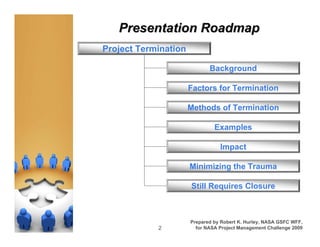
Project Termination

                             Background

                      Factors for Termination

                      Methods of Termination

                               Examples

                                 Impact

                      Minimizing the Trauma

                      Still Requires Closure


                      Prepared by Robert K. Hurley, NASA GSFC WFF,
            2           for NASA Project Management Challenge 2009
Presentation Purpose
• Explore project termination process
  – Factors that often cause a project
    termination.
  – Impact of project termination on
    individuals and the organization.
  – Suggested management techniques to best
    deal with such occurrences.


 Presenter’s Note: For the purpose of this presentation, the presenter
 refers to termination as the cancellation of a project before it has
 reached its expected goals.


                                    Prepared by Robert K. Hurley, NASA GSFC WFF,
                         3            for NASA Project Management Challenge 2009
Project termination is often
the right decision as it
demonstrates the
organization’s willingness to
challenge itself...


              Prepared by Robert K. Hurley, NASA GSFC WFF,
         4      for NASA Project Management Challenge 2009
Observations
• Limited information exists on the impact of
  project termination on individuals and the
  organization.
   – Few references in PMBOK.
   – Kerzner devotes less than 5 pages in his industry-
     leading project management “bible”.
   – Mantel and Meredith devote less than 5 pages in
     their widely used Project Management in
     Practice teaching text.
   – People hesitate to share project termination
     experiences.


                            Prepared by Robert K. Hurley, NASA GSFC WFF,
                    5         for NASA Project Management Challenge 2009
My Experience
• Next Generation Launch Technology
  (NGLT) HyTEx Project Team Member
  – High hopes extinguished.
  – NASA terminated my first project.
  – Quote from an APPEL classmate when sharing
    this experience.
     • “Forget about it Rob. I have either been a
       Project Manager or team member on 9
       projects and they have all been cancelled.”


                          Prepared by Robert K. Hurley, NASA GSFC WFF,
                  6         for NASA Project Management Challenge 2009
Termination –Often Externally Initiated


“NASA Presidential Transition Team
 Requests for Information," asks agency
 officials to provide the latest information on
 Ares 1, Orion and the planned Ares 5
 heavy-lift cargo launcher, and to calculate
 the near-term close-out costs and longer-
 term savings associated with canceling
 those programs.”
                    (Reference: Berger, 2008)
                              Prepared by Robert K. Hurley, NASA GSFC WFF,
                7               for NASA Project Management Challenge 2009
“ Termination of a project,
 particularly a long and difficult
 one is akin to the breakup of a
 family and may well be stressful,
 even to the point of grieving.”
       (Reference: Mantel, Meredith, Shafer, Sutton, 2005)


                               Prepared by Robert K. Hurley, NASA GSFC WFF,
                  8              for NASA Project Management Challenge 2009
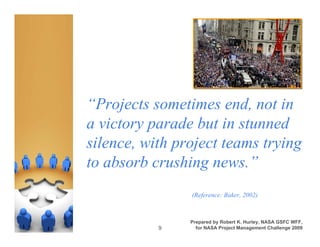
“Projects sometimes end, not in
a victory parade but in stunned
silence, with project teams trying
to absorb crushing news.”
                (Reference: Baker, 2002)


                Prepared by Robert K. Hurley, NASA GSFC WFF,
           9      for NASA Project Management Challenge 2009
Project Definitions Miss the Mark by
      What is a Project?
           Avoiding Termination

•   NASA defines a project as, “A specific investment identified in a
    Program Plan having defined requirements, a life-cycle cost, a
    beginning, and an end. A project also has a management structure
    and may have interfaces to other projects, agencies, and
    international partners. A project yields new or revised products
    that directly address NASA's strategic needs.” (NPR 7120.5D,
    2007)
•   Mantel and Meredith defines a project as, “A project, then, is a
    temporary endeavor undertaken to create a unique product or
    service. It is specific, timely, usually multidisplinary, and always
    conflict ridden.” (Mantel and Meredith, 2005)
•   Kerzner defines a project as, “Any series of activities and tasks
    that have a specific objective to be completed within certain
    specifications, have defined start and end dates, have funding
    limits, consume human and nonhuman resources, and are
    multifunctional.” (Kerzner, 2006)

                                     Prepared by Robert K. Hurley, NASA GSFC WFF,
                          10           for NASA Project Management Challenge 2009
What is athe Mark....Finally
      PMI Hits Project?
• The Project Management Institute (PMI) defines a
  project as, “A temporary endeavor undertaken to create
  a unique product or service.” (PMI, 1996, 2000, 2004)
• The PMI defines a project as, “A project is a temporary
  endeavor undertaken to create a unique product,
  service or result. The temporary nature of projects
  indicates a definite beginning and end. The end is
  reached when the project’s objectives have been
  achieved or when the project is terminated
  because its objectives will not or cannot be met, or
  when the need for the project no longer exists.” (PMI,
  2008)


                            Prepared by Robert K. Hurley, NASA GSFC WFF,
                    11        for NASA Project Management Challenge 2009
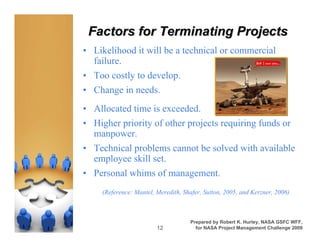
Factors for Terminating Projects
• Likelihood it will be a technical or commercial
  failure.
• Too costly to develop.
• Change in needs.
• Allocated time is exceeded.
• Higher priority of other projects requiring funds or
  manpower.
• Technical problems cannot be solved with available
  employee skill set.
• Personal whims of management.
    (Reference: Mantel, Meredith, Shafer, Sutton, 2005, and Kerzner, 2006)


                                    Prepared by Robert K. Hurley, NASA GSFC WFF,
                        12            for NASA Project Management Challenge 2009
Factors for Terminating Projects (Cont.)
• NASA (NPR 7120.5D, 2007)
  – Anticipated inability of the program or project to
    meet its commitments.
     • NASA Administrator Dan Goldin in a 1994 speech, “If
       projects run over budget they will be canceled. I am
       looking forward to the first opportunity to cancel a
       project for this reason!” (Grahn, 2008)
     • NASA Associate Administrator Ed Weiler in a 2008
       interview, “I have a clear record as the associate
       administrator for six years. I canceled five programs.
       I'm capable of doing that again.” (Berger, 2008)
  – Unanticipated change in Agency strategic goals.
  – Unanticipated change in the NASA budget.


                              Prepared by Robert K. Hurley, NASA GSFC WFF,
                   13           for NASA Project Management Challenge 2009
Methods of Project Termination
•   Termination-by-Extinction
     – Project stops (completed or terminated).
         • The “Hatchet” (removal of resources).
•   Termination-by-Addition
     – Project successfully completed and institutionalized (e.g., new
       division).
•   Termination-by-Integration
     – Project becomes standardized (e.g., software becomes standard
       or new machine part of the production line).
•   Termination-by-Starvation
     – Politically incorrect to terminate a project but its budget can be
       squeezed until it is a project in name only.
•   Termination-by-Murder
     – Forced retirement of the project champion.
     – Merger of the firm conducting the project with another firm.
         (Reference: Mantel, Meredith, Shafer, Sutton, 2005, and Kerzner, 2006)
                                              Prepared by Robert K. Hurley, NASA GSFC WFF,
                                14              for NASA Project Management Challenge 2009
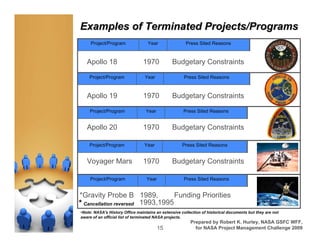
Examples of Terminated Projects/Programs
     Project/Program               Year               Press Sited Reasons


   Apollo 18                    1970           Budgetary Constraints

    Project/Program              Year                Press Sited Reasons


   Apollo 19                    1970           Budgetary Constraints

    Project/Program               Year               Press Sited Reasons


   Apollo 20                    1970           Budgetary Constraints

    Project/Program              Year               Press Sited Reasons


   Voyager Mars                 1970           Budgetary Constraints

     Project/Program              Year               Press Sited Reasons


 *Gravity Probe B 1989,           Funding Priorities
* Cancellation reversed 1993,1995
•Note: NASA's History Office maintains an extensive collection of historical documents but they are not
aware of an official list of terminated NASA projects.
                                                         Prepared by Robert K. Hurley, NASA GSFC WFF,
                                         15                for NASA Project Management Challenge 2009
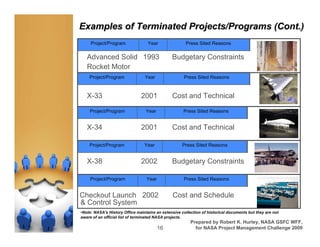
Examples of Terminated Projects/Programs (Cont.)
     Project/Program               Year               Press Sited Reasons

   Advanced Solid 1993                         Budgetary Constraints
   Rocket Motor
    Project/Program              Year                Press Sited Reasons


   X-33                        2001            Cost and Technical

    Project/Program               Year               Press Sited Reasons


   X-34                        2001            Cost and Technical

    Project/Program              Year               Press Sited Reasons


   X-38                        2002            Budgetary Constraints

     Project/Program              Year               Press Sited Reasons


Checkout Launch 2002                           Cost and Schedule
& Control System
•Note: NASA's History Office maintains an extensive collection of historical documents but they are not
aware of an official list of terminated NASA projects.
                                                         Prepared by Robert K. Hurley, NASA GSFC WFF,
                                         16                for NASA Project Management Challenge 2009
Examples of Terminated Projects/Programs (Cont.)
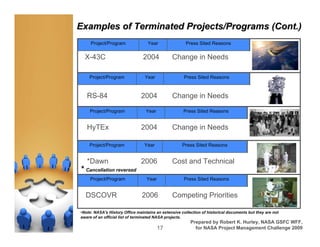
     Project/Program               Year               Press Sited Reasons

  X-43C                         2004           Change in Needs

    Project/Program              Year                Press Sited Reasons


   RS-84                       2004            Change in Needs

    Project/Program               Year               Press Sited Reasons


   HyTEx                       2004            Change in Needs

    Project/Program              Year               Press Sited Reasons


   *Dawn                       2006            Cost and Technical
* Cancellation reversed
     Project/Program              Year               Press Sited Reasons


  DSCOVR                       2006            Competing Priorities

•Note: NASA's History Office maintains an extensive collection of historical documents but they are not
aware of an official list of terminated NASA projects.
                                                         Prepared by Robert K. Hurley, NASA GSFC WFF,
                                         17                for NASA Project Management Challenge 2009
What projects or programs have
 you worked on that have been
 terminated?


               Prepared by Robert K. Hurley, NASA GSFC WFF,
          18     for NASA Project Management Challenge 2009
Negative Impact of Termination
• PM and team members can experience Anaclitic
  Depression.
   – Term used to describe a particular, circumscribed form of
     melancholy that we often experience when the individuals,
     organizations, or belief systems that we lean on or are
     dependent on for emotional support are withdrawn from us.
     (Harvey, 1999)
• Anaclitic Depression Phases
   –   Phase I: Anger directed toward the organization.
   –   Phase II: Reversed and focused inward, creating depression.
   –   Phase III: Sink into apathy.
   –   Phase IV: Detachment. (Harvey, 1999)
• Many PM’s and team members suffer from feelings
  of separation and abandonment.
• Removed PM’s or team members inevitably serve as
  a visible reminder of what could happen to those who
  remain. (Harvey, 1999)
                                 Prepared by Robert K. Hurley, NASA GSFC WFF,
                       19          for NASA Project Management Challenge 2009
“Meir Statman and David Caldwell
 reported that whereas companies
 acknowledge that project termination
 causes employee pain, they ignore the
 pain of employees such as project
 managers who are retained while their
 projects are terminated.”
                 (Reference: Statman and Caldwell, 1987)


                       Prepared by Robert K. Hurley, NASA GSFC WFF,
            20           for NASA Project Management Challenge 2009
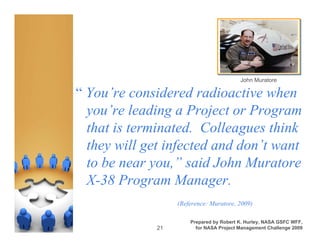
John Muratore

“ You’re considered radioactive when
  you’re leading a Project or Program
  that is terminated. Colleagues think
  they will get infected and don’t want
  to be near you,” said John Muratore
  X-38 Program Manager.
                  (Reference: Muratore, 2009)

                      Prepared by Robert K. Hurley, NASA GSFC WFF,
             21         for NASA Project Management Challenge 2009
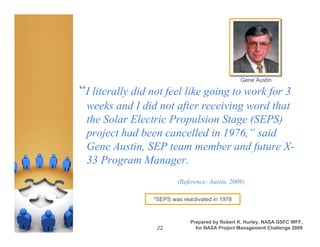
Gene Austin

“I literally did not feel like going to work for 3
 weeks and I did not after receiving word that
 the Solar Electric Propulsion Stage (SEPS)
 project had been cancelled in 1976,” said
 Gene Austin, SEP team member and future X-
 33 Program Manager.
                         (Reference: Austin, 2009)

                 *SEPS was reactivated in 1978


                              Prepared by Robert K. Hurley, NASA GSFC WFF,
                  22            for NASA Project Management Challenge 2009
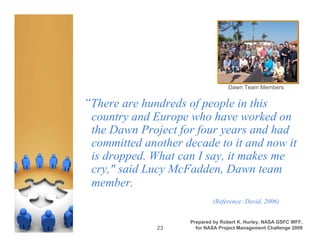
Dawn Team Members


“There are hundreds of people in this
 country and Europe who have worked on
 the Dawn Project for four years and had
 committed another decade to it and now it
 is dropped. What can I say, it makes me
 cry," said Lucy McFadden, Dawn team
 member.
                             (Reference: David, 2006)


                     Prepared by Robert K. Hurley, NASA GSFC WFF,
              23       for NASA Project Management Challenge 2009
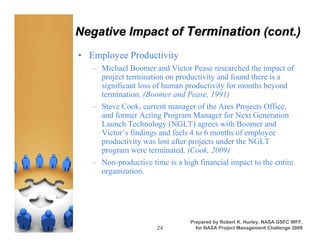
Negative Impact of Termination (cont.)
• Employee Productivity
   – Michael Boomer and Victor Pease researched the impact of
     project termination on productivity and found there is a
     significant loss of human productivity for months beyond
     termination. (Boomer and Pease, 1991)
   – Steve Cook, current manager of the Ares Projects Office,
     and former Acting Program Manager for Next Generation
     Launch Technology (NGLT) agrees with Boomer and
     Victor’s findings and feels 4 to 6 months of employee
     productivity was lost after projects under the NGLT
     program were terminated. (Cook, 2009)
   – Non-productive time is a high financial impact to the entire
     organization.


                                 Prepared by Robert K. Hurley, NASA GSFC WFF,
                      24           for NASA Project Management Challenge 2009
Negative Impact of Termination (cont.)
• Employee Commitment
  – Jerry B. Harvey, Professor Emeritus of Management at The
    George Washington University, found an unhealed
    employee may never work with the same sense of
    enthusiasm, loyalty, and commitment. (Harvey, 1999)
  – When terminations are perceived as a negative experience
    than employee commitment may never return to pre-
    termination levels. (Boomer and Pease, 1991)
  – A Stennis employee states every time they work on a project,
    one of their team members will remind them not get too
    connected and reminds them of what happened on the
    Advanced Solid Rocket Motor project.
  – Steve Cook felt it took 2 years for team members to buy into
    the Ares Program after being taken to the edge of the abyss
    after projects under the NGLT program were terminated.
    (Cook, 2009)
                               Prepared by Robert K. Hurley, NASA GSFC WFF,
                     25          for NASA Project Management Challenge 2009
Negative Impact of Termination (cont.)
• Reputation of the Agency
   – NASA suffers from a 'stop-start' approach to its human
     spaceflight programs. (Multiple sites, 2009)
   – NASA’s history in the last few decades has been littered
     with projects that have failed or were terminated. (Hedman,
     2005)
   – Terminated projects create a sense of wastefulness of
     taxpayer dollars.
   – Capability and leadership are also questioned when
     programs are terminated.


                                Prepared by Robert K. Hurley, NASA GSFC WFF,
                      26          for NASA Project Management Challenge 2009
Keys to Minimizing the Trauma
• Include team in the termination decision process.
   – Made aware of the rationale behind the termination well
     before the official announcement.
   – Invited to participate in review process as defined in NPR
     7120.5D.
• Encourage team that project termination does not
  always indicate project mismanagement.
   – “These science missions are not the one millionth copy of a
     Toyota,” said Dr. Ed Weiler. (Berger, 2008)
• Offer Employee Assistance Program services.
• Present team members plans for future assignments.
• Quickly reassign to a project that is perceived as
  comparable.
• Offer beneficial training opportunities.
                                Prepared by Robert K. Hurley, NASA GSFC WFF,
                      27          for NASA Project Management Challenge 2009
Keys to Minimizing the Trauma (Cont.)
• Allow team to document accomplishments and status.
   – Provides closure.
   – The scores of terminated projects in NASA’s history
     probably have a wealth of information lost that could help
     future projects. (Hedman, 2005)
• Acknowledge team and individual efforts.
   – Boomer and Pease research found the accomplishments of
     terminated projects were generally not recognized.
• Assure PM’s and team members that project
  termination does not threaten their career.
• Identify how the work completed will contribute to
  future projects.
• Hold a celebration of the team’s achievements.

          What are your experiences?
                                Prepared by Robert K. Hurley, NASA GSFC WFF,
                      28          for NASA Project Management Challenge 2009
Termination Still Requires Closure
•    Termination phase should be executed as a project in itself.
•    Secure top-management involvement and support.
•    Appoint a Termination Manager.
      – Project Manager supports the Termination Manager.
•    Plan termination phase.
      –   Clearly defined tasks.
      –   Agreed on responsibilities.
      –   Schedules.
      –   Budgets.
      –   Deliverable items.
•    Satisfy contractual requirements.
•    Release resources (team members and materials).
•    Determine what records to keep and store them in the
     organizations archives.
•    Clear the project with legal counsel.
•    Deliver a Project Final Report detailing the project history and
     the lessons learned.
                                        Prepared by Robert K. Hurley, NASA GSFC WFF,
                             29           for NASA Project Management Challenge 2009
Project termination is often the
right decision as it demonstrates
the organization’s willingness to
challenge itself, but how it is
managed can minimize the
inherent negative effects on
employees and the organization.
 Presenter’s Note: The present study is preliminary and
 exploratory. It reveals that further research is necessary.


                                Prepared by Robert K. Hurley, NASA GSFC WFF,
                     30           for NASA Project Management Challenge 2009
References
1.    Brian Berger. An Interview with NASA's Next Science Chief. Space News. 2008.
2.    Brian Berger. Obama to Review Costs of Shuttle Replacement Vehicle. Space News.
      2008
3.    Bud Baker. Making the Best of Project Termination. PM Network June 2002.
4.    Eric R. Hedman. Why Technology Projects Fail. The Space Review. May 2005.
5.    Harold Kerzner. Project Management: A Systems Approach to Planning, Scheduling
      and Controlling. Ninth Edition. John Wiley & Sons. 2006.
6.    Jerry B. Harvey. How Come Every Time I Get Stabbed In The Back My Fingerprints
      Are On The Knife? Jossey-Bass. 1999.
7.    Leonard David. NASA's Dawn Asteroid Mission Cancelled. Space.com. March 2006
8.    Michael Bommer and Victor Pease. Mitigating the Impact of Project Cancellations on
      Productivity. National Productivity Review. 1991.
9.    Office of the Chief Engineer. NASA Space Flight Program and Project Management
      Requirements. NASA Online Directives Information System. 2007.
10.   PMI. A Guide to Project Management Book of Knowledge. Project Management
      Institute. 1996, 2000, 2004, 2008
11.   Robert Hurley. Personal interview with NASA HQ History Division, Colin Fries.
      December 12, 2008.
12.   Robert Hurley. Personal interview with X-38 Program Manager, John Muratore.
      January 7, 2009.
13.   Robert Hurley. Personal interview with X-38 Deputy and future Program Manager,
      Brian Anderson. January 8, 2009.
14.   Robert Hurley. Personal interview with Dawn team member, Lucy McFadden.
      January 9, 2009.
15.   Robert Hurley. Personal interview with NGLT Program Manager, Steve Cook.
      January 9, 2009.
16.   Robert Hurley. Personal interview with SEPS team member and future X-33
      Program Manager, Robert “Gene” Austin. January 15, 2009.
17.   S.J. Mantel, J.R. Meredith, S. Shafer, M. Sutton. Project Management in Practice.
      Second Edition. John Wiley & Sons. 2005.
18.   Sven Grahn. Faster, Better, Cheaper Revisited. Retrieved from
      http://www.ssc.se/?id=8194&threadid=9681
                                             Prepared by Robert K. Hurley, NASA GSFC WFF,
                               31              for NASA Project Management Challenge 2009

Hurley.robert

  • 2.
    Presentation Roadmap Project Termination Background Factors for Termination Methods of Termination Examples Impact Minimizing the Trauma Still Requires Closure Prepared by Robert K. Hurley, NASA GSFC WFF, 2 for NASA Project Management Challenge 2009
  • 3.
    Presentation Purpose • Exploreproject termination process – Factors that often cause a project termination. – Impact of project termination on individuals and the organization. – Suggested management techniques to best deal with such occurrences. Presenter’s Note: For the purpose of this presentation, the presenter refers to termination as the cancellation of a project before it has reached its expected goals. Prepared by Robert K. Hurley, NASA GSFC WFF, 3 for NASA Project Management Challenge 2009
  • 4.
    Project termination isoften the right decision as it demonstrates the organization’s willingness to challenge itself... Prepared by Robert K. Hurley, NASA GSFC WFF, 4 for NASA Project Management Challenge 2009
  • 5.
    Observations • Limited informationexists on the impact of project termination on individuals and the organization. – Few references in PMBOK. – Kerzner devotes less than 5 pages in his industry- leading project management “bible”. – Mantel and Meredith devote less than 5 pages in their widely used Project Management in Practice teaching text. – People hesitate to share project termination experiences. Prepared by Robert K. Hurley, NASA GSFC WFF, 5 for NASA Project Management Challenge 2009
  • 6.
    My Experience • NextGeneration Launch Technology (NGLT) HyTEx Project Team Member – High hopes extinguished. – NASA terminated my first project. – Quote from an APPEL classmate when sharing this experience. • “Forget about it Rob. I have either been a Project Manager or team member on 9 projects and they have all been cancelled.” Prepared by Robert K. Hurley, NASA GSFC WFF, 6 for NASA Project Management Challenge 2009
  • 7.
    Termination –Often ExternallyInitiated “NASA Presidential Transition Team Requests for Information," asks agency officials to provide the latest information on Ares 1, Orion and the planned Ares 5 heavy-lift cargo launcher, and to calculate the near-term close-out costs and longer- term savings associated with canceling those programs.” (Reference: Berger, 2008) Prepared by Robert K. Hurley, NASA GSFC WFF, 7 for NASA Project Management Challenge 2009
  • 8.
    “ Termination ofa project, particularly a long and difficult one is akin to the breakup of a family and may well be stressful, even to the point of grieving.” (Reference: Mantel, Meredith, Shafer, Sutton, 2005) Prepared by Robert K. Hurley, NASA GSFC WFF, 8 for NASA Project Management Challenge 2009
  • 9.
    “Projects sometimes end,not in a victory parade but in stunned silence, with project teams trying to absorb crushing news.” (Reference: Baker, 2002) Prepared by Robert K. Hurley, NASA GSFC WFF, 9 for NASA Project Management Challenge 2009
  • 10.
    Project Definitions Missthe Mark by What is a Project? Avoiding Termination • NASA defines a project as, “A specific investment identified in a Program Plan having defined requirements, a life-cycle cost, a beginning, and an end. A project also has a management structure and may have interfaces to other projects, agencies, and international partners. A project yields new or revised products that directly address NASA's strategic needs.” (NPR 7120.5D, 2007) • Mantel and Meredith defines a project as, “A project, then, is a temporary endeavor undertaken to create a unique product or service. It is specific, timely, usually multidisplinary, and always conflict ridden.” (Mantel and Meredith, 2005) • Kerzner defines a project as, “Any series of activities and tasks that have a specific objective to be completed within certain specifications, have defined start and end dates, have funding limits, consume human and nonhuman resources, and are multifunctional.” (Kerzner, 2006) Prepared by Robert K. Hurley, NASA GSFC WFF, 10 for NASA Project Management Challenge 2009
  • 11.
    What is atheMark....Finally PMI Hits Project? • The Project Management Institute (PMI) defines a project as, “A temporary endeavor undertaken to create a unique product or service.” (PMI, 1996, 2000, 2004) • The PMI defines a project as, “A project is a temporary endeavor undertaken to create a unique product, service or result. The temporary nature of projects indicates a definite beginning and end. The end is reached when the project’s objectives have been achieved or when the project is terminated because its objectives will not or cannot be met, or when the need for the project no longer exists.” (PMI, 2008) Prepared by Robert K. Hurley, NASA GSFC WFF, 11 for NASA Project Management Challenge 2009
  • 12.
    Factors for TerminatingProjects • Likelihood it will be a technical or commercial failure. • Too costly to develop. • Change in needs. • Allocated time is exceeded. • Higher priority of other projects requiring funds or manpower. • Technical problems cannot be solved with available employee skill set. • Personal whims of management. (Reference: Mantel, Meredith, Shafer, Sutton, 2005, and Kerzner, 2006) Prepared by Robert K. Hurley, NASA GSFC WFF, 12 for NASA Project Management Challenge 2009
  • 13.
    Factors for TerminatingProjects (Cont.) • NASA (NPR 7120.5D, 2007) – Anticipated inability of the program or project to meet its commitments. • NASA Administrator Dan Goldin in a 1994 speech, “If projects run over budget they will be canceled. I am looking forward to the first opportunity to cancel a project for this reason!” (Grahn, 2008) • NASA Associate Administrator Ed Weiler in a 2008 interview, “I have a clear record as the associate administrator for six years. I canceled five programs. I'm capable of doing that again.” (Berger, 2008) – Unanticipated change in Agency strategic goals. – Unanticipated change in the NASA budget. Prepared by Robert K. Hurley, NASA GSFC WFF, 13 for NASA Project Management Challenge 2009
  • 14.
    Methods of ProjectTermination • Termination-by-Extinction – Project stops (completed or terminated). • The “Hatchet” (removal of resources). • Termination-by-Addition – Project successfully completed and institutionalized (e.g., new division). • Termination-by-Integration – Project becomes standardized (e.g., software becomes standard or new machine part of the production line). • Termination-by-Starvation – Politically incorrect to terminate a project but its budget can be squeezed until it is a project in name only. • Termination-by-Murder – Forced retirement of the project champion. – Merger of the firm conducting the project with another firm. (Reference: Mantel, Meredith, Shafer, Sutton, 2005, and Kerzner, 2006) Prepared by Robert K. Hurley, NASA GSFC WFF, 14 for NASA Project Management Challenge 2009
  • 15.
    Examples of TerminatedProjects/Programs Project/Program Year Press Sited Reasons Apollo 18 1970 Budgetary Constraints Project/Program Year Press Sited Reasons Apollo 19 1970 Budgetary Constraints Project/Program Year Press Sited Reasons Apollo 20 1970 Budgetary Constraints Project/Program Year Press Sited Reasons Voyager Mars 1970 Budgetary Constraints Project/Program Year Press Sited Reasons *Gravity Probe B 1989, Funding Priorities * Cancellation reversed 1993,1995 •Note: NASA's History Office maintains an extensive collection of historical documents but they are not aware of an official list of terminated NASA projects. Prepared by Robert K. Hurley, NASA GSFC WFF, 15 for NASA Project Management Challenge 2009
  • 16.
    Examples of TerminatedProjects/Programs (Cont.) Project/Program Year Press Sited Reasons Advanced Solid 1993 Budgetary Constraints Rocket Motor Project/Program Year Press Sited Reasons X-33 2001 Cost and Technical Project/Program Year Press Sited Reasons X-34 2001 Cost and Technical Project/Program Year Press Sited Reasons X-38 2002 Budgetary Constraints Project/Program Year Press Sited Reasons Checkout Launch 2002 Cost and Schedule & Control System •Note: NASA's History Office maintains an extensive collection of historical documents but they are not aware of an official list of terminated NASA projects. Prepared by Robert K. Hurley, NASA GSFC WFF, 16 for NASA Project Management Challenge 2009
  • 17.
    Examples of TerminatedProjects/Programs (Cont.) Project/Program Year Press Sited Reasons X-43C 2004 Change in Needs Project/Program Year Press Sited Reasons RS-84 2004 Change in Needs Project/Program Year Press Sited Reasons HyTEx 2004 Change in Needs Project/Program Year Press Sited Reasons *Dawn 2006 Cost and Technical * Cancellation reversed Project/Program Year Press Sited Reasons DSCOVR 2006 Competing Priorities •Note: NASA's History Office maintains an extensive collection of historical documents but they are not aware of an official list of terminated NASA projects. Prepared by Robert K. Hurley, NASA GSFC WFF, 17 for NASA Project Management Challenge 2009
  • 18.
    What projects orprograms have you worked on that have been terminated? Prepared by Robert K. Hurley, NASA GSFC WFF, 18 for NASA Project Management Challenge 2009
  • 19.
    Negative Impact ofTermination • PM and team members can experience Anaclitic Depression. – Term used to describe a particular, circumscribed form of melancholy that we often experience when the individuals, organizations, or belief systems that we lean on or are dependent on for emotional support are withdrawn from us. (Harvey, 1999) • Anaclitic Depression Phases – Phase I: Anger directed toward the organization. – Phase II: Reversed and focused inward, creating depression. – Phase III: Sink into apathy. – Phase IV: Detachment. (Harvey, 1999) • Many PM’s and team members suffer from feelings of separation and abandonment. • Removed PM’s or team members inevitably serve as a visible reminder of what could happen to those who remain. (Harvey, 1999) Prepared by Robert K. Hurley, NASA GSFC WFF, 19 for NASA Project Management Challenge 2009
  • 20.
    “Meir Statman andDavid Caldwell reported that whereas companies acknowledge that project termination causes employee pain, they ignore the pain of employees such as project managers who are retained while their projects are terminated.” (Reference: Statman and Caldwell, 1987) Prepared by Robert K. Hurley, NASA GSFC WFF, 20 for NASA Project Management Challenge 2009
  • 21.
    John Muratore “ You’reconsidered radioactive when you’re leading a Project or Program that is terminated. Colleagues think they will get infected and don’t want to be near you,” said John Muratore X-38 Program Manager. (Reference: Muratore, 2009) Prepared by Robert K. Hurley, NASA GSFC WFF, 21 for NASA Project Management Challenge 2009
  • 22.
    Gene Austin “I literallydid not feel like going to work for 3 weeks and I did not after receiving word that the Solar Electric Propulsion Stage (SEPS) project had been cancelled in 1976,” said Gene Austin, SEP team member and future X- 33 Program Manager. (Reference: Austin, 2009) *SEPS was reactivated in 1978 Prepared by Robert K. Hurley, NASA GSFC WFF, 22 for NASA Project Management Challenge 2009
  • 23.
    Dawn Team Members “Thereare hundreds of people in this country and Europe who have worked on the Dawn Project for four years and had committed another decade to it and now it is dropped. What can I say, it makes me cry," said Lucy McFadden, Dawn team member. (Reference: David, 2006) Prepared by Robert K. Hurley, NASA GSFC WFF, 23 for NASA Project Management Challenge 2009
  • 24.
    Negative Impact ofTermination (cont.) • Employee Productivity – Michael Boomer and Victor Pease researched the impact of project termination on productivity and found there is a significant loss of human productivity for months beyond termination. (Boomer and Pease, 1991) – Steve Cook, current manager of the Ares Projects Office, and former Acting Program Manager for Next Generation Launch Technology (NGLT) agrees with Boomer and Victor’s findings and feels 4 to 6 months of employee productivity was lost after projects under the NGLT program were terminated. (Cook, 2009) – Non-productive time is a high financial impact to the entire organization. Prepared by Robert K. Hurley, NASA GSFC WFF, 24 for NASA Project Management Challenge 2009
  • 25.
    Negative Impact ofTermination (cont.) • Employee Commitment – Jerry B. Harvey, Professor Emeritus of Management at The George Washington University, found an unhealed employee may never work with the same sense of enthusiasm, loyalty, and commitment. (Harvey, 1999) – When terminations are perceived as a negative experience than employee commitment may never return to pre- termination levels. (Boomer and Pease, 1991) – A Stennis employee states every time they work on a project, one of their team members will remind them not get too connected and reminds them of what happened on the Advanced Solid Rocket Motor project. – Steve Cook felt it took 2 years for team members to buy into the Ares Program after being taken to the edge of the abyss after projects under the NGLT program were terminated. (Cook, 2009) Prepared by Robert K. Hurley, NASA GSFC WFF, 25 for NASA Project Management Challenge 2009
  • 26.
    Negative Impact ofTermination (cont.) • Reputation of the Agency – NASA suffers from a 'stop-start' approach to its human spaceflight programs. (Multiple sites, 2009) – NASA’s history in the last few decades has been littered with projects that have failed or were terminated. (Hedman, 2005) – Terminated projects create a sense of wastefulness of taxpayer dollars. – Capability and leadership are also questioned when programs are terminated. Prepared by Robert K. Hurley, NASA GSFC WFF, 26 for NASA Project Management Challenge 2009
  • 27.
    Keys to Minimizingthe Trauma • Include team in the termination decision process. – Made aware of the rationale behind the termination well before the official announcement. – Invited to participate in review process as defined in NPR 7120.5D. • Encourage team that project termination does not always indicate project mismanagement. – “These science missions are not the one millionth copy of a Toyota,” said Dr. Ed Weiler. (Berger, 2008) • Offer Employee Assistance Program services. • Present team members plans for future assignments. • Quickly reassign to a project that is perceived as comparable. • Offer beneficial training opportunities. Prepared by Robert K. Hurley, NASA GSFC WFF, 27 for NASA Project Management Challenge 2009
  • 28.
    Keys to Minimizingthe Trauma (Cont.) • Allow team to document accomplishments and status. – Provides closure. – The scores of terminated projects in NASA’s history probably have a wealth of information lost that could help future projects. (Hedman, 2005) • Acknowledge team and individual efforts. – Boomer and Pease research found the accomplishments of terminated projects were generally not recognized. • Assure PM’s and team members that project termination does not threaten their career. • Identify how the work completed will contribute to future projects. • Hold a celebration of the team’s achievements. What are your experiences? Prepared by Robert K. Hurley, NASA GSFC WFF, 28 for NASA Project Management Challenge 2009
  • 29.
    Termination Still RequiresClosure • Termination phase should be executed as a project in itself. • Secure top-management involvement and support. • Appoint a Termination Manager. – Project Manager supports the Termination Manager. • Plan termination phase. – Clearly defined tasks. – Agreed on responsibilities. – Schedules. – Budgets. – Deliverable items. • Satisfy contractual requirements. • Release resources (team members and materials). • Determine what records to keep and store them in the organizations archives. • Clear the project with legal counsel. • Deliver a Project Final Report detailing the project history and the lessons learned. Prepared by Robert K. Hurley, NASA GSFC WFF, 29 for NASA Project Management Challenge 2009
  • 30.
    Project termination isoften the right decision as it demonstrates the organization’s willingness to challenge itself, but how it is managed can minimize the inherent negative effects on employees and the organization. Presenter’s Note: The present study is preliminary and exploratory. It reveals that further research is necessary. Prepared by Robert K. Hurley, NASA GSFC WFF, 30 for NASA Project Management Challenge 2009
  • 31.
    References 1. Brian Berger. An Interview with NASA's Next Science Chief. Space News. 2008. 2. Brian Berger. Obama to Review Costs of Shuttle Replacement Vehicle. Space News. 2008 3. Bud Baker. Making the Best of Project Termination. PM Network June 2002. 4. Eric R. Hedman. Why Technology Projects Fail. The Space Review. May 2005. 5. Harold Kerzner. Project Management: A Systems Approach to Planning, Scheduling and Controlling. Ninth Edition. John Wiley & Sons. 2006. 6. Jerry B. Harvey. How Come Every Time I Get Stabbed In The Back My Fingerprints Are On The Knife? Jossey-Bass. 1999. 7. Leonard David. NASA's Dawn Asteroid Mission Cancelled. Space.com. March 2006 8. Michael Bommer and Victor Pease. Mitigating the Impact of Project Cancellations on Productivity. National Productivity Review. 1991. 9. Office of the Chief Engineer. NASA Space Flight Program and Project Management Requirements. NASA Online Directives Information System. 2007. 10. PMI. A Guide to Project Management Book of Knowledge. Project Management Institute. 1996, 2000, 2004, 2008 11. Robert Hurley. Personal interview with NASA HQ History Division, Colin Fries. December 12, 2008. 12. Robert Hurley. Personal interview with X-38 Program Manager, John Muratore. January 7, 2009. 13. Robert Hurley. Personal interview with X-38 Deputy and future Program Manager, Brian Anderson. January 8, 2009. 14. Robert Hurley. Personal interview with Dawn team member, Lucy McFadden. January 9, 2009. 15. Robert Hurley. Personal interview with NGLT Program Manager, Steve Cook. January 9, 2009. 16. Robert Hurley. Personal interview with SEPS team member and future X-33 Program Manager, Robert “Gene” Austin. January 15, 2009. 17. S.J. Mantel, J.R. Meredith, S. Shafer, M. Sutton. Project Management in Practice. Second Edition. John Wiley & Sons. 2005. 18. Sven Grahn. Faster, Better, Cheaper Revisited. Retrieved from http://www.ssc.se/?id=8194&threadid=9681 Prepared by Robert K. Hurley, NASA GSFC WFF, 31 for NASA Project Management Challenge 2009