Computing Distributed Representations
for Polysemous Words
Master Thesis
Software Systems Engineering
Haiqing Wang
Matriculation number 340863
July 8, 2016
Supervisors:
Prof. Dr. Gerhard Lakemeyer
Prof. Dr. Christian Bauckhage
Advisors:
Dr. Gerhard Paaÿ
Dr. Jörg Kindermann
Statutory Declaration
I hereby certify that all work presented in this master thesis is my own, no other than the
sources and aids referred to were used and that all parts which have been adopted either
literally or in a general manner from other sources have been indicated accordingly.
Aachen, July 8, 2016
YOUR NAME
Acknowledgements
I would like to thank the Department of Computer Science 5 - Information Systems and
Fraunhofer Institute IAIS for supporting my master thesis. I would like to express my
great gratitude for the support of Dr. Gerhard Paaÿ and Dr. Jörg Kindermann. Their
patient guidance helps me a lot during the research of this topic.
Abstract
Recently, machine learning, and especially deep learning is very popular. Its main aim for
natural language processing to extract the meaning of words and sentences automatically.
The representation of words by a word vector is a very important tool for many natural
language processing tasks when using machine learning algorithms. There are many meth-
ods, e.g. [Mikolov et al., 2013]), to generate word vectors in such a way that semantically
similar words have similar word vectors of low distance. We call this process word embed-
ding, and these word vector a distributed representation. However, polysemous words can
have dierent meanings in dierent contexts. Accordingly, polysemous words should have
several vector representations for each sense. Some models have been recently proposed,
e.g. [Huang et al., 2012], to generate sense embeddings to represent word senses.
In our thesis we investigate and improve current methods to compute multiple sense em-
beddings per word. Specically we extend the basic word embedding model word2vec of
Mikolov et al. [2013] to build a sense assignment model. We use a score function to select
the best sense for each word in an unsupervised learning approach. Our model at the same
time selects senses for each word in sentences and adapts the sense embedding vectors. To
be able to train with large corpora we implement this model in Spark, a parallel execution
framework. We train sense vectors with a Wikipedia corpus of nearly 1 billion tokens. We
evaluate sense vectors by visualizing the semantic similarity of words and doing word simi-
larity tasks using the SCWS (Contextual Word Similarities) dataset and the WordSim-353
dataset from [Finkelstein et al., 2001].
Contents
1 Introduction 1
1.1 Word Embedding . . . . . . . . . . . . . . . . . . . . . . . . . . . . . . . . 1
1.2 Sense Embedding . . . . . . . . . . . . . . . . . . . . . . . . . . . . . . . . 2
1.3 Goal . . . . . . . . . . . . . . . . . . . . . . . . . . . . . . . . . . . . . . . 3
1.4 Outline . . . . . . . . . . . . . . . . . . . . . . . . . . . . . . . . . . . . . . 4
2 Background 5
2.1 Word Embedding . . . . . . . . . . . . . . . . . . . . . . . . . . . . . . . . 5
2.2 Neural Probabilistic Language Model . . . . . . . . . . . . . . . . . . . . . 6
2.3 The model of Collobert and Weston . . . . . . . . . . . . . . . . . . . . . . 10
2.4 Word2Vec . . . . . . . . . . . . . . . . . . . . . . . . . . . . . . . . . . . . 11
3 Related Works 15
3.1 Huang's Model . . . . . . . . . . . . . . . . . . . . . . . . . . . . . . . . . 15
3.2 EM-Algorithm based method . . . . . . . . . . . . . . . . . . . . . . . . . 16
3.3 A Method to Determine the Number of Senses . . . . . . . . . . . . . . . . 18
4 Solution 21
4.1 Denition . . . . . . . . . . . . . . . . . . . . . . . . . . . . . . . . . . . . 21
4.2 Objective Function . . . . . . . . . . . . . . . . . . . . . . . . . . . . . . . 22
4.3 Algorithm Description . . . . . . . . . . . . . . . . . . . . . . . . . . . . . 24
5 Implementation 27
5.1 Introduction of Spark . . . . . . . . . . . . . . . . . . . . . . . . . . . . . . 27
5.2 Implementation . . . . . . . . . . . . . . . . . . . . . . . . . . . . . . . . . 28
6 Evaluation 35
6.1 Results for dierent Hyper-Parameters . . . . . . . . . . . . . . . . . . . . 36
6.1.1 Comparison to prior analyses . . . . . . . . . . . . . . . . . . . . . 48
6.2 Case Analysis . . . . . . . . . . . . . . . . . . . . . . . . . . . . . . . . . . 48
7 Conclusion 55
ix
List of Figures
1.1 Neigboring words dening the specic sense of bank. . . . . . . . . . . . 2
2.1 Graph of the tanh function . . . . . . . . . . . . . . . . . . . . . . . . . . . 6
2.2 An example of neural network with three layers . . . . . . . . . . . . . . . 7
2.3 The neural network structure from [Bengio et al., 2003] . . . . . . . . . . . 9
2.4 word2vec . . . . . . . . . . . . . . . . . . . . . . . . . . . . . . . . . . . . . 12
3.1 The network structure from [Huang et al., 2012] . . . . . . . . . . . . . . . 16
3.2 Architecture of MSSG model with window size Rt = 2 and S = 3 . . . . . 19
5.1 Shows the accumulated frequency of word count in range [1,51] . . . . . . . 30
5.2 Shows the accumulated frequency of word count in range [51,637] . . . . . 30
5.3 Shows the accumulated frequency of word count in range [637,31140] . . . 31
5.4 Shows the accumulated frequency of word count in range [31140,919787] . . 31
6.1 Shows the eect of varying embedding dimensionality of our model on the
Time . . . . . . . . . . . . . . . . . . . . . . . . . . . . . . . . . . . . . . . 40
6.2 Shows the eect of varying embedding dimensionality of our model on the
loss of validation set . . . . . . . . . . . . . . . . . . . . . . . . . . . . . . 41
6.3 Shows the eect of varying embedding dimensionality of our model on the
SCWS task . . . . . . . . . . . . . . . . . . . . . . . . . . . . . . . . . . . 41
6.4 Shows the eect of varying embedding dimensionality of our model on the
WordSim-353 task . . . . . . . . . . . . . . . . . . . . . . . . . . . . . . . 42
6.5 Shows the number of words with dierent number of senses from three ex-
periments . . . . . . . . . . . . . . . . . . . . . . . . . . . . . . . . . . . . 44
6.6 Shows the eect of varying beginning learning rate on the best loss of vali-
dation set . . . . . . . . . . . . . . . . . . . . . . . . . . . . . . . . . . . . 44
6.7 Shows the eect of varying beginning learning rate on the total number of
training iterations . . . . . . . . . . . . . . . . . . . . . . . . . . . . . . . . 45
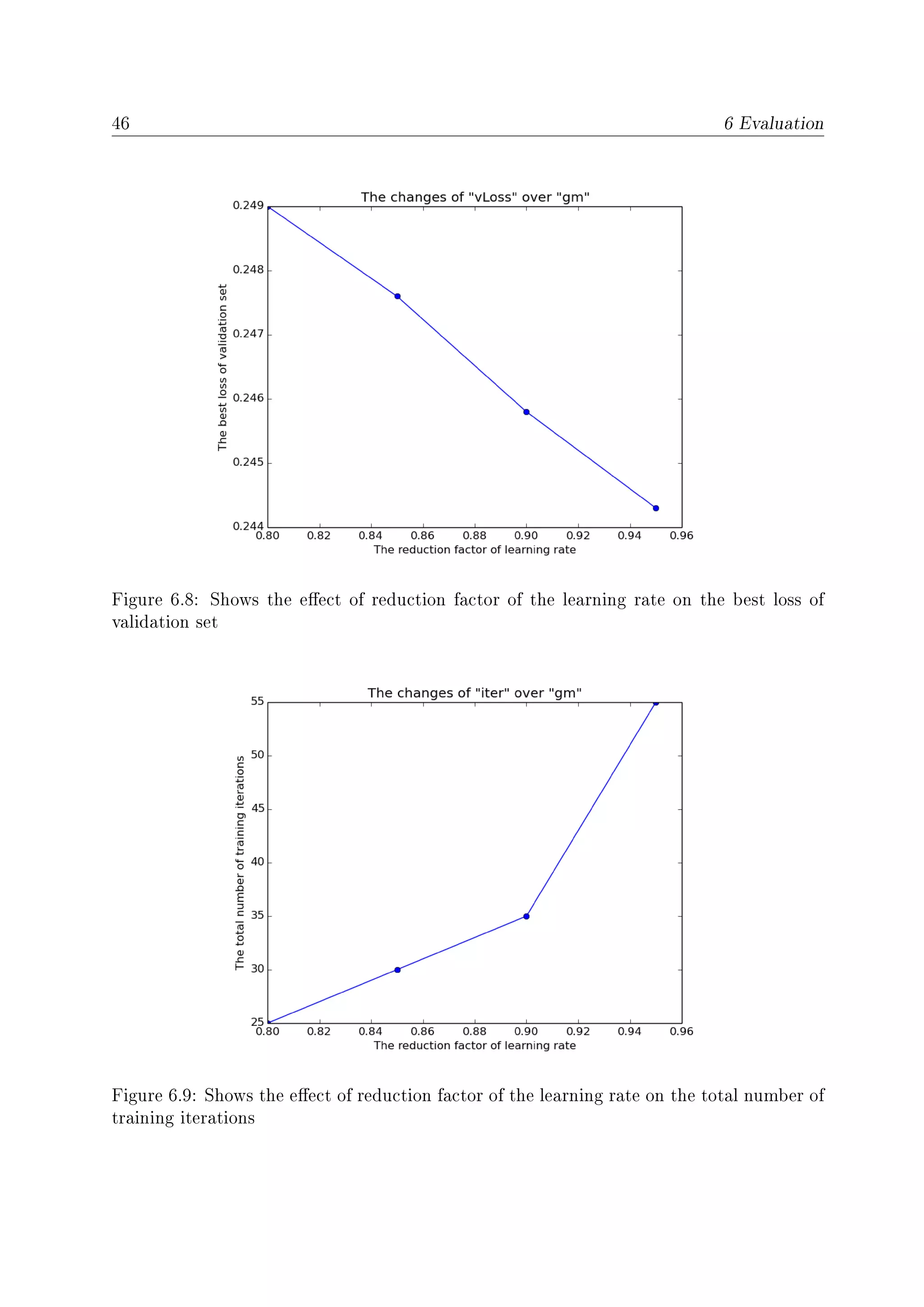
6.8 Shows the eect of reduction factor of the learning rate on the best loss of
validation set . . . . . . . . . . . . . . . . . . . . . . . . . . . . . . . . . . 46
6.9 Shows the eect of reduction factor of the learning rate on the total number
of training iterations . . . . . . . . . . . . . . . . . . . . . . . . . . . . . . 46
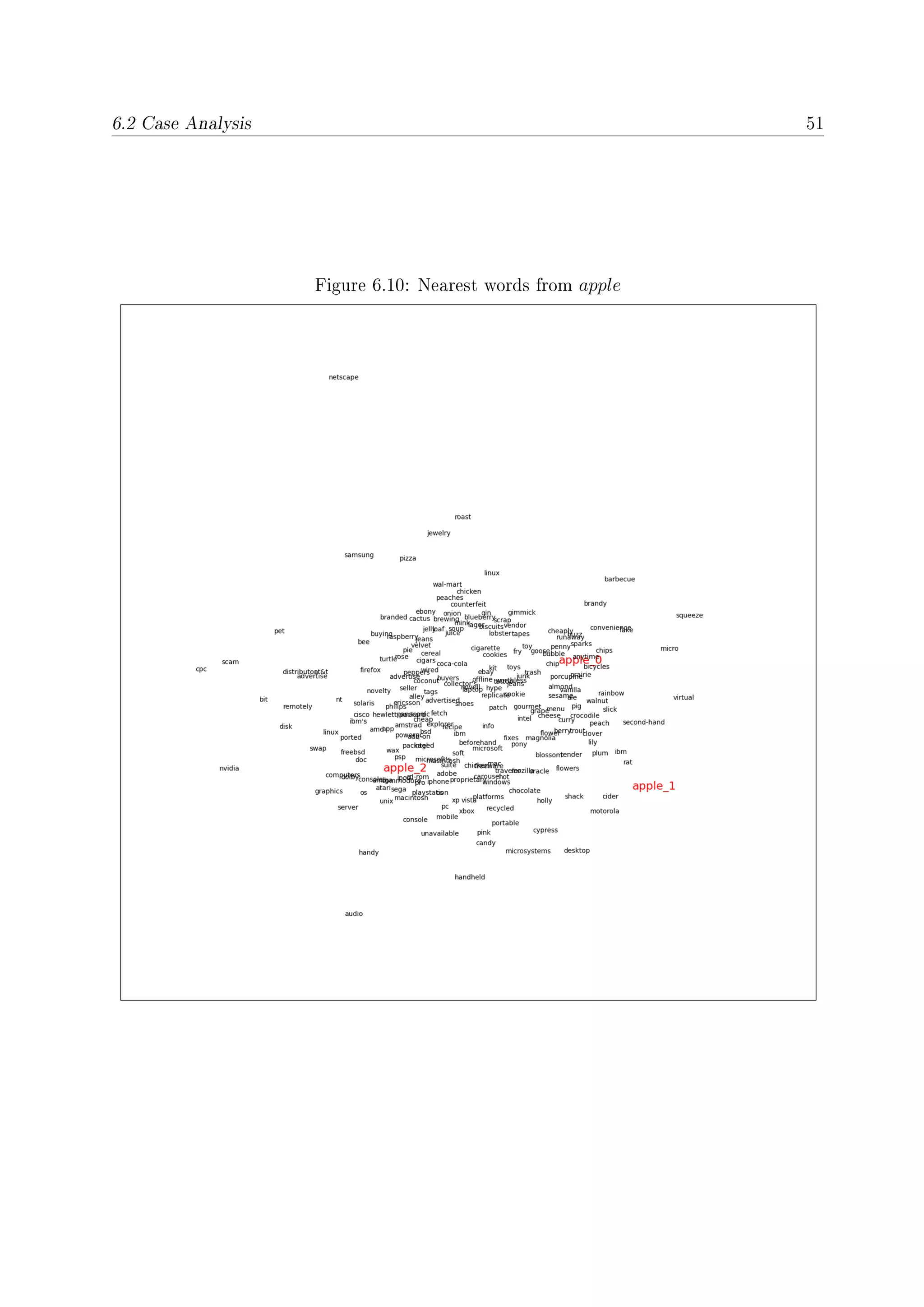
6.10 Nearest words from apple . . . . . . . . . . . . . . . . . . . . . . . . . . . 51
xi
xii LIST OF FIGURES
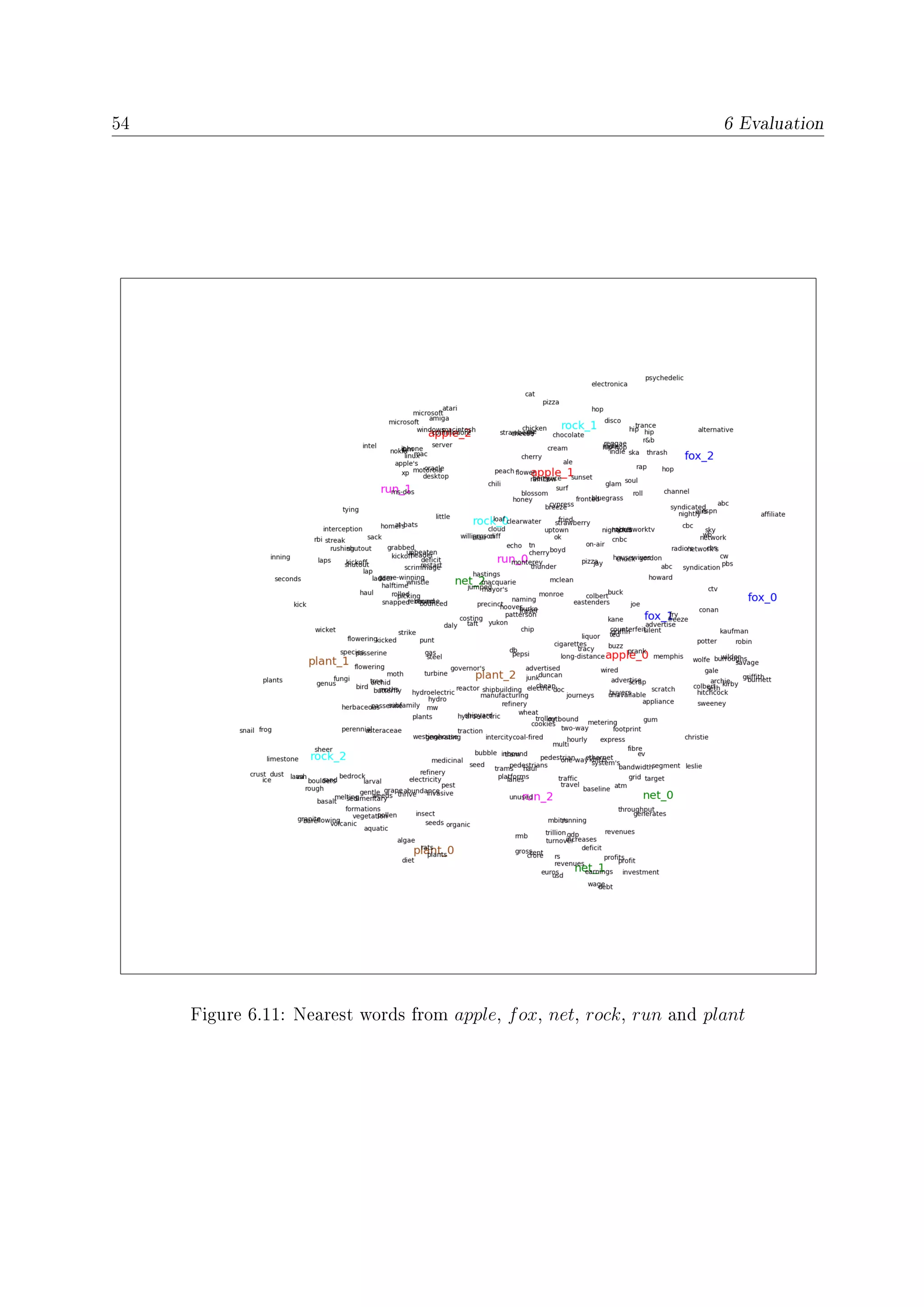
6.11 Nearest words from apple, fox, net, rock, run and plant . . . . . . . . . . 54
List of Tables
3.1 Senses computed with Huang's network and their nearest neighbors. . . . . 16
3.2 Word senses computed by Tian et al. . . . . . . . . . . . . . . . . . . . . . 17
6.1 Denition of Hyper-Parameters of the Experiments . . . . . . . . . . . . . 37
6.2 Denition of Evaluation Scores . . . . . . . . . . . . . . . . . . . . . . . . 37
6.3 13 Dierent Experiments in Step 1 . . . . . . . . . . . . . . . . . . . . . . 38
6.4 16 Dierent Experiments in Step 2 . . . . . . . . . . . . . . . . . . . . . . 39
6.5 Dierent Vector Size Comparison . . . . . . . . . . . . . . . . . . . . . . . 39
6.6 Dierent Min Count Comparison . . . . . . . . . . . . . . . . . . . . . . . 40
6.7 Dierent Sense Count Comparison . . . . . . . . . . . . . . . . . . . . . . 43
6.8 Dierent Learning Rate Comparison . . . . . . . . . . . . . . . . . . . . . 45
6.9 Dierent Gamma Comparison . . . . . . . . . . . . . . . . . . . . . . . . . 45
6.10 Comparison of the dierent number of output senses . . . . . . . . . . . . 47
6.11 Nearest words comparison . . . . . . . . . . . . . . . . . . . . . . . . . . . 48
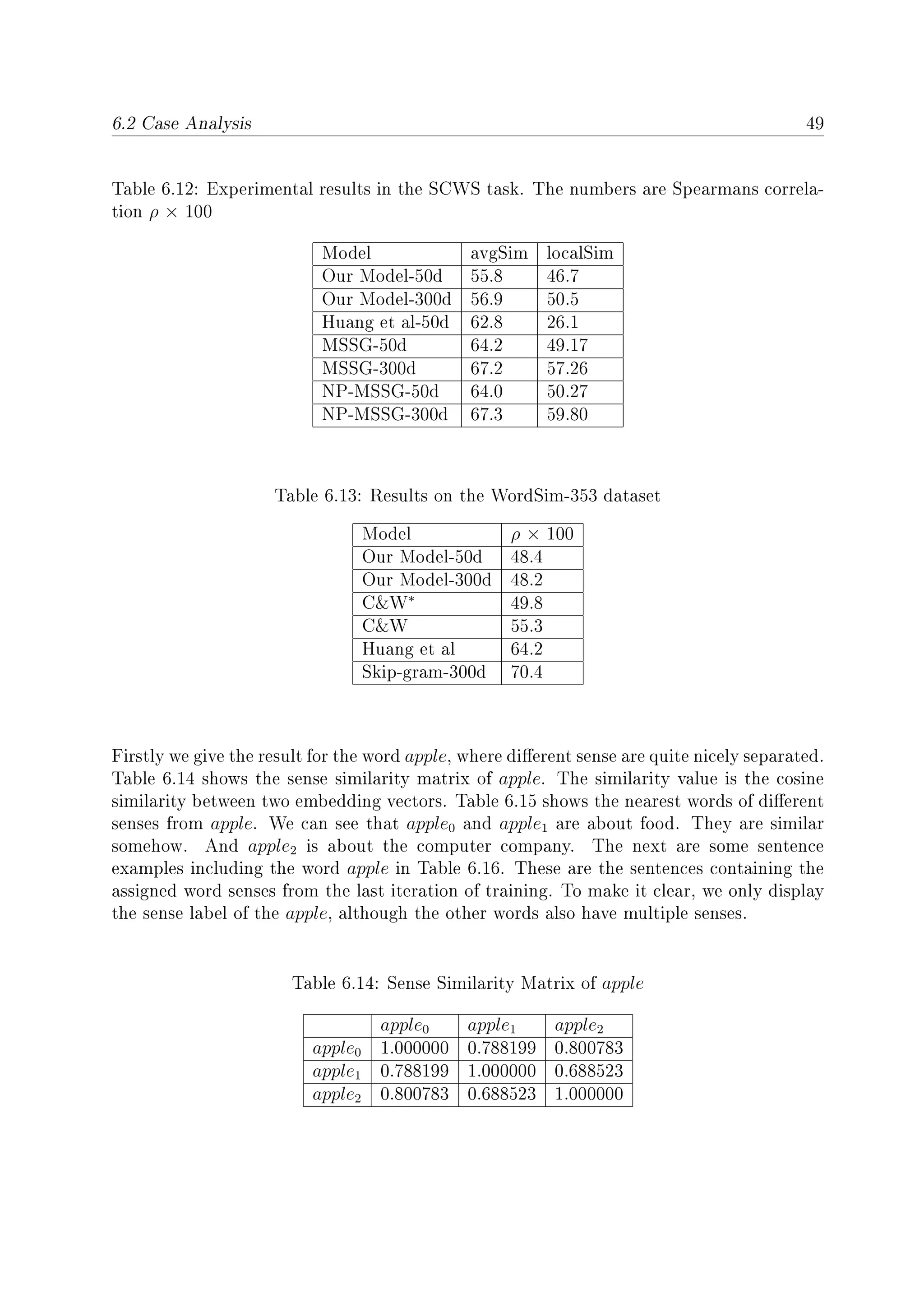
6.12 Experimental results in the SCWS task. The numbers are Spearmans cor-
relation ρ × 100 . . . . . . . . . . . . . . . . . . . . . . . . . . . . . . . . . 49
6.13 Results on the WordSim-353 dataset . . . . . . . . . . . . . . . . . . . . . 49
6.14 Sense Similarity Matrix of apple . . . . . . . . . . . . . . . . . . . . . . . . 49
6.15 Nearest Words of apple . . . . . . . . . . . . . . . . . . . . . . . . . . . . . 50
6.16 Sentence Examples of apple . . . . . . . . . . . . . . . . . . . . . . . . . . 50
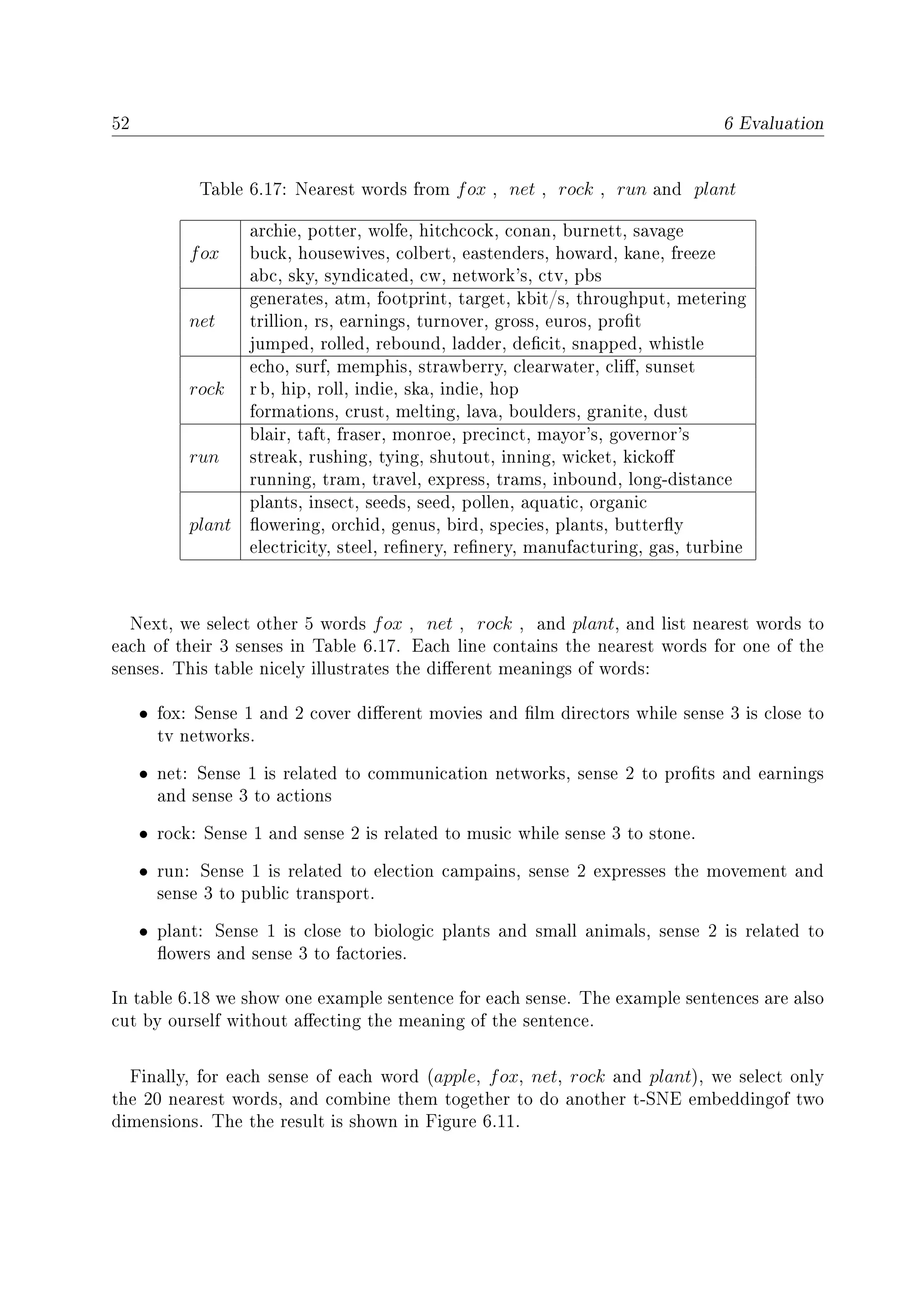
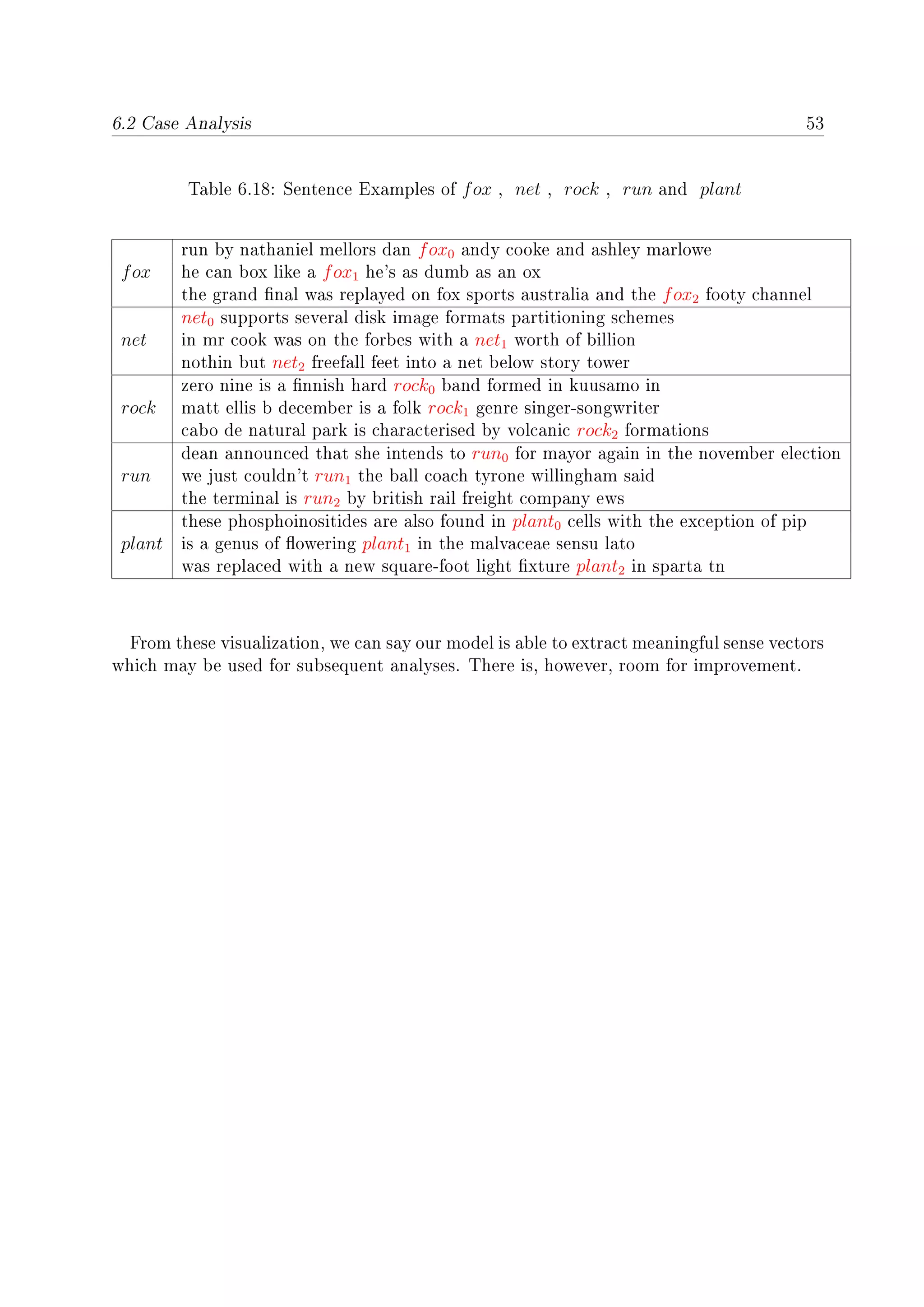
6.17 Nearest words from fox , net , rock , run and plant . . . . . . . . . . . 52
6.18 Sentence Examples of fox , net , rock , run and plant . . . . . . . . . 53
xiii
Mathematical Symbols and Acronyms
C The given corpus containing the sentences/documents of words. 1, 7, 8, 10, 11, 18
c The size of a context Contextn−1
(wt), i.e. the number of words before and after wt. 22,
37
Context(wt) The context of a word wt in the sentence Si may be dened as the subsequence
of the words Contex(wt) = (wi,max(t−c,0), . . . , wi,t−1, wi,t+1, . . . , wi,min(t+c,Li)). 11, 22
D The vocabulary, i.e. the set of N dierent words w in the corpus C. 1, 5, 811, 18, 39,
40
d The length of the embedding vector v(w) ∈ d
, e.g. d = 100. 1, 8, 3739
K The number of negative samples randomly generated for a word wt. 12, 21, 37
Li The number of words in the i-th sentence of the corpus C, Si = (wi,1, wi,2, . . . , wi,Li
).
1, 7
M The number of sentences Si in the corpus, C = (S1, . . . , SM ). 21
N The number of dierent words w in the corpus C, usually N ≥ 100.000. 1, 10, 11, 18,
40
Nw The number of dierent senses of a words w in the corpus C. 21
phrase(wt) A phrase with the center word wt from the sentence Si may be dened as the
subsequence of the words phrase(wt) = (wt−c, . . . , wt−1, wt, wt+1, . . . , wt+c). 10
Prevn−1
(wt) The words before a word wt in the sentence Si, i.e. the subsequence of the
words Prevn−1
(w) = (wmax(t−n+1,1), . . . , wt−1), and n − 1 is the number of words
before wt. 8
RDD Resilient Distributed Datatset: Spark's abstraction of a distributed collection of
items. 27
xv
xvi Mathematical Symbols and Acronyms
Si The i-th sentence of the corpus C, Si = (wi,1, wi,2, . . . , wi,Li
). 1, 7
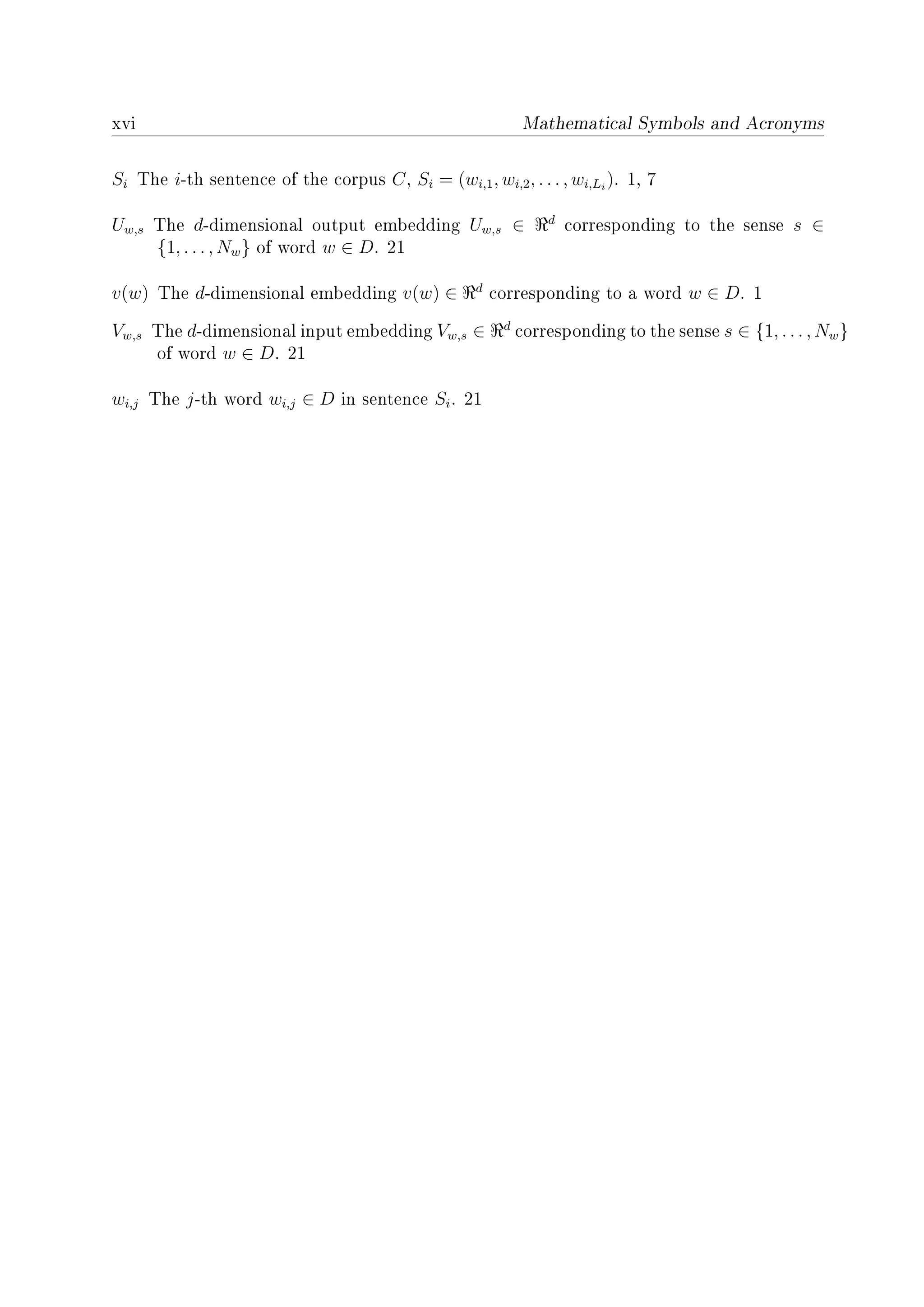
Uw,s The d-dimensional output embedding Uw,s ∈ d
corresponding to the sense s ∈
{1, . . . , Nw} of word w ∈ D. 21
v(w) The d-dimensional embedding v(w) ∈ d
corresponding to a word w ∈ D. 1
Vw,s The d-dimensional input embedding Vw,s ∈ d
corresponding to the sense s ∈ {1, . . . , Nw}
of word w ∈ D. 21
wi,j The j-th word wi,j ∈ D in sentence Si. 21
Chapter 1
Introduction
1.1 Word Embedding
Machine learning approaches for natural language processing have to represent the words
of a language in a way such that Machine Learning modules may process them. This is
especially important for text mining, where data mining modules analyze text corpora to
extract their properties and semantics.
Consider a corpus C of interest containing documents and sentences. Traditional text
mining analyses use the vector space representation [Salton et al., 1975], where a word w
is represented by a sparse vector of the size N of the vocabulary D (usually N ≥ 100.000),
where all values are 0 except the entry for the actual word. This representation is also
called One-hot representation. This sparse representation, however, has no information on
the semantic similarity of words.
Recently word representations have been developed which represent each word w as a
real vector of d real numbers (e.g. d = 100) as proposed by [Collobert and Weston,
2008] and [Mikolov et al., 2013]. Generally, we call such a vector v(w) ∈ k
a word
embedding. By using a large corpus in an unsupervised algorithm word representations
may be derived such that words with similar syntax and semantics have representations
with a small Euclidean distance. Hence the distances between word embeddings correspond
to the semantic similarity of underlying words. These embeddings may be visualized to
show comunalities and dierences between words, sentences and documents. Subsequently
these word representations may be employed for further text mining analyses like opinion
mining [Socher et al., 2013], Kim 2014, Tang et al. 2014) or semantic role labeling [Zhou
and Xu, 2015] which benet from this type of representation [Collobert et al., 2011].
These algorithms are based on the very important assumption that if the contexts of two
words are similar, their meaning and therefore representations should be similar as well
[Harris, 1954]. Consider a sentence (or document) Si in the corpus C consisting of Li
words Si = (wi,1, wi,2, . . . , wi,Li
). Then the context of a word wt may be dened as the
1
2 1 Introduction
words in the neighborhood of wt in the sentence. Figure 1.1 shows how neighboring words
determine the sense of the word bank in a number of example sentences. So many actual
text mining methods make use of the context of words to generate embeddings.
Figure 1.1: Neigboring words dening the specic sense of bank.
Traditional word embedding methods rst obtain the co-occurrence matrix and then per-
form dimension reduction using singular value decomposition (SVD) [Deerwester et al.,
1990].
Recently, articial neural networks became very popular to generate word embeddings.
Prominent algorithms are Senna [Collobert and Weston, 2008], Word2vec [Mikolov et al.,
2013] and Glove [Pennington et al., 2014]. They all use randomly initialized vectors to
represent words. Subsequently these embeddings are modied in such a way that the word
embeddings of the neigboring words may be predicted with minimal error by a simple
neural network function.
1.2 Sense Embedding
Note that in the approaches described above each word is mapped to a single embedding
vector. It is well known, however, that a word may have several dierent meanings, i.e. is
polysemous. For example the word bank among others may designate:
• the slope beside a body of water,
• a nancial institution,
• a ight maneuver of an airplane.
Further examples of polysemy are the words book, milk or crane. WordNet [Fell-
baum, 1998] and other lexical resources show that most common words have 3 to 10
dierent meanings. Obviously each of these meanings should be represented by a separate
1.3 Goal 3
embedding vector, otherwise the embedding will no longer represent the underlying sense.
This in addition will harm the performance of subsequent text mining analyses. Therefore
we need methods to learn embeddings for senses rather than words.
Sense embeddings are a renement of word embeddings. For example, bank can appear
either together with money, account, check or in the context of river, water,
canoe. And the embeddings of the words money, account, check will be quite
dierent from the embeddings of river, water, canoe. Consider the following two
sentences
• They pulled the canoe up the bank.
• He cashed a check at the bank.
The word bank in the rst sentence has a dierent sense than the word bank in the
second sentence. Obviously, the context is dierent.
So if we have a methods to determine the dierence of the context, we can relabel the
word bank to the word senses bank1 or bank2 denoting the slope near a river or the
nancial institution respectively. We call the number after the word the sense labels of the
word bank. This process can be performed iteratively for each word in the corpus by
evaluating its context.
An alternative representation of words is generated by topic models [Blei et al., 2003],
which represent each word of a document as a nite mixture of topic vectors. The mixture
weights of a word depend on the actual document. This implies that a word gets dierent
representations depending on the context.
In the last years a number of approaches to derive sense embeddings have been presented.
Huang et al. [2012] used the clustering of precomputed one-sense word embeddings and
their neighborhood embeddings to dene the dierent word senses. The resulting word
senses are xed to the corresponding words in the sentences. Their embedding vectors
are trained until convergence. A similar approach is described by Chen et al. [2014].
Instead of a single embedding each word is represented by a number of dierent sense
embeddings. During each iteration of the supervised training, for each position of the
word, the best tting embedding is selected according the tness criterion. Subsequently
only this embedding is trained using back-propagation. Note that during training a word
may be assigned to dierent senses thus reecting the training process. A related approach
was proposed by Tian et al. [2014].
1.3 Goal
It turned out that the resulting embeddings get better with the size of the training corpus
and an increase of the dimension of the embedding vectors. This usually requires a parallel
4 1 Introduction
environment for the execution of the training of the embeddings. Recently Apache Spark
[Zaharia et al., 2010] has been presented, an opensource cluster computing framework.
Spark provides the facility to utilize entire clusters with implicit data parallelism and
fault-tolerance against resource problems, e.g. memory shortage. The currently available
sense embedding approaches are not ready to use compute clusters, e.g. by Apache Spark.
Our goal is to investigate sense assignment models which will extend known word em-
bedding (one sense) approaches and implement such method on a compute cluster using
Apache Spark to be able to process larger training corpora and employ higher-dimensional
sense embedding vectors. So that we can derive expressive word representations for dif-
ferent senses in an ecient way. And our main work will focus on the extension of the
Skip-gram model [Mikolov et al., 2013] in connection to the approach of [Neelakantan et al.,
2015] because these models are easy to use, very ecient and convenient to train.
1.4 Outline
The rest of the thesis is structured as the following. Chapter 2 introduces the background
about word embeddings and explains the mathematical details of one model (word2vec
Mikolov et al. [2013]) that one must be acquainted with in order to understand the work
presented. Chapter 3 presents some relevant literature and several latest approaches about
sense embedding. Chapter 4 describes the mathematical model of our work for sense
embedding. Chapter 5 introduces the Spark framework and discusses in detail the imple-
mentation of our model. Chapter 6 analyzes the eect of dierent parameters from the
model and compares the result with other models. Chapter 7 represents concluding re-
marks to our work including the advantages and disadvantages and talks about what can
be done further to improve our model.
Chapter 2
Background
2.1 Word Embedding
Recently machine learning algorithms are used often in many NLP tasks, but the machine
can not directly understand human language. So the rst thing is to transform the language
to the mathematical form like word vectors, that is using digital vectors to represent words
in natural languages. The above process is called word embedding.
One of the easiest word embeddings is using a one-hot representation, which uses a long
vector to represent a word. It only has one component which is 1, and the other components
are all 0s. The position of 1 corresponds to the index of the word in dictionary D. But
this word vector representation has some disadvantages, such as troubled by the huge
dimensionality |D|. Most important it can not describe the similarity between words well.
An alternative word embedding is the Distributed Representation. It was rstly proposed
by Williams and Hinton [1986] and can overcome the above drawbacks from one-hot rep-
resentation. The basic idea is to map each word into a short vector of xed length (here
short is with respect to long dimension |D| of the one-hot representation). All of these
vectors constitute a vector space, and each vector can be regarded as a point in the vector
space. After introducing the distancein this space , it is possible to judge the similarity
between words (morphology and syntax) according to the distance.
There are many dierent models which can be used to estimate a Distributed Represen-
tation vector, including the famous LSA (Latent Semantic Analysis) [Deerwester et al.,
1990] and the LDA (Latent Dirichlet Allocation) [Blei et al., 2003]. In addition, the neural
network algorithm based language model is a very common method and becomes more
and more popular. A language model has the task to predict the next word in a sentence
from the words observed so far. In these neural network based models, the main goal is
to generate a language model usually generating a word vectors as byproducts. In fact, in
most cases, the word vector and the language model are bundled together. The rst paper
on this is the Neural Probabilistic Language Model from [Bengio et al., 2003], followed by
5
6 2 Background
Figure 2.1: Graph of the tanh function
a series of related research, including SENNA from Collobert et al. [2011] and word2vec
from Mikolov et al. [2013].
Word embedding actually is very useful. For example, Ronan Collobert's team makes use
of the word vectors trained from software package SENNA ([Collobert et al., 2011]) to do
part-of-speech tagging, chunking into phrases, named entity recognition and semantic role
labeling, and achieves good results.
2.2 Neural Probabilistic Language Model
Neural Network
General speaking, a neural network denes a mapping between some input and output,
and it usually contains an input layer, an output layer and one or more hidden layers
between the input layer and the output layer. Each layer has some nodes meaning that it
can contains a vector with some dimension. Let x(i − 1) be the input vector to the i-th
layer and x(i) its output vector. From one layer to the next layer, there is a map function
f(x(i − 1)) = x(i) made up by an activation function with a weight matrix and and an
oset vector.
Specically vector x(i−1) is multiplied by a weight matrix H and then adds an oset vector
q, after that an activation function such as tanh function shown as Figure 2.1. Hence we
have
x(i) = f(x(i − 1)) = tanh(H ∗ x(i − 1)) + q (2.1)
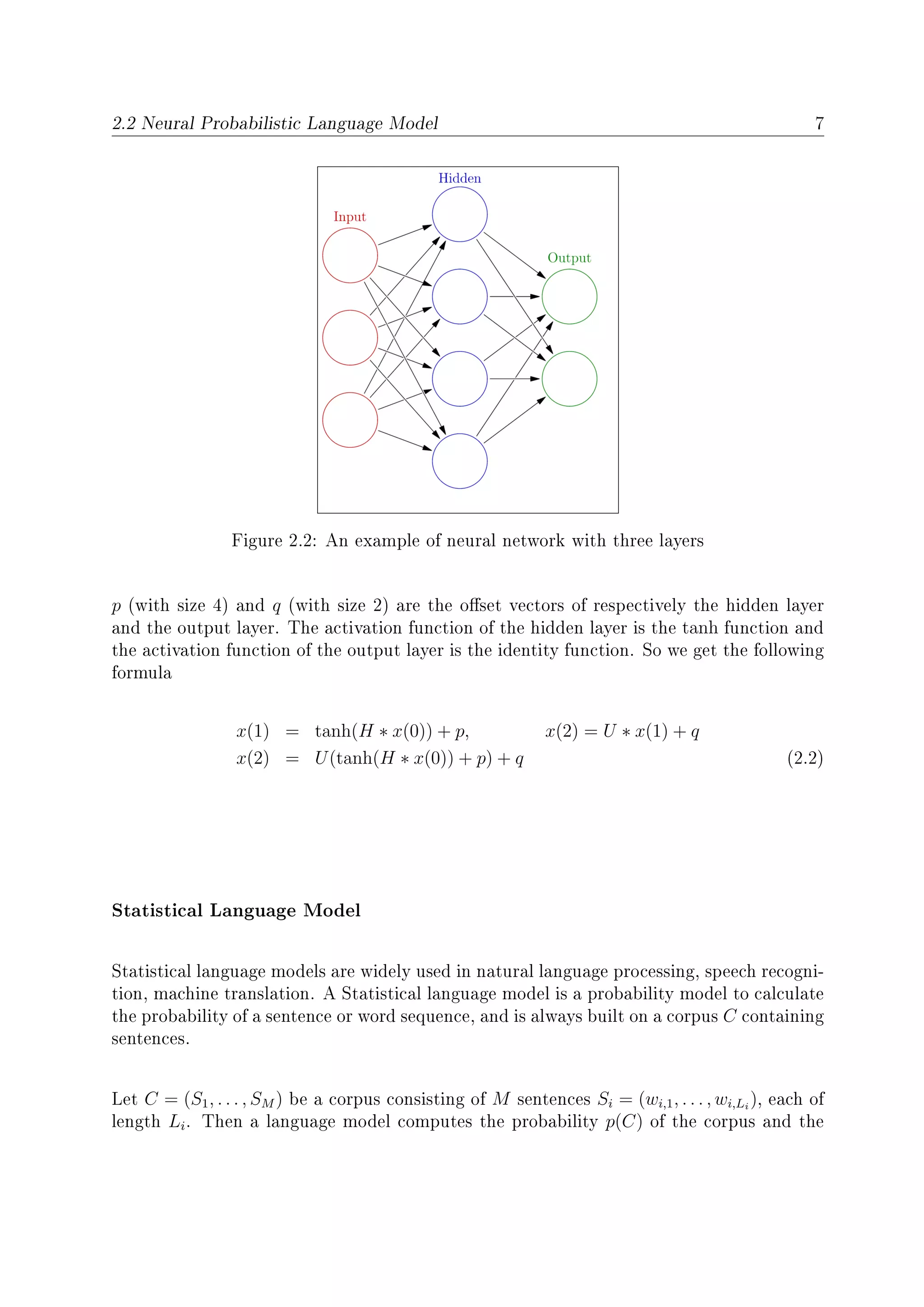
Let's start with the simplest neural network with three layers (only one hidden layer) shown
as Figure 2.2. We can nd that input layer has three nodes, that is the input should be a
vector with dimension 3. The hidden layer has four nodes, which means the input vector
will be mapped to a hidden vector with dimension 4. And then it will be mapped again to
the output vector with dimension 2. Specically, the input is a vector x(0) (with dimension
3). H (with size 4 × 3) and U (with size 2 × 4) are respectively the weight matrix between
input layer and hidden layer and the weight matrix between hidden layer and output layer,
2.2 Neural Probabilistic Language Model 7
Figure 2.2: An example of neural network with three layers
p (with size 4) and q (with size 2) are the oset vectors of respectively the hidden layer
and the output layer. The activation function of the hidden layer is the tanh function and
the activation function of the output layer is the identity function. So we get the following
formula
x(1) = tanh(H ∗ x(0)) + p, x(2) = U ∗ x(1) + q
x(2) = U(tanh(H ∗ x(0)) + p) + q (2.2)
Statistical Language Model
Statistical language models are widely used in natural language processing, speech recogni-
tion, machine translation. A Statistical language model is a probability model to calculate
the probability of a sentence or word sequence, and is always built on a corpus C containing
sentences.
Let C = (S1, . . . , SM ) be a corpus consisting of M sentences Si = (wi,1, . . . , wi,Li
), each of
length Li. Then a language model computes the probability p(C) of the corpus and the
8 2 Background
probabilities p(Si) of the sentences Si according to the conditional probability denition
p(C) =
M
i=1
p(Si) (2.3)
p(Si) =
Li
t=1
p(wt|wt−1, . . . , w1)
≈
Li
t=1
p(wt|Prev(wt)) (2.4)
where Prevn−1
(wt) = (wi,max(t−n+1,1), . . . , wi,t) is the subsequence of n−1 past words before
wt in sentence Si. Note that the last equation is an approximation of the full conditional
probability. The core part of a Statistic language model is to compute p(wt|Prev(wt)) by
some model if Prev(wt) is given.
Neural Probabilistic Language Model
Bengio et al. [2003] introduce a neural probabilistic language model shown as Figure 2.3,
which uses neural network to approximate p(wt|Prev(wt)) the language model (2.4).
C is the given corpus containing the sentences/documents of words from a dictionary D.
Consider a word wt in some sentence Si = (w1, w2, . . . , wT−1, wLi
) of corpus C, where t is
some position in S and Li is the length of S. Let Prevn−1
(wt) = (wmax(t−n+1,1), . . . , wt−1)
be the subsequence of words before wt.
Firstly for each word w in dictionary D, there is a look-up table V mapping the word w to
vector V (w). Note that V is denoted as C in gure 2.3. The vector size of V (w) is d. The
input layer is a long vector concatenated by n − 1 word vectors in Prevn−1
(wt). So the
input vector is x with dimension (n − 1)d, and the output vector is y with the dimension
|D|, where D is vocabulary and |D| is the size of vocabulary.
Bengio et al. [2003] also use tanh function for the activation function in the hidden layer.
H (with size m × (n − 1)d) and U (with size |D| × m) are respectively the weight matrix
between input layer and hidden layer and the weight matrix between hidden layer and
output layer, p (with size m)and q (with size D) are the oset vectors of respectively the
hidden layer and the output layer. Additionally, they introduce another weight matrix
between the input layer and output layer W (with size |D| × (n − 1)d). So the mapping
function from x to the output is
y = q + U ∗ tanh(p + H ∗ x) + W ∗ x (2.5)
2.2 Neural Probabilistic Language Model 9
Figure 2.3: The neural network structure from [Bengio et al., 2003]
Softmax Function
The softmax function, is a generalization of the logistic function that squashes a K-
dimensional vector z of arbitrary real values to a K-dimensional vector σ(z) of real values
in the range (0, 1) that add up to 1
1
. The function is given by
σ(z)j =
ezj
K
k=1 ezk
for j = 1, . . . , K.
From above, we know the output y is a vector with the length of |D| with arbitrary values
and can not represent probabilities. Because it is a language model, it needs to model the
probability as p(wt|Prevn−1
(wt)). Actually, Bengio et al. [2003] use the softmax function
to do normalization. After normalization, the nal result is a value between 0 to 1, which
can represent a probability. Using xwt to represent the input vector connected by word
vectors from Context(wt) and ywt to represent the output vector mapped from the neural
network. From Formula 2.5 we have
ywt = q + U ∗ tanh(p + H ∗ xwt ) + W ∗ xwt (2.6)
1https://en.wikipedia.org/wiki/Softmax_function
10 2 Background
and p(wt|Prevn−1
(wt)) can be expressed as
p(wt|Prevn−1
(wt)) =
eywt,iwt
|D|
i=1 eywt,i
, (2.7)
where iwt represents the index of wt in the dictionary D, ywt,i means the i-th element in
the vector ywt . Note that the denominator contains a term eywt,i
for every word in the
vocabulary. The goal is also to maximize the function shown as 2.4. In the beginning, all
word vectors are initialized randomly. And after maximizing the objective function, they
can get the meaningful word vectors.
2.3 The model of Collobert and Weston
The main purpose of the approach of Collobert and Weston [2008] originally is not to build
a language model, but to use the word vectors from their model to complete several tasks
from natural language processing, such as speech tagging, named entity recognition, phrase
recognition, semantic role labeling, and so on ([Collobert and Weston, 2008] and [Collobert
et al., 2011]). Due to the dierent purpose, their training method is also dierent. They
do not use the Formula 2.4 as other language models used. Their idea is to optimize a
score function on phrase so that if the phrase is reasonable or makes sense, the score would
be positive, otherwise the score would be negative.
C is the given corpus with a vocabulary D of size N. Consider a word wt in some sentence
S = (w1, w2, . . . , wT−1, wT ) from corpus C, where t is some position of S and T is the
length of S. Dene phrase(wt) = (wt−c, . . . , wt−1, wt, wt+1, . . . , wt+c), and c is the number
of words before and after wt. Note that phrase(wt) contains wt. We dene phrase(wt) as
phrase(wt) where the center word wt is replaced by anther random word w = wt. Each
word is represented by a vector of dimension d . For phrase phrase(wt), connect these 2c+1
vectors to be a long vector xwt with dimension d × (2c + 1). The input of f is the vector
xwt with dimension d × (2c + 1). And the output is a real number (positive or negative).
Use xwt
to represent the vector connected by 2c + 1 word vectors from phrase(wt) .
[Collobert and Weston, 2008] also use a neural network to build their model. But the neural
network structure is dierent from the network structure in [Bengio et al., 2003]. Its output
layer has only one node representing the score, rather than Bengio's N nodes, where N is
the size of dictionary D. Note that Bengio's model uses another softmax funtion to get
the probability value in order to represent the Formula 2.7. Doing so greatly reduced the
computational complexity.
Based on the above description, the model use f to represent its neural network, the input
is a phrase vector, the output can be an arbitrary real number. Note that there is no
active function in the output layer. The objective of this model is that for every phrase
2.4 Word2Vec 11
phrase(wt) from corpus, f(xwt ) should be always positive and f(xwt
) should be always
negative. Specically the model gives an objective function to be minimized as following
w∈C
max{0, 1 − f(xw), f(xw)} (2.8)
In most cases, replacing the middle of the word in a normal phrase, the new phrase is
certainly not the normal phrase, which is a good method to build negative sample (in most
cases they are negative samples, only in rare cases the normal phrases are considered as
negative samples but they would not aect the nal result).
2.4 Word2Vec
The main purpose of Word2Vec is to accelerate the training process and simplify the model.
Word2Vec actually contains two dierent models: the CBOW model (Continuous Bag-of-
Words Model), and the Skip-gram model(Continuous Skip-gram model), which uses the
following objective function
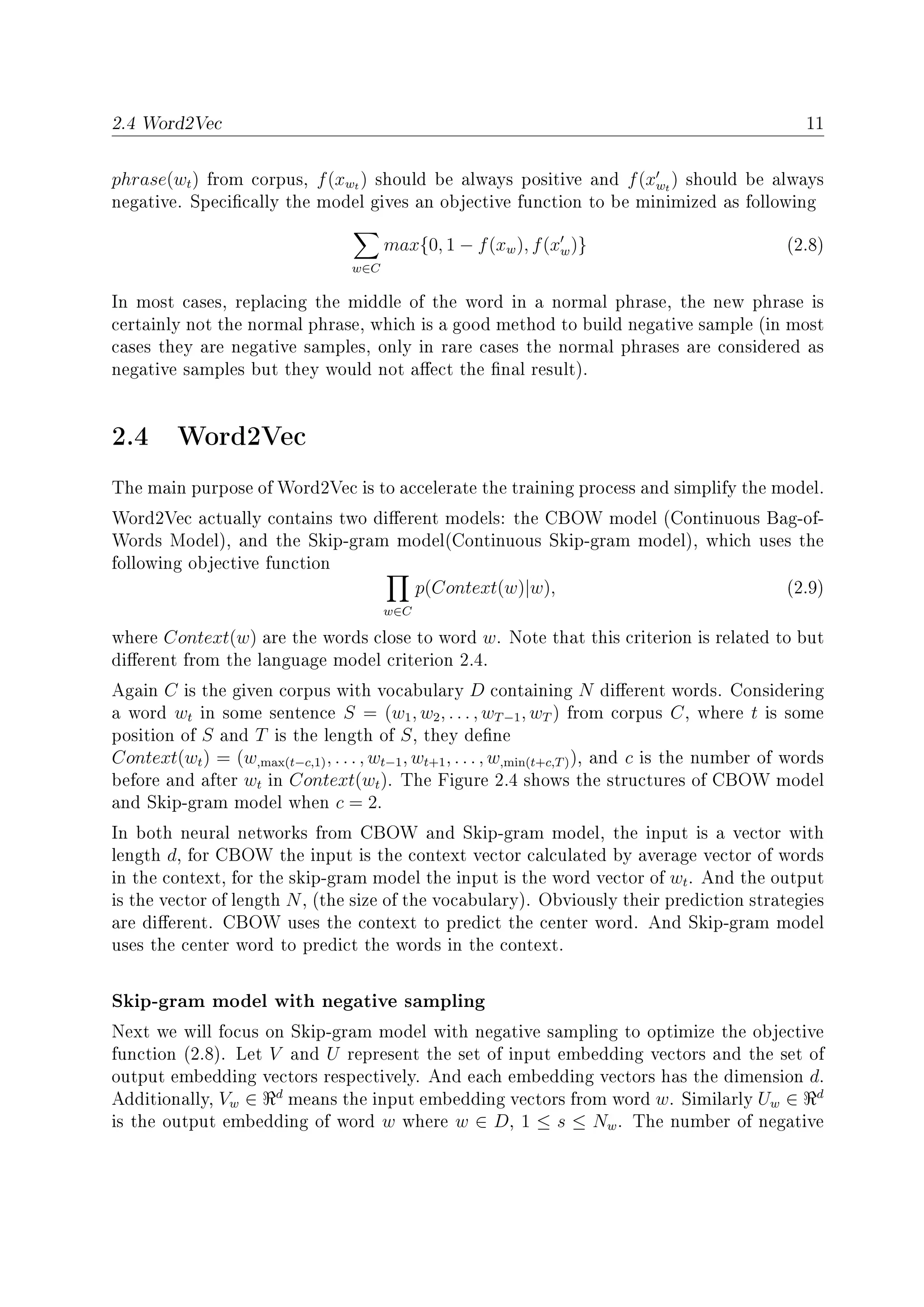
w∈C
p(Context(w)|w), (2.9)
where Context(w) are the words close to word w. Note that this criterion is related to but
dierent from the language model criterion 2.4.
Again C is the given corpus with vocabulary D containing N dierent words. Considering
a word wt in some sentence S = (w1, w2, . . . , wT−1, wT ) from corpus C, where t is some
position of S and T is the length of S, they dene
Context(wt) = (w,max(t−c,1), . . . , wt−1, wt+1, . . . , w,min(t+c,T)), and c is the number of words
before and after wt in Context(wt). The Figure 2.4 shows the structures of CBOW model
and Skip-gram model when c = 2.
In both neural networks from CBOW and Skip-gram model, the input is a vector with
length d, for CBOW the input is the context vector calculated by average vector of words
in the context, for the skip-gram model the input is the word vector of wt. And the output
is the vector of length N, (the size of the vocabulary). Obviously their prediction strategies
are dierent. CBOW uses the context to predict the center word. And Skip-gram model
uses the center word to predict the words in the context.
Skip-gram model with negative sampling
Next we will focus on Skip-gram model with negative sampling to optimize the objective
function (2.8). Let V and U represent the set of input embedding vectors and the set of
output embedding vectors respectively. And each embedding vectors has the dimension d.
Additionally, Vw ∈ d
means the input embedding vectors from word w. Similarly Uw ∈ d
is the output embedding of word w where w ∈ D, 1 ≤ s ≤ Nw. The number of negative
12 2 Background
Figure 2.4: word2vec
samples is K. And P(w) is the smoothed unigram distribution which is used to generate
negative samples. Specically for each w ∈ D
P(w) =
count(w)
3
4
( M
i=1 Li)
3
4
where count(w) is the number of times w occurred in C and
M
i=1 Li is the number of
total words in C. The objective function of skip-gram model with negative sampling can
be dened specically as
G =
1
M
M
i=1
1
Li
Li
t=1 −c ≤ j ≤ c
j = 0
1 ≤ j + t ≤ Li
log p(wi,t+j|wi,t) +
K
k=1
Ezk∼P(w)log [1 − p(zk|wi,t)]
(2.10)
where p(w |w) = σ(Uw
T
Vw) and σ(x) = 1
1+e−x .
p(wi,t+j|wi,t) is the probability of using center word wi,t to predict one surrounding word
wi,t+j, which needs to be maximized. z1,. . . ,zK are the negative sample words to replace
word wi,t+j, and p(zk|wi,t) (1 ≤ k ≤ K) is the probability of using center word wi,t to
2.4 Word2Vec 13
predict one negative sample word zk, which needs to be minimized. Equivalently, the
whole objective function needs to be maximized.
Take the word pair (wi,t, wi,t+j) as a training sample, and dene loss function loss for
each sample
loss(wi,t, wi,t+j) = −log p(wi,t+j|wi,t) −
K
k=1
Ezk∼P(w)log [1 − p(zk|wi,t)] (2.11)
Here the loss is dened as the negative log probability of wi,t given wi,t+j.
And the loss function of whole corpus is
loss(C) =
1
M
M
i=1
1
Li
Li
t=1 −c ≤ j ≤ c
j = 0
1 ≤ j + t ≤ Li
loss(wi,t, wi,t+j)
To maximize the objective function is equivalently to minimize the loss function. So the
objective of learning algorithm is
arg min
{V,U}
1
M
M
i=1
1
Li
Li
t=1 −c ≤ j ≤ c
j = 0
1 ≤ j + t ≤ Li
loss(wi,t, wi,t+j)
Use
It =
1
M
M
i=1
1
Li
Li
t=1 −c ≤ j ≤ c
j = 0
1 ≤ j + t ≤ Li
1
to represent the number of total training samples in one epoch. (An epoch is a measure of
the number of times all of the training samples are used once.) And the number of epochs
is T. So the total iterations is It ∗ T.
Use stochastic gradient descent:
2
• Initialize {V, U}
• For It ∗ T Iterations:
 For each training sample (wi,t, wi,t+j)
∗ Generate negative sample words to replace wi,t+j: (w1, . . . , zk)
2https://en.wikipedia.org/wiki/Stochastic_gradient_descent
14 2 Background
∗ Calculate the gradient ∆ = − {V,U}loss(wi,t, wi,t+j)
∗ ∆ is only made up by {∆Vwi,t
, ∆Uwi,t+j
, [∆Uw1
, . . . , ∆Uzk
]}
∗ Update Embeddings:
· Vwi,t
= Vwi,t
+ α∆Vwi,t
· Uwi,t+j
= Uwi,t+j
+ α∆Uwi,t+j
· Uzk
= Uzk
+ α∆Uzk
, 1 ≤ k ≤ K
(α is the learning rate and will be updated every several iterations)
The detail of gradient calculation of loss(wi,t, wi,t+j) is
∆Vwi,t
= −
∂loss(wi,t, wi,t+j)
∂Vwi,t
= [1 − log σ(UT
wi,t+j
Vwi,t
)]Uwi,t+j
+
k
i=1
[−log σ(UT
zk
Vwi,t
))]Uzk
∆Uwi,t+j
= −
∂loss(wi,t, wi,t+j)
∂Uwi,t+j
= [1 − log σ(UT
wi,t+j
Vwi,t
)]Vwi,t
∆Uzk
= −
∂loss(wi,t, wi,t+j)
∂Uzk
= [−log σ(UT
zk
Vwi,t
))]Vwi,t
, 1 ≤ k ≤ K
Chapter 3
Related Works
3.1 Huang's Model
The work of Huang et al. [2012] is based on the model of Collobert and Weston [2008].
They try to make embedding vectors with richer semantic information. They had two major
innovations to accomplish this goal : The rst innovation is using global information from
the whole text to assist local information, the second innovation is using the multiple word
vectors to represent polysemy.
Huang thinks Collobert and Weston [2008] use only local context. In the process of
training vectors, they used only 10 words as the context for each word, counting the center
word itself, there are totally 11 words' information. This local information can not fully
exploit the semantic information of the center word. Huang used their neural network
directly to compute a score as the local score.
And then Huang proposed a global information, which is somewhat similar to the tra-
ditional bag of words model. Bag of words is about accumulating One-hot Representation
from all the words of the article together to form a vector (like all the words thrown in a
bag), which is used to represent the article. Huang's global information used the average
weighted vectors from all words in the article (weight is word's idf), which is considered
the semantic of the article. He connected such semantic vector of the article (global in-
formation) with the current word's vector (local information) to form a new vector with
double size as an input, and then used the CW's network to calculate the score. Figure
[huang] shows such structure. With the local score from original CW approach and
Global score from improving method based on the CW approach, Huang directly add
two scores as the nal score. The nal score would be optimized by the pair-wise target
function from CW. Huang found his model can capture better semantic information.
The second contribution of this paper is to represent polysemy using multiple embeddings
for a single word. For each center word, he took 10 nearest context words and calculated the
15
16 3 Related Works
Figure 3.1: The network structure from [Huang et al., 2012]
Table 3.1: Senses computed with Huang's network and their nearest neighbors.
Center Word Nearest Neighbors
bank_1 corporation, insurance, company
bank_2 shore, coast, direction
star_1 movie, lm, radio
star_2 galaxy, planet, moon
cell_1 telephone, smart, phone
cell_2 pathology, molecular, physiology
left_1 close, leave, live
left_2 top, round, right
weighted average of the embeddings of these 10 word vectors (idf weights) as the context
vector. Huang used all context vectors to do a k-means clustering. He relabel each word
based on the clustering results (dierent classes of the same words would be considered as
dierent words to process). Finally he re-trained the word vectors. Table 3.1 gives some
examples from his model's results.
3.2 EM-Algorithm based method
Tian et al. [2014] proposed an approach based on the EM-algorithm from . This method
is the extension of the normal skip-gram model. They still use each center word to predict
several context words. The dierence is that each center word can have several senses
with dierent probabilities. The probability should represent the relative frequency of the
sense in the corpus. For example, considering bank1 in the sense of side of the river and
bank2 meaning nancial institution. Usually bank1 will have a smaller probability and
3.2 EM-Algorithm based method 17
Table 3.2: Word senses computed by Tian et al.
word Prior Probability Most Similar Words
apple_1 0.82 strawberry, cherry, blueberry
apple_2 0.17 iphone, macintosh, microsoft
bank_1 0.15 river, canal, waterway
bank_2 0.6 citibank , jpmorgan, bancorp
bank_3 0.25 stock, exchange, banking
cell_1 0.09 phones cellphones, mobile
cell_2 0.81 protein, tissues, lysis
cell_3 0.01 locked , escape , handcued
bank2. We can say in the corpus, in most sentences of the corpus the word bank means
nancial institution and in other fewer cases it means side of the river.
Objective Function
Considering wI as the input word and wO as the output word, (wI, wO) is a data sample.
The input word wI have NwI
prototypes, and it appears in its hwI
-th prototype, i.e.,
hwI
∈ {1, .., NwI
} [] The prediction P(wO|wI) is like the following formula
p(wO|wI) =
NwI
i=1
P(wO|hwI
= i, wI)P(hwI
= i|wI) =
NwI
i=1
exp(UT
wO
VwI ,i)
w∈Wexp(UT
w VwI ,i)
P(hwI
= i|wI)
where VwI ,i ∈ Rd
refers to the d-dimensional input embedding vector of wI's i-th proto-
type and UwO
∈ Rd
represents the output embedding vectors of wO. Specically, they
use the Hierarchical Softmax Tree function to approximate the probability calculation.
Algorithm Description
Particularly for the input word w, they put all samples (w as the input word) together like
{(w, w1), (w, w2), (w, w3)...(w, wn)} as a group. Each group is based on the input word. So
the whole training set can be separated as several groups. For the group mentioned above,
one can assume the input word w has m vectors (m senses), each with the probability
pj(1 ≤ j ≤ m). And each output word wi(1 ≤ i ≤ n) has only one vector.
In the training process, for each iteration, they fetch only part of the whole training set
and then split it into several groups based on the input word. In each E-step, for the group
mentioned above, they used soft label yi,j to represent the probability of input word in
sample (w, wi) assigned to the j-th sense. The calculating of yi,j is based on the value of
sense probability and sense vectors. After calculating each yi,j in each data group, in the
M-step, they use yi,j to update sense probabilities and sense vectors from input word, and
the word vectors from output word. Table 3.2 lists some results from this model.
18 3 Related Works
3.3 A Method to Determine the Number of Senses
Neelakantan et al. [2015] comes up with two dierent models, the rst one is the MSSG
(Multi-Sense Skip-gram) model, in which the number of senses for each word is xed and
decided manually. The second one is NP-MSSG (Non-Parametric MSSG) which is based
on the MSSG model , the number of senses for each word in this model is not xed and
can be decided dynamically by the model itself.
MSSG
C is the given corpus containing the sentences/documents of words. N is the number of
dierent words in the corpus C. D is the vocabulary (the set of N dierent words in
the corpus C). Considering a word wt in some sentence S = (w1, w2, . . . , wT−1, wT ) from
corpus C, where t is some position of S and T is the length of S, dene Context(w) =
(w,max(t−c,1), . . . , wt−1, wt+1, . . . , w,min(t+c,T)), and c is the number of words before and after
wt in the Context(w).
In the MSSG model, each word has S senses (S is set advance manually. Like huang's
model, MSSG model uses the clustering, but its clustering strategy is dierent. Assuming
each word has a context vector, which is summed up by all word vectors in the context.
Huang's model do clustering on all context vectors (calculated by the weighted average of
word vectors) from the corpus. While for MSSG model, they do clustering based on each
word, that is each word has its own context clusters. Another thing is that MSSG only
records the information (vector) of context cluster center for each word. For example, word
w has S clusters , it has only S context vectors. And in the initialization, these S context
vectors are set randomly. When there is a new context of word w, the model will rstly
check which cluster this context should belong to and then use this new context vector to
update the vector of selected context cluster center.
Specically, each word has a global vector, S sense vectors and S context cluster center
vectors. All of them are initialized randomly. For word wt, its global vector is vg(wt)
and its context vectors are vg(wt−c), . . . , vg(wt−1), vg(wt+1), . . . , vg(wt+c). vcontext(ct) is the
average context vector calculated by the average of these 2c global word vectors. And
wt's sense vectors are vs(wt, s)(s = 1, 2, . . . , S) and the context cluster center vectors are
µ(wt, s)(s = 1, 2, . . . , S). The architecture of the MSSG is like Figure 3.2 when c = 2. It
uses the following formula to select the best cluster center:
st = arg max
s=1,2,...,S
sim(µ(wt, s), vcontext(ct))
where st is index of selected cluster center and sim is the cosine similarity function. The
selected context cluster center vector µ(wt, st) will be updated with current context vector
vcontext(ct). And then the model selects v(w, st) as current word's sense. The rest thing
is similar as skip-gram model: use this sense vector to predict global word vectors in the
context and then update these global word vectors and this sense vector.
3.3 A Method to Determine the Number of Senses 19
Figure 3.2: Architecture of MSSG model with window size Rt = 2 and S = 3
NP-MSSG
Unlike MSSG, in NP-MSSG model, the number of senses for each word is unknown and
is learned during training. In the beginning, each word only has a global vector and does
not have sense vectors and context clusters. When meeting a new context, for each word,
the model will decide whether to create a new sense vector and a context cluster. When
a word meets the rst context, that is the rst occurrence of this word in the corpus, the
model creates the rst sense vector and the rst context cluster for this word. After that,
when there is a new context, the model will calculate all similarities between this word
and current all context clusters, if the biggest similarity value is smaller than some given
hyper-parameter λ, that is the new context is dierent from all current context clusters,
the model will create a new context cluster and also a new sense vector as the beginning
step. Otherwise, it will select the context with the biggest similarity value and do the same
thing as what MSSG model do . Specically, the selecting step can be described as the
following formula :
st =
s(wt) + 1, if max
s=1,2,...,s(wt)
{sim(µ(wt, s), vcontext(ct))}  λ
smax, otherwise
20 3 Related Works
where s(wt) is the number of senses (context clusters) of word wt, u(wt, s) is the cluster
center of sth
cluster of word wt and smax = arg maxs=1,2,. . . ,s(wt) sim(µ(wt, s), vcontext(ct)).
Chapter 4
Solution
In this section we present a model for the automatic generation of embeddings for the
dierent senses of words. Generally speaking, our model is a extension of skip-gram model
with negative sampling. We assume each word in the sentence can have one or more senses.
As described above Huang et al. [2012] cluster the embeddings of word contexts to label
word senses and once assigned, these senses can not be changed. Our model is dierent.
We do not assign senses to words in a preparatory step, instead we just initialize each
word with random senses and they can be adjusted afterwards. We also follow the idea
from EM-Algorithm based method [Tian et al., 2014], word's dierent senses have dierent
probabilities, the probability can represent if a sense is used frequent in the corpus.
In fact, after some experiments, we found our original model is not good. So we simplied
our original model. Anyhow we will introduce our original model and show the failures in
the next chapter, and explain the simplication.
4.1 Denition
C is the corpus containing M sentences, like (S1, S2, . . . , SM ), and each sentence is made
up by several words like Si = (wi,1, wi,2, . . . , wi,Li
) where Li is the length of sentence Si.
We use wi,j ∈ D to represent the word token from the vocabulary D in the position j of
sentence Si. We assume that each word w ∈ D in each sentence has Nw ≥ 1 senses. We
use the lookup function h to assign senses to words in a sentence, specically hi,j is the
sense index of word wi,j (1 ≤ hi,j ≤ Nwi,j
).
Similar to Mikolov et al. [2013] we use two dierent embeddings for the input and the
output of the network. Let V and U to represent respectively the set of input embedding
vectors and the set of output embedding vectors respectively. And each embedding vectors
has the dimension d. Additionally, Vw,s ∈ d
means the input embedding vectors from
sense s of word w. Similarly Uw,s ∈ d
is the ouput embedding of word w where w ∈ D,
1 ≤ s ≤ Nw. Following the Skip-gram model with negative sampling, K. The context of a
21
22 4 Solution
word wt in the sentence Si may be dened as the subsequence of the words Context(wt) =
(wi,max(t−c,0), . . . , wi,t−1, wi,t+1, . . . , wi,min(t+c,Li)), where c is the size of context. And P(w) is
the smoothed unigram distribution which is used to generate negative samples. Specically,
P(w) = count(w)
3
4
( M
i=1 Li)
3
4
(w ∈ D), where count(w) is the number of times w occurred in C and
M
i=1 Li is the number of total words in C.
4.2 Objective Function
Based on the skip-gram model with negative sampling. We still use same neural network
structure to optimize the probability of using the center word to predict all words in the
context. The dierence is that, such probability is not about word prediction, instead
it is about sense prediction. We use (w, s) to represent the word w's s-th sense, i.e.
(wi,t, hi,t) represents the word wi,t's hi,t-th sense, and p((wi,t+j, hi,t+j)|(wi,t, hi,t)) represents
the probability using wi,t's hi,t-th sense to predict wi,t+j's hi,t+j-th sense, where wi,t and
wi,t+j are indexes of words in the position t and t + j respectively from sentence Si. And
hi,t and hi,t+j represent their assigned sense indexes, which can be adjusted by model
in the training. The above prediction probability is only for a pair of word with sense
information, the goal of the model is to maximize every possible pairs of words which can
use a probability computed by producing every prediction probabilities of word pairs to
resent the prediction probability based on the whole corpus. The model's task is to adjust
sense assignment and learn sense vectors in order to get the biggest prediction probability
based on the whole corpus. Specically, we use the following likelihood function to achieve
above objective
G =
1
M
M
i=1
1
Li
Li
t=1 −c ≤ j ≤ c
j = 0
1 ≤ j + t ≤ Li
log p (wi,t+j, hi,t+j)|(wi,t, hi,t)
+
K
k=1
Ezk∼Pn(w)log 1 − p [zk, R(Nzk
)]|(wi,t, hi,t)
(4.1)
where p (w , s )|(w, s) = σ(Uw ,s
T
Vw,s) and σ(x) = 1
1+e−x .
p (wi,t+j, hi,t+j)|(wi,t, hi,t) is the probability of using center word wi,t with sense hi,t to
predict one surrounding word wi,t+j with sense hi,t+j, which needs to be maximized.
[z1, R(Nz1 )],. . . ,[(zK, R(NzK
)] are the negative sample words with random assigned senses
to replace (wi,t+j, hi,t+j), and p [zk, R(Nzk
)]|(wi,t, hi,t) (1 ≤ k ≤ K) is the probability of
using center word wi,t with sense hi,t to predict one negative sample word zk with sense
4.2 Objective Function 23
R(Nzk
), which needs to be minimized. It is noteworthy that, hi,t (wi,t's sense) and hi,t+j
(wi,t+j's sense) are assigned advance and hi,t may be changed in the Assign. But zk's sense
sk is always assigned randomly.
The nal objective is to nd out optimized parameters θ = {h, U, V } to maximize the
Objective Function G, where h is updated in the Assign and {U, V } is updated in the
Learn.
In the Assign, we use score function fi,t with xed negative samples
∪
−c ≤ j ≤ c
j = 0
1 ≤ j + t ≤ Li
[(zj,1, sj,1), . . . , (zj,K, sj,K)] (senses are assigned randomly already)
fi,t(s) =
−c ≤ j ≤ c
j = 0
1 ≤ t + j ≤ Li
log p[(wi,t+j, hi,t+j)|(wi,t, s)] +
K
k=1
log 1 − p[(zj,k, sj,k)|(wi,t, s)]
to select the best sense (with the max value) for word wi,t. In the Learn, we take
[(wi,t, hi,t), (wi,t+j, hi,t+j)] as a training sample and use the negative log probability as loss
function loss for each sample
loss (wi,t, hi,t), (wi,t+j, hi,t+j)
= −log p (wi,t+j, hi,t+j)|(wi,t, hi,t) −
K
k=1
Ezk∼Pn(w)log 1 − p [zk, R(Nzk
)]|(wi,t, hi,t)
And the loss function of whole corpus is
loss(C) =
1
M
M
i=1
1
Li
Li
t=1 −c ≤ j ≤ c
j = 0
1 ≤ j + t ≤ Li
loss (wi,t, hi,t), (wi,t+j, hi,t+j)
After Assign, h is xed. So we the same method in the normal Skip-gram with negative
sampling model (stochastic gradient decent) to minimize G in the Learn. So the objective
of Learn is to get
arg min
{V,U}
1
M
M
i=1
1
Li
Li
t=1 −c ≤ j ≤ c
j = 0
1 ≤ j + t ≤ Li
loss (wi,t, hi,t), (wi,t+j, hi,t+j)
24 4 Solution
4.3 Algorithm Description
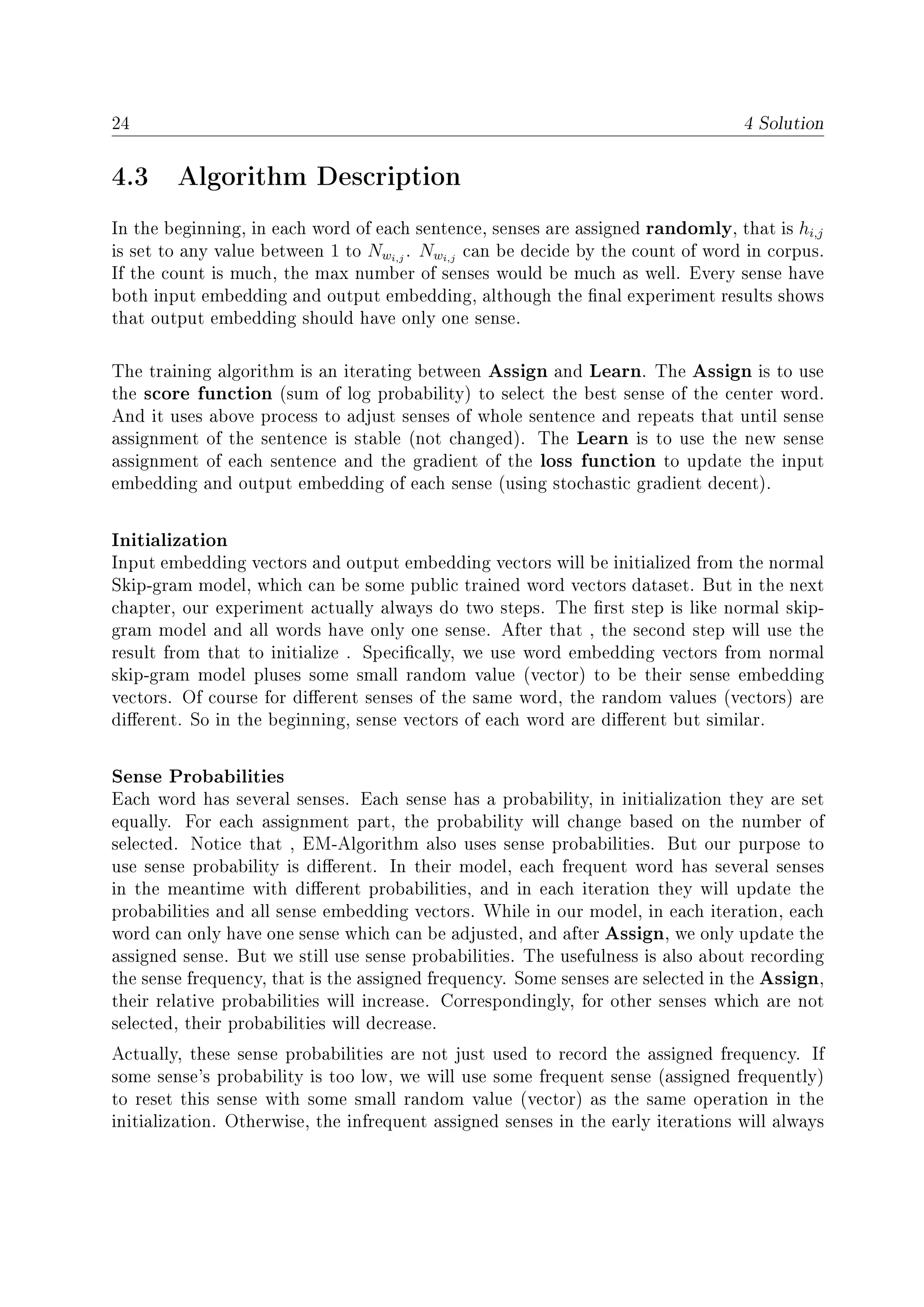
In the beginning, in each word of each sentence, senses are assigned randomly, that is hi,j
is set to any value between 1 to Nwi,j
. Nwi,j
can be decide by the count of word in corpus.
If the count is much, the max number of senses would be much as well. Every sense have
both input embedding and output embedding, although the nal experiment results shows
that output embedding should have only one sense.
The training algorithm is an iterating between Assign and Learn. The Assign is to use
the score function (sum of log probability) to select the best sense of the center word.
And it uses above process to adjust senses of whole sentence and repeats that until sense
assignment of the sentence is stable (not changed). The Learn is to use the new sense
assignment of each sentence and the gradient of the loss function to update the input
embedding and output embedding of each sense (using stochastic gradient decent).
Initialization
Input embedding vectors and output embedding vectors will be initialized from the normal
Skip-gram model, which can be some public trained word vectors dataset. But in the next
chapter, our experiment actually always do two steps. The rst step is like normal skip-
gram model and all words have only one sense. After that , the second step will use the
result from that to initialize . Specically, we use word embedding vectors from normal
skip-gram model pluses some small random value (vector) to be their sense embedding
vectors. Of course for dierent senses of the same word, the random values (vectors) are
dierent. So in the beginning, sense vectors of each word are dierent but similar.
Sense Probabilities
Each word has several senses. Each sense has a probability, in initialization they are set
equally. For each assignment part, the probability will change based on the number of
selected. Notice that , EM-Algorithm also uses sense probabilities. But our purpose to
use sense probability is dierent. In their model, each frequent word has several senses
in the meantime with dierent probabilities, and in each iteration they will update the
probabilities and all sense embedding vectors. While in our model, in each iteration, each
word can only have one sense which can be adjusted, and after Assign, we only update the
assigned sense. But we still use sense probabilities. The usefulness is also about recording
the sense frequency, that is the assigned frequency. Some senses are selected in the Assign,
their relative probabilities will increase. Correspondingly, for other senses which are not
selected, their probabilities will decrease.
Actually, these sense probabilities are not just used to record the assigned frequency. If
some sense's probability is too low, we will use some frequent sense (assigned frequently)
to reset this sense with some small random value (vector) as the same operation in the
initialization. Otherwise, the infrequent assigned senses in the early iterations will always
4.3 Algorithm Description 25
be ignored in the next iterations. Actually, we already did some experiments without sense
probabilities and these experiments' results really told use the above situation.
Next, we will describe the specic steps of Assign and Learn in the form of pseudo-code.
procedure Assign
for i:= 1 TO M do Loop over sentences.
repeat
for t:= 1 TO Li do Loop over words.
hi,t = max
1≤s≤Nwi,t
fi,t(s)
end for
until no hi,t changed
end for
end procedure
procedure Learn
for i:= 1 TO M do Loop over sentences.
for t:= 1 TO Li do Loop over words.
for FOR j:= −c TO c do
if j = 0 and t + j ≥ 1 and t + j ≤ Li then
generate negative samples (z1, s1), . . . , (zK, sK)
∆ = − θloss (wi,t, hi,t), (wi,t+j, hi,t+j)
∆ is made up by {∆Vwi,t,hi,t
, ∆Uwi,t+j,hi,t+j
, [∆Uw1,w1
, . . . , ∆Uzk,zk
]}
Vwi,t,hi,t
= Vwi,t,hi,t
+ α∆Vwi,t,hi,t
Uwi,t+j,hi,t+j
= Uwi,t+j,hi,t+j
+ α∆Uwi,t+j,hi,t+j
Uzk,sk
= Uzk,sk
+ α∆Uzk,sk
, 1 ≤ k ≤ K
end if
end for
end for
end for
end procedure
The detail of gradient calculation of loss (wi,t, hi,t), (wi,t+j, hi,t+j) is
∆Vwi,t,hi,t
= −
∂loss (wi,t, hi,t), (wi,t+j, hi,t+j)
∂Vwi,t,hi,t
26 4 Solution
= [1 − log σ(Uwi,t+j,hi,t+j
T
Vwi,t,hi,t
)]Uwi,t+j,hi,t+j
+
K
k=1
[−log σ(Uzk,sk
T
Vwi,t,hi,t
))]Uzk,sk
∆Uwi,t+j,hi,t+j
= −
∂loss (wi,t, hi,t), (wi,t+j, hi,t+j)
∂Uwi,t+j,hi,t+j
= [1 − log σ(Uwi,t+j,hi,t+j
T
Vwi,t,hi,t
)]Vwi,t,hi,t
∆Uzk,sk
= −
∂loss (wi,t, hi,t), (wi,t+j, hi,t+j)
∂Uzk,sk
= [−log σ(Uzk,sk
T
Vwi,t,hi,t
))]Vwi,t,hi,t
Iterating between Assign and Learn till the convergence of the value of G makes the
whole algorithm complete. Actually, we use the loss of validation set to monitor if the
training process is convergence. After a couple of iterations, we do the similar Assign
operation on validation set and then calculate the loss. To be noted that, the Assign on
validation set is a little dierent from the one on training set. Here, the negative samples
needs to be always xed throughout the training process. Another thing is that validation
set and training set should not be overlapped. As long as the validation loss begin to
increase. We stop training. And select the result with best validation loss as the nal
result.
Chapter 5
Implementation
For the implementation of our algorithm, we use the distributed framework Apache Spark
1
.
In this chapter, we will rstly introduce some knowledge about spark and how we use these
techniques to implement our model. After that, we will introduce the experiments we did
and analysis our results.
5.1 Introduction of Spark
Spark was developed by Zaharia et al. [2010] and has many useful features for the parallel
execution of programs. As the basic datastructure it has the RDD (Resilient Distributed
Dataset). The RDD is a special data structure containing the items of a dataset, e.g.
sentences or documents. Spark automatically distributes these items over a cluster of
compute nodes and manages its physical storage.
Spark has one driver and several executors. Usually, an executor is a cpu core, and we call
each machine as worker, so each worker has several executors. But logically we only need
the driver and the executors, only for something about tuning we should care about the
worker stu, e.g. some operations need to do communication between dierent machines.
But for most of cases, each executor just fetches part of data and deals with it, and then
the driver collects data from all executors.
The Spark operations can be called from dierent programming languages, e.g. Python,
Scala, Java, and R. For this thesis we use Scala to control the execution of Spark and to
dene its operations.
Firstly, Spark reads text le from le system (e.g. from the unix le system or from
HDFS, the Hadoop le system) and creates an RDD. An RDD usually is located in the
RAM storage of the dierent executors, but it may also stored on (persisted to) disks of
the executors. Spark operations follow the functional programming approach. There are
1http://spark.apache.org/
27
28 5 Implementation
two types of operations on RDDs: Transformation operations and action operations. A
transformation operation transforms a RDD to another RDD. Examples of transformation
operations are map (apply a function to all RDD elements), lter (select a subset of RDD
elements by some criterion), or sort (sort the RDD items by some key). Note that an RDD
is not mutable, i.e. cannot be changed. If its element are changed a new RDD is created.
Generally after some transformation operations, people use action operations to gain some
useful information from the RDD. Examples of action operations are count (count the
number of items), reduce (apply a single summation-like function), aggregate (apply several
summation-like functions), and collect (convert an RDD to a local array).
5.2 Implementation
We use syn0 to represent the input embedding V and syn1 to represent the output em-
bedding U. syn0 and syn1 are dened as broadcast variables, which are only readable and
can not be changed by executors. When they are changed in a training step copies are
returned as a new RDD.
Gradient Checking
Firstly we set a very small dataset mutually and calculate empirical derivative computed by
the nite dierence approaximation derivatives and the derivative computed as our model
shows from last chapter. The result shows the dierence between these two derivative is
very small. So our gradient calculation is correct.
Data preparing
We use the same corpus as other papers used, a snapshot of Wikipedia at April, 2010
created by Shaoul [2010], which has 990 million tokens. Firstly we count the all words
in the corpus. We transform all words to lower capital and then generate our vocabulary
(dictionary). And then we calculate the frequency of word count. For example, there
are 300 words which appear 10 times in the corpus. So the frequency of count 10 is
300. From this we can calculate the accumulated frequency. That is, if the accumulated
frequency of count 200 is 100000, there would be 100000 words whose count is at least 200.
This accumulated frequency can be used to select a vocabulary with the desired number of
entries, which all appear more frequent than c1 times in the corpus, where c1 is the minimal
count for the inclusion of a word in vocabulary D. The following 4 gures (Figure 5.1,Figure
5.2,Figure 5.3 and Figure 5.4) show the relationship between accumulated frequency and
word count. To make visualization more clear, we display it as four dierent gures with
dierent ranges of word count. And with some experience from other papers ([Huang et al.,
2012], [Tian et al., 2014] and [Neelakantan et al., 2015]), in some of our experiments we
set c1 = 20 and others have c1 = 200. Actually, when word count is 20, the accumulated
5.2 Implementation 29
frequency is 458142, that is the vocabulary size would be 458142; when word count is 200,
the accumulated frequency is 95434, that is the vocabulary size would be 95434.
30 5 Implementation
Figure 5.1: Shows the accumulated frequency of word count in range [1,51]
Figure 5.2: Shows the accumulated frequency of word count in range [51,637]
5.2 Implementation 31
Figure 5.3: Shows the accumulated frequency of word count in range [637,31140]
Figure 5.4: Shows the accumulated frequency of word count in range [31140,919787]
32 5 Implementation
Computing Environment
Our program is running on a single machine with 32 cores. For some experiments, we use
all cores as executers. We also tried some experiments on a compute cluster of several
machines, but the time of collecting parameters (syn0 and syn1) is too slow and actually
using too many executors is not really good for our program. After learning parameters
parallel by stochastic gradient, the program collects all parameters and calculates the
average, which reduces the learning eect and slow down the convergence especial when
the number of executors is too many, although more executors can speed up training more
or less.
Training set and validation set
We split the corpus into a training set and a validation set. The training set has 99% of
the data and validation set has only 1% of the data. We use the validation set to monitor
our training process if it is converging. If the training algorithm converges, the loss of
validation set should be at the lowest value. And then it gradually increases, which means
the training is over-tting. So we calculate the loss of the validation set after several
training iterations and then compare with the previous validation loss. If the current value
is bigger than previous value, we stop our training process and fetch the previous result as
the nal result to store to the disk. That is, after each calculation of the loss of validation
set, we store our results.
Note that, the validation set and training set should not be overlapping, because we use
the validation set to monitor our training. And another import thing is that, the negative
samples of validation set should always be xed to reduce variance. The assignment step
for the word senses of the validation set is almost the same as the one for training set.
The only dierent thing is that the negative samples for each word of each sentence in the
validation set are not changed. But for each iteration of sense assignment for sentences in
the training set, the negative sampling are new.
Another thing is that, for each iteration, we do not use the whole training set to assign
senses and learn parameters. Instead we split the training set into several parts and each
time we only fetch one data part to do sense assignment (Assign Step)and parameters
learning (Learn Step). Specically, the training set was split into numRDD dierent
RDDs, which were persisted to disk to allow execution of the training in RAM. numRDD
is the number of RDD to split training dataset.
Learning Rate Reduction
At the beginning of experiment, the learning rate is set to lr. After each iteration, the
learning rate will be reduced with a reduction factor gm. Specically, using α to represent
current learning rate and α to represent the new learning rate, we have
α = α ∗ gm
5.2 Implementation 33
Iteration
As described before, the while training process include several iterations. At the beginning
the program fetches the rst RDD and then for next each iteration, the it fetches one of
other RDDs orderly. After several iterations, the program nishes processing all RDDs,
and for the next iteration (if not stopping) it will fetches the rst RDD again and repeat the
above . Each iteration contains the sense assignment, adjusting the sense probabilities for
each word based on the assigned senses, learning parameters , collecting parameters using
treeAggregate and normalizing sense embeddings, and every operations are on training
set. And in some iteration (not every), the program assigns senses on the validation
set and stores the RDD data. In experiments we compare the time of each operation
in an iteration, and nd that comparing the time of learning parameters and the time of
parameters collection, the time of other operations can be ignored. Dene t1 as the average
time of learning parameters in an iteration, t2 as the collecting parameters in an iteration,
t3 as the average time of all operations in an iteration, t4 as the total training time and
iter as the total number of iterations. And we will do some analysis on these time in next
chapter.
Assign Step
In the assignment, we use map transformation to transform each sentence with senses
information to another sentence with changed senses information. The sense with the
lowes loss is selected. So one RDD is transformed to another RDD. In this process, syn0
and syn1 are constant and will be used (only read) to calculate the loss.
Learn Step
In the training, we also use a map transformation. Instead of transforming sentences to
sentences, we transform the original sentence RDD into the two-element collection of the
updated syn0 and updated syn1. We broadcast these variables to the local syn0 and syn1
in each executor, so that each executor has its own copy of syn0 and syn1 and can update
them independently. So each executor has copies of syn0 and syn1. And then we use
treeAggregate to collect all such vectors together from dierent executors (cpu cores). In
the aggregation operation, dierent syn0's vectors add up together, and dierent syn0's
vectors add up together. Finally, by dividing by the the number of partitions, we get one
global syn0 and one global syn1 in the driver. For now, we set them as new syn0 and
syn1, which will be broadcasted again in the next iteration.
Normalization
After getting the new global syn0 and syn1, some values of some embeddings may be very
big. Thus, we need to do normalization to avoid to big values. Our normalization method
is very simple, which is to check all embeddings from syn0 and syn1 if their Euclidean
length is bigger than 4. If that is the case we just normalize them to the new embeddings
with length of 4.
Chapter 6
Evaluation
In the following chapter we use three dierent methods to evaluate our results. First we
compute the nearest neighbors of dierent word senses. Then we use the t-SNE approach to
project the embedding vectors to two dimensions and visualize semantic similarity. Finally
we perform the WordSim-353 task proposed by Finkelstein et al. [2001] and the Contextual
Word Similarity (SCWS) task from Huang et al. [2012].
The WordSim-353 dataset is made up by 353 pairs of words followed by similarity scores
from 10 dierent people and an average similarity score. The SCWS Dataset has 2003
words pairs with their context respectively, which also contains 10 scores from 10 dierent
people and an average similarity score. The task is to reproduce these similarity scores.
For the WordSim-353 dataset, we use the avgSim function to calculate the similarity of
two words w, ˜w ∈ D from our model as following
avgSim(w, ˜w) =
1
Nw
1
N˜w
Nw
i=1
N ˜w
j=1
cos(Vw,i, V˜w,j) (6.1)
where cos(x, y) denotes the cosine similarity of vectors x and y, Nw means the number of
senses for word w, and Vw,i represents the i-th sense input embedding vector of word w.
Cosine similarity is a measure of similarity between two vectors of an inner product space
that measures the cosine of the angle between them
1
. Specically, given two vectors a and
b with the save dimension d, the cosine similarity of them is
cos(a, b) =
d
i=1 aibi
d
i=1 ai
2 d
i=1 bi
2
The SCWS task is similar as the Assign operation. In this task, we use avgSim function
as well and another function localSim. For two words w, ˜w ∈ D
localSim(w, ˜w) = cos(Vw,k, V˜w,˜k)
1https://en.wikipedia.org/wiki/Cosine_similarity
35
36 6 Evaluation
where k = arg maxi P(contextw|w, i)(1 ≤ i ≤ Nw) and ˜k = arg maxj P(context˜w| ˜w, j)(1 ≤
j ≤ N˜w) and P(contextw|w, i) is the probability that w takes the ith
sense given context
contextw. Note that contextw is the context information (several words before and after
w) given by SCWS dataset.
Here we calculate the probability using the center word to predict the context words as
above probability. But we do not do the real assignment for whole sentence which needs
several times to assign until it is stable. Actually, our sense output embedding has only
one sense (we will show the bad results when output embedding has multiple senses and
explain the reason in the following section). So we just use the normal skip-gram model's
prediction function to select the best center word's sense.
In order to evaluate our model, after getting the similarity score for each pair of words, we
use Spearman's rank correlations ρ to calculate the correlation between the word similarities
from our model and the given similarity values from SCWS and WordSim-353 datasets.
The higher correlation represents the better result. The denition details can be referred
in Wikipedia
2
. And in fact we always use this Spearman's rank correlations as the score
of similarity task.
In the following analysis, for the hyper-parameters comparison we only use localSim func-
tion to calculate the word similarity. And in the comparison with other models, we use
both localSim and avgSim functions to get word similarity.
6.1 Results for dierent Hyper-Parameters
Dierent hyper-parameters can generate dierent loss values on the validation set and
require dierent computation time and memory. We tried many dierent parameters and
found that the number of negative samples, the context size are not the typical factors to
aect the nal results. From the experiments we choose c = 5, the size of the Context(wt),
i.e. the number of words before and after wt. The number of negative samples K randomly
generated for a word was set to 10.
And we also found that it is better to choose numRDDs = 20, which can balance the time
of learning parameters and the time of collecting parameters. So in the following analysis,
we do not change these three hyper-parameters only focus on other hyper-parameters, and
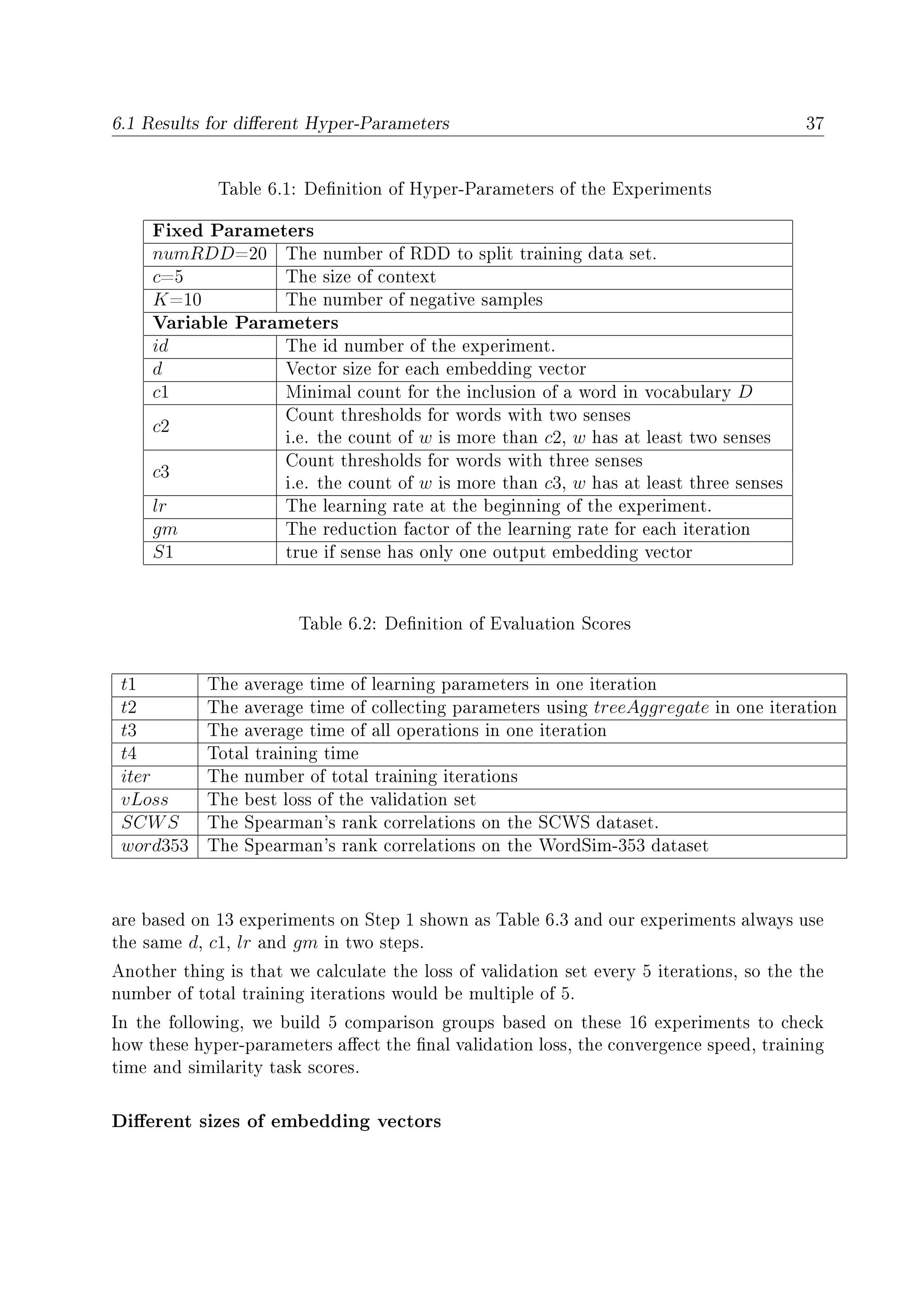
Table 6.1 shows the hyper-parameters we need. And we mainly use the time, the loss and
the score of similarity task shown as Table 6.2 to compare these hyper-parameters.
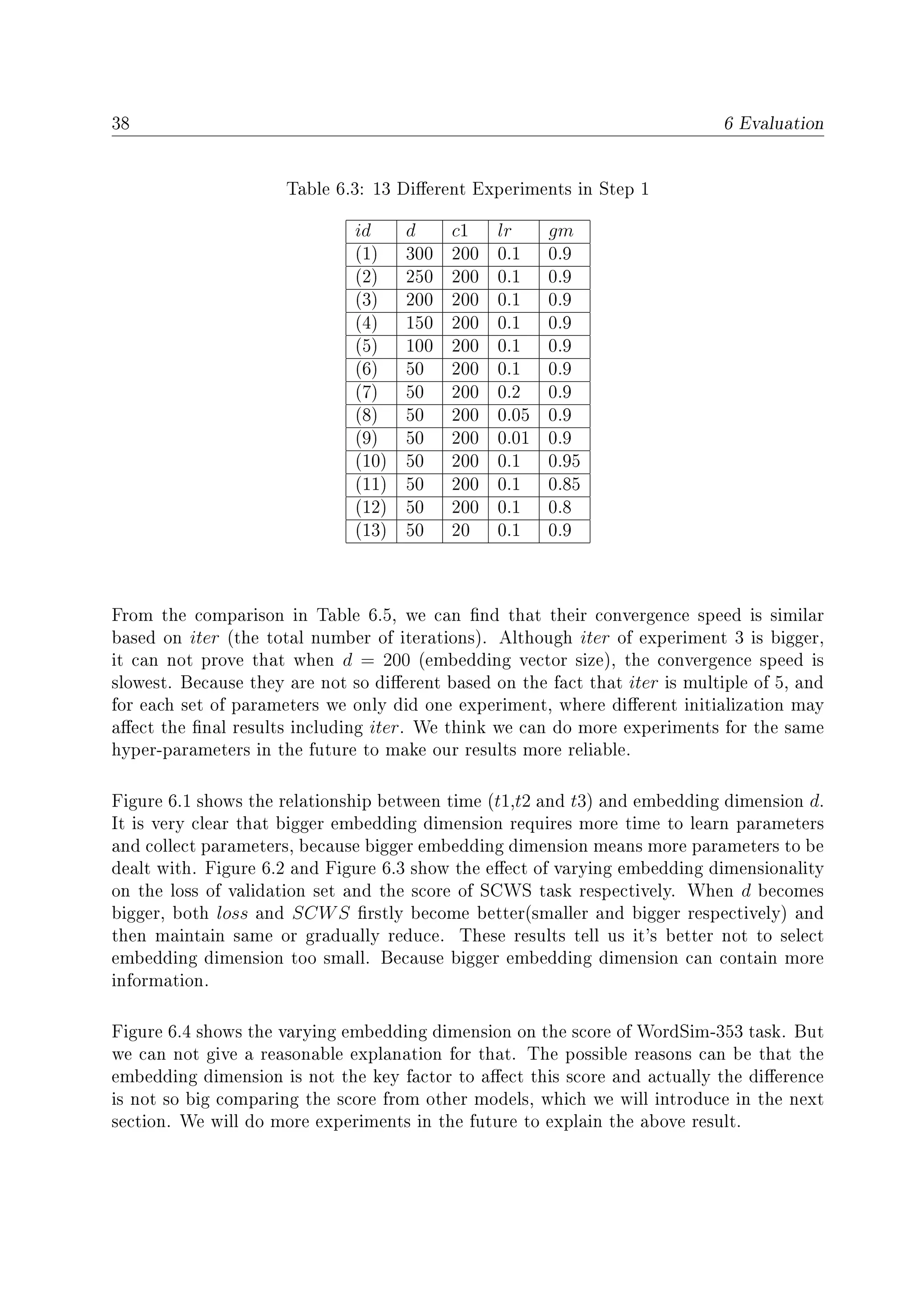
Note that we need two steps to train sense embedding vectors. In Step 1 the number
of all word senses is set to one and the word embedding vectors are trained as in the
usual word2vec approach. In Step 2 the program will use the result from Step 1 to do
initialization of senses vectors (adding a tiny noise) and then train the sense embedding
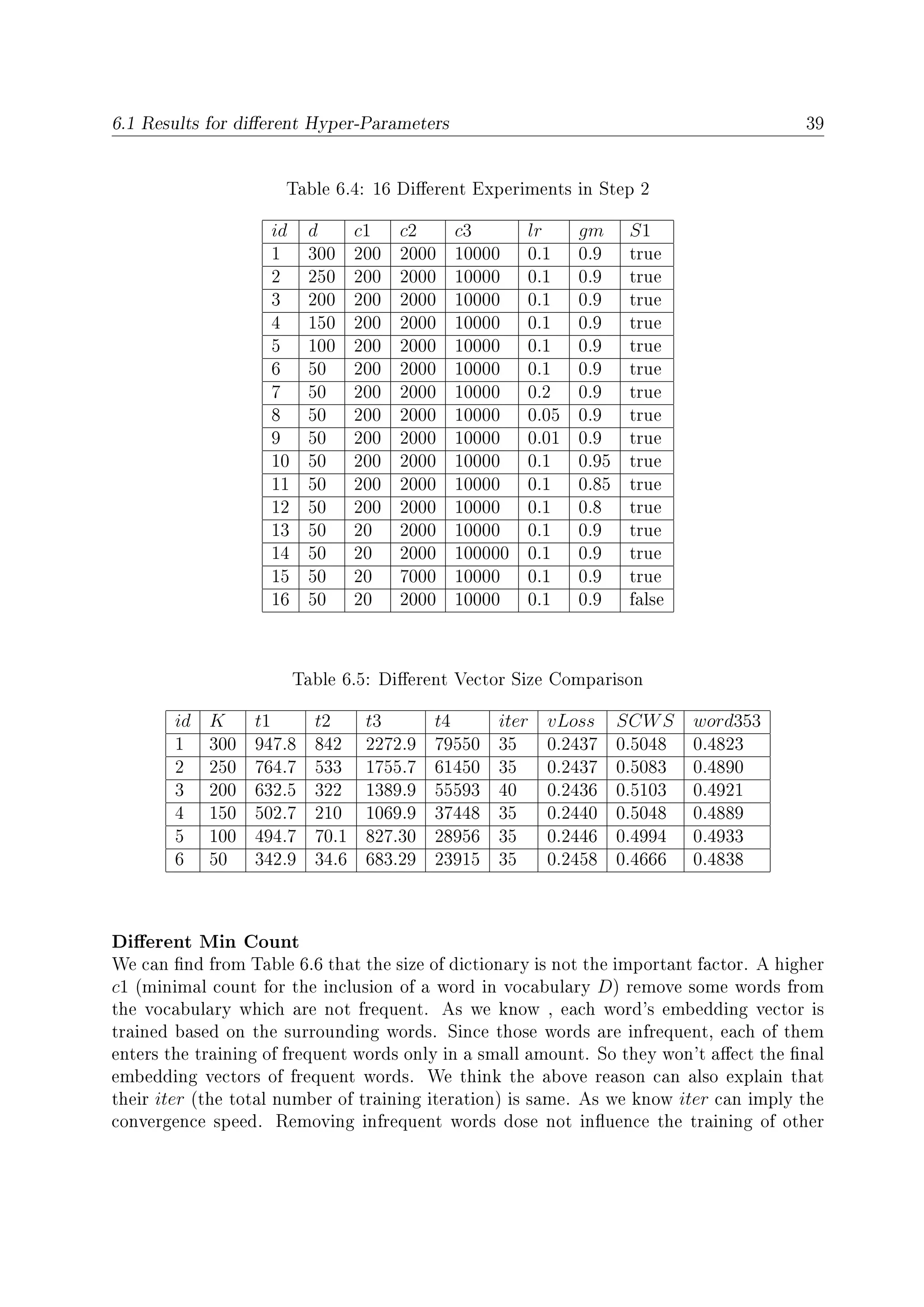
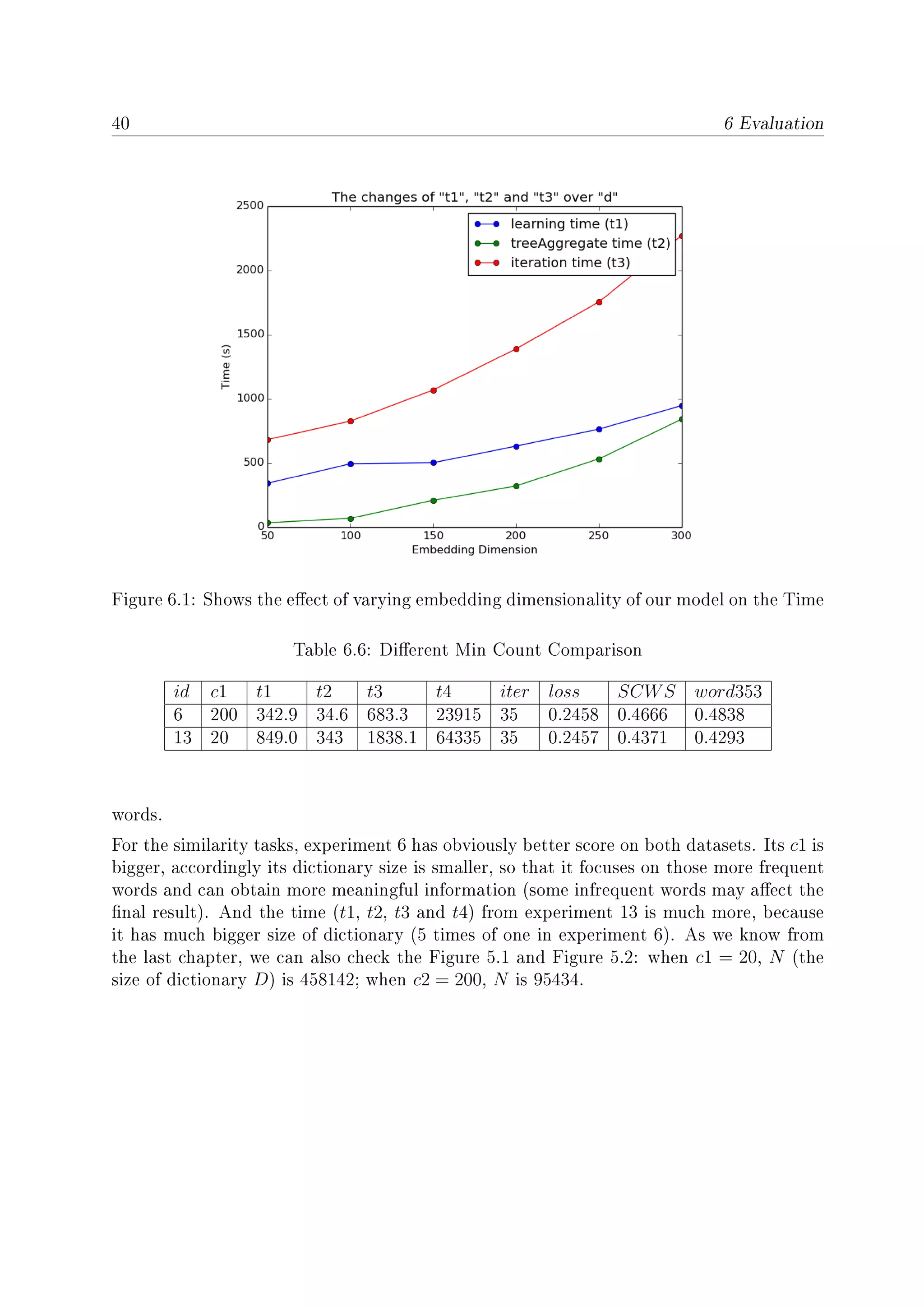
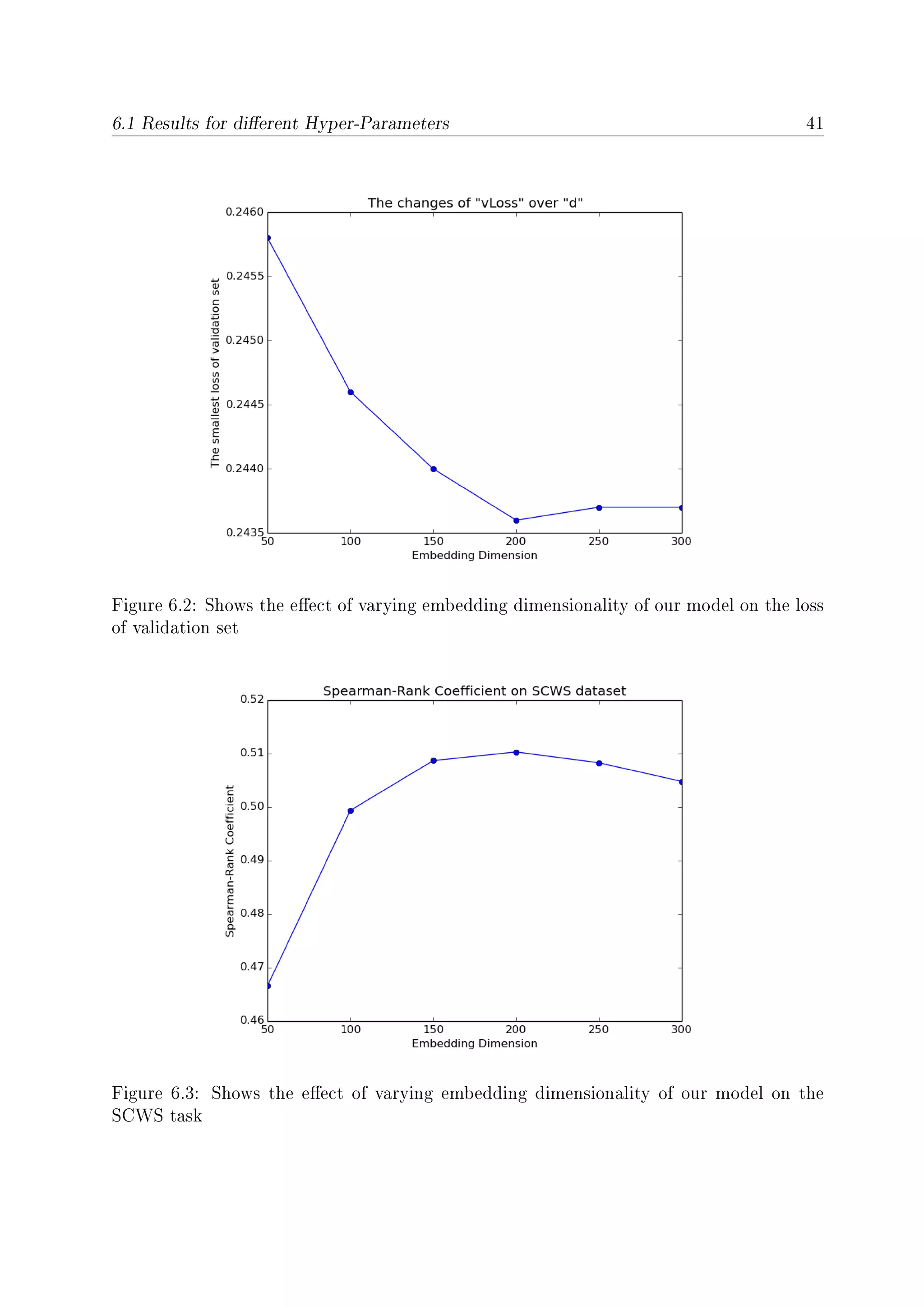
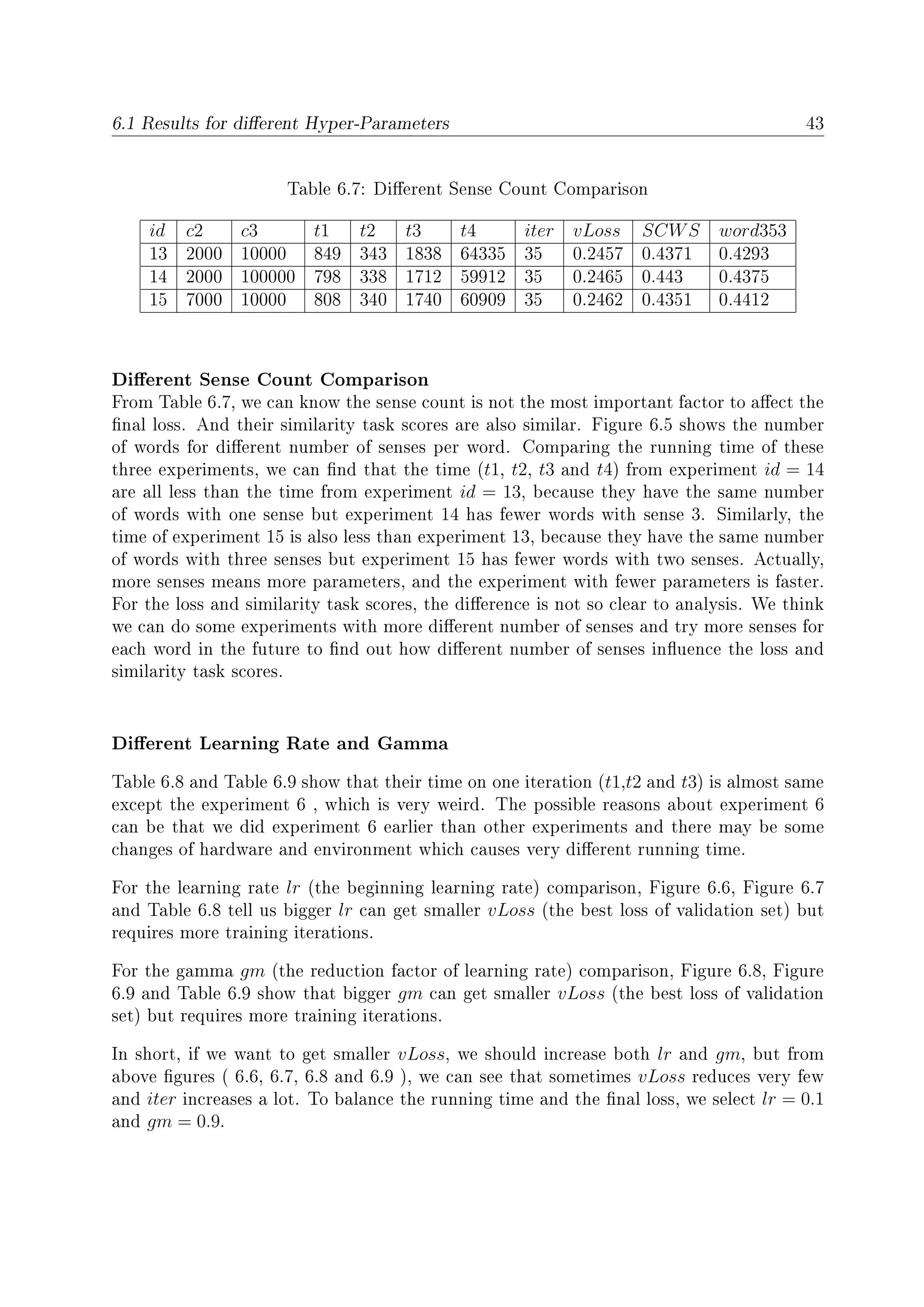
vectors. Finally, we decide to list only 16 experiments on Step 2 shown as Table 6.4, which
2https://en.wikipedia.org/wiki/Spearman%27s_rank_correlation_coecient
6.1 Results for dierent Hyper-Parameters 37
Table 6.1: Denition of Hyper-Parameters of the Experiments
Fixed Parameters
numRDD=20 The number of RDD to split training data set.
c=5 The size of context
K=10 The number of negative samples
Variable Parameters
id The id number of the experiment.
d Vector size for each embedding vector
c1 Minimal count for the inclusion of a word in vocabulary D
c2
Count thresholds for words with two senses
i.e. the count of w is more than c2, w has at least two senses
c3
Count thresholds for words with three senses
i.e. the count of w is more than c3, w has at least three senses
lr The learning rate at the beginning of the experiment.
gm The reduction factor of the learning rate for each iteration
S1 true if sense has only one output embedding vector
Table 6.2: Denition of Evaluation Scores
t1 The average time of learning parameters in one iteration
t2 The average time of collecting parameters using treeAggregate in one iteration
t3 The average time of all operations in one iteration
t4 Total training time
iter The number of total training iterations
vLoss The best loss of the validation set
SCWS The Spearman's rank correlations on the SCWS dataset.
word353 The Spearman's rank correlations on the WordSim-353 dataset
are based on 13 experiments on Step 1 shown as Table 6.3 and our experiments always use
the same d, c1, lr and gm in two steps.
Another thing is that we calculate the loss of validation set every 5 iterations, so the the
number of total training iterations would be multiple of 5.
In the following, we build 5 comparison groups based on these 16 experiments to check
how these hyper-parameters aect the nal validation loss, the convergence speed, training
time and similarity task scores.
Dierent sizes of embedding vectors
38 6 Evaluation
Table 6.3: 13 Dierent Experiments in Step 1
id d c1 lr gm
(1) 300 200 0.1 0.9
(2) 250 200 0.1 0.9
(3) 200 200 0.1 0.9
(4) 150 200 0.1 0.9
(5) 100 200 0.1 0.9
(6) 50 200 0.1 0.9
(7) 50 200 0.2 0.9
(8) 50 200 0.05 0.9
(9) 50 200 0.01 0.9
(10) 50 200 0.1 0.95
(11) 50 200 0.1 0.85
(12) 50 200 0.1 0.8
(13) 50 20 0.1 0.9
From the comparison in Table 6.5, we can nd that their convergence speed is similar
based on iter (the total number of iterations). Although iter of experiment 3 is bigger,
it can not prove that when d = 200 (embedding vector size), the convergence speed is
slowest. Because they are not so dierent based on the fact that iter is multiple of 5, and
for each set of parameters we only did one experiment, where dierent initialization may
aect the nal results including iter. We think we can do more experiments for the same
hyper-parameters in the future to make our results more reliable.
Figure 6.1 shows the relationship between time (t1,t2 and t3) and embedding dimension d.
It is very clear that bigger embedding dimension requires more time to learn parameters
and collect parameters, because bigger embedding dimension means more parameters to be
dealt with. Figure 6.2 and Figure 6.3 show the eect of varying embedding dimensionality
on the loss of validation set and the score of SCWS task respectively. When d becomes
bigger, both loss and SCWS rstly become better(smaller and bigger respectively) and
then maintain same or gradually reduce. These results tell us it's better not to select
embedding dimension too small. Because bigger embedding dimension can contain more
information.
Figure 6.4 shows the varying embedding dimension on the score of WordSim-353 task. But
we can not give a reasonable explanation for that. The possible reasons can be that the
embedding dimension is not the key factor to aect this score and actually the dierence
is not so big comparing the score from other models, which we will introduce in the next
section. We will do more experiments in the future to explain the above result.
6.1 Results for dierent Hyper-Parameters 39
Table 6.4: 16 Dierent Experiments in Step 2
id d c1 c2 c3 lr gm S1
1 300 200 2000 10000 0.1 0.9 true
2 250 200 2000 10000 0.1 0.9 true
3 200 200 2000 10000 0.1 0.9 true
4 150 200 2000 10000 0.1 0.9 true
5 100 200 2000 10000 0.1 0.9 true
6 50 200 2000 10000 0.1 0.9 true
7 50 200 2000 10000 0.2 0.9 true
8 50 200 2000 10000 0.05 0.9 true
9 50 200 2000 10000 0.01 0.9 true
10 50 200 2000 10000 0.1 0.95 true
11 50 200 2000 10000 0.1 0.85 true
12 50 200 2000 10000 0.1 0.8 true
13 50 20 2000 10000 0.1 0.9 true
14 50 20 2000 100000 0.1 0.9 true
15 50 20 7000 10000 0.1 0.9 true
16 50 20 2000 10000 0.1 0.9 false
Table 6.5: Dierent Vector Size Comparison
id K t1 t2 t3 t4 iter vLoss SCWS word353
1 300 947.8 842 2272.9 79550 35 0.2437 0.5048 0.4823
2 250 764.7 533 1755.7 61450 35 0.2437 0.5083 0.4890
3 200 632.5 322 1389.9 55593 40 0.2436 0.5103 0.4921
4 150 502.7 210 1069.9 37448 35 0.2440 0.5048 0.4889
5 100 494.7 70.1 827.30 28956 35 0.2446 0.4994 0.4933
6 50 342.9 34.6 683.29 23915 35 0.2458 0.4666 0.4838
Dierent Min Count
We can nd from Table 6.6 that the size of dictionary is not the important factor. A higher
c1 (minimal count for the inclusion of a word in vocabulary D) remove some words from
the vocabulary which are not frequent. As we know , each word's embedding vector is
trained based on the surrounding words. Since those words are infrequent, each of them
enters the training of frequent words only in a small amount. So they won't aect the nal
embedding vectors of frequent words. We think the above reason can also explain that
their iter (the total number of training iteration) is same. As we know iter can imply the
convergence speed. Removing infrequent words dose not inuence the training of other
40 6 Evaluation
Figure 6.1: Shows the eect of varying embedding dimensionality of our model on the Time
Table 6.6: Dierent Min Count Comparison
id c1 t1 t2 t3 t4 iter loss SCWS word353
6 200 342.9 34.6 683.3 23915 35 0.2458 0.4666 0.4838
13 20 849.0 343 1838.1 64335 35 0.2457 0.4371 0.4293
words.
For the similarity tasks, experiment 6 has obviously better score on both datasets. Its c1 is
bigger, accordingly its dictionary size is smaller, so that it focuses on those more frequent
words and can obtain more meaningful information (some infrequent words may aect the
nal result). And the time (t1, t2, t3 and t4) from experiment 13 is much more, because
it has much bigger size of dictionary (5 times of one in experiment 6). As we know from
the last chapter, we can also check the Figure 5.1 and Figure 5.2: when c1 = 20, N (the
size of dictionary D) is 458142; when c2 = 200, N is 95434.
6.1 Results for dierent Hyper-Parameters 41
Figure 6.2: Shows the eect of varying embedding dimensionality of our model on the loss
of validation set
Figure 6.3: Shows the eect of varying embedding dimensionality of our model on the
SCWS task
42 6 Evaluation
Figure 6.4: Shows the eect of varying embedding dimensionality of our model on the
WordSim-353 task
6.1 Results for dierent Hyper-Parameters 43
Table 6.7: Dierent Sense Count Comparison
id c2 c3 t1 t2 t3 t4 iter vLoss SCWS word353
13 2000 10000 849 343 1838 64335 35 0.2457 0.4371 0.4293
14 2000 100000 798 338 1712 59912 35 0.2465 0.443 0.4375
15 7000 10000 808 340 1740 60909 35 0.2462 0.4351 0.4412
Dierent Sense Count Comparison
From Table 6.7, we can know the sense count is not the most important factor to aect the
nal loss. And their similarity task scores are also similar. Figure 6.5 shows the number
of words for dierent number of senses per word. Comparing the running time of these
three experiments, we can nd that the time (t1, t2, t3 and t4) from experiment id = 14
are all less than the time from experiment id = 13, because they have the same number
of words with one sense but experiment 14 has fewer words with sense 3. Similarly, the
time of experiment 15 is also less than experiment 13, because they have the same number
of words with three senses but experiment 15 has fewer words with two senses. Actually,
more senses means more parameters, and the experiment with fewer parameters is faster.
For the loss and similarity task scores, the dierence is not so clear to analysis. We think
we can do some experiments with more dierent number of senses and try more senses for
each word in the future to nd out how dierent number of senses inuence the loss and
similarity task scores.
Dierent Learning Rate and Gamma
Table 6.8 and Table 6.9 show that their time on one iteration (t1,t2 and t3) is almost same
except the experiment 6 , which is very weird. The possible reasons about experiment 6
can be that we did experiment 6 earlier than other experiments and there may be some
changes of hardware and environment which causes very dierent running time.
For the learning rate lr (the beginning learning rate) comparison, Figure 6.6, Figure 6.7
and Table 6.8 tell us bigger lr can get smaller vLoss (the best loss of validation set) but
requires more training iterations.
For the gamma gm (the reduction factor of learning rate) comparison, Figure 6.8, Figure
6.9 and Table 6.9 show that bigger gm can get smaller vLoss (the best loss of validation
set) but requires more training iterations.
In short, if we want to get smaller vLoss, we should increase both lr and gm, but from
above gures ( 6.6, 6.7, 6.8 and 6.9 ), we can see that sometimes vLoss reduces very few
and iter increases a lot. To balance the running time and the nal loss, we select lr = 0.1
and gm = 0.9.
44 6 Evaluation
Figure 6.5: Shows the number of words with dierent number of senses from three experi-
ments
Figure 6.6: Shows the eect of varying beginning learning rate on the best loss of validation
set
6.1 Results for dierent Hyper-Parameters 45
Table 6.8: Dierent Learning Rate Comparison
id lr gm t1 t2 t3 t4 iter vLoss
7 0.2 0.9 818.2 19.7 1416 63721 45 0.2445
6 0.1 0.9 342.9 34.6 683.3 23915 35 0.2458
8 0.05 0.9 789.1 18.4 1367 41013 30 0.2485
9 0.01 0.9 745.7 19.0 1381 34516 25 0.2632
Table 6.9: Dierent Gamma Comparison
id lr gm t1 t2 t3 t4 iter vLoss
10 0.1 0.95 854.0 18.5 1402 77110 55 0.2443
6 0.1 0.9 342.9 34.6 683.3 23915 35 0.2458
11 0.1 0.85 768.9 19.8 1413 42402 30 0.2476
12 0.1 0.8 850.0 19.0 1479 36985 25 0.2490
Figure 6.7: Shows the eect of varying beginning learning rate on the total number of
training iterations
46 6 Evaluation
Figure 6.8: Shows the eect of reduction factor of the learning rate on the best loss of
validation set
Figure 6.9: Shows the eect of reduction factor of the learning rate on the total number of
training iterations
6.1 Results for dierent Hyper-Parameters 47
Table 6.10: Comparison of the dierent number of output senses
id S1 t1 t2 t3 t4 iter vLoss
13 true (one sense) 849 343 1838 64335 35 0.2457
16 false (multiple senses) 1192 365 2866 128949 45 0.2069
Dierent Number of Output Senses
From Table 6.10, we can nd that the dierence in this group is very obvious comparing
with previous groups. But t2 (the average time of collecting parameters in one iteration)
is almost same. Actually in our program to be able to change the number of output senses
(one or multiple) easier, we do not change the data structure syn1 and let syn1 always
have several embedding vectors for each word, if S1 = true the program only process the
rst embedding vector for each word. So these two experiments have the same number
of parameters. And the time of collecting parameters is only inuenced by the number of
parameters, that's why their t2 is very similar. Note that t1 (the average time of learning
parameters in one iteration) of experiment 16 is a little bigger than one of experiment
13 and t3 ( the average time of all operations in one iteration) of experiment 16 is much
bigger than one of experiment 13. Multiple output embedding vectors for each word means
more time to do sense assignment, specically it requires more times of adjusting senses for
each sentence to achieve stable, that's why t3 (including the time of sense assignment) is
very dierent. In the process of learning parameters, no matter how many output senses,
the the number of learning samples are same. So we can not tell the real reason about
dierence of t1. The possible reason can be from the program structure. We will analysis
our program and do some testing experiments to nd out the reason in the future.
The Table 6.10 also shows that the convergence speed of experiment 16 is slower (it has
more training iterations) because it has several output senses and requires more iterations
to adjust senses and learn embedding vectors. The vLoss of experiment 16 is obviously
smaller, because the fact of several output senses means more options for each center word
to do prediction. It can make the nal predicting probability based on the whole dataset
bigger, which means smaller loss.
But we compare the nearest words for dierent senses of selected words from these two
experiments in the Table 6.11. It is clear that if words can have multiple output embedding
vectors (experiment 16), the nearest words of dierent senses for each word are similar,
which can not achieve our goal. After inspection the closest neighbors of senses the reason
got clear. Say there are two words, e.g. bank and money with multiple senses. Then if
money1 was a close neighbor of bank0 then it turned out that money0 was a close neighbor
of bank1. Hence the closest senses were simply permuted, and the senses were not really
meaningful. Hence we concluded that there should be only one output sense for each word.
This will avoid this eect.
48 6 Evaluation
Table 6.11: Nearest words comparison
id 13 , one sense output embedding id 16, multiple senses output embedding
apple
cheap, junk, scrap, advertised kodak, marketed, nokia, kit
chocolate, chicken, cherry, berry portable, mgm, toy, mc
macintosh, linux, ibm, amiga marketed, chip, portable, packaging
bank
corporation, banking, banking, hsbc trade, trust, venture, joint
deposit, stake, creditors, concession trust, corporation, trade, banking
banks, side, edge, thames banks, border, banks, country
cell
imaging, plasma, neural, sensing dna, brain, stem, virus
lab, con, inadvertently, tardis cells, dna, proteins, proteins
cells, nucleus, membrane, tumor dna, cells, plasma, uid
6.1.1 Comparison to prior analyses
We fetch the results of similarity task scores from experiment 1 and experiment 6 to
compare with other models in Table 6.12 and Table 6.13. Table 6.13 compares our model
with Huang's model (Huang et al. [2012]), the model from [Collobert and Weston, 2008]
(CW), and the Skip-gram model [Mikolov et al., 2013], where CW∗
is trained without
stop words. Our result is very bad on WordSim-353 task. Our model may not be suitable
for word similarity task without context information. Table 6.12 compares our model
with Huang's model [Huang et al., 2012] , and the models from [Neelakantan et al., 2015]
(MSSG and NP-MSSG). The number after the model name is the embedding dimension,
i.e. MSSG-50d means MSSG model with 50 embedding dimension.
Even that our score on SCWS is still not good. The possible reasons can be that our model
do not remove the stop words, we do not use sub-sampling used word2vec (Mikolov et al.
[2013]), our training is not enough and we uses too many executors (32 cores), where fewer
executors may give us better results. Additionally, we only use localSim and avgSim for
SCWS task and avgSim for WordSim-353 task, which may not be suitable for our model.
We will try other similarity functions. From Tabel 6.12, we can see NP-MSSG performs
really good on SCWS task. We think we can also follow some idea from it and improve
our model in the future so that the model can have dynamic number of senses.
6.2 Case Analysis
In the following, we will select only one experiment's result to do the visualization of senses
and compute nearest word senses. The selection is based on the nal loss and similarity
task, specically it is experiment 13 from above.
6.2 Case Analysis 49
Table 6.12: Experimental results in the SCWS task. The numbers are Spearmans correla-
tion ρ × 100
Model avgSim localSim
Our Model-50d 55.8 46.7
Our Model-300d 56.9 50.5
Huang et al-50d 62.8 26.1
MSSG-50d 64.2 49.17
MSSG-300d 67.2 57.26
NP-MSSG-50d 64.0 50.27
NP-MSSG-300d 67.3 59.80
Table 6.13: Results on the WordSim-353 dataset
Model ρ × 100
Our Model-50d 48.4
Our Model-300d 48.2
CW∗
49.8
CW 55.3
Huang et al 64.2
Skip-gram-300d 70.4
Firstly we give the result for the word apple, where dierent sense are quite nicely separated.
Table 6.14 shows the sense similarity matrix of apple. The similarity value is the cosine
similarity between two embedding vectors. Table 6.15 shows the nearest words of dierent
senses from apple. We can see that apple0 and apple1 are about food. They are similar
somehow. And apple2 is about the computer company. The next are some sentence
examples including the word apple in Table 6.16. These are the sentences containing the
assigned word senses from the last iteration of training. To make it clear, we only display
the sense label of the apple, although the other words also have multiple senses.
Table 6.14: Sense Similarity Matrix of apple
apple0 apple1 apple2
apple0 1.000000 0.788199 0.800783
apple1 0.788199 1.000000 0.688523
apple2 0.800783 0.688523 1.000000
50 6 Evaluation
Table 6.15: Nearest Words of apple
apple0: cheap , junk , scrap , advertised , gum , liquor , pizza
apple1: chocolate, chicken, cherry, berry, cream, pizza, strawberry
apple2: macintosh, linux, ibm, amiga, atari, commodore, server
Table 6.16: Sentence Examples of apple
apple0
he can't tell an onion from an apple0 and he's your eye witness
some fruits e.g apple0 pear quince will be ground
apple1
the cultivar is not to be confused with the dutch rubens apple1
the rome beauty apple1 was developed by joel gillette
apple2
a list of all apple2 internal and external drives in chronological order
the game was made available for the apple2 iphone os mobile platform
To visualize semantic neighborhoods we selected 100 nearest words for each sense of apple
and use t-SNE algorithm [Maaten and Hinton, 2008] to project the embedding vectors into
two dimensions. And then we only displayed 70% of words randomly to make visualization
better, which is shown in Figure 6.10.
6.2 Case Analysis 51
Figure 6.10: Nearest words from apple
52 6 Evaluation
Table 6.17: Nearest words from fox , net , rock , run and plant
fox
archie, potter, wolfe, hitchcock, conan, burnett, savage
buck, housewives, colbert, eastenders, howard, kane, freeze
abc, sky, syndicated, cw, network's, ctv, pbs
net
generates, atm, footprint, target, kbit/s, throughput, metering
trillion, rs, earnings, turnover, gross, euros, prot
jumped, rolled, rebound, ladder, decit, snapped, whistle
rock
echo, surf, memphis, strawberry, clearwater, cli, sunset
r b, hip, roll, indie, ska, indie, hop
formations, crust, melting, lava, boulders, granite, dust
run
blair, taft, fraser, monroe, precinct, mayor's, governor's
streak, rushing, tying, shutout, inning, wicket, kicko
running, tram, travel, express, trams, inbound, long-distance
plant
plants, insect, seeds, seed, pollen, aquatic, organic
owering, orchid, genus, bird, species, plants, buttery
electricity, steel, renery, renery, manufacturing, gas, turbine
Next, we select other 5 words fox , net , rock , and plant, and list nearest words to
each of their 3 senses in Table 6.17. Each line contains the nearest words for one of the
senses. This table nicely illustrates the dierent meanings of words:
• fox: Sense 1 and 2 cover dierent movies and lm directors while sense 3 is close to
tv networks.
• net: Sense 1 is related to communication networks, sense 2 to prots and earnings
and sense 3 to actions
• rock: Sense 1 and sense 2 is related to music while sense 3 to stone.
• run: Sense 1 is related to election campains, sense 2 expresses the movement and
sense 3 to public transport.
• plant: Sense 1 is close to biologic plants and small animals, sense 2 is related to
owers and sense 3 to factories.
In table 6.18 we show one example sentence for each sense. The example sentences are also
cut by ourself without aecting the meaning of the sentence.
Finally, for each sense of each word (apple, fox, net, rock and plant), we select only
the 20 nearest words, and combine them together to do another t-SNE embeddingof two
dimensions. The the result is shown in Figure 6.11.
6.2 Case Analysis 53
Table 6.18: Sentence Examples of fox , net , rock , run and plant
fox
run by nathaniel mellors dan fox0 andy cooke and ashley marlowe
he can box like a fox1 he's as dumb as an ox
the grand nal was replayed on fox sports australia and the fox2 footy channel
net
net0 supports several disk image formats partitioning schemes
in mr cook was on the forbes with a net1 worth of billion
nothin but net2 freefall feet into a net below story tower
rock
zero nine is a nnish hard rock0 band formed in kuusamo in
matt ellis b december is a folk rock1 genre singer-songwriter
cabo de natural park is characterised by volcanic rock2 formations
run
dean announced that she intends to run0 for mayor again in the november election
we just couldn't run1 the ball coach tyrone willingham said
the terminal is run2 by british rail freight company ews
plant
these phosphoinositides are also found in plant0 cells with the exception of pip
is a genus of owering plant1 in the malvaceae sensu lato
was replaced with a new square-foot light xture plant2 in sparta tn
From these visualization, we can say our model is able to extract meaningful sense vectors
which may be used for subsequent analyses. There is, however, room for improvement.
54 6 Evaluation
Figure 6.11: Nearest words from apple, fox, net, rock, run and plant
Chapter 7
Conclusion
This thesis had the goal to develop an algorithm to estimate multiple sense embeddings per
word and implement this algorithm in the parallel execution framework Spark. We were
able to develop such an algorithm based on the Skip-gram model of Mikolov et al. [2013].
The implementation in the Spark framework in terms of the programming language Scala
and the understanding of the setup parameters and the functionality of Spark were a major
task. Nevertheless the spark framework is very convenient to use. Especially dicult was
the testing of derivatives which was done by nite dierence approximation. Originally
our model assumes that for each word both input embedding and output embedding have
multiple senses. But the experiment results told us, the performance would be better if
the output embeddings have only one sense. We displayed the nearest words of dierent
senses from the same word. The result showed that our model can really derive expres-
sive sense embeddings, which achieved our goal. And the experiments showed that our
implementation is quite ecient, that is also our goal.
However, the evaluation on similarity tasks seems not very satisfying comparing with other
approaches. This may have two possible reasons. Note, that due to time constraints we
were not able to explore many combinations of model hyper-parameters. In addition we had
no time to optimize the conguration of Spark (e.g. memory assignment, number of data
batches collected in RDDs, etc.) to be able to do an exhaustive training on many cluster
nodes. In the future we plan to improve our model. We will try bigger sizes of embedding
vectors. On the other hand, we can also modify preprocessing such as to remove the stop
words, which may also improve our results. And the maximum number of senses in our
model is only three. We will increase the number of senses and try to extend our model so
that it can decide the number of senses for each word similar to (Neelakantan et al. [2015]).
Further more, we think we can do more experiments for the dierent hyper-parameters in
the future to make our results more reliable.
55
Bibliography
Bengio, Y., Ducharme, R., Vincent, P., and Jauvin, C. (2003). A neural probabilistic
language model. journal of machine learning research, 3(Feb):11371155.
Blei, D. M., Ng, A. Y., and Jordan, M. I. (2003). Latent dirichlet allocation. Journal of
machine Learning research, 3(Jan):9931022.
Chen, X., Liu, Z., and Sun, M. (2014). A unied model for word sense representation and
disambiguation. In EMNLP, pages 10251035. Citeseer.
Collobert, R., Weston, J., Bottou, L., Karlen, M., Kavukcuoglu, K., and Kuksa, P. (2011).
Natural language processing (almost) from scratch. Journal of Machine Learning Re-
search, 12(Aug):24932537.
Collobert, R. and Weston, J. W. (2008). A unied architecture for natural language
processing: Deep neural networks with multitask learning. In Proceedings of the 25th
international conference on Machine learning (ICML). ACM.
Deerwester, S., Dumais, S. T., Furnas, G. W., Landauer, T. K., and Harshman, R. (1990).
Indexing by latent semantic analysis. Journal of the American society for information
science, 41(6):391.
Fellbaum, C. (1998). WordNet: An Electronic Lexical Database. MIT Press, Cambridge,
MA.
Finkelstein, L., Gabrilovich, E., Matias, Y., Rivlin, E., Solan, Z., Wolfman, G., and Ruppin,
E. (2001). Placing search in context: The concept revisited. In Proceedings of the 10th
international conference on World Wide Web, pages 406414. ACM.
Harris, Z. S. (1954). Distributional structure. word, 10 (2-3): 146162. reprinted in fodor,
j. a and katz, jj (eds.), readings in the philosophy of language.
Huang, E. H., Socher, R., Manning, C. D., and Ng, A. Y. (2012). Improving word repre-
sentations via global context and multiple word prototypes. In Proceedings of the 50th
Annual Meeting of the Association for Computational Linguistics: Long Papers-Volume
1, pages 873882. Association for Computational Linguistics.
57
58 BIBLIOGRAPHY
Maaten, L. v. d. and Hinton, G. (2008). Visualizing data using t-sne. Journal of Machine
Learning Research, 9(Nov):25792605.
Mikolov, T., Sutskever, I., Chen, K., Corrado, G. S., and Dean, J. (2013). Distributed
representations of words and phrases and their compositionality. In Advances in neural
information processing systems, pages 31113119.
Neelakantan, A., Shankar, J., Passos, A., and McCallum, A. (2015). Ecient non-
parametric estimation of multiple embeddings per word in vector space. arXiv preprint
arXiv:1504.06654.
Pennington, J., Socher, R., and Manning, C. D. (2014). Glove: Global vectors for word
representation. In EMNLP, volume 14, pages 153243.
Salton, G., Wong, A., and Yang, C.-S. (1975). A vector space model for automatic indexing.
Communications of the ACM, 18(11):613620.
Shaoul, C. (2010). The westbury lab wikipedia corpus. Edmonton, AB: University of
Alberta.
Socher, R., Perelygin, A., Wu, J. Y., Chuang, J., Manning, C. D., Ng, A. Y., and Potts, C.
(2013). Recursive deep models for semantic compositionality over a sentiment treebank.
In Proceedings of the conference on empirical methods in natural language processing
(EMNLP), volume 1631, page 1642. Citeseer.
Tian, F., Dai, H., Bian, J., Gao, B., Zhang, R., Chen, E., and Liu, T.-Y. (2014). A
probabilistic model for learning multi-prototype word embeddings. In COLING, pages
151160.
Williams, D. and Hinton, G. (1986). Learning representations by back-propagating errors.
Nature, 323:533536.
Zaharia, M., Chowdhury, M., Franklin, M. J., Shenker, S., and Stoica, I. (2010). Spark:
cluster computing with working sets. HotCloud, 10:1010.
Zhou, J. and Xu, W. (2015). End-to-end learning of semantic role labeling using recurrent
neural networks. In Proceedings of the Annual Meeting of the Association for Computa-
tional Linguistics.

HaiqingWang-MasterThesis

  • 1.
    Computing Distributed Representations forPolysemous Words Master Thesis Software Systems Engineering Haiqing Wang Matriculation number 340863 July 8, 2016 Supervisors: Prof. Dr. Gerhard Lakemeyer Prof. Dr. Christian Bauckhage Advisors: Dr. Gerhard Paaÿ Dr. Jörg Kindermann
  • 3.
    Statutory Declaration I herebycertify that all work presented in this master thesis is my own, no other than the sources and aids referred to were used and that all parts which have been adopted either literally or in a general manner from other sources have been indicated accordingly. Aachen, July 8, 2016 YOUR NAME
  • 5.
    Acknowledgements I would liketo thank the Department of Computer Science 5 - Information Systems and Fraunhofer Institute IAIS for supporting my master thesis. I would like to express my great gratitude for the support of Dr. Gerhard Paaÿ and Dr. Jörg Kindermann. Their patient guidance helps me a lot during the research of this topic.
  • 7.
    Abstract Recently, machine learning,and especially deep learning is very popular. Its main aim for natural language processing to extract the meaning of words and sentences automatically. The representation of words by a word vector is a very important tool for many natural language processing tasks when using machine learning algorithms. There are many meth- ods, e.g. [Mikolov et al., 2013]), to generate word vectors in such a way that semantically similar words have similar word vectors of low distance. We call this process word embed- ding, and these word vector a distributed representation. However, polysemous words can have dierent meanings in dierent contexts. Accordingly, polysemous words should have several vector representations for each sense. Some models have been recently proposed, e.g. [Huang et al., 2012], to generate sense embeddings to represent word senses. In our thesis we investigate and improve current methods to compute multiple sense em- beddings per word. Specically we extend the basic word embedding model word2vec of Mikolov et al. [2013] to build a sense assignment model. We use a score function to select the best sense for each word in an unsupervised learning approach. Our model at the same time selects senses for each word in sentences and adapts the sense embedding vectors. To be able to train with large corpora we implement this model in Spark, a parallel execution framework. We train sense vectors with a Wikipedia corpus of nearly 1 billion tokens. We evaluate sense vectors by visualizing the semantic similarity of words and doing word simi- larity tasks using the SCWS (Contextual Word Similarities) dataset and the WordSim-353 dataset from [Finkelstein et al., 2001].
  • 9.
    Contents 1 Introduction 1 1.1Word Embedding . . . . . . . . . . . . . . . . . . . . . . . . . . . . . . . . 1 1.2 Sense Embedding . . . . . . . . . . . . . . . . . . . . . . . . . . . . . . . . 2 1.3 Goal . . . . . . . . . . . . . . . . . . . . . . . . . . . . . . . . . . . . . . . 3 1.4 Outline . . . . . . . . . . . . . . . . . . . . . . . . . . . . . . . . . . . . . . 4 2 Background 5 2.1 Word Embedding . . . . . . . . . . . . . . . . . . . . . . . . . . . . . . . . 5 2.2 Neural Probabilistic Language Model . . . . . . . . . . . . . . . . . . . . . 6 2.3 The model of Collobert and Weston . . . . . . . . . . . . . . . . . . . . . . 10 2.4 Word2Vec . . . . . . . . . . . . . . . . . . . . . . . . . . . . . . . . . . . . 11 3 Related Works 15 3.1 Huang's Model . . . . . . . . . . . . . . . . . . . . . . . . . . . . . . . . . 15 3.2 EM-Algorithm based method . . . . . . . . . . . . . . . . . . . . . . . . . 16 3.3 A Method to Determine the Number of Senses . . . . . . . . . . . . . . . . 18 4 Solution 21 4.1 Denition . . . . . . . . . . . . . . . . . . . . . . . . . . . . . . . . . . . . 21 4.2 Objective Function . . . . . . . . . . . . . . . . . . . . . . . . . . . . . . . 22 4.3 Algorithm Description . . . . . . . . . . . . . . . . . . . . . . . . . . . . . 24 5 Implementation 27 5.1 Introduction of Spark . . . . . . . . . . . . . . . . . . . . . . . . . . . . . . 27 5.2 Implementation . . . . . . . . . . . . . . . . . . . . . . . . . . . . . . . . . 28 6 Evaluation 35 6.1 Results for dierent Hyper-Parameters . . . . . . . . . . . . . . . . . . . . 36 6.1.1 Comparison to prior analyses . . . . . . . . . . . . . . . . . . . . . 48 6.2 Case Analysis . . . . . . . . . . . . . . . . . . . . . . . . . . . . . . . . . . 48 7 Conclusion 55 ix
  • 11.
    List of Figures 1.1Neigboring words dening the specic sense of bank. . . . . . . . . . . . 2 2.1 Graph of the tanh function . . . . . . . . . . . . . . . . . . . . . . . . . . . 6 2.2 An example of neural network with three layers . . . . . . . . . . . . . . . 7 2.3 The neural network structure from [Bengio et al., 2003] . . . . . . . . . . . 9 2.4 word2vec . . . . . . . . . . . . . . . . . . . . . . . . . . . . . . . . . . . . . 12 3.1 The network structure from [Huang et al., 2012] . . . . . . . . . . . . . . . 16 3.2 Architecture of MSSG model with window size Rt = 2 and S = 3 . . . . . 19 5.1 Shows the accumulated frequency of word count in range [1,51] . . . . . . . 30 5.2 Shows the accumulated frequency of word count in range [51,637] . . . . . 30 5.3 Shows the accumulated frequency of word count in range [637,31140] . . . 31 5.4 Shows the accumulated frequency of word count in range [31140,919787] . . 31 6.1 Shows the eect of varying embedding dimensionality of our model on the Time . . . . . . . . . . . . . . . . . . . . . . . . . . . . . . . . . . . . . . . 40 6.2 Shows the eect of varying embedding dimensionality of our model on the loss of validation set . . . . . . . . . . . . . . . . . . . . . . . . . . . . . . 41 6.3 Shows the eect of varying embedding dimensionality of our model on the SCWS task . . . . . . . . . . . . . . . . . . . . . . . . . . . . . . . . . . . 41 6.4 Shows the eect of varying embedding dimensionality of our model on the WordSim-353 task . . . . . . . . . . . . . . . . . . . . . . . . . . . . . . . 42 6.5 Shows the number of words with dierent number of senses from three ex- periments . . . . . . . . . . . . . . . . . . . . . . . . . . . . . . . . . . . . 44 6.6 Shows the eect of varying beginning learning rate on the best loss of vali- dation set . . . . . . . . . . . . . . . . . . . . . . . . . . . . . . . . . . . . 44 6.7 Shows the eect of varying beginning learning rate on the total number of training iterations . . . . . . . . . . . . . . . . . . . . . . . . . . . . . . . . 45 6.8 Shows the eect of reduction factor of the learning rate on the best loss of validation set . . . . . . . . . . . . . . . . . . . . . . . . . . . . . . . . . . 46 6.9 Shows the eect of reduction factor of the learning rate on the total number of training iterations . . . . . . . . . . . . . . . . . . . . . . . . . . . . . . 46 6.10 Nearest words from apple . . . . . . . . . . . . . . . . . . . . . . . . . . . 51 xi
  • 12.
    xii LIST OFFIGURES 6.11 Nearest words from apple, fox, net, rock, run and plant . . . . . . . . . . 54
  • 13.
    List of Tables 3.1Senses computed with Huang's network and their nearest neighbors. . . . . 16 3.2 Word senses computed by Tian et al. . . . . . . . . . . . . . . . . . . . . . 17 6.1 Denition of Hyper-Parameters of the Experiments . . . . . . . . . . . . . 37 6.2 Denition of Evaluation Scores . . . . . . . . . . . . . . . . . . . . . . . . 37 6.3 13 Dierent Experiments in Step 1 . . . . . . . . . . . . . . . . . . . . . . 38 6.4 16 Dierent Experiments in Step 2 . . . . . . . . . . . . . . . . . . . . . . 39 6.5 Dierent Vector Size Comparison . . . . . . . . . . . . . . . . . . . . . . . 39 6.6 Dierent Min Count Comparison . . . . . . . . . . . . . . . . . . . . . . . 40 6.7 Dierent Sense Count Comparison . . . . . . . . . . . . . . . . . . . . . . 43 6.8 Dierent Learning Rate Comparison . . . . . . . . . . . . . . . . . . . . . 45 6.9 Dierent Gamma Comparison . . . . . . . . . . . . . . . . . . . . . . . . . 45 6.10 Comparison of the dierent number of output senses . . . . . . . . . . . . 47 6.11 Nearest words comparison . . . . . . . . . . . . . . . . . . . . . . . . . . . 48 6.12 Experimental results in the SCWS task. The numbers are Spearmans cor- relation ρ × 100 . . . . . . . . . . . . . . . . . . . . . . . . . . . . . . . . . 49 6.13 Results on the WordSim-353 dataset . . . . . . . . . . . . . . . . . . . . . 49 6.14 Sense Similarity Matrix of apple . . . . . . . . . . . . . . . . . . . . . . . . 49 6.15 Nearest Words of apple . . . . . . . . . . . . . . . . . . . . . . . . . . . . . 50 6.16 Sentence Examples of apple . . . . . . . . . . . . . . . . . . . . . . . . . . 50 6.17 Nearest words from fox , net , rock , run and plant . . . . . . . . . . . 52 6.18 Sentence Examples of fox , net , rock , run and plant . . . . . . . . . 53 xiii
  • 15.
    Mathematical Symbols andAcronyms C The given corpus containing the sentences/documents of words. 1, 7, 8, 10, 11, 18 c The size of a context Contextn−1 (wt), i.e. the number of words before and after wt. 22, 37 Context(wt) The context of a word wt in the sentence Si may be dened as the subsequence of the words Contex(wt) = (wi,max(t−c,0), . . . , wi,t−1, wi,t+1, . . . , wi,min(t+c,Li)). 11, 22 D The vocabulary, i.e. the set of N dierent words w in the corpus C. 1, 5, 811, 18, 39, 40 d The length of the embedding vector v(w) ∈ d , e.g. d = 100. 1, 8, 3739 K The number of negative samples randomly generated for a word wt. 12, 21, 37 Li The number of words in the i-th sentence of the corpus C, Si = (wi,1, wi,2, . . . , wi,Li ). 1, 7 M The number of sentences Si in the corpus, C = (S1, . . . , SM ). 21 N The number of dierent words w in the corpus C, usually N ≥ 100.000. 1, 10, 11, 18, 40 Nw The number of dierent senses of a words w in the corpus C. 21 phrase(wt) A phrase with the center word wt from the sentence Si may be dened as the subsequence of the words phrase(wt) = (wt−c, . . . , wt−1, wt, wt+1, . . . , wt+c). 10 Prevn−1 (wt) The words before a word wt in the sentence Si, i.e. the subsequence of the words Prevn−1 (w) = (wmax(t−n+1,1), . . . , wt−1), and n − 1 is the number of words before wt. 8 RDD Resilient Distributed Datatset: Spark's abstraction of a distributed collection of items. 27 xv
  • 16.
    xvi Mathematical Symbolsand Acronyms Si The i-th sentence of the corpus C, Si = (wi,1, wi,2, . . . , wi,Li ). 1, 7 Uw,s The d-dimensional output embedding Uw,s ∈ d corresponding to the sense s ∈ {1, . . . , Nw} of word w ∈ D. 21 v(w) The d-dimensional embedding v(w) ∈ d corresponding to a word w ∈ D. 1 Vw,s The d-dimensional input embedding Vw,s ∈ d corresponding to the sense s ∈ {1, . . . , Nw} of word w ∈ D. 21 wi,j The j-th word wi,j ∈ D in sentence Si. 21
  • 17.
    Chapter 1 Introduction 1.1 WordEmbedding Machine learning approaches for natural language processing have to represent the words of a language in a way such that Machine Learning modules may process them. This is especially important for text mining, where data mining modules analyze text corpora to extract their properties and semantics. Consider a corpus C of interest containing documents and sentences. Traditional text mining analyses use the vector space representation [Salton et al., 1975], where a word w is represented by a sparse vector of the size N of the vocabulary D (usually N ≥ 100.000), where all values are 0 except the entry for the actual word. This representation is also called One-hot representation. This sparse representation, however, has no information on the semantic similarity of words. Recently word representations have been developed which represent each word w as a real vector of d real numbers (e.g. d = 100) as proposed by [Collobert and Weston, 2008] and [Mikolov et al., 2013]. Generally, we call such a vector v(w) ∈ k a word embedding. By using a large corpus in an unsupervised algorithm word representations may be derived such that words with similar syntax and semantics have representations with a small Euclidean distance. Hence the distances between word embeddings correspond to the semantic similarity of underlying words. These embeddings may be visualized to show comunalities and dierences between words, sentences and documents. Subsequently these word representations may be employed for further text mining analyses like opinion mining [Socher et al., 2013], Kim 2014, Tang et al. 2014) or semantic role labeling [Zhou and Xu, 2015] which benet from this type of representation [Collobert et al., 2011]. These algorithms are based on the very important assumption that if the contexts of two words are similar, their meaning and therefore representations should be similar as well [Harris, 1954]. Consider a sentence (or document) Si in the corpus C consisting of Li words Si = (wi,1, wi,2, . . . , wi,Li ). Then the context of a word wt may be dened as the 1
  • 18.
    2 1 Introduction wordsin the neighborhood of wt in the sentence. Figure 1.1 shows how neighboring words determine the sense of the word bank in a number of example sentences. So many actual text mining methods make use of the context of words to generate embeddings. Figure 1.1: Neigboring words dening the specic sense of bank. Traditional word embedding methods rst obtain the co-occurrence matrix and then per- form dimension reduction using singular value decomposition (SVD) [Deerwester et al., 1990]. Recently, articial neural networks became very popular to generate word embeddings. Prominent algorithms are Senna [Collobert and Weston, 2008], Word2vec [Mikolov et al., 2013] and Glove [Pennington et al., 2014]. They all use randomly initialized vectors to represent words. Subsequently these embeddings are modied in such a way that the word embeddings of the neigboring words may be predicted with minimal error by a simple neural network function. 1.2 Sense Embedding Note that in the approaches described above each word is mapped to a single embedding vector. It is well known, however, that a word may have several dierent meanings, i.e. is polysemous. For example the word bank among others may designate: • the slope beside a body of water, • a nancial institution, • a ight maneuver of an airplane. Further examples of polysemy are the words book, milk or crane. WordNet [Fell- baum, 1998] and other lexical resources show that most common words have 3 to 10 dierent meanings. Obviously each of these meanings should be represented by a separate
  • 19.
    1.3 Goal 3 embeddingvector, otherwise the embedding will no longer represent the underlying sense. This in addition will harm the performance of subsequent text mining analyses. Therefore we need methods to learn embeddings for senses rather than words. Sense embeddings are a renement of word embeddings. For example, bank can appear either together with money, account, check or in the context of river, water, canoe. And the embeddings of the words money, account, check will be quite dierent from the embeddings of river, water, canoe. Consider the following two sentences • They pulled the canoe up the bank. • He cashed a check at the bank. The word bank in the rst sentence has a dierent sense than the word bank in the second sentence. Obviously, the context is dierent. So if we have a methods to determine the dierence of the context, we can relabel the word bank to the word senses bank1 or bank2 denoting the slope near a river or the nancial institution respectively. We call the number after the word the sense labels of the word bank. This process can be performed iteratively for each word in the corpus by evaluating its context. An alternative representation of words is generated by topic models [Blei et al., 2003], which represent each word of a document as a nite mixture of topic vectors. The mixture weights of a word depend on the actual document. This implies that a word gets dierent representations depending on the context. In the last years a number of approaches to derive sense embeddings have been presented. Huang et al. [2012] used the clustering of precomputed one-sense word embeddings and their neighborhood embeddings to dene the dierent word senses. The resulting word senses are xed to the corresponding words in the sentences. Their embedding vectors are trained until convergence. A similar approach is described by Chen et al. [2014]. Instead of a single embedding each word is represented by a number of dierent sense embeddings. During each iteration of the supervised training, for each position of the word, the best tting embedding is selected according the tness criterion. Subsequently only this embedding is trained using back-propagation. Note that during training a word may be assigned to dierent senses thus reecting the training process. A related approach was proposed by Tian et al. [2014]. 1.3 Goal It turned out that the resulting embeddings get better with the size of the training corpus and an increase of the dimension of the embedding vectors. This usually requires a parallel
  • 20.
    4 1 Introduction environmentfor the execution of the training of the embeddings. Recently Apache Spark [Zaharia et al., 2010] has been presented, an opensource cluster computing framework. Spark provides the facility to utilize entire clusters with implicit data parallelism and fault-tolerance against resource problems, e.g. memory shortage. The currently available sense embedding approaches are not ready to use compute clusters, e.g. by Apache Spark. Our goal is to investigate sense assignment models which will extend known word em- bedding (one sense) approaches and implement such method on a compute cluster using Apache Spark to be able to process larger training corpora and employ higher-dimensional sense embedding vectors. So that we can derive expressive word representations for dif- ferent senses in an ecient way. And our main work will focus on the extension of the Skip-gram model [Mikolov et al., 2013] in connection to the approach of [Neelakantan et al., 2015] because these models are easy to use, very ecient and convenient to train. 1.4 Outline The rest of the thesis is structured as the following. Chapter 2 introduces the background about word embeddings and explains the mathematical details of one model (word2vec Mikolov et al. [2013]) that one must be acquainted with in order to understand the work presented. Chapter 3 presents some relevant literature and several latest approaches about sense embedding. Chapter 4 describes the mathematical model of our work for sense embedding. Chapter 5 introduces the Spark framework and discusses in detail the imple- mentation of our model. Chapter 6 analyzes the eect of dierent parameters from the model and compares the result with other models. Chapter 7 represents concluding re- marks to our work including the advantages and disadvantages and talks about what can be done further to improve our model.
  • 21.
    Chapter 2 Background 2.1 WordEmbedding Recently machine learning algorithms are used often in many NLP tasks, but the machine can not directly understand human language. So the rst thing is to transform the language to the mathematical form like word vectors, that is using digital vectors to represent words in natural languages. The above process is called word embedding. One of the easiest word embeddings is using a one-hot representation, which uses a long vector to represent a word. It only has one component which is 1, and the other components are all 0s. The position of 1 corresponds to the index of the word in dictionary D. But this word vector representation has some disadvantages, such as troubled by the huge dimensionality |D|. Most important it can not describe the similarity between words well. An alternative word embedding is the Distributed Representation. It was rstly proposed by Williams and Hinton [1986] and can overcome the above drawbacks from one-hot rep- resentation. The basic idea is to map each word into a short vector of xed length (here short is with respect to long dimension |D| of the one-hot representation). All of these vectors constitute a vector space, and each vector can be regarded as a point in the vector space. After introducing the distancein this space , it is possible to judge the similarity between words (morphology and syntax) according to the distance. There are many dierent models which can be used to estimate a Distributed Represen- tation vector, including the famous LSA (Latent Semantic Analysis) [Deerwester et al., 1990] and the LDA (Latent Dirichlet Allocation) [Blei et al., 2003]. In addition, the neural network algorithm based language model is a very common method and becomes more and more popular. A language model has the task to predict the next word in a sentence from the words observed so far. In these neural network based models, the main goal is to generate a language model usually generating a word vectors as byproducts. In fact, in most cases, the word vector and the language model are bundled together. The rst paper on this is the Neural Probabilistic Language Model from [Bengio et al., 2003], followed by 5
  • 22.
    6 2 Background Figure2.1: Graph of the tanh function a series of related research, including SENNA from Collobert et al. [2011] and word2vec from Mikolov et al. [2013]. Word embedding actually is very useful. For example, Ronan Collobert's team makes use of the word vectors trained from software package SENNA ([Collobert et al., 2011]) to do part-of-speech tagging, chunking into phrases, named entity recognition and semantic role labeling, and achieves good results. 2.2 Neural Probabilistic Language Model Neural Network General speaking, a neural network denes a mapping between some input and output, and it usually contains an input layer, an output layer and one or more hidden layers between the input layer and the output layer. Each layer has some nodes meaning that it can contains a vector with some dimension. Let x(i − 1) be the input vector to the i-th layer and x(i) its output vector. From one layer to the next layer, there is a map function f(x(i − 1)) = x(i) made up by an activation function with a weight matrix and and an oset vector. Specically vector x(i−1) is multiplied by a weight matrix H and then adds an oset vector q, after that an activation function such as tanh function shown as Figure 2.1. Hence we have x(i) = f(x(i − 1)) = tanh(H ∗ x(i − 1)) + q (2.1) Let's start with the simplest neural network with three layers (only one hidden layer) shown as Figure 2.2. We can nd that input layer has three nodes, that is the input should be a vector with dimension 3. The hidden layer has four nodes, which means the input vector will be mapped to a hidden vector with dimension 4. And then it will be mapped again to the output vector with dimension 2. Specically, the input is a vector x(0) (with dimension 3). H (with size 4 × 3) and U (with size 2 × 4) are respectively the weight matrix between input layer and hidden layer and the weight matrix between hidden layer and output layer,
  • 23.
    2.2 Neural ProbabilisticLanguage Model 7 Figure 2.2: An example of neural network with three layers p (with size 4) and q (with size 2) are the oset vectors of respectively the hidden layer and the output layer. The activation function of the hidden layer is the tanh function and the activation function of the output layer is the identity function. So we get the following formula x(1) = tanh(H ∗ x(0)) + p, x(2) = U ∗ x(1) + q x(2) = U(tanh(H ∗ x(0)) + p) + q (2.2) Statistical Language Model Statistical language models are widely used in natural language processing, speech recogni- tion, machine translation. A Statistical language model is a probability model to calculate the probability of a sentence or word sequence, and is always built on a corpus C containing sentences. Let C = (S1, . . . , SM ) be a corpus consisting of M sentences Si = (wi,1, . . . , wi,Li ), each of length Li. Then a language model computes the probability p(C) of the corpus and the
  • 24.
    8 2 Background probabilitiesp(Si) of the sentences Si according to the conditional probability denition p(C) = M i=1 p(Si) (2.3) p(Si) = Li t=1 p(wt|wt−1, . . . , w1) ≈ Li t=1 p(wt|Prev(wt)) (2.4) where Prevn−1 (wt) = (wi,max(t−n+1,1), . . . , wi,t) is the subsequence of n−1 past words before wt in sentence Si. Note that the last equation is an approximation of the full conditional probability. The core part of a Statistic language model is to compute p(wt|Prev(wt)) by some model if Prev(wt) is given. Neural Probabilistic Language Model Bengio et al. [2003] introduce a neural probabilistic language model shown as Figure 2.3, which uses neural network to approximate p(wt|Prev(wt)) the language model (2.4). C is the given corpus containing the sentences/documents of words from a dictionary D. Consider a word wt in some sentence Si = (w1, w2, . . . , wT−1, wLi ) of corpus C, where t is some position in S and Li is the length of S. Let Prevn−1 (wt) = (wmax(t−n+1,1), . . . , wt−1) be the subsequence of words before wt. Firstly for each word w in dictionary D, there is a look-up table V mapping the word w to vector V (w). Note that V is denoted as C in gure 2.3. The vector size of V (w) is d. The input layer is a long vector concatenated by n − 1 word vectors in Prevn−1 (wt). So the input vector is x with dimension (n − 1)d, and the output vector is y with the dimension |D|, where D is vocabulary and |D| is the size of vocabulary. Bengio et al. [2003] also use tanh function for the activation function in the hidden layer. H (with size m × (n − 1)d) and U (with size |D| × m) are respectively the weight matrix between input layer and hidden layer and the weight matrix between hidden layer and output layer, p (with size m)and q (with size D) are the oset vectors of respectively the hidden layer and the output layer. Additionally, they introduce another weight matrix between the input layer and output layer W (with size |D| × (n − 1)d). So the mapping function from x to the output is y = q + U ∗ tanh(p + H ∗ x) + W ∗ x (2.5)
  • 25.
    2.2 Neural ProbabilisticLanguage Model 9 Figure 2.3: The neural network structure from [Bengio et al., 2003] Softmax Function The softmax function, is a generalization of the logistic function that squashes a K- dimensional vector z of arbitrary real values to a K-dimensional vector σ(z) of real values in the range (0, 1) that add up to 1 1 . The function is given by σ(z)j = ezj K k=1 ezk for j = 1, . . . , K. From above, we know the output y is a vector with the length of |D| with arbitrary values and can not represent probabilities. Because it is a language model, it needs to model the probability as p(wt|Prevn−1 (wt)). Actually, Bengio et al. [2003] use the softmax function to do normalization. After normalization, the nal result is a value between 0 to 1, which can represent a probability. Using xwt to represent the input vector connected by word vectors from Context(wt) and ywt to represent the output vector mapped from the neural network. From Formula 2.5 we have ywt = q + U ∗ tanh(p + H ∗ xwt ) + W ∗ xwt (2.6) 1https://en.wikipedia.org/wiki/Softmax_function
  • 26.
    10 2 Background andp(wt|Prevn−1 (wt)) can be expressed as p(wt|Prevn−1 (wt)) = eywt,iwt |D| i=1 eywt,i , (2.7) where iwt represents the index of wt in the dictionary D, ywt,i means the i-th element in the vector ywt . Note that the denominator contains a term eywt,i for every word in the vocabulary. The goal is also to maximize the function shown as 2.4. In the beginning, all word vectors are initialized randomly. And after maximizing the objective function, they can get the meaningful word vectors. 2.3 The model of Collobert and Weston The main purpose of the approach of Collobert and Weston [2008] originally is not to build a language model, but to use the word vectors from their model to complete several tasks from natural language processing, such as speech tagging, named entity recognition, phrase recognition, semantic role labeling, and so on ([Collobert and Weston, 2008] and [Collobert et al., 2011]). Due to the dierent purpose, their training method is also dierent. They do not use the Formula 2.4 as other language models used. Their idea is to optimize a score function on phrase so that if the phrase is reasonable or makes sense, the score would be positive, otherwise the score would be negative. C is the given corpus with a vocabulary D of size N. Consider a word wt in some sentence S = (w1, w2, . . . , wT−1, wT ) from corpus C, where t is some position of S and T is the length of S. Dene phrase(wt) = (wt−c, . . . , wt−1, wt, wt+1, . . . , wt+c), and c is the number of words before and after wt. Note that phrase(wt) contains wt. We dene phrase(wt) as phrase(wt) where the center word wt is replaced by anther random word w = wt. Each word is represented by a vector of dimension d . For phrase phrase(wt), connect these 2c+1 vectors to be a long vector xwt with dimension d × (2c + 1). The input of f is the vector xwt with dimension d × (2c + 1). And the output is a real number (positive or negative). Use xwt to represent the vector connected by 2c + 1 word vectors from phrase(wt) . [Collobert and Weston, 2008] also use a neural network to build their model. But the neural network structure is dierent from the network structure in [Bengio et al., 2003]. Its output layer has only one node representing the score, rather than Bengio's N nodes, where N is the size of dictionary D. Note that Bengio's model uses another softmax funtion to get the probability value in order to represent the Formula 2.7. Doing so greatly reduced the computational complexity. Based on the above description, the model use f to represent its neural network, the input is a phrase vector, the output can be an arbitrary real number. Note that there is no active function in the output layer. The objective of this model is that for every phrase
  • 27.
    2.4 Word2Vec 11 phrase(wt)from corpus, f(xwt ) should be always positive and f(xwt ) should be always negative. Specically the model gives an objective function to be minimized as following w∈C max{0, 1 − f(xw), f(xw)} (2.8) In most cases, replacing the middle of the word in a normal phrase, the new phrase is certainly not the normal phrase, which is a good method to build negative sample (in most cases they are negative samples, only in rare cases the normal phrases are considered as negative samples but they would not aect the nal result). 2.4 Word2Vec The main purpose of Word2Vec is to accelerate the training process and simplify the model. Word2Vec actually contains two dierent models: the CBOW model (Continuous Bag-of- Words Model), and the Skip-gram model(Continuous Skip-gram model), which uses the following objective function w∈C p(Context(w)|w), (2.9) where Context(w) are the words close to word w. Note that this criterion is related to but dierent from the language model criterion 2.4. Again C is the given corpus with vocabulary D containing N dierent words. Considering a word wt in some sentence S = (w1, w2, . . . , wT−1, wT ) from corpus C, where t is some position of S and T is the length of S, they dene Context(wt) = (w,max(t−c,1), . . . , wt−1, wt+1, . . . , w,min(t+c,T)), and c is the number of words before and after wt in Context(wt). The Figure 2.4 shows the structures of CBOW model and Skip-gram model when c = 2. In both neural networks from CBOW and Skip-gram model, the input is a vector with length d, for CBOW the input is the context vector calculated by average vector of words in the context, for the skip-gram model the input is the word vector of wt. And the output is the vector of length N, (the size of the vocabulary). Obviously their prediction strategies are dierent. CBOW uses the context to predict the center word. And Skip-gram model uses the center word to predict the words in the context. Skip-gram model with negative sampling Next we will focus on Skip-gram model with negative sampling to optimize the objective function (2.8). Let V and U represent the set of input embedding vectors and the set of output embedding vectors respectively. And each embedding vectors has the dimension d. Additionally, Vw ∈ d means the input embedding vectors from word w. Similarly Uw ∈ d is the output embedding of word w where w ∈ D, 1 ≤ s ≤ Nw. The number of negative
  • 28.
    12 2 Background Figure2.4: word2vec samples is K. And P(w) is the smoothed unigram distribution which is used to generate negative samples. Specically for each w ∈ D P(w) = count(w) 3 4 ( M i=1 Li) 3 4 where count(w) is the number of times w occurred in C and M i=1 Li is the number of total words in C. The objective function of skip-gram model with negative sampling can be dened specically as G = 1 M M i=1 1 Li Li t=1 −c ≤ j ≤ c j = 0 1 ≤ j + t ≤ Li log p(wi,t+j|wi,t) + K k=1 Ezk∼P(w)log [1 − p(zk|wi,t)] (2.10) where p(w |w) = σ(Uw T Vw) and σ(x) = 1 1+e−x . p(wi,t+j|wi,t) is the probability of using center word wi,t to predict one surrounding word wi,t+j, which needs to be maximized. z1,. . . ,zK are the negative sample words to replace word wi,t+j, and p(zk|wi,t) (1 ≤ k ≤ K) is the probability of using center word wi,t to
  • 29.
    2.4 Word2Vec 13 predictone negative sample word zk, which needs to be minimized. Equivalently, the whole objective function needs to be maximized. Take the word pair (wi,t, wi,t+j) as a training sample, and dene loss function loss for each sample loss(wi,t, wi,t+j) = −log p(wi,t+j|wi,t) − K k=1 Ezk∼P(w)log [1 − p(zk|wi,t)] (2.11) Here the loss is dened as the negative log probability of wi,t given wi,t+j. And the loss function of whole corpus is loss(C) = 1 M M i=1 1 Li Li t=1 −c ≤ j ≤ c j = 0 1 ≤ j + t ≤ Li loss(wi,t, wi,t+j) To maximize the objective function is equivalently to minimize the loss function. So the objective of learning algorithm is arg min {V,U} 1 M M i=1 1 Li Li t=1 −c ≤ j ≤ c j = 0 1 ≤ j + t ≤ Li loss(wi,t, wi,t+j) Use It = 1 M M i=1 1 Li Li t=1 −c ≤ j ≤ c j = 0 1 ≤ j + t ≤ Li 1 to represent the number of total training samples in one epoch. (An epoch is a measure of the number of times all of the training samples are used once.) And the number of epochs is T. So the total iterations is It ∗ T. Use stochastic gradient descent: 2 • Initialize {V, U} • For It ∗ T Iterations: For each training sample (wi,t, wi,t+j) ∗ Generate negative sample words to replace wi,t+j: (w1, . . . , zk) 2https://en.wikipedia.org/wiki/Stochastic_gradient_descent
  • 30.
    14 2 Background ∗Calculate the gradient ∆ = − {V,U}loss(wi,t, wi,t+j) ∗ ∆ is only made up by {∆Vwi,t , ∆Uwi,t+j , [∆Uw1 , . . . , ∆Uzk ]} ∗ Update Embeddings: · Vwi,t = Vwi,t + α∆Vwi,t · Uwi,t+j = Uwi,t+j + α∆Uwi,t+j · Uzk = Uzk + α∆Uzk , 1 ≤ k ≤ K (α is the learning rate and will be updated every several iterations) The detail of gradient calculation of loss(wi,t, wi,t+j) is ∆Vwi,t = − ∂loss(wi,t, wi,t+j) ∂Vwi,t = [1 − log σ(UT wi,t+j Vwi,t )]Uwi,t+j + k i=1 [−log σ(UT zk Vwi,t ))]Uzk ∆Uwi,t+j = − ∂loss(wi,t, wi,t+j) ∂Uwi,t+j = [1 − log σ(UT wi,t+j Vwi,t )]Vwi,t ∆Uzk = − ∂loss(wi,t, wi,t+j) ∂Uzk = [−log σ(UT zk Vwi,t ))]Vwi,t , 1 ≤ k ≤ K
  • 31.
    Chapter 3 Related Works 3.1Huang's Model The work of Huang et al. [2012] is based on the model of Collobert and Weston [2008]. They try to make embedding vectors with richer semantic information. They had two major innovations to accomplish this goal : The rst innovation is using global information from the whole text to assist local information, the second innovation is using the multiple word vectors to represent polysemy. Huang thinks Collobert and Weston [2008] use only local context. In the process of training vectors, they used only 10 words as the context for each word, counting the center word itself, there are totally 11 words' information. This local information can not fully exploit the semantic information of the center word. Huang used their neural network directly to compute a score as the local score. And then Huang proposed a global information, which is somewhat similar to the tra- ditional bag of words model. Bag of words is about accumulating One-hot Representation from all the words of the article together to form a vector (like all the words thrown in a bag), which is used to represent the article. Huang's global information used the average weighted vectors from all words in the article (weight is word's idf), which is considered the semantic of the article. He connected such semantic vector of the article (global in- formation) with the current word's vector (local information) to form a new vector with double size as an input, and then used the CW's network to calculate the score. Figure [huang] shows such structure. With the local score from original CW approach and Global score from improving method based on the CW approach, Huang directly add two scores as the nal score. The nal score would be optimized by the pair-wise target function from CW. Huang found his model can capture better semantic information. The second contribution of this paper is to represent polysemy using multiple embeddings for a single word. For each center word, he took 10 nearest context words and calculated the 15
  • 32.
    16 3 RelatedWorks Figure 3.1: The network structure from [Huang et al., 2012] Table 3.1: Senses computed with Huang's network and their nearest neighbors. Center Word Nearest Neighbors bank_1 corporation, insurance, company bank_2 shore, coast, direction star_1 movie, lm, radio star_2 galaxy, planet, moon cell_1 telephone, smart, phone cell_2 pathology, molecular, physiology left_1 close, leave, live left_2 top, round, right weighted average of the embeddings of these 10 word vectors (idf weights) as the context vector. Huang used all context vectors to do a k-means clustering. He relabel each word based on the clustering results (dierent classes of the same words would be considered as dierent words to process). Finally he re-trained the word vectors. Table 3.1 gives some examples from his model's results. 3.2 EM-Algorithm based method Tian et al. [2014] proposed an approach based on the EM-algorithm from . This method is the extension of the normal skip-gram model. They still use each center word to predict several context words. The dierence is that each center word can have several senses with dierent probabilities. The probability should represent the relative frequency of the sense in the corpus. For example, considering bank1 in the sense of side of the river and bank2 meaning nancial institution. Usually bank1 will have a smaller probability and
  • 33.
    3.2 EM-Algorithm basedmethod 17 Table 3.2: Word senses computed by Tian et al. word Prior Probability Most Similar Words apple_1 0.82 strawberry, cherry, blueberry apple_2 0.17 iphone, macintosh, microsoft bank_1 0.15 river, canal, waterway bank_2 0.6 citibank , jpmorgan, bancorp bank_3 0.25 stock, exchange, banking cell_1 0.09 phones cellphones, mobile cell_2 0.81 protein, tissues, lysis cell_3 0.01 locked , escape , handcued bank2. We can say in the corpus, in most sentences of the corpus the word bank means nancial institution and in other fewer cases it means side of the river. Objective Function Considering wI as the input word and wO as the output word, (wI, wO) is a data sample. The input word wI have NwI prototypes, and it appears in its hwI -th prototype, i.e., hwI ∈ {1, .., NwI } [] The prediction P(wO|wI) is like the following formula p(wO|wI) = NwI i=1 P(wO|hwI = i, wI)P(hwI = i|wI) = NwI i=1 exp(UT wO VwI ,i) w∈Wexp(UT w VwI ,i) P(hwI = i|wI) where VwI ,i ∈ Rd refers to the d-dimensional input embedding vector of wI's i-th proto- type and UwO ∈ Rd represents the output embedding vectors of wO. Specically, they use the Hierarchical Softmax Tree function to approximate the probability calculation. Algorithm Description Particularly for the input word w, they put all samples (w as the input word) together like {(w, w1), (w, w2), (w, w3)...(w, wn)} as a group. Each group is based on the input word. So the whole training set can be separated as several groups. For the group mentioned above, one can assume the input word w has m vectors (m senses), each with the probability pj(1 ≤ j ≤ m). And each output word wi(1 ≤ i ≤ n) has only one vector. In the training process, for each iteration, they fetch only part of the whole training set and then split it into several groups based on the input word. In each E-step, for the group mentioned above, they used soft label yi,j to represent the probability of input word in sample (w, wi) assigned to the j-th sense. The calculating of yi,j is based on the value of sense probability and sense vectors. After calculating each yi,j in each data group, in the M-step, they use yi,j to update sense probabilities and sense vectors from input word, and the word vectors from output word. Table 3.2 lists some results from this model.
  • 34.
    18 3 RelatedWorks 3.3 A Method to Determine the Number of Senses Neelakantan et al. [2015] comes up with two dierent models, the rst one is the MSSG (Multi-Sense Skip-gram) model, in which the number of senses for each word is xed and decided manually. The second one is NP-MSSG (Non-Parametric MSSG) which is based on the MSSG model , the number of senses for each word in this model is not xed and can be decided dynamically by the model itself. MSSG C is the given corpus containing the sentences/documents of words. N is the number of dierent words in the corpus C. D is the vocabulary (the set of N dierent words in the corpus C). Considering a word wt in some sentence S = (w1, w2, . . . , wT−1, wT ) from corpus C, where t is some position of S and T is the length of S, dene Context(w) = (w,max(t−c,1), . . . , wt−1, wt+1, . . . , w,min(t+c,T)), and c is the number of words before and after wt in the Context(w). In the MSSG model, each word has S senses (S is set advance manually. Like huang's model, MSSG model uses the clustering, but its clustering strategy is dierent. Assuming each word has a context vector, which is summed up by all word vectors in the context. Huang's model do clustering on all context vectors (calculated by the weighted average of word vectors) from the corpus. While for MSSG model, they do clustering based on each word, that is each word has its own context clusters. Another thing is that MSSG only records the information (vector) of context cluster center for each word. For example, word w has S clusters , it has only S context vectors. And in the initialization, these S context vectors are set randomly. When there is a new context of word w, the model will rstly check which cluster this context should belong to and then use this new context vector to update the vector of selected context cluster center. Specically, each word has a global vector, S sense vectors and S context cluster center vectors. All of them are initialized randomly. For word wt, its global vector is vg(wt) and its context vectors are vg(wt−c), . . . , vg(wt−1), vg(wt+1), . . . , vg(wt+c). vcontext(ct) is the average context vector calculated by the average of these 2c global word vectors. And wt's sense vectors are vs(wt, s)(s = 1, 2, . . . , S) and the context cluster center vectors are µ(wt, s)(s = 1, 2, . . . , S). The architecture of the MSSG is like Figure 3.2 when c = 2. It uses the following formula to select the best cluster center: st = arg max s=1,2,...,S sim(µ(wt, s), vcontext(ct)) where st is index of selected cluster center and sim is the cosine similarity function. The selected context cluster center vector µ(wt, st) will be updated with current context vector vcontext(ct). And then the model selects v(w, st) as current word's sense. The rest thing is similar as skip-gram model: use this sense vector to predict global word vectors in the context and then update these global word vectors and this sense vector.
  • 35.
    3.3 A Methodto Determine the Number of Senses 19 Figure 3.2: Architecture of MSSG model with window size Rt = 2 and S = 3 NP-MSSG Unlike MSSG, in NP-MSSG model, the number of senses for each word is unknown and is learned during training. In the beginning, each word only has a global vector and does not have sense vectors and context clusters. When meeting a new context, for each word, the model will decide whether to create a new sense vector and a context cluster. When a word meets the rst context, that is the rst occurrence of this word in the corpus, the model creates the rst sense vector and the rst context cluster for this word. After that, when there is a new context, the model will calculate all similarities between this word and current all context clusters, if the biggest similarity value is smaller than some given hyper-parameter λ, that is the new context is dierent from all current context clusters, the model will create a new context cluster and also a new sense vector as the beginning step. Otherwise, it will select the context with the biggest similarity value and do the same thing as what MSSG model do . Specically, the selecting step can be described as the following formula : st = s(wt) + 1, if max s=1,2,...,s(wt) {sim(µ(wt, s), vcontext(ct))} λ smax, otherwise
  • 36.
    20 3 RelatedWorks where s(wt) is the number of senses (context clusters) of word wt, u(wt, s) is the cluster center of sth cluster of word wt and smax = arg maxs=1,2,. . . ,s(wt) sim(µ(wt, s), vcontext(ct)).
  • 37.
    Chapter 4 Solution In thissection we present a model for the automatic generation of embeddings for the dierent senses of words. Generally speaking, our model is a extension of skip-gram model with negative sampling. We assume each word in the sentence can have one or more senses. As described above Huang et al. [2012] cluster the embeddings of word contexts to label word senses and once assigned, these senses can not be changed. Our model is dierent. We do not assign senses to words in a preparatory step, instead we just initialize each word with random senses and they can be adjusted afterwards. We also follow the idea from EM-Algorithm based method [Tian et al., 2014], word's dierent senses have dierent probabilities, the probability can represent if a sense is used frequent in the corpus. In fact, after some experiments, we found our original model is not good. So we simplied our original model. Anyhow we will introduce our original model and show the failures in the next chapter, and explain the simplication. 4.1 Denition C is the corpus containing M sentences, like (S1, S2, . . . , SM ), and each sentence is made up by several words like Si = (wi,1, wi,2, . . . , wi,Li ) where Li is the length of sentence Si. We use wi,j ∈ D to represent the word token from the vocabulary D in the position j of sentence Si. We assume that each word w ∈ D in each sentence has Nw ≥ 1 senses. We use the lookup function h to assign senses to words in a sentence, specically hi,j is the sense index of word wi,j (1 ≤ hi,j ≤ Nwi,j ). Similar to Mikolov et al. [2013] we use two dierent embeddings for the input and the output of the network. Let V and U to represent respectively the set of input embedding vectors and the set of output embedding vectors respectively. And each embedding vectors has the dimension d. Additionally, Vw,s ∈ d means the input embedding vectors from sense s of word w. Similarly Uw,s ∈ d is the ouput embedding of word w where w ∈ D, 1 ≤ s ≤ Nw. Following the Skip-gram model with negative sampling, K. The context of a 21
  • 38.
    22 4 Solution wordwt in the sentence Si may be dened as the subsequence of the words Context(wt) = (wi,max(t−c,0), . . . , wi,t−1, wi,t+1, . . . , wi,min(t+c,Li)), where c is the size of context. And P(w) is the smoothed unigram distribution which is used to generate negative samples. Specically, P(w) = count(w) 3 4 ( M i=1 Li) 3 4 (w ∈ D), where count(w) is the number of times w occurred in C and M i=1 Li is the number of total words in C. 4.2 Objective Function Based on the skip-gram model with negative sampling. We still use same neural network structure to optimize the probability of using the center word to predict all words in the context. The dierence is that, such probability is not about word prediction, instead it is about sense prediction. We use (w, s) to represent the word w's s-th sense, i.e. (wi,t, hi,t) represents the word wi,t's hi,t-th sense, and p((wi,t+j, hi,t+j)|(wi,t, hi,t)) represents the probability using wi,t's hi,t-th sense to predict wi,t+j's hi,t+j-th sense, where wi,t and wi,t+j are indexes of words in the position t and t + j respectively from sentence Si. And hi,t and hi,t+j represent their assigned sense indexes, which can be adjusted by model in the training. The above prediction probability is only for a pair of word with sense information, the goal of the model is to maximize every possible pairs of words which can use a probability computed by producing every prediction probabilities of word pairs to resent the prediction probability based on the whole corpus. The model's task is to adjust sense assignment and learn sense vectors in order to get the biggest prediction probability based on the whole corpus. Specically, we use the following likelihood function to achieve above objective G = 1 M M i=1 1 Li Li t=1 −c ≤ j ≤ c j = 0 1 ≤ j + t ≤ Li log p (wi,t+j, hi,t+j)|(wi,t, hi,t) + K k=1 Ezk∼Pn(w)log 1 − p [zk, R(Nzk )]|(wi,t, hi,t) (4.1) where p (w , s )|(w, s) = σ(Uw ,s T Vw,s) and σ(x) = 1 1+e−x . p (wi,t+j, hi,t+j)|(wi,t, hi,t) is the probability of using center word wi,t with sense hi,t to predict one surrounding word wi,t+j with sense hi,t+j, which needs to be maximized. [z1, R(Nz1 )],. . . ,[(zK, R(NzK )] are the negative sample words with random assigned senses to replace (wi,t+j, hi,t+j), and p [zk, R(Nzk )]|(wi,t, hi,t) (1 ≤ k ≤ K) is the probability of using center word wi,t with sense hi,t to predict one negative sample word zk with sense
  • 39.
    4.2 Objective Function23 R(Nzk ), which needs to be minimized. It is noteworthy that, hi,t (wi,t's sense) and hi,t+j (wi,t+j's sense) are assigned advance and hi,t may be changed in the Assign. But zk's sense sk is always assigned randomly. The nal objective is to nd out optimized parameters θ = {h, U, V } to maximize the Objective Function G, where h is updated in the Assign and {U, V } is updated in the Learn. In the Assign, we use score function fi,t with xed negative samples ∪ −c ≤ j ≤ c j = 0 1 ≤ j + t ≤ Li [(zj,1, sj,1), . . . , (zj,K, sj,K)] (senses are assigned randomly already) fi,t(s) = −c ≤ j ≤ c j = 0 1 ≤ t + j ≤ Li log p[(wi,t+j, hi,t+j)|(wi,t, s)] + K k=1 log 1 − p[(zj,k, sj,k)|(wi,t, s)] to select the best sense (with the max value) for word wi,t. In the Learn, we take [(wi,t, hi,t), (wi,t+j, hi,t+j)] as a training sample and use the negative log probability as loss function loss for each sample loss (wi,t, hi,t), (wi,t+j, hi,t+j) = −log p (wi,t+j, hi,t+j)|(wi,t, hi,t) − K k=1 Ezk∼Pn(w)log 1 − p [zk, R(Nzk )]|(wi,t, hi,t) And the loss function of whole corpus is loss(C) = 1 M M i=1 1 Li Li t=1 −c ≤ j ≤ c j = 0 1 ≤ j + t ≤ Li loss (wi,t, hi,t), (wi,t+j, hi,t+j) After Assign, h is xed. So we the same method in the normal Skip-gram with negative sampling model (stochastic gradient decent) to minimize G in the Learn. So the objective of Learn is to get arg min {V,U} 1 M M i=1 1 Li Li t=1 −c ≤ j ≤ c j = 0 1 ≤ j + t ≤ Li loss (wi,t, hi,t), (wi,t+j, hi,t+j)
  • 40.
    24 4 Solution 4.3Algorithm Description In the beginning, in each word of each sentence, senses are assigned randomly, that is hi,j is set to any value between 1 to Nwi,j . Nwi,j can be decide by the count of word in corpus. If the count is much, the max number of senses would be much as well. Every sense have both input embedding and output embedding, although the nal experiment results shows that output embedding should have only one sense. The training algorithm is an iterating between Assign and Learn. The Assign is to use the score function (sum of log probability) to select the best sense of the center word. And it uses above process to adjust senses of whole sentence and repeats that until sense assignment of the sentence is stable (not changed). The Learn is to use the new sense assignment of each sentence and the gradient of the loss function to update the input embedding and output embedding of each sense (using stochastic gradient decent). Initialization Input embedding vectors and output embedding vectors will be initialized from the normal Skip-gram model, which can be some public trained word vectors dataset. But in the next chapter, our experiment actually always do two steps. The rst step is like normal skip- gram model and all words have only one sense. After that , the second step will use the result from that to initialize . Specically, we use word embedding vectors from normal skip-gram model pluses some small random value (vector) to be their sense embedding vectors. Of course for dierent senses of the same word, the random values (vectors) are dierent. So in the beginning, sense vectors of each word are dierent but similar. Sense Probabilities Each word has several senses. Each sense has a probability, in initialization they are set equally. For each assignment part, the probability will change based on the number of selected. Notice that , EM-Algorithm also uses sense probabilities. But our purpose to use sense probability is dierent. In their model, each frequent word has several senses in the meantime with dierent probabilities, and in each iteration they will update the probabilities and all sense embedding vectors. While in our model, in each iteration, each word can only have one sense which can be adjusted, and after Assign, we only update the assigned sense. But we still use sense probabilities. The usefulness is also about recording the sense frequency, that is the assigned frequency. Some senses are selected in the Assign, their relative probabilities will increase. Correspondingly, for other senses which are not selected, their probabilities will decrease. Actually, these sense probabilities are not just used to record the assigned frequency. If some sense's probability is too low, we will use some frequent sense (assigned frequently) to reset this sense with some small random value (vector) as the same operation in the initialization. Otherwise, the infrequent assigned senses in the early iterations will always
  • 41.
    4.3 Algorithm Description25 be ignored in the next iterations. Actually, we already did some experiments without sense probabilities and these experiments' results really told use the above situation. Next, we will describe the specic steps of Assign and Learn in the form of pseudo-code. procedure Assign for i:= 1 TO M do Loop over sentences. repeat for t:= 1 TO Li do Loop over words. hi,t = max 1≤s≤Nwi,t fi,t(s) end for until no hi,t changed end for end procedure procedure Learn for i:= 1 TO M do Loop over sentences. for t:= 1 TO Li do Loop over words. for FOR j:= −c TO c do if j = 0 and t + j ≥ 1 and t + j ≤ Li then generate negative samples (z1, s1), . . . , (zK, sK) ∆ = − θloss (wi,t, hi,t), (wi,t+j, hi,t+j) ∆ is made up by {∆Vwi,t,hi,t , ∆Uwi,t+j,hi,t+j , [∆Uw1,w1 , . . . , ∆Uzk,zk ]} Vwi,t,hi,t = Vwi,t,hi,t + α∆Vwi,t,hi,t Uwi,t+j,hi,t+j = Uwi,t+j,hi,t+j + α∆Uwi,t+j,hi,t+j Uzk,sk = Uzk,sk + α∆Uzk,sk , 1 ≤ k ≤ K end if end for end for end for end procedure The detail of gradient calculation of loss (wi,t, hi,t), (wi,t+j, hi,t+j) is ∆Vwi,t,hi,t = − ∂loss (wi,t, hi,t), (wi,t+j, hi,t+j) ∂Vwi,t,hi,t
  • 42.
    26 4 Solution =[1 − log σ(Uwi,t+j,hi,t+j T Vwi,t,hi,t )]Uwi,t+j,hi,t+j + K k=1 [−log σ(Uzk,sk T Vwi,t,hi,t ))]Uzk,sk ∆Uwi,t+j,hi,t+j = − ∂loss (wi,t, hi,t), (wi,t+j, hi,t+j) ∂Uwi,t+j,hi,t+j = [1 − log σ(Uwi,t+j,hi,t+j T Vwi,t,hi,t )]Vwi,t,hi,t ∆Uzk,sk = − ∂loss (wi,t, hi,t), (wi,t+j, hi,t+j) ∂Uzk,sk = [−log σ(Uzk,sk T Vwi,t,hi,t ))]Vwi,t,hi,t Iterating between Assign and Learn till the convergence of the value of G makes the whole algorithm complete. Actually, we use the loss of validation set to monitor if the training process is convergence. After a couple of iterations, we do the similar Assign operation on validation set and then calculate the loss. To be noted that, the Assign on validation set is a little dierent from the one on training set. Here, the negative samples needs to be always xed throughout the training process. Another thing is that validation set and training set should not be overlapped. As long as the validation loss begin to increase. We stop training. And select the result with best validation loss as the nal result.
  • 43.
    Chapter 5 Implementation For theimplementation of our algorithm, we use the distributed framework Apache Spark 1 . In this chapter, we will rstly introduce some knowledge about spark and how we use these techniques to implement our model. After that, we will introduce the experiments we did and analysis our results. 5.1 Introduction of Spark Spark was developed by Zaharia et al. [2010] and has many useful features for the parallel execution of programs. As the basic datastructure it has the RDD (Resilient Distributed Dataset). The RDD is a special data structure containing the items of a dataset, e.g. sentences or documents. Spark automatically distributes these items over a cluster of compute nodes and manages its physical storage. Spark has one driver and several executors. Usually, an executor is a cpu core, and we call each machine as worker, so each worker has several executors. But logically we only need the driver and the executors, only for something about tuning we should care about the worker stu, e.g. some operations need to do communication between dierent machines. But for most of cases, each executor just fetches part of data and deals with it, and then the driver collects data from all executors. The Spark operations can be called from dierent programming languages, e.g. Python, Scala, Java, and R. For this thesis we use Scala to control the execution of Spark and to dene its operations. Firstly, Spark reads text le from le system (e.g. from the unix le system or from HDFS, the Hadoop le system) and creates an RDD. An RDD usually is located in the RAM storage of the dierent executors, but it may also stored on (persisted to) disks of the executors. Spark operations follow the functional programming approach. There are 1http://spark.apache.org/ 27
  • 44.
    28 5 Implementation twotypes of operations on RDDs: Transformation operations and action operations. A transformation operation transforms a RDD to another RDD. Examples of transformation operations are map (apply a function to all RDD elements), lter (select a subset of RDD elements by some criterion), or sort (sort the RDD items by some key). Note that an RDD is not mutable, i.e. cannot be changed. If its element are changed a new RDD is created. Generally after some transformation operations, people use action operations to gain some useful information from the RDD. Examples of action operations are count (count the number of items), reduce (apply a single summation-like function), aggregate (apply several summation-like functions), and collect (convert an RDD to a local array). 5.2 Implementation We use syn0 to represent the input embedding V and syn1 to represent the output em- bedding U. syn0 and syn1 are dened as broadcast variables, which are only readable and can not be changed by executors. When they are changed in a training step copies are returned as a new RDD. Gradient Checking Firstly we set a very small dataset mutually and calculate empirical derivative computed by the nite dierence approaximation derivatives and the derivative computed as our model shows from last chapter. The result shows the dierence between these two derivative is very small. So our gradient calculation is correct. Data preparing We use the same corpus as other papers used, a snapshot of Wikipedia at April, 2010 created by Shaoul [2010], which has 990 million tokens. Firstly we count the all words in the corpus. We transform all words to lower capital and then generate our vocabulary (dictionary). And then we calculate the frequency of word count. For example, there are 300 words which appear 10 times in the corpus. So the frequency of count 10 is 300. From this we can calculate the accumulated frequency. That is, if the accumulated frequency of count 200 is 100000, there would be 100000 words whose count is at least 200. This accumulated frequency can be used to select a vocabulary with the desired number of entries, which all appear more frequent than c1 times in the corpus, where c1 is the minimal count for the inclusion of a word in vocabulary D. The following 4 gures (Figure 5.1,Figure 5.2,Figure 5.3 and Figure 5.4) show the relationship between accumulated frequency and word count. To make visualization more clear, we display it as four dierent gures with dierent ranges of word count. And with some experience from other papers ([Huang et al., 2012], [Tian et al., 2014] and [Neelakantan et al., 2015]), in some of our experiments we set c1 = 20 and others have c1 = 200. Actually, when word count is 20, the accumulated
  • 45.
    5.2 Implementation 29 frequencyis 458142, that is the vocabulary size would be 458142; when word count is 200, the accumulated frequency is 95434, that is the vocabulary size would be 95434.
  • 46.
    30 5 Implementation Figure5.1: Shows the accumulated frequency of word count in range [1,51] Figure 5.2: Shows the accumulated frequency of word count in range [51,637]
  • 47.
    5.2 Implementation 31 Figure5.3: Shows the accumulated frequency of word count in range [637,31140] Figure 5.4: Shows the accumulated frequency of word count in range [31140,919787]
  • 48.
    32 5 Implementation ComputingEnvironment Our program is running on a single machine with 32 cores. For some experiments, we use all cores as executers. We also tried some experiments on a compute cluster of several machines, but the time of collecting parameters (syn0 and syn1) is too slow and actually using too many executors is not really good for our program. After learning parameters parallel by stochastic gradient, the program collects all parameters and calculates the average, which reduces the learning eect and slow down the convergence especial when the number of executors is too many, although more executors can speed up training more or less. Training set and validation set We split the corpus into a training set and a validation set. The training set has 99% of the data and validation set has only 1% of the data. We use the validation set to monitor our training process if it is converging. If the training algorithm converges, the loss of validation set should be at the lowest value. And then it gradually increases, which means the training is over-tting. So we calculate the loss of the validation set after several training iterations and then compare with the previous validation loss. If the current value is bigger than previous value, we stop our training process and fetch the previous result as the nal result to store to the disk. That is, after each calculation of the loss of validation set, we store our results. Note that, the validation set and training set should not be overlapping, because we use the validation set to monitor our training. And another import thing is that, the negative samples of validation set should always be xed to reduce variance. The assignment step for the word senses of the validation set is almost the same as the one for training set. The only dierent thing is that the negative samples for each word of each sentence in the validation set are not changed. But for each iteration of sense assignment for sentences in the training set, the negative sampling are new. Another thing is that, for each iteration, we do not use the whole training set to assign senses and learn parameters. Instead we split the training set into several parts and each time we only fetch one data part to do sense assignment (Assign Step)and parameters learning (Learn Step). Specically, the training set was split into numRDD dierent RDDs, which were persisted to disk to allow execution of the training in RAM. numRDD is the number of RDD to split training dataset. Learning Rate Reduction At the beginning of experiment, the learning rate is set to lr. After each iteration, the learning rate will be reduced with a reduction factor gm. Specically, using α to represent current learning rate and α to represent the new learning rate, we have α = α ∗ gm
  • 49.
    5.2 Implementation 33 Iteration Asdescribed before, the while training process include several iterations. At the beginning the program fetches the rst RDD and then for next each iteration, the it fetches one of other RDDs orderly. After several iterations, the program nishes processing all RDDs, and for the next iteration (if not stopping) it will fetches the rst RDD again and repeat the above . Each iteration contains the sense assignment, adjusting the sense probabilities for each word based on the assigned senses, learning parameters , collecting parameters using treeAggregate and normalizing sense embeddings, and every operations are on training set. And in some iteration (not every), the program assigns senses on the validation set and stores the RDD data. In experiments we compare the time of each operation in an iteration, and nd that comparing the time of learning parameters and the time of parameters collection, the time of other operations can be ignored. Dene t1 as the average time of learning parameters in an iteration, t2 as the collecting parameters in an iteration, t3 as the average time of all operations in an iteration, t4 as the total training time and iter as the total number of iterations. And we will do some analysis on these time in next chapter. Assign Step In the assignment, we use map transformation to transform each sentence with senses information to another sentence with changed senses information. The sense with the lowes loss is selected. So one RDD is transformed to another RDD. In this process, syn0 and syn1 are constant and will be used (only read) to calculate the loss. Learn Step In the training, we also use a map transformation. Instead of transforming sentences to sentences, we transform the original sentence RDD into the two-element collection of the updated syn0 and updated syn1. We broadcast these variables to the local syn0 and syn1 in each executor, so that each executor has its own copy of syn0 and syn1 and can update them independently. So each executor has copies of syn0 and syn1. And then we use treeAggregate to collect all such vectors together from dierent executors (cpu cores). In the aggregation operation, dierent syn0's vectors add up together, and dierent syn0's vectors add up together. Finally, by dividing by the the number of partitions, we get one global syn0 and one global syn1 in the driver. For now, we set them as new syn0 and syn1, which will be broadcasted again in the next iteration. Normalization After getting the new global syn0 and syn1, some values of some embeddings may be very big. Thus, we need to do normalization to avoid to big values. Our normalization method is very simple, which is to check all embeddings from syn0 and syn1 if their Euclidean length is bigger than 4. If that is the case we just normalize them to the new embeddings with length of 4.
  • 51.
    Chapter 6 Evaluation In thefollowing chapter we use three dierent methods to evaluate our results. First we compute the nearest neighbors of dierent word senses. Then we use the t-SNE approach to project the embedding vectors to two dimensions and visualize semantic similarity. Finally we perform the WordSim-353 task proposed by Finkelstein et al. [2001] and the Contextual Word Similarity (SCWS) task from Huang et al. [2012]. The WordSim-353 dataset is made up by 353 pairs of words followed by similarity scores from 10 dierent people and an average similarity score. The SCWS Dataset has 2003 words pairs with their context respectively, which also contains 10 scores from 10 dierent people and an average similarity score. The task is to reproduce these similarity scores. For the WordSim-353 dataset, we use the avgSim function to calculate the similarity of two words w, ˜w ∈ D from our model as following avgSim(w, ˜w) = 1 Nw 1 N˜w Nw i=1 N ˜w j=1 cos(Vw,i, V˜w,j) (6.1) where cos(x, y) denotes the cosine similarity of vectors x and y, Nw means the number of senses for word w, and Vw,i represents the i-th sense input embedding vector of word w. Cosine similarity is a measure of similarity between two vectors of an inner product space that measures the cosine of the angle between them 1 . Specically, given two vectors a and b with the save dimension d, the cosine similarity of them is cos(a, b) = d i=1 aibi d i=1 ai 2 d i=1 bi 2 The SCWS task is similar as the Assign operation. In this task, we use avgSim function as well and another function localSim. For two words w, ˜w ∈ D localSim(w, ˜w) = cos(Vw,k, V˜w,˜k) 1https://en.wikipedia.org/wiki/Cosine_similarity 35
  • 52.
    36 6 Evaluation wherek = arg maxi P(contextw|w, i)(1 ≤ i ≤ Nw) and ˜k = arg maxj P(context˜w| ˜w, j)(1 ≤ j ≤ N˜w) and P(contextw|w, i) is the probability that w takes the ith sense given context contextw. Note that contextw is the context information (several words before and after w) given by SCWS dataset. Here we calculate the probability using the center word to predict the context words as above probability. But we do not do the real assignment for whole sentence which needs several times to assign until it is stable. Actually, our sense output embedding has only one sense (we will show the bad results when output embedding has multiple senses and explain the reason in the following section). So we just use the normal skip-gram model's prediction function to select the best center word's sense. In order to evaluate our model, after getting the similarity score for each pair of words, we use Spearman's rank correlations ρ to calculate the correlation between the word similarities from our model and the given similarity values from SCWS and WordSim-353 datasets. The higher correlation represents the better result. The denition details can be referred in Wikipedia 2 . And in fact we always use this Spearman's rank correlations as the score of similarity task. In the following analysis, for the hyper-parameters comparison we only use localSim func- tion to calculate the word similarity. And in the comparison with other models, we use both localSim and avgSim functions to get word similarity. 6.1 Results for dierent Hyper-Parameters Dierent hyper-parameters can generate dierent loss values on the validation set and require dierent computation time and memory. We tried many dierent parameters and found that the number of negative samples, the context size are not the typical factors to aect the nal results. From the experiments we choose c = 5, the size of the Context(wt), i.e. the number of words before and after wt. The number of negative samples K randomly generated for a word was set to 10. And we also found that it is better to choose numRDDs = 20, which can balance the time of learning parameters and the time of collecting parameters. So in the following analysis, we do not change these three hyper-parameters only focus on other hyper-parameters, and Table 6.1 shows the hyper-parameters we need. And we mainly use the time, the loss and the score of similarity task shown as Table 6.2 to compare these hyper-parameters. Note that we need two steps to train sense embedding vectors. In Step 1 the number of all word senses is set to one and the word embedding vectors are trained as in the usual word2vec approach. In Step 2 the program will use the result from Step 1 to do initialization of senses vectors (adding a tiny noise) and then train the sense embedding vectors. Finally, we decide to list only 16 experiments on Step 2 shown as Table 6.4, which 2https://en.wikipedia.org/wiki/Spearman%27s_rank_correlation_coecient
  • 53.
    6.1 Results fordierent Hyper-Parameters 37 Table 6.1: Denition of Hyper-Parameters of the Experiments Fixed Parameters numRDD=20 The number of RDD to split training data set. c=5 The size of context K=10 The number of negative samples Variable Parameters id The id number of the experiment. d Vector size for each embedding vector c1 Minimal count for the inclusion of a word in vocabulary D c2 Count thresholds for words with two senses i.e. the count of w is more than c2, w has at least two senses c3 Count thresholds for words with three senses i.e. the count of w is more than c3, w has at least three senses lr The learning rate at the beginning of the experiment. gm The reduction factor of the learning rate for each iteration S1 true if sense has only one output embedding vector Table 6.2: Denition of Evaluation Scores t1 The average time of learning parameters in one iteration t2 The average time of collecting parameters using treeAggregate in one iteration t3 The average time of all operations in one iteration t4 Total training time iter The number of total training iterations vLoss The best loss of the validation set SCWS The Spearman's rank correlations on the SCWS dataset. word353 The Spearman's rank correlations on the WordSim-353 dataset are based on 13 experiments on Step 1 shown as Table 6.3 and our experiments always use the same d, c1, lr and gm in two steps. Another thing is that we calculate the loss of validation set every 5 iterations, so the the number of total training iterations would be multiple of 5. In the following, we build 5 comparison groups based on these 16 experiments to check how these hyper-parameters aect the nal validation loss, the convergence speed, training time and similarity task scores. Dierent sizes of embedding vectors
  • 54.
    38 6 Evaluation Table6.3: 13 Dierent Experiments in Step 1 id d c1 lr gm (1) 300 200 0.1 0.9 (2) 250 200 0.1 0.9 (3) 200 200 0.1 0.9 (4) 150 200 0.1 0.9 (5) 100 200 0.1 0.9 (6) 50 200 0.1 0.9 (7) 50 200 0.2 0.9 (8) 50 200 0.05 0.9 (9) 50 200 0.01 0.9 (10) 50 200 0.1 0.95 (11) 50 200 0.1 0.85 (12) 50 200 0.1 0.8 (13) 50 20 0.1 0.9 From the comparison in Table 6.5, we can nd that their convergence speed is similar based on iter (the total number of iterations). Although iter of experiment 3 is bigger, it can not prove that when d = 200 (embedding vector size), the convergence speed is slowest. Because they are not so dierent based on the fact that iter is multiple of 5, and for each set of parameters we only did one experiment, where dierent initialization may aect the nal results including iter. We think we can do more experiments for the same hyper-parameters in the future to make our results more reliable. Figure 6.1 shows the relationship between time (t1,t2 and t3) and embedding dimension d. It is very clear that bigger embedding dimension requires more time to learn parameters and collect parameters, because bigger embedding dimension means more parameters to be dealt with. Figure 6.2 and Figure 6.3 show the eect of varying embedding dimensionality on the loss of validation set and the score of SCWS task respectively. When d becomes bigger, both loss and SCWS rstly become better(smaller and bigger respectively) and then maintain same or gradually reduce. These results tell us it's better not to select embedding dimension too small. Because bigger embedding dimension can contain more information. Figure 6.4 shows the varying embedding dimension on the score of WordSim-353 task. But we can not give a reasonable explanation for that. The possible reasons can be that the embedding dimension is not the key factor to aect this score and actually the dierence is not so big comparing the score from other models, which we will introduce in the next section. We will do more experiments in the future to explain the above result.
  • 55.
    6.1 Results fordierent Hyper-Parameters 39 Table 6.4: 16 Dierent Experiments in Step 2 id d c1 c2 c3 lr gm S1 1 300 200 2000 10000 0.1 0.9 true 2 250 200 2000 10000 0.1 0.9 true 3 200 200 2000 10000 0.1 0.9 true 4 150 200 2000 10000 0.1 0.9 true 5 100 200 2000 10000 0.1 0.9 true 6 50 200 2000 10000 0.1 0.9 true 7 50 200 2000 10000 0.2 0.9 true 8 50 200 2000 10000 0.05 0.9 true 9 50 200 2000 10000 0.01 0.9 true 10 50 200 2000 10000 0.1 0.95 true 11 50 200 2000 10000 0.1 0.85 true 12 50 200 2000 10000 0.1 0.8 true 13 50 20 2000 10000 0.1 0.9 true 14 50 20 2000 100000 0.1 0.9 true 15 50 20 7000 10000 0.1 0.9 true 16 50 20 2000 10000 0.1 0.9 false Table 6.5: Dierent Vector Size Comparison id K t1 t2 t3 t4 iter vLoss SCWS word353 1 300 947.8 842 2272.9 79550 35 0.2437 0.5048 0.4823 2 250 764.7 533 1755.7 61450 35 0.2437 0.5083 0.4890 3 200 632.5 322 1389.9 55593 40 0.2436 0.5103 0.4921 4 150 502.7 210 1069.9 37448 35 0.2440 0.5048 0.4889 5 100 494.7 70.1 827.30 28956 35 0.2446 0.4994 0.4933 6 50 342.9 34.6 683.29 23915 35 0.2458 0.4666 0.4838 Dierent Min Count We can nd from Table 6.6 that the size of dictionary is not the important factor. A higher c1 (minimal count for the inclusion of a word in vocabulary D) remove some words from the vocabulary which are not frequent. As we know , each word's embedding vector is trained based on the surrounding words. Since those words are infrequent, each of them enters the training of frequent words only in a small amount. So they won't aect the nal embedding vectors of frequent words. We think the above reason can also explain that their iter (the total number of training iteration) is same. As we know iter can imply the convergence speed. Removing infrequent words dose not inuence the training of other
  • 56.
    40 6 Evaluation Figure6.1: Shows the eect of varying embedding dimensionality of our model on the Time Table 6.6: Dierent Min Count Comparison id c1 t1 t2 t3 t4 iter loss SCWS word353 6 200 342.9 34.6 683.3 23915 35 0.2458 0.4666 0.4838 13 20 849.0 343 1838.1 64335 35 0.2457 0.4371 0.4293 words. For the similarity tasks, experiment 6 has obviously better score on both datasets. Its c1 is bigger, accordingly its dictionary size is smaller, so that it focuses on those more frequent words and can obtain more meaningful information (some infrequent words may aect the nal result). And the time (t1, t2, t3 and t4) from experiment 13 is much more, because it has much bigger size of dictionary (5 times of one in experiment 6). As we know from the last chapter, we can also check the Figure 5.1 and Figure 5.2: when c1 = 20, N (the size of dictionary D) is 458142; when c2 = 200, N is 95434.
  • 57.
    6.1 Results fordierent Hyper-Parameters 41 Figure 6.2: Shows the eect of varying embedding dimensionality of our model on the loss of validation set Figure 6.3: Shows the eect of varying embedding dimensionality of our model on the SCWS task
  • 58.
    42 6 Evaluation Figure6.4: Shows the eect of varying embedding dimensionality of our model on the WordSim-353 task
  • 59.
    6.1 Results fordierent Hyper-Parameters 43 Table 6.7: Dierent Sense Count Comparison id c2 c3 t1 t2 t3 t4 iter vLoss SCWS word353 13 2000 10000 849 343 1838 64335 35 0.2457 0.4371 0.4293 14 2000 100000 798 338 1712 59912 35 0.2465 0.443 0.4375 15 7000 10000 808 340 1740 60909 35 0.2462 0.4351 0.4412 Dierent Sense Count Comparison From Table 6.7, we can know the sense count is not the most important factor to aect the nal loss. And their similarity task scores are also similar. Figure 6.5 shows the number of words for dierent number of senses per word. Comparing the running time of these three experiments, we can nd that the time (t1, t2, t3 and t4) from experiment id = 14 are all less than the time from experiment id = 13, because they have the same number of words with one sense but experiment 14 has fewer words with sense 3. Similarly, the time of experiment 15 is also less than experiment 13, because they have the same number of words with three senses but experiment 15 has fewer words with two senses. Actually, more senses means more parameters, and the experiment with fewer parameters is faster. For the loss and similarity task scores, the dierence is not so clear to analysis. We think we can do some experiments with more dierent number of senses and try more senses for each word in the future to nd out how dierent number of senses inuence the loss and similarity task scores. Dierent Learning Rate and Gamma Table 6.8 and Table 6.9 show that their time on one iteration (t1,t2 and t3) is almost same except the experiment 6 , which is very weird. The possible reasons about experiment 6 can be that we did experiment 6 earlier than other experiments and there may be some changes of hardware and environment which causes very dierent running time. For the learning rate lr (the beginning learning rate) comparison, Figure 6.6, Figure 6.7 and Table 6.8 tell us bigger lr can get smaller vLoss (the best loss of validation set) but requires more training iterations. For the gamma gm (the reduction factor of learning rate) comparison, Figure 6.8, Figure 6.9 and Table 6.9 show that bigger gm can get smaller vLoss (the best loss of validation set) but requires more training iterations. In short, if we want to get smaller vLoss, we should increase both lr and gm, but from above gures ( 6.6, 6.7, 6.8 and 6.9 ), we can see that sometimes vLoss reduces very few and iter increases a lot. To balance the running time and the nal loss, we select lr = 0.1 and gm = 0.9.
  • 60.
    44 6 Evaluation Figure6.5: Shows the number of words with dierent number of senses from three experi- ments Figure 6.6: Shows the eect of varying beginning learning rate on the best loss of validation set
  • 61.
    6.1 Results fordierent Hyper-Parameters 45 Table 6.8: Dierent Learning Rate Comparison id lr gm t1 t2 t3 t4 iter vLoss 7 0.2 0.9 818.2 19.7 1416 63721 45 0.2445 6 0.1 0.9 342.9 34.6 683.3 23915 35 0.2458 8 0.05 0.9 789.1 18.4 1367 41013 30 0.2485 9 0.01 0.9 745.7 19.0 1381 34516 25 0.2632 Table 6.9: Dierent Gamma Comparison id lr gm t1 t2 t3 t4 iter vLoss 10 0.1 0.95 854.0 18.5 1402 77110 55 0.2443 6 0.1 0.9 342.9 34.6 683.3 23915 35 0.2458 11 0.1 0.85 768.9 19.8 1413 42402 30 0.2476 12 0.1 0.8 850.0 19.0 1479 36985 25 0.2490 Figure 6.7: Shows the eect of varying beginning learning rate on the total number of training iterations
  • 62.
    46 6 Evaluation Figure6.8: Shows the eect of reduction factor of the learning rate on the best loss of validation set Figure 6.9: Shows the eect of reduction factor of the learning rate on the total number of training iterations
  • 63.
    6.1 Results fordierent Hyper-Parameters 47 Table 6.10: Comparison of the dierent number of output senses id S1 t1 t2 t3 t4 iter vLoss 13 true (one sense) 849 343 1838 64335 35 0.2457 16 false (multiple senses) 1192 365 2866 128949 45 0.2069 Dierent Number of Output Senses From Table 6.10, we can nd that the dierence in this group is very obvious comparing with previous groups. But t2 (the average time of collecting parameters in one iteration) is almost same. Actually in our program to be able to change the number of output senses (one or multiple) easier, we do not change the data structure syn1 and let syn1 always have several embedding vectors for each word, if S1 = true the program only process the rst embedding vector for each word. So these two experiments have the same number of parameters. And the time of collecting parameters is only inuenced by the number of parameters, that's why their t2 is very similar. Note that t1 (the average time of learning parameters in one iteration) of experiment 16 is a little bigger than one of experiment 13 and t3 ( the average time of all operations in one iteration) of experiment 16 is much bigger than one of experiment 13. Multiple output embedding vectors for each word means more time to do sense assignment, specically it requires more times of adjusting senses for each sentence to achieve stable, that's why t3 (including the time of sense assignment) is very dierent. In the process of learning parameters, no matter how many output senses, the the number of learning samples are same. So we can not tell the real reason about dierence of t1. The possible reason can be from the program structure. We will analysis our program and do some testing experiments to nd out the reason in the future. The Table 6.10 also shows that the convergence speed of experiment 16 is slower (it has more training iterations) because it has several output senses and requires more iterations to adjust senses and learn embedding vectors. The vLoss of experiment 16 is obviously smaller, because the fact of several output senses means more options for each center word to do prediction. It can make the nal predicting probability based on the whole dataset bigger, which means smaller loss. But we compare the nearest words for dierent senses of selected words from these two experiments in the Table 6.11. It is clear that if words can have multiple output embedding vectors (experiment 16), the nearest words of dierent senses for each word are similar, which can not achieve our goal. After inspection the closest neighbors of senses the reason got clear. Say there are two words, e.g. bank and money with multiple senses. Then if money1 was a close neighbor of bank0 then it turned out that money0 was a close neighbor of bank1. Hence the closest senses were simply permuted, and the senses were not really meaningful. Hence we concluded that there should be only one output sense for each word. This will avoid this eect.
  • 64.
    48 6 Evaluation Table6.11: Nearest words comparison id 13 , one sense output embedding id 16, multiple senses output embedding apple cheap, junk, scrap, advertised kodak, marketed, nokia, kit chocolate, chicken, cherry, berry portable, mgm, toy, mc macintosh, linux, ibm, amiga marketed, chip, portable, packaging bank corporation, banking, banking, hsbc trade, trust, venture, joint deposit, stake, creditors, concession trust, corporation, trade, banking banks, side, edge, thames banks, border, banks, country cell imaging, plasma, neural, sensing dna, brain, stem, virus lab, con, inadvertently, tardis cells, dna, proteins, proteins cells, nucleus, membrane, tumor dna, cells, plasma, uid 6.1.1 Comparison to prior analyses We fetch the results of similarity task scores from experiment 1 and experiment 6 to compare with other models in Table 6.12 and Table 6.13. Table 6.13 compares our model with Huang's model (Huang et al. [2012]), the model from [Collobert and Weston, 2008] (CW), and the Skip-gram model [Mikolov et al., 2013], where CW∗ is trained without stop words. Our result is very bad on WordSim-353 task. Our model may not be suitable for word similarity task without context information. Table 6.12 compares our model with Huang's model [Huang et al., 2012] , and the models from [Neelakantan et al., 2015] (MSSG and NP-MSSG). The number after the model name is the embedding dimension, i.e. MSSG-50d means MSSG model with 50 embedding dimension. Even that our score on SCWS is still not good. The possible reasons can be that our model do not remove the stop words, we do not use sub-sampling used word2vec (Mikolov et al. [2013]), our training is not enough and we uses too many executors (32 cores), where fewer executors may give us better results. Additionally, we only use localSim and avgSim for SCWS task and avgSim for WordSim-353 task, which may not be suitable for our model. We will try other similarity functions. From Tabel 6.12, we can see NP-MSSG performs really good on SCWS task. We think we can also follow some idea from it and improve our model in the future so that the model can have dynamic number of senses. 6.2 Case Analysis In the following, we will select only one experiment's result to do the visualization of senses and compute nearest word senses. The selection is based on the nal loss and similarity task, specically it is experiment 13 from above.
  • 65.
    6.2 Case Analysis49 Table 6.12: Experimental results in the SCWS task. The numbers are Spearmans correla- tion ρ × 100 Model avgSim localSim Our Model-50d 55.8 46.7 Our Model-300d 56.9 50.5 Huang et al-50d 62.8 26.1 MSSG-50d 64.2 49.17 MSSG-300d 67.2 57.26 NP-MSSG-50d 64.0 50.27 NP-MSSG-300d 67.3 59.80 Table 6.13: Results on the WordSim-353 dataset Model ρ × 100 Our Model-50d 48.4 Our Model-300d 48.2 CW∗ 49.8 CW 55.3 Huang et al 64.2 Skip-gram-300d 70.4 Firstly we give the result for the word apple, where dierent sense are quite nicely separated. Table 6.14 shows the sense similarity matrix of apple. The similarity value is the cosine similarity between two embedding vectors. Table 6.15 shows the nearest words of dierent senses from apple. We can see that apple0 and apple1 are about food. They are similar somehow. And apple2 is about the computer company. The next are some sentence examples including the word apple in Table 6.16. These are the sentences containing the assigned word senses from the last iteration of training. To make it clear, we only display the sense label of the apple, although the other words also have multiple senses. Table 6.14: Sense Similarity Matrix of apple apple0 apple1 apple2 apple0 1.000000 0.788199 0.800783 apple1 0.788199 1.000000 0.688523 apple2 0.800783 0.688523 1.000000
  • 66.
    50 6 Evaluation Table6.15: Nearest Words of apple apple0: cheap , junk , scrap , advertised , gum , liquor , pizza apple1: chocolate, chicken, cherry, berry, cream, pizza, strawberry apple2: macintosh, linux, ibm, amiga, atari, commodore, server Table 6.16: Sentence Examples of apple apple0 he can't tell an onion from an apple0 and he's your eye witness some fruits e.g apple0 pear quince will be ground apple1 the cultivar is not to be confused with the dutch rubens apple1 the rome beauty apple1 was developed by joel gillette apple2 a list of all apple2 internal and external drives in chronological order the game was made available for the apple2 iphone os mobile platform To visualize semantic neighborhoods we selected 100 nearest words for each sense of apple and use t-SNE algorithm [Maaten and Hinton, 2008] to project the embedding vectors into two dimensions. And then we only displayed 70% of words randomly to make visualization better, which is shown in Figure 6.10.
  • 67.
    6.2 Case Analysis51 Figure 6.10: Nearest words from apple
  • 68.
    52 6 Evaluation Table6.17: Nearest words from fox , net , rock , run and plant fox archie, potter, wolfe, hitchcock, conan, burnett, savage buck, housewives, colbert, eastenders, howard, kane, freeze abc, sky, syndicated, cw, network's, ctv, pbs net generates, atm, footprint, target, kbit/s, throughput, metering trillion, rs, earnings, turnover, gross, euros, prot jumped, rolled, rebound, ladder, decit, snapped, whistle rock echo, surf, memphis, strawberry, clearwater, cli, sunset r b, hip, roll, indie, ska, indie, hop formations, crust, melting, lava, boulders, granite, dust run blair, taft, fraser, monroe, precinct, mayor's, governor's streak, rushing, tying, shutout, inning, wicket, kicko running, tram, travel, express, trams, inbound, long-distance plant plants, insect, seeds, seed, pollen, aquatic, organic owering, orchid, genus, bird, species, plants, buttery electricity, steel, renery, renery, manufacturing, gas, turbine Next, we select other 5 words fox , net , rock , and plant, and list nearest words to each of their 3 senses in Table 6.17. Each line contains the nearest words for one of the senses. This table nicely illustrates the dierent meanings of words: • fox: Sense 1 and 2 cover dierent movies and lm directors while sense 3 is close to tv networks. • net: Sense 1 is related to communication networks, sense 2 to prots and earnings and sense 3 to actions • rock: Sense 1 and sense 2 is related to music while sense 3 to stone. • run: Sense 1 is related to election campains, sense 2 expresses the movement and sense 3 to public transport. • plant: Sense 1 is close to biologic plants and small animals, sense 2 is related to owers and sense 3 to factories. In table 6.18 we show one example sentence for each sense. The example sentences are also cut by ourself without aecting the meaning of the sentence. Finally, for each sense of each word (apple, fox, net, rock and plant), we select only the 20 nearest words, and combine them together to do another t-SNE embeddingof two dimensions. The the result is shown in Figure 6.11.
  • 69.
    6.2 Case Analysis53 Table 6.18: Sentence Examples of fox , net , rock , run and plant fox run by nathaniel mellors dan fox0 andy cooke and ashley marlowe he can box like a fox1 he's as dumb as an ox the grand nal was replayed on fox sports australia and the fox2 footy channel net net0 supports several disk image formats partitioning schemes in mr cook was on the forbes with a net1 worth of billion nothin but net2 freefall feet into a net below story tower rock zero nine is a nnish hard rock0 band formed in kuusamo in matt ellis b december is a folk rock1 genre singer-songwriter cabo de natural park is characterised by volcanic rock2 formations run dean announced that she intends to run0 for mayor again in the november election we just couldn't run1 the ball coach tyrone willingham said the terminal is run2 by british rail freight company ews plant these phosphoinositides are also found in plant0 cells with the exception of pip is a genus of owering plant1 in the malvaceae sensu lato was replaced with a new square-foot light xture plant2 in sparta tn From these visualization, we can say our model is able to extract meaningful sense vectors which may be used for subsequent analyses. There is, however, room for improvement.
  • 70.
    54 6 Evaluation Figure6.11: Nearest words from apple, fox, net, rock, run and plant
  • 71.
    Chapter 7 Conclusion This thesishad the goal to develop an algorithm to estimate multiple sense embeddings per word and implement this algorithm in the parallel execution framework Spark. We were able to develop such an algorithm based on the Skip-gram model of Mikolov et al. [2013]. The implementation in the Spark framework in terms of the programming language Scala and the understanding of the setup parameters and the functionality of Spark were a major task. Nevertheless the spark framework is very convenient to use. Especially dicult was the testing of derivatives which was done by nite dierence approximation. Originally our model assumes that for each word both input embedding and output embedding have multiple senses. But the experiment results told us, the performance would be better if the output embeddings have only one sense. We displayed the nearest words of dierent senses from the same word. The result showed that our model can really derive expres- sive sense embeddings, which achieved our goal. And the experiments showed that our implementation is quite ecient, that is also our goal. However, the evaluation on similarity tasks seems not very satisfying comparing with other approaches. This may have two possible reasons. Note, that due to time constraints we were not able to explore many combinations of model hyper-parameters. In addition we had no time to optimize the conguration of Spark (e.g. memory assignment, number of data batches collected in RDDs, etc.) to be able to do an exhaustive training on many cluster nodes. In the future we plan to improve our model. We will try bigger sizes of embedding vectors. On the other hand, we can also modify preprocessing such as to remove the stop words, which may also improve our results. And the maximum number of senses in our model is only three. We will increase the number of senses and try to extend our model so that it can decide the number of senses for each word similar to (Neelakantan et al. [2015]). Further more, we think we can do more experiments for the dierent hyper-parameters in the future to make our results more reliable. 55
  • 73.
    Bibliography Bengio, Y., Ducharme,R., Vincent, P., and Jauvin, C. (2003). A neural probabilistic language model. journal of machine learning research, 3(Feb):11371155. Blei, D. M., Ng, A. Y., and Jordan, M. I. (2003). Latent dirichlet allocation. Journal of machine Learning research, 3(Jan):9931022. Chen, X., Liu, Z., and Sun, M. (2014). A unied model for word sense representation and disambiguation. In EMNLP, pages 10251035. Citeseer. Collobert, R., Weston, J., Bottou, L., Karlen, M., Kavukcuoglu, K., and Kuksa, P. (2011). Natural language processing (almost) from scratch. Journal of Machine Learning Re- search, 12(Aug):24932537. Collobert, R. and Weston, J. W. (2008). A unied architecture for natural language processing: Deep neural networks with multitask learning. In Proceedings of the 25th international conference on Machine learning (ICML). ACM. Deerwester, S., Dumais, S. T., Furnas, G. W., Landauer, T. K., and Harshman, R. (1990). Indexing by latent semantic analysis. Journal of the American society for information science, 41(6):391. Fellbaum, C. (1998). WordNet: An Electronic Lexical Database. MIT Press, Cambridge, MA. Finkelstein, L., Gabrilovich, E., Matias, Y., Rivlin, E., Solan, Z., Wolfman, G., and Ruppin, E. (2001). Placing search in context: The concept revisited. In Proceedings of the 10th international conference on World Wide Web, pages 406414. ACM. Harris, Z. S. (1954). Distributional structure. word, 10 (2-3): 146162. reprinted in fodor, j. a and katz, jj (eds.), readings in the philosophy of language. Huang, E. H., Socher, R., Manning, C. D., and Ng, A. Y. (2012). Improving word repre- sentations via global context and multiple word prototypes. In Proceedings of the 50th Annual Meeting of the Association for Computational Linguistics: Long Papers-Volume 1, pages 873882. Association for Computational Linguistics. 57
  • 74.
    58 BIBLIOGRAPHY Maaten, L.v. d. and Hinton, G. (2008). Visualizing data using t-sne. Journal of Machine Learning Research, 9(Nov):25792605. Mikolov, T., Sutskever, I., Chen, K., Corrado, G. S., and Dean, J. (2013). Distributed representations of words and phrases and their compositionality. In Advances in neural information processing systems, pages 31113119. Neelakantan, A., Shankar, J., Passos, A., and McCallum, A. (2015). Ecient non- parametric estimation of multiple embeddings per word in vector space. arXiv preprint arXiv:1504.06654. Pennington, J., Socher, R., and Manning, C. D. (2014). Glove: Global vectors for word representation. In EMNLP, volume 14, pages 153243. Salton, G., Wong, A., and Yang, C.-S. (1975). A vector space model for automatic indexing. Communications of the ACM, 18(11):613620. Shaoul, C. (2010). The westbury lab wikipedia corpus. Edmonton, AB: University of Alberta. Socher, R., Perelygin, A., Wu, J. Y., Chuang, J., Manning, C. D., Ng, A. Y., and Potts, C. (2013). Recursive deep models for semantic compositionality over a sentiment treebank. In Proceedings of the conference on empirical methods in natural language processing (EMNLP), volume 1631, page 1642. Citeseer. Tian, F., Dai, H., Bian, J., Gao, B., Zhang, R., Chen, E., and Liu, T.-Y. (2014). A probabilistic model for learning multi-prototype word embeddings. In COLING, pages 151160. Williams, D. and Hinton, G. (1986). Learning representations by back-propagating errors. Nature, 323:533536. Zaharia, M., Chowdhury, M., Franklin, M. J., Shenker, S., and Stoica, I. (2010). Spark: cluster computing with working sets. HotCloud, 10:1010. Zhou, J. and Xu, W. (2015). End-to-end learning of semantic role labeling using recurrent neural networks. In Proceedings of the Annual Meeting of the Association for Computa- tional Linguistics.