Media Engineering and Technology Faculty
German University in Cairo
Challenges in VoIP Systems
Bachelor Thesis
Author: Mostafa Ahmed Mostafa El Beheiry
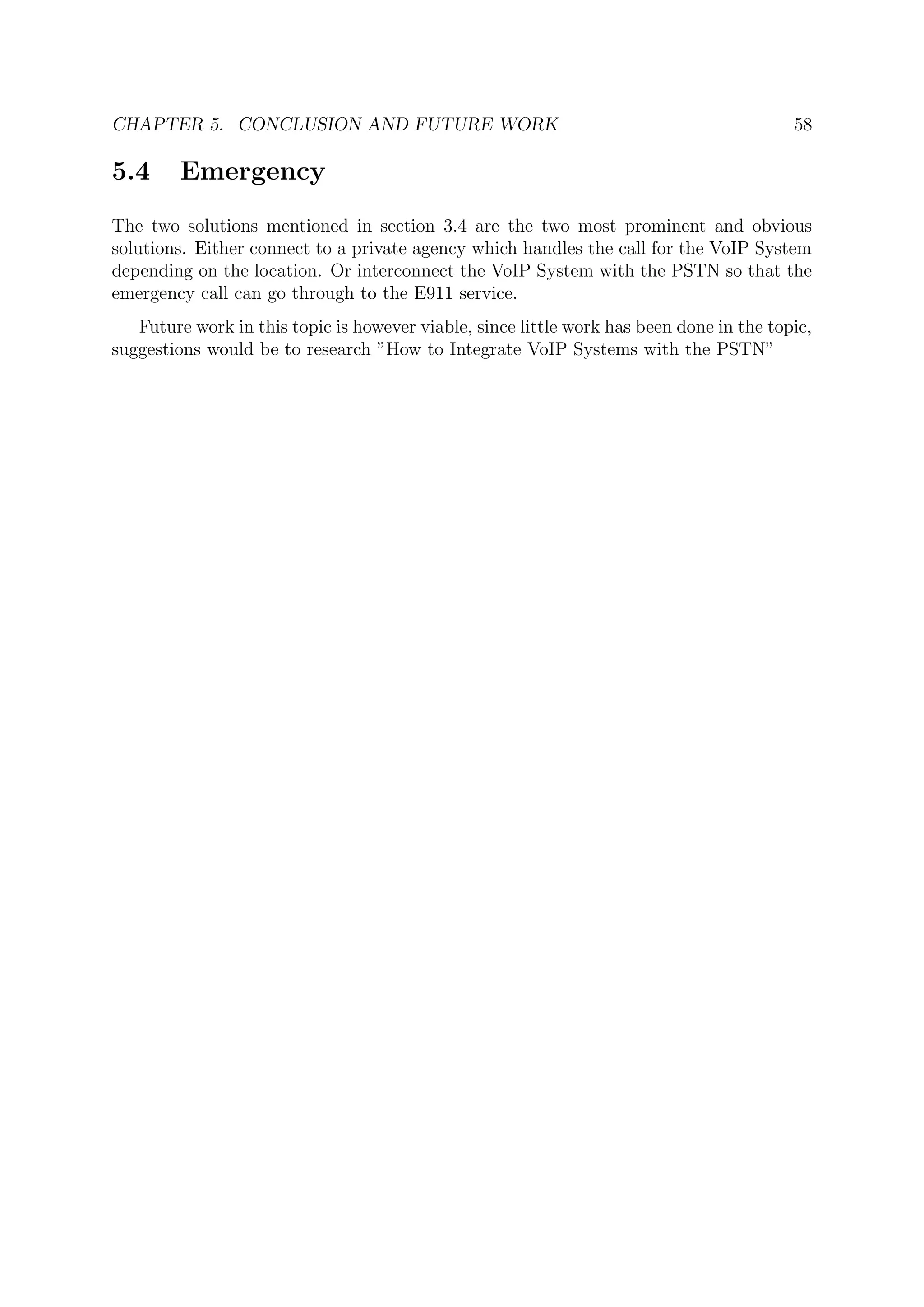
Supervisors: Dr. Hisham Hassaballah Othman
Submission Date: 3 June, 2014
This is to certify that:
(i) the thesis comprises only my original work toward the Bachelor Degree
(ii) due acknowledgement has been made in the text to all other material used
Mostafa Ahmed Mostafa El Beheiry
3 June, 2014
Acknowledgments
I would like to acknowledge the following people and institutes whom have been instru-
mental in how this work turned out. Who kept me motivated and enthusiastic to work
throughout the entire span of the work.
Before anything I would like to thank God Almighty, for everything.
Dr. Hisham, for guiding me through this work, accepting it as my own work and allowing me to
express it as I envisioned it and not holding me back from putting in as much in it
as need be.
I may have disagreed with some things we discussed and planned to do or not to do,
but I thank him for his understanding that my disagreements were purely academic
and only had the interest of this work in mind.
I would also like to thank Dr. Hisham for the vision he has about VoIP Systems
and how important they are to advance in this country, and in turn giving me the
opportunity to be a building block and hopefully benefit humanity in our never
ending quest for science.
Ahmed Khaled, for his work on VoIP using Java, we explored this thing together and uncovered
the magics that make it work together, and without your work I would not have a
trustworthy application for my simulation.
I thank him for calling me day by day, keeping me up to date with his exploits and
for understanding all the point of criticism I leveled at his work.
The days we spent on the fixing the server were some of the most frustrating and
memorable days I’ve ever spent of a project, but we pulled through somehow, and
thanks for letting me and helping me attack your work for my simulation!
My Parents, for providing me with whatever I asked for the sake of knowledge, for believing in
me and knowing that I can make use of every single penny spent on my educational
life. I can’t begin to express the gratitude. And thanks for giving me a multitude
of solutions to overcome the lack of electricity in these trying times. I love you guys
from the bottom of my heart!
Riot Games, for giving me a way out of the stresses of life by playing League of Legends.
Valve, for making a better game than Riot.
III
Abstract
The remarkable advancement of VoIP Systems in the previous decades made possible what
was thought to be fiction. But with great prgress come great challenges, the development
of VoIP Systems is no different. This work is a collection, categorization and examination
of some of VoIP’s greatest challenges. This work has identified four main categories of
issues, Security, Quality, Dependency, Emergency and how they came to be during the
development of VoIP Systems. Their impact on Voice over IP (VoIP) Systems, whether
or not these issues are crippling to VoIP Systems. Included also are illustrations of the
various issues, for visualization purposes. A real time simulation of a singled out issue
is also included in this work. Finally, this work will also look into possible solutions if
present, or suggest solutions if the issues mentioned do not possess a certain, industry-
standard solution.
Certain topics amongst the four categories have been singled out as the most im-
portant, and will be the focus of this work. As for the Security category all of, Packet
Sniffers, Distributed Distributed Denial of Service (DDoS) Attacks, Eavesdropping, Spam
over IP Telephony (SPIT) Attacks, Difficulties with Firewalls and Operating System and
Network, have been the focus. Concerning Quality the issues of, Bandwidth, Codecs,
Queuing, and Low-Speed Links, will be discussed.
Collaboration has taken place with colleague Ahmed Khaled Saeed Metwally, in cre-
ating a simulation of a SPIT attack using his own implementation of a VoIP Client as a
base [11], and using OfficeSIP as a server.
IV
Contents
Acknowledgements III
1 Introduction 1
1.1 Motivation . . . . . . . . . . . . . . . . . . . . . . . . . . . . . . . . . . . 2
1.2 Aim of Work . . . . . . . . . . . . . . . . . . . . . . . . . . . . . . . . . 3
2 Background 4
2.1 Session Initiation Protocol (SIP) . . . . . . . . . . . . . . . . . . . . . . . 6
2.1.1 SIP Invite Request . . . . . . . . . . . . . . . . . . . . . . . . . . 6
2.1.2 Message Method Extension . . . . . . . . . . . . . . . . . . . . . 7
2.1.3 SIP Codes . . . . . . . . . . . . . . . . . . . . . . . . . . . . . . . 7
2.2 Real Time Protocol (RTP) . . . . . . . . . . . . . . . . . . . . . . . . . . 9
2.2.1 Packet Format . . . . . . . . . . . . . . . . . . . . . . . . . . . . 9
2.3 Wireshark . . . . . . . . . . . . . . . . . . . . . . . . . . . . . . . . . . . 10
2.4 Network Address Translators (NAT) . . . . . . . . . . . . . . . . . . . . 11
2.5 VideoLAN Client (VLC) . . . . . . . . . . . . . . . . . . . . . . . . . . . 12
3 Own Work 13
3.1 Security . . . . . . . . . . . . . . . . . . . . . . . . . . . . . . . . . . . . 15
3.1.1 Packet Sniffing . . . . . . . . . . . . . . . . . . . . . . . . . . . . 15
3.1.2 Eavesdropping . . . . . . . . . . . . . . . . . . . . . . . . . . . . . 18
3.1.3 Distributed Denial of Service (DDoS) . . . . . . . . . . . . . . . . 19
3.1.4 Spam over IP Telephony (SPIT) . . . . . . . . . . . . . . . . . . . 21
3.1.5 NAT Traversal . . . . . . . . . . . . . . . . . . . . . . . . . . . . 24
3.1.6 Operating System . . . . . . . . . . . . . . . . . . . . . . . . . . . 25
3.2 Quality . . . . . . . . . . . . . . . . . . . . . . . . . . . . . . . . . . . . . 26
3.2.1 Bandwidth . . . . . . . . . . . . . . . . . . . . . . . . . . . . . . . 28
3.2.2 Codecs . . . . . . . . . . . . . . . . . . . . . . . . . . . . . . . . . 30
3.2.3 Queueing . . . . . . . . . . . . . . . . . . . . . . . . . . . . . . . 33
3.2.4 Low Speed Links . . . . . . . . . . . . . . . . . . . . . . . . . . . 35
3.3 Dependency . . . . . . . . . . . . . . . . . . . . . . . . . . . . . . . . . . 36
3.3.1 Power Dependency . . . . . . . . . . . . . . . . . . . . . . . . . . 36
3.3.2 Internet Dependacy . . . . . . . . . . . . . . . . . . . . . . . . . 38
3.4 Emergency . . . . . . . . . . . . . . . . . . . . . . . . . . . . . . . . . . . 39
V
4 SPIT Simulation 41
4.1 Server . . . . . . . . . . . . . . . . . . . . . . . . . . . . . . . . . . . . . 41
4.1.1 Failed Attempts . . . . . . . . . . . . . . . . . . . . . . . . . . . . 42
4.1.2 OfficeSIP . . . . . . . . . . . . . . . . . . . . . . . . . . . . . . . 43
4.2 Client . . . . . . . . . . . . . . . . . . . . . . . . . . . . . . . . . . . . . 44
4.3 Modifications . . . . . . . . . . . . . . . . . . . . . . . . . . . . . . . . . 47
4.3.1 GUI . . . . . . . . . . . . . . . . . . . . . . . . . . . . . . . . . . 47
4.3.2 Code . . . . . . . . . . . . . . . . . . . . . . . . . . . . . . . . . . 49
5 Conclusion and Future Work 52
5.1 Security . . . . . . . . . . . . . . . . . . . . . . . . . . . . . . . . . . . . 53
5.1.1 Packet Sniffers . . . . . . . . . . . . . . . . . . . . . . . . . . . . 53
5.1.2 Eavesdropping . . . . . . . . . . . . . . . . . . . . . . . . . . . . . 53
5.1.3 DDoS . . . . . . . . . . . . . . . . . . . . . . . . . . . . . . . . . 53
5.1.4 SPIT . . . . . . . . . . . . . . . . . . . . . . . . . . . . . . . . . . 53
5.1.5 NAT Traversal . . . . . . . . . . . . . . . . . . . . . . . . . . . . 54
5.1.6 OS . . . . . . . . . . . . . . . . . . . . . . . . . . . . . . . . . . . 54
5.2 Quality . . . . . . . . . . . . . . . . . . . . . . . . . . . . . . . . . . . . . 55
5.2.1 Bandwidth . . . . . . . . . . . . . . . . . . . . . . . . . . . . . . . 55
5.2.2 Codecs . . . . . . . . . . . . . . . . . . . . . . . . . . . . . . . . . 55
5.2.3 Queueing . . . . . . . . . . . . . . . . . . . . . . . . . . . . . . . 55
5.2.4 Low Speed Links . . . . . . . . . . . . . . . . . . . . . . . . . . . 56
5.3 Dependency . . . . . . . . . . . . . . . . . . . . . . . . . . . . . . . . . . 57
5.3.1 Power . . . . . . . . . . . . . . . . . . . . . . . . . . . . . . . . . 57
5.3.2 Net . . . . . . . . . . . . . . . . . . . . . . . . . . . . . . . . . . . 57
5.4 Emergency . . . . . . . . . . . . . . . . . . . . . . . . . . . . . . . . . . . 58
5.5 Last Words . . . . . . . . . . . . . . . . . . . . . . . . . . . . . . . . . . 59
Appendix 60
A Lists 61
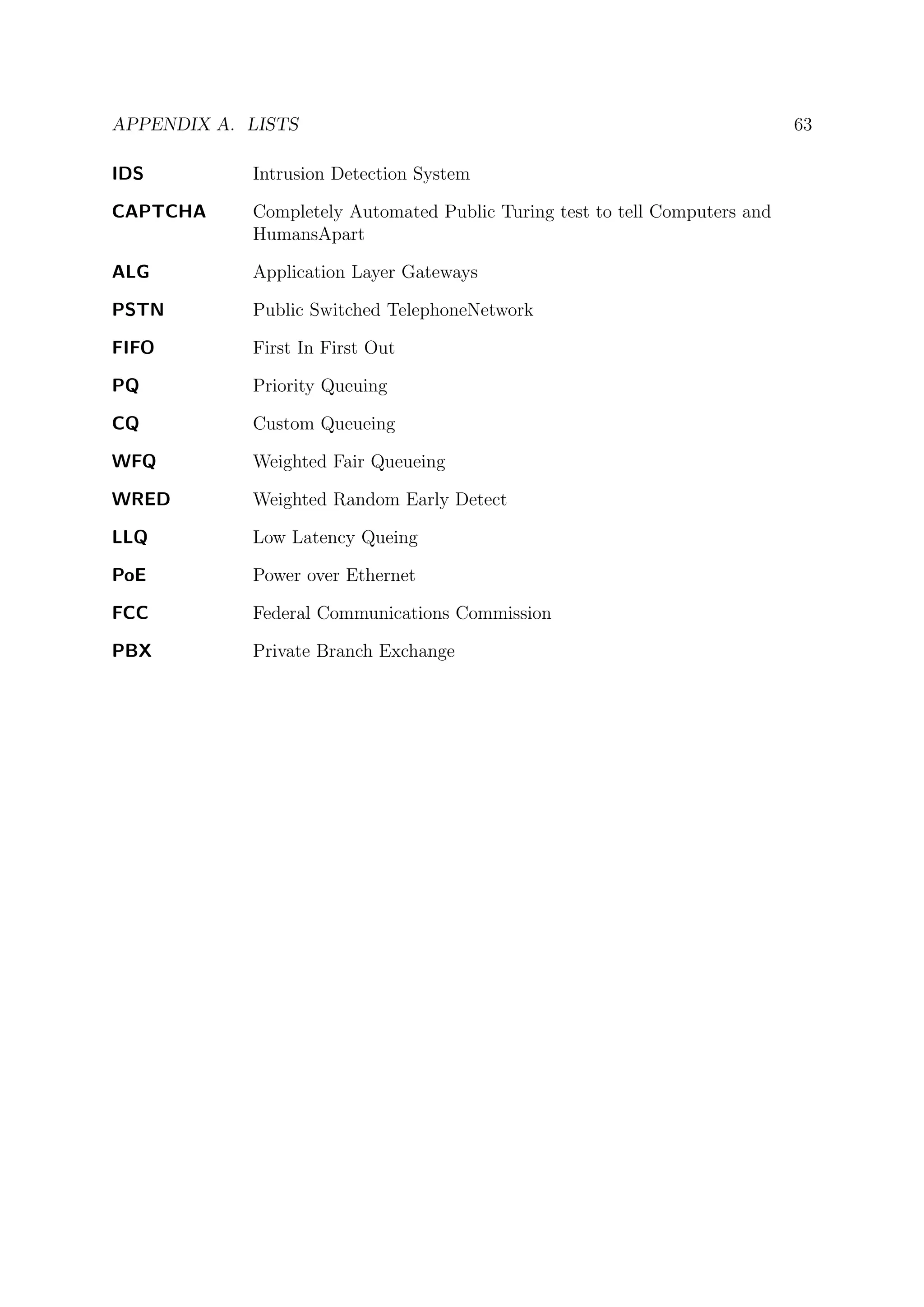
List of Abbreviations . . . . . . . . . . . . . . . . . . . . . . . . . . . . . . . . 61
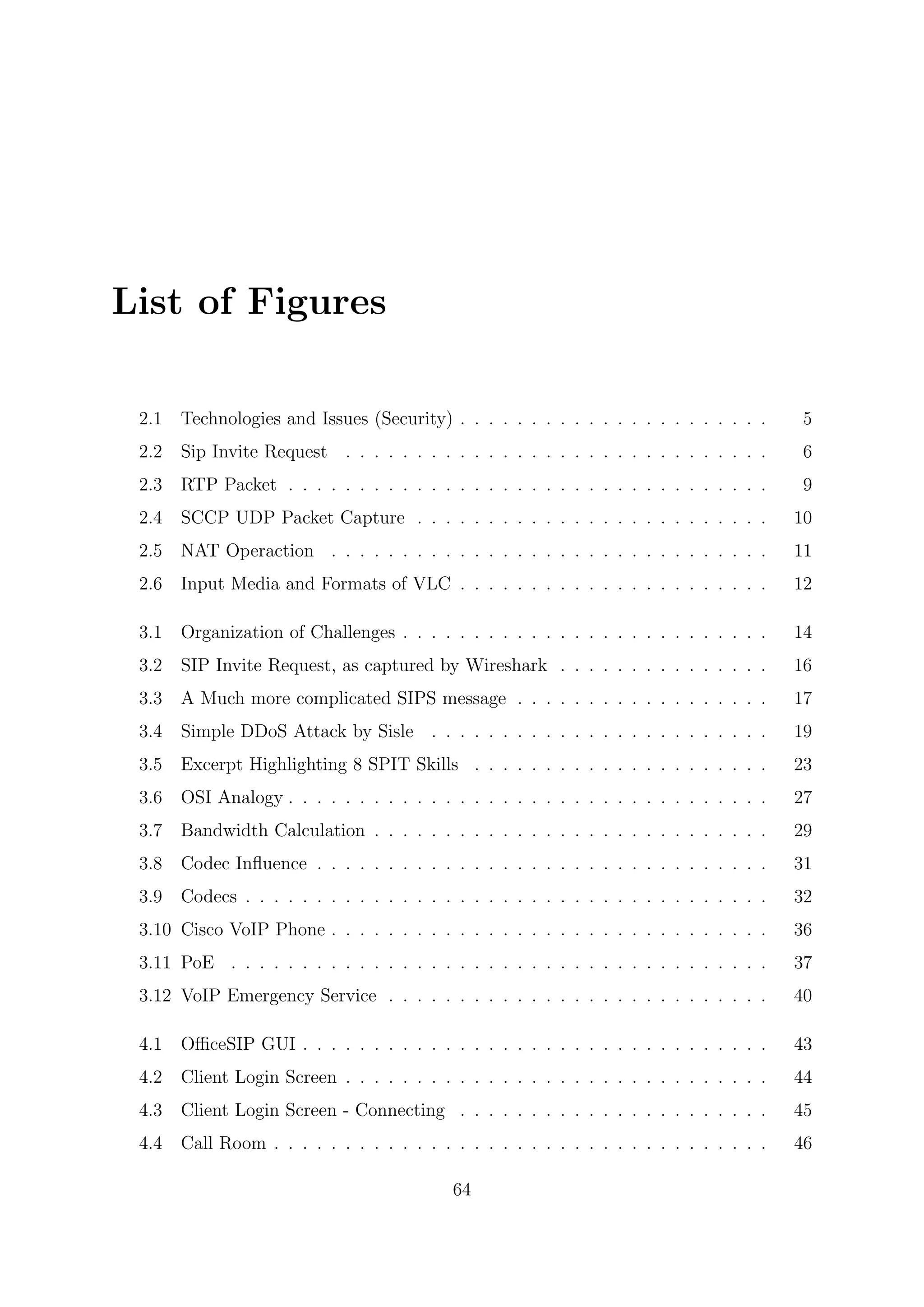
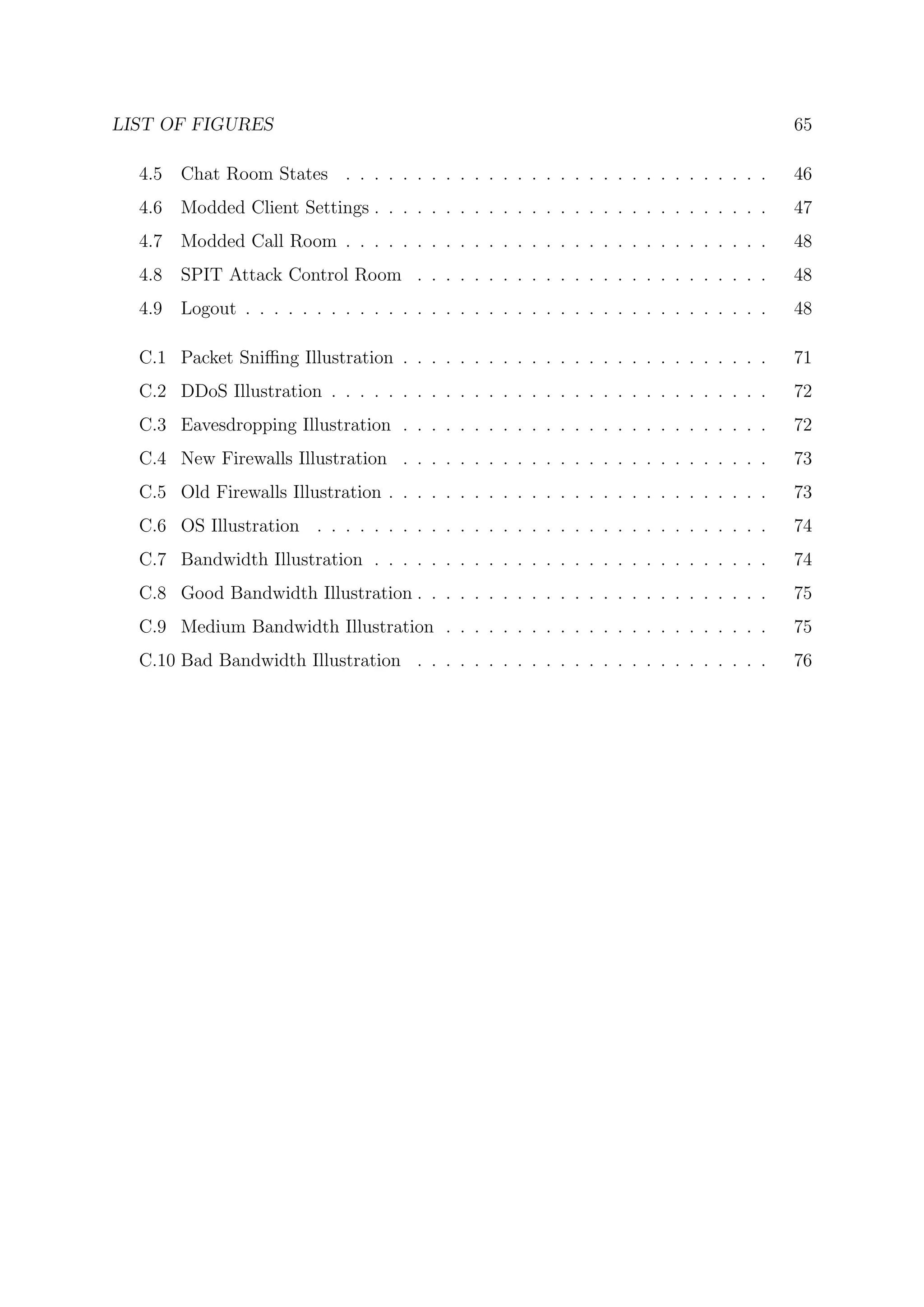
List of Figures . . . . . . . . . . . . . . . . . . . . . . . . . . . . . . . . . . . . 65
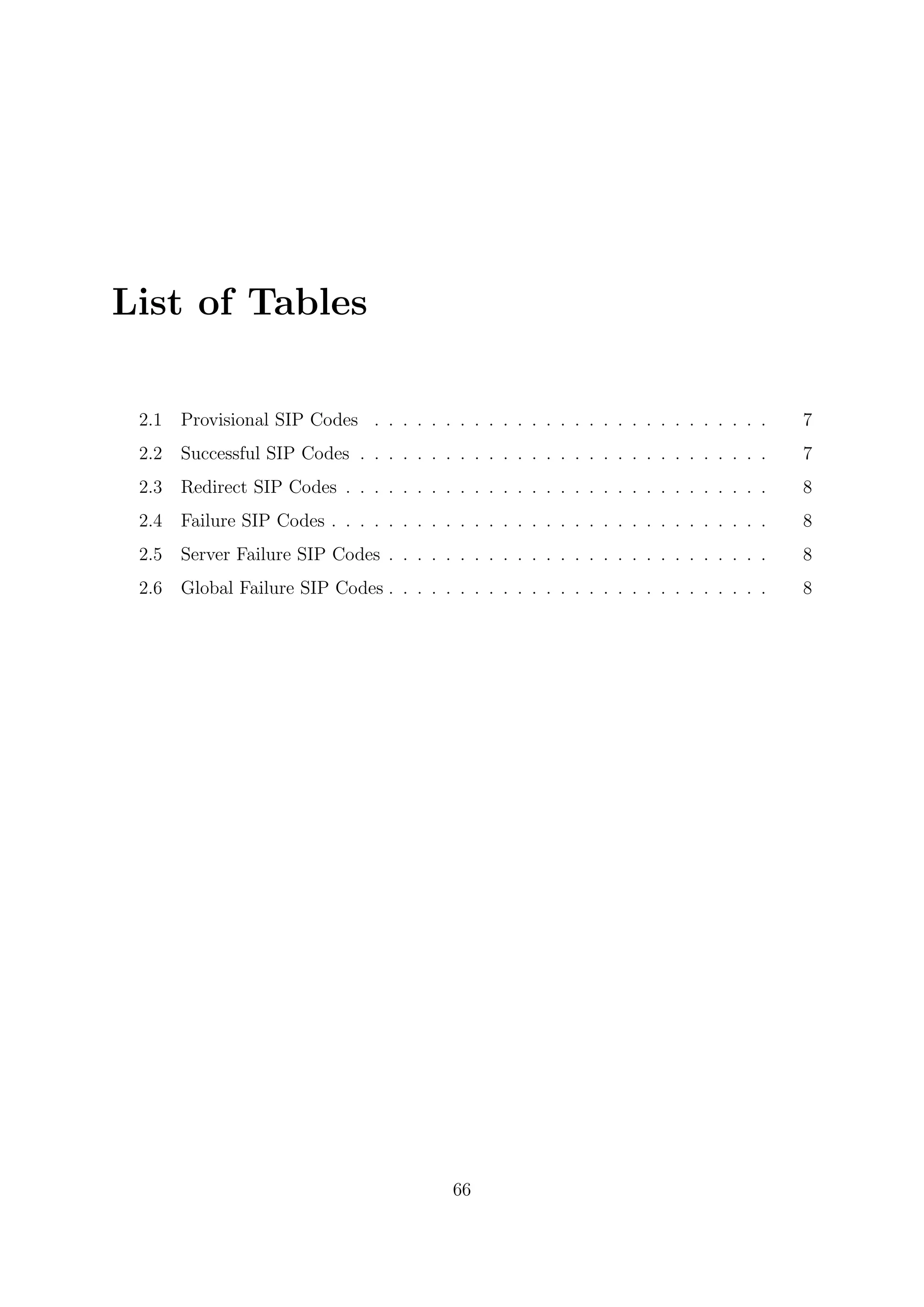
List of Tables . . . . . . . . . . . . . . . . . . . . . . . . . . . . . . . . . . . . 66
B Code 67
C Illustrations 71
References 78
VI
Chapter 1
Introduction
Long distance communication has come a long way since the days of Samuel Morse, and
his 1835 invention of the Morse Code. An invention which Morse used to develop the
worlds first long distance means of communication, the Electric Telegraph Line. 41 years
later humanity saw its second leap, as Scottish inventor Alexander Graham Bell along
with his assistant Thomas A. Watson unveiled the first electric telephone in Boston.
1969 however would see the most significant leap humanity has taken in progressing long
distance communication, as Advanced Research Projects Agency Network (ARPANET)
deployed and managed to successfully connect its first hosts.
While VoIP does not trace its lineage back to a single historic event, it did inherit
fundamental weaknesses from all of its ancestors. Issues of Security passed down from
the telephone are present, as well as issues of Quality introduced from its usage of the
Internet. However, issues passed down such as these are not the only concern for VoIP
Systems, certain Dependencies along with the absence of a way to place an Emergency
Call are all challenges VoIP Systems are faced with if they are to progress as the prime
method of long distance communication.
1
CHAPTER 1. INTRODUCTION 2
1.1 Motivation
Since the early 2000s VoIP Systems have seen major developments, and major widespread
usage. Since then, efforts were made into reviewing and refining VoIP systems, countless
papers have been written detailing flaws, suggesting solutions, or merely documenting
the development of said VoIP Systems. So far however, none has attempted to be com-
prehensive. This work attempts just that, to become a reference point for future works,
to provide a basis on which further research can be made and further developments can
be ensued.
As humanity transitions into the late 2010s, the need for such a work grows, a docu-
mentation of what has come to pass, a reference point for future studies, and a basis for
future work is what this paper has been written to become.
CHAPTER 1. INTRODUCTION 3
1.2 Aim of Work
This Thesis does not claim to solve a single specific challenge facing VoIP Systems, but
rather attempts to raise multiple questions, discuss them and their probable solutions.
Challenges of VoIP Systems, aims to categorize these challenges into four major cat-
egories which will be discussed. Ordered by the most to least impact, which will be
discussed, the categories are Security, Quality, Dependency, and Emergency.
The Security issues which will be discussed in this work are six, the Quality issues
four, the Dependency three and a single Emergency issue will be discussed. Section 4 is
divided into four chapters, each tackling a category as described above. Each chapter is
divided into as many subsection as there are topics to be discussed. As for how the topics
will be discussed, each topic will contain four major points of discussion. The origin of
the issue, and how it came to be during the development of VoIP Systems. Its impact on
VoIP Systems, the extent of how crippling it can be to a VoIP System, which is also its
importance. Solvability, whether or not this problem has been solved, can be solved, or
even merits a solution. In the case of there not being a solution, and the issue meriting
one, a solution will be proposed.
The six Security issues this work will focus on are, in no particular order; Packet Snif-
fers, Distributed DDoS Attacks, Eavesdropping, SPIT Attacks, Difficulties with Firewalls
and Operating System and Network.
The four Quality issues discussed are, Bandwidth, Codecs, Queuing, and Low-Speed
Links.
The three Dependencies in question are, Power Dependency, Internet Dependency,
and Bandwidth Dependency.
A single issue under the Emergency chapter would be, the ability to place Emergency
Calls. Which is a real concern if VoIP systems are to be considered as a real replacement
for modern day telephones.
Chapter 2
Background
The most notable work around the subject matter of Challenges in VoIP Systems as a
general whole subject, would be Hughes Systique Corporations VoIP [9] and its challenges.
Which focused further on the challenges facing VoIP Systems during its deployment phase.
Spoke of some security issues such as NAT and Firewall Traversal. Tackled Quality of
Service (QoS) briefly in a single, two paragraphed page containing 294 words[9, p. 7].
Which by all stretches of imagination is not deep enough for such an issue. It also went
on to focus its efforts on SPIT.
Although a much more in depth, concentrated and well-rounded effort has been made
by Fraunhofer Institute for Secure Information Technologys Rachid El Khayari. His own
work of SPAM over Internet Telephony and how to deal with it, has heavily influenced
this own works section concerning the subject matter[10].
DDoS, has been worked on in the title Evaluating DoS Attacks Against SIP-Based
VoIP Systems written by the collaborated efforts of M. Zubair Rafique, M. Ali Akbar
and Muddassar Farooq. The authors themselves have stated; ”The purpose of our study
is to help both VoIP vendors and academia better understand different vulnerabilities in
the existing SIP servers and how adequately they are protected against them.”[15, p. 1]
Their study however, did not include a solution to DDoS attacks, since the focus of their
paper has been merely the Evaluation of DDoS attacks.
Challenges in Securing Voice over IP and Top Ten Security Issues VoIP, covered the
remainder of the topics adequately and have been extensively read before attempting this
paper [17].
What follows is an explanation of any and all technologies used in this paper, detailing
all the relevant information used from these technologies.
4
CHAPTER 2. BACKGROUND 5
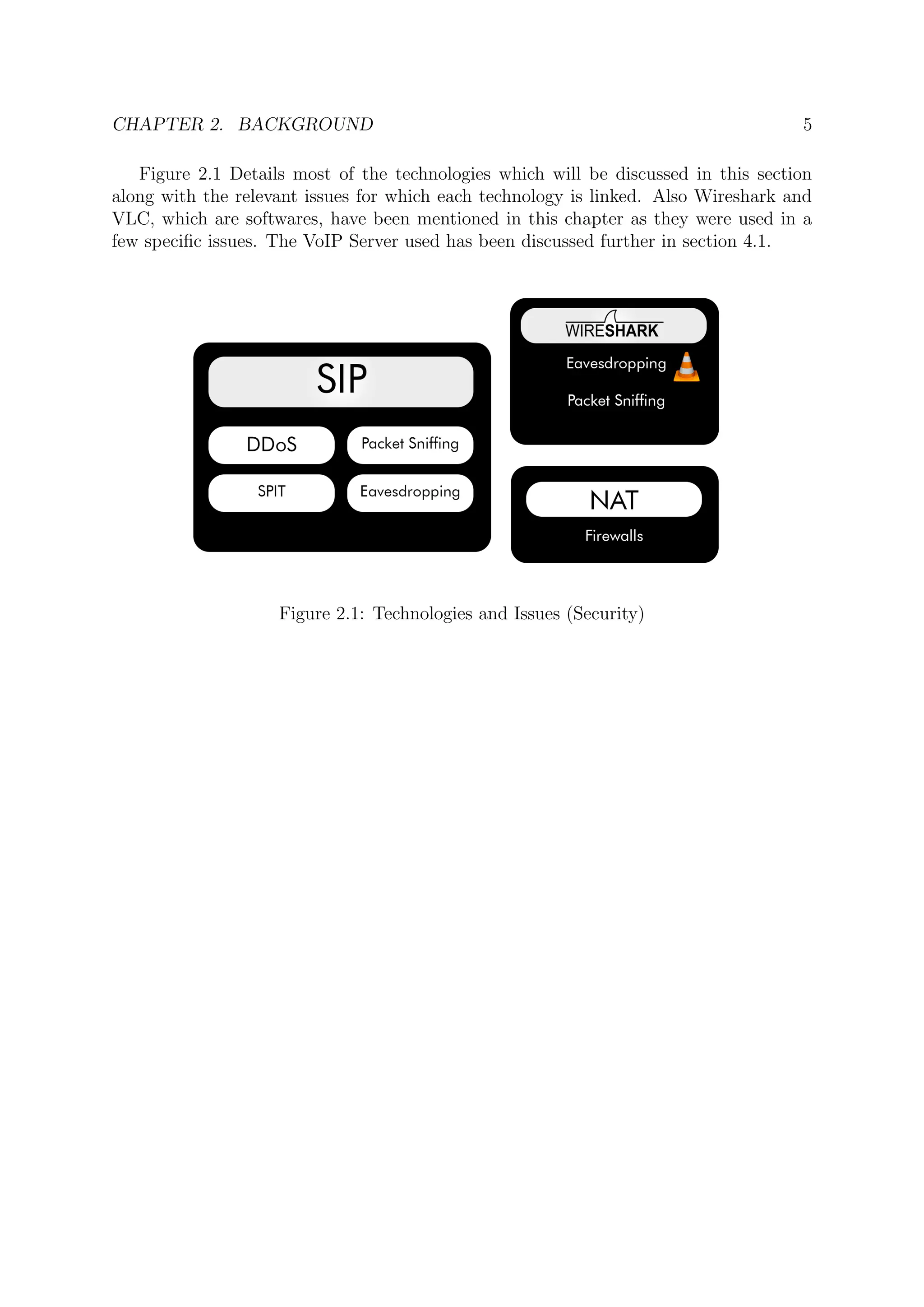
Figure 2.1 Details most of the technologies which will be discussed in this section
along with the relevant issues for which each technology is linked. Also Wireshark and
VLC, which are softwares, have been mentioned in this chapter as they were used in a
few specific issues. The VoIP Server used has been discussed further in section 4.1.
Figure 2.1: Technologies and Issues (Security)
CHAPTER 2. BACKGROUND 6
2.1 Session Initiation Protocol (SIP)
As mentioned above, only relevant to this work information about Session Initiation
Protocol (SIP) will be discussed.
Developed by Internet Engineering Task Force (IETF), it acts as the primary core for
VoIP Systems[16]. Of which many variants have been derived with the aim and goal of
further developing the protocol beyond its weaknesses.
It is a signaling protocol, its tasks are restricted to initiating, maintaining, and closing
the VoIP Call. It has become an industry standard which becomes its greatest strength
and weakness. Strength, in that any SIP based client can communicate with another SIP
based client disregarding most hindering factors. Weakness, in the fact that anyone can
manipulate or extract information from most SIP packets, valuable information at that.
Two of the greatest offenders of this weakness are the Invite Request, and the Message
Method. These will be extensively referenced in the coming chapters thus an explanation
of them is due.
2.1.1 SIP Invite Request
Figure 2.2: Sip Invite Request
The above code snippet in Figure 2.2 details the actual format of SIPs invite request
taken from IETFs own documentation of SIP.[16, 11] What is primarily a concern in this
work is the fact that this request contains the IP Addresses of the person receiving the
call and the person initiating it. It also shows the version of SIP used, the transportation
protocol used and the server handling the call.
The availability of these facts in the Invite Request is an important fact to take into
consideration for the coming chapters, as most of the weaknesses of SIP lay in the fact
that information such as this is readily available.
CHAPTER 2. BACKGROUND 7
2.1.2 Message Method Extension
Added to SIP in 2002 [2], this is how SIP handles chat where possible, whether it be a
VoIP application such as Skype with a text chat feature, or an internal company system
with VoIP phones with SIP Messaging Service (SMS) enabled.
Since SIP is in nature a signaling protocol as mentioned is section 2.1, it can only
ever send request or response messages, the extension handles messaging in a way IETF
described as; ”using a metaphor similar to that of a two-way pager or SMS enabled
handset” [2, 2]
Hence, staying true to SIPs nature, the way Instant Messaging (IM) is done is by
sending a request using the Message Method which contains the deliverable message in
the body of the Request Message sent. Also, since it is a Request Message the receiver
must reply with a Response Message.
2.1.3 SIP Codes
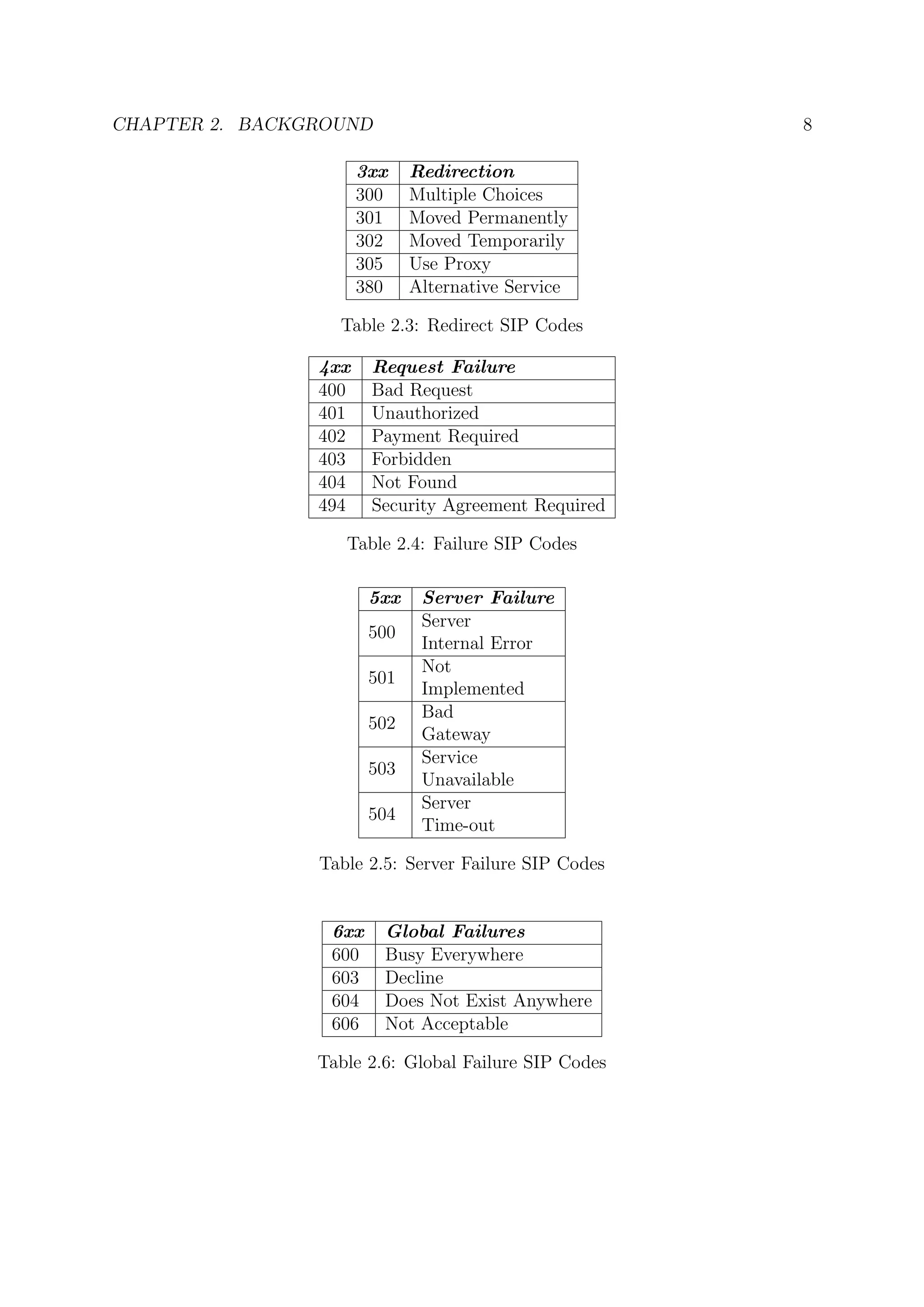
The following are tables of the response codes used by SIP as taken from the IETF
Documentation. Some codes have been removed for sake of remaining concise to the
goal. Continued on page 8
1xx Provisional
100 Trying
180 Ringing
199
Early
Dialog Terminated
Table 2.1: Provisional SIP Codes
2xx Successful
200 OK
202 Accepted (Deprecated)
204 No Notification
Table 2.2: Successful SIP Codes
CHAPTER 2. BACKGROUND 8
3xx Redirection
300 Multiple Choices
301 Moved Permanently
302 Moved Temporarily
305 Use Proxy
380 Alternative Service
Table 2.3: Redirect SIP Codes
4xx Request Failure
400 Bad Request
401 Unauthorized
402 Payment Required
403 Forbidden
404 Not Found
494 Security Agreement Required
Table 2.4: Failure SIP Codes
5xx Server Failure
500
Server
Internal Error
501
Not
Implemented
502
Bad
Gateway
503
Service
Unavailable
504
Server
Time-out
Table 2.5: Server Failure SIP Codes
6xx Global Failures
600 Busy Everywhere
603 Decline
604 Does Not Exist Anywhere
606 Not Acceptable
Table 2.6: Global Failure SIP Codes
CHAPTER 2. BACKGROUND 9
2.2 Real Time Protocol (RTP)
2.2.1 Packet Format
This section will be referred to later in the Bandwidth subsection of the Quality section.
A single Real Time Protocol (RTP) packet contains header fields which hold speech
sample time stamps along with sequence numbers and identify each voice packets con-
tents. The content fields however define the compression technique used.
Figure 2.3: RTP Packet
This packet is left unchanged on most protocols, aside from the edge header and
trailer which vary. The Digitized voice, RTP Header, User Diagram Protocol (UDP)
Header along with the IP Header remain unchanged.
The Ethernet Trailer is present to detect errors, while the Ethernet Header holds the
Local Area Network (LAN) Media Access Control (MAC) addresses of the devices it is
being transferred to and from. The IP Header holds the to and from IP Adresses along
with some control information. The UDP Header carries the portnumbers of the sending
and receiving devices. The digitized voice filed can carry anything from 10 to 320 bytes
of voice[18].
CHAPTER 2. BACKGROUND 10
2.3 Wireshark
The Open Sourced nature of Internet development has made a tool such as Wireshark
available, primarily it functions as a traffic analysis tool, but its abilities go much further
than just that.
Its core function is capturing all traffic flowing in and out of a certain gateway/com-
puter/target device, for instance a simple capture of Wireshark on a certain computer
would reveal the packets being sent to and from that computer. With the luxury of most
of the industry standard protocols being open sourced, such as SIP, Wireshark has been
able to integrate a truly deep method of inspecting each and every packet rushing along
its target device.
It is a Multi-platform program, meaning it is available to the vast majority of users,
by which this means it is available to Windows, Linux, OS X, Solaris users amongst
others. Boasting filters for over a hundred protocols one could argue it is too powerful a
tool to be put, free of charge, to this vast majority of users.
Amongst the features it boasts to possess is a ”Rich VoIP analysis” meaning it is
especially capable in this field. Aided by the ability to capture a stream of data and not
only play but output the capture to a number of different formats after being compressed.
Also it boasts to be able to capture traffic and output the capture to another network
analysis tool, making it more flexible than any other choice in the industry[4].
Figure 2.4 shows an actual capture taken by Wireshark of a UDP Packet.
Figure 2.4: SCCP UDP Packet Capture
CHAPTER 2. BACKGROUND 11
2.4 Network Address Translators (NAT)
Network Address Translators (NAT) was created as a countermeasure to delay the im-
pending depletion of IPv4 addresses, it functions by allowing for IP Address reuse through
a router function. This occurs by dividing the networks into a stub for which the router
can assign the same addresses assigned in other stubs.
Figure Figure 2.5 depicts an operational network in which NAT is used, as is taken
from the IETF Documentation. [6]
Figure 2.5: NAT Operaction
CHAPTER 2. BACKGROUND 12
2.5 VideoLAN Client (VLC)
VLC originally began as a client for streaming videos over a network. A product of Ecole
Centrale Paris students and began as a purely academic endeavor is now a media player
managed by the VideoLAN Non-profit organization. Amassing over 1.3 billion downloads
for Windows and OSX alone[19].
It is arguably the strongest media player in the industry, in which it does not simply
retrieve a file from the Hard Disk Drive (HDD). The various methods of input are its
greatest strength and above all the various ways in which it can receive content is what
truly makes it stand out.
The windows version for instance can play a video using the following protocols: UD-
P/RTP Unicast, UDP/RTP Multicast, Hypertext Transfer Protocol (HTTP)/File Trans-
fer Protocol (FTP), Multimedia Messaging Service (MMS), Transmission Control Proto-
col (TCP)/RTP Unicast, File on HDD, Digital Video Disc (DVD), Video CD (VCD),
Super VCD (SVCD), Audio CD, Digital Video Broadcasting (DVB) (Satellite), Digitale
TV, Cable TV, Motion Pictures Experts Group (MPEG) Encoder, Video Acquisition
(Direct Show).
For a show of its strength in playable formats, all of the following can be played on
all of the Windows, OS X and Linux versions: MPEG, Audio Video Interleave (AVI),
Advanced Systems Format (ASF)/Windows Media Video (WMV)/Windows Media Audio
(WMA), MPEG 4 (MP4)/QuickTime File Format (MOV)/Third Generation Partnership
Project (3GP), Ogging (OGG)/OGG Movie (OGM)/Annodex, Matroska Video (MKV),
Real, Waveform Audio File Format (WAV), Raw Audio, Raw DV, Free Lossless Audio
Codec (FLAC), Flash Video (FLV), Material eXchange Format (MXF), Nut, Musical
Instrument Digital Interface (MIDI)/Standard MIDI File (SMF), CreativeTM Voice.
Figure Figure 2.6 details on what versions are these features available
Figure 2.6: Input Media and Formats of VLC
Chapter 3
Own Work
The following details this own works attempt at gathering and developing information
about the four categories of challenges facing VoIP Systems. First a brief introduction
to this chapter to talk again about these four categories and why they were chosen.
Security, the simplest, most obvious decision. Many of the issues facing VoIP systems
fall under this category, this is due to its inheritance coming from the very first form of
long distance communication to the modern day telephone and the advancement of the
Internet.
Quality, if you are sure your call is one hundred percent secure, yet you cannot hear
or make sense of the audio stream you are receiving then the call is as flawed as if it was
not secure. Perhaps even more so, quality issues come right after security and owe all
their existence to how the Internet has developed.
Dependency, during a power-cut the traditional telephone is still usable, so long as
the call centre that is being connected to remains intact. However, VoIP Systems find
themselves much more reliant on electricity than the telephone. As far as the development
of this particular dependency has come it is still not worked out completely as of yet.
Emergency, admittedly consisting of only the issue of emergency calls, it is an under-
valued challenge which needs to be looked at more than it has been given effort. Virtually
no papers in the field have been written with the goal of addressing this issue, which is
surprising since this is a great disadvantage to using a VoIP System at office or in Mobiles
over relying on traditional systems.
As mentioned in section 1.2, the issues are more than the ones mentioned in this
paper, and hence there will be justification as to why each issue was chosen, this would
also be a suitable time to explain further the structure of each issue and how it will be
dealt with.
Origin, of the issue will be the first focal point of discussion, in many papers the issues
are directly talked about with little mention of how they came to be. Which helps in
understanding why the issue is there, and how it can be dealt with, the age old adage of
13
CHAPTER 3. OWN WORK 14
”History Repeats itself” is true even when computer science is concerned. Learning from
our past can make the future all that much clearer.
Impact, for an issue to qualify as one that needs discussion its impact needs to be
stated, for instance if a DDoS attack can render a call un-place able then it is an issue of
severe magnitude. However if some Echo in the call makes it difficult to understand this
is less of a major concern. It is still a concern which affects the quality of the service, but
it is not as concerning as the service being up altogether. To further seek consistency in
how this variable will be measured, comparisons to the telephone and the mobile phone
(current industry standard) will be drawn.
Solvability, this paper has stated its intention of becoming more of a point of reference
and a base over which future studies could be placed, and this part of the discussion is
essential to this goal. The issues chosen were done favoring the impact of the issue on
VoIP Systems, regardless of whether or not this issue has been solved or not. If the issue
has been solved under a credible reference it will be mentioned, if not then a suggestion
on how it could be solved will be written. If the solution exists but is controversial
then both conditions will occur, hence these are not mutual exclusive conditions. The
Solvability section could mention both a present solution and a proposed better one,
along with a comparison and contrast of both solutions. However, whether or not the
solutions mentioned should be attempted will be discussed in the last section.
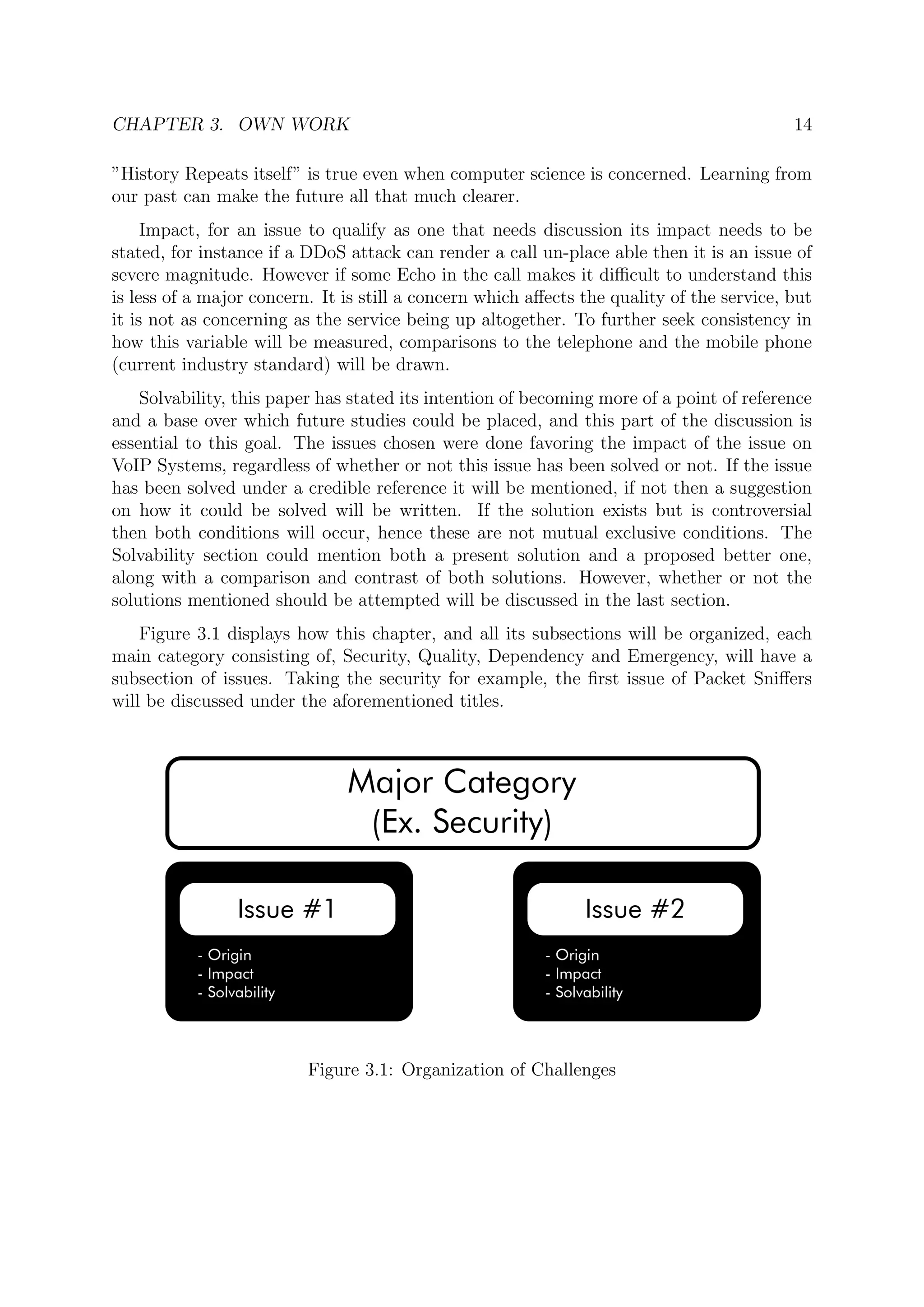
Figure 3.1 displays how this chapter, and all its subsections will be organized, each
main category consisting of, Security, Quality, Dependency and Emergency, will have a
subsection of issues. Taking the security for example, the first issue of Packet Sniffers
will be discussed under the aforementioned titles.
Figure 3.1: Organization of Challenges
CHAPTER 3. OWN WORK 15
3.1 Security
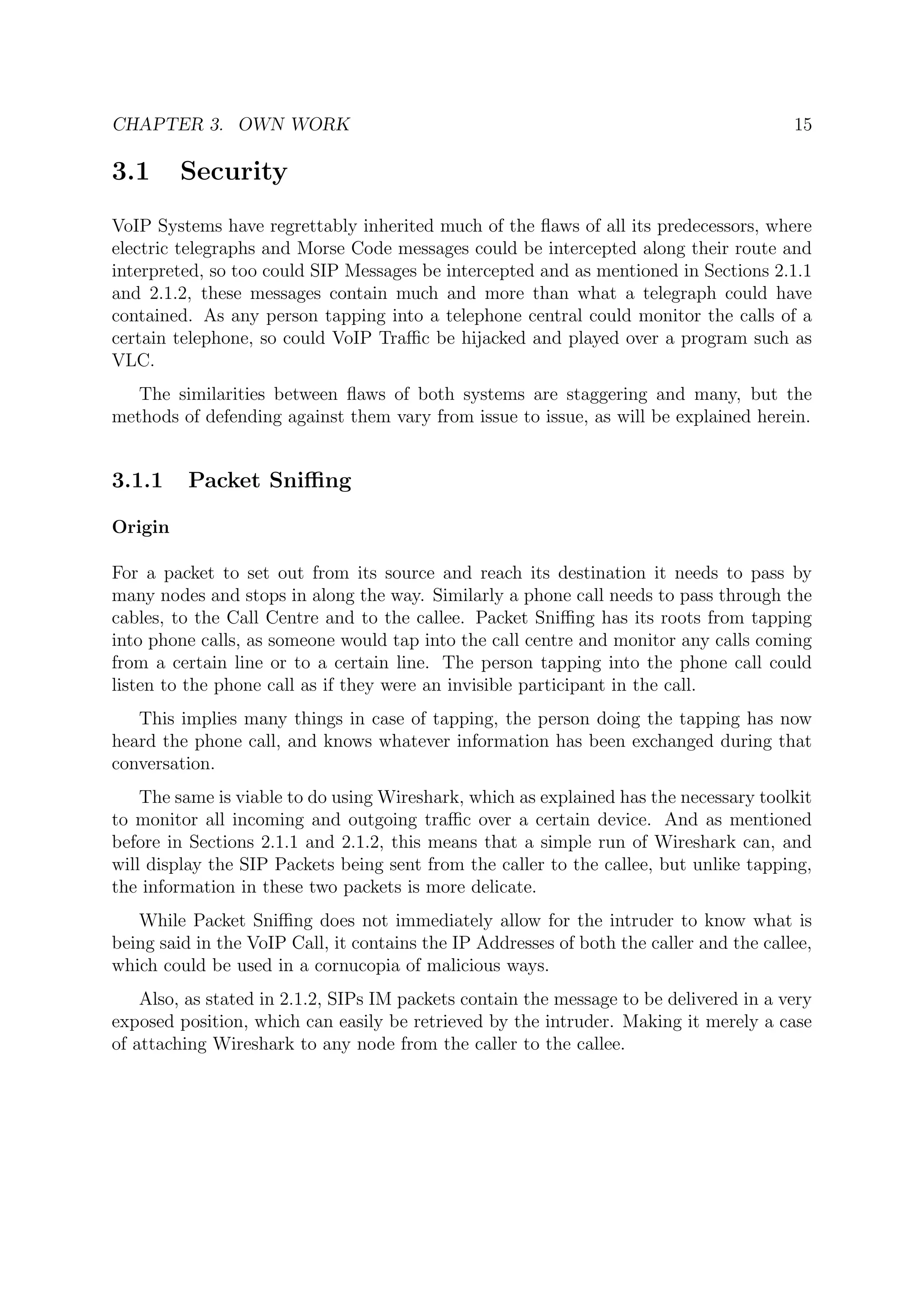
VoIP Systems have regrettably inherited much of the flaws of all its predecessors, where
electric telegraphs and Morse Code messages could be intercepted along their route and
interpreted, so too could SIP Messages be intercepted and as mentioned in Sections 2.1.1
and 2.1.2, these messages contain much and more than what a telegraph could have
contained. As any person tapping into a telephone central could monitor the calls of a
certain telephone, so could VoIP Traffic be hijacked and played over a program such as
VLC.
The similarities between flaws of both systems are staggering and many, but the
methods of defending against them vary from issue to issue, as will be explained herein.
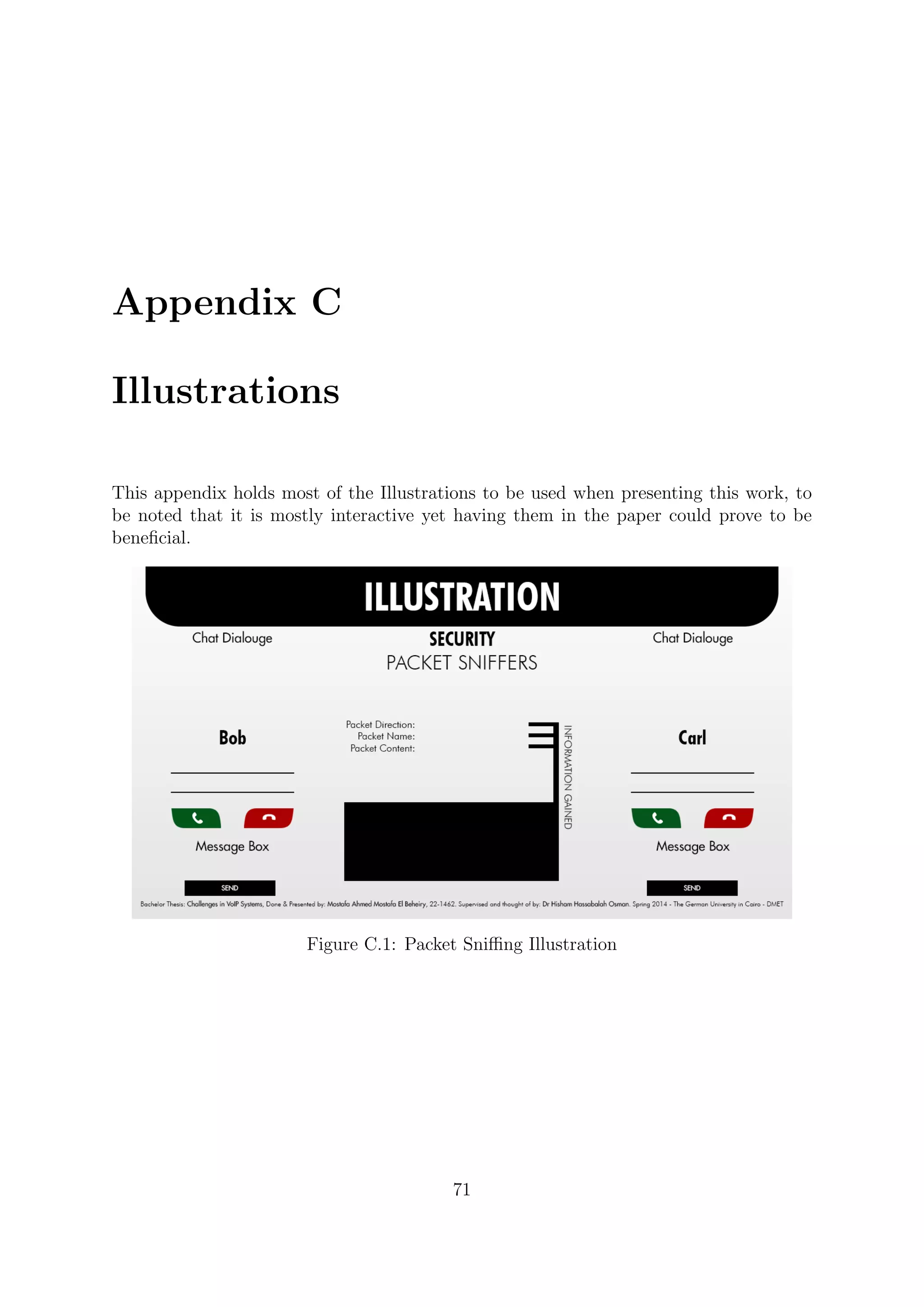
3.1.1 Packet Sniffing
Origin
For a packet to set out from its source and reach its destination it needs to pass by
many nodes and stops in along the way. Similarly a phone call needs to pass through the
cables, to the Call Centre and to the callee. Packet Sniffing has its roots from tapping
into phone calls, as someone would tap into the call centre and monitor any calls coming
from a certain line or to a certain line. The person tapping into the phone call could
listen to the phone call as if they were an invisible participant in the call.
This implies many things in case of tapping, the person doing the tapping has now
heard the phone call, and knows whatever information has been exchanged during that
conversation.
The same is viable to do using Wireshark, which as explained has the necessary toolkit
to monitor all incoming and outgoing traffic over a certain device. And as mentioned
before in Sections 2.1.1 and 2.1.2, this means that a simple run of Wireshark can, and
will display the SIP Packets being sent from the caller to the callee, but unlike tapping,
the information in these two packets is more delicate.
While Packet Sniffing does not immediately allow for the intruder to know what is
being said in the VoIP Call, it contains the IP Addresses of both the caller and the callee,
which could be used in a cornucopia of malicious ways.
Also, as stated in 2.1.2, SIPs IM packets contain the message to be delivered in a very
exposed position, which can easily be retrieved by the intruder. Making it merely a case
of attaching Wireshark to any node from the caller to the callee.
CHAPTER 3. OWN WORK 16
Impact
Figure 3.2: SIP Invite Request, as captured by Wireshark
Figure 3.2 [8] shows an actual SIP Invite Request packet captured using Wireshark, and
immediately the magnitude of the issue is made obvious. The IP Address of 107 along
with the IP Address of 101 are known using the two consecutive lines of From and To.
Also the Via line shows the last hop the packet took in order to reach its destination,
allowing for further abuse of the network, and how it is set up.
In Section 2.1.3 the various SIP Response Codes were noted, and since SIP is a
signaling protocol the Invite Request needs a Response. However, the response will also
be sniffed, and the sniffer would now know not only who attempted to call who, but the
state of the callee depending on the response code which is sniffed.
Moreover, the Message Method, which is SIPs own way of handling IM as was men-
tioned in Section 2.1.2, can be sniffed and immediately the chat would become apparent
to the intruder. An argument could be made that this is not worrisome in VoIP Systems
since they are primarily focused with Voice, but many newer systems come with SMS
Enabled devices, and in the case of Skype, it is built around the notion of chatting in the
first place.
The reason why Packet Sniffing is placed amongst the highest on the impact charts is
simple. If a call is denied, as in the case of DDoS, there is no information leaked. If a call
is breached however, this is another matter entirely. The only real argument that could
be made is for Eavesdropping as a contender for the most impactful security breech, but
Eavesdropping is merely an afterthought of Packet Sniffing, Eavesdropping in on its own
does not reveal IP Addresses nor reveal chat messages, and hence Packet Sniffing was
ranked higher.
CHAPTER 3. OWN WORK 17
Solvability
Coming back to the argument of line tapping, and to the adage of looking to the past.
How did our predecessors solve the issue of line tapping, the answer to this question lies
in many ways. To stop a person from tapping into a telephone line at the telephone
centre, it would seem easier to restrict access of people with no security clearance in said
centre. Another solution for those who thought they were under surveillance and did not
want anyone to know what they were saying was to speak in cyphers, hence the content
of the call might be stolen but the thief would not understand it to use it.
Case in point, a solution akin to the first one mentioned above would be to stop any
and all access to the network, which becomes increasingly difficult the bigger the network
grows and the more people begin using it. Hence a further security measure could be
added, speak in cyphers. Or rather, encrypt the SIP packets so they would not be as
easy to gain access to their contents.
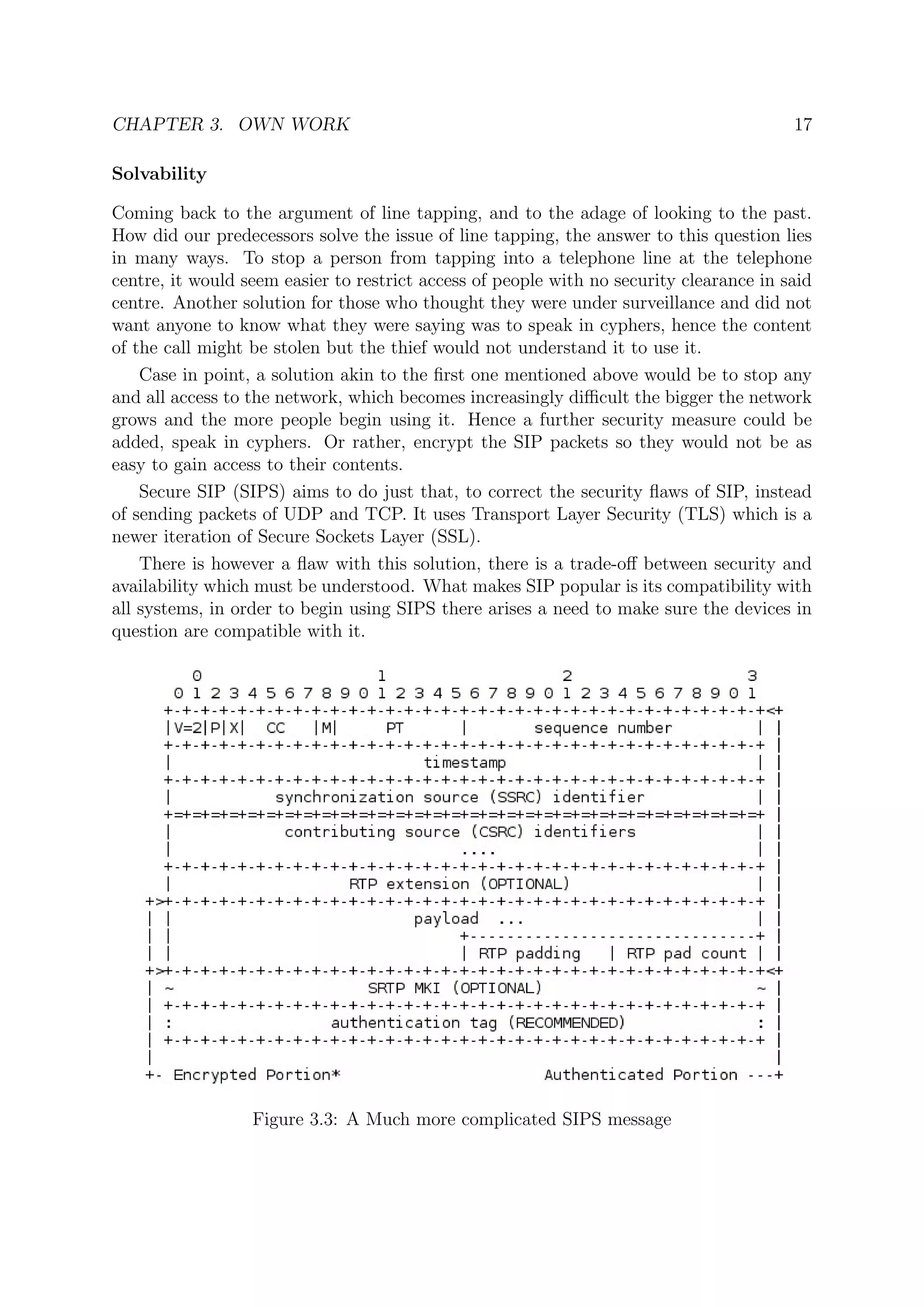
Secure SIP (SIPS) aims to do just that, to correct the security flaws of SIP, instead
of sending packets of UDP and TCP. It uses Transport Layer Security (TLS) which is a
newer iteration of Secure Sockets Layer (SSL).
There is however a flaw with this solution, there is a trade-off between security and
availability which must be understood. What makes SIP popular is its compatibility with
all systems, in order to begin using SIPS there arises a need to make sure the devices in
question are compatible with it.
Figure 3.3: A Much more complicated SIPS message
CHAPTER 3. OWN WORK 18
3.1.2 Eavesdropping
Origin
Eavesdropping could be considered Packet Sniffings younger, stronger, but less intelligent
brother. To provide context and follow up on this analogy, Packet Sniffing is more
intelligent in which it requires knowledge in order to know where to look and for what,
and in the end it returns information which in turn requires a good mind to know how
to use. Eavesdropping however merely plays out or outputs a conversation, making it
hypothetically no different from phone tapping.
To note, this section deals with Eavesdropping as a standalone issue, there are tools
available for eavesdropping on a certain connection, attempting to pick up any UDP
Packets and play them, regardless of IP Address. While the more classical way of viewing
eavesdropping is that it is a level above Packet Sniffing, this work has the notion of the
opposite. From packet sniffing one can eavesdrop and not the other way around.
Eavesdropping is much more of a difficult subject to discuss, it bears so much similarity
to Packet Sniffing, yet it remains a different topic. Hence for interest of eliminating
repetitiveness this chapter will remain shorter.
Impact
”It is said that if you know your enemies and know yourself, you will not be imperiled in
a hundred battles...” - Sun Tzu The Art of War
Another adage dating back to first written history which rings true to this day, knowl-
edge is power as Sun Tzu told of in The Art of War, an intruder peering into your own
calls freely needs not much proof to warrant its position on the impact list.
Even more so, today there are techniques to spot a certain word uttered during the
conversation, so for instance if used in espionage or in tyrannous countries could have
severe implications.
Solvability
One would assume the easiest way to solve this issue is as the above issue was solved,
until recently most of the community working in this industry thought so as well. In
order to encrypt a VoIP Call without losing time to encryption it is also compressed
with Variable Bit Rate (VBR) to shorten the sending time. However, recent studies have
shown that the language of the audio being compressed could be accurately achieved from
the encrypted stream. This, along with searching for a single phrase it has been proven
with over fifty percent accuracy to be successfully able to identify whether an encrypted
stream contained a certain phrase or not. Which calls in question the true strength of
these methods of encryption [20].
Another research suggests to randomly pad the outputs of the VBR encoder to dif-
ferent lengths in order to overcome this issue[14].
CHAPTER 3. OWN WORK 19
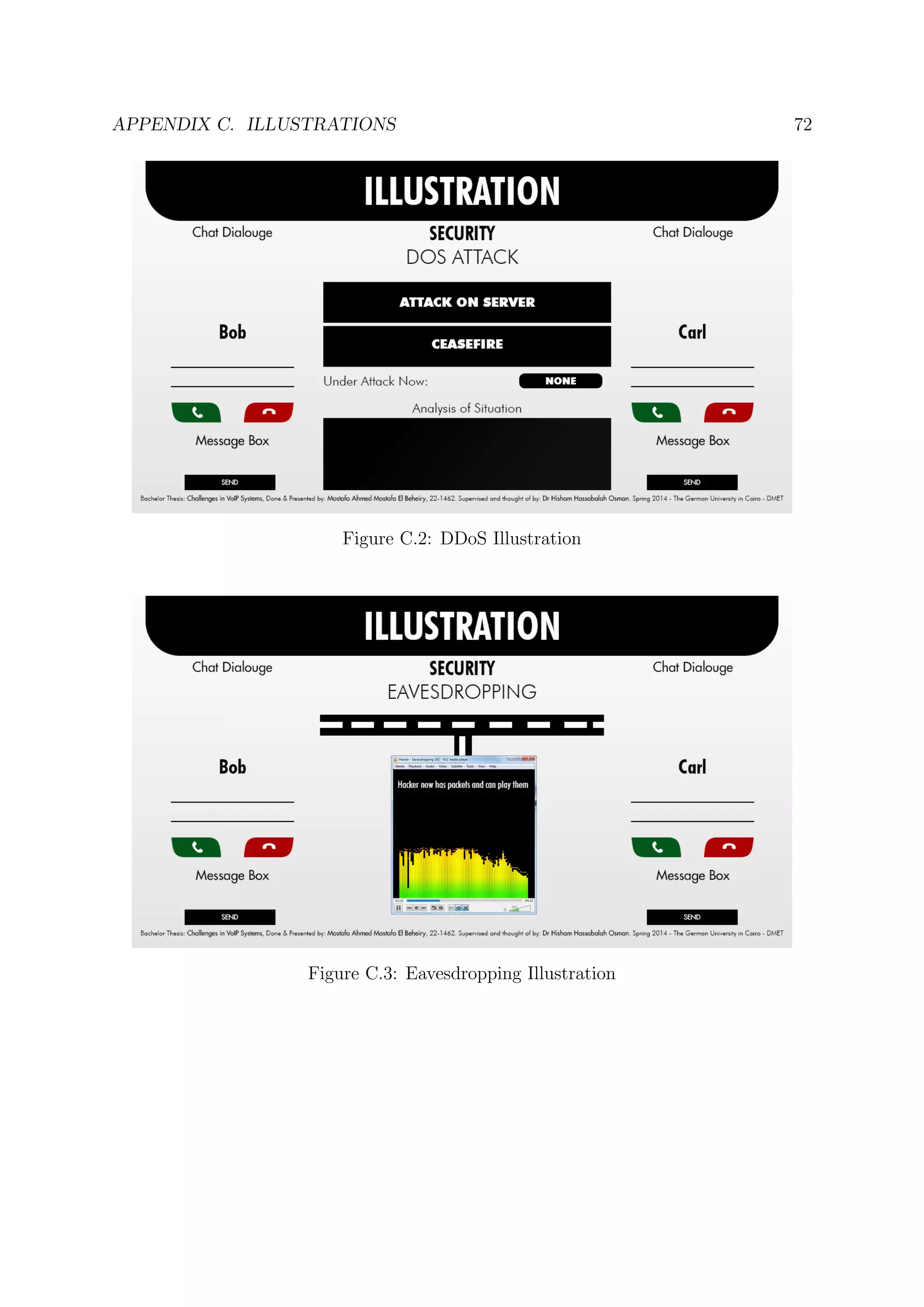
3.1.3 Distributed Denial of Service (DDoS)
Origin
To compare to an older long distance communication method and to provide an analogy
of sorts. If a post man on average under normal circumstances has to deliver 1000 letters
per day, and on a certain day he receives 100,000 letters to deliver. There is virtually
little this man can do to distribute 100x his normal workload. It also comes as no surprise
to the postman when he opens these letters and finds than 99,000 of them are empty and
from the same person. This type of attack did not occur due to the cost and effort needed
to launch such a massive attack, numbers aside.
However, in a hypothetical word, where there was only one very fast postman, but
paper was free, and stamps were unlimited, such an attack could still be feasible, and
this is precisely what happens in VoIP DDoS attacks.
DDoS attacks first originated from 1989, as people discovered they could render ma-
chines inoperable using the -f (flood) command in ping.c source code. And soon developed
into almost bankrupting a high profile New York based ISP! (ISP!) in 1996 [5].
A flash forward to 2013, and the largest recorded high profile DDoS attacks of 300
Gbps in the first half of the year.
Impact
The sole reason this is not placed higher than it is on the impact list, is that there is
simply more to be gained from allowing a call to go through and knowing what was said
than denying it altogether. Denying the call however remains the next best thing.
The severity of the DDoS attack is limited only by its scope.
Figure 3.4: Simple DDoS Attack by Sisle
CHAPTER 3. OWN WORK 20
Solvability
DDoS attacks are growing daily in size and frequency, and are now used as prime tools in
Cyber Warfare. Everything from Governments to Gaming Companies have been at one
point in time been the target of DDoS Attacks, of various magnitudes.
Recent researches [15] have shown that, while SIP Servers vary from robustness and
at which point they reach a contrived Breaking Point, all of the servers available for use
today can indeed be knocked down by a simple flooding of Invite requests.
The solution mentioned was the implementation of a SIP Intrusion Detection System
(IDS), to expand on this, simply allowing users a limited number of attempts to send
invite requests before shutting them out of the server for a time would solve the issue,
since in order to place an invite request one needs to be registered on the server in the
first place.
This is a very solid potential for future work, if not the solutions mentioned but the
subject matter itself, as said above DDoS attacks are only getting stronger, so it is only
natural for the next focus of research to concern surefire ways of defending against DDoS
attacks.
To shed further light on the severity of the issue, companies dedicated to ”Cloud
Based DDoS Mitigation” have recently opened up and have attained immediate success
[5].
CHAPTER 3. OWN WORK 21
3.1.4 Spam over IP Telephony (SPIT)
Origin
If for example Bob knows that Carl is expecting an important call from Alice on the 13th
of April, and Bob wants to stop Carl from answering this call, a valid way of doing this
is repetitively calling Carl and hence making it seem for Alice that Bob is busy. This is
what is known as SPAM. SPIT however is much easier and less costly to execute.
Also it is much like E-Mail SPAM, except with E-Mail a person can go through them
all and in a sense Randomly Access the mails they deem important. Unlike E-Mail SPAM,
SPIT is more direct, the phone is ringing and will not stop ringing until it is answered or
declined. At the same time any legitimate calls are not being allowed into the system.
Also, E-Mails are scanned at an E-Mail server before being distributed to the user,
and hence most SPAM can be detected before it even reaches the user, unlike SPIT which
directly arrives to the user. E-Mails are also much easier to analyze, they give room for
analysis with the information they carry, yet a SPIT call cannot be determine pre-hand
for it arrives as a regular call would.
SPIT faced a difficulty in its definition, but recently it is being agreed on the definition
of: ”bulk unsolicited set of session initiation attempts (e.g., INVITE requests) [10], at-
tempting to establish a voice, video, instant messaging, or other type of communications
session. Meaning that SPIT could very easily be identified as Telemarketing of VoIP.
Impact
A step below DDoS attacks, but a sizable one at that. While DDoS attacks render an
entire server unusable, SPIT attacks only target bulks of people. To perform a SPIT
attack, the VoIP network is scanned and information regarding the IPs of the users on
the network is gathered. Afterwards attempts to establish calls with as much of these
users as possible being, and in the instance one picks up a message is relayed.
Solvability
As with all SPAM based attacks, simple black lists could suffice to prevent SPIT calls,
but this is a reactive solution and not a proactive one. And simply placing addresses
accused with SPIT in a blacklist is impractical at best.
A method of dealing with SPAM, or rather unwanted automation over the Internet
in general is Completely Automated Public Turing test to tell Completely Automated
Public Turing test to tell Computers and HumansApart (CAPTCHA) but even this can
be worked around by performing a CAPTCHA Relay Attack, by relaying it to human
solvers.
CHAPTER 3. OWN WORK 22
Also an IDS does not seem as viable here as it would in a DDoS Attack, even though it
does seem as if the IDS can identify a SPIT IP by the rate of calls it places and abnormal
behavior it displays there is still a way around it. The attacker could simply adjust the
call rate randomly, making it more difficult for a pattern to be realized.
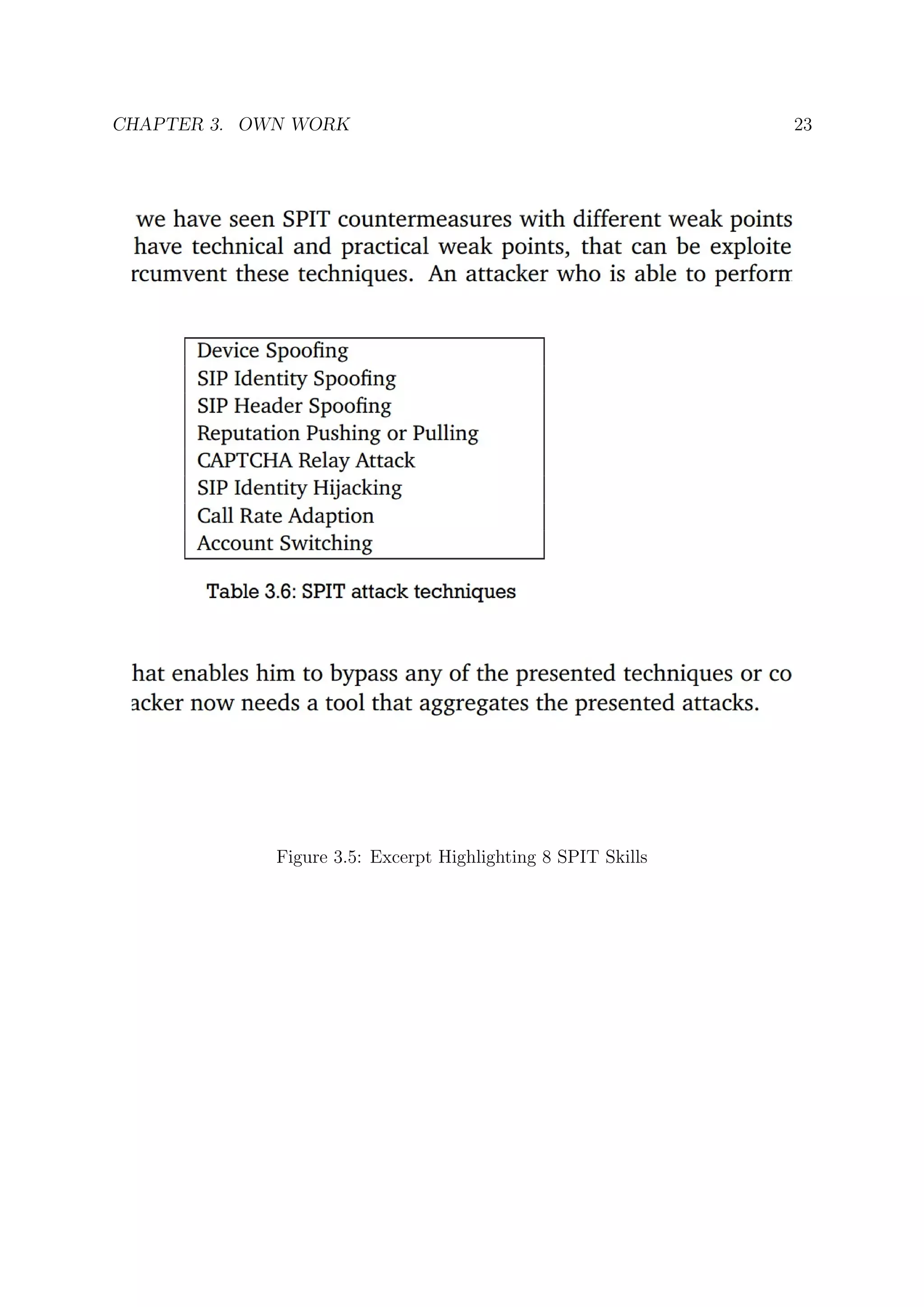
As a research claims, Any attacker who is able to: Device Spoof, SIP Identity Spoof,
SIP Header Spoof, Reputation Push or Pull, CAPTCHA Relay Attack, SIP Identity
Hijack, Call Rate Adapt and Account Switch, will in the end be able to breech most
present countermeasures.
The results of this same research were indeed very alarming and concerning;
”As an attacker we acted only with simple methods on the Application layer, but could
nonetheless find ways to bypass countermeasures, without even exploiting SIP protocol
weaknesses or deploy methods of lower layer protocols. This showed us, that in order to
mitigate threats like SPAM over Internet Telephony, developers and administrators need
to challenge their solutions.
More research in this issue is a must, an explosion in these types of attacks can very
well be in the works, such as was the case with DDoS attacks.
CHAPTER 3. OWN WORK 23
Figure 3.5: Excerpt Highlighting 8 SPIT Skills
CHAPTER 3. OWN WORK 24
3.1.5 NAT Traversal
Origin
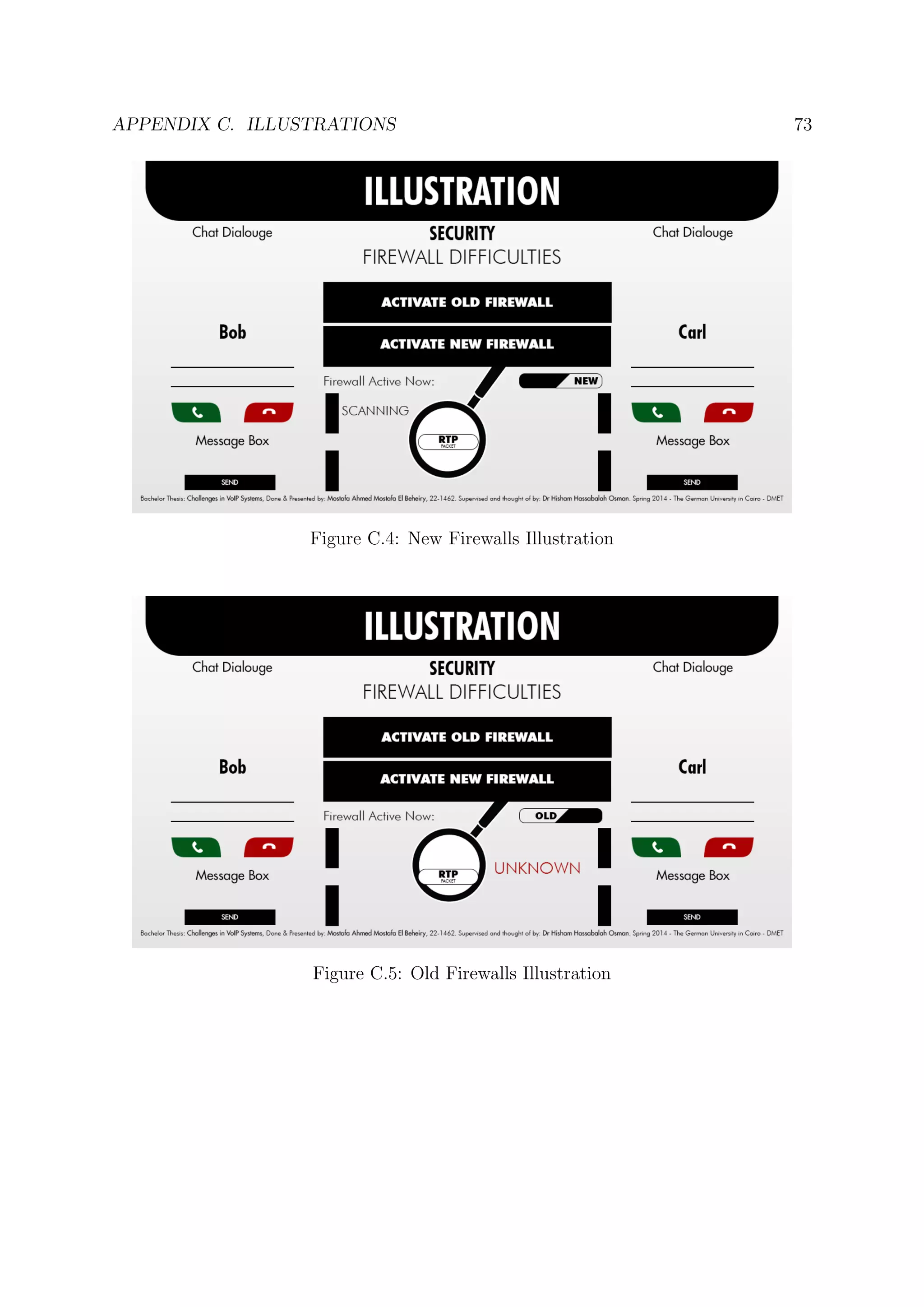
VoIP, or rather, SIPs issues with Firewalls originate from three major points. Older
Firewalls predate SIP entirely, or did not anticipate the need to let SIP Messages pass
unhindered, making for blocked SIP Messages entirely.
Yet, even with new firewalls VoIP systems seemed to struggle to preform, as the newer
firewalls put more emphasis on security over all else, and when a firewall finds a mass
of RTP packets wanting to pass through, it will feel compelled to check each and every
one. Causing an unsettling delay in the call, and in lower end computers possibly jitter
as well.
The last origin of issues with reach-ability stems from the impending depletion of IPv4
addresses, and the short term solution of NAT, as was described in Section 2.3, along
with how SIP Messages are constructed[9].
Since the internal IP Address is different from the Public IP Address the SIP message
leaving the network will hold the wrong internal IP Address and not the Public IP and
Port.
Impact
A SIP Packet going to its destination with a wrong return address has only one impli-
cation. The response will be sent to the wrong return address, and probably lost along
the way. This is however an issue with the setup of the system and has a multitude of
solutions.
Solvability
Simply using a NAT Box to change the IP Payload of the SIP packets would be enough
to solve this issue. This would allow for a simple change of the IP to the correct Public
and Port variant.
Application Level NATing could be also considered by adding an Application aware
gateway to handle the VoIP Traffic. Known as, Application Layer Gateways (ALG).
However this solution is flawed at its core, for it the ALG would have to change the
packet and hence decrypt the packet, meaning that this solutions defeats the purpose of
encryption.
The solution proposed by IETF is one which involves yet another protocol, and re-
quires the presence of a Relay Server. Skype however use a protocol of their own and it
would be advisable to follow in these footsteps when building a VoIP System.
CHAPTER 3. OWN WORK 25
3.1.6 Operating System
Origin
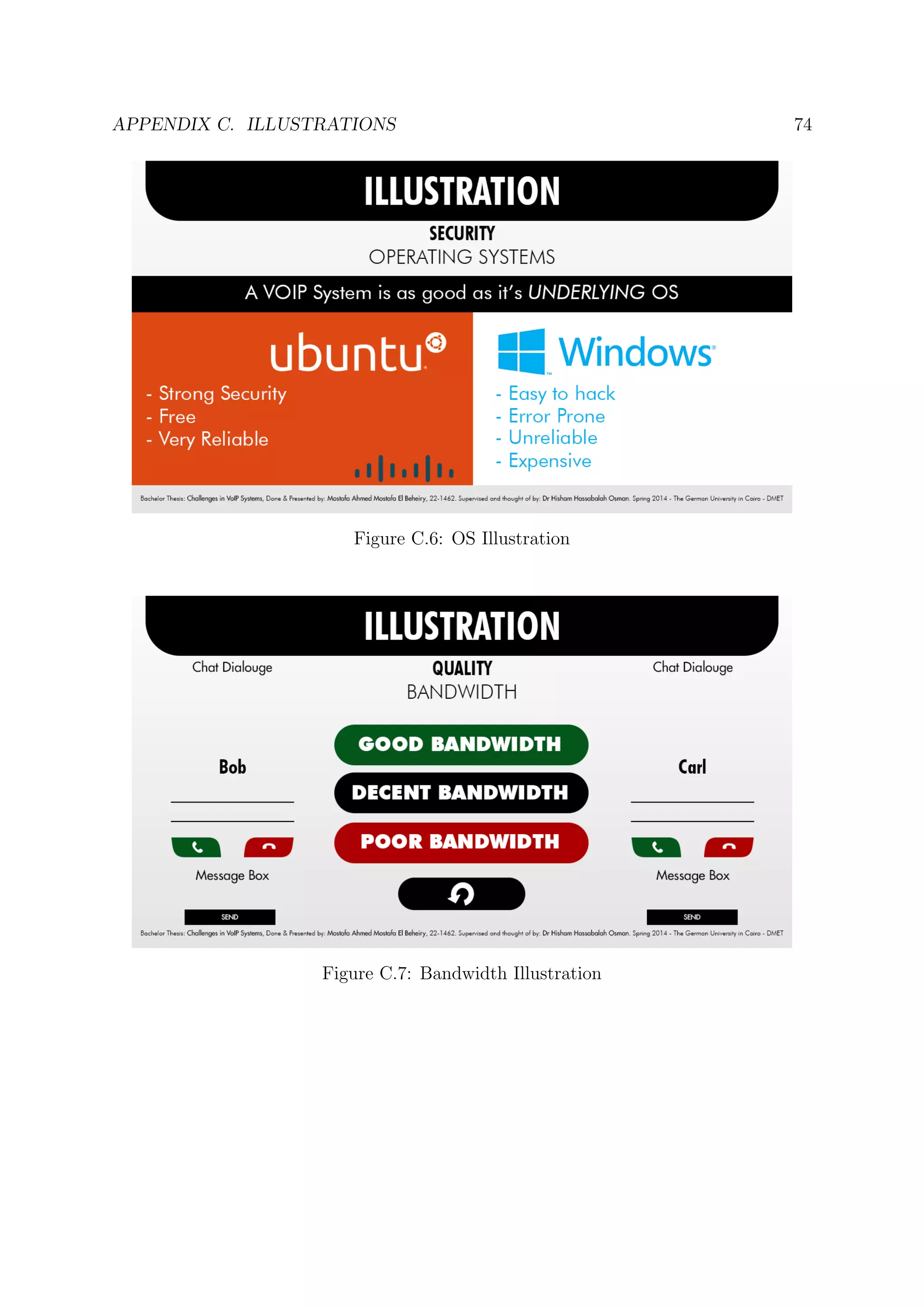
A VoIP System is as good as its underlying OS. A sentence taught to anyone willing
to set foot in the field, and a fundamentally correct one at that. Until this point the
contention has been over abusing VoIPs inherent weaknesses, looking at the weaknesses
of an Operating System such as Windows however brings up a new host of other security
issues entirely.
Impact
Windows is inherently a weak OS to base any system which requires any form of consid-
erable security upon. Monitoring tools for windows are in abundance, whether they be
keyloggers or sniffing utilities, basing a VoIP on an OS such as windows only makes it
that much easier for intruders to attack the system.
Solvability
Cisco, a leading developer in the industry have long since migrated their systems and
services to a Linux based OS, and the same is advised for any VoIP System willing to
maintain a semblance of security.
CHAPTER 3. OWN WORK 26
3.2 Quality
Assuming all issues of securing VoIP Systems are done with, and a perfectly secure VoIP
System is created. The first issue this hypothetical system is going to have is a concern
for the quality of the calls in this system. Security does not come without a price, in this
case quality is favored over security or reliability. For instance, the media packets sent
are traditionally done using UDP, and while TCP is known to be the more reliable way
of sending a packet it is speed that is sought by using UDP.
For instance, as described in Section 3.1.5, newer firewalls are a direct representative
of better security measures, but the way they secure the network might lead to horrible
delays.
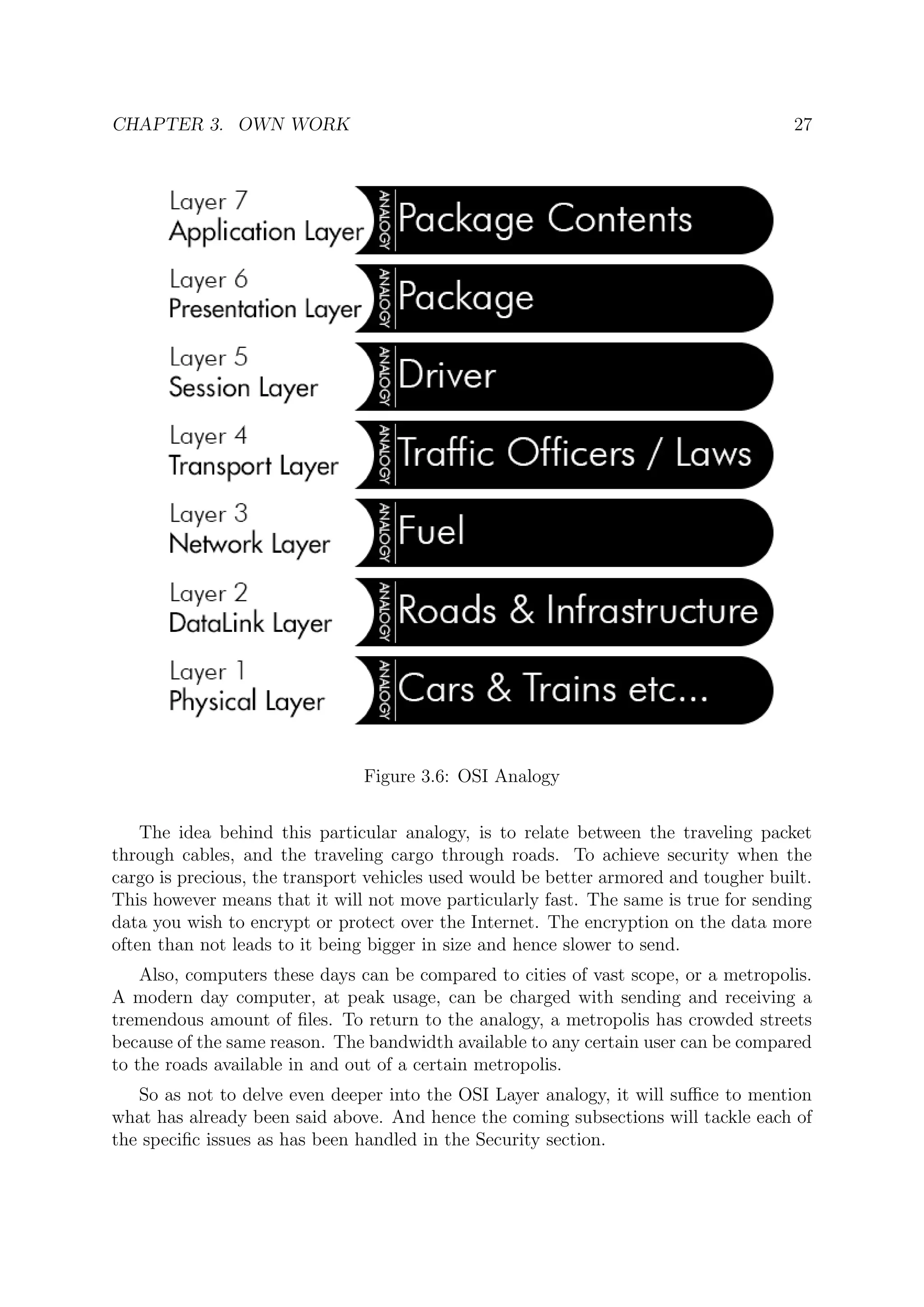
To return to real world analogies an argument can be made to relate between packets
traveling in coaxial Ethernet cables, and people traveling around the roads. Bringing this
argument to its bare bones, transportation is in essence an layer on which communication
was built. In order to get a message across , there must first be a way to get this message
across. A look back at the OSI models layers would provide further insight.
CHAPTER 3. OWN WORK 27
Figure 3.6: OSI Analogy
The idea behind this particular analogy, is to relate between the traveling packet
through cables, and the traveling cargo through roads. To achieve security when the
cargo is precious, the transport vehicles used would be better armored and tougher built.
This however means that it will not move particularly fast. The same is true for sending
data you wish to encrypt or protect over the Internet. The encryption on the data more
often than not leads to it being bigger in size and hence slower to send.
Also, computers these days can be compared to cities of vast scope, or a metropolis.
A modern day computer, at peak usage, can be charged with sending and receiving a
tremendous amount of files. To return to the analogy, a metropolis has crowded streets
because of the same reason. The bandwidth available to any certain user can be compared
to the roads available in and out of a certain metropolis.
So as not to delve even deeper into the OSI Layer analogy, it will suffice to mention
what has already been said above. And hence the coming subsections will tackle each of
the specific issues as has been handled in the Security section.
CHAPTER 3. OWN WORK 28
3.2.1 Bandwidth
Origin
This particular issue stems from the amount of other activities using up the bandwidth
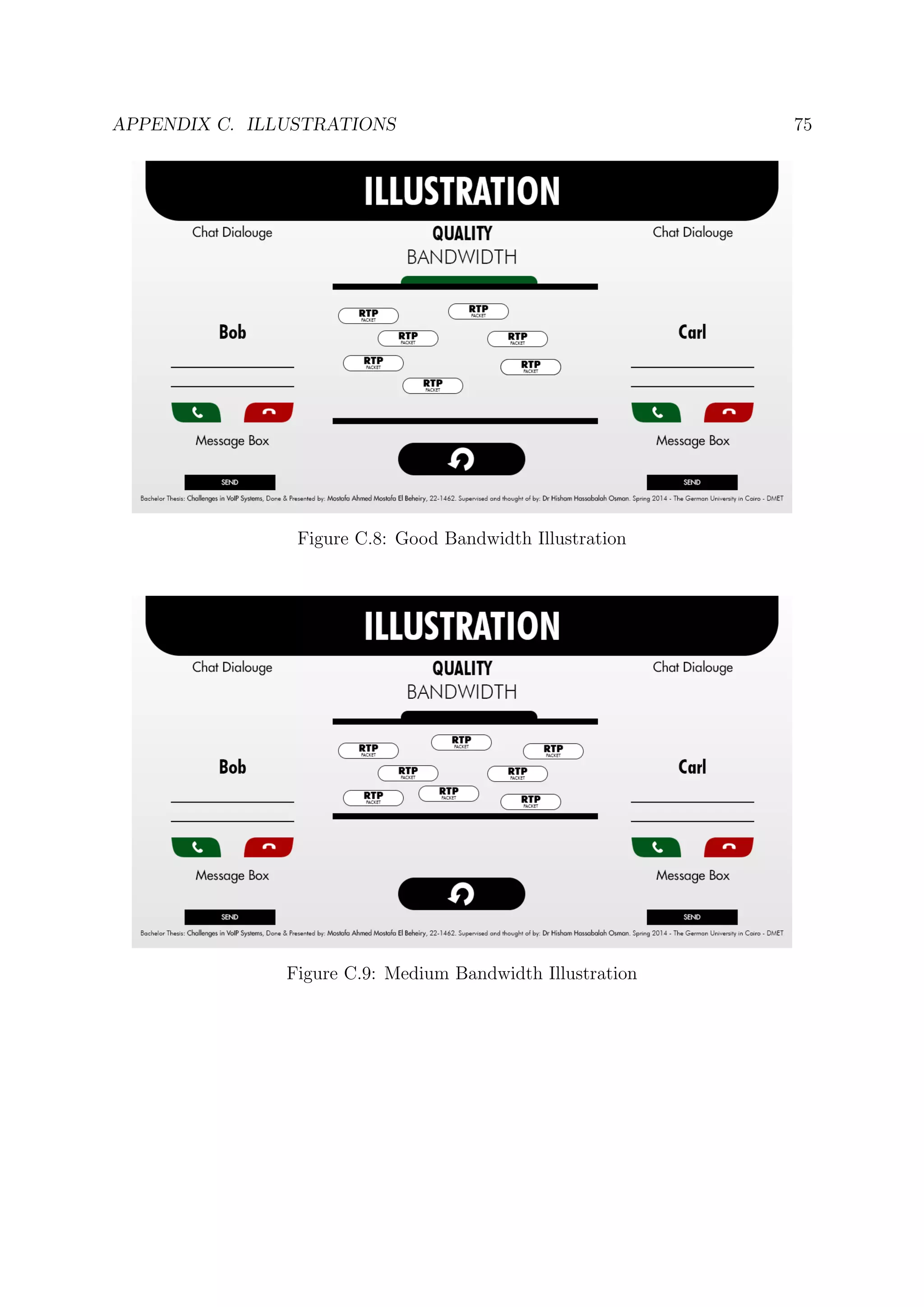
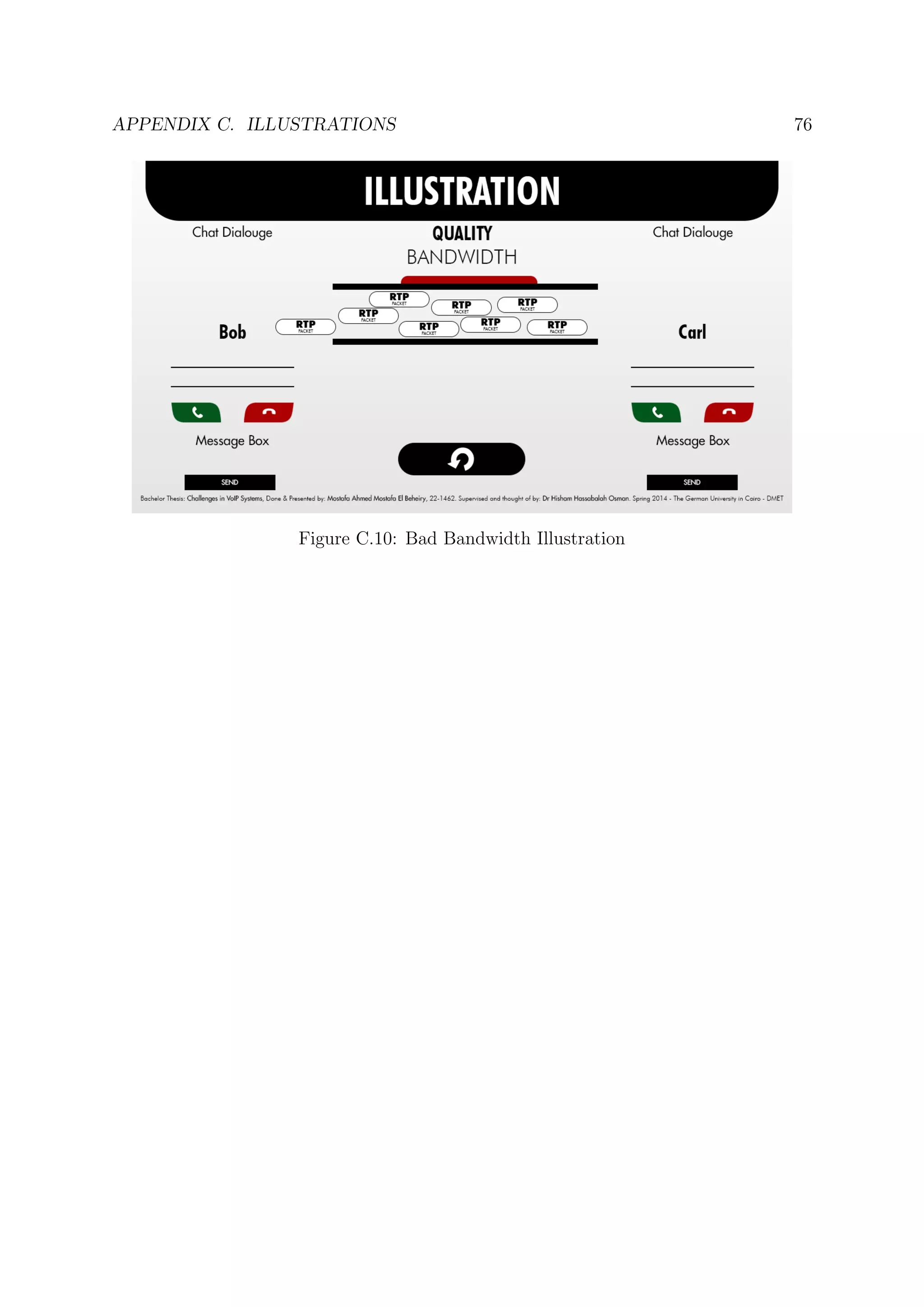
available, along with the large bandwidth required to properly set up a VoIP call.
For instance, a soft-phone using any of SIP, H.323 or MGCP along with RTP sends
a single voice packet every 10 to 40 ms. This can be either compressed, uncompressed or
encrypted. RTP will send the same number of packets regardless. It can take anywhere
from ten to a hundred packets to carry a single word using this standard system in the
best of cases, so the need for bigger bandwidth becomes more apparent.
Fundamentally the delay from end to end needs to remain as low and little as possible
for the quality to remain at an adequate level. As the size of the packet decreases the time
it takes to create and send it go down proportionally to it. Yet the need for bandwidth
relates with inverse proportionality to the size of the packet. The smaller the packet, the
more packets are sent, and the bigger the packet overhead becomes.
The issue with long packets however is that they are being sent over UDP, meaning
that if a packet is lost it will not be easily fixed.
On average, a packet will be sent each 20-30ms, depending on the implementation in
question, meaning that in a single second a total of about 50 packets are sent, and as
mentioned in section 2.2.1, the digitized voice field can carry up to 320 bytes of voice.
Meaning that for 50 packets per second a total of 16 KB are being sent in the digitized
voice field alone.
Impact
” In reality, there is no Voice over IP. It is really voice over RTP, over UDP, over IP
and usually over Ethernet. The headers and trailers are required fields for the networks
to carry the packets. The header and trailer overhead can be called the shipping and
handling cost.
Keeping this in mind, a few calculations and numbers should be considered. The RTP,
UDP, IP headers add 40 bytes to the digitized voice mentioned, the Ethernet trailer and
header contribute with 18 bytes overhead. A total of 58 bytes of overhead are generated
outside of any voice bytes in the packet, this can account for 80 to 20 percent of the
bandwidth used in a VoIP call. This is in a single packet, and this shows how inefficient
shorter packets are in contrast to longer ones. And this is all before any encryption is
added. [1]
From the above discussion we can conclude that the bandwidth consumption of a VoIP
call relies on, Compression Techniques used, Packet Overheads, and Network Protocol
used.
CHAPTER 3. OWN WORK 29
Solvability
An issue such as this has indeed attained a significant amount of attention and for the
most part can be considered solvable, with various applicable solutions.
The first of which would be compressing voice in the RTP packets, which in the end
makes up the majority of the bandwidth usage. Which is how Codecs came by, and will
be discussed in depth in the coming section.
However compressing voice comes at a price and creates an interesting trade off which
needs to be taken into consideration. The lower the size of the file the easier it is to
send and the smaller the delay, however compression in essence usually involves a loss of
data. Hence in order to better the quality of a call for a low bandwidth link, it could
be that the quality is being brought down in terms of the actual call itself. Also, while
compression decreases the delay in sending the packet it does create a sort of processing
delay to compress the packet in the first place.
Strategies on choosing a certain codec will be discussed in the coming section, this
section could be considered as an introductory section to the coming one, or the coming
a supplementary section to this[1].
Figure 3.7: Bandwidth Calculation
Another way to manage this issue, is to allocate bandwidth where possible to VoIP
calls alone. This can be attained by calculating the bandwidth needed by the system and
reserving this amount exclusively for the VoIP calls.
CHAPTER 3. OWN WORK 30
3.2.2 Codecs
Not all the roads in the world are the same, some are paved well and can allow for any
type of vehicle to pass over them. Some are rougher and require tougher more durable
vehicles to navigate, and some are dirt roads that require lighter vehicles to traverse.
It then falls to reason that the different the road, the different the experience of
navigating it. The same is true to Internet connections. A dial-up connection cannot
be expected to offer the same level of quality that an Asymmetric digital subscriber
line (ADSL) or Cable connection offers. This will be further discussed in a later section,
but for now the issue at hand is accommodating for these variable bandwidths.
Origin
Since the first telephone calls were being made, the American Public Switched Tele-
phoneNetwork (PSTN) had built a network underground of a copper cable pair per ac-
tive call. This solution however was deemed not good enough when the areas they were
using became saturated with cables. In the 1950s however a technique was created by
the American ATnT communications company which allowed for a single copper wire to
hold more than a single call, by digitizing the previously analog speech they managed to
achieve 24 calls per pair of copper wire, this was the earliest form of compressing speech.
Voice compression carried on to influence even digital cell calls which were at the time
operating at 8 64 Kbps, and while it is not regularly applied to LAN connections, this
showcases how compression can be useful at any range, hence CODECs were created to
choose based on the bandwidth available, the appropriate compression.
Impact
The word CODEC, comes from the essential parts on compressing a speech signal, which
are: COding, and DECoding. The impact of CODECs has been discussed extensively in
the previous section and in order to avoid repetition will only be briefly mentioned here.
The issue at hand however is not what a CODEC is, it is concerned with choosing
the proper CODEC for a certain VoIP System. As mentioned this depends primarily on
the bandwidth in hand, and how it influences the system is illustrated in figure 3.8.
CHAPTER 3. OWN WORK 31
Figure 3.8: Codec Influence
Solvability
As is mentioned in the Bandwidth section, given the bandwidth available along with the
available codecs, a good VoIP System can dynamically change the codec to use for each
call.
For instance, if the network is congested at peak time, a lower quality codec should
be used to compensate for the lack of available bandwidth, and on the other hand, during
low periods a higher quality codec could be used.
The following are the four most popular codecs [1] along with an analysis of each,
the last table will showcase the codecs Cisco use along with a table provided from their
website and official docs.
G.711, the industry standard which digitizes voice, with no encryption at 64 Kbps.
G.722, as with G.711 it operates at the same 64 Kbps, but offers much higher quality
speech by delivering analog sound range of 7kHz as opposed to the 3.4kHz by its
G.711 counterpart.
G.723.1, reduces bandwidth consumption greatly but the speech is noticeably poorer than
its counterparts. It runs at 6.3 5.3 Kbps.
G.729, compresses at 8 Kbps, with a quality that falls just short of G.711.
Quick suggestions would refer G.722 for the best links, G.729 for the moderate ones,
and G.723.1 for the worst of links.
CHAPTER 3. OWN WORK 32
A more detailed look can be had at the other available codecs from figure 3.9 taken
from Cisco [3].
Figure 3.9: Codecs
CHAPTER 3. OWN WORK 33
3.2.3 Queueing
Traffic lights exist in the digital world as much as they do in the real world, a big part of
QoS is prioritizing which traffic moves on and which is delayed based on its classification
or characteristics.
Origin
When dealing with traffic in the real world, very little distinguishment is made, leading
to important cargo being put behind lesser important ones when being processed due to
the nature of how things work.
However in the digital world, there is a way to classify packets based on their priority,
based on how fast they need to be dealt with. The issue at hand is congestion, with the
various forms of traffic on any given system at any given time, any VoIP System will be
faced with the issue of Congestion.
Impact
Simply put, if handled in an improper fashion, congestion will lead to huge amounts of
lag inside calls, without proper prioritizing for the packets carrying the voice a proper
call would never take place.
Solvability
To solve the issue of congestion and to ensure that the higher priority packets be dealt with
immediately, a series of Queueing Systems were established. This section will highlight
four queuing systems, and their role in VoIP Systems [12].
First In First Out (FIFO), is the first, easiest, and most inefficient method. In reality
it is not a real queueing system, it simply transmits by order of arrival.
Priority Queuing (PQ), this method assigns four different priorities for each packet
based on its classification, ranging from High, Medium, Normal, and to Low. Simply
put, when packets are received those in the High Queue are transmitted before those in
medium, and then those in normal and finally those in low. The fundamental flaw in this
system is that the Low Priority Queue might never be handled if there is an influx of the
higher priorities.
Custom Queueing (CQ), sixteen queues are offered with this method and as with PQ
the packets are assigned to these queues based on classification. It operates in a round
robin and its goal was to stop protocol starvation, this method does however introduce a
large amount of overhead and can prove to be detrimental.
Weighted Fair Queueing (WFQ), dynamically assigns bandwidth to the traffic reliant
on the weight or IP Precedence Value within the IP headers. This method however may
CHAPTER 3. OWN WORK 34
stop high priority packets from being sent since it dynamically assigns bandwidth, and
hence could make for an undesirable latency.
Out of these queuing methods none fit the needs of a VoIP System, and hence mixing
and merging between these methods to create a Hybrid fit for a VoIP System is the best
approach to handle congestion.
CHAPTER 3. OWN WORK 35
3.2.4 Low Speed Links
Catering for lower speed links can be difficult, but what exactly is defined as a low speed
link? The speeds considered by modern day researches to be slow links range from 56
kbps, to 2 Mbps. And hence special care should be given to those links.
Origin
Bandwidth in developing countries, or indeed any bandwidth that passes through un-
derwater cables, is very expensive to attain. Taking into consideration the weak infras-
tructure, poverty rates, and general quality of life in these countries would lead to the
conclusion that a well set up person would most likely actively work under a low speed
link.
Impact
What this means however, is that there is little and less bandwidth to provide for whatever
work is being done alongside a VoIP Call, which takes high priority in its share for
bandwidth.
This means that not all the VoIP Quality Assurance Parameters are satisfied, delays
could increase the 150ms barrier, jitter extends the 25ms margin, and packet loss exceeds
the maximum allowed.
Solvability
Researches have shown that the methods mentioned in this paper can be enough to deal
with these types of links. [13]
More advanced Queuing Algorithms such as Weighted Random Early Detect (WRED)
and Low Latency Queing (LLQ), have been proposed as possible solutions.
Mixed with various selection of codecs, and through testing of these various Queuing
methods these results were attained.
For the speeds between 2Mbps and 128kbs, WFQ showed prominence, along with
G.711, while the G.728 has shown good performance for all speeds but will be excluded
on account of its much lower quality. For the lower links however no form of satisfiable
QoS was obtained after applying the various queuing algorithms and the lowest OS codecs.
Researches however still favor the G.723.1 codec as a highly recommended to use codec
for future use. The research also showed that the main culprit of QoS Degradation in
low speed links was jitter.
CHAPTER 3. OWN WORK 36
3.3 Dependency
One of the prominent challenges that face VoIP Systems outside of the actual imple-
mentation of the actual systems, were the basic limitations which VoIP Systems need to
function.
In this section, a discussion on VoIP Systems reliance on power will be held, alongside
a comparison between VoIP Systems reliance on the Internet, and telephones to the cable.
Various solutions will be discussed for one of the two issues, and general discussion will
be held over the other.
3.3.1 Power Dependency
Computers are not designed to run without power, they are in essence, machines which
handle electric signals in the basic binary form. And so it did not occur to the leading
developers of VoIP Phones that they would need to establish a method to avoid using
power cables for their Phone sets.
Origin
The very first phones were not developed with smart power consumption or power source
choosing in mind, and hence as will all computer related appliances they came with a
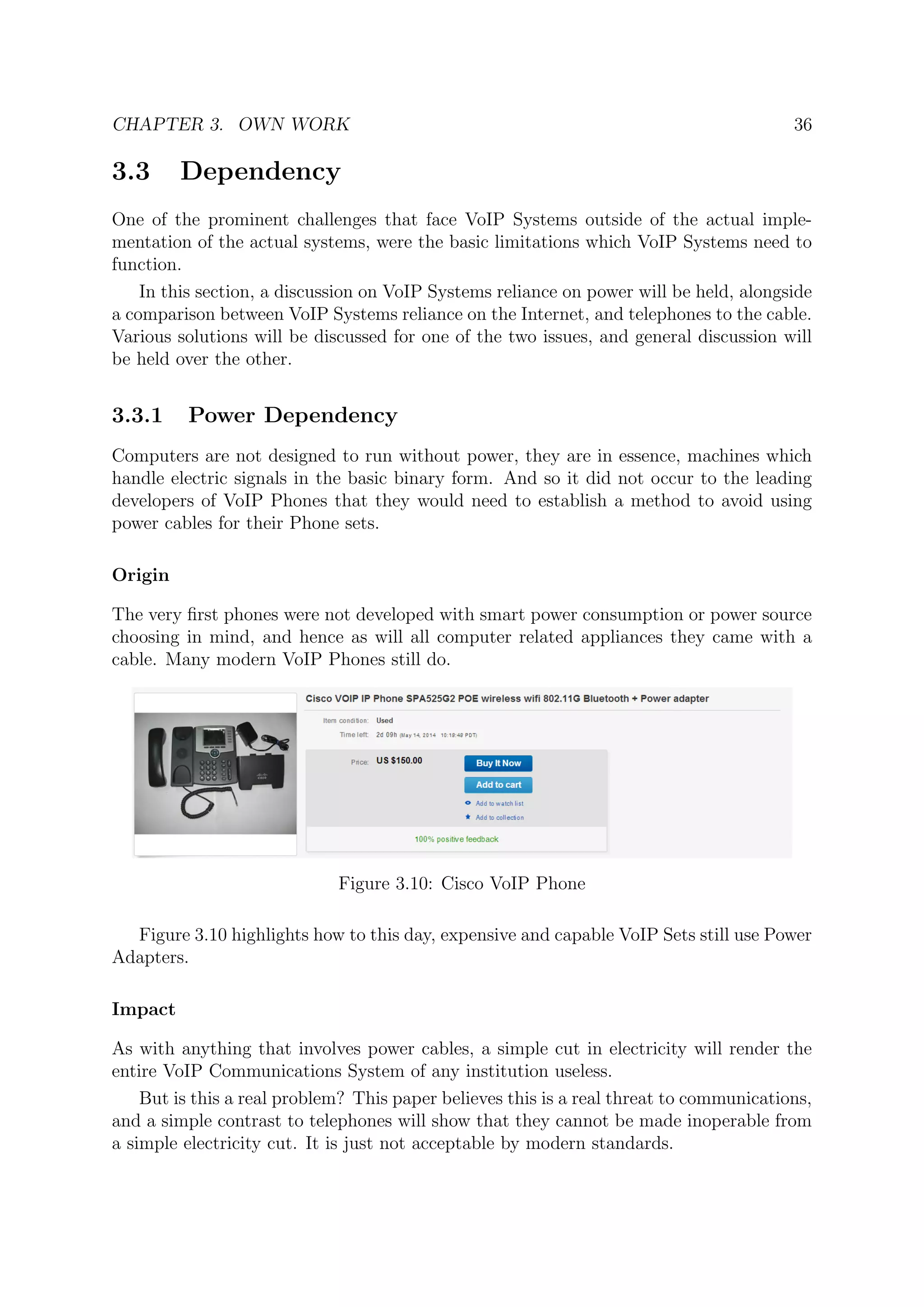
cable. Many modern VoIP Phones still do.
Figure 3.10: Cisco VoIP Phone
Figure 3.10 highlights how to this day, expensive and capable VoIP Sets still use Power
Adapters.
Impact
As with anything that involves power cables, a simple cut in electricity will render the
entire VoIP Communications System of any institution useless.
But is this a real problem? This paper believes this is a real threat to communications,
and a simple contrast to telephones will show that they cannot be made inoperable from
a simple electricity cut. It is just not acceptable by modern standards.
CHAPTER 3. OWN WORK 37
Solvability
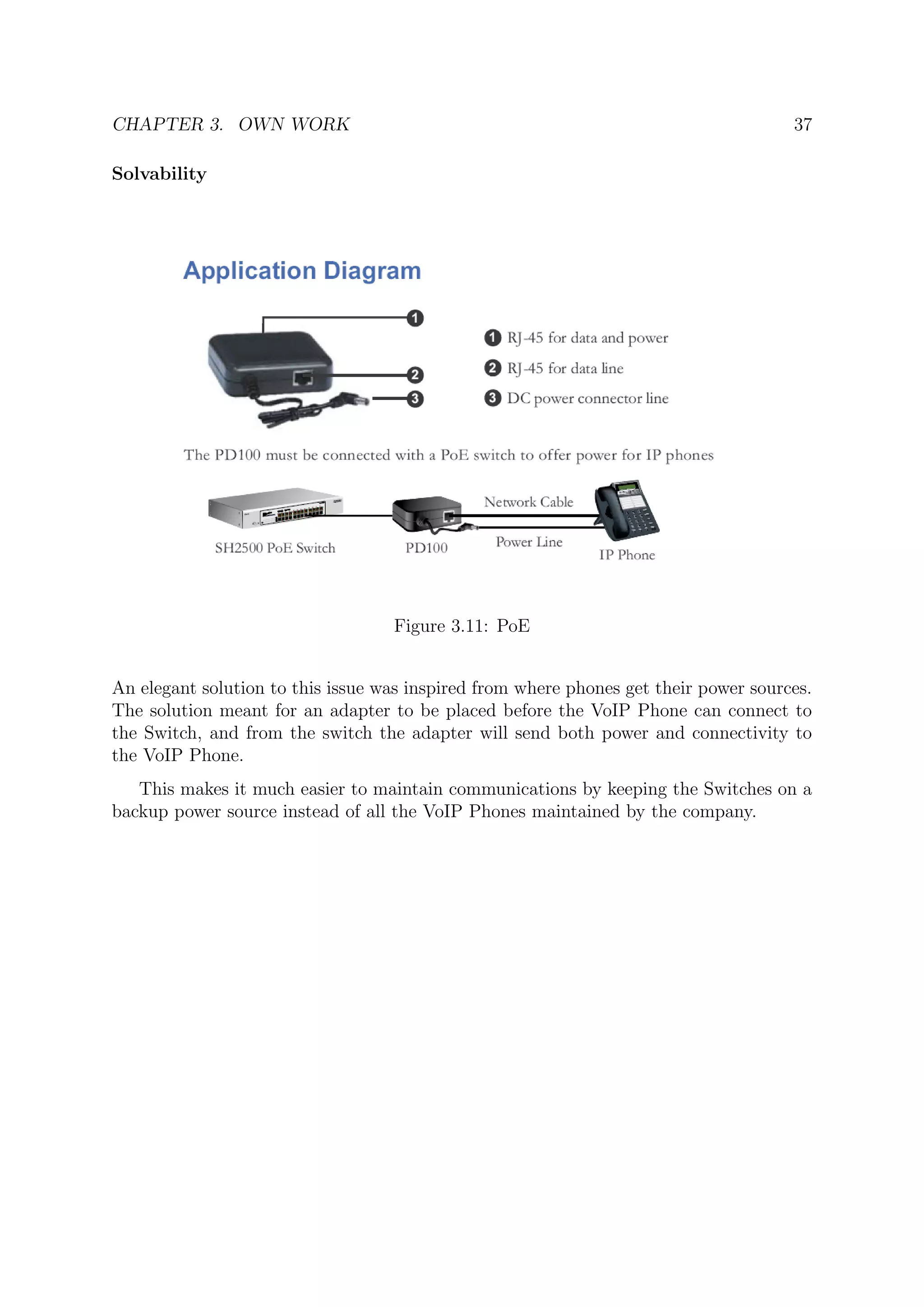
Figure 3.11: PoE
An elegant solution to this issue was inspired from where phones get their power sources.
The solution meant for an adapter to be placed before the VoIP Phone can connect to
the Switch, and from the switch the adapter will send both power and connectivity to
the VoIP Phone.
This makes it much easier to maintain communications by keeping the Switches on a
backup power source instead of all the VoIP Phones maintained by the company.
CHAPTER 3. OWN WORK 38
3.3.2 Internet Dependacy
There is not much that should be discussed in this matter, but it is important to bring
up none the less.
As with regular phones which are dependant on their connection to the PSTN, VoIP
Phones are dependant on their connection to whatever outlet they should be connected
to. Whether it be a WAN connection, or a Local one, should the connection be severed
the VoIP System will be rendered inoperable.
CHAPTER 3. OWN WORK 39
3.4 Emergency
The last of the glaring challenges this work focused on, but by all means not the last
challenge facing VoIP in general.
”The ability to access emergency services by dialing 911 is a vital component of public
safety and emergency preparedness. It is imperative that consumers of telephone service
be able to reach emergency services regardless of the technology used to place a 911 call.”
[7]
This is a statement issued on the Federal Communications Commission (FCC)s own
website, which is responsible for moderating the standards of communications in the
United States of America.
Origin
As with the power dependency issue, VoIP Systems were initially created as a way to
have vocal exchanges over the Internet or over LAN. It was not initially developed with
the mindset of defeating PSTN Telephones.
People simply aspire to use the most cost efficient methods possible to them, and
hence VoIP Systems were brought into contention with PSTN Telephones.
The way 911 calls operate is solely through the PSTN, and so it would seem that
all LAN VoIP Systems would not have the remote ability to contact 911, or even VoIP
Systems in general.
Other than this, traditional phones have a specific phone number linked to a specific
fixed address, and so upon reaching 911 Emergency Call, the location is quickly identified
and aid can be quickly offered.
However in VoIP Systems a single user can connect from virtually anywhere if the
service allows it, whether it be from home or in office. This portability raises many
challenges for VoIP Systems in regard to emergency calls.
Impact
Needless to discuss, the impact of not being able to contact 911 is great by will vary. For
instance in the office where there probably is a normal telephone in the vicinity it will
not be as big an issue as in a corporate building which focuses its communications soley
on VoIP.
Aside from the impact in reality, this issue is a defying block between VoIP Systems
chance at eclipsing PSTN phones. And so in order for VoIP Systems to progress and
develop in the mainstream consumer market a solution will need to be put into action.
CHAPTER 3. OWN WORK 40
Solvability
People who saw potential in the current VoIP Market did not sit idly by as this hinderance
affected VoIPs development. Other people saw opportunity in this situation and created
VoIP Emergency Services.
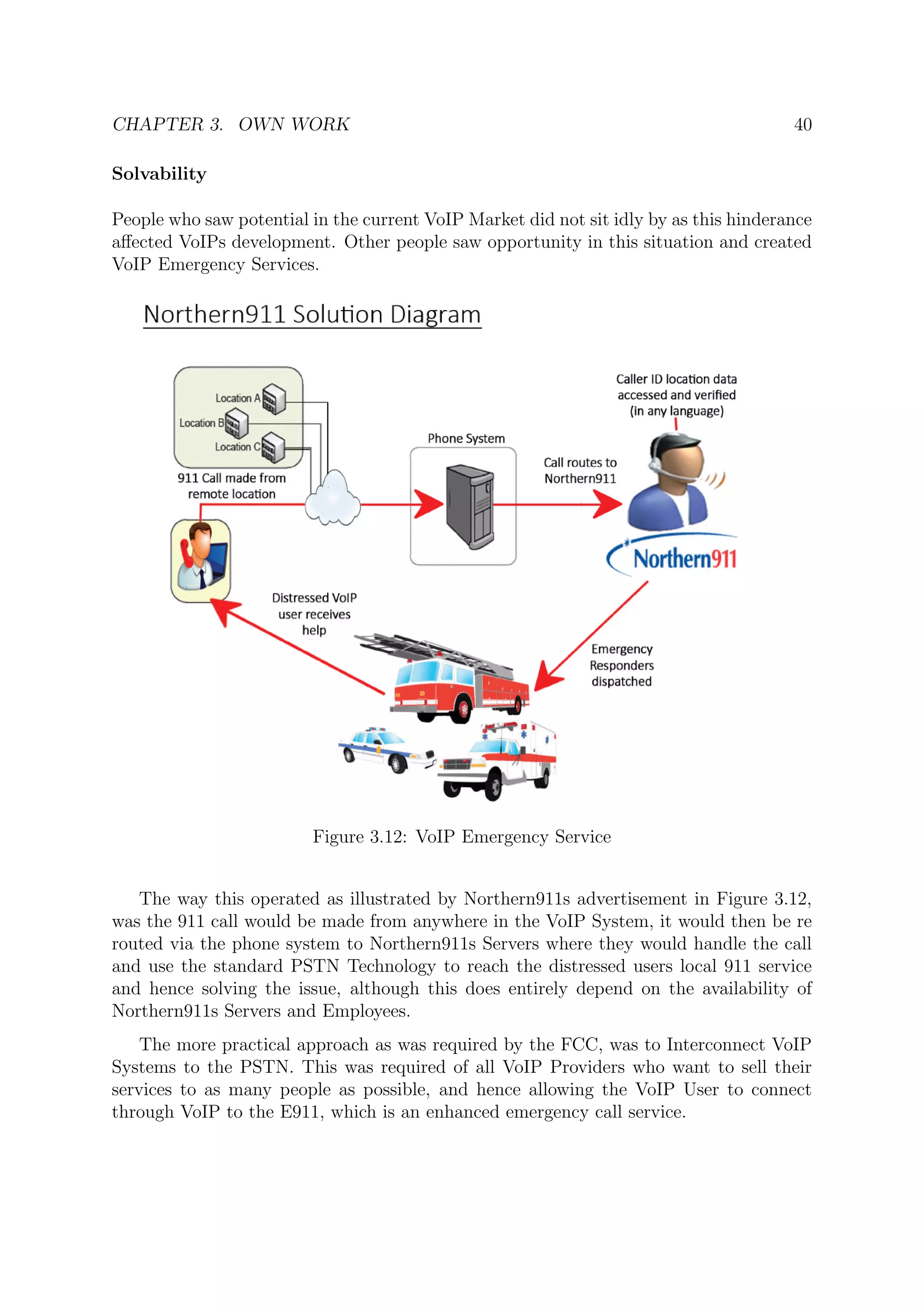
Figure 3.12: VoIP Emergency Service
The way this operated as illustrated by Northern911s advertisement in Figure 3.12,
was the 911 call would be made from anywhere in the VoIP System, it would then be re
routed via the phone system to Northern911s Servers where they would handle the call
and use the standard PSTN Technology to reach the distressed users local 911 service
and hence solving the issue, although this does entirely depend on the availability of
Northern911s Servers and Employees.
The more practical approach as was required by the FCC, was to Interconnect VoIP
Systems to the PSTN. This was required of all VoIP Providers who want to sell their
services to as many people as possible, and hence allowing the VoIP User to connect
through VoIP to the E911, which is an enhanced emergency call service.
Chapter 4
SPIT Simulation
In order to not restrain this work to theoretics, and to further elaborate on the issues
raised by this work. Collaboration with Ahmed Khaled Saad Metwally took place, in
which this work and his merged for mutual benefit.[11]
A Running VoIP System was needed in order to present the chosen topic, which
in order to present at peak capacity needed to be restrained to a single topic, as was
suggested.
For the topic, SPIT Attacks were chosen, since it is a good basis for future work, and
can be underestimated by the majority of people. A demonstration in the true power of
SPIT even on a local scale should reveal the fact that it is a real threat that will rear its
face with the spread of VoIP Systems.
To find a suitable VoIP System, which had an open source code that was under-
standable and easy to manipulate would prove to be difficult, after much research the
conclusion to collaborate and use Ahmed Khaled’s VoIP System using Java would be the
safest and best option available. After having already build the client, the collaboration
took place when connecting it to a server, particularly the setup of a server.
While this may be slightly irrelevant to the SPIT Attack, the process should still be
mentioned and documented.
4.1 Server
Finding a suitable VoIP Proxy Server which did not act as a Private Branch Exchange
(PBX) took time to locate and install. Bearing in mind that the only Linux distributions
available at the time was Ubuntu, which was run over Oracle’s Virtual Machine. Hence
the only choice with which there was sufficient experience was Windows.
41
CHAPTER 4. SPIT SIMULATION 42
4.1.1 Failed Attempts
At first, servers such as Asterisk and 3CX were tried out, but after many compatibility
issues with Windows 8 for 3CX, and after Asterisk began showing promising signs, these
two servers turned out to be PBXes and not Proxy Servers as was required.
Kamailio and reSIProcate were the two next server to be tested, but they simply did
not run under the available Linux distribution, after attempting install Kamailio from the
Ubuntu Application Manager, as well as manual installation to compilation from source
code, Kamailio and reSIProcate proved to be too difficult to set up, which contradicts
their advertisement of being easy and fast to set up.
Going back to Windows based servers, OfficeSIP was first tested but the response
codes seemed to be off and so was abandoned prematurely. A variety of SIP Servers
came after, partySIP, MSS, simpleSIP. All of which behaved and reacted in ways that
directly opposed the RFC. And hence our work saw a return to OfficeSIP as a last gasp
effort before writing a customized server.
CHAPTER 4. SPIT SIMULATION 43
4.1.2 OfficeSIP
Figure 4.1: OfficeSIP GUI
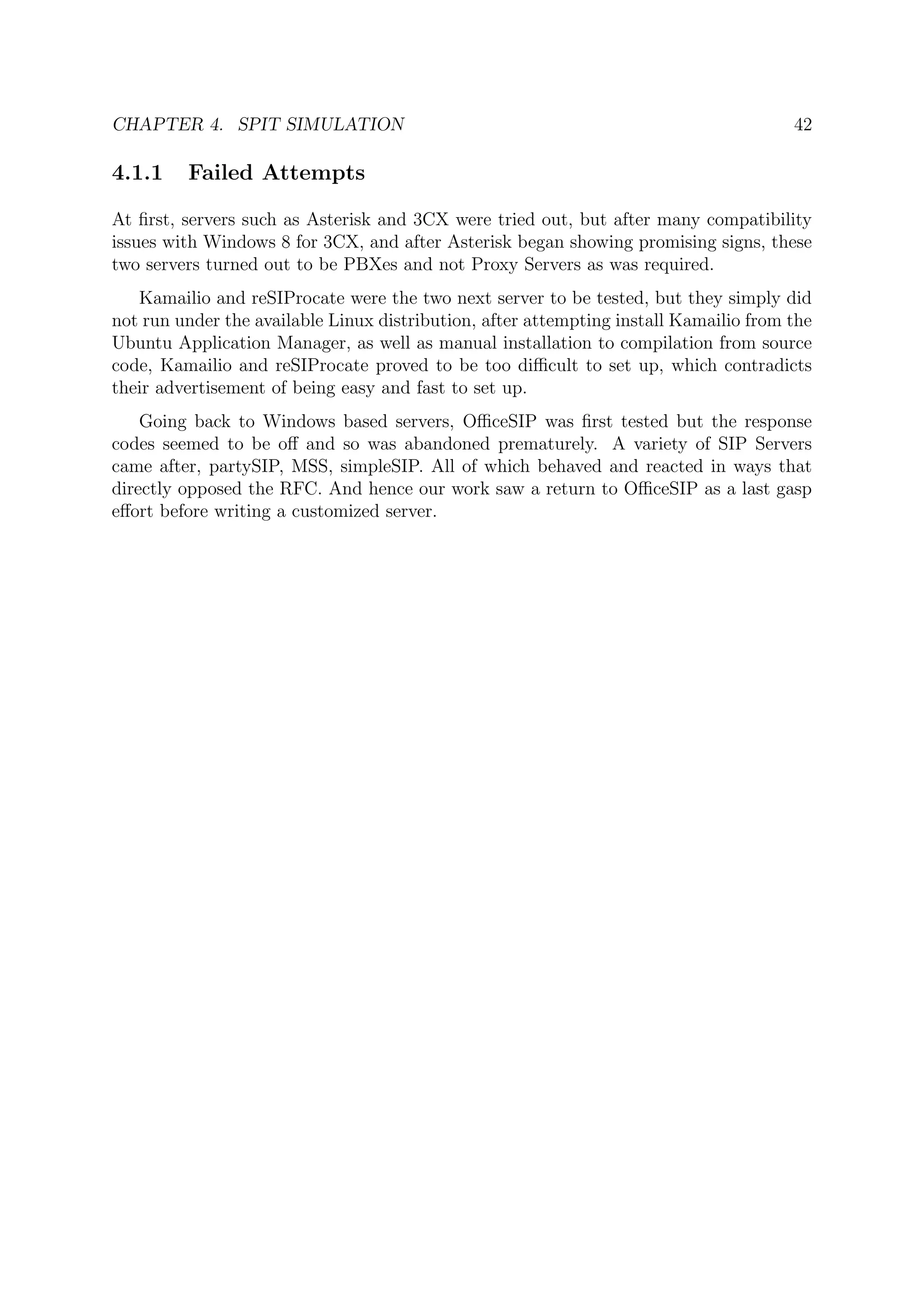
Finally the OfficeSIP Server functioned as intended, it served as a Registrar and Proxy,
it saved up to a hundred users, and operated with accordance to the RFC. After creation
of user accounts on the server, and testing their connectivity to the client, results proved
to be satisfactory and the server was finally selected.
CHAPTER 4. SPIT SIMULATION 44
4.2 Client
Ahmed Khaled’s Client, is a Java based SIP Client as this was the objective of his own
thesis. To help out, the GUI was created in collaboration. The following figures will
showcase the GUI created for the client along with its capabilities.
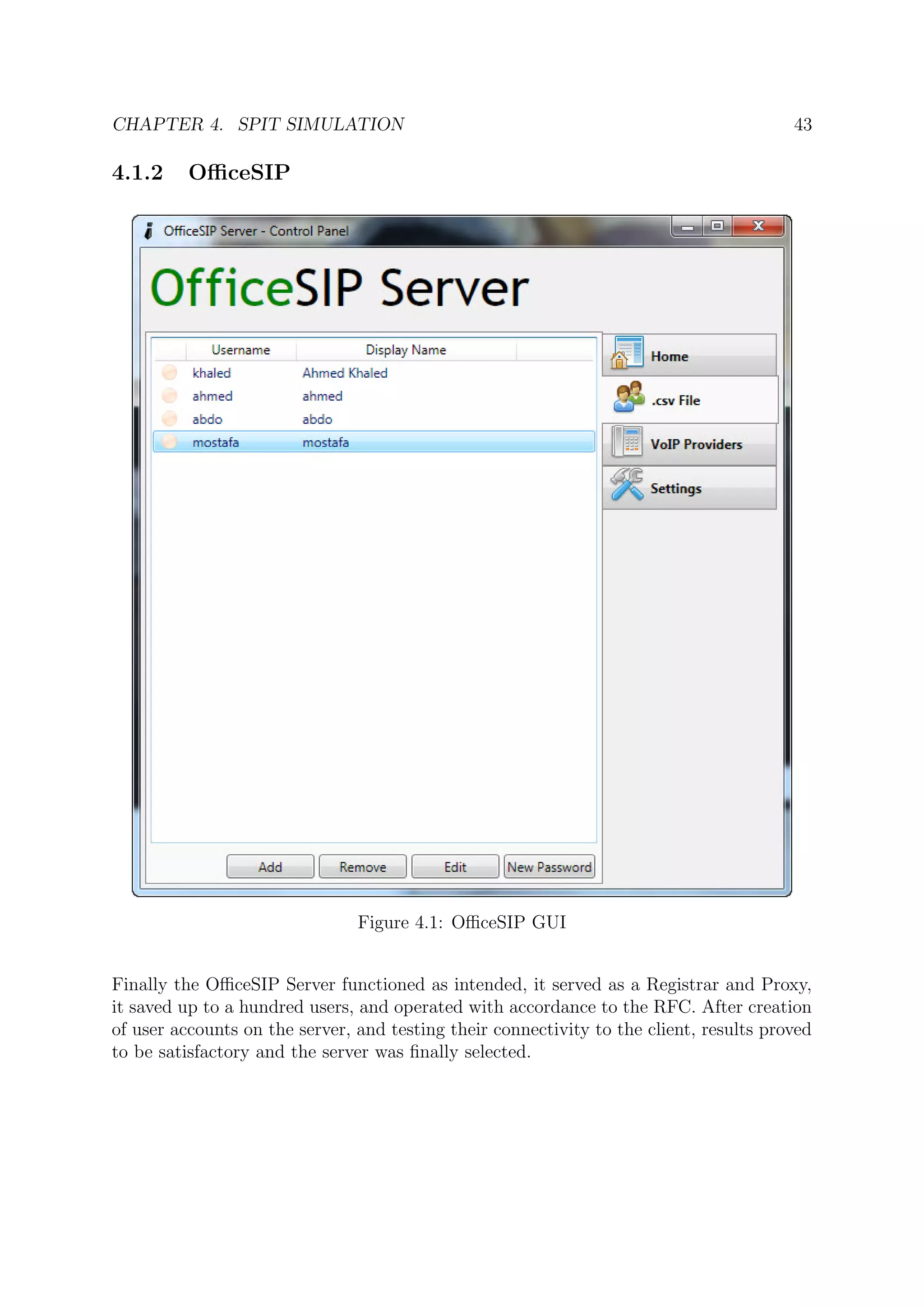
Figure 4.2: Client Login Screen
In order to connect to the OfficeSIP server, a username needs to be created first on
the OfficeSIP server. Hence, the client login screen takes the Server IP Address along
with a username and a password. It then sends a registration request to the server with
this data (after the authentication process), and connects to the server if a user with the
given name and password is given.
CHAPTER 4. SPIT SIMULATION 45
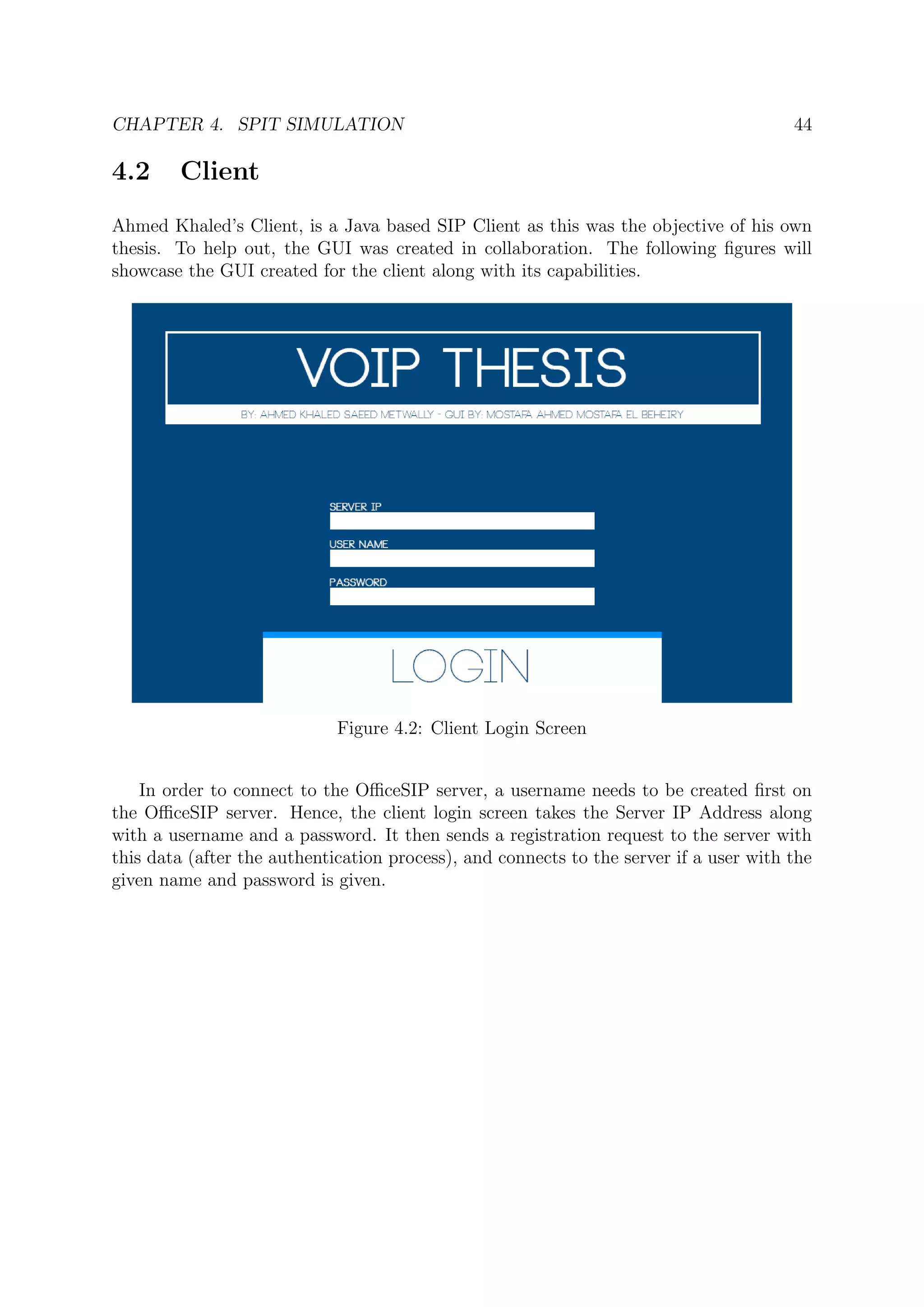
A Couple of scenarios could lead to a return to the login screen and failure to connect.
A wrong username or password will return a notification to the user of the issue, if the
server itself is not available the application will time out and notify the user of the issue
as well.
Figure 4.3: Client Login Screen - Connecting
CHAPTER 4. SPIT SIMULATION 46
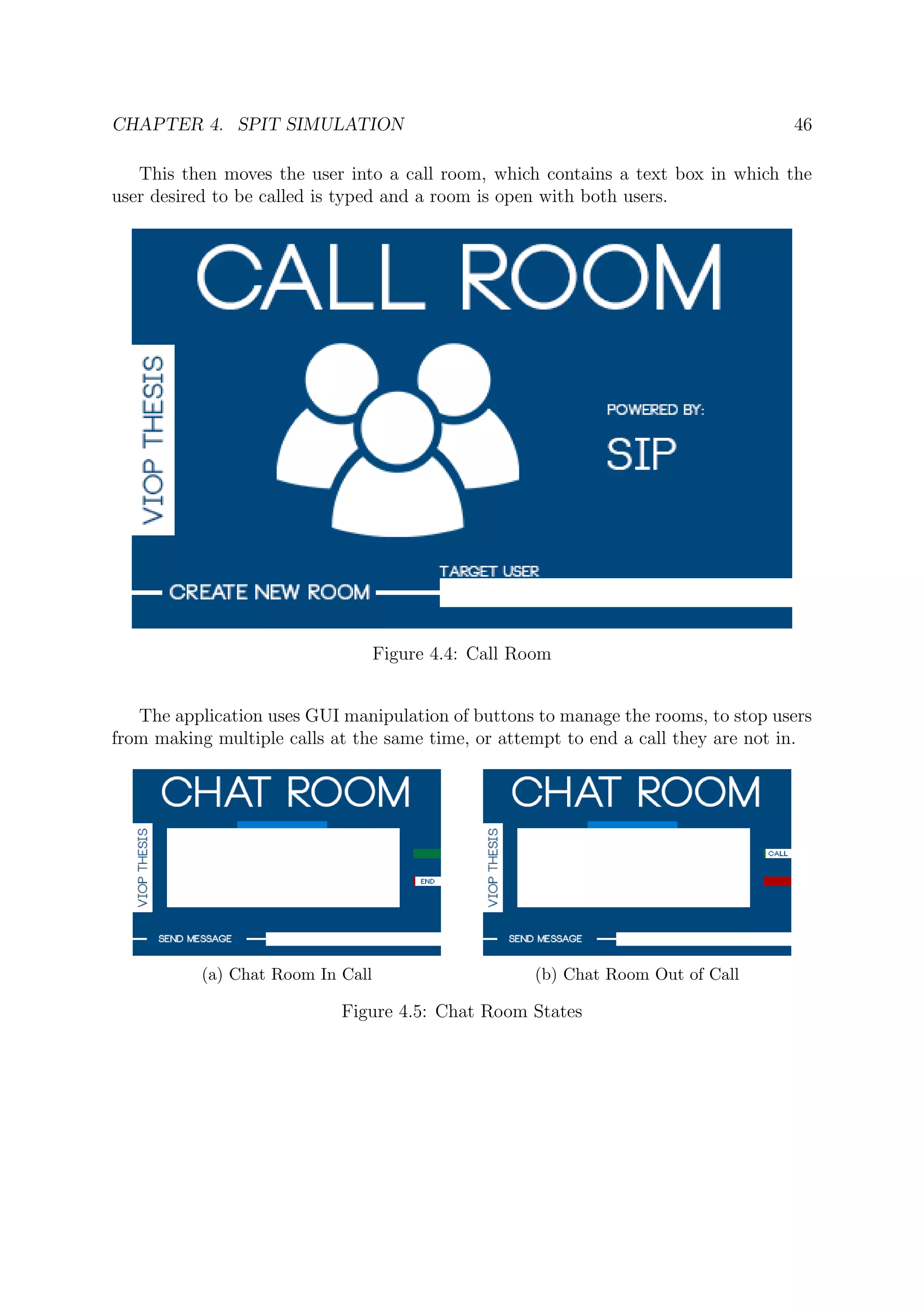
This then moves the user into a call room, which contains a text box in which the
user desired to be called is typed and a room is open with both users.
Figure 4.4: Call Room
The application uses GUI manipulation of buttons to manage the rooms, to stop users
from making multiple calls at the same time, or attempt to end a call they are not in.
(a) Chat Room In Call (b) Chat Room Out of Call
Figure 4.5: Chat Room States
CHAPTER 4. SPIT SIMULATION 47
4.3 Modifications
4.3.1 GUI
In the interest of not needing to include a multitude of Figures to showcase the modded
client, only the important parts or differences between the Vanilla client and the modded
one will be discussed.
The aim of this modded client, is simply to be used when presenting the work, and
to show that SPIT is a real issue where VoIP Systems are concerned.
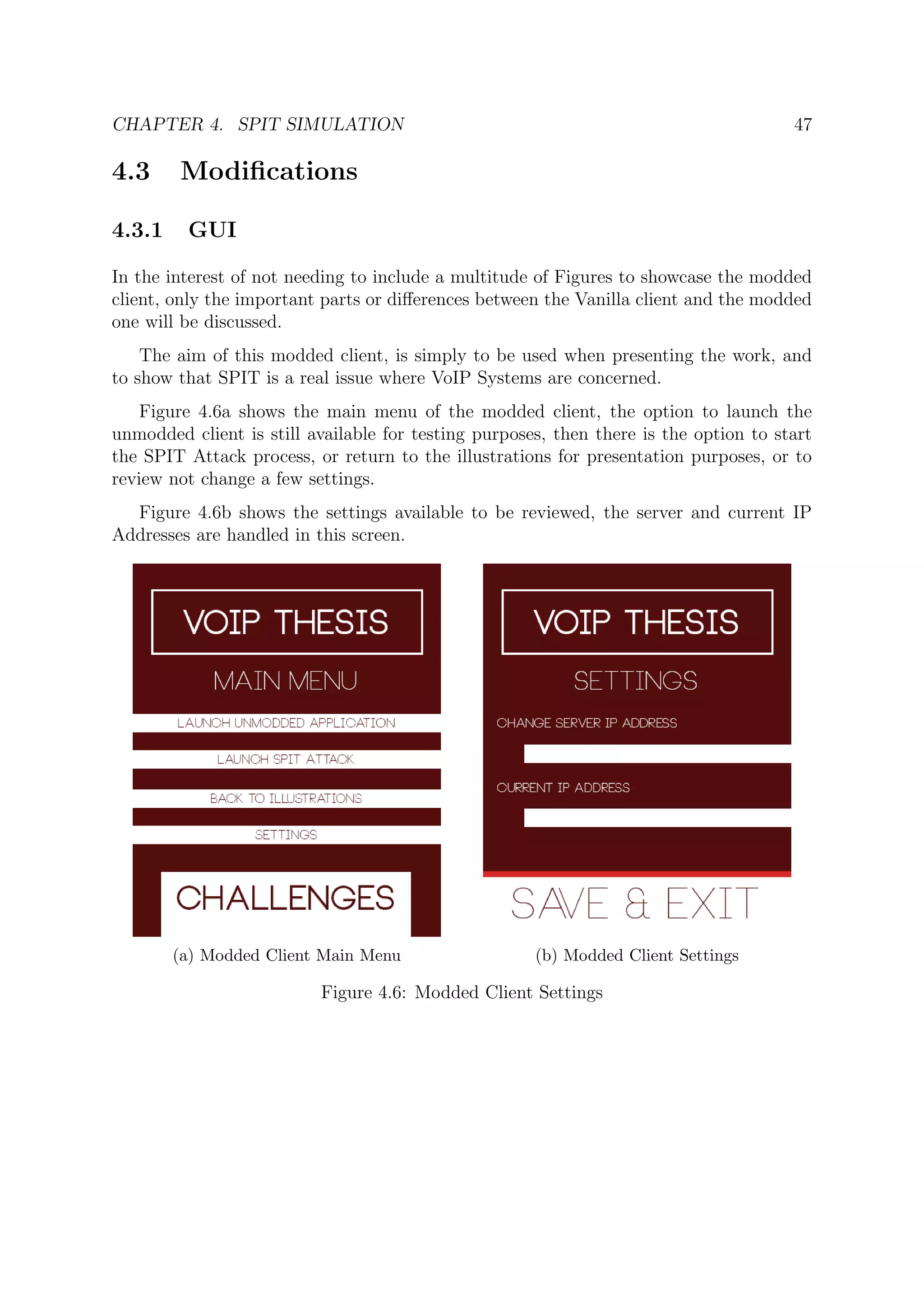
Figure 4.6a shows the main menu of the modded client, the option to launch the
unmodded client is still available for testing purposes, then there is the option to start
the SPIT Attack process, or return to the illustrations for presentation purposes, or to
review not change a few settings.
Figure 4.6b shows the settings available to be reviewed, the server and current IP
Addresses are handled in this screen.
(a) Modded Client Main Menu (b) Modded Client Settings
Figure 4.6: Modded Client Settings
CHAPTER 4. SPIT SIMULATION 48
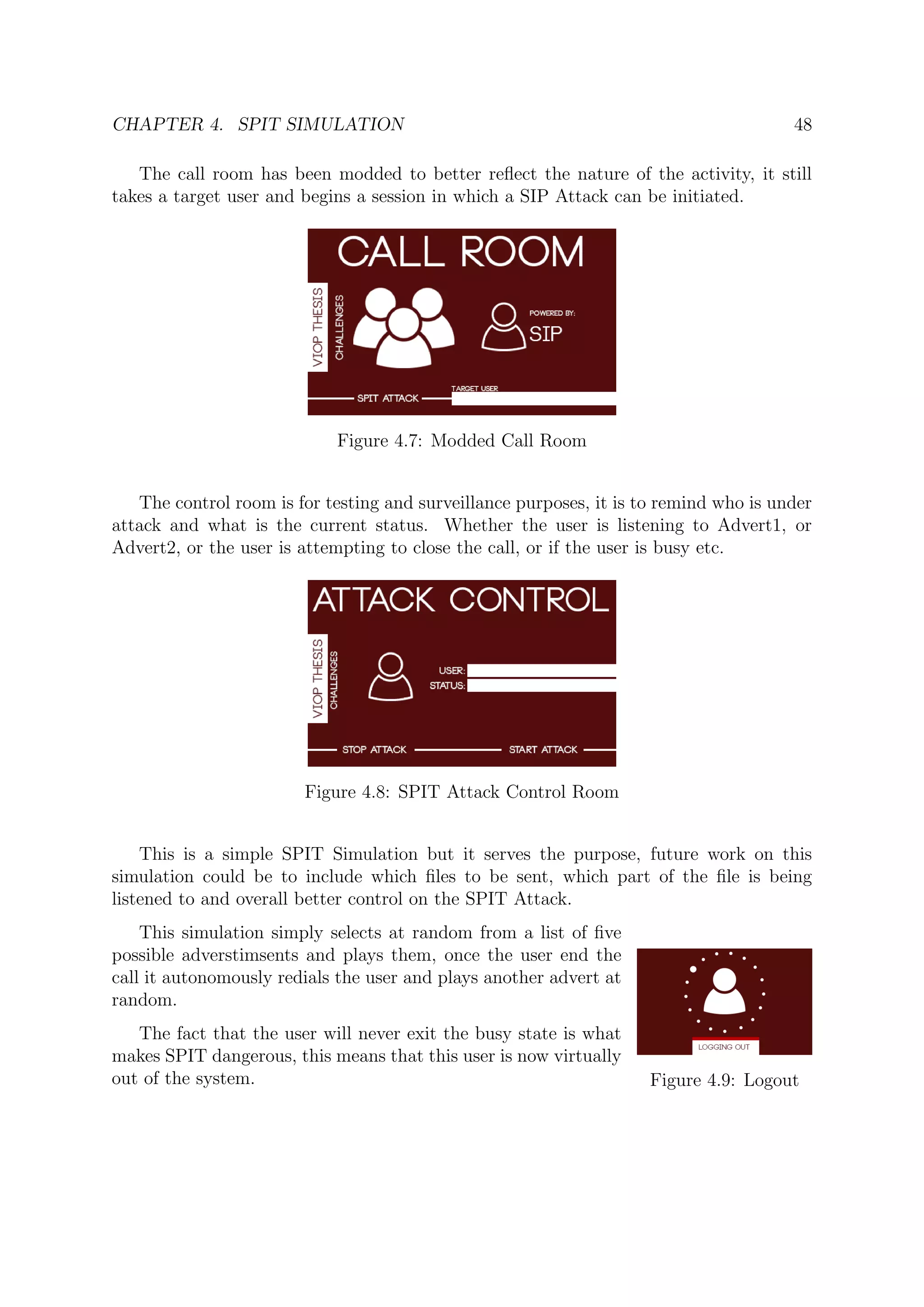
The call room has been modded to better reflect the nature of the activity, it still
takes a target user and begins a session in which a SIP Attack can be initiated.
Figure 4.7: Modded Call Room
The control room is for testing and surveillance purposes, it is to remind who is under
attack and what is the current status. Whether the user is listening to Advert1, or
Advert2, or the user is attempting to close the call, or if the user is busy etc.
Figure 4.8: SPIT Attack Control Room
This is a simple SPIT Simulation but it serves the purpose, future work on this
simulation could be to include which files to be sent, which part of the file is being
listened to and overall better control on the SPIT Attack.
Figure 4.9: Logout
This simulation simply selects at random from a list of five
possible adverstimsents and plays them, once the user end the
call it autonomously redials the user and plays another advert at
random.
The fact that the user will never exit the busy state is what
makes SPIT dangerous, this means that this user is now virtually
out of the system.
CHAPTER 4. SPIT SIMULATION 49
4.3.2 Code
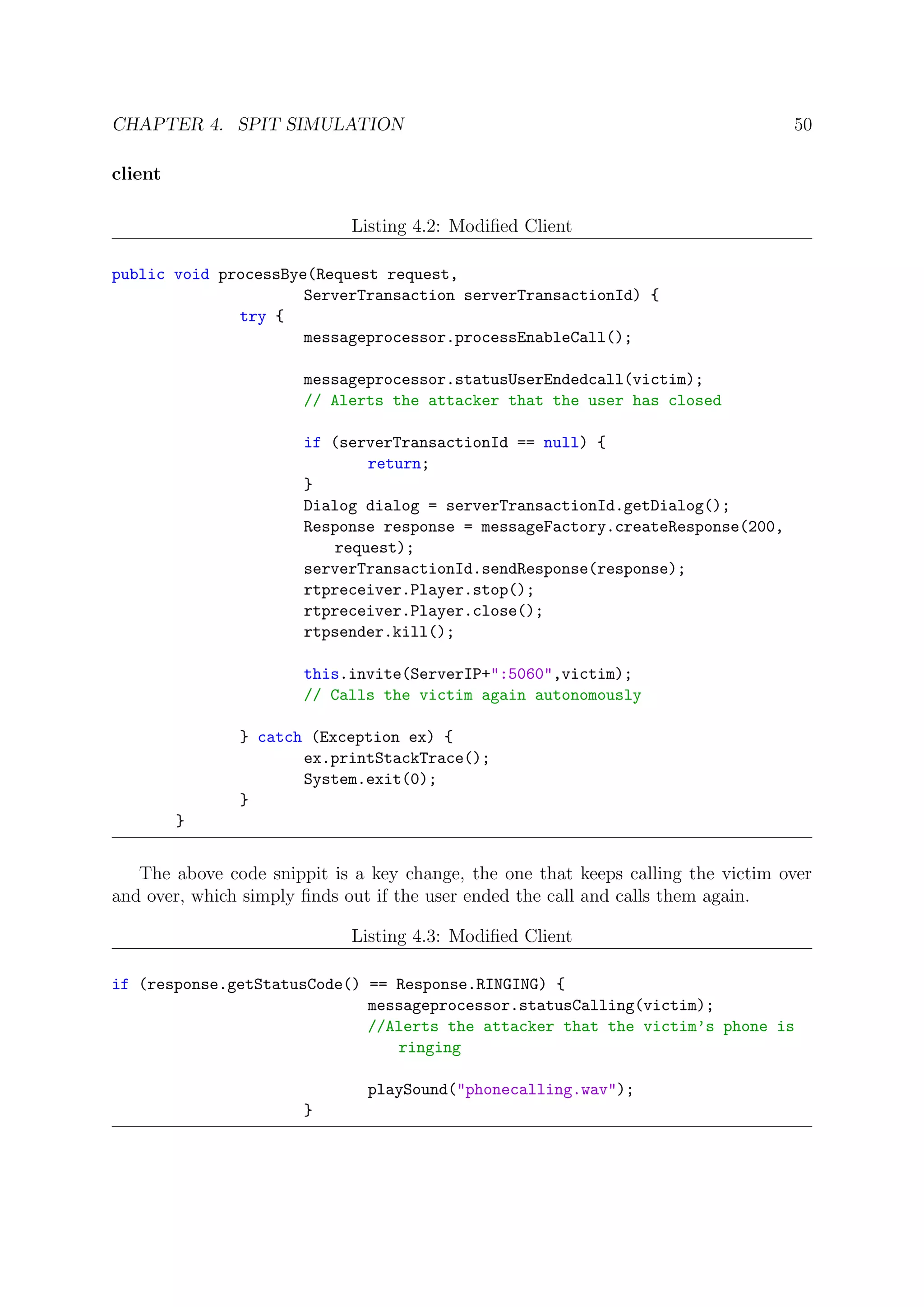
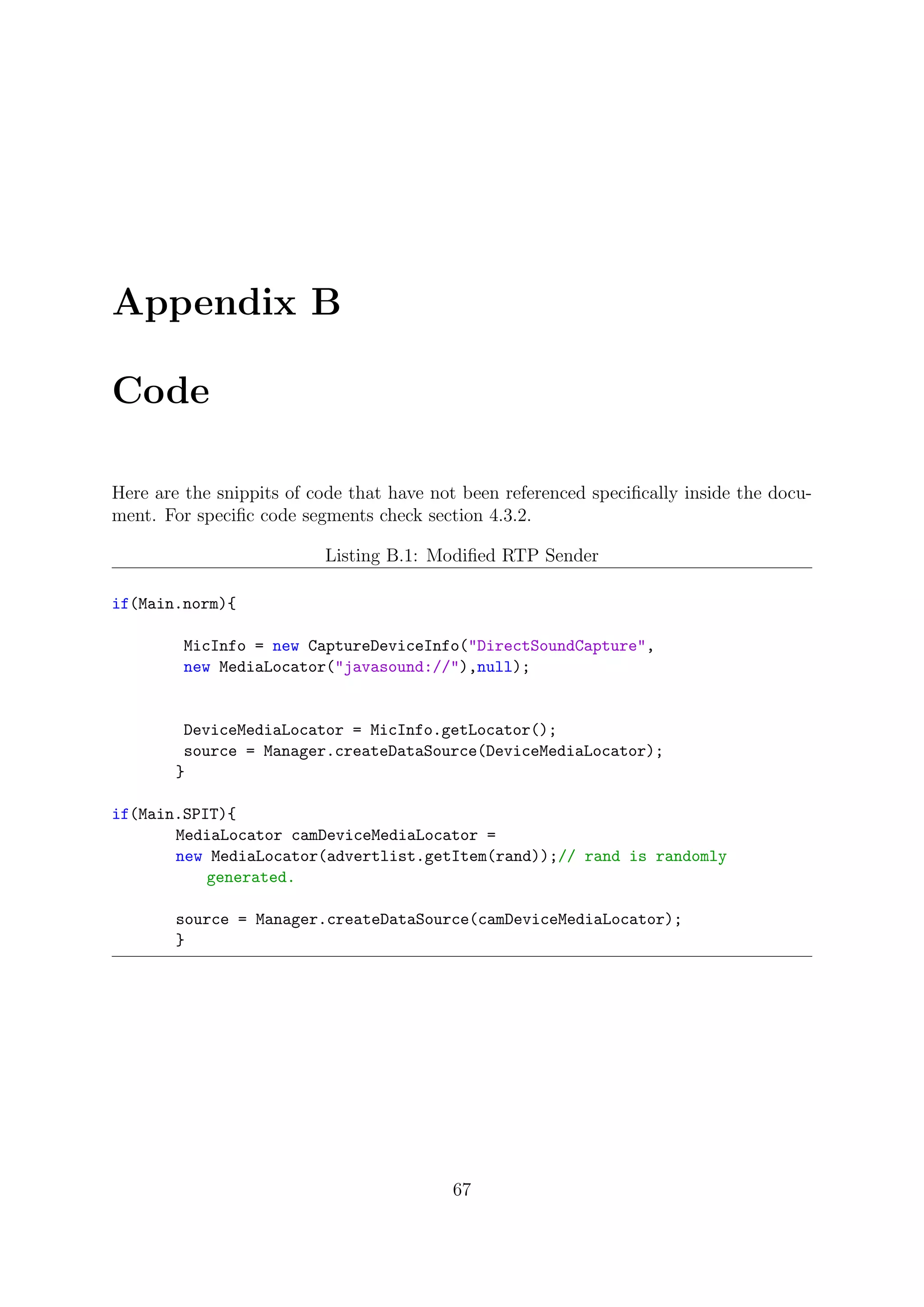
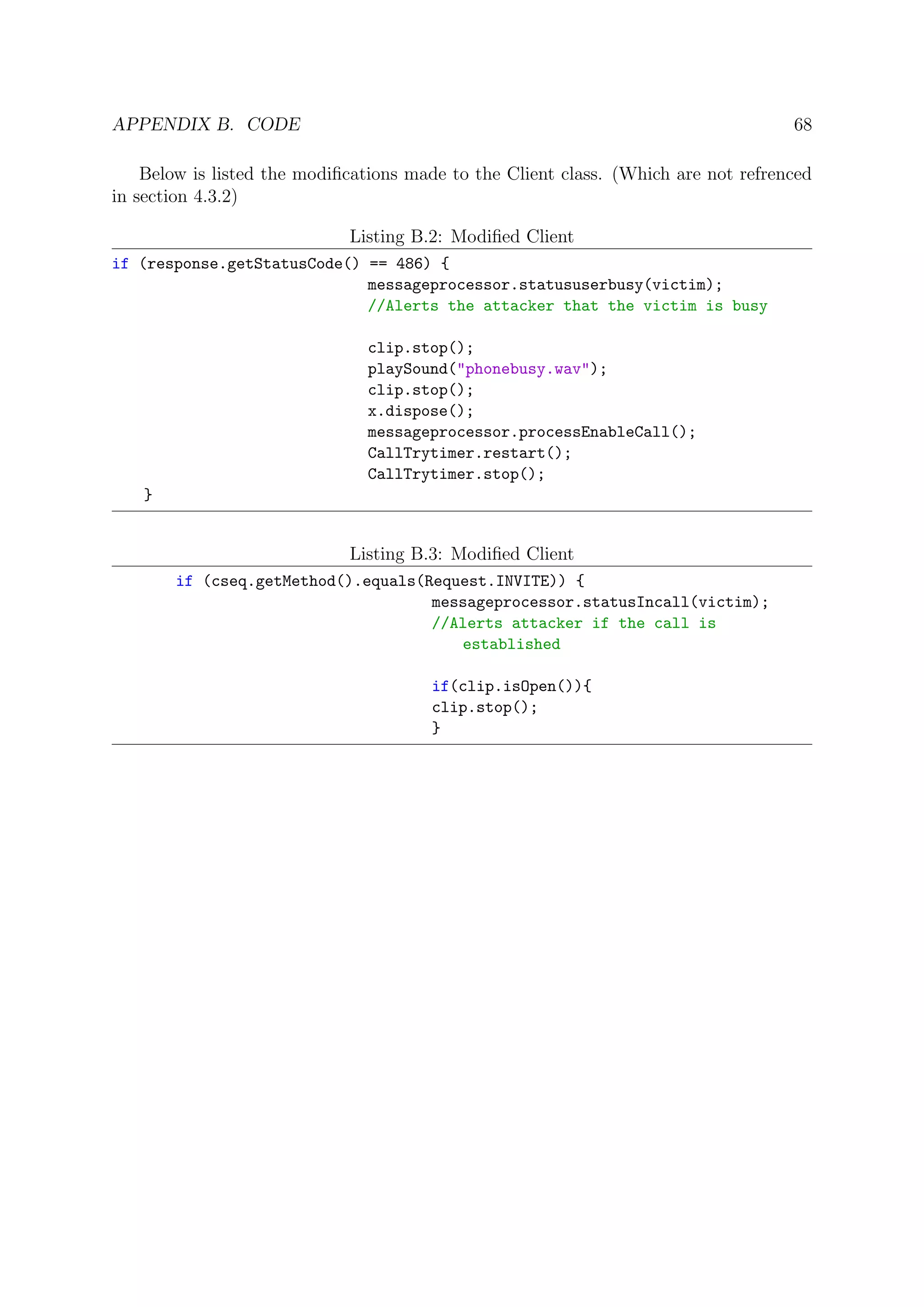
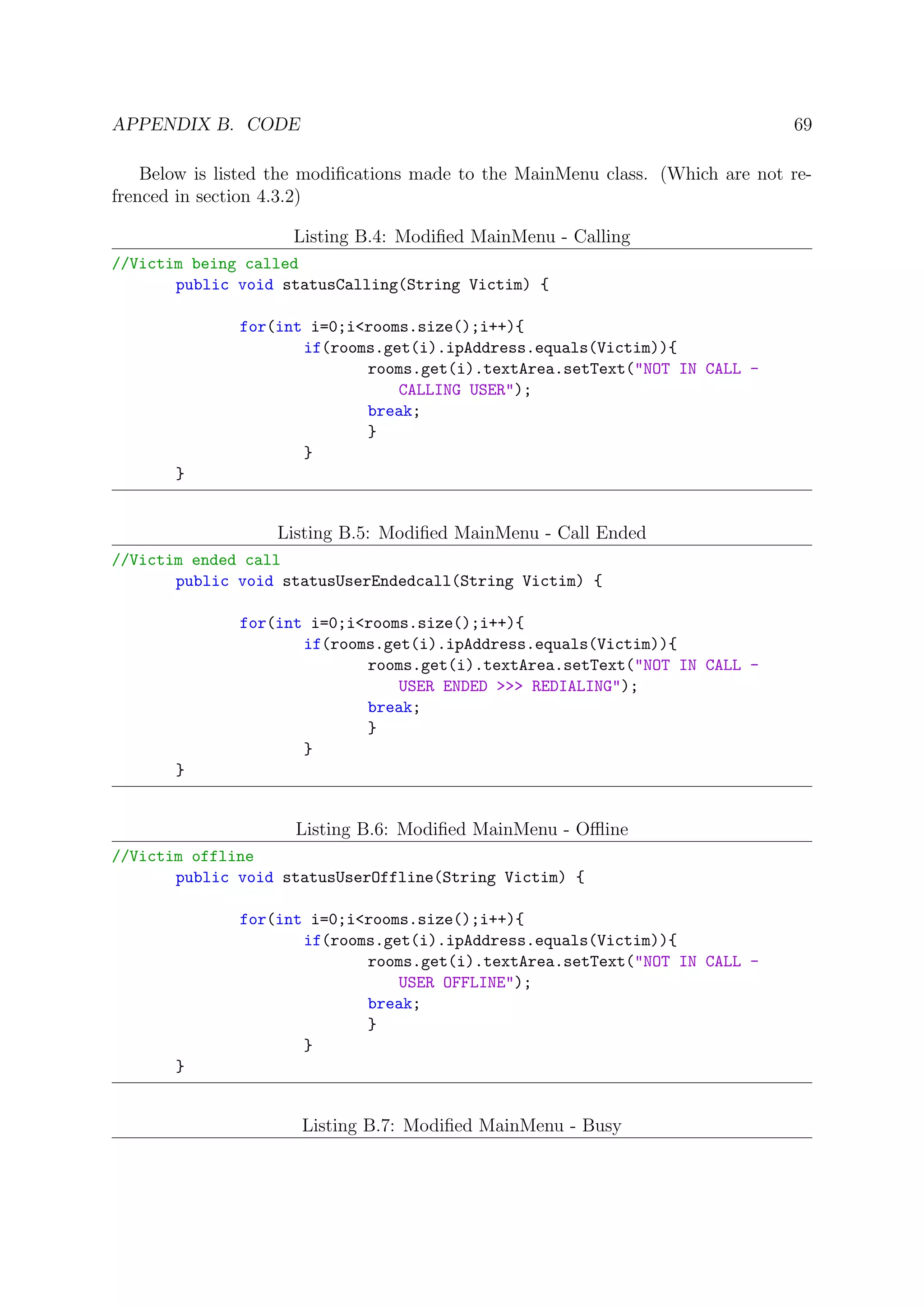
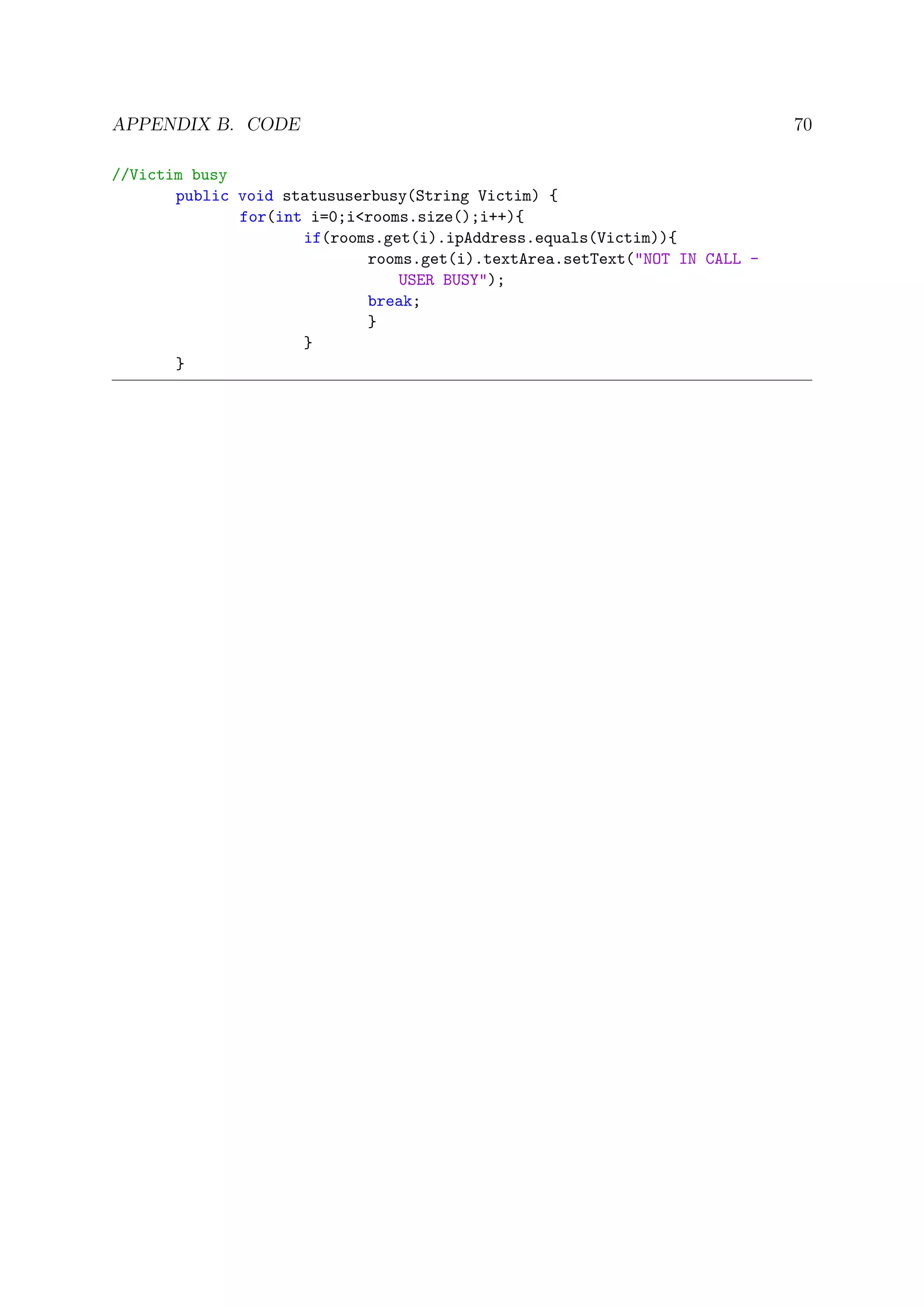
This section details what was changed in Ahmed Khaled’s Client in technical terms. To
be noted as a reminder that the client was made entirely in Java and hence the code
displayed in this chapter is Java code.
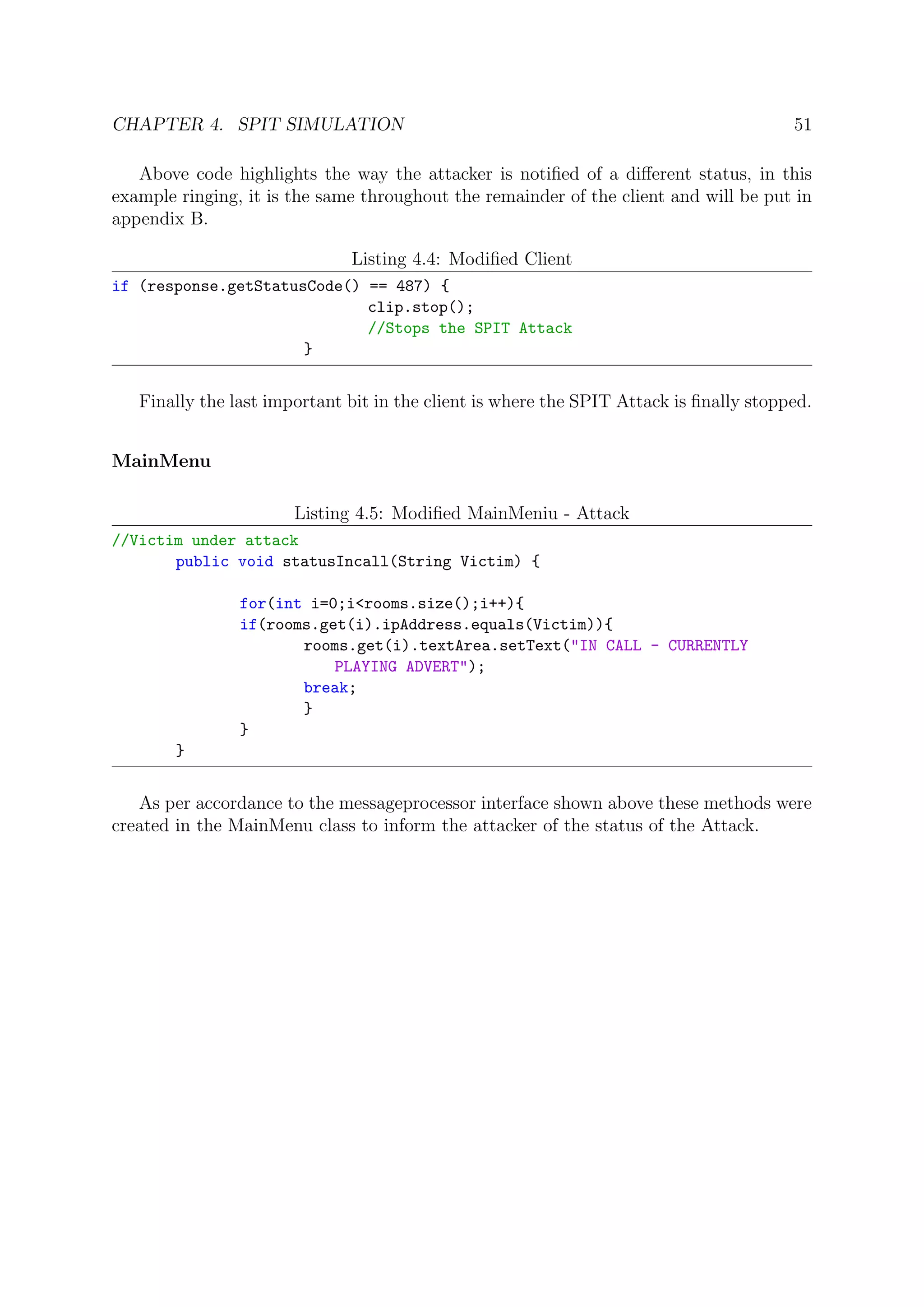
For a detailed description on how Ahmed Khaled handled his own client, the report
VOIP in Java is available and is cited here [11].
The coming section will dissect the changes and tackle them per class.
messageprocessor
Listing 4.1: Modified RTP Sender
public void statusIncall(String Victim);
// Tells the attacker that the call has been established
public void statusCalling(String Victim);
// Tells the attacker that the user is being called
public void statusUserEndedcall(String Victim);
// Tells the attacker that the user ended the call
public void statusUserOffline(String Victim);
// Tells the attacker that the user is offline
public void statususerbusy(String Victim);
// Tells the attacker that the user is busy
These methods were added to the messageprocessor interface, to facilitate communi-
cation between the back and front ends.
They handle the status box shown in figure 4.8 on page 48. The statuses available are
the ones the attacker needs to concern himself with, such as whether the victim’s phone
is ringing, or whether the call is established and a certain advert is beind played, or if
the user ended the call and the SPIT attack attempts to redial, or if the user is simply
offline or is in a call.
CHAPTER 4. SPIT SIMULATION 50
client
Listing 4.2: Modified Client
public void processBye(Request request,
ServerTransaction serverTransactionId) {
try {
messageprocessor.processEnableCall();
messageprocessor.statusUserEndedcall(victim);
// Alerts the attacker that the user has closed
if (serverTransactionId == null) {
return;
}
Dialog dialog = serverTransactionId.getDialog();
Response response = messageFactory.createResponse(200,
request);
serverTransactionId.sendResponse(response);
rtpreceiver.Player.stop();
rtpreceiver.Player.close();
rtpsender.kill();
this.invite(ServerIP+":5060",victim);
// Calls the victim again autonomously
} catch (Exception ex) {
ex.printStackTrace();
System.exit(0);
}
}
The above code snippit is a key change, the one that keeps calling the victim over
and over, which simply finds out if the user ended the call and calls them again.
Listing 4.3: Modified Client
if (response.getStatusCode() == Response.RINGING) {
messageprocessor.statusCalling(victim);
//Alerts the attacker that the victim’s phone is
ringing
playSound("phonecalling.wav");
}
CHAPTER 4. SPIT SIMULATION 51
Above code highlights the way the attacker is notified of a different status, in this
example ringing, it is the same throughout the remainder of the client and will be put in
appendix B.
Listing 4.4: Modified Client
if (response.getStatusCode() == 487) {
clip.stop();
//Stops the SPIT Attack
}
Finally the last important bit in the client is where the SPIT Attack is finally stopped.
MainMenu
Listing 4.5: Modified MainMeniu - Attack
//Victim under attack
public void statusIncall(String Victim) {
for(int i=0;i<rooms.size();i++){
if(rooms.get(i).ipAddress.equals(Victim)){
rooms.get(i).textArea.setText("IN CALL - CURRENTLY
PLAYING ADVERT");
break;
}
}
}
As per accordance to the messageprocessor interface shown above these methods were
created in the MainMenu class to inform the attacker of the status of the Attack.
Chapter 5
Conclusion and Future Work
To summarize, this work has focused on bringing together the most glaring issues and
challenges that face VoIP Systems. In an attempt at becoming something of a reference
point upon which future works could be based upon, and hence a total of 13 topics were
discussed, most of which require yet more investigation.
When considering the title of this work, one should also consider the question of
whether or not each topic has been solved yet, and if not then what are the proposed
solutions.
In this chapter the summaries of all the proposed solutions will be gathered for ease
of traversing.
52
CHAPTER 5. CONCLUSION AND FUTURE WORK 53
5.1 Security
5.1.1 Packet Sniffers
The suggested solution to this issue, was to find a good trade-off between security and
compatibility depending on the system in question, a casual chat application will need
to be more compatible on more devices than a Secret Service Agency would need, and
in turn the Agency would prefer to capitalize on the strongest security possible hence
decreasing the amount of devices with the capability of compatibility drastically.
For future work in this matter, the suggestion would be to research for the possible
optimal level of security to compatibility, for instance creation of a rating system to rate
the security and the compatibility of the VoIP System in terms of encryption and a study
to ensue to establish a Security to Compatibility ratio.
5.1.2 Eavesdropping
Assuming an encrypted system, to further protect against eavesdropping researches sug-
gest to use a random length padding to the VBR encoded output to confuse and throw
off the newer methods of realizing a phrase when uttered throughout a call.
This subject, while very specific, is considered fertile ground for future work. The
two strongly backed researches mentioned should be read and considered, and to build
on their work the suggested solution implemented. The reports in question are [20] and
[14].
5.1.3 DDoS
Further research in this area is a must, the need is rising quickly and the only real defence
available it to mitigate the DDoS attack, high profile targets should look at Cloud Based
Mitigation companies, while more middle ranged targets should look to implement an
IDS.
The toughest task to tackle due to the ease of its execution but the one in most need
of handling.
5.1.4 SPIT
An area of great controversy as there is a vast multitude of solutions available, but all
possess exploitable weaknesses, anyone with the ability to: Device Spoof, SIP Identity
Spoof, SIP Header Spoof, Reputation Push or Pull, CAPTCHA Relay Attack, SIP Iden-
tity Hijack, Call Rate Adapt and Account Switch, will breech all currently available
CHAPTER 5. CONCLUSION AND FUTURE WORK 54
countermeasures to SPIT, although a combination of all the suggested methods might
just prove too formidable to breech at once.
As VoIP Systems spread this issue will grow with it, future work here would be well
based on Rachid’s work, and would lead to a direct solution or the confirmation of the
need of a new method of thought to solve this issue.
5.1.5 NAT Traversal
One of VoIPs greater challenges, and the best way to solve would be to either use IETFs
STUN and TURN protocol and server, or follow the path Skype took and write your own
custom protocol along with a relay server.
It could prove to be good practice to develop an open Java Based API to handle these
STUN and TURN protocol and sever creation.
5.1.6 OS
Switching to a Linux based OS seems to be the only feasible solution to this issue, if more
security is what is desired. Moving at least the servers to a Linux based system would
be advisable if the VoIP System wishes to sell on Windows. The servers at the very least
need to be well protected against attacks.
A rarity, but no future work is suggested in this area, unless a massive undertaking
of a windows based OS being produced with satisfactory design elements.
CHAPTER 5. CONCLUSION AND FUTURE WORK 55
5.2 Quality
5.2.1 Bandwidth
The multiple methods that could be employed to solve this issue involve two main stand-
out solutions. Depending on the situation, the available bandwidth could be allocated
to always save enough bandwidth for VoIP Communications to go through unhindered,
which is a way that works in a controlled environment as in an Office or a place of work.
The other prominent solution would be to use higher compressed Codecs, depending
on the available bandwidth, for this a calculation of the bandwidth available and the
bandwidth needed for a codec to function without causing issues would be needed and is
described in Figure 3.7.
5.2.2 Codecs
Figure 3.9 features the most prominent codecs as mentioned by Cisco along with the
required Bandwidth to run each codec. Bearing in mind that not most PCs have all the
codecs installed by default. The way this issue is solved classically would be through
a negotiation of codecs before the call starts hence choosing a codec that will function
correctly on both bandwidths of the caller and the calee.
As for the most famously used of upcoming codecs, a discussion has been held in
Section 3.2.2 concerning each one.
Suggestions for future work in this area involve a way to negotiate and install codecs
based purely on the bandwidth at runtime. Or a simple deep research into the available
codecs, backed by a thesis on which one should be the industry standard.
5.2.3 Queueing
As was discussed in section 3.2.3, this issue has multiple answers, but not a simple
solution. Meaning that there are a few popular queuing algorithms such as FIFO, PQ,
CQ, WFQ, but none of these are one hundred per cent suitable for VoIP Traffic handling,
a much more complex merge between these queueing algorithms would be a start.
Hence it is sold ground for future work, a work under the title of Queueing for VoIP
Traffic could unfold new and better ways to direct VoIP Traffic, but will require a good
amount of knowledge in the subject matter. And while the different queueing algorithms
could indeed be simulated, testing in real time would require access to a programable
router.
CHAPTER 5. CONCLUSION AND FUTURE WORK 56
5.2.4 Low Speed Links
The current solutions for Low Speed Links are not satisfactory, yet research in the matter
is not considered to be a priority since the world is advancing in terms of speed and
quality of links available, yet research in this field is still crucial. Developing countries,
or countries with weak infrastructure for the Internet such as Egypt for example could
benefit from a detailed study and research in this particular field.
A look in [13] would prove useful for future research.
CHAPTER 5. CONCLUSION AND FUTURE WORK 57
5.3 Dependency
5.3.1 Power
Current solutions to this issue as is shown in Figure 3.11, involve the use of a PoE adapter,
which is a good, practical and applicable solution, but could raise the cost and connections
needed in the VoIP network significantly, if for instance a wire could be developed that
carried PoE without the need for this adapter entirely, then this would eliminate a few
of these issues.
Future work in this certain field is not encouraged as it is purely hardware focused and
already in development, however if this were to be pursued then a more abstract topic
could open up, the possibility of sending power over wireless has been long discussed and it
would be applicable in this case for the benefit of eliminating multiple wired connections,
but would bring about a world of security issues.
5.3.2 Net
As was mentioned in Section 3.2.3, the absence of a network will render VoIP Communi-
cations useless.
However a system could be developed which employs the idea of an answer machine,
but the opposite way around. If the connection is severed on the callers end, the system
detects the downed connection and switches to a buffer mode. In which calls from the
caller will be recorded and sent once the network returns.
CHAPTER 5. CONCLUSION AND FUTURE WORK 58
5.4 Emergency
The two solutions mentioned in section 3.4 are the two most prominent and obvious
solutions. Either connect to a private agency which handles the call for the VoIP System
depending on the location. Or interconnect the VoIP System with the PSTN so that the
emergency call can go through to the E911 service.
Future work in this topic is however viable, since little work has been done in the topic,
suggestions would be to research ”How to Integrate VoIP Systems with the PSTN”
CHAPTER 5. CONCLUSION AND FUTURE WORK 59
5.5 Last Words
To reiterate what was said in Sections 1.1 and 1.2, this work does not claim to solve a
single issue, or discuss it in depth. This works aims to be a staple for future works to
come, the topic of VoIP Systems is an uprising topic, and one which could soon change
much of how we communicate.
Much development has gone into this topic, yet the articles about the challenges facing
it are not nearly as well rounded as need be. What this work claims to be, is a reference
point from which future works could spawn in an organized fashion.
This work should be thought of as a sort of check list, or progress report on the status
of VoIP Systems, how far we’ve come, the problems that have spawned since the early
days of VoIP Systems, how they originated, how sever they could be, and finally how
they could be solved.
Appendix
60
Appendix A
Lists
VoIP Voice over IP
DDoS Distributed Denial of Service
SPIT Spam over IP Telephony
QoS Quality of Service
SIP Session Initiation Protocol
IETF Internet Engineering Task Force
SMS SIP Messaging Service
IM Instant Messaging
RTP Real Time Protocol
UDP User Diagram Protocol
LAN Local Area Network
MAC Media Access Control
NAT Network Address Translators
HTTP Hypertext Transfer Protocol
FTP File Transfer Protocol
ADSL Asymmetric digital subscriber line
MMS Multimedia Messaging Service
TCP Transmission Control Protocol
61
APPENDIX A. LISTS 62
HDD Hard Disk Drive
DVD Digital Video Disc
VCD Video CD
SVCD Super VCD
DVB Digital Video Broadcasting
MPEG Motion Pictures Experts Group
AVI Audio Video Interleave
ASF Advanced Systems Format
WMV Windows Media Video
WMA Windows Media Audio
MP4 MPEG 4
MOV QuickTime File Format
3GP Third Generation Partnership Project
OGG Ogging
OGM OGG Movie
MKV Matroska Video
WAV Waveform Audio File Format
FLAC Free Lossless Audio Codec
FLV Flash Video
MXF Material eXchange Format
MIDI Musical Instrument Digital Interface
SMF Standard MIDI File
SIPS Secure SIP
TLS Transport Layer Security
SSL Secure Sockets Layer
VBR Variable Bit Rate
APPENDIX A. LISTS 63
IDS Intrusion Detection System
CAPTCHA Completely Automated Public Turing test to tell Computers and
HumansApart
ALG Application Layer Gateways
PSTN Public Switched TelephoneNetwork
FIFO First In First Out
PQ Priority Queuing
CQ Custom Queueing
WFQ Weighted Fair Queueing
WRED Weighted Random Early Detect
LLQ Low Latency Queing
PoE Power over Ethernet
FCC Federal Communications Commission
PBX Private Branch Exchange
List of Figures
2.1 Technologies and Issues (Security) . . . . . . . . . . . . . . . . . . . . . . 5
2.2 Sip Invite Request . . . . . . . . . . . . . . . . . . . . . . . . . . . . . . 6
2.3 RTP Packet . . . . . . . . . . . . . . . . . . . . . . . . . . . . . . . . . . 9
2.4 SCCP UDP Packet Capture . . . . . . . . . . . . . . . . . . . . . . . . . 10
2.5 NAT Operaction . . . . . . . . . . . . . . . . . . . . . . . . . . . . . . . 11
2.6 Input Media and Formats of VLC . . . . . . . . . . . . . . . . . . . . . . 12
3.1 Organization of Challenges . . . . . . . . . . . . . . . . . . . . . . . . . . 14
3.2 SIP Invite Request, as captured by Wireshark . . . . . . . . . . . . . . . 16
3.3 A Much more complicated SIPS message . . . . . . . . . . . . . . . . . . 17
3.4 Simple DDoS Attack by Sisle . . . . . . . . . . . . . . . . . . . . . . . . 19
3.5 Excerpt Highlighting 8 SPIT Skills . . . . . . . . . . . . . . . . . . . . . 23
3.6 OSI Analogy . . . . . . . . . . . . . . . . . . . . . . . . . . . . . . . . . . 27
3.7 Bandwidth Calculation . . . . . . . . . . . . . . . . . . . . . . . . . . . . 29
3.8 Codec Influence . . . . . . . . . . . . . . . . . . . . . . . . . . . . . . . . 31
3.9 Codecs . . . . . . . . . . . . . . . . . . . . . . . . . . . . . . . . . . . . . 32
3.10 Cisco VoIP Phone . . . . . . . . . . . . . . . . . . . . . . . . . . . . . . . 36
3.11 PoE . . . . . . . . . . . . . . . . . . . . . . . . . . . . . . . . . . . . . . 37
3.12 VoIP Emergency Service . . . . . . . . . . . . . . . . . . . . . . . . . . . 40
4.1 OfficeSIP GUI . . . . . . . . . . . . . . . . . . . . . . . . . . . . . . . . . 43
4.2 Client Login Screen . . . . . . . . . . . . . . . . . . . . . . . . . . . . . . 44
4.3 Client Login Screen - Connecting . . . . . . . . . . . . . . . . . . . . . . 45
4.4 Call Room . . . . . . . . . . . . . . . . . . . . . . . . . . . . . . . . . . . 46
64
LIST OF FIGURES 65
4.5 Chat Room States . . . . . . . . . . . . . . . . . . . . . . . . . . . . . . 46
4.6 Modded Client Settings . . . . . . . . . . . . . . . . . . . . . . . . . . . . 47
4.7 Modded Call Room . . . . . . . . . . . . . . . . . . . . . . . . . . . . . . 48
4.8 SPIT Attack Control Room . . . . . . . . . . . . . . . . . . . . . . . . . 48
4.9 Logout . . . . . . . . . . . . . . . . . . . . . . . . . . . . . . . . . . . . . 48
C.1 Packet Sniffing Illustration . . . . . . . . . . . . . . . . . . . . . . . . . . 71
C.2 DDoS Illustration . . . . . . . . . . . . . . . . . . . . . . . . . . . . . . . 72
C.3 Eavesdropping Illustration . . . . . . . . . . . . . . . . . . . . . . . . . . 72
C.4 New Firewalls Illustration . . . . . . . . . . . . . . . . . . . . . . . . . . 73
C.5 Old Firewalls Illustration . . . . . . . . . . . . . . . . . . . . . . . . . . . 73
C.6 OS Illustration . . . . . . . . . . . . . . . . . . . . . . . . . . . . . . . . 74
C.7 Bandwidth Illustration . . . . . . . . . . . . . . . . . . . . . . . . . . . . 74
C.8 Good Bandwidth Illustration . . . . . . . . . . . . . . . . . . . . . . . . . 75
C.9 Medium Bandwidth Illustration . . . . . . . . . . . . . . . . . . . . . . . 75
C.10 Bad Bandwidth Illustration . . . . . . . . . . . . . . . . . . . . . . . . . 76
List of Tables
2.1 Provisional SIP Codes . . . . . . . . . . . . . . . . . . . . . . . . . . . . 7
2.2 Successful SIP Codes . . . . . . . . . . . . . . . . . . . . . . . . . . . . . 7
2.3 Redirect SIP Codes . . . . . . . . . . . . . . . . . . . . . . . . . . . . . . 8
2.4 Failure SIP Codes . . . . . . . . . . . . . . . . . . . . . . . . . . . . . . . 8
2.5 Server Failure SIP Codes . . . . . . . . . . . . . . . . . . . . . . . . . . . 8
2.6 Global Failure SIP Codes . . . . . . . . . . . . . . . . . . . . . . . . . . . 8
66
Appendix B
Code
Here are the snippits of code that have not been referenced specifically inside the docu-
ment. For specific code segments check section 4.3.2.
Listing B.1: Modified RTP Sender
if(Main.norm){
MicInfo = new CaptureDeviceInfo("DirectSoundCapture",
new MediaLocator("javasound://"),null);
DeviceMediaLocator = MicInfo.getLocator();
source = Manager.createDataSource(DeviceMediaLocator);
}
if(Main.SPIT){
MediaLocator camDeviceMediaLocator =
new MediaLocator(advertlist.getItem(rand));// rand is randomly
generated.
source = Manager.createDataSource(camDeviceMediaLocator);
}
67
APPENDIX B. CODE 68
Below is listed the modifications made to the Client class. (Which are not refrenced
in section 4.3.2)
Listing B.2: Modified Client
if (response.getStatusCode() == 486) {
messageprocessor.statususerbusy(victim);
//Alerts the attacker that the victim is busy
clip.stop();
playSound("phonebusy.wav");
clip.stop();
x.dispose();
messageprocessor.processEnableCall();
CallTrytimer.restart();
CallTrytimer.stop();
}
Listing B.3: Modified Client
if (cseq.getMethod().equals(Request.INVITE)) {
messageprocessor.statusIncall(victim);
//Alerts attacker if the call is
established
if(clip.isOpen()){
clip.stop();
}
APPENDIX B. CODE 69
Below is listed the modifications made to the MainMenu class. (Which are not re-
frenced in section 4.3.2)
Listing B.4: Modified MainMenu - Calling
//Victim being called
public void statusCalling(String Victim) {
for(int i=0;i<rooms.size();i++){
if(rooms.get(i).ipAddress.equals(Victim)){
rooms.get(i).textArea.setText("NOT IN CALL -
CALLING USER");
break;
}
}
}
Listing B.5: Modified MainMenu - Call Ended
//Victim ended call
public void statusUserEndedcall(String Victim) {
for(int i=0;i<rooms.size();i++){
if(rooms.get(i).ipAddress.equals(Victim)){
rooms.get(i).textArea.setText("NOT IN CALL -
USER ENDED >>> REDIALING");
break;
}
}
}
Listing B.6: Modified MainMenu - Offline
//Victim offline
public void statusUserOffline(String Victim) {
for(int i=0;i<rooms.size();i++){
if(rooms.get(i).ipAddress.equals(Victim)){
rooms.get(i).textArea.setText("NOT IN CALL -
USER OFFLINE");
break;
}
}
}
Listing B.7: Modified MainMenu - Busy
APPENDIX B. CODE 70
//Victim busy
public void statususerbusy(String Victim) {
for(int i=0;i<rooms.size();i++){
if(rooms.get(i).ipAddress.equals(Victim)){
rooms.get(i).textArea.setText("NOT IN CALL -
USER BUSY");
break;
}
}
}
Appendix C
Illustrations
This appendix holds most of the Illustrations to be used when presenting this work, to
be noted that it is mostly interactive yet having them in the paper could prove to be
beneficial.
Figure C.1: Packet Sniffing Illustration
71
APPENDIX C. ILLUSTRATIONS 72
Figure C.2: DDoS Illustration
Figure C.3: Eavesdropping Illustration
APPENDIX C. ILLUSTRATIONS 73
Figure C.4: New Firewalls Illustration
Figure C.5: Old Firewalls Illustration
APPENDIX C. ILLUSTRATIONS 74
Figure C.6: OS Illustration
Figure C.7: Bandwidth Illustration
APPENDIX C. ILLUSTRATIONS 75
Figure C.8: Good Bandwidth Illustration
Figure C.9: Medium Bandwidth Illustration
APPENDIX C. ILLUSTRATIONS 76
Figure C.10: Bad Bandwidth Illustration
Bibliography
[1] Gary Audin. Voip bandwidth fundamentals. 2008.
[2] Ed B. Campbell, J. Rosenberg, H. Schulzrinne, C. Huitema, and D. Gurle. Sip
message extension. Standards Track, 2002.
[3] Cisco. Voice over ip - per call bandwidth consumption. 2006.
[4] Gerald Combs. About wireshark. 2014.
[5] defense.net. Ddos attack timeline: The history and changing nature of ddos attacks.
2014.
[6] K Egevang and P Francis. The ip network address translator (nat). Request for
Comments, 1994.
[7] FederalCommunicationsCommission. Voip and 911 service. 2005.
[8] Nick Galea. The main sip invite header fields explained. 3CX Blog, 2010.
[9] HughesCoporation. Voip and it’s challenges. 2006.
[10] Rachid Khayari. Spam over internet telephony and how to deal with it. 2011.
[11] Ahmed Khaled Saeed Metwally. Voip using java. Bachelor Thesis, page 0, 2014.
[12] Richard Parsons. Voip congestion management - basic queuing methods. TIP, 2004.
[13] Julije Ivana Pezelj. Voip qos on low speed links. 2012.
[14] Vasily Prokopov and Oleksii Chyrkov. Eavesdropping on encrypted voip conversa-
tions: phrase spotting attack and defense approaches. 2011.
[15] M Rafique, M Akbar, and Muddassar Farooq. Evaluating dos attacks against sip-
based voip systems. 2008.
[16] J. Rosenberg, H. Schulzrinne, G. Camarillo, A. Johnston, J. Peterson, R. Sparks,
M. Handley, and E. Schooler. Sip: Session initiation protocol. Request for Comments,
2002.
77
BIBLIOGRAPHY 78
[17] Matthew Ruck. Top ten security issues with voice over ip (voip). designData, 1:0,
2010.
[18] H. Schulzrinne, S. Casner, R. Frederick, and V. Jacobson . Rtp: A transport protocol
for real-time applications. Request for Comments, 2003.
[19] VLC Staff. Vlc download statistics. https://videolan.org/vlc/stats/downloads.html,
2014.
[20] Charles Wright, Lucas Ballard, Scott Coull, Fabian Monrose, and Gerald Masson.
Uncovering spoken phrases in encrypted voice over ip conversations. 2010.

Challenges in VoIP Systems - Mostafa Ahmed Mostafa El Beheiry - First Draft Final

  • 1.
    Media Engineering andTechnology Faculty German University in Cairo Challenges in VoIP Systems Bachelor Thesis Author: Mostafa Ahmed Mostafa El Beheiry Supervisors: Dr. Hisham Hassaballah Othman Submission Date: 3 June, 2014
  • 2.
    This is tocertify that: (i) the thesis comprises only my original work toward the Bachelor Degree (ii) due acknowledgement has been made in the text to all other material used Mostafa Ahmed Mostafa El Beheiry 3 June, 2014
  • 3.
    Acknowledgments I would liketo acknowledge the following people and institutes whom have been instru- mental in how this work turned out. Who kept me motivated and enthusiastic to work throughout the entire span of the work. Before anything I would like to thank God Almighty, for everything. Dr. Hisham, for guiding me through this work, accepting it as my own work and allowing me to express it as I envisioned it and not holding me back from putting in as much in it as need be. I may have disagreed with some things we discussed and planned to do or not to do, but I thank him for his understanding that my disagreements were purely academic and only had the interest of this work in mind. I would also like to thank Dr. Hisham for the vision he has about VoIP Systems and how important they are to advance in this country, and in turn giving me the opportunity to be a building block and hopefully benefit humanity in our never ending quest for science. Ahmed Khaled, for his work on VoIP using Java, we explored this thing together and uncovered the magics that make it work together, and without your work I would not have a trustworthy application for my simulation. I thank him for calling me day by day, keeping me up to date with his exploits and for understanding all the point of criticism I leveled at his work. The days we spent on the fixing the server were some of the most frustrating and memorable days I’ve ever spent of a project, but we pulled through somehow, and thanks for letting me and helping me attack your work for my simulation! My Parents, for providing me with whatever I asked for the sake of knowledge, for believing in me and knowing that I can make use of every single penny spent on my educational life. I can’t begin to express the gratitude. And thanks for giving me a multitude of solutions to overcome the lack of electricity in these trying times. I love you guys from the bottom of my heart! Riot Games, for giving me a way out of the stresses of life by playing League of Legends. Valve, for making a better game than Riot. III
  • 4.
    Abstract The remarkable advancementof VoIP Systems in the previous decades made possible what was thought to be fiction. But with great prgress come great challenges, the development of VoIP Systems is no different. This work is a collection, categorization and examination of some of VoIP’s greatest challenges. This work has identified four main categories of issues, Security, Quality, Dependency, Emergency and how they came to be during the development of VoIP Systems. Their impact on Voice over IP (VoIP) Systems, whether or not these issues are crippling to VoIP Systems. Included also are illustrations of the various issues, for visualization purposes. A real time simulation of a singled out issue is also included in this work. Finally, this work will also look into possible solutions if present, or suggest solutions if the issues mentioned do not possess a certain, industry- standard solution. Certain topics amongst the four categories have been singled out as the most im- portant, and will be the focus of this work. As for the Security category all of, Packet Sniffers, Distributed Distributed Denial of Service (DDoS) Attacks, Eavesdropping, Spam over IP Telephony (SPIT) Attacks, Difficulties with Firewalls and Operating System and Network, have been the focus. Concerning Quality the issues of, Bandwidth, Codecs, Queuing, and Low-Speed Links, will be discussed. Collaboration has taken place with colleague Ahmed Khaled Saeed Metwally, in cre- ating a simulation of a SPIT attack using his own implementation of a VoIP Client as a base [11], and using OfficeSIP as a server. IV
  • 5.
    Contents Acknowledgements III 1 Introduction1 1.1 Motivation . . . . . . . . . . . . . . . . . . . . . . . . . . . . . . . . . . . 2 1.2 Aim of Work . . . . . . . . . . . . . . . . . . . . . . . . . . . . . . . . . 3 2 Background 4 2.1 Session Initiation Protocol (SIP) . . . . . . . . . . . . . . . . . . . . . . . 6 2.1.1 SIP Invite Request . . . . . . . . . . . . . . . . . . . . . . . . . . 6 2.1.2 Message Method Extension . . . . . . . . . . . . . . . . . . . . . 7 2.1.3 SIP Codes . . . . . . . . . . . . . . . . . . . . . . . . . . . . . . . 7 2.2 Real Time Protocol (RTP) . . . . . . . . . . . . . . . . . . . . . . . . . . 9 2.2.1 Packet Format . . . . . . . . . . . . . . . . . . . . . . . . . . . . 9 2.3 Wireshark . . . . . . . . . . . . . . . . . . . . . . . . . . . . . . . . . . . 10 2.4 Network Address Translators (NAT) . . . . . . . . . . . . . . . . . . . . 11 2.5 VideoLAN Client (VLC) . . . . . . . . . . . . . . . . . . . . . . . . . . . 12 3 Own Work 13 3.1 Security . . . . . . . . . . . . . . . . . . . . . . . . . . . . . . . . . . . . 15 3.1.1 Packet Sniffing . . . . . . . . . . . . . . . . . . . . . . . . . . . . 15 3.1.2 Eavesdropping . . . . . . . . . . . . . . . . . . . . . . . . . . . . . 18 3.1.3 Distributed Denial of Service (DDoS) . . . . . . . . . . . . . . . . 19 3.1.4 Spam over IP Telephony (SPIT) . . . . . . . . . . . . . . . . . . . 21 3.1.5 NAT Traversal . . . . . . . . . . . . . . . . . . . . . . . . . . . . 24 3.1.6 Operating System . . . . . . . . . . . . . . . . . . . . . . . . . . . 25 3.2 Quality . . . . . . . . . . . . . . . . . . . . . . . . . . . . . . . . . . . . . 26 3.2.1 Bandwidth . . . . . . . . . . . . . . . . . . . . . . . . . . . . . . . 28 3.2.2 Codecs . . . . . . . . . . . . . . . . . . . . . . . . . . . . . . . . . 30 3.2.3 Queueing . . . . . . . . . . . . . . . . . . . . . . . . . . . . . . . 33 3.2.4 Low Speed Links . . . . . . . . . . . . . . . . . . . . . . . . . . . 35 3.3 Dependency . . . . . . . . . . . . . . . . . . . . . . . . . . . . . . . . . . 36 3.3.1 Power Dependency . . . . . . . . . . . . . . . . . . . . . . . . . . 36 3.3.2 Internet Dependacy . . . . . . . . . . . . . . . . . . . . . . . . . 38 3.4 Emergency . . . . . . . . . . . . . . . . . . . . . . . . . . . . . . . . . . . 39 V
  • 6.
    4 SPIT Simulation41 4.1 Server . . . . . . . . . . . . . . . . . . . . . . . . . . . . . . . . . . . . . 41 4.1.1 Failed Attempts . . . . . . . . . . . . . . . . . . . . . . . . . . . . 42 4.1.2 OfficeSIP . . . . . . . . . . . . . . . . . . . . . . . . . . . . . . . 43 4.2 Client . . . . . . . . . . . . . . . . . . . . . . . . . . . . . . . . . . . . . 44 4.3 Modifications . . . . . . . . . . . . . . . . . . . . . . . . . . . . . . . . . 47 4.3.1 GUI . . . . . . . . . . . . . . . . . . . . . . . . . . . . . . . . . . 47 4.3.2 Code . . . . . . . . . . . . . . . . . . . . . . . . . . . . . . . . . . 49 5 Conclusion and Future Work 52 5.1 Security . . . . . . . . . . . . . . . . . . . . . . . . . . . . . . . . . . . . 53 5.1.1 Packet Sniffers . . . . . . . . . . . . . . . . . . . . . . . . . . . . 53 5.1.2 Eavesdropping . . . . . . . . . . . . . . . . . . . . . . . . . . . . . 53 5.1.3 DDoS . . . . . . . . . . . . . . . . . . . . . . . . . . . . . . . . . 53 5.1.4 SPIT . . . . . . . . . . . . . . . . . . . . . . . . . . . . . . . . . . 53 5.1.5 NAT Traversal . . . . . . . . . . . . . . . . . . . . . . . . . . . . 54 5.1.6 OS . . . . . . . . . . . . . . . . . . . . . . . . . . . . . . . . . . . 54 5.2 Quality . . . . . . . . . . . . . . . . . . . . . . . . . . . . . . . . . . . . . 55 5.2.1 Bandwidth . . . . . . . . . . . . . . . . . . . . . . . . . . . . . . . 55 5.2.2 Codecs . . . . . . . . . . . . . . . . . . . . . . . . . . . . . . . . . 55 5.2.3 Queueing . . . . . . . . . . . . . . . . . . . . . . . . . . . . . . . 55 5.2.4 Low Speed Links . . . . . . . . . . . . . . . . . . . . . . . . . . . 56 5.3 Dependency . . . . . . . . . . . . . . . . . . . . . . . . . . . . . . . . . . 57 5.3.1 Power . . . . . . . . . . . . . . . . . . . . . . . . . . . . . . . . . 57 5.3.2 Net . . . . . . . . . . . . . . . . . . . . . . . . . . . . . . . . . . . 57 5.4 Emergency . . . . . . . . . . . . . . . . . . . . . . . . . . . . . . . . . . . 58 5.5 Last Words . . . . . . . . . . . . . . . . . . . . . . . . . . . . . . . . . . 59 Appendix 60 A Lists 61 List of Abbreviations . . . . . . . . . . . . . . . . . . . . . . . . . . . . . . . . 61 List of Figures . . . . . . . . . . . . . . . . . . . . . . . . . . . . . . . . . . . . 65 List of Tables . . . . . . . . . . . . . . . . . . . . . . . . . . . . . . . . . . . . 66 B Code 67 C Illustrations 71 References 78 VI
  • 7.
    Chapter 1 Introduction Long distancecommunication has come a long way since the days of Samuel Morse, and his 1835 invention of the Morse Code. An invention which Morse used to develop the worlds first long distance means of communication, the Electric Telegraph Line. 41 years later humanity saw its second leap, as Scottish inventor Alexander Graham Bell along with his assistant Thomas A. Watson unveiled the first electric telephone in Boston. 1969 however would see the most significant leap humanity has taken in progressing long distance communication, as Advanced Research Projects Agency Network (ARPANET) deployed and managed to successfully connect its first hosts. While VoIP does not trace its lineage back to a single historic event, it did inherit fundamental weaknesses from all of its ancestors. Issues of Security passed down from the telephone are present, as well as issues of Quality introduced from its usage of the Internet. However, issues passed down such as these are not the only concern for VoIP Systems, certain Dependencies along with the absence of a way to place an Emergency Call are all challenges VoIP Systems are faced with if they are to progress as the prime method of long distance communication. 1
  • 8.
    CHAPTER 1. INTRODUCTION2 1.1 Motivation Since the early 2000s VoIP Systems have seen major developments, and major widespread usage. Since then, efforts were made into reviewing and refining VoIP systems, countless papers have been written detailing flaws, suggesting solutions, or merely documenting the development of said VoIP Systems. So far however, none has attempted to be com- prehensive. This work attempts just that, to become a reference point for future works, to provide a basis on which further research can be made and further developments can be ensued. As humanity transitions into the late 2010s, the need for such a work grows, a docu- mentation of what has come to pass, a reference point for future studies, and a basis for future work is what this paper has been written to become.
  • 9.
    CHAPTER 1. INTRODUCTION3 1.2 Aim of Work This Thesis does not claim to solve a single specific challenge facing VoIP Systems, but rather attempts to raise multiple questions, discuss them and their probable solutions. Challenges of VoIP Systems, aims to categorize these challenges into four major cat- egories which will be discussed. Ordered by the most to least impact, which will be discussed, the categories are Security, Quality, Dependency, and Emergency. The Security issues which will be discussed in this work are six, the Quality issues four, the Dependency three and a single Emergency issue will be discussed. Section 4 is divided into four chapters, each tackling a category as described above. Each chapter is divided into as many subsection as there are topics to be discussed. As for how the topics will be discussed, each topic will contain four major points of discussion. The origin of the issue, and how it came to be during the development of VoIP Systems. Its impact on VoIP Systems, the extent of how crippling it can be to a VoIP System, which is also its importance. Solvability, whether or not this problem has been solved, can be solved, or even merits a solution. In the case of there not being a solution, and the issue meriting one, a solution will be proposed. The six Security issues this work will focus on are, in no particular order; Packet Snif- fers, Distributed DDoS Attacks, Eavesdropping, SPIT Attacks, Difficulties with Firewalls and Operating System and Network. The four Quality issues discussed are, Bandwidth, Codecs, Queuing, and Low-Speed Links. The three Dependencies in question are, Power Dependency, Internet Dependency, and Bandwidth Dependency. A single issue under the Emergency chapter would be, the ability to place Emergency Calls. Which is a real concern if VoIP systems are to be considered as a real replacement for modern day telephones.
  • 10.
    Chapter 2 Background The mostnotable work around the subject matter of Challenges in VoIP Systems as a general whole subject, would be Hughes Systique Corporations VoIP [9] and its challenges. Which focused further on the challenges facing VoIP Systems during its deployment phase. Spoke of some security issues such as NAT and Firewall Traversal. Tackled Quality of Service (QoS) briefly in a single, two paragraphed page containing 294 words[9, p. 7]. Which by all stretches of imagination is not deep enough for such an issue. It also went on to focus its efforts on SPIT. Although a much more in depth, concentrated and well-rounded effort has been made by Fraunhofer Institute for Secure Information Technologys Rachid El Khayari. His own work of SPAM over Internet Telephony and how to deal with it, has heavily influenced this own works section concerning the subject matter[10]. DDoS, has been worked on in the title Evaluating DoS Attacks Against SIP-Based VoIP Systems written by the collaborated efforts of M. Zubair Rafique, M. Ali Akbar and Muddassar Farooq. The authors themselves have stated; ”The purpose of our study is to help both VoIP vendors and academia better understand different vulnerabilities in the existing SIP servers and how adequately they are protected against them.”[15, p. 1] Their study however, did not include a solution to DDoS attacks, since the focus of their paper has been merely the Evaluation of DDoS attacks. Challenges in Securing Voice over IP and Top Ten Security Issues VoIP, covered the remainder of the topics adequately and have been extensively read before attempting this paper [17]. What follows is an explanation of any and all technologies used in this paper, detailing all the relevant information used from these technologies. 4
  • 11.
    CHAPTER 2. BACKGROUND5 Figure 2.1 Details most of the technologies which will be discussed in this section along with the relevant issues for which each technology is linked. Also Wireshark and VLC, which are softwares, have been mentioned in this chapter as they were used in a few specific issues. The VoIP Server used has been discussed further in section 4.1. Figure 2.1: Technologies and Issues (Security)
  • 12.
    CHAPTER 2. BACKGROUND6 2.1 Session Initiation Protocol (SIP) As mentioned above, only relevant to this work information about Session Initiation Protocol (SIP) will be discussed. Developed by Internet Engineering Task Force (IETF), it acts as the primary core for VoIP Systems[16]. Of which many variants have been derived with the aim and goal of further developing the protocol beyond its weaknesses. It is a signaling protocol, its tasks are restricted to initiating, maintaining, and closing the VoIP Call. It has become an industry standard which becomes its greatest strength and weakness. Strength, in that any SIP based client can communicate with another SIP based client disregarding most hindering factors. Weakness, in the fact that anyone can manipulate or extract information from most SIP packets, valuable information at that. Two of the greatest offenders of this weakness are the Invite Request, and the Message Method. These will be extensively referenced in the coming chapters thus an explanation of them is due. 2.1.1 SIP Invite Request Figure 2.2: Sip Invite Request The above code snippet in Figure 2.2 details the actual format of SIPs invite request taken from IETFs own documentation of SIP.[16, 11] What is primarily a concern in this work is the fact that this request contains the IP Addresses of the person receiving the call and the person initiating it. It also shows the version of SIP used, the transportation protocol used and the server handling the call. The availability of these facts in the Invite Request is an important fact to take into consideration for the coming chapters, as most of the weaknesses of SIP lay in the fact that information such as this is readily available.
  • 13.
    CHAPTER 2. BACKGROUND7 2.1.2 Message Method Extension Added to SIP in 2002 [2], this is how SIP handles chat where possible, whether it be a VoIP application such as Skype with a text chat feature, or an internal company system with VoIP phones with SIP Messaging Service (SMS) enabled. Since SIP is in nature a signaling protocol as mentioned is section 2.1, it can only ever send request or response messages, the extension handles messaging in a way IETF described as; ”using a metaphor similar to that of a two-way pager or SMS enabled handset” [2, 2] Hence, staying true to SIPs nature, the way Instant Messaging (IM) is done is by sending a request using the Message Method which contains the deliverable message in the body of the Request Message sent. Also, since it is a Request Message the receiver must reply with a Response Message. 2.1.3 SIP Codes The following are tables of the response codes used by SIP as taken from the IETF Documentation. Some codes have been removed for sake of remaining concise to the goal. Continued on page 8 1xx Provisional 100 Trying 180 Ringing 199 Early Dialog Terminated Table 2.1: Provisional SIP Codes 2xx Successful 200 OK 202 Accepted (Deprecated) 204 No Notification Table 2.2: Successful SIP Codes
  • 14.
    CHAPTER 2. BACKGROUND8 3xx Redirection 300 Multiple Choices 301 Moved Permanently 302 Moved Temporarily 305 Use Proxy 380 Alternative Service Table 2.3: Redirect SIP Codes 4xx Request Failure 400 Bad Request 401 Unauthorized 402 Payment Required 403 Forbidden 404 Not Found 494 Security Agreement Required Table 2.4: Failure SIP Codes 5xx Server Failure 500 Server Internal Error 501 Not Implemented 502 Bad Gateway 503 Service Unavailable 504 Server Time-out Table 2.5: Server Failure SIP Codes 6xx Global Failures 600 Busy Everywhere 603 Decline 604 Does Not Exist Anywhere 606 Not Acceptable Table 2.6: Global Failure SIP Codes
  • 15.
    CHAPTER 2. BACKGROUND9 2.2 Real Time Protocol (RTP) 2.2.1 Packet Format This section will be referred to later in the Bandwidth subsection of the Quality section. A single Real Time Protocol (RTP) packet contains header fields which hold speech sample time stamps along with sequence numbers and identify each voice packets con- tents. The content fields however define the compression technique used. Figure 2.3: RTP Packet This packet is left unchanged on most protocols, aside from the edge header and trailer which vary. The Digitized voice, RTP Header, User Diagram Protocol (UDP) Header along with the IP Header remain unchanged. The Ethernet Trailer is present to detect errors, while the Ethernet Header holds the Local Area Network (LAN) Media Access Control (MAC) addresses of the devices it is being transferred to and from. The IP Header holds the to and from IP Adresses along with some control information. The UDP Header carries the portnumbers of the sending and receiving devices. The digitized voice filed can carry anything from 10 to 320 bytes of voice[18].
  • 16.
    CHAPTER 2. BACKGROUND10 2.3 Wireshark The Open Sourced nature of Internet development has made a tool such as Wireshark available, primarily it functions as a traffic analysis tool, but its abilities go much further than just that. Its core function is capturing all traffic flowing in and out of a certain gateway/com- puter/target device, for instance a simple capture of Wireshark on a certain computer would reveal the packets being sent to and from that computer. With the luxury of most of the industry standard protocols being open sourced, such as SIP, Wireshark has been able to integrate a truly deep method of inspecting each and every packet rushing along its target device. It is a Multi-platform program, meaning it is available to the vast majority of users, by which this means it is available to Windows, Linux, OS X, Solaris users amongst others. Boasting filters for over a hundred protocols one could argue it is too powerful a tool to be put, free of charge, to this vast majority of users. Amongst the features it boasts to possess is a ”Rich VoIP analysis” meaning it is especially capable in this field. Aided by the ability to capture a stream of data and not only play but output the capture to a number of different formats after being compressed. Also it boasts to be able to capture traffic and output the capture to another network analysis tool, making it more flexible than any other choice in the industry[4]. Figure 2.4 shows an actual capture taken by Wireshark of a UDP Packet. Figure 2.4: SCCP UDP Packet Capture
  • 17.
    CHAPTER 2. BACKGROUND11 2.4 Network Address Translators (NAT) Network Address Translators (NAT) was created as a countermeasure to delay the im- pending depletion of IPv4 addresses, it functions by allowing for IP Address reuse through a router function. This occurs by dividing the networks into a stub for which the router can assign the same addresses assigned in other stubs. Figure Figure 2.5 depicts an operational network in which NAT is used, as is taken from the IETF Documentation. [6] Figure 2.5: NAT Operaction
  • 18.
    CHAPTER 2. BACKGROUND12 2.5 VideoLAN Client (VLC) VLC originally began as a client for streaming videos over a network. A product of Ecole Centrale Paris students and began as a purely academic endeavor is now a media player managed by the VideoLAN Non-profit organization. Amassing over 1.3 billion downloads for Windows and OSX alone[19]. It is arguably the strongest media player in the industry, in which it does not simply retrieve a file from the Hard Disk Drive (HDD). The various methods of input are its greatest strength and above all the various ways in which it can receive content is what truly makes it stand out. The windows version for instance can play a video using the following protocols: UD- P/RTP Unicast, UDP/RTP Multicast, Hypertext Transfer Protocol (HTTP)/File Trans- fer Protocol (FTP), Multimedia Messaging Service (MMS), Transmission Control Proto- col (TCP)/RTP Unicast, File on HDD, Digital Video Disc (DVD), Video CD (VCD), Super VCD (SVCD), Audio CD, Digital Video Broadcasting (DVB) (Satellite), Digitale TV, Cable TV, Motion Pictures Experts Group (MPEG) Encoder, Video Acquisition (Direct Show). For a show of its strength in playable formats, all of the following can be played on all of the Windows, OS X and Linux versions: MPEG, Audio Video Interleave (AVI), Advanced Systems Format (ASF)/Windows Media Video (WMV)/Windows Media Audio (WMA), MPEG 4 (MP4)/QuickTime File Format (MOV)/Third Generation Partnership Project (3GP), Ogging (OGG)/OGG Movie (OGM)/Annodex, Matroska Video (MKV), Real, Waveform Audio File Format (WAV), Raw Audio, Raw DV, Free Lossless Audio Codec (FLAC), Flash Video (FLV), Material eXchange Format (MXF), Nut, Musical Instrument Digital Interface (MIDI)/Standard MIDI File (SMF), CreativeTM Voice. Figure Figure 2.6 details on what versions are these features available Figure 2.6: Input Media and Formats of VLC
  • 19.
    Chapter 3 Own Work Thefollowing details this own works attempt at gathering and developing information about the four categories of challenges facing VoIP Systems. First a brief introduction to this chapter to talk again about these four categories and why they were chosen. Security, the simplest, most obvious decision. Many of the issues facing VoIP systems fall under this category, this is due to its inheritance coming from the very first form of long distance communication to the modern day telephone and the advancement of the Internet. Quality, if you are sure your call is one hundred percent secure, yet you cannot hear or make sense of the audio stream you are receiving then the call is as flawed as if it was not secure. Perhaps even more so, quality issues come right after security and owe all their existence to how the Internet has developed. Dependency, during a power-cut the traditional telephone is still usable, so long as the call centre that is being connected to remains intact. However, VoIP Systems find themselves much more reliant on electricity than the telephone. As far as the development of this particular dependency has come it is still not worked out completely as of yet. Emergency, admittedly consisting of only the issue of emergency calls, it is an under- valued challenge which needs to be looked at more than it has been given effort. Virtually no papers in the field have been written with the goal of addressing this issue, which is surprising since this is a great disadvantage to using a VoIP System at office or in Mobiles over relying on traditional systems. As mentioned in section 1.2, the issues are more than the ones mentioned in this paper, and hence there will be justification as to why each issue was chosen, this would also be a suitable time to explain further the structure of each issue and how it will be dealt with. Origin, of the issue will be the first focal point of discussion, in many papers the issues are directly talked about with little mention of how they came to be. Which helps in understanding why the issue is there, and how it can be dealt with, the age old adage of 13
  • 20.
    CHAPTER 3. OWNWORK 14 ”History Repeats itself” is true even when computer science is concerned. Learning from our past can make the future all that much clearer. Impact, for an issue to qualify as one that needs discussion its impact needs to be stated, for instance if a DDoS attack can render a call un-place able then it is an issue of severe magnitude. However if some Echo in the call makes it difficult to understand this is less of a major concern. It is still a concern which affects the quality of the service, but it is not as concerning as the service being up altogether. To further seek consistency in how this variable will be measured, comparisons to the telephone and the mobile phone (current industry standard) will be drawn. Solvability, this paper has stated its intention of becoming more of a point of reference and a base over which future studies could be placed, and this part of the discussion is essential to this goal. The issues chosen were done favoring the impact of the issue on VoIP Systems, regardless of whether or not this issue has been solved or not. If the issue has been solved under a credible reference it will be mentioned, if not then a suggestion on how it could be solved will be written. If the solution exists but is controversial then both conditions will occur, hence these are not mutual exclusive conditions. The Solvability section could mention both a present solution and a proposed better one, along with a comparison and contrast of both solutions. However, whether or not the solutions mentioned should be attempted will be discussed in the last section. Figure 3.1 displays how this chapter, and all its subsections will be organized, each main category consisting of, Security, Quality, Dependency and Emergency, will have a subsection of issues. Taking the security for example, the first issue of Packet Sniffers will be discussed under the aforementioned titles. Figure 3.1: Organization of Challenges
  • 21.
    CHAPTER 3. OWNWORK 15 3.1 Security VoIP Systems have regrettably inherited much of the flaws of all its predecessors, where electric telegraphs and Morse Code messages could be intercepted along their route and interpreted, so too could SIP Messages be intercepted and as mentioned in Sections 2.1.1 and 2.1.2, these messages contain much and more than what a telegraph could have contained. As any person tapping into a telephone central could monitor the calls of a certain telephone, so could VoIP Traffic be hijacked and played over a program such as VLC. The similarities between flaws of both systems are staggering and many, but the methods of defending against them vary from issue to issue, as will be explained herein. 3.1.1 Packet Sniffing Origin For a packet to set out from its source and reach its destination it needs to pass by many nodes and stops in along the way. Similarly a phone call needs to pass through the cables, to the Call Centre and to the callee. Packet Sniffing has its roots from tapping into phone calls, as someone would tap into the call centre and monitor any calls coming from a certain line or to a certain line. The person tapping into the phone call could listen to the phone call as if they were an invisible participant in the call. This implies many things in case of tapping, the person doing the tapping has now heard the phone call, and knows whatever information has been exchanged during that conversation. The same is viable to do using Wireshark, which as explained has the necessary toolkit to monitor all incoming and outgoing traffic over a certain device. And as mentioned before in Sections 2.1.1 and 2.1.2, this means that a simple run of Wireshark can, and will display the SIP Packets being sent from the caller to the callee, but unlike tapping, the information in these two packets is more delicate. While Packet Sniffing does not immediately allow for the intruder to know what is being said in the VoIP Call, it contains the IP Addresses of both the caller and the callee, which could be used in a cornucopia of malicious ways. Also, as stated in 2.1.2, SIPs IM packets contain the message to be delivered in a very exposed position, which can easily be retrieved by the intruder. Making it merely a case of attaching Wireshark to any node from the caller to the callee.
  • 22.
    CHAPTER 3. OWNWORK 16 Impact Figure 3.2: SIP Invite Request, as captured by Wireshark Figure 3.2 [8] shows an actual SIP Invite Request packet captured using Wireshark, and immediately the magnitude of the issue is made obvious. The IP Address of 107 along with the IP Address of 101 are known using the two consecutive lines of From and To. Also the Via line shows the last hop the packet took in order to reach its destination, allowing for further abuse of the network, and how it is set up. In Section 2.1.3 the various SIP Response Codes were noted, and since SIP is a signaling protocol the Invite Request needs a Response. However, the response will also be sniffed, and the sniffer would now know not only who attempted to call who, but the state of the callee depending on the response code which is sniffed. Moreover, the Message Method, which is SIPs own way of handling IM as was men- tioned in Section 2.1.2, can be sniffed and immediately the chat would become apparent to the intruder. An argument could be made that this is not worrisome in VoIP Systems since they are primarily focused with Voice, but many newer systems come with SMS Enabled devices, and in the case of Skype, it is built around the notion of chatting in the first place. The reason why Packet Sniffing is placed amongst the highest on the impact charts is simple. If a call is denied, as in the case of DDoS, there is no information leaked. If a call is breached however, this is another matter entirely. The only real argument that could be made is for Eavesdropping as a contender for the most impactful security breech, but Eavesdropping is merely an afterthought of Packet Sniffing, Eavesdropping in on its own does not reveal IP Addresses nor reveal chat messages, and hence Packet Sniffing was ranked higher.
  • 23.
    CHAPTER 3. OWNWORK 17 Solvability Coming back to the argument of line tapping, and to the adage of looking to the past. How did our predecessors solve the issue of line tapping, the answer to this question lies in many ways. To stop a person from tapping into a telephone line at the telephone centre, it would seem easier to restrict access of people with no security clearance in said centre. Another solution for those who thought they were under surveillance and did not want anyone to know what they were saying was to speak in cyphers, hence the content of the call might be stolen but the thief would not understand it to use it. Case in point, a solution akin to the first one mentioned above would be to stop any and all access to the network, which becomes increasingly difficult the bigger the network grows and the more people begin using it. Hence a further security measure could be added, speak in cyphers. Or rather, encrypt the SIP packets so they would not be as easy to gain access to their contents. Secure SIP (SIPS) aims to do just that, to correct the security flaws of SIP, instead of sending packets of UDP and TCP. It uses Transport Layer Security (TLS) which is a newer iteration of Secure Sockets Layer (SSL). There is however a flaw with this solution, there is a trade-off between security and availability which must be understood. What makes SIP popular is its compatibility with all systems, in order to begin using SIPS there arises a need to make sure the devices in question are compatible with it. Figure 3.3: A Much more complicated SIPS message
  • 24.
    CHAPTER 3. OWNWORK 18 3.1.2 Eavesdropping Origin Eavesdropping could be considered Packet Sniffings younger, stronger, but less intelligent brother. To provide context and follow up on this analogy, Packet Sniffing is more intelligent in which it requires knowledge in order to know where to look and for what, and in the end it returns information which in turn requires a good mind to know how to use. Eavesdropping however merely plays out or outputs a conversation, making it hypothetically no different from phone tapping. To note, this section deals with Eavesdropping as a standalone issue, there are tools available for eavesdropping on a certain connection, attempting to pick up any UDP Packets and play them, regardless of IP Address. While the more classical way of viewing eavesdropping is that it is a level above Packet Sniffing, this work has the notion of the opposite. From packet sniffing one can eavesdrop and not the other way around. Eavesdropping is much more of a difficult subject to discuss, it bears so much similarity to Packet Sniffing, yet it remains a different topic. Hence for interest of eliminating repetitiveness this chapter will remain shorter. Impact ”It is said that if you know your enemies and know yourself, you will not be imperiled in a hundred battles...” - Sun Tzu The Art of War Another adage dating back to first written history which rings true to this day, knowl- edge is power as Sun Tzu told of in The Art of War, an intruder peering into your own calls freely needs not much proof to warrant its position on the impact list. Even more so, today there are techniques to spot a certain word uttered during the conversation, so for instance if used in espionage or in tyrannous countries could have severe implications. Solvability One would assume the easiest way to solve this issue is as the above issue was solved, until recently most of the community working in this industry thought so as well. In order to encrypt a VoIP Call without losing time to encryption it is also compressed with Variable Bit Rate (VBR) to shorten the sending time. However, recent studies have shown that the language of the audio being compressed could be accurately achieved from the encrypted stream. This, along with searching for a single phrase it has been proven with over fifty percent accuracy to be successfully able to identify whether an encrypted stream contained a certain phrase or not. Which calls in question the true strength of these methods of encryption [20]. Another research suggests to randomly pad the outputs of the VBR encoder to dif- ferent lengths in order to overcome this issue[14].
  • 25.
    CHAPTER 3. OWNWORK 19 3.1.3 Distributed Denial of Service (DDoS) Origin To compare to an older long distance communication method and to provide an analogy of sorts. If a post man on average under normal circumstances has to deliver 1000 letters per day, and on a certain day he receives 100,000 letters to deliver. There is virtually little this man can do to distribute 100x his normal workload. It also comes as no surprise to the postman when he opens these letters and finds than 99,000 of them are empty and from the same person. This type of attack did not occur due to the cost and effort needed to launch such a massive attack, numbers aside. However, in a hypothetical word, where there was only one very fast postman, but paper was free, and stamps were unlimited, such an attack could still be feasible, and this is precisely what happens in VoIP DDoS attacks. DDoS attacks first originated from 1989, as people discovered they could render ma- chines inoperable using the -f (flood) command in ping.c source code. And soon developed into almost bankrupting a high profile New York based ISP! (ISP!) in 1996 [5]. A flash forward to 2013, and the largest recorded high profile DDoS attacks of 300 Gbps in the first half of the year. Impact The sole reason this is not placed higher than it is on the impact list, is that there is simply more to be gained from allowing a call to go through and knowing what was said than denying it altogether. Denying the call however remains the next best thing. The severity of the DDoS attack is limited only by its scope. Figure 3.4: Simple DDoS Attack by Sisle
  • 26.
    CHAPTER 3. OWNWORK 20 Solvability DDoS attacks are growing daily in size and frequency, and are now used as prime tools in Cyber Warfare. Everything from Governments to Gaming Companies have been at one point in time been the target of DDoS Attacks, of various magnitudes. Recent researches [15] have shown that, while SIP Servers vary from robustness and at which point they reach a contrived Breaking Point, all of the servers available for use today can indeed be knocked down by a simple flooding of Invite requests. The solution mentioned was the implementation of a SIP Intrusion Detection System (IDS), to expand on this, simply allowing users a limited number of attempts to send invite requests before shutting them out of the server for a time would solve the issue, since in order to place an invite request one needs to be registered on the server in the first place. This is a very solid potential for future work, if not the solutions mentioned but the subject matter itself, as said above DDoS attacks are only getting stronger, so it is only natural for the next focus of research to concern surefire ways of defending against DDoS attacks. To shed further light on the severity of the issue, companies dedicated to ”Cloud Based DDoS Mitigation” have recently opened up and have attained immediate success [5].
  • 27.
    CHAPTER 3. OWNWORK 21 3.1.4 Spam over IP Telephony (SPIT) Origin If for example Bob knows that Carl is expecting an important call from Alice on the 13th of April, and Bob wants to stop Carl from answering this call, a valid way of doing this is repetitively calling Carl and hence making it seem for Alice that Bob is busy. This is what is known as SPAM. SPIT however is much easier and less costly to execute. Also it is much like E-Mail SPAM, except with E-Mail a person can go through them all and in a sense Randomly Access the mails they deem important. Unlike E-Mail SPAM, SPIT is more direct, the phone is ringing and will not stop ringing until it is answered or declined. At the same time any legitimate calls are not being allowed into the system. Also, E-Mails are scanned at an E-Mail server before being distributed to the user, and hence most SPAM can be detected before it even reaches the user, unlike SPIT which directly arrives to the user. E-Mails are also much easier to analyze, they give room for analysis with the information they carry, yet a SPIT call cannot be determine pre-hand for it arrives as a regular call would. SPIT faced a difficulty in its definition, but recently it is being agreed on the definition of: ”bulk unsolicited set of session initiation attempts (e.g., INVITE requests) [10], at- tempting to establish a voice, video, instant messaging, or other type of communications session. Meaning that SPIT could very easily be identified as Telemarketing of VoIP. Impact A step below DDoS attacks, but a sizable one at that. While DDoS attacks render an entire server unusable, SPIT attacks only target bulks of people. To perform a SPIT attack, the VoIP network is scanned and information regarding the IPs of the users on the network is gathered. Afterwards attempts to establish calls with as much of these users as possible being, and in the instance one picks up a message is relayed. Solvability As with all SPAM based attacks, simple black lists could suffice to prevent SPIT calls, but this is a reactive solution and not a proactive one. And simply placing addresses accused with SPIT in a blacklist is impractical at best. A method of dealing with SPAM, or rather unwanted automation over the Internet in general is Completely Automated Public Turing test to tell Completely Automated Public Turing test to tell Computers and HumansApart (CAPTCHA) but even this can be worked around by performing a CAPTCHA Relay Attack, by relaying it to human solvers.
  • 28.
    CHAPTER 3. OWNWORK 22 Also an IDS does not seem as viable here as it would in a DDoS Attack, even though it does seem as if the IDS can identify a SPIT IP by the rate of calls it places and abnormal behavior it displays there is still a way around it. The attacker could simply adjust the call rate randomly, making it more difficult for a pattern to be realized. As a research claims, Any attacker who is able to: Device Spoof, SIP Identity Spoof, SIP Header Spoof, Reputation Push or Pull, CAPTCHA Relay Attack, SIP Identity Hijack, Call Rate Adapt and Account Switch, will in the end be able to breech most present countermeasures. The results of this same research were indeed very alarming and concerning; ”As an attacker we acted only with simple methods on the Application layer, but could nonetheless find ways to bypass countermeasures, without even exploiting SIP protocol weaknesses or deploy methods of lower layer protocols. This showed us, that in order to mitigate threats like SPAM over Internet Telephony, developers and administrators need to challenge their solutions. More research in this issue is a must, an explosion in these types of attacks can very well be in the works, such as was the case with DDoS attacks.
  • 29.
    CHAPTER 3. OWNWORK 23 Figure 3.5: Excerpt Highlighting 8 SPIT Skills
  • 30.
    CHAPTER 3. OWNWORK 24 3.1.5 NAT Traversal Origin VoIP, or rather, SIPs issues with Firewalls originate from three major points. Older Firewalls predate SIP entirely, or did not anticipate the need to let SIP Messages pass unhindered, making for blocked SIP Messages entirely. Yet, even with new firewalls VoIP systems seemed to struggle to preform, as the newer firewalls put more emphasis on security over all else, and when a firewall finds a mass of RTP packets wanting to pass through, it will feel compelled to check each and every one. Causing an unsettling delay in the call, and in lower end computers possibly jitter as well. The last origin of issues with reach-ability stems from the impending depletion of IPv4 addresses, and the short term solution of NAT, as was described in Section 2.3, along with how SIP Messages are constructed[9]. Since the internal IP Address is different from the Public IP Address the SIP message leaving the network will hold the wrong internal IP Address and not the Public IP and Port. Impact A SIP Packet going to its destination with a wrong return address has only one impli- cation. The response will be sent to the wrong return address, and probably lost along the way. This is however an issue with the setup of the system and has a multitude of solutions. Solvability Simply using a NAT Box to change the IP Payload of the SIP packets would be enough to solve this issue. This would allow for a simple change of the IP to the correct Public and Port variant. Application Level NATing could be also considered by adding an Application aware gateway to handle the VoIP Traffic. Known as, Application Layer Gateways (ALG). However this solution is flawed at its core, for it the ALG would have to change the packet and hence decrypt the packet, meaning that this solutions defeats the purpose of encryption. The solution proposed by IETF is one which involves yet another protocol, and re- quires the presence of a Relay Server. Skype however use a protocol of their own and it would be advisable to follow in these footsteps when building a VoIP System.
  • 31.
    CHAPTER 3. OWNWORK 25 3.1.6 Operating System Origin A VoIP System is as good as its underlying OS. A sentence taught to anyone willing to set foot in the field, and a fundamentally correct one at that. Until this point the contention has been over abusing VoIPs inherent weaknesses, looking at the weaknesses of an Operating System such as Windows however brings up a new host of other security issues entirely. Impact Windows is inherently a weak OS to base any system which requires any form of consid- erable security upon. Monitoring tools for windows are in abundance, whether they be keyloggers or sniffing utilities, basing a VoIP on an OS such as windows only makes it that much easier for intruders to attack the system. Solvability Cisco, a leading developer in the industry have long since migrated their systems and services to a Linux based OS, and the same is advised for any VoIP System willing to maintain a semblance of security.
  • 32.
    CHAPTER 3. OWNWORK 26 3.2 Quality Assuming all issues of securing VoIP Systems are done with, and a perfectly secure VoIP System is created. The first issue this hypothetical system is going to have is a concern for the quality of the calls in this system. Security does not come without a price, in this case quality is favored over security or reliability. For instance, the media packets sent are traditionally done using UDP, and while TCP is known to be the more reliable way of sending a packet it is speed that is sought by using UDP. For instance, as described in Section 3.1.5, newer firewalls are a direct representative of better security measures, but the way they secure the network might lead to horrible delays. To return to real world analogies an argument can be made to relate between packets traveling in coaxial Ethernet cables, and people traveling around the roads. Bringing this argument to its bare bones, transportation is in essence an layer on which communication was built. In order to get a message across , there must first be a way to get this message across. A look back at the OSI models layers would provide further insight.
  • 33.
    CHAPTER 3. OWNWORK 27 Figure 3.6: OSI Analogy The idea behind this particular analogy, is to relate between the traveling packet through cables, and the traveling cargo through roads. To achieve security when the cargo is precious, the transport vehicles used would be better armored and tougher built. This however means that it will not move particularly fast. The same is true for sending data you wish to encrypt or protect over the Internet. The encryption on the data more often than not leads to it being bigger in size and hence slower to send. Also, computers these days can be compared to cities of vast scope, or a metropolis. A modern day computer, at peak usage, can be charged with sending and receiving a tremendous amount of files. To return to the analogy, a metropolis has crowded streets because of the same reason. The bandwidth available to any certain user can be compared to the roads available in and out of a certain metropolis. So as not to delve even deeper into the OSI Layer analogy, it will suffice to mention what has already been said above. And hence the coming subsections will tackle each of the specific issues as has been handled in the Security section.
  • 34.
    CHAPTER 3. OWNWORK 28 3.2.1 Bandwidth Origin This particular issue stems from the amount of other activities using up the bandwidth available, along with the large bandwidth required to properly set up a VoIP call. For instance, a soft-phone using any of SIP, H.323 or MGCP along with RTP sends a single voice packet every 10 to 40 ms. This can be either compressed, uncompressed or encrypted. RTP will send the same number of packets regardless. It can take anywhere from ten to a hundred packets to carry a single word using this standard system in the best of cases, so the need for bigger bandwidth becomes more apparent. Fundamentally the delay from end to end needs to remain as low and little as possible for the quality to remain at an adequate level. As the size of the packet decreases the time it takes to create and send it go down proportionally to it. Yet the need for bandwidth relates with inverse proportionality to the size of the packet. The smaller the packet, the more packets are sent, and the bigger the packet overhead becomes. The issue with long packets however is that they are being sent over UDP, meaning that if a packet is lost it will not be easily fixed. On average, a packet will be sent each 20-30ms, depending on the implementation in question, meaning that in a single second a total of about 50 packets are sent, and as mentioned in section 2.2.1, the digitized voice field can carry up to 320 bytes of voice. Meaning that for 50 packets per second a total of 16 KB are being sent in the digitized voice field alone. Impact ” In reality, there is no Voice over IP. It is really voice over RTP, over UDP, over IP and usually over Ethernet. The headers and trailers are required fields for the networks to carry the packets. The header and trailer overhead can be called the shipping and handling cost. Keeping this in mind, a few calculations and numbers should be considered. The RTP, UDP, IP headers add 40 bytes to the digitized voice mentioned, the Ethernet trailer and header contribute with 18 bytes overhead. A total of 58 bytes of overhead are generated outside of any voice bytes in the packet, this can account for 80 to 20 percent of the bandwidth used in a VoIP call. This is in a single packet, and this shows how inefficient shorter packets are in contrast to longer ones. And this is all before any encryption is added. [1] From the above discussion we can conclude that the bandwidth consumption of a VoIP call relies on, Compression Techniques used, Packet Overheads, and Network Protocol used.
  • 35.
    CHAPTER 3. OWNWORK 29 Solvability An issue such as this has indeed attained a significant amount of attention and for the most part can be considered solvable, with various applicable solutions. The first of which would be compressing voice in the RTP packets, which in the end makes up the majority of the bandwidth usage. Which is how Codecs came by, and will be discussed in depth in the coming section. However compressing voice comes at a price and creates an interesting trade off which needs to be taken into consideration. The lower the size of the file the easier it is to send and the smaller the delay, however compression in essence usually involves a loss of data. Hence in order to better the quality of a call for a low bandwidth link, it could be that the quality is being brought down in terms of the actual call itself. Also, while compression decreases the delay in sending the packet it does create a sort of processing delay to compress the packet in the first place. Strategies on choosing a certain codec will be discussed in the coming section, this section could be considered as an introductory section to the coming one, or the coming a supplementary section to this[1]. Figure 3.7: Bandwidth Calculation Another way to manage this issue, is to allocate bandwidth where possible to VoIP calls alone. This can be attained by calculating the bandwidth needed by the system and reserving this amount exclusively for the VoIP calls.
  • 36.
    CHAPTER 3. OWNWORK 30 3.2.2 Codecs Not all the roads in the world are the same, some are paved well and can allow for any type of vehicle to pass over them. Some are rougher and require tougher more durable vehicles to navigate, and some are dirt roads that require lighter vehicles to traverse. It then falls to reason that the different the road, the different the experience of navigating it. The same is true to Internet connections. A dial-up connection cannot be expected to offer the same level of quality that an Asymmetric digital subscriber line (ADSL) or Cable connection offers. This will be further discussed in a later section, but for now the issue at hand is accommodating for these variable bandwidths. Origin Since the first telephone calls were being made, the American Public Switched Tele- phoneNetwork (PSTN) had built a network underground of a copper cable pair per ac- tive call. This solution however was deemed not good enough when the areas they were using became saturated with cables. In the 1950s however a technique was created by the American ATnT communications company which allowed for a single copper wire to hold more than a single call, by digitizing the previously analog speech they managed to achieve 24 calls per pair of copper wire, this was the earliest form of compressing speech. Voice compression carried on to influence even digital cell calls which were at the time operating at 8 64 Kbps, and while it is not regularly applied to LAN connections, this showcases how compression can be useful at any range, hence CODECs were created to choose based on the bandwidth available, the appropriate compression. Impact The word CODEC, comes from the essential parts on compressing a speech signal, which are: COding, and DECoding. The impact of CODECs has been discussed extensively in the previous section and in order to avoid repetition will only be briefly mentioned here. The issue at hand however is not what a CODEC is, it is concerned with choosing the proper CODEC for a certain VoIP System. As mentioned this depends primarily on the bandwidth in hand, and how it influences the system is illustrated in figure 3.8.
  • 37.
    CHAPTER 3. OWNWORK 31 Figure 3.8: Codec Influence Solvability As is mentioned in the Bandwidth section, given the bandwidth available along with the available codecs, a good VoIP System can dynamically change the codec to use for each call. For instance, if the network is congested at peak time, a lower quality codec should be used to compensate for the lack of available bandwidth, and on the other hand, during low periods a higher quality codec could be used. The following are the four most popular codecs [1] along with an analysis of each, the last table will showcase the codecs Cisco use along with a table provided from their website and official docs. G.711, the industry standard which digitizes voice, with no encryption at 64 Kbps. G.722, as with G.711 it operates at the same 64 Kbps, but offers much higher quality speech by delivering analog sound range of 7kHz as opposed to the 3.4kHz by its G.711 counterpart. G.723.1, reduces bandwidth consumption greatly but the speech is noticeably poorer than its counterparts. It runs at 6.3 5.3 Kbps. G.729, compresses at 8 Kbps, with a quality that falls just short of G.711. Quick suggestions would refer G.722 for the best links, G.729 for the moderate ones, and G.723.1 for the worst of links.
  • 38.
    CHAPTER 3. OWNWORK 32 A more detailed look can be had at the other available codecs from figure 3.9 taken from Cisco [3]. Figure 3.9: Codecs
  • 39.
    CHAPTER 3. OWNWORK 33 3.2.3 Queueing Traffic lights exist in the digital world as much as they do in the real world, a big part of QoS is prioritizing which traffic moves on and which is delayed based on its classification or characteristics. Origin When dealing with traffic in the real world, very little distinguishment is made, leading to important cargo being put behind lesser important ones when being processed due to the nature of how things work. However in the digital world, there is a way to classify packets based on their priority, based on how fast they need to be dealt with. The issue at hand is congestion, with the various forms of traffic on any given system at any given time, any VoIP System will be faced with the issue of Congestion. Impact Simply put, if handled in an improper fashion, congestion will lead to huge amounts of lag inside calls, without proper prioritizing for the packets carrying the voice a proper call would never take place. Solvability To solve the issue of congestion and to ensure that the higher priority packets be dealt with immediately, a series of Queueing Systems were established. This section will highlight four queuing systems, and their role in VoIP Systems [12]. First In First Out (FIFO), is the first, easiest, and most inefficient method. In reality it is not a real queueing system, it simply transmits by order of arrival. Priority Queuing (PQ), this method assigns four different priorities for each packet based on its classification, ranging from High, Medium, Normal, and to Low. Simply put, when packets are received those in the High Queue are transmitted before those in medium, and then those in normal and finally those in low. The fundamental flaw in this system is that the Low Priority Queue might never be handled if there is an influx of the higher priorities. Custom Queueing (CQ), sixteen queues are offered with this method and as with PQ the packets are assigned to these queues based on classification. It operates in a round robin and its goal was to stop protocol starvation, this method does however introduce a large amount of overhead and can prove to be detrimental. Weighted Fair Queueing (WFQ), dynamically assigns bandwidth to the traffic reliant on the weight or IP Precedence Value within the IP headers. This method however may
  • 40.
    CHAPTER 3. OWNWORK 34 stop high priority packets from being sent since it dynamically assigns bandwidth, and hence could make for an undesirable latency. Out of these queuing methods none fit the needs of a VoIP System, and hence mixing and merging between these methods to create a Hybrid fit for a VoIP System is the best approach to handle congestion.
  • 41.
    CHAPTER 3. OWNWORK 35 3.2.4 Low Speed Links Catering for lower speed links can be difficult, but what exactly is defined as a low speed link? The speeds considered by modern day researches to be slow links range from 56 kbps, to 2 Mbps. And hence special care should be given to those links. Origin Bandwidth in developing countries, or indeed any bandwidth that passes through un- derwater cables, is very expensive to attain. Taking into consideration the weak infras- tructure, poverty rates, and general quality of life in these countries would lead to the conclusion that a well set up person would most likely actively work under a low speed link. Impact What this means however, is that there is little and less bandwidth to provide for whatever work is being done alongside a VoIP Call, which takes high priority in its share for bandwidth. This means that not all the VoIP Quality Assurance Parameters are satisfied, delays could increase the 150ms barrier, jitter extends the 25ms margin, and packet loss exceeds the maximum allowed. Solvability Researches have shown that the methods mentioned in this paper can be enough to deal with these types of links. [13] More advanced Queuing Algorithms such as Weighted Random Early Detect (WRED) and Low Latency Queing (LLQ), have been proposed as possible solutions. Mixed with various selection of codecs, and through testing of these various Queuing methods these results were attained. For the speeds between 2Mbps and 128kbs, WFQ showed prominence, along with G.711, while the G.728 has shown good performance for all speeds but will be excluded on account of its much lower quality. For the lower links however no form of satisfiable QoS was obtained after applying the various queuing algorithms and the lowest OS codecs. Researches however still favor the G.723.1 codec as a highly recommended to use codec for future use. The research also showed that the main culprit of QoS Degradation in low speed links was jitter.
  • 42.
    CHAPTER 3. OWNWORK 36 3.3 Dependency One of the prominent challenges that face VoIP Systems outside of the actual imple- mentation of the actual systems, were the basic limitations which VoIP Systems need to function. In this section, a discussion on VoIP Systems reliance on power will be held, alongside a comparison between VoIP Systems reliance on the Internet, and telephones to the cable. Various solutions will be discussed for one of the two issues, and general discussion will be held over the other. 3.3.1 Power Dependency Computers are not designed to run without power, they are in essence, machines which handle electric signals in the basic binary form. And so it did not occur to the leading developers of VoIP Phones that they would need to establish a method to avoid using power cables for their Phone sets. Origin The very first phones were not developed with smart power consumption or power source choosing in mind, and hence as will all computer related appliances they came with a cable. Many modern VoIP Phones still do. Figure 3.10: Cisco VoIP Phone Figure 3.10 highlights how to this day, expensive and capable VoIP Sets still use Power Adapters. Impact As with anything that involves power cables, a simple cut in electricity will render the entire VoIP Communications System of any institution useless. But is this a real problem? This paper believes this is a real threat to communications, and a simple contrast to telephones will show that they cannot be made inoperable from a simple electricity cut. It is just not acceptable by modern standards.
  • 43.
    CHAPTER 3. OWNWORK 37 Solvability Figure 3.11: PoE An elegant solution to this issue was inspired from where phones get their power sources. The solution meant for an adapter to be placed before the VoIP Phone can connect to the Switch, and from the switch the adapter will send both power and connectivity to the VoIP Phone. This makes it much easier to maintain communications by keeping the Switches on a backup power source instead of all the VoIP Phones maintained by the company.
  • 44.
    CHAPTER 3. OWNWORK 38 3.3.2 Internet Dependacy There is not much that should be discussed in this matter, but it is important to bring up none the less. As with regular phones which are dependant on their connection to the PSTN, VoIP Phones are dependant on their connection to whatever outlet they should be connected to. Whether it be a WAN connection, or a Local one, should the connection be severed the VoIP System will be rendered inoperable.
  • 45.
    CHAPTER 3. OWNWORK 39 3.4 Emergency The last of the glaring challenges this work focused on, but by all means not the last challenge facing VoIP in general. ”The ability to access emergency services by dialing 911 is a vital component of public safety and emergency preparedness. It is imperative that consumers of telephone service be able to reach emergency services regardless of the technology used to place a 911 call.” [7] This is a statement issued on the Federal Communications Commission (FCC)s own website, which is responsible for moderating the standards of communications in the United States of America. Origin As with the power dependency issue, VoIP Systems were initially created as a way to have vocal exchanges over the Internet or over LAN. It was not initially developed with the mindset of defeating PSTN Telephones. People simply aspire to use the most cost efficient methods possible to them, and hence VoIP Systems were brought into contention with PSTN Telephones. The way 911 calls operate is solely through the PSTN, and so it would seem that all LAN VoIP Systems would not have the remote ability to contact 911, or even VoIP Systems in general. Other than this, traditional phones have a specific phone number linked to a specific fixed address, and so upon reaching 911 Emergency Call, the location is quickly identified and aid can be quickly offered. However in VoIP Systems a single user can connect from virtually anywhere if the service allows it, whether it be from home or in office. This portability raises many challenges for VoIP Systems in regard to emergency calls. Impact Needless to discuss, the impact of not being able to contact 911 is great by will vary. For instance in the office where there probably is a normal telephone in the vicinity it will not be as big an issue as in a corporate building which focuses its communications soley on VoIP. Aside from the impact in reality, this issue is a defying block between VoIP Systems chance at eclipsing PSTN phones. And so in order for VoIP Systems to progress and develop in the mainstream consumer market a solution will need to be put into action.
  • 46.
    CHAPTER 3. OWNWORK 40 Solvability People who saw potential in the current VoIP Market did not sit idly by as this hinderance affected VoIPs development. Other people saw opportunity in this situation and created VoIP Emergency Services. Figure 3.12: VoIP Emergency Service The way this operated as illustrated by Northern911s advertisement in Figure 3.12, was the 911 call would be made from anywhere in the VoIP System, it would then be re routed via the phone system to Northern911s Servers where they would handle the call and use the standard PSTN Technology to reach the distressed users local 911 service and hence solving the issue, although this does entirely depend on the availability of Northern911s Servers and Employees. The more practical approach as was required by the FCC, was to Interconnect VoIP Systems to the PSTN. This was required of all VoIP Providers who want to sell their services to as many people as possible, and hence allowing the VoIP User to connect through VoIP to the E911, which is an enhanced emergency call service.
  • 47.
    Chapter 4 SPIT Simulation Inorder to not restrain this work to theoretics, and to further elaborate on the issues raised by this work. Collaboration with Ahmed Khaled Saad Metwally took place, in which this work and his merged for mutual benefit.[11] A Running VoIP System was needed in order to present the chosen topic, which in order to present at peak capacity needed to be restrained to a single topic, as was suggested. For the topic, SPIT Attacks were chosen, since it is a good basis for future work, and can be underestimated by the majority of people. A demonstration in the true power of SPIT even on a local scale should reveal the fact that it is a real threat that will rear its face with the spread of VoIP Systems. To find a suitable VoIP System, which had an open source code that was under- standable and easy to manipulate would prove to be difficult, after much research the conclusion to collaborate and use Ahmed Khaled’s VoIP System using Java would be the safest and best option available. After having already build the client, the collaboration took place when connecting it to a server, particularly the setup of a server. While this may be slightly irrelevant to the SPIT Attack, the process should still be mentioned and documented. 4.1 Server Finding a suitable VoIP Proxy Server which did not act as a Private Branch Exchange (PBX) took time to locate and install. Bearing in mind that the only Linux distributions available at the time was Ubuntu, which was run over Oracle’s Virtual Machine. Hence the only choice with which there was sufficient experience was Windows. 41
  • 48.
    CHAPTER 4. SPITSIMULATION 42 4.1.1 Failed Attempts At first, servers such as Asterisk and 3CX were tried out, but after many compatibility issues with Windows 8 for 3CX, and after Asterisk began showing promising signs, these two servers turned out to be PBXes and not Proxy Servers as was required. Kamailio and reSIProcate were the two next server to be tested, but they simply did not run under the available Linux distribution, after attempting install Kamailio from the Ubuntu Application Manager, as well as manual installation to compilation from source code, Kamailio and reSIProcate proved to be too difficult to set up, which contradicts their advertisement of being easy and fast to set up. Going back to Windows based servers, OfficeSIP was first tested but the response codes seemed to be off and so was abandoned prematurely. A variety of SIP Servers came after, partySIP, MSS, simpleSIP. All of which behaved and reacted in ways that directly opposed the RFC. And hence our work saw a return to OfficeSIP as a last gasp effort before writing a customized server.
  • 49.
    CHAPTER 4. SPITSIMULATION 43 4.1.2 OfficeSIP Figure 4.1: OfficeSIP GUI Finally the OfficeSIP Server functioned as intended, it served as a Registrar and Proxy, it saved up to a hundred users, and operated with accordance to the RFC. After creation of user accounts on the server, and testing their connectivity to the client, results proved to be satisfactory and the server was finally selected.
  • 50.
    CHAPTER 4. SPITSIMULATION 44 4.2 Client Ahmed Khaled’s Client, is a Java based SIP Client as this was the objective of his own thesis. To help out, the GUI was created in collaboration. The following figures will showcase the GUI created for the client along with its capabilities. Figure 4.2: Client Login Screen In order to connect to the OfficeSIP server, a username needs to be created first on the OfficeSIP server. Hence, the client login screen takes the Server IP Address along with a username and a password. It then sends a registration request to the server with this data (after the authentication process), and connects to the server if a user with the given name and password is given.
  • 51.
    CHAPTER 4. SPITSIMULATION 45 A Couple of scenarios could lead to a return to the login screen and failure to connect. A wrong username or password will return a notification to the user of the issue, if the server itself is not available the application will time out and notify the user of the issue as well. Figure 4.3: Client Login Screen - Connecting
  • 52.
    CHAPTER 4. SPITSIMULATION 46 This then moves the user into a call room, which contains a text box in which the user desired to be called is typed and a room is open with both users. Figure 4.4: Call Room The application uses GUI manipulation of buttons to manage the rooms, to stop users from making multiple calls at the same time, or attempt to end a call they are not in. (a) Chat Room In Call (b) Chat Room Out of Call Figure 4.5: Chat Room States
  • 53.
    CHAPTER 4. SPITSIMULATION 47 4.3 Modifications 4.3.1 GUI In the interest of not needing to include a multitude of Figures to showcase the modded client, only the important parts or differences between the Vanilla client and the modded one will be discussed. The aim of this modded client, is simply to be used when presenting the work, and to show that SPIT is a real issue where VoIP Systems are concerned. Figure 4.6a shows the main menu of the modded client, the option to launch the unmodded client is still available for testing purposes, then there is the option to start the SPIT Attack process, or return to the illustrations for presentation purposes, or to review not change a few settings. Figure 4.6b shows the settings available to be reviewed, the server and current IP Addresses are handled in this screen. (a) Modded Client Main Menu (b) Modded Client Settings Figure 4.6: Modded Client Settings
  • 54.
    CHAPTER 4. SPITSIMULATION 48 The call room has been modded to better reflect the nature of the activity, it still takes a target user and begins a session in which a SIP Attack can be initiated. Figure 4.7: Modded Call Room The control room is for testing and surveillance purposes, it is to remind who is under attack and what is the current status. Whether the user is listening to Advert1, or Advert2, or the user is attempting to close the call, or if the user is busy etc. Figure 4.8: SPIT Attack Control Room This is a simple SPIT Simulation but it serves the purpose, future work on this simulation could be to include which files to be sent, which part of the file is being listened to and overall better control on the SPIT Attack. Figure 4.9: Logout This simulation simply selects at random from a list of five possible adverstimsents and plays them, once the user end the call it autonomously redials the user and plays another advert at random. The fact that the user will never exit the busy state is what makes SPIT dangerous, this means that this user is now virtually out of the system.
  • 55.
    CHAPTER 4. SPITSIMULATION 49 4.3.2 Code This section details what was changed in Ahmed Khaled’s Client in technical terms. To be noted as a reminder that the client was made entirely in Java and hence the code displayed in this chapter is Java code. For a detailed description on how Ahmed Khaled handled his own client, the report VOIP in Java is available and is cited here [11]. The coming section will dissect the changes and tackle them per class. messageprocessor Listing 4.1: Modified RTP Sender public void statusIncall(String Victim); // Tells the attacker that the call has been established public void statusCalling(String Victim); // Tells the attacker that the user is being called public void statusUserEndedcall(String Victim); // Tells the attacker that the user ended the call public void statusUserOffline(String Victim); // Tells the attacker that the user is offline public void statususerbusy(String Victim); // Tells the attacker that the user is busy These methods were added to the messageprocessor interface, to facilitate communi- cation between the back and front ends. They handle the status box shown in figure 4.8 on page 48. The statuses available are the ones the attacker needs to concern himself with, such as whether the victim’s phone is ringing, or whether the call is established and a certain advert is beind played, or if the user ended the call and the SPIT attack attempts to redial, or if the user is simply offline or is in a call.
  • 56.
    CHAPTER 4. SPITSIMULATION 50 client Listing 4.2: Modified Client public void processBye(Request request, ServerTransaction serverTransactionId) { try { messageprocessor.processEnableCall(); messageprocessor.statusUserEndedcall(victim); // Alerts the attacker that the user has closed if (serverTransactionId == null) { return; } Dialog dialog = serverTransactionId.getDialog(); Response response = messageFactory.createResponse(200, request); serverTransactionId.sendResponse(response); rtpreceiver.Player.stop(); rtpreceiver.Player.close(); rtpsender.kill(); this.invite(ServerIP+":5060",victim); // Calls the victim again autonomously } catch (Exception ex) { ex.printStackTrace(); System.exit(0); } } The above code snippit is a key change, the one that keeps calling the victim over and over, which simply finds out if the user ended the call and calls them again. Listing 4.3: Modified Client if (response.getStatusCode() == Response.RINGING) { messageprocessor.statusCalling(victim); //Alerts the attacker that the victim’s phone is ringing playSound("phonecalling.wav"); }
  • 57.
    CHAPTER 4. SPITSIMULATION 51 Above code highlights the way the attacker is notified of a different status, in this example ringing, it is the same throughout the remainder of the client and will be put in appendix B. Listing 4.4: Modified Client if (response.getStatusCode() == 487) { clip.stop(); //Stops the SPIT Attack } Finally the last important bit in the client is where the SPIT Attack is finally stopped. MainMenu Listing 4.5: Modified MainMeniu - Attack //Victim under attack public void statusIncall(String Victim) { for(int i=0;i<rooms.size();i++){ if(rooms.get(i).ipAddress.equals(Victim)){ rooms.get(i).textArea.setText("IN CALL - CURRENTLY PLAYING ADVERT"); break; } } } As per accordance to the messageprocessor interface shown above these methods were created in the MainMenu class to inform the attacker of the status of the Attack.
  • 58.
    Chapter 5 Conclusion andFuture Work To summarize, this work has focused on bringing together the most glaring issues and challenges that face VoIP Systems. In an attempt at becoming something of a reference point upon which future works could be based upon, and hence a total of 13 topics were discussed, most of which require yet more investigation. When considering the title of this work, one should also consider the question of whether or not each topic has been solved yet, and if not then what are the proposed solutions. In this chapter the summaries of all the proposed solutions will be gathered for ease of traversing. 52
  • 59.
    CHAPTER 5. CONCLUSIONAND FUTURE WORK 53 5.1 Security 5.1.1 Packet Sniffers The suggested solution to this issue, was to find a good trade-off between security and compatibility depending on the system in question, a casual chat application will need to be more compatible on more devices than a Secret Service Agency would need, and in turn the Agency would prefer to capitalize on the strongest security possible hence decreasing the amount of devices with the capability of compatibility drastically. For future work in this matter, the suggestion would be to research for the possible optimal level of security to compatibility, for instance creation of a rating system to rate the security and the compatibility of the VoIP System in terms of encryption and a study to ensue to establish a Security to Compatibility ratio. 5.1.2 Eavesdropping Assuming an encrypted system, to further protect against eavesdropping researches sug- gest to use a random length padding to the VBR encoded output to confuse and throw off the newer methods of realizing a phrase when uttered throughout a call. This subject, while very specific, is considered fertile ground for future work. The two strongly backed researches mentioned should be read and considered, and to build on their work the suggested solution implemented. The reports in question are [20] and [14]. 5.1.3 DDoS Further research in this area is a must, the need is rising quickly and the only real defence available it to mitigate the DDoS attack, high profile targets should look at Cloud Based Mitigation companies, while more middle ranged targets should look to implement an IDS. The toughest task to tackle due to the ease of its execution but the one in most need of handling. 5.1.4 SPIT An area of great controversy as there is a vast multitude of solutions available, but all possess exploitable weaknesses, anyone with the ability to: Device Spoof, SIP Identity Spoof, SIP Header Spoof, Reputation Push or Pull, CAPTCHA Relay Attack, SIP Iden- tity Hijack, Call Rate Adapt and Account Switch, will breech all currently available
  • 60.
    CHAPTER 5. CONCLUSIONAND FUTURE WORK 54 countermeasures to SPIT, although a combination of all the suggested methods might just prove too formidable to breech at once. As VoIP Systems spread this issue will grow with it, future work here would be well based on Rachid’s work, and would lead to a direct solution or the confirmation of the need of a new method of thought to solve this issue. 5.1.5 NAT Traversal One of VoIPs greater challenges, and the best way to solve would be to either use IETFs STUN and TURN protocol and server, or follow the path Skype took and write your own custom protocol along with a relay server. It could prove to be good practice to develop an open Java Based API to handle these STUN and TURN protocol and sever creation. 5.1.6 OS Switching to a Linux based OS seems to be the only feasible solution to this issue, if more security is what is desired. Moving at least the servers to a Linux based system would be advisable if the VoIP System wishes to sell on Windows. The servers at the very least need to be well protected against attacks. A rarity, but no future work is suggested in this area, unless a massive undertaking of a windows based OS being produced with satisfactory design elements.
  • 61.
    CHAPTER 5. CONCLUSIONAND FUTURE WORK 55 5.2 Quality 5.2.1 Bandwidth The multiple methods that could be employed to solve this issue involve two main stand- out solutions. Depending on the situation, the available bandwidth could be allocated to always save enough bandwidth for VoIP Communications to go through unhindered, which is a way that works in a controlled environment as in an Office or a place of work. The other prominent solution would be to use higher compressed Codecs, depending on the available bandwidth, for this a calculation of the bandwidth available and the bandwidth needed for a codec to function without causing issues would be needed and is described in Figure 3.7. 5.2.2 Codecs Figure 3.9 features the most prominent codecs as mentioned by Cisco along with the required Bandwidth to run each codec. Bearing in mind that not most PCs have all the codecs installed by default. The way this issue is solved classically would be through a negotiation of codecs before the call starts hence choosing a codec that will function correctly on both bandwidths of the caller and the calee. As for the most famously used of upcoming codecs, a discussion has been held in Section 3.2.2 concerning each one. Suggestions for future work in this area involve a way to negotiate and install codecs based purely on the bandwidth at runtime. Or a simple deep research into the available codecs, backed by a thesis on which one should be the industry standard. 5.2.3 Queueing As was discussed in section 3.2.3, this issue has multiple answers, but not a simple solution. Meaning that there are a few popular queuing algorithms such as FIFO, PQ, CQ, WFQ, but none of these are one hundred per cent suitable for VoIP Traffic handling, a much more complex merge between these queueing algorithms would be a start. Hence it is sold ground for future work, a work under the title of Queueing for VoIP Traffic could unfold new and better ways to direct VoIP Traffic, but will require a good amount of knowledge in the subject matter. And while the different queueing algorithms could indeed be simulated, testing in real time would require access to a programable router.
  • 62.
    CHAPTER 5. CONCLUSIONAND FUTURE WORK 56 5.2.4 Low Speed Links The current solutions for Low Speed Links are not satisfactory, yet research in the matter is not considered to be a priority since the world is advancing in terms of speed and quality of links available, yet research in this field is still crucial. Developing countries, or countries with weak infrastructure for the Internet such as Egypt for example could benefit from a detailed study and research in this particular field. A look in [13] would prove useful for future research.
  • 63.
    CHAPTER 5. CONCLUSIONAND FUTURE WORK 57 5.3 Dependency 5.3.1 Power Current solutions to this issue as is shown in Figure 3.11, involve the use of a PoE adapter, which is a good, practical and applicable solution, but could raise the cost and connections needed in the VoIP network significantly, if for instance a wire could be developed that carried PoE without the need for this adapter entirely, then this would eliminate a few of these issues. Future work in this certain field is not encouraged as it is purely hardware focused and already in development, however if this were to be pursued then a more abstract topic could open up, the possibility of sending power over wireless has been long discussed and it would be applicable in this case for the benefit of eliminating multiple wired connections, but would bring about a world of security issues. 5.3.2 Net As was mentioned in Section 3.2.3, the absence of a network will render VoIP Communi- cations useless. However a system could be developed which employs the idea of an answer machine, but the opposite way around. If the connection is severed on the callers end, the system detects the downed connection and switches to a buffer mode. In which calls from the caller will be recorded and sent once the network returns.
  • 64.
    CHAPTER 5. CONCLUSIONAND FUTURE WORK 58 5.4 Emergency The two solutions mentioned in section 3.4 are the two most prominent and obvious solutions. Either connect to a private agency which handles the call for the VoIP System depending on the location. Or interconnect the VoIP System with the PSTN so that the emergency call can go through to the E911 service. Future work in this topic is however viable, since little work has been done in the topic, suggestions would be to research ”How to Integrate VoIP Systems with the PSTN”
  • 65.
    CHAPTER 5. CONCLUSIONAND FUTURE WORK 59 5.5 Last Words To reiterate what was said in Sections 1.1 and 1.2, this work does not claim to solve a single issue, or discuss it in depth. This works aims to be a staple for future works to come, the topic of VoIP Systems is an uprising topic, and one which could soon change much of how we communicate. Much development has gone into this topic, yet the articles about the challenges facing it are not nearly as well rounded as need be. What this work claims to be, is a reference point from which future works could spawn in an organized fashion. This work should be thought of as a sort of check list, or progress report on the status of VoIP Systems, how far we’ve come, the problems that have spawned since the early days of VoIP Systems, how they originated, how sever they could be, and finally how they could be solved.
  • 66.
  • 67.
    Appendix A Lists VoIP Voiceover IP DDoS Distributed Denial of Service SPIT Spam over IP Telephony QoS Quality of Service SIP Session Initiation Protocol IETF Internet Engineering Task Force SMS SIP Messaging Service IM Instant Messaging RTP Real Time Protocol UDP User Diagram Protocol LAN Local Area Network MAC Media Access Control NAT Network Address Translators HTTP Hypertext Transfer Protocol FTP File Transfer Protocol ADSL Asymmetric digital subscriber line MMS Multimedia Messaging Service TCP Transmission Control Protocol 61
  • 68.
    APPENDIX A. LISTS62 HDD Hard Disk Drive DVD Digital Video Disc VCD Video CD SVCD Super VCD DVB Digital Video Broadcasting MPEG Motion Pictures Experts Group AVI Audio Video Interleave ASF Advanced Systems Format WMV Windows Media Video WMA Windows Media Audio MP4 MPEG 4 MOV QuickTime File Format 3GP Third Generation Partnership Project OGG Ogging OGM OGG Movie MKV Matroska Video WAV Waveform Audio File Format FLAC Free Lossless Audio Codec FLV Flash Video MXF Material eXchange Format MIDI Musical Instrument Digital Interface SMF Standard MIDI File SIPS Secure SIP TLS Transport Layer Security SSL Secure Sockets Layer VBR Variable Bit Rate
  • 69.
    APPENDIX A. LISTS63 IDS Intrusion Detection System CAPTCHA Completely Automated Public Turing test to tell Computers and HumansApart ALG Application Layer Gateways PSTN Public Switched TelephoneNetwork FIFO First In First Out PQ Priority Queuing CQ Custom Queueing WFQ Weighted Fair Queueing WRED Weighted Random Early Detect LLQ Low Latency Queing PoE Power over Ethernet FCC Federal Communications Commission PBX Private Branch Exchange
  • 70.
    List of Figures 2.1Technologies and Issues (Security) . . . . . . . . . . . . . . . . . . . . . . 5 2.2 Sip Invite Request . . . . . . . . . . . . . . . . . . . . . . . . . . . . . . 6 2.3 RTP Packet . . . . . . . . . . . . . . . . . . . . . . . . . . . . . . . . . . 9 2.4 SCCP UDP Packet Capture . . . . . . . . . . . . . . . . . . . . . . . . . 10 2.5 NAT Operaction . . . . . . . . . . . . . . . . . . . . . . . . . . . . . . . 11 2.6 Input Media and Formats of VLC . . . . . . . . . . . . . . . . . . . . . . 12 3.1 Organization of Challenges . . . . . . . . . . . . . . . . . . . . . . . . . . 14 3.2 SIP Invite Request, as captured by Wireshark . . . . . . . . . . . . . . . 16 3.3 A Much more complicated SIPS message . . . . . . . . . . . . . . . . . . 17 3.4 Simple DDoS Attack by Sisle . . . . . . . . . . . . . . . . . . . . . . . . 19 3.5 Excerpt Highlighting 8 SPIT Skills . . . . . . . . . . . . . . . . . . . . . 23 3.6 OSI Analogy . . . . . . . . . . . . . . . . . . . . . . . . . . . . . . . . . . 27 3.7 Bandwidth Calculation . . . . . . . . . . . . . . . . . . . . . . . . . . . . 29 3.8 Codec Influence . . . . . . . . . . . . . . . . . . . . . . . . . . . . . . . . 31 3.9 Codecs . . . . . . . . . . . . . . . . . . . . . . . . . . . . . . . . . . . . . 32 3.10 Cisco VoIP Phone . . . . . . . . . . . . . . . . . . . . . . . . . . . . . . . 36 3.11 PoE . . . . . . . . . . . . . . . . . . . . . . . . . . . . . . . . . . . . . . 37 3.12 VoIP Emergency Service . . . . . . . . . . . . . . . . . . . . . . . . . . . 40 4.1 OfficeSIP GUI . . . . . . . . . . . . . . . . . . . . . . . . . . . . . . . . . 43 4.2 Client Login Screen . . . . . . . . . . . . . . . . . . . . . . . . . . . . . . 44 4.3 Client Login Screen - Connecting . . . . . . . . . . . . . . . . . . . . . . 45 4.4 Call Room . . . . . . . . . . . . . . . . . . . . . . . . . . . . . . . . . . . 46 64
  • 71.
    LIST OF FIGURES65 4.5 Chat Room States . . . . . . . . . . . . . . . . . . . . . . . . . . . . . . 46 4.6 Modded Client Settings . . . . . . . . . . . . . . . . . . . . . . . . . . . . 47 4.7 Modded Call Room . . . . . . . . . . . . . . . . . . . . . . . . . . . . . . 48 4.8 SPIT Attack Control Room . . . . . . . . . . . . . . . . . . . . . . . . . 48 4.9 Logout . . . . . . . . . . . . . . . . . . . . . . . . . . . . . . . . . . . . . 48 C.1 Packet Sniffing Illustration . . . . . . . . . . . . . . . . . . . . . . . . . . 71 C.2 DDoS Illustration . . . . . . . . . . . . . . . . . . . . . . . . . . . . . . . 72 C.3 Eavesdropping Illustration . . . . . . . . . . . . . . . . . . . . . . . . . . 72 C.4 New Firewalls Illustration . . . . . . . . . . . . . . . . . . . . . . . . . . 73 C.5 Old Firewalls Illustration . . . . . . . . . . . . . . . . . . . . . . . . . . . 73 C.6 OS Illustration . . . . . . . . . . . . . . . . . . . . . . . . . . . . . . . . 74 C.7 Bandwidth Illustration . . . . . . . . . . . . . . . . . . . . . . . . . . . . 74 C.8 Good Bandwidth Illustration . . . . . . . . . . . . . . . . . . . . . . . . . 75 C.9 Medium Bandwidth Illustration . . . . . . . . . . . . . . . . . . . . . . . 75 C.10 Bad Bandwidth Illustration . . . . . . . . . . . . . . . . . . . . . . . . . 76
  • 72.
    List of Tables 2.1Provisional SIP Codes . . . . . . . . . . . . . . . . . . . . . . . . . . . . 7 2.2 Successful SIP Codes . . . . . . . . . . . . . . . . . . . . . . . . . . . . . 7 2.3 Redirect SIP Codes . . . . . . . . . . . . . . . . . . . . . . . . . . . . . . 8 2.4 Failure SIP Codes . . . . . . . . . . . . . . . . . . . . . . . . . . . . . . . 8 2.5 Server Failure SIP Codes . . . . . . . . . . . . . . . . . . . . . . . . . . . 8 2.6 Global Failure SIP Codes . . . . . . . . . . . . . . . . . . . . . . . . . . . 8 66
  • 73.
    Appendix B Code Here arethe snippits of code that have not been referenced specifically inside the docu- ment. For specific code segments check section 4.3.2. Listing B.1: Modified RTP Sender if(Main.norm){ MicInfo = new CaptureDeviceInfo("DirectSoundCapture", new MediaLocator("javasound://"),null); DeviceMediaLocator = MicInfo.getLocator(); source = Manager.createDataSource(DeviceMediaLocator); } if(Main.SPIT){ MediaLocator camDeviceMediaLocator = new MediaLocator(advertlist.getItem(rand));// rand is randomly generated. source = Manager.createDataSource(camDeviceMediaLocator); } 67
  • 74.
    APPENDIX B. CODE68 Below is listed the modifications made to the Client class. (Which are not refrenced in section 4.3.2) Listing B.2: Modified Client if (response.getStatusCode() == 486) { messageprocessor.statususerbusy(victim); //Alerts the attacker that the victim is busy clip.stop(); playSound("phonebusy.wav"); clip.stop(); x.dispose(); messageprocessor.processEnableCall(); CallTrytimer.restart(); CallTrytimer.stop(); } Listing B.3: Modified Client if (cseq.getMethod().equals(Request.INVITE)) { messageprocessor.statusIncall(victim); //Alerts attacker if the call is established if(clip.isOpen()){ clip.stop(); }
  • 75.
    APPENDIX B. CODE69 Below is listed the modifications made to the MainMenu class. (Which are not re- frenced in section 4.3.2) Listing B.4: Modified MainMenu - Calling //Victim being called public void statusCalling(String Victim) { for(int i=0;i<rooms.size();i++){ if(rooms.get(i).ipAddress.equals(Victim)){ rooms.get(i).textArea.setText("NOT IN CALL - CALLING USER"); break; } } } Listing B.5: Modified MainMenu - Call Ended //Victim ended call public void statusUserEndedcall(String Victim) { for(int i=0;i<rooms.size();i++){ if(rooms.get(i).ipAddress.equals(Victim)){ rooms.get(i).textArea.setText("NOT IN CALL - USER ENDED >>> REDIALING"); break; } } } Listing B.6: Modified MainMenu - Offline //Victim offline public void statusUserOffline(String Victim) { for(int i=0;i<rooms.size();i++){ if(rooms.get(i).ipAddress.equals(Victim)){ rooms.get(i).textArea.setText("NOT IN CALL - USER OFFLINE"); break; } } } Listing B.7: Modified MainMenu - Busy
  • 76.
    APPENDIX B. CODE70 //Victim busy public void statususerbusy(String Victim) { for(int i=0;i<rooms.size();i++){ if(rooms.get(i).ipAddress.equals(Victim)){ rooms.get(i).textArea.setText("NOT IN CALL - USER BUSY"); break; } } }
  • 77.
    Appendix C Illustrations This appendixholds most of the Illustrations to be used when presenting this work, to be noted that it is mostly interactive yet having them in the paper could prove to be beneficial. Figure C.1: Packet Sniffing Illustration 71
  • 78.
    APPENDIX C. ILLUSTRATIONS72 Figure C.2: DDoS Illustration Figure C.3: Eavesdropping Illustration
  • 79.
    APPENDIX C. ILLUSTRATIONS73 Figure C.4: New Firewalls Illustration Figure C.5: Old Firewalls Illustration
  • 80.
    APPENDIX C. ILLUSTRATIONS74 Figure C.6: OS Illustration Figure C.7: Bandwidth Illustration
  • 81.
    APPENDIX C. ILLUSTRATIONS75 Figure C.8: Good Bandwidth Illustration Figure C.9: Medium Bandwidth Illustration
  • 82.
    APPENDIX C. ILLUSTRATIONS76 Figure C.10: Bad Bandwidth Illustration
  • 83.
    Bibliography [1] Gary Audin.Voip bandwidth fundamentals. 2008. [2] Ed B. Campbell, J. Rosenberg, H. Schulzrinne, C. Huitema, and D. Gurle. Sip message extension. Standards Track, 2002. [3] Cisco. Voice over ip - per call bandwidth consumption. 2006. [4] Gerald Combs. About wireshark. 2014. [5] defense.net. Ddos attack timeline: The history and changing nature of ddos attacks. 2014. [6] K Egevang and P Francis. The ip network address translator (nat). Request for Comments, 1994. [7] FederalCommunicationsCommission. Voip and 911 service. 2005. [8] Nick Galea. The main sip invite header fields explained. 3CX Blog, 2010. [9] HughesCoporation. Voip and it’s challenges. 2006. [10] Rachid Khayari. Spam over internet telephony and how to deal with it. 2011. [11] Ahmed Khaled Saeed Metwally. Voip using java. Bachelor Thesis, page 0, 2014. [12] Richard Parsons. Voip congestion management - basic queuing methods. TIP, 2004. [13] Julije Ivana Pezelj. Voip qos on low speed links. 2012. [14] Vasily Prokopov and Oleksii Chyrkov. Eavesdropping on encrypted voip conversa- tions: phrase spotting attack and defense approaches. 2011. [15] M Rafique, M Akbar, and Muddassar Farooq. Evaluating dos attacks against sip- based voip systems. 2008. [16] J. Rosenberg, H. Schulzrinne, G. Camarillo, A. Johnston, J. Peterson, R. Sparks, M. Handley, and E. Schooler. Sip: Session initiation protocol. Request for Comments, 2002. 77
  • 84.
    BIBLIOGRAPHY 78 [17] MatthewRuck. Top ten security issues with voice over ip (voip). designData, 1:0, 2010. [18] H. Schulzrinne, S. Casner, R. Frederick, and V. Jacobson . Rtp: A transport protocol for real-time applications. Request for Comments, 2003. [19] VLC Staff. Vlc download statistics. https://videolan.org/vlc/stats/downloads.html, 2014. [20] Charles Wright, Lucas Ballard, Scott Coull, Fabian Monrose, and Gerald Masson. Uncovering spoken phrases in encrypted voice over ip conversations. 2010.