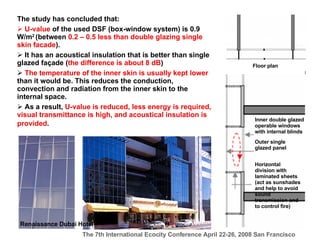
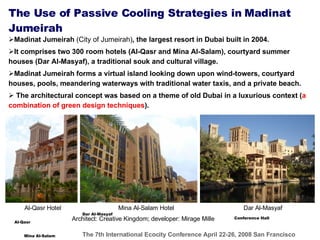
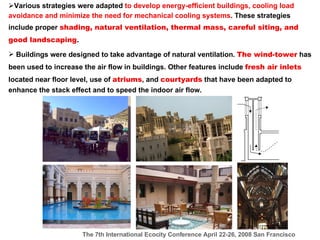
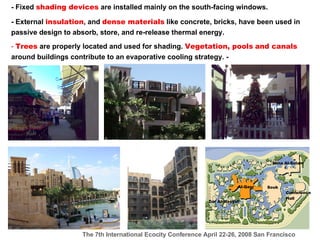
This document discusses passive cooling strategies that can be used in Dubai to reduce energy consumption in buildings and move towards more sustainable practices. It outlines how traditional Arabic architecture effectively used passive design through elements like wind towers, courtyards, and shading. Modern Dubai has moved towards glass tower designs that increase cooling loads. The document examines the Madinat Jumeirah resort as a case study that successfully incorporated passive strategies like wind towers, courtyards, shading, and vegetation to reduce the need for mechanical cooling. It concludes that integrating passive design principles with architecture and mechanical systems can significantly reduce energy use in Dubai's hot climate.
![[a, b, and c] THE PALMS, Three man-made residential islands ( Jumeirah , Jabal Ali and Deira). a b c [d] BURJ DUBAI , the World's tallest tower with one of the largest retail spaces in the world. d [e] THE WORLD PROJECT , 300 artificial islands with 750,000 inhabitants. e [f] MADINAT AL-ARAB , new communities with an area of about 81-million-square metres. f j [j] THE ARABIAN CANAL , a man-made canal with new neighborhoods. k [k] MADINAT JUMEIRA , designed and built in an ecological and resource-efficient manner](https://image.slidesharecdn.com/haggag-7467-1210309472167246-9/85/Haggag-7467-7-320.jpg)