CHITKARA SCHOOL OF PLANNING AND ARCHITECTURE
TALL BUILDINGS
TOPIC:
TALL BUILDINGS IN DUBAI
S A R T H A K K A U R A
+91-85588-69566
T A L L B U I L D I N G S I N D U B A I Page 2
CONTENT
S.NO. TOPIC PAGE NO.
1. INTRODUCTION 2
2. ETYMOLOGY 3
3. HISTORY OF DUBAI
 CHRONOLOGY
 DISCOVERY OF OIL
i. PRE-OIL
ii. OIL ERA
4. HISTORY OF SKYSCRAPPER IN DUBAI 6
5. GEOGRAPHY
 CLIMATE 7
6. ARCHITECTURE OF DUBAI 8
7. JUSTIFICATION OF TOPIC 8
8. CASE STUDIES
 BURJ- AL- ARAB
 EMIRATES TOWER
 CAYAN TOWER
INTRODUCTION
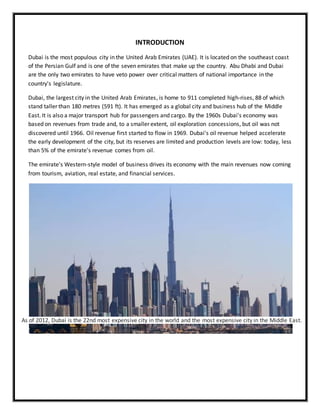
Dubai is the most populous city in the United Arab Emirates (UAE). It is located on the southeast coast
of the Persian Gulf and is one of the seven emirates that make up the country. Abu Dhabi and Dubai
are the only two emirates to have veto power over critical matters of national importance in the
country's legislature.
Dubai, the largest city in the United Arab Emirates, is home to 911 completed high-rises, 88 of which
stand taller than 180 metres (591 ft). It has emerged as a global city and business hub of the Middle
East. It is also a major transport hub for passengers and cargo. By the 1960s Dubai's economy was
based on revenues from trade and, to a smaller extent, oil exploration concessions, but oil was not
discovered until 1966. Oil revenue first started to flow in 1969. Dubai's oil revenue helped accelerate
the early development of the city, but its reserves are limited and production levels are low: today, less
than 5% of the emirate's revenue comes from oil.
The emirate's Western-style model of business drives its economy with the main revenues now coming
from tourism, aviation, real estate, and financial services.
As of 2012, Dubai is the 22nd most expensive city in the world and the most expensive city in the Middle East.
T A L L B U I L D I N G S I N D U B A I Page 4
ETYMOLOGY
Many theories have been proposed as to the origin of the word Dubai. One theory suggests the word
was used to describe the souq, which was similar to the souq in Ba. Another theory states that the
name came from a word meaning "money", as people from Dubai were commonly believed to be rich
due to the thriving trading center of the location. An Arabic proverb says "Daba Dubai" meaning "They
came with a lot of money." According to Fedel-Handhal, a scholar on the UAE's history and culture, the
word Dubai may have come from the word daba (a past tense derivative of yadub , which means "to
creep"), referring to the slow flow of Dubai Creek inland. The poet and scholar Ahmad Mohammad
Obaid traces it to the same word, but to its alternative meaning of "baby locust" due to the abundant
nature of locusts in the area before settlement.
HISTORY
.
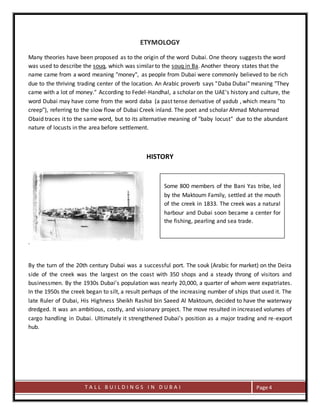
By the turn of the 20th century Dubai was a successful port. The souk (Arabic for market) on the Deira
side of the creek was the largest on the coast with 350 shops and a steady throng of visitors and
businessmen. By the 1930s Dubai's population was nearly 20,000, a quarter of whom were expatriates.
In the 1950s the creek began to silt, a result perhaps of the increasing number of ships that used it. The
late Ruler of Dubai, His Highness Sheikh Rashid bin Saeed Al Maktoum, decided to have the waterway
dredged. It was an ambitious, costly, and visionary project. The move resulted in increased volumes of
cargo handling in Dubai. Ultimately it strengthened Dubai's position as a major trading and re-export
hub.
Some 800 members of the Bani Yas tribe, led
by the Maktoum Family, settled at the mouth
of the creek in 1833. The creek was a natural
harbour and Dubai soon became a center for
the fishing, pearling and sea trade.
CHRONOLOGY
 At the beginning of the 20th century, as trade flourished, many mosques were constructed in
residential and commercial areas so that people would be able to perform their daily prayers
easily. Muslims gathered for Friday prayers at the grand mosque on the Dubai side of the creek.
With its minaret and 52 domes, it was the most elegant building in town.
 With the discovery of oil, Dubai witnessed an unprecedented population explosion. During the
1970s, the emphasis was on accommodating more people in less space, and Dubai's skyline
began to rise, as the Western concept of apartment buildings began to appear alongside the
traditional houses.
 Much of Dubai's infrastructure was established in this decade (roads, housing, drainage, office
buildings, etc.). The most famous building constructed at this time was the 39-storey Dubai
World Trade Centre.
 The 1980s saw architectural projects being developed more in relation with local culture, as
many local architects graduated at this time. A shaded courtyard and water pools were added
to the Dubai Municipality building, and traditional arches graced the Al Wasl Hospital.
 The 1990s saw Dubai architecture mature, with still greater importance given to culture and
heritage. Renovation projects were initiated all over the city, while public gardens were created
in many areas.
DISCOVERY OF OIL
The history of Dubai can be divided into two periods: before and after discovery of oil reserves.
Pre- oil was discovered in Dubai, the place was mostly inhabited by Bedouins, who were engaged in
cultivation of dates, breeding camels and goats. And proximity to the sea has made Dubai the center of
trade with European countries.
OIL ERA
When oil was discovered in 1966, Sheikh Rashid utilized the oil revenues to spur infrastructure
development in Dubai. Schools, hospitals, roads, a modern telecommunications network … the pace of
development was frenetic. A new port and terminal building were built at Dubai International Airport.
A runway extension that could accommodate any type of aircraft was implemented. The largest man-
made harbor in the world was constructed at Jebel Ali, and a free zone was created around the port.
Dubai's formula for development was becoming evident to everyone – visionary leadership, high-
quality infrastructure, an expatriate-friendly environment, zero tax on personal and corporate income
and low import duties. The result was that Dubai quickly became a business and tourism hub for a
T A L L B U I L D I N G S I N D U B A I Page 6
region that stretches from Egypt to the Indian sub-continent and from South Africa to what are now
called the CIS countries.
City life has changed dramatically when oil fields Fateh were discovered in 1966, 60 nautical miles from
the coastline. They were quickly developed, and in 1969 the first batch of “black gold” - 180 thousand
barrels – was exported.
1970s and 1980s of the last century were marked for Dubai by discovering other marine deposits of oil,
in particular Rashed and Falah and onshore field Margam. Peak of “black gold” production in the
Emirate was in 1991, when the total volume of crude oil amounted to around 410 thousand barrels per
day. Currently 68 million barrels of precious liquid is annually produced in Dubai.
HISTORY OF SKYSCRAPPER
At the time of its completion, it also stood as the tallest building in the Middle East. Since 1999, and
especially from 2005 onwards, Dubai has been the site of an extremely large skyscraper building boom,
with all 73 of its buildings over 200 metres (656 ft) tall completed after 1999.
In less than ten years, the city has amassed one of the largest skylines in the world; it is now home to
the world's tallest building, the world's tallest residence, and the world's tallest hotel. As of 2012,
363 new skyscrapers are under construction in Dubai; additionally, there are over 640 active high-rise
developments that have been proposed for construction in the city.
GEOGRAPHY
Dubai lies directly within the Arabian Desert. However, the topography of Dubai is significantly
different from that of the southern portion of the UAE in that much of Dubai's landscape is highlighted
by sandy desert patterns, while gravel deserts dominate much of the southern region of the country.
The sand consists mostly of crushed shell and coral and is fine, clean and white.
The flat sandy desert gives way to the Western Hajar Mountains, which run alongside Dubai's border
with Oman at Hatta. The Western Hajar chain has an arid, jagged and shattered landscape, whose
mountains rise to about 1,300 metres (4,265 feet) in some places.
Dubai has no natural river bodies or oases; however, Dubai does have a natural inlet, Dubai Creek,
which has been dredged to make it deep enough for large vessels to pass through. Dubai also has
multiple gorges and waterholes, which dot the base of the Western Al Hajar mountains. A vast sea of
sand dunes covers much of southern Dubai and eventually leads into the desert known as The Empty
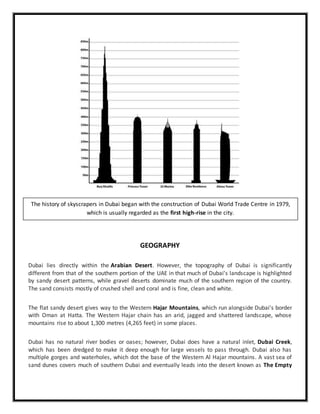
The history of skyscrapers in Dubai began with the construction of Dubai World Trade Centre in 1979,
which is usually regarded as the first high-rise in the city.
T A L L B U I L D I N G S I N D U B A I Page 8
Quarter. Seismically, Dubai is in a very stable zone—the nearest seismic fault line, the Zagros Fault, is
200 kilometres (124 miles) from the UAE and is unlikely to have any seismic impact on Dubai.
CLIMATE
Dubai has a hot desert climate. Summers in Dubai are extremely hot, windy, and humid, with an
average high around 41 °C (106 °F) and overnight lows around 30 °C (86 °F) in the hottest month,
August. Most days are sunny throughout the year. Winters are warm with an average high of 24 °C
(75 °F) and overnight lows of 14 °C (57 °F) in January, the coldest month. Precipitation, however, has
been increasing in the last few decades, with accumulated rain reaching 94.3 mm (3.71 in) per year.
Dubai summers are also known for the moderate to high humidity level, which can make it
uncomfortable for many.
ARCHITECTURE
The traditional vernacular style of architecture in Dubai is the result of a mixture of three dominant
factors: the climate (hot and humid), the religion and customs of its people, and the locally available
building materials.
Dubai has a rich collection of buildings and structures of various architectural styles.
Many modern interpretations of Islamic architecture can be found here, due to a boom in
construction and architectural innovation in the Arab World in general, and in Dubai in particular,
supported not only by top Arab or international architectural and engineering design firms such as Al
Hashemi and Aedas, but also by top firms of New York and Chicago.
As a result of this boom, modern Islamic – and world – architecture has literally been taken to new
levels in skyscraper building design and technology.
Dubai now has more completed or topped-out skyscrapers higher than 2/3 km, 1/3 km, or 1/4 km than
any other city. A culmination point was reached in 2010 with the completion of
the Burj_Khalifa (Khalifa Tower), now by far the world's tallest building at 829.8 m (2,722 ft).
JUSTIFICATION OF TOPIC
Due to the population explosion after the discovery of oil there was a requirement of every type of
building. hence the case studies chosen are according to the use of the building .
1. Burj al arab -Hotel
2. Emirates office tower -Office
3. Cayan tower -Residential
BURJ-AL-ARAB
INTRODUCTION
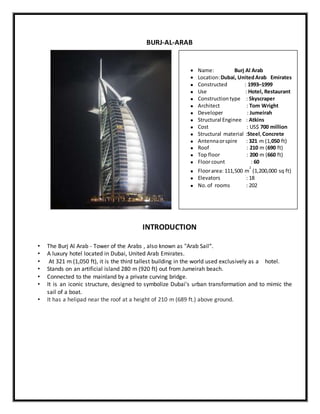
• The Burj Al Arab - Tower of the Arabs , also known as "Arab Sail“.
• A luxury hotel located in Dubai, United Arab Emirates.
• At 321 m (1,050 ft), it is the third tallest building in the world used exclusively as a hotel.
• Stands on an artificial island 280 m (920 ft) out from Jumeirah beach.
• Connected to the mainland by a private curving bridge.
• It is an iconic structure, designed to symbolize Dubai's urban transformation and to mimic the
sail of a boat.
• It has a helipad near the roof at a height of 210 m (689 ft.) above ground.
 Name: Burj Al Arab
 Location:Dubai, UnitedArab Emirates
 Constructed : 1993–1999
 Use : Hotel, Restaurant
 Constructiontype : Skyscraper
 Architect : Tom Wright
 Developer : Jumeirah
 Structural Enginee : Atkins
 Cost : US$ 700 million
 Structural material :Steel,Concrete
 Antennaorspire : 321 m (1,050 ft)
 Roof : 210 m (690 ft)
 Top floor : 200 m (660 ft)
 Floorcount : 60
 Floorarea: 111,500 m
2
(1,200,000 sq ft)
 Elevators : 18
 No.of rooms : 202
T A L L B U I L D I N G S I N D U B A I Page 10
FEATURES OF BURJ-AL-ARAB
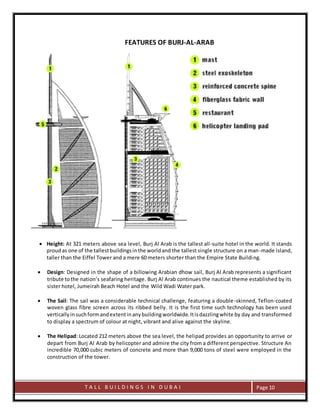
 Height: At 321 meters above sea level, Burj Al Arab is the tallest all-suite hotel in the world. It stands
proudas one of the tallestbuildingsinthe worldand the tallest single structure on a man-made island,
taller than the Eiffel Tower and a mere 60 meters shorter than the Empire State Building.
 Design: Designed in the shape of a billowing Arabian dhow sail, Burj Al Arab represents a significant
tribute tothe nation’s seafaring heritage. Burj Al Arab continues the nautical theme established by its
sister hotel, Jumeirah Beach Hotel and the Wild Wadi Water park.
 The Sail: The sail was a considerable technical challenge, featuring a double-skinned, Teflon-coated
woven glass fibre screen across its ribbed belly. It is the first time such technology has been used
verticallyinsuchformandextentinanybuildingworldwide.Itisdazzlingwhite by day and transformed
to display a spectrum of colour at night, vibrant and alive against the skyline.
 The Helipad: Located 212 meters above the sea level, the helipad provides an opportunity to arrive or
depart from Burj Al Arab by helicopter and admire the city from a different perspective. Structure An
incredible 70,000 cubic meters of concrete and more than 9,000 tons of steel were employed in the
construction of the tower.
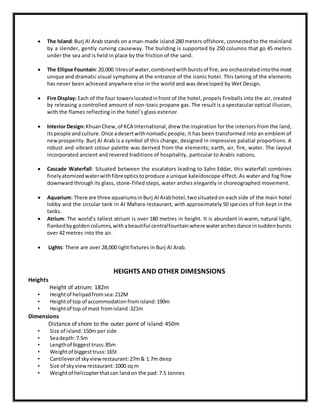
 The Island:Burj Al Arab stands on a man-made island 280 meters offshore, connected to the mainland
by a slender, gently curving causeway. The building is supported by 250 columns that go 45 meters
under the sea and is held in place by the friction of the sand.
 The Ellipse Fountain:20,000 litresof water,combinedwithburstsof fire,are orchestratedintothe most
unique and dramatic visual symphony at the entrance of the iconic hotel. This taming of the elements
has never been achieved anywhere else in the world and was developed by Wet Design.
 Fire Display: Each of the four towerslocatedinfront of the hotel, propels fireballs into the air, created
by releasing a controlled amount of non-toxic propane gas. The result is a spectacular optical illusion,
with the flames reflecting in the hotel’s glass exterior.
 Interior Design:KhuanChew,of KCA International,drew the inspiration for the interiors from the land,
itspeople andculture.Once adesertwithnomadicpeople, it has been transformed into an emblem of
newprosperity. Burj Al Arab is a symbol of this change, designed in impressive palatial proportions. A
robust and vibrant colour palette was derived from the elements; earth, air, fire, water. The layout
incorporated ancient and revered traditions of hospitality, particular to Arabic nations.
 Cascade Waterfall: Situated between the escalators leading to Sahn Eddar, this waterfall combines
finelyatomizedwaterwithfibreopticstoproduce a unique kaleidoscope effect. As water and fog flow
downward through its glass, stone-filled steps, water arches elegantly in choreographed movement.
 Aquarium: There are three aquariumsinBurj Al Arabhotel,twosituatedon each side of the main hotel
lobby and the circular tank in Al Mahara restaurant, with approximately 50 species of fish kept in the
tanks.
 Atrium: The world’s tallest atrium is over 180 metres in height. It is abundant in warm, natural light,
flankedbygoldencolumns,withabeautiful centralfountainwhere waterarchesdance insuddenbursts
over 42 metres into the air.
 Lights: There are over 28,000 light fixtures in Burj Al Arab.
HEIGHTS AND OTHER DIMESNSIONS
Heights
Height of atrium: 182m
• Heightof helipadfromsea:212M
• Heightof top of accommodationfromisland:190m
• Heightof top of mast fromisland:321m
Dimensions
Distance of shore to the outer point of island: 450m
• Size of island:150m per side
• Seadepth:7.5m
• Lengthof biggesttruss:85m
• Weightof biggesttruss:165t
• Cantileverof skyviewrestaurant:27m& 1.7m deep
• Size of skyviewrestaurant:1000 sq m
• Weightof helicopterthatcan landon the pad: 7.5 tonnes
T A L L B U I L D I N G S I N D U B A I Page 12
• Maximumswayat top of accommodation:300mm
• Total volume of concrete onthe island:33,000 sqm
• Total volume of concrete inthe superstructure:36,000 sqm
• Total tonnage of steel:9200 tonnes
• Gross areaof building:120,000 sqm
• 28 double heightfloors(7mfloortofloorheight)
• Heightof atrium:180.5m withvolume of:285,000m3
• Lengthof mast: 60m
• Fabricarea: 8700 sq m x 2 Thickness:1mmwith50cm air gap
How the idea was born...
• The instruction from the client (the Crown Prince of Dubai) was to design, not just a hotel, but also a
signature building; one that would announce, "Welcome to Dubai".
• The clientwanteda dramatic statement with imagery that would immediately conjure up images of the
city.
• The reasonof Burj al Arab buildinglooklike agiantsail- Dubai is becoming a world resort location, so the
buildinghadtosay holiday, fun and sophistication all things associated with yachting. This mixed with
Dubai's nautical heritage it seemed an appropriate shape.
CONCEPT SHEET
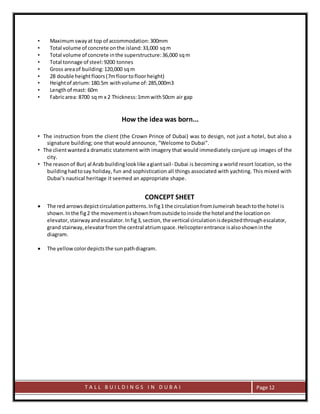
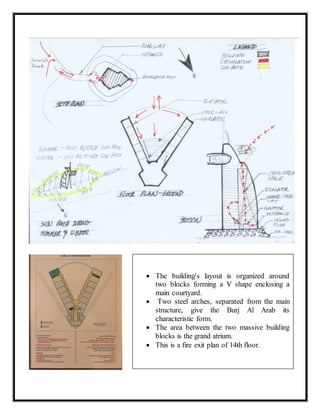
 The red arrowsdepictcirculationpatterns.Infig1 the circulationfromJumeirah beachtothe hotel is
shown.Inthe fig2 the movementisshownfromoutside toinside the hotel andthe locationon
elevator,stairwayandescalator.Infig3,section,the vertical circulationisdepictedthroughescalator,
grand stairway,elevatorfrom the central atriumspace.Helicopterentrance isalsoshowninthe
diagram.
 The yellowcolordepictsthe sunpathdiagram.
 The building's layout is organized around
two blocks forming a V shape enclosing a
main courtyard.
 Two steel arches, separated from the main
structure, give the Burj Al Arab its
characteristic form.
 The area between the two massive building
blocks is the grand atrium.
 This is a fire exit plan of 14th floor.
T A L L B U I L D I N G S I N D U B A I Page 14
LOADS ON THE BUILDING
GRAVITY LOADS:
• Core connections
• Central core service transmits gravity loads
Since the Burj Al Arab is built on a man-made island into the sea, certain geotechnical
considerations had to be considered. Mainly, the ground beneath the Burj Al Arab is sand and
silt. To take this into account, the foundation was made with cement piles that reach a depth of
130 feet. The foundation of this superstructure does not reach bedrock; therefore the stability
comes from the shear forces along each deep pile.
The Burj Al Arab withstands gravity loads through the stability of the two intertwined V’s of
steel and concrete. The concrete walls and slabs come out from the point of the V which is a
special service core. At the end of each floor level are wings. Gravity loads are transferred down
from the core and wings to the foundation. The use of a core and wings was suitable for this
structure to allow for the world’s largest atrium to be enclosed between the two sides of hotel
suites.
LATERAL LOADS:
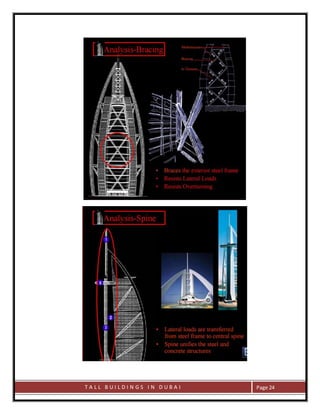
• 3 TUBE STEEL TRUSSES
• CROSS BRACING AND CURVED TRUSS ARCH
• TEFLON COATEDFIBERGLASS FABRIC
As a tall building, the lateral loads of the Burj Al Arab are of most importance. Due to the
geographic location in the Persian Gulf, winds and seismic activity had to be considered. The
building was built to withstand a fifty year wind of 100 miles per hour and a seismic ground
acceleration of 0.2 times gravity (Reina).The structure transfers lateral loads in a number of
ways. First, the Burj Al Arab has three tubular steel trusses on the outside of the two sides of
the V. These trusses act as cross bracing to wind and earthquake forces. The translucent fabric
wall of the atrium is not only a stunning architectural feature but also helps transfer lateral
load. The fabric covers a series of steel cross bracing and is comprised of two layers of fiberglass
material which is Teflon-coated. The fabric goes over the trussed arches mentioned before. Due
to the rigidity, lateral loads are transferred to the fabric wall which acts similar to a diaphragm.
The shape of Burj Al Arab lowers wind forces more effectively then a square building because of
the streamlined V and curved fabric atrium wall.
WIND EFFECTS
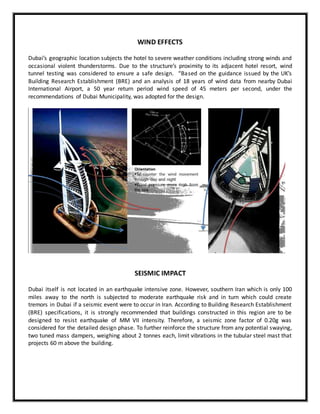
Dubai’s geographic location subjects the hotel to severe weather conditions including strong winds and
occasional violent thunderstorms. Due to the structure’s proximity to its adjacent hotel resort, wind
tunnel testing was considered to ensure a safe design. “Based on the guidance issued by the UK’s
Building Research Establishment (BRE) and an analysis of 18 years of wind data from nearby Dubai
International Airport, a 50 year return period wind speed of 45 meters per second, under the
recommendations of Dubai Municipality, was adopted for the design.
SEISMIC IMPACT
Dubai itself is not located in an earthquake intensive zone. However, southern Iran which is only 100
miles away to the north is subjected to moderate earthquake risk and in turn which could create
tremors in Dubai if a seismic event were to occur in Iran. According to Building Research Establishment
(BRE) specifications, it is strongly recommended that buildings constructed in this region are to be
designed to resist earthquake of MM VII intensity. Therefore, a seismic zone factor of 0.20g was
considered for the detailed design phase. To further reinforce the structure from any potential swaying,
two tuned mass dampers, weighing about 2 tonnes each, limit vibrations in the tubular steel mast that
projects 60 m above the building.
T A L L B U I L D I N G S I N D U B A I Page 16
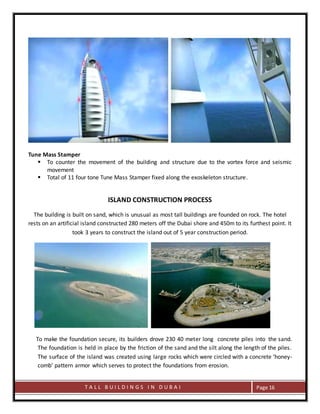
Tune Mass Stamper
 To counter the movement of the building and structure due to the vortex force and seismic
movement
 Total of 11 four tone Tune Mass Stamper fixed along the exoskeleton structure.
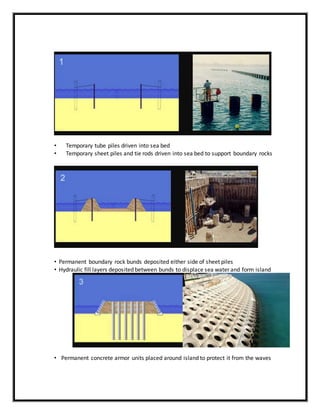
ISLAND CONSTRUCTION PROCESS
The building is built on sand, which is unusual as most tall buildings are founded on rock. The hotel
rests on an artificial island constructed 280 meters off the Dubai shore and 450m to its furthest point. It
took 3 years to construct the island out of 5 year construction period.
To make the foundation secure, its builders drove 230 40 meter long concrete piles into the sand.
The foundation is held in place by the friction of the sand and the silt along the length of the piles.
The surface of the island was created using large rocks which were circled with a concrete ‘honey-
comb′ pattern armor which serves to protect the foundations from erosion.
• Temporary tube piles driven into sea bed
• Temporary sheet piles and tie rods driven into sea bed to support boundary rocks
• Permanent boundary rock bunds deposited either side of sheet piles
• Hydraulic fill layers deposited between bunds to displace sea water and form island
• Permanent concrete armor units placed around island to protect it from the waves
T A L L B U I L D I N G S I N D U B A I Page 18
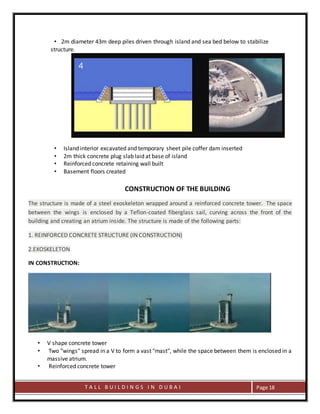
• 2m diameter 43m deep piles driven through island and sea bed below to stabilize
structure.
• Island interior excavated and temporary sheet pile coffer dam inserted
• 2m thick concrete plug slab laid at base of island
• Reinforced concrete retaining wall built
• Basement floors created
CONSTRUCTION OF THE BUILDING
The structure is made of a steel exoskeleton wrapped around a reinforced concrete tower. The space
between the wings is enclosed by a Teflon-coated fiberglass sail, curving across the front of the
building and creating an atrium inside. The structure is made of the following parts:
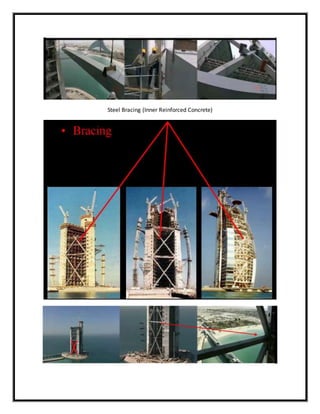
1. REINFORCED CONCRETE STRUCTURE (IN CONSTRUCTION)
2.EXOSKELETON
IN CONSTRUCTION:
• V shape concrete tower
• Two "wings" spread in a V to form a vast "mast", while the space between them is enclosed in a
massive atrium.
• Reinforced concrete tower
Steel Bracing (Inner Reinforced Concrete)
T A L L B U I L D I N G S I N D U B A I Page 20
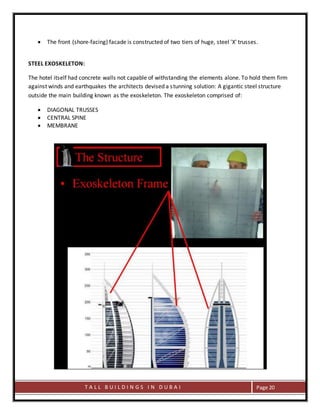
 The front (shore-facing) facade is constructed of two tiers of huge, steel 'X' trusses.
STEEL EXOSKELETON:
The hotel itself had concrete walls not capable of withstanding the elements alone. To hold them firm
against winds and earthquakes the architects devised a stunning solution: A gigantic steel structure
outside the main building known as the exoskeleton. The exoskeleton comprised of:
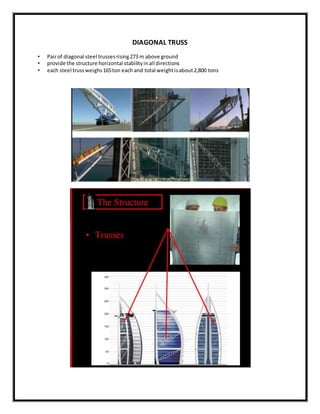
 DIAGONAL TRUSSES
 CENTRAL SPINE
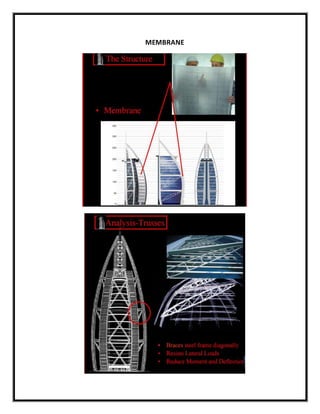
 MEMBRANE
DIAGONAL TRUSS
• Pairof diagonal steel trusses rising273 m above ground
• provide the structure horizontal stabilityinall directions
• each steel trussweighs165ton each and total weightisabout2,800 tons
T A L L B U I L D I N G S I N D U B A I Page 22
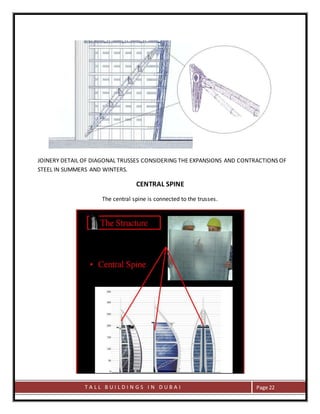
JOINERY DETAIL OF DIAGONAL TRUSSES CONSIDERING THE EXPANSIONS AND CONTRACTIONS OF
STEEL IN SUMMERS AND WINTERS.
CENTRAL SPINE
The central spine is connected to the trusses.
MEMBRANE
T A L L B U I L D I N G S I N D U B A I Page 24
ATRIUM
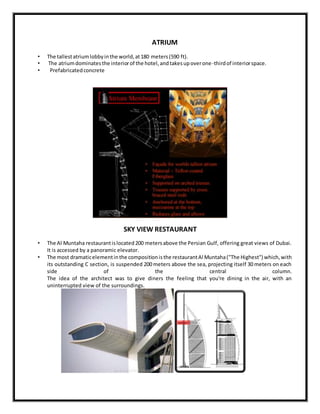
• The tallestatriumlobbyinthe world,at180 meters(590 ft).
• The atriumdominatesthe interiorof the hotel,andtakesupoverone-thirdof interiorspace.
• Prefabricatedconcrete
SKY VIEW RESTAURANT
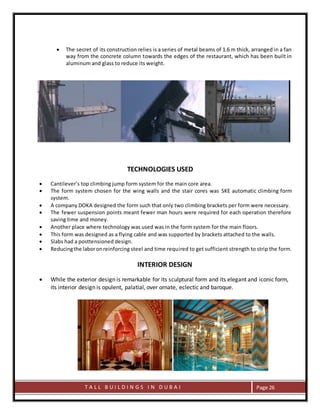
• The Al Muntaha restaurantislocated200 metersabove the Persian Gulf, offering great views of Dubai.
It is accessed by a panoramic elevator.
• The most dramaticelementinthe compositionisthe restaurantAl Muntaha("The Highest") which,with
its outstanding C section, is suspended 200 meters above the sea, projecting itself 30 meters on each
side of the central column.
The idea of the architect was to give diners the feeling that you're dining in the air, with an
uninterrupted view of the surroundings.
T A L L B U I L D I N G S I N D U B A I Page 26
 The secret of its construction relies is a series of metal beams of 1.6 m thick, arranged in a fan
way from the concrete column towards the edges of the restaurant, which has been built in
aluminum and glass to reduce its weight.
TECHNOLOGIES USED
 Cantilever’s top climbing jump form system for the main core area.
 The form system chosen for the wing walls and the stair cores was SKE automatic climbing form
system.
 A company DOKA designed the form such that only two climbing brackets per form were necessary.
 The fewer suspension points meant fewer man hours were required for each operation therefore
saving time and money.
 Another place where technology was used was in the form system for the main floors.
 This form was designed as a flying cable and was supported by brackets attached to the walls.
 Slabs had a posttensioned design.
 Reducingthe laboronreinforcing steel and time required to get sufficient strength to strip the form.
INTERIOR DESIGN
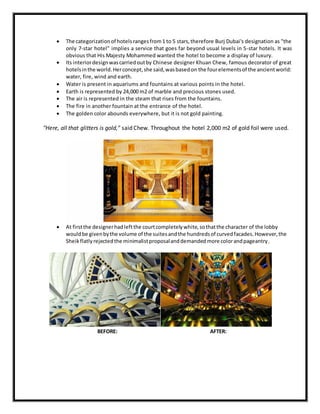
 While the exterior design is remarkable for its sculptural form and its elegant and iconic form,
its interior design is opulent, palatial, over ornate, eclectic and baroque.
 The categorizationof hotelsrangesfrom1 to 5 stars,therefore Burj Dubai's designation as "the
only 7-star hotel" implies a service that goes far beyond usual levels in 5-star hotels. It was
obvious that His Majesty Mohammed wanted the hotel to become a display of luxury.
 Its interiordesignwascarriedoutby Chinese designer Khuan Chew, famous decorator of great
hotelsinthe world.Herconcept,she said,wasbasedon the fourelementsof the ancientworld:
water, fire, wind and earth.
 Water is present in aquariums and fountains at various points in the hotel.
 Earth is represented by 24,000 m2 of marble and precious stones used.
 The air is represented in the steam that rises from the fountains.
 The fire in another fountain at the entrance of the hotel.
 The golden color abounds everywhere, but it is not gold painting.
"Here, all that glitters is gold," said Chew. Throughout the hotel 2,000 m2 of gold foil were used.
 At firstthe designerhadleftthe courtcompletelywhite,sothatthe character of the lobby
wouldbe givenbythe volume of the suitesandthe hundredsof curvedfacades.However,the
Sheikflatlyrejectedthe minimalistproposalanddemandedmore colorandpageantry.
BEFORE: AFTER:
T A L L B U I L D I N G S I N D U B A I Page 28
SUITES
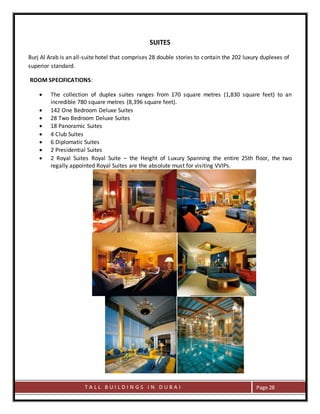
Burj Al Arab is an all-suite hotel that comprises 28 double stories to contain the 202 luxury duplexes of
superior standard.
ROOM SPECIFICATIONS:
 The collection of duplex suites ranges from 170 square metres (1,830 square feet) to an
incredible 780 square metres (8,396 square feet).
 142 One Bedroom Deluxe Suites
 28 Two Bedroom Deluxe Suites
 18 Panoramic Suites
 4 Club Suites
 6 Diplomatic Suites
 2 Presidential Suites
 2 Royal Suites Royal Suite – the Height of Luxury Spanning the entire 25th floor, the two
regally appointed Royal Suites are the absolute must for visiting VVIPs.
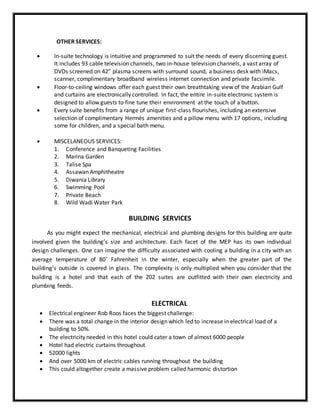
OTHER SERVICES:
 In-suite technology is intuitive and programmed to suit the needs of every discerning guest.
It includes 93 cable television channels, two in-house television channels, a vast array of
DVDs screened on 42” plasma screens with surround sound, a business desk with iMacs,
scanner, complimentary broadband wireless internet connection and private facsimile.
 Floor-to-ceiling windows offer each guest their own breathtaking view of the Arabian Gulf
and curtains are electronically controlled. In fact, the entire in-suite electronic system is
designed to allow guests to fine tune their environment at the touch of a button.
 Every suite benefits from a range of unique first-class flourishes, including an extensive
selection of complimentary Hermès amenities and a pillow menu with 17 options, including
some for children, and a special bath menu.
 MISCELANEOUS SERVICES:
1. Conference and Banqueting Facilities
2. Marina Garden
3. Talise Spa
4. Assawan Amphitheatre
5. Diwania Library
6. Swimming Pool
7. Private Beach
8. Wild Wadi Water Park
BUILDING SERVICES
As you might expect the mechanical, electrical and plumbing designs for this building are quite
involved given the building’s size and architecture. Each facet of the MEP has its own individual
design challenges. One can imagine the difficulty associated with cooling a building in a city with an
average temperature of 80˚ Fahrenheit in the winter, especially when the greater part of the
building’s outside is covered in glass. The complexity is only multiplied when you consider that the
building is a hotel and that each of the 202 suites are outfitted with their own electricity and
plumbing feeds.
ELECTRICAL
 Electrical engineer Rob Roos faces the biggest challenge:
 There was a total change in the interior design which led to increase in electrical load of a
building to 50%.
 The electricity needed in this hotel could cater a town of almost 6000 people
 Hotel had electric curtains throughout
 52000 lights
 And over 5000 km of electric cables running throughout the building
 This could altogether create a massive problem called harmonic distortion
T A L L B U I L D I N G S I N D U B A I Page 30
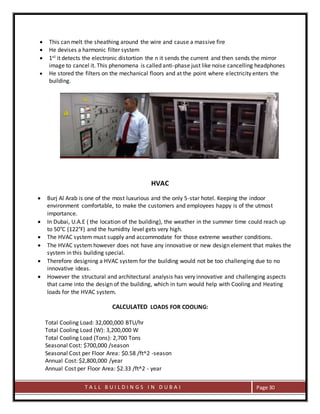
 This can melt the sheathing around the wire and cause a massive fire
 He devises a harmonic filter system
 1st it detects the electronic distortion the n it sends the current and then sends the mirror
image to cancel it. This phenomena is called anti-phase just like noise cancelling headphones
 He stored the filters on the mechanical floors and at the point where electricity enters the
building.
HVAC
 Burj Al Arab is one of the most luxurious and the only 5-star hotel. Keeping the indoor
environment comfortable, to make the customers and employees happy is of the utmost
importance.
 In Dubai, U.A.E ( the location of the building), the weather in the summer time could reach up
to 50°C (122°F) and the humidity level gets very high.
 The HVAC system must supply and accommodate for those extreme weather conditions.
 The HVAC system however does not have any innovative or new design element that makes the
system in this building special.
 Therefore designing a HVAC system for the building would not be too challenging due to no
innovative ideas.
 However the structural and architectural analysis has very innovative and challenging aspects
that came into the design of the building, which in turn would help with Cooling and Heating
loads for the HVAC system.
CALCULATED LOADS FOR COOLING:
Total Cooling Load: 32,000,000 BTU/hr
Total Cooling Load (W): 3,200,000 W
Total Cooling Load (Tons): 2,700 Tons
Seasonal Cost: $700,000 /season
Seasonal Cost per Floor Area: $0.58 /ft^2 -season
Annual Cost: $2,800,000 /year
Annual Cost per Floor Area: $2.33 /ft^2 - year
CALCULATED LOADS FOR HEATING:
Total Heating Load: 3,600,000 BTU/hr
Total Heating Load (gal/hr): 30 gal/hr
Total Cost per Hour: $60/hr
Total Cost per Year: $525,000/year
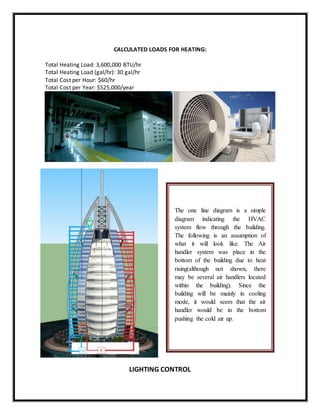
LIGHTING CONTROL
The one line diagram is a simple
diagram indicating the HVAC
system flow through the building.
The following is an assumption of
what it will look like. The Air
handler system was place in the
bottom of the building due to heat
rising(although not shown, there
may be several air handlers located
within the building). Since the
building will be mainly in cooling
mode, it would seem that the air
handler would be in the bottom
pushing the cold air up.
T A L L B U I L D I N G S I N D U B A I Page 32
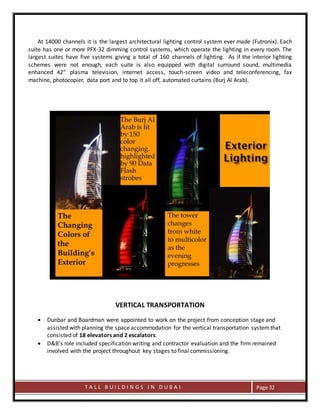
At 14000 channels it is the largest architectural lighting control system ever made (Futronix). Each
suite has one or more PFX-32 dimming control systems, which operate the lighting in every room. The
largest suites have five systems giving a total of 160 channels of lighting. As if the interior lighting
schemes were not enough, each suite is also equipped with digital surround sound, multimedia
enhanced 42” plasma television, internet access, touch-screen video and teleconferencing, fax
machine, photocopier, data port and to top it all off, automated curtains (Burj Al Arab).
VERTICAL TRANSPORTATION
 Dunbar and Boardman were appointed to work on the project from conception stage and
assisted with planning the space accommodation for the vertical transportation systemthat
consisted of 18 elevators and 2 escalators.
 D&B’s role included specification writing and contractor evaluation and the firm remained
involved with the project throughout key stages to final commissioning.
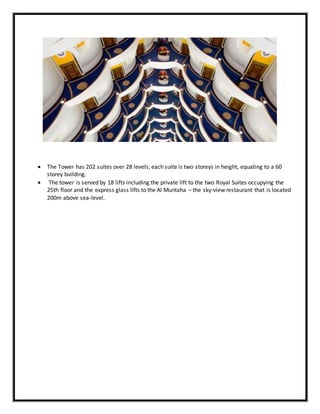
 The Tower has 202 suites over 28 levels; each suite is two storeys in height, equating to a 60
storey building.
 The tower is served by 18 lifts including the private lift to the two Royal Suites occupying the
25th floor and the express glass lifts to the Al Muntaha – the sky-view restaurant that is located
200m above sea-level.
T A L L B U I L D I N G S I N D U B A I Page 34
EMIRATES TOWER
INTRODUCTION
 The Emirates Office Tower, also known as Emirates Tower One, is a 54-floor office building in
the city of Dubai, United Arab Emirates.
 Connected with the 56-floor Jumeirah Emirates Towers Hotel by a retail boulevard, the two
towers form what is commonly referred to as the Emirates Towers complex.
 Many international organizations and companies, including: CARTIER ,ROLLS ROYCE, BMW
have chosen the Emirates Office Tower as their business location.
 The tower has a total structural height of 354.6 m (1,163 ft.) and roof height of 311 m
(1,020 ft.), making it the 23rd-tallest building in the world.
 Jumeirah Emirates Office Tower attains its iconic status not only from its imposing profile, but
from its outstanding standards of finish, design and functionality.
 This is a design without compromise, a concept which reflects leading business style. Sharp
lines and high technology meet in a place which provides the optimum environment, natural
light and panoramic views.
 This is a place where function and form operate in harmony - creating maximum efficiency in
an atmosphere of corporate strength.
 The Emirates Office Tower One is taller than the neighboring Jumeirah Emirates Towers Hotel,
but has two fewer floors.
 Construction of the building was completed on November 3, 1999.
 Emirates Towers remains one of the most admired profiles of the city skyline.
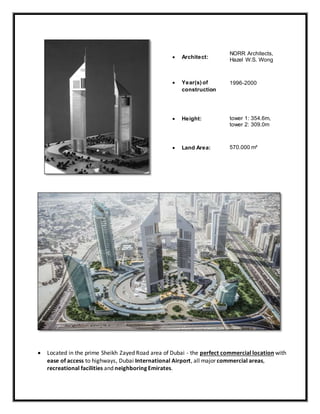
 Located in the prime Sheikh Zayed Road area of Dubai - the perfect commercial location with
ease of access to highways, Dubai International Airport, all major commercial areas,
recreational facilities and neighboring Emirates.
 Architect:
NORR Architects,
Hazel W.S. Wong
 Year(s) of
construction
1996-2000
 Height: tower 1: 354.6m,
tower 2: 309.0m
 Land Area: 570.000 m²
T A L L B U I L D I N G S I N D U B A I Page 36
 The site for the project, approximately 500 meters -350 meters and 169,000 square meters in
area is located along a major thoroughfare in the new bustling commercial and residential
center of the city.
 The design concentrates the buildings away from the highway in a central portion of the
site.This way the project is distinctly set apart from the standard commercial development and
the twin towers are positioned so as to create meaningful visual compositions from every
viewpoint.
 Beyond the immediate periphery of the building complex, the formal landscaped environment
progress into a natural park-like setting with gentle contours and lush vegetation buffering the
roadways around the site perimeter completing the development which represents a major
destination point and offers a sense of an oasis amidst an urban concrete environment.
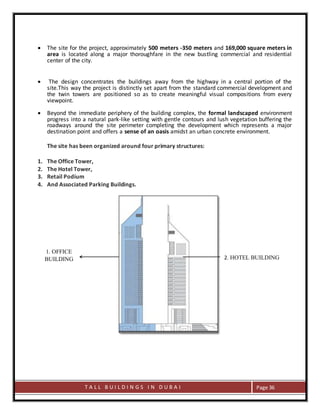
The site has been organized around four primary structures:
1. The Office Tower,
2. The Hotel Tower,
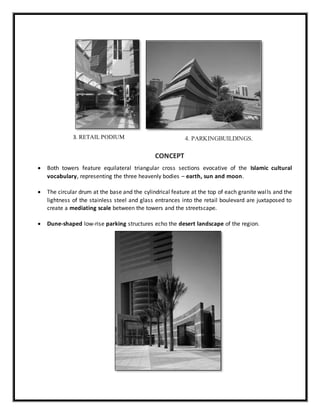
3. Retail Podium
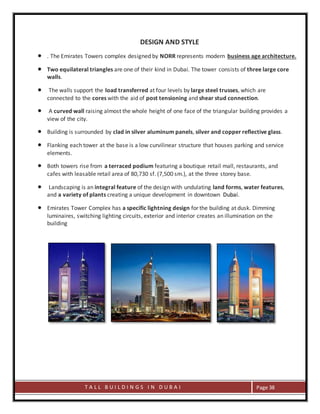
4. And Associated Parking Buildings.
2. HOTEL BUILDING
1. OFFICE
BUILDING
CONCEPT
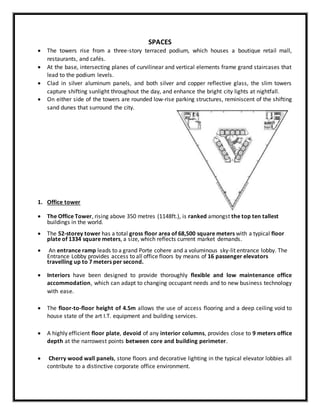
 Both towers feature equilateral triangular cross sections evocative of the Islamic cultural
vocabulary, representing the three heavenly bodies – earth, sun and moon.
 The circular drum at the base and the cylindrical feature at the top of each granite walls and the
lightness of the stainless steel and glass entrances into the retail boulevard are juxtaposed to
create a mediating scale between the towers and the streetscape.
 Dune-shaped low-rise parking structures echo the desert landscape of the region.
4. PARKINGBUILDINGS.3. RETAIL PODIUM
T A L L B U I L D I N G S I N D U B A I Page 38
DESIGN AND STYLE
 . The Emirates Towers complex designed by NORR represents modern business age architecture.
 Two equilateral triangles are one of their kind in Dubai. The tower consists of three large core
walls.
 The walls support the load transferred at four levels by large steel trusses, which are
connected to the cores with the aid of post tensioning and shear stud connection.
 A curved wall raising almost the whole height of one face of the triangular building provides a
view of the city.
 Building is surrounded by clad in silver aluminum panels, silver and copper reflective glass.
 Flanking each tower at the base is a low curvilinear structure that houses parking and service
elements.
 Both towers rise from a terraced podium featuring a boutique retail mall, restaurants, and
cafes with leasable retail area of 80,730 sf. (7,500 sm.), at the three storey base.
 Landscaping is an integral feature of the design with undulating land forms, water features,
and a variety of plants creating a unique development in downtown Dubai.
 Emirates Tower Complex has a specific lightning design for the building at dusk. Dimming
luminaires, switching lighting circuits, exterior and interior creates an illumination on the
building
SPACES
 The towers rise from a three-story terraced podium, which houses a boutique retail mall,
restaurants, and cafés.
 At the base, intersecting planes of curvilinear and vertical elements frame grand staircases that
lead to the podium levels.
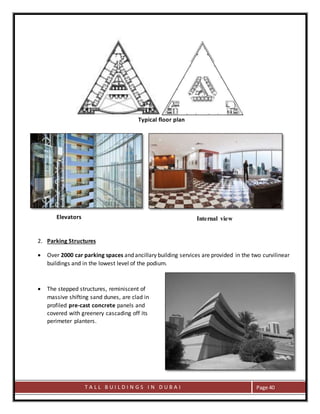
 Clad in silver aluminum panels, and both silver and copper reflective glass, the slim towers
capture shifting sunlight throughout the day, and enhance the bright city lights at nightfall.
 On either side of the towers are rounded low-rise parking structures, reminiscent of the shifting
sand dunes that surround the city.
1. Office tower
 The Office Tower, rising above 350 metres (1148ft.), is ranked amongst the top ten tallest
buildings in the world.
 The 52-storey tower has a total gross floor area of 68,500 square meters with a typical floor
plate of 1334 square meters, a size, which reflects current market demands.
 An entrance ramp leads to a grand Porte cohere and a voluminous sky-lit entrance lobby. The
Entrance Lobby provides access to all office floors by means of 16 passenger elevators
travelling up to 7 meters per second.
 Interiors have been designed to provide thoroughly flexible and low maintenance office
accommodation, which can adapt to changing occupant needs and to new business technology
with ease.
 The floor-to-floor height of 4.5m allows the use of access flooring and a deep ceiling void to
house state of the art I.T. equipment and building services.
 A highly efficient floor plate, devoid of any interior columns, provides close to 9 meters office
depth at the narrowest points between core and building perimeter.
 Cherry wood wall panels, stone floors and decorative lighting in the typical elevator lobbies all
contribute to a distinctive corporate office environment.
T A L L B U I L D I N G S I N D U B A I Page 40
Typical floor plan
Elevators
2. Parking Structures
 Over 2000 car parking spaces and ancillary building services are provided in the two curvilinear
buildings and in the lowest level of the podium.
 The stepped structures, reminiscent of
massive shifting sand dunes, are clad in
profiled pre-cast concrete panels and
covered with greenery cascading off its
perimeter planters.
Internal view
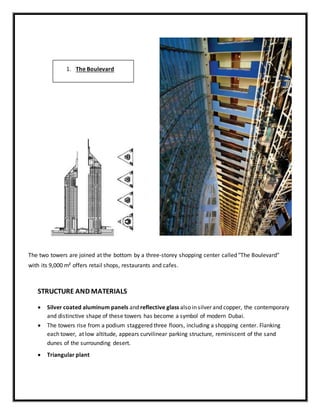
The two towers are joined at the bottom by a three-storey shopping center called "The Boulevard"
with its 9,000 m² offers retail shops, restaurants and cafes.
STRUCTURE AND MATERIALS
 Silver coated aluminum panels and reflective glass also in silver and copper, the contemporary
and distinctive shape of these towers has become a symbol of modern Dubai.
 The towers rise from a podium staggered three floors, including a shopping center. Flanking
each tower, at low altitude, appears curvilinear parking structure, reminiscent of the sand
dunes of the surrounding desert.
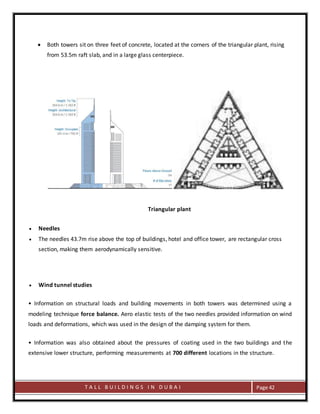
 Triangular plant
1. The Boulevard
T A L L B U I L D I N G S I N D U B A I Page 42
 Both towers sit on three feet of concrete, located at the corners of the triangular plant, rising
from 53.5m raft slab, and in a large glass centerpiece.
Triangular plant
 Needles
 The needles 43.7m rise above the top of buildings, hotel and office tower, are rectangular cross
section, making them aerodynamically sensitive.
 Wind tunnel studies
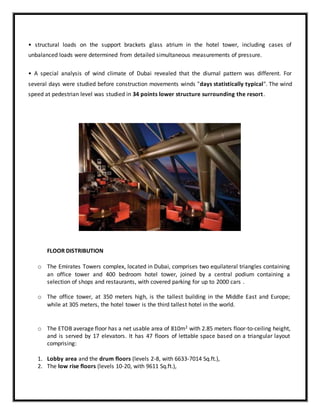
• Information on structural loads and building movements in both towers was determined using a
modeling technique force balance. Aero elastic tests of the two needles provided information on wind
loads and deformations, which was used in the design of the damping system for them.
• Information was also obtained about the pressures of coating used in the two buildings and the
extensive lower structure, performing measurements at 700 different locations in the structure.
• structural loads on the support brackets glass atrium in the hotel tower, including cases of
unbalanced loads were determined from detailed simultaneous measurements of pressure.
• A special analysis of wind climate of Dubai revealed that the diurnal pattern was different. For
several days were studied before construction movements winds "days statistically typical". The wind
speed at pedestrian level was studied in 34 points lower structure surrounding the resort.
FLOOR DISTRIBUTION
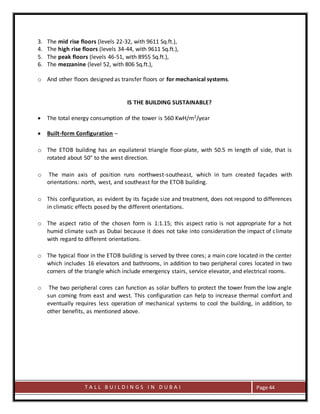
o The Emirates Towers complex, located in Dubai, comprises two equilateral triangles containing
an office tower and 400 bedroom hotel tower, joined by a central podium containing a
selection of shops and restaurants, with covered parking for up to 2000 cars .
o The office tower, at 350 meters high, is the tallest building in the Middle East and Europe;
while at 305 meters, the hotel tower is the third tallest hotel in the world.
o The ETOB average floor has a net usable area of 810m2 with 2.85 meters floor-to-ceiling height,
and is served by 17 elevators. It has 47 floors of lettable space based on a triangular layout
comprising:
1. Lobby area and the drum floors (levels 2-8, with 6633-7014 Sq.ft.),
2. The low rise floors (levels 10-20, with 9611 Sq.ft.),
T A L L B U I L D I N G S I N D U B A I Page 44
3. The mid rise floors (levels 22-32, with 9611 Sq.ft.),
4. The high rise floors (levels 34-44, with 9611 Sq.ft.),
5. The peak floors (levels 46-51, with 8955 Sq.ft.),
6. The mezzanine (level 52, with 806 Sq.ft.),
o And other floors designed as transfer floors or for mechanical systems.
IS THE BUILDING SUSTAINABLE?
 The total energy consumption of the tower is 560 KwH/m2/year
 Built-form Configuration –
o The ETOB building has an equilateral triangle floor-plate, with 50.5 m length of side, that is
rotated about 50° to the west direction.
o The main axis of position runs northwest-southeast, which in turn created façades with
orientations: north, west, and southeast for the ETOB building.
o This configuration, as evident by its façade size and treatment, does not respond to differences
in climatic effects posed by the different orientations.
o The aspect ratio of the chosen form is 1:1.15; this aspect ratio is not appropriate for a hot
humid climate such as Dubai because it does not take into consideration the impact of climate
with regard to different orientations.
o The typical floor in the ETOB building is served by three cores; a main core located in the center
which includes 16 elevators and bathrooms, in addition to two peripheral cores located in two
corners of the triangle which include emergency stairs, service elevator, and electrical rooms.
o The two peripheral cores can function as solar buffers to protect the tower from the low angle
sun coming from east and west. This configuration can help to increase thermal comfort and
eventually requires less operation of mechanical systems to cool the building, in addition, to
other benefits, as mentioned above.
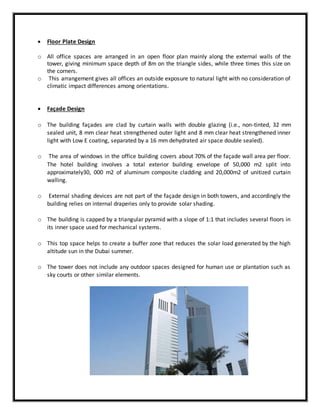
 Floor Plate Design
o All office spaces are arranged in an open floor plan mainly along the external walls of the
tower, giving minimum space depth of 8m on the triangle sides, while three times this size on
the corners.
o This arrangement gives all offices an outside exposure to natural light with no consideration of
climatic impact differences among orientations.
 Façade Design
o The building façades are clad by curtain walls with double glazing (i.e., non-tinted, 32 mm
sealed unit, 8 mm clear heat strengthened outer light and 8 mm clear heat strengthened inner
light with Low E coating, separated by a 16 mm dehydrated air space double sealed).
o The area of windows in the office building covers about 70% of the façade wall area per floor.
The hotel building involves a total exterior building envelope of 50,000 m2 split into
approximately30, 000 m2 of aluminum composite cladding and 20,000m2 of unitized curtain
walling.
o External shading devices are not part of the façade design in both towers, and accordingly the
building relies on internal draperies only to provide solar shading.
o The building is capped by a triangular pyramid with a slope of 1:1 that includes several floors in
its inner space used for mechanical systems.
o This top space helps to create a buffer zone that reduces the solar load generated by the high
altitude sun in the Dubai summer.
o The tower does not include any outdoor spaces designed for human use or plantation such as
sky courts or other similar elements.
T A L L B U I L D I N G S I N D U B A I Page 46
 Natural and Artificial Lighting Systems
o The building is not designed to maximize utilization of day lighting; yet, during the day, most of
the offices have access to natural lighting through the windows (i.e., sidelight systems without
light shelves).
o The room height-to-depth ratio is 1:2.7 with window glazing that is 30% of the external wall
area. The office tower has general and decorative lighting using modular and compact
fluorescent luminaries.
o The general illumination is designed to meet European guidelines for areas where VDU
terminals are used. The illumination level for the office area is designed for 500LUX and the low
brightness louvers meet the requirement of CIBSE LG3 category 2 criteria.
o A computer based centralized lighting control system is provided to give the tenant a high level
of flexibility for sub division and to provide benefits in terms of reduced fit out work.
o Each modular light fitting can be individually addressed to suit the tenant’s requirements
without alteration to base wiring.
o If required, facilities are also available to allow the tenant to fit movement detectors, manual
and infrared switches to suit individual needs. The high frequency control gear allows tenants
to dim the fluorescent lighting if required.
o Emergency lighting is provided on each floor and to all escape routes. Each tower is equipped
with a workstation running Dalmatic ZMC lighting control software. This object-oriented tool
uses the building’s CAD drawings and displays all lights and lighting control devices in the entire
site.
o Furthermore, the ZMC software allows lights to be configured in predefined scenes to meet
operational requirements. In the office tower each light fixture is attached to a Dalmatic
lighting control module which supplies power and enables independent or group dimming and
on/off switching.
o Since the module is a node on the Lon Works network, each luminaire is addressed and can be
controlled from the two ZMC workstations or a physical switch to which it has been bound. All
physical switches and lighting control devices, including floor control switches, are connected to
the lighting control modules.
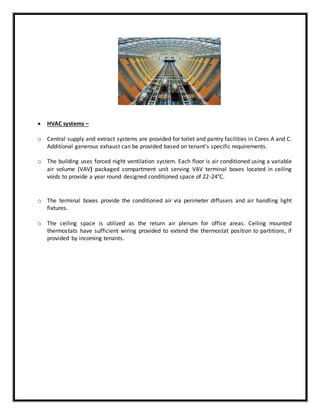
 HVAC systems –
o Central supply and extract systems are provided for toilet and pantry facilities in Cores A and C.
Additional generous exhaust can be provided based on tenant’s specific requirements.
o The building uses forced night ventilation system. Each floor is air conditioned using a variable
air volume (VAV) packaged compartment unit serving VAV terminal boxes located in ceiling
voids to provide a year round designed conditioned space of 22-24°C.
o The terminal boxes provide the conditioned air via perimeter diffusers and air handling light
fixtures.
o The ceiling space is utilized as the return air plenum for office areas. Ceiling mounted
thermostats have sufficient wiring provided to extend the thermostat position to partitions, if
provided by incoming tenants.
T A L L B U I L D I N G S I N D U B A I Page 48
CAYAN TOWER
INTRODUCTION
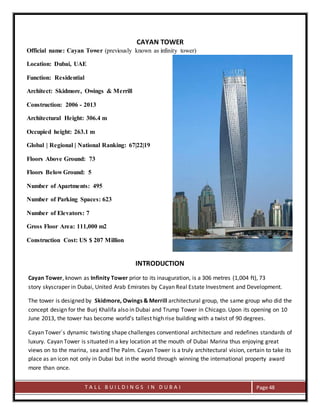
Cayan Tower, known as Infinity Tower prior to its inauguration, is a 306 metres (1,004 ft), 73
story skyscraper in Dubai, United Arab Emirates by Cayan Real Estate Investment and Development.
The tower is designed by Skidmore, Owings & Merrill architectural group, the same group who did the
concept design for the Burj Khalifa also in Dubai and Trump Tower in Chicago. Upon its opening on 10
June 2013, the tower has become world's tallest high rise building with a twist of 90 degrees.
Cayan Tower´s dynamic twisting shape challenges conventional architecture and redefines standards of
luxury. Cayan Tower is situated in a key location at the mouth of Dubai Marina thus enjoying great
views on to the marina, sea and The Palm. Cayan Tower is a truly architectural vision, certain to take its
place as an icon not only in Dubai but in the world through winning the international property award
more than once.
Official name: Cayan Tower (previously known as infinity tower)
Location: Dubai, UAE
Function: Residential
Architect: Skidmore, Owings & Merrill
Construction: 2006 - 2013
Architectural Height: 306.4 m
Occupied height: 263.1 m
Global | Regional | National Ranking: 67|22|19
Floors Above Ground: 73
Floors Below Ground: 5
Number of Apartments: 495
Number of Parking Spaces: 623
Number of Elevators: 7
Gross Floor Area: 111,000 m2
Construction Cost: US $ 207 Million
Material: Reinforced Concrete
DESIGN IDEA AND GOALS
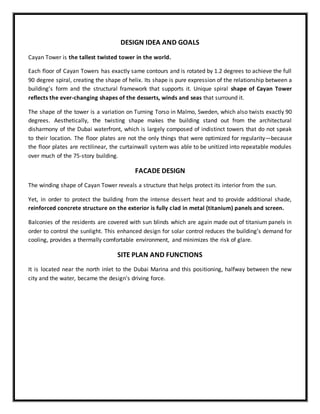
Cayan Tower is the tallest twisted tower in the world.
Each floor of Cayan Towers has exactly same contours and is rotated by 1.2 degrees to achieve the full
90 degree spiral, creating the shape of helix. Its shape is pure expression of the relationship between a
building’s form and the structural framework that supports it. Unique spiral shape of Cayan Tower
reflects the ever-changing shapes of the desserts, winds and seas that surround it.
The shape of the tower is a variation on Turning Torso in Malmo, Sweden, which also twists exactly 90
degrees. Aesthetically, the twisting shape makes the building stand out from the architectural
disharmony of the Dubai waterfront, which is largely composed of indistinct towers that do not speak
to their location. The floor plates are not the only things that were optimized for regularity—because
the floor plates are rectilinear, the curtainwall system was able to be unitized into repeatable modules
over much of the 75-story building.
FACADE DESIGN
The winding shape of Cayan Tower reveals a structure that helps protect its interior from the sun.
Yet, in order to protect the building from the intense dessert heat and to provide additional shade,
reinforced concrete structure on the exterior is fully clad in metal (titanium) panels and screen.
Balconies of the residents are covered with sun blinds which are again made out of titanium panels in
order to control the sunlight. This enhanced design for solar control reduces the building’s demand for
cooling, provides a thermally comfortable environment, and minimizes the risk of glare.
SITE PLAN AND FUNCTIONS
It is located near the north inlet to the Dubai Marina and this positioning, halfway between the new
city and the water, became the design's driving force.
T A L L B U I L D I N G S I N D U B A I Page 50
BUILDING FUNCTIONS
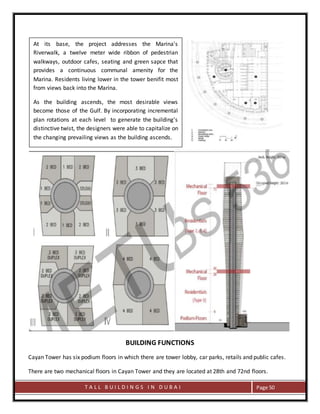
Cayan Tower has six podium floors in which there are tower lobby, car parks, retails and public cafes.
There are two mechanical floors in Cayan Tower and they are located at 28th and 72nd floors.
At its base, the project addresses the Marina's
Riverwalk, a twelve meter wide ribbon of pedestrian
walkways, outdoor cafes, seating and green sapce that
provides a continuous communal amenity for the
Marina. Residents living lower in the tower benifit most
from views back into the Marina.
As the building ascends, the most desirable views
become those of the Gulf. By incorporating incremental
plan rotations at each level to generate the building's
distinctive twist, the designers were able to capitalize on
the changing prevailing views as the building ascends.
Both mechanical floors are in two-storey height.
DIVISION OF UNITS IN THE BUILDING
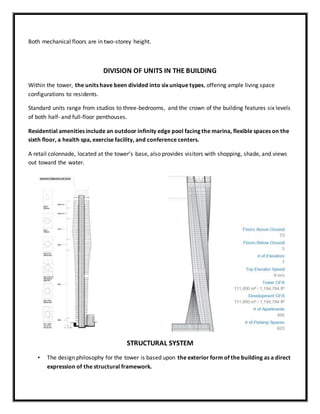
Within the tower, the units have been divided into six unique types, offering ample living space
configurations to residents.
Standard units range from studios to three-bedrooms, and the crown of the building features six levels
of both half- and full-floor penthouses.
Residential amenities include an outdoor infinity edge pool facing the marina, flexible spaces on the
sixth floor, a health spa, exercise facility, and conference centers.
A retail colonnade, located at the tower’s base, also provides visitors with shopping, shade, and views
out toward the water.
STRUCTURAL SYSTEM
• The design philosophy for the tower is based upon the exterior form of the building as a direct
expression of the structural framework.
T A L L B U I L D I N G S I N D U B A I Page 52
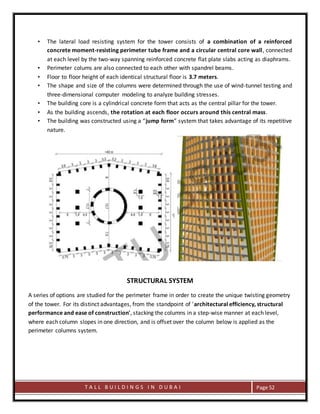
• The lateral load resisting system for the tower consists of a combination of a reinforced
concrete moment-resisting perimeter tube frame and a circular central core wall, connected
at each level by the two-way spanning reinforced concrete flat plate slabs acting as diaphrams.
• Perimeter colums are also connected to each other with spandrel beams.
• Floor to floor height of each identical structural floor is 3.7 meters.
• The shape and size of the columns were determined through the use of wind-tunnel testing and
three-dimensional computer modeling to analyze building stresses.
• The building core is a cylindrical concrete form that acts as the central pillar for the tower.
• As the building ascends, the rotation at each floor occurs around this central mass.
• The building was constructed using a “jump form” system that takes advantage of its repetitive
nature.
STRUCTURAL SYSTEM
A series of options are studied for the perimeter frame in order to create the unique twisting geometry
of the tower. For its distinct advantages, from the standpoint of 'architectural efficiency, structural
performance and ease of construction', stacking the columns in a step-wise manner at each level,
where each column slopes in one direction, and is offset over the column below is applied as the
perimeter columns system.
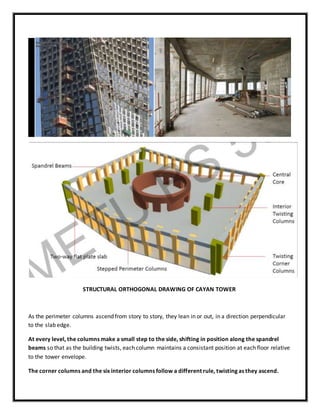
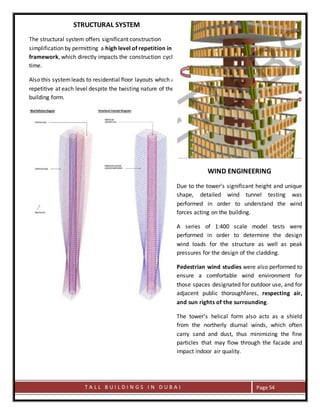
As the perimeter columns ascend from story to story, they lean in or out, in a direction perpendicular
to the slab edge.
At every level, the columns make a small step to the side, shifting in position along the spandrel
beams so that as the building twists, each column maintains a consistant position at each floor relative
to the tower envelope.
The corner columns and the six interior columns follow a different rule, twisting as they ascend.
STRUCTURAL ORTHOGONAL DRAWING OF CAYAN TOWER
T A L L B U I L D I N G S I N D U B A I Page 54
STRUCTURAL SYSTEM
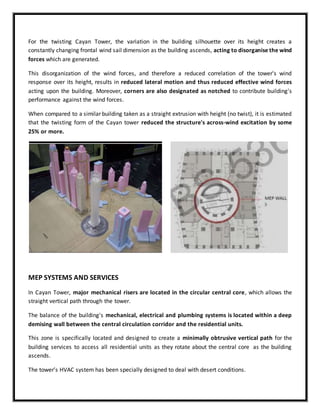
The structural system offers significant construction
simplification by permitting a high level of repetition in the
framework, which directly impacts the construction cycle
time.
Also this systemleads to residential floor layouts which are
repetitive at each level despite the twisting nature of the
building form.
WIND ENGINEERING
Due to the tower's significant height and unique
shape, detailed wind tunnel testing was
performed in order to understand the wind
forces acting on the building.
A series of 1:400 scale model tests were
performed in order to determine the design
wind loads for the structure as well as peak
pressures for the design of the cladding.
Pedestrian wind studies were also performed to
ensure a comfortable wind environment for
those spaces designated for outdoor use, and for
adjacent public thoroughfares, respecting air,
and sun rights of the surrounding.
The tower’s helical form also acts as a shield
from the northerly diurnal winds, which often
carry sand and dust, thus minimizing the fine
particles that may flow through the facade and
impact indoor air quality.
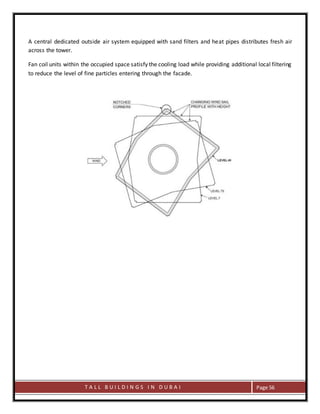
For the twisting Cayan Tower, the variation in the building silhouette over its height creates a
constantly changing frontal wind sail dimension as the building ascends, acting to disorganise the wind
forces which are generated.
This disorganization of the wind forces, and therefore a reduced correlation of the tower's wind
response over its height, results in reduced lateral motion and thus reduced effective wind forces
acting upon the building. Moreover, corners are also designated as notched to contribute building's
performance against the wind forces.
When compared to a similar building taken as a straight extrusion with height (no twist), it is estimated
that the twisting form of the Cayan tower reduced the structure's across-wind excitation by some
25% or more.
MEP SYSTEMS AND SERVICES
In Cayan Tower, major mechanical risers are located in the circular central core, which allows the
straight vertical path through the tower.
The balance of the building's mechanical, electrical and plumbing systems is located within a deep
demising wall between the central circulation corridor and the residential units.
This zone is specifically located and designed to create a minimally obtrusive vertical path for the
building services to access all residential units as they rotate about the central core as the building
ascends.
The tower’s HVAC system has been specially designed to deal with desert conditions.
T A L L B U I L D I N G S I N D U B A I Page 56
A central dedicated outside air system equipped with sand filters and heat pipes distributes fresh air
across the tower.
Fan coil units within the occupied space satisfy the cooling load while providing additional local filtering
to reduce the level of fine particles entering through the facade.

Final report by sarthak kaura

  • 1.
    CHITKARA SCHOOL OFPLANNING AND ARCHITECTURE TALL BUILDINGS TOPIC: TALL BUILDINGS IN DUBAI S A R T H A K K A U R A +91-85588-69566
  • 2.
    T A LL B U I L D I N G S I N D U B A I Page 2 CONTENT S.NO. TOPIC PAGE NO. 1. INTRODUCTION 2 2. ETYMOLOGY 3 3. HISTORY OF DUBAI  CHRONOLOGY  DISCOVERY OF OIL i. PRE-OIL ii. OIL ERA 4. HISTORY OF SKYSCRAPPER IN DUBAI 6 5. GEOGRAPHY  CLIMATE 7 6. ARCHITECTURE OF DUBAI 8 7. JUSTIFICATION OF TOPIC 8 8. CASE STUDIES  BURJ- AL- ARAB  EMIRATES TOWER  CAYAN TOWER
  • 3.
    INTRODUCTION Dubai is themost populous city in the United Arab Emirates (UAE). It is located on the southeast coast of the Persian Gulf and is one of the seven emirates that make up the country. Abu Dhabi and Dubai are the only two emirates to have veto power over critical matters of national importance in the country's legislature. Dubai, the largest city in the United Arab Emirates, is home to 911 completed high-rises, 88 of which stand taller than 180 metres (591 ft). It has emerged as a global city and business hub of the Middle East. It is also a major transport hub for passengers and cargo. By the 1960s Dubai's economy was based on revenues from trade and, to a smaller extent, oil exploration concessions, but oil was not discovered until 1966. Oil revenue first started to flow in 1969. Dubai's oil revenue helped accelerate the early development of the city, but its reserves are limited and production levels are low: today, less than 5% of the emirate's revenue comes from oil. The emirate's Western-style model of business drives its economy with the main revenues now coming from tourism, aviation, real estate, and financial services. As of 2012, Dubai is the 22nd most expensive city in the world and the most expensive city in the Middle East.
  • 4.
    T A LL B U I L D I N G S I N D U B A I Page 4 ETYMOLOGY Many theories have been proposed as to the origin of the word Dubai. One theory suggests the word was used to describe the souq, which was similar to the souq in Ba. Another theory states that the name came from a word meaning "money", as people from Dubai were commonly believed to be rich due to the thriving trading center of the location. An Arabic proverb says "Daba Dubai" meaning "They came with a lot of money." According to Fedel-Handhal, a scholar on the UAE's history and culture, the word Dubai may have come from the word daba (a past tense derivative of yadub , which means "to creep"), referring to the slow flow of Dubai Creek inland. The poet and scholar Ahmad Mohammad Obaid traces it to the same word, but to its alternative meaning of "baby locust" due to the abundant nature of locusts in the area before settlement. HISTORY . By the turn of the 20th century Dubai was a successful port. The souk (Arabic for market) on the Deira side of the creek was the largest on the coast with 350 shops and a steady throng of visitors and businessmen. By the 1930s Dubai's population was nearly 20,000, a quarter of whom were expatriates. In the 1950s the creek began to silt, a result perhaps of the increasing number of ships that used it. The late Ruler of Dubai, His Highness Sheikh Rashid bin Saeed Al Maktoum, decided to have the waterway dredged. It was an ambitious, costly, and visionary project. The move resulted in increased volumes of cargo handling in Dubai. Ultimately it strengthened Dubai's position as a major trading and re-export hub. Some 800 members of the Bani Yas tribe, led by the Maktoum Family, settled at the mouth of the creek in 1833. The creek was a natural harbour and Dubai soon became a center for the fishing, pearling and sea trade.
  • 5.
    CHRONOLOGY  At thebeginning of the 20th century, as trade flourished, many mosques were constructed in residential and commercial areas so that people would be able to perform their daily prayers easily. Muslims gathered for Friday prayers at the grand mosque on the Dubai side of the creek. With its minaret and 52 domes, it was the most elegant building in town.  With the discovery of oil, Dubai witnessed an unprecedented population explosion. During the 1970s, the emphasis was on accommodating more people in less space, and Dubai's skyline began to rise, as the Western concept of apartment buildings began to appear alongside the traditional houses.  Much of Dubai's infrastructure was established in this decade (roads, housing, drainage, office buildings, etc.). The most famous building constructed at this time was the 39-storey Dubai World Trade Centre.  The 1980s saw architectural projects being developed more in relation with local culture, as many local architects graduated at this time. A shaded courtyard and water pools were added to the Dubai Municipality building, and traditional arches graced the Al Wasl Hospital.  The 1990s saw Dubai architecture mature, with still greater importance given to culture and heritage. Renovation projects were initiated all over the city, while public gardens were created in many areas. DISCOVERY OF OIL The history of Dubai can be divided into two periods: before and after discovery of oil reserves. Pre- oil was discovered in Dubai, the place was mostly inhabited by Bedouins, who were engaged in cultivation of dates, breeding camels and goats. And proximity to the sea has made Dubai the center of trade with European countries. OIL ERA When oil was discovered in 1966, Sheikh Rashid utilized the oil revenues to spur infrastructure development in Dubai. Schools, hospitals, roads, a modern telecommunications network … the pace of development was frenetic. A new port and terminal building were built at Dubai International Airport. A runway extension that could accommodate any type of aircraft was implemented. The largest man- made harbor in the world was constructed at Jebel Ali, and a free zone was created around the port. Dubai's formula for development was becoming evident to everyone – visionary leadership, high- quality infrastructure, an expatriate-friendly environment, zero tax on personal and corporate income and low import duties. The result was that Dubai quickly became a business and tourism hub for a
  • 6.
    T A LL B U I L D I N G S I N D U B A I Page 6 region that stretches from Egypt to the Indian sub-continent and from South Africa to what are now called the CIS countries. City life has changed dramatically when oil fields Fateh were discovered in 1966, 60 nautical miles from the coastline. They were quickly developed, and in 1969 the first batch of “black gold” - 180 thousand barrels – was exported. 1970s and 1980s of the last century were marked for Dubai by discovering other marine deposits of oil, in particular Rashed and Falah and onshore field Margam. Peak of “black gold” production in the Emirate was in 1991, when the total volume of crude oil amounted to around 410 thousand barrels per day. Currently 68 million barrels of precious liquid is annually produced in Dubai. HISTORY OF SKYSCRAPPER At the time of its completion, it also stood as the tallest building in the Middle East. Since 1999, and especially from 2005 onwards, Dubai has been the site of an extremely large skyscraper building boom, with all 73 of its buildings over 200 metres (656 ft) tall completed after 1999. In less than ten years, the city has amassed one of the largest skylines in the world; it is now home to the world's tallest building, the world's tallest residence, and the world's tallest hotel. As of 2012, 363 new skyscrapers are under construction in Dubai; additionally, there are over 640 active high-rise developments that have been proposed for construction in the city.
  • 7.
    GEOGRAPHY Dubai lies directlywithin the Arabian Desert. However, the topography of Dubai is significantly different from that of the southern portion of the UAE in that much of Dubai's landscape is highlighted by sandy desert patterns, while gravel deserts dominate much of the southern region of the country. The sand consists mostly of crushed shell and coral and is fine, clean and white. The flat sandy desert gives way to the Western Hajar Mountains, which run alongside Dubai's border with Oman at Hatta. The Western Hajar chain has an arid, jagged and shattered landscape, whose mountains rise to about 1,300 metres (4,265 feet) in some places. Dubai has no natural river bodies or oases; however, Dubai does have a natural inlet, Dubai Creek, which has been dredged to make it deep enough for large vessels to pass through. Dubai also has multiple gorges and waterholes, which dot the base of the Western Al Hajar mountains. A vast sea of sand dunes covers much of southern Dubai and eventually leads into the desert known as The Empty The history of skyscrapers in Dubai began with the construction of Dubai World Trade Centre in 1979, which is usually regarded as the first high-rise in the city.
  • 8.
    T A LL B U I L D I N G S I N D U B A I Page 8 Quarter. Seismically, Dubai is in a very stable zone—the nearest seismic fault line, the Zagros Fault, is 200 kilometres (124 miles) from the UAE and is unlikely to have any seismic impact on Dubai. CLIMATE Dubai has a hot desert climate. Summers in Dubai are extremely hot, windy, and humid, with an average high around 41 °C (106 °F) and overnight lows around 30 °C (86 °F) in the hottest month, August. Most days are sunny throughout the year. Winters are warm with an average high of 24 °C (75 °F) and overnight lows of 14 °C (57 °F) in January, the coldest month. Precipitation, however, has been increasing in the last few decades, with accumulated rain reaching 94.3 mm (3.71 in) per year. Dubai summers are also known for the moderate to high humidity level, which can make it uncomfortable for many. ARCHITECTURE The traditional vernacular style of architecture in Dubai is the result of a mixture of three dominant factors: the climate (hot and humid), the religion and customs of its people, and the locally available building materials. Dubai has a rich collection of buildings and structures of various architectural styles. Many modern interpretations of Islamic architecture can be found here, due to a boom in construction and architectural innovation in the Arab World in general, and in Dubai in particular, supported not only by top Arab or international architectural and engineering design firms such as Al Hashemi and Aedas, but also by top firms of New York and Chicago. As a result of this boom, modern Islamic – and world – architecture has literally been taken to new levels in skyscraper building design and technology. Dubai now has more completed or topped-out skyscrapers higher than 2/3 km, 1/3 km, or 1/4 km than any other city. A culmination point was reached in 2010 with the completion of the Burj_Khalifa (Khalifa Tower), now by far the world's tallest building at 829.8 m (2,722 ft). JUSTIFICATION OF TOPIC Due to the population explosion after the discovery of oil there was a requirement of every type of building. hence the case studies chosen are according to the use of the building . 1. Burj al arab -Hotel 2. Emirates office tower -Office 3. Cayan tower -Residential
  • 9.
    BURJ-AL-ARAB INTRODUCTION • The BurjAl Arab - Tower of the Arabs , also known as "Arab Sail“. • A luxury hotel located in Dubai, United Arab Emirates. • At 321 m (1,050 ft), it is the third tallest building in the world used exclusively as a hotel. • Stands on an artificial island 280 m (920 ft) out from Jumeirah beach. • Connected to the mainland by a private curving bridge. • It is an iconic structure, designed to symbolize Dubai's urban transformation and to mimic the sail of a boat. • It has a helipad near the roof at a height of 210 m (689 ft.) above ground.  Name: Burj Al Arab  Location:Dubai, UnitedArab Emirates  Constructed : 1993–1999  Use : Hotel, Restaurant  Constructiontype : Skyscraper  Architect : Tom Wright  Developer : Jumeirah  Structural Enginee : Atkins  Cost : US$ 700 million  Structural material :Steel,Concrete  Antennaorspire : 321 m (1,050 ft)  Roof : 210 m (690 ft)  Top floor : 200 m (660 ft)  Floorcount : 60  Floorarea: 111,500 m 2 (1,200,000 sq ft)  Elevators : 18  No.of rooms : 202
  • 10.
    T A LL B U I L D I N G S I N D U B A I Page 10 FEATURES OF BURJ-AL-ARAB  Height: At 321 meters above sea level, Burj Al Arab is the tallest all-suite hotel in the world. It stands proudas one of the tallestbuildingsinthe worldand the tallest single structure on a man-made island, taller than the Eiffel Tower and a mere 60 meters shorter than the Empire State Building.  Design: Designed in the shape of a billowing Arabian dhow sail, Burj Al Arab represents a significant tribute tothe nation’s seafaring heritage. Burj Al Arab continues the nautical theme established by its sister hotel, Jumeirah Beach Hotel and the Wild Wadi Water park.  The Sail: The sail was a considerable technical challenge, featuring a double-skinned, Teflon-coated woven glass fibre screen across its ribbed belly. It is the first time such technology has been used verticallyinsuchformandextentinanybuildingworldwide.Itisdazzlingwhite by day and transformed to display a spectrum of colour at night, vibrant and alive against the skyline.  The Helipad: Located 212 meters above the sea level, the helipad provides an opportunity to arrive or depart from Burj Al Arab by helicopter and admire the city from a different perspective. Structure An incredible 70,000 cubic meters of concrete and more than 9,000 tons of steel were employed in the construction of the tower.
  • 11.
     The Island:BurjAl Arab stands on a man-made island 280 meters offshore, connected to the mainland by a slender, gently curving causeway. The building is supported by 250 columns that go 45 meters under the sea and is held in place by the friction of the sand.  The Ellipse Fountain:20,000 litresof water,combinedwithburstsof fire,are orchestratedintothe most unique and dramatic visual symphony at the entrance of the iconic hotel. This taming of the elements has never been achieved anywhere else in the world and was developed by Wet Design.  Fire Display: Each of the four towerslocatedinfront of the hotel, propels fireballs into the air, created by releasing a controlled amount of non-toxic propane gas. The result is a spectacular optical illusion, with the flames reflecting in the hotel’s glass exterior.  Interior Design:KhuanChew,of KCA International,drew the inspiration for the interiors from the land, itspeople andculture.Once adesertwithnomadicpeople, it has been transformed into an emblem of newprosperity. Burj Al Arab is a symbol of this change, designed in impressive palatial proportions. A robust and vibrant colour palette was derived from the elements; earth, air, fire, water. The layout incorporated ancient and revered traditions of hospitality, particular to Arabic nations.  Cascade Waterfall: Situated between the escalators leading to Sahn Eddar, this waterfall combines finelyatomizedwaterwithfibreopticstoproduce a unique kaleidoscope effect. As water and fog flow downward through its glass, stone-filled steps, water arches elegantly in choreographed movement.  Aquarium: There are three aquariumsinBurj Al Arabhotel,twosituatedon each side of the main hotel lobby and the circular tank in Al Mahara restaurant, with approximately 50 species of fish kept in the tanks.  Atrium: The world’s tallest atrium is over 180 metres in height. It is abundant in warm, natural light, flankedbygoldencolumns,withabeautiful centralfountainwhere waterarchesdance insuddenbursts over 42 metres into the air.  Lights: There are over 28,000 light fixtures in Burj Al Arab. HEIGHTS AND OTHER DIMESNSIONS Heights Height of atrium: 182m • Heightof helipadfromsea:212M • Heightof top of accommodationfromisland:190m • Heightof top of mast fromisland:321m Dimensions Distance of shore to the outer point of island: 450m • Size of island:150m per side • Seadepth:7.5m • Lengthof biggesttruss:85m • Weightof biggesttruss:165t • Cantileverof skyviewrestaurant:27m& 1.7m deep • Size of skyviewrestaurant:1000 sq m • Weightof helicopterthatcan landon the pad: 7.5 tonnes
  • 12.
    T A LL B U I L D I N G S I N D U B A I Page 12 • Maximumswayat top of accommodation:300mm • Total volume of concrete onthe island:33,000 sqm • Total volume of concrete inthe superstructure:36,000 sqm • Total tonnage of steel:9200 tonnes • Gross areaof building:120,000 sqm • 28 double heightfloors(7mfloortofloorheight) • Heightof atrium:180.5m withvolume of:285,000m3 • Lengthof mast: 60m • Fabricarea: 8700 sq m x 2 Thickness:1mmwith50cm air gap How the idea was born... • The instruction from the client (the Crown Prince of Dubai) was to design, not just a hotel, but also a signature building; one that would announce, "Welcome to Dubai". • The clientwanteda dramatic statement with imagery that would immediately conjure up images of the city. • The reasonof Burj al Arab buildinglooklike agiantsail- Dubai is becoming a world resort location, so the buildinghadtosay holiday, fun and sophistication all things associated with yachting. This mixed with Dubai's nautical heritage it seemed an appropriate shape. CONCEPT SHEET  The red arrowsdepictcirculationpatterns.Infig1 the circulationfromJumeirah beachtothe hotel is shown.Inthe fig2 the movementisshownfromoutside toinside the hotel andthe locationon elevator,stairwayandescalator.Infig3,section,the vertical circulationisdepictedthroughescalator, grand stairway,elevatorfrom the central atriumspace.Helicopterentrance isalsoshowninthe diagram.  The yellowcolordepictsthe sunpathdiagram.
  • 13.
     The building'slayout is organized around two blocks forming a V shape enclosing a main courtyard.  Two steel arches, separated from the main structure, give the Burj Al Arab its characteristic form.  The area between the two massive building blocks is the grand atrium.  This is a fire exit plan of 14th floor.
  • 14.
    T A LL B U I L D I N G S I N D U B A I Page 14 LOADS ON THE BUILDING GRAVITY LOADS: • Core connections • Central core service transmits gravity loads Since the Burj Al Arab is built on a man-made island into the sea, certain geotechnical considerations had to be considered. Mainly, the ground beneath the Burj Al Arab is sand and silt. To take this into account, the foundation was made with cement piles that reach a depth of 130 feet. The foundation of this superstructure does not reach bedrock; therefore the stability comes from the shear forces along each deep pile. The Burj Al Arab withstands gravity loads through the stability of the two intertwined V’s of steel and concrete. The concrete walls and slabs come out from the point of the V which is a special service core. At the end of each floor level are wings. Gravity loads are transferred down from the core and wings to the foundation. The use of a core and wings was suitable for this structure to allow for the world’s largest atrium to be enclosed between the two sides of hotel suites. LATERAL LOADS: • 3 TUBE STEEL TRUSSES • CROSS BRACING AND CURVED TRUSS ARCH • TEFLON COATEDFIBERGLASS FABRIC As a tall building, the lateral loads of the Burj Al Arab are of most importance. Due to the geographic location in the Persian Gulf, winds and seismic activity had to be considered. The building was built to withstand a fifty year wind of 100 miles per hour and a seismic ground acceleration of 0.2 times gravity (Reina).The structure transfers lateral loads in a number of ways. First, the Burj Al Arab has three tubular steel trusses on the outside of the two sides of the V. These trusses act as cross bracing to wind and earthquake forces. The translucent fabric wall of the atrium is not only a stunning architectural feature but also helps transfer lateral load. The fabric covers a series of steel cross bracing and is comprised of two layers of fiberglass material which is Teflon-coated. The fabric goes over the trussed arches mentioned before. Due to the rigidity, lateral loads are transferred to the fabric wall which acts similar to a diaphragm. The shape of Burj Al Arab lowers wind forces more effectively then a square building because of the streamlined V and curved fabric atrium wall.
  • 15.
    WIND EFFECTS Dubai’s geographiclocation subjects the hotel to severe weather conditions including strong winds and occasional violent thunderstorms. Due to the structure’s proximity to its adjacent hotel resort, wind tunnel testing was considered to ensure a safe design. “Based on the guidance issued by the UK’s Building Research Establishment (BRE) and an analysis of 18 years of wind data from nearby Dubai International Airport, a 50 year return period wind speed of 45 meters per second, under the recommendations of Dubai Municipality, was adopted for the design. SEISMIC IMPACT Dubai itself is not located in an earthquake intensive zone. However, southern Iran which is only 100 miles away to the north is subjected to moderate earthquake risk and in turn which could create tremors in Dubai if a seismic event were to occur in Iran. According to Building Research Establishment (BRE) specifications, it is strongly recommended that buildings constructed in this region are to be designed to resist earthquake of MM VII intensity. Therefore, a seismic zone factor of 0.20g was considered for the detailed design phase. To further reinforce the structure from any potential swaying, two tuned mass dampers, weighing about 2 tonnes each, limit vibrations in the tubular steel mast that projects 60 m above the building.
  • 16.
    T A LL B U I L D I N G S I N D U B A I Page 16 Tune Mass Stamper  To counter the movement of the building and structure due to the vortex force and seismic movement  Total of 11 four tone Tune Mass Stamper fixed along the exoskeleton structure. ISLAND CONSTRUCTION PROCESS The building is built on sand, which is unusual as most tall buildings are founded on rock. The hotel rests on an artificial island constructed 280 meters off the Dubai shore and 450m to its furthest point. It took 3 years to construct the island out of 5 year construction period. To make the foundation secure, its builders drove 230 40 meter long concrete piles into the sand. The foundation is held in place by the friction of the sand and the silt along the length of the piles. The surface of the island was created using large rocks which were circled with a concrete ‘honey- comb′ pattern armor which serves to protect the foundations from erosion.
  • 17.
    • Temporary tubepiles driven into sea bed • Temporary sheet piles and tie rods driven into sea bed to support boundary rocks • Permanent boundary rock bunds deposited either side of sheet piles • Hydraulic fill layers deposited between bunds to displace sea water and form island • Permanent concrete armor units placed around island to protect it from the waves
  • 18.
    T A LL B U I L D I N G S I N D U B A I Page 18 • 2m diameter 43m deep piles driven through island and sea bed below to stabilize structure. • Island interior excavated and temporary sheet pile coffer dam inserted • 2m thick concrete plug slab laid at base of island • Reinforced concrete retaining wall built • Basement floors created CONSTRUCTION OF THE BUILDING The structure is made of a steel exoskeleton wrapped around a reinforced concrete tower. The space between the wings is enclosed by a Teflon-coated fiberglass sail, curving across the front of the building and creating an atrium inside. The structure is made of the following parts: 1. REINFORCED CONCRETE STRUCTURE (IN CONSTRUCTION) 2.EXOSKELETON IN CONSTRUCTION: • V shape concrete tower • Two "wings" spread in a V to form a vast "mast", while the space between them is enclosed in a massive atrium. • Reinforced concrete tower
  • 19.
    Steel Bracing (InnerReinforced Concrete)
  • 20.
    T A LL B U I L D I N G S I N D U B A I Page 20  The front (shore-facing) facade is constructed of two tiers of huge, steel 'X' trusses. STEEL EXOSKELETON: The hotel itself had concrete walls not capable of withstanding the elements alone. To hold them firm against winds and earthquakes the architects devised a stunning solution: A gigantic steel structure outside the main building known as the exoskeleton. The exoskeleton comprised of:  DIAGONAL TRUSSES  CENTRAL SPINE  MEMBRANE
  • 21.
    DIAGONAL TRUSS • Pairofdiagonal steel trusses rising273 m above ground • provide the structure horizontal stabilityinall directions • each steel trussweighs165ton each and total weightisabout2,800 tons
  • 22.
    T A LL B U I L D I N G S I N D U B A I Page 22 JOINERY DETAIL OF DIAGONAL TRUSSES CONSIDERING THE EXPANSIONS AND CONTRACTIONS OF STEEL IN SUMMERS AND WINTERS. CENTRAL SPINE The central spine is connected to the trusses.
  • 23.
  • 24.
    T A LL B U I L D I N G S I N D U B A I Page 24
  • 25.
    ATRIUM • The tallestatriumlobbyintheworld,at180 meters(590 ft). • The atriumdominatesthe interiorof the hotel,andtakesupoverone-thirdof interiorspace. • Prefabricatedconcrete SKY VIEW RESTAURANT • The Al Muntaha restaurantislocated200 metersabove the Persian Gulf, offering great views of Dubai. It is accessed by a panoramic elevator. • The most dramaticelementinthe compositionisthe restaurantAl Muntaha("The Highest") which,with its outstanding C section, is suspended 200 meters above the sea, projecting itself 30 meters on each side of the central column. The idea of the architect was to give diners the feeling that you're dining in the air, with an uninterrupted view of the surroundings.
  • 26.
    T A LL B U I L D I N G S I N D U B A I Page 26  The secret of its construction relies is a series of metal beams of 1.6 m thick, arranged in a fan way from the concrete column towards the edges of the restaurant, which has been built in aluminum and glass to reduce its weight. TECHNOLOGIES USED  Cantilever’s top climbing jump form system for the main core area.  The form system chosen for the wing walls and the stair cores was SKE automatic climbing form system.  A company DOKA designed the form such that only two climbing brackets per form were necessary.  The fewer suspension points meant fewer man hours were required for each operation therefore saving time and money.  Another place where technology was used was in the form system for the main floors.  This form was designed as a flying cable and was supported by brackets attached to the walls.  Slabs had a posttensioned design.  Reducingthe laboronreinforcing steel and time required to get sufficient strength to strip the form. INTERIOR DESIGN  While the exterior design is remarkable for its sculptural form and its elegant and iconic form, its interior design is opulent, palatial, over ornate, eclectic and baroque.
  • 27.
     The categorizationofhotelsrangesfrom1 to 5 stars,therefore Burj Dubai's designation as "the only 7-star hotel" implies a service that goes far beyond usual levels in 5-star hotels. It was obvious that His Majesty Mohammed wanted the hotel to become a display of luxury.  Its interiordesignwascarriedoutby Chinese designer Khuan Chew, famous decorator of great hotelsinthe world.Herconcept,she said,wasbasedon the fourelementsof the ancientworld: water, fire, wind and earth.  Water is present in aquariums and fountains at various points in the hotel.  Earth is represented by 24,000 m2 of marble and precious stones used.  The air is represented in the steam that rises from the fountains.  The fire in another fountain at the entrance of the hotel.  The golden color abounds everywhere, but it is not gold painting. "Here, all that glitters is gold," said Chew. Throughout the hotel 2,000 m2 of gold foil were used.  At firstthe designerhadleftthe courtcompletelywhite,sothatthe character of the lobby wouldbe givenbythe volume of the suitesandthe hundredsof curvedfacades.However,the Sheikflatlyrejectedthe minimalistproposalanddemandedmore colorandpageantry. BEFORE: AFTER:
  • 28.
    T A LL B U I L D I N G S I N D U B A I Page 28 SUITES Burj Al Arab is an all-suite hotel that comprises 28 double stories to contain the 202 luxury duplexes of superior standard. ROOM SPECIFICATIONS:  The collection of duplex suites ranges from 170 square metres (1,830 square feet) to an incredible 780 square metres (8,396 square feet).  142 One Bedroom Deluxe Suites  28 Two Bedroom Deluxe Suites  18 Panoramic Suites  4 Club Suites  6 Diplomatic Suites  2 Presidential Suites  2 Royal Suites Royal Suite – the Height of Luxury Spanning the entire 25th floor, the two regally appointed Royal Suites are the absolute must for visiting VVIPs.
  • 29.
    OTHER SERVICES:  In-suitetechnology is intuitive and programmed to suit the needs of every discerning guest. It includes 93 cable television channels, two in-house television channels, a vast array of DVDs screened on 42” plasma screens with surround sound, a business desk with iMacs, scanner, complimentary broadband wireless internet connection and private facsimile.  Floor-to-ceiling windows offer each guest their own breathtaking view of the Arabian Gulf and curtains are electronically controlled. In fact, the entire in-suite electronic system is designed to allow guests to fine tune their environment at the touch of a button.  Every suite benefits from a range of unique first-class flourishes, including an extensive selection of complimentary Hermès amenities and a pillow menu with 17 options, including some for children, and a special bath menu.  MISCELANEOUS SERVICES: 1. Conference and Banqueting Facilities 2. Marina Garden 3. Talise Spa 4. Assawan Amphitheatre 5. Diwania Library 6. Swimming Pool 7. Private Beach 8. Wild Wadi Water Park BUILDING SERVICES As you might expect the mechanical, electrical and plumbing designs for this building are quite involved given the building’s size and architecture. Each facet of the MEP has its own individual design challenges. One can imagine the difficulty associated with cooling a building in a city with an average temperature of 80˚ Fahrenheit in the winter, especially when the greater part of the building’s outside is covered in glass. The complexity is only multiplied when you consider that the building is a hotel and that each of the 202 suites are outfitted with their own electricity and plumbing feeds. ELECTRICAL  Electrical engineer Rob Roos faces the biggest challenge:  There was a total change in the interior design which led to increase in electrical load of a building to 50%.  The electricity needed in this hotel could cater a town of almost 6000 people  Hotel had electric curtains throughout  52000 lights  And over 5000 km of electric cables running throughout the building  This could altogether create a massive problem called harmonic distortion
  • 30.
    T A LL B U I L D I N G S I N D U B A I Page 30  This can melt the sheathing around the wire and cause a massive fire  He devises a harmonic filter system  1st it detects the electronic distortion the n it sends the current and then sends the mirror image to cancel it. This phenomena is called anti-phase just like noise cancelling headphones  He stored the filters on the mechanical floors and at the point where electricity enters the building. HVAC  Burj Al Arab is one of the most luxurious and the only 5-star hotel. Keeping the indoor environment comfortable, to make the customers and employees happy is of the utmost importance.  In Dubai, U.A.E ( the location of the building), the weather in the summer time could reach up to 50°C (122°F) and the humidity level gets very high.  The HVAC system must supply and accommodate for those extreme weather conditions.  The HVAC system however does not have any innovative or new design element that makes the system in this building special.  Therefore designing a HVAC system for the building would not be too challenging due to no innovative ideas.  However the structural and architectural analysis has very innovative and challenging aspects that came into the design of the building, which in turn would help with Cooling and Heating loads for the HVAC system. CALCULATED LOADS FOR COOLING: Total Cooling Load: 32,000,000 BTU/hr Total Cooling Load (W): 3,200,000 W Total Cooling Load (Tons): 2,700 Tons Seasonal Cost: $700,000 /season Seasonal Cost per Floor Area: $0.58 /ft^2 -season Annual Cost: $2,800,000 /year Annual Cost per Floor Area: $2.33 /ft^2 - year
  • 31.
    CALCULATED LOADS FORHEATING: Total Heating Load: 3,600,000 BTU/hr Total Heating Load (gal/hr): 30 gal/hr Total Cost per Hour: $60/hr Total Cost per Year: $525,000/year LIGHTING CONTROL The one line diagram is a simple diagram indicating the HVAC system flow through the building. The following is an assumption of what it will look like. The Air handler system was place in the bottom of the building due to heat rising(although not shown, there may be several air handlers located within the building). Since the building will be mainly in cooling mode, it would seem that the air handler would be in the bottom pushing the cold air up.
  • 32.
    T A LL B U I L D I N G S I N D U B A I Page 32 At 14000 channels it is the largest architectural lighting control system ever made (Futronix). Each suite has one or more PFX-32 dimming control systems, which operate the lighting in every room. The largest suites have five systems giving a total of 160 channels of lighting. As if the interior lighting schemes were not enough, each suite is also equipped with digital surround sound, multimedia enhanced 42” plasma television, internet access, touch-screen video and teleconferencing, fax machine, photocopier, data port and to top it all off, automated curtains (Burj Al Arab). VERTICAL TRANSPORTATION  Dunbar and Boardman were appointed to work on the project from conception stage and assisted with planning the space accommodation for the vertical transportation systemthat consisted of 18 elevators and 2 escalators.  D&B’s role included specification writing and contractor evaluation and the firm remained involved with the project throughout key stages to final commissioning.
  • 33.
     The Towerhas 202 suites over 28 levels; each suite is two storeys in height, equating to a 60 storey building.  The tower is served by 18 lifts including the private lift to the two Royal Suites occupying the 25th floor and the express glass lifts to the Al Muntaha – the sky-view restaurant that is located 200m above sea-level.
  • 34.
    T A LL B U I L D I N G S I N D U B A I Page 34 EMIRATES TOWER INTRODUCTION  The Emirates Office Tower, also known as Emirates Tower One, is a 54-floor office building in the city of Dubai, United Arab Emirates.  Connected with the 56-floor Jumeirah Emirates Towers Hotel by a retail boulevard, the two towers form what is commonly referred to as the Emirates Towers complex.  Many international organizations and companies, including: CARTIER ,ROLLS ROYCE, BMW have chosen the Emirates Office Tower as their business location.  The tower has a total structural height of 354.6 m (1,163 ft.) and roof height of 311 m (1,020 ft.), making it the 23rd-tallest building in the world.  Jumeirah Emirates Office Tower attains its iconic status not only from its imposing profile, but from its outstanding standards of finish, design and functionality.  This is a design without compromise, a concept which reflects leading business style. Sharp lines and high technology meet in a place which provides the optimum environment, natural light and panoramic views.  This is a place where function and form operate in harmony - creating maximum efficiency in an atmosphere of corporate strength.  The Emirates Office Tower One is taller than the neighboring Jumeirah Emirates Towers Hotel, but has two fewer floors.  Construction of the building was completed on November 3, 1999.  Emirates Towers remains one of the most admired profiles of the city skyline.
  • 35.
     Located inthe prime Sheikh Zayed Road area of Dubai - the perfect commercial location with ease of access to highways, Dubai International Airport, all major commercial areas, recreational facilities and neighboring Emirates.  Architect: NORR Architects, Hazel W.S. Wong  Year(s) of construction 1996-2000  Height: tower 1: 354.6m, tower 2: 309.0m  Land Area: 570.000 m²
  • 36.
    T A LL B U I L D I N G S I N D U B A I Page 36  The site for the project, approximately 500 meters -350 meters and 169,000 square meters in area is located along a major thoroughfare in the new bustling commercial and residential center of the city.  The design concentrates the buildings away from the highway in a central portion of the site.This way the project is distinctly set apart from the standard commercial development and the twin towers are positioned so as to create meaningful visual compositions from every viewpoint.  Beyond the immediate periphery of the building complex, the formal landscaped environment progress into a natural park-like setting with gentle contours and lush vegetation buffering the roadways around the site perimeter completing the development which represents a major destination point and offers a sense of an oasis amidst an urban concrete environment. The site has been organized around four primary structures: 1. The Office Tower, 2. The Hotel Tower, 3. Retail Podium 4. And Associated Parking Buildings. 2. HOTEL BUILDING 1. OFFICE BUILDING
  • 37.
    CONCEPT  Both towersfeature equilateral triangular cross sections evocative of the Islamic cultural vocabulary, representing the three heavenly bodies – earth, sun and moon.  The circular drum at the base and the cylindrical feature at the top of each granite walls and the lightness of the stainless steel and glass entrances into the retail boulevard are juxtaposed to create a mediating scale between the towers and the streetscape.  Dune-shaped low-rise parking structures echo the desert landscape of the region. 4. PARKINGBUILDINGS.3. RETAIL PODIUM
  • 38.
    T A LL B U I L D I N G S I N D U B A I Page 38 DESIGN AND STYLE  . The Emirates Towers complex designed by NORR represents modern business age architecture.  Two equilateral triangles are one of their kind in Dubai. The tower consists of three large core walls.  The walls support the load transferred at four levels by large steel trusses, which are connected to the cores with the aid of post tensioning and shear stud connection.  A curved wall raising almost the whole height of one face of the triangular building provides a view of the city.  Building is surrounded by clad in silver aluminum panels, silver and copper reflective glass.  Flanking each tower at the base is a low curvilinear structure that houses parking and service elements.  Both towers rise from a terraced podium featuring a boutique retail mall, restaurants, and cafes with leasable retail area of 80,730 sf. (7,500 sm.), at the three storey base.  Landscaping is an integral feature of the design with undulating land forms, water features, and a variety of plants creating a unique development in downtown Dubai.  Emirates Tower Complex has a specific lightning design for the building at dusk. Dimming luminaires, switching lighting circuits, exterior and interior creates an illumination on the building
  • 39.
    SPACES  The towersrise from a three-story terraced podium, which houses a boutique retail mall, restaurants, and cafés.  At the base, intersecting planes of curvilinear and vertical elements frame grand staircases that lead to the podium levels.  Clad in silver aluminum panels, and both silver and copper reflective glass, the slim towers capture shifting sunlight throughout the day, and enhance the bright city lights at nightfall.  On either side of the towers are rounded low-rise parking structures, reminiscent of the shifting sand dunes that surround the city. 1. Office tower  The Office Tower, rising above 350 metres (1148ft.), is ranked amongst the top ten tallest buildings in the world.  The 52-storey tower has a total gross floor area of 68,500 square meters with a typical floor plate of 1334 square meters, a size, which reflects current market demands.  An entrance ramp leads to a grand Porte cohere and a voluminous sky-lit entrance lobby. The Entrance Lobby provides access to all office floors by means of 16 passenger elevators travelling up to 7 meters per second.  Interiors have been designed to provide thoroughly flexible and low maintenance office accommodation, which can adapt to changing occupant needs and to new business technology with ease.  The floor-to-floor height of 4.5m allows the use of access flooring and a deep ceiling void to house state of the art I.T. equipment and building services.  A highly efficient floor plate, devoid of any interior columns, provides close to 9 meters office depth at the narrowest points between core and building perimeter.  Cherry wood wall panels, stone floors and decorative lighting in the typical elevator lobbies all contribute to a distinctive corporate office environment.
  • 40.
    T A LL B U I L D I N G S I N D U B A I Page 40 Typical floor plan Elevators 2. Parking Structures  Over 2000 car parking spaces and ancillary building services are provided in the two curvilinear buildings and in the lowest level of the podium.  The stepped structures, reminiscent of massive shifting sand dunes, are clad in profiled pre-cast concrete panels and covered with greenery cascading off its perimeter planters. Internal view
  • 41.
    The two towersare joined at the bottom by a three-storey shopping center called "The Boulevard" with its 9,000 m² offers retail shops, restaurants and cafes. STRUCTURE AND MATERIALS  Silver coated aluminum panels and reflective glass also in silver and copper, the contemporary and distinctive shape of these towers has become a symbol of modern Dubai.  The towers rise from a podium staggered three floors, including a shopping center. Flanking each tower, at low altitude, appears curvilinear parking structure, reminiscent of the sand dunes of the surrounding desert.  Triangular plant 1. The Boulevard
  • 42.
    T A LL B U I L D I N G S I N D U B A I Page 42  Both towers sit on three feet of concrete, located at the corners of the triangular plant, rising from 53.5m raft slab, and in a large glass centerpiece. Triangular plant  Needles  The needles 43.7m rise above the top of buildings, hotel and office tower, are rectangular cross section, making them aerodynamically sensitive.  Wind tunnel studies • Information on structural loads and building movements in both towers was determined using a modeling technique force balance. Aero elastic tests of the two needles provided information on wind loads and deformations, which was used in the design of the damping system for them. • Information was also obtained about the pressures of coating used in the two buildings and the extensive lower structure, performing measurements at 700 different locations in the structure.
  • 43.
    • structural loadson the support brackets glass atrium in the hotel tower, including cases of unbalanced loads were determined from detailed simultaneous measurements of pressure. • A special analysis of wind climate of Dubai revealed that the diurnal pattern was different. For several days were studied before construction movements winds "days statistically typical". The wind speed at pedestrian level was studied in 34 points lower structure surrounding the resort. FLOOR DISTRIBUTION o The Emirates Towers complex, located in Dubai, comprises two equilateral triangles containing an office tower and 400 bedroom hotel tower, joined by a central podium containing a selection of shops and restaurants, with covered parking for up to 2000 cars . o The office tower, at 350 meters high, is the tallest building in the Middle East and Europe; while at 305 meters, the hotel tower is the third tallest hotel in the world. o The ETOB average floor has a net usable area of 810m2 with 2.85 meters floor-to-ceiling height, and is served by 17 elevators. It has 47 floors of lettable space based on a triangular layout comprising: 1. Lobby area and the drum floors (levels 2-8, with 6633-7014 Sq.ft.), 2. The low rise floors (levels 10-20, with 9611 Sq.ft.),
  • 44.
    T A LL B U I L D I N G S I N D U B A I Page 44 3. The mid rise floors (levels 22-32, with 9611 Sq.ft.), 4. The high rise floors (levels 34-44, with 9611 Sq.ft.), 5. The peak floors (levels 46-51, with 8955 Sq.ft.), 6. The mezzanine (level 52, with 806 Sq.ft.), o And other floors designed as transfer floors or for mechanical systems. IS THE BUILDING SUSTAINABLE?  The total energy consumption of the tower is 560 KwH/m2/year  Built-form Configuration – o The ETOB building has an equilateral triangle floor-plate, with 50.5 m length of side, that is rotated about 50° to the west direction. o The main axis of position runs northwest-southeast, which in turn created façades with orientations: north, west, and southeast for the ETOB building. o This configuration, as evident by its façade size and treatment, does not respond to differences in climatic effects posed by the different orientations. o The aspect ratio of the chosen form is 1:1.15; this aspect ratio is not appropriate for a hot humid climate such as Dubai because it does not take into consideration the impact of climate with regard to different orientations. o The typical floor in the ETOB building is served by three cores; a main core located in the center which includes 16 elevators and bathrooms, in addition to two peripheral cores located in two corners of the triangle which include emergency stairs, service elevator, and electrical rooms. o The two peripheral cores can function as solar buffers to protect the tower from the low angle sun coming from east and west. This configuration can help to increase thermal comfort and eventually requires less operation of mechanical systems to cool the building, in addition, to other benefits, as mentioned above.
  • 45.
     Floor PlateDesign o All office spaces are arranged in an open floor plan mainly along the external walls of the tower, giving minimum space depth of 8m on the triangle sides, while three times this size on the corners. o This arrangement gives all offices an outside exposure to natural light with no consideration of climatic impact differences among orientations.  Façade Design o The building façades are clad by curtain walls with double glazing (i.e., non-tinted, 32 mm sealed unit, 8 mm clear heat strengthened outer light and 8 mm clear heat strengthened inner light with Low E coating, separated by a 16 mm dehydrated air space double sealed). o The area of windows in the office building covers about 70% of the façade wall area per floor. The hotel building involves a total exterior building envelope of 50,000 m2 split into approximately30, 000 m2 of aluminum composite cladding and 20,000m2 of unitized curtain walling. o External shading devices are not part of the façade design in both towers, and accordingly the building relies on internal draperies only to provide solar shading. o The building is capped by a triangular pyramid with a slope of 1:1 that includes several floors in its inner space used for mechanical systems. o This top space helps to create a buffer zone that reduces the solar load generated by the high altitude sun in the Dubai summer. o The tower does not include any outdoor spaces designed for human use or plantation such as sky courts or other similar elements.
  • 46.
    T A LL B U I L D I N G S I N D U B A I Page 46  Natural and Artificial Lighting Systems o The building is not designed to maximize utilization of day lighting; yet, during the day, most of the offices have access to natural lighting through the windows (i.e., sidelight systems without light shelves). o The room height-to-depth ratio is 1:2.7 with window glazing that is 30% of the external wall area. The office tower has general and decorative lighting using modular and compact fluorescent luminaries. o The general illumination is designed to meet European guidelines for areas where VDU terminals are used. The illumination level for the office area is designed for 500LUX and the low brightness louvers meet the requirement of CIBSE LG3 category 2 criteria. o A computer based centralized lighting control system is provided to give the tenant a high level of flexibility for sub division and to provide benefits in terms of reduced fit out work. o Each modular light fitting can be individually addressed to suit the tenant’s requirements without alteration to base wiring. o If required, facilities are also available to allow the tenant to fit movement detectors, manual and infrared switches to suit individual needs. The high frequency control gear allows tenants to dim the fluorescent lighting if required. o Emergency lighting is provided on each floor and to all escape routes. Each tower is equipped with a workstation running Dalmatic ZMC lighting control software. This object-oriented tool uses the building’s CAD drawings and displays all lights and lighting control devices in the entire site. o Furthermore, the ZMC software allows lights to be configured in predefined scenes to meet operational requirements. In the office tower each light fixture is attached to a Dalmatic lighting control module which supplies power and enables independent or group dimming and on/off switching. o Since the module is a node on the Lon Works network, each luminaire is addressed and can be controlled from the two ZMC workstations or a physical switch to which it has been bound. All physical switches and lighting control devices, including floor control switches, are connected to the lighting control modules.
  • 47.
     HVAC systems– o Central supply and extract systems are provided for toilet and pantry facilities in Cores A and C. Additional generous exhaust can be provided based on tenant’s specific requirements. o The building uses forced night ventilation system. Each floor is air conditioned using a variable air volume (VAV) packaged compartment unit serving VAV terminal boxes located in ceiling voids to provide a year round designed conditioned space of 22-24°C. o The terminal boxes provide the conditioned air via perimeter diffusers and air handling light fixtures. o The ceiling space is utilized as the return air plenum for office areas. Ceiling mounted thermostats have sufficient wiring provided to extend the thermostat position to partitions, if provided by incoming tenants.
  • 48.
    T A LL B U I L D I N G S I N D U B A I Page 48 CAYAN TOWER INTRODUCTION Cayan Tower, known as Infinity Tower prior to its inauguration, is a 306 metres (1,004 ft), 73 story skyscraper in Dubai, United Arab Emirates by Cayan Real Estate Investment and Development. The tower is designed by Skidmore, Owings & Merrill architectural group, the same group who did the concept design for the Burj Khalifa also in Dubai and Trump Tower in Chicago. Upon its opening on 10 June 2013, the tower has become world's tallest high rise building with a twist of 90 degrees. Cayan Tower´s dynamic twisting shape challenges conventional architecture and redefines standards of luxury. Cayan Tower is situated in a key location at the mouth of Dubai Marina thus enjoying great views on to the marina, sea and The Palm. Cayan Tower is a truly architectural vision, certain to take its place as an icon not only in Dubai but in the world through winning the international property award more than once. Official name: Cayan Tower (previously known as infinity tower) Location: Dubai, UAE Function: Residential Architect: Skidmore, Owings & Merrill Construction: 2006 - 2013 Architectural Height: 306.4 m Occupied height: 263.1 m Global | Regional | National Ranking: 67|22|19 Floors Above Ground: 73 Floors Below Ground: 5 Number of Apartments: 495 Number of Parking Spaces: 623 Number of Elevators: 7 Gross Floor Area: 111,000 m2 Construction Cost: US $ 207 Million Material: Reinforced Concrete
  • 49.
    DESIGN IDEA ANDGOALS Cayan Tower is the tallest twisted tower in the world. Each floor of Cayan Towers has exactly same contours and is rotated by 1.2 degrees to achieve the full 90 degree spiral, creating the shape of helix. Its shape is pure expression of the relationship between a building’s form and the structural framework that supports it. Unique spiral shape of Cayan Tower reflects the ever-changing shapes of the desserts, winds and seas that surround it. The shape of the tower is a variation on Turning Torso in Malmo, Sweden, which also twists exactly 90 degrees. Aesthetically, the twisting shape makes the building stand out from the architectural disharmony of the Dubai waterfront, which is largely composed of indistinct towers that do not speak to their location. The floor plates are not the only things that were optimized for regularity—because the floor plates are rectilinear, the curtainwall system was able to be unitized into repeatable modules over much of the 75-story building. FACADE DESIGN The winding shape of Cayan Tower reveals a structure that helps protect its interior from the sun. Yet, in order to protect the building from the intense dessert heat and to provide additional shade, reinforced concrete structure on the exterior is fully clad in metal (titanium) panels and screen. Balconies of the residents are covered with sun blinds which are again made out of titanium panels in order to control the sunlight. This enhanced design for solar control reduces the building’s demand for cooling, provides a thermally comfortable environment, and minimizes the risk of glare. SITE PLAN AND FUNCTIONS It is located near the north inlet to the Dubai Marina and this positioning, halfway between the new city and the water, became the design's driving force.
  • 50.
    T A LL B U I L D I N G S I N D U B A I Page 50 BUILDING FUNCTIONS Cayan Tower has six podium floors in which there are tower lobby, car parks, retails and public cafes. There are two mechanical floors in Cayan Tower and they are located at 28th and 72nd floors. At its base, the project addresses the Marina's Riverwalk, a twelve meter wide ribbon of pedestrian walkways, outdoor cafes, seating and green sapce that provides a continuous communal amenity for the Marina. Residents living lower in the tower benifit most from views back into the Marina. As the building ascends, the most desirable views become those of the Gulf. By incorporating incremental plan rotations at each level to generate the building's distinctive twist, the designers were able to capitalize on the changing prevailing views as the building ascends.
  • 51.
    Both mechanical floorsare in two-storey height. DIVISION OF UNITS IN THE BUILDING Within the tower, the units have been divided into six unique types, offering ample living space configurations to residents. Standard units range from studios to three-bedrooms, and the crown of the building features six levels of both half- and full-floor penthouses. Residential amenities include an outdoor infinity edge pool facing the marina, flexible spaces on the sixth floor, a health spa, exercise facility, and conference centers. A retail colonnade, located at the tower’s base, also provides visitors with shopping, shade, and views out toward the water. STRUCTURAL SYSTEM • The design philosophy for the tower is based upon the exterior form of the building as a direct expression of the structural framework.
  • 52.
    T A LL B U I L D I N G S I N D U B A I Page 52 • The lateral load resisting system for the tower consists of a combination of a reinforced concrete moment-resisting perimeter tube frame and a circular central core wall, connected at each level by the two-way spanning reinforced concrete flat plate slabs acting as diaphrams. • Perimeter colums are also connected to each other with spandrel beams. • Floor to floor height of each identical structural floor is 3.7 meters. • The shape and size of the columns were determined through the use of wind-tunnel testing and three-dimensional computer modeling to analyze building stresses. • The building core is a cylindrical concrete form that acts as the central pillar for the tower. • As the building ascends, the rotation at each floor occurs around this central mass. • The building was constructed using a “jump form” system that takes advantage of its repetitive nature. STRUCTURAL SYSTEM A series of options are studied for the perimeter frame in order to create the unique twisting geometry of the tower. For its distinct advantages, from the standpoint of 'architectural efficiency, structural performance and ease of construction', stacking the columns in a step-wise manner at each level, where each column slopes in one direction, and is offset over the column below is applied as the perimeter columns system.
  • 53.
    As the perimetercolumns ascend from story to story, they lean in or out, in a direction perpendicular to the slab edge. At every level, the columns make a small step to the side, shifting in position along the spandrel beams so that as the building twists, each column maintains a consistant position at each floor relative to the tower envelope. The corner columns and the six interior columns follow a different rule, twisting as they ascend. STRUCTURAL ORTHOGONAL DRAWING OF CAYAN TOWER
  • 54.
    T A LL B U I L D I N G S I N D U B A I Page 54 STRUCTURAL SYSTEM The structural system offers significant construction simplification by permitting a high level of repetition in the framework, which directly impacts the construction cycle time. Also this systemleads to residential floor layouts which are repetitive at each level despite the twisting nature of the building form. WIND ENGINEERING Due to the tower's significant height and unique shape, detailed wind tunnel testing was performed in order to understand the wind forces acting on the building. A series of 1:400 scale model tests were performed in order to determine the design wind loads for the structure as well as peak pressures for the design of the cladding. Pedestrian wind studies were also performed to ensure a comfortable wind environment for those spaces designated for outdoor use, and for adjacent public thoroughfares, respecting air, and sun rights of the surrounding. The tower’s helical form also acts as a shield from the northerly diurnal winds, which often carry sand and dust, thus minimizing the fine particles that may flow through the facade and impact indoor air quality.
  • 55.
    For the twistingCayan Tower, the variation in the building silhouette over its height creates a constantly changing frontal wind sail dimension as the building ascends, acting to disorganise the wind forces which are generated. This disorganization of the wind forces, and therefore a reduced correlation of the tower's wind response over its height, results in reduced lateral motion and thus reduced effective wind forces acting upon the building. Moreover, corners are also designated as notched to contribute building's performance against the wind forces. When compared to a similar building taken as a straight extrusion with height (no twist), it is estimated that the twisting form of the Cayan tower reduced the structure's across-wind excitation by some 25% or more. MEP SYSTEMS AND SERVICES In Cayan Tower, major mechanical risers are located in the circular central core, which allows the straight vertical path through the tower. The balance of the building's mechanical, electrical and plumbing systems is located within a deep demising wall between the central circulation corridor and the residential units. This zone is specifically located and designed to create a minimally obtrusive vertical path for the building services to access all residential units as they rotate about the central core as the building ascends. The tower’s HVAC system has been specially designed to deal with desert conditions.
  • 56.
    T A LL B U I L D I N G S I N D U B A I Page 56 A central dedicated outside air system equipped with sand filters and heat pipes distributes fresh air across the tower. Fan coil units within the occupied space satisfy the cooling load while providing additional local filtering to reduce the level of fine particles entering through the facade.