AVISHEK PANDA
INTERNEE
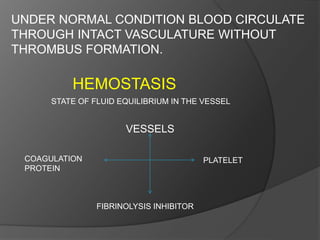
UNDER NORMAL CONDITION BLOOD CIRCULATE
THROUGH INTACT VASCULATURE WITHOUT
THROMBUS FORMATION.
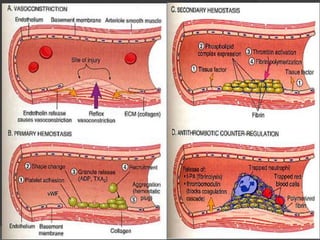
HEMOSTASIS
STATE OF FLUID EQUILIBRIUM IN THE VESSEL
VESSELS
COAGULATION
PROTEIN
FIBRINOLYSIS INHIBITOR
PLATELET
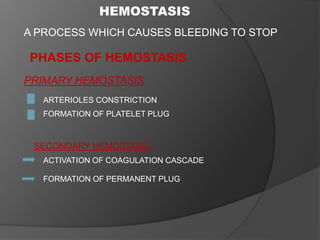
HEMOSTASIS
A PROCESS WHICH CAUSES BLEEDING TO STOP
PHASES OF HEMOSTASIS
PRIMARY HEMOSTASIS
ARTERIOLES CONSTRICTION
FORMATION OF PLATELET PLUG
SECONDARY HEMOSTASIS
ACTIVATION OF COAGULATION CASCADE
FORMATION OF PERMANENT PLUG
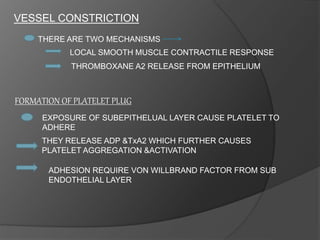
VESSEL CONSTRICTION
THERE ARE TWO MECHANISMS
LOCAL SMOOTH MUSCLE CONTRACTILE RESPONSE
THROMBOXANE A2 RELEASE FROM EPITHELIUM
FORMATION OF PLATELET PLUG
EXPOSURE OF SUBEPITHELUAL LAYER CAUSE PLATELET TO
ADHERE
THEY RELEASE ADP &TxA2 WHICH FURTHER CAUSES
PLATELET AGGREGATION &ACTIVATION
ADHESION REQUIRE VON WILLBRAND FACTOR FROM SUB
ENDOTHELIAL LAYER
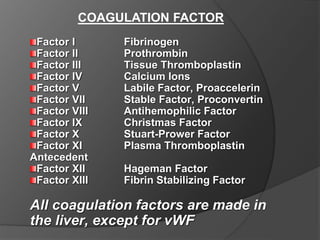
COAGULATION FACTOR
Factor I Fibrinogen
Factor II Prothrombin
Factor III Tissue Thromboplastin
Factor IV Calcium Ions
Factor V Labile Factor, Proaccelerin
Factor VII Stable Factor, Proconvertin
Factor VIII Antihemophilic Factor
Factor IX Christmas Factor
Factor X Stuart-Prower Factor
Factor XI Plasma Thromboplastin
Antecedent
Factor XII Hageman Factor
Factor XIII Fibrin Stabilizing Factor
All coagulation factors are made in
the liver, except for vWF
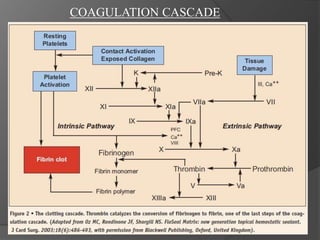
COAGULATION CASCADE
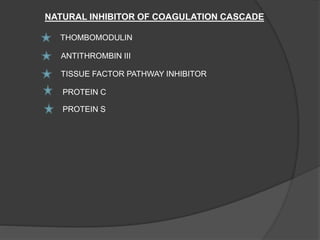
NATURAL INHIBITOR OF COAGULATION CASCADE
THOMBOMODULIN
ANTITHROMBIN III
TISSUE FACTOR PATHWAY INHIBITOR
PROTEIN C
PROTEIN S
• Visual obstruction of the surgical field
• Need for blood transfusions
• Reduction in core temperature
• Thrombocytopenia
• Hypovolemic shock
• Economic consequences
Adverse effects of
Surgical bleeding
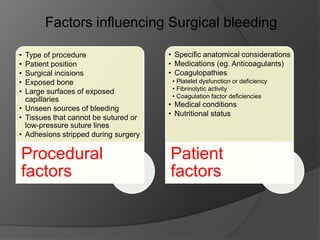
• Type of procedure
• Patient position
• Surgical incisions
• Exposed bone
• Large surfaces of exposed
capillaries
• Unseen sources of bleeding
• Tissues that cannot be sutured or
low-pressure suture lines
• Adhesions stripped during surgery
Procedural
factors
• Specific anatomical considerations
• Medications (eg. Anticoagulants)
• Coagulopathies
• Platelet dysfunction or deficiency
• Fibrinolytic activity
• Coagulation factor deficiencies
• Medical conditions
• Nutritional status
Patient
factors
Factors influencing Surgical bleeding
Why Use Hemostatic Agents
• Minimize blood loss
• Improve visualization
• Save operative time
• Reduce or avoid transfusion
• Manage anticoagulated patient
• Avoid conversion of lap procedures
• Prevent leakage of non-bloody fluids
• Decrease post-op drainage and infection
• Decrease hospital length of stay
Characteristics of an Ideal hemostatic agents
for clinical use:
(1) capability to stop large vessel arterial and venous
bleeding within minutes of application when applied to an
actively bleeding wound through a pool of blood;
(2) no requirement for mixing or pre-application
preparation;
(3) simplicity of application
(4) light weight and durable;
(5) long shelf life in extreme environments;
(6) safe to use with no risk of injury to tissues or
transmission of infection;
(7) cost-effective
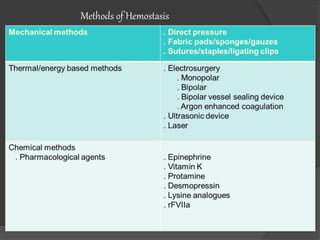
Methods of Hemostasis
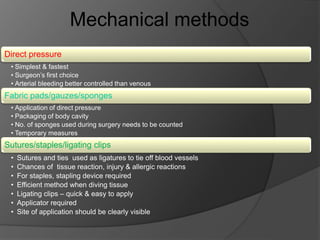
Direct pressure
• Simplest & fastest
• Surgeon’s first choice
• Arterial bleeding better controlled than venous
Fabric pads/gauzes/sponges
• Application of direct pressure
• Packaging of body cavity
• No. of sponges used during surgery needs to be counted
• Temporary measures
Sutures/staples/ligating clips
• Sutures and ties used as ligatures to tie off blood vessels
• Chances of tissue reaction, injury & allergic reactions
• For staples, stapling device required
• Efficient method when diving tissue
• Ligating clips – quick & easy to apply
• Applicator required
• Site of application should be clearly visible
Mechanical methods
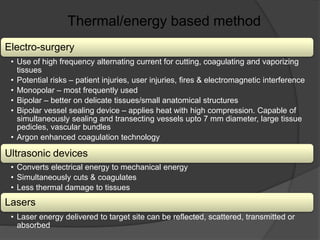
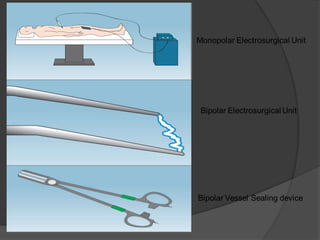
Electro-surgery
• Use of high frequency alternating current for cutting, coagulating and vaporizing
tissues
• Potential risks – patient injuries, user injuries, fires & electromagnetic interference
• Monopolar – most frequently used
• Bipolar – better on delicate tissues/small anatomical structures
• Bipolar vessel sealing device – applies heat with high compression. Capable of
simultaneously sealing and transecting vessels upto 7 mm diameter, large tissue
pedicles, vascular bundles
• Argon enhanced coagulation technology
Ultrasonic devices
• Converts electrical energy to mechanical energy
• Simultaneously cuts & coagulates
• Less thermal damage to tissues
Lasers
• Laser energy delivered to target site can be reflected, scattered, transmitted or
absorbed
Thermal/energy based method
Epinephrine
• Causes direct vasoconstriction & increases heart rate
• Can be applied topically or injected with local anesthesia
Vitamin K
• Administered pre-operatively to reverse effects of warfarin
& to avoid need of transfusion of FFP
• Reversal of raised INR takes app. 24 hours
Protamine
• Only agent with ability to reverse heparin anticoagulation
• Can cause anaphylaxis, acute pulmonary
vasoconstriction, right ventricular failure
Chemical methods – pharmacological agents
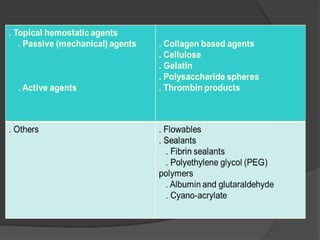
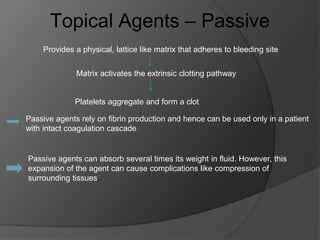
Topical Agents – Passive
Provides a physical, lattice like matrix that adheres to bleeding site
Matrix activates the extrinsic clotting pathway
Platelets aggregate and form a clot
Passive agents rely on fibrin production and hence can be used only in a patient
with intact coagulation cascade
Passive agents can absorb several times its weight in fluid. However, this
expansion of the agent can cause complications like compression of
surrounding tissues.
Activated on contact with bleeding. Provide stable matrix for clot formation,
enhance platelet aggregation, degranulation and release of clotting factors
Collagen Based Products
Microfibrillar collagen hemostat (Avitene)
• Derived from purified bovine dermal collagen
• Effective agents when there is capillary, venous or small arterial bleeding
• MCH attract platelet & promote plug formation
• It inactivates thrombin as a result of ph factor.
• Potential adverse events: allergic reaction, adhesion formation, inflammation,potentiation of
infection and abscess formation
Absorbable collagen hemostat sponge (Instat)
• Derived from purified and lyophilized bovine dermal tendon
• Adhere to surface when wet,does not stick into the instrument.
• Collagen sponge gets absorbed into 8 to 10 weeks
• Control bleeding 2-5 mins.
Oxidized regenerated cellulose (Surgicel)
• ORC reacts with blood, increases in size and forms a gelatinous
mass(after 24-48 hrs )and promotes clot formation
• Potential AEs: encapsulation of fluid and FB reaction, stenosis of
vascular structures, burning or stinging sensations, headaches ,
etc
Gelatins (Gelfoam)
• Derived from purified bovine gelatin solutions
• Can be used in dry or wet form
• Conforms easily to wounds and therefore can be used for irregular
wounds
Polysacchride hemospheres
• Derived from vegetable starch
• Contains no human or animal component
Topical agents – active
Have biological activity
Participate directly at the end of coagulation cascade
Stimulate fibrinogen at the bleeding site to produce a clot
Thrombin acts at the end of the clotting cascade, action of agent is not affected by
clotting factor deficiencies or platelets malfunction.
Can also be given to patients receiving anti-platelets/anti-coagulation
Active topical agents provide hemostasis within 10 minutes and they are
more effective in controlling bleeding than passive agents
Bovine thrombin
• Applied using a pump or spray kit, or in a saturated, absorbable
gelatin sponge
• AEs: antibody formation to bovine thrombin can lead to
coagulopathy, allergic reactions, death
Pooled human plasma thrombin
• Delivered via saturated, absorbable gelatin sponge
• Has potential risk of viral or prion disease transmission
Recombinant thrombin
• Reduced risk of antibody formation and eliminates risk of viral
or prion disease transmission
Thrombin products
• Combine passive and active hemostatic agents into a single
application product
• Work by blocking blood flow & actively converting fibrinogen into
fibrin
• Two types of products:
– Absorbable bovine gelatin + pooled human thrombin
– Absorbable porcine gelatin + either of the 3 thrombin types
• Both the products do not contain fibrinogen. Hence direct contact
with blood is necessary
• Both products are indicated for all types of surgeries except
ophthalmic surgeries
• AEs: anemia, arrhythmia, arterial thrombosis, atelectasis, atrial
fibrillation, hemorrhage, infection, pleural effusion, right heart failure
Flowable hemostatic agents
Fibrin sealants
• Consists of conc. fibrinogen and thrombin which upon mixing with blood
create a fibrin clot.
• Increases rate of clot formation by providing higher conc of both fibrinogen
& thrombin at bleeding site .
• 3 types: pooled human plasma, individual human plasma with bovine
collagen and bovine thrombin, pooled human plasma and equine collagen
• Fibrin sealants control local as well as diffuse bleeding
• Do not control vigorous bleeding.
• Fibrin sealants can be used in patients with coagulopathies.
• Also in patients receiving heparin.
• Clinical concerns: difficulty of reconstitution, time taken for surgeon to learn
application.
• AEs: viral or prion disease transmission, antibody formation with bovine
thrombin, swelling associated with collagen use.
Sealants
Sealants work by forming a barrier that is impervious to the flow of most liquids
Polyethylene glycol polymers
CoSeal
• Combination of 2 PEG polymers to form synthetic, hydrogel matrix
• Polymers cross-link to each other & to contact tissue - forms barrier
DuraSeal
• Combination of PEG, trilysine amine, blue dye
• On combination form a hydrogel - water tight seal
ProGel
• PEG polymer combined with human serum albumin
• Only product approved by FDA for lung sealing
• Safety concern: swelling, allergic reaction to blue dye, infection.
Delayed wound healing
• Contains 10% glutaraldehyde sol and 45% bovine serum
albumin
• Glutaraldehyde cross-links the residual proteins in
albumin to cell proteins at wound site and forms a tough
scaffold to which clot can adhere
• Commonly used for sealing holes around suture or
staple lines in complex CV procedures and in peripheral
vascular procedures
• AEs: tissue injury, muscle necrosis, emboli, delayed
pseudoaneurysm formation, sensitivity to glutaraldehyde
Albumin-Glutaraldehyde
• Consists of 2 cyanoacrylate monomers
– 2-octyl cyanoacrylate
– Butyl lactoyl cyanoacrylate
• Product to be used as a sealant and not as a substitute
for sutures, staples, or other methods of mechanical
closure
Cyano-acrylates
• Rapidly and effectively control bleeding
• Effectively contact the bleeding surface
• Work reliably
• Be handled easily
• Be prepared easily
• Be available in multiple delivery options
• Be compatible with patient’s physiology
• Be safely used
• Be cost effective
Key considerations in the selection of topical agent
Reference:
TEXTBOOK OF PATHOLOGY 6TH ED.-HARSH MOHAN
TEXTBOOK OF PATHOLOGY -ROBBINS
DENTAL MANAGEMENT OF MEDICALLY
COMPROMISED PATIENT -FALACE
TEXTBOOK OF PHARMACOLOGY –K.D.TRIPATHY
THANK
YOU
Haemostatic agent used in dentistry to control bleeding

Haemostatic agent used in dentistry to control bleeding

  • 1.
  • 2.
    UNDER NORMAL CONDITIONBLOOD CIRCULATE THROUGH INTACT VASCULATURE WITHOUT THROMBUS FORMATION. HEMOSTASIS STATE OF FLUID EQUILIBRIUM IN THE VESSEL VESSELS COAGULATION PROTEIN FIBRINOLYSIS INHIBITOR PLATELET
  • 3.
    HEMOSTASIS A PROCESS WHICHCAUSES BLEEDING TO STOP PHASES OF HEMOSTASIS PRIMARY HEMOSTASIS ARTERIOLES CONSTRICTION FORMATION OF PLATELET PLUG SECONDARY HEMOSTASIS ACTIVATION OF COAGULATION CASCADE FORMATION OF PERMANENT PLUG
  • 4.
    VESSEL CONSTRICTION THERE ARETWO MECHANISMS LOCAL SMOOTH MUSCLE CONTRACTILE RESPONSE THROMBOXANE A2 RELEASE FROM EPITHELIUM FORMATION OF PLATELET PLUG EXPOSURE OF SUBEPITHELUAL LAYER CAUSE PLATELET TO ADHERE THEY RELEASE ADP &TxA2 WHICH FURTHER CAUSES PLATELET AGGREGATION &ACTIVATION ADHESION REQUIRE VON WILLBRAND FACTOR FROM SUB ENDOTHELIAL LAYER
  • 6.
    COAGULATION FACTOR Factor IFibrinogen Factor II Prothrombin Factor III Tissue Thromboplastin Factor IV Calcium Ions Factor V Labile Factor, Proaccelerin Factor VII Stable Factor, Proconvertin Factor VIII Antihemophilic Factor Factor IX Christmas Factor Factor X Stuart-Prower Factor Factor XI Plasma Thromboplastin Antecedent Factor XII Hageman Factor Factor XIII Fibrin Stabilizing Factor All coagulation factors are made in the liver, except for vWF
  • 7.
  • 8.
    NATURAL INHIBITOR OFCOAGULATION CASCADE THOMBOMODULIN ANTITHROMBIN III TISSUE FACTOR PATHWAY INHIBITOR PROTEIN C PROTEIN S
  • 9.
    • Visual obstructionof the surgical field • Need for blood transfusions • Reduction in core temperature • Thrombocytopenia • Hypovolemic shock • Economic consequences Adverse effects of Surgical bleeding
  • 10.
    • Type ofprocedure • Patient position • Surgical incisions • Exposed bone • Large surfaces of exposed capillaries • Unseen sources of bleeding • Tissues that cannot be sutured or low-pressure suture lines • Adhesions stripped during surgery Procedural factors • Specific anatomical considerations • Medications (eg. Anticoagulants) • Coagulopathies • Platelet dysfunction or deficiency • Fibrinolytic activity • Coagulation factor deficiencies • Medical conditions • Nutritional status Patient factors Factors influencing Surgical bleeding
  • 11.
    Why Use HemostaticAgents • Minimize blood loss • Improve visualization • Save operative time • Reduce or avoid transfusion • Manage anticoagulated patient • Avoid conversion of lap procedures • Prevent leakage of non-bloody fluids • Decrease post-op drainage and infection • Decrease hospital length of stay
  • 12.
    Characteristics of anIdeal hemostatic agents for clinical use: (1) capability to stop large vessel arterial and venous bleeding within minutes of application when applied to an actively bleeding wound through a pool of blood; (2) no requirement for mixing or pre-application preparation; (3) simplicity of application (4) light weight and durable; (5) long shelf life in extreme environments; (6) safe to use with no risk of injury to tissues or transmission of infection; (7) cost-effective
  • 13.
  • 15.
    Direct pressure • Simplest& fastest • Surgeon’s first choice • Arterial bleeding better controlled than venous Fabric pads/gauzes/sponges • Application of direct pressure • Packaging of body cavity • No. of sponges used during surgery needs to be counted • Temporary measures Sutures/staples/ligating clips • Sutures and ties used as ligatures to tie off blood vessels • Chances of tissue reaction, injury & allergic reactions • For staples, stapling device required • Efficient method when diving tissue • Ligating clips – quick & easy to apply • Applicator required • Site of application should be clearly visible Mechanical methods
  • 16.
    Electro-surgery • Use ofhigh frequency alternating current for cutting, coagulating and vaporizing tissues • Potential risks – patient injuries, user injuries, fires & electromagnetic interference • Monopolar – most frequently used • Bipolar – better on delicate tissues/small anatomical structures • Bipolar vessel sealing device – applies heat with high compression. Capable of simultaneously sealing and transecting vessels upto 7 mm diameter, large tissue pedicles, vascular bundles • Argon enhanced coagulation technology Ultrasonic devices • Converts electrical energy to mechanical energy • Simultaneously cuts & coagulates • Less thermal damage to tissues Lasers • Laser energy delivered to target site can be reflected, scattered, transmitted or absorbed Thermal/energy based method
  • 18.
    Epinephrine • Causes directvasoconstriction & increases heart rate • Can be applied topically or injected with local anesthesia Vitamin K • Administered pre-operatively to reverse effects of warfarin & to avoid need of transfusion of FFP • Reversal of raised INR takes app. 24 hours Protamine • Only agent with ability to reverse heparin anticoagulation • Can cause anaphylaxis, acute pulmonary vasoconstriction, right ventricular failure Chemical methods – pharmacological agents
  • 20.
    Topical Agents –Passive Provides a physical, lattice like matrix that adheres to bleeding site Matrix activates the extrinsic clotting pathway Platelets aggregate and form a clot Passive agents rely on fibrin production and hence can be used only in a patient with intact coagulation cascade Passive agents can absorb several times its weight in fluid. However, this expansion of the agent can cause complications like compression of surrounding tissues.
  • 21.
    Activated on contactwith bleeding. Provide stable matrix for clot formation, enhance platelet aggregation, degranulation and release of clotting factors Collagen Based Products Microfibrillar collagen hemostat (Avitene) • Derived from purified bovine dermal collagen • Effective agents when there is capillary, venous or small arterial bleeding • MCH attract platelet & promote plug formation • It inactivates thrombin as a result of ph factor. • Potential adverse events: allergic reaction, adhesion formation, inflammation,potentiation of infection and abscess formation Absorbable collagen hemostat sponge (Instat) • Derived from purified and lyophilized bovine dermal tendon • Adhere to surface when wet,does not stick into the instrument. • Collagen sponge gets absorbed into 8 to 10 weeks • Control bleeding 2-5 mins.
  • 22.
    Oxidized regenerated cellulose(Surgicel) • ORC reacts with blood, increases in size and forms a gelatinous mass(after 24-48 hrs )and promotes clot formation • Potential AEs: encapsulation of fluid and FB reaction, stenosis of vascular structures, burning or stinging sensations, headaches , etc Gelatins (Gelfoam) • Derived from purified bovine gelatin solutions • Can be used in dry or wet form • Conforms easily to wounds and therefore can be used for irregular wounds Polysacchride hemospheres • Derived from vegetable starch • Contains no human or animal component
  • 23.
    Topical agents –active Have biological activity Participate directly at the end of coagulation cascade Stimulate fibrinogen at the bleeding site to produce a clot Thrombin acts at the end of the clotting cascade, action of agent is not affected by clotting factor deficiencies or platelets malfunction. Can also be given to patients receiving anti-platelets/anti-coagulation Active topical agents provide hemostasis within 10 minutes and they are more effective in controlling bleeding than passive agents
  • 24.
    Bovine thrombin • Appliedusing a pump or spray kit, or in a saturated, absorbable gelatin sponge • AEs: antibody formation to bovine thrombin can lead to coagulopathy, allergic reactions, death Pooled human plasma thrombin • Delivered via saturated, absorbable gelatin sponge • Has potential risk of viral or prion disease transmission Recombinant thrombin • Reduced risk of antibody formation and eliminates risk of viral or prion disease transmission Thrombin products
  • 25.
    • Combine passiveand active hemostatic agents into a single application product • Work by blocking blood flow & actively converting fibrinogen into fibrin • Two types of products: – Absorbable bovine gelatin + pooled human thrombin – Absorbable porcine gelatin + either of the 3 thrombin types • Both the products do not contain fibrinogen. Hence direct contact with blood is necessary • Both products are indicated for all types of surgeries except ophthalmic surgeries • AEs: anemia, arrhythmia, arterial thrombosis, atelectasis, atrial fibrillation, hemorrhage, infection, pleural effusion, right heart failure Flowable hemostatic agents
  • 26.
    Fibrin sealants • Consistsof conc. fibrinogen and thrombin which upon mixing with blood create a fibrin clot. • Increases rate of clot formation by providing higher conc of both fibrinogen & thrombin at bleeding site . • 3 types: pooled human plasma, individual human plasma with bovine collagen and bovine thrombin, pooled human plasma and equine collagen • Fibrin sealants control local as well as diffuse bleeding • Do not control vigorous bleeding. • Fibrin sealants can be used in patients with coagulopathies. • Also in patients receiving heparin. • Clinical concerns: difficulty of reconstitution, time taken for surgeon to learn application. • AEs: viral or prion disease transmission, antibody formation with bovine thrombin, swelling associated with collagen use. Sealants Sealants work by forming a barrier that is impervious to the flow of most liquids
  • 27.
    Polyethylene glycol polymers CoSeal •Combination of 2 PEG polymers to form synthetic, hydrogel matrix • Polymers cross-link to each other & to contact tissue - forms barrier DuraSeal • Combination of PEG, trilysine amine, blue dye • On combination form a hydrogel - water tight seal ProGel • PEG polymer combined with human serum albumin • Only product approved by FDA for lung sealing • Safety concern: swelling, allergic reaction to blue dye, infection. Delayed wound healing
  • 28.
    • Contains 10%glutaraldehyde sol and 45% bovine serum albumin • Glutaraldehyde cross-links the residual proteins in albumin to cell proteins at wound site and forms a tough scaffold to which clot can adhere • Commonly used for sealing holes around suture or staple lines in complex CV procedures and in peripheral vascular procedures • AEs: tissue injury, muscle necrosis, emboli, delayed pseudoaneurysm formation, sensitivity to glutaraldehyde Albumin-Glutaraldehyde
  • 29.
    • Consists of2 cyanoacrylate monomers – 2-octyl cyanoacrylate – Butyl lactoyl cyanoacrylate • Product to be used as a sealant and not as a substitute for sutures, staples, or other methods of mechanical closure Cyano-acrylates
  • 30.
    • Rapidly andeffectively control bleeding • Effectively contact the bleeding surface • Work reliably • Be handled easily • Be prepared easily • Be available in multiple delivery options • Be compatible with patient’s physiology • Be safely used • Be cost effective Key considerations in the selection of topical agent
  • 31.
    Reference: TEXTBOOK OF PATHOLOGY6TH ED.-HARSH MOHAN TEXTBOOK OF PATHOLOGY -ROBBINS DENTAL MANAGEMENT OF MEDICALLY COMPROMISED PATIENT -FALACE TEXTBOOK OF PHARMACOLOGY –K.D.TRIPATHY
  • 32.