

Making Decision Support Systems
       Useful in the Classroom:
Designing a Needs Assessment Process


           Christopher A. Thorn
     Wisconsin Center for Education Research
         University of Wisconsin-Madison
The School Improvement Planning
Process and local decision support
• Much of our work has been working with
  district technology and research staff as
  well as with schools on SIP projects.
• School Improvement Plans have been the
  justification for our efforts, but rarely seem
  to play an important role in improvement.
• Is it possible to get inside the improvement
  process and see why this is failing?
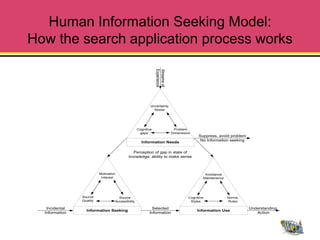
Human Information Seeking Model:
How the search application process works


                                                               Experience
                                                               Streams of
                                                           Uncertainty
                                                             Stress


                                                   Cognitive                 Problem
                                                     gaps                   Dimensions
                                                                                           Suppress, avoid problem
                                                                                            No Information seeking
                                                     Information Needs

                                              Perception of gap in state of
                                            knowledge, ability to make sense


                          Motivation                                                              Avoidance
                           Interest                                                              Maintenance


                Source               Source                                          Cognitive                 Norms,
                Quality            Accessibility                                      Styles                   Rules

   Incidental                                               Selected                                                    Understanding,
                  Information Seeking                                                     Information Use
  Information                                             Information                                                      Action
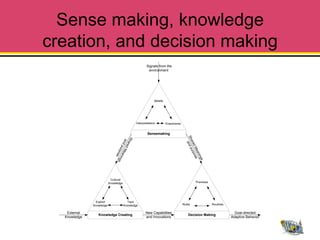
Sense making, knowledge
creation, and decision making
                                                         Signals from the
                                                          environment


                                                               Beliefs


                                                 Interpretations         Enactments


                                                         Sensemaking


                                                                                        Sh n d p
                              Sh
                               an d M


                                                                                          are urp
                                 are


                                                                                           a
                                  d


                                                                                             d M os
                                    pu eanin
                                      rpo


                                                                                                 ea e
                                          se s


                                                                                                   nin
                                                                                                       gs
                                             g


                           Cultural
                          Knowledge                                                              Premises


               Explicit                 Tacit
              Knowledge               Knowledge                                       Rules                 Routines

   External                                             New Capabilities                                                 Goal-directed
                 Knowledge Creating                                                       Decision Making
  Knowledge                                             and Innovations                                                Adaptive Behavior
Supporting information model and
     decision making model
• Understanding these two models can help
  district and state administrators craft better
  school improvement planning processes
• Recognize that the various roles of
  administrators differ and that sensemaking
  is at least as important as decision making
• Support professional development efforts
  that encourage building of analytical skills
  and local data collection efforts
What steps can one take to improve
   the school improvement process?
• Data at finer levels of temporal resolution
  are key to understanding and addressing
  instructional problems. Local
  documentation of practice may help.
• Needs assessment is a skill that seems to
  be lacking in most educational training.
  Rubric-type surveys could serve to
  education and provide feedback
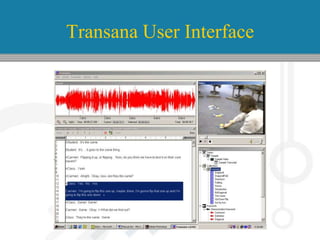
Transana

• A tool for…
     – Transcription,
     – Fine-grained analysis,
     – Management of large video datasets
• Allows researchers to…
     – View,
     – Code,
     – Organize in an intuitive graphical environment

January 2, 2013
Transana User Interface


January 2, 2013
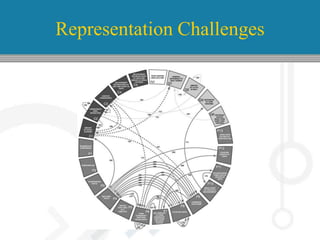
Representation Challenges


January 2, 2013
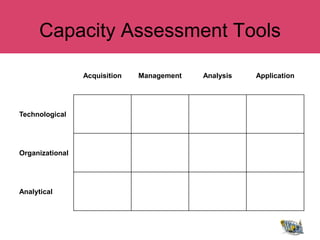
Capacity Assessment Tools

                 Acquisition   Management   Analysis   Application


Technological


Organizational


Analytical
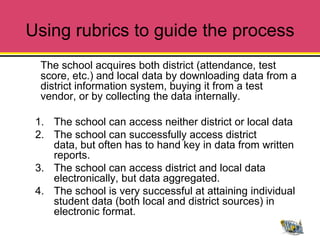
Using rubrics to guide the process
  The school acquires both district (attendance, test
  score, etc.) and local data by downloading data from a
  district information system, buying it from a test
  vendor, or by collecting the data internally.

 1. The school can access neither district or local data
 2. The school can successfully access district
    data, but often has to hand key in data from written
    reports.
 3. The school can access district and local data
    electronically, but data aggregated.
 4. The school is very successful at attaining individual
    student data (both local and district sources) in
    electronic format.
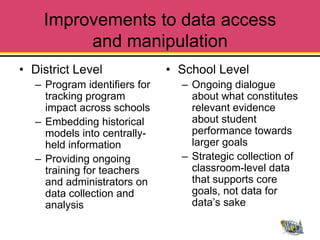
Improvements to data access
         and manipulation
• District Level               • School Level
   – Program identifiers for     – Ongoing dialogue
     tracking program              about what constitutes
     impact across schools         relevant evidence
   – Embedding historical          about student
     models into centrally-        performance towards
     held information              larger goals
   – Providing ongoing           – Strategic collection of
     training for teachers         classroom-level data
     and administrators on         that supports core
     data collection and           goals, not data for
     analysis                      data’s sake
For more information

             Chris Thorn
       cthorn@wcer.wisc.edu
http://facstaff.wcer.wisc.edu/cthorn

 Wisconsin Center for Education Research
 Center for the Study of Systemic Reform

2002 aera making decision support systems useful in the classroom

  • 1.
    Making Decision SupportSystems Useful in the Classroom: Designing a Needs Assessment Process Christopher A. Thorn Wisconsin Center for Education Research University of Wisconsin-Madison
  • 2.
    The School ImprovementPlanning Process and local decision support • Much of our work has been working with district technology and research staff as well as with schools on SIP projects. • School Improvement Plans have been the justification for our efforts, but rarely seem to play an important role in improvement. • Is it possible to get inside the improvement process and see why this is failing?
  • 3.
    Human Information SeekingModel: How the search application process works Experience Streams of Uncertainty Stress Cognitive Problem gaps Dimensions Suppress, avoid problem No Information seeking Information Needs Perception of gap in state of knowledge, ability to make sense Motivation Avoidance Interest Maintenance Source Source Cognitive Norms, Quality Accessibility Styles Rules Incidental Selected Understanding, Information Seeking Information Use Information Information Action
  • 4.
    Sense making, knowledge creation,and decision making Signals from the environment Beliefs Interpretations Enactments Sensemaking Sh n d p Sh an d M are urp are a d d M os pu eanin rpo ea e se s nin gs g Cultural Knowledge Premises Explicit Tacit Knowledge Knowledge Rules Routines External New Capabilities Goal-directed Knowledge Creating Decision Making Knowledge and Innovations Adaptive Behavior
  • 5.
    Supporting information modeland decision making model • Understanding these two models can help district and state administrators craft better school improvement planning processes • Recognize that the various roles of administrators differ and that sensemaking is at least as important as decision making • Support professional development efforts that encourage building of analytical skills and local data collection efforts
  • 6.
    What steps canone take to improve the school improvement process? • Data at finer levels of temporal resolution are key to understanding and addressing instructional problems. Local documentation of practice may help. • Needs assessment is a skill that seems to be lacking in most educational training. Rubric-type surveys could serve to education and provide feedback
  • 7.
    Transana • A toolfor… – Transcription, – Fine-grained analysis, – Management of large video datasets • Allows researchers to… – View, – Code, – Organize in an intuitive graphical environment January 2, 2013
  • 8.
  • 9.
  • 10.
    Capacity Assessment Tools Acquisition Management Analysis Application Technological Organizational Analytical
  • 11.
    Using rubrics toguide the process The school acquires both district (attendance, test score, etc.) and local data by downloading data from a district information system, buying it from a test vendor, or by collecting the data internally. 1. The school can access neither district or local data 2. The school can successfully access district data, but often has to hand key in data from written reports. 3. The school can access district and local data electronically, but data aggregated. 4. The school is very successful at attaining individual student data (both local and district sources) in electronic format.
  • 12.
    Improvements to dataaccess and manipulation • District Level • School Level – Program identifiers for – Ongoing dialogue tracking program about what constitutes impact across schools relevant evidence – Embedding historical about student models into centrally- performance towards held information larger goals – Providing ongoing – Strategic collection of training for teachers classroom-level data and administrators on that supports core data collection and goals, not data for analysis data’s sake
  • 13.
    For more information Chris Thorn cthorn@wcer.wisc.edu http://facstaff.wcer.wisc.edu/cthorn Wisconsin Center for Education Research Center for the Study of Systemic Reform