Hadoop: Distributed Data Processing
      Amr Awadallah
      Founder/CTO, Cloudera, Inc.
      ACM Data Mining SIG
      Thursday, January 25th, 2010


Wednesday, January 27, 2010
Outline

      ▪Scaling for Large Data
       Processing
      ▪What is Hadoop?

      ▪HDFS and MapReduce

      ▪Hadoop Ecosystem

      ▪Hadoop vs RDBMSes

      ▪Conclusion
     Amr Awadallah, Cloudera Inc   2
Wednesday, January 27, 2010
Current Storage Systems Can’t Compute


     Amr Awadallah, Cloudera Inc    3
Wednesday, January 27, 2010
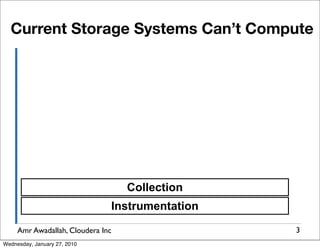
Current Storage Systems Can’t Compute


                                   Collection
                               Instrumentation

     Amr Awadallah, Cloudera Inc                 3
Wednesday, January 27, 2010
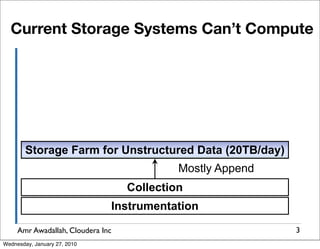
Current Storage Systems Can’t Compute


        Storage Farm for Unstructured Data (20TB/day)
                                            Mostly Append
                                   Collection
                               Instrumentation

     Amr Awadallah, Cloudera Inc                            3
Wednesday, January 27, 2010
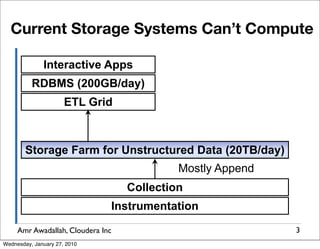
Current Storage Systems Can’t Compute

              Interactive Apps
          RDBMS (200GB/day)
                      ETL Grid


        Storage Farm for Unstructured Data (20TB/day)
                                            Mostly Append
                                   Collection
                               Instrumentation

     Amr Awadallah, Cloudera Inc                            3
Wednesday, January 27, 2010
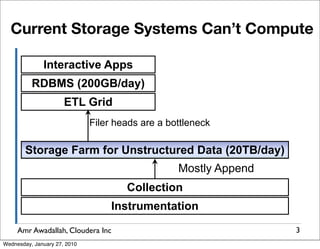
Current Storage Systems Can’t Compute

              Interactive Apps
          RDBMS (200GB/day)
                      ETL Grid
                              Filer heads are a bottleneck

        Storage Farm for Unstructured Data (20TB/day)
                                                  Mostly Append
                                      Collection
                                   Instrumentation

     Amr Awadallah, Cloudera Inc                                  3
Wednesday, January 27, 2010
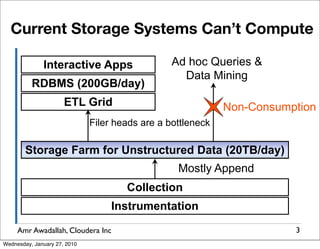
Current Storage Systems Can’t Compute

              Interactive Apps                   Ad hoc Queries &
                                                   Data Mining
          RDBMS (200GB/day)
                      ETL Grid                               Non-Consumption
                              Filer heads are a bottleneck

        Storage Farm for Unstructured Data (20TB/day)
                                                  Mostly Append
                                      Collection
                                   Instrumentation

     Amr Awadallah, Cloudera Inc                                        3
Wednesday, January 27, 2010
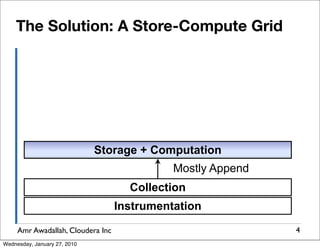
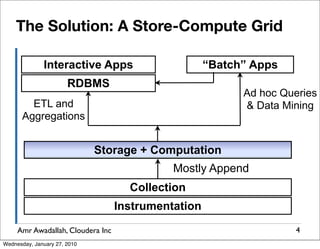
The Solution: A Store-Compute Grid


     Amr Awadallah, Cloudera Inc         4
Wednesday, January 27, 2010
The Solution: A Store-Compute Grid


                              Storage + Computation
                                             Mostly Append
                                     Collection
                                   Instrumentation

     Amr Awadallah, Cloudera Inc                             4
Wednesday, January 27, 2010
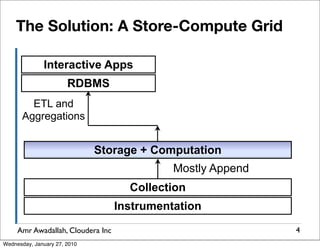
The Solution: A Store-Compute Grid

              Interactive Apps
                       RDBMS
        ETL and
      Aggregations


                              Storage + Computation
                                             Mostly Append
                                     Collection
                                   Instrumentation

     Amr Awadallah, Cloudera Inc                             4
Wednesday, January 27, 2010
The Solution: A Store-Compute Grid

              Interactive Apps                       “Batch” Apps
                       RDBMS
                                                           Ad hoc Queries
        ETL and                                            & Data Mining
      Aggregations


                              Storage + Computation
                                             Mostly Append
                                     Collection
                                   Instrumentation

     Amr Awadallah, Cloudera Inc                                     4
Wednesday, January 27, 2010
What is Hadoop?


     Amr Awadallah, Cloudera Inc   5
Wednesday, January 27, 2010
What is Hadoop?
      ▪A  scalable fault-tolerant grid operating
        system for data storage and processing


     Amr Awadallah, Cloudera Inc                   5
Wednesday, January 27, 2010
What is Hadoop?
      ▪A   scalable fault-tolerant grid operating
        system for data storage and processing
      ▪ Its scalability comes from the marriage of:

         ▪ HDFS: Self-Healing High-Bandwidth Clustered Storage
         ▪ MapReduce: Fault-Tolerant Distributed Processing


     Amr Awadallah, Cloudera Inc                          5
Wednesday, January 27, 2010
What is Hadoop?
      ▪A   scalable fault-tolerant grid operating
        system for data storage and processing
      ▪ Its scalability comes from the marriage of:

         ▪ HDFS: Self-Healing High-Bandwidth Clustered Storage
         ▪ MapReduce: Fault-Tolerant Distributed Processing

      ▪ Operates              on unstructured and structured data


     Amr Awadallah, Cloudera Inc                             5
Wednesday, January 27, 2010
What is Hadoop?
      ▪A   scalable fault-tolerant grid operating
        system for data storage and processing
      ▪ Its scalability comes from the marriage of:

         ▪ HDFS: Self-Healing High-Bandwidth Clustered Storage
         ▪ MapReduce: Fault-Tolerant Distributed Processing

      ▪ Operates on unstructured and structured data
      ▪ A large and active ecosystem (many developers
        and additions like HBase, Hive, Pig, …)


     Amr Awadallah, Cloudera Inc                          5
Wednesday, January 27, 2010
What is Hadoop?
      ▪A   scalable fault-tolerant grid operating
        system for data storage and processing
      ▪ Its scalability comes from the marriage of:

         ▪ HDFS: Self-Healing High-Bandwidth Clustered Storage
         ▪ MapReduce: Fault-Tolerant Distributed Processing

      ▪ Operates on unstructured and structured data
      ▪ A large and active ecosystem (many developers
        and additions like HBase, Hive, Pig, …)
      ▪ Open source under the friendly Apache License


     Amr Awadallah, Cloudera Inc                          5
Wednesday, January 27, 2010
What is Hadoop?
      ▪A   scalable fault-tolerant grid operating
        system for data storage and processing
      ▪ Its scalability comes from the marriage of:

         ▪ HDFS: Self-Healing High-Bandwidth Clustered Storage
         ▪ MapReduce: Fault-Tolerant Distributed Processing

      ▪ Operates on unstructured and structured data
      ▪ A large and active ecosystem (many developers
        and additions like HBase, Hive, Pig, …)
      ▪ Open source under the friendly Apache License

      ▪ http://wiki.apache.org/hadoop/


     Amr Awadallah, Cloudera Inc                          5
Wednesday, January 27, 2010
Hadoop History


     Amr Awadallah, Cloudera Inc   6
Wednesday, January 27, 2010
Hadoop History
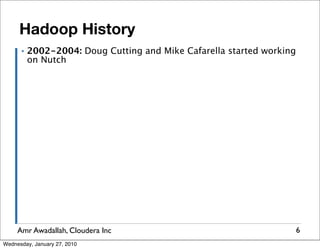
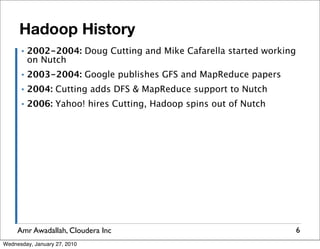
      ▪   2002-2004: Doug Cutting and Mike Cafarella started working
          on Nutch


     Amr Awadallah, Cloudera Inc                                       6
Wednesday, January 27, 2010
Hadoop History
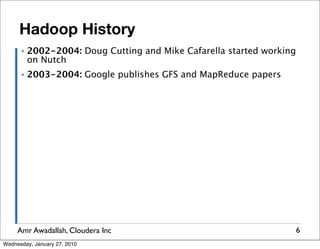
      ▪   2002-2004: Doug Cutting and Mike Cafarella started working
          on Nutch
      ▪   2003-2004: Google publishes GFS and MapReduce papers


     Amr Awadallah, Cloudera Inc                                       6
Wednesday, January 27, 2010
Hadoop History
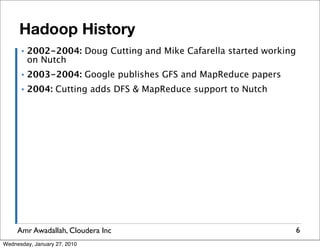
      ▪   2002-2004: Doug Cutting and Mike Cafarella started working
          on Nutch
      ▪   2003-2004: Google publishes GFS and MapReduce papers
      ▪   2004: Cutting adds DFS & MapReduce support to Nutch


     Amr Awadallah, Cloudera Inc                                       6
Wednesday, January 27, 2010
Hadoop History
      ▪   2002-2004: Doug Cutting and Mike Cafarella started working
          on Nutch
      ▪   2003-2004: Google publishes GFS and MapReduce papers
      ▪   2004: Cutting adds DFS & MapReduce support to Nutch
      ▪   2006: Yahoo! hires Cutting, Hadoop spins out of Nutch


     Amr Awadallah, Cloudera Inc                                       6
Wednesday, January 27, 2010
Hadoop History
      ▪   2002-2004: Doug Cutting and Mike Cafarella started working
          on Nutch
      ▪   2003-2004: Google publishes GFS and MapReduce papers
      ▪   2004: Cutting adds DFS & MapReduce support to Nutch
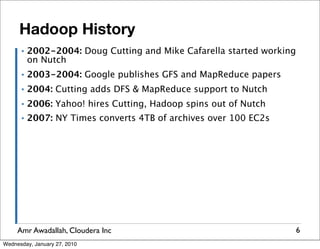
      ▪   2006: Yahoo! hires Cutting, Hadoop spins out of Nutch
      ▪   2007: NY Times converts 4TB of archives over 100 EC2s


     Amr Awadallah, Cloudera Inc                                       6
Wednesday, January 27, 2010
Hadoop History
      ▪   2002-2004: Doug Cutting and Mike Cafarella started working
          on Nutch
      ▪   2003-2004: Google publishes GFS and MapReduce papers
      ▪   2004: Cutting adds DFS & MapReduce support to Nutch
      ▪   2006: Yahoo! hires Cutting, Hadoop spins out of Nutch
      ▪   2007: NY Times converts 4TB of archives over 100 EC2s
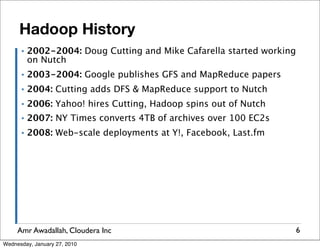
      ▪   2008: Web-scale deployments at Y!, Facebook, Last.fm


     Amr Awadallah, Cloudera Inc                                       6
Wednesday, January 27, 2010
Hadoop History
      ▪   2002-2004: Doug Cutting and Mike Cafarella started working
          on Nutch
      ▪   2003-2004: Google publishes GFS and MapReduce papers
      ▪   2004: Cutting adds DFS & MapReduce support to Nutch
      ▪   2006: Yahoo! hires Cutting, Hadoop spins out of Nutch
      ▪   2007: NY Times converts 4TB of archives over 100 EC2s
      ▪   2008: Web-scale deployments at Y!, Facebook, Last.fm
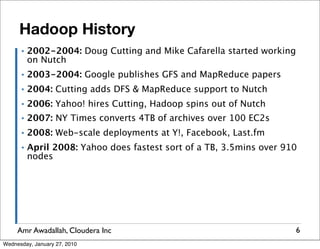
      ▪   April 2008: Yahoo does fastest sort of a TB, 3.5mins over 910
          nodes


     Amr Awadallah, Cloudera Inc                                       6
Wednesday, January 27, 2010
Hadoop History
      ▪   2002-2004: Doug Cutting and Mike Cafarella started working
          on Nutch
      ▪   2003-2004: Google publishes GFS and MapReduce papers
      ▪   2004: Cutting adds DFS & MapReduce support to Nutch
      ▪   2006: Yahoo! hires Cutting, Hadoop spins out of Nutch
      ▪   2007: NY Times converts 4TB of archives over 100 EC2s
      ▪   2008: Web-scale deployments at Y!, Facebook, Last.fm
      ▪   April 2008: Yahoo does fastest sort of a TB, 3.5mins over 910
          nodes
      ▪   May 2009:
          ▪   Yahoo does fastest sort of a TB, 62secs over 1460 nodes
          ▪   Yahoo sorts a PB in 16.25hours over 3658 nodes


     Amr Awadallah, Cloudera Inc                                        6
Wednesday, January 27, 2010
Hadoop History
      ▪   2002-2004: Doug Cutting and Mike Cafarella started working
          on Nutch
      ▪   2003-2004: Google publishes GFS and MapReduce papers
      ▪   2004: Cutting adds DFS & MapReduce support to Nutch
      ▪   2006: Yahoo! hires Cutting, Hadoop spins out of Nutch
      ▪   2007: NY Times converts 4TB of archives over 100 EC2s
      ▪   2008: Web-scale deployments at Y!, Facebook, Last.fm
      ▪   April 2008: Yahoo does fastest sort of a TB, 3.5mins over 910
          nodes
      ▪   May 2009:
          ▪   Yahoo does fastest sort of a TB, 62secs over 1460 nodes
          ▪   Yahoo sorts a PB in 16.25hours over 3658 nodes
      ▪   June 2009, Oct 2009: Hadoop Summit (750), Hadoop World
          (500)
     Amr Awadallah, Cloudera Inc                                        6
Wednesday, January 27, 2010
Hadoop History
      ▪   2002-2004: Doug Cutting and Mike Cafarella started working
          on Nutch
      ▪   2003-2004: Google publishes GFS and MapReduce papers
      ▪   2004: Cutting adds DFS & MapReduce support to Nutch
      ▪   2006: Yahoo! hires Cutting, Hadoop spins out of Nutch
      ▪   2007: NY Times converts 4TB of archives over 100 EC2s
      ▪   2008: Web-scale deployments at Y!, Facebook, Last.fm
      ▪   April 2008: Yahoo does fastest sort of a TB, 3.5mins over 910
          nodes
      ▪   May 2009:
          ▪   Yahoo does fastest sort of a TB, 62secs over 1460 nodes
          ▪   Yahoo sorts a PB in 16.25hours over 3658 nodes
      ▪   June 2009, Oct 2009: Hadoop Summit (750), Hadoop World
          (500)
     Amr Awadallah, Cloudera Inc                                        6
      ▪   September 2009: Doug Cutting joins Cloudera
Wednesday, January 27, 2010
Hadoop Design Axioms


     Amr Awadallah, Cloudera Inc   7
Wednesday, January 27, 2010
Hadoop Design Axioms


      1.    System Shall Manage and Heal Itself


     Amr Awadallah, Cloudera Inc            7
Wednesday, January 27, 2010
Hadoop Design Axioms


      1.    System Shall Manage and Heal Itself
      2.    Performance Shall Scale Linearly


     Amr Awadallah, Cloudera Inc            7
Wednesday, January 27, 2010
Hadoop Design Axioms


      1.    System Shall Manage and Heal Itself
      2.    Performance Shall Scale Linearly
      3.    Compute Should Move to Data


     Amr Awadallah, Cloudera Inc            7
Wednesday, January 27, 2010
Hadoop Design Axioms


      1.    System Shall Manage and Heal Itself
      2.    Performance Shall Scale Linearly
      3.    Compute Should Move to Data
      4.    Simple Core, Modular and
            Extensible

     Amr Awadallah, Cloudera Inc            7
Wednesday, January 27, 2010
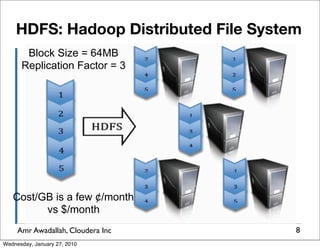
HDFS: Hadoop Distributed File System
       Block Size = 64MB
      Replication Factor = 3


   Cost/GB is a few ¢/month
         vs $/month
     Amr Awadallah, Cloudera Inc       8
Wednesday, January 27, 2010
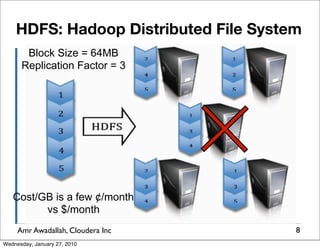
HDFS: Hadoop Distributed File System
       Block Size = 64MB
      Replication Factor = 3


   Cost/GB is a few ¢/month
         vs $/month
     Amr Awadallah, Cloudera Inc       8
Wednesday, January 27, 2010
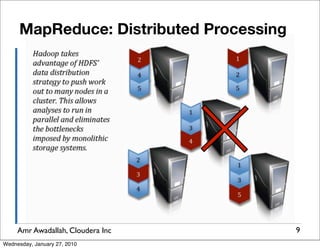
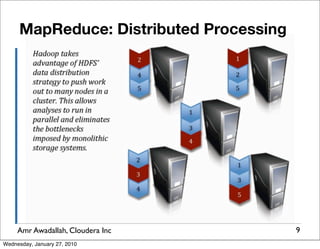
MapReduce: Distributed Processing


     Amr Awadallah, Cloudera Inc         9
Wednesday, January 27, 2010
MapReduce: Distributed Processing


     Amr Awadallah, Cloudera Inc         9
Wednesday, January 27, 2010
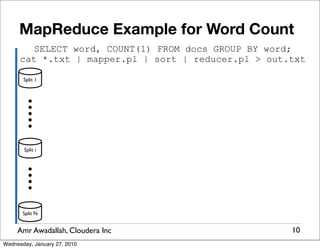
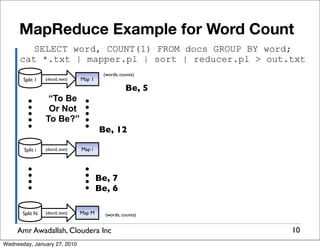
MapReduce Example for Word Count
         SELECT word, COUNT(1) FROM docs GROUP BY word;
      cat *.txt | mapper.pl | sort | reducer.pl > out.txt

       Split 1


       Split i


       Split N


     Amr Awadallah, Cloudera Inc                      10
Wednesday, January 27, 2010
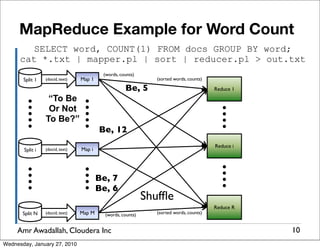
MapReduce Example for Word Count
         SELECT word, COUNT(1) FROM docs GROUP BY word;
      cat *.txt | mapper.pl | sort | reducer.pl > out.txt
                                          (words, counts)
       Split 1   (docid, text)   Map 1
                                                    Be, 5
                  “To Be
                  Or Not
                 To Be?”
                                         Be, 12

       Split i   (docid, text)   Map i


                                         Be, 7
                                         Be, 6

       Split N   (docid, text)   Map M     (words, counts)


     Amr Awadallah, Cloudera Inc                             10
Wednesday, January 27, 2010
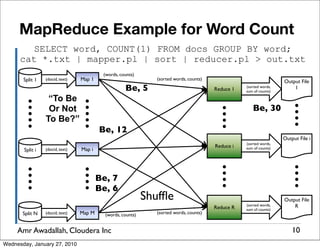
MapReduce Example for Word Count
         SELECT word, COUNT(1) FROM docs GROUP BY word;
      cat *.txt | mapper.pl | sort | reducer.pl > out.txt
                                          (words, counts)
       Split 1   (docid, text)   Map 1                         (sorted words, counts)

                                                    Be, 5                               Reduce 1
                  “To Be
                  Or Not
                 To Be?”
                                         Be, 12
                                                                                        Reduce i
       Split i   (docid, text)   Map i


                                         Be, 7
                                         Be, 6
                                                             Shuffle
                                                                                        Reduce R
       Split N   (docid, text)   Map M     (words, counts)     (sorted words, counts)


     Amr Awadallah, Cloudera Inc                                                                   10
Wednesday, January 27, 2010
MapReduce Example for Word Count
         SELECT word, COUNT(1) FROM docs GROUP BY word;
      cat *.txt | mapper.pl | sort | reducer.pl > out.txt
                                          (words, counts)
       Split 1   (docid, text)   Map 1                         (sorted words, counts)
                                                                                                                    Output File
                                                    Be, 5                               Reduce 1   (sorted words,
                                                                                                   sum of counts)
                                                                                                                        1

                  “To Be
                  Or Not                                                                              Be, 30
                 To Be?”
                                         Be, 12
                                                                                                                    Output File i
                                                                                                   (sorted words,
                                                                                        Reduce i   sum of counts)
       Split i   (docid, text)   Map i


                                         Be, 7
                                         Be, 6
                                                             Shuffle                                                 Output File
                                                                                                   (sorted words,       R
                                                                                        Reduce R   sum of counts)
       Split N   (docid, text)   Map M     (words, counts)     (sorted words, counts)


     Amr Awadallah, Cloudera Inc                                                                                        10
Wednesday, January 27, 2010
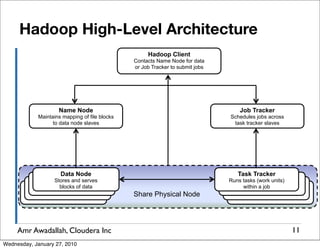
Hadoop High-Level Architecture
                                                    Hadoop Client
                                               Contacts Name Node for data
                                               or Job Tracker to submit jobs


                    Name Node                                                      Job Tracker
            Maintains mapping of file blocks                                   Schedules jobs across
                  to data node slaves                                           task tracker slaves


                     Data Node                                                    Task Tracker
                  Stores and serves                                            Runs tasks (work units)
                    blocks of data                                                  within a job
                                               Share Physical Node


     Amr Awadallah, Cloudera Inc                                                                         11
Wednesday, January 27, 2010
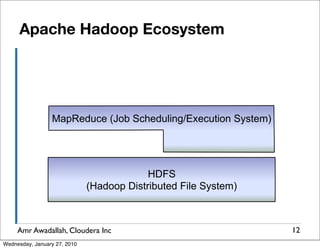
Apache Hadoop Ecosystem


                 MapReduce (Job Scheduling/Execution System)


                                           HDFS
                              (Hadoop Distributed File System)


     Amr Awadallah, Cloudera Inc                                 12
Wednesday, January 27, 2010
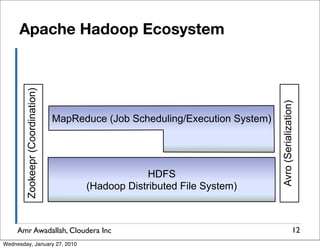
Apache Hadoop Ecosystem
        Zookeepr (Coordination)


                                                                                Avro (Serialization)
                                  MapReduce (Job Scheduling/Execution System)


                                                     HDFS
                                        (Hadoop Distributed File System)


     Amr Awadallah, Cloudera Inc                                                                 12
Wednesday, January 27, 2010
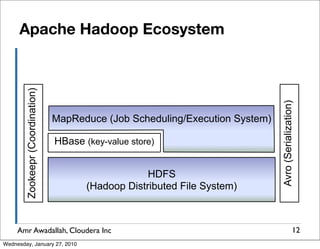
Apache Hadoop Ecosystem
        Zookeepr (Coordination)


                                                                                Avro (Serialization)
                                  MapReduce (Job Scheduling/Execution System)

                                  HBase (key-value store)


                                                      HDFS
                                         (Hadoop Distributed File System)


     Amr Awadallah, Cloudera Inc                                                                 12
Wednesday, January 27, 2010
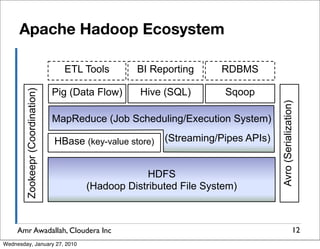
Apache Hadoop Ecosystem

                                    ETL Tools        BI Reporting      RDBMS

                                  Pig (Data Flow)    Hive (SQL)         Sqoop
        Zookeepr (Coordination)


                                                                                     Avro (Serialization)
                                  MapReduce (Job Scheduling/Execution System)

                                  HBase (key-value store)   (Streaming/Pipes APIs)


                                                      HDFS
                                         (Hadoop Distributed File System)


     Amr Awadallah, Cloudera Inc                                                                      12
Wednesday, January 27, 2010
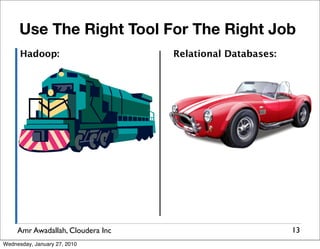
Use The Right Tool For The Right Job
      Hadoop:                      Relational Databases:


     Amr Awadallah, Cloudera Inc                           13
Wednesday, January 27, 2010
Use The Right Tool For The Right Job
      Hadoop:                      Relational Databases:


     Amr Awadallah, Cloudera Inc                           13
Wednesday, January 27, 2010
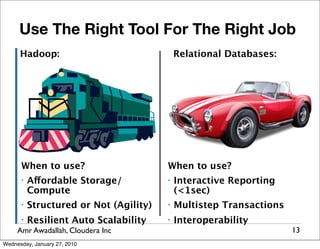
Use The Right Tool For The Right Job
      Hadoop:                               Relational Databases:


      When to use?                      When to use?
      •   Affordable Storage/           •   Interactive Reporting
          Compute                           (<1sec)
      •   Structured or Not (Agility)   •   Multistep Transactions
      •   Resilient Auto Scalability    •   Interoperability
     Amr Awadallah, Cloudera Inc                                     13
Wednesday, January 27, 2010
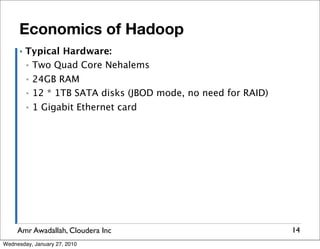
Economics of Hadoop


     Amr Awadallah, Cloudera Inc   14
Wednesday, January 27, 2010
Economics of Hadoop
      ▪   Typical Hardware:
          ▪ Two Quad Core Nehalems

          ▪   24GB RAM
          ▪   12 * 1TB SATA disks (JBOD mode, no need for RAID)
          ▪   1 Gigabit Ethernet card


     Amr Awadallah, Cloudera Inc                                  14
Wednesday, January 27, 2010
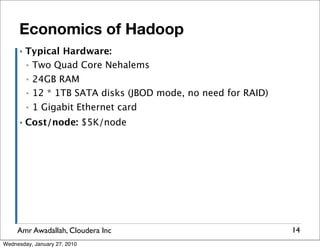
Economics of Hadoop
      ▪   Typical Hardware:
          ▪ Two Quad Core Nehalems

          ▪   24GB RAM
          ▪   12 * 1TB SATA disks (JBOD mode, no need for RAID)
          ▪   1 Gigabit Ethernet card
      ▪   Cost/node: $5K/node


     Amr Awadallah, Cloudera Inc                                  14
Wednesday, January 27, 2010
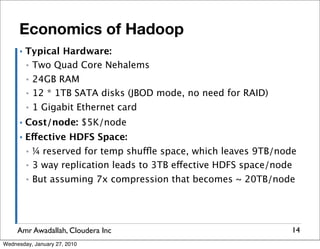
Economics of Hadoop
      ▪   Typical Hardware:
          ▪ Two Quad Core Nehalems

          ▪   24GB RAM
          ▪   12 * 1TB SATA disks (JBOD mode, no need for RAID)
          ▪   1 Gigabit Ethernet card
      ▪   Cost/node: $5K/node
      ▪   Effective HDFS Space:
          ▪   ¼ reserved for temp shuffle space, which leaves 9TB/node
          ▪   3 way replication leads to 3TB effective HDFS space/node
          ▪   But assuming 7x compression that becomes ~ 20TB/node


     Amr Awadallah, Cloudera Inc                                     14
Wednesday, January 27, 2010
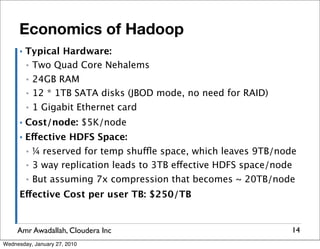
Economics of Hadoop
      ▪   Typical Hardware:
          ▪ Two Quad Core Nehalems

          ▪   24GB RAM
          ▪   12 * 1TB SATA disks (JBOD mode, no need for RAID)
          ▪   1 Gigabit Ethernet card
      ▪   Cost/node: $5K/node
      ▪   Effective HDFS Space:
          ▪   ¼ reserved for temp shuffle space, which leaves 9TB/node
          ▪   3 way replication leads to 3TB effective HDFS space/node
          ▪   But assuming 7x compression that becomes ~ 20TB/node
      Effective Cost per user TB: $250/TB


     Amr Awadallah, Cloudera Inc                                     14
Wednesday, January 27, 2010
Economics of Hadoop
      ▪   Typical Hardware:
          ▪ Two Quad Core Nehalems

          ▪   24GB RAM
          ▪   12 * 1TB SATA disks (JBOD mode, no need for RAID)
          ▪   1 Gigabit Ethernet card
      ▪   Cost/node: $5K/node
      ▪   Effective HDFS Space:
          ▪   ¼ reserved for temp shuffle space, which leaves 9TB/node
          ▪   3 way replication leads to 3TB effective HDFS space/node
          ▪   But assuming 7x compression that becomes ~ 20TB/node
      Effective Cost per user TB: $250/TB
      Other solutions cost in the range of $5K to $100K per
       user TB
     Amr Awadallah, Cloudera Inc                                     14
Wednesday, January 27, 2010
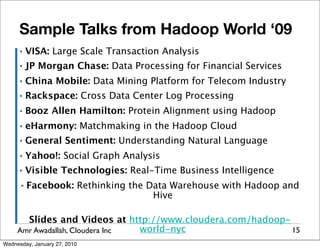
Sample Talks from Hadoop World ‘09
      ▪   VISA: Large Scale Transaction Analysis
      ▪   JP Morgan Chase: Data Processing for Financial Services
      ▪   China Mobile: Data Mining Platform for Telecom Industry
      ▪   Rackspace: Cross Data Center Log Processing
      ▪   Booz Allen Hamilton: Protein Alignment using Hadoop
      ▪   eHarmony: Matchmaking in the Hadoop Cloud
      ▪   General Sentiment: Understanding Natural Language
      ▪   Yahoo!: Social Graph Analysis
      ▪   Visible Technologies: Real-Time Business Intelligence
      ▪   Facebook: Rethinking the Data Warehouse with Hadoop and
                                    Hive

       Slides and Videos at http://www.cloudera.com/hadoop-
     Amr Awadallah, Cloudera Inc world-nyc                  15
Wednesday, January 27, 2010
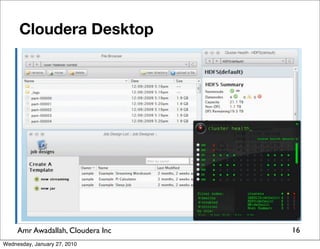
Cloudera Desktop


     Amr Awadallah, Cloudera Inc   16
Wednesday, January 27, 2010
Conclusion


     Amr Awadallah, Cloudera Inc   17
Wednesday, January 27, 2010
Conclusion


              Hadoop is a data grid
            operating system which
            provides an economically
          scalable solution for storing
         and processing large amounts
         of unstructured or structured
           data over long periods of
                      time.
     Amr Awadallah, Cloudera Inc     17
Wednesday, January 27, 2010
Contact Information

                        Amr Awadallah
                     CTO, Cloudera Inc.
                     aaa@cloudera.com
            http://twitter.com/awadallah


          Online Training Videos and Info:
           http://cloudera.com/hadoop-
                       training
               http://cloudera.com/blog
             http://twitter.com/cloudera


     Amr Awadallah, Cloudera Inc             18
Wednesday, January 27, 2010
(c) 2008 Cloudera, Inc. or its licensors.  "Cloudera" is a registered trademark of Cloudera, Inc.. All rights reserved. 1.0


Wednesday, January 27, 2010

Hadoop: Distributed data processing

  • 1.
    Hadoop: Distributed DataProcessing Amr Awadallah Founder/CTO, Cloudera, Inc. ACM Data Mining SIG Thursday, January 25th, 2010 Wednesday, January 27, 2010
  • 2.
    Outline ▪Scaling for Large Data Processing ▪What is Hadoop? ▪HDFS and MapReduce ▪Hadoop Ecosystem ▪Hadoop vs RDBMSes ▪Conclusion Amr Awadallah, Cloudera Inc 2 Wednesday, January 27, 2010
  • 3.
    Current Storage SystemsCan’t Compute Amr Awadallah, Cloudera Inc 3 Wednesday, January 27, 2010
  • 4.
    Current Storage SystemsCan’t Compute Collection Instrumentation Amr Awadallah, Cloudera Inc 3 Wednesday, January 27, 2010
  • 5.
    Current Storage SystemsCan’t Compute Storage Farm for Unstructured Data (20TB/day) Mostly Append Collection Instrumentation Amr Awadallah, Cloudera Inc 3 Wednesday, January 27, 2010
  • 6.
    Current Storage SystemsCan’t Compute Interactive Apps RDBMS (200GB/day) ETL Grid Storage Farm for Unstructured Data (20TB/day) Mostly Append Collection Instrumentation Amr Awadallah, Cloudera Inc 3 Wednesday, January 27, 2010
  • 7.
    Current Storage SystemsCan’t Compute Interactive Apps RDBMS (200GB/day) ETL Grid Filer heads are a bottleneck Storage Farm for Unstructured Data (20TB/day) Mostly Append Collection Instrumentation Amr Awadallah, Cloudera Inc 3 Wednesday, January 27, 2010
  • 8.
    Current Storage SystemsCan’t Compute Interactive Apps Ad hoc Queries & Data Mining RDBMS (200GB/day) ETL Grid Non-Consumption Filer heads are a bottleneck Storage Farm for Unstructured Data (20TB/day) Mostly Append Collection Instrumentation Amr Awadallah, Cloudera Inc 3 Wednesday, January 27, 2010
  • 9.
    The Solution: AStore-Compute Grid Amr Awadallah, Cloudera Inc 4 Wednesday, January 27, 2010
  • 10.
    The Solution: AStore-Compute Grid Storage + Computation Mostly Append Collection Instrumentation Amr Awadallah, Cloudera Inc 4 Wednesday, January 27, 2010
  • 11.
    The Solution: AStore-Compute Grid Interactive Apps RDBMS ETL and Aggregations Storage + Computation Mostly Append Collection Instrumentation Amr Awadallah, Cloudera Inc 4 Wednesday, January 27, 2010
  • 12.
    The Solution: AStore-Compute Grid Interactive Apps “Batch” Apps RDBMS Ad hoc Queries ETL and & Data Mining Aggregations Storage + Computation Mostly Append Collection Instrumentation Amr Awadallah, Cloudera Inc 4 Wednesday, January 27, 2010
  • 13.
    What is Hadoop? Amr Awadallah, Cloudera Inc 5 Wednesday, January 27, 2010
  • 14.
    What is Hadoop? ▪A scalable fault-tolerant grid operating system for data storage and processing Amr Awadallah, Cloudera Inc 5 Wednesday, January 27, 2010
  • 15.
    What is Hadoop? ▪A scalable fault-tolerant grid operating system for data storage and processing ▪ Its scalability comes from the marriage of: ▪ HDFS: Self-Healing High-Bandwidth Clustered Storage ▪ MapReduce: Fault-Tolerant Distributed Processing Amr Awadallah, Cloudera Inc 5 Wednesday, January 27, 2010
  • 16.
    What is Hadoop? ▪A scalable fault-tolerant grid operating system for data storage and processing ▪ Its scalability comes from the marriage of: ▪ HDFS: Self-Healing High-Bandwidth Clustered Storage ▪ MapReduce: Fault-Tolerant Distributed Processing ▪ Operates on unstructured and structured data Amr Awadallah, Cloudera Inc 5 Wednesday, January 27, 2010
  • 17.
    What is Hadoop? ▪A scalable fault-tolerant grid operating system for data storage and processing ▪ Its scalability comes from the marriage of: ▪ HDFS: Self-Healing High-Bandwidth Clustered Storage ▪ MapReduce: Fault-Tolerant Distributed Processing ▪ Operates on unstructured and structured data ▪ A large and active ecosystem (many developers and additions like HBase, Hive, Pig, …) Amr Awadallah, Cloudera Inc 5 Wednesday, January 27, 2010
  • 18.
    What is Hadoop? ▪A scalable fault-tolerant grid operating system for data storage and processing ▪ Its scalability comes from the marriage of: ▪ HDFS: Self-Healing High-Bandwidth Clustered Storage ▪ MapReduce: Fault-Tolerant Distributed Processing ▪ Operates on unstructured and structured data ▪ A large and active ecosystem (many developers and additions like HBase, Hive, Pig, …) ▪ Open source under the friendly Apache License Amr Awadallah, Cloudera Inc 5 Wednesday, January 27, 2010
  • 19.
    What is Hadoop? ▪A scalable fault-tolerant grid operating system for data storage and processing ▪ Its scalability comes from the marriage of: ▪ HDFS: Self-Healing High-Bandwidth Clustered Storage ▪ MapReduce: Fault-Tolerant Distributed Processing ▪ Operates on unstructured and structured data ▪ A large and active ecosystem (many developers and additions like HBase, Hive, Pig, …) ▪ Open source under the friendly Apache License ▪ http://wiki.apache.org/hadoop/ Amr Awadallah, Cloudera Inc 5 Wednesday, January 27, 2010
  • 20.
    Hadoop History Amr Awadallah, Cloudera Inc 6 Wednesday, January 27, 2010
  • 21.
    Hadoop History ▪ 2002-2004: Doug Cutting and Mike Cafarella started working on Nutch Amr Awadallah, Cloudera Inc 6 Wednesday, January 27, 2010
  • 22.
    Hadoop History ▪ 2002-2004: Doug Cutting and Mike Cafarella started working on Nutch ▪ 2003-2004: Google publishes GFS and MapReduce papers Amr Awadallah, Cloudera Inc 6 Wednesday, January 27, 2010
  • 23.
    Hadoop History ▪ 2002-2004: Doug Cutting and Mike Cafarella started working on Nutch ▪ 2003-2004: Google publishes GFS and MapReduce papers ▪ 2004: Cutting adds DFS & MapReduce support to Nutch Amr Awadallah, Cloudera Inc 6 Wednesday, January 27, 2010
  • 24.
    Hadoop History ▪ 2002-2004: Doug Cutting and Mike Cafarella started working on Nutch ▪ 2003-2004: Google publishes GFS and MapReduce papers ▪ 2004: Cutting adds DFS & MapReduce support to Nutch ▪ 2006: Yahoo! hires Cutting, Hadoop spins out of Nutch Amr Awadallah, Cloudera Inc 6 Wednesday, January 27, 2010
  • 25.
    Hadoop History ▪ 2002-2004: Doug Cutting and Mike Cafarella started working on Nutch ▪ 2003-2004: Google publishes GFS and MapReduce papers ▪ 2004: Cutting adds DFS & MapReduce support to Nutch ▪ 2006: Yahoo! hires Cutting, Hadoop spins out of Nutch ▪ 2007: NY Times converts 4TB of archives over 100 EC2s Amr Awadallah, Cloudera Inc 6 Wednesday, January 27, 2010
  • 26.
    Hadoop History ▪ 2002-2004: Doug Cutting and Mike Cafarella started working on Nutch ▪ 2003-2004: Google publishes GFS and MapReduce papers ▪ 2004: Cutting adds DFS & MapReduce support to Nutch ▪ 2006: Yahoo! hires Cutting, Hadoop spins out of Nutch ▪ 2007: NY Times converts 4TB of archives over 100 EC2s ▪ 2008: Web-scale deployments at Y!, Facebook, Last.fm Amr Awadallah, Cloudera Inc 6 Wednesday, January 27, 2010
  • 27.
    Hadoop History ▪ 2002-2004: Doug Cutting and Mike Cafarella started working on Nutch ▪ 2003-2004: Google publishes GFS and MapReduce papers ▪ 2004: Cutting adds DFS & MapReduce support to Nutch ▪ 2006: Yahoo! hires Cutting, Hadoop spins out of Nutch ▪ 2007: NY Times converts 4TB of archives over 100 EC2s ▪ 2008: Web-scale deployments at Y!, Facebook, Last.fm ▪ April 2008: Yahoo does fastest sort of a TB, 3.5mins over 910 nodes Amr Awadallah, Cloudera Inc 6 Wednesday, January 27, 2010
  • 28.
    Hadoop History ▪ 2002-2004: Doug Cutting and Mike Cafarella started working on Nutch ▪ 2003-2004: Google publishes GFS and MapReduce papers ▪ 2004: Cutting adds DFS & MapReduce support to Nutch ▪ 2006: Yahoo! hires Cutting, Hadoop spins out of Nutch ▪ 2007: NY Times converts 4TB of archives over 100 EC2s ▪ 2008: Web-scale deployments at Y!, Facebook, Last.fm ▪ April 2008: Yahoo does fastest sort of a TB, 3.5mins over 910 nodes ▪ May 2009: ▪ Yahoo does fastest sort of a TB, 62secs over 1460 nodes ▪ Yahoo sorts a PB in 16.25hours over 3658 nodes Amr Awadallah, Cloudera Inc 6 Wednesday, January 27, 2010
  • 29.
    Hadoop History ▪ 2002-2004: Doug Cutting and Mike Cafarella started working on Nutch ▪ 2003-2004: Google publishes GFS and MapReduce papers ▪ 2004: Cutting adds DFS & MapReduce support to Nutch ▪ 2006: Yahoo! hires Cutting, Hadoop spins out of Nutch ▪ 2007: NY Times converts 4TB of archives over 100 EC2s ▪ 2008: Web-scale deployments at Y!, Facebook, Last.fm ▪ April 2008: Yahoo does fastest sort of a TB, 3.5mins over 910 nodes ▪ May 2009: ▪ Yahoo does fastest sort of a TB, 62secs over 1460 nodes ▪ Yahoo sorts a PB in 16.25hours over 3658 nodes ▪ June 2009, Oct 2009: Hadoop Summit (750), Hadoop World (500) Amr Awadallah, Cloudera Inc 6 Wednesday, January 27, 2010
  • 30.
    Hadoop History ▪ 2002-2004: Doug Cutting and Mike Cafarella started working on Nutch ▪ 2003-2004: Google publishes GFS and MapReduce papers ▪ 2004: Cutting adds DFS & MapReduce support to Nutch ▪ 2006: Yahoo! hires Cutting, Hadoop spins out of Nutch ▪ 2007: NY Times converts 4TB of archives over 100 EC2s ▪ 2008: Web-scale deployments at Y!, Facebook, Last.fm ▪ April 2008: Yahoo does fastest sort of a TB, 3.5mins over 910 nodes ▪ May 2009: ▪ Yahoo does fastest sort of a TB, 62secs over 1460 nodes ▪ Yahoo sorts a PB in 16.25hours over 3658 nodes ▪ June 2009, Oct 2009: Hadoop Summit (750), Hadoop World (500) Amr Awadallah, Cloudera Inc 6 ▪ September 2009: Doug Cutting joins Cloudera Wednesday, January 27, 2010
  • 31.
    Hadoop Design Axioms Amr Awadallah, Cloudera Inc 7 Wednesday, January 27, 2010
  • 32.
    Hadoop Design Axioms 1. System Shall Manage and Heal Itself Amr Awadallah, Cloudera Inc 7 Wednesday, January 27, 2010
  • 33.
    Hadoop Design Axioms 1. System Shall Manage and Heal Itself 2. Performance Shall Scale Linearly Amr Awadallah, Cloudera Inc 7 Wednesday, January 27, 2010
  • 34.
    Hadoop Design Axioms 1. System Shall Manage and Heal Itself 2. Performance Shall Scale Linearly 3. Compute Should Move to Data Amr Awadallah, Cloudera Inc 7 Wednesday, January 27, 2010
  • 35.
    Hadoop Design Axioms 1. System Shall Manage and Heal Itself 2. Performance Shall Scale Linearly 3. Compute Should Move to Data 4. Simple Core, Modular and Extensible Amr Awadallah, Cloudera Inc 7 Wednesday, January 27, 2010
  • 36.
    HDFS: Hadoop DistributedFile System Block Size = 64MB Replication Factor = 3 Cost/GB is a few ¢/month vs $/month Amr Awadallah, Cloudera Inc 8 Wednesday, January 27, 2010
  • 37.
    HDFS: Hadoop DistributedFile System Block Size = 64MB Replication Factor = 3 Cost/GB is a few ¢/month vs $/month Amr Awadallah, Cloudera Inc 8 Wednesday, January 27, 2010
  • 38.
    MapReduce: Distributed Processing Amr Awadallah, Cloudera Inc 9 Wednesday, January 27, 2010
  • 39.
    MapReduce: Distributed Processing Amr Awadallah, Cloudera Inc 9 Wednesday, January 27, 2010
  • 40.
    MapReduce Example forWord Count SELECT word, COUNT(1) FROM docs GROUP BY word; cat *.txt | mapper.pl | sort | reducer.pl > out.txt Split 1 Split i Split N Amr Awadallah, Cloudera Inc 10 Wednesday, January 27, 2010
  • 41.
    MapReduce Example forWord Count SELECT word, COUNT(1) FROM docs GROUP BY word; cat *.txt | mapper.pl | sort | reducer.pl > out.txt (words, counts) Split 1 (docid, text) Map 1 Be, 5 “To Be Or Not To Be?” Be, 12 Split i (docid, text) Map i Be, 7 Be, 6 Split N (docid, text) Map M (words, counts) Amr Awadallah, Cloudera Inc 10 Wednesday, January 27, 2010
  • 42.
    MapReduce Example forWord Count SELECT word, COUNT(1) FROM docs GROUP BY word; cat *.txt | mapper.pl | sort | reducer.pl > out.txt (words, counts) Split 1 (docid, text) Map 1 (sorted words, counts) Be, 5 Reduce 1 “To Be Or Not To Be?” Be, 12 Reduce i Split i (docid, text) Map i Be, 7 Be, 6 Shuffle Reduce R Split N (docid, text) Map M (words, counts) (sorted words, counts) Amr Awadallah, Cloudera Inc 10 Wednesday, January 27, 2010
  • 43.
    MapReduce Example forWord Count SELECT word, COUNT(1) FROM docs GROUP BY word; cat *.txt | mapper.pl | sort | reducer.pl > out.txt (words, counts) Split 1 (docid, text) Map 1 (sorted words, counts) Output File Be, 5 Reduce 1 (sorted words, sum of counts) 1 “To Be Or Not Be, 30 To Be?” Be, 12 Output File i (sorted words, Reduce i sum of counts) Split i (docid, text) Map i Be, 7 Be, 6 Shuffle Output File (sorted words, R Reduce R sum of counts) Split N (docid, text) Map M (words, counts) (sorted words, counts) Amr Awadallah, Cloudera Inc 10 Wednesday, January 27, 2010
  • 44.
    Hadoop High-Level Architecture Hadoop Client Contacts Name Node for data or Job Tracker to submit jobs Name Node Job Tracker Maintains mapping of file blocks Schedules jobs across to data node slaves task tracker slaves Data Node Task Tracker Stores and serves Runs tasks (work units) blocks of data within a job Share Physical Node Amr Awadallah, Cloudera Inc 11 Wednesday, January 27, 2010
  • 45.
    Apache Hadoop Ecosystem MapReduce (Job Scheduling/Execution System) HDFS (Hadoop Distributed File System) Amr Awadallah, Cloudera Inc 12 Wednesday, January 27, 2010
  • 46.
    Apache Hadoop Ecosystem Zookeepr (Coordination) Avro (Serialization) MapReduce (Job Scheduling/Execution System) HDFS (Hadoop Distributed File System) Amr Awadallah, Cloudera Inc 12 Wednesday, January 27, 2010
  • 47.
    Apache Hadoop Ecosystem Zookeepr (Coordination) Avro (Serialization) MapReduce (Job Scheduling/Execution System) HBase (key-value store) HDFS (Hadoop Distributed File System) Amr Awadallah, Cloudera Inc 12 Wednesday, January 27, 2010
  • 48.
    Apache Hadoop Ecosystem ETL Tools BI Reporting RDBMS Pig (Data Flow) Hive (SQL) Sqoop Zookeepr (Coordination) Avro (Serialization) MapReduce (Job Scheduling/Execution System) HBase (key-value store) (Streaming/Pipes APIs) HDFS (Hadoop Distributed File System) Amr Awadallah, Cloudera Inc 12 Wednesday, January 27, 2010
  • 49.
    Use The RightTool For The Right Job Hadoop: Relational Databases: Amr Awadallah, Cloudera Inc 13 Wednesday, January 27, 2010
  • 50.
    Use The RightTool For The Right Job Hadoop: Relational Databases: Amr Awadallah, Cloudera Inc 13 Wednesday, January 27, 2010
  • 51.
    Use The RightTool For The Right Job Hadoop: Relational Databases: When to use? When to use? • Affordable Storage/ • Interactive Reporting Compute (<1sec) • Structured or Not (Agility) • Multistep Transactions • Resilient Auto Scalability • Interoperability Amr Awadallah, Cloudera Inc 13 Wednesday, January 27, 2010
  • 52.
    Economics of Hadoop Amr Awadallah, Cloudera Inc 14 Wednesday, January 27, 2010
  • 53.
    Economics of Hadoop ▪ Typical Hardware: ▪ Two Quad Core Nehalems ▪ 24GB RAM ▪ 12 * 1TB SATA disks (JBOD mode, no need for RAID) ▪ 1 Gigabit Ethernet card Amr Awadallah, Cloudera Inc 14 Wednesday, January 27, 2010
  • 54.
    Economics of Hadoop ▪ Typical Hardware: ▪ Two Quad Core Nehalems ▪ 24GB RAM ▪ 12 * 1TB SATA disks (JBOD mode, no need for RAID) ▪ 1 Gigabit Ethernet card ▪ Cost/node: $5K/node Amr Awadallah, Cloudera Inc 14 Wednesday, January 27, 2010
  • 55.
    Economics of Hadoop ▪ Typical Hardware: ▪ Two Quad Core Nehalems ▪ 24GB RAM ▪ 12 * 1TB SATA disks (JBOD mode, no need for RAID) ▪ 1 Gigabit Ethernet card ▪ Cost/node: $5K/node ▪ Effective HDFS Space: ▪ ¼ reserved for temp shuffle space, which leaves 9TB/node ▪ 3 way replication leads to 3TB effective HDFS space/node ▪ But assuming 7x compression that becomes ~ 20TB/node Amr Awadallah, Cloudera Inc 14 Wednesday, January 27, 2010
  • 56.
    Economics of Hadoop ▪ Typical Hardware: ▪ Two Quad Core Nehalems ▪ 24GB RAM ▪ 12 * 1TB SATA disks (JBOD mode, no need for RAID) ▪ 1 Gigabit Ethernet card ▪ Cost/node: $5K/node ▪ Effective HDFS Space: ▪ ¼ reserved for temp shuffle space, which leaves 9TB/node ▪ 3 way replication leads to 3TB effective HDFS space/node ▪ But assuming 7x compression that becomes ~ 20TB/node Effective Cost per user TB: $250/TB Amr Awadallah, Cloudera Inc 14 Wednesday, January 27, 2010
  • 57.
    Economics of Hadoop ▪ Typical Hardware: ▪ Two Quad Core Nehalems ▪ 24GB RAM ▪ 12 * 1TB SATA disks (JBOD mode, no need for RAID) ▪ 1 Gigabit Ethernet card ▪ Cost/node: $5K/node ▪ Effective HDFS Space: ▪ ¼ reserved for temp shuffle space, which leaves 9TB/node ▪ 3 way replication leads to 3TB effective HDFS space/node ▪ But assuming 7x compression that becomes ~ 20TB/node Effective Cost per user TB: $250/TB Other solutions cost in the range of $5K to $100K per user TB Amr Awadallah, Cloudera Inc 14 Wednesday, January 27, 2010
  • 58.
    Sample Talks fromHadoop World ‘09 ▪ VISA: Large Scale Transaction Analysis ▪ JP Morgan Chase: Data Processing for Financial Services ▪ China Mobile: Data Mining Platform for Telecom Industry ▪ Rackspace: Cross Data Center Log Processing ▪ Booz Allen Hamilton: Protein Alignment using Hadoop ▪ eHarmony: Matchmaking in the Hadoop Cloud ▪ General Sentiment: Understanding Natural Language ▪ Yahoo!: Social Graph Analysis ▪ Visible Technologies: Real-Time Business Intelligence ▪ Facebook: Rethinking the Data Warehouse with Hadoop and Hive Slides and Videos at http://www.cloudera.com/hadoop- Amr Awadallah, Cloudera Inc world-nyc 15 Wednesday, January 27, 2010
  • 59.
    Cloudera Desktop Amr Awadallah, Cloudera Inc 16 Wednesday, January 27, 2010
  • 60.
    Conclusion Amr Awadallah, Cloudera Inc 17 Wednesday, January 27, 2010
  • 61.
    Conclusion Hadoop is a data grid operating system which provides an economically scalable solution for storing and processing large amounts of unstructured or structured data over long periods of time. Amr Awadallah, Cloudera Inc 17 Wednesday, January 27, 2010
  • 62.
    Contact Information Amr Awadallah CTO, Cloudera Inc. aaa@cloudera.com http://twitter.com/awadallah Online Training Videos and Info: http://cloudera.com/hadoop- training http://cloudera.com/blog http://twitter.com/cloudera Amr Awadallah, Cloudera Inc 18 Wednesday, January 27, 2010
  • 63.
    (c) 2008 Cloudera,Inc. or its licensors.  "Cloudera" is a registered trademark of Cloudera, Inc.. All rights reserved. 1.0 Wednesday, January 27, 2010