Black Ops 2007: Design Reviewing The Web AKA: “Packets Will Be Involved” Dan Kaminsky Director of Penetration Testing IOActive, Inc. copyright IOActive, Inc. 2006, all rights reserved.
Introduction This is my  seventh  talk here at Black Hat, where previous subjects have included: Everything over SSH Massive Speed Network Scanning Everything over DNS Pattern Analysis Neutrality Verification New Target:  The World Wide Web Why?
That’s Not A Moon, That’s A Web Browser © LucasFilm
Mobile Too! © LucasFilm
Where The Wild Things Are Rampant and persistent XSS/XSRF announcements Superbowl .WMF 0-day Two days before Superbowl, malicious image placed on web page 1+M desktops compromised overnight DNS Rebinding Test By Dan Boneh’s Team at Stanford Test flash applet placed on an Ad network, distributed across many web sites Applet acquired partial network connectivity to client LAN +100K networks exposed
These Are A Few Of My Favorite Things DNS…?  Tunneling…?  Behind Firewalls…? “ I try to get out, but they pull me back in!” DNS Rebinding is an  old  bug Dates back to 1996 So old, people forgot about it, and started building systems that didn’t defend against it Dan Boneh of Stanford University’s been driving the most thorough research Attack dates back to 1996 (“Princeton Attack”) Martin Johns revived the attack in August 2006 RSnake’s been pushing a lot of attention its way Effect:  DNS Rebinding partially breaks the security policy of the web.
How Does The Web Work? Web pages are pulled together in the browser, from pieces that can come from all over the place You can even embed one web page inside another one! This is an “IFrame” But what if someone embedded Hotmail, and you were logged in?  Would they be able to read your mail?
The Same Origin Policy “ Look but don’t touch” A web page can embed Hotmail, but it can’t “look inside” to see what’s happening Access to “look inside” controlled by Same Origin Policy If foo.com has an iframe to foo.com, it can look inside. If foo.com has an iframe to bar.com, it can display bar.com to the user, but it can’t peek inside and see what the user sees. “ If two things come from the same place, they must be trusted the same” Same place = Same name, right?
The Bug Names don’t host anything. Everything comes from IP addresses We use DNS to translate between a name we trust and an IP address we communicate with Foo.com -> 1.2.3.4 Bar.com -> 3.4.5.6 Assumption:  The translations don’t change Reality:  Both foo.com and bar.com can return any IP address, at any time, whether they control that IP or not Bar.com can return an IP address of Foo.Com’s
Now What? One moment, bar.com could point to a server in Europe The next moment, bar.com could point to the printer down the hall Suppose your browser loaded a page from each address The content from the European server would be from bar.com The content from the printer down the hall would  also  be from bar.com According to the Same Origin Policy, the server in Europe can do whatever it wants to your printer! The server can’t get past your corporate firewall… … but it doesn’t need to.  It’ll tell your browser what to do, and your browser will report back with whatever your printer is up to.
Why The Attack Works Browser doesn’t know bar.com from the external IP is any different from bar.com from the internal IP This is  by design Major web sites have IP addresses spread across the world, and resources acquired from them need to be able to script against one another Detecting  that there’s a cross-IP scripting action happening is only the beginning – what to do after that is what people are trying to figure out.
What is the canonical attack here? Firewall Bypass Most corporate networks draw a significant distinction between the  external  network and the  internal  network Things inside can route out Things outside cannot route in By bouncing off a lured browser, an attacker on the outside can access resources on the inside
Levels of Exploitation Level 1:  Browser-Only One IFrame is from Europe, the other is down the hall.  Same name, so they can script against eachother. The Win:  Arbitrary HTTP Sites Level 2: Web Plugins MSXML* / XmlHTTPRequest / Silverlight The Win: HTTP + Web Services + Semi-Arbitrary Headers Level 3: Socket Plugins Flash / Java, though different resources available through each The Win:  Everything from L1+L2, plus various degrees of TCP or UDP access
Java Original Target of 1996 Princeton Attack From Applet interface, can only get high-port UDP and TCP to the actual calling app More widely deployed than I thought LiveConnect Ability for Javascript to call Sockets directly, without going through Applet interface Totally rebindable – effect is high-port UDP and TCP to anyone FireFox and Safari only though
Flash Has worked hardest to make arbitrary socket connections work when they’re supposed to Most mature security model in the industry They don’t handle rebinding well though Breaks what is otherwise a lot of really good work   Effect:  Arbitrary TCP, though you have to pull some tricks to get TCP ports below 1024
Mechanisms for rebinding an address Lots of ways to  use  a rebind, but how do you achieve it in the first place? How do you cause the DNS infrastructure to accept your change of address? The entire architecture is designed to cache across hours to days, not to be swappable in seconds Three mechanisms Temporal Spatial Ridiculous
Traditional Rebinding:  Temporal Modulation DNS records have a TTL field – lets you declare how long a record should live in the infrastructure before a second query causes a new request to the original server Declare a 0 TTL and records will supposedly not cache Now every time the browser has a slightly different DNS request, you get an opportunity to provide a different location Problem:  Some networks won’t respect your low TTL.  Some networks  brag  about that ;) You could wait until the network-enforced minimum TTL expires, but that takes time
Another Rebinding Mechanism:  Spatial Modulation DNS responses can contain multiple addresses When bar.com is asked for its IP address, it returns  both  its address  and  the address of the printer This can have a infinite TTL Problem:  Which record will the browser choose? Totally random.   Solution:  Try again Seriously.
Spatial Error Resolution Case 1:  Browser wants external, gets internal Fix 1: External resource is hosted on an unusual port, so the internal connection will fail and thus retry to external.  This has problems with outbound firewalls, though. Fix 2: Immediately after connecting, look for evidence in the connected session that we’ve actually reached the correct server.  If not, destroy the object that did the incorrect retrieve and keep trying until success. The trick:  Retrieve the content with XMLHttpRequest so that you  can  actually destroy the object that guessed incorrectly. Case 2:  Flash/Java wants internal, gets external Fix:  Look for magic token on incoming session.  If magic token is returned, destroy the object and try again.  If no token, retry the applet a couple times just in case there’s a extrusion firewall in the way.
Ridiculous? People are trying to use DNS TTLs as a security technology DNS TTL’s are not a security technology Finally, something less a security technology than Virtual Machines   Overriding a TTL, if you control the record, turns out to be  very easy , and this is  by design When something wasn’t  designed  to be a security technology, don’t be surprised when it  isn’t  one
CNiping CNAME Records:  DNS Aliases Instead of returning an address, return what the “Canonical”, or Official Name was, and then the address of that Canonical Name If you are allowed to be the resolver for that canonical name, your additional record overrides whatever’s already in the cache, even if the TTL hasn’t expired yet It’s not a bug. Works against most, but not actually  all  name servers
CNiping Demo[0] dig 1.foo.notmallory.com ;; ANSWER SECTION: 1.foo.notmallory.com.  120  IN  CNAME  bar.foo.notmallory.com bar.foo.notmallory.com. 120  IN  A  10.0.0.0 dig bar.foo.notmallory.com bar.foo.notmallory.com. 111  IN  A  10.0.0.0
CNiping Demo[1] dig 2.foo.notmallory.com 2.foo.notmallory.com.  120  IN  CNAME  bar.foo.notmallory.com. bar.foo.notmallory.com. 120  IN  A  10.0.0.1 dig bar.foo.notmallory.com bar.foo.notmallory.com. 118  IN  A  10.0.0.1
Review By swapping addresses out from underneath a web browser, we can get arbitrary TCP (and sometimes UDP) access to hosts reachable by the client.  What can we do with this? Can we VPN into corporate networks with nothing but a lured web browser? Sure!  It’s easy!* * Actually a pain in the ass, but heh  
Concentration Three actors in this little dance The Browser, which has access to internal resources The Attacker, which wants access to those internal resources The Proxy, which sends code to the Browser to copy messages from the Attacker We will start with the Proxy, running software of my design.  This software is called Slirpie.
Slirpie, The Proxy Multiprotocol Server, Built using POE Accepts TCP streams for Browser delivery, containing routing data Accepts HTTP requests for those routable streams Accepts DNS requests to direct routing Accepts XMLSocket requests to determine routing policy For Flash The basic theme is – Attacker connects to Proxy, which manages the appropriate resources in Browser to service the Attacker’s connections.
A Bucket of Suckets Browser connects, establishes an IFrame called a “Bucket” A bucket is a collection of connection managers The bucket polls for new connections to establish Attacker connects to Proxy and requests a socket to 10.0.0.1, port 80.  Browser Bucket retrieves list of new connections, compares against the previous list, notices one new demand for 10.0.0.1:80. Bucket opens up a 2 nd  level IFrame for this new IP address. The IFRAME SRC attribute for the 2 nd  level IFrame is set to 10.0.0.1.foo.proxydomain.com.  For now, it still resolves to the Proxy’s address. This 2 nd  level IFrame is called a “Sucket”.
Demo JSON { "10.0.0.1" : { "3" : { "from_browser_seq" : -1, "server_state" : "CONNECTED", "from_browser_ack" : -1, "to_browser" : { "1" : "YQo=", "0" : "Zm9vCg==", "3" : "Ywo=", "2" : "Ygo=" }, "dport" : 80, "dproto" : 6, "browser_state" : "CONNECTING", "to_browser_seq" : 3, "to_browser_ack" : -1, "from_browser" : { } } } }
How many DNS requests  does  it take to get to the center of your corporate network? Javascript alone will not open this Socket.  Flash is necessary. HaXe, a metalanguage, is used to compile both a Flash object and a Javascript interface to it. The Flash object is loaded, and directed to create a connection to 10.0.0.1:80 QUERY ONE:  Load the movie  from 10.0.0.1.foo.proxyhost.com (actually Proxy’s IP) QUERY TWO:  Load the  security policy  controlling <1024 port access from 10.0.0.1.foo.proxyhost.com (still Proxy’s IP) ARM THE REBIND: Tell the Proxy to return a different address with the next query, using a special HTTP query. QUERY THREE:  Connect  to 10.0.0.1.foo.proxyhost.com:80 (now finally returning 10.0.0.1). Connection is in the applet loaded by the proxy, using the security policy provided by the proxy.
Managing Dataflows 1) Data is received by Flash – sent down into the Sucket’s DOM for eventual collection. 2) Bucket prepares to send an update to the Proxy.  It visits each Sucket, and retrieves the latest list of updates. 3) Proxy received the update, acknowledges reception, and sends any replies in the update response. 4) Bucket receives the response, and tells each Sucket to parse their replies and send() them up through Flash.
But What Of Domains? Each of those IFrames inside the bucket is in a different domain than the bucket itself. Why can they push stuff up, or pull stuff down? Same Origin Policy allows two subdomains from the same domain to explicitly claim support for one another So we do that. Thanks Same Origin Policy!  
And that’s it! OK, a little bit of housekeeping for opening and closing sockets, and eventually entire suckets. Yeah, it’s a reimplementation of TCP in Javascript.  Who else was going to write it?   … but what about the attacker?  How does he open sockets?
Does anyone remember this?
Back In The Day, When I Was Young I’m Not Runnin’ 95 Anymore SLiRP 1995 era tool that turned shell connections (text only) into PPP connections (pretty pretty pictures) Was old school when I used it in my talk back in 2001 What SLiRP actually does:  Given a stream of packets, create sockets and send the data in the packets into the sockets SLiRP was Userspace NAT Where to find SLiRP:  Recent versions … uh … disappeared. Found in my “ancient cool stuff” archive  
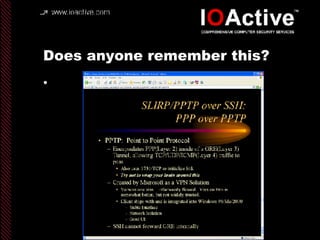
SLIRP and PPTP PoPToP:  Linux PPTP Daemon PPTP:  Horrifyingly hideous VPN protocol, ultimately uses a PPP encapsulated stream of packets PoPToP can hand this PPP stream to SLiRP for termination Makes setting up a VPN link much easier Makes VPN’ing into a web browser possible. Normally, SLiRP would now handle sockets directly What if, instead, it gave the socket requests to Slirpie?
The General Idea The Attacker runs applications that use sockets. The sockets get their traffic sent over PPTP to SLIRP. SLIRP provides a set of streams to the Proxy. The Proxy tells the Browser’s bucket to open appropriate suckets. The Browser opens suckets, which themselves provide sockets. The Proxy mediates traffic between the Attacker’s sockets and the Browser’s sockets. And it all just works. Nessus over IE:  Nessie! WoW over IE:  Wowie! Any TCP-based protocol should work.
What else can we use this for? Things other people have mentioned Click Fraud – go to random web sites, do bad things SPAM – er, you get Port 25 access too What else can we do? “ Stealth Tor” – go to a website, be involuntarily added to a worldwide proxy network Protect Network Neutrality P2P Networking? Java provides UDP support.  Even through NATs, bidirectional UDP = ability to generate a cloud entirely in the browser That one thing…
IP OVER SPAM Defcon 14, TCP/IP Drinking Game “ How would you get around the great firewall of China?” “ Correct Answer”:  Drop all RST packets, ignore the firewall trying to shut you down My Answer:  Encapsulate data in SPAM. We have IP (or at least TCP) inbound We have SPAM outbound Uh… You know, I was originally joking…
Oh, People Are Interested In This Whole Network Neutrality Thing? I…was unaware this was such a hot button subject when I started developing tools to detect problems with it First of all, we need to start using the correct language:  We wish to detect  Provider Hostility If you’re sniffing my traffic, you’re hostile. If you’re altering my traffic, you’re hostile. If you’re censoring my traffic, you’re hostile. If you’re selling my traffic, you’re very very hostile. Would the military bomb you for doing it to them?  You’re hostile.  Deal.
What Do We Need To Detect Provider Hostility? Downloading data from two separate sites, at two separate speeds, unfortunately doesn’t tell us much Too many factors are conflated to determine what one thing is causing the problem What we want:  “Given identical network paths for two web sites, is the last mile provider hostile to content from one site vs. another?” Detect differential speeds Correct content injection
SOMEBODY is buying this stuff Everyone who knows anyone who makes routers knows that carriers are desperately trying to buy routers that support hostility. There are repeated news articles about ISPs replacing ads and companies setting themselves up as ad replacers Can we monitor the spread of this problem? Can we defend Online Advertising against the Times Square effect?
The Times Square Effect Movies that show Times Square replace all the ads. No contractual obligation not to No real expectation from the viewer that this is reality – it’s a movie Carriers are under no contractual obligation to host the web sites they say they are “ Provider In The Middle” attacks might very well be profitable! Web sites and ads Users tolerate them Businesses would pay dearly to be top ranked on Google Google Times Squared would not be…good.
A Modest Proposal For Correcting Corruption WARNING:  This is hideous Why the web can’t go 100% SSL/TLS yet Ignoring perf, most web sites are aggregated on one IP, with Host: multiplexing SSL/TLS didn’t get an equivalent to the Host: header to determine which certificate to present until  very  recently, and most downlevel clients don’t support One idea:  We use SSL/TLS  only to acquire loaders , which acquire content from existing CDN mechanism but refuse to inject into the DOM unless a HMAC or Tiger Tree check is passed Can definitely do from Flash or Silverlight, possibly from simple AJAX as well Building a system to do this, codenamed “NDK” “ Not DOMokun”
A Reminder The commercial people are why we have strong crypto in the browser in the first place.  Thanks credit card craving commerce people! Feds:  If you like sniffing traffic, require the providers to need a warrant before going hostile. Ad replacement will spread web crypto like nothing else ever has. Now:  Is it possible to get better data regarding the inevitability of all of this?
The Transparent Proxy Gem Some consumer networks have transparent proxies These take all traffic outbound on Port 80 and coalesce onto a single proxy instance that uses the Host: header to route requests to the correct destination Arbitrary TCP = Arbitrary Headers So an attacker can go back to the IP address that provided the applet, and ask for Host:  www.fark.com  – it’ll get routed to Fark instead of to the original host What this means Since the same infrastructure ultimately hosts all web content, all sites (once they’re cached in proxy) come from the same host A speed test against this “transparent” (easily detectable) proxy for various sites will directly yield information about hostility
The Silent Censor Detector Even if there’s no transparent proxy, a filter box can still limit traffic for web requests with non-preferred Host: headers. Using Flash, we can impersonate being a Host: for any site on the Internet when we provide a speed check. The thinking is that the attacker/provider won’t monitor the IP address used to contact Host:  www.whatever.com , and will thus equally rate limit traffic with that Host: no matter what provider.
The Detectability Problem In every major networking company, I assume there is a protocol guy as ornery as I am “Oh yeah, well I’ll just detect him doing that…this way!” Is it possible to build a hostility detection system that uses traffic  indistinguishable  from real world traffic?
Well… We want to spoof sites on the Internet. We want to know what these sites would see. We want to be able to respond as if we were these sites. We don’t want the real sites to interfere with our interference. Good luck!  That would require…sequence numbers. We’d have to know where in the TCP stream an attacker was, and that’s  clearly  not possible…
OMG ACTIVEX FTW
PACKET CLAUS IS COMING TO TOWN
Introducing:  INSPECTOR PAKKET What normally stops Mallory from pretending to be a random site on the Internet? Mallory doesn’t know sequence numbers client will accept Mallory has to compete with real server for the sending of data What do we have? A sniffer that will leak sequence numbers to Mallory What can Mallory now do? Send data to the client that it’ll accept Send a RST to the server so it’ll shut down the session it has with the client
Go Pakket Go! About that RST… RST is a TCP Reset message – it shuts down a socket rather unceremoniously Requires correct SEQ#, but don’t worry,  we have that When Mallory spoofs Bob to Alice, Alice is going to ACK to Bob Normally , Bob will send RSTs back to Alice, since there’s no associated session Thankfully,  Bob is usually running a firewall that long since shut down its connection for Alice… and so drops all of Alice’s ACKs that have been stimulated by Mallory’s traffic! And just to be clear, how is Mallory getting those ACKs? AJAcks:  TCP Acks over AJAX
Go Go Pakket Pwn ‘ The goal is to identify the applications being used on the network, but some of these devices can go much further; those from a company like Narus, for instance, can look inside all traffic from a specific IP address, pick out the HTTP traffic, then drill even further down to capture only traffic headed to and from Gmail, and can even reassemble emails as they are typed out by the user.‘ Given a colluding client, I can: Impersonate anyone who doesn’t ACK my traffic Generate arbitrary traffic that is completely indistinguishable from theirs Provide deep packet inspectors with a whole new realm of content to inspect. I recommend inspecting this information.  Deeply.
Conclusions DNS Rebinding threatens the boundaries of your network There are multiple rebinding mechanisms and many major use cases for each of them; this will not be an easy problem to fix. The web could use some real work on its underlying security models We may need to consider applying integrity, and perhaps encryption to all web traffic due to provider hostility There are mechanisms for detecting such hostility that should be deployable shortly.
[extra slides]
My Process Sit down Relax Put some music on Start writing code Get totally distracted Write something completely different than intended Find out later why
A Fun Little Distraction “ Dotplots???  WTF!” Best feedback I’ve ever gotten   Dotplots are a mechanism for visually analyzing similarity across a dataset See last year’s talk for details So I decided to port last year’s talk to WinAMP. I’m listening to music I like pretty pictures I should like listening to music that generates pretty pictures! Be nice to code something that I’d never show at Black Hat!
The Chemical Brothers,  “Where Do I Begin”
+30% vs. -30% tempo
LudiVu:  Realtime Audio Visualizer Images are based  directly  on spectral similarity “ How similar is what I’m hearing now, to what I’ve heard for the last n seconds?” Bass = Red Midrange = Green Treble = Blue Our auditory system almost certainly does this too Always good to match what the ear is up to Our auditory system almost certain does this better   Amazingly apocalyptically naïve similarity metric!
What We See “ Visual Hash” of auditory segments, based on mutual similarity/dissimilarity across frequencies Reflects overall timbre of what we’re hearing Vertical lines representing repeated structures in the music Lines close = Fast Tempo Lines far away = Slow Tempo Tradeoff between visual hash and structure detection Blur less, get better visual hashing Blur more, get better structure detection
So Why Is This At Black Hat? I’m doing web research! One of my friends, Zane Lackey, knows AJAX quite well and is in town We go out for beers. Me:  “So I’m working on this really cool thing, it makes pictures from sound!” Zane:  “What, for Audio CAPTCHAs?” Me:  “…”
Whatsa CAPTCHA? CAPTCHA:  “Completely Automated Public Turing test to tell Computers and Humans Apart” Used to bind access to a resource to the presence of a human Web sites use them to suppress bots So I get this email, in response to me breaking CAPTCHAs... “ CAPTCHA is quite annoying. I use a few programs to send &quot;auto-messages&quot; and to &quot;steal friends&quot; from others' pages. They had a way around the CAPTCHA system for a while, but not anymore. Check out www.xxx.com and www.yyy.com. I dunno, I have 5 different accounts, and I add 300 people a day on each one, so imagine - I'm typing 250+ CAPTCHA codes a day on this damn thing. ;)”
AmIHumanOrNot The general idea is to use a human’s superior ability at figure/ground separation to differentiate human/machine Image Captchas:  Text, distorted and overlaid with lines and other non-text shapes Problem:  Blind people can’t get in Audio Captchas:  Speech, distorted and overlaid with quieter speech Humans get a 10db boost in perception simply by paying conscious attention Problem:  Audio is actually easier to hack.
Detecting “8”…
…and “9”
Tips For Building Better Audio CAPTCHAs Don’t actually make your speech much louder than your noise Easy to sync on regions of high volume Expand your vocabulary Use a sentence, rather than words in isolation, as we’re much better at parsing them Ask a question, perhaps? “ My name is Bob.  How many letters are in my name?”

Dmk Bo2 K7 Web

  • 1.
    Black Ops 2007:Design Reviewing The Web AKA: “Packets Will Be Involved” Dan Kaminsky Director of Penetration Testing IOActive, Inc. copyright IOActive, Inc. 2006, all rights reserved.
  • 2.
    Introduction This ismy seventh talk here at Black Hat, where previous subjects have included: Everything over SSH Massive Speed Network Scanning Everything over DNS Pattern Analysis Neutrality Verification New Target: The World Wide Web Why?
  • 3.
    That’s Not AMoon, That’s A Web Browser © LucasFilm
  • 4.
    Mobile Too! ©LucasFilm
  • 5.
    Where The WildThings Are Rampant and persistent XSS/XSRF announcements Superbowl .WMF 0-day Two days before Superbowl, malicious image placed on web page 1+M desktops compromised overnight DNS Rebinding Test By Dan Boneh’s Team at Stanford Test flash applet placed on an Ad network, distributed across many web sites Applet acquired partial network connectivity to client LAN +100K networks exposed
  • 6.
    These Are AFew Of My Favorite Things DNS…? Tunneling…? Behind Firewalls…? “ I try to get out, but they pull me back in!” DNS Rebinding is an old bug Dates back to 1996 So old, people forgot about it, and started building systems that didn’t defend against it Dan Boneh of Stanford University’s been driving the most thorough research Attack dates back to 1996 (“Princeton Attack”) Martin Johns revived the attack in August 2006 RSnake’s been pushing a lot of attention its way Effect: DNS Rebinding partially breaks the security policy of the web.
  • 7.
    How Does TheWeb Work? Web pages are pulled together in the browser, from pieces that can come from all over the place You can even embed one web page inside another one! This is an “IFrame” But what if someone embedded Hotmail, and you were logged in? Would they be able to read your mail?
  • 8.
    The Same OriginPolicy “ Look but don’t touch” A web page can embed Hotmail, but it can’t “look inside” to see what’s happening Access to “look inside” controlled by Same Origin Policy If foo.com has an iframe to foo.com, it can look inside. If foo.com has an iframe to bar.com, it can display bar.com to the user, but it can’t peek inside and see what the user sees. “ If two things come from the same place, they must be trusted the same” Same place = Same name, right?
  • 9.
    The Bug Namesdon’t host anything. Everything comes from IP addresses We use DNS to translate between a name we trust and an IP address we communicate with Foo.com -> 1.2.3.4 Bar.com -> 3.4.5.6 Assumption: The translations don’t change Reality: Both foo.com and bar.com can return any IP address, at any time, whether they control that IP or not Bar.com can return an IP address of Foo.Com’s
  • 10.
    Now What? Onemoment, bar.com could point to a server in Europe The next moment, bar.com could point to the printer down the hall Suppose your browser loaded a page from each address The content from the European server would be from bar.com The content from the printer down the hall would also be from bar.com According to the Same Origin Policy, the server in Europe can do whatever it wants to your printer! The server can’t get past your corporate firewall… … but it doesn’t need to. It’ll tell your browser what to do, and your browser will report back with whatever your printer is up to.
  • 11.
    Why The AttackWorks Browser doesn’t know bar.com from the external IP is any different from bar.com from the internal IP This is by design Major web sites have IP addresses spread across the world, and resources acquired from them need to be able to script against one another Detecting that there’s a cross-IP scripting action happening is only the beginning – what to do after that is what people are trying to figure out.
  • 12.
    What is thecanonical attack here? Firewall Bypass Most corporate networks draw a significant distinction between the external network and the internal network Things inside can route out Things outside cannot route in By bouncing off a lured browser, an attacker on the outside can access resources on the inside
  • 13.
    Levels of ExploitationLevel 1: Browser-Only One IFrame is from Europe, the other is down the hall. Same name, so they can script against eachother. The Win: Arbitrary HTTP Sites Level 2: Web Plugins MSXML* / XmlHTTPRequest / Silverlight The Win: HTTP + Web Services + Semi-Arbitrary Headers Level 3: Socket Plugins Flash / Java, though different resources available through each The Win: Everything from L1+L2, plus various degrees of TCP or UDP access
  • 14.
    Java Original Targetof 1996 Princeton Attack From Applet interface, can only get high-port UDP and TCP to the actual calling app More widely deployed than I thought LiveConnect Ability for Javascript to call Sockets directly, without going through Applet interface Totally rebindable – effect is high-port UDP and TCP to anyone FireFox and Safari only though
  • 15.
    Flash Has workedhardest to make arbitrary socket connections work when they’re supposed to Most mature security model in the industry They don’t handle rebinding well though Breaks what is otherwise a lot of really good work  Effect: Arbitrary TCP, though you have to pull some tricks to get TCP ports below 1024
  • 16.
    Mechanisms for rebindingan address Lots of ways to use a rebind, but how do you achieve it in the first place? How do you cause the DNS infrastructure to accept your change of address? The entire architecture is designed to cache across hours to days, not to be swappable in seconds Three mechanisms Temporal Spatial Ridiculous
  • 17.
    Traditional Rebinding: Temporal Modulation DNS records have a TTL field – lets you declare how long a record should live in the infrastructure before a second query causes a new request to the original server Declare a 0 TTL and records will supposedly not cache Now every time the browser has a slightly different DNS request, you get an opportunity to provide a different location Problem: Some networks won’t respect your low TTL. Some networks brag about that ;) You could wait until the network-enforced minimum TTL expires, but that takes time
  • 18.
    Another Rebinding Mechanism: Spatial Modulation DNS responses can contain multiple addresses When bar.com is asked for its IP address, it returns both its address and the address of the printer This can have a infinite TTL Problem: Which record will the browser choose? Totally random.  Solution: Try again Seriously.
  • 19.
    Spatial Error ResolutionCase 1: Browser wants external, gets internal Fix 1: External resource is hosted on an unusual port, so the internal connection will fail and thus retry to external. This has problems with outbound firewalls, though. Fix 2: Immediately after connecting, look for evidence in the connected session that we’ve actually reached the correct server. If not, destroy the object that did the incorrect retrieve and keep trying until success. The trick: Retrieve the content with XMLHttpRequest so that you can actually destroy the object that guessed incorrectly. Case 2: Flash/Java wants internal, gets external Fix: Look for magic token on incoming session. If magic token is returned, destroy the object and try again. If no token, retry the applet a couple times just in case there’s a extrusion firewall in the way.
  • 20.
    Ridiculous? People aretrying to use DNS TTLs as a security technology DNS TTL’s are not a security technology Finally, something less a security technology than Virtual Machines  Overriding a TTL, if you control the record, turns out to be very easy , and this is by design When something wasn’t designed to be a security technology, don’t be surprised when it isn’t one
  • 21.
    CNiping CNAME Records: DNS Aliases Instead of returning an address, return what the “Canonical”, or Official Name was, and then the address of that Canonical Name If you are allowed to be the resolver for that canonical name, your additional record overrides whatever’s already in the cache, even if the TTL hasn’t expired yet It’s not a bug. Works against most, but not actually all name servers
  • 22.
    CNiping Demo[0] dig1.foo.notmallory.com ;; ANSWER SECTION: 1.foo.notmallory.com. 120 IN CNAME bar.foo.notmallory.com bar.foo.notmallory.com. 120 IN A 10.0.0.0 dig bar.foo.notmallory.com bar.foo.notmallory.com. 111 IN A 10.0.0.0
  • 23.
    CNiping Demo[1] dig2.foo.notmallory.com 2.foo.notmallory.com. 120 IN CNAME bar.foo.notmallory.com. bar.foo.notmallory.com. 120 IN A 10.0.0.1 dig bar.foo.notmallory.com bar.foo.notmallory.com. 118 IN A 10.0.0.1
  • 24.
    Review By swappingaddresses out from underneath a web browser, we can get arbitrary TCP (and sometimes UDP) access to hosts reachable by the client. What can we do with this? Can we VPN into corporate networks with nothing but a lured web browser? Sure! It’s easy!* * Actually a pain in the ass, but heh 
  • 25.
    Concentration Three actorsin this little dance The Browser, which has access to internal resources The Attacker, which wants access to those internal resources The Proxy, which sends code to the Browser to copy messages from the Attacker We will start with the Proxy, running software of my design. This software is called Slirpie.
  • 26.
    Slirpie, The ProxyMultiprotocol Server, Built using POE Accepts TCP streams for Browser delivery, containing routing data Accepts HTTP requests for those routable streams Accepts DNS requests to direct routing Accepts XMLSocket requests to determine routing policy For Flash The basic theme is – Attacker connects to Proxy, which manages the appropriate resources in Browser to service the Attacker’s connections.
  • 27.
    A Bucket ofSuckets Browser connects, establishes an IFrame called a “Bucket” A bucket is a collection of connection managers The bucket polls for new connections to establish Attacker connects to Proxy and requests a socket to 10.0.0.1, port 80. Browser Bucket retrieves list of new connections, compares against the previous list, notices one new demand for 10.0.0.1:80. Bucket opens up a 2 nd level IFrame for this new IP address. The IFRAME SRC attribute for the 2 nd level IFrame is set to 10.0.0.1.foo.proxydomain.com. For now, it still resolves to the Proxy’s address. This 2 nd level IFrame is called a “Sucket”.
  • 28.
    Demo JSON {&quot;10.0.0.1&quot; : { &quot;3&quot; : { &quot;from_browser_seq&quot; : -1, &quot;server_state&quot; : &quot;CONNECTED&quot;, &quot;from_browser_ack&quot; : -1, &quot;to_browser&quot; : { &quot;1&quot; : &quot;YQo=&quot;, &quot;0&quot; : &quot;Zm9vCg==&quot;, &quot;3&quot; : &quot;Ywo=&quot;, &quot;2&quot; : &quot;Ygo=&quot; }, &quot;dport&quot; : 80, &quot;dproto&quot; : 6, &quot;browser_state&quot; : &quot;CONNECTING&quot;, &quot;to_browser_seq&quot; : 3, &quot;to_browser_ack&quot; : -1, &quot;from_browser&quot; : { } } } }
  • 29.
    How many DNSrequests does it take to get to the center of your corporate network? Javascript alone will not open this Socket. Flash is necessary. HaXe, a metalanguage, is used to compile both a Flash object and a Javascript interface to it. The Flash object is loaded, and directed to create a connection to 10.0.0.1:80 QUERY ONE: Load the movie from 10.0.0.1.foo.proxyhost.com (actually Proxy’s IP) QUERY TWO: Load the security policy controlling <1024 port access from 10.0.0.1.foo.proxyhost.com (still Proxy’s IP) ARM THE REBIND: Tell the Proxy to return a different address with the next query, using a special HTTP query. QUERY THREE: Connect to 10.0.0.1.foo.proxyhost.com:80 (now finally returning 10.0.0.1). Connection is in the applet loaded by the proxy, using the security policy provided by the proxy.
  • 30.
    Managing Dataflows 1)Data is received by Flash – sent down into the Sucket’s DOM for eventual collection. 2) Bucket prepares to send an update to the Proxy. It visits each Sucket, and retrieves the latest list of updates. 3) Proxy received the update, acknowledges reception, and sends any replies in the update response. 4) Bucket receives the response, and tells each Sucket to parse their replies and send() them up through Flash.
  • 31.
    But What OfDomains? Each of those IFrames inside the bucket is in a different domain than the bucket itself. Why can they push stuff up, or pull stuff down? Same Origin Policy allows two subdomains from the same domain to explicitly claim support for one another So we do that. Thanks Same Origin Policy! 
  • 32.
    And that’s it!OK, a little bit of housekeeping for opening and closing sockets, and eventually entire suckets. Yeah, it’s a reimplementation of TCP in Javascript. Who else was going to write it?  … but what about the attacker? How does he open sockets?
  • 33.
  • 34.
    Back In TheDay, When I Was Young I’m Not Runnin’ 95 Anymore SLiRP 1995 era tool that turned shell connections (text only) into PPP connections (pretty pretty pictures) Was old school when I used it in my talk back in 2001 What SLiRP actually does: Given a stream of packets, create sockets and send the data in the packets into the sockets SLiRP was Userspace NAT Where to find SLiRP: Recent versions … uh … disappeared. Found in my “ancient cool stuff” archive 
  • 35.
    SLIRP and PPTPPoPToP: Linux PPTP Daemon PPTP: Horrifyingly hideous VPN protocol, ultimately uses a PPP encapsulated stream of packets PoPToP can hand this PPP stream to SLiRP for termination Makes setting up a VPN link much easier Makes VPN’ing into a web browser possible. Normally, SLiRP would now handle sockets directly What if, instead, it gave the socket requests to Slirpie?
  • 36.
    The General IdeaThe Attacker runs applications that use sockets. The sockets get their traffic sent over PPTP to SLIRP. SLIRP provides a set of streams to the Proxy. The Proxy tells the Browser’s bucket to open appropriate suckets. The Browser opens suckets, which themselves provide sockets. The Proxy mediates traffic between the Attacker’s sockets and the Browser’s sockets. And it all just works. Nessus over IE: Nessie! WoW over IE: Wowie! Any TCP-based protocol should work.
  • 37.
    What else canwe use this for? Things other people have mentioned Click Fraud – go to random web sites, do bad things SPAM – er, you get Port 25 access too What else can we do? “ Stealth Tor” – go to a website, be involuntarily added to a worldwide proxy network Protect Network Neutrality P2P Networking? Java provides UDP support. Even through NATs, bidirectional UDP = ability to generate a cloud entirely in the browser That one thing…
  • 38.
    IP OVER SPAMDefcon 14, TCP/IP Drinking Game “ How would you get around the great firewall of China?” “ Correct Answer”: Drop all RST packets, ignore the firewall trying to shut you down My Answer: Encapsulate data in SPAM. We have IP (or at least TCP) inbound We have SPAM outbound Uh… You know, I was originally joking…
  • 39.
    Oh, People AreInterested In This Whole Network Neutrality Thing? I…was unaware this was such a hot button subject when I started developing tools to detect problems with it First of all, we need to start using the correct language: We wish to detect Provider Hostility If you’re sniffing my traffic, you’re hostile. If you’re altering my traffic, you’re hostile. If you’re censoring my traffic, you’re hostile. If you’re selling my traffic, you’re very very hostile. Would the military bomb you for doing it to them? You’re hostile. Deal.
  • 40.
    What Do WeNeed To Detect Provider Hostility? Downloading data from two separate sites, at two separate speeds, unfortunately doesn’t tell us much Too many factors are conflated to determine what one thing is causing the problem What we want: “Given identical network paths for two web sites, is the last mile provider hostile to content from one site vs. another?” Detect differential speeds Correct content injection
  • 41.
    SOMEBODY is buyingthis stuff Everyone who knows anyone who makes routers knows that carriers are desperately trying to buy routers that support hostility. There are repeated news articles about ISPs replacing ads and companies setting themselves up as ad replacers Can we monitor the spread of this problem? Can we defend Online Advertising against the Times Square effect?
  • 42.
    The Times SquareEffect Movies that show Times Square replace all the ads. No contractual obligation not to No real expectation from the viewer that this is reality – it’s a movie Carriers are under no contractual obligation to host the web sites they say they are “ Provider In The Middle” attacks might very well be profitable! Web sites and ads Users tolerate them Businesses would pay dearly to be top ranked on Google Google Times Squared would not be…good.
  • 43.
    A Modest ProposalFor Correcting Corruption WARNING: This is hideous Why the web can’t go 100% SSL/TLS yet Ignoring perf, most web sites are aggregated on one IP, with Host: multiplexing SSL/TLS didn’t get an equivalent to the Host: header to determine which certificate to present until very recently, and most downlevel clients don’t support One idea: We use SSL/TLS only to acquire loaders , which acquire content from existing CDN mechanism but refuse to inject into the DOM unless a HMAC or Tiger Tree check is passed Can definitely do from Flash or Silverlight, possibly from simple AJAX as well Building a system to do this, codenamed “NDK” “ Not DOMokun”
  • 44.
    A Reminder Thecommercial people are why we have strong crypto in the browser in the first place. Thanks credit card craving commerce people! Feds: If you like sniffing traffic, require the providers to need a warrant before going hostile. Ad replacement will spread web crypto like nothing else ever has. Now: Is it possible to get better data regarding the inevitability of all of this?
  • 45.
    The Transparent ProxyGem Some consumer networks have transparent proxies These take all traffic outbound on Port 80 and coalesce onto a single proxy instance that uses the Host: header to route requests to the correct destination Arbitrary TCP = Arbitrary Headers So an attacker can go back to the IP address that provided the applet, and ask for Host: www.fark.com – it’ll get routed to Fark instead of to the original host What this means Since the same infrastructure ultimately hosts all web content, all sites (once they’re cached in proxy) come from the same host A speed test against this “transparent” (easily detectable) proxy for various sites will directly yield information about hostility
  • 46.
    The Silent CensorDetector Even if there’s no transparent proxy, a filter box can still limit traffic for web requests with non-preferred Host: headers. Using Flash, we can impersonate being a Host: for any site on the Internet when we provide a speed check. The thinking is that the attacker/provider won’t monitor the IP address used to contact Host: www.whatever.com , and will thus equally rate limit traffic with that Host: no matter what provider.
  • 47.
    The Detectability ProblemIn every major networking company, I assume there is a protocol guy as ornery as I am “Oh yeah, well I’ll just detect him doing that…this way!” Is it possible to build a hostility detection system that uses traffic indistinguishable from real world traffic?
  • 48.
    Well… We wantto spoof sites on the Internet. We want to know what these sites would see. We want to be able to respond as if we were these sites. We don’t want the real sites to interfere with our interference. Good luck! That would require…sequence numbers. We’d have to know where in the TCP stream an attacker was, and that’s clearly not possible…
  • 49.
  • 50.
    PACKET CLAUS ISCOMING TO TOWN
  • 51.
    Introducing: INSPECTORPAKKET What normally stops Mallory from pretending to be a random site on the Internet? Mallory doesn’t know sequence numbers client will accept Mallory has to compete with real server for the sending of data What do we have? A sniffer that will leak sequence numbers to Mallory What can Mallory now do? Send data to the client that it’ll accept Send a RST to the server so it’ll shut down the session it has with the client
  • 52.
    Go Pakket Go!About that RST… RST is a TCP Reset message – it shuts down a socket rather unceremoniously Requires correct SEQ#, but don’t worry, we have that When Mallory spoofs Bob to Alice, Alice is going to ACK to Bob Normally , Bob will send RSTs back to Alice, since there’s no associated session Thankfully, Bob is usually running a firewall that long since shut down its connection for Alice… and so drops all of Alice’s ACKs that have been stimulated by Mallory’s traffic! And just to be clear, how is Mallory getting those ACKs? AJAcks: TCP Acks over AJAX
  • 53.
    Go Go PakketPwn ‘ The goal is to identify the applications being used on the network, but some of these devices can go much further; those from a company like Narus, for instance, can look inside all traffic from a specific IP address, pick out the HTTP traffic, then drill even further down to capture only traffic headed to and from Gmail, and can even reassemble emails as they are typed out by the user.‘ Given a colluding client, I can: Impersonate anyone who doesn’t ACK my traffic Generate arbitrary traffic that is completely indistinguishable from theirs Provide deep packet inspectors with a whole new realm of content to inspect. I recommend inspecting this information. Deeply.
  • 54.
    Conclusions DNS Rebindingthreatens the boundaries of your network There are multiple rebinding mechanisms and many major use cases for each of them; this will not be an easy problem to fix. The web could use some real work on its underlying security models We may need to consider applying integrity, and perhaps encryption to all web traffic due to provider hostility There are mechanisms for detecting such hostility that should be deployable shortly.
  • 55.
  • 56.
    My Process Sitdown Relax Put some music on Start writing code Get totally distracted Write something completely different than intended Find out later why
  • 57.
    A Fun LittleDistraction “ Dotplots??? WTF!” Best feedback I’ve ever gotten  Dotplots are a mechanism for visually analyzing similarity across a dataset See last year’s talk for details So I decided to port last year’s talk to WinAMP. I’m listening to music I like pretty pictures I should like listening to music that generates pretty pictures! Be nice to code something that I’d never show at Black Hat!
  • 58.
    The Chemical Brothers, “Where Do I Begin”
  • 59.
  • 60.
    LudiVu: RealtimeAudio Visualizer Images are based directly on spectral similarity “ How similar is what I’m hearing now, to what I’ve heard for the last n seconds?” Bass = Red Midrange = Green Treble = Blue Our auditory system almost certainly does this too Always good to match what the ear is up to Our auditory system almost certain does this better  Amazingly apocalyptically naïve similarity metric!
  • 61.
    What We See“ Visual Hash” of auditory segments, based on mutual similarity/dissimilarity across frequencies Reflects overall timbre of what we’re hearing Vertical lines representing repeated structures in the music Lines close = Fast Tempo Lines far away = Slow Tempo Tradeoff between visual hash and structure detection Blur less, get better visual hashing Blur more, get better structure detection
  • 62.
    So Why IsThis At Black Hat? I’m doing web research! One of my friends, Zane Lackey, knows AJAX quite well and is in town We go out for beers. Me: “So I’m working on this really cool thing, it makes pictures from sound!” Zane: “What, for Audio CAPTCHAs?” Me: “…”
  • 63.
    Whatsa CAPTCHA? CAPTCHA: “Completely Automated Public Turing test to tell Computers and Humans Apart” Used to bind access to a resource to the presence of a human Web sites use them to suppress bots So I get this email, in response to me breaking CAPTCHAs... “ CAPTCHA is quite annoying. I use a few programs to send &quot;auto-messages&quot; and to &quot;steal friends&quot; from others' pages. They had a way around the CAPTCHA system for a while, but not anymore. Check out www.xxx.com and www.yyy.com. I dunno, I have 5 different accounts, and I add 300 people a day on each one, so imagine - I'm typing 250+ CAPTCHA codes a day on this damn thing. ;)”
  • 64.
    AmIHumanOrNot The generalidea is to use a human’s superior ability at figure/ground separation to differentiate human/machine Image Captchas: Text, distorted and overlaid with lines and other non-text shapes Problem: Blind people can’t get in Audio Captchas: Speech, distorted and overlaid with quieter speech Humans get a 10db boost in perception simply by paying conscious attention Problem: Audio is actually easier to hack.
  • 65.
  • 66.
  • 67.
    Tips For BuildingBetter Audio CAPTCHAs Don’t actually make your speech much louder than your noise Easy to sync on regions of high volume Expand your vocabulary Use a sentence, rather than words in isolation, as we’re much better at parsing them Ask a question, perhaps? “ My name is Bob. How many letters are in my name?”