Flickr   : Web Services Cal Henderson
What is Flickr? Photo sharing website (flickr.com) The  place to store digital photos The centre of a big distributed system A set of open APIs
What the heck are ‘Web Services’? The future of the Internet!!!1 Really just buzzwords
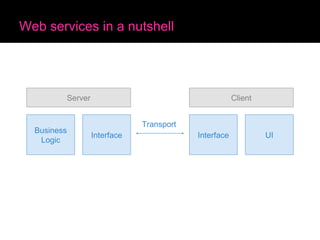
Web services in a nutshell Server Business Logic Interface Client Interface UI Transport
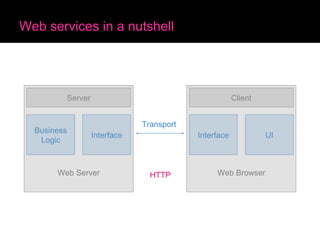
Web services in a nutshell Server Business Logic Interface Client Interface UI Transport Web Server Web Browser HTTP
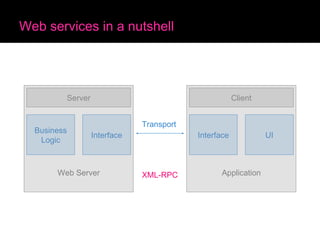
Web services in a nutshell Server Business Logic Interface Client Interface UI Transport Web Server Application XML-RPC
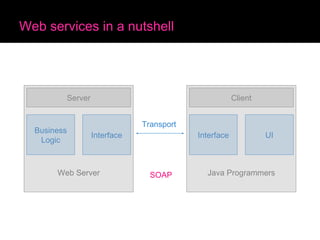
Web services in a nutshell Server Business Logic Interface Client Interface UI Transport Web Server Java Programmers SOAP
Why should I care? You can avoid code reuse While offering multiple services…
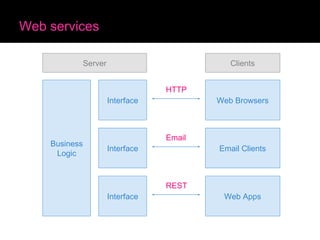
Web services Server Business Logic Interface Web Browsers HTTP Interface Interface Email Clients Email Web Apps REST Clients
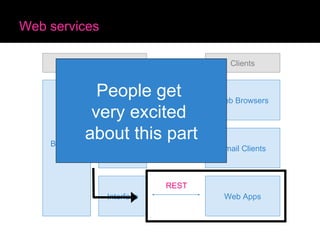
Web services Server Business Logic Interface Web Browsers HTTP Interface Interface Email Clients Email Web Apps REST Clients People get  very excited  about this part
Ok, I get that bit Give me a real example! Aren’t you supposed to be talking about Flickr?
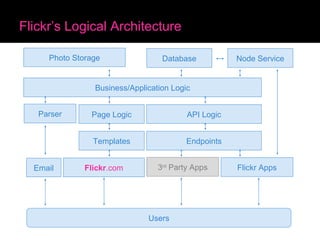
Flickr’s Logical Architecture Page Logic Business/Application Logic Database Photo Storage API Logic Endpoints Templates Users 3 rd  Party Apps Flickr Apps Node Service Flickr .com Email Parser
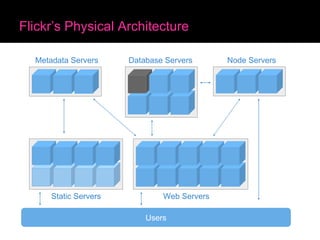
Flickr’s Physical Architecture Web Servers Database Servers Node Servers Static Servers Users Metadata Servers
But seriously… We only care about PHP! So where does Flickr use it?
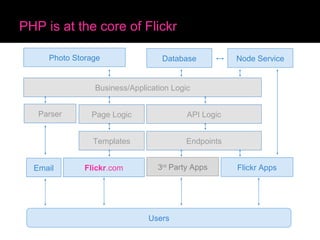
PHP is at the core of Flickr Page Logic Business/Application Logic Database Photo Storage API Logic Endpoints Templates Users 3 rd  Party Apps Flickr Apps Node Service Flickr .com Email Parser
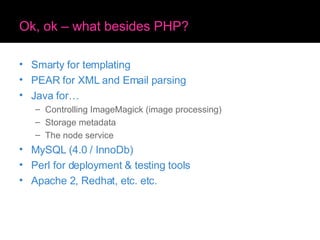
Ok, ok – what besides PHP? Smarty for templating PEAR for XML and Email parsing Java for… Controlling ImageMagick (image processing) Storage metadata The node service MySQL (4.0 / InnoDb) Perl for deployment & testing tools Apache 2, Redhat, etc. etc.
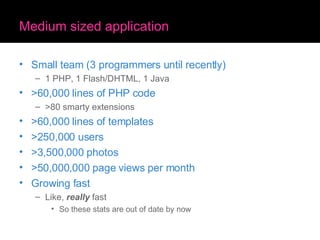
Medium sized application Small team (3 programmers until recently) 1 PHP, 1 Flash/DHTML, 1 Java >60,000 lines of PHP code >80 smarty extensions >60,000 lines of templates >250,000 users >3,500,000 photos >50,000,000 page views per month Growing fast Like,  really  fast So these stats are out of date by now
Thinking outside the web app Services Atom/RSS/RDF Feeds APIs SOAP XML-RPC REST We love PEAR::XML::Tree
More services Email interface Postfix PHP PEAR::Mail::mimeDecode FTP Uploading API Authentication API Unicode (Not really a service, but common to all Flickr services)
Even more services Real time application The “node service” ‘Cool’ flash apps Which use the REST APIs Blogging APIs Blogger API (1 & 2) Metaweblog API Atom LiveJournal
APIs are simple! Modeled on XML-RPC (sort of) Method calls with XML responses Named arguments (key/name pairs) Tricky in  WebServices.framework on Mac OS X SOAP, XML-RPC and REST are just transports PHP endpoints mean we can use the same application logic as the website Endpoints talk to the business logic using PHP function calls Essentially a really fast transport
XML isn’t simple :( PHP 4 doesn’t have good a XML parser PHP 5 is new and scares me (and it wasn’t out when we started) Expat is cool though (PEAR::XML::Parser) Why doesn’t PEAR have XPath? Because PEAR is stupid! PHP 4 sucks! Actually, PHPXPath rocks http://phpxpath.sourceforge.net/
Creating API methods Stateless method-call APIs are easy to extend They don’t affect each other Adding a method requires no knowledge of the transport We just get passed arguments and return XML The transport layer hides all that junk Adding a method once makes it available to all the interfaces Self documenting – method dispatch requires a list of methods Because everyone hates writing documentation
Red-Hot Unicode Action UTF-8 pages CJKV support It’s  really  cool
 
Unicode for all It’s  really  easy Don’t need PHP support Don’t need MySQL support Just need the right HTTP headers UTF-8 is 7-bit transparent Just don’t mess with high characters Don’t use HtmlEntities()! Or |escape in Smarty But bear in mind… JavaScript has patchy Unicode support People using your APIs might be stupid Some of them ARE stupid, guaranteed
Scaling the beast Why PHP is great MySQL scaling Search scaling Horizontal scaling
But first… Why do we need to scale? There are a lot of people on the Internet They all want to use our “web services” Whether they know it yet or not
Why PHP is great Stateless We can bounce people around servers Everything is stored in the database Even the smarty cache “Shared nothing” (so long as we avoid PHP sessions) But what this really means… …is we just have to deal with scaling elsewhere
A MySQL Scaling Haiku Database server slow Load of over two hundred Replication wins!
MySQL Replication But it only gives you more SELECT’s Else you need to partition vertically Re-architecting sucks :(
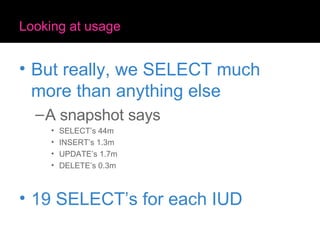
Looking at usage But really, we SELECT much more than anything else A snapshot says SELECT’s 44m INSERT’s 1.3m UPDATE’s 1.7m DELETE’s 0.3m 19 SELECT’s for each IUD
Replication is really cool A bunch of slave servers handle all the SELECT’s A single master handles IUD’s We can scale horizontally, at least for a while.
Searching A simple text search We were using RLIKE Then switched to LIKE Then disabled it all together
FULLTEXT Indexes FULLTEXT saves the day! But they’re only supported on MyISAM tables And we use InnoDb for locking We’re doomed :(
But wait! Partial replication saves the day Replicate the portion of the database we want to search  But change the table types on the slave to MyISAM It can keep up because it’s only handling IUD’s on a couple of tables And we can reduce the IUD’s with a little bit of vertical partitioning
JOIN’s are slow “ Normalised data is for sissies” Erm, “ Selective de-normalisation can be a big win” Keep multiple copies of data around Makes searching faster Have to ensure consistency in the application logic For instance, have a concat’d field containing a bunch of child-row data, just for searching.
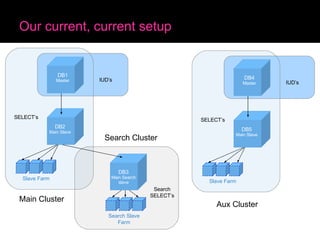
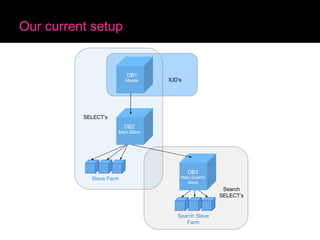
Our current setup Slave Farm DB1 Master IUD’s SELECT’s Search Slave Farm Search SELECT’s DB3 Main Search slave DB2 Main Slave
Our current, current setup Main Cluster Aux Cluster Search Cluster Slave Farm DB1 Master IUD’s SELECT’s Search Slave Farm Search SELECT’s DB3 Main Search slave DB2 Main Slave Slave Farm DB4 Master IUD’s SELECT’s DB5 Main Slave
Horizontal scaling At the core of our design Just add hardware! Inexpensive Not exponential Avoid redesigns/re-architectures
Talking to the Node Service Just another service with an API But just internal at the moment Everyone speaks XML (badly) Just TCP/IP - fsockopen() We’re issuing commands, not requesting data, so we don’t bother to parse the response Just substring search for  state=“ok” This only works for a simple protocol
Still talking to the Node Service Don’t rely on it! Check the connection was established Use a connection timeout Use an IO timeout!
RSS / Atom / RDF Different formats (all quite bad) We’re generating a lot of different feeds Abstract the difference away using templates No good way to do private feeds. Why is nobody working on this? (WSSE maybe?) Most of the feed readers (including bloglines.com) support basic HTTP Auth Easy to implement in PHP We love PHP It’s great!
Receiving email We want users to be able to email photos to Flickr Get postfix to pipe each mail to a PHP script Parse the mail and find any photos Cellular phone companies hate you Lots of mailers are retarded Photos as text/plain attachments Segments out of order No mime types UUEncoded and mime-less
Processing email PEAR to the rescue Mail::mime_decode With some patches UUEncoding Relax the address atom parser We need to convert character sets ICONV loves you
Upload via FTP PHP isn’t so great at being a daemon PHP4, I mean. Maybe PHP 5 is great Leaks memory like a sieve No (easy) threads Java to the rescue Java just acts as an FTPd and passes all uploaded files to PHP for processing This isn’t actually public Not my idea Bricolage does this I think. Maybe Zope?
Blogs Why does everyone loves blogs so much? Only a few APIs really Blogger Metaweblog Blogger2 Movable Type Atom Live Journal
It’s all broken Lots of blog software has broken interfaces It’s a support nightmare Manila is tricky But it all works, more or less Abstracted in the application logic We just call  blogs_post_message(); And so can you, via the API
Back to those APIs We opened up the Flickr APIs a few months ago Programmers mainly build tools for other programmers We now have Perl, python, PHP, ActionScript, XMLHTTP, .NET, Objective-C, C++, C and Ruby interface libraries But also a few actual applications
Flickr Rainbow
Tag Wallpaper
iPhoto Plugin We developed a Mac uploader But it wasn’t great A user developed an iPhoto plugin It  was  great APIs encourage people to do your work for you
Flickr Carnivore Uses Carnivore PE Sniffs AIM traffic (amongst others) from the local net Calculates the most popular words of the moment Uses the Flickr API to display photos of those words It’s like a really invasive zeitgeist
Flickr Tivo A Tivo app which uses Flickr photos Just Type in some tags And your TV becomes a “digital picture frame”
So what next? Even more scaling PHP 5? MySQL 5? or NDB? Taking over the world
Flickr   : Web Services Cal Henderson
These slides are online http://ludicorp.com/flickr/
Any  Questions?

Flickr Services

  • 1.
    Flickr : Web Services Cal Henderson
  • 2.
    What is Flickr?Photo sharing website (flickr.com) The place to store digital photos The centre of a big distributed system A set of open APIs
  • 3.
    What the heckare ‘Web Services’? The future of the Internet!!!1 Really just buzzwords
  • 4.
    Web services ina nutshell Server Business Logic Interface Client Interface UI Transport
  • 5.
    Web services ina nutshell Server Business Logic Interface Client Interface UI Transport Web Server Web Browser HTTP
  • 6.
    Web services ina nutshell Server Business Logic Interface Client Interface UI Transport Web Server Application XML-RPC
  • 7.
    Web services ina nutshell Server Business Logic Interface Client Interface UI Transport Web Server Java Programmers SOAP
  • 8.
    Why should Icare? You can avoid code reuse While offering multiple services…
  • 9.
    Web services ServerBusiness Logic Interface Web Browsers HTTP Interface Interface Email Clients Email Web Apps REST Clients
  • 10.
    Web services ServerBusiness Logic Interface Web Browsers HTTP Interface Interface Email Clients Email Web Apps REST Clients People get very excited about this part
  • 11.
    Ok, I getthat bit Give me a real example! Aren’t you supposed to be talking about Flickr?
  • 12.
    Flickr’s Logical ArchitecturePage Logic Business/Application Logic Database Photo Storage API Logic Endpoints Templates Users 3 rd Party Apps Flickr Apps Node Service Flickr .com Email Parser
  • 13.
    Flickr’s Physical ArchitectureWeb Servers Database Servers Node Servers Static Servers Users Metadata Servers
  • 14.
    But seriously… Weonly care about PHP! So where does Flickr use it?
  • 15.
    PHP is atthe core of Flickr Page Logic Business/Application Logic Database Photo Storage API Logic Endpoints Templates Users 3 rd Party Apps Flickr Apps Node Service Flickr .com Email Parser
  • 16.
    Ok, ok –what besides PHP? Smarty for templating PEAR for XML and Email parsing Java for… Controlling ImageMagick (image processing) Storage metadata The node service MySQL (4.0 / InnoDb) Perl for deployment & testing tools Apache 2, Redhat, etc. etc.
  • 17.
    Medium sized applicationSmall team (3 programmers until recently) 1 PHP, 1 Flash/DHTML, 1 Java >60,000 lines of PHP code >80 smarty extensions >60,000 lines of templates >250,000 users >3,500,000 photos >50,000,000 page views per month Growing fast Like, really fast So these stats are out of date by now
  • 18.
    Thinking outside theweb app Services Atom/RSS/RDF Feeds APIs SOAP XML-RPC REST We love PEAR::XML::Tree
  • 19.
    More services Emailinterface Postfix PHP PEAR::Mail::mimeDecode FTP Uploading API Authentication API Unicode (Not really a service, but common to all Flickr services)
  • 20.
    Even more servicesReal time application The “node service” ‘Cool’ flash apps Which use the REST APIs Blogging APIs Blogger API (1 & 2) Metaweblog API Atom LiveJournal
  • 21.
    APIs are simple!Modeled on XML-RPC (sort of) Method calls with XML responses Named arguments (key/name pairs) Tricky in WebServices.framework on Mac OS X SOAP, XML-RPC and REST are just transports PHP endpoints mean we can use the same application logic as the website Endpoints talk to the business logic using PHP function calls Essentially a really fast transport
  • 22.
    XML isn’t simple:( PHP 4 doesn’t have good a XML parser PHP 5 is new and scares me (and it wasn’t out when we started) Expat is cool though (PEAR::XML::Parser) Why doesn’t PEAR have XPath? Because PEAR is stupid! PHP 4 sucks! Actually, PHPXPath rocks http://phpxpath.sourceforge.net/
  • 23.
    Creating API methodsStateless method-call APIs are easy to extend They don’t affect each other Adding a method requires no knowledge of the transport We just get passed arguments and return XML The transport layer hides all that junk Adding a method once makes it available to all the interfaces Self documenting – method dispatch requires a list of methods Because everyone hates writing documentation
  • 24.
    Red-Hot Unicode ActionUTF-8 pages CJKV support It’s really cool
  • 25.
  • 26.
    Unicode for allIt’s really easy Don’t need PHP support Don’t need MySQL support Just need the right HTTP headers UTF-8 is 7-bit transparent Just don’t mess with high characters Don’t use HtmlEntities()! Or |escape in Smarty But bear in mind… JavaScript has patchy Unicode support People using your APIs might be stupid Some of them ARE stupid, guaranteed
  • 27.
    Scaling the beastWhy PHP is great MySQL scaling Search scaling Horizontal scaling
  • 28.
    But first… Whydo we need to scale? There are a lot of people on the Internet They all want to use our “web services” Whether they know it yet or not
  • 29.
    Why PHP isgreat Stateless We can bounce people around servers Everything is stored in the database Even the smarty cache “Shared nothing” (so long as we avoid PHP sessions) But what this really means… …is we just have to deal with scaling elsewhere
  • 30.
    A MySQL ScalingHaiku Database server slow Load of over two hundred Replication wins!
  • 31.
    MySQL Replication Butit only gives you more SELECT’s Else you need to partition vertically Re-architecting sucks :(
  • 32.
    Looking at usageBut really, we SELECT much more than anything else A snapshot says SELECT’s 44m INSERT’s 1.3m UPDATE’s 1.7m DELETE’s 0.3m 19 SELECT’s for each IUD
  • 33.
    Replication is reallycool A bunch of slave servers handle all the SELECT’s A single master handles IUD’s We can scale horizontally, at least for a while.
  • 34.
    Searching A simpletext search We were using RLIKE Then switched to LIKE Then disabled it all together
  • 35.
    FULLTEXT Indexes FULLTEXTsaves the day! But they’re only supported on MyISAM tables And we use InnoDb for locking We’re doomed :(
  • 36.
    But wait! Partialreplication saves the day Replicate the portion of the database we want to search But change the table types on the slave to MyISAM It can keep up because it’s only handling IUD’s on a couple of tables And we can reduce the IUD’s with a little bit of vertical partitioning
  • 37.
    JOIN’s are slow“ Normalised data is for sissies” Erm, “ Selective de-normalisation can be a big win” Keep multiple copies of data around Makes searching faster Have to ensure consistency in the application logic For instance, have a concat’d field containing a bunch of child-row data, just for searching.
  • 38.
    Our current setupSlave Farm DB1 Master IUD’s SELECT’s Search Slave Farm Search SELECT’s DB3 Main Search slave DB2 Main Slave
  • 39.
    Our current, currentsetup Main Cluster Aux Cluster Search Cluster Slave Farm DB1 Master IUD’s SELECT’s Search Slave Farm Search SELECT’s DB3 Main Search slave DB2 Main Slave Slave Farm DB4 Master IUD’s SELECT’s DB5 Main Slave
  • 40.
    Horizontal scaling Atthe core of our design Just add hardware! Inexpensive Not exponential Avoid redesigns/re-architectures
  • 41.
    Talking to theNode Service Just another service with an API But just internal at the moment Everyone speaks XML (badly) Just TCP/IP - fsockopen() We’re issuing commands, not requesting data, so we don’t bother to parse the response Just substring search for state=“ok” This only works for a simple protocol
  • 42.
    Still talking tothe Node Service Don’t rely on it! Check the connection was established Use a connection timeout Use an IO timeout!
  • 43.
    RSS / Atom/ RDF Different formats (all quite bad) We’re generating a lot of different feeds Abstract the difference away using templates No good way to do private feeds. Why is nobody working on this? (WSSE maybe?) Most of the feed readers (including bloglines.com) support basic HTTP Auth Easy to implement in PHP We love PHP It’s great!
  • 44.
    Receiving email Wewant users to be able to email photos to Flickr Get postfix to pipe each mail to a PHP script Parse the mail and find any photos Cellular phone companies hate you Lots of mailers are retarded Photos as text/plain attachments Segments out of order No mime types UUEncoded and mime-less
  • 45.
    Processing email PEARto the rescue Mail::mime_decode With some patches UUEncoding Relax the address atom parser We need to convert character sets ICONV loves you
  • 46.
    Upload via FTPPHP isn’t so great at being a daemon PHP4, I mean. Maybe PHP 5 is great Leaks memory like a sieve No (easy) threads Java to the rescue Java just acts as an FTPd and passes all uploaded files to PHP for processing This isn’t actually public Not my idea Bricolage does this I think. Maybe Zope?
  • 47.
    Blogs Why doeseveryone loves blogs so much? Only a few APIs really Blogger Metaweblog Blogger2 Movable Type Atom Live Journal
  • 48.
    It’s all brokenLots of blog software has broken interfaces It’s a support nightmare Manila is tricky But it all works, more or less Abstracted in the application logic We just call blogs_post_message(); And so can you, via the API
  • 49.
    Back to thoseAPIs We opened up the Flickr APIs a few months ago Programmers mainly build tools for other programmers We now have Perl, python, PHP, ActionScript, XMLHTTP, .NET, Objective-C, C++, C and Ruby interface libraries But also a few actual applications
  • 50.
  • 51.
  • 52.
    iPhoto Plugin Wedeveloped a Mac uploader But it wasn’t great A user developed an iPhoto plugin It was great APIs encourage people to do your work for you
  • 53.
    Flickr Carnivore UsesCarnivore PE Sniffs AIM traffic (amongst others) from the local net Calculates the most popular words of the moment Uses the Flickr API to display photos of those words It’s like a really invasive zeitgeist
  • 54.
    Flickr Tivo ATivo app which uses Flickr photos Just Type in some tags And your TV becomes a “digital picture frame”
  • 55.
    So what next?Even more scaling PHP 5? MySQL 5? or NDB? Taking over the world
  • 56.
    Flickr : Web Services Cal Henderson
  • 57.
    These slides areonline http://ludicorp.com/flickr/
  • 58.