Web Services Mash-up :  Flick r Cal Henderson <cal@flickr.com> O’Reilly Emerging Technology Conference March 14-17, 2005
What’s Flickr? A website –  flickr.com A photo-sharing application The centre of a big distributed system An open set of APIs flickr.com/services/
Web services? What the heck are web services? The future of the Interwebnet!!!1 Web 2.0 An ‘emerging technology’ (no, really)
But seriously? Probably a  service  accessed over the  web RSS/Atom/RDF Feeds The Flickr API (Also, Flickr-specific junk)
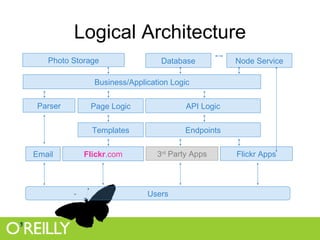
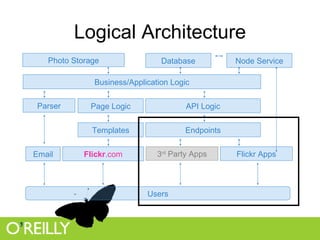
Logical Architecture Page Logic Business/Application Logic Database Photo Storage API Logic Endpoints Templates Users 3 rd  Party Apps Flickr Apps Node Service Flickr .com Email Parser
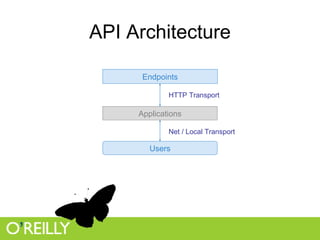
API Architecture Endpoints Users Applications HTTP Transport Net / Local Transport
Transport Voodoo Like any decent Internet ‘standard’, there’s more than one A quick guide to the trendy ones…
SOAP Simple Object Access Protocol Now just SOAP (not  so simple anymore) Google uses it
SOAP Response <s:Envelope xmlns:s= http://www.w3.org/2003/05/soap-envelope xmlns:xsi= http://www.w3.org/1999/XMLSchema-instance xmlns:xsd= http://www.w3.org/1999/XMLSchema > <s:Body> <x:FlickrResponse xmlns:x=&quot;urn:flickr&quot;> [escaped-xml-payload] </x:FlickrResponse> </s:Body> </s:Envelope>
XML-RPC XML Remote Procedure Call Used by the blogging APIs Created by Dave Winer in 1998 Because SOAP was taking a long time
XML-RPC Response <methodResponse> <params> <param> <value> <string> [escaped-xml-payload] </string> </value> </param> </params> </methodResponse>
REST Representational State Transfer Crazy name Thanks Roy Fielding at Apache It’s really simple Just XML over HTTP (Though purists say it’s  only  HTTP GET)
REST Response <rsp stat=&quot;ok&quot;> [xml-payload] </rsp>
Page Scraping Been around for ever HTML-over-HTTP Volatile interface Makes site owners angry
Scrumjax Probably the future
Offering Web Services Be transport agnostic Some people love SOAP, some love REST Make them all (somewhat) happy Beware of ‘shitty coders’
Performance Problems People can scrape your site and pull a lot of pages in a short time This is bad But API abuse (even accidental) can be a lot worse
An example Someone writes a trendy screensaver app for Flickr which shows recent photos. It checks for new photos every 2 seconds A bunch of people download it
Danger! With 100 users, that’s 50 hits per second If it’s making a particularly taxing database call, it’s going to cause problems
Possible solutions Incorporate caching into API bindings Enforced policy Through API keys, etc. Cache at the host application level Monitor things closely
 

Etech2005

  • 1.
    Web Services Mash-up: Flick r Cal Henderson <cal@flickr.com> O’Reilly Emerging Technology Conference March 14-17, 2005
  • 2.
    What’s Flickr? Awebsite – flickr.com A photo-sharing application The centre of a big distributed system An open set of APIs flickr.com/services/
  • 3.
    Web services? Whatthe heck are web services? The future of the Interwebnet!!!1 Web 2.0 An ‘emerging technology’ (no, really)
  • 4.
    But seriously? Probablya service accessed over the web RSS/Atom/RDF Feeds The Flickr API (Also, Flickr-specific junk)
  • 5.
    Logical Architecture PageLogic Business/Application Logic Database Photo Storage API Logic Endpoints Templates Users 3 rd Party Apps Flickr Apps Node Service Flickr .com Email Parser
  • 6.
    Logical Architecture PageLogic Business/Application Logic Database Photo Storage API Logic Endpoints Templates Users 3 rd Party Apps Flickr Apps Node Service Flickr .com Email Parser
  • 7.
    API Architecture EndpointsUsers Applications HTTP Transport Net / Local Transport
  • 8.
    Transport Voodoo Likeany decent Internet ‘standard’, there’s more than one A quick guide to the trendy ones…
  • 9.
    SOAP Simple ObjectAccess Protocol Now just SOAP (not so simple anymore) Google uses it
  • 10.
    SOAP Response <s:Envelopexmlns:s= http://www.w3.org/2003/05/soap-envelope xmlns:xsi= http://www.w3.org/1999/XMLSchema-instance xmlns:xsd= http://www.w3.org/1999/XMLSchema > <s:Body> <x:FlickrResponse xmlns:x=&quot;urn:flickr&quot;> [escaped-xml-payload] </x:FlickrResponse> </s:Body> </s:Envelope>
  • 11.
    XML-RPC XML RemoteProcedure Call Used by the blogging APIs Created by Dave Winer in 1998 Because SOAP was taking a long time
  • 12.
    XML-RPC Response <methodResponse><params> <param> <value> <string> [escaped-xml-payload] </string> </value> </param> </params> </methodResponse>
  • 13.
    REST Representational StateTransfer Crazy name Thanks Roy Fielding at Apache It’s really simple Just XML over HTTP (Though purists say it’s only HTTP GET)
  • 14.
    REST Response <rspstat=&quot;ok&quot;> [xml-payload] </rsp>
  • 15.
    Page Scraping Beenaround for ever HTML-over-HTTP Volatile interface Makes site owners angry
  • 16.
  • 17.
    Offering Web ServicesBe transport agnostic Some people love SOAP, some love REST Make them all (somewhat) happy Beware of ‘shitty coders’
  • 18.
    Performance Problems Peoplecan scrape your site and pull a lot of pages in a short time This is bad But API abuse (even accidental) can be a lot worse
  • 19.
    An example Someonewrites a trendy screensaver app for Flickr which shows recent photos. It checks for new photos every 2 seconds A bunch of people download it
  • 20.
    Danger! With 100users, that’s 50 hits per second If it’s making a particularly taxing database call, it’s going to cause problems
  • 21.
    Possible solutions Incorporatecaching into API bindings Enforced policy Through API keys, etc. Cache at the host application level Monitor things closely
  • 22.