FOOD QUALITY
MANAGEMENT
SYSTEMS.
Aims of Presentation:
• What is food quality ?
• Need for food quality?
• Consumer requirements
• What is ISO, HACCP, VACCP,
TACCP, GMP and GHP?
• 5 Key elements of safe food
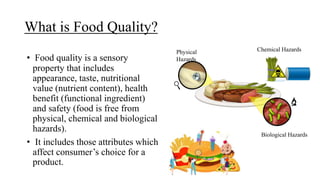
What is Food Quality?
• Food quality is a sensory
property that includes
appearance, taste, nutritional
value (nutrient content), health
benefit (functional ingredient)
and safety (food is free from
physical, chemical and biological
hazards).
• It includes those attributes which
affect consumer’s choice for a
product.
Physical
Hazards
Chemical Hazards
Biological Hazards
Need for Food Quality:
• Major challenge for food industry is to
maintain the food quality; the reason being
well consumers.
• For this reason, food industry has to adopt
certain techniques in order to meet the
growing need of maintaining food quality;
this is known as quality control.
• The main issue which is considered while
quality control process is to deteriorate the
level of microbes and other contaminants
in food.
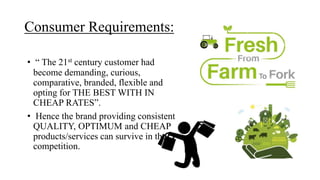
Consumer Requirements:
• “ The 21st century customer had
become demanding, curious,
comparative, branded, flexible and
opting for THE BEST WITH IN
CHEAP RATES”.
• Hence the brand providing consistent
QUALITY, OPTIMUM and CHEAP
products/services can survive in the
competition.
INTRODUCTION……
Food quality management is the process of directing and controlling
the raw material handling, production, packaging and distribution of
food products in order to ensure effectiveness and efficiency.
A common food quality management system applied in each section
are:
• ISO (International Organisation for Standardisation),
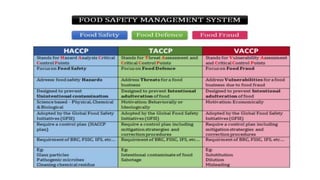
• HACCP (Hazard Analysis Critical Control Points),
• TACCP (Threat Assessment Critical Control Points),
• VACCP (Vulnerability Assessment Critical Control Points).
• GMP (Good Manufacturing Practices),
• GHP (Good Hygenic Practices).
ISO
International Organisation for
Standardisation
• The International Organisation for
Standardisation (ISO) ensure that
products and services are safe,
reliable and of good quality.
• ISO 22000 isa Food Safety
Management System that can be
applied to any organisation in the
food chain, farm to fork.
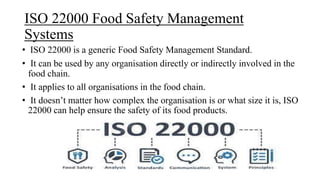
ISO 22000 Food Safety Management
Systems
• ISO 22000 is a generic Food Safety Management Standard.
• It can be used by any organisation directly or indirectly involved in the
food chain.
• It applies to all organisations in the food chain.
• It doesn’t matter how complex the organisation is or what size it is, ISO
22000 can help ensure the safety of its food products.
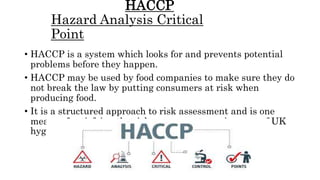
HACCP
Hazard Analysis Critical
Point
• HACCP is a system which looks for and prevents potential
problems before they happen.
• HACCP may be used by food companies to make sure they do
not break the law by putting consumers at risk when
producing food.
• It is a structured approach to risk assessment and is one
means of satisfying the risk assessment requirement of UK
hygiene legislation.
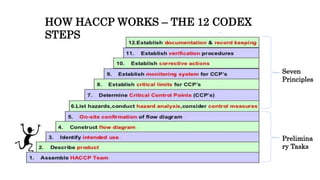
Prelimina
ry Tasks
Seven
Principles
HOW HACCP WORKS – THE 12 CODEX
STEPS
Benefits to consumers:
• Reduced risk of food borne diseases.
• Increased confidence in food supply.
• Increased awareness of basic hygiene
increased quality of life (health and
economic).
Benefits to industry:
• Increased market access.
• Reduction in production costs
reduced wastage and recall of food
increased consumer and government
confidence.
• Mitigating the business risk.
Benefits to governments:
• Improved public health.
• Reduced public health costs.
• Enhanced facilitation of international
• Increased confidence of the
TACCP
Threat Assessment Critical Control
• This is all about food defense and the
focus is on food tampering, intentional
adulteration or contamination of food.
• TACCP builds upon the existing processes
of HACCP in ensuring the safety of food
products.
• TACCP implementation involves thinking
like a potential attacker and examines
vulnerability, likelihood, opportunities and
an appreciation that intentional
contamination requires human
intervention.
• TACCP helps to proactively identify and
manage control points in the supply chain
that can be at risk of intentional
VACCP
Vulnerability Assessment Critical
Points
VACCP focuses more on adulteration for financial gain in the
supply chain.
For example:
• Product substitution.
• Bulking out with a cheaper ingredient.
• The sale of counterfeit or stolen goods.
VACCP is a special type of risk assessment that helps
identify and control vulnerabilities in the food supply chain
that can be exposed to economically motivated food fraud.
CONT.....
Unlike HACCP, which identifies all the potential hazards that can
enter food unintentionally, VACCP is concerned with preventing food
fraud, which is the intentional contamination of food during its
production.
VACCP is concerned with preventing two of these:
• Adulteration – including a foreign substance which is not on the
product’s label to lower costs or fake a higher quality.
• Substitution – replacing a food or ingredient with another substance
that is similar but inferior.
GMP
Good Manufacturing Practices
• Good manufacturing practices is a set of regulations , codes
and guidelines for the manufacture of drug substances and
drug products, medical devices, invivo and invitro diagnostic
products and foods.
• A basic principle of GMP is that quality cannot be tested into
a batch of product but must be built into each batch of
product during all stages of the manufacturing process.
• It is used to minimize the risks involved in any
pharmaceutical production that cannot be eliminated
through testing the final product.
TEN PRINCIPLES OF GMP
• Design and construct the facilities and equipments properly.
• Follow written procedures and experiments.
• Document work.
• Validate work.
• Monitor facilities and equipment.
• Write step by step operating procedures and work on instructions.
• Design, develop and demonstrate job compentence.
• Protect against contamination.
• Controls components and product related products.
• Conduct planned and periodic audits.
GMP in Food Industry
• Personnel
• Plant and grounds
• Sanitary operations
• Sanitary facilities and control
• Equipment’s and utensils
• Processes and controls
• Ware housing and distribution
• Maximum defect action level
Raw material, Packaging material and
Finished product Testing
 Each lot or batch of raw materials is tested
• Confirm the identity of the raw materials.
• Provide assurance that quality of the drug in dosage.
 Materials and products should be stored under conditions specified and
protected from contamination especially microbiological cross
contamination.
 Samples of incoming materials are collected and tested before use.
 Approved test methods and specifications are used.
 Results must conform to specifications for use or sale.
 Transportation and storage records.
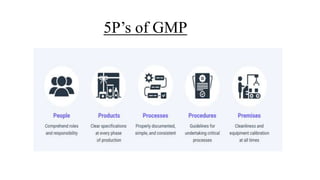
5P’s of GMP
GHP
Good Hygienic Practices
• Good Hygienic Practices deal with safety and suitability requirements
to be followed world wide.
• GHP includes all practices regarding the conditions and measures
necessary to ensure the safety and suitability of food at all stages of
the food chain.
• It is a guide for food manufacturers on compliance with food safety
regulations (general food hygiene).
• GHP is a prerequisite for GMP implementation.
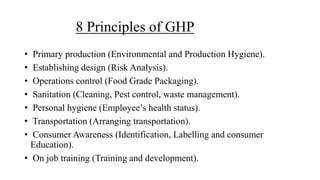
8 Principles of GHP
• Primary production (Environmental and Production Hygiene).
• Establishing design (Risk Analysis).
• Operations control (Food Grade Packaging).
• Sanitation (Cleaning, Pest control, waste management).
• Personal hygiene (Employee’s health status).
• Transportation (Arranging transportation).
• Consumer Awareness (Identification, Labelling and consumer
Education).
• On job training (Training and development).
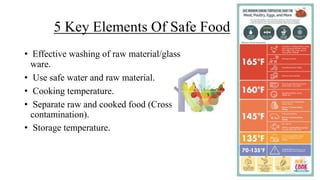
5 Key Elements Of Safe Food
• Effective washing of raw material/glass
ware.
• Use safe water and raw material.
• Cooking temperature.
• Separate raw and cooked food (Cross
contamination).
• Storage temperature.

Food Quality Management Systems.pptx

  • 1.
  • 2.
    Aims of Presentation: •What is food quality ? • Need for food quality? • Consumer requirements • What is ISO, HACCP, VACCP, TACCP, GMP and GHP? • 5 Key elements of safe food
  • 3.
    What is FoodQuality? • Food quality is a sensory property that includes appearance, taste, nutritional value (nutrient content), health benefit (functional ingredient) and safety (food is free from physical, chemical and biological hazards). • It includes those attributes which affect consumer’s choice for a product. Physical Hazards Chemical Hazards Biological Hazards
  • 4.
    Need for FoodQuality: • Major challenge for food industry is to maintain the food quality; the reason being well consumers. • For this reason, food industry has to adopt certain techniques in order to meet the growing need of maintaining food quality; this is known as quality control. • The main issue which is considered while quality control process is to deteriorate the level of microbes and other contaminants in food.
  • 5.
    Consumer Requirements: • “The 21st century customer had become demanding, curious, comparative, branded, flexible and opting for THE BEST WITH IN CHEAP RATES”. • Hence the brand providing consistent QUALITY, OPTIMUM and CHEAP products/services can survive in the competition.
  • 6.
    INTRODUCTION…… Food quality managementis the process of directing and controlling the raw material handling, production, packaging and distribution of food products in order to ensure effectiveness and efficiency. A common food quality management system applied in each section are: • ISO (International Organisation for Standardisation), • HACCP (Hazard Analysis Critical Control Points), • TACCP (Threat Assessment Critical Control Points), • VACCP (Vulnerability Assessment Critical Control Points). • GMP (Good Manufacturing Practices), • GHP (Good Hygenic Practices).
  • 7.
    ISO International Organisation for Standardisation •The International Organisation for Standardisation (ISO) ensure that products and services are safe, reliable and of good quality. • ISO 22000 isa Food Safety Management System that can be applied to any organisation in the food chain, farm to fork.
  • 8.
    ISO 22000 FoodSafety Management Systems • ISO 22000 is a generic Food Safety Management Standard. • It can be used by any organisation directly or indirectly involved in the food chain. • It applies to all organisations in the food chain. • It doesn’t matter how complex the organisation is or what size it is, ISO 22000 can help ensure the safety of its food products.
  • 9.
    HACCP Hazard Analysis Critical Point •HACCP is a system which looks for and prevents potential problems before they happen. • HACCP may be used by food companies to make sure they do not break the law by putting consumers at risk when producing food. • It is a structured approach to risk assessment and is one means of satisfying the risk assessment requirement of UK hygiene legislation.
  • 10.
  • 11.
    Benefits to consumers: •Reduced risk of food borne diseases. • Increased confidence in food supply. • Increased awareness of basic hygiene increased quality of life (health and economic). Benefits to industry: • Increased market access. • Reduction in production costs reduced wastage and recall of food increased consumer and government confidence. • Mitigating the business risk. Benefits to governments: • Improved public health. • Reduced public health costs. • Enhanced facilitation of international • Increased confidence of the
  • 12.
    TACCP Threat Assessment CriticalControl • This is all about food defense and the focus is on food tampering, intentional adulteration or contamination of food. • TACCP builds upon the existing processes of HACCP in ensuring the safety of food products. • TACCP implementation involves thinking like a potential attacker and examines vulnerability, likelihood, opportunities and an appreciation that intentional contamination requires human intervention. • TACCP helps to proactively identify and manage control points in the supply chain that can be at risk of intentional
  • 13.
    VACCP Vulnerability Assessment Critical Points VACCPfocuses more on adulteration for financial gain in the supply chain. For example: • Product substitution. • Bulking out with a cheaper ingredient. • The sale of counterfeit or stolen goods. VACCP is a special type of risk assessment that helps identify and control vulnerabilities in the food supply chain that can be exposed to economically motivated food fraud.
  • 14.
    CONT..... Unlike HACCP, whichidentifies all the potential hazards that can enter food unintentionally, VACCP is concerned with preventing food fraud, which is the intentional contamination of food during its production. VACCP is concerned with preventing two of these: • Adulteration – including a foreign substance which is not on the product’s label to lower costs or fake a higher quality. • Substitution – replacing a food or ingredient with another substance that is similar but inferior.
  • 16.
    GMP Good Manufacturing Practices •Good manufacturing practices is a set of regulations , codes and guidelines for the manufacture of drug substances and drug products, medical devices, invivo and invitro diagnostic products and foods. • A basic principle of GMP is that quality cannot be tested into a batch of product but must be built into each batch of product during all stages of the manufacturing process. • It is used to minimize the risks involved in any pharmaceutical production that cannot be eliminated through testing the final product.
  • 17.
    TEN PRINCIPLES OFGMP • Design and construct the facilities and equipments properly. • Follow written procedures and experiments. • Document work. • Validate work. • Monitor facilities and equipment. • Write step by step operating procedures and work on instructions. • Design, develop and demonstrate job compentence. • Protect against contamination. • Controls components and product related products. • Conduct planned and periodic audits.
  • 18.
    GMP in FoodIndustry • Personnel • Plant and grounds • Sanitary operations • Sanitary facilities and control • Equipment’s and utensils • Processes and controls • Ware housing and distribution • Maximum defect action level
  • 19.
    Raw material, Packagingmaterial and Finished product Testing  Each lot or batch of raw materials is tested • Confirm the identity of the raw materials. • Provide assurance that quality of the drug in dosage.  Materials and products should be stored under conditions specified and protected from contamination especially microbiological cross contamination.  Samples of incoming materials are collected and tested before use.  Approved test methods and specifications are used.  Results must conform to specifications for use or sale.  Transportation and storage records.
  • 20.
  • 21.
    GHP Good Hygienic Practices •Good Hygienic Practices deal with safety and suitability requirements to be followed world wide. • GHP includes all practices regarding the conditions and measures necessary to ensure the safety and suitability of food at all stages of the food chain. • It is a guide for food manufacturers on compliance with food safety regulations (general food hygiene). • GHP is a prerequisite for GMP implementation.
  • 22.
    8 Principles ofGHP • Primary production (Environmental and Production Hygiene). • Establishing design (Risk Analysis). • Operations control (Food Grade Packaging). • Sanitation (Cleaning, Pest control, waste management). • Personal hygiene (Employee’s health status). • Transportation (Arranging transportation). • Consumer Awareness (Identification, Labelling and consumer Education). • On job training (Training and development).
  • 23.
    5 Key ElementsOf Safe Food • Effective washing of raw material/glass ware. • Use safe water and raw material. • Cooking temperature. • Separate raw and cooked food (Cross contamination). • Storage temperature.