Classification of Mood Disorders
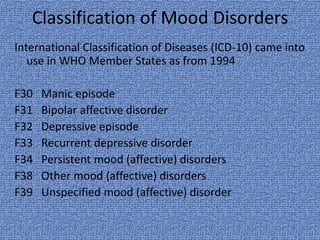
International Classification of Diseases (ICD-10) came into
   use in WHO Member States as from 1994

F30   Manic episode
F31   Bipolar affective disorder
F32   Depressive episode
F33   Recurrent depressive disorder
F34   Persistent mood (affective) disorders
F38   Other mood (affective) disorders
F39   Unspecified mood (affective) disorder
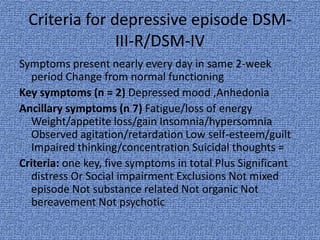
Criteria for depressive episode DSM-
               III-R/DSM-IV
Symptoms present nearly every day in same 2-week
  period Change from normal functioning
Key symptoms (n = 2) Depressed mood ,Anhedonia
Ancillary symptoms (n 7) Fatigue/loss of energy
  Weight/appetite loss/gain Insomnia/hypersomnia
  Observed agitation/retardation Low self-esteem/guilt
  Impaired thinking/concentration Suicidal thoughts =
Criteria: one key, five symptoms in total Plus Significant
  distress Or Social impairment Exclusions Not mixed
  episode Not substance related Not organic Not
  bereavement Not psychotic
ICD-10
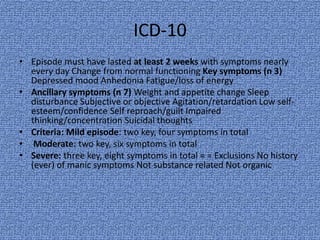
• Episode must have lasted at least 2 weeks with symptoms nearly
  every day Change from normal functioning Key symptoms (n 3)
  Depressed mood Anhedonia Fatigue/loss of energy
• Ancillary symptoms (n 7) Weight and appetite change Sleep
  disturbance Subjective or objective Agitation/retardation Low self-
  esteem/confidence Self reproach/guilt Impaired
  thinking/concentration Suicidal thoughts
• Criteria: Mild episode: two key, four symptoms in total
• Moderate: two key, six symptoms in total
• Severe: three key, eight symptoms in total = = Exclusions No history
  (ever) of manic symptoms Not substance related Not organic
Key points – epidemiology and impact
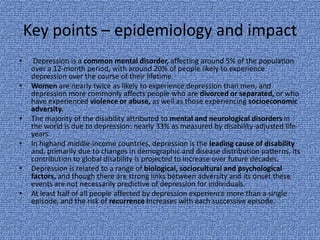
•     Depression is a common mental disorder, affecting around 5% of the population
     over a 12-month period, with around 20% of people likely to experience
     depression over the course of their lifetime.
•    Women are nearly twice as likely to experience depression than men, and
     depression more commonly affects people who are divorced or separated, or who
     have experienced violence or abuse, as well as those experiencing socioeconomic
     adversity.
•    The majority of the disability attributed to mental and neurological disorders in
     the world is due to depression: nearly 33% as measured by disability-adjusted life-
     years.
•    In highand middle-income countries, depression is the leading cause of disability
     and, primarily due to changes in demographic and disease distribution patterns, its
     contribution to global disability is projected to increase over future decades.
•    Depression is related to a range of biological, sociocultural and psychological
     factors, and though there are strong links between adversity and its onset these
     events are not necessarily predictive of depression for individuals.
•    At least half of all people affected by depression experience more than a single
     episode, and the risk of recurrence increases with each successive episode.
Symptoms of dysthymic disorder
• For diagnostic purposes at least two of these
   symptoms must be experienced for most of the
   day, for more days than not, for at least 2 years
• Disturbed sleep – insomnia or hypersomnia
 • Poor concentration or difficulty making decisions
   • Reduced energy or fatigue (anergia)
• Disturbed appetite – may be increased or
   decreased
• Feelings of hopelessness or pessimism
• Low self-esteem
Features of mixed anxiety and
            depressive disorder
 Diagnosis based on the presence of symptoms of anxiety and
   depression, but neither is clearly predominant Neither
   type of symptom is present to the extent that justifies a
   diagnosis if considered separately Symptoms should be
   present for at least 4 weeks, and result in significant
   distress or functional impairment
Typical symptoms include those listed below • Anxiety •
   Persistent nervousness • Palpitations, chest pain, dizziness
   • Irritability • Fearful anticipation • Excessive alertness
Depression • Sleep disturbance • Fatigue or low energy •
   Hopelessness or pessimism • Poor concentration • Low
   self-esteem or feelings of worthlessness
Diagnostic features of bipolar
               disorder(Mania)
A distinct period of abnormally and persistently elevated or irritable
    mood, lasting at least 1 week (or 4 days for hypomania/ bipolar II disorder)
The mood change is severe enough to disrupt normal activities
Several of the following symptoms are present:
– inflated self-esteem or grandiosity
– decreased requirements for
– racing thoughts or flight of ideas
– reduced attention or distractibility
– increased talkativeness
– increased activity levels or agitation
– increased involvement in activities that have a risk of adverse
    consequences (sexual relationships, business ventures, spending sprees)

• .
Treatment
•   Antidepressants:
•   TCAs,SSRIs
•   CBT
•   ECT
Bipolar disorder
• Type 1
• Type 2
Medications
•   Mood Stabilizers
•   Lithium
•   Sodium Valproate
•   Carbamazapine
Sleep hygiene activities for improving
               sleep quality •
•    A clear routine is important, and a consistent waking time is more important than
    bedtime: get up at the same time each day, 7 days a week
•    If you are not asleep after about 20 minutes, go to another room and do
    something relaxing, such as listening to soothing music, before returning to bed
•   Keep your bedroom dark, reducing stimulation such as noise; keep the room
    cooler rather than warmer
•   Avoid stimulating activity such as heated discussions or work before going to sleep
•   A regular exercise program helps sleep, but not in the hours prior to bedtime
•   Avoid caffeine (coffee, tea, cola drinks) within 7 hours of bedtime
•   Avoid alcohol in the evening, as it can reduce the quality of sleep or make you
    wake in the night
•   A light carbohydrate snack before bed may be helpful
•   Avoid naps; sleep should be reserved for bedtime
•   A wind-down routine before going to bed (e.g. reading, having a warm bath or
    listening to music) can make it easier to sleep

Mood disorders

  • 1.
    Classification of MoodDisorders International Classification of Diseases (ICD-10) came into use in WHO Member States as from 1994 F30 Manic episode F31 Bipolar affective disorder F32 Depressive episode F33 Recurrent depressive disorder F34 Persistent mood (affective) disorders F38 Other mood (affective) disorders F39 Unspecified mood (affective) disorder
  • 2.
    Criteria for depressiveepisode DSM- III-R/DSM-IV Symptoms present nearly every day in same 2-week period Change from normal functioning Key symptoms (n = 2) Depressed mood ,Anhedonia Ancillary symptoms (n 7) Fatigue/loss of energy Weight/appetite loss/gain Insomnia/hypersomnia Observed agitation/retardation Low self-esteem/guilt Impaired thinking/concentration Suicidal thoughts = Criteria: one key, five symptoms in total Plus Significant distress Or Social impairment Exclusions Not mixed episode Not substance related Not organic Not bereavement Not psychotic
  • 3.
    ICD-10 • Episode musthave lasted at least 2 weeks with symptoms nearly every day Change from normal functioning Key symptoms (n 3) Depressed mood Anhedonia Fatigue/loss of energy • Ancillary symptoms (n 7) Weight and appetite change Sleep disturbance Subjective or objective Agitation/retardation Low self- esteem/confidence Self reproach/guilt Impaired thinking/concentration Suicidal thoughts • Criteria: Mild episode: two key, four symptoms in total • Moderate: two key, six symptoms in total • Severe: three key, eight symptoms in total = = Exclusions No history (ever) of manic symptoms Not substance related Not organic
  • 4.
    Key points –epidemiology and impact • Depression is a common mental disorder, affecting around 5% of the population over a 12-month period, with around 20% of people likely to experience depression over the course of their lifetime. • Women are nearly twice as likely to experience depression than men, and depression more commonly affects people who are divorced or separated, or who have experienced violence or abuse, as well as those experiencing socioeconomic adversity. • The majority of the disability attributed to mental and neurological disorders in the world is due to depression: nearly 33% as measured by disability-adjusted life- years. • In highand middle-income countries, depression is the leading cause of disability and, primarily due to changes in demographic and disease distribution patterns, its contribution to global disability is projected to increase over future decades. • Depression is related to a range of biological, sociocultural and psychological factors, and though there are strong links between adversity and its onset these events are not necessarily predictive of depression for individuals. • At least half of all people affected by depression experience more than a single episode, and the risk of recurrence increases with each successive episode.
  • 5.
    Symptoms of dysthymicdisorder • For diagnostic purposes at least two of these symptoms must be experienced for most of the day, for more days than not, for at least 2 years • Disturbed sleep – insomnia or hypersomnia • Poor concentration or difficulty making decisions • Reduced energy or fatigue (anergia) • Disturbed appetite – may be increased or decreased • Feelings of hopelessness or pessimism • Low self-esteem
  • 6.
    Features of mixedanxiety and depressive disorder Diagnosis based on the presence of symptoms of anxiety and depression, but neither is clearly predominant Neither type of symptom is present to the extent that justifies a diagnosis if considered separately Symptoms should be present for at least 4 weeks, and result in significant distress or functional impairment Typical symptoms include those listed below • Anxiety • Persistent nervousness • Palpitations, chest pain, dizziness • Irritability • Fearful anticipation • Excessive alertness Depression • Sleep disturbance • Fatigue or low energy • Hopelessness or pessimism • Poor concentration • Low self-esteem or feelings of worthlessness
  • 7.
    Diagnostic features ofbipolar disorder(Mania) A distinct period of abnormally and persistently elevated or irritable mood, lasting at least 1 week (or 4 days for hypomania/ bipolar II disorder) The mood change is severe enough to disrupt normal activities Several of the following symptoms are present: – inflated self-esteem or grandiosity – decreased requirements for – racing thoughts or flight of ideas – reduced attention or distractibility – increased talkativeness – increased activity levels or agitation – increased involvement in activities that have a risk of adverse consequences (sexual relationships, business ventures, spending sprees) • .
  • 8.
    Treatment • Antidepressants: • TCAs,SSRIs • CBT • ECT
  • 9.
  • 10.
    Medications • Mood Stabilizers • Lithium • Sodium Valproate • Carbamazapine
  • 11.
    Sleep hygiene activitiesfor improving sleep quality • • A clear routine is important, and a consistent waking time is more important than bedtime: get up at the same time each day, 7 days a week • If you are not asleep after about 20 minutes, go to another room and do something relaxing, such as listening to soothing music, before returning to bed • Keep your bedroom dark, reducing stimulation such as noise; keep the room cooler rather than warmer • Avoid stimulating activity such as heated discussions or work before going to sleep • A regular exercise program helps sleep, but not in the hours prior to bedtime • Avoid caffeine (coffee, tea, cola drinks) within 7 hours of bedtime • Avoid alcohol in the evening, as it can reduce the quality of sleep or make you wake in the night • A light carbohydrate snack before bed may be helpful • Avoid naps; sleep should be reserved for bedtime • A wind-down routine before going to bed (e.g. reading, having a warm bath or listening to music) can make it easier to sleep