The accelerated expansion of the universe and the cosmological constant problem Spring Summer School on Strings Cosmology and Particles 31 March – 4 April 2009, Belgrade-Niš, Serbia Hrvoje Štefančić, Theoretical Physics Division,  Ruđer Bošković Institute, Zagreb, Croatia
Big issues - observational and theoretical Present accelerated expansion of the universe – observational discovery The cosmological constant (vacuum energy) problem – theoretical challenge
Our concept of the (present) universe Evolution dominated by gravity   the interactions governing the evolution of the universe have to have long range to be effective at cosmological distances   matter is neutral at cosmological (and much smaller) scales   General relativity   Known forms of matter (radiation, nonrelativistic matter) Four dimensional universe
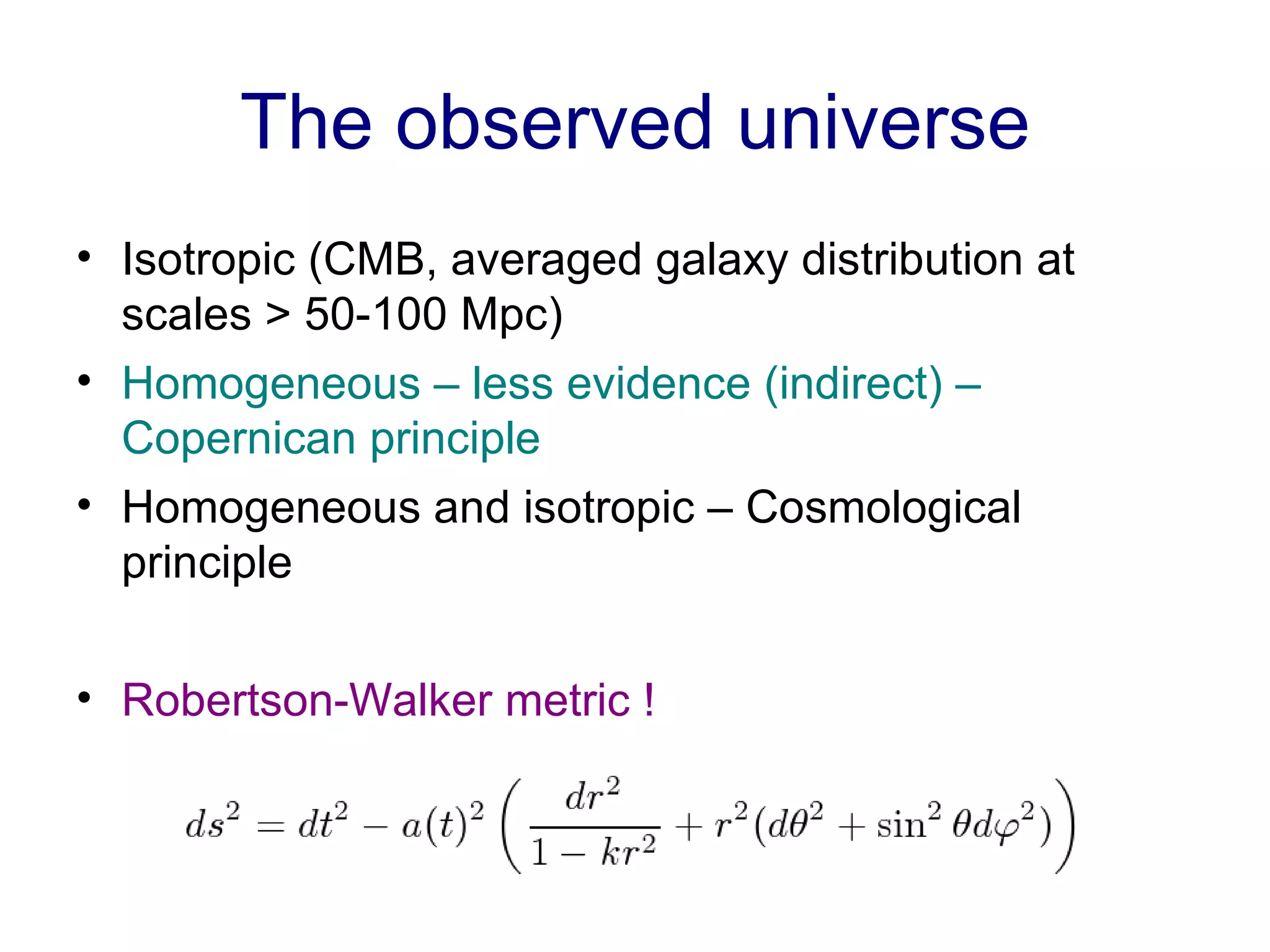
The observed universe Isotropic (CMB, averaged galaxy distribution at scales > 50-100 Mpc) Homogeneous – less evidence (indirect) – Copernican principle Homogeneous and isotropic – Cosmological principle Robertson-Walker metric !
Expansion of the universe Hubble (1929)  – dynamical universe   Cosmological redshift Standard forms of matter lead to decelerated expansion Inflation – early epoch of the accelerated expansion 1998 – universe accelerated (decelerated universe expected)
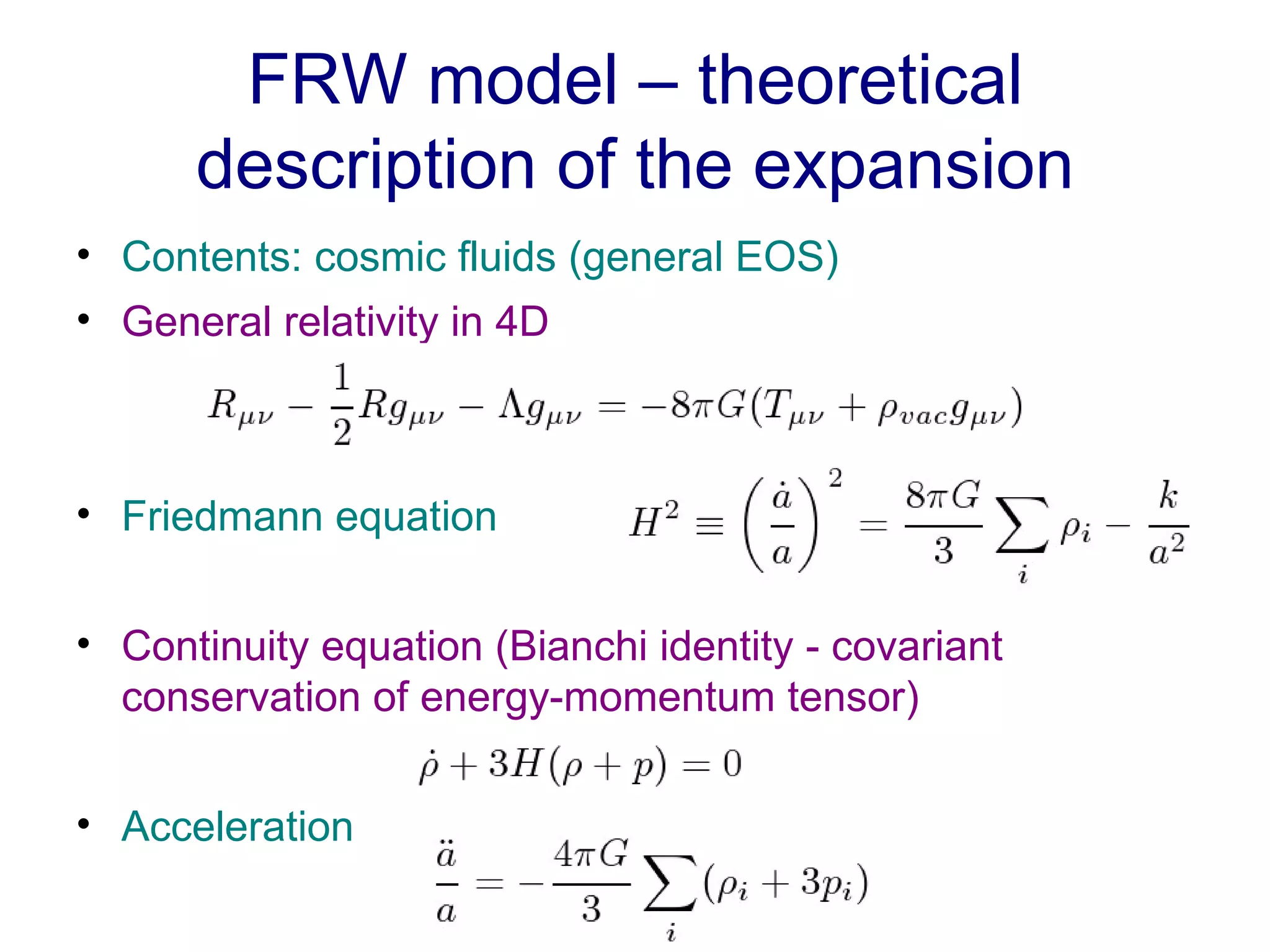
FRW model – theoretical description of the expansion Contents: cosmic fluids (general EOS) General relativity in 4D Friedmann equation Continuity equation (Bianchi identity - covariant conservation of energy-momentum tensor) Acceleration
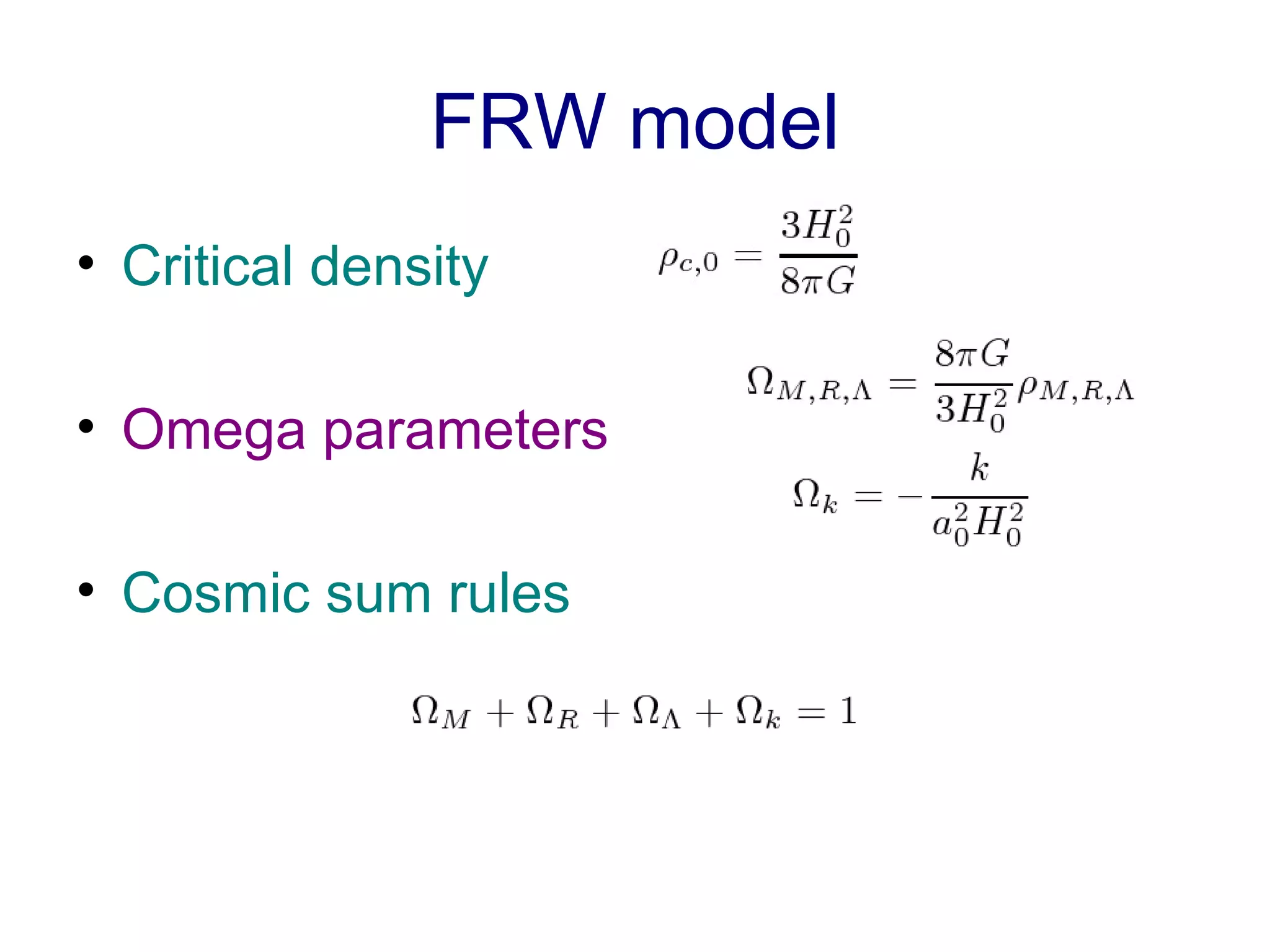
FRW model Critical density Omega parameters Cosmic sum rules
Cosmological observations – mapping the expansion Standard candles (luminosity distance) Supernovae Ia, GRB Standard rulers CMB (cosmic microwave background) BAO (baryonic acoustic oscillations) Others (gravitational lensing...)
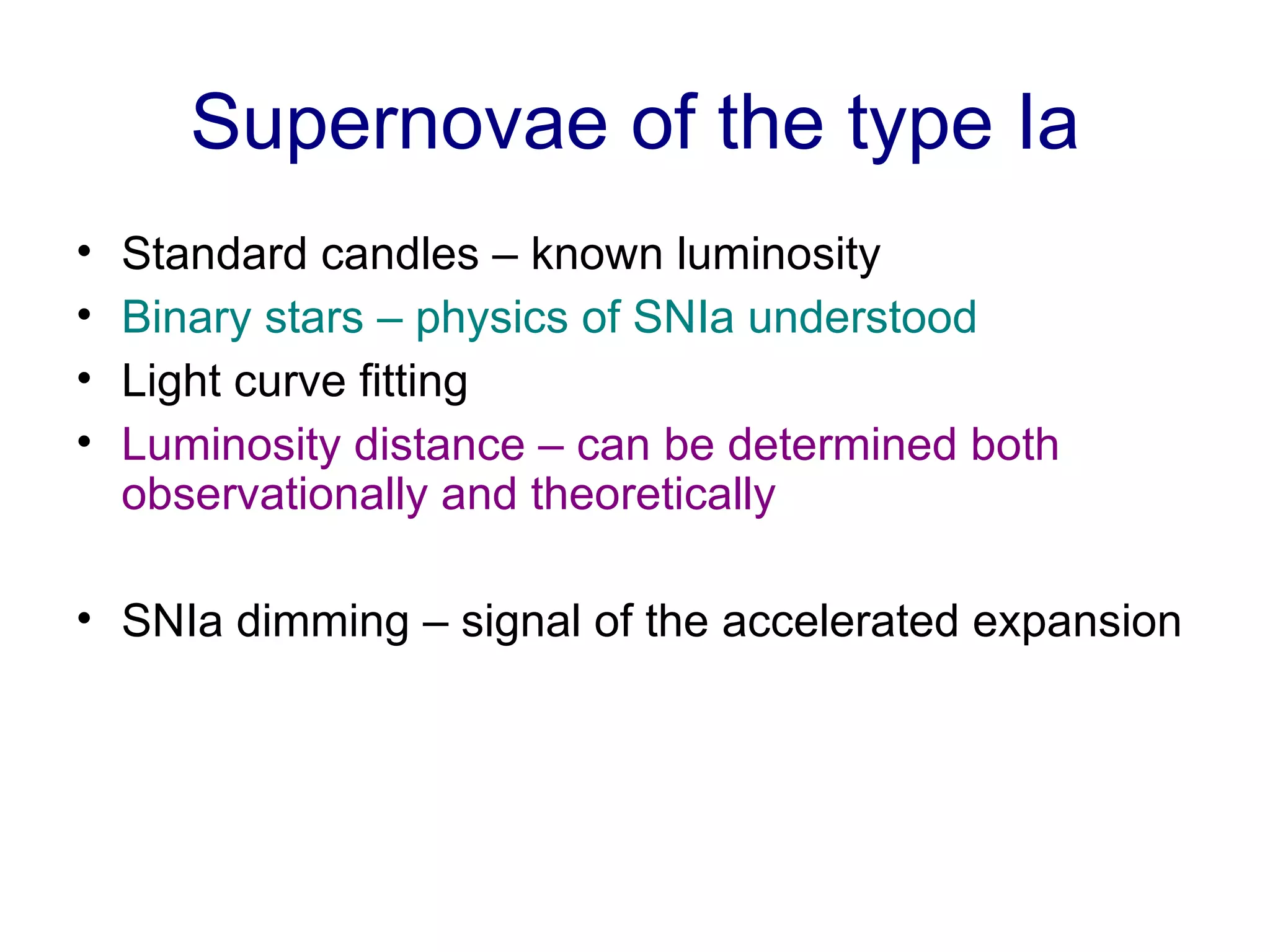
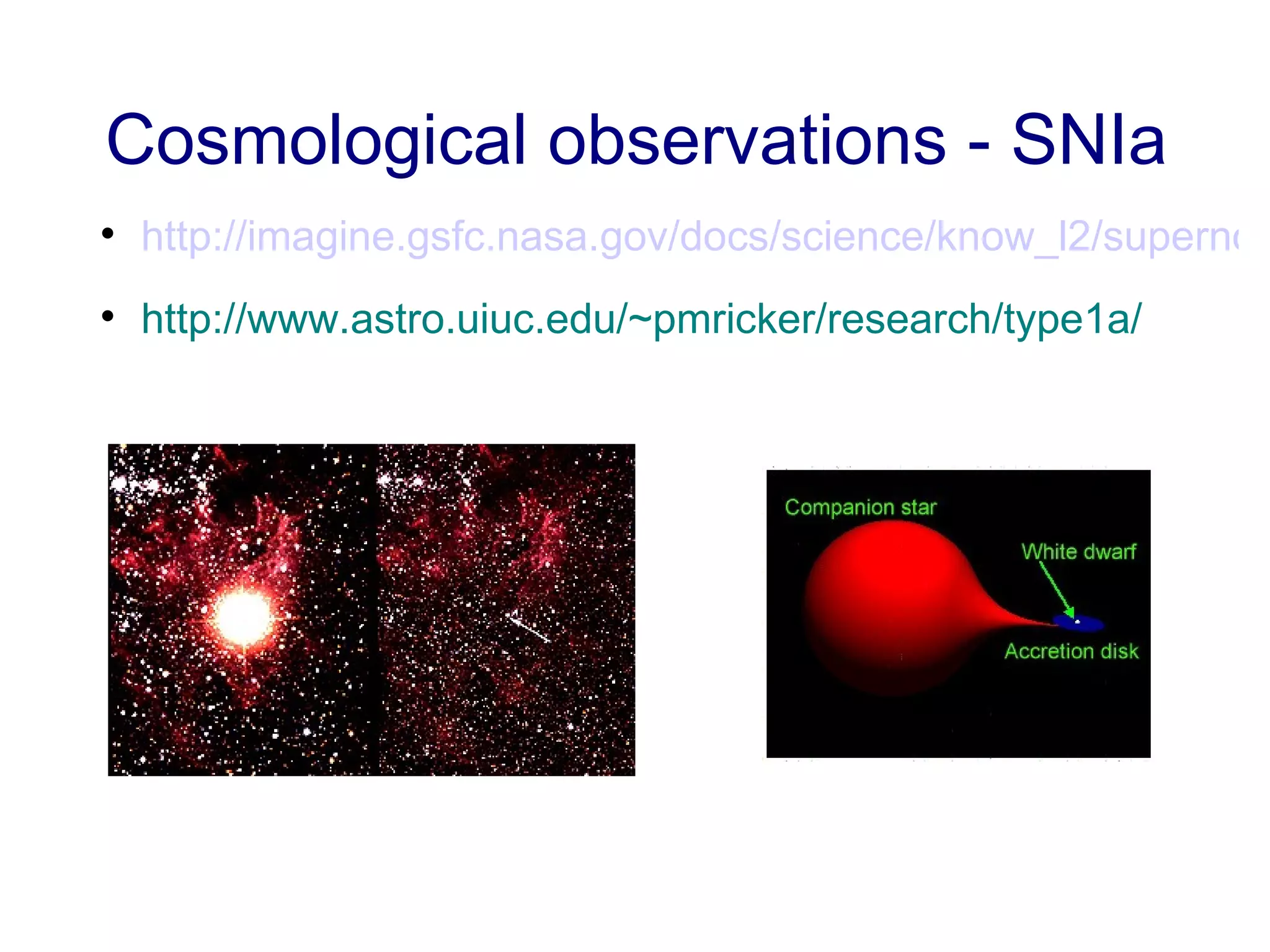
Supernovae of the type Ia Standard candles – known luminosity Binary stars – physics of SNIa understood   Light curve fitting Luminosity distance – can be determined both observationally and theoretically SNIa dimming – signal of the accelerated expansion
Cosmological observations - SNIa http://imagine.gsfc.nasa.gov/docs/science/know_l2/supernovae.html http://www.astro.uiuc.edu/~pmricker/research/type1a/
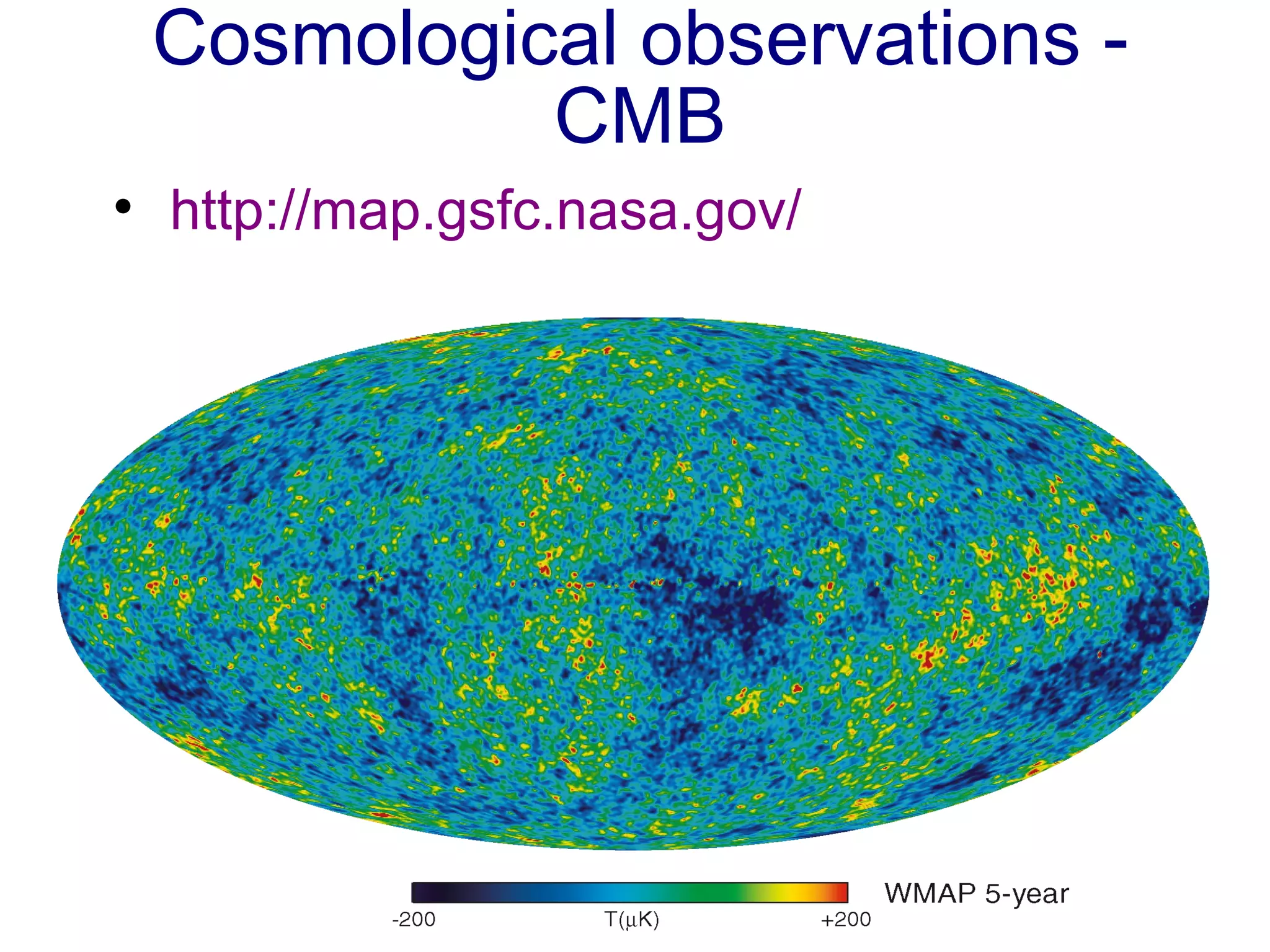
Cosmological observations - CMB http://map.gsfc.nasa.gov/
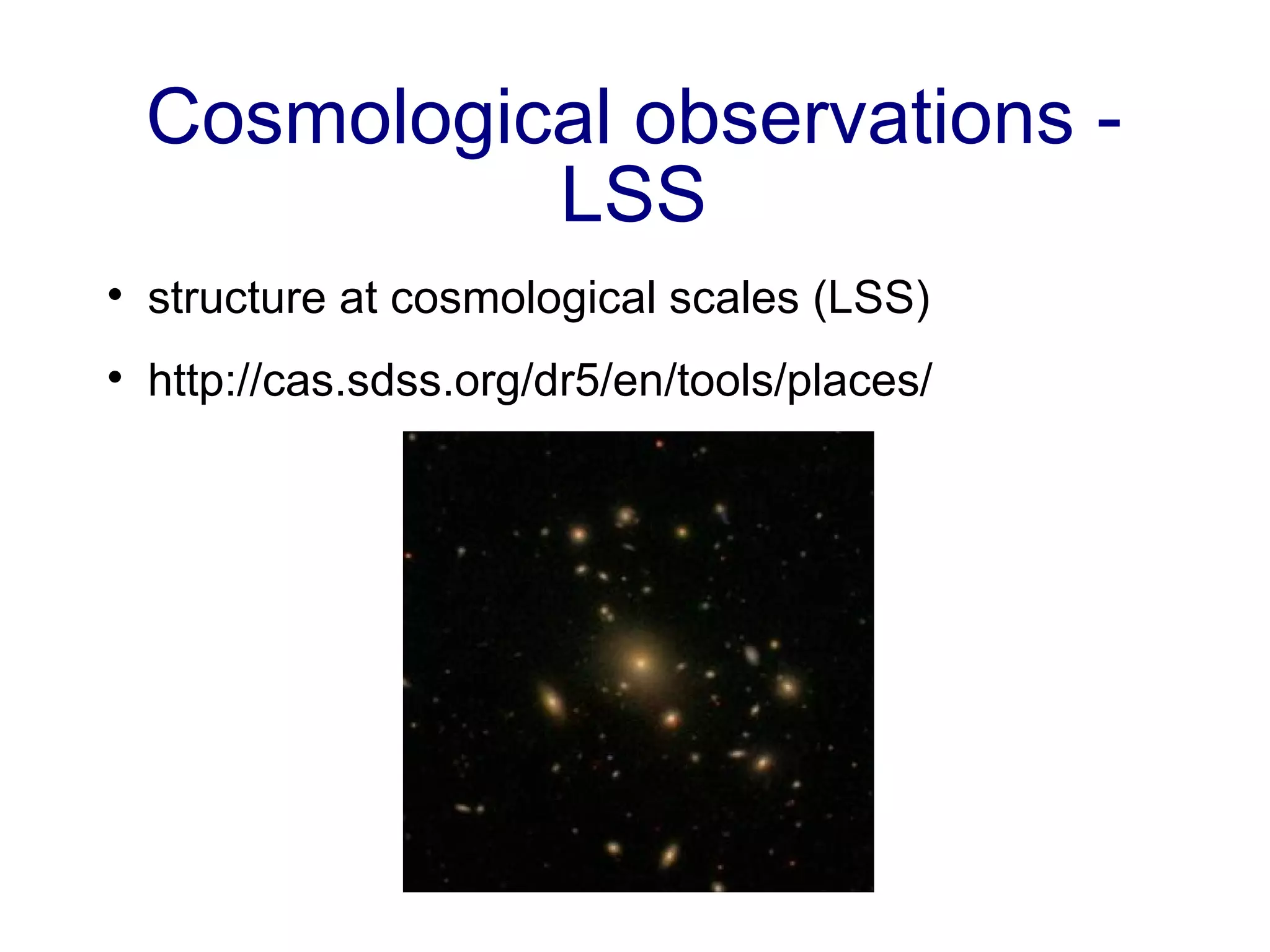
Cosmological observations - LSS structure at cosmological scales (LSS) http://cas.sdss.org/dr5/en/tools/places/
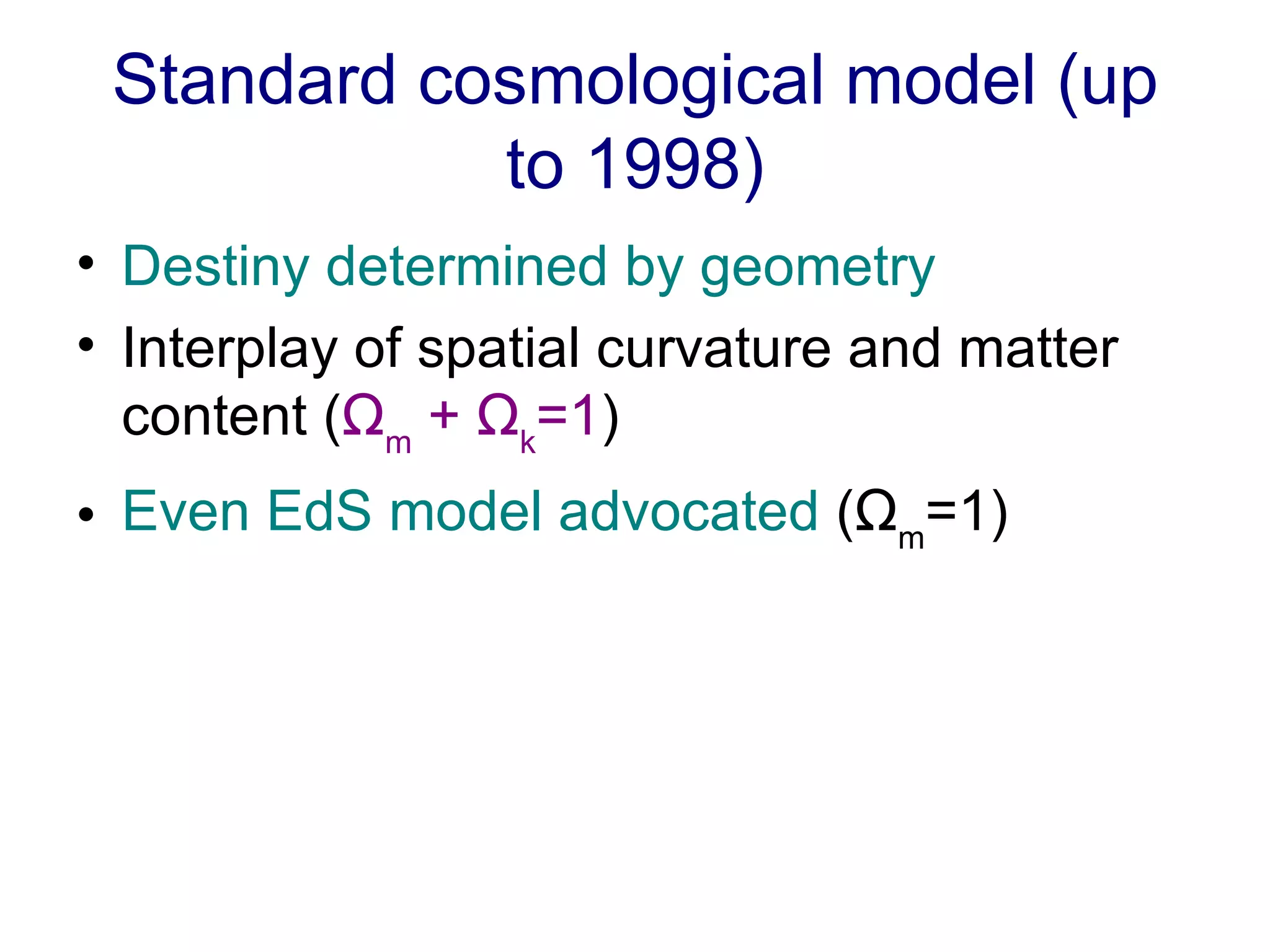
Standard cosmological model (up to 1998) Destiny determined by geometry   Interplay of spatial curvature and matter content ( Ω m  +  Ω k =1 ) Even EdS model advocated  ( Ω m =1)
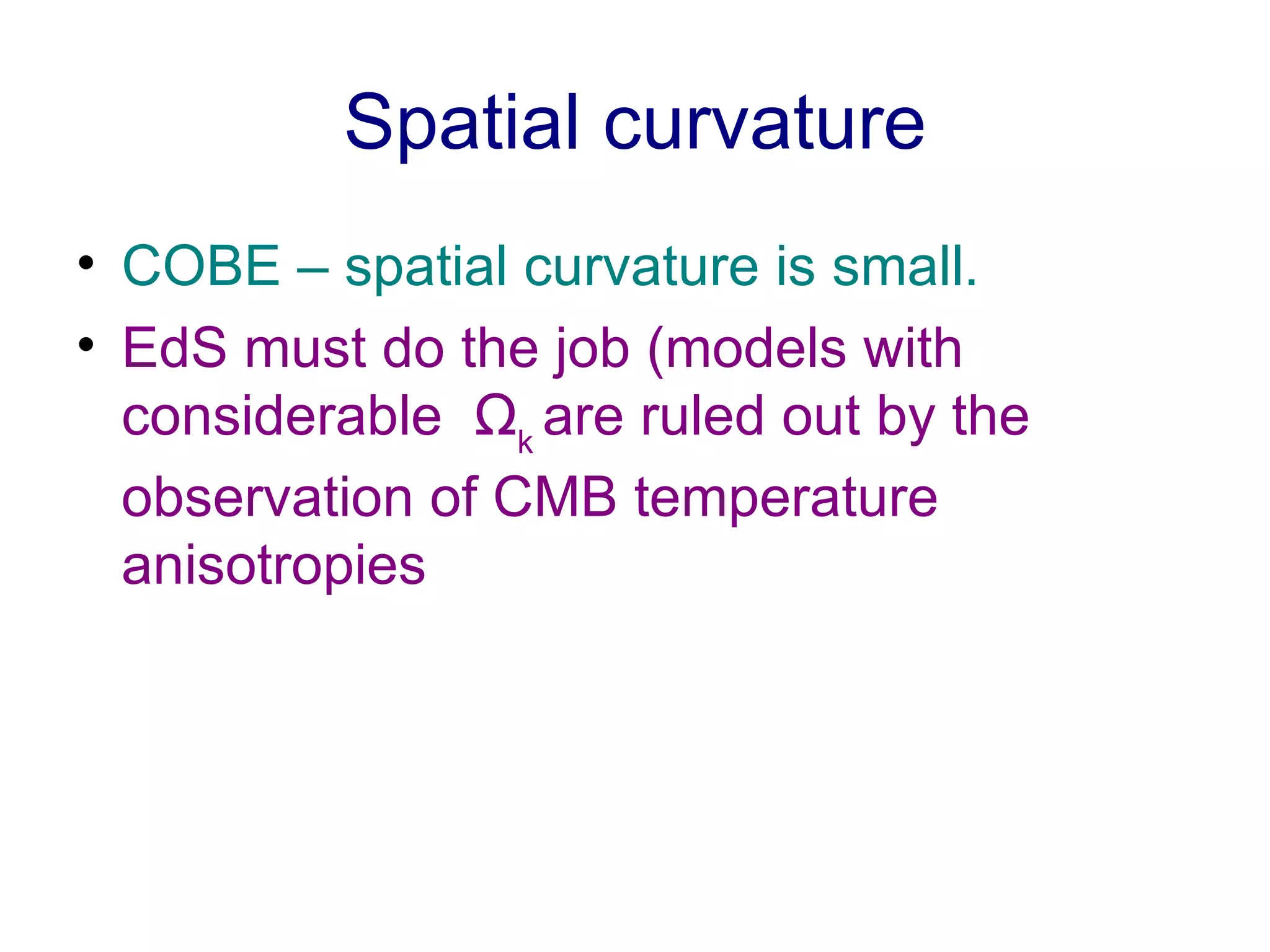
Spatial curvature COBE – spatial curvature is small. EdS must do the job (models with considerable  Ω k  are ruled out by the observation of CMB temperature anisotropies
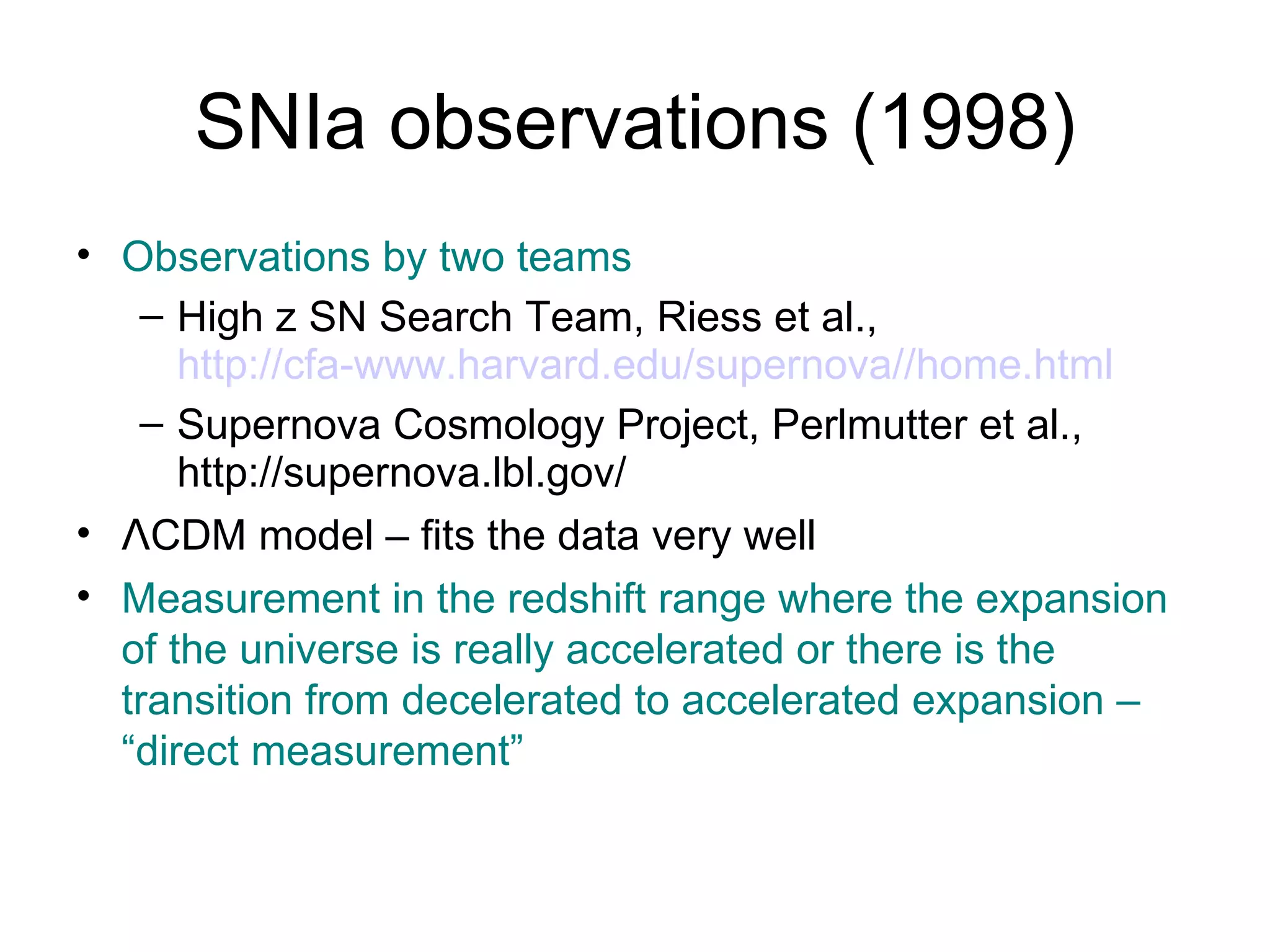
SNIa observations (1998) Observations by two teams High z SN Search Team, Riess et al.,  http://cfa-www.harvard.edu/supernova//home.html Supernova Cosmology Project, Perlmutter et al., http://supernova.lbl.gov/ Λ CDM model – fits the data very well Measurement in the redshift range where the expansion of the universe is really accelerated or there is the transition from decelerated to accelerated expansion – “direct measurement”
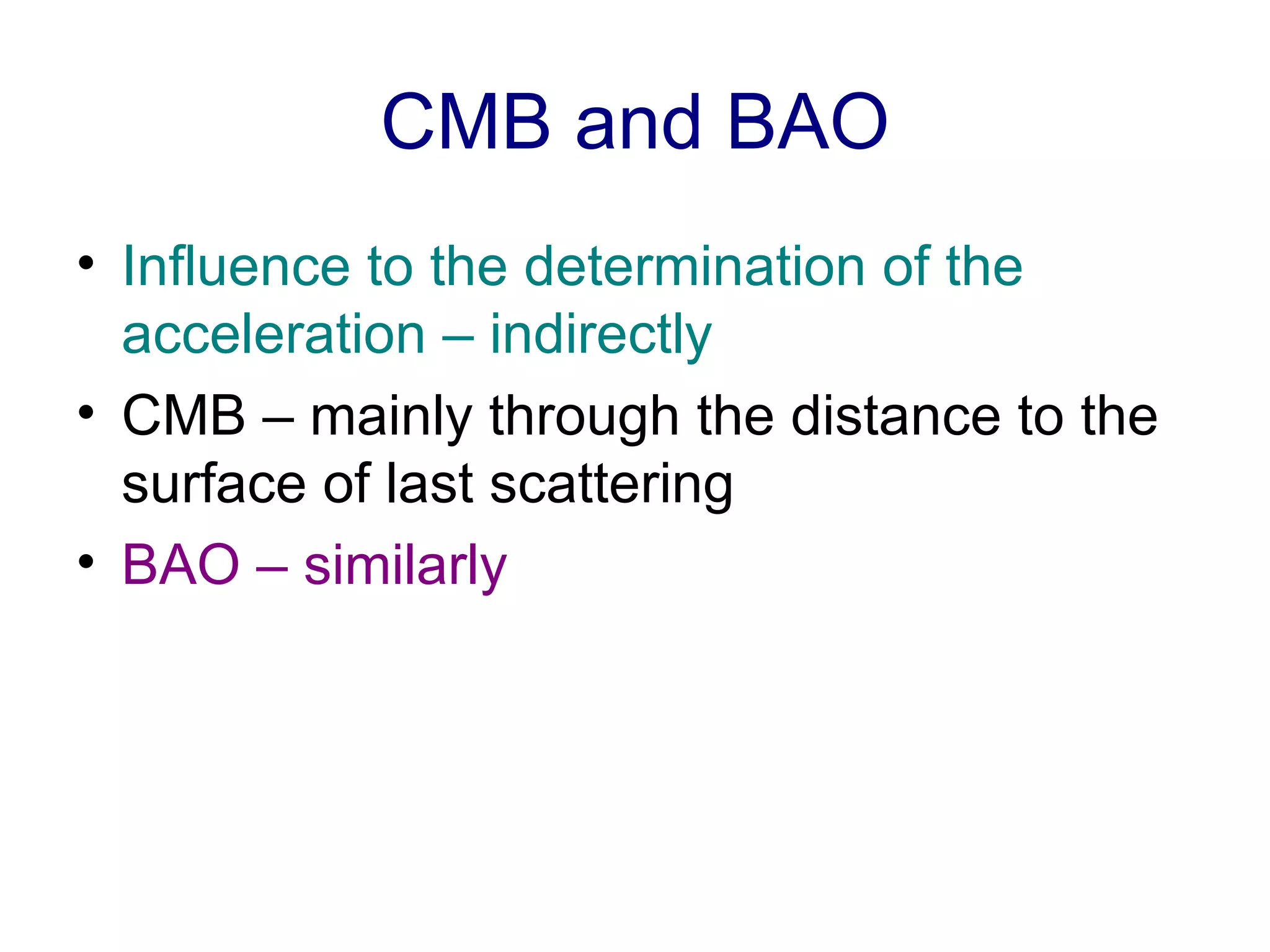
CMB and BAO Influence to the determination of the acceleration – indirectly CMB – mainly through the distance to the surface of last scattering BAO – similarly
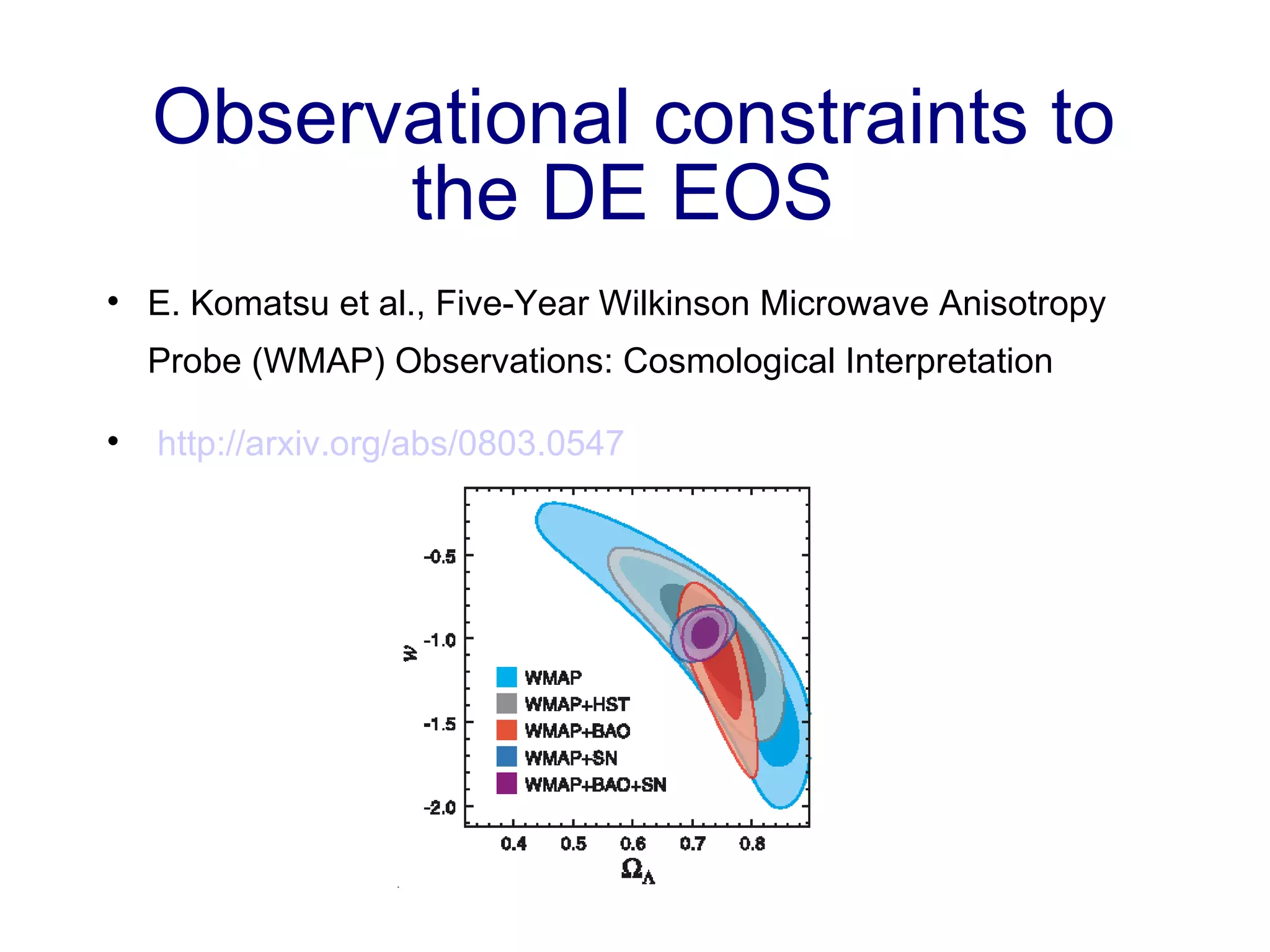
Combining observational data Degeneracies of cosmic parameters - different combinations of cosmic parameters may produce the same observed phenomena Removal of degeneracies – using different observations at different redshifts (redshift intervals) SNIa + WMAP + BAO – precision cosmology
Observational constraints to the DE EOS  E. Komatsu et al., Five-Year Wilkinson Microwave Anisotropy Probe (WMAP) Observations: Cosmological Interpretation http://arxiv.org/abs/0803.0547
Accelerated expansion In a FRW universe the observed signals strongly favor a presently accelerated expansion of the universe (and reject EdS model) Do we interpret the observational data correctly?
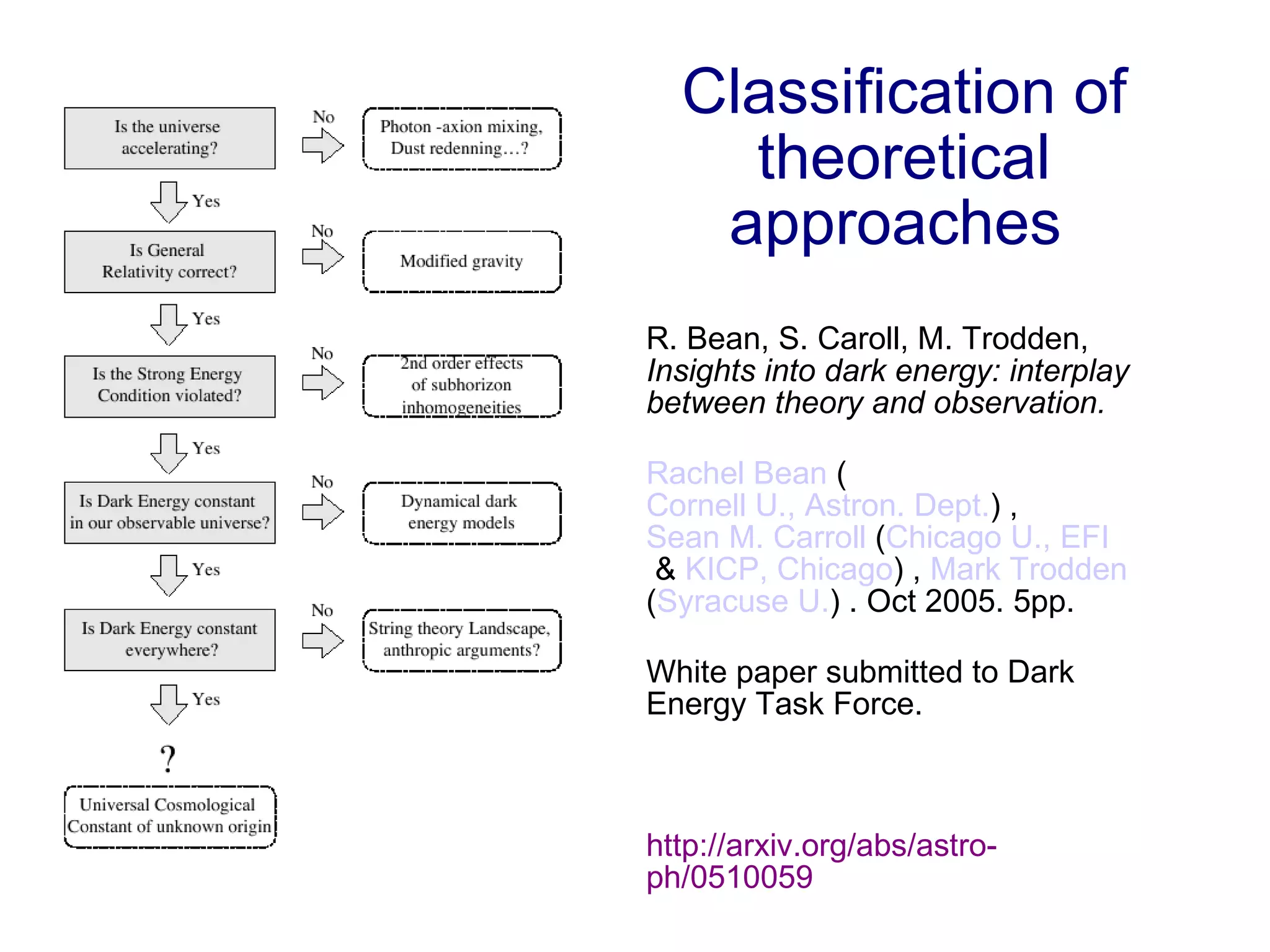
Classification of theoretical approaches  ll R. Bean, S. Caroll, M. Trodden,  Insights into dark energy: interplay between theory and observation.  Rachel Bean  ( Cornell U., Astron. Dept. ) ,  Sean M. Carroll  ( Chicago U., EFI  &  KICP, Chicago ) ,  Mark Trodden  ( Syracuse U. ) . Oct 2005. 5pp.  White paper submitted to Dark Energy Task Force.  http://arxiv.org/abs/astro-ph/0510059
Distorted signals and unjustified assumptions? Photons from SNIa convert to axions in the intergalactic magnetic field   light signal dissipated  Reduction in intensity confused for the effects of acceleration C. Csaki, N. Kaloper, J. Terning, Phys. Rev. Lett. 88 (2002) 161302 does not work (very interesting attempt – invokes more or less standard (or at least already known physics)  connection with the phantom  “mirage”
Distorted signals and unjustified assumptions? The influence of inhomogeneities (below 50-100 Mpc) Nonlinearity of GR in its fundamental form Solving Einstein equations in an inhomogeneous universe and averaging the solutions is not equivalent to averaging sources and solving Einsteins equations in a homogeneous universe No additional components (just NR matter) The acceleration is apparent  The perceived acceleration begins with the onset of structure formation – very convenient for the cosmic coincidence problem The effect is not sufficient to account for acceleration, but is should be taken into considerations in precise determination of cosmic parameters
Distorted signals and unjustified assumptions? Inhomogeneities at scales above the Hubble horizon Underdense region Relinquishing the Copernican principle? Falsifiability? No additional components The effect of “super large scale structure”
Mechanism of the acceleration No acceleration in the “old standard cosmological model”  Our (pre)concepts of the universe have to be modified Modifying contents – dark energy (+ DM) Modyfing gravity – modified (dark) gravity Modifying dimensionality – new (large) dimesions – braneworld models ... and combinations
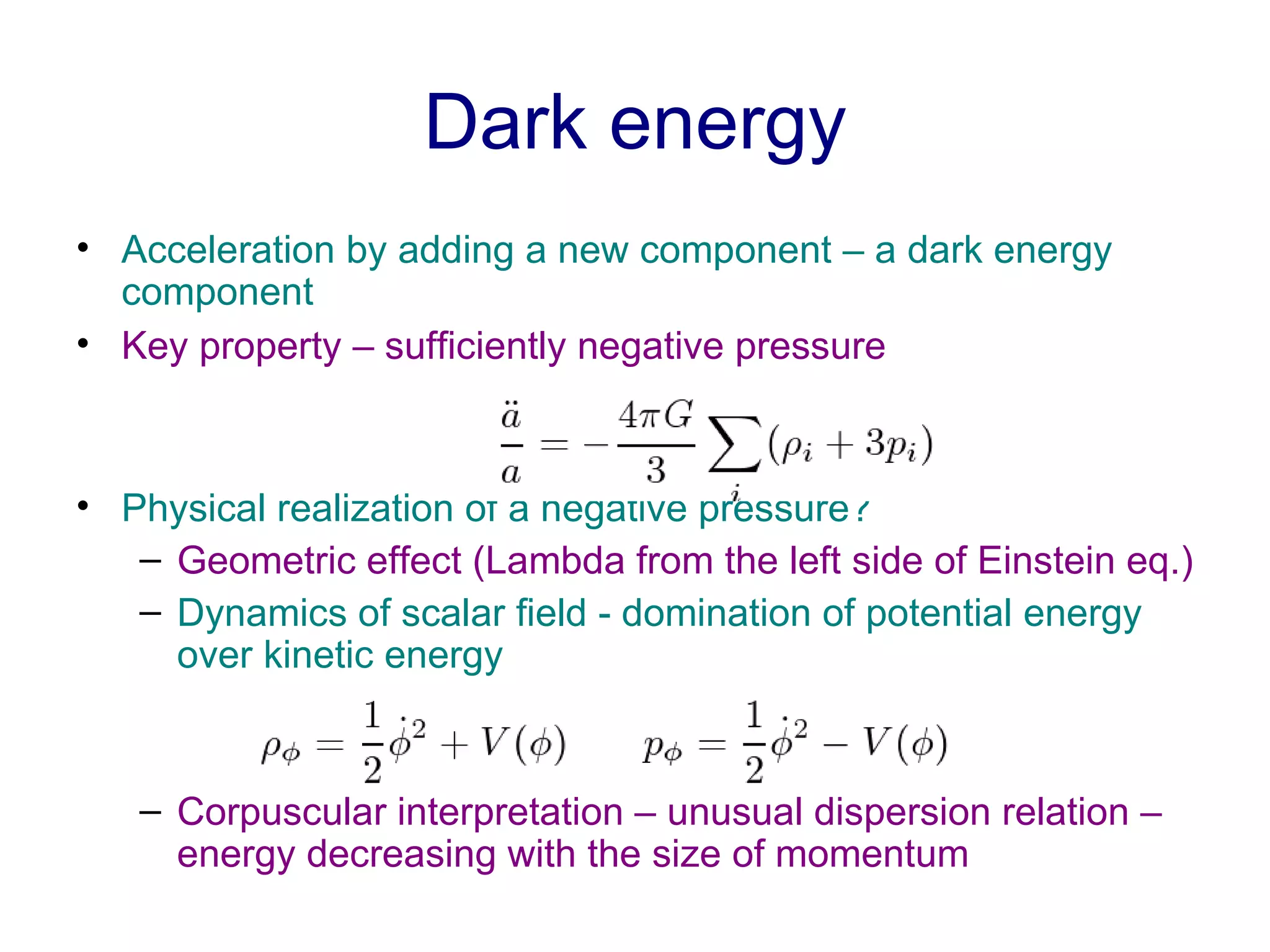
Dark energy Acceleration by adding a new component – a dark energy component Key property – sufficiently negative pressure Physical realization of a negative pressure? Geometric effect (Lambda from the left side of Einstein eq.) Dynamics of scalar field - domination of potential energy over kinetic energy Corpuscular interpretation – unusual dispersion relation – energy decreasing with the size of momentum
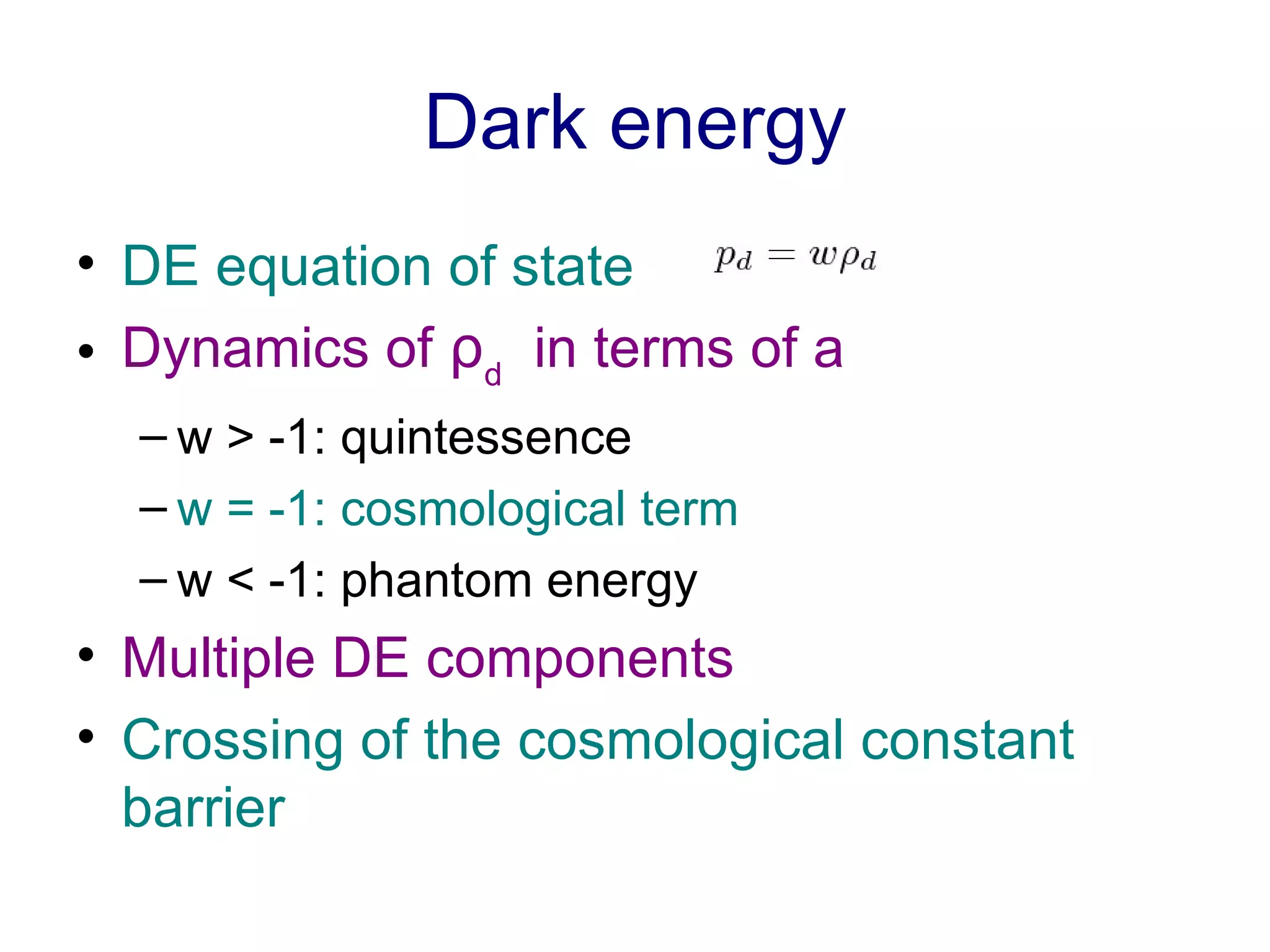
Dark energy DE equation of state  Dynamics of  ρ d   in terms of a w > -1: quintessence w = -1: cosmological term w < -1: phantom energy Multiple DE components Crossing of the cosmological constant barrier
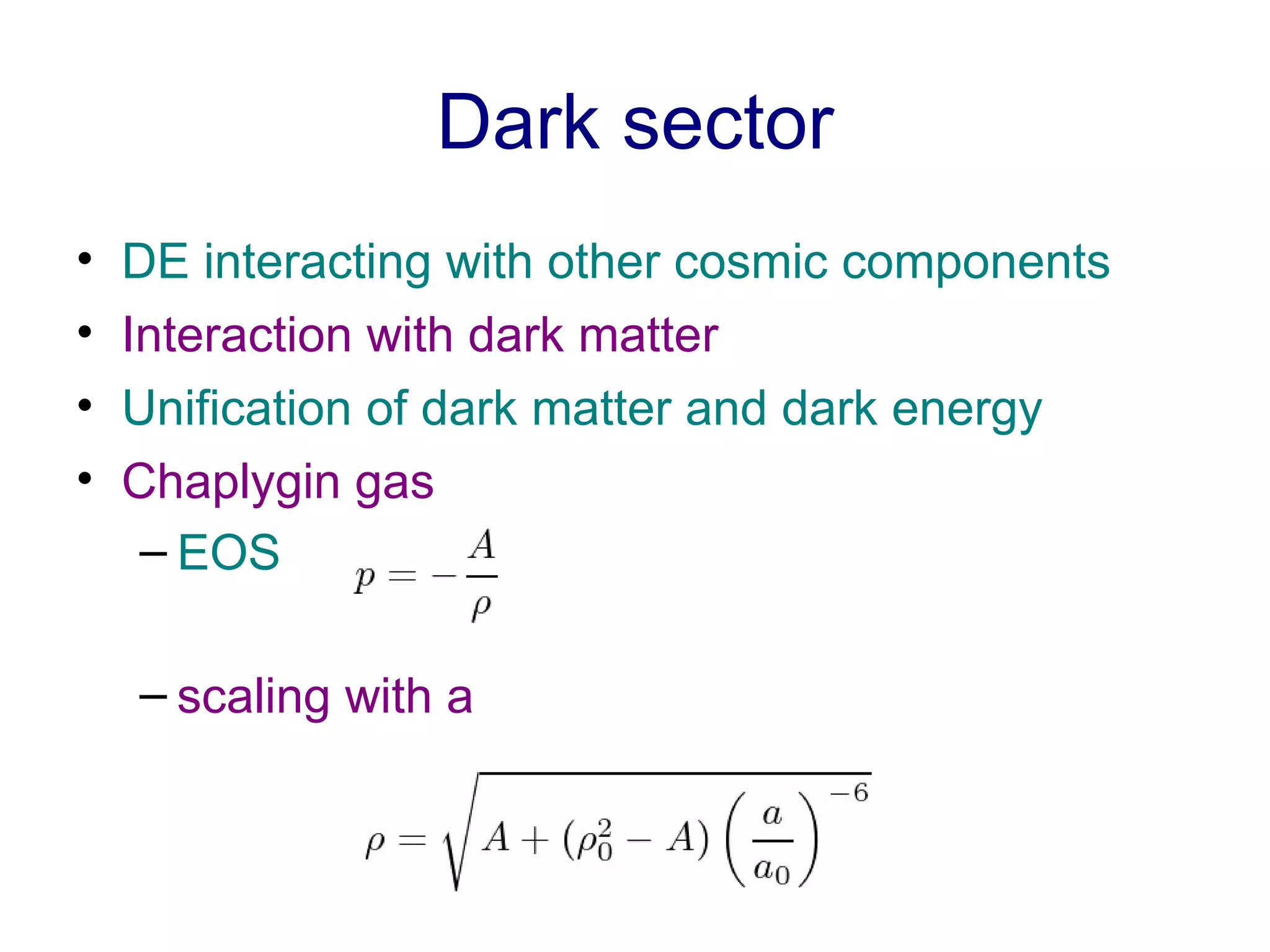
Dark sector DE interacting with other cosmic components Interaction with dark matter Unification of dark matter and dark energy Chaplygin gas  EOS scaling with a
DE models Cosmic fluid Scalar fields (quintessence, phantom) ... Effective description of other acceleration mechanisms (at least at the level of global expansion)
Λ CDM Benchmark model Only known concepts (CC, NR matter, radiation) small number of parameters The size of  Λ  not understood – cosmological constant problem(s) Problems with  Λ CDM cosmology
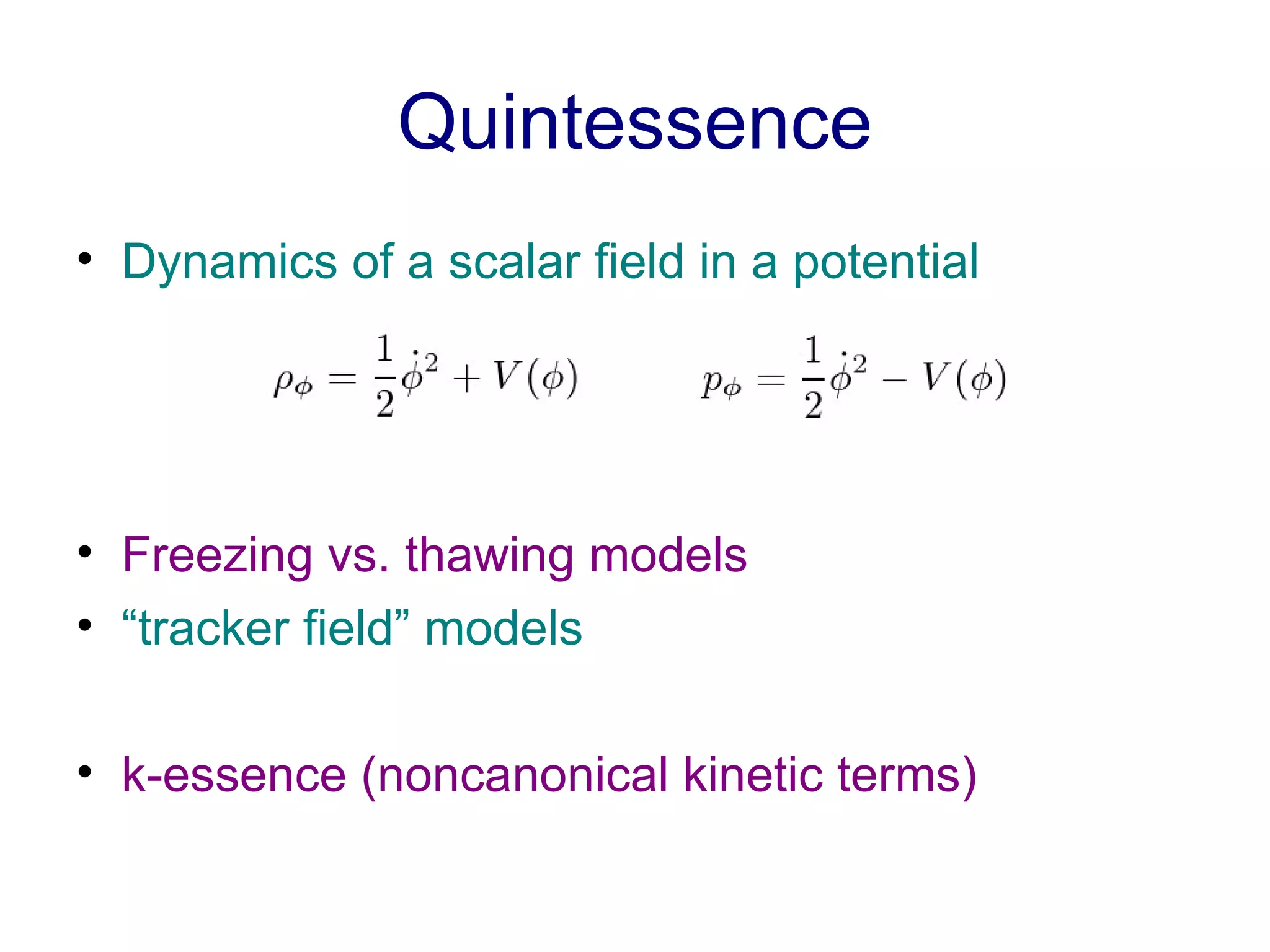
Quintessence Dynamics of a scalar field in a potential  Freezing vs. thawing models “ tracker field” models k-essence (noncanonical kinetic terms)
Phantom energy Energy density growing with time Big rip Stability Problems with microscopic formulation Instability to formation of gradients Effective description
Singularities New types of singularities Finite time (finite scale factor) singularities Sudden singularities
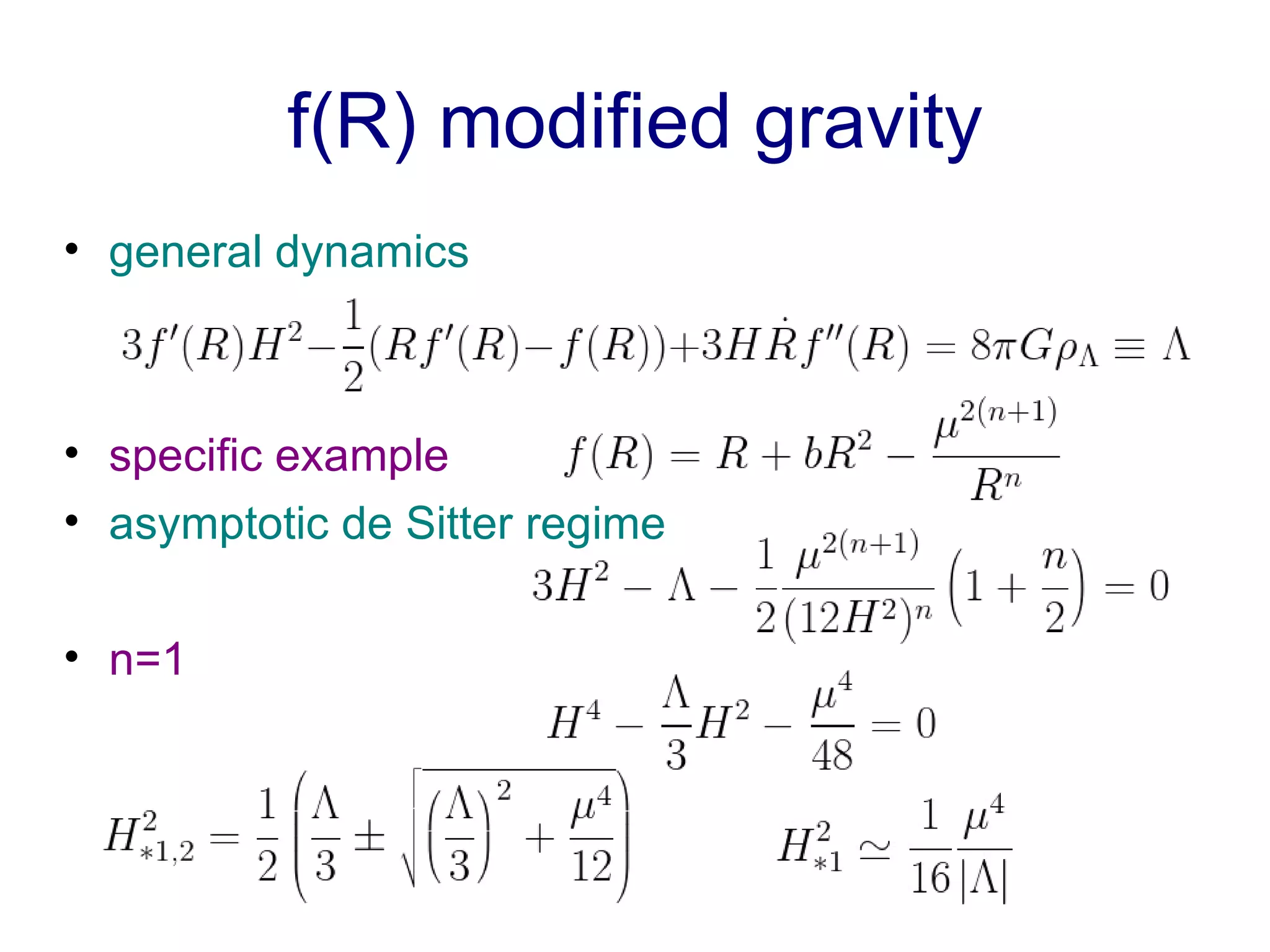
Modified gravity Modification of gravity at cosmological scales Dark gravity (effective dark energy) F(R) gravity – various formulations (metric, Palatini, metric-affine)   Conditions for stability Stringent precision tests in Solar system and astrophysical systems
Braneworlds Matter confined to a 4D brane Gravity also exists in the bulk Dvali-Gabadadaze-Poratti (DGP) Different DGP models – discussion of the status! Phenomenological modifications of the Friedmann equation – Cardassian expansion
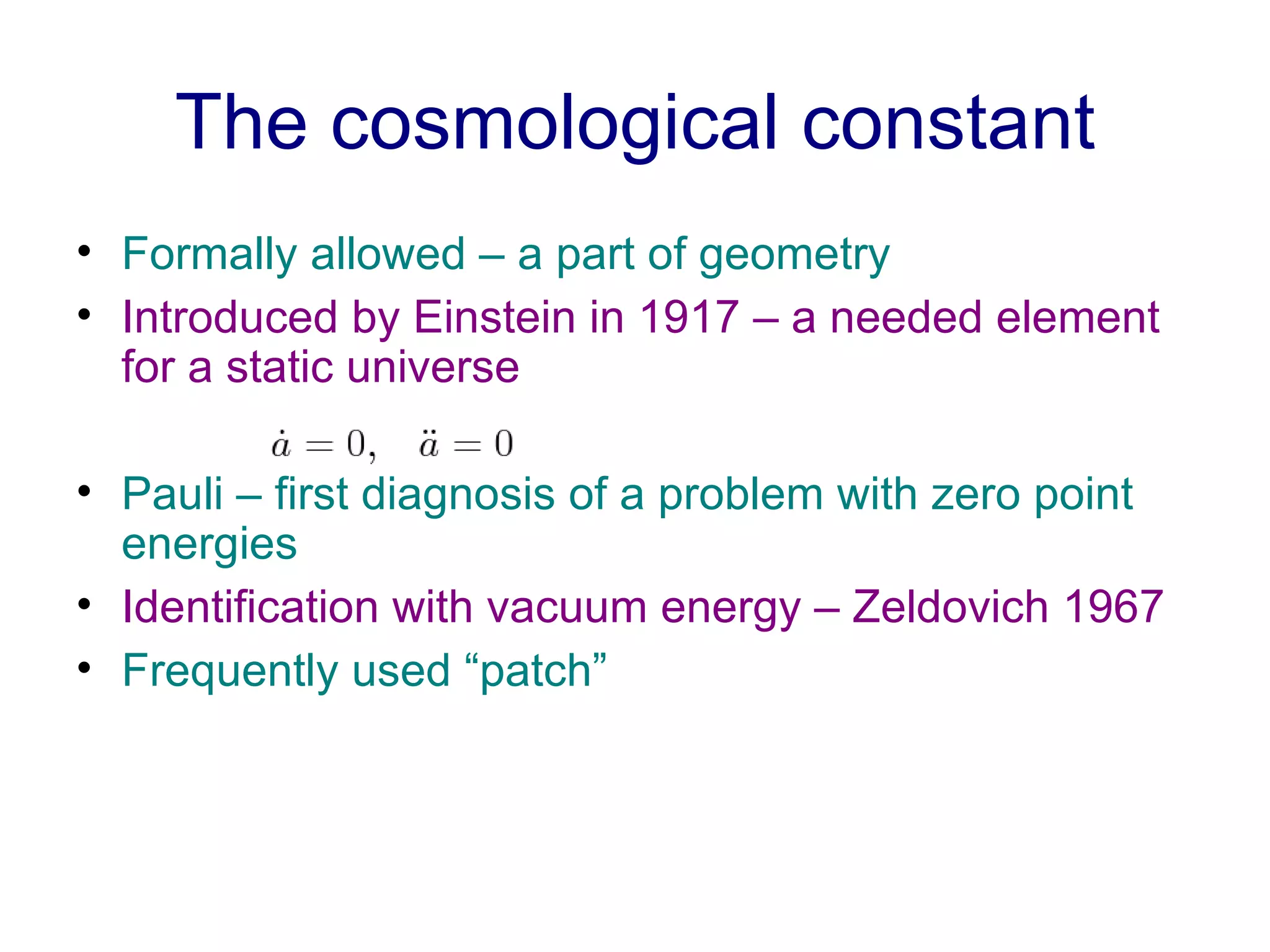
The cosmological constant Formally allowed – a part of geometry  Introduced by Einstein in 1917 – a needed element for a static universe Pauli – first diagnosis of a problem with zero point energies   Identification with vacuum energy – Zeldovich 1967 Frequently used “patch”
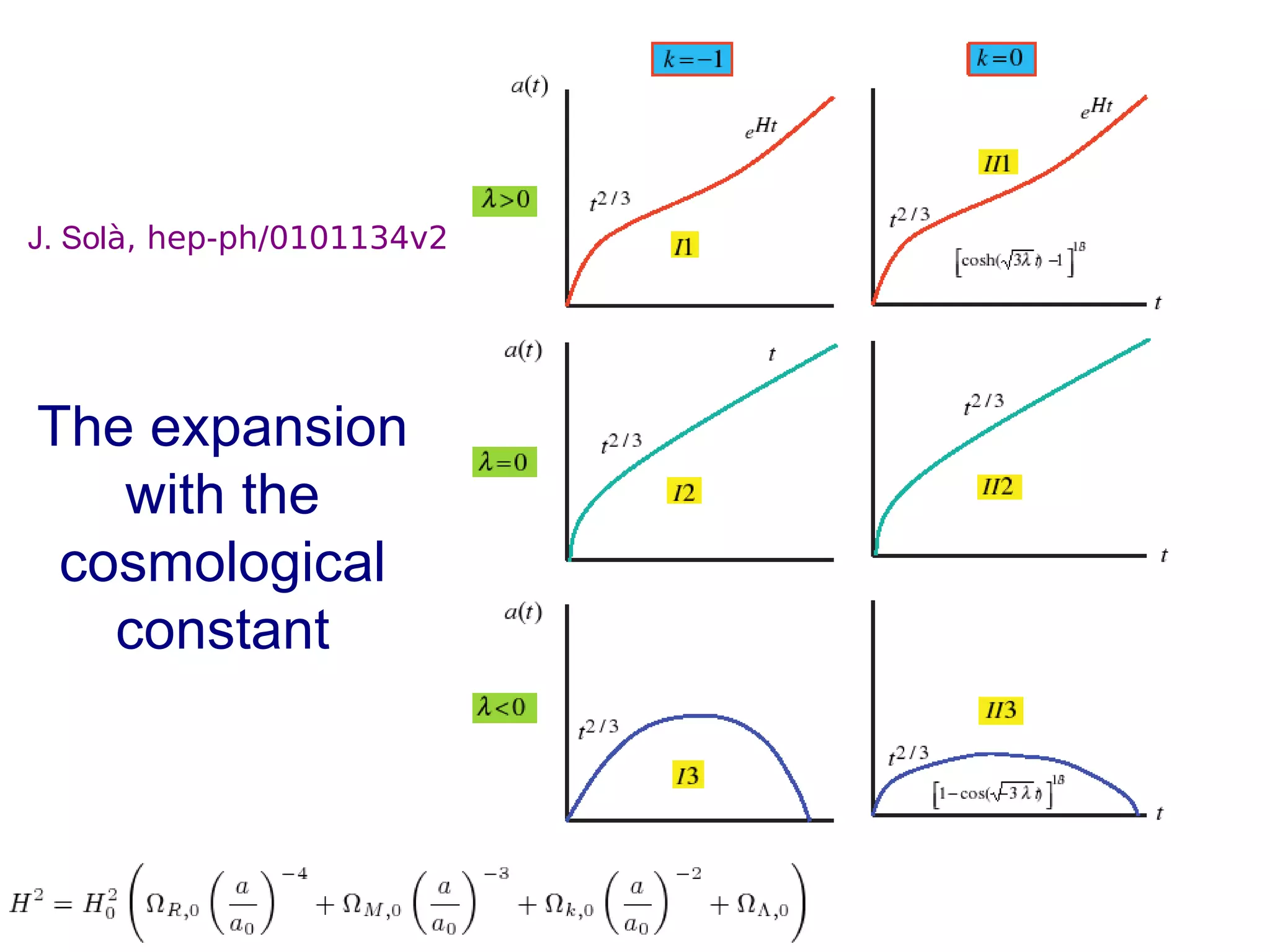
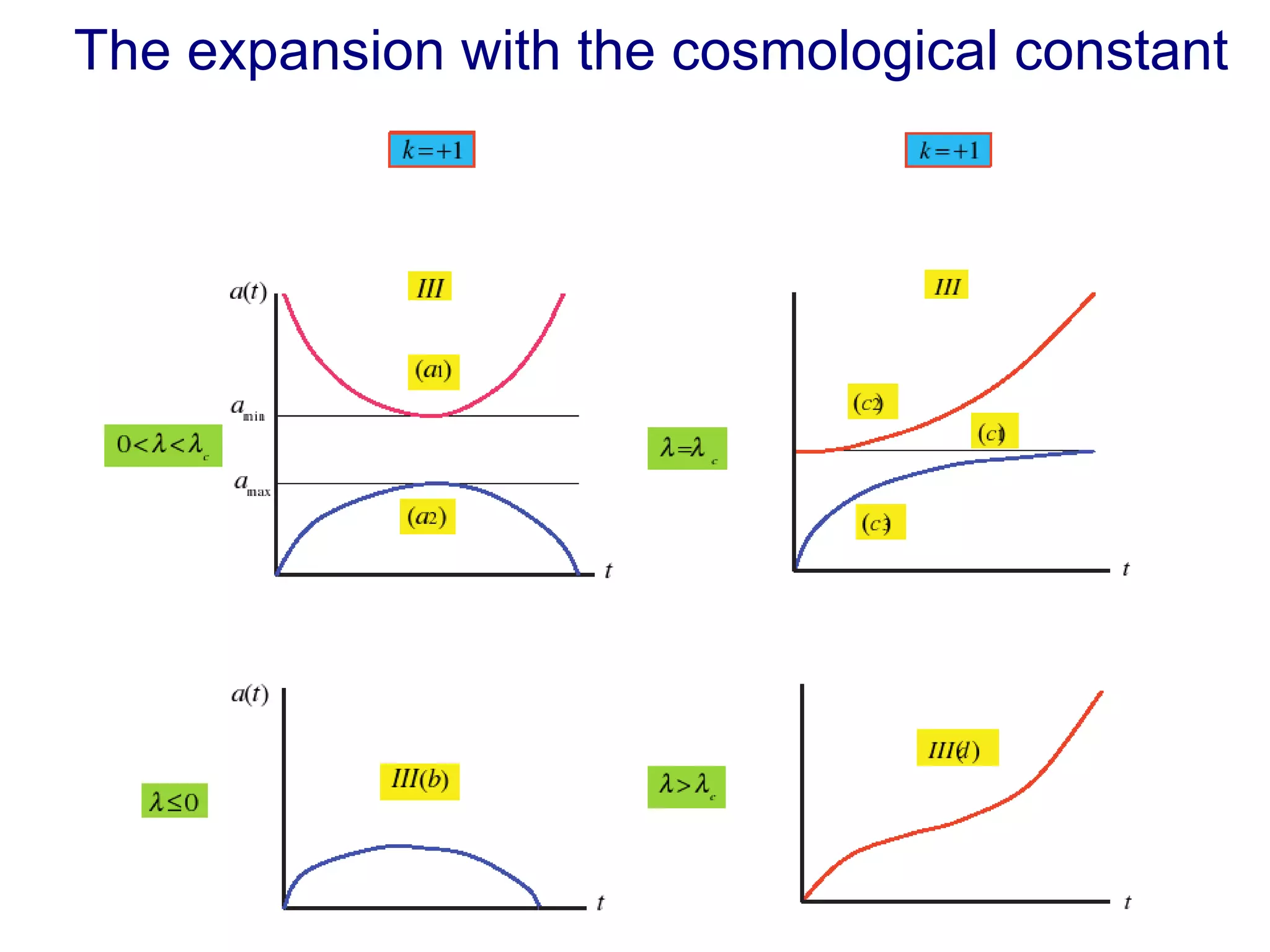
The expansion with the cosmological constant J. Sol à, hep-ph/0101134v2
The expansion with the cosmological constant
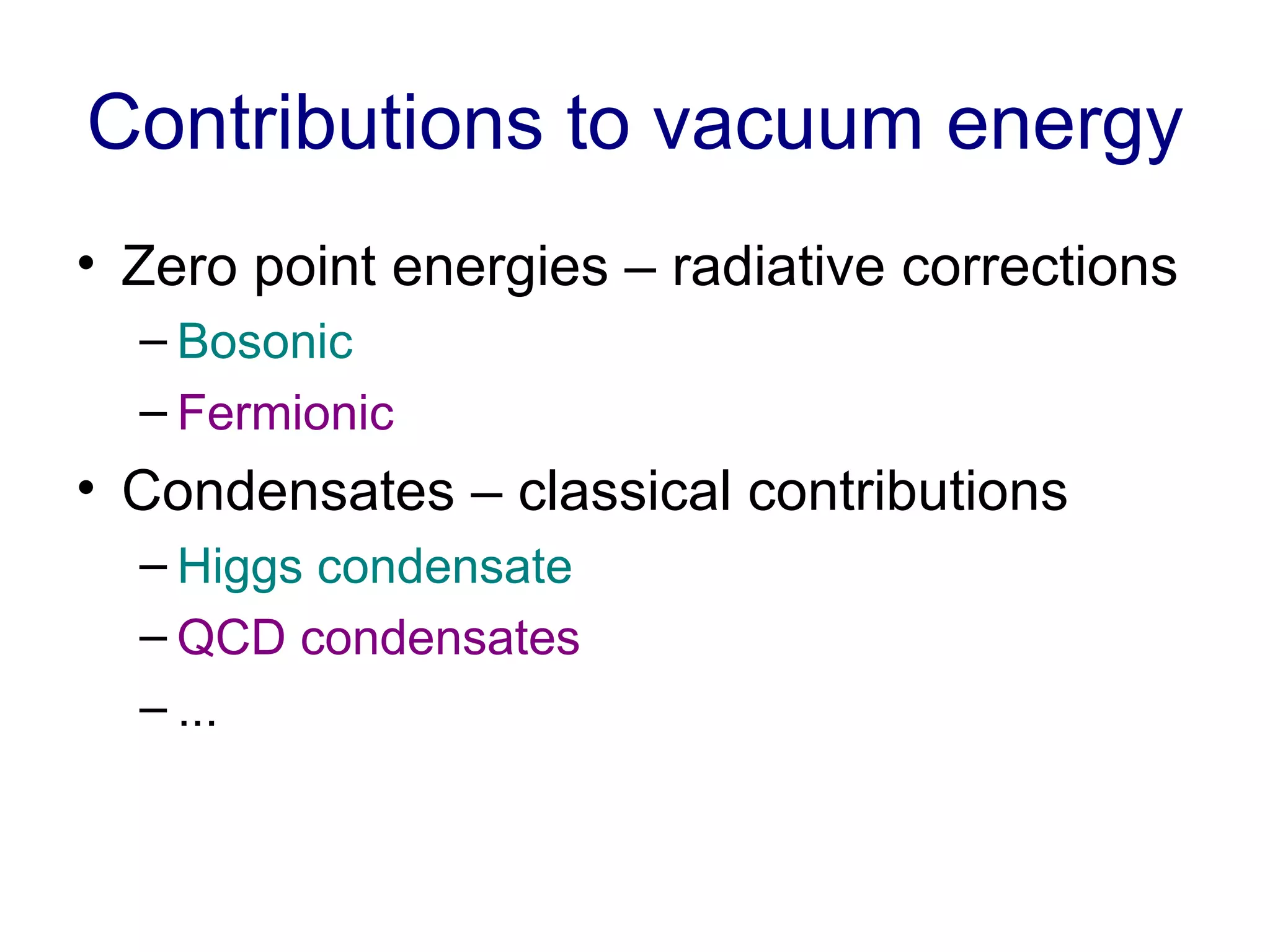
Contributions to vacuum energy Zero point energies – radiative corrections Bosonic Fermionic Condensates – classical contributions Higgs condensate QCD condensates ...
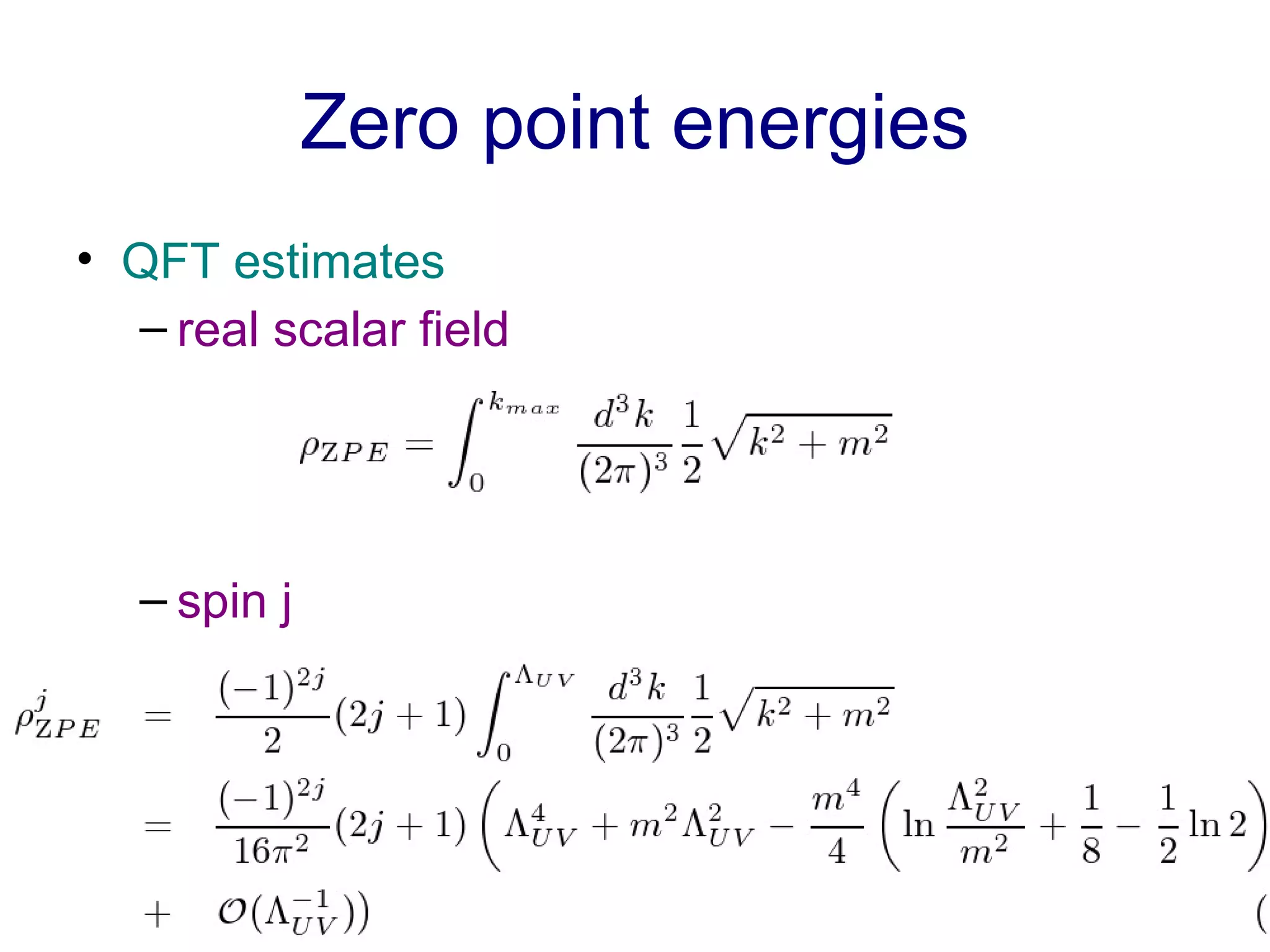
Zero point energies QFT estimates real scalar field spin j
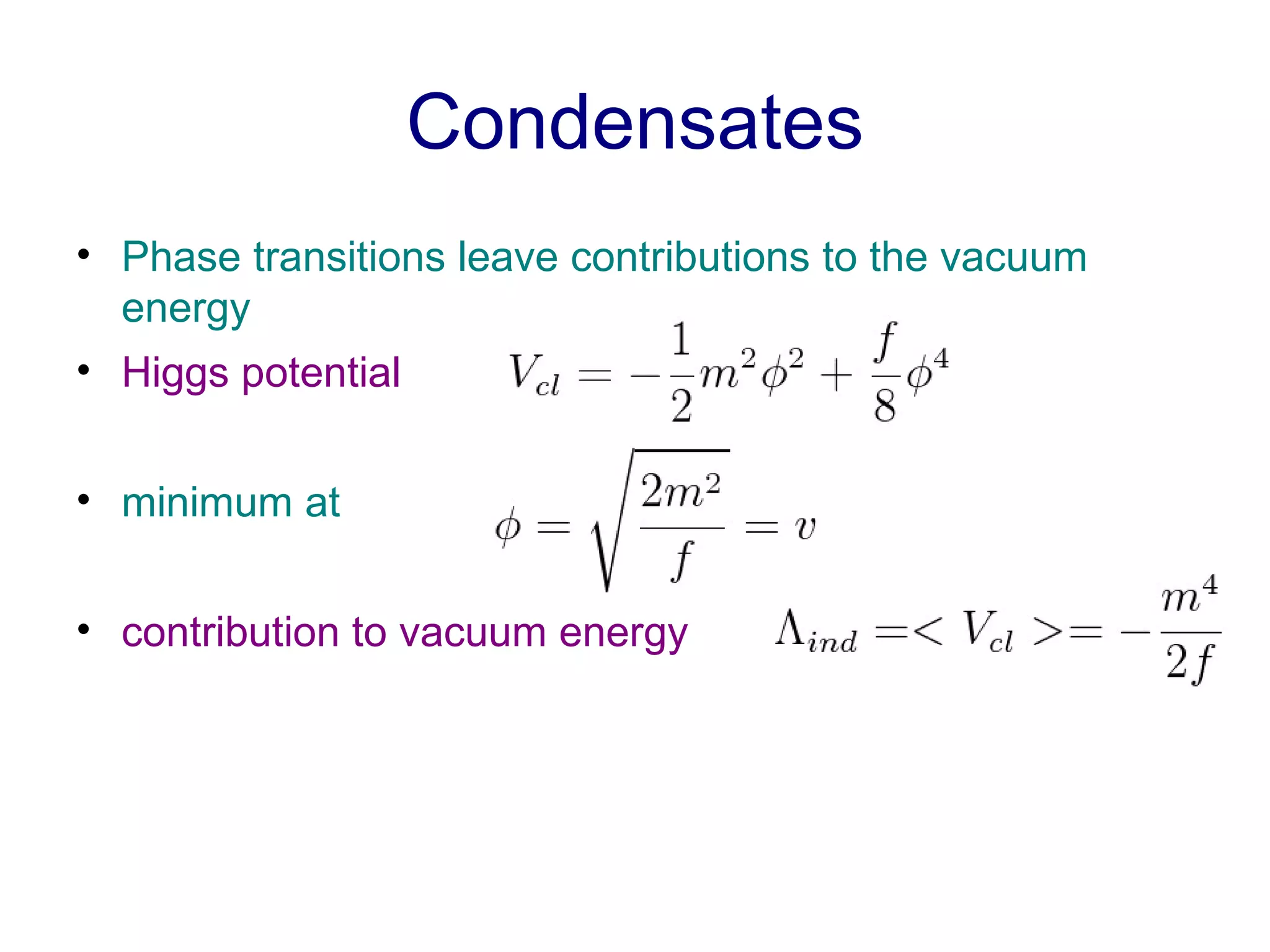
Condensates Phase transitions leave contributions to the vacuum energy Higgs potential minimum at contribution to vacuum energy
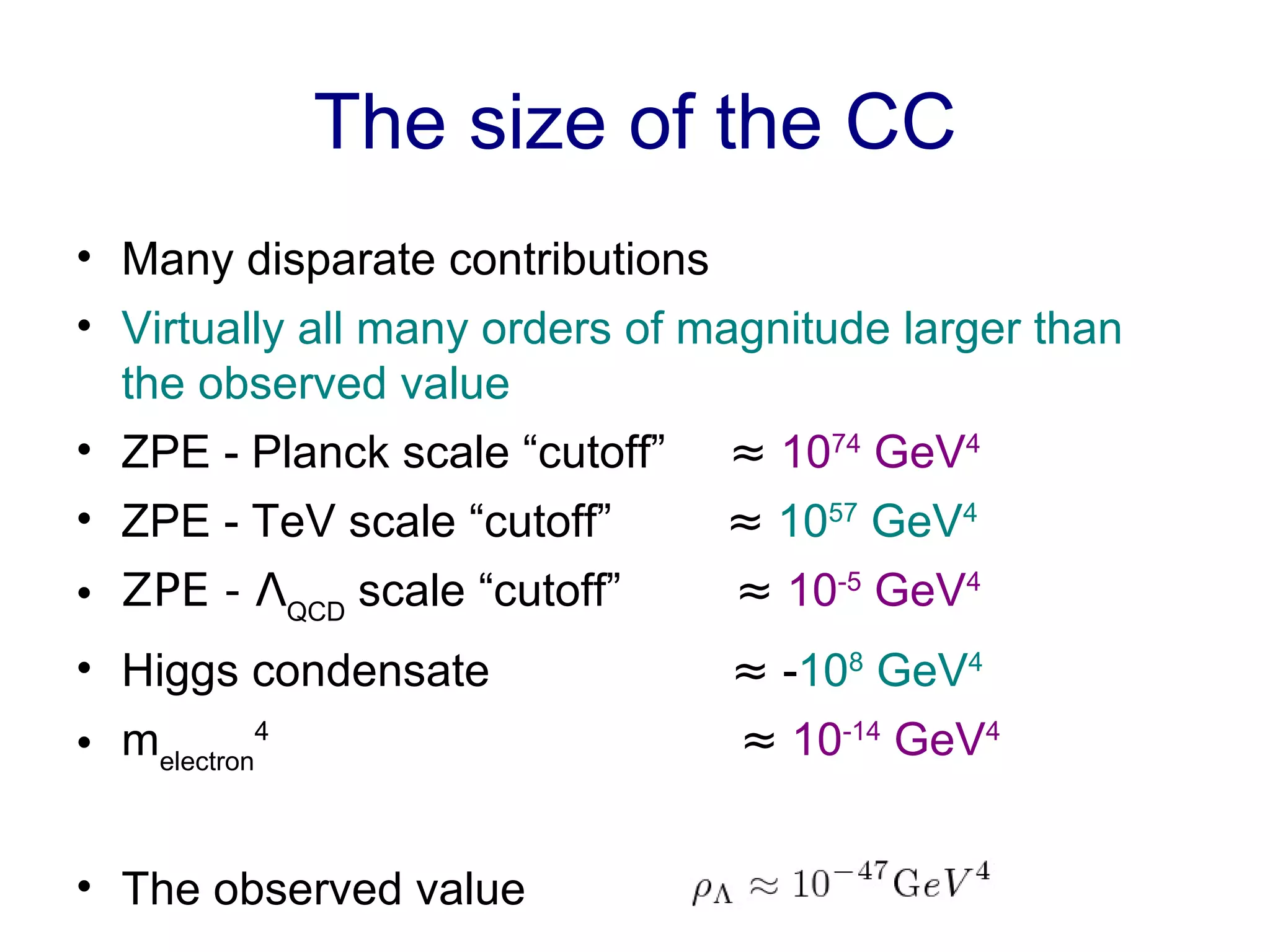
The size of the CC Many disparate contributions Virtually all many orders of magnitude larger than the observed value ZPE - Planck scale “cutoff”  ≈   10 74  GeV 4 ZPE - TeV scale “cutoff”  ≈   10 57  GeV 4 ZPE - Λ QCD  scale “cutoff”  ≈   10 -5  GeV 4 Higgs condensate  ≈  - 10 8  GeV 4 m electron 4   ≈   10 -14  GeV 4 The observed value
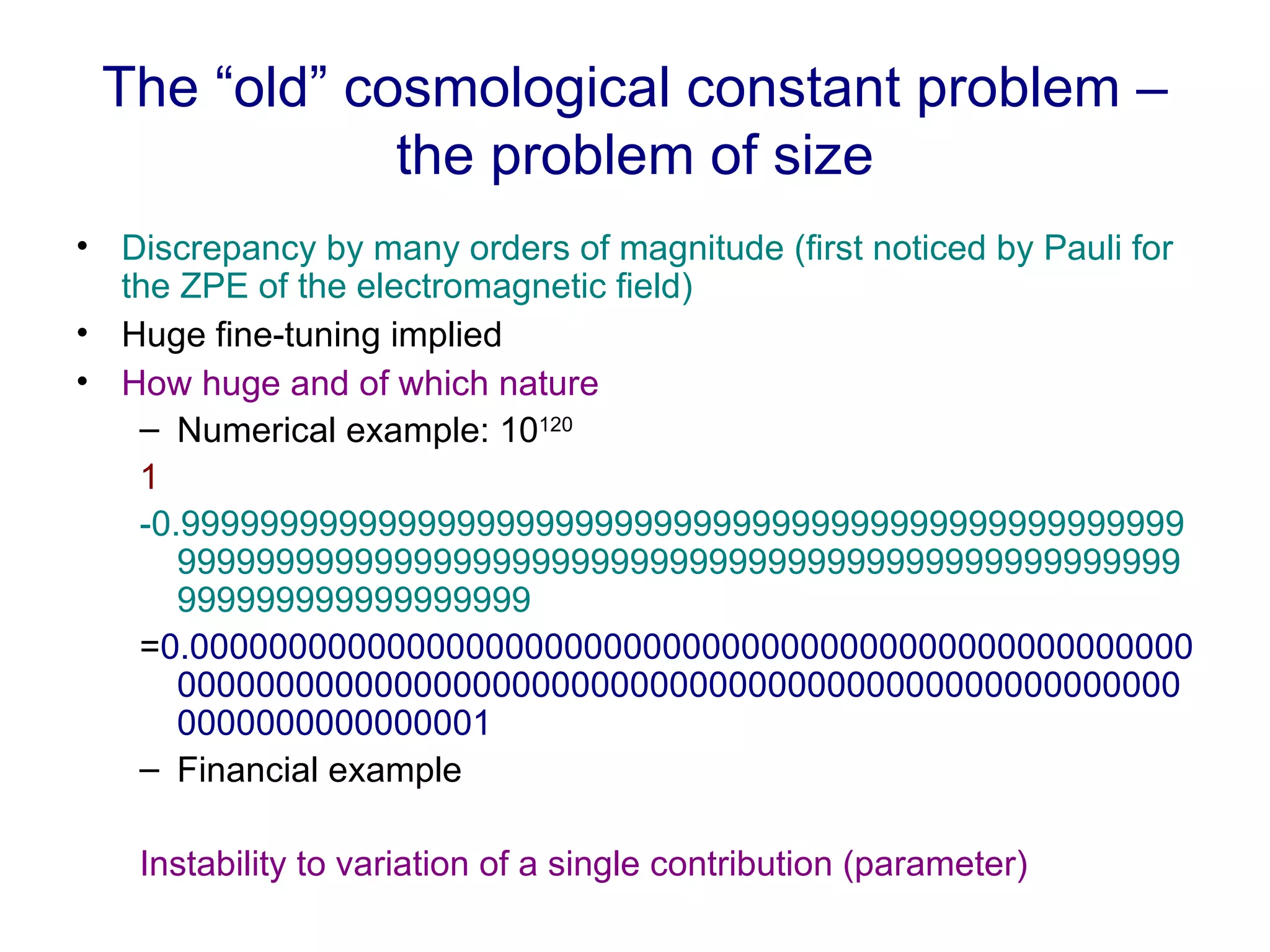
The “old” cosmological constant problem – the problem of size Discrepancy by many orders of magnitude (first noticed by Pauli for the ZPE of the electromagnetic field)  Huge fine-tuning implied How huge and of which nature Numerical example: 10 120 1 -0.999999999999999999999999999999999999999999999999999999999999999999999999999999999999999999999999999999999999999999999999 = 0.0000000000000000000000000000000000000000000000000000000000000000000000000000000000000000000000000000000000000000000001 Financial example Instability to variation of a single contribution (parameter)
The “old” cosmological constant problem  Fundamental theoretical problem – the problem of the vacuum energy density All proposed solutions assume that the “old” CC problem is somehow solved Λ CDM model – CC relaxed to the observed value DE models and other models – CC is zero or much smaller in absolute value compared to the observed DE energy density  Even should the future observations confirm the dynamical nature of DE or some other alternative acceleration mechanism, the “old” CC problem must be resolved
DE vs CC Raphael Bousso, “TASI lectures on the cosmological constant” “ If a poet sees something that walks like a duck and swims like a duck and quacks like a duck, we will forgive him for entertaining more fanciful possibilities. It could be a unicorn in a duck suit – who's to say! But we know that more likely, it's a duck.”  Conditions for a mechanism solving the CC problem
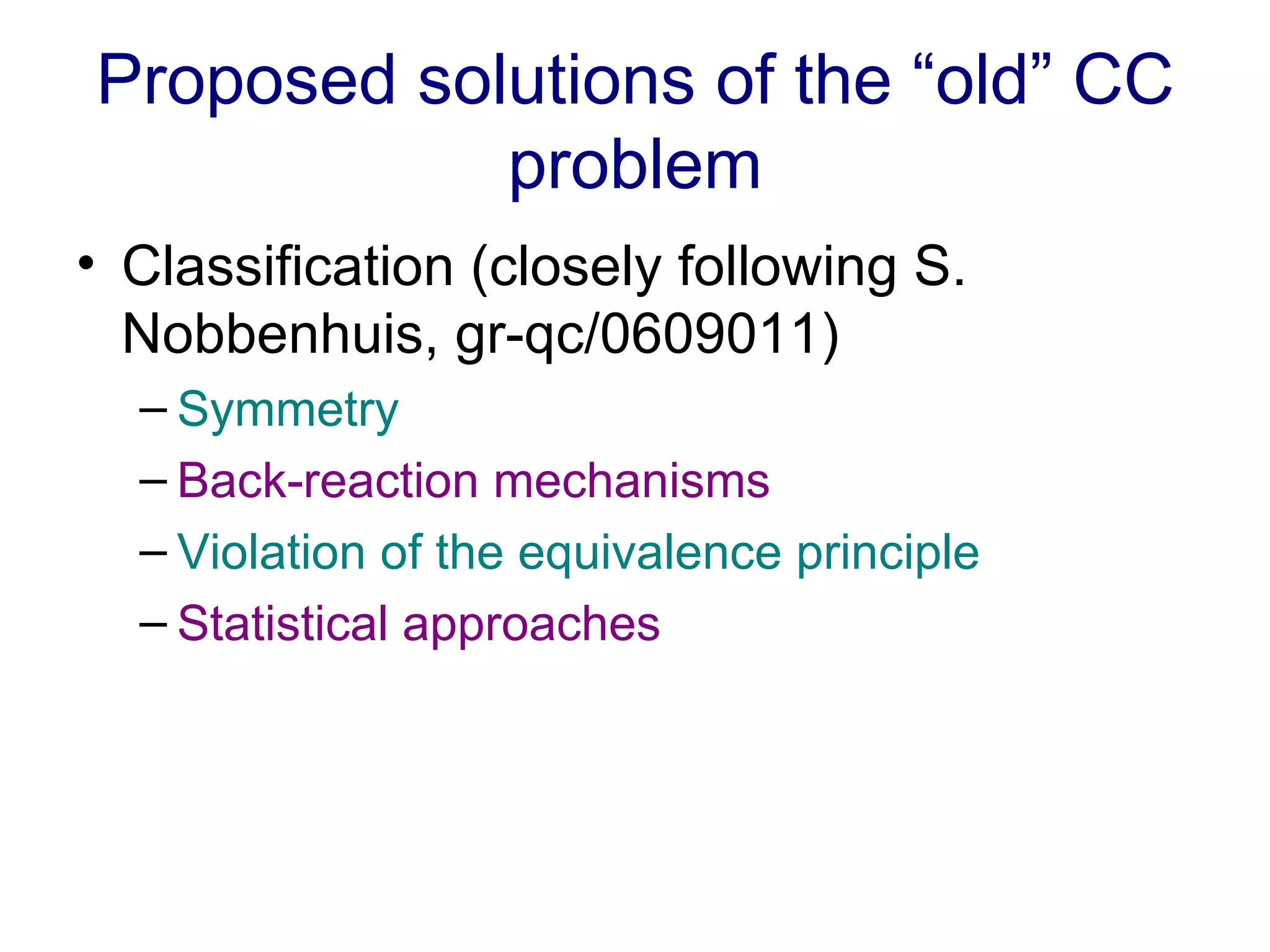
Proposed solutions of the “old” CC problem Classification (closely following S. Nobbenhuis, gr-qc/0609011) Symmetry Back-reaction mechanisms Violation of the equivalence principle Statistical approaches
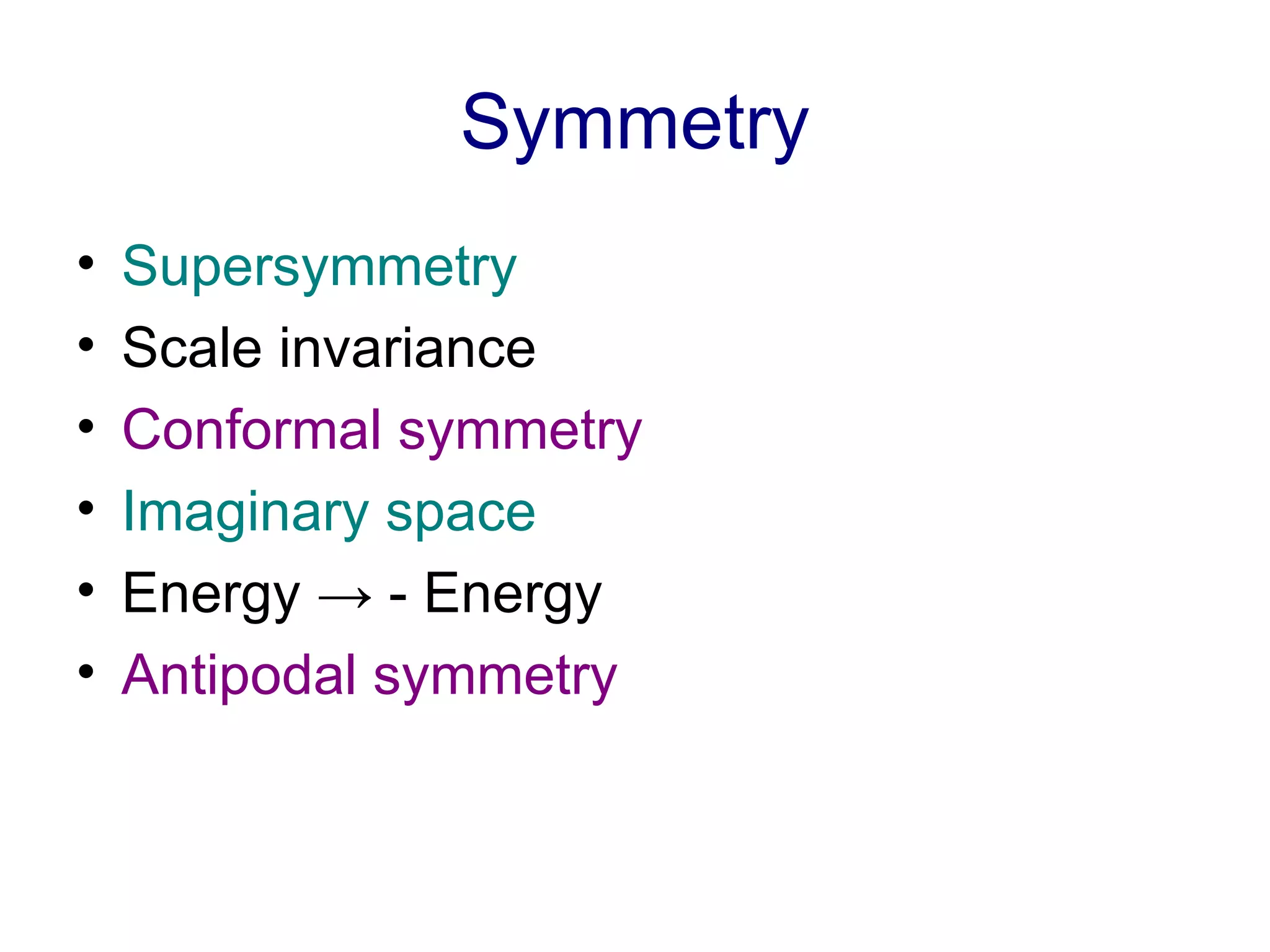
Symmetry Supersymmetry Scale invariance Conformal symmetry Imaginary space Energy  -> - Energy Antipodal symmetry
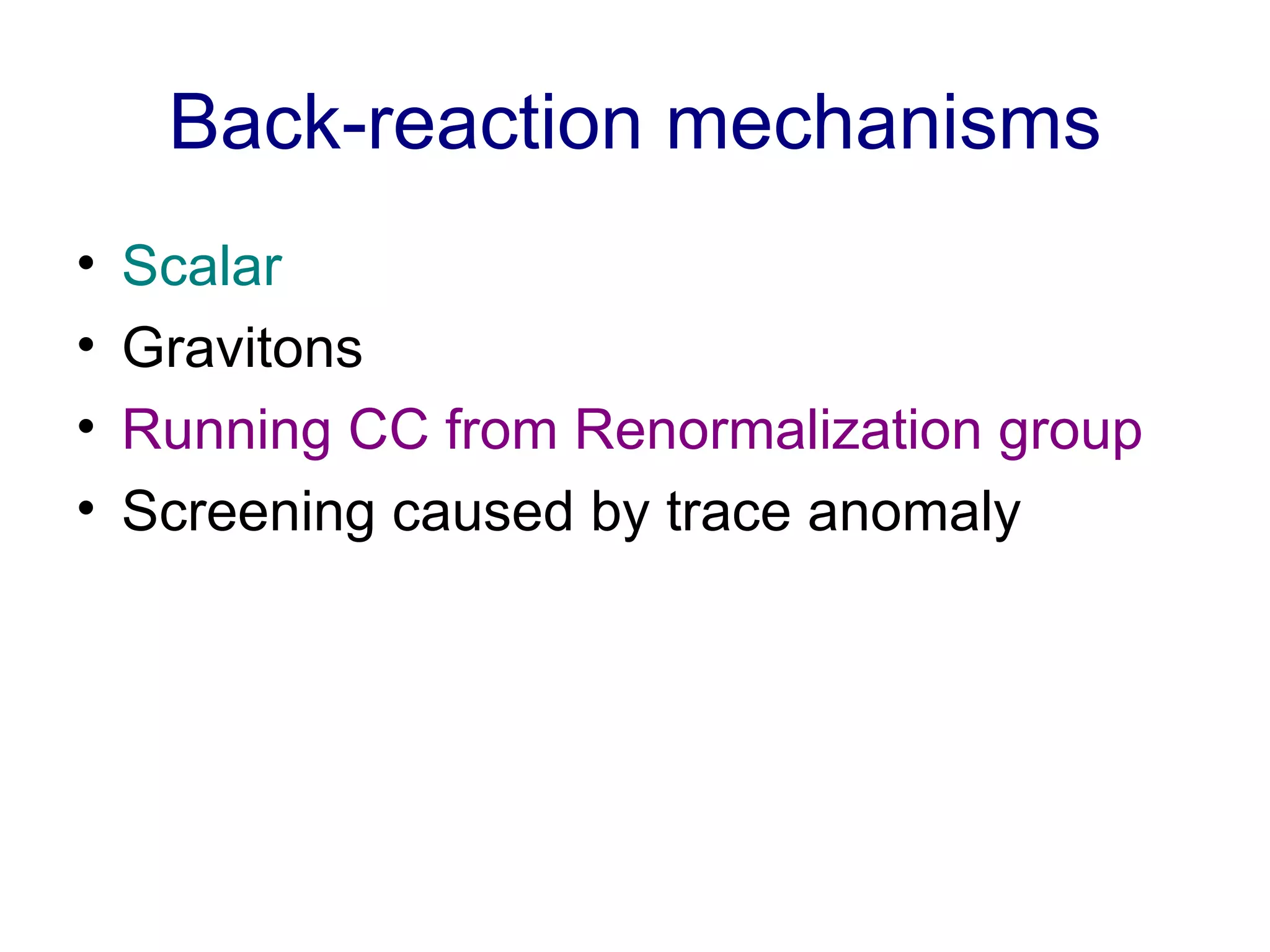
Back-reaction mechanisms Scalar Gravitons Running CC from Renormalization group Screening caused by trace anomaly
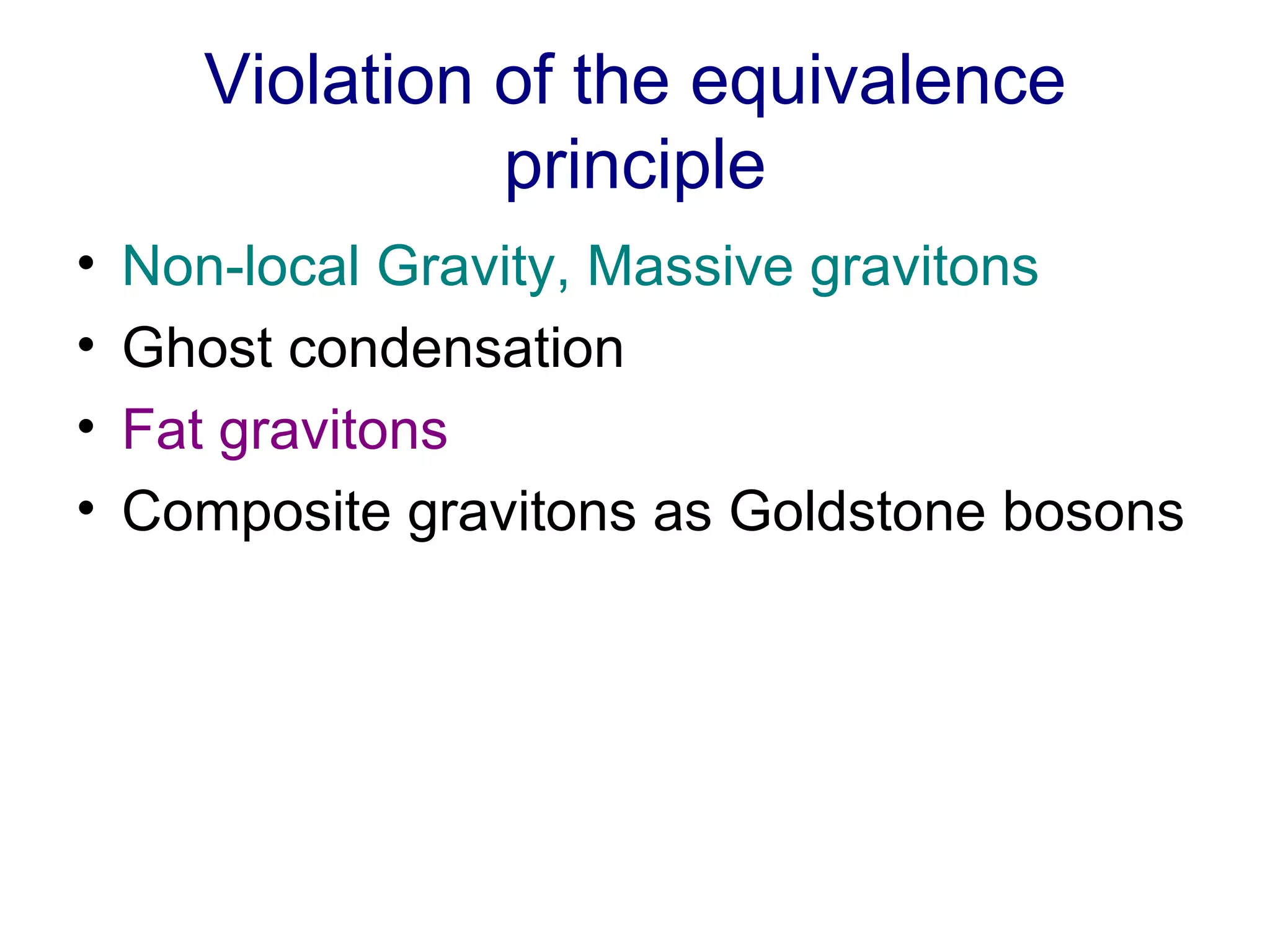
Violation of the equivalence principle Non-local Gravity, Massive gravitons Ghost condensation Fat gravitons Composite gravitons as Goldstone bosons
Statistical approaches Hawking statistics Wormholes Anthropic Principle
The cosmic coincidence problem – the problem of timing Why the CC (DE) energy density and the energy density of (NR) matter are comparable (of the same order of magnitude) at the present epoch? A problem in a DE (CC) approach to the problem of accelerated expansion: DE (CC) energy density scale very differently with the expansion (if presently comparable they were very different in the past and will be very different in the future NR:  ρ ~ a -3 DE:  ρ ~ a -3(1+w)  , slower than a -2  , CC: ~ 1 Also present in many approaches not based on DE
Possible solutions of the cosmic coincidence problem Naturally solved in (matter) back-reaction approaches “ tracker field” Oscillating DE model DE-DM interaction models (although problem still present in e.g. Chaplygin gas model) Composite DE model (LambdaXCDM model) Two interacting DE components: a (dynamical) cosmological term and an additional DE component (cosmon X) … .
Composite dark energy –  Λ XCDM models ordinary matter (radiation and NR matter) separately conserved)  Λ XCDM 1   : CT  interacting with cosmon  J. Grande, J. Sol à , H. Š., JCAP 0608 (2006) 011. Λ XCDM 2   : varaible CT i G, X concerved J. Grande, J. Sol à , H. Š.,  Phys. Lett . B645 (2007) 236.
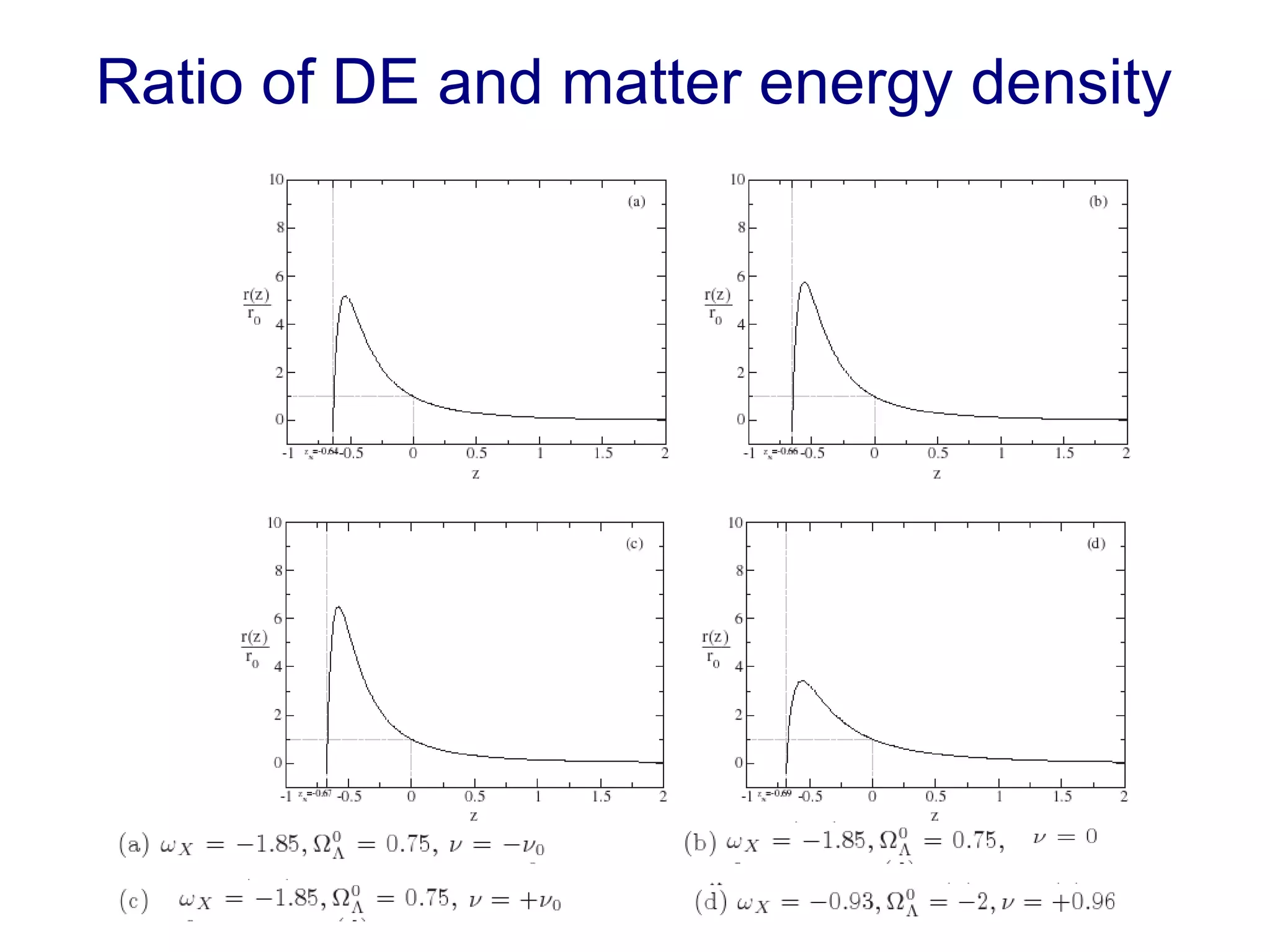
Ratio of DE and matter energy density
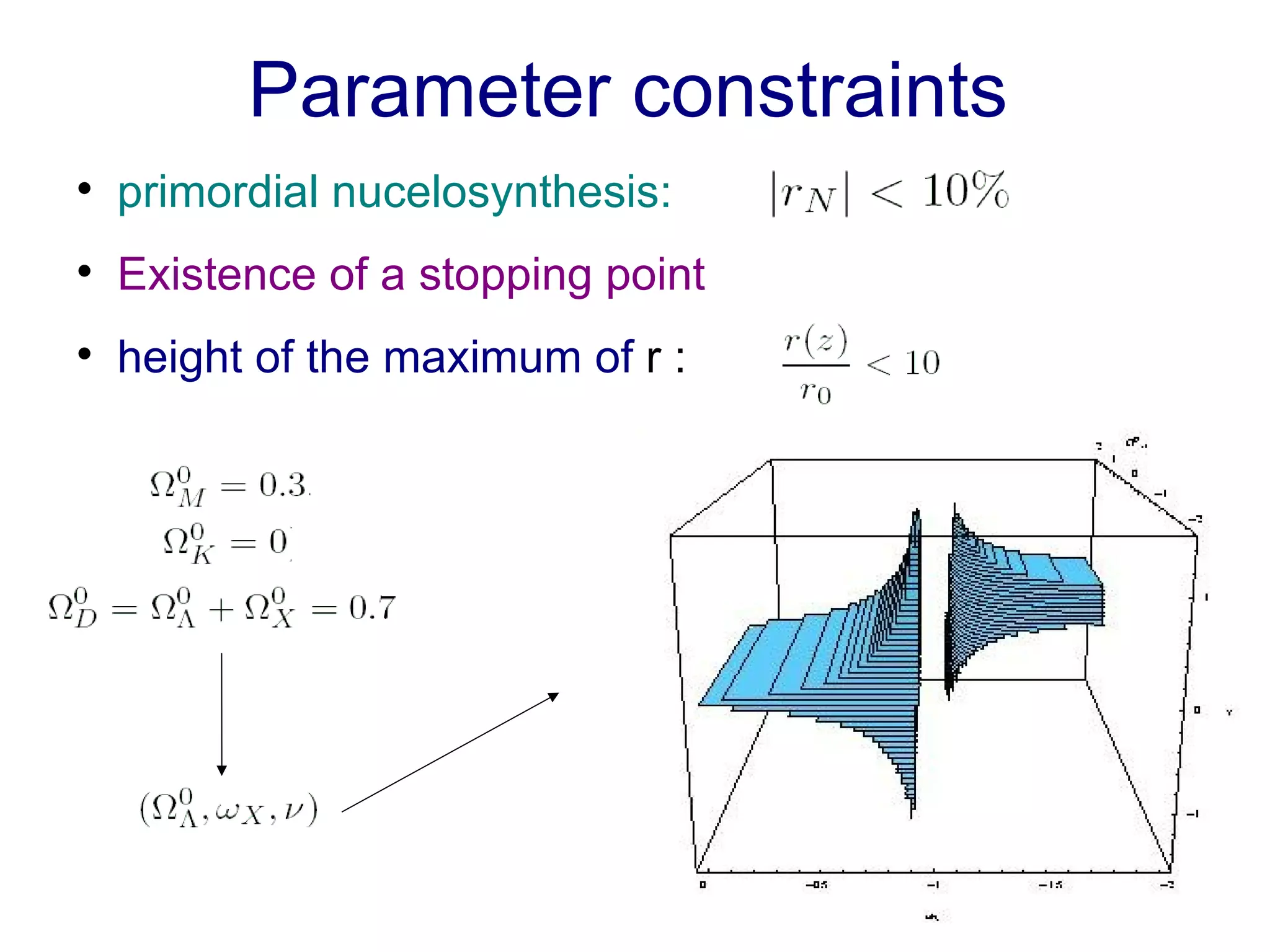
Parameter constraints primordial nucelosynthesis:  Existence of a stopping point   height of the maximum of  r :
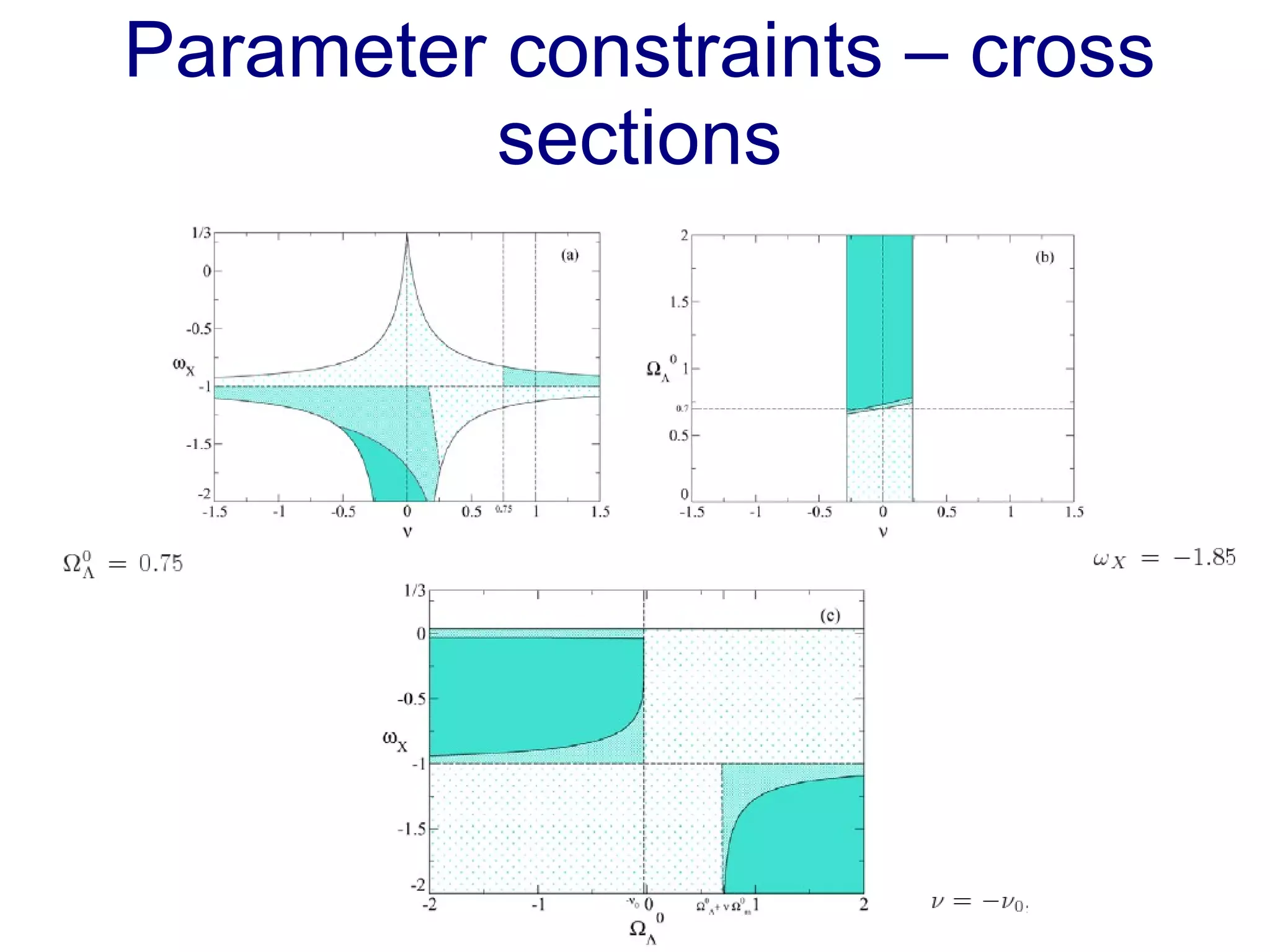
Parameter constraints – cross sections
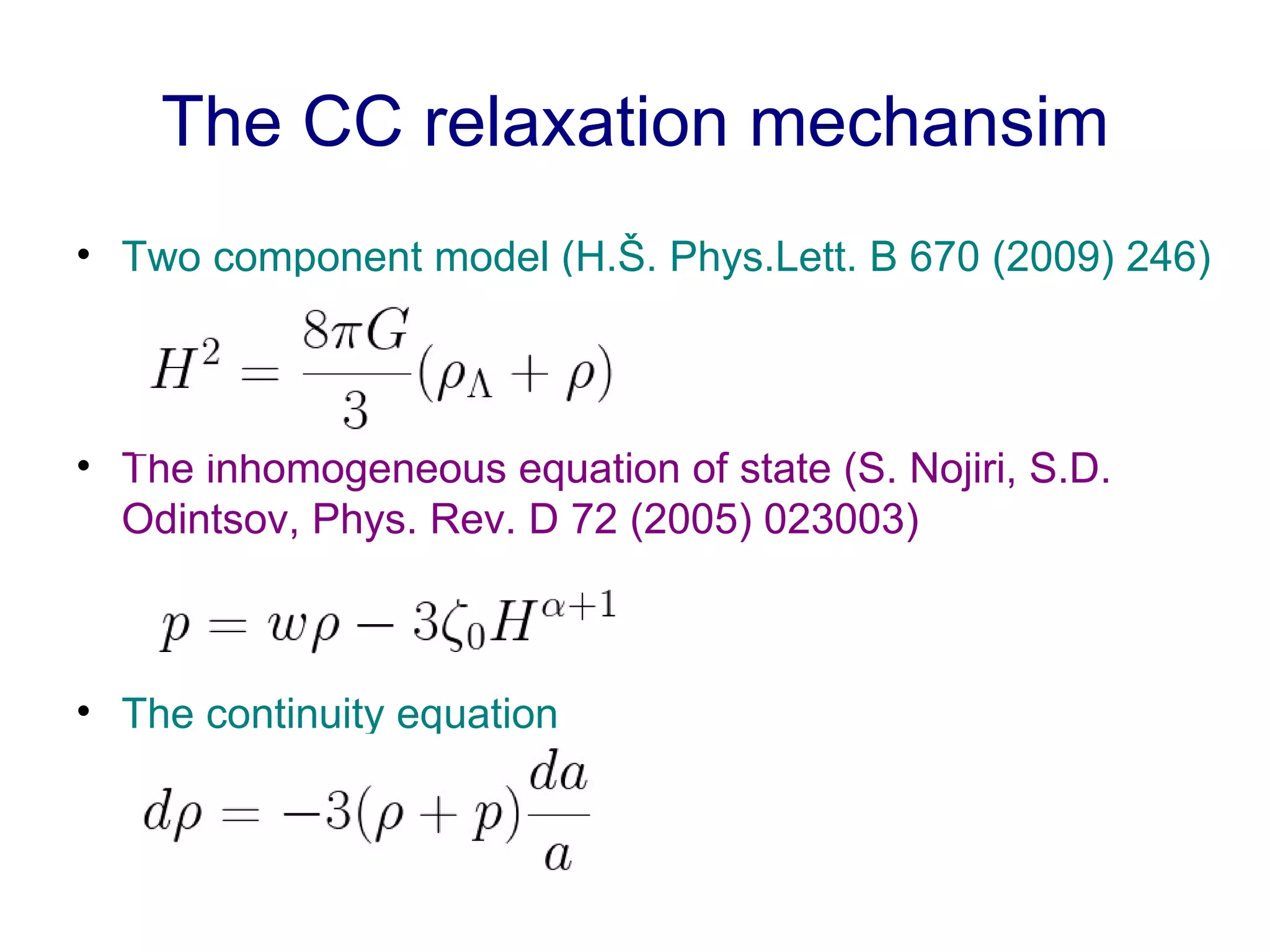
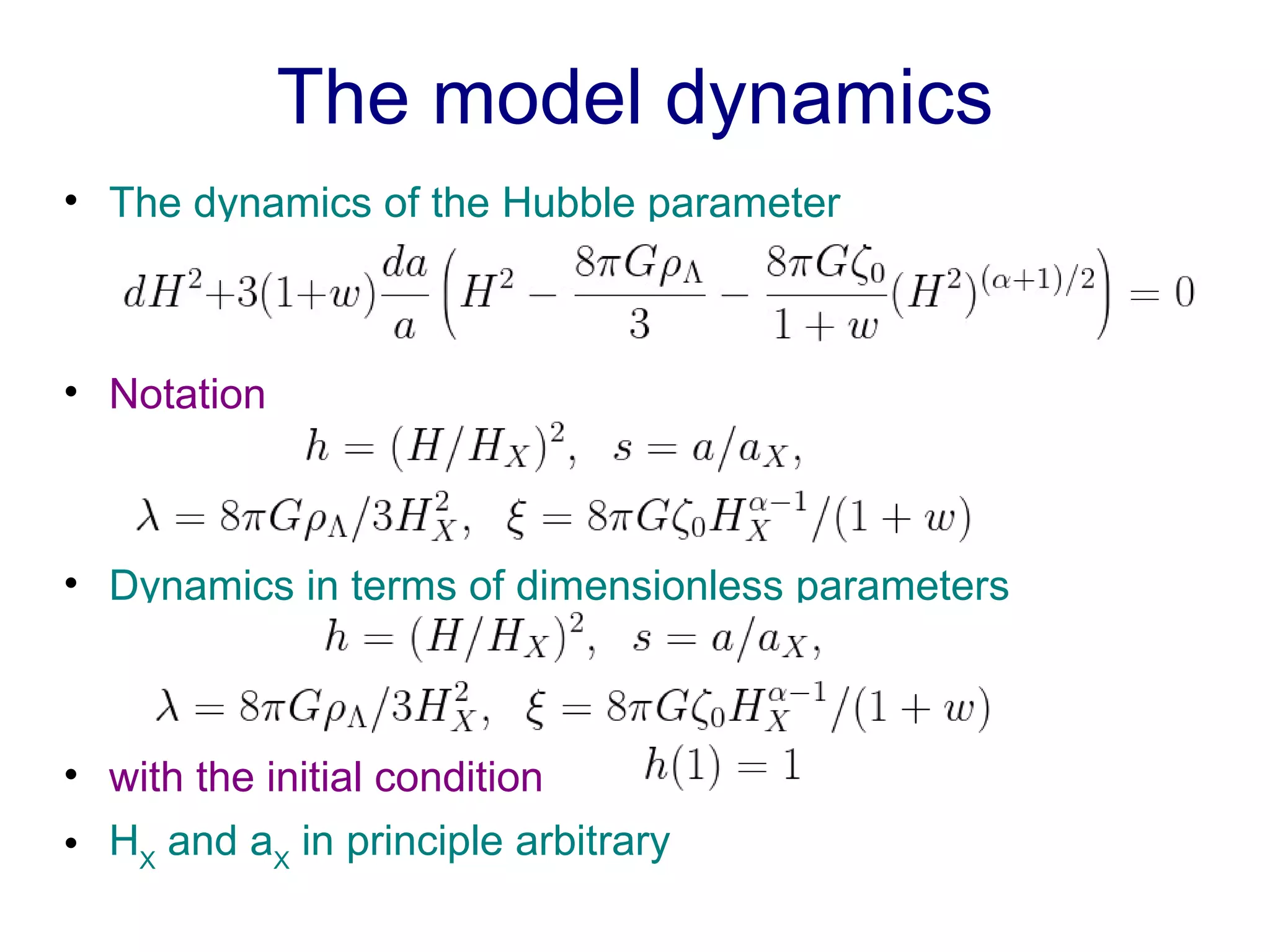
The CC relaxation mechansim Two component model (H.Š. Phys.Lett. B 670 (2009) 246) The inhomogeneous equation of state (S. Nojiri, S.D. Odintsov, Phys. Rev. D 72 (2005) 023003) The continuity equation
The model dynamics The dynamics of the Hubble parameter Notation  Dynamics in terms of dimensionless parameters with the initial condition H X  and a X  in principle arbitrary
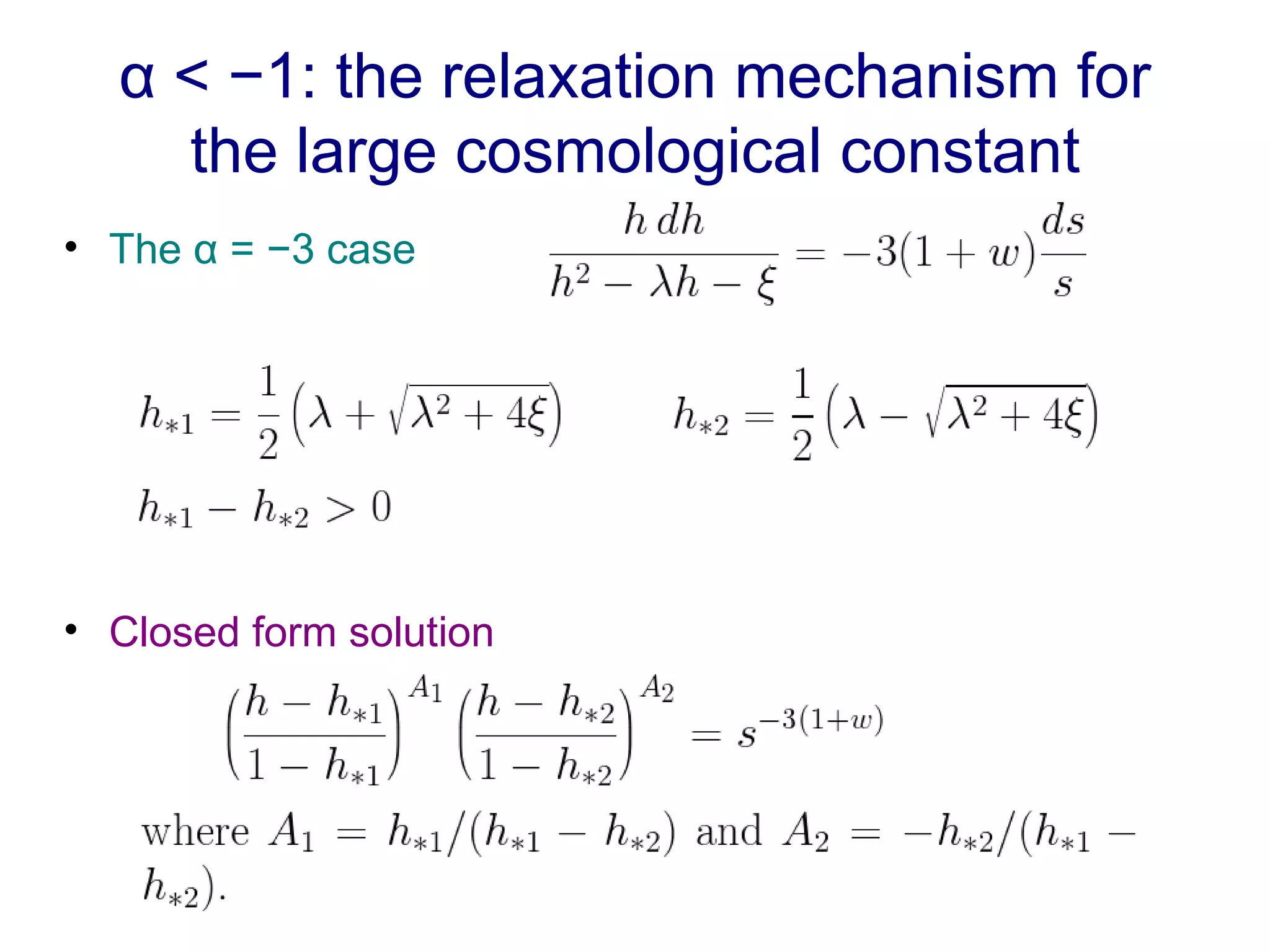
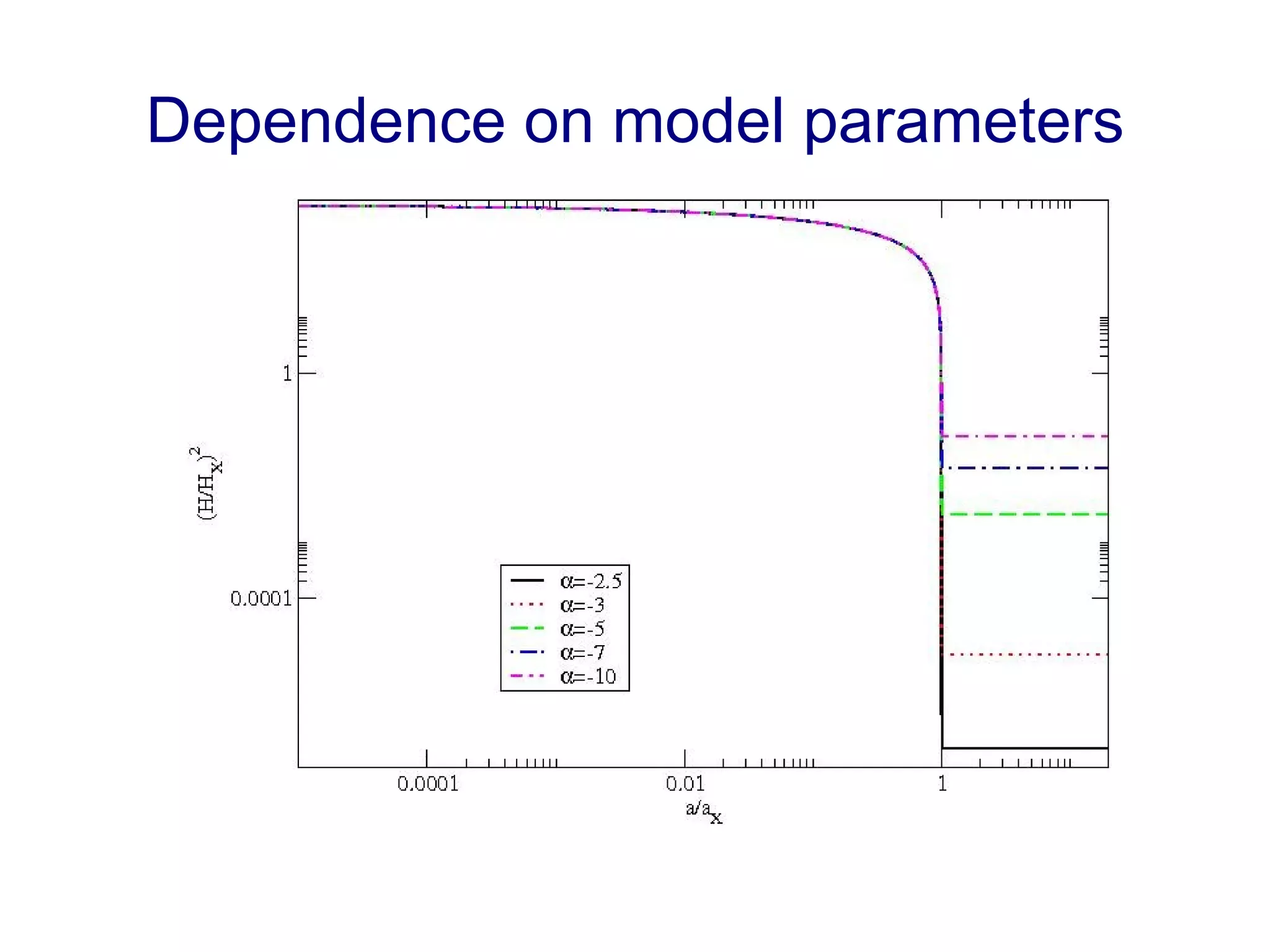
α < −1: the relaxation mechanism for the large cosmological constant The α = −3 case Closed form solution
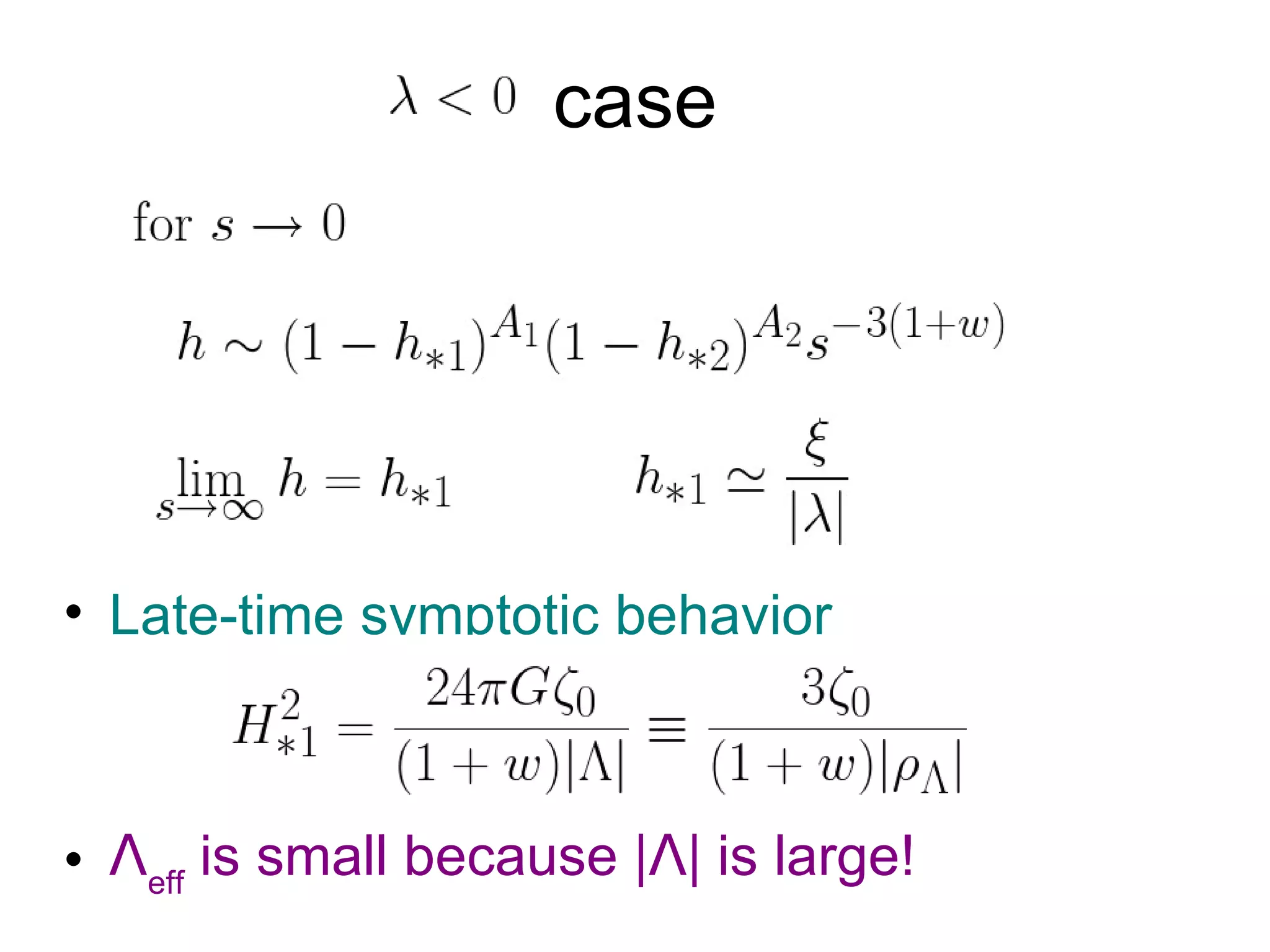
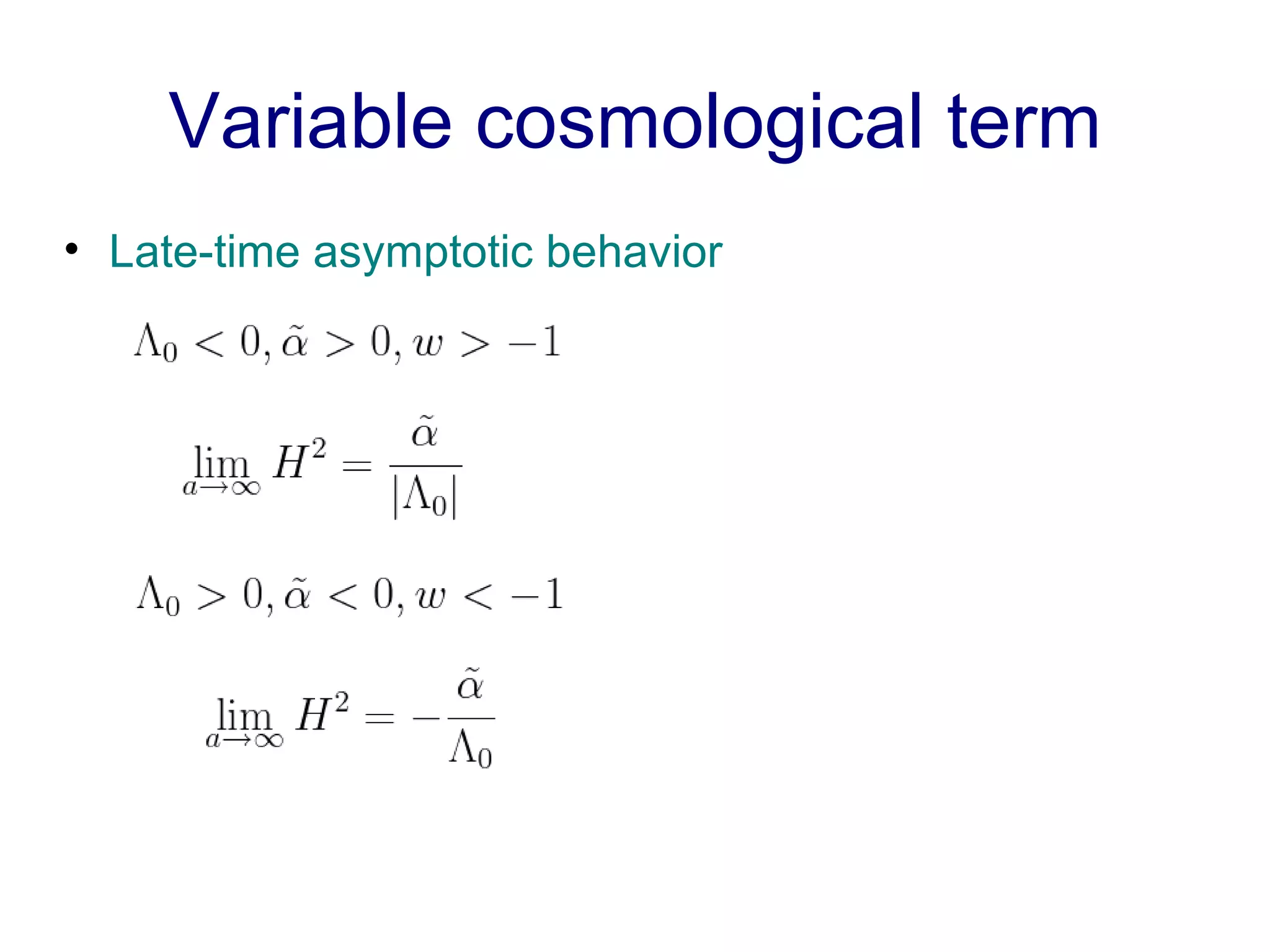
case Late-time symptotic behavior  Ʌ eff  is small because | Ʌ | is large!
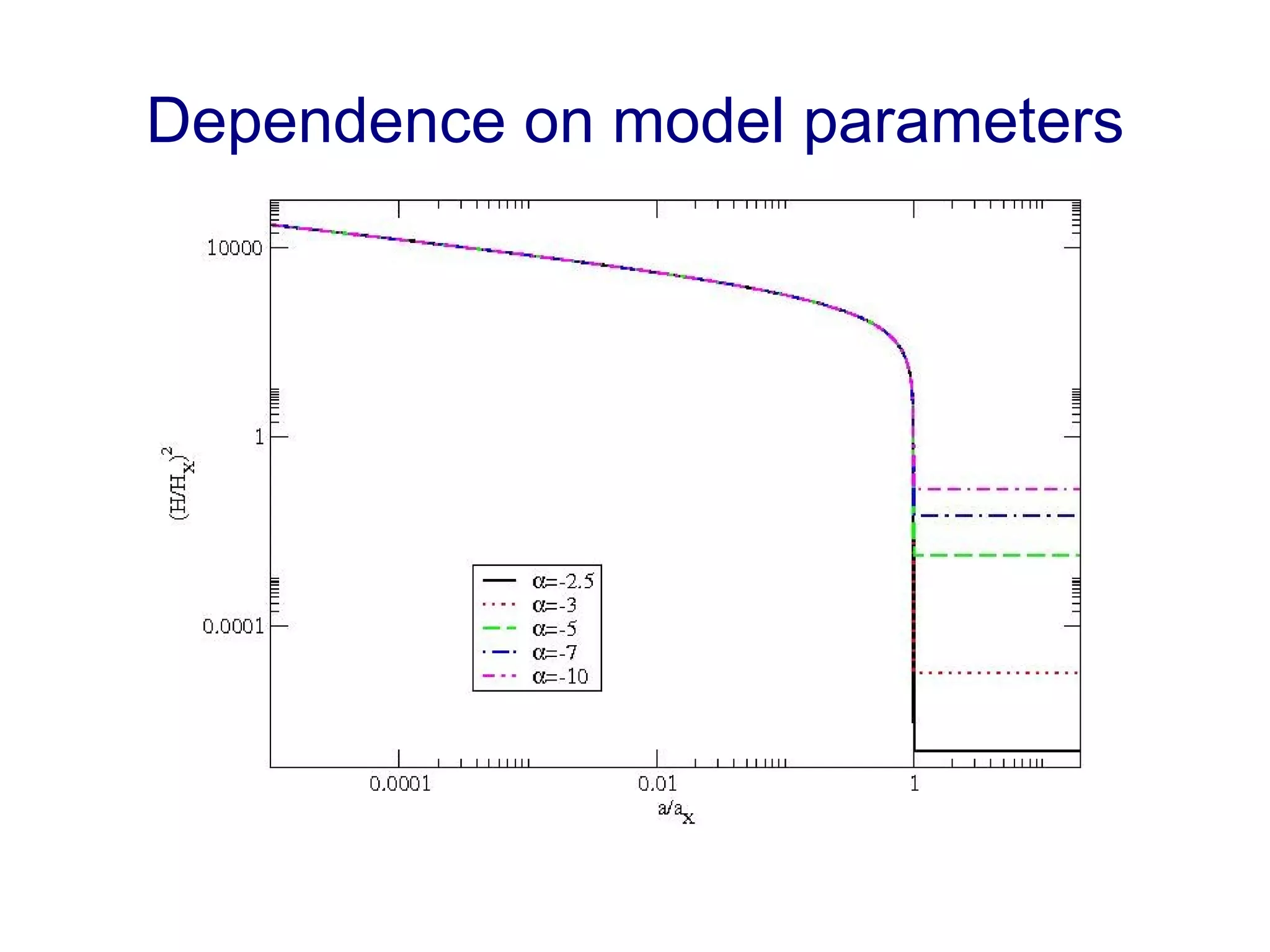
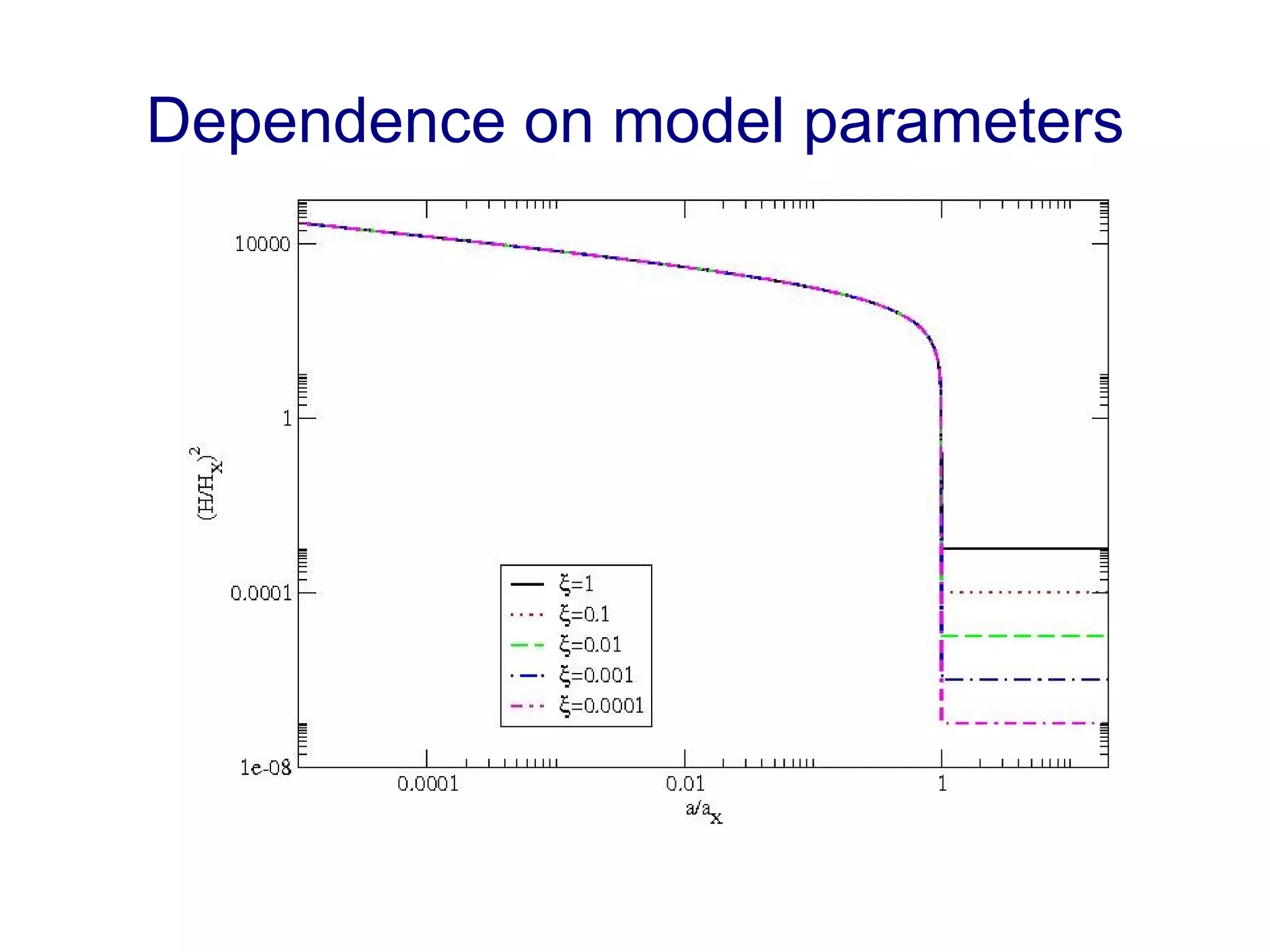
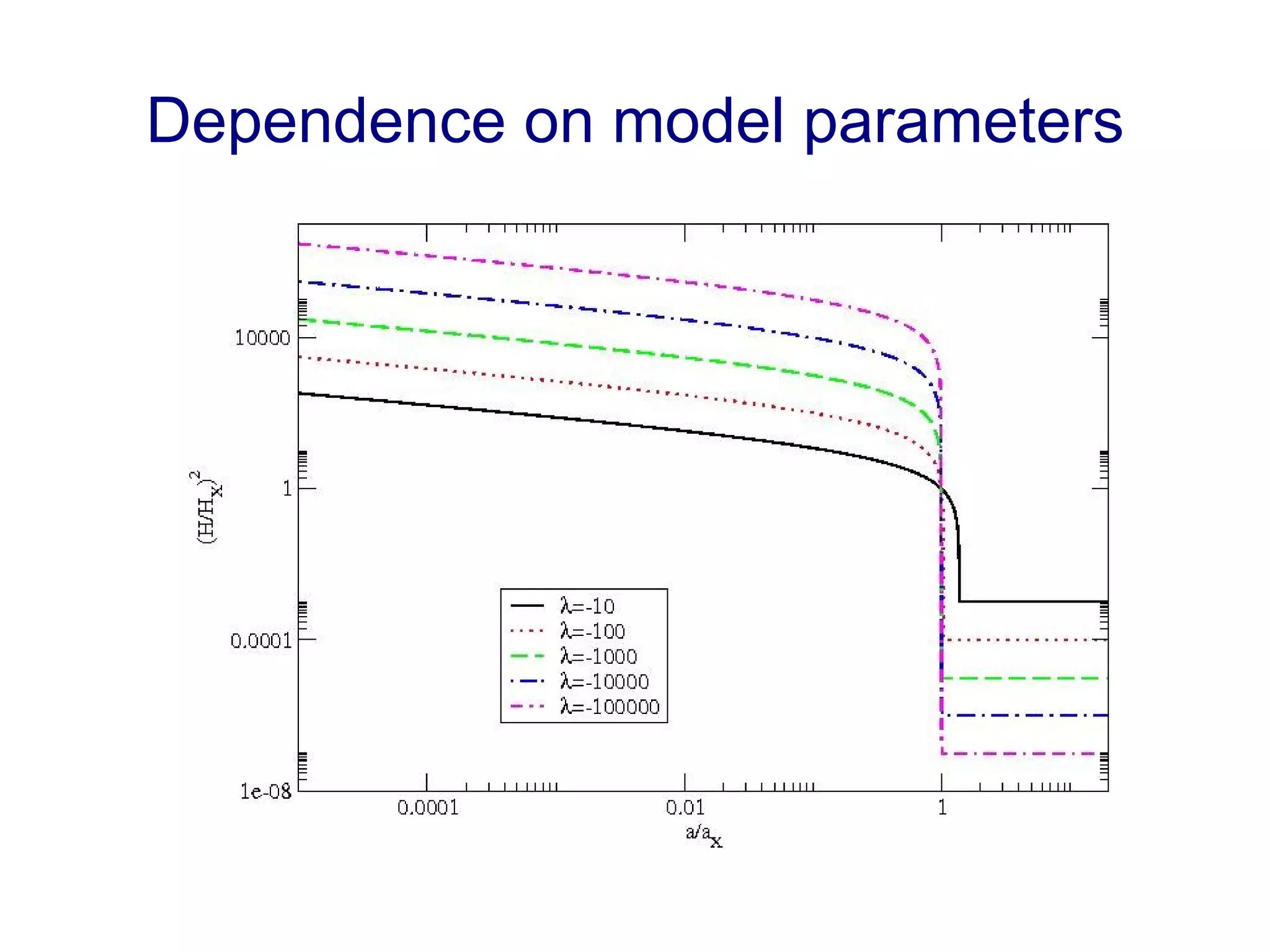
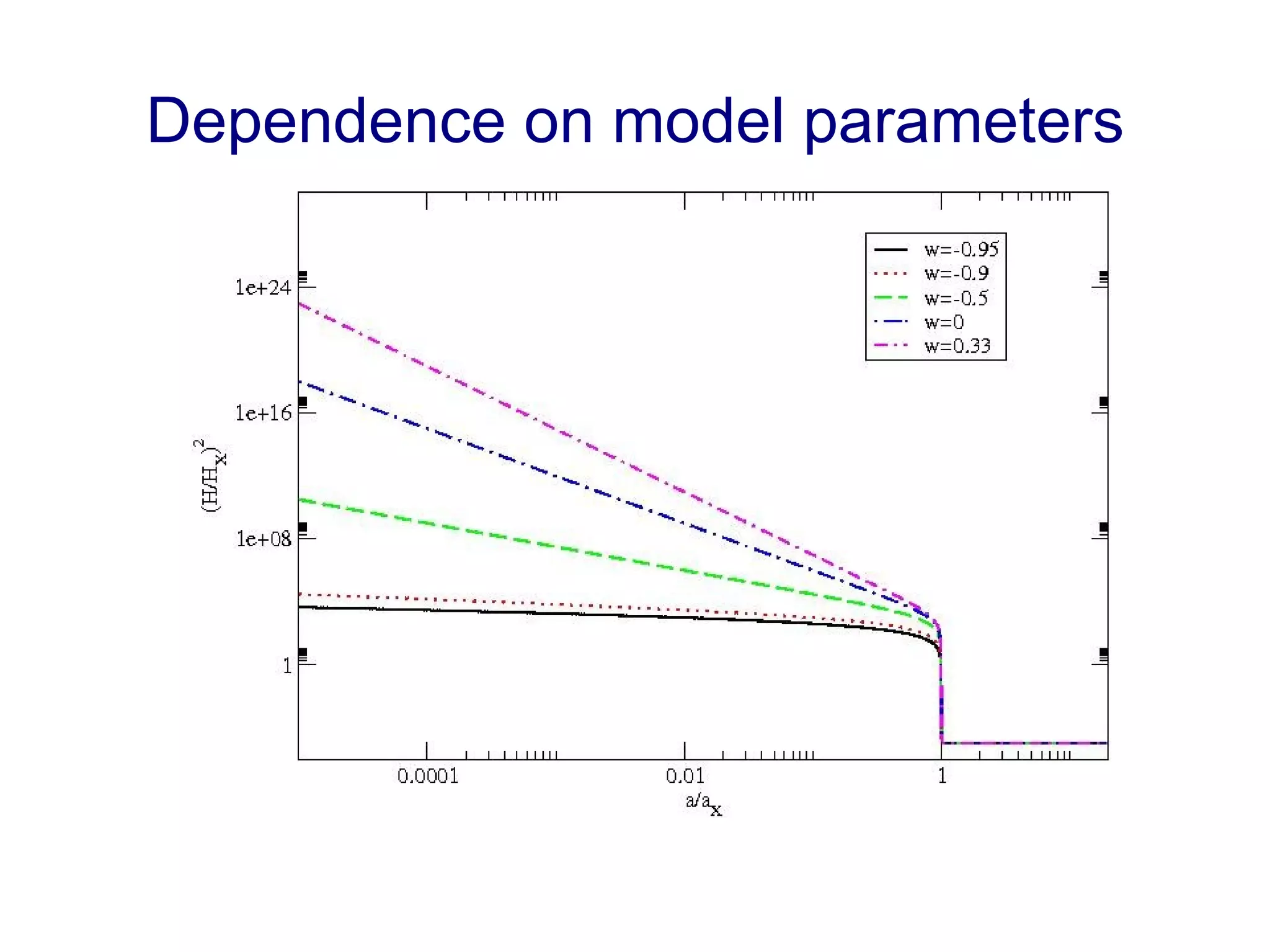
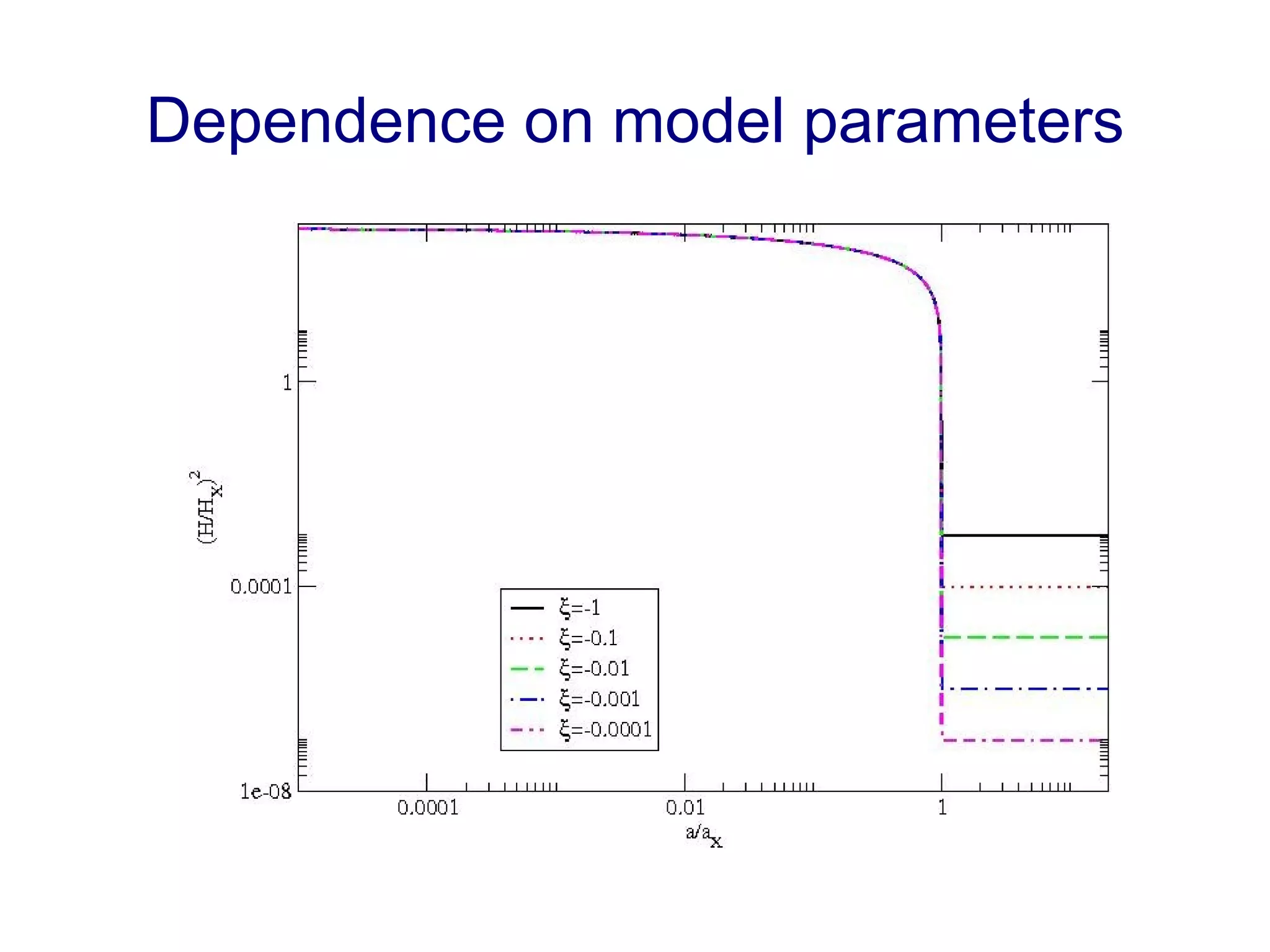
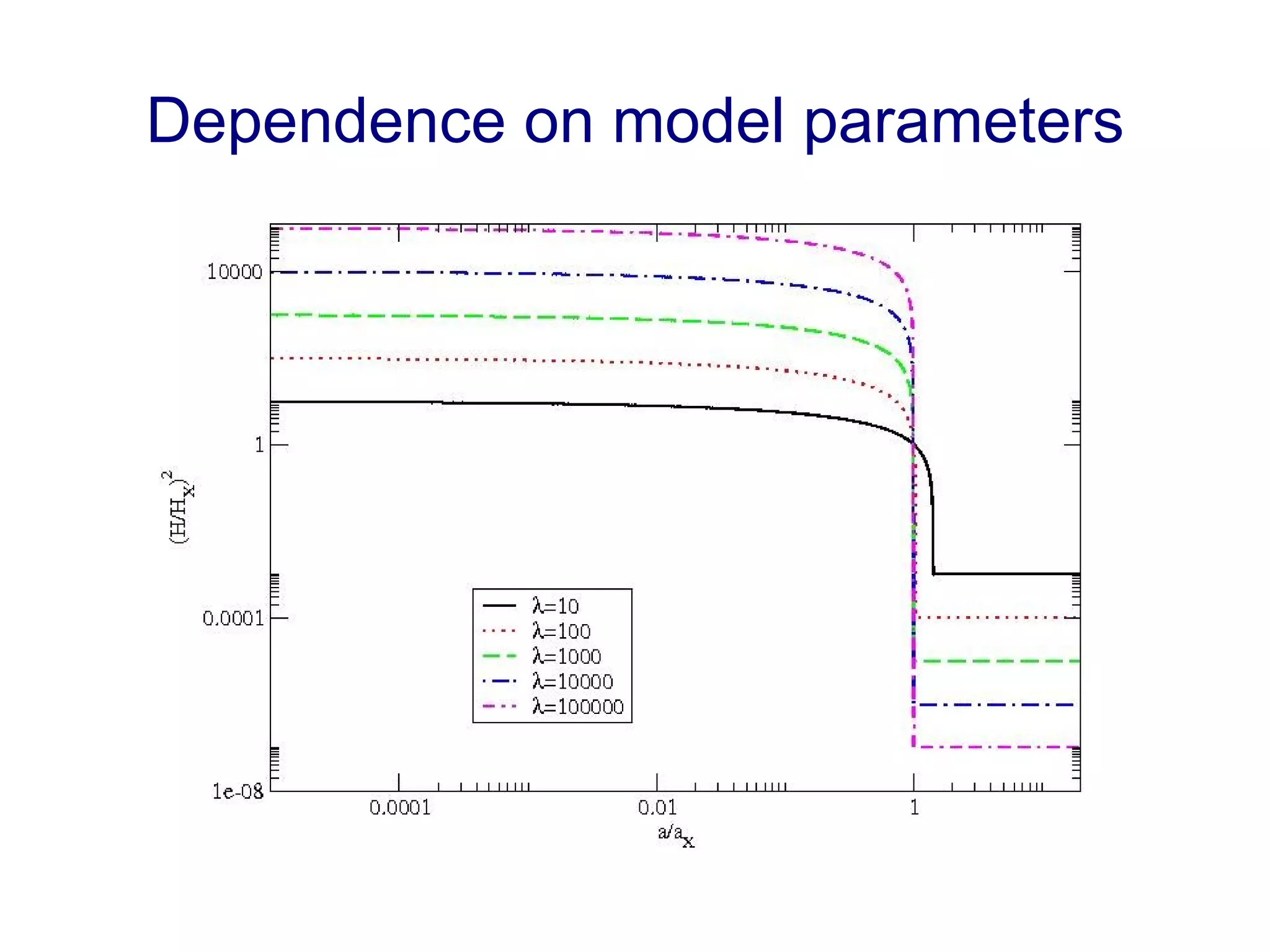
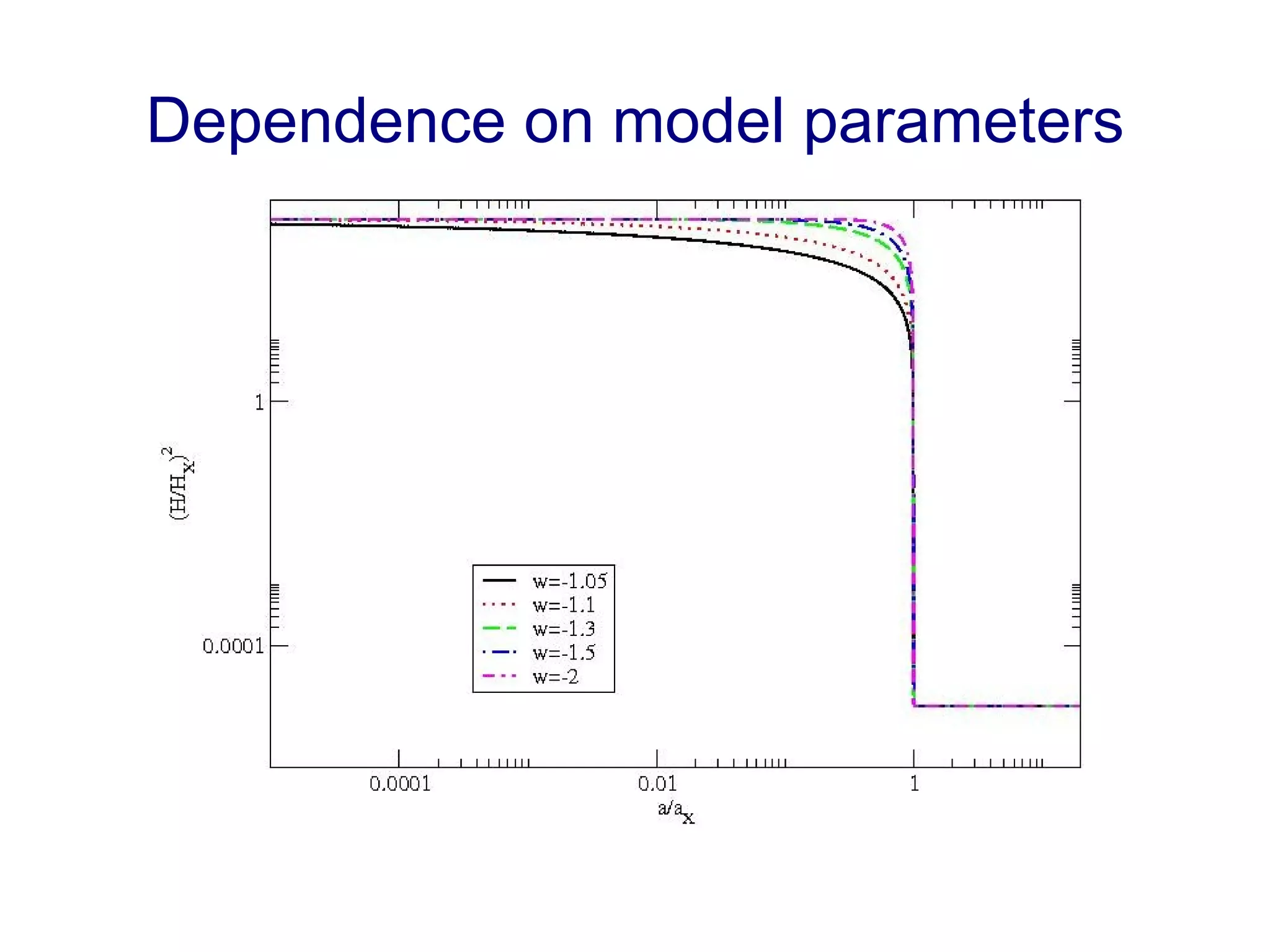
Dependence on model parameters
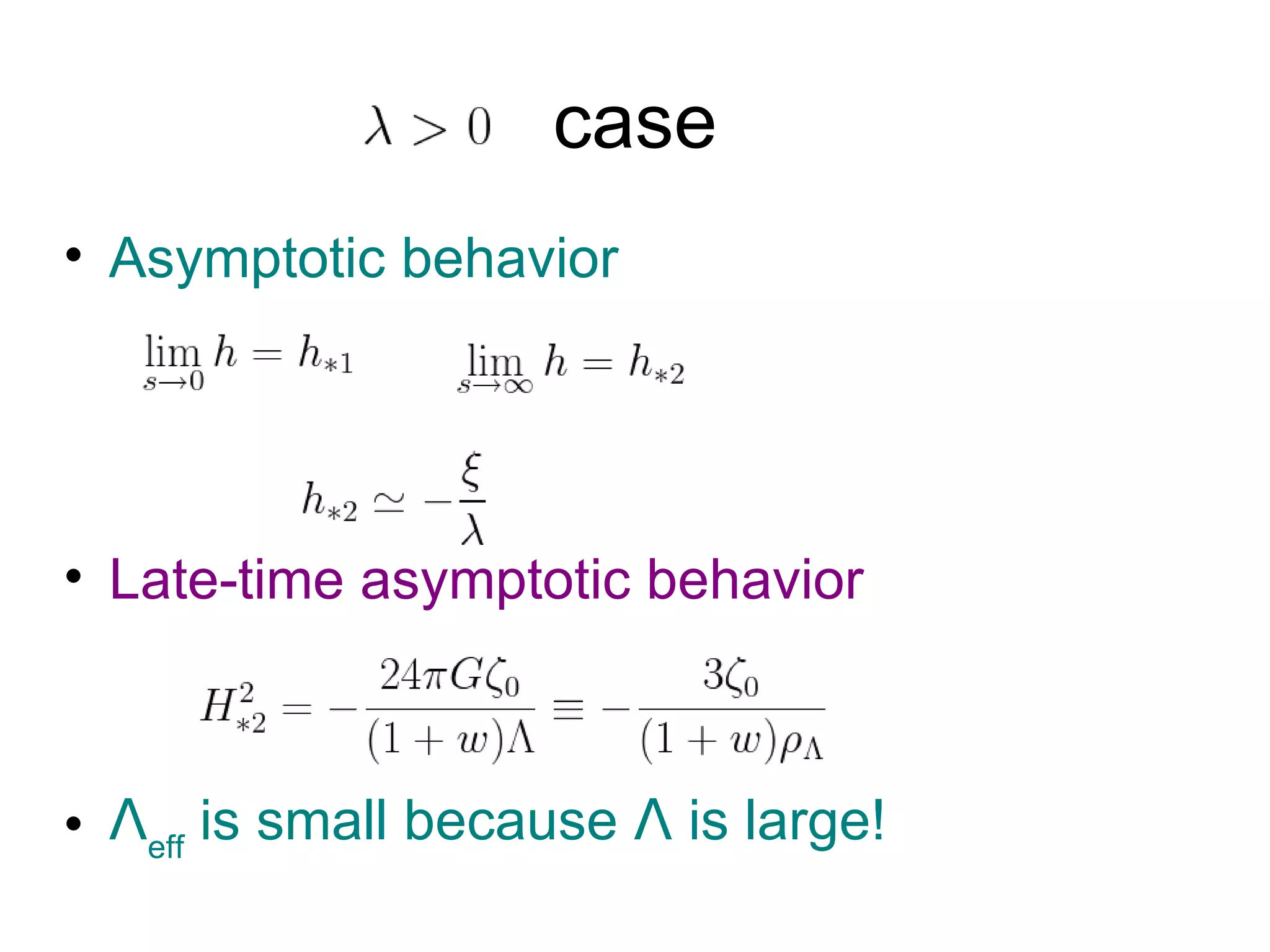
case Asymptotic behavior Late-time asymptotic behavior Ʌ eff  is small because  Ʌ  is large!
Dependence on model parameters
Other parameter regimes For  α > −1 the behavior is different The relaxation mechanism is not automatic
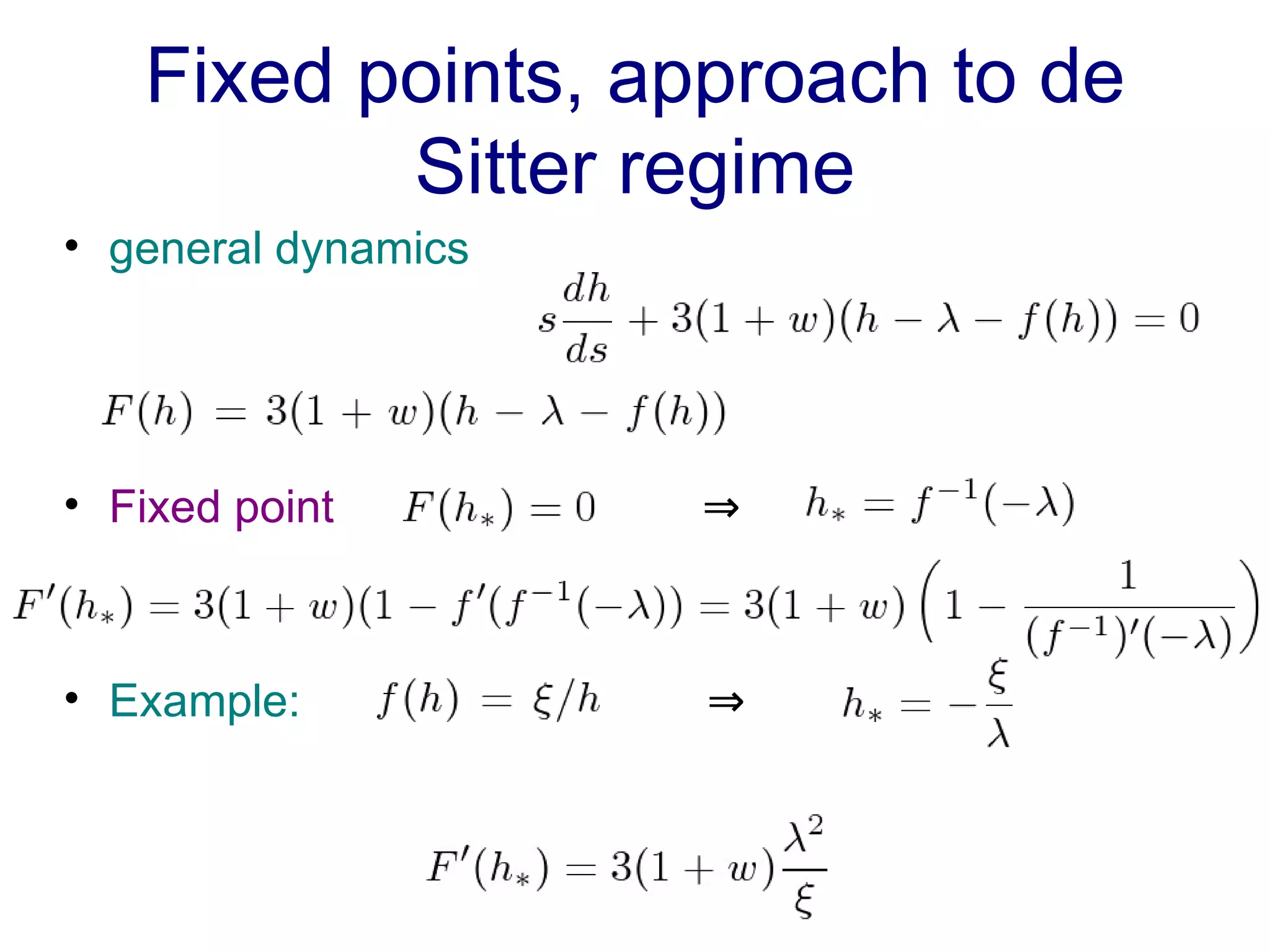
Fixed points, approach to de Sitter regime general dynamics Fixed point  ⇒ Example:   ⇒
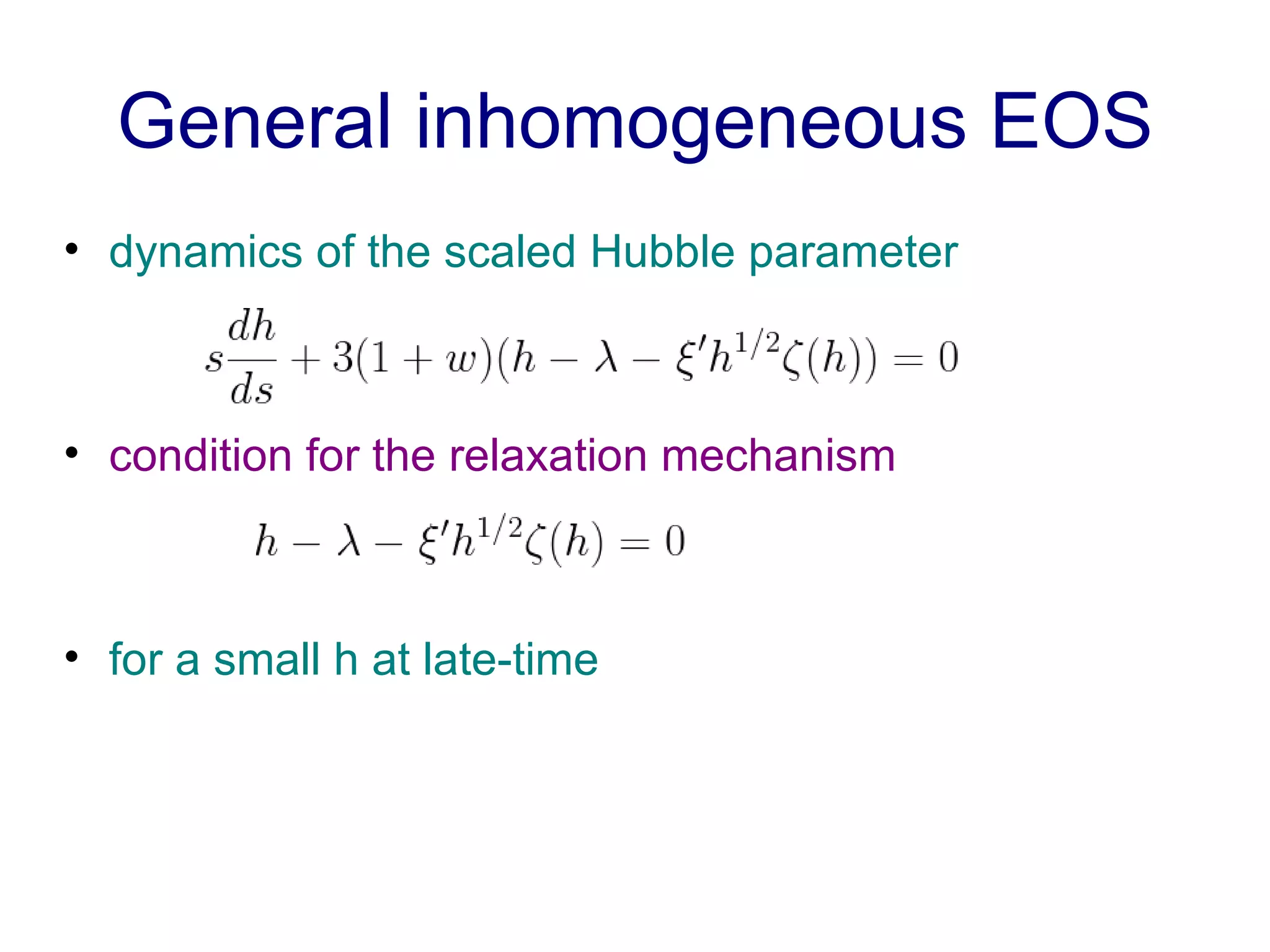
General inhomogeneous EOS dynamics of the scaled Hubble parameter condition for the relaxation mechanism for a small h at late-time
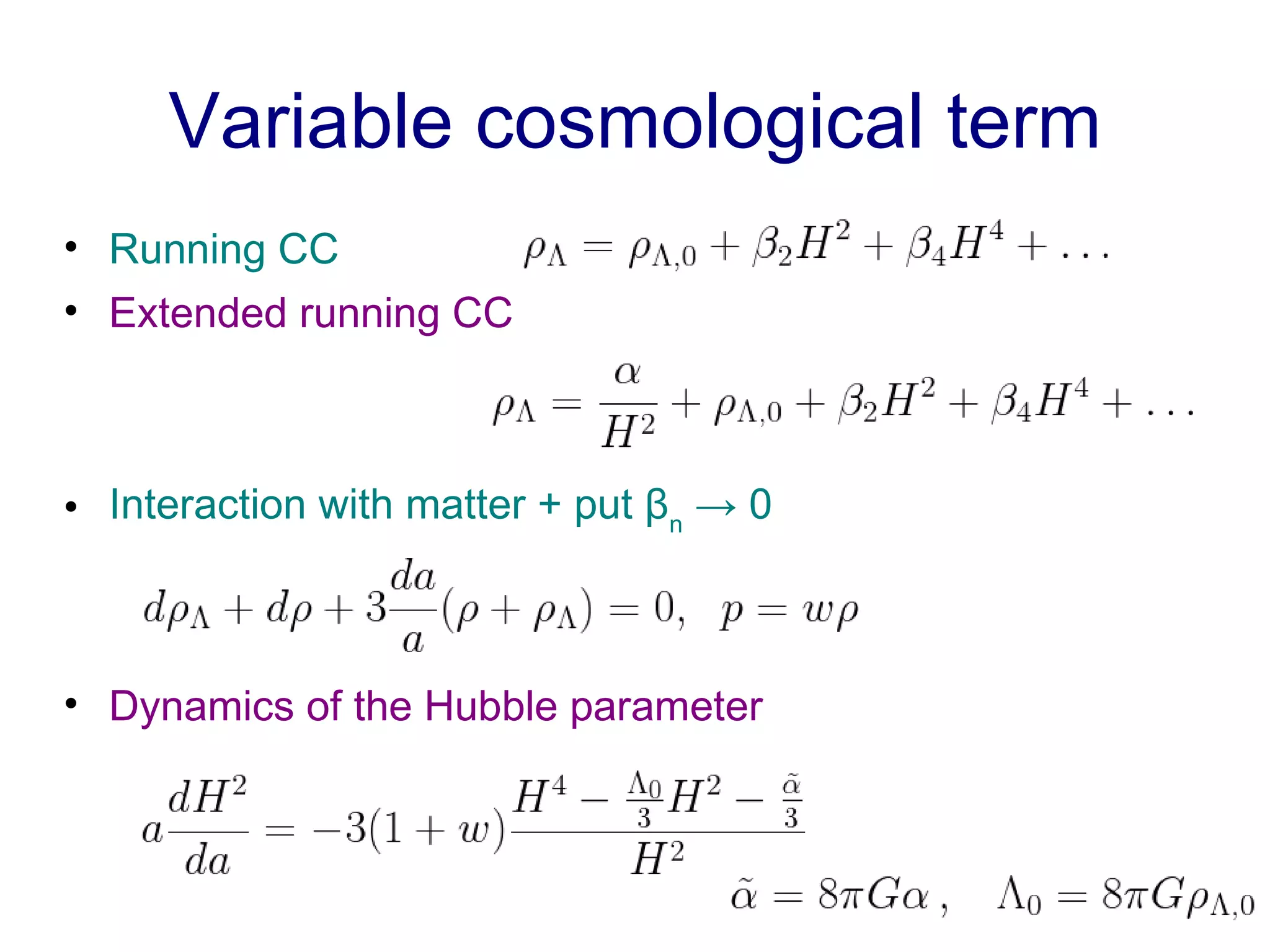
Variable cosmological term Running CC Extended running CC Interaction with matter + put β n  -> 0 Dynamics of the Hubble parameter
Variable cosmological term Late-time asymptotic behavior
f(R) modified gravity general dynamics specific example  asymptotic de Sitter regime n=1
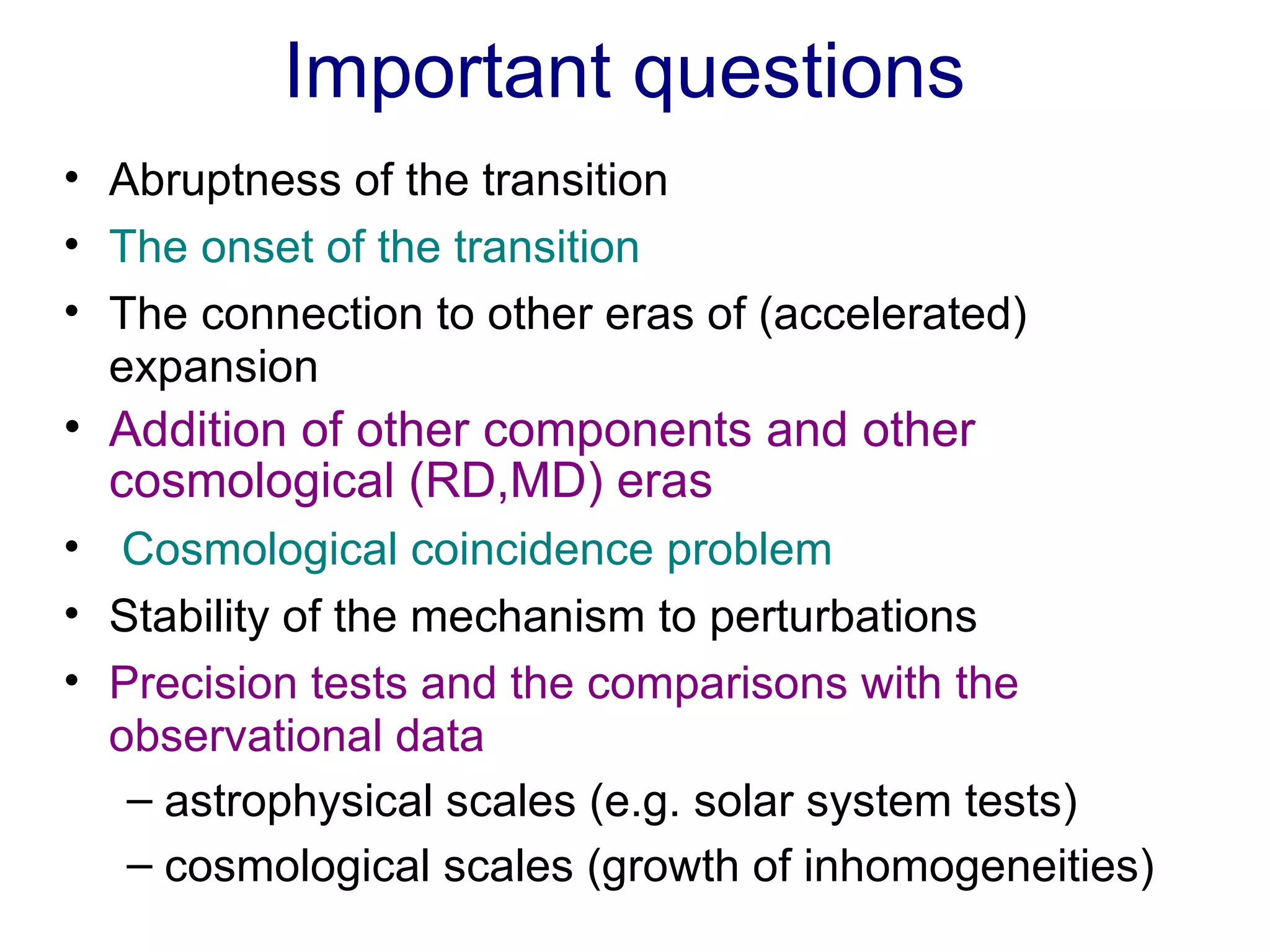
Important questions  Abruptness of the transition The onset of the transition The connection to other eras of (accelerated) expansion Addition of other components and other cosmological (RD,MD) eras Cosmological coincidence problem Stability of the mechanism to perturbations Precision tests and the comparisons with the observational data astrophysical scales (e.g. solar system tests) cosmological scales (growth of inhomogeneities)
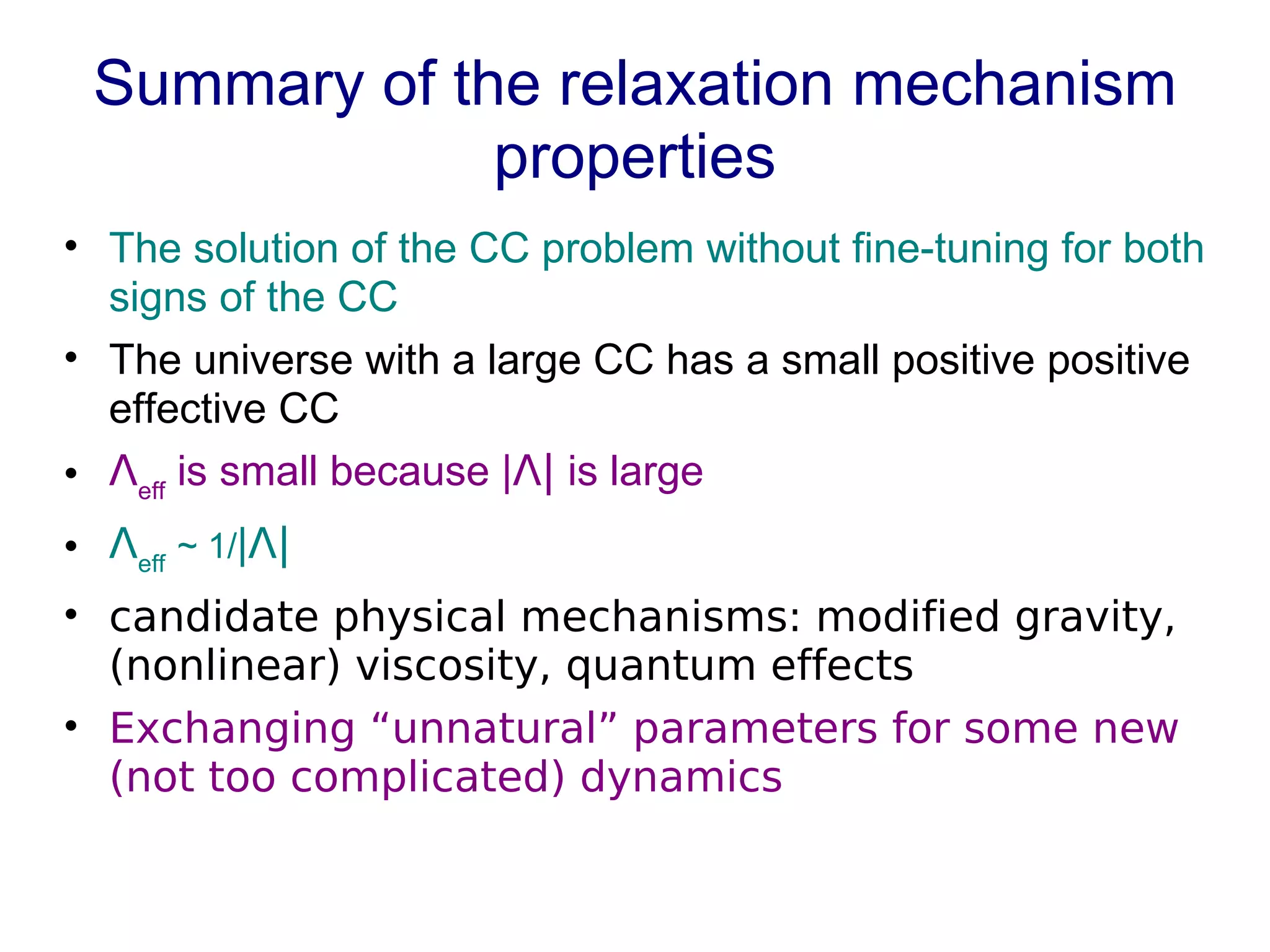
Summary of the relaxation mechanism properties The solution of the CC problem without fine-tuning for both signs of the CC The universe with a large CC has a small positive positive effective CC Ʌ eff  is small because | Ʌ|  is large Ʌ eff   ~ 1/ | Ʌ| candidate physical mechanisms: modified gravity, (nonlinear) viscosity, quantum effects Exchanging “unnatural” parameters for some new (not too complicated) dynamics
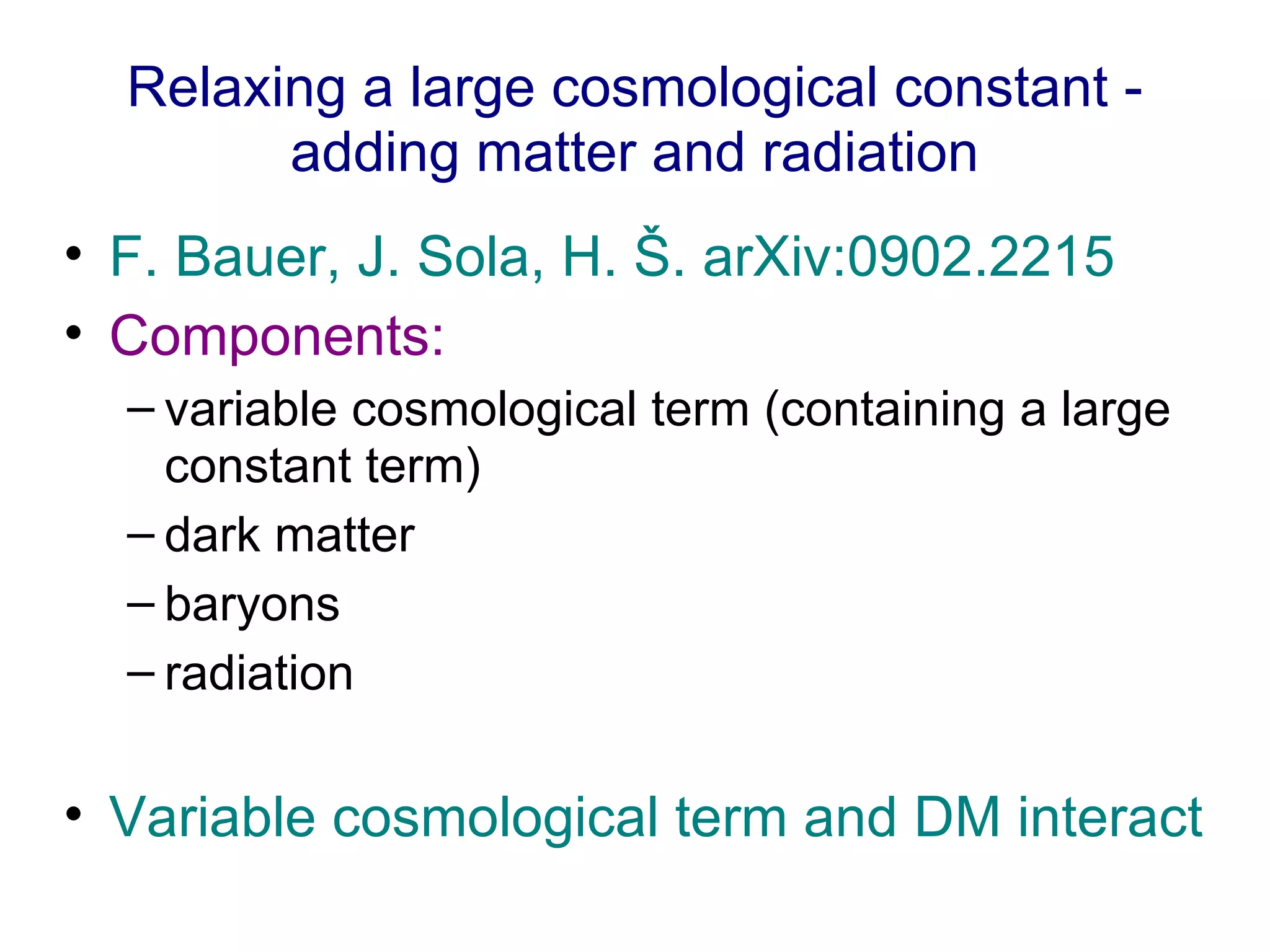
Relaxing a large cosmological constant - adding matter and radiation F. Bauer, J. Sola, H. Š. arXiv:0902.2215  Components: variable cosmological term (containing a large constant term)  dark matter baryons  radiation Variable cosmological term and DM interact
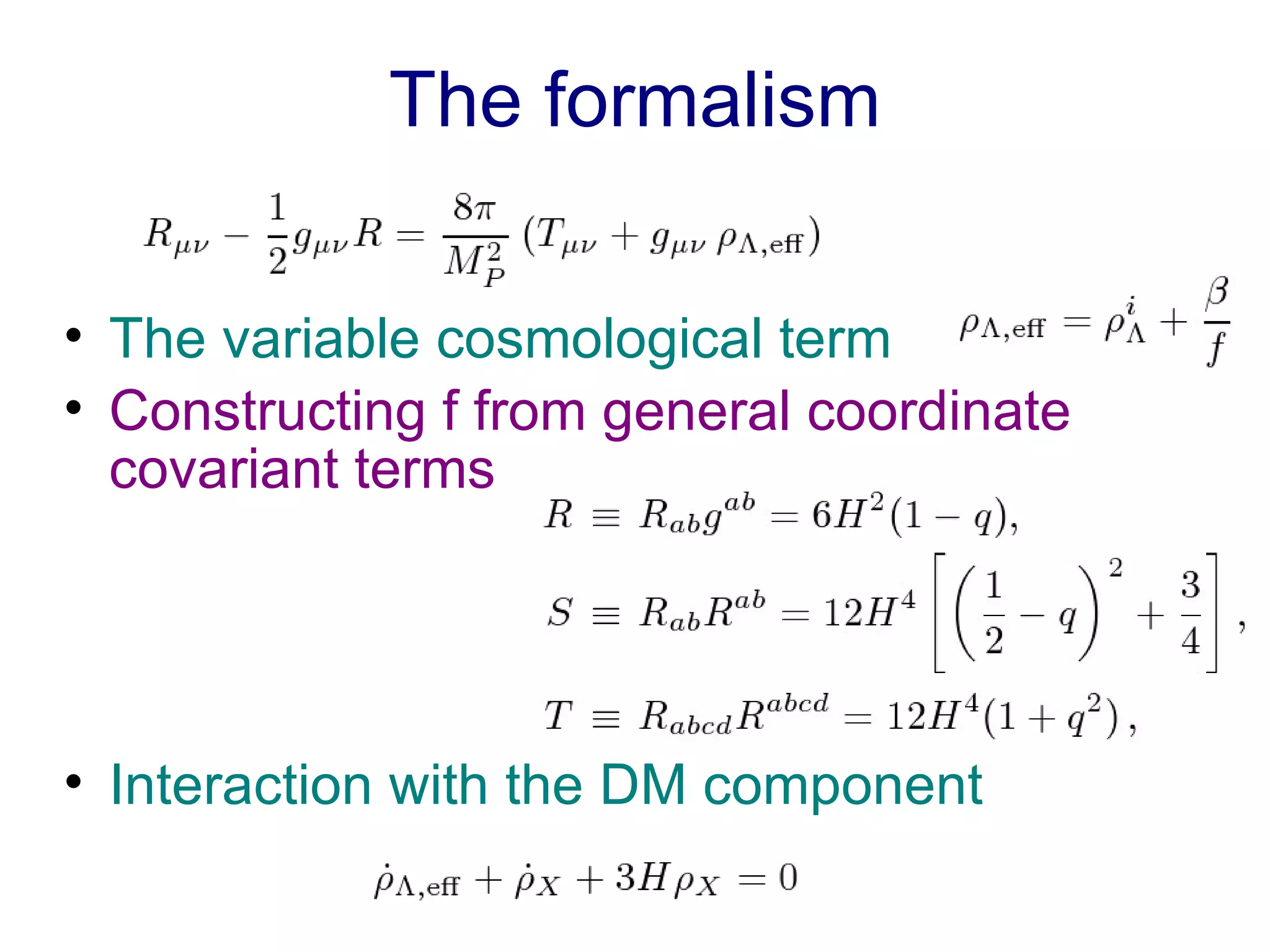
The formalism The variable cosmological term Constructing f from general coordinate  covariant terms   Interaction with the DM component
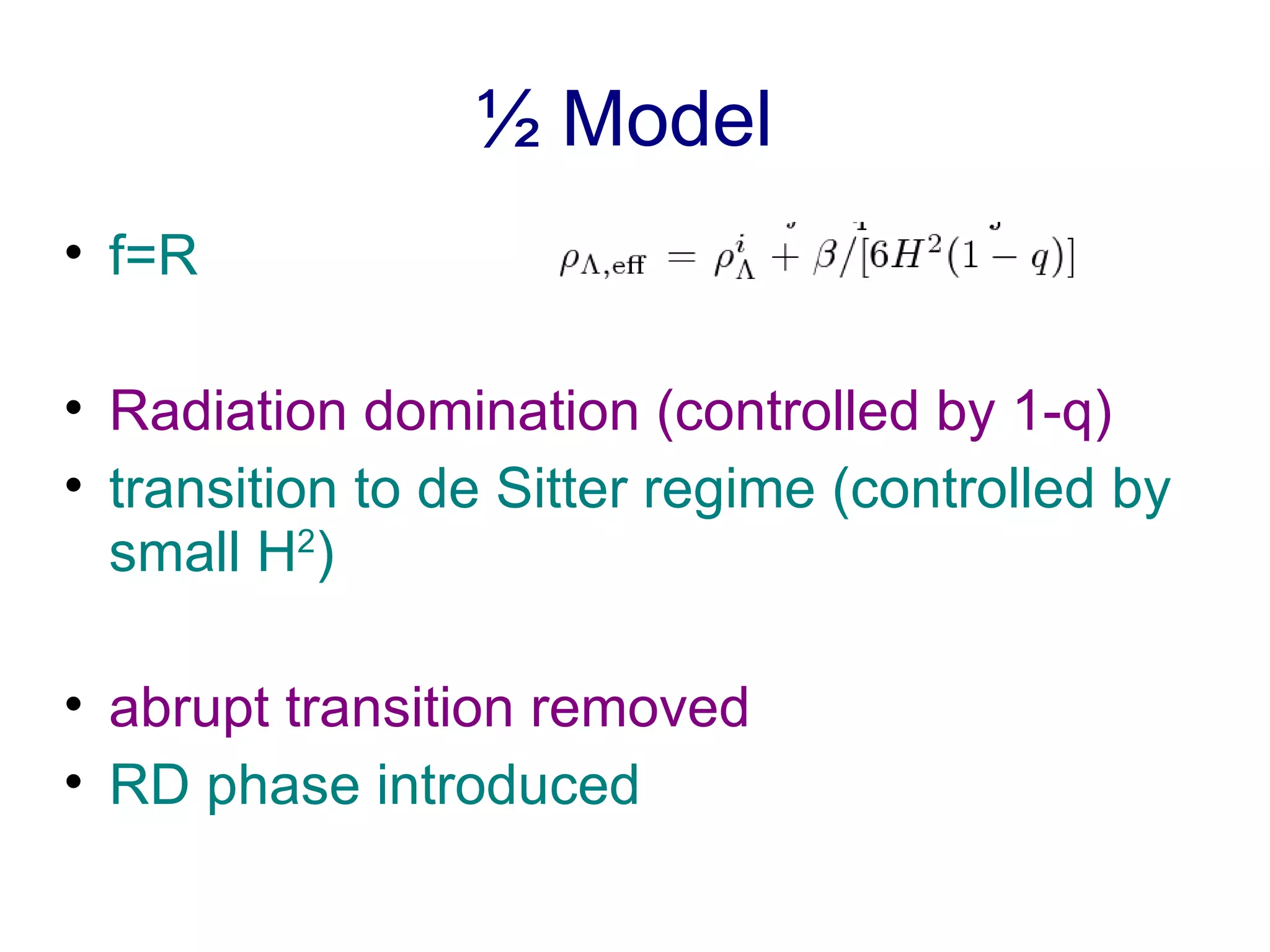
½ Model  f=R Radiation domination (controlled by 1-q) transition to de Sitter regime (controlled by small H 2 ) abrupt transition removed RD phase introduced
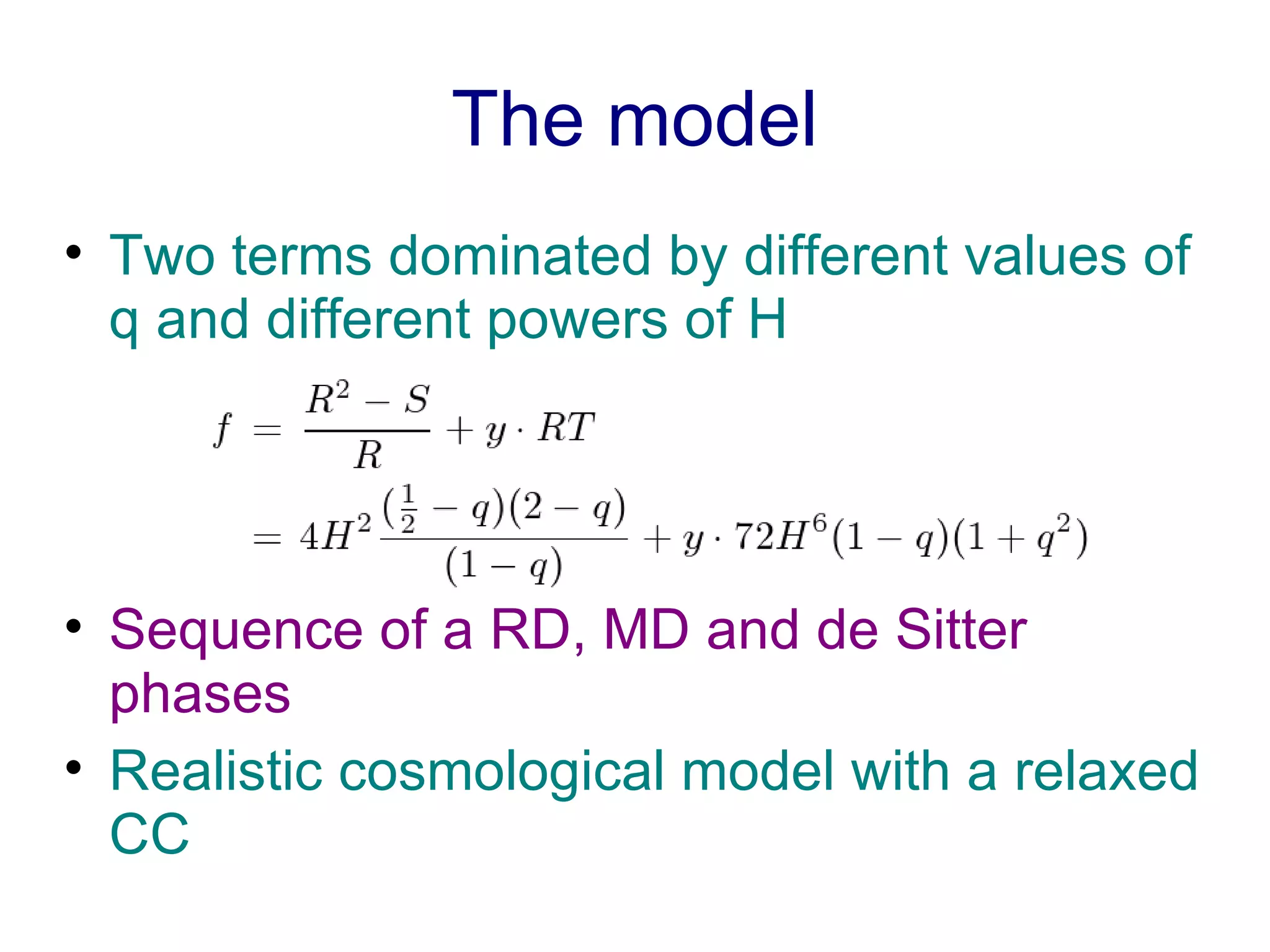
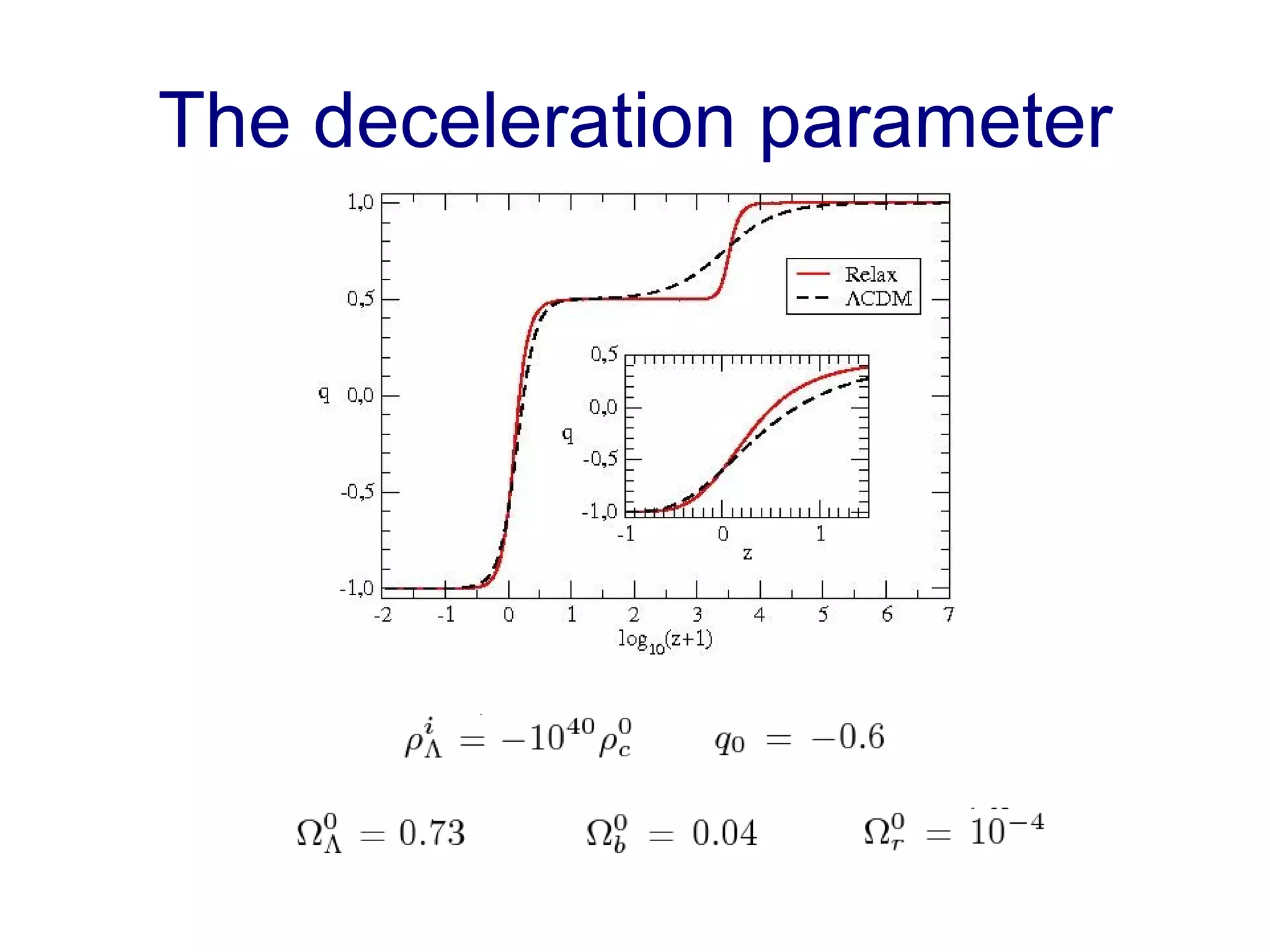
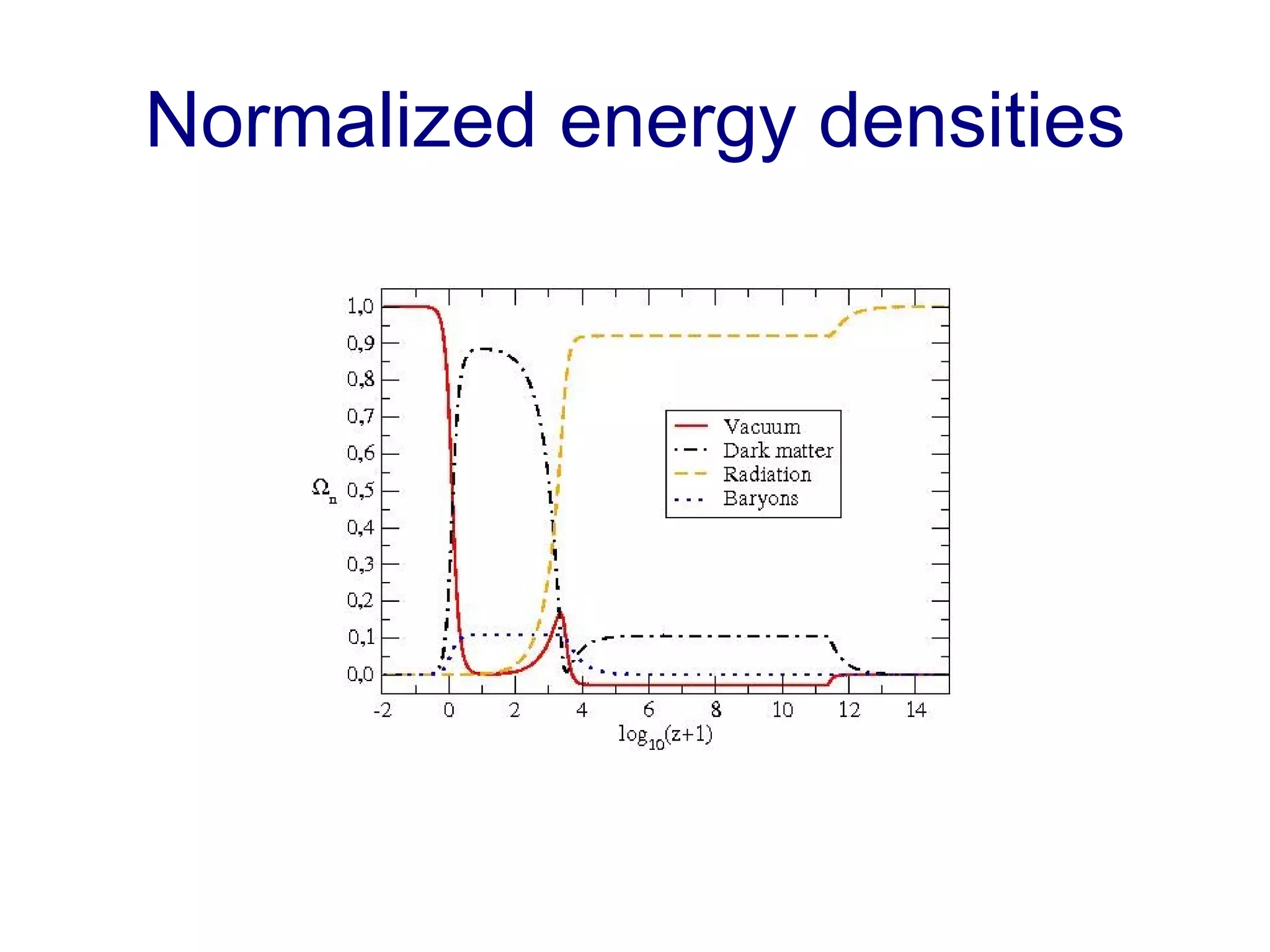
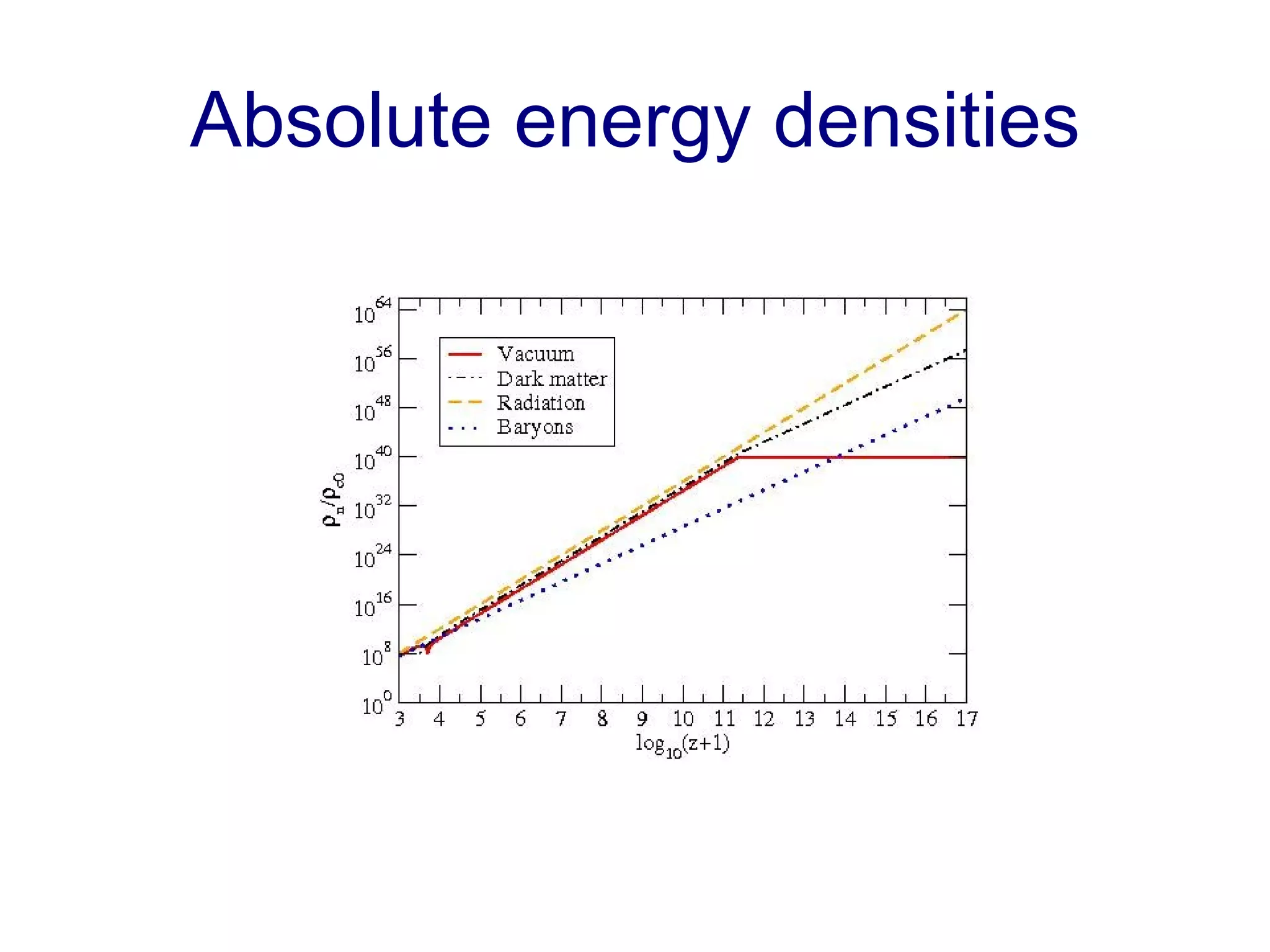
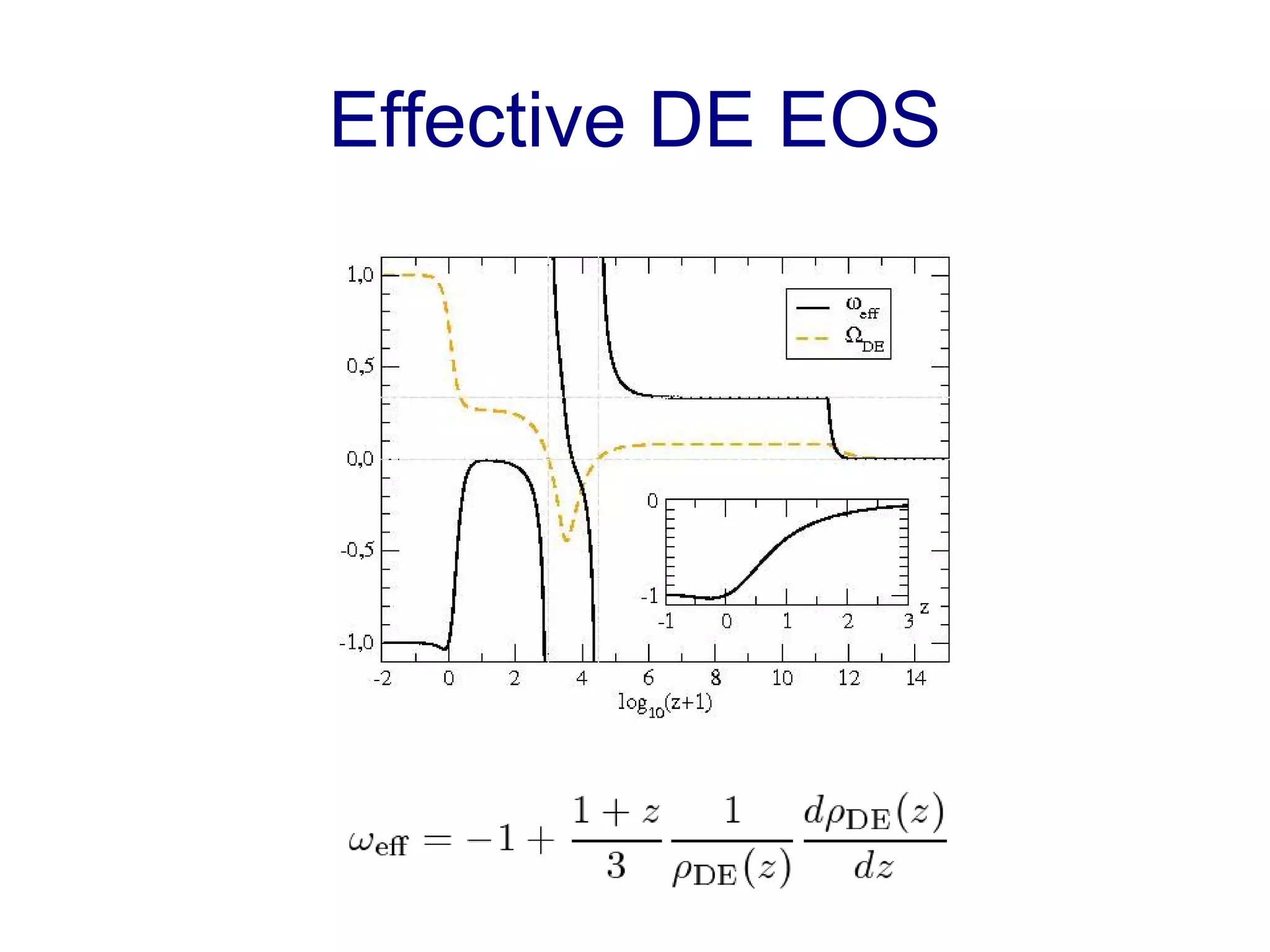
The model Two terms dominated by different values of q and different powers of H Sequence of a RD, MD and de Sitter phases Realistic cosmological model with a relaxed CC
The deceleration parameter
Normalized energy densities
Absolute energy densities
Effective DE EOS
Conclusions The question of the mechanism of the acceleration of the universe still open The cosmological constant problem(s) – many proposed approaches – decisive arguments still to come   The nexus of physics at many very different distance/energy scales Testing ground of the future theoretical, observational and experimental efforts

H. Stefancic: The Accelerated Expansion of the Universe and the Cosmological Constant Problem

  • 1.
    The accelerated expansionof the universe and the cosmological constant problem Spring Summer School on Strings Cosmology and Particles 31 March – 4 April 2009, Belgrade-Niš, Serbia Hrvoje Štefančić, Theoretical Physics Division, Ruđer Bošković Institute, Zagreb, Croatia
  • 2.
    Big issues -observational and theoretical Present accelerated expansion of the universe – observational discovery The cosmological constant (vacuum energy) problem – theoretical challenge
  • 3.
    Our concept ofthe (present) universe Evolution dominated by gravity the interactions governing the evolution of the universe have to have long range to be effective at cosmological distances matter is neutral at cosmological (and much smaller) scales General relativity Known forms of matter (radiation, nonrelativistic matter) Four dimensional universe
  • 4.
    The observed universeIsotropic (CMB, averaged galaxy distribution at scales > 50-100 Mpc) Homogeneous – less evidence (indirect) – Copernican principle Homogeneous and isotropic – Cosmological principle Robertson-Walker metric !
  • 5.
    Expansion of theuniverse Hubble (1929) – dynamical universe Cosmological redshift Standard forms of matter lead to decelerated expansion Inflation – early epoch of the accelerated expansion 1998 – universe accelerated (decelerated universe expected)
  • 6.
    FRW model –theoretical description of the expansion Contents: cosmic fluids (general EOS) General relativity in 4D Friedmann equation Continuity equation (Bianchi identity - covariant conservation of energy-momentum tensor) Acceleration
  • 7.
    FRW model Criticaldensity Omega parameters Cosmic sum rules
  • 8.
    Cosmological observations –mapping the expansion Standard candles (luminosity distance) Supernovae Ia, GRB Standard rulers CMB (cosmic microwave background) BAO (baryonic acoustic oscillations) Others (gravitational lensing...)
  • 9.
    Supernovae of thetype Ia Standard candles – known luminosity Binary stars – physics of SNIa understood Light curve fitting Luminosity distance – can be determined both observationally and theoretically SNIa dimming – signal of the accelerated expansion
  • 10.
    Cosmological observations -SNIa http://imagine.gsfc.nasa.gov/docs/science/know_l2/supernovae.html http://www.astro.uiuc.edu/~pmricker/research/type1a/
  • 11.
    Cosmological observations -CMB http://map.gsfc.nasa.gov/
  • 12.
    Cosmological observations -LSS structure at cosmological scales (LSS) http://cas.sdss.org/dr5/en/tools/places/
  • 13.
    Standard cosmological model(up to 1998) Destiny determined by geometry Interplay of spatial curvature and matter content ( Ω m + Ω k =1 ) Even EdS model advocated ( Ω m =1)
  • 14.
    Spatial curvature COBE– spatial curvature is small. EdS must do the job (models with considerable Ω k are ruled out by the observation of CMB temperature anisotropies
  • 15.
    SNIa observations (1998)Observations by two teams High z SN Search Team, Riess et al., http://cfa-www.harvard.edu/supernova//home.html Supernova Cosmology Project, Perlmutter et al., http://supernova.lbl.gov/ Λ CDM model – fits the data very well Measurement in the redshift range where the expansion of the universe is really accelerated or there is the transition from decelerated to accelerated expansion – “direct measurement”
  • 16.
    CMB and BAOInfluence to the determination of the acceleration – indirectly CMB – mainly through the distance to the surface of last scattering BAO – similarly
  • 17.
    Combining observational dataDegeneracies of cosmic parameters - different combinations of cosmic parameters may produce the same observed phenomena Removal of degeneracies – using different observations at different redshifts (redshift intervals) SNIa + WMAP + BAO – precision cosmology
  • 18.
    Observational constraints tothe DE EOS E. Komatsu et al., Five-Year Wilkinson Microwave Anisotropy Probe (WMAP) Observations: Cosmological Interpretation http://arxiv.org/abs/0803.0547
  • 19.
    Accelerated expansion Ina FRW universe the observed signals strongly favor a presently accelerated expansion of the universe (and reject EdS model) Do we interpret the observational data correctly?
  • 20.
    Classification of theoreticalapproaches ll R. Bean, S. Caroll, M. Trodden, Insights into dark energy: interplay between theory and observation. Rachel Bean ( Cornell U., Astron. Dept. ) , Sean M. Carroll ( Chicago U., EFI & KICP, Chicago ) , Mark Trodden ( Syracuse U. ) . Oct 2005. 5pp. White paper submitted to Dark Energy Task Force. http://arxiv.org/abs/astro-ph/0510059
  • 21.
    Distorted signals andunjustified assumptions? Photons from SNIa convert to axions in the intergalactic magnetic field light signal dissipated Reduction in intensity confused for the effects of acceleration C. Csaki, N. Kaloper, J. Terning, Phys. Rev. Lett. 88 (2002) 161302 does not work (very interesting attempt – invokes more or less standard (or at least already known physics) connection with the phantom “mirage”
  • 22.
    Distorted signals andunjustified assumptions? The influence of inhomogeneities (below 50-100 Mpc) Nonlinearity of GR in its fundamental form Solving Einstein equations in an inhomogeneous universe and averaging the solutions is not equivalent to averaging sources and solving Einsteins equations in a homogeneous universe No additional components (just NR matter) The acceleration is apparent The perceived acceleration begins with the onset of structure formation – very convenient for the cosmic coincidence problem The effect is not sufficient to account for acceleration, but is should be taken into considerations in precise determination of cosmic parameters
  • 23.
    Distorted signals andunjustified assumptions? Inhomogeneities at scales above the Hubble horizon Underdense region Relinquishing the Copernican principle? Falsifiability? No additional components The effect of “super large scale structure”
  • 24.
    Mechanism of theacceleration No acceleration in the “old standard cosmological model” Our (pre)concepts of the universe have to be modified Modifying contents – dark energy (+ DM) Modyfing gravity – modified (dark) gravity Modifying dimensionality – new (large) dimesions – braneworld models ... and combinations
  • 25.
    Dark energy Accelerationby adding a new component – a dark energy component Key property – sufficiently negative pressure Physical realization of a negative pressure? Geometric effect (Lambda from the left side of Einstein eq.) Dynamics of scalar field - domination of potential energy over kinetic energy Corpuscular interpretation – unusual dispersion relation – energy decreasing with the size of momentum
  • 26.
    Dark energy DEequation of state Dynamics of ρ d in terms of a w > -1: quintessence w = -1: cosmological term w < -1: phantom energy Multiple DE components Crossing of the cosmological constant barrier
  • 27.
    Dark sector DEinteracting with other cosmic components Interaction with dark matter Unification of dark matter and dark energy Chaplygin gas EOS scaling with a
  • 28.
    DE models Cosmicfluid Scalar fields (quintessence, phantom) ... Effective description of other acceleration mechanisms (at least at the level of global expansion)
  • 29.
    Λ CDM Benchmarkmodel Only known concepts (CC, NR matter, radiation) small number of parameters The size of Λ not understood – cosmological constant problem(s) Problems with Λ CDM cosmology
  • 30.
    Quintessence Dynamics ofa scalar field in a potential Freezing vs. thawing models “ tracker field” models k-essence (noncanonical kinetic terms)
  • 31.
    Phantom energy Energydensity growing with time Big rip Stability Problems with microscopic formulation Instability to formation of gradients Effective description
  • 32.
    Singularities New typesof singularities Finite time (finite scale factor) singularities Sudden singularities
  • 33.
    Modified gravity Modificationof gravity at cosmological scales Dark gravity (effective dark energy) F(R) gravity – various formulations (metric, Palatini, metric-affine) Conditions for stability Stringent precision tests in Solar system and astrophysical systems
  • 34.
    Braneworlds Matter confinedto a 4D brane Gravity also exists in the bulk Dvali-Gabadadaze-Poratti (DGP) Different DGP models – discussion of the status! Phenomenological modifications of the Friedmann equation – Cardassian expansion
  • 35.
    The cosmological constantFormally allowed – a part of geometry Introduced by Einstein in 1917 – a needed element for a static universe Pauli – first diagnosis of a problem with zero point energies Identification with vacuum energy – Zeldovich 1967 Frequently used “patch”
  • 36.
    The expansion withthe cosmological constant J. Sol à, hep-ph/0101134v2
  • 37.
    The expansion withthe cosmological constant
  • 38.
    Contributions to vacuumenergy Zero point energies – radiative corrections Bosonic Fermionic Condensates – classical contributions Higgs condensate QCD condensates ...
  • 39.
    Zero point energiesQFT estimates real scalar field spin j
  • 40.
    Condensates Phase transitionsleave contributions to the vacuum energy Higgs potential minimum at contribution to vacuum energy
  • 41.
    The size ofthe CC Many disparate contributions Virtually all many orders of magnitude larger than the observed value ZPE - Planck scale “cutoff” ≈ 10 74 GeV 4 ZPE - TeV scale “cutoff” ≈ 10 57 GeV 4 ZPE - Λ QCD scale “cutoff” ≈ 10 -5 GeV 4 Higgs condensate ≈ - 10 8 GeV 4 m electron 4 ≈ 10 -14 GeV 4 The observed value
  • 42.
    The “old” cosmologicalconstant problem – the problem of size Discrepancy by many orders of magnitude (first noticed by Pauli for the ZPE of the electromagnetic field) Huge fine-tuning implied How huge and of which nature Numerical example: 10 120 1 -0.999999999999999999999999999999999999999999999999999999999999999999999999999999999999999999999999999999999999999999999999 = 0.0000000000000000000000000000000000000000000000000000000000000000000000000000000000000000000000000000000000000000000001 Financial example Instability to variation of a single contribution (parameter)
  • 43.
    The “old” cosmologicalconstant problem Fundamental theoretical problem – the problem of the vacuum energy density All proposed solutions assume that the “old” CC problem is somehow solved Λ CDM model – CC relaxed to the observed value DE models and other models – CC is zero or much smaller in absolute value compared to the observed DE energy density Even should the future observations confirm the dynamical nature of DE or some other alternative acceleration mechanism, the “old” CC problem must be resolved
  • 44.
    DE vs CCRaphael Bousso, “TASI lectures on the cosmological constant” “ If a poet sees something that walks like a duck and swims like a duck and quacks like a duck, we will forgive him for entertaining more fanciful possibilities. It could be a unicorn in a duck suit – who's to say! But we know that more likely, it's a duck.” Conditions for a mechanism solving the CC problem
  • 45.
    Proposed solutions ofthe “old” CC problem Classification (closely following S. Nobbenhuis, gr-qc/0609011) Symmetry Back-reaction mechanisms Violation of the equivalence principle Statistical approaches
  • 46.
    Symmetry Supersymmetry Scaleinvariance Conformal symmetry Imaginary space Energy -> - Energy Antipodal symmetry
  • 47.
    Back-reaction mechanisms ScalarGravitons Running CC from Renormalization group Screening caused by trace anomaly
  • 48.
    Violation of theequivalence principle Non-local Gravity, Massive gravitons Ghost condensation Fat gravitons Composite gravitons as Goldstone bosons
  • 49.
    Statistical approaches Hawkingstatistics Wormholes Anthropic Principle
  • 50.
    The cosmic coincidenceproblem – the problem of timing Why the CC (DE) energy density and the energy density of (NR) matter are comparable (of the same order of magnitude) at the present epoch? A problem in a DE (CC) approach to the problem of accelerated expansion: DE (CC) energy density scale very differently with the expansion (if presently comparable they were very different in the past and will be very different in the future NR: ρ ~ a -3 DE: ρ ~ a -3(1+w) , slower than a -2 , CC: ~ 1 Also present in many approaches not based on DE
  • 51.
    Possible solutions ofthe cosmic coincidence problem Naturally solved in (matter) back-reaction approaches “ tracker field” Oscillating DE model DE-DM interaction models (although problem still present in e.g. Chaplygin gas model) Composite DE model (LambdaXCDM model) Two interacting DE components: a (dynamical) cosmological term and an additional DE component (cosmon X) … .
  • 52.
    Composite dark energy– Λ XCDM models ordinary matter (radiation and NR matter) separately conserved) Λ XCDM 1 : CT interacting with cosmon J. Grande, J. Sol à , H. Š., JCAP 0608 (2006) 011. Λ XCDM 2 : varaible CT i G, X concerved J. Grande, J. Sol à , H. Š., Phys. Lett . B645 (2007) 236.
  • 53.
    Ratio of DEand matter energy density
  • 54.
    Parameter constraints primordialnucelosynthesis: Existence of a stopping point height of the maximum of r :
  • 55.
  • 56.
    The CC relaxationmechansim Two component model (H.Š. Phys.Lett. B 670 (2009) 246) The inhomogeneous equation of state (S. Nojiri, S.D. Odintsov, Phys. Rev. D 72 (2005) 023003) The continuity equation
  • 57.
    The model dynamicsThe dynamics of the Hubble parameter Notation Dynamics in terms of dimensionless parameters with the initial condition H X and a X in principle arbitrary
  • 58.
    α < −1:the relaxation mechanism for the large cosmological constant The α = −3 case Closed form solution
  • 59.
    case Late-time symptoticbehavior Ʌ eff is small because | Ʌ | is large!
  • 60.
  • 61.
  • 62.
  • 63.
  • 64.
    case Asymptotic behaviorLate-time asymptotic behavior Ʌ eff is small because Ʌ is large!
  • 65.
  • 66.
  • 67.
  • 68.
  • 69.
    Other parameter regimesFor α > −1 the behavior is different The relaxation mechanism is not automatic
  • 70.
    Fixed points, approachto de Sitter regime general dynamics Fixed point ⇒ Example: ⇒
  • 71.
    General inhomogeneous EOSdynamics of the scaled Hubble parameter condition for the relaxation mechanism for a small h at late-time
  • 72.
    Variable cosmological termRunning CC Extended running CC Interaction with matter + put β n -> 0 Dynamics of the Hubble parameter
  • 73.
    Variable cosmological termLate-time asymptotic behavior
  • 74.
    f(R) modified gravitygeneral dynamics specific example asymptotic de Sitter regime n=1
  • 75.
    Important questions Abruptness of the transition The onset of the transition The connection to other eras of (accelerated) expansion Addition of other components and other cosmological (RD,MD) eras Cosmological coincidence problem Stability of the mechanism to perturbations Precision tests and the comparisons with the observational data astrophysical scales (e.g. solar system tests) cosmological scales (growth of inhomogeneities)
  • 76.
    Summary of therelaxation mechanism properties The solution of the CC problem without fine-tuning for both signs of the CC The universe with a large CC has a small positive positive effective CC Ʌ eff is small because | Ʌ| is large Ʌ eff ~ 1/ | Ʌ| candidate physical mechanisms: modified gravity, (nonlinear) viscosity, quantum effects Exchanging “unnatural” parameters for some new (not too complicated) dynamics
  • 77.
    Relaxing a largecosmological constant - adding matter and radiation F. Bauer, J. Sola, H. Š. arXiv:0902.2215 Components: variable cosmological term (containing a large constant term) dark matter baryons radiation Variable cosmological term and DM interact
  • 78.
    The formalism Thevariable cosmological term Constructing f from general coordinate covariant terms Interaction with the DM component
  • 79.
    ½ Model f=R Radiation domination (controlled by 1-q) transition to de Sitter regime (controlled by small H 2 ) abrupt transition removed RD phase introduced
  • 80.
    The model Twoterms dominated by different values of q and different powers of H Sequence of a RD, MD and de Sitter phases Realistic cosmological model with a relaxed CC
  • 81.
  • 82.
  • 83.
  • 84.
  • 85.
    Conclusions The questionof the mechanism of the acceleration of the universe still open The cosmological constant problem(s) – many proposed approaches – decisive arguments still to come The nexus of physics at many very different distance/energy scales Testing ground of the future theoretical, observational and experimental efforts