1
What is the Dark Energy?
David Spergel
Princeton University
2
One of the most challenging
problems in Physics
 Several cosmological observations demonstrated
that the expansion of the universe is accelerating
 What is causing this acceleration?
 How can we learn more about this acceleration,
the Dark Energy it implies, and the questions it
raises?
3
Outline
 A brief summary on the contents of the universe
 Evidence for the acceleration and the implied Dark Energy
 Supernovae type Ia observations (SNe Ia)
 Cosmic Microwave Background Radiation (CMB)
 Large-scale structure (LSS) (clusters of galaxies)
 What is the Dark Energy?
 Future Measurements
4
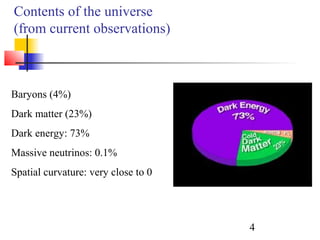
Contents of the universe
(from current observations)
Baryons (4%)
Dark matter (23%)
Dark energy: 73%
Massive neutrinos: 0.1%
Spatial curvature: very close to 0
5
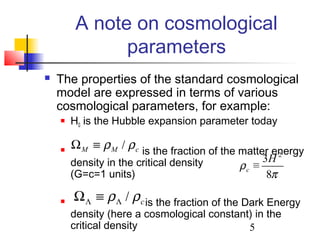
A note on cosmological
parameters
 The properties of the standard cosmological
model are expressed in terms of various
cosmological parameters, for example:
 H0 is the Hubble expansion parameter today
 is the fraction of the matter energy
density in the critical density
(G=c=1 units)
 is the fraction of the Dark Energy
density (here a cosmological constant) in the
critical density
cMM ρρ /≡Ω
π
ρ
8
3 2
H
c ≡
cρρ /ΛΛ ≡Ω
6
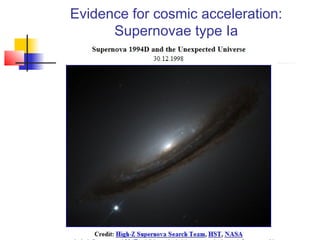
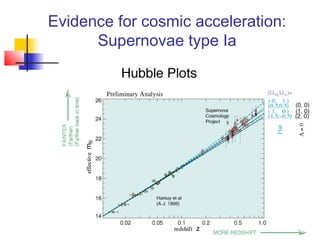
Evidence for cosmic acceleration:
Supernovae type Ia
7
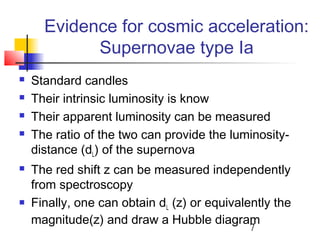
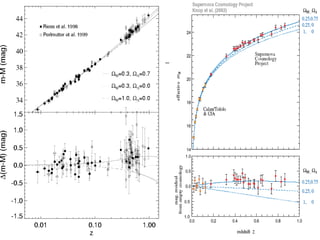
Evidence for cosmic acceleration:
Supernovae type Ia
 Standard candles
 Their intrinsic luminosity is know
 Their apparent luminosity can be measured
 The ratio of the two can provide the luminosity-
distance (dL) of the supernova
 The red shift z can be measured independently
from spectroscopy
 Finally, one can obtain dL (z) or equivalently the
magnitude(z) and draw a Hubble diagram
8
Evidence for cosmic acceleration:
Supernovae type Ia
9
10
Evidence from Cosmic Microwave
Background Radiation (CMB)
 CMB is an almost isotropic relic radiation of
T=2.725±0.002 K
 CMB is a strong pillar of the Big Bang
cosmology
 It is a powerful tool to use in order to
constrain several cosmological parameters
 The CMB power spectrum is sensitive to
several cosmological parameters
11
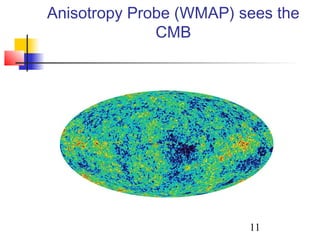
Anisotropy Probe (WMAP) sees the
CMB
12
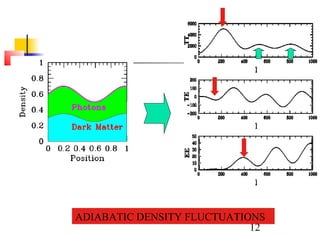
ADIABATIC DENSITY FLUCTUATIONS
13
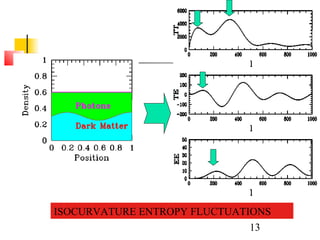
ISOCURVATURE ENTROPY FLUCTUATIONS
14
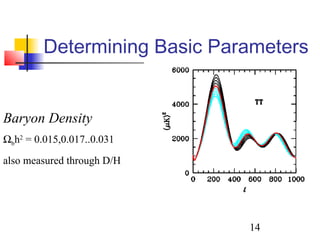
Determining Basic Parameters
Baryon Density
Ωbh2
= 0.015,0.017..0.031
also measured through D/H
15
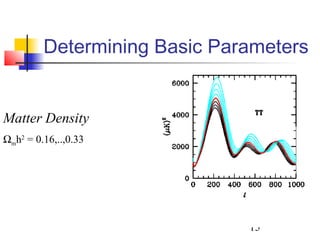
Determining Basic Parameters
Matter Density
Ωmh2
= 0.16,..,0.33
16
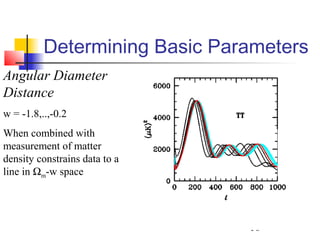
Determining Basic Parameters
Angular Diameter
Distance
w = -1.8,..,-0.2
When combined with
measurement of matter
density constrains data to a
line in Ωm-w space
17
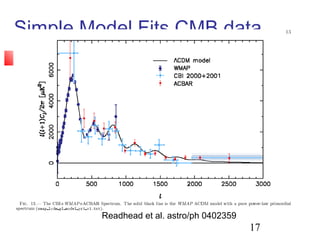
Simple Model Fits CMB data
Readhead et al. astro/ph 0402359
18
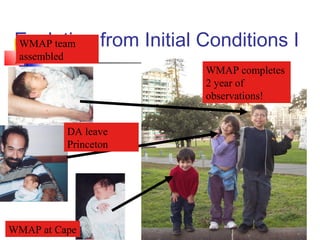
Evolution from Initial Conditions IWMAP team
assembled
DA leave
Princeton
WMAP completes
2 year of
observations!
WMAP at Cape
19
Evidence from large-scale structure
in the universe (clusters of galaxies)
 Counting clusters of galaxies can infer the matter energy
density in the universe
 The matter energy density found is usually around ~0.3 the
critical density
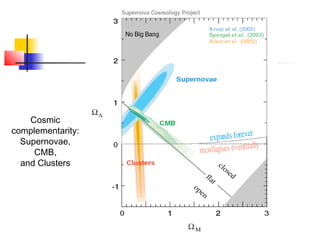
 CMB best fit model has a total energy density of ~1, so
another ~0.7 is required but with a different EOS
 The same ~0.7 with a the same different EOS is required
from combining supernovae data and CMB constraints
20
Cosmic
complementarity:
Supernovae,
CMB,
and Clusters
21
What is Dark Energy ?
“ ‘Most embarrassing observation
in physics’ – that’s the only quick
thing I can say about dark energy
that’s also true.”
Edward Witten
22
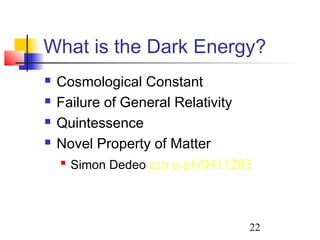
What is the Dark Energy?
 Cosmological Constant
 Failure of General Relativity
 Quintessence
 Novel Property of Matter

Simon Dedeo astro-ph/0411283
23
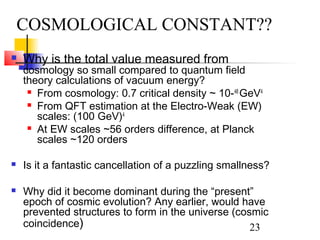
 Why is the total value measured from
cosmology so small compared to quantum field
theory calculations of vacuum energy?
 From cosmology: 0.7 critical density ~ 10-48
GeV4
 From QFT estimation at the Electro-Weak (EW)
scales: (100 GeV)4
 At EW scales ~56 orders difference, at Planck
scales ~120 orders
 Is it a fantastic cancellation of a puzzling smallness?
 Why did it become dominant during the “present”
epoch of cosmic evolution? Any earlier, would have
prevented structures to form in the universe (cosmic
coincidence)
COSMOLOGICAL CONSTANT??
24
Anthropic Solution?
 Not useful to discuss creation science
in any of its forms….
Dorothy… we are not in Kansas anymore …
25
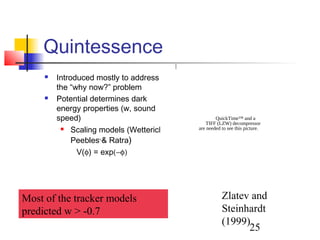
Quintessence
 Introduced mostly to address
the “why now?” problem
 Potential determines dark
energy properties (w, sound
speed)
 Scaling models (Wetterich;
Peebles & Ratra)
V(φ) = exp(−φ)
Most of the tracker models
predicted w > -0.7
ρ
matter
QuickTime™ and a
TIFF (LZW) decompressor
are needed to see this picture.
Zlatev and
Steinhardt
(1999)
26
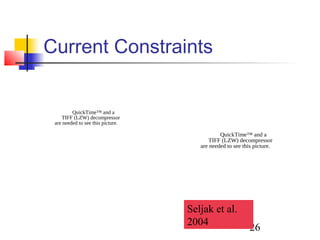
Current Constraints
QuickTime™ and a
TIFF (LZW) decompressor
are needed to see this picture.
Seljak et al.
2004
QuickTime™ and a
TIFF (LZW) decompressor
are needed to see this picture.
27
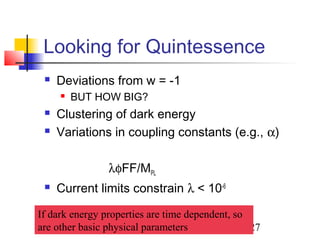
Looking for Quintessence
 Deviations from w = -1
 BUT HOW BIG?
 Clustering of dark energy
 Variations in coupling constants (e.g., α)
λφFF/MPL
 Current limits constrain λ < 10-6
If dark energy properties are time dependent, so
are other basic physical parameters
28
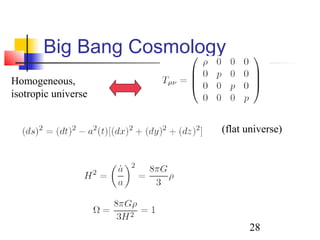
Big Bang Cosmology
Homogeneous,
isotropic universe
(flat universe)
29
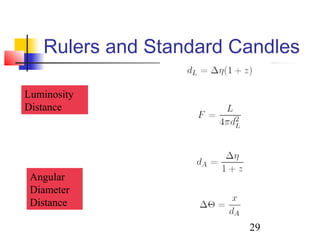
Rulers and Standard Candles
Luminosity
Distance
Angular
Diameter
Distance
30
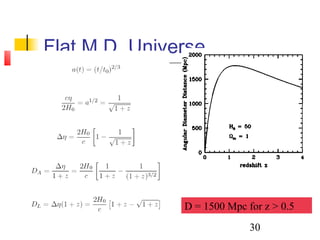
Flat M.D. Universe
D = 1500 Mpc for z > 0.5
31
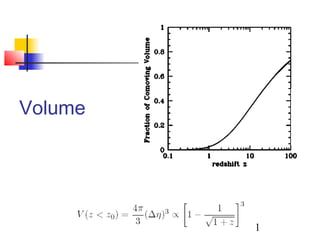
Volume
32
Techniques
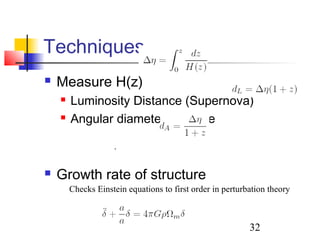
 Measure H(z)
 Luminosity Distance (Supernova)
 Angular diameter distance
 Growth rate of structure
.
Checks Einstein equations to first order in perturbation theory
33
What if GR is wrong?
 Friedman equation (measured through
distance) and Growth rate equation are
probing different parts of the theory
 For any distance measurement, there exists a
w(z) that will fit it. However, the theory can
not fit growth rate of structure
 Upcoming measurements can distinguish
Dvali et al. DGP from GR (Ishak, Spergel,
Upadye 2005)
34
Growth Rate of Structure Galaxy Surveys
 Need to measure bias

Non-linear dynamics

Gravitational Lensing

Halo Models

Bias is a function of galaxy properties,
scale, etc….
35
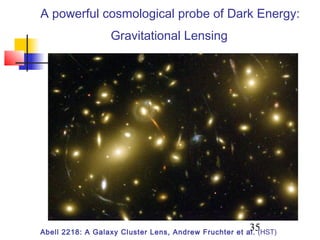
A powerful cosmological probe of Dark Energy:
Gravitational Lensing
Abell 2218: A Galaxy Cluster Lens, Andrew Fruchter et al. (HST)
36
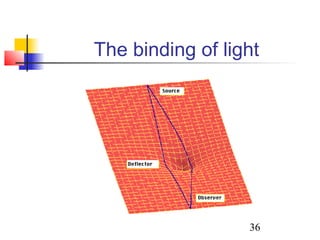
The binding of light
37
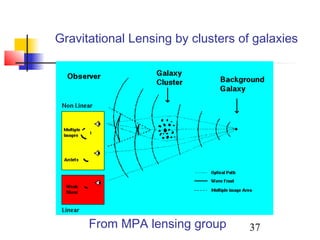
Gravitational Lensing by clusters of galaxies
From MPA lensing group
38
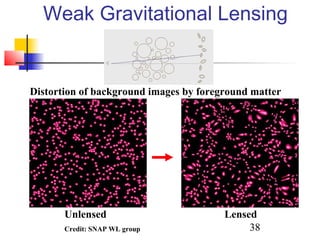
Weak Gravitational Lensing
Distortion of background images by foreground matter
Unlensed Lensed
Credit: SNAP WL group
39
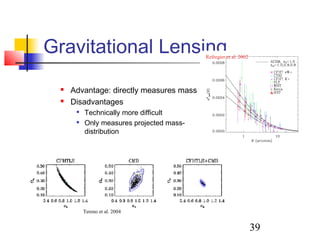
Gravitational Lensing
 Advantage: directly measures mass
 Disadvantages

Technically more difficult
 Only measures projected mass-
distribution
Tereno et al. 2004
Refregier et al. 2002
40
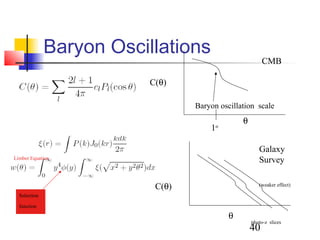
Baryon Oscillations
C(θ)
C(θ)
θ
θ
CMB
Galaxy
Survey
Baryon oscillation scale
1o
photo-z slices
Selection
function
Limber Equation
(weaker effect)
41
Baryon Oscillations as a
Standard Ruler
 In a redshift survey, we
can measure correlations
along and across the line
of sight.
 Yields H(z) and DA(z)!
[Alcock-Paczynski Effect]
Observer
δr = (c/H)δzδr = DAδθ
42
Large Galaxy Redshift Surveys
 By performing large spectroscopic surveys, we can measure the
acoustic oscillation standard ruler at a range of redshifts.
 Higher harmonics are at k~0.2h Mpc-1
(λ=30 Mpc).
 Measuring 1% bandpowers in the peaks and troughs requires about 1
Gpc3
of survey volume with number density ~10-3
galaxy Mpc-3
. ~1
million galaxies!
 SDSS Luminous Red Galaxy Survey has done this at z=0.3!
 A number of studies of using this effect
 Blake & Glazebrook (2003), Hu & Haiman (2003), Linder (2003),
Amendola et al. (2004)
 Seo & Eisenstein (2003), ApJ 598, 720 [source of next few figures]
43
Conclusions
 Cosmology provides lots of evidence for
physics beyond the standard model.
 Upcoming observations can test ideas about
the nature of the dark energy.

Dark energy by david spergel

  • 1.
    1 What is theDark Energy? David Spergel Princeton University
  • 2.
    2 One of themost challenging problems in Physics  Several cosmological observations demonstrated that the expansion of the universe is accelerating  What is causing this acceleration?  How can we learn more about this acceleration, the Dark Energy it implies, and the questions it raises?
  • 3.
    3 Outline  A briefsummary on the contents of the universe  Evidence for the acceleration and the implied Dark Energy  Supernovae type Ia observations (SNe Ia)  Cosmic Microwave Background Radiation (CMB)  Large-scale structure (LSS) (clusters of galaxies)  What is the Dark Energy?  Future Measurements
  • 4.
    4 Contents of theuniverse (from current observations) Baryons (4%) Dark matter (23%) Dark energy: 73% Massive neutrinos: 0.1% Spatial curvature: very close to 0
  • 5.
    5 A note oncosmological parameters  The properties of the standard cosmological model are expressed in terms of various cosmological parameters, for example:  H0 is the Hubble expansion parameter today  is the fraction of the matter energy density in the critical density (G=c=1 units)  is the fraction of the Dark Energy density (here a cosmological constant) in the critical density cMM ρρ /≡Ω π ρ 8 3 2 H c ≡ cρρ /ΛΛ ≡Ω
  • 6.
    6 Evidence for cosmicacceleration: Supernovae type Ia
  • 7.
    7 Evidence for cosmicacceleration: Supernovae type Ia  Standard candles  Their intrinsic luminosity is know  Their apparent luminosity can be measured  The ratio of the two can provide the luminosity- distance (dL) of the supernova  The red shift z can be measured independently from spectroscopy  Finally, one can obtain dL (z) or equivalently the magnitude(z) and draw a Hubble diagram
  • 8.
    8 Evidence for cosmicacceleration: Supernovae type Ia
  • 9.
  • 10.
    10 Evidence from CosmicMicrowave Background Radiation (CMB)  CMB is an almost isotropic relic radiation of T=2.725±0.002 K  CMB is a strong pillar of the Big Bang cosmology  It is a powerful tool to use in order to constrain several cosmological parameters  The CMB power spectrum is sensitive to several cosmological parameters
  • 11.
  • 12.
  • 13.
  • 14.
    14 Determining Basic Parameters BaryonDensity Ωbh2 = 0.015,0.017..0.031 also measured through D/H
  • 15.
    15 Determining Basic Parameters MatterDensity Ωmh2 = 0.16,..,0.33
  • 16.
    16 Determining Basic Parameters AngularDiameter Distance w = -1.8,..,-0.2 When combined with measurement of matter density constrains data to a line in Ωm-w space
  • 17.
    17 Simple Model FitsCMB data Readhead et al. astro/ph 0402359
  • 18.
    18 Evolution from InitialConditions IWMAP team assembled DA leave Princeton WMAP completes 2 year of observations! WMAP at Cape
  • 19.
    19 Evidence from large-scalestructure in the universe (clusters of galaxies)  Counting clusters of galaxies can infer the matter energy density in the universe  The matter energy density found is usually around ~0.3 the critical density  CMB best fit model has a total energy density of ~1, so another ~0.7 is required but with a different EOS  The same ~0.7 with a the same different EOS is required from combining supernovae data and CMB constraints
  • 20.
  • 21.
    21 What is DarkEnergy ? “ ‘Most embarrassing observation in physics’ – that’s the only quick thing I can say about dark energy that’s also true.” Edward Witten
  • 22.
    22 What is theDark Energy?  Cosmological Constant  Failure of General Relativity  Quintessence  Novel Property of Matter  Simon Dedeo astro-ph/0411283
  • 23.
    23  Why isthe total value measured from cosmology so small compared to quantum field theory calculations of vacuum energy?  From cosmology: 0.7 critical density ~ 10-48 GeV4  From QFT estimation at the Electro-Weak (EW) scales: (100 GeV)4  At EW scales ~56 orders difference, at Planck scales ~120 orders  Is it a fantastic cancellation of a puzzling smallness?  Why did it become dominant during the “present” epoch of cosmic evolution? Any earlier, would have prevented structures to form in the universe (cosmic coincidence) COSMOLOGICAL CONSTANT??
  • 24.
    24 Anthropic Solution?  Notuseful to discuss creation science in any of its forms…. Dorothy… we are not in Kansas anymore …
  • 25.
    25 Quintessence  Introduced mostlyto address the “why now?” problem  Potential determines dark energy properties (w, sound speed)  Scaling models (Wetterich; Peebles & Ratra) V(φ) = exp(−φ) Most of the tracker models predicted w > -0.7 ρ matter QuickTime™ and a TIFF (LZW) decompressor are needed to see this picture. Zlatev and Steinhardt (1999)
  • 26.
    26 Current Constraints QuickTime™ anda TIFF (LZW) decompressor are needed to see this picture. Seljak et al. 2004 QuickTime™ and a TIFF (LZW) decompressor are needed to see this picture.
  • 27.
    27 Looking for Quintessence Deviations from w = -1  BUT HOW BIG?  Clustering of dark energy  Variations in coupling constants (e.g., α) λφFF/MPL  Current limits constrain λ < 10-6 If dark energy properties are time dependent, so are other basic physical parameters
  • 28.
  • 29.
    29 Rulers and StandardCandles Luminosity Distance Angular Diameter Distance
  • 30.
    30 Flat M.D. Universe D= 1500 Mpc for z > 0.5
  • 31.
  • 32.
    32 Techniques  Measure H(z) Luminosity Distance (Supernova)  Angular diameter distance  Growth rate of structure . Checks Einstein equations to first order in perturbation theory
  • 33.
    33 What if GRis wrong?  Friedman equation (measured through distance) and Growth rate equation are probing different parts of the theory  For any distance measurement, there exists a w(z) that will fit it. However, the theory can not fit growth rate of structure  Upcoming measurements can distinguish Dvali et al. DGP from GR (Ishak, Spergel, Upadye 2005)
  • 34.
    34 Growth Rate ofStructure Galaxy Surveys  Need to measure bias  Non-linear dynamics  Gravitational Lensing  Halo Models  Bias is a function of galaxy properties, scale, etc….
  • 35.
    35 A powerful cosmologicalprobe of Dark Energy: Gravitational Lensing Abell 2218: A Galaxy Cluster Lens, Andrew Fruchter et al. (HST)
  • 36.
  • 37.
    37 Gravitational Lensing byclusters of galaxies From MPA lensing group
  • 38.
    38 Weak Gravitational Lensing Distortionof background images by foreground matter Unlensed Lensed Credit: SNAP WL group
  • 39.
    39 Gravitational Lensing  Advantage:directly measures mass  Disadvantages  Technically more difficult  Only measures projected mass- distribution Tereno et al. 2004 Refregier et al. 2002
  • 40.
    40 Baryon Oscillations C(θ) C(θ) θ θ CMB Galaxy Survey Baryon oscillationscale 1o photo-z slices Selection function Limber Equation (weaker effect)
  • 41.
    41 Baryon Oscillations asa Standard Ruler  In a redshift survey, we can measure correlations along and across the line of sight.  Yields H(z) and DA(z)! [Alcock-Paczynski Effect] Observer δr = (c/H)δzδr = DAδθ
  • 42.
    42 Large Galaxy RedshiftSurveys  By performing large spectroscopic surveys, we can measure the acoustic oscillation standard ruler at a range of redshifts.  Higher harmonics are at k~0.2h Mpc-1 (λ=30 Mpc).  Measuring 1% bandpowers in the peaks and troughs requires about 1 Gpc3 of survey volume with number density ~10-3 galaxy Mpc-3 . ~1 million galaxies!  SDSS Luminous Red Galaxy Survey has done this at z=0.3!  A number of studies of using this effect  Blake & Glazebrook (2003), Hu & Haiman (2003), Linder (2003), Amendola et al. (2004)  Seo & Eisenstein (2003), ApJ 598, 720 [source of next few figures]
  • 43.
    43 Conclusions  Cosmology provideslots of evidence for physics beyond the standard model.  Upcoming observations can test ideas about the nature of the dark energy.

Editor's Notes

  • #22 Obviously a puzzling and far reaching question that has many unexpected consequences
  • #42 The acoustic oscillations are also quantitatively useful, because they can form a standard ruler.