Gyroscope
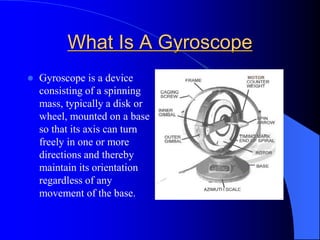
What Is A Gyroscope
 Gyroscope is a device
consisting of a spinning
mass, typically a disk or
wheel, mounted on a base
so that its axis can turn
freely in one or more
directions and thereby
maintain its orientation
regardless of any
movement of the base.
Historical Issue
 The first modern gyroscope was developed in
the first half of the 19th century by the French
physicist jean B. L. Foucault, and its first
notable use was in a visual demonstration of the
earth's rotation.
Gyroscopic Effect
 A straightforward observation:
Coriolis effect
 Examples:
River bank
Train’s wheels
Gyroscope Vs. Rate Sensor
 The major difference: gyroscope can be mounted
at any position of the rotational frame to sense the
rate of rotation, while the conventional rate sensor
needs to have an aligned shaft to be mounted
exactly at the centre of the rotational frame.
 Conclusion: the conventional rate sensor cannot be
used in navigation systems where the centre of the
rotational frame is unknown.
Merits of Gyro As Rate Sensor
 Low power consumption,
 High sensitivity,
 Low temperature drift,
 Good stability
Principle of Gyro
Coriolis force -- the main physical principal to
explain the vibrating gyroscope operation.
In general, when in a rotating frame, there is a
force on all moving objects which is given by:
FCoriolis = -2 m (w x vr)
Where w is angular frequency and vr is radial
velocity.
The direction of Coriolis force is orthogonal to the
velocity vector and the rotation vector.
Principle of Gyro
• The spin axis: the
source of the gyroscopic
effect
• The primary axis:
conceptually the input or
driving axis
• The secondary axis:
output
Conclusion
Gyroscope is very useful in many applications.
To chose the right rate gyro sensor, some
features, such as power consumption, weight,
dimension, etc., must be taken into
consideration.

gyroscopic

  • 1.
  • 2.
    What Is AGyroscope  Gyroscope is a device consisting of a spinning mass, typically a disk or wheel, mounted on a base so that its axis can turn freely in one or more directions and thereby maintain its orientation regardless of any movement of the base.
  • 3.
    Historical Issue  Thefirst modern gyroscope was developed in the first half of the 19th century by the French physicist jean B. L. Foucault, and its first notable use was in a visual demonstration of the earth's rotation.
  • 4.
    Gyroscopic Effect  Astraightforward observation: Coriolis effect  Examples: River bank Train’s wheels
  • 5.
    Gyroscope Vs. RateSensor  The major difference: gyroscope can be mounted at any position of the rotational frame to sense the rate of rotation, while the conventional rate sensor needs to have an aligned shaft to be mounted exactly at the centre of the rotational frame.  Conclusion: the conventional rate sensor cannot be used in navigation systems where the centre of the rotational frame is unknown.
  • 6.
    Merits of GyroAs Rate Sensor  Low power consumption,  High sensitivity,  Low temperature drift,  Good stability
  • 7.
    Principle of Gyro Coriolisforce -- the main physical principal to explain the vibrating gyroscope operation. In general, when in a rotating frame, there is a force on all moving objects which is given by: FCoriolis = -2 m (w x vr) Where w is angular frequency and vr is radial velocity. The direction of Coriolis force is orthogonal to the velocity vector and the rotation vector.
  • 8.
    Principle of Gyro •The spin axis: the source of the gyroscopic effect • The primary axis: conceptually the input or driving axis • The secondary axis: output
  • 9.
    Conclusion Gyroscope is veryuseful in many applications. To chose the right rate gyro sensor, some features, such as power consumption, weight, dimension, etc., must be taken into consideration.