Contents
1 Purpose

 o    1.1 Scientific research

 o    1.2 Exploration

 o    1.3 Education and cultural outreach

2 Origins

 o    2.1 Mir-2

 o    2.2 Freedom with Kibō

 o    2.3 Columbus

3 Station structure

 o    3.1 Assembly

 o    3.2 Pressurised modules

 o    3.3 Unpressurized elements

4 Station systems

 o    4.1 Life support

 o    4.2 Power and thermal control

 o    4.3 Communications and computers

5 Station operations

 o    5.1 Expeditions and private flights

 o    5.2 Crew activities

 o    5.3 Orbit and mission control

 o    5.4 Repairs

6 Fleet operations

 o    6.1 Currently docked/berthed

 o    6.2 Scheduled launches and dockings/berthings

 o    6.3 Docking

 o    6.4 Launch and docking windows

7 Sightings

 o    7.1 Naked eye

 o    7.2 Astrophotography

8 Crew health and safety

 o    8.1 Radiation

 o    8.2 Stress
o    8.3 Medical

 o    8.4 Orbital debris

9 Politics

 o    9.1 International co-operation

 o    9.2 China

 o    9.3 End of mission

 o    9.4 Program cost in United States dollars

10 Notes

11 References

12 External links

 o    12.1 Children's websites

 o    12.2 Live viewing

 o    12.3 Contact the crew

 o    12.4 Video

 o    12.5 Image galleries

 o    12.6 Research

 o    12.7 Travel agency website
International Space Station


The International Space Station, as seen from Space ShuttleEndeavour in
May 2011.


ISS insignia

Station statistics

COSPAR ID                    1998-067A

Call sign                    Alpha

                             Fully                crewed                  6
Crew                         Currently              onboard               6
                             (Expedition 34)

Launch                       1998–2020

                             Baikonur LC-81/23, LC-1/5
Launch pad
                             KSC LC-39,

Mass                         approximately 450,000 kg (990,000 lb)

Length                       72.8 m

Width                        108.5 m

                             c.          20 m              (c.        66 ft)
Height                       nadir–zenith,        arrays         forward–aft
                             (27 November 2009)[dated info]

                             837 m3 (29,600 cu ft)
Pressurised volume
                             (21 March 2011)

Atmospheric pressure         101.3 kPa (29.91 inHg, 1 atm)
402 km                   (250 mi) AMSL[1]
Perigee
                                           (02 November 2012 04:38:51 epoch)

                                           424 km                   (263 mi) AMSL[1]
Apogee
                                           (02 November 2012 04:38:51 epoch)

Orbital inclination                        51.6 degrees

                                           7,706.6 m/s
Average speed
                                           (27,743.8 km/h, 17,239.2 mph)

                                           92       minutes        50      seconds[1]
Orbital period
                                           (02 November 2012 04:38:51 epoch)

                                           5140
Days in orbit
                                           (16 December)

                                           4427
Days occupied
                                           (16 December)

                                           80680
Number of orbits
                                           (16 December)

Orbital decay                              2 km/month
Statistics         as                      of          9           March         2011
(unless noted otherwise)
References: [2][3][4][5][6][7]

Configuration


Station   elements               as   of        December   2011,     but   missing Pirs
(exploded view)


The International Space Station (ISS) is a habitable artificial satellite in low Earth orbit. It follows
the Salyut, Almaz, Skylab and Mir stations as the ninth space station to be inhabited. The ISS is a
modular structure whose first component was launched in 1998. Like many artificial satellites, the station
[8][9]
can be seen with the naked eye from Earth without any special equipment.            The ISS consists of
pressurised modules, external trusses, solar arrays and other components. ISS components have been
                                                                                              [10]
launched by American Space Shuttles as well as Russian Proton and Soyuz rockets. Budget
constraints led to the merger of three space station projects with the Japanese Kibō module
and Canadian robotics. In 1993 the partially built Soviet/Russian Mir-2, the proposed American Freedom,
                                                                                         [10]
and the proposed European Columbus merged into a single multinational programme. The Russian
Federal Space Agency (RSA/RKA) is using the ISS as a work site to assemble their next space station,
called OPSEK. Modules and components for the new station began arriving on orbit in 2010, and the
RSA plans to commission the new station before the remainder of the ISS is de-orbited.

The ISS serves as a microgravity and space environment research laboratory in which crew members
conduct              experiments     in biology, human      biology, physics, astronomy, meteorology and other
        [11][12][13]
fields.              The station is suited for the testing of spacecraft systems and equipment required for
                                      [14]
missions to the Moon and Mars.

The station has been continuously occupied for 12 years and 44 days, having exceeded the previous
record of almost 10 years (or 3,634 days) held by Mir, in 2010. The station is serviced by
                                                                                                   [15]
Soyuz spacecraft, Progress spacecraft, the Automated Transfer Vehicle, the H-II Transfer Vehicle, and
formerly the Space Shuttle. It has been visited by astronauts and cosmonauts from 15 different
        [16]
nations. On 25 May 2012, Space Exploration Technologies Corporation (or SpaceX) became the
world's first privately held company to send a cargo load, via the Dragon spacecraft, to the International
                 [17]
Space Station.

The ISS programme is a joint project between five participating space agencies: NASA, the Russian
                                                 [15][18]
Federal Space Agency, JAXA, ESA, and CSA.                 The ownership and use of the space station is
                                                               [19]
established by intergovernmental treaties and agreements. The station is divided into two sections,
the Russian orbital segment (ROS) and the United States orbital segment (USOS), which is shared by
many nations. The ISS is maintained at an orbital altitude of between 330 km (205 mi) and 410 km
                                            [20]
(255 mi). It completes 15.7 orbits per day. The ISS is funded until 2020, and may operate until
      [21][22][23]
2028.
Purpose
According to the original Memorandum of Understanding between NASA and RSA, the International
Space Station was intended to be a laboratory, observatory and factory in space. It was also planned to
provide transportation, maintenance, and act as a staging base for possible future missions to the Moon,
                     [24]
Mars and asteroids. In the 2010 United States National Space Policy, the ISS was given additional
                                       [25]                        [26]
roles of serving commercial, diplomatic and educational purposes.

[edit]Scientific    research
Main article: Scientific research on the ISS

The ISS provides a platform to conduct scientific research that cannot be performed in any other way.
While small unmanned spacecraft can provide platforms for zero gravity and exposure to space, space
stations offer a long term environment where studies can be performed potentially for decades, combined
with ready access by human researchers over periods that exceed the capabilities of manned
            [16][27]
spacecraft.

The Station simplifies individual experiments by eliminating the need for separate rocket launches and
research     staff.  The     primary      fields   of       research        include Astrobiology, astronomy, human
research including space medicine and life sciences, physical sciences, materials science, Space
                                                 [11][12][13][28][29]
weather and weather on Earth (meteorology).                           Scientists on Earth have access to the crew's
data and can modify experiments or launch new ones, benefits generally unavailable on unmanned
           [27]
spacecraft. Crews fly expeditions of several months duration, providing approximately 160 man-hours a
                                 [11][30]
week of labour with a crew of 6.

Kibō is intended to accelerate Japan's progress in science and technology, gain new knowledge and
                                                  [31]
apply it to such fields as industry and medicine.

In order to detect dark matter and answer other fundamental questions about our universe, engineers and
scientists from all over the world built the Alpha Magnetic Spectrometer (AMS), which NASA compares to
the Hubble telescope, and says could not be accommodated on a free flying satellite platform due in part
                                                      [32][33]
to its power requirements and data bandwidth needs.
The space environment is hostile to life. Unprotected presence in space is characterised by an intense
radiation field (consisting primarily of protons and other subatomic charged particles from the solar wind,
                                                                                     [34]
in addition to cosmic rays), high vacuum, extreme temperatures, and microgravity. Some simple forms
                               [35]                                                [36]
of life called extremophiles, including small invertebrates called tardigrades can survive in this
environment in an extremely dry state called desiccation.

Medical research improves knowledge about the effects of long-term space exposure on the human body,
including muscle atrophy, bone loss, and fluid shift. This data will be used to determine whether
lengthy human spaceflight and space colonisation are feasible. As of 2006, data on bone loss and
muscular atrophy suggest that there would be a significant risk of fractures and movement problems if
astronauts landed on a planet after a lengthy interplanetary cruise, such as the six-month interval
                           [37][38]
required to travel to Mars.         Medical studies are conducted aboard the ISS on behalf of the National
Space Biomedical Research Institute (NSBRI). Prominent among these is the Advanced Diagnostic
Ultrasound in Microgravity study in which astronauts perform ultrasound scans under the guidance of
remote experts. The study considers the diagnosis and treatment of medical conditions in space. Usually,
there is no physician on board the ISS and diagnosis of medical conditions is a challenge. It is anticipated
that remotely guided ultrasound scans will have application on Earth in emergency and rural care
                                                             [39][40][41]
situations where access to a trained physician is difficult.

[edit]Microgravity


A comparison between the combustion of a candle on Earth (left) and in a microgravity environment, such as that found on
the ISS (right)

Contrary to popular belief, the earth's gravity is only slightly less at the altitude of the ISS as at the
surface. According to the equivalence principle, gravity only seems absent because, like any orbiting
object, it is in continuous freefall. This state of perceived weightlessness is not perfect however, being
                                     [42]
disturbed by five separate effects:

     Drag from the residual atmosphere; when the ISS enters the Earth's shadow, the main solar panels
     are rotated to minimise this aerodynamic drag, helping reduce orbital decay.
Vibration from movements of mechanical systems and the crew.
    Actuation of the on-board altitude control moment gyroscopes.
    Thruster firings for altitude or orbital changes.
    Gravity-gradient effects, also known as tidal effects. Items not at the exact ISS center of mass would,
    if not attached to the station, follow slightly different orbits than that of the ISS as a whole. Those
    closer to the earth would tend to follow faster, shorter orbits and move forward along the velocity
    vector. Those farther away would have slower, longer orbits and move rearward against the velocity
    vector. Those to the left or right of the ISS center of mass would be in different orbital planes. Being
    attached to the rigid ISS, however, these items experience small forces that keep them moving along
    with the ISS center of mass.
Researchers are investigating the effect of the station's near-weightless environment on the evolution,
development, growth and internal processes of plants and animals. In response to some of this data,
NASA wants to investigate microgravity's effects on the growth of three-dimensional, human-like tissues,
                                                              [12]
and the unusual protein crystals that can be formed in space.

The investigation of the physics of fluids in microgravity will allow researchers to model the behaviour of
fluids better. Because fluids can be almost completely combined in microgravity, physicists investigate
fluids that do not mix well on Earth. In addition, an examination of reactions that are slowed by low gravity
                                                                                     [12]
and temperatures will give scientists a deeper understanding ofsuperconductivity.

The study of materials science is an important ISS research activity, with the objective of reaping
                                                                                 [43]
economic benefits through the improvement of techniques used on the ground. Other areas of interest
include the effect of the low gravity environment on combustion, through the study of the efficiency of
burning and control of emissions and pollutants. These findings may improve current knowledge about
energy production, and lead to economic and environmental benefits. Future plans are for the
researchers aboard the ISS to examine aerosols, ozone, water vapour, and oxidesin Earth's atmosphere,
                                                                                  [12]
as well as cosmic rays, cosmic dust, antimatter, and dark matter in the universe.

[edit]Exploration


A 3D plan of the MARS-500 complex, used for ground-based experiments which complement ISS-based preparations for
amanned mission to Mars

The ISS provides a location in the relative safety of Low Earth Orbit to test spacecraft systems that will be
required for long-duration missions to the Moon and Mars. This provides experience in operations,
maintenance as well as repair and replacement activities on-orbit, which will be essential skills in
operating spacecraft farther from Earth, mission risks can be reduced and the capabilities of
                                    [14]
interplanetary spacecraft advanced. Referring to theMARS-500 experiment, ESA states that "Whereas
the ISS is essential for answering questions concerning the possible impact of weightlessness, radiation
and other space-specific factors, aspects such as the effect of long-term isolation and confinement can be
                                                                  [44]
more appropriately addressed via ground-based simulations". Sergey Krasnov, the head of human
space flight programmes for Russia's space agency, Roscosmos, in 2011 suggested a "shorter version"
                                             [45]
of MARS-500 may be carried out on the ISS.

In 2009, noting the value of the partnership framework itself, Sergey Krasnov wrote, "When compared
with partners acting separately, partners developing complementary abilities and resources could give us
much more assurance of the success and safety of space exploration. The ISS is helping further advance
near-Earth space exploration and realisation of prospective programmes of research and exploration of
                                                    [46]
the Solar system, including the Moon and Mars." A manned mission to Mars, however, may be a
multinational effort involving space agencies and countries outside of the current ISS partnership. In 2010
ESA Director-General Jean-Jacques Dordain stated his agency was ready to propose to the other 4
                                                                                     [47]
partners that China, India and South Korea be invited to join the ISS partnership. NASA chief Charlie
                                                                                    [48]
Bolden stated in Feb 2011 "Any mission to Mars is likely to be a global effort". Currently, American
                                                                       [49]
legislation prevents NASA co-operation with China on space projects.

[edit]Education      and cultural outreach
The ISS crew provide opportunities for students on Earth by running student-developed experiments,
making educational demonstrations, allowing for student participation in classroom versions of ISS
                                                                                [15][50]
experiments, and directly engaging students using radio, videolink and email.            ESA offers a wide
                                                                              [51]
range of free teaching materials that can be downloaded for use in classrooms. In one lesson, students
can navigate a 3-D model of the interior and exterior of the ISS, and face spontaneous challenges to
                    [52]
solve in real time.

JAXA aims both to "Stimulate the curiosity of children, cultivating their spirits, and encouraging their
passion to pursue craftsmanship", and to "Heighten the child's awareness of the importance of life and
                                   [53]
their responsibilities in society." Through a series of education guides, a deeper understanding of the
                                                                                                      [54][55]
past and near-term future of manned space flight, as well as that of Earth and life, will be learned.          In
the JAXA Seeds in Space experiments, the mutation effects of spaceflight on plant seeds aboard the ISS
is explored. Students grow sunflower seeds which flew on the ISS for about nine months as a start to
‗touch the Universe‘. In the first phase of Kibō utilisation from 2008 to mid-2010, researchers from more
                                                                              [56]
than a dozen Japanese universities conducted experiments in diverse fields.


                        Susan J. Helms, Expedition Two flight engineer, A student speaks to crew
talks to amateur radio operators on Earth from using   Amateur     Radio,
                       the Amateur radio workstation in the Zarya.    provided free by ARISS.


Cultural activities are another major objective. Tetsuo Tanaka, director of JAXA's Space Environment and
Utilization Center, says "There is something about space that touches even people who are not interested
             [31]
in science."

Amateur Radio on the ISS (ARISS) is a volunteer programme which encourages students worldwide to
pursue careers in science, technology, engineering and mathematics through amateur
radio communications opportunities with the ISS crew. ARISS is an international working group,
consisting of delegations from 9 countries including several countries in Europe as well as Japan, Russia,
Canada, and the United States. In areas where radio equipment cannot be used, speakerphones connect
                                                                         [57]
students to ground stations which then connect the calls to the station.

First Orbit is a feature-length documentary film about Vostok 1, the first manned space flight around the
Earth. By matching the orbit of the International Space Station to that of Vostok 1 as closely as possible,
in terms of ground path and time of day, documentary filmmaker Christopher Riley and ESA
astronaut Paolo Nespoli were able to film the view that Yuri Gagarin saw on his pioneering orbital space
flight. This new footage was cut together with the original Vostok 1 mission audio recordings sourced from
the Russian State Archive. Nespoli, during Expedition 26/27, filmed the majority of the footage for this
                                                                                [58]
documentary film, and as a result is credited as its director of photography. The film was streamed
                                                                                                   [59]
through the website www.firstorbit.org in a global YouTube premiere in 2011, under a free license.

[edit]Origins

The International Space Station programme represents a combination of three national space station
projects: the Russian/Soviet Mir-2, NASA's Freedom including the Japanese Kibō laboratory, and the
European Columbus space stations. Canadian robotics supplement these projects.

Mir-2 was originally authorised in the February 1976 resolution setting forth plans for development of third
generation Soviet space systems; the first module, which would have served the same function as Zarya,
was destroyed in a launch mishap.

In the early 1980s, NASA planned to launch a modular space station called Freedom as a counterpart to
the Soviet Salyut and Mir space stations. Freedom was never constructed and the remnants of the project
became part of the ISS. The Japanese Experiment Module (JEM), or Kibō, was announced in 1985, as
part of the Freedom space station in response to a NASA request in 1982.

In Rome in early 1985, science ministers from the European Space Agency (ESA) countries approved
the Columbus program, the most ambitious effort in space undertaken by that organisation at the time.
The plan spearheaded by Germany and Italy included a module which would be attached to Freedom,
and with the capability to evolve into a full-fledged European orbital outpost before the end of the century.
The space station was also going to tie the emerging European and Japanese national space
programmes closer to the U.S.-led project, thereby preventing those nations from becoming major,
                              [60]
independent competitors too.

In September 1993, American Vice-President Al Gore and Russian Prime Minister Viktor
Chernomyrdin announced plans for a new space station, which eventually became the International
[61]
Space Station. They also agreed, in preparation for this new project, that the United States would be
                                                                                               [62]
involved in the Mir programme, including American Shuttles docking, in the Shuttle-Mir Program.

[edit]Mir-2
Main articles: Mir, Mir-2, Polyus (spacecraft), Buran program, and Energia


The Soviet Buran shuttle would have carried modules up to 30 tons to MIR-2. 80–100 ton modules could have used its
launcher without the shuttle (seen here withAn-225, the heaviest aeroplane).

The Russian Orbital Segment (ROS or RS) is the eleventh Soviet-Russian space station. Mir ("Peace")
and the ISS are successors to the Salyut("Fireworks") and Almaz ("Diamond") stations. The first MIR-2
module was launched in 1986 by an Energia heavy-lift expendable launch system. The launcher worked
properly, however the Polyus payload fired its engines to insert itself into orbit whilst in the wrong position
due to a programming error, and re-entered the atmosphere. The planned station changed several times,
but Zvezda was always the service module, containing the station's critical systems such as life support.
The station would have used the Buran spaceplane and Proton rockets to lift new modules into orbit. The
spaceframe of Zvezda, also called DOS-8 serial number 128, was completed in February 1985 and major
                                                  [63]
internal equipment was installed by October 1986.

The Polyus module or spacecraft would have served as the FGB, a foundation which provides propulsion
and guidance, but it lacks life support. Polyus was a satellite interceptor/destroyer, carrying a 1 megawatt
carbon dioxide laser. The module had a length of almost 37 m and a diameter of 4.1 m, weighed nearly
80 t, and included 2 principal sections, the smallest, the functional service block (FGB), and the largest,
                [64]
the aim module.

In 1983, the design was changed and the station would consist of Zvezda, followed by several 90 metric
ton modules and a truss structure similar to the current station. The draft was approved by NPO Energia
Chief Semenov on 14 December 1987 and announced to the press as 'Mir-2' in January 1988. This
station would be visited by the Soviet Buran, but mainly resupplied by Progress-M2 spacecraft. Orbital
                                                       [63]
assembly of the station was expected to begin in 1993. In 1993 with the collapse of the Soviet Union, a
redesigned smaller Mir-2 was to be built whilst attached to Mir, just as OPSEK is being assembled whilst
attached to the ISS.

[edit]Freedom           with Kibō
Main articles: Space Station Freedom, Kibō, and H-II Transfer Vehicle
Artist's conception of the proposed "Power Tower" space station with the Japanese Experiment Module attached

Approved by then-president Ronald Reagan and announced in the 1984 State of the Union Address, "We
can follow our dreams to distant stars, living and working in space for peaceful economic and scientific
gain", the proposed Freedom changed considerably.

NASA's first cost assessment in 1987 revealed the "Dual Keel" Station would cost $14.5 billion. This
caused a political uproar in Congress, and NASA and Reagan Administration officials reached a
compromise in March 1987 which allowed the agency to proceed with a cheaper $12.2-billion Phase One
Station that could be completed after 10 or 11 Shuttle assembly flights. This design initially omitted the
$3.4-billion 'Dual Keel' structure and half of the power generators. The new Space Station configuration
was named Freedom by Reagan in June 1988. Originally, Freedom would have carried two 37.5 kW solar
arrays. However, Congress quickly insisted on adding two more arrays for scientific users. The Space
Station programme was plagued by conflicts during the entire 1984–87 definition phase. In 1987, the
Department of Defense (DoD) briefly demanded to have full access to the Station for military research,
despite strong objections from NASA and the international partners. Besides the expected furore from the
international partners, the DoD position sparked a shouting match between Defense Secretary Caspar
Weinberger and powerful members of Congress that extended right up to the final Fiscal 1988 budget
                             [65]
authorisation in July 1987. Reagan wanted to invite other NATO countries to participate in the U.S-led
project, since the Soviet Union had been launching international crews to their Salyut space stations
since 1971. At one point, then-anonymous disgruntled NASA employees calling themselves "Center for
Strategic Space Studies" suggested that instead of building Freedom, NASA should take the back-up
                                                                                          [66]
Skylab from display in the National Air and Space Museum in Washington and launch that.

An agreement signed in September 1988 allocated 97% of the US lab resources to NASA while the
Canadian CSA would receive 3% in return for its contribution to the programme. Europe and Japan would
retain 51% of their own laboratory modules. Six Americans and two international astronauts would be
permanently based on Space Station Freedom. Several NASA Space Shuttle missions in the 1980s and
early 1990s included spacewalks to demonstrate and test space station construction techniques.
The Japanese Experiment Module (JEM), christened Kibō ("hope") in 1999, is Japan's first manned
spacecraft. Kibō consists of a pressurised laboratory dedicated to advanced technology experiments,
education and art, a cargo bay, an unpressurised pallet for vacuum experiments in space, a robotic arm,
and interorbital communication system. While the proposed space station was redesigned many times
around Kibō, the only significant change has been the placement of its ballistic shielding. Its final position
at the front of the station increases the risk of damage from debris. The ESA and NASA, by contrast, both
reduced the size of their laboratories over the course of the program. The Japanese National Space
Development Agency (NASDA) formally submitted the JEM proposal to NASA in March 1986, and by
                              [60][67][68]
1990 design work began.                    Constructed in the Tobishima Plant of Nagoya Aerospace Systems
Works, by Mitsubishi Heavy Industries, Ltd., Kibō made its way to the Tsukuba Space Center and in 2003
Kibō was shipped, first by river barge and then by ship, to America. In 2010, Kibō won the Good Design
Award, a 55 year old consumer and industry award which identifies the best of Japanese
                 [69][70]
craftsmanship.

A decade before Zarya was launched into orbit, Japan was working on the development of its own space
shuttle, intended to use the H-II launcher. Depending on the configuration of the launcher, it would weigh
between 10 and 20 metric tons and mix crew and cargo together. It would take off vertically on its booster
and at the end of its mission re-enter and land just as the NASA and Soviet shuttles did. The program
                                                            [71][72]
was terminated by JAXA in 2003 after scale mockup testing.
Columbus
Main articles: Columbus ISS module, Man-Tended Free Flyer, and Hermes spaceplane

The first elements of the Columbus program were expected to fly as early as 1992, to coincide with the
500th anniversary of Columbus' voyage to America. ESA and NASA clashed over the very concept of the
Columbus program in 1986. America objected to ESA's using Columbus as building block of a future
European space station, and were concerned that they would facilitate the creation of a potential
competitor if the manned space outpost fulfilled its promise as supplier of commercially viable products,
such as new materials and pharmaceuticals. Plans were scaled down as a result, and by 1988, Europe
proposed to participate with three elements, the Columbus module, the Man-Tended Free Flyer (MTFF),
                              [73]                                                              [74]
and the Polar Platform (PPF), supported by theAriane-5 launcher and the Hermes spaceplane.

The Columbus Man-Tended Free Flyer (MTFF) was an ESA programme to develop a space station that
could be used for a variety of microgravity experiments while serving ESA's needs for an autonomous
                          [75]
manned space platform. The MTFF would be a space station without long term life support, visited by
short term crews to replenish and maintain experiments in a Zero-G environment free of vibrations
caused by a permanent crew. The project was canceled after budget constraints caused by German
reunification. The Hermes spaceplane is comparable in function to the American and Soviet space
shuttles, with a smaller crew of up to 6 (reduced to 3 with ejection seats after the Columbia disaster) and
substantially smaller cargo capacity, 4,550 kg, comparable to ISS unmanned cargo ships.

By 1991 the Columbus and Hermes pre-development activities were good enough to progress into full
development, however profound geopolitical changes prompted examining broader international
cooperation, in particular with the Russian Federation. ESA Member States approved the complete
development of the Attached Pressurised Module (APM) and the Polar Platform (PPF) for Columbus, but
the Man-Tended Free-Flyer (MTFF) was abandoned. The Hermes programme was reoriented into the
Manned Space Transportation Programme (MSTP), and a three-year period extending from 1993 to 1995
was agreed on in order to define a future manned space transportation system in cooperation with
                                                     [76][77]
Russia, including joint development and use of Mir-2.

The ESA ATV robot spacecraft is a powerful 'space tug' that can be adapted to shuttle supplies into Mars
      [78]
orbit. Its propulsion is arranged with a central hollow section, to allow the possibility of a docking port at
both ends. It could then form larger assemblies, strung together as a space station or allowing piggyback
                   [citation needed]
docking to Zvezda.

[edit]Station   structure
Expedition 18 commander Michael Fincke's Station layout, photographed from Soyuz TMA-20,
             video tour of the habitable part of the ISS with NASA's Endeavour docked
             from January 2009


The ISS follows Salyut and Almaz series, Cosmos 557, Skylab, and Mir as the 11th space station
launched, as the Genesis prototypes were never intended to be manned. The ISS is a third
          [79]                    [80]
generation modular space station.

Other examples of modular station projects include the Soviet/Russian Mir, Russian OPSEK,
and Chinese space station. The first space station, Salyut 1, and other one-piece or 'monolithic' first
generation space stations, such as Salyut 2,3,4,5, DOS 2, Kosmos 557, Almaz and
                                                          [81]
NASA's Skylab stations were not designed for re-supply. Generally, each crew had to depart the station
to free the only docking port for the next crew to arrive, Skylab had more than one docking port but was
not designed for resupply. Salyut 6 and 7 had more than one docking port and were designed to be
                                               [82]
resupplied routinely during crewed operation. Modular stations can allow the mission to be changed
over time and new modules can be added or removed from the existing structure, allowing greater
flexibility.

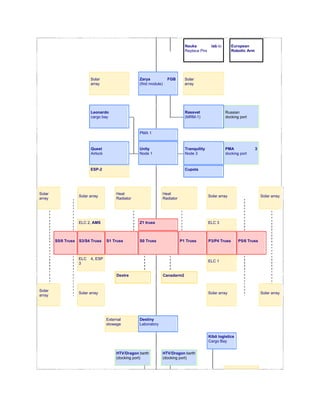
Below is a diagram of major station components. The blue areas are pressurised sections accessible by
the crew without using spacesuits. The station's unpressurised superstructure is indicated in red. Other
unpressurised components are yellow. Note that the Unity node joins directly to the Destiny laboratory.
For clarity, they are shown apart.


                                                 Russian
                                                 docking port


                         Solar                   Zvezda      DOS-8      Solar
                         array                   Service Module         array


          Russian        Poisk(MRM-2)                                   Pirs            Russian
          docking port   Airlock                                        Airlock         docking port
Nauka           lab to       European
                                                                                  Replace Pirs                 Robotic Arm


                           Solar                     Zarya             FGB        Solar
                           array                     (first module)               array


                           Leonardo                                               Rassvet                  Russian
                           cargo bay                                              (MRM-1)                  docking port


                                                     PMA 1


                           Quest                     Unity                        Tranquility              PMA               3
                           Airlock                   Node 1                       Node 3                   docking port


                           ESP-2                                                  Cupola


Solar                                     Heat                    Heat
                     Solar array                                                                 Solar array                     Solar array
array                                     Radiator                Radiator


                     ELC 2, AMS                      Z1 truss                                    ELC 3


        S5/6 Truss   S3/S4 Truss     S1 Truss        S0 Truss                P1 Truss            P3/P4 Truss      P5/6 Truss


                     ELC   4, ESP
                                                                                                 ELC 1
                     3


                                          Dextre                      Canadarm2


Solar
                     Solar array                                                                 Solar array                     Solar array
array


                                     External        Destiny
                                     stowage         Laboratory


                                                                                                 Kibō logistics
                                                                                                 Cargo Bay


                                          HTV/Dragon berth        HTV/Dragon berth
                                          (docking port)          (docking port)
Robotic Arm


           External      Columbus                Harmony               Kibō                Kibō
           Payloads      Laboratory              (Node 2)              Laboratory          External Platform


                                                 PMA              2
                                                 docking port


[edit]Assembly
Main article: Assembly of the International Space Station

See also: List of ISS spacewalks


Ron Garan during STS-124 uses a computer controlled screwdriver for speed, torque and number of turns.

The assembly of the International Space Station, a major endeavour in space architecture, began in
                    [3]
November 1998. Russian modules launched and docked robotically, with the exception of Rassvet. All
other modules were delivered by the Space Shuttle, which required installation by ISS and shuttle
crewmembers using the SSRMS and EVAs; as of 5 June 2011, they had added 159 components during
more than 1,000 hours of EVA activity. 127 of these spacewalks originated from the station, while the
                                                                           [2]
remaining 32 were launched from the airlocks of docked Space Shuttles. The beta angle of the station
had to be considered at all times during construction, as the station's beta angle is directly related to the
percentage of its orbit that the station (as well as any docked or docking spacecraft) is exposed to the
                                                                                            [83]
sun; the Space Shuttle would not perform optimally above a limit called the "beta cutoff". Rassvet was
delivered by NASA's Atlantis Space Shuttle in 2010 in exchange for the Russian Proton delivery of the
                                                           [84]
United States-funded Russian-built Zarya Module in 1998. Robot arms rather than EVAs were utilised
in its installation (docking).

The first segment of the ISS, Zarya, was launched on 20 November 1998 on an autonomous
Russian Proton rocket. It provided propulsion, orientation control, communications, electrical power, but
lacked long-term life support functions. Two weeks later a passive NASA module Unity was launched
aboard Space Shuttle flight STS-88 and attached to Zarya by astronauts during EVAs. This module has
two Pressurized Mating Adapters (PMAs), one connects permanently to Zarya, the other allows the
Space Shuttle to dock to the space station. At this time, the Russian station Mir was still inhabited. The
ISS remained unmanned for two years, during which time Mir was de-orbited. On 12 July
2000 Zvezda was launched into orbit. Preprogrammed commands on board deployed its solar arrays and
communications antenna. It then became the passive vehicle for a rendezvous with the Zarya and Unity.
As a passive "target" vehicle, the Zvezda maintained a stationkeeping orbit as the Zarya-Unity vehicle
performed the rendezvous and docking via ground control and the Russian automated rendezvous and
docking system. Zarya's computer transferred control of the station to Zvezda's computer soon after
docking. Zvezda added sleeping quarters, a toilet, kitchen, CO2 scrubbers, dehumidifier, oxygen
generators, exercise equipment, plus data, voice and television communications with mission control.
                                                  [85][86]
This enabled permanent habitation of the station.

The first resident crew, Expedition 1, arrived in November 2000 on Soyuz TM-31, midway between the
flights of STS-92 and STS-97. These two Space Shuttle flights each added segments of the
station's Integrated Truss Structure, which provided the station with Ku-band communication for U.S.
television, additional attitude support needed for the additional weight of the USOS, and substantial solar
                                                            [87]
arrays supplementing the station's existing 4 solar arrays.


Partially constructed ISS in December 2002

Over the next two years the station continued to expand. A Soyuz-U rocket delivered the Pirs docking
compartment.         The       Space          Shuttles Discovery,Atlantis,         and Endeavour delivered
the Destiny laboratory and Quest airlock, in addition to the station's main robot arm, the Canadarm2, and
several more segments of the Integrated Truss Structure.

The expansion schedule was interrupted by the destruction of the Space Shuttle Columbia on STS-107 in
2003, with the resulting hiatus in the Space Shuttle programme halting station assembly until the launch
                                   [88]
of Discovery on STS-114 in 2005.

The official resumption of assembly was marked by the arrival of Atlantis, flying STS-115, which delivered
the station's second set of solar arrays. Several more truss segments and a third set of arrays were
delivered on STS-116, STS-117, and STS-118. As a result of the major expansion of the station's power-
generating capabilities, more pressurised modules could be accommodated, and the Harmony node
and Columbus European laboratory were added. These were followed shortly after by the first two
components of Kibō. In March 2009, STS-119 completed the Integrated Truss Structure with the
installation of the fourth and final set of solar arrays. The final section of Kibō was delivered in July 2009
on STS-127, followed by the Russian Poisk module. The third node, Tranquility, was delivered in
February 2010 during STS-130 by the Space Shuttle Endeavour, alongside the Cupola, closely followed
in May 2010 by the penultimate Russian module, Rassvet, delivered by Space Shuttle Atlantis on STS-
132. The last pressurised module of the USOS, Leonardo, was brought to the station by Discovery on her
final flight, STS-133, followed           by    the Alpha      Magnetic       Spectrometer on STS-134,   delivered
               [citation needed]
by Endeavour.


ISS in orbit docked with the Space Shuttle Endeavour in May 2011

As of June 2011, the station consisted of fifteen pressurised modules and the Integrated Truss Structure.
Still to be launched are the RussianMultipurpose Laboratory Module Nauka and a number of external
components, including the European Robotic Arm. Assembly is expected to be completed by 2012, by
                                                                                       [3][89]
which point the station will have a mass in excess of 400 metric tons (440 short tons).

The gross mass of the station is not possible to calculate with precision. The total launch weight of the
                                                                 [90]
modules on orbit is 417,289 kg (919,960 lb) (as of 03/09/2011). The mass of experiments, spare parts,
personal effects, crew, foodstuff, clothing, propellants, water supplies, gas supplies, docked spacecraft,
and other items add to the total mass of the station. Gas (Hydrogen) is constantly vented overboard by
the Oxygen generators.

[edit]Pressurised        modules
Main article: Assembly sequence


                               Unity node (top) and Zarya From top to bottom: Unity, Zarya,
                               (with solar panels deployed) Zvezda modules with Progress M1-
                               in 1998                    3 docked


Zarya (Russian:       ; lit. dawn), also known as the Functional Cargo Block or FGB(Russian: ФГБ),
was the first module of the station, launched on 20 November 1998 on a Russian Proton rocket from Site
81 in the first and largest spaceport, Baikonur to a 400 km (250 mi) high orbit. After parking in orbit, the
Zarya Module provided orientation control, communications and electrical power for itself, and for the
passive Node 1 (Unity) attached later, while the station awaited launch of the third component, a Russian-
provided crew living quarters and early station core, the service module Zvezda. The Service Module
enhanced or replaced many functions of Zarya. The FGB is a descendant of the TKS spacecraft designed
for the Russian Salyut programme. 6,100 kg of propellant fuel can be stored and transferred automatically
to and from ships docked to the Russian portion of the station – the Russian Orbital Segment (ROS).
Zarya was originally intended as a module for the Russian Mir space station, but was not flown as of the
end of the Mir-1 programme. Development costs for Zarya were paid for by Russia (and the former Soviet
Union), spread across previous space station programmes, and some construction and preparation costs
were paid for by the United States.

Unity, a passive connecting module was the first U.S.-built component of the Station. It is cylindrical in
shape, with six berthing locations facilitating connections to other modules. Unity was carried into orbit as
the primary cargo of STS-88 in 1998.

Zvezda (Russian: Звезда,          meaning       "star"), DOS-8,      also      known       as       the Service
Module or SM (Russian: СМ). It provides all of the station's critical systems, its addition rendered the
station permanently habitable for the first time, adding life support for up to six crew and living quarters for
                                                                                                           [91]
two. Zvezda's DMS-R computer handles guidance, navigation & control for the entire space station. A
second computer which performs the same functions is installed in the Nauka FGB-2. The rocket used for
                                                             [92]
Zvezda's launch was one of the first to carry advertising. The space frame was completed in February
1985, major internal equipment was installed by October 1986, and it was launched on 12 July 2000.
Zvezda is at the rear of the station according to its normal direction of travel and orientation, its engines
are used to boost the station's orbit. Alternatively Russian and European spacecraft can dock to Zvezda's
aft (rear) port and use their engines to boost the station.

Destiny is the primary research facility for United States payloads aboard the ISS. In 2011, NASA
solicited proposals for a not-for-profit group to manage all American science on the station which does not
relate to manned exploration. The module houses 24 International Standard Payload Racks, some of
which are used for environmental systems and crew daily living equipment. Destinyalso serves as the
                                                   [93]
mounting point for the station's Truss Structure.


          Blue EVA hatches in the Pirs airlock frame cosmonaut Thomas Reiter (left), is attired in a liquid cooling and
          Maxim Suraev Flight engineer who displays two Orlanventilation garment that complements the EMU style
          space suits                                           space suit worn by Jeffrey N. Williams in the Quest
Airlock


Quest is the only USOS airlock, Quest hosts spacewalks with both United States EMU and
RussianOrlan spacesuits. Quest consists of two segments; the equipment lock, that stores spacesuits
and equipment, and the crew lock, from which astronauts can exit into space. This module has a
separately controlled atmosphere. Crew sleep in this module, breathing a low nitrogen mixture the night
before scheduled EVAs, to avoid decompression sickness (known as "the bends") in the low pressure
       [94]
suits.

Pirs (Russian: Пирс, meaning "pier"), (Russian: Стыковочный отсек), "docking module", SO-1 or DC-1
(docking compartment), and Poisk (Russian:            ; lit. Search), also known as the Mini-Research
Module 2 (MRM 2), Малый исследовательский модуль 2, or МИМ 2. Pirs and Poisk are Russian
airlock modules. Each of these modules have 2 identical hatches. An outward opening hatch on the MIR
space station failed after it swung open too fast after unlatching, due to a small amount of air pressure
                         [95]
remaining in the airlock. A different entry was used, and the hatch repaired. All EVA hatches on the ISS
open inwards and are pressure sealing. Pirs is used to store, service, and refurbish Russian Orlan suits
and provides contingency entry for crew using the slightly bulkier American suits. The outermost docking
ports on both airlocks allow docking of Soyuz and Progress spacecraft, and the automatic transfer of
                                            [96]
propellants to and from storage on the ROS.

Harmony, is the second of the station's node modules and the utility hub of the USOS. The module
contains four racks that provide electrical power, bus electronic data, and acts as a central connecting
point for several other components via its six Common Berthing Mechanisms (CBMs). The European
Columbus and Japanese Kibō laboratories are permanently berthed to two of the radial ports, the other
two can used for the HTV. American Shuttle Orbiters docked with the ISS via PMA-2, attached to the
forward port. Tranquility is the third and last of the station's U.S. nodes, it contains an additional life
support system to recycle waste water for crew use and supplements oxygen generation. Three of the
four berthing locations are not used. One location has the cupola installed, and one has the docking port
adapter installed.


         Not large enough for crew using spacesuits, the airlock The Columbus Module in 2008
         on Kibō has an internal sliding drawer for experiments.


Columbus, the primary research facility for European payloads aboard the ISS, provides a generic
laboratory as well as facilities specifically designed for biology, biomedical research and fluid physics.
Several mounting locations are affixed to the exterior of the module, which provide power and data to
external experiments such as the European Technology Exposure Facility (EuTEF), Solar Monitoring
Observatory, Materials International Space Station Experiment, and Atomic Clock Ensemble in Space. A
                                                                                         [97][98]
number of expansions are planned for the module to study quantum physics andcosmology.            ESA‘s
development of technologies on all the main areas of life support has been ongoing for more than 20
years and are/have been used in modules such as Columbus and the ATV. The German Aerospace
Center DLR manages ground control operations for Columbus and the ATV is controlled from the French
CNES Toulouse Space Center.
Kibō (Japanese: きぼう, "hope") is the largest single ISS module. This laboratory is used to carry out
research in space medicine, biology, Earth observations, materials production, biotechnology,
communications research, and has facilities for growing plants and fish. During August 2011, an
observatory mounted on Kibō, which utilises the ISS's orbital motion to image the whole sky in the X-ray
                                                                                               [99][100]
spectrum, detected for the first time the moment a star was swallowed by a black hole.                   The
laboratory contains a total of 23 racks, including 10 experiment racks and has a dedicated airlock for
experiments. In a 'shirt sleeves' environment, crew attach an experiment to the sliding drawer within the
airlock, close the inner, and then open the outer hatch. By extending the drawer and removing the
experiment using the dedicated robotic arm, payloads are placed on the external platform. The process
can be reversed and repeated quickly, allowing access to maintain external experiments without the
delays caused by EVA's. Only the Russian and Japanese laboratories have this feature. A smaller
pressurised module is attached to the top of Kibō, serving as a cargo bay. The dedicated Interorbital
communications system allows large amounts of data to be beamed from Kibō's ICS, first to the
Japanese KODAMA satellite in geostationary orbit, then to Japanese ground stations. When a direct
communication link is used, contact time between the ISS and a ground station is limited to approximately
10 minutes per visible pass. When KODAMA relays data between a LEO spacecraft and a ground station,
real-time communications are possible in 60% of the flight path of the spacecraft. Ground staff use tele-
present robotics to conduct on-orbit research without crew intervention.


        The Cupola's design has been compared toDmitri Kondratyev and Paolo Nespoli in the Cupola. Background left to
        the Millennium Falcon from the motion right, Progress M-09M, Soyuz TMA-20, the Leonardomodule and HTV-
        picture Star Wars.                        2.
Tracy Caldwell Dyson poses for a photo in the Cupola, admiring the view of the Earth.

Cupola is a seven window observatory, used to view Earth and docking spacecraft. Its name derives from
the Italian word cupola, which means "dome". The Cupola project was started by NASA and Boeing, but
cancelled due to budget cuts. A barter agreement between NASA and the ESA resulted in the Cupola's
development being resumed in 1998 by the ESA. The module comes equipped with robotic workstations
for operating the station's main robotic arm and shutters to protect its windows from damage caused by
micrometeorites. It features 7 windows, with a 80-centimetre (31 in) round window, the largest window on
the station. The distinctive design has been compared to the 'turret' of the fictitious Millennium Falcon in
                                  [101][102]
the motion picture Star Wars;               the original prop lightsaber used by actor Mark Hamill as Luke
                                                                 [103]
Skywalker in the 1977 film was flown to the station in 2007,           and the Falcon rockets commercial ships
that come to the station use, are named after the Millennium Falcon itself.

Rassvet (Russian:               ; lit. "dawn"), also known as the Mini-Research Module 1 (MRM-1)
(Russian: Малый исследовательский модуль, МИМ 1) and formerly known as the Docking Cargo
Module (DCM), is similar in design to the Mir Docking Module launched on STS-74 in 1995. Rassvet is
primarily used for cargo storage and as a docking port for visiting spacecraft. It was flown to the ISS
aboard       NASA's Space        Shuttle Atlantis on the STS-132 mission     and     connected    in   May
      [104][105]
2010,            Rassvet is the only Russian owned module launched by NASA, to repay for the launch of
                                                                            [106]
Zarya, which is Russian designed and built, but partially paid for by NASA.       Rassvet was launched with
the Russian Nauka Laboratory's Experiments airlock temporarily attached to it, and spare parts for the
European Robotic Arm.

Leonardo Permanent Multipurpose Module (PMM) The three NASA Space Shuttle MPLM cargo
containers Leonardo, Raffaello and Donatello, were built for NASA in Turin, Italy by Alcatel Alenia Space,
                               [107]
now Thales Alenia Space.             The MPLMs are provided to the ISS programme by the Italy (independent
of Italy's role as a member state of ESA) to NASA and are considered to be U.S. elements. In a bartered
exchange for providing these containers, the U.S. has given Italy research time aboard the ISS out of the
                                                                                       [108]
U.S. allotment in addition to that which Italy receives as a member of ESA.                  The Permanent
Multipurpose Module was created by converting Leonardo into a module that could be permanently
                         [109][110][111]
attached to the station.

[edit]Scheduled additional modules
Nauka (Russian:         ; lit. Science), also known as the Multipurpose Laboratory Module (MLM)
or FGB-2, (Russian: Многофункциональный лабораторный модуль, or МЛМ), is the major Russian
                                                                    [112]
laboratory module. It is scheduled to arrive at the station in 2014       and will replace PIRS. Prior to the
arrival of the Nauka, a progress robot spacecraft will dock with PIRS, depart with that module, and both
will be discarded. It contains an additional set of life support systems and orientation control. Originally it
would have routed power from the single Science-and-Power Platform, but that single module design
changed over the first ten years of the ISS mission, and the two science modules which attach to Nauka
via the Node Module each incorporate their own large solar arrays to power Russian science experiments
in the ROS. Nauka's mission has changed over time. During the mid 1990s, it was intended as a backup
for the FGB, and later as a universal docking module (UDM); its docking ports will be able to support
automatic docking of both space craft, additional modules and fuel transfer. Nauka is a module in the 20
ton class and has its own engines. Smaller ISS modules (less than 10 tons) which dock to the ROS do
not have engines of their own, but rely for propulsion upon the spaceship that brings them to the station.
Zvezda and Zarya, like Nauka, weigh about 20 tons each and are launched by the larger Proton rockets
rather than by Soyuz rockets. They are the only 3 modules on the ISS that contain engines, or navigation
computers with star, sun and horizon sensors, to enable flight and station-keeping. Nauka will be
separated from the ISS before de-orbit, together with support modules, and become the OPSEK space
station.

Node Module (UM)/(NM) This 4-ton ball shaped module will support the docking of two scientific and
power modules during the final stage of the station assembly and provide the Russian segment additional
docking ports to receive Soyuz TMA (transportation modified anthropometric) and Progress M spacecraft.
NM is to be incorporated into the ISS in 2014. It will be integrated with a special version of the Progress
cargo ship and launched by a standard Soyuz rocket. The Progress would use its own propulsion and
flight control system to deliver and dock the Node Module to the nadir (Earth-facing) docking port of the
Nauka MLM/FGB-2 module. One port is equipped with an active hybrid docking port, which enables
docking with the MLM module. The remaining five ports are passive hybrids, enabling docking of Soyuz
and Progress vehicles, as well as heavier modules and future spacecraft with modified docking systems.
However more importantly, the node module was conceived to serve as the only permanent element of
the future Russian successor to the ISS, OPSEK. Equipped with six docking ports, the Node Module
would serve as a single permanent core of the future station with all other modules coming and going as
                                      [113][114]
their life span and mission required.            This would be a progression beyond the ISS and Russia's
modular MIR space station, which are in turn more advanced than early monolithic first generation
stations such as Skylab, and early Salyut and Almaz stations.

Science Power Modules 1 & 2 (NEM-1, NEM-2) (Russian: Научно-Энергетический Модуль-1 и -2)

[edit]Cancelled components
The US Habitation Module would have served as the station's living quarters. Instead, the sleep stations
                                            [115]
are now spread throughout the station.            The US Interim Control Module and ISS Propulsion
                                                                                                [116]
Module were intended to replace functions of Zvezda in case of a launch failure.                      The
Russian Universal Docking Module, to which the cancelled Russian Research modules and spacecraft
                    [117]
would have docked.        The Russian Science Power Platform would have provided the Russian Orbital
                                                                       [117]
Segment with a power supply independent of the ITS solar arrays,             and twoRussian Research
                                                              [118]
Modules that were planned to be used for scientific research.
[edit]Unpressurized           elements


ISS Truss Components breakdown showing Trusses and all ORUs in situ

The ISS features a large number of external components that do not require pressurisation. The largest
such component is the Integrated Truss Structure (ITS), to which the station's main solar arrays and
                               [119]
thermal radiators are mounted.       The ITS consists of ten separate segments forming a structure
                      [3]
108.5 m (356 ft) long.

The station in its complete form has several smaller external components, such as the six robotic arms,
                                                                                                [89][120]
the three External Stowage Platforms (ESPs) and four ExPrESS Logistics Carriers (ELCs).                   Whilst
these platforms allow experiments (including MISSE, the STP-H3 and the Robotic Refuelling Mission) to
be deployed and conducted in the vacuum of space by providing electricity and processing experimental
data locally, the platforms' primary function is to store Orbital Replacement Units (ORUs). ORUs are
spare parts that can be replaced when the item either passes its design life or fails. Examples of ORUs
include pumps, storage tanks, antennas and battery units. Such units are replaced either by astronauts
during EVA or by robotic arms. While spare parts were routinely transported to and from the station via
Space Shuttle resupply missions, there was a heavy emphasis on ORU transport once the NASA Shuttle
                            [121]
approached retirement.            Several shuttle missions were dedicated to the delivery of ORUs,
                    [122]           [123]             [124]
including STS-129, STS-133                and STS-134.      To date only one other mode of transportation of
ORUs has been utilised – the Japanese cargo vessel HTV-2 – which delivered an FHRC and CTC-2 via
                          [125]
its Exposed Pallet (EP).


Construction of the Integrated Truss Structure over New Zealand.
There are also smaller exposure facilities mounted directly to laboratory modules; the JEM Exposed
                                                                                        [126]
Facility serves as an external 'porch' for the Japanese Experiment Module complex,            and a facility on
the European Columbus laboratory provides power and data connections for experiments such as
                                                          [127][128]
the European       Technology        Exposure    Facility            and the Atomic Clock      Ensemble       in
        [129]
Space.        A remote sensing instrument, SAGE III-ISS, is due to be delivered to the station in 2014
                              [130]
aboard a Dragon capsule.            The largest such scientific payload externally mounted to the ISS is
theAlpha Magnetic Spectrometer (AMS), a particle physics experiment launched on STS-134 in May
2011, and mounted externally on the ITS. The AMS measures cosmic rays to look for evidence of dark
                        [131]
matter and antimatter.

[edit]Cranes and robotic arms
Canadarm2, the largest robotic arm on the ISS, has a mass of 1,800 kilograms and is used to dock and
manipulate spacecraft and modules on the USOS, and hold crew members and equipment during
       [132]
EVAs.        The ROS does not require spacecraft or modules to be manipulated, as all spacecraft and
modules dock automatically, and may be discarded the same way. Crew use the
2 Strela (Russian: Стрела; lit. Arrow) cargo cranes during EVAs for moving crew and equipment around
the ROS. Each Strela crane has a mass of 45 kg. The Russian and Japanese laboratories both have
airlocks and robotic arms.


          Commander Volkov stands on Pirs with his back to Dextre, like many of the station's experiments and
          the Soyuz whilst    operating    the     manual Strela robotic arms, can be operated from Earth and perform
          craneholding photographer Kononenko. Zarya is seen tasks while the crew sleeps.
          to the left and Zvezda across the bottom of the image.


The Integrated Truss Structure serves as a base for the main remote manipulator system called the
Mobile Servicing System (MSS). This consists of the Mobile Base System (MBS), the Canadarm2,
and Dextre. Dextre is a 1,500 kg agile robotic manipulator with two 'arms' which have 7 degrees of
movement each, a 'torso' which bends at the waist and rotates at the base, a tool holster, lights and
video. Staff on earth can operate Dextre via remote control, performing work without crew intervention.
The MBS rolls along rails built into some of the ITS segments to allow the arm to reach all parts of the
                                       [133]
United States segment of the station.        The MSS had its reach increased an Orbiter Boom Sensor
System in May 2011, used to inspect tiles on the NASA shuttle, and converted for permanent station use.
To gain access to the extreme extents of the Russian Segment the crew also placed a "Power Data
Grapple Fixture" to the forward docking section of Zarya, so that the Canadarm2 may inchworm itself onto
           [134]
that point.
The European Robotic Arm, which will service the Russian Orbital Segment, will be launched alongside
                                              [135]
the Multipurpose Laboratory Module in 2012.         The Japanese Experiment Module's Remote Manipulator
                                                                   [136]
System (JFM RMS), which services the JEM Exposed Facility,               was launched on STS-124 and is
                                        [137]
attached to the JEM Pressurised Module.

[edit]Station     systems
[edit]Life   support
Main articles: ISS ECLSS and Chemical oxygen generator

The critical systems are the atmosphere control system, the water supply system, the food supply
facilities, the sanitation and hygiene equipment, and fire detection and suppression equipment. The
Russian orbital segment's life support systems are contained in the Service Module Zvezda. Some of
these systems are supplemented by equipment in the USOS. The MLM Nauka laboratory has a complete
set of life support systems.

[edit]Atmospheric control systems
                                                                 [138]
The atmosphere on board the ISS is similar to the Earth's.          Normal air pressure on the ISS is
                     [139]
101.3 kPa (14.7 psi);      the same as at sea level on Earth. An Earth-like atmosphere offers benefits for
crew comfort, and is much safer than the alternative, a pure oxygen atmosphere, because of the
                                                                                            [140]
increased risk of a fire such as that responsible for the deaths of the Apollo 1crew.             Earth-like
                                                                                   [141]
atmospheric conditions have been maintained on all Russian and Soviet spacecraft.


Elektron units in the Zvezda service module.

The Elektron system aboard Zvezda and a similar system in Destiny generate oxygen aboard the
        [142]
station.      The crew has a backup option in the form of bottled oxygen and Solid Fuel Oxygen
                                                                   [143]
Generation (SFOG) canisters, a chemical oxygen generator system. Carbon dioxide is removed from
the air by the Vozdukh system in Zvezda. Other by-products of human metabolism, such as methane
                                                                                       [143]
from the intestines and ammonia from sweat, are removed by activated charcoal filters.

Part of the ROS atmosphere control system is the oxygen supply, triple-redundancy is provided by the
Elektron unit, solid fuel generators, and stored oxygen. The Elektron unit is the primary oxygen
supply, O2 and H2 are produced by electrolysis, with the H2 being vented overboard. The 1 kW system
uses approximately 1 litre of water per crew member per day from stored water from Earth, or water
recycled from other systems. MIR was the first spacecraft to use recycled water for oxygen production.
The secondary oxygen supply is provided by burning O2-producing Vika cartridges (see also ISS ECLSS).
Each 'candle' takes 5–20 minutes to decompose at 450–500 °C, producing 600 litres of O2. This unit is
                   [144]
manually operated.

The US orbital segment has redundant supplies of oxygen, from a pressurised storage tank on the Quest
airlock module delivered in 2001, supplemented ten years later by ESA built Advanced Closed-Loop
                                                                                        [145]
System (ACLS) in the Tranquility module (Node 3), which produces O2by electrolysis.           Hydrogen
produced is combined with carbon dioxide from the cabin atmosphere and converted to water and
methane.

[edit]Food
See also: Space food


The crews of STS-127 and Expedition 20enjoy a meal inside Unity.

Most of the food on board is vacuum sealed in plastic bags. Cans are too heavy and expensive to
transport, so there are not as many. The preserved food is generally not held in high regard by the crew,
                                                                                                [146]
and when combined with the reduced sense of taste in a microgravity environment,                      a great deal of
effort is made to make the food more palatable. More spices are used than in regular cooking, and the
crew looks forward to the arrival of any ships from Earth, as they bring fresh fruit and vegetables with
them. Care is taken that foods do not create crumbs. Sauces are often used to ensure station equipment
is not contaminated. Each crew member has individual food packages and cooks them using the on-
board galley. The galley features two food warmers, a refrigerator added in November 2008, and a water
                                                                   [147]
dispenser that provides both heated and unheated water.                  Drinks are provided in dehydrated powder
                                                        [147][148]
form and are mixed with water before consumption.                  Drinks and soups are sipped from plastic bags
with straws, while solid food is eaten with a knife and fork, which are attached to a tray with magnets to
prevent them from floating away. Any food that does float away, including crumbs, must be collected to
                                                                                [148]
prevent it from clogging up the station's air filters and other equipment.

[edit]Hygiene
                                                                                                [149]:139
Showers on space stations were introduced in the early 1970s on Skylab and Salyut 3.       By Salyut 6,
in the early 1980s, the crew complained of the complexity of showering in space, which was a monthly
activity. The ISS does not feature a shower; instead, crewmembers wash using a water jet and wet wipes,
with soap dispensed from a toothpaste tube-like container. Crews are also provided with rinseless
                                             [150][151]
shampoo and edible toothpaste to save water.

There       are    two space       toilets on        the   ISS,     both    of   Russian       design,   located
                            [147]
in Zvezda and Tranquility.        These Waste and Hygiene Compartments use a fan-driven suction system
similar to the Space Shuttle Waste Collection System. Astronauts first fasten themselves to the toilet seat,
                                                                                        [146]
which is equipped with spring-loaded restraining bars to ensure a good seal.                  A lever operates a
powerful fan and a suction hole slides open: the air stream carries the waste away. Solid waste is
collected in individual bags which are stored in an aluminium container. Full containers are transferred to
                                     [147][152]
Progress spacecraft for disposal.               Liquid waste is evacuated by a hose connected to the front of the
toilet, with anatomically correct "urine funnel adapters" attached to the tube so both men and women can
use the same toilet. Waste is collected and transferred to the Water Recovery System, where it is
                                      [148]
recycled back into drinking water.

[edit]Power    and thermal control
Main articles: Electrical system of the International Space Station and External Active Thermal Control
System


                   Russian solar arrays, backlit by sunset.   One of the eight truss mounted pairs of
                                                              USOS solar arrays


Double-sided solar, or Photovoltaic arrays, provide electrical power for the ISS. These bifacial cells are
more efficient and operate at a lower temperature than single-sided cells commonly used on Earth, by
                                                                                [153]
collecting sunlight on one side and light reflected off the Earth on the other.

The Russian segment of the station, like the Space Shuttle and most spacecraft, uses 28 volt DC from
four rotating solar arrays mounted on Zarya and Zvezda. The USOS uses 130–180 V DC from the USOS
PV array, power is stabilised and distributed at 160 V DC and converted to the user-required 124 V DC.
The higher distribution voltageallows smaller, lighter conductors, at the expense of crew safety. The ROS
                                                                           [119]
uses low voltage. The two station segments share power with converters.

The USOS solar arrays are arranged as four wing pairs, with each wing producing nearly
          [119]
32.8 kW.        These arrays normally track the sun to maximise power generation. Each array is about
       2          2
375 m (450 yd ) in area and 58 metres (63 yd) long. In the complete configuration, the solar arrays track
the sun by rotating the alpha gimbal once per orbit while the beta gimbal follows slower changes in the
angle of the sun to the orbital plane. The Night Glider mode aligns the solar arrays parallel to the ground
                                                                                                      [154]
at night to reduce the significant aerodynamic drag at the station's relatively low orbital altitude.
The station uses rechargeable nickel-hydrogen batteries (NiH2) for continuous power during the 35
minutes of every 90 minute orbit that it is eclipsed by the Earth. The batteries are recharged on the day
side of the Earth. They have a 6.5 year lifetime (over 37,000 charge/discharge cycles) and will be
                                                                     [155]
regularly replaced over the anticipated 20-year life of the station.

The station's large solar panels generate a high potential voltage difference between the station and the
ionosphere. This could cause arcing through insulating surfaces and sputtering of conductive surfaces as
ions are accelerated by the spacecraft plasma sheath. To mitigate this, plasma contactor units (PCU)s
                                                                        [156]
create current paths between the station and the ambient plasma field.


ISS External Active Thermal Control System (EATCS) diagram

The large amount of electrical power consumed by the station's systems and experiments is turned
almost entirely into heat. The heat which can be dissipated through the walls of the stations modules is
insufficient to keep the internal ambient temperature within comfortable, workable limits.Ammonia is
continuously pumped through pipework throughout the station to collect heat, and then into external
radiators exposed to the cold of space, and back into the station.

The International Space Station (ISS) External Active Thermal Control System (EATCS) maintains an
equilibrium when the ISS environment or heat loads exceed the capabilities of the Passive Thermal
Control System (PTCS). Note Elements of the PTCS are external surface materials, insulation such as
MLI, or Heat Pipes. The EATCS provides heat rejection capabilities for all the US pressurised modules,
including the JEM and COF as well as the main power distribution electronics of the S0, S1 and P1
Trusses. The EATCS consists of two independent Loops (Loop A & Loop B), they both use mechanically
pumped Ammonia in fluid state, in closed-loop circuits. The EATCS is capable of rejecting up to 70 kW,
and provides a substantial upgrade in heat rejection capacity from the 14 kW capability of the Early
External Active Thermal Control System (EEATCS) via the Early Ammonia Servicer (EAS), which was
                                                     [157]
launched on STS-105 and installed onto the P6 Truss.

[edit]Communications            and computers
Main articles: Tracking and Data Relay Satellite and Luch (satellite)

See also: ThinkPad use in space
The               communications           systems             used             by             the            ISS
* Luch satellite not currently in use

Radio communications provide telemetry and scientific data links between the station and Mission Control
Centres. Radio links are also used during rendezvous and docking procedures and for audio and video
communication between crewmembers, flight controllers and family members. As a result, the ISS is
                                                                                       [158]
equipped with internal and external communication systems used for different purposes.

The Russian Orbital Segment communicates directly with the ground via the Lira antenna mounted
              [15][159]
to Zvezda.              The Lira antenna also has the capability to use the Luch data relay satellite
         [15]
system. This system, used for communications with Mir, fell into disrepair during the 1990s, and as a
                                [15][160][161]
result is no longer in use,                    although two new Luch satellites—Luch-5A and Luch-5B—are planned
                                                                                             [162]
for launch in 2011 to restore the operational capability of the system.                            Another Russian
communications system is the Voskhod-M, which enables internal telephone communications
between Zvezda, Zarya, Pirs, Poisk and the USOS, and also provides a VHF radio link to ground control
                                                      [163]
centres via antennas on Zvezda's exterior.

The US Orbital Segment (USOS) makes use of two separate radio links mounted in the Z1 truss
structure: the S band (used for audio) and Ku band (used for audio, video and data) systems. These
transmissions are routed via the United States Tracking and Data Relay Satellite System (TDRSS)
in geostationary orbit, which allows for almost continuous real-time communications with NASA's Mission
                                               [10][15][158]
Control      Center (MCC-H)        in Houston.               Data channels  for     the    Canadarm2,
European Columbus laboratory and Japanese Kibōmodules are routed via the S band and K u band
systems, although the European Data Relay Satellite System and a similar Japanese system will
[10][164]
eventually complement the TDRSS in this role.                  Communications between modules are carried on
                                    [165]
an internal digitalwireless network.


Laptop computers surround the Canadarm2 console.

UHF radio is used by astronauts and cosmonauts conducting EVAs. UHF is employed by other
spacecraft that dock to or undock from the station, such as Soyuz, Progress, HTV, ATV and the Space
Shuttle (except the shuttle also makes use of the S band and K u band systems via TDRSS), to receive
                                                        [15]
commands from Mission Control and ISS crewmembers. Automated spacecraft are fitted with their own
communications equipment; the ATV uses a laser attached to the spacecraft and equipment attached
                                                                                               [166][167]
to Zvezda, known as the Proximity Communications Equipment, to accurately dock to the station.

The ISS is equipped with approximately 100 IBM and Lenovo ThinkPad model A31 and T61P laptop
computers. Each computer is a commercial off-the-shelf purchase which is then modified for safety and
operation including updates to connectors, cooling and power to accommodate the station's 28V DC
power system and weightless environment. Heat generated by the laptops doesn't rise, but stagnates
surrounding the laptop, so additional forced ventilation is required. Laptops aboard the ISS are connected
to the station's wireless LAN via Wi-Fi and are connected to the ground at 3 Mbit/s up and 10 Mbit/s
                                                      [168]
down, comparable to home DSL connection speeds.
Expeditions and private flights


Soyuz TM-31 being prepared to bring the first resident crew to the station in October 2000

See also the list of professional crew, private travellers, or both

The station crew "are our representatives spearheading humanity's exploration of new spaces and
                                                                  [169]
possibilities for our future" according to Pope Benedict XVI.           Each permanent crew is given an
expedition number. Expeditions run up to six months, from launch until undocking, an 'increment' covers
the same time period, but includes cargo ships and all activities. Expeditions 1 to 6 consisted of 3 person
crews, Expeditions 7 to 12 were reduced to the safe minimum of two following the destruction of the
                                                                                                [170][171]
NASA Shuttle Columbia. From Expedition 13 the crew gradually increased to 6 around 2010.                   With
the arrival of the American Commercial Crew vehicles in the middle of the 2010s, expedition size may be
                                                                      [172][173]
increased to seven crew members, the number ISS is designed for.

Sergei Krikalev, member of Expedition 1 and Commander of Expedition 11 has spent more time in space
than anyone else, a total of 803 days and 9 hours and 39 minutes. His awards include the Order of
Lenin, Hero of the Soviet Union, Hero of the Russian Federation, and 4 NASA medals. On 16 August
2005 at 1:44 am EDT he passed the record of 748 days held by Sergei Avdeyev, who had 'time travelled'
                                                      [174]
1/50th of a second into the future on board MIR.            He participated in psychosocial experiment
SFINCSS-99 (Simulation of Flight of International Crew on Space Station), which examined inter-cultural
and other stress factors effecting integration of crew in preparation for the ISS spaceflights.
Commander Michael Fincke is the U.S. space endurance record holder with a total of 382 days.

Travelers who pay for their own passage into space are called spaceflight participants by the RSA and
                                                                                         [note 1]
NASA, and are sometimes referred to as space tourists, a term they generally dislike.             All seven were
transported to the ISS on Russian Soyuz spacecraft. When professional crews change over in numbers
not divisible by the three seats in a Soyuz, and a short-stay crewmember is not sent, the spare seat is
sold by MirCorp through Space Adventures. When the space shuttle retired in 2011, and the station's
crew size was reduced to 6, space tourism was halted, as the partners relied on Russian transport seats
for access to the station. Soyuz flight schedules increase after 2013, allowing 5 Soyuz flights (15 seats)
                                                [180]
with only two expeditions (12 seats) required.        The remaining seats are sold for around US$40 million
to members of the public who can pass a medical. ESA and NASA criticised private spaceflight at the
beginning of the ISS, and NASA initially resisted training Dennis Tito, the first man to pay for his own
                     [note 2]
passage to the ISS.           Toyohiro Akiyama was flown to Mir for a week, he was classed as a business
traveller, as his employer, Tokyo Broadcasting System, paid for his ticket, and he gave a daily TV
broadcast from orbit.
Anousheh Ansari (Persian:                 ) became the first Iranian in space and the first self-funded woman
to fly to the station. Officials reported that her education and experience make her much more than a
                                                                   [181]
tourist, and her performance in training had been "excellent."           Ansari herself dismisses the idea that
she is a tourist. She did Russian and European studies involving medicine and microbiology during her 10
day stay. The documentary Space Tourists follows her journey to the station, where she fulfilled the
                                                                                           [182]
childhood dream 'to leave our planet as a normal person and travel into outer space.'            In the film, some
Kazakhs are shown waiting in the middle of the steppes for four rocket stages to literally fall from the sky.
Film-maker Christian Frei states "Filming the work of the Kazakh scrap metal collectors was anything but
easy. The Russian authorities finally gave us a film permit in principle, but they imposed crippling
preconditions on our activities. The real daily routine of the scrap metal collectors could definitely not be
shown. Secret service agents and military personnel dressed in overalls and helmets were willing to re-
enact their work for the cameras – in an idealised way that officials in Moscow deemed to be presentable,
but not at all how it takes place in reality."

[edit]Crew    activities


NASA astronaut Scott Kelly works on theCombustion Integrated Rack in the Destiny laboratory.

A typical day for the crew begins with a wake-up at 06:00, followed by post-sleep activities and a morning
inspection of the station. The crew then eats breakfast and takes part in a daily planning conference with
Mission Control before starting work at around 08:10. The first scheduled exercise of the day follows,
after which the crew continues work until 13:05. Following a one-hour lunch break, the afternoon consists
of more exercise and work before the crew carries out its pre-sleep activities beginning at 19:30, including
dinner and a crew conference. The scheduled sleep period begins at 21:30. In general, the crew works
ten hours per day on a weekday, and five hours on Saturdays, with the rest of the time their own for
                             [183]
relaxation or work catch-up.

The station provides crew quarters for each member of the expedition's crew, with two 'sleep stations' in
                                                    [184][185]
the Zvezda and four more installed inHarmony.                  The American quarters are private, approximately
person-sized soundproof booths. The Russian crew quarters include a small window, but do not provide
the same amount of ventilation or block the same amount of noise as their American counterparts. A
crewmember can sleep in a crew quarter in a tethered sleeping bag, listen to music, use a laptop, and
store personal items in a large drawer or in nets attached to the module's walls. The module also provides
                                          [146][147][148]
a reading lamp, a shelf and a desktop.                    Visiting crews have no allocated sleep module, and
attach a sleeping bag to an available space on a wall—it is possible to sleep floating freely through the
                                                                                                          [150]
station, but this is generally avoided because of the possibility of bumping into sensitive equipment.          It
is important that crew accommodations be well ventilated; otherwise, astronauts can wake up oxygen-
deprived and gasping for air, because a bubble of their own exhaled carbon dioxide has formed around
             [146]
their heads.


Orbit and mission control


       Graph showing the changing altitude of the ISS from November Animation of ISS orbit from a North American
       1998 until January 2009                                   geostationary point of view (sped up 1800 times)


The ISS is maintained in a nearly circular orbit with a minimum mean altitude of 330 km (205 mi) and a
maximum of 410 km (255 mi), in the centre of the Thermosphere, at an inclination of 51.6 degrees to
Earth's equator, necessary to ensure that Russian Soyuz and Progress spacecraft launched from
the Baikonur Cosmodrome may be safely launched to reach the station. Spent rocket stages must be
dropped into uninhabited areas and this limits the directions rockets can be launched from the
           [186][187]
spaceport.            The orbital inclination chosen was also low enough to allow American space shuttles
launched from Florida to reach the ISS.

It travels at an average speed of 27,724 kilometres (17,227 mi) per hour, and completes 15.7 orbits per
      [20]
day. The station's altitude was allowed to fall around the time of each NASA shuttle mission. Orbital
boost burns would generally be delayed until after the shuttle's departure. This allowed shuttle payloads
to be lifted with the station's engines during the routine firings, rather than have the shuttle lift itself and
the payload together to a higher orbit. This trade-off allowed heavier loads to be transferred to the station.
After the retirement of the NASA shuttle, the nominal orbit of the space station was raised in
           [188][189]
altitude.             Other, more frequent supply ships do not require this adjustment as they are substantially
                      [27][190]
lighter vehicles.

Orbital boosting can be performed by the station's two main engines on the Zvezda service module, or
Russian or European spacecraft docked to Zvezda's aft port. The ATV has been designed with the
possibility of adding a second docking port to its other end, allowing it to remain at the ISS and still allow
other craft to dock and boost the station. It takes approximately two orbits (three hours) for the boost to a
                                  [190]
higher altitude to be completed.        In December 2008 NASA signed an agreement with the Ad Astra
Rocket Company which may result in the testing on the ISS of aVASIMR plasma propulsion
        [191]
engine.       This technology could allow station-keeping to be done more economically than at
         [192][193]
present.
The Russian Orbital Segment contains the station's engines and control bridge, which handles Guidance,
                                                            [91]
Navigation and Control (ROS GNC) for the entire station. Initially, Zarya, the first module of the station,
controlled the station until a short time after the Russian service module Zvezda docked and was
                                                                                               [194]
transferred control. Zvezda contains the ESA built DMS-R Data Management System.                     Using two fault-
tolerant computers (FTC), Zvezda computes the station's position and orbital trajectory using redundant
Earth horizon sensors, Solar horizon sensors as well as Sun and star trackers. The FTCs each contain
three identical processing units working in parallel and provide advanced fault-masking by majority voting.
Zvezda uses gyroscopes and thrusters to turn itself around. Gyroscopes don't need propellant, rather
they use electricity to 'store' momentum in flywheels by turning in the opposite direction to the station's
movement. The USOS has its own computer controlled gyroscopes to handle the extra mass of that
section. When gyroscopes 'saturate', reaching their maximum speed, thrusters are used to cancel out the
stored momentum. During Expedition 10, an incorrect command was sent to the station's computer, using
about 14 kilograms of propellant before the fault was noticed and fixed. When attitude control computers
in the ROS and USOS don't communicate properly, it can result in a rare 'force fight' where the ROS GNC
                                                                              [195][196][197]
computer must ignore the USOS counterpart, which has no thrusters.                            When an ATV, Nasa
Shuttle, or Soyuz is docked to the station, it can also be used to maintain station attitude such as for
troubleshooting. Shuttle control was used exclusively during installation of the S3/S4 truss, which
                                                                             [198]
provides electrical power and data interfaces for the station's electronics.


Space centres involved with the ISS programme

The components of the ISS are operated and monitored by their respective space agencies at mission
control centres across the globe, including:
Roskosmos's Mission Control Center at Korolyov, Moscow Oblast, controls the Russian Orbital
                                                                                   [91][194]
     Segment which handles Guidance, Navigation & Control for the entire Station.,           in addition to
                                             [15]
     individual Soyuz and Progress missions.
     ESA's ATV Control Centre, at the Toulouse Space Centre (CST) in Toulouse, France, controls flights
                                                          [15]
     of the unmanned European Automated Transfer Vehicle.
     JAXA's JEM Control Centre and HTV Control Centre at Tsukuba Space Centre (TKSC) in Tsukuba,
     Japan, are responsible for operating the Japanese Experiment Module complex and all flights of the
                                                       [15]
     'White Stork' HTV Cargo spacecraft, respectively.
     NASA's Mission Control Center at Lyndon B. Johnson Space Center in Houston, Texas, serves as
     the primary control facility for the United States segment of the ISS and also controlled the Space
                                                [15]
     Shuttle missions that visited the station.
     NASA's Payload Operations and Integration Center at Marshall Space Flight Center in Huntsville,
                                                          [15]
     Alabama, coordinates payload operations in the USOS.
     ESA's Columbus Control Centre at the German Aerospace Centre (DLR) in Oberpfaffenhofen,
                                                                 [15]
     Germany, manages the European Columbus research laboratory.
     CSA's MSS Control at Saint-Hubert, Quebec, Canada, controls and monitors the Mobile Servicing
                           [15]
     System, or Canadarm2.
[edit]Repairs
Main articles: Orbital Replacement Units and International Space Station maintenance

Orbital Replacement Units (ORUs) are spare parts that can be readily replaced when a unit either
passes its design life or fails. Examples of ORUs are pumps, storage tanks, controller boxes, antennas,
and battery units. Some units can be replaced using robotic arms. Many are stored outside the station,
either on small pallets called ExPRESS Logistics Carriers (ELCs) or share larger platforms called External
Stowage Platforms which also hold science experiments. Both kinds of pallets have electricity as many
parts which could be damaged by the cold of space require heating. The larger logistics carriers also
have computer local area network connections (LAN) and telemetry to connect experiments. A heavy
emphasis on stocking the USOS with ORU's occurred around 2011, before the end of the NASA shuttle
program, as its commercial replacements, Cygnus and Dragon, carry one tenth to one quarter the
payload.


Spare parts are called ORU's, some are externally stored on pallets called ELC's and ESP's.

Unexpected problems and failures have impacted the station's assembly time-line and work schedules
leading to periods of reduced capabilities and, in some cases, could have forced abandonment of the
station for safety reasons, had these problems not been resolved. During STS-120 on 2007, following the
relocation of the P6 truss and solar arrays, it was noted during the redeployment of the array that it had
                                                  [199]
become torn and was not deploying properly.             An EVA was carried out by Scott Parazynski, assisted
by Douglas Wheelock, the men took extra precautions to reduce the risk of electric shock, as the repairs
                                                               [200]
were carried out with the solar array exposed to sunlight.           The issues with the array were followed in
the same year by problems with the starboard Solar Alpha Rotary Joint (SARJ), which rotates the arrays
on the starboard side of the station. Excessive vibration and high-current spikes in the array drive motor
were noted, resulting in a decision to substantially curtail motion of the starboard SARJ until the cause
was understood. Inspections during EVAs on STS-120 and STS-123 showed extensive contamination
from metallic shavings and debris in the large drive gear and confirmed damage to the large metallic race
                                                                                         [201]
ring at the heart of the joint, and so the joint was locked to prevent further damage.         Repairs to the joint
were carried out during STS-126 with lubrication of both joints and the replacement of 11 out of 12 trundle
                       [202][203]
bearings on the joint.


While anchored on the end of the OBSS, astronaut Scott Parazynski performs makeshift repairs to a US Solar array which
damaged itself when unfolding, during STS-120.

2009 saw damage to the S1 radiator, one of the components of the station's cooling system. The problem
                                                                                          [204]
was first noticed in Soyuz imagery in September 2008, but was not thought to be serious.        The imagery
showed that the surface of one sub-panel has peeled back from the underlying central structure, possibly
due to micro-meteoroid or debris impact. It is also known that a Service Module thruster cover, jettisoned
during an EVA in 2008, had struck the S1 radiator, but its effect, if any, has not been determined. On 15
May 2009 the damaged radiator panel's ammonia tubing was mechanically shut off from the rest of the
cooling system by the computer-controlled closure of a valve. The same valve was used immediately
afterwards to vent the ammonia from the damaged panel, eliminating the possibility of an ammonia leak
                                                 [204]
from the cooling system via the damaged panel.

Early on 1 August 2010, a failure in cooling Loop A (starboard side), one of two external cooling loops, left
the station with only half of its normal cooling capacity and zero redundancy in some
         [205][206][207]
systems.                 The problem appeared to be in the ammonia pump module that circulates the
ammonia cooling fluid. Several subsystems, including two of the four CMGs, were shut down.

Planned operations on the ISS were interrupted through a series of EVAs to address the cooling system
issue. A first EVA on 7 August 2010, to replace the failed pump module, was not fully completed due to
an ammonia leak in one of four quick-disconnects. A second EVA on 11 August successfully removed the
                    [208][209]                                                                     [210][211]
failed pump module.            A third EVA was required to restore Loop A to normal functionality.
[212]
The USOS's cooling system is largely built by the American company Boeing,                       which is also the
                                 [213]
manufacturer of the failed pump.
                                          [214]
An air leak from the USOS in 2004,          the venting of fumes from an Elektron oxygen generator in
      [215]
2006,       and the failure of the computers in the ROS in 2007 during STS-117 which left the station
without thruster, Elektron, Vozdukh and other environmental control system operations, the root cause of
                                                                                                [citation needed]
which was found to be condensation inside the electrical connectors leading to a short-circuit.

The four Main Bus Switching Units (MBSUs, located in the S0 truss), control the routing of power from the
four solar array wings to the rest of the ISS. In late 2011 MBSU-1, while still routing power correctly,
ceased responding to commands or sending data confirming its health, and was scheduled to be
swapped out at the next available EVA. In each MBSU, two power channels feed 160V DC from the
arrays to two DC-to-DC power converters (DDCUs) that supply the 124V power used in the station. A
spare MBSU was already on board, but the 30 August 2012 EVA failed to be completed when a bolt
being tightened to finish installation of the spare unit jammed before electrical connection was
          [216]
secured.        The loss of MBSU-1 limits the station to 75% of its normal power capacity, requiring minor
limitations in normal operations until the problem can be addressed.

As of 2 September 2012, a second EVA to tighten the balky bolt, completing the installation of the
                                                                                                [217]
replacement MBSU-1 in an attempt to restore full power, has been scheduled for Wednesday,             Yet in
the meanwhile, a third solar array wing has gone off line due to some fault in that array's Direct Current
Switching Unit (DCSU) or its associated system, further reducing ISS power to just five of the eight solar
array wings for the first time in several years.

On 5 September 2012, in a second, 6 hr, EVA to replace MBSU-1, astronauts Sunita Williams and
                                                             [218]
Akihiko Hoshide successfully restored the ISS to 100% power.

[edit]Fleet   operations
Progress M-15M (ISS-47P) was the 48th progress robot to arrive at the ISS, including M-MIM2 and M-
SO1 which installed modules. Thirty-five flights of the retired NASA Space Shuttle were made to the
        [2]
station. TMA-05M is the 31st Soyuz flight, and there have been three European ATV and three
Japanese Kounotori 'White Stork' arrivals.
The Progress M-14M resupply vehicle as it approaches the ISS. Almost 50 unpiloted Progress spacecraft have been sent
with supplies during the lifetime of the station.

[edit]Currently        docked/berthed
See also the list of professional crew, private travellers, both or just the Robots.


Spacecraft and mission                                  Location Arrived (UTC)               Departure date


      Progress M-16M                  Progress 48 Cargo Pirs       2 August 2012 01:18       11 February 2013


      Soyuz TMA-06M 'Union' Expedition 33/34            Poisk      25 October 2012 12:29 15 March 2013


      Progress M-17M                  Progress 49 Cargo Zvezda     31 October 2012 13:33 27 April 2013

[edit]Scheduled           launches and dockings/berthings
All dates are UTC. Dates are the earliest possible dates and may change. Forward ports are at the front
of the station according to its normal direction of travel and orientation (attitude). Aft is at the rear of the
station, used by spacecraft boosting the station's orbit. Nadir is closest the Earth, Zenith is on top.

Uncrewed cargoships are in light blue. Crewed spacecraft are in light green. Modules are white.
Spacecraft operated by government agencies are indicated with 'Gov', while 'Com' denotes those
operated under commercial arrangements.


                                                                                            Docking/Berthing
Spacecraft and operator                   Spaceport and mission              Launch
                                                                                            Port


2012 launches                                                                2012


              Soyuz               TMA-
      Gov                                 Baikonur      Expedition 34/35     19 December Rassvet
              07M 'Union'


2013 onwards                                                                 2013


                                                        Progress        50
      Gov Progress M-18M                  Baikonur                           February       Pirs nadir
                                                        Cargo
Cape
      Com Dragon CRS Spx-2                                Dragon 2 Cargo         March              Harmony nadir
                                        Canaveral


                                        MARS (in          Cygnus          COTS
      Com Cygnus COTS Demo                                                       April              Harmony nadir
                                        USA)              Demo


      Gov Albert Einstein               French Guiana ATV-4 Cargo                April              Zvezda aft


             Kounotori      4 'White
      Gov                               Tanegashima       HTV-4 Cargo            June               Harmony
             Stork'


                                                          Module Nauka                      [219]
      Gov Proton                        Baikonur                                 December           Zvezda nadir
                                                          MLM


             Progress M-UM          &                     Module Node
      Gov                               Baikonur                                 2014               Nauka nadir
             Soyuz-2.1b                                   Module


             Proton-M (or Angara
      Gov                        Baikonur                 Module NEM-1           2014               Node Module nadir
             A5)


             Proton-M (or Angara
      Gov                        Baikonur                 Module NEM-2           2015               Node Module nadir
             A5)

[edit]Docking
See also: Spacecraft Docking and Berthing Mechanisms


View through automatic (left) and NASA shuttle (right) docking systems.
All Russian manned spacecraft, modules, and progress craft are able to rendezvous and dock to the
space station without human intervention. UsingKurs radar they detect and intercept the ISS from over
200 kilometres away. The European ATV uses star sensors and GPS to determine its intercept course,
when it catches up it then uses laser equipment to optically recognise Zvezda, with Russian Kurs
redundancy. Crew supervise these craft, but do not intervene except to send abort commands in
emergencies. The Japanese H-II Transfer Vehicle parks itself in progressively closer orbits to the station,
and then awaits 'approach' commands from the crew, until it is close enough for the crew to grapple it with
a robotic arm and berth it to the USOS. The American Space Shuttle was manually docked, and on
missions with a cargo container, the container would be berthed to the Station with the use of manual
robotic arms. Berthed craft can transfer International Standard Payload Racks. Japanese spacecraft berth
for one to two months. Russian and European Supply craft can remain at the ISS for six
         [220][221]
months,             allowing great flexibility in crew time for loading and unloading of supplies and trash.
                                                          [222]
NASA Shuttles could remain docked for 11–12 days.

The American manual approach to docking allows greater initial flexibility and less complexity. The
downside to this mode of operation is that each mission becomes unique and requires specialised
training and planning, making the process more labour-intensive and expensive. The Russians pursued
an automated methodology that used the crew in override or monitoring roles. Although the initial
development costs were high, the system has become very reliable with standardisations that provide
                                                            [223]
significant cost benefits in repetitive routine operations.       An automated approach could allow assembly
of modules orbiting other worlds prior to manned missions.


Space Shuttle Endeavour, ATV-2, Soyuz TMA-21 and Progress M-10M docked to the ISS during STS-134, as seen from the
departing Soyuz TMA-20
Soyuz manned spacecraft for crew rotation also serve as lifeboats for emergency evacuation, they are
replaced every six months and have been used once to remove excess crew after the Columbia
         [224]
disaster.      Expeditions require, on average, 2 722 kg of supplies, and as of 9 March 2011, crews had
                                            [2]
consumed a total of around 22 000 meals. Soyuz crew rotation flights and Progress resupply flights visit
                                                                         [225]
the station on average two and three times respectively each year,             with the ATV and HTV planned to
                                                [citation needed]
visit   annually     from     2010     onwards.                   Following     retirement        of the NASA
                                                                                         [226][227]
ShuttleCygnus and Dragon will begin to fly cargo to the station until at least 2015.

From 26 February 2011 to 7 March 2011 four of the governmental partners (United States, ESA, Japan
and Russia) had their spacecraft (NASA Shuttle, ATV, HTV, Progress and Soyuz) docked at the ISS, the
                                     [228]
only time this has happened to date.

[edit]Launch     and docking windows
Prior to a ship's docking to the ISS, navigation and orientation (GNC) is handed over to the ground control
of the ships' country of origin. GNC is set to allow the station to drift in space, rather than fire its thrusters
or turn using gyroscopes. The solar panels of the station are turned edge-on to the incoming ships, so
residue from its thrusters does not damage the cells. When a NASA shuttle docked to the station, other
ships were grounded, as the carbon wingtips, cameras, windows, and instruments aboard the shuttle
were at too much risk from damage from thruster residue from other ships movements.

Approximately 30% of NASA shuttle launch delays were caused by poor weather. Occasional priority was
given to the Soyuz arrivals at the station where the Soyuz carried crew with time-critical cargoes such as
biological experiment materials, also causing shuttle delays. Departure of the NASA shuttle was often
delayed or prioritised according to weather over its two landing sites. Whilst the Soyuz is capable of
landing anywhere, anytime, its planned landing time and place is chosen to give consideration to
helicopter pilots and ground recovery crew, to give acceptable flying weather and lighting conditions.
Soyuz launches occur in adverse weather conditions, however the cosmodrome had been shut down on
occasions when buried by snow drifts up to 6 metres in depth, hampering ground operations.

[edit]Sightings

See also: List of satellite pass predictors

[edit]Naked    eye
The ISS is visible to the naked eye before sunrise or after sunset as a slow-moving, bright white dot,
crossing the sky in 2 to 5 minutes. This happens before dawn and after dusk when the ISS is sunlit but
the ground and sky are dark, which is typically the case up to a few hours after sunset or before
         [229]
sunrise.       Because of the size of its reflective surface area, the ISS is the brightest man made object in
the sky excluding flares, with an approximate maximum brightness of −4 when overhead, similar to
Venus. The ISS, like many satellites including the Iridium constellation, can also produce flares as
                                                                                                     [230][231]
sunlight glints off reflective surfaces as it orbits of up to 8 or 16 times the brightness of Venus.            The
ISS is also visible during broad daylight conditions, albeit with a great deal more effort.

Tools are provided by a number of websites such as Heavens-Above as well as smartphone applications
that use the known orbital data and the observer's longitude and latitude to predict when the ISS will be
visible (weather permitting), where the station will appear to rise to the observer, the altitude above the
horizon it will reach and the duration of the pass before the station disappears to the observer either by
                                                           [232][233][234][235]
setting below the horizon or entering into Earth's shadow.

In November 2012 NASA launched its 'Spot the Station' service, which sends people text and email alerts
                                                 [236]
when the station is due to fly above their town.


              The ISS and HTV photographed using a A time exposure of a station pass
              telescope-mounted camera by Ralf Vandebergh


The station is visible from 95% of the inhabited land on Earth, but is not visible from extreme northern or
                    [186]
southern latitudes.       OPSEK will orbit at a higher inclination of 71 degrees, allowing observation to and
from all of the Russian federation.

[edit]Astrophotography

Using a telescope mounted camera to photograph the station is a popular hobby for
                [237]
astronomers,          whilst using a mounted camera to photograph the Earth and stars is a popular hobby for
      [238]                                                                                       [239]
crew.       The use of a telescope or binoculars allows viewing of the ISS during daylight hours.

Parisian engineer and astrophotographer Thierry Legault, known for his photos of spaceships crossing
the sun (called occultation), travelled to Oman in 2011, to photograph the sun, moon and space station all
          [240]
lined up.       Legault, who received the Marius Jacquemetton award from the Société astronomique de
France in 1999, and other hobbyists, use websites that predict when the ISS will pass in front of the Sun
or Moon and what location those passes will be visible from.


Crew health and safety
Main article: Effect of spaceflight on the human body

[edit]Radiation
Main articles: Coronal mass ejection and Aurora (astronomy)

The ISS is partially protected from the space environment by the Earth's magnetic field. From an average
distance of about 70,000 km, depending on Solar activity, the magnetosphere begins to deflect solar wind
around the Earth and ISS. However, solar flares are still a hazard to the crew, who may receive only a
few minutes warning. The crew of Expedition 10 took shelter as a precaution in 2005 in a more heavily
shielded part of the ROS designed for this purpose during the initial 'proton storm' of an X-3 class solar
[241][242]
flare,      but without the limited protection of the Earth's magnetosphere, interplanetary manned
missions are especially vulnerable.


Video of the Aurora Australis taken by the crew ofExpedition 28 on an ascending pass from south ofMadagascar to just
north of Australia over the Indian Ocean.

Subatomic charged particles, primarily protons from cosmic rays and solar wind, are normally absorbed
by the earth's atmosphere, when they interact in sufficient quantity their effect becomes visible to the
naked eye in a phenomenon called an Aurora. Without the protection of the Earth's atmosphere, which
absorbs this radiation, crews are exposed to about 1 millisievert each day, which is about the same as
someone would get in a year on Earth, from natural sources. This results in a higher risk of astronauts'
developing cancer. Radiation can penetrate living tissue, damage DNA, and cause damage to
the chromosomes of lymphocytes. These cells are central to the immune system and so any damage to
them could contribute to the lowered immunity experienced by astronauts. Radiation has also been linked
to a higher incidence of cataracts in astronauts. Protective shielding and protective drugs may lower the
                              [37]
risks to an acceptable level.

The radiation levels experienced on ISS are about five times greater than those experienced by airline
passengers and crew. The Earth's electromagnetic field provides almost the same level of protection
against solar and other radiation in low Earth orbit as in the stratosphere. Airline passengers, however,
experience this level of radiation for no more than 15 hours for the longest intercontinental flights. For
example, on a 12 hour flight an airline passenger would experience 0.1 millisievert of radiation, or a rate
                                                                                    [243]
of 0.2 millisieverts per day; only 1/5 the rate experienced by an astronaut in LEO.

[edit]Stress
There has been considerable evidence that psychosocial stressors are among the most important
                                                          [244]
impediments to optimal crew morale and performance.             Cosmonaut Valery Ryumin, twice Hero of the
Soviet Union, wrote in his journal during a particularly difficult period onboard the Salyut 6 space station:
―All the conditions necessary for murder are met if you shut two men in a cabin measuring 18 feet by 20
and leave them together for two months.‖

NASA's interest in psychological stress caused by space travel, initially studied when their manned
missions began, was rekindled when astronauts joined cosmonauts on the Russian space station Mir.
Common sources of stress in early American missions included maintaining high performance while
under public scrutiny, as well as isolation from peers and family. The latter is still often a cause of stress
on the ISS, such as when NASA Astronaut Daniel Tani's mother died in a car accident, and when Michael
Fincke was forced to miss the birth of his second child.

A study of the longest spaceflight concluded that the first three weeks represent a critical period where
attention is adversely affected because of the demand to adjust to the extreme change of
             [245]
environment.       While Skylab's 3 crews remained one, two, and three months respectively, long term
crews on Salyut 6, Salyut 7, and the ISS last about five to six months while MIR's expeditions often lasted
longer. The ISS working environment includes further stress caused by living and working in cramped
conditions with people from very different cultures who speak a different language. First generation space
stations had crews who spoke a single language, while second and third-generation stations have crew
from many cultures who speak many languages. The ISS is unique because visitors are not classed
automatically into 'host' or 'guest' categories as with previous stations and spacecraft, and may not suffer
from feelings of isolation in the same way. Crew members with a military pilot background and those with
an academic science background or teachers and politicians may have problems understanding each
other‘s jargon and worldview.

[edit]Medical


Astronaut Frank De Winne is attached to the TVIS treadmill with bungee cords aboard the International Space Station

Medical effects of long-term weightlessness include muscle atrophy, deterioration of the
skeleton (osteopenia), fluid redistribution, a slowing of the cardiovascular system, decreased production
of red blood cells, balance disorders, and a weakening of the immune system. Lesser symptoms include
                                               [37]
loss of body mass, and puffiness of the face.

Sleep is disturbed on the ISS regularly due to mission demands, such as incoming or departing ships.
Sound levels in the station are unavoidably high; because the atmosphere is unable to thermosyphon,
fans are required at all times to allow processing of the atmosphere which would stagnate in the freefall
(zero-g) environment.

To prevent some of these adverse physiological effects, the station is equipped with two treadmills
(including the COLBERT), and the aRED (advanced Resistive Exercise Device) which enables various
                                                                          [246]
weightlifting exercises which add muscle but do nothing for bone density,       and a stationary bicycle;
[146][147]
each astronaut spends at least two hours per day exercising on the equipment.                                             Astronauts use
                                                   [247][248]
bungee cords to strap themselves to the treadmill.

[edit]Orbital   debris
Main article: Space debris


               A 7 gram object (shown in centre) shot at 7 km/s Radar-trackable objects including debris, note
               (the orbital velocity of the ISS) made this 15 cm distinct ring of Geostationary satellites
               crater in a solid block of aluminium.

                                                                                                         [249]
At the low altitudes at which the ISS orbits there is a variety of space debris,              consisting of many
different objects including entire spent rocket stages, dead satellites, explosion fragments—including
materials fromanti-satellite weapon tests, paint flakes, slag from solid rocket motors, coolant released
                                                                                  [250]
by RORSAT nuclear powered satellites and some of the 750,000,000                        small needles from the
                                          [251]                                                         [252]
American military Project West Ford.            These objects, in addition to natural micrometeoroids,        are a
significant threat. Large objects could destroy the station, but are less of a threat as their orbits can be
           [253][254]
predicted.            Objects too small to be detected by optical and radar instruments, from approximately
1 cm down to microscopic size, number in the trillions. Despite their small size, some of these objects are
still a threat because of their kinetic energyand direction in relation to the station. Spacesuits of
                                                                        [255]
spacewalking crew could puncture, causing exposure to vacuum.

The station's shields and structure are divided between the ROS and the USOS, with completely different
designs. On the USOS, a thin aluminium sheet is held apart from the hull, the sheet causes objects to
shatter into a cloud before hitting the hull thereby spreading the energy of the impact. On the ROS, a
carbon plastic honeycomb screen is spaced from the hull, an aluminium honeycomb screen is spaced
from that, with a screen-vacuum thermal insulation covering, and glass cloth over the top. It's about 50%
less likely to be punctured, and crew move to the ROS when the station is under threat. Punctures on the
ROS would be contained within the panels which are 70 cm square.
Example of risk management: A NASA model showing areas at high risk from impact for the International Space Station.

                                                                                                              [256]
Space debris objects are tracked remotely from the ground, and the station crew can be notified.                This
allows for a Debris Avoidance Manoeuvre (DAM) to be conducted, which uses thrusters on the Russian
Orbital Segment to alter the station's orbital altitude, avoiding the debris. DAMs are not uncommon, taking
place if computational models show the debris will approach within a certain threat distance. Eight DAMs
                                                       [257]
had been performed prior to March 2009,                      the first seven between October 1999 and May
      [258]
2003.       Usually the orbit is raised by one or two kilometres by means of an increase in orbital velocity of
the order of 1 m/s. Unusually there was a lowering of 1.7 km on 27 August 2008, the first such lowering
              [258][259]                                                               [260]
for 8 years.             There were two DAMs in 2009, on 22 March and 17 July.               If a threat from orbital
debris is identified too late for a DAM to be safely conducted, the station crew close all the hatches
aboard the station and retreat into their Soyuz spacecraft, so that they would be able to evacuate in the
event it was damaged by the debris. This partial station evacuation has occurred on 13 March 2009, 28
                                    [261]
June 2011 and 24 March 2012.              Ballistic panels, also called micrometeorite shielding, are incorporated
into the station to protect pressurised sections and critical systems. The type and thickness of these
panels varies depending upon their predicted exposure to damage.

[edit]Politics

Main article: International Space Station program

[edit]International       co-operation
Primary contributing nations                        Allocation of US Orbital Segmenthardware
                                                                   usage between contributors
               Formerly contracted nations


International co-operation in space began between the United States and the Soviet Union in 1972, with
theApollo-Soyuz Test Project. This cooperative venture resulted in the July 1975 docking of Soyuz
19 with anApollo spacecraft. From 1978–1987 the USSR's Interkosmos programme included allied
Warsaw Pact countries, and countries which were not Soviet allies, such as India, Syria and France, in
manned and unmanned missions to Space stations Salyut 6 and 7. In 1986 the USSR extended this co-
operation to a dozen countries in the MIR programme. In 1994–98 NASA Space Shuttles and crew visited
MIR in the Shuttle-Mir programme. In 1998 the ISS programme began.

In March 2012, a meeting in Quebec City between the leaders of the Canadian Space Agency and those
from Japan, Russia, the United States and involved European nations resulted in a renewed pledge to
maintain the International Space Station until at least 2020. NASA reports to be still committed to the
principles of the mission but also to use the station in new ways of which were not elaborated. President
of the CSA Steve MacLean adds his belief that the station's Canadarm will continue to function properly
                                                                              [262]
until 2028, alluding to Canada's probable extension of continued involvement.

Ownership of modules, station usage by participant nations, and responsibilities for station resupply are
established by the Space Station Intergovernmental Agreement (IGA). This international treaty was
signed on 28 January 1998 by the United States of America, Russia, Japan, Canada and eleven member
states of the European Space Agency (Belgium, Denmark, France, Germany, Italy, The Netherlands,
                                                                      [18][19]
Norway, Spain, Sweden, Switzerland, and the United Kingdom).                   With the exception of the United
Kingdom, all of the signatories went on to contribute to the Space Station project. A second layer of
agreements was then achieved, called Memoranda of Understanding (MOU), between NASA and ESA,
CSA, RKA and JAXA. These agreements are then further split, such as for the contractual obligations
                                                                 [19]
between nations, and trading of partners' rights and obligations. Use of the Russian Orbital Segment is
                               [24]
also negotiated at this level.


               Annotated image of the Russian Orbital Segment configuration as The USOS is          shared
               of 2011                                                        byNASA, ESA, CSA and JAXA
In addition to these main intergovernmental agreements, Brazil originally joined the programme as a
                                                                                           [263]
bilateral partner of the United States by a contract with NASA to supply hardware.               In return, NASA
would provide Brazil with access to its ISS facilities on-orbit, as well as a flight opportunity for one
Brazilian astronaut during the course of the ISS programme. However, due to cost issues, the
subcontractor Embraer was unable to provide the promised ExPrESS pallet, and Brazil left the
             [264]
programme.         Italy has a similar contract with NASA to provide comparable services, although Italy also
                                                                         [265]
takes part in the programme directly via its membership in ESA.                Expanding the partnership would
require unanimous agreement of the existing partners. Chinese participation has been prevented by
                                [266][267]
unilateral US opposition.                  The heads of both the South Korean and Indian space
agency ISRO announced at the first plenary session of the 2009 International Astronautical Congress that
their nations wished to join the ISS programme, with talks due to begin in 2010. The heads of agency also
                                                   [268]
expressed support for extending ISS lifetime.            European countries not part of the programme will be
                                                                                 [269]
allowed access to the station in a three-year trial period, ESA officials say.

The Russian part of the station is operated and controlled by the Russian Federation's space agency and
provides Russia with the right to nearly one-half of the crew time for the ISS. The allocation of remaining
crew time (three to four crew members of the total permanent crew of six) and hardware within the other
sections of the station is as follows: Columbus: 51% for the ESA, 46.7% for NASA, and 2.3% for
      [19]                                                               [164]
CSA. Kibō: 51% for the JAXA, 46.7% for NASA, and 2.3% for CSA.                 Destiny: 97.7% for NASA and
               [270]
2.3% for CSA.        Crew time, electrical power and rights to purchase supporting services (such as data
upload and download and communications) are divided 76.6% for NASA, 12.8% for JAXA, 8.3% for ESA,
                     [19][89][164][270] [160]
and 2.3% for CSA.

[edit]China

China is not an ISS partner, and no Chinese nationals have been aboard. China has its own
contemporary manned space program, Project 921, and has carried out cooperation and exchanges with
                                                                                          [271][272]
countries such as Russia and Germany in manned and unmanned space projects.                          China launched
                                      [273]                                   [274]
its first experimental space station,       Tiangong 1, in September 2011,          and has officially initiated the
                                                          [275]
permanently manned Chinese space station project.               In 2007, Chinese vice minister of science and
                                                                                         [276]
technology Li Xueyong stated that China would like to participate in the ISS,                  then, in 2010 ESA
Director-General Jean-Jacques Dordain stated his agency was ready to propose to the other 4 partners
that China be invited to join the partnership, but this needs to be a collective decision by all the current
           [47]
partners.

All 5 governmental partners would need to agree before China could be included. ESA is open to China's
inclusion, the United States of America (US) is against it. The US concerns over the transfer of
technology which could be used for military purposes echo similar concerns with Russia prior to their
              [277]
membership.          These concerns were overcome, and NASA became solely dependent upon Russian
                                                                                          [278]
crew capsules when its Shuttles were grounded after the Columbia accident in 2003,              and again after
                         [279][280]
its retirement in 2011.             China believes that international exchanges and cooperation in the field of
aerospace engineering should be intensified on the basis of mutual benefit, peaceful use and common
               [271]
development.         China's manned Shenzhouspacecraft use an APAS docking system, developed after a
1994–95 deal for the transfer of Russian Soyuz spacecraft technology. Included in the agreement was
training, provision of Soyuz capsules, life support systems, docking systems, and space suits. American
observers comment that Shenzhou spacecraft could dock at the ISS if it became politically feasible, whilst
Chinese engineers say work is still required on the rendezvous system. Shenzhou 7 passed within about
                          [272][281][282]
50 kilometres of the ISS.

American co-operation with China in space is limited, efforts have been made by both sides to improve
           [283]
relations,       but in 2011 new American legislation further strengthened legal barriers to co-operation,
preventing NASA co-operation with China or Chinese owned companies, even the expenditure of funds
                                                                                                 [49]
used to host Chinese visitors at NASA facilities, unless specifically authorised by new laws, at the
same time China, Europe and Russia have a co-operative relationship in several space exploration
          [284]
projects.        Between 2007 and 2011, the space agencies of Europe, Russia and China carried out the
ground-based preparations in the Mars500 project, which complement the ISS-based preparations for a
                            [285]
manned mission to Mars.

[edit]End   of mission


Many ISS resupply spacecraft have already undergone atmospheric re-entry, such as Jules Verne ATV

According to a 2009 report, RKK Energia is considering methods to remove from the station some
modules of the Russian Orbital Segment when the end of mission is reached and use them as a basis for
a new station, known as the Orbital Piloted Assembly and Experiment Complex (OPSEK). The modules
under consideration for removal from the current ISS include the Multipurpose Laboratory Module (MLM),
currently scheduled to be launched in 2014, with other Russian modules which are currently planned to
be attached to the MLM until 2015. Neither the MLM nor any additional modules attached to it would have
reached the end of their useful lives in 2016 or 2020. The report presents a statement from an unnamed
Russian engineer who believes that, based on the experience from Mir, a thirty-year life should be
possible, except for micrometeorite damage, because the Russian modules have been built with on-orbit
                       [286]
refurbishment in mind.

According to the Outer Space Treaty the United States and Russia are legally responsible for all modules
                      [287]
they have launched.         In ISS planning, NASA examined options including returning the station to Earth
via shuttle missions (deemed too expensive, as the station (USOS) is not designed for disassembly and
                                                   [288]
this would require at least 27 shuttle missions ), natural orbital decay with random reentry similar
to Skylab, boosting the station to a higher altitude (which would simply delay reentry) and a controlled
                                             [289]
targeted de-orbit to a remote ocean area.

The technical feasibility of a controlled targeted deorbit into a remote ocean was found to be possible only
                            [289]
with Russia's assistance.         The Russian Space Agency has experience from de-orbiting the Salyut
4, 5, 6, 7 and Mir space stations, while NASA's first intentional controlled de-orbit of a satellite
                                                                 [290]
(the Compton Gamma Ray Observatory) occurred in 2000.                  As of late 2010, the preferred plan is to
[291]
use a slightly modified Progress spacecraft to de-orbit the ISS.      This plan was seen as the simplest,
                                                  [291]
most cost efficient one with the highest margin.        Skylab, the only space station built and launched
entirely by the US, decayed from orbit slowly over 5 years, and no attempt was made to de-orbit the
station using a deorbital burn. Remains of Skylab hit populated areas of Esperance, Western
          [292]
Australia       without injuries or loss of life.

The Exploration Gateway Platform, a discussion by NASA and Boeing at the end of 2011, suggested
using leftover USOS hardware and 'Zvezda 2' [sic] as a refueling depot and servicing station located at
one of the Earth Moon Lagrange points, L1 or L2. While the entire USOS cannot be reused and will be
discarded, some other Russian modules are planned to be reused. Nauka, theNode module, two science
power platforms and Rassvet, launched between 2010 and 2015 and joined to the ROS may be
                           [293]
separated to form OPSEK.         The Nauka module of the ISS will be used in the station, whose main goal
is supporting manned deep space exploration. OPSEK will orbit at a higher inclination of 71 degrees,
allowing observation to and from all of the Russian Federation.

[edit]Program        cost in United States dollars
As of 2010 NASA budgeted $58.7 billion for the station from 1985 to 2015, or $72.4 billion in 2010 dollars.
The cost is $150 billion including 36 shuttle flights at $1.4 billion each, Russia's $12 billion ISS budget,
Europe's $5 billion, Japan's $5 billion, and Canada's $2 billion. Assuming 20,000 person-days of use from
2000 to 2015 by two to six-person crews, each person-day would cost $7.5 million, slightly more than
                                         [294]
$5.5 million per person-day on Skylab.

[edit]Notes


    1. ^ Privately funded travellers who have objected to the term include Dennis Tito, the first such
        traveller (Associated Press, 8 May 2001), Mark Shuttleworth, founder of Ubuntu (Associated
        press, The Spokesman Review, 6 January 2002, p. A4), Gregory Olsen and Richard
                    [175][176]
        Garriott.                Canadian astronaut Bob Thirsk said the term does not seem appropriate,
                                                                                     [177]
        referring to his crewmate, Guy Laliberté, founder of Cirque du Soleil.               Anousheh Ansari denied
                             [178]                                   [179]
        being a tourist              and took offence at the term.
    2. ^ ESA director Jorg Feustel-Buechl said in 2001 that Russia had no right to send 'amateurs' to
        the ISS. A 'stand-off' occurred at the Johnson Space Centre between Commander Talgat
        Musabayev and NASA manager Robert Cabana. Cabana refused to train Dennis Tito, a member
        of Musabayev's crew along with Yuri Baturin. The commander argued that Tito had trained 700
        hours in the last year and was as qualified as any NASA astronaut, and refused to allow his crew
        to be trained on the American portions of the station without Tito. Cabana stated training could
        not begin, and the commander returned with his crew to their hotel.
References

          a b c
  1. ^            Chris            Peat,             Heavens-Above. "ISS                   orbit".http://www.heavens-
     above.com/orbit.aspx?satid=25544. Retrieved 2 November, 2012.
          a b c d
  2. ^              NASA           (9          March              2011). "The         ISS           to          Date".
     NASA.http://spaceflight.nasa.gov/station/isstodate.html. Retrieved 21 March 2011.
          a b c d
  3. ^              NASA           (18             February             2010). "On-Orbit           Elements" (PDF).
     NASA.http://www.nasa.gov/externalflash/ISSRG/pdfs/on_orbit.pdf. Retrieved 19 June 2010.
  4. ^ Chris Peat (18 June 2010). "ISS—Orbit Data". Heavens-Above.com. http://www.heavens-
     above.com/orbit.aspx?satid=25544. Retrieved 18 June 2010.
  5. ^ "STS-132                    Press               Kit" (PDF).              NASA.               7             May
     2010.http://www.nasa.gov/pdf/451029main_sts132_press_kit.pdf. Retrieved 19 June 2010.
  6. ^ "STS-133               FD         04        Execute          Package".       NASA.          27         February
     2011.http://www.nasa.gov/pdf/521138main_fd04_ep.pdf. Retrieved 27 February 2011.
  7. ^ "NASA —             Facts   and     Figures —        International   Space   Station".   NASA.    21     March
     2011.http://www.nasa.gov/mission_pages/station/main/onthestation/facts_and_figures.html.
     Retrieved 9 April 2011.
  8. ^ "Central Research Institute for Machine Building (FGUP TSNIIMASH) Control of manned and
     unmanned space vehicles from Mission Control Centre Moscow". Russian Federal Space
     Agency.ftp://130.206.92.88/Espacio/Mesa%20Redonda%205%20-%20R3%20-
     %20TSNIIMASH%20-%20V%20M%20IVANOV.pdf. Retrieved 26 September 2011.
  9. ^ "NASA               Sightings       Help        Page".         Spaceflight.nasa.gov.       30      November
     2011.http://spaceflight.nasa.gov/realdata/sightings/help.html. Retrieved 1 May 2012.
          a b c d
  10. ^             John E. Catchpole (17 June 2008). The International Space Station: Building for the
     Future. Springer-Praxis. ISBN 978-0387781440.
          a b c
  11. ^           "International       Space      Station       Overview".      ShuttlePressKit.com.      3      June
     1999.http://www.shuttlepresskit.com/ISS_OVR/index.htm. Retrieved 17 February 2009.
          a b c d e
  12. ^               "Fields of Research". NASA. 26 June 2007. Archived from the original on 25 March
     2008.http://web.archive.org/web/20080123150641/http://pdlprod3.hosc.msfc.nasa.gov/A-
     fieldsresearch/index.html.
          a b
  13. ^         "Getting on Board". NASA. 26 June 2007. Archived from the original on 8 December
     2007.http://web.archive.org/web/20071208091537/http://pdlprod3.hosc.msfc.nasa.gov/B-
     gettingonboard/index.html.
a b
14. ^         "ISS                                          Research                                          Program".
   NASA.http://spaceflightsystems.grc.nasa.gov/Advanced/ISSResearch/. Retrieved 27 February
              [dead link]
   2009.
        a b c d e f g h i j k l m n o
15. ^                                   Gary Kitmacher (2006).Reference Guide to the International Space
   Station. Canada: Apogee Books. pp. 71–80. ISBN 978-1-894959-34-6. ISSN 1496-6921.
        a b
16. ^         "Nations Around the World Mark 10th Anniversary of International Space Station". NASA. 17
   November                       2008.http://www.nasa.gov/mission_pages/station/main/10th_anniversary.html.
   Retrieved 6 March 2009.
17. ^ Chang, Kenneth (25 May 2012). "Space X Capsule Docks at Space Station". New York
   Times.http://www.nytimes.com/2012/05/26/science/space/space-x-capsule-docks-at-space-
   station.html. Retrieved 25 May 2012.
        a b
18. ^         "Human Spaceflight and Exploration—European Participating States". European Space
   Agency (ESA). 2009.http://www.esa.int/esaHS/partstates.html. Retrieved 17 January 2009.
        a b c d e
19. ^               "ISS Intergovernmental Agreement". European Space Agency (ESA). 19 April
   2009.http://www.spaceflight.esa.int/users/index.cfm?act=default.page&level=11&page=1980.
   Retrieved 19 April 2009.
        a b
20. ^         NASA            (15          December         2008). "Current         ISS         Tracking          data".
   NASA.http://spaceflight.nasa.gov/realdata/tracking/index.html. Retrieved 28 January 2009.
21. ^ Smith, Marcia (27 April 2011). "ESA Formally Agrees to Continue ISS Through 2020".
   spacepolicyonline.com.http://www.spacepolicyonline.com/pages/index.php?option=com_content
   &view=article&id=1538:esa-formally-agrees-to-continue-iss-through-
   2020&catid=67:news&Itemid=27. Retrieved 1 June 2011.
22. ^ Clark, Stephen (11 March 2010). "Space station partners set 2028 as certification goal".
   Spaceflight Now.http://spaceflightnow.com/news/n1003/11station/. Retrieved 1 June 2011.
23. ^ "Canada's              space        station   commitment        renewed".CBC          News.     29      February
   2012.http://www.cbc.ca/news/technology/story/2012/02/29/science-international-space-
   station.html.
        a b
24. ^         "Memorandum           of    Understanding     Between    the    National     Aeronautics     and    Space
   Administration of the United States of America and the Russian Space Agency Concerning
   Cooperation              on      the     Civil   International   Space      Station".     NASA.       29      January
   1998.http://www.nasa.gov/mission_pages/station/structure/elements/nasa_rsa.html.                           Retrieved
   19 April 2009.
25. ^ Payette, Julie (12/10/12). "Research and Diplomacy 350 Kilometers above the Earth: Lessons
   from                     the             International           Space                Station". Science            &
Diplomacy 1(4).http://www.sciencediplomacy.org/article/2012/research-and-diplomacy-350-
   kilometers-above-earth.
26. ^ "National Space Policy of the United States of America". White House; USA Federal
   government.http://www.whitehouse.gov/sites/default/files/national_space_policy_6-28-10.pdf.
   Retrieved 20 July 2011.
        a b c
27. ^           James Oberg (2005). "International Space Station". World Book Online Reference Center.
   World Book, Inc.http://www.nasa.gov/worldbook/intspacestation_worldbook.html. Retrieved 14
                      [dead link]
   June 2008.
28. ^ "Monitor                      of          All-sky        X-ray           Image         (MAXI)".              JAXA.
   2008.http://www.isas.jaxa.jp/e/forefront/2009/ueno/index.shtml. Retrieved 12 March 2011.
29. ^ ESA via SPACEREF "SOLAR: three years observing and ready for solar maximum", 14 March
   2011
30. ^ "The International Space Station: life in space". Science in School. 10 December
   2008.http://www.scienceinschool.org/2008/issue10/iss. Retrieved 17 February 2009.
        a b
31. ^         JAXA | Kibo: Japan's First Human Space Facility. Jaxa.jp. Retrieved 8 October 2011.
32. ^ NASA – AMS to Focus on Invisible Universe. Nasa.gov (18 March 2011). Retrieved 8 October
   2011.
33. ^ In Search of Antimatter Galaxies – NASA Science. Science.nasa.gov (16 May 2011). Retrieved
   8 October 2011.
34. ^ G Horneck, DM Klaus & RL Mancinelli (March 2010)."Space Microbiology, section Space
   Environment                      (p.         122)".       Microbiology         and       Molecular             Biology
   Reviews.http://syntheticbiology.arc.nasa.gov/files/SpaceMicrobiology%20MMBR%201.pdf.
   Retrieved 4 June 2011.
35. ^ Jonathan Amos (23 August 2010). "Beer microbes live 553 days outside ISS". BBC
   News.http://www.bbc.co.uk/news/science-environment-11039206. Retrieved 4 June 2011.
36. ^ "Spacesuits                   optional      for     'water    bears'".      Nature.com.         8     September
   2008.http://www.nature.com/news/2008/080908/full/news.2008.1087.html.                           Retrieved   4    June
   2011.
        a b c
37. ^           Jay    Buckey            (23   February   2006). Space      Physiology.   Oxford     University    Press
   USA. ISBN 978-0-19-513725-5.
38. ^ List Grossman (24 July 2009). "Ion engine could one day power 39-day trips to Mars". New
   Scientist.http://www.newscientist.com/article/dn17476-ion-engine-could-one-day-power-39day-
   trips-to-mars.html?full=true. Retrieved 8 January 2010.
39. ^ Brooke Boen (1 May 2009). "Advanced Diagnostic Ultrasound in Microgravity (ADUM)".
    NASA.http://www.nasa.gov/mission_pages/station/science/experiments/ADUM.html. Retrieved 1
    October 2009.
40. ^ Sishir Rao et al. (2008). "A Pilot Study of Comprehensive Ultrasound Education at the Wayne
    State University School of Medicine". Journal of Ultrasound in Medicine 27 (5): 745–
    749.PMID 18424650.
41. ^ Michael Fincke et al. (2004). "Evaluation of Shoulder Integrity in Space: First Report of
    Musculoskeletal          US     on       the    International        Space     Station". Radiology 234 (2):          319–
    322. doi:10.1148/radiol.2342041680.PMID 15533948.
42. ^ "European Users Guide to Low Gravity Platforms"(PDF). European Space Agency. 6
    December                 2005.http://www.spaceflight.esa.int/users/downloads/userguides/physenv.pdf.
                                   [dead link]
    Retrieved 16 May 2006.
43. ^ "Materials             Science                101".             Science@NASA.                15              September
    1999.http://science.nasa.gov/newhome/headlines/msad15sep99_1.htm.                              Retrieved       18    June
    2009.
44. ^ "Mars500                    study                     overview".              ESA.                4                June
    2011.http://www.esa.int/esaMI/Mars500/SEM7W9XX3RF_0.html.
45. ^ "Space station may be site for next mock Mars mission". New Scientist. 4 November
    2011.http://www.newscientist.com/blogs/shortsharpscience/2011/11/space-station-may-be-site-
    for.html.
46. ^ "The        Sustainable     Utilisation      of   the     ISS   Beyond      2015".    International        Astronautical
    Congress.http://www.iafastro.org/docs/2009/ISS2015.pdf. Retrieved 15 December 2011.
        a b
47. ^         "ESA Chief Lauds Renewed U.S. Commitment to Space Station, Earth Science". Peter B.
    de Selding, Space News.. 2 March 2010.http://www.spacenews.com/civil/100203-esa-chief-
    lauds-renewed-commitment-space-station-earth-science.html.
48. ^ "Charlie       Bolden".      space.com.           4     June    2011.http://www.space.com/11335-nasa-mars-
    exploration-space-station.html.
        a b
49. ^         Seitz, Virginia (11 September 2011),"Memorandum Opinion for the General Counsel, Office
    of             Science             and              Technology               Policy", Office            of          Legal
    Counsel 35, http://www.justice.gov/olc/2011/conduct-diplomacy.pdf, retrieved 23 May 2012
50. ^ Gro Mjeldheim Sandal and Dietrich Manzey (December 2009). "Cross-cultural issues in space
    operations: A survey study among ground personnel of the European Space Agency". Acta
    Astronautica 65(11–12): 1520–1529.doi:10.1016/j.actaastro.2009.03.074.
51. ^ ESA – Education – Online material. Esa.int (7 September 2011). Retrieved 8 October 2011.
52. ^ ESA – Education – ISS 3-D Teaching Tool: Spaceflight Challenge I. Esa.int (24 May 2011).
    Retrieved 8 October 2011.
53. ^ Building Peace in Young Minds through Space Education. Committee on the Peaceful Uses of
    Outer Space, 53rd Session. June 2010, Vienna, Austria; Space Education Center, Japan
    Aerospace Exploration Agency (JAXA)
54. ^ JAXA Space Education Center : JAXA Spaceflight Seeds Kids I : Spaceflight Sunflower seeds
    – Let's make them flower! and learn freshly the Earth environment just by contrast with the
    Space one. Edu.jaxa.jp. Retrieved 8 October 2011.
55. ^ JAXA Space Education Center : JAXA Seeds in Space I : Let's Cultivate Spaceflight Asagao,
    Miyako-gusa Seeds and Identify the Mutants!. Edu.jaxa.jp. Retrieved 8 October 2011.
56. ^ Keiji Murakami JEM Utilization Overview. JAXA. Steering Committee for the Decadal Survey
    on Biological and Physical Sciences in Space. 14 October 2009
57. ^ "Amateur            Radio        on      the      International   Space      Station".      6        June
    2011. http://www.rac.ca/ariss/oindex.htm. Retrieved 10 June 2011.
58. ^ Riley, Christopher (11 April 2011). "What Yuri Gagarin saw: First Orbit film to reveal the view
    from         Vostok    1".Guardian (London).http://www.guardian.co.uk/science/blog/2011/apr/11/yuri-
    gagarin-first-orbit-vostok.
59. ^ "Yuri Gagarin's First Orbit – FAQs". Firstorbit.org.http://www.firstorbit.org/first-orbit-faqs.
    Retrieved 1 May 2012.
        a b
60. ^         "International Space Station". Astronautix.com.http://www.astronautix.com/craft/intation.htm.
    Retrieved 1 May 2012.
61. ^ Heivilin, Donna (21 June 1994). "Space Station: Impact of the Expanded Russian Role on
    Funding                    and                   Research" (PDF). Government               Accountability
    Office.http://archive.gao.gov/t2pbat3/151975.pdf. Retrieved 3 November 2006.
62. ^ Dismukes, Kim (4 April 2004). "Shuttle–Mir History/Background/How "Phase 1" Started".
    NASA.http://spaceflight.nasa.gov/history/shuttle-mir/history/h-b-start.htm.       Retrieved       12   April
    2007.
        a b
63. ^         Mir-2. Astronautix.com. Retrieved 8 October 2011.
64. ^ "Polyus          Description".        Buran-energia.com.http://www.buran-energia.com/polious/polious-
    desc.php. Retrieved 1 May 2012.
65. ^ "Space Station Freedom". Astronautix.com.http://www.astronautix.com/craft/spaeedom.htm.
    Retrieved 1 May 2012.
66. ^ "Skylab's Untimely Fate". Astronautix.com.http://www.astronautix.com/articles/skyyfate.htm.
    Retrieved 1 May 2012.
67. ^ "NASDA                          Japanese                             Experiment                          Module".
    Astronautix.com.http://www.astronautix.com/craft/nasodule.htm#chrono. Retrieved 1 May 2012.
68. ^ "Hyper       Velocity           Impact         Test          of            Kibo's         Debris             Shield".
    Iss.jaxa.jp.http://iss.jaxa.jp/iss/kibo/develop_status_09_e.html. Retrieved 1 May 2012.
69. ^ http://www.g-mark.org/archive/2010/best15/10d06001.html
70. ^ "NASDA                          Japanese                             Experiment                          Module".
    Astronautix.com.http://www.astronautix.com/craft/nasodule.htm. Retrieved 1 May 2012.
71. ^ John      Pike. "HOPE           –      Japan        and          Space            Transportation        Systems".
    Globalsecurity.org.http://www.globalsecurity.org/space/world/japan/hope.htm. Retrieved 1 May
    2012.
72. ^ "HSFD             (High             Speed               Flight               Demonstrator)                    -2003".
    Stratocat.com.ar. http://stratocat.com.ar/fichas-e/2003/KRN-20030701.htm. Retrieved 1                              May
    2012.
73. ^ "ESA              Polar                Platform".                    Friends-partners.org.http://www.friends-
    partners.org/partners/mwade/craft/esatform.htm. Retrieved 1 May 2012.
74. ^ "Columbus                           space                               station                          module".
    Russianspaceweb.com.http://www.russianspaceweb.com/columbus.html. Retrieved 1 May 2012.
75. ^ "Marcus        Lindroos:            Columbus              Man-Tended                  Free           Flyer          –
    MTFF".http://www.astronautix.com/craft/colrmtff.htm.
76. ^ "The     Manned     Space        and     Microgravity      Programmes".             Esa.int.    10      November
    1992.http://www.esa.int/esapub/br/br114/br114man.htm. Retrieved 1 May 2012.
77. ^ ESA MTFF-Derived Space Station. Astronautix.com. Retrieved 8 October 2011.
78. ^ "Research – research*eu – Topics – Space – 57 – Europe on board the space station". Europa
    (web portal). http://ec.europa.eu/research/research-eu/57/article_5730_en.html. Retrieved 1 May
    2012.
79. ^ "DLR – International Space Station ISS – From Cold War to international cooperation – the
    story of the ISS". Dlr.de.http://www.dlr.de/iss/en/desktopdefault.aspx/tabid-1945/2746_read-
    4182/gallery-1/gallery_read-Image.19.2296/. Retrieved 1 May 2012.
80. ^ "Third              Generation                      Soviet                    Space                     Systems".
    Astronautix.com.http://www.astronautix.com/articles/thistems.htm. Retrieved 1 May 2012.
81. ^http://spaceflight.nasa.gov/spacenews/factsheets/pdfs/history.pdf
82. ^ "Space       Station        |       The        Station           |        Russian            Space           History".
    Pbs.org.http://www.pbs.org/spacestation/station/russian.htm. Retrieved 1 May 2012.
83. ^ Derek        Hassman,            NASA     Flight   Director      (1   December        2002). "MCC        Answers".
    NASA.http://spaceflight.nasa.gov/feedback/expert/answer/mcc/sts-113/11_23_20_01_179.html.
    Retrieved 14 June 2009.
84. ^ "Mini-Research                    Module             1            (MIM1)             Rassvet             (MRM-1)".
    Russianspaceweb.com.http://www.russianspaceweb.com/iss_mim1.html.                           Retrieved          12     July
    2011.
85. ^ NASA Facts. The Service Module: A Cornerstone of Russian International Space Station
    Modules. NASA. January 1999
86. ^ "STS-88".           Science.ksc.nasa.gov.http://science.ksc.nasa.gov/shuttle/missions/sts-88/mission-
    sts-88.html. Retrieved 19 April 2011.
87. ^ "STS-92".           Science.ksc.nasa.gov.http://science.ksc.nasa.gov/shuttle/missions/sts-92/mission-
    sts-92.html. Retrieved 19 April 2011.
88. ^ Chris        Bergin        (26     July     2005). "Discovery         launches—The       Shuttle        is        back".
    NASASpaceflight.com.http://www.nasaspaceflight.com/2005/07/discovery-launches-the-shuttle-
    is-back/. Retrieved 6 March 2009.
        a b c
89. ^           NASA                     (2008). "Consolidated                      Launch                     Manifest".
    NASA.http://www.nasa.gov/mission_pages/station/structure/iss_manifest.html. Retrieved 8 July
    2008.
90. ^ "NASA                  –             The             ISS              to         Date               (03/09/2011)".
    Nasa.gov.http://www.nasa.gov/mission_pages/station/structure/isstodate.html. Retrieved 12 July
    2011.
        a b c
91. ^           "DMS-R:     ESA's      Data Management System                for   the Russian       Segment of            the
    ISS".http://www.esa.int/export/esaHS/ESAOXX0VMOC_iss_0.html.
92. ^ Space.com, 30 September 1999. Pizza Hut Puts Pie in the Sky with Rocket Logo. Retrieved 27
    June 2006.
93. ^ "NASA—US                      Destiny              Laboratory".              NASA.             26                 March
    2007.http://www.nasa.gov/mission_pages/station/structure/elements/destiny.html. Retrieved 26
    June 2007.
94. ^ "Space                 Station             Extravehicular             Activity". NASA.              4              April
    2004.http://spaceflight.nasa.gov/station/eva/outside.html. Retrieved 11 March 2009.
95. ^ "Mir                                                     close                                                    calls".
    Russianspaceweb.com.http://www.russianspaceweb.com/mir_close_calls.html. Retrieved 1 May
    2012.
96. ^ "Pirs            Docking              Compartment".             NASA.            10           May
    2006.http://www.nasa.gov/mission_pages/station/structure/elements/pirs.html.        Retrieved    28
    March 2009.
97. ^ Chris Bergin (10 January 2008). "PRCB plan STS-122 for NET Feb 7—three launches in 10–
    11 weeks". NASASpaceflight.com.http://www.nasaspaceflight.com/2008/01/prcb-plan-sts-122-
    for-net-feb-7-three-launches-in-10-11-weeks/. Retrieved 12 January 2008.
98. ^ "Columbus        laboratory".       European   Space          Agency    (ESA).    10     January
    2009.http://www.esa.int/esaHS/ESAAYI0VMOC_iss_0.html. Retrieved 6 March 2009.
99. ^ JAXA (30 March 2007). "Monitor of All-sky X-ray Image (MAXI):Experiment – Kibo Japanese
    Experimental Module – JAXA". Kibo.jaxa.jp.http://kibo.jaxa.jp/en/experiment/ef/maxi/. Retrieved 1
    May 2012.
100.          ^ "JAXA | Scientific paper in Nature using the Monitor of All-sky X-ray Image (MAXI) on
    Kibo and the Swift satellite (USA) observations – First observation of a massive black hole
    swallowing a star". Jaxa.jp.http://www.jaxa.jp/press/2011/08/20110825_maxi_e.html. Retrieved 1
    May 2012.
101.          ^ "Astronauts    Bask   in    Spectacular     Views    From     New   Space    Windows".
    Space.com.http://www.space.com/7932-astronauts-bask-spectacular-views-space-windows.html.
    Retrieved 1 May 2012.
102.          ^ USA. "First     Photos:     Space    Station's       Observation    Deck     Unveiled".
    News.nationalgeographic.com.http://news.nationalgeographic.com/news/2010/02/photogalleries/
    100218-international-space-station-cupola-iss-obama-nasa-pictures/. Retrieved 1 May 2012.
103.          ^ "NASA Shuttle to Launch Luke Skywalker's Lightsaber". Space.com. 28 August
    2007.http://www.space.com/4283-nasa-shuttle-launch-luke-skywalker-lightsaber.html. Retrieved
    1 May 2012.
104.          ^ Chris Gebhardt (9 April 2009). "STS-132: PRCB baselines Atlantis' mission to deliver
    Russia‘s MRM-1". NASAspaceflight.com.http://www.nasaspaceflight.com/2009/04/sts-132-prcb-
    baselines-mission-to-deliver-russias-mrm-1/. Retrieved 12 November 2009.
105.          ^ NASA          (18     May        2010). "STS-132         MCC        Status      Report
    #09".http://www.nasa.gov/mission_pages/shuttle/shuttlemissions/sts132/news/STS-132-09.html.
    Retrieved 7 July 2010.
106.          ^ MIM1. russianspaceweb.com
107.          ^ Thales Alenia Space and ISS modules – Thales Alenia Space and ISS modules.
    Thalesaleniaspace-issmodules.com. Retrieved 8 October 2011.
108.          ^ Space Station User's Guide. SpaceRef (3 April 2001). Retrieved 8 October 2011.
109.       ^ Chris Gebhardt (5 August 2009). "STS-133 refined to a five crew, one EVA mission—
   will leave MPLM on ISS". NASASpaceflight.com.http://www.nasaspaceflight.com/2009/08/sts-
   133-five-crew-one-eva-mission-leave-mpm-on-iss.
110.       ^ Amos, Jonathan (29 August 2009). "Europe looks to buy Soyuz craft". BBC
   News.http://news.bbc.co.uk/2/hi/science/nature/8226309.stm.
111.       ^ "Shuttle            Q&A      Part         5".          NASASpaceflight.com.             27     September
   2009.http://forum.nasaspaceflight.com/index.php?topic=17437.msg483604#msg483604.
   Retrieved 12 October 2009.
112.       ^ Morring, Frank (23 May 2012). "Russia Sees Moon Base As Logical Next Step".
   Aviation Week.http://www.aviationweek.com/Article.aspx?id=/article-xml/asd_05_23_2012_p05-
   01-460939.xml. Retrieved 29 May 2012.
113.       ^ S.P. Korolev RSC Energia – News. Energia.ru (13 January 2011). Retrieved 8 October
   2011.
114.       ^ Node Module. Russianspaceweb.com. Retrieved 8 October 2011.
115.       ^ Tariq Malik (14 February 2006). "NASA Recycles Former ISS Module for Life Support
   Research".              Space.com.http://www.space.com/missionlaunches/060214_iss_module.html.
   Retrieved 11 March 2009.
116.       ^ "ICM Interim Control Module". U.S. Naval Center for Space Technology. Archived
   from the                              original on                                   8                     February
   2007.http://web.archive.org/web/20070208164211/http://code8200.nrl.navy.mil/icm.html.
               a b
117.       ^         Anatoly           Zak. "Russian                    segment              of       the        ISS".
   russianspaceweb.com.http://www.russianspaceweb.com/iss_russia.html. Retrieved 3 October
   2009.
118.       ^ "Russian             Research         Modules".                Boeing.http://www.boeing.com/defense-
   space/space/spacestation/components/russian_laboratory.html. Retrieved 21 June 2009.
               a b c
119.       ^           "Spread    Your       Wings,          It's       Time      to       Fly".   NASA.    26    July
   2006.http://www.nasa.gov/mission_pages/station/behindscenes/truss_segment.html.                           Retrieved
   21 September 2006.
120.       ^ "EXPRESS             Racks       1        and          2     fact         sheet".     NASA.    12   April
   2008.http://www.nasa.gov/centers/marshall/news/background/facts/expressrack.html. Retrieved
   4 October 2009.
121.       ^ "Soyuz TMA-03M docks to ISS, returns station to six crewmembers for future ops".
   NASASpaceFlight.com. 23 December 2011.http://www.nasaspaceflight.com/2011/12/soyuz-tma-
   03m-docks-iss-returns-station-six-crewmembers-future-ops/. Retrieved 1 May 2012.
122.       ^ L. D. Welsch (30 October 2009). "EVA Checklist: STS-129 Flight Supplement".
   NASA.http://www.nasa.gov/centers/johnson/pdf/404493main_EVA_129_F_E1.pdf.
123.       ^ "Space            Shuttle        Mission:           STS-131".               NASA.            February
   2011.http://www.nasa.gov/pdf/491387main_STS-133%20Press%20Kit.pdf.
124.       ^ "Space            Shuttle         Mission:              STS-134".                NASA.            April
   2011.http://www.nasa.gov/pdf/538352main_sts134_presskit_508.pdf.
125.       ^ "HTV2: Mission Press Kit". Japan Aerospace Exploration Agency. 20 January
   2011.http://iss.jaxa.jp/en/htv/mission/htv-2/library/presskit/htv2_presskit_en.pdf.
126.       ^ "Exposed             Facility:About            Kibo".            JAXA.             29           August
   2008. http://kibo.jaxa.jp/en/about/kibo/jef/. Retrieved 9 October 2009.
127.       ^ "NASA—European Technology Exposure Facility (EuTEF)". NASA. 6 October
   2008.http://www.nasa.gov/mission_pages/station/science/experiments/EuTEF.html. Retrieved 28
   February 2009.
128.       ^ "ESA—Columbus—European Technology Exposure Facility (EuTEF)". ESA. 13
   January     2009.http://www.esa.int/esaMI/Columbus/SEM7ZTEMKBF_0.html.                         Retrieved       28
   February 2009.
129.       ^ "Atomic             Clock             Ensemble              in             Space             (ACES)".
   ESA.http://www.esa.int/SPECIALS/HSF_Research/SEMJSK0YDUF_0.html. Retrieved 9 October
   2009.
130.       ^ Michael Finneran (1 March 2011). "Time to Fly: SAGE III — ISS Prepped for Space
   Station". NASA.http://www.nasa.gov/topics/earth/features/sage3.html. Retrieved 12 March 2011.
131.       ^ "The      Alpha      Magnetic     Spectrometer            Experiment".CERN.             21     January
   2009. http://ams.cern.ch/. Retrieved 6 March 2009.
132.       ^ "NASA        –        Spacewalk             Complete,        Debris         Panels           Installed".
   Nasa.gov.http://www.nasa.gov/mission_pages/station/expeditions/expedition15/exp15_eva18.ht
   ml. Retrieved 1 May 2012.
133.       ^ "International Space Station". Canadian Space Agency. 9 March 2006. http://www.asc-
   csa.gc.ca/eng/iss/default.asp. Retrieved 4 October 2009.
134.       ^ "STS-134             press            kit         cover            print           file           3-31-
   11" (PDF).http://www.nasa.gov/pdf/538352main_sts134_presskit_508.pdf. Retrieved 12 July
   2011.
135.       ^ "ERA:        European            Robotic           Arm".           ESA.            16          January
   2009.http://www.esa.int/esaHS/ESAQEI0VMOC_iss_0.html. Retrieved 4 October 2009.
136.       ^ "Remote       Manipulator         System:About            Kibo".         JAXA.          29      August
   2008.http://kibo.jaxa.jp/en/about/kibo/rms/. Retrieved 4 October 2009.
137.        ^ "International         Space      Station    Status   Report   #02-03".   NASA.       14     January
   2002.http://www.nasa.gov/centers/johnson/news/station/2002/iss02-03.txt. Retrieved 4 October
   2009.
138.        ^ Freudenrich,           Craig      (20   November      2000). "How    Space        Stations    Work".
   Howstuffworks.http://science.howstuffworks.com/space-station2.htm. Retrieved 23 November
   2008.
139.        ^ "5–8: The Air Up There". NASAexplores. NASA. Archived from the original on 14
   November
   2006.http://web.archive.org/web/20061114010931/http://www.nasaexplores.com/show2_5_8a.ph
   p?id=04-032&gl=58. Retrieved 31 October 2008.
140.        ^ Clinton Anderson et al. (30 January 1968). Report of the Committee on Aeronautical
   and Space Sciences, United States Senate—Apollo 204 Accident. Washington, DC: US
   Government             Printing    Office.     p. 8.http://klabs.org/richcontent/Reports/Failure_Reports/as-
   204/senate_956/as204_senate_956.pdf.
141.        ^ Davis, Jeffrey R.; Johnson, Robert & Stepanek, Jan (2008), Fundamentals of
   Aerospace Medicine, XII, Philadelphia PA, USA: Lippincott Williams & Wilkins, pp. 261–264
142.        ^ Tariq Malik (15 February 2006). "Air Apparent: New Oxygen Systems for the ISS".
   Space.com.http://www.space.com/businesstechnology/060215_techwed_iss_oxygen.html.
   Retrieved 21 November 2008.
                a b
143.        ^         Patrick L. Barry (13 November 2000). "Breathing Easy on the Space Station".
   NASA.http://science.nasa.gov/headlines/y2000/ast13nov_1.htm. Retrieved 21 November 2008.
144.        ^ RuSpace | ISS Russian Segment Life Support System. Suzymchale.com. Retrieved 8
   October 2011.
145.        ^ Breathing Easy on the Space Station – NASA Science. Science.nasa.gov (13
   November 2000). Retrieved 8 October 2011.
                a b c d e
146.        ^               "Daily                life".              ESA.                 19                 July
   2004.http://www.esa.int/esaHS/ESAH1V0VMOC_astronauts_0.html. Retrieved 28 October 2009.
                a b c d e f
147.        ^                 Cheryl L. Mansfield (7 November 2008)."Station Prepares for Expanding
   Crew".             NASA.http://www.nasa.gov/mission_pages/station/behindscenes/126_payload.html.
   Retrieved 17 September 2009.
                a b c d
148.        ^             "Living and Working on the International Space Station". CSA. http://www.asc-
   csa.gc.ca/pdf/educator-liv_wor_iss.pdf. Retrieved 28 October 2009.
149.        ^ Benson, Charles Dunlap and William David Compton.Living and Working in Space: A
   History of Skylab. NASA publication SP-4208.
a b
150.        ^         Malik, Tariq (27 July 2009). "Sleeping in Space is Easy, But There's No Shower".
   Space.com.http://www.space.com/missionlaunches/090827-sts127-space-sleeping.html.
   Retrieved 29 October 2009.
151.        ^ "Mir       Hardware    Heritage/Part    2   –    Almaz,     Salyut,   and   Mir   –    Wikisource".
   En.wikisource.org.http://en.wikisource.org/wiki/Mir_Hardware_Heritage/Part_2_-
   _Almaz,_Salyut,_and_Mir. Retrieved 1 May 2012.
152.        ^ Ed              Lu         (8          September            2003). "Greetings            Earthling".
   NASA.http://spaceflight.nasa.gov/station/crew/exp7/luletters/lu_letter9.html.                Retrieved       1
   November 2009.
153.        ^ <%=data.fold_name %> (25 October 2010). "The early history of bifacial solar
   cell_百度文库". Wenku.baidu.com.http://wenku.baidu.com/view/a815121ffc4ffe473368ab7a.html.

   Retrieved 14 August 2012.
154.        ^ G. Landis and C-Y. Lu (1991). "Solar Array Orientation Options for a Space Station in
   Low Earth Orbit". Journal of Propulsion and Power 7 (1): 123–125.doi:10.2514/3.23302.
155.        ^ Thomas B. Miller (24 April 2000). "Nickel-Hydrogen Battery Cell Life Test Program
   Update                   for           the             International              Space              Station".
   NASA.http://www.grc.nasa.gov/WWW/RT/RT1999/5000/5420miller.html. Retrieved 27 November
   2009.
156.        ^ Cathodes Delivered for Space Station Plasma Contactor System. Grc.nasa.gov (18
   June 1999). Retrieved 8 October 2011.
157.        ^ ATCS Team Overview. (PDF). Retrieved 8 October 2011.
                a b
158.        ^         "Communications and Tracking". Boeing. Archived from the original on 11 June
   2008.http://web.archive.org/web/20080611115319/http://www.boeing.com/defense-
   space/space/spacestation/systems/communications_tracking.html.                   Retrieved   30    November
   2009.
159.        ^ Mathews, Melissa; James Hartsfield (25 March 2005)."International Space Station
   Status                           Report:                      SS05-015". NASA                            News.
   NASA.http://www.nasa.gov/home/hqnews/2005/mar/HQ_ss05015_ISS_status_report.html.
   Retrieved 11 January 2010.
                a b
160.        ^         Harland, David (30 November 2004). The Story of Space Station Mir. New York:
   Springer-Verlag                      New                   York                  Inc. ISBN 978-0-387-23011-
   5.http://www.amazon.co.uk/exec/obidos/ASIN/0387230114/ref=ord_cart_shr/202-3649698-
   1866219?%5Fencoding=UTF8&m=A3P5ROKL5A1OLE.
161.        ^ Harvey, Brian (2007). The rebirth of the Russian space program: 50 years after
   Sputnik, new frontiers. Springer Praxis Books. p. 263. ISBN 0-387-71354-9.
162.       ^ Anatoly             Zak         (4      January        2010). "Space       exploration    in        2011".
   RussianSpaceWeb.http://www.russianspaceweb.com/2011.html. Retrieved 12 January 2010.
163.       ^ "ISS                On-Orbit             Status          05/02/10".          NASA.        2           May
   2010.http://www.nasa.gov/directorates/somd/reports/iss_reports/2010/05022010.html. Retrieved
   7 July 2010.
               a b c
164.       ^           "Memorandum of Understanding Between the National Aeronautics and Space
   Administration of the United States of America and the Government of Japan Concerning
   Cooperation          on     the      Civil       International    Space    Station".    NASA.      24    February
   1998.http://www.nasa.gov/mission_pages/station/structure/elements/nasa_japan.html. Retrieved
   19 April 2009.
165.       ^ "Operations Local Area Network (OPS LAN) Interface Control Document" (PDF).
   NASA. February 2000.http://www.spaceref.com/iss/computer/iss.ops.lan.icd.pdf. Retrieved 30
   November 2009.
166.       ^ "ISS/ATV communication system flight on Soyuz".EADS Astrium. 28 February
   2005.http://www.spaceref.com/news/viewpr.html?pid=16247. Retrieved 30 November 2009.
167.       ^ Chris Bergin (10 November 2009). "STS-129 ready to support Dragon communication
   demo        with      ISS".       NASASpaceflight.com.http://www.nasaspaceflight.com/2009/11/sts-129-
   support-dragon-communication-demo-iss/. Retrieved 30 November 2009.
168.       ^ Bilton,         Nick      (22        January    2010). "First   Tweet      from    Space". New       York
   Times.http://bits.blogs.nytimes.com/2010/01/22/first-tweet-from-space/.
169.       ^ Dunn, Marcia. "Pope blesses astronauts during first papal call to space". msn.
   msnbc.http://www.msnbc.msn.com/id/43120039/ns/technology_and_science-space/t/pope-
   blesses-astronauts-during-first-papal-call-space/#.T0PAg3k-qr4.
170.       ^ "International             Space            Station       Expeditions".       NASA.       10         April
   2009.http://www.nasa.gov/mission_pages/station/expeditions/index.html.                      Retrieved    13    April
   2009.
171.       ^ NASA                            (2008). "International                    Space                Station".
   NASA.http://www.nasa.gov/mission_pages/station/main/index.html. Retrieved 22 October 2008.
172.       ^ Morring, Frank (27 July 2012). "ISS Research Hampered By Crew Availability". Aviation
   Week.http://www.aviationweek.com/article.aspx?id=/article-xml/asd_07_26_2012_p01-02-
   480253.xml. Retrieved 30 July 2012. "A commercial capability would allow the station‘s crew to
   grow from six to seven by providing a four-seat vehicle for emergency departures in addition to
   the three-seat Russian Soyuz capsules in use today."
173.       ^ Hoversten, Paul (1 May 2011). "Assembly (Nearly) Complete". Air & Space
   Magazine.http://www.airspacemag.com/space-exploration/AS-Interview-Mike-Suffredini.html.
Retrieved 8 May 2011. "In fact, we're designed on the U.S. side to take four crew. The ISS
   design is actually for seven. We operate with six because first, we can get all our work done with
   six, and second, we don't have a vehicle that allows us to fly a seventh crew member. Our
   requirement for the new vehicles being designed is for four seats. So I don't expect us to go
   down in crew size. I would expect us to increase it."
174.       ^ "Let's Do the Time Warp Again". Web.archive.org. 28 June 2010. Archived from the
   original on                                        28                                        June
   2010.http://web.archive.org/web/20100628190931/http://www.popsci.com/scitech/article/2002-
   02/lets-do-time-warp-again?page=2. Retrieved 1 May 2012.
175.       ^ Schwartz, John (10 October 2008). "Russia Leads Way in Space Tourism With Paid
   Trips                         Into                       Orbit".New                          York
   Times.http://www.nytimes.com/2008/10/11/science/space/11space.html.
176.       ^ Boyle,   Alan. "Space      passenger   Olsen   to   pull    his   own   weight". msnbc.
   msn.http://msnbc.msn.com/id/9323509/#.Tz5lcFE-qr4.
177.       ^ nurun.com. "Flight to space ignited dreams | Canada | News | St. Catharines Standard".
   Stcatharinesstandard.ca.http://www.stcatharinesstandard.ca/ArticleDisplay.aspx?e=1975186&ar
   chive=true. Retrieved 1 May 2012.
178.       ^ "ESA – Human Spaceflight and Exploration – Business – "I am NOT a tourist"". Esa.int.
   18 September 2006.http://www.esa.int/esaHS/SEMD58BE8YE_business_0.html. Retrieved 1
   May 2012.
179.       ^ "Interview with Anousheh Ansari, the First Female Space Tourist". Space.com. 15
   September             2006.http://www.space.com/2889-interview-anousheh-ansari-female-space-
   tourist.html. Retrieved 1 May 2012.
180.       ^ "Breaking News | Resumption of Soyuz tourist flights announced". Spaceflight
   Now.http://www.spaceflightnow.com/news/n1101/12soyuz/. Retrieved 1 May 2012.
181.       ^ Maher, Heather (15 September 2006). "U.S.: Iranian-American To Be First Female
   Civilian In Space". Rferl.org.http://www.rferl.org/content/article/1071358.html. Retrieved 1 May
   2012.
182.       ^ "Space Tourists | A Film By Christian Frei". Space-tourists-film.com. http://www.space-
   tourists-film.com/en/film_synopsis.php. Retrieved 1 May 2012.
183.       ^ "ISS         Crew           Timeline" (PDF).        NASA.           5        November
   2008.http://www.nasa.gov/pdf/287386main_110508_tl.pdf. Retrieved 5 November 2008.
184.       ^ "At Home with Commander Scott Kelly (Video)". International Space Station: NASA. 6
   December 2010.http://www.youtube.com/watch?v=Q4dG9vSyUFQ. Retrieved 8 May 2011.
185.       ^ "International Space Station USOS Crew Quarters Development". SAE International.
   2008.http://ntrs.nasa.gov/archive/nasa/casi.ntrs.nasa.gov/20080013462_2008012884.pdf.
   Retrieved 8 May 2011.
               a b
186.       ^         Cooney,       Jim. "Mission     Control        Answers     Your    Questions".      Houston,
   TX.http://spaceflight.nasa.gov/feedback/expert/answer/mcc/sts-112/09_04_12_54_17.html. "Jim
   Cooney ISS Trajectory Operations Officer"
187.       ^ Pelt, Michel van (2009). Into the Solar System on a String : Space Tethers and Space
   Elevators (1. ed.). New York, NY: Springer New York. p. 133.ISBN 0387765557.
188.       ^ "Europe‘s ATV-2 departs ISS to make way for Russia‘s Progress M-11M".
   NASASpaceFlight.com. 20 June 2011.http://www.nasaspaceflight.com/2011/06/europes-atv-2-
   depart-iss-make-way-russias-progress-m-11m/. Retrieved 1 May 2012.
189.       ^ Rand Simberg (29 July 2008). "The Uncertain Future of the International Space Station:
   Analysis". Popular
   Mechanics.http://www.popularmechanics.com/science/air_space/4275571.html.                        Retrieved   6
   March 2009.
               a b
190.       ^         "ISS Environment". Johnson Space Center. Archived from the original on 13
   February
   2008.http://web.archive.org/web/20080213164432/http://pdlprod3.hosc.msfc.nasa.gov/D-
   aboutiss/D6.html. Retrieved 15 October 2007.
191.       ^ "Press        Release      121208" (PDF).     AdAstra       Rocket    Company.        12   December
   2008.http://www.adastrarocket.com/AdAstra-NASA_PR12Dec08.pdf.                       Retrieved    7   December
   2009.
192.       ^ "Propulsion                     Systems                   of               the              Future".
   NASA.http://www.nasa.gov/vision/space/travelinginspace/future_propulsion.html. Retrieved 29
   May 2009.
193.       ^ David Shiga (5 October 2009). "Rocket company tests world's most powerful ion
   engine".          New    Scientist.http://www.newscientist.com/article/dn17918-rocket-company-tests-
   worlds-most-powerful-ion-engine.html. Retrieved 7 October 2009.
               a b
194.       ^         "Exercising           Control             49             months          of          DMS-R
   Operations".http://www.esa.int/esapub/onstation/onstation17/os17_chapter6.pdf.
195.       ^ "Microsoft                                               Word                                      -
   hb_qs_vehicle_RussianUSGNCForceFight_pg1.doc"(PDF).http://pims.grc.nasa.gov/pimsdocs/pu
   blic/ISS%20Handbook/hb_qs_vehicle_RussianUSGNCForceFight.pdf. Retrieved 1 May 2012.
196.         ^ "International     Space     Station   Status   Report   #05-7".   NASA.   11   February
   2005.http://spaceflight.nasa.gov/spacenews/reports/issreports/2005/iss05-7.html. Retrieved 23
   November 2008.
197.         ^ Carlos Roithmayr (2003) (PDF). Dynamics and Control of Attitude, Power, and
   Momentum for a Spacecraft Using Flywheels and Control Moment Gyroscopes. Langley
   Research                                                                                     Center:
   NASA.http://ntrs.nasa.gov/archive/nasa/casi.ntrs.nasa.gov/20030038806_2003038772.pdf.
   Retrieved 12 July 2011.
198.         ^ Chris Bergin (14 June 2007). "Atlantis ready to support ISS troubleshooting".
   NASASPaceflight.com.http://www.nasaspaceflight.com/2007/06/atlantis-ready-to-support-iss-
   troubleshooting/. Retrieved 6 March 2009.
199.         ^ Liz Austin Peterson (30 October 2007). "Astronauts notice tear in solar panel".
   Associated
   Press.http://www.redorbit.com/news/space/1123767/astronauts_notice_tear_in_solar_panel/inde
   x.html. Retrieved 30 October 2007.
200.         ^ Stein, Rob (4 November 2007). "Space Station's Damaged Panel Is Fixed". The
   Washington                                                   Post.http://www.washingtonpost.com/wp-
   dyn/content/article/2007/11/03/AR2007110300227.html. Retrieved 4 November 2007.
201.         ^ William Harwood (25 March 2008). "Station chief gives detailed update on joint
   problem".                                CBS                          News                         &
   SpaceflightNow.com.http://spaceflightnow.com/shuttle/sts123/080325sarj/index.html. Retrieved 5
   November 2008.
202.         ^ "Crew Expansion Prep, SARJ Repair Focus of STS-126". NASA. 30 October
   2008.http://www.nasa.gov/mission_pages/shuttle/shuttlemissions/sts126/126_overview.html.
   Retrieved 5 November 2008.
203.         ^ William Harwood (18 November 2008). "Astronauts prepare for first spacewalk of
   shuttle                       flight".                 CBS                     News                &
   SpaceflightNow.com.http://www.spaceflightnow.com/shuttle/sts126/081118fd5/index.html.
   Retrieved 22 November 2008.
                 a b
204.         ^         Chris Bergin (1 April 2009). "ISS concern over S1 Radiator – may require
   replacement                              via                     shuttle                    mission".
   NASASpaceflight.com.http://www.nasaspaceflight.com/2009/04/iss-concern-s1-radiator-may-
   require-replacement-shuttle-mission/. Retrieved 3 April 2009.
205.         ^ "Problem forces partial powerdown aboard station". Spaceflightnow.com. 31 July
   2010.http://spaceflightnow.com/news/n1007/31station/. Retrieved 16 November 2010.
206.         ^ "NASA ISS On-Orbit Status 1 August 2010 (early edition)". Spaceref.com. 31 July
   2010.http://www.spaceref.com/news/viewsr.html?pid=34622. Retrieved 16 November 2010.
207.         ^ "ISS      Active     Control          System".        Boeing.com.       21         November
   2006. http://www.boeing.com/defense-space/space/spacestation/systems/atcs.html.                   Retrieved
   16 November 2010.
208.         ^ Spaceflight Now "Wednesday spacewalk to remove failed coolant pump"
209.         ^ NASA spaceflight 11 August "Large success for second EVA as failed Pump Module is
   removed"
210.         ^ Spaceflight Now 12 August "Station's bad pump removed; more spacewalking ahead"
211.         ^ Spaceflight Now, 18 August ISS cooling configuration returning to normal confirming
   ETCS PM success
212.         ^ "Cooling System Malfunction Highlights Space Station's Complexity". Space.com. 2
   August 2010.http://www.space.com/businesstechnology/international-space-station-complexities-
   100802.html.
213.         ^ "Spacewalks needed to fix station cooling problem". Spaceflightnow. 31 July
   2010.http://spaceflightnow.com/news/n1007/31station/.
214.         ^ James Oberg (11 January 2004). "Crew finds ‗culprit' in space station leak".
   MSNBC.http://www.msnbc.msn.com/id/3882962/. Retrieved 22 August 2010.
215.         ^ William Harwood (18 September 2006). "Oxygen Generator Problem Triggers Station
   Alarm".                 CBS                  News                   through                   Spaceflight
   Now.http://spaceflightnow.com/station/exp13/060918elektron.html.          Retrieved      24    November
   2008.
216.         ^ Astronaut duo complete challenging first post-Shuttle US spacewalk on ISS
217.         ^ Spaceflight Now 2012 Sept 2, "Spacewalkers to try power repair again Wednesday"
218.         ^ Spaceref.com Sept 5, 2012 Marc Boucher "Critical Space Station spacewalk a
   Success".
219.         ^ "Consolidated                                Launch                                Manifest".
   NASA.http://www.nasa.gov/mission_pages/station/structure/iss_manifest.html.                Retrieved     1
   March 2011.
220.         ^ "ESA —     ATV —     Crew      role     in   mission     control".   Esa.int.     2      March
   2011.http://www.esa.int/esaMI/ATV/SEMBW0PR4CF_0.html. Retrieved 23 May 2011.
221.         ^ "ESA — Human Spaceflight and Exploration — International Space Station —
   Automated            Transfer      Vehicle           (ATV)".         Esa.int.         16           January
   2009.http://www.esa.int/esaHS/ESA4ZJ0VMOC_iss_0.html. Retrieved 23 May 2011.
222.       ^ Memi, Ed. "Space Shuttle upgrade lets astronauts at ISS stay in space longer".
   Boeing.http://www.boeing.com/news/frontiers/archive/2005/july/i_ids4.html.                        Retrieved      17
   September 2011.
223.       ^ David C. Wo±nden and David K. Geller The Road to Autonomous Orbital Rendezvous.
   Utah State University, Logan, Utah
224.       ^ "ISS EO-6". Astronautix.com.http://www.astronautix.com/flights/isseo6.htm. Retrieved 1
   May 2012.
225.       ^ "Live listing of spacecraft operations". NASA. 1 December 2009. Archived from the
   original on                                               3                                                   August
   2008.http://web.archive.org/web/20080803015945/http://www.nasa.gov/mission_pages/station/re
   supply/index.html. Retrieved 8 December 2009.
226.       ^ Space Operations Mission Directorate (30 August 2006). "Human Space Flight
   Transition Plan". NASA.http://www.nasa.gov/pdf/315546main_space_flight_transition_plan.pdf.
227.       ^ "NASA Seeks Proposals for Crew and Cargo Transportation to Orbit" (Press release).
   NASA. 18 January 2006.http://www.spaceref.com/news/viewpr.html?pid=18791. Retrieved 21
   November 2006.
228.       ^ "NASA proposes Soyuz photo op; shuttle launch readiness reviewed (UPDATED)".
   CBS.http://www.cbsnews.com/network/news/space/home/spacenews/files/b0e194a8338c336e8
   23c03601f046707-157.html. Retrieved 11 February 2011.
229.       ^ Price, Pat (2005). The backyard stargazer : an absolute beginner's guide to
   skywatching      with        and    without   a     telescope.        Gloucester,      Mass.:     Quarry      Books.
   p. 140. ISBN 1592531482.
230.       ^ "Artificial                 Satellites                 >                  (Iridium)              Flares".
   Calsky.com.http://www.calsky.com/cs.cgi/Satellites/8. Retrieved 1 May 2012.
231.       ^ "How to Spot the International Space Station (and other satellites)". Hayden
   Planetarium.http://www.haydenplanetarium.org/blog/joerao/2009/07/01/how-spot-international-
   space-station-and-other-satellites. Retrieved 12 July 2011.
232.       ^ NASA          (2   July   2008). "International     Space        Station     Sighting     Opportunities".
   NASA.http://spaceflight.nasa.gov/realdata/sightings/index.html. Retrieved 28 January 2009.
233.       ^ "ISS –                    Information".                    Heavens-Above.com.http://www.heavens-
   above.com/satinfo.aspx?satid=25544&lat=0&lng=0&loc=Unspecified&alt=0&tz=CET. Retrieved 8
   July 2010.
234.       ^ Harold F. Weaver (1947). "The Visibility of Stars Without Optical Aid". Publications of
   the Astronomical Society of the Pacific 59 (350).
235.      ^ Spaceweather.com           (5    June      2009). "ISS      visible      during      the      daytime".
   Spaceweather.com.http://spaceweather.com/archive.php?view=1&day=05&month=06&year=200
   9. Retrieved 5 June 2009.
236.      ^ "Get notified when the International Space Station is in your area". 3 News NZ. 6
   November 2012.http://www.3news.co.nz/Get-notified-when-the-International-Space-Station-is-in-
   your-area/tabid/1160/articleID/275612/Default.aspx.
237.      ^ "Satellite      Watching".         HobbySpace.http://www.hobbyspace.com/SatWatching/.
   Retrieved 1 May 2012.
238.      ^ "Space StationAstrophotography – NASA Science". Science.nasa.gov. 24 March
   2003.http://science.nasa.gov/science-news/science-at-nasa/2003/24mar_noseprints/. Retrieved
   1 May 2012.
239.      ^ "[VIDEO] The ISS and Atlantis shuttle as seen in broad daylight". Zmescience.com. 20
   July 2011.http://www.zmescience.com/space/video-the-iss-and-atlantis-shuttle-as-seen-in-broad-
   daylight/. Retrieved 1 May 2012.
240.      ^ Grossman,          Lisa. "Moon           and        Space         Station            Eclipse       the
   Sun". Wired.http://www.wired.com/wiredscience/tag/thierry-legault/.
241.      ^ Ker     Than    (23    February         2006). "Solar    Flare        Hits   Earth      and     Mars".
   Space.com. http://www.space.com/2080-solar-flare-hits-earth-mars.html.
242.      ^ "A new kind of solar storm". NASA. 10 June 2005.http://science.nasa.gov/science-
   news/science-at-nasa/2005/10jun_newstorm/.
243.      ^ "Galactic      Radiation        Received       in    Flight".     FAA        Civil         Aeromedical
   Institute.http://jag.cami.jccbi.gov./cariprofile.asp. Retrieved 20 May 2010.
244.      ^ Peter Suedfeld1; Kasia E. Wilk; Lindi Cassel. Flying with Strangers: Postmission
   Reflections of Multinational Space Crews.
245.      ^ "Taylor & Francis Online :: Mental performance in extreme environments: results from a
   performance monitoring study during a 438-day spaceflight – Ergonomics – Volume 41, Issue 4".
   Tandfonline.com.                                        10                                           November
   2010.http://www.tandfonline.com/doi/abs/10.1080/001401398186991. Retrieved 1 May 2012.
246.      ^ USA (4 April 2012). "Training with the International Space S... [Med Sci Sports Exerc.
   2003] – PubMed – NCBI". Ncbi.nlm.nih.gov.http://www.ncbi.nlm.nih.gov/pubmed/14600562.
   Retrieved 1 May 2012.
247.      ^ "Bungee Cords Keep Astronauts Grounded While Running". NASA. 16 June
   2009.http://www.nasa.gov/mission_pages/station/behindscenes/bungee_running.html. Retrieved
   23 August 2009.
248.       ^ Amiko           Kauderer       (19     August       2009). "Do    Tread             on      Me".
   NASA.http://www.nasa.gov/mission_pages/station/behindscenes/colbert_feature.html. Retrieved
   Augist 23, 2009.
249.       ^ Michael Hoffman (3 April 2009). "National Space Symposium 2009: It's getting crowded
   up   there".        Defense     News. http://defensenews.com/blogs/space-symposium/2009/04/03/its-
   getting-crowded-up-there/#more-155. Retrieved 7 October 2009.
250.       ^ "Microsoft                                         Word                                        -
   OrbitalCover.doc" (PDF).http://ston.jsc.nasa.gov/collections/TRS/_techrep/TP-1999-208856.pdf.
   Retrieved 1 May 2012.
251.       ^ Kendall, Anthony (2 May 2006). "Earth's Artificial Ring: Project West Ford".
   DamnInteresting.com.http://www.damninteresting.com/?p=516. Retrieved 16 October 2006.
252.       ^ F. L. Whipple (1949). "The Theory of Micrometeoroids". Popular Astronomy 57:
   517. Bibcode1949PA.....57..517W.
253.       ^ Chris Bergin (28 June 2011). "STS-135: FRR sets 8 July Launch Date for Atlantis –
   Debris misses ISS". NASASpaceflight.com.http://www.nasaspaceflight.com/2011/06/sts-135-frr-
   july-8-atlantis-debris-misses-iss/. Retrieved 28 June 2011.
254.       ^ Henry Nahra (24–29 April 1989). "Effect of Micrometeoroid and Space Debris Impacts
   on          the         Space         Station      Freedom          Solar       Array          Surfaces".
   NASA.http://ntrs.nasa.gov/archive/nasa/casi.ntrs.nasa.gov/19890016664_1989016664.pdf.
   Retrieved 7 October 2009.
255.       ^ "Space           Suit      Punctures       and      Decompression".           The        Artemis
   Project. http://www.asi.org/adb/04/03/08/suit-punctures.html. Retrieved 20 July 2011.
256.       ^ "Microsoft                    PowerPoint                  -              EducationPackage
   SMALL.ppt" (PDF).http://www.orbitaldebris.jsc.nasa.gov/library/EducationPackage.pdf. Retrieved
   1 May 2012.
257.       ^ Rachel Courtland (16 March 2009). "Space station may move to dodge debris". New
   Scientist.http://www.newscientist.com/article/dn16777-space-station-may-move-to-dodge-
   debris.html. Retrieved 20 April 2010.
               a b
258.       ^         "ISS Maneuvers to Avoid Russian Fragmentation Debris". Orbital Debris Quarterly
   News (NASA) 12 (4):                                        1&2.                                    October
   2008.http://www.orbitaldebris.jsc.nasa.gov/newsletter/pdfs/ODQNv12i4.pdf. Retrieved 20 April
   2010.
259.       ^ "ATV carries out first debris avoidance manoeuvre for the ISS". ESA. 28 August
   2008.http://www.esa.int/esaMI/ATV/SEM64X0SAKF_0.html. Retrieved 26 February 2010.
260.       ^ "Avoiding satellite collisions in 2009". Orbital Debris Quarterly News (NASA) 14 (1): 2.
   January 2010.http://www.orbitaldebris.jsc.nasa.gov/newsletter/pdfs/ODQNv14i1.pdf. Retrieved
   20 April 2010.
261.       ^ "ISS crew take to escape capsules in space junk alert". BBC. 24 March
   2012.http://www.bbc.co.uk/news/science-environment-17497766. Retrieved 24 March 2012.
262.       ^ Canada renews pledge to International Space Station until 2020. The Vancouver Sun.
   1 March 2012.
263.       ^ "NASA Signs International Space Station Agreement With Brazil". NASA. 14 October
   1997.http://www.nasa.gov/centers/johnson/news/releases/1996_1998/h97-233.html.                         Retrieved
   18 January 2009.
264.       ^ Emerson         Kimura    (2009). "Made     in     Brazil   O     Brasil   na    Estação      Espacial
   Internacional" (in       Portuguese).    Gizmodo     Brazil.http://www.gizmodo.com.br/conteudo/made-
   brazil-o-brasil-na-estacao-espacial-internacional/. Retrieved 9 March 2011.
265.       ^ "International        Space    Station   (ISS)".     Italian     Space     Agency.      18    January
   2009.http://www.asi.it/en/flash_en/living/the_international_space_station_iss.                 Retrieved      18
   January 2009.
266.       ^ Spotts, Pete. "NASA's Bolden walks tight rope on China trip". The Christian Science
   Monitor.http://www.csmonitor.com/Science/2010/1016/NASA-s-Bolden-walks-tight-rope-on-
   China-trip. Retrieved 5 October 2011.
267.       ^ Kulacki,       Gregory    (June   2011).    "US      and       China   need     contact,     not   cold
   war". Nature. doi:10.1038/474444a.
268.       ^ "South Korea, India to begin ISS partnership talks in 2010". Flight International. 19
   June        2010.http://www.flightglobal.com/articles/2009/10/14/333406/south-korea-india-to-begin-
   iss-partnership-talks-in.html. Retrieved 14 October 2009.
269.       ^ "EU mulls opening ISS to more countries". Space-travel.com. http://www.space-
   travel.com/reports/EU_mulls_opening_ISS_to_more_countries_999.html.                         Retrieved         16
   November 2010.
               a b
270.       ^         "Memorandum of Understanding Between the National Aeronautics and Space
   Administration of the United States of America and the Canadian Space Agency Concerning
   Cooperation         on    the    Civil   International     Space         Station".   NASA.        29    January
   1998.http://www.nasa.gov/mission_pages/station/structure/elements/nasa_csa.html.                       Retrieved
   19 April 2009.
               a b
271.       ^         Wednesday,28 September 2011 Posted: 20:25 BJT(25 GMT) (28 September
   2011). "Ministry           Of        Commerce            People‘S            Republic        Of          China".
English.mofcom.gov.cn.http://english.mofcom.gov.cn/aarticle/newsrelease/counselorsoffice/west
   ernasiaandafricareport/201109/20110907761198.html. Retrieved 1 May 2012.
                a b
272.        ^         http://fpc.state.gov/documents/organization/106143.pdf
273.        ^ "NASA                     –         09-29-2011".          Nasa.gov.          29         September
   2011.http://www.nasa.gov/directorates/heo/reports/iss_reports/2011/09292011_prt.htm.
   Retrieved 1 May 2012.
274.        ^ "Tiangong                     I".          Chinese          Space           Agency.           Jun4
   2011.http://en.cmse.gov.cn/list.php?catid=44.
275.        ^ "China modular space station program officially initiated". Chinese Space Agency. Jun4
   2011.http://en.cmse.gov.cn/list.php?catid=64.
276.        ^ Sebastian Rice (17 October 2007). "China wants to help with Space Station".
   iTWire.http://www.itwire.com/science-news/space/14908-china-wants-to-help-with-space-station.
   Retrieved 1 May 2012.
277.        ^ "Can China enter the international space family?". Universetoday.com. 10 January
   2011.http://www.universetoday.com/82368/can-china-enter-the-international-space-family/.
   Retrieved 16 January 2011.
278.        ^ "GAO-04-201T NASA: Shuttle Fleet's Safe Return to Flight Is Key to Space Station
   Progress" (PDF).http://www.gao.gov/new.items/d04201t.pdf. Retrieved 1 May 2012.
                      [dead link]
279.        ^ [1]
280.        ^http://science.house.gov/sites/republicans.science.house.gov/files/documents/hearings/
   102611_Gerstenmaier.pdf
281.        ^ Sullivan, Patricia (1 October 2006). "Vladimir Syromyatnikov; Designed Docking
   System         for           Space       Capsules". Washington       Post.http://www.washingtonpost.com/wp-
   dyn/content/article/2006/09/30/AR2006093001038.html.
282.        ^ "China                  Ready         to        Conduct            2nd      Space         Docking".
   English.cri.cn.http://english.cri.cn/6909/2011/11/14/2941s667032.htm. Retrieved 1 May 2012.
283.        ^ "Ministry Of Commerce People‘S Republic Of China". English.mofcom.gov.cn. 26
   September
   2006.http://english.mofcom.gov.cn/aarticle/newsrelease/commonnews/200609/20060903267934
   .html. Retrieved 1 May 2012.
284.        ^ "China            may     become    space    station   partner".    News.xinhuanet.com.   1   June
   2010.http://news.xinhuanet.com/english2010/china/2010-06/01/c_13326632.htm.                      Retrieved   1
   May 2012.
285.        ^ "Mars500 partners". ESA. Jun4 2011.http://mars500.imbp.ru/en/partners.html.
286.      ^ Anatoly         Zak     (22      May   2009). "Russia     'to   save    its    ISS    modules'".    BBC
   News.http://news.bbc.co.uk/2/hi/science/nature/8064060.stm. Retrieved 23 May 2009.
287.      ^ United Nations Treaties and Principles on Outer Space. (PDF) . United Nations. New
   York. 2002.ISBN 92-1-100900-6. Retrieved 8 October 2011.
288.      ^ Thomas Kelly (2000). Engineering Challenges to the Long-Term Operation of the
   International      Space       Station.    National    Academies      Press.    pp. 28–30.ISBN 0-309-06938-
   6.http://search.nap.edu/openbook.php?record_id=9794&page=28. Retrieved 12 July 2011.
              a b
289.      ^         "Tier                     2                 EIS                       for                   ISS".
   NASA.http://ntrs.nasa.gov/archive/nasa/casi.ntrs.nasa.gov/19960053133_1996092350.pdf.
   Retrieved 12 July 2011.
290.      ^ "Entry Debris Field estimation methods and application to Compton Gamma Ray
   Observatory".            Mission          Operations      Directorate,         NASA          Johnson        Space
   Center.http://ntrs.nasa.gov/archive/nasa/casi.ntrs.nasa.gov/20010084992_2001127597.pdf.
   Retrieved 12 July 2011.
              a b
291.      ^         Suffredini,       Michael       (2010-10). "ISS         End-of-Life          Disposal      Plan".
   NASA.http://www.nasa.gov/pdf/578543main_asap_eol_plan_2010_101020.pdf.                             Retrieved    7
   March 2012.
292.      ^ "Paul            Maley's          (Skylab      spaceflight       controller)          Space        Debris
   Page".http://www.eclipsetours.com/sat/debris.html. Retrieved 28 May 2011.
293.      ^ "DC-1                                              and                                          MIM-2".
   Russianspaceweb.com.http://www.russianspaceweb.com/iss_dc.html. Retrieved 12 July 2011.
294.      ^ Lafleur, Claude (8 March 2010). "Costs of US piloted programs". The Space
   Review.http://www.thespacereview.com/article/1579/1. Retrieved 18 February 2012. See author
   correction in comments.

International space station

  • 1.
    Contents 1 Purpose o 1.1 Scientific research o 1.2 Exploration o 1.3 Education and cultural outreach 2 Origins o 2.1 Mir-2 o 2.2 Freedom with Kibō o 2.3 Columbus 3 Station structure o 3.1 Assembly o 3.2 Pressurised modules o 3.3 Unpressurized elements 4 Station systems o 4.1 Life support o 4.2 Power and thermal control o 4.3 Communications and computers 5 Station operations o 5.1 Expeditions and private flights o 5.2 Crew activities o 5.3 Orbit and mission control o 5.4 Repairs 6 Fleet operations o 6.1 Currently docked/berthed o 6.2 Scheduled launches and dockings/berthings o 6.3 Docking o 6.4 Launch and docking windows 7 Sightings o 7.1 Naked eye o 7.2 Astrophotography 8 Crew health and safety o 8.1 Radiation o 8.2 Stress
  • 2.
    o 8.3 Medical o 8.4 Orbital debris 9 Politics o 9.1 International co-operation o 9.2 China o 9.3 End of mission o 9.4 Program cost in United States dollars 10 Notes 11 References 12 External links o 12.1 Children's websites o 12.2 Live viewing o 12.3 Contact the crew o 12.4 Video o 12.5 Image galleries o 12.6 Research o 12.7 Travel agency website
  • 3.
    International Space Station TheInternational Space Station, as seen from Space ShuttleEndeavour in May 2011. ISS insignia Station statistics COSPAR ID 1998-067A Call sign Alpha Fully crewed 6 Crew Currently onboard 6 (Expedition 34) Launch 1998–2020 Baikonur LC-81/23, LC-1/5 Launch pad KSC LC-39, Mass approximately 450,000 kg (990,000 lb) Length 72.8 m Width 108.5 m c. 20 m (c. 66 ft) Height nadir–zenith, arrays forward–aft (27 November 2009)[dated info] 837 m3 (29,600 cu ft) Pressurised volume (21 March 2011) Atmospheric pressure 101.3 kPa (29.91 inHg, 1 atm)
  • 4.
    402 km (250 mi) AMSL[1] Perigee (02 November 2012 04:38:51 epoch) 424 km (263 mi) AMSL[1] Apogee (02 November 2012 04:38:51 epoch) Orbital inclination 51.6 degrees 7,706.6 m/s Average speed (27,743.8 km/h, 17,239.2 mph) 92 minutes 50 seconds[1] Orbital period (02 November 2012 04:38:51 epoch) 5140 Days in orbit (16 December) 4427 Days occupied (16 December) 80680 Number of orbits (16 December) Orbital decay 2 km/month Statistics as of 9 March 2011 (unless noted otherwise) References: [2][3][4][5][6][7] Configuration Station elements as of December 2011, but missing Pirs (exploded view) The International Space Station (ISS) is a habitable artificial satellite in low Earth orbit. It follows the Salyut, Almaz, Skylab and Mir stations as the ninth space station to be inhabited. The ISS is a modular structure whose first component was launched in 1998. Like many artificial satellites, the station
  • 5.
    [8][9] can be seenwith the naked eye from Earth without any special equipment. The ISS consists of pressurised modules, external trusses, solar arrays and other components. ISS components have been [10] launched by American Space Shuttles as well as Russian Proton and Soyuz rockets. Budget constraints led to the merger of three space station projects with the Japanese Kibō module and Canadian robotics. In 1993 the partially built Soviet/Russian Mir-2, the proposed American Freedom, [10] and the proposed European Columbus merged into a single multinational programme. The Russian Federal Space Agency (RSA/RKA) is using the ISS as a work site to assemble their next space station, called OPSEK. Modules and components for the new station began arriving on orbit in 2010, and the RSA plans to commission the new station before the remainder of the ISS is de-orbited. The ISS serves as a microgravity and space environment research laboratory in which crew members conduct experiments in biology, human biology, physics, astronomy, meteorology and other [11][12][13] fields. The station is suited for the testing of spacecraft systems and equipment required for [14] missions to the Moon and Mars. The station has been continuously occupied for 12 years and 44 days, having exceeded the previous record of almost 10 years (or 3,634 days) held by Mir, in 2010. The station is serviced by [15] Soyuz spacecraft, Progress spacecraft, the Automated Transfer Vehicle, the H-II Transfer Vehicle, and formerly the Space Shuttle. It has been visited by astronauts and cosmonauts from 15 different [16] nations. On 25 May 2012, Space Exploration Technologies Corporation (or SpaceX) became the world's first privately held company to send a cargo load, via the Dragon spacecraft, to the International [17] Space Station. The ISS programme is a joint project between five participating space agencies: NASA, the Russian [15][18] Federal Space Agency, JAXA, ESA, and CSA. The ownership and use of the space station is [19] established by intergovernmental treaties and agreements. The station is divided into two sections, the Russian orbital segment (ROS) and the United States orbital segment (USOS), which is shared by many nations. The ISS is maintained at an orbital altitude of between 330 km (205 mi) and 410 km [20] (255 mi). It completes 15.7 orbits per day. The ISS is funded until 2020, and may operate until [21][22][23] 2028.
  • 6.
    Purpose According to theoriginal Memorandum of Understanding between NASA and RSA, the International Space Station was intended to be a laboratory, observatory and factory in space. It was also planned to provide transportation, maintenance, and act as a staging base for possible future missions to the Moon, [24] Mars and asteroids. In the 2010 United States National Space Policy, the ISS was given additional [25] [26] roles of serving commercial, diplomatic and educational purposes. [edit]Scientific research Main article: Scientific research on the ISS The ISS provides a platform to conduct scientific research that cannot be performed in any other way. While small unmanned spacecraft can provide platforms for zero gravity and exposure to space, space stations offer a long term environment where studies can be performed potentially for decades, combined with ready access by human researchers over periods that exceed the capabilities of manned [16][27] spacecraft. The Station simplifies individual experiments by eliminating the need for separate rocket launches and research staff. The primary fields of research include Astrobiology, astronomy, human research including space medicine and life sciences, physical sciences, materials science, Space [11][12][13][28][29] weather and weather on Earth (meteorology). Scientists on Earth have access to the crew's data and can modify experiments or launch new ones, benefits generally unavailable on unmanned [27] spacecraft. Crews fly expeditions of several months duration, providing approximately 160 man-hours a [11][30] week of labour with a crew of 6. Kibō is intended to accelerate Japan's progress in science and technology, gain new knowledge and [31] apply it to such fields as industry and medicine. In order to detect dark matter and answer other fundamental questions about our universe, engineers and scientists from all over the world built the Alpha Magnetic Spectrometer (AMS), which NASA compares to the Hubble telescope, and says could not be accommodated on a free flying satellite platform due in part [32][33] to its power requirements and data bandwidth needs.
  • 7.
    The space environmentis hostile to life. Unprotected presence in space is characterised by an intense radiation field (consisting primarily of protons and other subatomic charged particles from the solar wind, [34] in addition to cosmic rays), high vacuum, extreme temperatures, and microgravity. Some simple forms [35] [36] of life called extremophiles, including small invertebrates called tardigrades can survive in this environment in an extremely dry state called desiccation. Medical research improves knowledge about the effects of long-term space exposure on the human body, including muscle atrophy, bone loss, and fluid shift. This data will be used to determine whether lengthy human spaceflight and space colonisation are feasible. As of 2006, data on bone loss and muscular atrophy suggest that there would be a significant risk of fractures and movement problems if astronauts landed on a planet after a lengthy interplanetary cruise, such as the six-month interval [37][38] required to travel to Mars. Medical studies are conducted aboard the ISS on behalf of the National Space Biomedical Research Institute (NSBRI). Prominent among these is the Advanced Diagnostic Ultrasound in Microgravity study in which astronauts perform ultrasound scans under the guidance of remote experts. The study considers the diagnosis and treatment of medical conditions in space. Usually, there is no physician on board the ISS and diagnosis of medical conditions is a challenge. It is anticipated that remotely guided ultrasound scans will have application on Earth in emergency and rural care [39][40][41] situations where access to a trained physician is difficult. [edit]Microgravity A comparison between the combustion of a candle on Earth (left) and in a microgravity environment, such as that found on the ISS (right) Contrary to popular belief, the earth's gravity is only slightly less at the altitude of the ISS as at the surface. According to the equivalence principle, gravity only seems absent because, like any orbiting object, it is in continuous freefall. This state of perceived weightlessness is not perfect however, being [42] disturbed by five separate effects: Drag from the residual atmosphere; when the ISS enters the Earth's shadow, the main solar panels are rotated to minimise this aerodynamic drag, helping reduce orbital decay.
  • 8.
    Vibration from movementsof mechanical systems and the crew. Actuation of the on-board altitude control moment gyroscopes. Thruster firings for altitude or orbital changes. Gravity-gradient effects, also known as tidal effects. Items not at the exact ISS center of mass would, if not attached to the station, follow slightly different orbits than that of the ISS as a whole. Those closer to the earth would tend to follow faster, shorter orbits and move forward along the velocity vector. Those farther away would have slower, longer orbits and move rearward against the velocity vector. Those to the left or right of the ISS center of mass would be in different orbital planes. Being attached to the rigid ISS, however, these items experience small forces that keep them moving along with the ISS center of mass. Researchers are investigating the effect of the station's near-weightless environment on the evolution, development, growth and internal processes of plants and animals. In response to some of this data, NASA wants to investigate microgravity's effects on the growth of three-dimensional, human-like tissues, [12] and the unusual protein crystals that can be formed in space. The investigation of the physics of fluids in microgravity will allow researchers to model the behaviour of fluids better. Because fluids can be almost completely combined in microgravity, physicists investigate fluids that do not mix well on Earth. In addition, an examination of reactions that are slowed by low gravity [12] and temperatures will give scientists a deeper understanding ofsuperconductivity. The study of materials science is an important ISS research activity, with the objective of reaping [43] economic benefits through the improvement of techniques used on the ground. Other areas of interest include the effect of the low gravity environment on combustion, through the study of the efficiency of burning and control of emissions and pollutants. These findings may improve current knowledge about energy production, and lead to economic and environmental benefits. Future plans are for the researchers aboard the ISS to examine aerosols, ozone, water vapour, and oxidesin Earth's atmosphere, [12] as well as cosmic rays, cosmic dust, antimatter, and dark matter in the universe. [edit]Exploration A 3D plan of the MARS-500 complex, used for ground-based experiments which complement ISS-based preparations for amanned mission to Mars The ISS provides a location in the relative safety of Low Earth Orbit to test spacecraft systems that will be required for long-duration missions to the Moon and Mars. This provides experience in operations, maintenance as well as repair and replacement activities on-orbit, which will be essential skills in
  • 9.
    operating spacecraft fartherfrom Earth, mission risks can be reduced and the capabilities of [14] interplanetary spacecraft advanced. Referring to theMARS-500 experiment, ESA states that "Whereas the ISS is essential for answering questions concerning the possible impact of weightlessness, radiation and other space-specific factors, aspects such as the effect of long-term isolation and confinement can be [44] more appropriately addressed via ground-based simulations". Sergey Krasnov, the head of human space flight programmes for Russia's space agency, Roscosmos, in 2011 suggested a "shorter version" [45] of MARS-500 may be carried out on the ISS. In 2009, noting the value of the partnership framework itself, Sergey Krasnov wrote, "When compared with partners acting separately, partners developing complementary abilities and resources could give us much more assurance of the success and safety of space exploration. The ISS is helping further advance near-Earth space exploration and realisation of prospective programmes of research and exploration of [46] the Solar system, including the Moon and Mars." A manned mission to Mars, however, may be a multinational effort involving space agencies and countries outside of the current ISS partnership. In 2010 ESA Director-General Jean-Jacques Dordain stated his agency was ready to propose to the other 4 [47] partners that China, India and South Korea be invited to join the ISS partnership. NASA chief Charlie [48] Bolden stated in Feb 2011 "Any mission to Mars is likely to be a global effort". Currently, American [49] legislation prevents NASA co-operation with China on space projects. [edit]Education and cultural outreach The ISS crew provide opportunities for students on Earth by running student-developed experiments, making educational demonstrations, allowing for student participation in classroom versions of ISS [15][50] experiments, and directly engaging students using radio, videolink and email. ESA offers a wide [51] range of free teaching materials that can be downloaded for use in classrooms. In one lesson, students can navigate a 3-D model of the interior and exterior of the ISS, and face spontaneous challenges to [52] solve in real time. JAXA aims both to "Stimulate the curiosity of children, cultivating their spirits, and encouraging their passion to pursue craftsmanship", and to "Heighten the child's awareness of the importance of life and [53] their responsibilities in society." Through a series of education guides, a deeper understanding of the [54][55] past and near-term future of manned space flight, as well as that of Earth and life, will be learned. In the JAXA Seeds in Space experiments, the mutation effects of spaceflight on plant seeds aboard the ISS is explored. Students grow sunflower seeds which flew on the ISS for about nine months as a start to ‗touch the Universe‘. In the first phase of Kibō utilisation from 2008 to mid-2010, researchers from more [56] than a dozen Japanese universities conducted experiments in diverse fields. Susan J. Helms, Expedition Two flight engineer, A student speaks to crew
  • 10.
    talks to amateurradio operators on Earth from using Amateur Radio, the Amateur radio workstation in the Zarya. provided free by ARISS. Cultural activities are another major objective. Tetsuo Tanaka, director of JAXA's Space Environment and Utilization Center, says "There is something about space that touches even people who are not interested [31] in science." Amateur Radio on the ISS (ARISS) is a volunteer programme which encourages students worldwide to pursue careers in science, technology, engineering and mathematics through amateur radio communications opportunities with the ISS crew. ARISS is an international working group, consisting of delegations from 9 countries including several countries in Europe as well as Japan, Russia, Canada, and the United States. In areas where radio equipment cannot be used, speakerphones connect [57] students to ground stations which then connect the calls to the station. First Orbit is a feature-length documentary film about Vostok 1, the first manned space flight around the Earth. By matching the orbit of the International Space Station to that of Vostok 1 as closely as possible, in terms of ground path and time of day, documentary filmmaker Christopher Riley and ESA astronaut Paolo Nespoli were able to film the view that Yuri Gagarin saw on his pioneering orbital space flight. This new footage was cut together with the original Vostok 1 mission audio recordings sourced from the Russian State Archive. Nespoli, during Expedition 26/27, filmed the majority of the footage for this [58] documentary film, and as a result is credited as its director of photography. The film was streamed [59] through the website www.firstorbit.org in a global YouTube premiere in 2011, under a free license. [edit]Origins The International Space Station programme represents a combination of three national space station projects: the Russian/Soviet Mir-2, NASA's Freedom including the Japanese Kibō laboratory, and the European Columbus space stations. Canadian robotics supplement these projects. Mir-2 was originally authorised in the February 1976 resolution setting forth plans for development of third generation Soviet space systems; the first module, which would have served the same function as Zarya, was destroyed in a launch mishap. In the early 1980s, NASA planned to launch a modular space station called Freedom as a counterpart to the Soviet Salyut and Mir space stations. Freedom was never constructed and the remnants of the project became part of the ISS. The Japanese Experiment Module (JEM), or Kibō, was announced in 1985, as part of the Freedom space station in response to a NASA request in 1982. In Rome in early 1985, science ministers from the European Space Agency (ESA) countries approved the Columbus program, the most ambitious effort in space undertaken by that organisation at the time. The plan spearheaded by Germany and Italy included a module which would be attached to Freedom, and with the capability to evolve into a full-fledged European orbital outpost before the end of the century. The space station was also going to tie the emerging European and Japanese national space programmes closer to the U.S.-led project, thereby preventing those nations from becoming major, [60] independent competitors too. In September 1993, American Vice-President Al Gore and Russian Prime Minister Viktor Chernomyrdin announced plans for a new space station, which eventually became the International
  • 11.
    [61] Space Station. Theyalso agreed, in preparation for this new project, that the United States would be [62] involved in the Mir programme, including American Shuttles docking, in the Shuttle-Mir Program. [edit]Mir-2 Main articles: Mir, Mir-2, Polyus (spacecraft), Buran program, and Energia The Soviet Buran shuttle would have carried modules up to 30 tons to MIR-2. 80–100 ton modules could have used its launcher without the shuttle (seen here withAn-225, the heaviest aeroplane). The Russian Orbital Segment (ROS or RS) is the eleventh Soviet-Russian space station. Mir ("Peace") and the ISS are successors to the Salyut("Fireworks") and Almaz ("Diamond") stations. The first MIR-2 module was launched in 1986 by an Energia heavy-lift expendable launch system. The launcher worked properly, however the Polyus payload fired its engines to insert itself into orbit whilst in the wrong position due to a programming error, and re-entered the atmosphere. The planned station changed several times, but Zvezda was always the service module, containing the station's critical systems such as life support. The station would have used the Buran spaceplane and Proton rockets to lift new modules into orbit. The spaceframe of Zvezda, also called DOS-8 serial number 128, was completed in February 1985 and major [63] internal equipment was installed by October 1986. The Polyus module or spacecraft would have served as the FGB, a foundation which provides propulsion and guidance, but it lacks life support. Polyus was a satellite interceptor/destroyer, carrying a 1 megawatt carbon dioxide laser. The module had a length of almost 37 m and a diameter of 4.1 m, weighed nearly 80 t, and included 2 principal sections, the smallest, the functional service block (FGB), and the largest, [64] the aim module. In 1983, the design was changed and the station would consist of Zvezda, followed by several 90 metric ton modules and a truss structure similar to the current station. The draft was approved by NPO Energia Chief Semenov on 14 December 1987 and announced to the press as 'Mir-2' in January 1988. This station would be visited by the Soviet Buran, but mainly resupplied by Progress-M2 spacecraft. Orbital [63] assembly of the station was expected to begin in 1993. In 1993 with the collapse of the Soviet Union, a redesigned smaller Mir-2 was to be built whilst attached to Mir, just as OPSEK is being assembled whilst attached to the ISS. [edit]Freedom with Kibō Main articles: Space Station Freedom, Kibō, and H-II Transfer Vehicle
  • 12.
    Artist's conception ofthe proposed "Power Tower" space station with the Japanese Experiment Module attached Approved by then-president Ronald Reagan and announced in the 1984 State of the Union Address, "We can follow our dreams to distant stars, living and working in space for peaceful economic and scientific gain", the proposed Freedom changed considerably. NASA's first cost assessment in 1987 revealed the "Dual Keel" Station would cost $14.5 billion. This caused a political uproar in Congress, and NASA and Reagan Administration officials reached a compromise in March 1987 which allowed the agency to proceed with a cheaper $12.2-billion Phase One Station that could be completed after 10 or 11 Shuttle assembly flights. This design initially omitted the $3.4-billion 'Dual Keel' structure and half of the power generators. The new Space Station configuration was named Freedom by Reagan in June 1988. Originally, Freedom would have carried two 37.5 kW solar arrays. However, Congress quickly insisted on adding two more arrays for scientific users. The Space Station programme was plagued by conflicts during the entire 1984–87 definition phase. In 1987, the Department of Defense (DoD) briefly demanded to have full access to the Station for military research, despite strong objections from NASA and the international partners. Besides the expected furore from the international partners, the DoD position sparked a shouting match between Defense Secretary Caspar Weinberger and powerful members of Congress that extended right up to the final Fiscal 1988 budget [65] authorisation in July 1987. Reagan wanted to invite other NATO countries to participate in the U.S-led project, since the Soviet Union had been launching international crews to their Salyut space stations since 1971. At one point, then-anonymous disgruntled NASA employees calling themselves "Center for Strategic Space Studies" suggested that instead of building Freedom, NASA should take the back-up [66] Skylab from display in the National Air and Space Museum in Washington and launch that. An agreement signed in September 1988 allocated 97% of the US lab resources to NASA while the Canadian CSA would receive 3% in return for its contribution to the programme. Europe and Japan would retain 51% of their own laboratory modules. Six Americans and two international astronauts would be permanently based on Space Station Freedom. Several NASA Space Shuttle missions in the 1980s and early 1990s included spacewalks to demonstrate and test space station construction techniques.
  • 13.
    The Japanese ExperimentModule (JEM), christened Kibō ("hope") in 1999, is Japan's first manned spacecraft. Kibō consists of a pressurised laboratory dedicated to advanced technology experiments, education and art, a cargo bay, an unpressurised pallet for vacuum experiments in space, a robotic arm, and interorbital communication system. While the proposed space station was redesigned many times around Kibō, the only significant change has been the placement of its ballistic shielding. Its final position at the front of the station increases the risk of damage from debris. The ESA and NASA, by contrast, both reduced the size of their laboratories over the course of the program. The Japanese National Space Development Agency (NASDA) formally submitted the JEM proposal to NASA in March 1986, and by [60][67][68] 1990 design work began. Constructed in the Tobishima Plant of Nagoya Aerospace Systems Works, by Mitsubishi Heavy Industries, Ltd., Kibō made its way to the Tsukuba Space Center and in 2003 Kibō was shipped, first by river barge and then by ship, to America. In 2010, Kibō won the Good Design Award, a 55 year old consumer and industry award which identifies the best of Japanese [69][70] craftsmanship. A decade before Zarya was launched into orbit, Japan was working on the development of its own space shuttle, intended to use the H-II launcher. Depending on the configuration of the launcher, it would weigh between 10 and 20 metric tons and mix crew and cargo together. It would take off vertically on its booster and at the end of its mission re-enter and land just as the NASA and Soviet shuttles did. The program [71][72] was terminated by JAXA in 2003 after scale mockup testing.
  • 14.
    Columbus Main articles: ColumbusISS module, Man-Tended Free Flyer, and Hermes spaceplane The first elements of the Columbus program were expected to fly as early as 1992, to coincide with the 500th anniversary of Columbus' voyage to America. ESA and NASA clashed over the very concept of the Columbus program in 1986. America objected to ESA's using Columbus as building block of a future European space station, and were concerned that they would facilitate the creation of a potential competitor if the manned space outpost fulfilled its promise as supplier of commercially viable products, such as new materials and pharmaceuticals. Plans were scaled down as a result, and by 1988, Europe proposed to participate with three elements, the Columbus module, the Man-Tended Free Flyer (MTFF), [73] [74] and the Polar Platform (PPF), supported by theAriane-5 launcher and the Hermes spaceplane. The Columbus Man-Tended Free Flyer (MTFF) was an ESA programme to develop a space station that could be used for a variety of microgravity experiments while serving ESA's needs for an autonomous [75] manned space platform. The MTFF would be a space station without long term life support, visited by short term crews to replenish and maintain experiments in a Zero-G environment free of vibrations caused by a permanent crew. The project was canceled after budget constraints caused by German reunification. The Hermes spaceplane is comparable in function to the American and Soviet space shuttles, with a smaller crew of up to 6 (reduced to 3 with ejection seats after the Columbia disaster) and substantially smaller cargo capacity, 4,550 kg, comparable to ISS unmanned cargo ships. By 1991 the Columbus and Hermes pre-development activities were good enough to progress into full development, however profound geopolitical changes prompted examining broader international cooperation, in particular with the Russian Federation. ESA Member States approved the complete development of the Attached Pressurised Module (APM) and the Polar Platform (PPF) for Columbus, but the Man-Tended Free-Flyer (MTFF) was abandoned. The Hermes programme was reoriented into the Manned Space Transportation Programme (MSTP), and a three-year period extending from 1993 to 1995 was agreed on in order to define a future manned space transportation system in cooperation with [76][77] Russia, including joint development and use of Mir-2. The ESA ATV robot spacecraft is a powerful 'space tug' that can be adapted to shuttle supplies into Mars [78] orbit. Its propulsion is arranged with a central hollow section, to allow the possibility of a docking port at both ends. It could then form larger assemblies, strung together as a space station or allowing piggyback [citation needed] docking to Zvezda. [edit]Station structure
  • 15.
    Expedition 18 commanderMichael Fincke's Station layout, photographed from Soyuz TMA-20, video tour of the habitable part of the ISS with NASA's Endeavour docked from January 2009 The ISS follows Salyut and Almaz series, Cosmos 557, Skylab, and Mir as the 11th space station launched, as the Genesis prototypes were never intended to be manned. The ISS is a third [79] [80] generation modular space station. Other examples of modular station projects include the Soviet/Russian Mir, Russian OPSEK, and Chinese space station. The first space station, Salyut 1, and other one-piece or 'monolithic' first generation space stations, such as Salyut 2,3,4,5, DOS 2, Kosmos 557, Almaz and [81] NASA's Skylab stations were not designed for re-supply. Generally, each crew had to depart the station to free the only docking port for the next crew to arrive, Skylab had more than one docking port but was not designed for resupply. Salyut 6 and 7 had more than one docking port and were designed to be [82] resupplied routinely during crewed operation. Modular stations can allow the mission to be changed over time and new modules can be added or removed from the existing structure, allowing greater flexibility. Below is a diagram of major station components. The blue areas are pressurised sections accessible by the crew without using spacesuits. The station's unpressurised superstructure is indicated in red. Other unpressurised components are yellow. Note that the Unity node joins directly to the Destiny laboratory. For clarity, they are shown apart. Russian docking port Solar Zvezda DOS-8 Solar array Service Module array Russian Poisk(MRM-2) Pirs Russian docking port Airlock Airlock docking port
  • 16.
    Nauka lab to European Replace Pirs Robotic Arm Solar Zarya FGB Solar array (first module) array Leonardo Rassvet Russian cargo bay (MRM-1) docking port PMA 1 Quest Unity Tranquility PMA 3 Airlock Node 1 Node 3 docking port ESP-2 Cupola Solar Heat Heat Solar array Solar array Solar array array Radiator Radiator ELC 2, AMS Z1 truss ELC 3 S5/6 Truss S3/S4 Truss S1 Truss S0 Truss P1 Truss P3/P4 Truss P5/6 Truss ELC 4, ESP ELC 1 3 Dextre Canadarm2 Solar Solar array Solar array Solar array array External Destiny stowage Laboratory Kibō logistics Cargo Bay HTV/Dragon berth HTV/Dragon berth (docking port) (docking port)
  • 17.
    Robotic Arm External Columbus Harmony Kibō Kibō Payloads Laboratory (Node 2) Laboratory External Platform PMA 2 docking port [edit]Assembly Main article: Assembly of the International Space Station See also: List of ISS spacewalks Ron Garan during STS-124 uses a computer controlled screwdriver for speed, torque and number of turns. The assembly of the International Space Station, a major endeavour in space architecture, began in [3] November 1998. Russian modules launched and docked robotically, with the exception of Rassvet. All other modules were delivered by the Space Shuttle, which required installation by ISS and shuttle crewmembers using the SSRMS and EVAs; as of 5 June 2011, they had added 159 components during more than 1,000 hours of EVA activity. 127 of these spacewalks originated from the station, while the [2] remaining 32 were launched from the airlocks of docked Space Shuttles. The beta angle of the station had to be considered at all times during construction, as the station's beta angle is directly related to the percentage of its orbit that the station (as well as any docked or docking spacecraft) is exposed to the [83] sun; the Space Shuttle would not perform optimally above a limit called the "beta cutoff". Rassvet was delivered by NASA's Atlantis Space Shuttle in 2010 in exchange for the Russian Proton delivery of the [84] United States-funded Russian-built Zarya Module in 1998. Robot arms rather than EVAs were utilised in its installation (docking). The first segment of the ISS, Zarya, was launched on 20 November 1998 on an autonomous Russian Proton rocket. It provided propulsion, orientation control, communications, electrical power, but lacked long-term life support functions. Two weeks later a passive NASA module Unity was launched aboard Space Shuttle flight STS-88 and attached to Zarya by astronauts during EVAs. This module has two Pressurized Mating Adapters (PMAs), one connects permanently to Zarya, the other allows the Space Shuttle to dock to the space station. At this time, the Russian station Mir was still inhabited. The
  • 18.
    ISS remained unmannedfor two years, during which time Mir was de-orbited. On 12 July 2000 Zvezda was launched into orbit. Preprogrammed commands on board deployed its solar arrays and communications antenna. It then became the passive vehicle for a rendezvous with the Zarya and Unity. As a passive "target" vehicle, the Zvezda maintained a stationkeeping orbit as the Zarya-Unity vehicle performed the rendezvous and docking via ground control and the Russian automated rendezvous and docking system. Zarya's computer transferred control of the station to Zvezda's computer soon after docking. Zvezda added sleeping quarters, a toilet, kitchen, CO2 scrubbers, dehumidifier, oxygen generators, exercise equipment, plus data, voice and television communications with mission control. [85][86] This enabled permanent habitation of the station. The first resident crew, Expedition 1, arrived in November 2000 on Soyuz TM-31, midway between the flights of STS-92 and STS-97. These two Space Shuttle flights each added segments of the station's Integrated Truss Structure, which provided the station with Ku-band communication for U.S. television, additional attitude support needed for the additional weight of the USOS, and substantial solar [87] arrays supplementing the station's existing 4 solar arrays. Partially constructed ISS in December 2002 Over the next two years the station continued to expand. A Soyuz-U rocket delivered the Pirs docking compartment. The Space Shuttles Discovery,Atlantis, and Endeavour delivered the Destiny laboratory and Quest airlock, in addition to the station's main robot arm, the Canadarm2, and several more segments of the Integrated Truss Structure. The expansion schedule was interrupted by the destruction of the Space Shuttle Columbia on STS-107 in 2003, with the resulting hiatus in the Space Shuttle programme halting station assembly until the launch [88] of Discovery on STS-114 in 2005. The official resumption of assembly was marked by the arrival of Atlantis, flying STS-115, which delivered the station's second set of solar arrays. Several more truss segments and a third set of arrays were delivered on STS-116, STS-117, and STS-118. As a result of the major expansion of the station's power- generating capabilities, more pressurised modules could be accommodated, and the Harmony node and Columbus European laboratory were added. These were followed shortly after by the first two components of Kibō. In March 2009, STS-119 completed the Integrated Truss Structure with the installation of the fourth and final set of solar arrays. The final section of Kibō was delivered in July 2009 on STS-127, followed by the Russian Poisk module. The third node, Tranquility, was delivered in February 2010 during STS-130 by the Space Shuttle Endeavour, alongside the Cupola, closely followed in May 2010 by the penultimate Russian module, Rassvet, delivered by Space Shuttle Atlantis on STS- 132. The last pressurised module of the USOS, Leonardo, was brought to the station by Discovery on her
  • 19.
    final flight, STS-133,followed by the Alpha Magnetic Spectrometer on STS-134, delivered [citation needed] by Endeavour. ISS in orbit docked with the Space Shuttle Endeavour in May 2011 As of June 2011, the station consisted of fifteen pressurised modules and the Integrated Truss Structure. Still to be launched are the RussianMultipurpose Laboratory Module Nauka and a number of external components, including the European Robotic Arm. Assembly is expected to be completed by 2012, by [3][89] which point the station will have a mass in excess of 400 metric tons (440 short tons). The gross mass of the station is not possible to calculate with precision. The total launch weight of the [90] modules on orbit is 417,289 kg (919,960 lb) (as of 03/09/2011). The mass of experiments, spare parts, personal effects, crew, foodstuff, clothing, propellants, water supplies, gas supplies, docked spacecraft, and other items add to the total mass of the station. Gas (Hydrogen) is constantly vented overboard by the Oxygen generators. [edit]Pressurised modules Main article: Assembly sequence Unity node (top) and Zarya From top to bottom: Unity, Zarya, (with solar panels deployed) Zvezda modules with Progress M1- in 1998 3 docked Zarya (Russian: ; lit. dawn), also known as the Functional Cargo Block or FGB(Russian: ФГБ), was the first module of the station, launched on 20 November 1998 on a Russian Proton rocket from Site
  • 20.
    81 in thefirst and largest spaceport, Baikonur to a 400 km (250 mi) high orbit. After parking in orbit, the Zarya Module provided orientation control, communications and electrical power for itself, and for the passive Node 1 (Unity) attached later, while the station awaited launch of the third component, a Russian- provided crew living quarters and early station core, the service module Zvezda. The Service Module enhanced or replaced many functions of Zarya. The FGB is a descendant of the TKS spacecraft designed for the Russian Salyut programme. 6,100 kg of propellant fuel can be stored and transferred automatically to and from ships docked to the Russian portion of the station – the Russian Orbital Segment (ROS). Zarya was originally intended as a module for the Russian Mir space station, but was not flown as of the end of the Mir-1 programme. Development costs for Zarya were paid for by Russia (and the former Soviet Union), spread across previous space station programmes, and some construction and preparation costs were paid for by the United States. Unity, a passive connecting module was the first U.S.-built component of the Station. It is cylindrical in shape, with six berthing locations facilitating connections to other modules. Unity was carried into orbit as the primary cargo of STS-88 in 1998. Zvezda (Russian: Звезда, meaning "star"), DOS-8, also known as the Service Module or SM (Russian: СМ). It provides all of the station's critical systems, its addition rendered the station permanently habitable for the first time, adding life support for up to six crew and living quarters for [91] two. Zvezda's DMS-R computer handles guidance, navigation & control for the entire space station. A second computer which performs the same functions is installed in the Nauka FGB-2. The rocket used for [92] Zvezda's launch was one of the first to carry advertising. The space frame was completed in February 1985, major internal equipment was installed by October 1986, and it was launched on 12 July 2000. Zvezda is at the rear of the station according to its normal direction of travel and orientation, its engines are used to boost the station's orbit. Alternatively Russian and European spacecraft can dock to Zvezda's aft (rear) port and use their engines to boost the station. Destiny is the primary research facility for United States payloads aboard the ISS. In 2011, NASA solicited proposals for a not-for-profit group to manage all American science on the station which does not relate to manned exploration. The module houses 24 International Standard Payload Racks, some of which are used for environmental systems and crew daily living equipment. Destinyalso serves as the [93] mounting point for the station's Truss Structure. Blue EVA hatches in the Pirs airlock frame cosmonaut Thomas Reiter (left), is attired in a liquid cooling and Maxim Suraev Flight engineer who displays two Orlanventilation garment that complements the EMU style space suits space suit worn by Jeffrey N. Williams in the Quest
  • 21.
    Airlock Quest is theonly USOS airlock, Quest hosts spacewalks with both United States EMU and RussianOrlan spacesuits. Quest consists of two segments; the equipment lock, that stores spacesuits and equipment, and the crew lock, from which astronauts can exit into space. This module has a separately controlled atmosphere. Crew sleep in this module, breathing a low nitrogen mixture the night before scheduled EVAs, to avoid decompression sickness (known as "the bends") in the low pressure [94] suits. Pirs (Russian: Пирс, meaning "pier"), (Russian: Стыковочный отсек), "docking module", SO-1 or DC-1 (docking compartment), and Poisk (Russian: ; lit. Search), also known as the Mini-Research Module 2 (MRM 2), Малый исследовательский модуль 2, or МИМ 2. Pirs and Poisk are Russian airlock modules. Each of these modules have 2 identical hatches. An outward opening hatch on the MIR space station failed after it swung open too fast after unlatching, due to a small amount of air pressure [95] remaining in the airlock. A different entry was used, and the hatch repaired. All EVA hatches on the ISS open inwards and are pressure sealing. Pirs is used to store, service, and refurbish Russian Orlan suits and provides contingency entry for crew using the slightly bulkier American suits. The outermost docking ports on both airlocks allow docking of Soyuz and Progress spacecraft, and the automatic transfer of [96] propellants to and from storage on the ROS. Harmony, is the second of the station's node modules and the utility hub of the USOS. The module contains four racks that provide electrical power, bus electronic data, and acts as a central connecting point for several other components via its six Common Berthing Mechanisms (CBMs). The European Columbus and Japanese Kibō laboratories are permanently berthed to two of the radial ports, the other two can used for the HTV. American Shuttle Orbiters docked with the ISS via PMA-2, attached to the forward port. Tranquility is the third and last of the station's U.S. nodes, it contains an additional life support system to recycle waste water for crew use and supplements oxygen generation. Three of the four berthing locations are not used. One location has the cupola installed, and one has the docking port adapter installed. Not large enough for crew using spacesuits, the airlock The Columbus Module in 2008 on Kibō has an internal sliding drawer for experiments. Columbus, the primary research facility for European payloads aboard the ISS, provides a generic laboratory as well as facilities specifically designed for biology, biomedical research and fluid physics. Several mounting locations are affixed to the exterior of the module, which provide power and data to
  • 22.
    external experiments suchas the European Technology Exposure Facility (EuTEF), Solar Monitoring Observatory, Materials International Space Station Experiment, and Atomic Clock Ensemble in Space. A [97][98] number of expansions are planned for the module to study quantum physics andcosmology. ESA‘s development of technologies on all the main areas of life support has been ongoing for more than 20 years and are/have been used in modules such as Columbus and the ATV. The German Aerospace Center DLR manages ground control operations for Columbus and the ATV is controlled from the French CNES Toulouse Space Center. Kibō (Japanese: きぼう, "hope") is the largest single ISS module. This laboratory is used to carry out research in space medicine, biology, Earth observations, materials production, biotechnology, communications research, and has facilities for growing plants and fish. During August 2011, an observatory mounted on Kibō, which utilises the ISS's orbital motion to image the whole sky in the X-ray [99][100] spectrum, detected for the first time the moment a star was swallowed by a black hole. The laboratory contains a total of 23 racks, including 10 experiment racks and has a dedicated airlock for experiments. In a 'shirt sleeves' environment, crew attach an experiment to the sliding drawer within the airlock, close the inner, and then open the outer hatch. By extending the drawer and removing the experiment using the dedicated robotic arm, payloads are placed on the external platform. The process can be reversed and repeated quickly, allowing access to maintain external experiments without the delays caused by EVA's. Only the Russian and Japanese laboratories have this feature. A smaller pressurised module is attached to the top of Kibō, serving as a cargo bay. The dedicated Interorbital communications system allows large amounts of data to be beamed from Kibō's ICS, first to the Japanese KODAMA satellite in geostationary orbit, then to Japanese ground stations. When a direct communication link is used, contact time between the ISS and a ground station is limited to approximately 10 minutes per visible pass. When KODAMA relays data between a LEO spacecraft and a ground station, real-time communications are possible in 60% of the flight path of the spacecraft. Ground staff use tele- present robotics to conduct on-orbit research without crew intervention. The Cupola's design has been compared toDmitri Kondratyev and Paolo Nespoli in the Cupola. Background left to the Millennium Falcon from the motion right, Progress M-09M, Soyuz TMA-20, the Leonardomodule and HTV- picture Star Wars. 2.
  • 23.
    Tracy Caldwell Dysonposes for a photo in the Cupola, admiring the view of the Earth. Cupola is a seven window observatory, used to view Earth and docking spacecraft. Its name derives from the Italian word cupola, which means "dome". The Cupola project was started by NASA and Boeing, but cancelled due to budget cuts. A barter agreement between NASA and the ESA resulted in the Cupola's development being resumed in 1998 by the ESA. The module comes equipped with robotic workstations for operating the station's main robotic arm and shutters to protect its windows from damage caused by micrometeorites. It features 7 windows, with a 80-centimetre (31 in) round window, the largest window on the station. The distinctive design has been compared to the 'turret' of the fictitious Millennium Falcon in [101][102] the motion picture Star Wars; the original prop lightsaber used by actor Mark Hamill as Luke [103] Skywalker in the 1977 film was flown to the station in 2007, and the Falcon rockets commercial ships that come to the station use, are named after the Millennium Falcon itself. Rassvet (Russian: ; lit. "dawn"), also known as the Mini-Research Module 1 (MRM-1) (Russian: Малый исследовательский модуль, МИМ 1) and formerly known as the Docking Cargo Module (DCM), is similar in design to the Mir Docking Module launched on STS-74 in 1995. Rassvet is primarily used for cargo storage and as a docking port for visiting spacecraft. It was flown to the ISS aboard NASA's Space Shuttle Atlantis on the STS-132 mission and connected in May [104][105] 2010, Rassvet is the only Russian owned module launched by NASA, to repay for the launch of [106] Zarya, which is Russian designed and built, but partially paid for by NASA. Rassvet was launched with the Russian Nauka Laboratory's Experiments airlock temporarily attached to it, and spare parts for the European Robotic Arm. Leonardo Permanent Multipurpose Module (PMM) The three NASA Space Shuttle MPLM cargo containers Leonardo, Raffaello and Donatello, were built for NASA in Turin, Italy by Alcatel Alenia Space, [107] now Thales Alenia Space. The MPLMs are provided to the ISS programme by the Italy (independent of Italy's role as a member state of ESA) to NASA and are considered to be U.S. elements. In a bartered exchange for providing these containers, the U.S. has given Italy research time aboard the ISS out of the [108] U.S. allotment in addition to that which Italy receives as a member of ESA. The Permanent Multipurpose Module was created by converting Leonardo into a module that could be permanently [109][110][111] attached to the station. [edit]Scheduled additional modules Nauka (Russian: ; lit. Science), also known as the Multipurpose Laboratory Module (MLM) or FGB-2, (Russian: Многофункциональный лабораторный модуль, or МЛМ), is the major Russian [112] laboratory module. It is scheduled to arrive at the station in 2014 and will replace PIRS. Prior to the
  • 24.
    arrival of theNauka, a progress robot spacecraft will dock with PIRS, depart with that module, and both will be discarded. It contains an additional set of life support systems and orientation control. Originally it would have routed power from the single Science-and-Power Platform, but that single module design changed over the first ten years of the ISS mission, and the two science modules which attach to Nauka via the Node Module each incorporate their own large solar arrays to power Russian science experiments in the ROS. Nauka's mission has changed over time. During the mid 1990s, it was intended as a backup for the FGB, and later as a universal docking module (UDM); its docking ports will be able to support automatic docking of both space craft, additional modules and fuel transfer. Nauka is a module in the 20 ton class and has its own engines. Smaller ISS modules (less than 10 tons) which dock to the ROS do not have engines of their own, but rely for propulsion upon the spaceship that brings them to the station. Zvezda and Zarya, like Nauka, weigh about 20 tons each and are launched by the larger Proton rockets rather than by Soyuz rockets. They are the only 3 modules on the ISS that contain engines, or navigation computers with star, sun and horizon sensors, to enable flight and station-keeping. Nauka will be separated from the ISS before de-orbit, together with support modules, and become the OPSEK space station. Node Module (UM)/(NM) This 4-ton ball shaped module will support the docking of two scientific and power modules during the final stage of the station assembly and provide the Russian segment additional docking ports to receive Soyuz TMA (transportation modified anthropometric) and Progress M spacecraft. NM is to be incorporated into the ISS in 2014. It will be integrated with a special version of the Progress cargo ship and launched by a standard Soyuz rocket. The Progress would use its own propulsion and flight control system to deliver and dock the Node Module to the nadir (Earth-facing) docking port of the Nauka MLM/FGB-2 module. One port is equipped with an active hybrid docking port, which enables docking with the MLM module. The remaining five ports are passive hybrids, enabling docking of Soyuz and Progress vehicles, as well as heavier modules and future spacecraft with modified docking systems. However more importantly, the node module was conceived to serve as the only permanent element of the future Russian successor to the ISS, OPSEK. Equipped with six docking ports, the Node Module would serve as a single permanent core of the future station with all other modules coming and going as [113][114] their life span and mission required. This would be a progression beyond the ISS and Russia's modular MIR space station, which are in turn more advanced than early monolithic first generation stations such as Skylab, and early Salyut and Almaz stations. Science Power Modules 1 & 2 (NEM-1, NEM-2) (Russian: Научно-Энергетический Модуль-1 и -2) [edit]Cancelled components The US Habitation Module would have served as the station's living quarters. Instead, the sleep stations [115] are now spread throughout the station. The US Interim Control Module and ISS Propulsion [116] Module were intended to replace functions of Zvezda in case of a launch failure. The Russian Universal Docking Module, to which the cancelled Russian Research modules and spacecraft [117] would have docked. The Russian Science Power Platform would have provided the Russian Orbital [117] Segment with a power supply independent of the ITS solar arrays, and twoRussian Research [118] Modules that were planned to be used for scientific research.
  • 25.
    [edit]Unpressurized elements ISS Truss Components breakdown showing Trusses and all ORUs in situ The ISS features a large number of external components that do not require pressurisation. The largest such component is the Integrated Truss Structure (ITS), to which the station's main solar arrays and [119] thermal radiators are mounted. The ITS consists of ten separate segments forming a structure [3] 108.5 m (356 ft) long. The station in its complete form has several smaller external components, such as the six robotic arms, [89][120] the three External Stowage Platforms (ESPs) and four ExPrESS Logistics Carriers (ELCs). Whilst these platforms allow experiments (including MISSE, the STP-H3 and the Robotic Refuelling Mission) to be deployed and conducted in the vacuum of space by providing electricity and processing experimental data locally, the platforms' primary function is to store Orbital Replacement Units (ORUs). ORUs are spare parts that can be replaced when the item either passes its design life or fails. Examples of ORUs include pumps, storage tanks, antennas and battery units. Such units are replaced either by astronauts during EVA or by robotic arms. While spare parts were routinely transported to and from the station via Space Shuttle resupply missions, there was a heavy emphasis on ORU transport once the NASA Shuttle [121] approached retirement. Several shuttle missions were dedicated to the delivery of ORUs, [122] [123] [124] including STS-129, STS-133 and STS-134. To date only one other mode of transportation of ORUs has been utilised – the Japanese cargo vessel HTV-2 – which delivered an FHRC and CTC-2 via [125] its Exposed Pallet (EP). Construction of the Integrated Truss Structure over New Zealand.
  • 26.
    There are alsosmaller exposure facilities mounted directly to laboratory modules; the JEM Exposed [126] Facility serves as an external 'porch' for the Japanese Experiment Module complex, and a facility on the European Columbus laboratory provides power and data connections for experiments such as [127][128] the European Technology Exposure Facility and the Atomic Clock Ensemble in [129] Space. A remote sensing instrument, SAGE III-ISS, is due to be delivered to the station in 2014 [130] aboard a Dragon capsule. The largest such scientific payload externally mounted to the ISS is theAlpha Magnetic Spectrometer (AMS), a particle physics experiment launched on STS-134 in May 2011, and mounted externally on the ITS. The AMS measures cosmic rays to look for evidence of dark [131] matter and antimatter. [edit]Cranes and robotic arms Canadarm2, the largest robotic arm on the ISS, has a mass of 1,800 kilograms and is used to dock and manipulate spacecraft and modules on the USOS, and hold crew members and equipment during [132] EVAs. The ROS does not require spacecraft or modules to be manipulated, as all spacecraft and modules dock automatically, and may be discarded the same way. Crew use the 2 Strela (Russian: Стрела; lit. Arrow) cargo cranes during EVAs for moving crew and equipment around the ROS. Each Strela crane has a mass of 45 kg. The Russian and Japanese laboratories both have airlocks and robotic arms. Commander Volkov stands on Pirs with his back to Dextre, like many of the station's experiments and the Soyuz whilst operating the manual Strela robotic arms, can be operated from Earth and perform craneholding photographer Kononenko. Zarya is seen tasks while the crew sleeps. to the left and Zvezda across the bottom of the image. The Integrated Truss Structure serves as a base for the main remote manipulator system called the Mobile Servicing System (MSS). This consists of the Mobile Base System (MBS), the Canadarm2, and Dextre. Dextre is a 1,500 kg agile robotic manipulator with two 'arms' which have 7 degrees of movement each, a 'torso' which bends at the waist and rotates at the base, a tool holster, lights and video. Staff on earth can operate Dextre via remote control, performing work without crew intervention. The MBS rolls along rails built into some of the ITS segments to allow the arm to reach all parts of the [133] United States segment of the station. The MSS had its reach increased an Orbiter Boom Sensor System in May 2011, used to inspect tiles on the NASA shuttle, and converted for permanent station use. To gain access to the extreme extents of the Russian Segment the crew also placed a "Power Data Grapple Fixture" to the forward docking section of Zarya, so that the Canadarm2 may inchworm itself onto [134] that point.
  • 27.
    The European RoboticArm, which will service the Russian Orbital Segment, will be launched alongside [135] the Multipurpose Laboratory Module in 2012. The Japanese Experiment Module's Remote Manipulator [136] System (JFM RMS), which services the JEM Exposed Facility, was launched on STS-124 and is [137] attached to the JEM Pressurised Module. [edit]Station systems [edit]Life support Main articles: ISS ECLSS and Chemical oxygen generator The critical systems are the atmosphere control system, the water supply system, the food supply facilities, the sanitation and hygiene equipment, and fire detection and suppression equipment. The Russian orbital segment's life support systems are contained in the Service Module Zvezda. Some of these systems are supplemented by equipment in the USOS. The MLM Nauka laboratory has a complete set of life support systems. [edit]Atmospheric control systems [138] The atmosphere on board the ISS is similar to the Earth's. Normal air pressure on the ISS is [139] 101.3 kPa (14.7 psi); the same as at sea level on Earth. An Earth-like atmosphere offers benefits for crew comfort, and is much safer than the alternative, a pure oxygen atmosphere, because of the [140] increased risk of a fire such as that responsible for the deaths of the Apollo 1crew. Earth-like [141] atmospheric conditions have been maintained on all Russian and Soviet spacecraft. Elektron units in the Zvezda service module. The Elektron system aboard Zvezda and a similar system in Destiny generate oxygen aboard the [142] station. The crew has a backup option in the form of bottled oxygen and Solid Fuel Oxygen [143] Generation (SFOG) canisters, a chemical oxygen generator system. Carbon dioxide is removed from the air by the Vozdukh system in Zvezda. Other by-products of human metabolism, such as methane [143] from the intestines and ammonia from sweat, are removed by activated charcoal filters. Part of the ROS atmosphere control system is the oxygen supply, triple-redundancy is provided by the Elektron unit, solid fuel generators, and stored oxygen. The Elektron unit is the primary oxygen supply, O2 and H2 are produced by electrolysis, with the H2 being vented overboard. The 1 kW system
  • 28.
    uses approximately 1litre of water per crew member per day from stored water from Earth, or water recycled from other systems. MIR was the first spacecraft to use recycled water for oxygen production. The secondary oxygen supply is provided by burning O2-producing Vika cartridges (see also ISS ECLSS). Each 'candle' takes 5–20 minutes to decompose at 450–500 °C, producing 600 litres of O2. This unit is [144] manually operated. The US orbital segment has redundant supplies of oxygen, from a pressurised storage tank on the Quest airlock module delivered in 2001, supplemented ten years later by ESA built Advanced Closed-Loop [145] System (ACLS) in the Tranquility module (Node 3), which produces O2by electrolysis. Hydrogen produced is combined with carbon dioxide from the cabin atmosphere and converted to water and methane. [edit]Food See also: Space food The crews of STS-127 and Expedition 20enjoy a meal inside Unity. Most of the food on board is vacuum sealed in plastic bags. Cans are too heavy and expensive to transport, so there are not as many. The preserved food is generally not held in high regard by the crew, [146] and when combined with the reduced sense of taste in a microgravity environment, a great deal of effort is made to make the food more palatable. More spices are used than in regular cooking, and the crew looks forward to the arrival of any ships from Earth, as they bring fresh fruit and vegetables with them. Care is taken that foods do not create crumbs. Sauces are often used to ensure station equipment is not contaminated. Each crew member has individual food packages and cooks them using the on- board galley. The galley features two food warmers, a refrigerator added in November 2008, and a water [147] dispenser that provides both heated and unheated water. Drinks are provided in dehydrated powder [147][148] form and are mixed with water before consumption. Drinks and soups are sipped from plastic bags with straws, while solid food is eaten with a knife and fork, which are attached to a tray with magnets to prevent them from floating away. Any food that does float away, including crumbs, must be collected to [148] prevent it from clogging up the station's air filters and other equipment. [edit]Hygiene [149]:139 Showers on space stations were introduced in the early 1970s on Skylab and Salyut 3. By Salyut 6, in the early 1980s, the crew complained of the complexity of showering in space, which was a monthly activity. The ISS does not feature a shower; instead, crewmembers wash using a water jet and wet wipes,
  • 29.
    with soap dispensedfrom a toothpaste tube-like container. Crews are also provided with rinseless [150][151] shampoo and edible toothpaste to save water. There are two space toilets on the ISS, both of Russian design, located [147] in Zvezda and Tranquility. These Waste and Hygiene Compartments use a fan-driven suction system similar to the Space Shuttle Waste Collection System. Astronauts first fasten themselves to the toilet seat, [146] which is equipped with spring-loaded restraining bars to ensure a good seal. A lever operates a powerful fan and a suction hole slides open: the air stream carries the waste away. Solid waste is collected in individual bags which are stored in an aluminium container. Full containers are transferred to [147][152] Progress spacecraft for disposal. Liquid waste is evacuated by a hose connected to the front of the toilet, with anatomically correct "urine funnel adapters" attached to the tube so both men and women can use the same toilet. Waste is collected and transferred to the Water Recovery System, where it is [148] recycled back into drinking water. [edit]Power and thermal control Main articles: Electrical system of the International Space Station and External Active Thermal Control System Russian solar arrays, backlit by sunset. One of the eight truss mounted pairs of USOS solar arrays Double-sided solar, or Photovoltaic arrays, provide electrical power for the ISS. These bifacial cells are more efficient and operate at a lower temperature than single-sided cells commonly used on Earth, by [153] collecting sunlight on one side and light reflected off the Earth on the other. The Russian segment of the station, like the Space Shuttle and most spacecraft, uses 28 volt DC from four rotating solar arrays mounted on Zarya and Zvezda. The USOS uses 130–180 V DC from the USOS PV array, power is stabilised and distributed at 160 V DC and converted to the user-required 124 V DC. The higher distribution voltageallows smaller, lighter conductors, at the expense of crew safety. The ROS [119] uses low voltage. The two station segments share power with converters. The USOS solar arrays are arranged as four wing pairs, with each wing producing nearly [119] 32.8 kW. These arrays normally track the sun to maximise power generation. Each array is about 2 2 375 m (450 yd ) in area and 58 metres (63 yd) long. In the complete configuration, the solar arrays track the sun by rotating the alpha gimbal once per orbit while the beta gimbal follows slower changes in the angle of the sun to the orbital plane. The Night Glider mode aligns the solar arrays parallel to the ground [154] at night to reduce the significant aerodynamic drag at the station's relatively low orbital altitude.
  • 30.
    The station usesrechargeable nickel-hydrogen batteries (NiH2) for continuous power during the 35 minutes of every 90 minute orbit that it is eclipsed by the Earth. The batteries are recharged on the day side of the Earth. They have a 6.5 year lifetime (over 37,000 charge/discharge cycles) and will be [155] regularly replaced over the anticipated 20-year life of the station. The station's large solar panels generate a high potential voltage difference between the station and the ionosphere. This could cause arcing through insulating surfaces and sputtering of conductive surfaces as ions are accelerated by the spacecraft plasma sheath. To mitigate this, plasma contactor units (PCU)s [156] create current paths between the station and the ambient plasma field. ISS External Active Thermal Control System (EATCS) diagram The large amount of electrical power consumed by the station's systems and experiments is turned almost entirely into heat. The heat which can be dissipated through the walls of the stations modules is insufficient to keep the internal ambient temperature within comfortable, workable limits.Ammonia is continuously pumped through pipework throughout the station to collect heat, and then into external radiators exposed to the cold of space, and back into the station. The International Space Station (ISS) External Active Thermal Control System (EATCS) maintains an equilibrium when the ISS environment or heat loads exceed the capabilities of the Passive Thermal Control System (PTCS). Note Elements of the PTCS are external surface materials, insulation such as MLI, or Heat Pipes. The EATCS provides heat rejection capabilities for all the US pressurised modules, including the JEM and COF as well as the main power distribution electronics of the S0, S1 and P1 Trusses. The EATCS consists of two independent Loops (Loop A & Loop B), they both use mechanically pumped Ammonia in fluid state, in closed-loop circuits. The EATCS is capable of rejecting up to 70 kW, and provides a substantial upgrade in heat rejection capacity from the 14 kW capability of the Early External Active Thermal Control System (EEATCS) via the Early Ammonia Servicer (EAS), which was [157] launched on STS-105 and installed onto the P6 Truss. [edit]Communications and computers Main articles: Tracking and Data Relay Satellite and Luch (satellite) See also: ThinkPad use in space
  • 31.
    The communications systems used by the ISS * Luch satellite not currently in use Radio communications provide telemetry and scientific data links between the station and Mission Control Centres. Radio links are also used during rendezvous and docking procedures and for audio and video communication between crewmembers, flight controllers and family members. As a result, the ISS is [158] equipped with internal and external communication systems used for different purposes. The Russian Orbital Segment communicates directly with the ground via the Lira antenna mounted [15][159] to Zvezda. The Lira antenna also has the capability to use the Luch data relay satellite [15] system. This system, used for communications with Mir, fell into disrepair during the 1990s, and as a [15][160][161] result is no longer in use, although two new Luch satellites—Luch-5A and Luch-5B—are planned [162] for launch in 2011 to restore the operational capability of the system. Another Russian communications system is the Voskhod-M, which enables internal telephone communications between Zvezda, Zarya, Pirs, Poisk and the USOS, and also provides a VHF radio link to ground control [163] centres via antennas on Zvezda's exterior. The US Orbital Segment (USOS) makes use of two separate radio links mounted in the Z1 truss structure: the S band (used for audio) and Ku band (used for audio, video and data) systems. These transmissions are routed via the United States Tracking and Data Relay Satellite System (TDRSS) in geostationary orbit, which allows for almost continuous real-time communications with NASA's Mission [10][15][158] Control Center (MCC-H) in Houston. Data channels for the Canadarm2, European Columbus laboratory and Japanese Kibōmodules are routed via the S band and K u band systems, although the European Data Relay Satellite System and a similar Japanese system will
  • 32.
    [10][164] eventually complement theTDRSS in this role. Communications between modules are carried on [165] an internal digitalwireless network. Laptop computers surround the Canadarm2 console. UHF radio is used by astronauts and cosmonauts conducting EVAs. UHF is employed by other spacecraft that dock to or undock from the station, such as Soyuz, Progress, HTV, ATV and the Space Shuttle (except the shuttle also makes use of the S band and K u band systems via TDRSS), to receive [15] commands from Mission Control and ISS crewmembers. Automated spacecraft are fitted with their own communications equipment; the ATV uses a laser attached to the spacecraft and equipment attached [166][167] to Zvezda, known as the Proximity Communications Equipment, to accurately dock to the station. The ISS is equipped with approximately 100 IBM and Lenovo ThinkPad model A31 and T61P laptop computers. Each computer is a commercial off-the-shelf purchase which is then modified for safety and operation including updates to connectors, cooling and power to accommodate the station's 28V DC power system and weightless environment. Heat generated by the laptops doesn't rise, but stagnates surrounding the laptop, so additional forced ventilation is required. Laptops aboard the ISS are connected to the station's wireless LAN via Wi-Fi and are connected to the ground at 3 Mbit/s up and 10 Mbit/s [168] down, comparable to home DSL connection speeds.
  • 33.
    Expeditions and privateflights Soyuz TM-31 being prepared to bring the first resident crew to the station in October 2000 See also the list of professional crew, private travellers, or both The station crew "are our representatives spearheading humanity's exploration of new spaces and [169] possibilities for our future" according to Pope Benedict XVI. Each permanent crew is given an expedition number. Expeditions run up to six months, from launch until undocking, an 'increment' covers the same time period, but includes cargo ships and all activities. Expeditions 1 to 6 consisted of 3 person crews, Expeditions 7 to 12 were reduced to the safe minimum of two following the destruction of the [170][171] NASA Shuttle Columbia. From Expedition 13 the crew gradually increased to 6 around 2010. With the arrival of the American Commercial Crew vehicles in the middle of the 2010s, expedition size may be [172][173] increased to seven crew members, the number ISS is designed for. Sergei Krikalev, member of Expedition 1 and Commander of Expedition 11 has spent more time in space than anyone else, a total of 803 days and 9 hours and 39 minutes. His awards include the Order of Lenin, Hero of the Soviet Union, Hero of the Russian Federation, and 4 NASA medals. On 16 August 2005 at 1:44 am EDT he passed the record of 748 days held by Sergei Avdeyev, who had 'time travelled' [174] 1/50th of a second into the future on board MIR. He participated in psychosocial experiment SFINCSS-99 (Simulation of Flight of International Crew on Space Station), which examined inter-cultural and other stress factors effecting integration of crew in preparation for the ISS spaceflights. Commander Michael Fincke is the U.S. space endurance record holder with a total of 382 days. Travelers who pay for their own passage into space are called spaceflight participants by the RSA and [note 1] NASA, and are sometimes referred to as space tourists, a term they generally dislike. All seven were transported to the ISS on Russian Soyuz spacecraft. When professional crews change over in numbers not divisible by the three seats in a Soyuz, and a short-stay crewmember is not sent, the spare seat is sold by MirCorp through Space Adventures. When the space shuttle retired in 2011, and the station's crew size was reduced to 6, space tourism was halted, as the partners relied on Russian transport seats for access to the station. Soyuz flight schedules increase after 2013, allowing 5 Soyuz flights (15 seats) [180] with only two expeditions (12 seats) required. The remaining seats are sold for around US$40 million to members of the public who can pass a medical. ESA and NASA criticised private spaceflight at the beginning of the ISS, and NASA initially resisted training Dennis Tito, the first man to pay for his own [note 2] passage to the ISS. Toyohiro Akiyama was flown to Mir for a week, he was classed as a business traveller, as his employer, Tokyo Broadcasting System, paid for his ticket, and he gave a daily TV broadcast from orbit.
  • 34.
    Anousheh Ansari (Persian: ) became the first Iranian in space and the first self-funded woman to fly to the station. Officials reported that her education and experience make her much more than a [181] tourist, and her performance in training had been "excellent." Ansari herself dismisses the idea that she is a tourist. She did Russian and European studies involving medicine and microbiology during her 10 day stay. The documentary Space Tourists follows her journey to the station, where she fulfilled the [182] childhood dream 'to leave our planet as a normal person and travel into outer space.' In the film, some Kazakhs are shown waiting in the middle of the steppes for four rocket stages to literally fall from the sky. Film-maker Christian Frei states "Filming the work of the Kazakh scrap metal collectors was anything but easy. The Russian authorities finally gave us a film permit in principle, but they imposed crippling preconditions on our activities. The real daily routine of the scrap metal collectors could definitely not be shown. Secret service agents and military personnel dressed in overalls and helmets were willing to re- enact their work for the cameras – in an idealised way that officials in Moscow deemed to be presentable, but not at all how it takes place in reality." [edit]Crew activities NASA astronaut Scott Kelly works on theCombustion Integrated Rack in the Destiny laboratory. A typical day for the crew begins with a wake-up at 06:00, followed by post-sleep activities and a morning inspection of the station. The crew then eats breakfast and takes part in a daily planning conference with Mission Control before starting work at around 08:10. The first scheduled exercise of the day follows, after which the crew continues work until 13:05. Following a one-hour lunch break, the afternoon consists of more exercise and work before the crew carries out its pre-sleep activities beginning at 19:30, including dinner and a crew conference. The scheduled sleep period begins at 21:30. In general, the crew works ten hours per day on a weekday, and five hours on Saturdays, with the rest of the time their own for [183] relaxation or work catch-up. The station provides crew quarters for each member of the expedition's crew, with two 'sleep stations' in [184][185] the Zvezda and four more installed inHarmony. The American quarters are private, approximately person-sized soundproof booths. The Russian crew quarters include a small window, but do not provide the same amount of ventilation or block the same amount of noise as their American counterparts. A crewmember can sleep in a crew quarter in a tethered sleeping bag, listen to music, use a laptop, and store personal items in a large drawer or in nets attached to the module's walls. The module also provides [146][147][148] a reading lamp, a shelf and a desktop. Visiting crews have no allocated sleep module, and attach a sleeping bag to an available space on a wall—it is possible to sleep floating freely through the [150] station, but this is generally avoided because of the possibility of bumping into sensitive equipment. It
  • 35.
    is important thatcrew accommodations be well ventilated; otherwise, astronauts can wake up oxygen- deprived and gasping for air, because a bubble of their own exhaled carbon dioxide has formed around [146] their heads. Orbit and mission control Graph showing the changing altitude of the ISS from November Animation of ISS orbit from a North American 1998 until January 2009 geostationary point of view (sped up 1800 times) The ISS is maintained in a nearly circular orbit with a minimum mean altitude of 330 km (205 mi) and a maximum of 410 km (255 mi), in the centre of the Thermosphere, at an inclination of 51.6 degrees to Earth's equator, necessary to ensure that Russian Soyuz and Progress spacecraft launched from the Baikonur Cosmodrome may be safely launched to reach the station. Spent rocket stages must be dropped into uninhabited areas and this limits the directions rockets can be launched from the [186][187] spaceport. The orbital inclination chosen was also low enough to allow American space shuttles launched from Florida to reach the ISS. It travels at an average speed of 27,724 kilometres (17,227 mi) per hour, and completes 15.7 orbits per [20] day. The station's altitude was allowed to fall around the time of each NASA shuttle mission. Orbital boost burns would generally be delayed until after the shuttle's departure. This allowed shuttle payloads to be lifted with the station's engines during the routine firings, rather than have the shuttle lift itself and the payload together to a higher orbit. This trade-off allowed heavier loads to be transferred to the station. After the retirement of the NASA shuttle, the nominal orbit of the space station was raised in [188][189] altitude. Other, more frequent supply ships do not require this adjustment as they are substantially [27][190] lighter vehicles. Orbital boosting can be performed by the station's two main engines on the Zvezda service module, or Russian or European spacecraft docked to Zvezda's aft port. The ATV has been designed with the possibility of adding a second docking port to its other end, allowing it to remain at the ISS and still allow other craft to dock and boost the station. It takes approximately two orbits (three hours) for the boost to a [190] higher altitude to be completed. In December 2008 NASA signed an agreement with the Ad Astra Rocket Company which may result in the testing on the ISS of aVASIMR plasma propulsion [191] engine. This technology could allow station-keeping to be done more economically than at [192][193] present.
  • 36.
    The Russian OrbitalSegment contains the station's engines and control bridge, which handles Guidance, [91] Navigation and Control (ROS GNC) for the entire station. Initially, Zarya, the first module of the station, controlled the station until a short time after the Russian service module Zvezda docked and was [194] transferred control. Zvezda contains the ESA built DMS-R Data Management System. Using two fault- tolerant computers (FTC), Zvezda computes the station's position and orbital trajectory using redundant Earth horizon sensors, Solar horizon sensors as well as Sun and star trackers. The FTCs each contain three identical processing units working in parallel and provide advanced fault-masking by majority voting. Zvezda uses gyroscopes and thrusters to turn itself around. Gyroscopes don't need propellant, rather they use electricity to 'store' momentum in flywheels by turning in the opposite direction to the station's movement. The USOS has its own computer controlled gyroscopes to handle the extra mass of that section. When gyroscopes 'saturate', reaching their maximum speed, thrusters are used to cancel out the stored momentum. During Expedition 10, an incorrect command was sent to the station's computer, using about 14 kilograms of propellant before the fault was noticed and fixed. When attitude control computers in the ROS and USOS don't communicate properly, it can result in a rare 'force fight' where the ROS GNC [195][196][197] computer must ignore the USOS counterpart, which has no thrusters. When an ATV, Nasa Shuttle, or Soyuz is docked to the station, it can also be used to maintain station attitude such as for troubleshooting. Shuttle control was used exclusively during installation of the S3/S4 truss, which [198] provides electrical power and data interfaces for the station's electronics. Space centres involved with the ISS programme The components of the ISS are operated and monitored by their respective space agencies at mission control centres across the globe, including:
  • 37.
    Roskosmos's Mission ControlCenter at Korolyov, Moscow Oblast, controls the Russian Orbital [91][194] Segment which handles Guidance, Navigation & Control for the entire Station., in addition to [15] individual Soyuz and Progress missions. ESA's ATV Control Centre, at the Toulouse Space Centre (CST) in Toulouse, France, controls flights [15] of the unmanned European Automated Transfer Vehicle. JAXA's JEM Control Centre and HTV Control Centre at Tsukuba Space Centre (TKSC) in Tsukuba, Japan, are responsible for operating the Japanese Experiment Module complex and all flights of the [15] 'White Stork' HTV Cargo spacecraft, respectively. NASA's Mission Control Center at Lyndon B. Johnson Space Center in Houston, Texas, serves as the primary control facility for the United States segment of the ISS and also controlled the Space [15] Shuttle missions that visited the station. NASA's Payload Operations and Integration Center at Marshall Space Flight Center in Huntsville, [15] Alabama, coordinates payload operations in the USOS. ESA's Columbus Control Centre at the German Aerospace Centre (DLR) in Oberpfaffenhofen, [15] Germany, manages the European Columbus research laboratory. CSA's MSS Control at Saint-Hubert, Quebec, Canada, controls and monitors the Mobile Servicing [15] System, or Canadarm2. [edit]Repairs Main articles: Orbital Replacement Units and International Space Station maintenance Orbital Replacement Units (ORUs) are spare parts that can be readily replaced when a unit either passes its design life or fails. Examples of ORUs are pumps, storage tanks, controller boxes, antennas, and battery units. Some units can be replaced using robotic arms. Many are stored outside the station, either on small pallets called ExPRESS Logistics Carriers (ELCs) or share larger platforms called External Stowage Platforms which also hold science experiments. Both kinds of pallets have electricity as many parts which could be damaged by the cold of space require heating. The larger logistics carriers also have computer local area network connections (LAN) and telemetry to connect experiments. A heavy emphasis on stocking the USOS with ORU's occurred around 2011, before the end of the NASA shuttle program, as its commercial replacements, Cygnus and Dragon, carry one tenth to one quarter the payload. Spare parts are called ORU's, some are externally stored on pallets called ELC's and ESP's. Unexpected problems and failures have impacted the station's assembly time-line and work schedules leading to periods of reduced capabilities and, in some cases, could have forced abandonment of the
  • 38.
    station for safetyreasons, had these problems not been resolved. During STS-120 on 2007, following the relocation of the P6 truss and solar arrays, it was noted during the redeployment of the array that it had [199] become torn and was not deploying properly. An EVA was carried out by Scott Parazynski, assisted by Douglas Wheelock, the men took extra precautions to reduce the risk of electric shock, as the repairs [200] were carried out with the solar array exposed to sunlight. The issues with the array were followed in the same year by problems with the starboard Solar Alpha Rotary Joint (SARJ), which rotates the arrays on the starboard side of the station. Excessive vibration and high-current spikes in the array drive motor were noted, resulting in a decision to substantially curtail motion of the starboard SARJ until the cause was understood. Inspections during EVAs on STS-120 and STS-123 showed extensive contamination from metallic shavings and debris in the large drive gear and confirmed damage to the large metallic race [201] ring at the heart of the joint, and so the joint was locked to prevent further damage. Repairs to the joint were carried out during STS-126 with lubrication of both joints and the replacement of 11 out of 12 trundle [202][203] bearings on the joint. While anchored on the end of the OBSS, astronaut Scott Parazynski performs makeshift repairs to a US Solar array which damaged itself when unfolding, during STS-120. 2009 saw damage to the S1 radiator, one of the components of the station's cooling system. The problem [204] was first noticed in Soyuz imagery in September 2008, but was not thought to be serious. The imagery showed that the surface of one sub-panel has peeled back from the underlying central structure, possibly due to micro-meteoroid or debris impact. It is also known that a Service Module thruster cover, jettisoned during an EVA in 2008, had struck the S1 radiator, but its effect, if any, has not been determined. On 15 May 2009 the damaged radiator panel's ammonia tubing was mechanically shut off from the rest of the cooling system by the computer-controlled closure of a valve. The same valve was used immediately afterwards to vent the ammonia from the damaged panel, eliminating the possibility of an ammonia leak [204] from the cooling system via the damaged panel. Early on 1 August 2010, a failure in cooling Loop A (starboard side), one of two external cooling loops, left the station with only half of its normal cooling capacity and zero redundancy in some [205][206][207] systems. The problem appeared to be in the ammonia pump module that circulates the ammonia cooling fluid. Several subsystems, including two of the four CMGs, were shut down. Planned operations on the ISS were interrupted through a series of EVAs to address the cooling system issue. A first EVA on 7 August 2010, to replace the failed pump module, was not fully completed due to an ammonia leak in one of four quick-disconnects. A second EVA on 11 August successfully removed the [208][209] [210][211] failed pump module. A third EVA was required to restore Loop A to normal functionality.
  • 39.
    [212] The USOS's coolingsystem is largely built by the American company Boeing, which is also the [213] manufacturer of the failed pump. [214] An air leak from the USOS in 2004, the venting of fumes from an Elektron oxygen generator in [215] 2006, and the failure of the computers in the ROS in 2007 during STS-117 which left the station without thruster, Elektron, Vozdukh and other environmental control system operations, the root cause of [citation needed] which was found to be condensation inside the electrical connectors leading to a short-circuit. The four Main Bus Switching Units (MBSUs, located in the S0 truss), control the routing of power from the four solar array wings to the rest of the ISS. In late 2011 MBSU-1, while still routing power correctly, ceased responding to commands or sending data confirming its health, and was scheduled to be swapped out at the next available EVA. In each MBSU, two power channels feed 160V DC from the arrays to two DC-to-DC power converters (DDCUs) that supply the 124V power used in the station. A spare MBSU was already on board, but the 30 August 2012 EVA failed to be completed when a bolt being tightened to finish installation of the spare unit jammed before electrical connection was [216] secured. The loss of MBSU-1 limits the station to 75% of its normal power capacity, requiring minor limitations in normal operations until the problem can be addressed. As of 2 September 2012, a second EVA to tighten the balky bolt, completing the installation of the [217] replacement MBSU-1 in an attempt to restore full power, has been scheduled for Wednesday, Yet in the meanwhile, a third solar array wing has gone off line due to some fault in that array's Direct Current Switching Unit (DCSU) or its associated system, further reducing ISS power to just five of the eight solar array wings for the first time in several years. On 5 September 2012, in a second, 6 hr, EVA to replace MBSU-1, astronauts Sunita Williams and [218] Akihiko Hoshide successfully restored the ISS to 100% power. [edit]Fleet operations Progress M-15M (ISS-47P) was the 48th progress robot to arrive at the ISS, including M-MIM2 and M- SO1 which installed modules. Thirty-five flights of the retired NASA Space Shuttle were made to the [2] station. TMA-05M is the 31st Soyuz flight, and there have been three European ATV and three Japanese Kounotori 'White Stork' arrivals.
  • 40.
    The Progress M-14Mresupply vehicle as it approaches the ISS. Almost 50 unpiloted Progress spacecraft have been sent with supplies during the lifetime of the station. [edit]Currently docked/berthed See also the list of professional crew, private travellers, both or just the Robots. Spacecraft and mission Location Arrived (UTC) Departure date Progress M-16M Progress 48 Cargo Pirs 2 August 2012 01:18 11 February 2013 Soyuz TMA-06M 'Union' Expedition 33/34 Poisk 25 October 2012 12:29 15 March 2013 Progress M-17M Progress 49 Cargo Zvezda 31 October 2012 13:33 27 April 2013 [edit]Scheduled launches and dockings/berthings All dates are UTC. Dates are the earliest possible dates and may change. Forward ports are at the front of the station according to its normal direction of travel and orientation (attitude). Aft is at the rear of the station, used by spacecraft boosting the station's orbit. Nadir is closest the Earth, Zenith is on top. Uncrewed cargoships are in light blue. Crewed spacecraft are in light green. Modules are white. Spacecraft operated by government agencies are indicated with 'Gov', while 'Com' denotes those operated under commercial arrangements. Docking/Berthing Spacecraft and operator Spaceport and mission Launch Port 2012 launches 2012 Soyuz TMA- Gov Baikonur Expedition 34/35 19 December Rassvet 07M 'Union' 2013 onwards 2013 Progress 50 Gov Progress M-18M Baikonur February Pirs nadir Cargo
  • 41.
    Cape Com Dragon CRS Spx-2 Dragon 2 Cargo March Harmony nadir Canaveral MARS (in Cygnus COTS Com Cygnus COTS Demo April Harmony nadir USA) Demo Gov Albert Einstein French Guiana ATV-4 Cargo April Zvezda aft Kounotori 4 'White Gov Tanegashima HTV-4 Cargo June Harmony Stork' Module Nauka [219] Gov Proton Baikonur December Zvezda nadir MLM Progress M-UM & Module Node Gov Baikonur 2014 Nauka nadir Soyuz-2.1b Module Proton-M (or Angara Gov Baikonur Module NEM-1 2014 Node Module nadir A5) Proton-M (or Angara Gov Baikonur Module NEM-2 2015 Node Module nadir A5) [edit]Docking See also: Spacecraft Docking and Berthing Mechanisms View through automatic (left) and NASA shuttle (right) docking systems.
  • 42.
    All Russian mannedspacecraft, modules, and progress craft are able to rendezvous and dock to the space station without human intervention. UsingKurs radar they detect and intercept the ISS from over 200 kilometres away. The European ATV uses star sensors and GPS to determine its intercept course, when it catches up it then uses laser equipment to optically recognise Zvezda, with Russian Kurs redundancy. Crew supervise these craft, but do not intervene except to send abort commands in emergencies. The Japanese H-II Transfer Vehicle parks itself in progressively closer orbits to the station, and then awaits 'approach' commands from the crew, until it is close enough for the crew to grapple it with a robotic arm and berth it to the USOS. The American Space Shuttle was manually docked, and on missions with a cargo container, the container would be berthed to the Station with the use of manual robotic arms. Berthed craft can transfer International Standard Payload Racks. Japanese spacecraft berth for one to two months. Russian and European Supply craft can remain at the ISS for six [220][221] months, allowing great flexibility in crew time for loading and unloading of supplies and trash. [222] NASA Shuttles could remain docked for 11–12 days. The American manual approach to docking allows greater initial flexibility and less complexity. The downside to this mode of operation is that each mission becomes unique and requires specialised training and planning, making the process more labour-intensive and expensive. The Russians pursued an automated methodology that used the crew in override or monitoring roles. Although the initial development costs were high, the system has become very reliable with standardisations that provide [223] significant cost benefits in repetitive routine operations. An automated approach could allow assembly of modules orbiting other worlds prior to manned missions. Space Shuttle Endeavour, ATV-2, Soyuz TMA-21 and Progress M-10M docked to the ISS during STS-134, as seen from the departing Soyuz TMA-20
  • 43.
    Soyuz manned spacecraftfor crew rotation also serve as lifeboats for emergency evacuation, they are replaced every six months and have been used once to remove excess crew after the Columbia [224] disaster. Expeditions require, on average, 2 722 kg of supplies, and as of 9 March 2011, crews had [2] consumed a total of around 22 000 meals. Soyuz crew rotation flights and Progress resupply flights visit [225] the station on average two and three times respectively each year, with the ATV and HTV planned to [citation needed] visit annually from 2010 onwards. Following retirement of the NASA [226][227] ShuttleCygnus and Dragon will begin to fly cargo to the station until at least 2015. From 26 February 2011 to 7 March 2011 four of the governmental partners (United States, ESA, Japan and Russia) had their spacecraft (NASA Shuttle, ATV, HTV, Progress and Soyuz) docked at the ISS, the [228] only time this has happened to date. [edit]Launch and docking windows Prior to a ship's docking to the ISS, navigation and orientation (GNC) is handed over to the ground control of the ships' country of origin. GNC is set to allow the station to drift in space, rather than fire its thrusters or turn using gyroscopes. The solar panels of the station are turned edge-on to the incoming ships, so residue from its thrusters does not damage the cells. When a NASA shuttle docked to the station, other ships were grounded, as the carbon wingtips, cameras, windows, and instruments aboard the shuttle were at too much risk from damage from thruster residue from other ships movements. Approximately 30% of NASA shuttle launch delays were caused by poor weather. Occasional priority was given to the Soyuz arrivals at the station where the Soyuz carried crew with time-critical cargoes such as biological experiment materials, also causing shuttle delays. Departure of the NASA shuttle was often delayed or prioritised according to weather over its two landing sites. Whilst the Soyuz is capable of landing anywhere, anytime, its planned landing time and place is chosen to give consideration to helicopter pilots and ground recovery crew, to give acceptable flying weather and lighting conditions. Soyuz launches occur in adverse weather conditions, however the cosmodrome had been shut down on occasions when buried by snow drifts up to 6 metres in depth, hampering ground operations. [edit]Sightings See also: List of satellite pass predictors [edit]Naked eye The ISS is visible to the naked eye before sunrise or after sunset as a slow-moving, bright white dot, crossing the sky in 2 to 5 minutes. This happens before dawn and after dusk when the ISS is sunlit but the ground and sky are dark, which is typically the case up to a few hours after sunset or before [229] sunrise. Because of the size of its reflective surface area, the ISS is the brightest man made object in the sky excluding flares, with an approximate maximum brightness of −4 when overhead, similar to Venus. The ISS, like many satellites including the Iridium constellation, can also produce flares as [230][231] sunlight glints off reflective surfaces as it orbits of up to 8 or 16 times the brightness of Venus. The ISS is also visible during broad daylight conditions, albeit with a great deal more effort. Tools are provided by a number of websites such as Heavens-Above as well as smartphone applications that use the known orbital data and the observer's longitude and latitude to predict when the ISS will be visible (weather permitting), where the station will appear to rise to the observer, the altitude above the
  • 44.
    horizon it willreach and the duration of the pass before the station disappears to the observer either by [232][233][234][235] setting below the horizon or entering into Earth's shadow. In November 2012 NASA launched its 'Spot the Station' service, which sends people text and email alerts [236] when the station is due to fly above their town. The ISS and HTV photographed using a A time exposure of a station pass telescope-mounted camera by Ralf Vandebergh The station is visible from 95% of the inhabited land on Earth, but is not visible from extreme northern or [186] southern latitudes. OPSEK will orbit at a higher inclination of 71 degrees, allowing observation to and from all of the Russian federation. [edit]Astrophotography Using a telescope mounted camera to photograph the station is a popular hobby for [237] astronomers, whilst using a mounted camera to photograph the Earth and stars is a popular hobby for [238] [239] crew. The use of a telescope or binoculars allows viewing of the ISS during daylight hours. Parisian engineer and astrophotographer Thierry Legault, known for his photos of spaceships crossing the sun (called occultation), travelled to Oman in 2011, to photograph the sun, moon and space station all [240] lined up. Legault, who received the Marius Jacquemetton award from the Société astronomique de France in 1999, and other hobbyists, use websites that predict when the ISS will pass in front of the Sun or Moon and what location those passes will be visible from. Crew health and safety Main article: Effect of spaceflight on the human body [edit]Radiation Main articles: Coronal mass ejection and Aurora (astronomy) The ISS is partially protected from the space environment by the Earth's magnetic field. From an average distance of about 70,000 km, depending on Solar activity, the magnetosphere begins to deflect solar wind around the Earth and ISS. However, solar flares are still a hazard to the crew, who may receive only a few minutes warning. The crew of Expedition 10 took shelter as a precaution in 2005 in a more heavily shielded part of the ROS designed for this purpose during the initial 'proton storm' of an X-3 class solar
  • 45.
    [241][242] flare, but without the limited protection of the Earth's magnetosphere, interplanetary manned missions are especially vulnerable. Video of the Aurora Australis taken by the crew ofExpedition 28 on an ascending pass from south ofMadagascar to just north of Australia over the Indian Ocean. Subatomic charged particles, primarily protons from cosmic rays and solar wind, are normally absorbed by the earth's atmosphere, when they interact in sufficient quantity their effect becomes visible to the naked eye in a phenomenon called an Aurora. Without the protection of the Earth's atmosphere, which absorbs this radiation, crews are exposed to about 1 millisievert each day, which is about the same as someone would get in a year on Earth, from natural sources. This results in a higher risk of astronauts' developing cancer. Radiation can penetrate living tissue, damage DNA, and cause damage to the chromosomes of lymphocytes. These cells are central to the immune system and so any damage to them could contribute to the lowered immunity experienced by astronauts. Radiation has also been linked to a higher incidence of cataracts in astronauts. Protective shielding and protective drugs may lower the [37] risks to an acceptable level. The radiation levels experienced on ISS are about five times greater than those experienced by airline passengers and crew. The Earth's electromagnetic field provides almost the same level of protection against solar and other radiation in low Earth orbit as in the stratosphere. Airline passengers, however, experience this level of radiation for no more than 15 hours for the longest intercontinental flights. For example, on a 12 hour flight an airline passenger would experience 0.1 millisievert of radiation, or a rate [243] of 0.2 millisieverts per day; only 1/5 the rate experienced by an astronaut in LEO. [edit]Stress There has been considerable evidence that psychosocial stressors are among the most important [244] impediments to optimal crew morale and performance. Cosmonaut Valery Ryumin, twice Hero of the Soviet Union, wrote in his journal during a particularly difficult period onboard the Salyut 6 space station: ―All the conditions necessary for murder are met if you shut two men in a cabin measuring 18 feet by 20 and leave them together for two months.‖ NASA's interest in psychological stress caused by space travel, initially studied when their manned missions began, was rekindled when astronauts joined cosmonauts on the Russian space station Mir.
  • 46.
    Common sources ofstress in early American missions included maintaining high performance while under public scrutiny, as well as isolation from peers and family. The latter is still often a cause of stress on the ISS, such as when NASA Astronaut Daniel Tani's mother died in a car accident, and when Michael Fincke was forced to miss the birth of his second child. A study of the longest spaceflight concluded that the first three weeks represent a critical period where attention is adversely affected because of the demand to adjust to the extreme change of [245] environment. While Skylab's 3 crews remained one, two, and three months respectively, long term crews on Salyut 6, Salyut 7, and the ISS last about five to six months while MIR's expeditions often lasted longer. The ISS working environment includes further stress caused by living and working in cramped conditions with people from very different cultures who speak a different language. First generation space stations had crews who spoke a single language, while second and third-generation stations have crew from many cultures who speak many languages. The ISS is unique because visitors are not classed automatically into 'host' or 'guest' categories as with previous stations and spacecraft, and may not suffer from feelings of isolation in the same way. Crew members with a military pilot background and those with an academic science background or teachers and politicians may have problems understanding each other‘s jargon and worldview. [edit]Medical Astronaut Frank De Winne is attached to the TVIS treadmill with bungee cords aboard the International Space Station Medical effects of long-term weightlessness include muscle atrophy, deterioration of the skeleton (osteopenia), fluid redistribution, a slowing of the cardiovascular system, decreased production of red blood cells, balance disorders, and a weakening of the immune system. Lesser symptoms include [37] loss of body mass, and puffiness of the face. Sleep is disturbed on the ISS regularly due to mission demands, such as incoming or departing ships. Sound levels in the station are unavoidably high; because the atmosphere is unable to thermosyphon, fans are required at all times to allow processing of the atmosphere which would stagnate in the freefall (zero-g) environment. To prevent some of these adverse physiological effects, the station is equipped with two treadmills (including the COLBERT), and the aRED (advanced Resistive Exercise Device) which enables various [246] weightlifting exercises which add muscle but do nothing for bone density, and a stationary bicycle;
  • 47.
    [146][147] each astronaut spendsat least two hours per day exercising on the equipment. Astronauts use [247][248] bungee cords to strap themselves to the treadmill. [edit]Orbital debris Main article: Space debris A 7 gram object (shown in centre) shot at 7 km/s Radar-trackable objects including debris, note (the orbital velocity of the ISS) made this 15 cm distinct ring of Geostationary satellites crater in a solid block of aluminium. [249] At the low altitudes at which the ISS orbits there is a variety of space debris, consisting of many different objects including entire spent rocket stages, dead satellites, explosion fragments—including materials fromanti-satellite weapon tests, paint flakes, slag from solid rocket motors, coolant released [250] by RORSAT nuclear powered satellites and some of the 750,000,000 small needles from the [251] [252] American military Project West Ford. These objects, in addition to natural micrometeoroids, are a significant threat. Large objects could destroy the station, but are less of a threat as their orbits can be [253][254] predicted. Objects too small to be detected by optical and radar instruments, from approximately 1 cm down to microscopic size, number in the trillions. Despite their small size, some of these objects are still a threat because of their kinetic energyand direction in relation to the station. Spacesuits of [255] spacewalking crew could puncture, causing exposure to vacuum. The station's shields and structure are divided between the ROS and the USOS, with completely different designs. On the USOS, a thin aluminium sheet is held apart from the hull, the sheet causes objects to shatter into a cloud before hitting the hull thereby spreading the energy of the impact. On the ROS, a carbon plastic honeycomb screen is spaced from the hull, an aluminium honeycomb screen is spaced from that, with a screen-vacuum thermal insulation covering, and glass cloth over the top. It's about 50% less likely to be punctured, and crew move to the ROS when the station is under threat. Punctures on the ROS would be contained within the panels which are 70 cm square.
  • 48.
    Example of riskmanagement: A NASA model showing areas at high risk from impact for the International Space Station. [256] Space debris objects are tracked remotely from the ground, and the station crew can be notified. This allows for a Debris Avoidance Manoeuvre (DAM) to be conducted, which uses thrusters on the Russian Orbital Segment to alter the station's orbital altitude, avoiding the debris. DAMs are not uncommon, taking place if computational models show the debris will approach within a certain threat distance. Eight DAMs [257] had been performed prior to March 2009, the first seven between October 1999 and May [258] 2003. Usually the orbit is raised by one or two kilometres by means of an increase in orbital velocity of the order of 1 m/s. Unusually there was a lowering of 1.7 km on 27 August 2008, the first such lowering [258][259] [260] for 8 years. There were two DAMs in 2009, on 22 March and 17 July. If a threat from orbital debris is identified too late for a DAM to be safely conducted, the station crew close all the hatches aboard the station and retreat into their Soyuz spacecraft, so that they would be able to evacuate in the event it was damaged by the debris. This partial station evacuation has occurred on 13 March 2009, 28 [261] June 2011 and 24 March 2012. Ballistic panels, also called micrometeorite shielding, are incorporated into the station to protect pressurised sections and critical systems. The type and thickness of these panels varies depending upon their predicted exposure to damage. [edit]Politics Main article: International Space Station program [edit]International co-operation
  • 49.
    Primary contributing nations Allocation of US Orbital Segmenthardware usage between contributors Formerly contracted nations International co-operation in space began between the United States and the Soviet Union in 1972, with theApollo-Soyuz Test Project. This cooperative venture resulted in the July 1975 docking of Soyuz 19 with anApollo spacecraft. From 1978–1987 the USSR's Interkosmos programme included allied Warsaw Pact countries, and countries which were not Soviet allies, such as India, Syria and France, in manned and unmanned missions to Space stations Salyut 6 and 7. In 1986 the USSR extended this co- operation to a dozen countries in the MIR programme. In 1994–98 NASA Space Shuttles and crew visited MIR in the Shuttle-Mir programme. In 1998 the ISS programme began. In March 2012, a meeting in Quebec City between the leaders of the Canadian Space Agency and those from Japan, Russia, the United States and involved European nations resulted in a renewed pledge to maintain the International Space Station until at least 2020. NASA reports to be still committed to the principles of the mission but also to use the station in new ways of which were not elaborated. President of the CSA Steve MacLean adds his belief that the station's Canadarm will continue to function properly [262] until 2028, alluding to Canada's probable extension of continued involvement. Ownership of modules, station usage by participant nations, and responsibilities for station resupply are established by the Space Station Intergovernmental Agreement (IGA). This international treaty was signed on 28 January 1998 by the United States of America, Russia, Japan, Canada and eleven member states of the European Space Agency (Belgium, Denmark, France, Germany, Italy, The Netherlands, [18][19] Norway, Spain, Sweden, Switzerland, and the United Kingdom). With the exception of the United Kingdom, all of the signatories went on to contribute to the Space Station project. A second layer of agreements was then achieved, called Memoranda of Understanding (MOU), between NASA and ESA, CSA, RKA and JAXA. These agreements are then further split, such as for the contractual obligations [19] between nations, and trading of partners' rights and obligations. Use of the Russian Orbital Segment is [24] also negotiated at this level. Annotated image of the Russian Orbital Segment configuration as The USOS is shared of 2011 byNASA, ESA, CSA and JAXA
  • 50.
    In addition tothese main intergovernmental agreements, Brazil originally joined the programme as a [263] bilateral partner of the United States by a contract with NASA to supply hardware. In return, NASA would provide Brazil with access to its ISS facilities on-orbit, as well as a flight opportunity for one Brazilian astronaut during the course of the ISS programme. However, due to cost issues, the subcontractor Embraer was unable to provide the promised ExPrESS pallet, and Brazil left the [264] programme. Italy has a similar contract with NASA to provide comparable services, although Italy also [265] takes part in the programme directly via its membership in ESA. Expanding the partnership would require unanimous agreement of the existing partners. Chinese participation has been prevented by [266][267] unilateral US opposition. The heads of both the South Korean and Indian space agency ISRO announced at the first plenary session of the 2009 International Astronautical Congress that their nations wished to join the ISS programme, with talks due to begin in 2010. The heads of agency also [268] expressed support for extending ISS lifetime. European countries not part of the programme will be [269] allowed access to the station in a three-year trial period, ESA officials say. The Russian part of the station is operated and controlled by the Russian Federation's space agency and provides Russia with the right to nearly one-half of the crew time for the ISS. The allocation of remaining crew time (three to four crew members of the total permanent crew of six) and hardware within the other sections of the station is as follows: Columbus: 51% for the ESA, 46.7% for NASA, and 2.3% for [19] [164] CSA. Kibō: 51% for the JAXA, 46.7% for NASA, and 2.3% for CSA. Destiny: 97.7% for NASA and [270] 2.3% for CSA. Crew time, electrical power and rights to purchase supporting services (such as data upload and download and communications) are divided 76.6% for NASA, 12.8% for JAXA, 8.3% for ESA, [19][89][164][270] [160] and 2.3% for CSA. [edit]China China is not an ISS partner, and no Chinese nationals have been aboard. China has its own contemporary manned space program, Project 921, and has carried out cooperation and exchanges with [271][272] countries such as Russia and Germany in manned and unmanned space projects. China launched [273] [274] its first experimental space station, Tiangong 1, in September 2011, and has officially initiated the [275] permanently manned Chinese space station project. In 2007, Chinese vice minister of science and [276] technology Li Xueyong stated that China would like to participate in the ISS, then, in 2010 ESA Director-General Jean-Jacques Dordain stated his agency was ready to propose to the other 4 partners that China be invited to join the partnership, but this needs to be a collective decision by all the current [47] partners. All 5 governmental partners would need to agree before China could be included. ESA is open to China's inclusion, the United States of America (US) is against it. The US concerns over the transfer of technology which could be used for military purposes echo similar concerns with Russia prior to their [277] membership. These concerns were overcome, and NASA became solely dependent upon Russian [278] crew capsules when its Shuttles were grounded after the Columbia accident in 2003, and again after [279][280] its retirement in 2011. China believes that international exchanges and cooperation in the field of aerospace engineering should be intensified on the basis of mutual benefit, peaceful use and common [271] development. China's manned Shenzhouspacecraft use an APAS docking system, developed after a 1994–95 deal for the transfer of Russian Soyuz spacecraft technology. Included in the agreement was training, provision of Soyuz capsules, life support systems, docking systems, and space suits. American observers comment that Shenzhou spacecraft could dock at the ISS if it became politically feasible, whilst
  • 51.
    Chinese engineers saywork is still required on the rendezvous system. Shenzhou 7 passed within about [272][281][282] 50 kilometres of the ISS. American co-operation with China in space is limited, efforts have been made by both sides to improve [283] relations, but in 2011 new American legislation further strengthened legal barriers to co-operation, preventing NASA co-operation with China or Chinese owned companies, even the expenditure of funds [49] used to host Chinese visitors at NASA facilities, unless specifically authorised by new laws, at the same time China, Europe and Russia have a co-operative relationship in several space exploration [284] projects. Between 2007 and 2011, the space agencies of Europe, Russia and China carried out the ground-based preparations in the Mars500 project, which complement the ISS-based preparations for a [285] manned mission to Mars. [edit]End of mission Many ISS resupply spacecraft have already undergone atmospheric re-entry, such as Jules Verne ATV According to a 2009 report, RKK Energia is considering methods to remove from the station some modules of the Russian Orbital Segment when the end of mission is reached and use them as a basis for a new station, known as the Orbital Piloted Assembly and Experiment Complex (OPSEK). The modules under consideration for removal from the current ISS include the Multipurpose Laboratory Module (MLM), currently scheduled to be launched in 2014, with other Russian modules which are currently planned to be attached to the MLM until 2015. Neither the MLM nor any additional modules attached to it would have reached the end of their useful lives in 2016 or 2020. The report presents a statement from an unnamed Russian engineer who believes that, based on the experience from Mir, a thirty-year life should be possible, except for micrometeorite damage, because the Russian modules have been built with on-orbit [286] refurbishment in mind. According to the Outer Space Treaty the United States and Russia are legally responsible for all modules [287] they have launched. In ISS planning, NASA examined options including returning the station to Earth via shuttle missions (deemed too expensive, as the station (USOS) is not designed for disassembly and [288] this would require at least 27 shuttle missions ), natural orbital decay with random reentry similar to Skylab, boosting the station to a higher altitude (which would simply delay reentry) and a controlled [289] targeted de-orbit to a remote ocean area. The technical feasibility of a controlled targeted deorbit into a remote ocean was found to be possible only [289] with Russia's assistance. The Russian Space Agency has experience from de-orbiting the Salyut 4, 5, 6, 7 and Mir space stations, while NASA's first intentional controlled de-orbit of a satellite [290] (the Compton Gamma Ray Observatory) occurred in 2000. As of late 2010, the preferred plan is to
  • 52.
    [291] use a slightlymodified Progress spacecraft to de-orbit the ISS. This plan was seen as the simplest, [291] most cost efficient one with the highest margin. Skylab, the only space station built and launched entirely by the US, decayed from orbit slowly over 5 years, and no attempt was made to de-orbit the station using a deorbital burn. Remains of Skylab hit populated areas of Esperance, Western [292] Australia without injuries or loss of life. The Exploration Gateway Platform, a discussion by NASA and Boeing at the end of 2011, suggested using leftover USOS hardware and 'Zvezda 2' [sic] as a refueling depot and servicing station located at one of the Earth Moon Lagrange points, L1 or L2. While the entire USOS cannot be reused and will be discarded, some other Russian modules are planned to be reused. Nauka, theNode module, two science power platforms and Rassvet, launched between 2010 and 2015 and joined to the ROS may be [293] separated to form OPSEK. The Nauka module of the ISS will be used in the station, whose main goal is supporting manned deep space exploration. OPSEK will orbit at a higher inclination of 71 degrees, allowing observation to and from all of the Russian Federation. [edit]Program cost in United States dollars As of 2010 NASA budgeted $58.7 billion for the station from 1985 to 2015, or $72.4 billion in 2010 dollars. The cost is $150 billion including 36 shuttle flights at $1.4 billion each, Russia's $12 billion ISS budget, Europe's $5 billion, Japan's $5 billion, and Canada's $2 billion. Assuming 20,000 person-days of use from 2000 to 2015 by two to six-person crews, each person-day would cost $7.5 million, slightly more than [294] $5.5 million per person-day on Skylab. [edit]Notes 1. ^ Privately funded travellers who have objected to the term include Dennis Tito, the first such traveller (Associated Press, 8 May 2001), Mark Shuttleworth, founder of Ubuntu (Associated press, The Spokesman Review, 6 January 2002, p. A4), Gregory Olsen and Richard [175][176] Garriott. Canadian astronaut Bob Thirsk said the term does not seem appropriate, [177] referring to his crewmate, Guy Laliberté, founder of Cirque du Soleil. Anousheh Ansari denied [178] [179] being a tourist and took offence at the term. 2. ^ ESA director Jorg Feustel-Buechl said in 2001 that Russia had no right to send 'amateurs' to the ISS. A 'stand-off' occurred at the Johnson Space Centre between Commander Talgat Musabayev and NASA manager Robert Cabana. Cabana refused to train Dennis Tito, a member of Musabayev's crew along with Yuri Baturin. The commander argued that Tito had trained 700 hours in the last year and was as qualified as any NASA astronaut, and refused to allow his crew to be trained on the American portions of the station without Tito. Cabana stated training could not begin, and the commander returned with his crew to their hotel.
  • 53.
    References a b c 1. ^ Chris Peat, Heavens-Above. "ISS orbit".http://www.heavens- above.com/orbit.aspx?satid=25544. Retrieved 2 November, 2012. a b c d 2. ^ NASA (9 March 2011). "The ISS to Date". NASA.http://spaceflight.nasa.gov/station/isstodate.html. Retrieved 21 March 2011. a b c d 3. ^ NASA (18 February 2010). "On-Orbit Elements" (PDF). NASA.http://www.nasa.gov/externalflash/ISSRG/pdfs/on_orbit.pdf. Retrieved 19 June 2010. 4. ^ Chris Peat (18 June 2010). "ISS—Orbit Data". Heavens-Above.com. http://www.heavens- above.com/orbit.aspx?satid=25544. Retrieved 18 June 2010. 5. ^ "STS-132 Press Kit" (PDF). NASA. 7 May 2010.http://www.nasa.gov/pdf/451029main_sts132_press_kit.pdf. Retrieved 19 June 2010. 6. ^ "STS-133 FD 04 Execute Package". NASA. 27 February 2011.http://www.nasa.gov/pdf/521138main_fd04_ep.pdf. Retrieved 27 February 2011. 7. ^ "NASA — Facts and Figures — International Space Station". NASA. 21 March 2011.http://www.nasa.gov/mission_pages/station/main/onthestation/facts_and_figures.html. Retrieved 9 April 2011. 8. ^ "Central Research Institute for Machine Building (FGUP TSNIIMASH) Control of manned and unmanned space vehicles from Mission Control Centre Moscow". Russian Federal Space Agency.ftp://130.206.92.88/Espacio/Mesa%20Redonda%205%20-%20R3%20- %20TSNIIMASH%20-%20V%20M%20IVANOV.pdf. Retrieved 26 September 2011. 9. ^ "NASA Sightings Help Page". Spaceflight.nasa.gov. 30 November 2011.http://spaceflight.nasa.gov/realdata/sightings/help.html. Retrieved 1 May 2012. a b c d 10. ^ John E. Catchpole (17 June 2008). The International Space Station: Building for the Future. Springer-Praxis. ISBN 978-0387781440. a b c 11. ^ "International Space Station Overview". ShuttlePressKit.com. 3 June 1999.http://www.shuttlepresskit.com/ISS_OVR/index.htm. Retrieved 17 February 2009. a b c d e 12. ^ "Fields of Research". NASA. 26 June 2007. Archived from the original on 25 March 2008.http://web.archive.org/web/20080123150641/http://pdlprod3.hosc.msfc.nasa.gov/A- fieldsresearch/index.html. a b 13. ^ "Getting on Board". NASA. 26 June 2007. Archived from the original on 8 December 2007.http://web.archive.org/web/20071208091537/http://pdlprod3.hosc.msfc.nasa.gov/B- gettingonboard/index.html.
  • 54.
    a b 14. ^ "ISS Research Program". NASA.http://spaceflightsystems.grc.nasa.gov/Advanced/ISSResearch/. Retrieved 27 February [dead link] 2009. a b c d e f g h i j k l m n o 15. ^ Gary Kitmacher (2006).Reference Guide to the International Space Station. Canada: Apogee Books. pp. 71–80. ISBN 978-1-894959-34-6. ISSN 1496-6921. a b 16. ^ "Nations Around the World Mark 10th Anniversary of International Space Station". NASA. 17 November 2008.http://www.nasa.gov/mission_pages/station/main/10th_anniversary.html. Retrieved 6 March 2009. 17. ^ Chang, Kenneth (25 May 2012). "Space X Capsule Docks at Space Station". New York Times.http://www.nytimes.com/2012/05/26/science/space/space-x-capsule-docks-at-space- station.html. Retrieved 25 May 2012. a b 18. ^ "Human Spaceflight and Exploration—European Participating States". European Space Agency (ESA). 2009.http://www.esa.int/esaHS/partstates.html. Retrieved 17 January 2009. a b c d e 19. ^ "ISS Intergovernmental Agreement". European Space Agency (ESA). 19 April 2009.http://www.spaceflight.esa.int/users/index.cfm?act=default.page&level=11&page=1980. Retrieved 19 April 2009. a b 20. ^ NASA (15 December 2008). "Current ISS Tracking data". NASA.http://spaceflight.nasa.gov/realdata/tracking/index.html. Retrieved 28 January 2009. 21. ^ Smith, Marcia (27 April 2011). "ESA Formally Agrees to Continue ISS Through 2020". spacepolicyonline.com.http://www.spacepolicyonline.com/pages/index.php?option=com_content &view=article&id=1538:esa-formally-agrees-to-continue-iss-through- 2020&catid=67:news&Itemid=27. Retrieved 1 June 2011. 22. ^ Clark, Stephen (11 March 2010). "Space station partners set 2028 as certification goal". Spaceflight Now.http://spaceflightnow.com/news/n1003/11station/. Retrieved 1 June 2011. 23. ^ "Canada's space station commitment renewed".CBC News. 29 February 2012.http://www.cbc.ca/news/technology/story/2012/02/29/science-international-space- station.html. a b 24. ^ "Memorandum of Understanding Between the National Aeronautics and Space Administration of the United States of America and the Russian Space Agency Concerning Cooperation on the Civil International Space Station". NASA. 29 January 1998.http://www.nasa.gov/mission_pages/station/structure/elements/nasa_rsa.html. Retrieved 19 April 2009. 25. ^ Payette, Julie (12/10/12). "Research and Diplomacy 350 Kilometers above the Earth: Lessons from the International Space Station". Science &
  • 55.
    Diplomacy 1(4).http://www.sciencediplomacy.org/article/2012/research-and-diplomacy-350- kilometers-above-earth. 26. ^ "National Space Policy of the United States of America". White House; USA Federal government.http://www.whitehouse.gov/sites/default/files/national_space_policy_6-28-10.pdf. Retrieved 20 July 2011. a b c 27. ^ James Oberg (2005). "International Space Station". World Book Online Reference Center. World Book, Inc.http://www.nasa.gov/worldbook/intspacestation_worldbook.html. Retrieved 14 [dead link] June 2008. 28. ^ "Monitor of All-sky X-ray Image (MAXI)". JAXA. 2008.http://www.isas.jaxa.jp/e/forefront/2009/ueno/index.shtml. Retrieved 12 March 2011. 29. ^ ESA via SPACEREF "SOLAR: three years observing and ready for solar maximum", 14 March 2011 30. ^ "The International Space Station: life in space". Science in School. 10 December 2008.http://www.scienceinschool.org/2008/issue10/iss. Retrieved 17 February 2009. a b 31. ^ JAXA | Kibo: Japan's First Human Space Facility. Jaxa.jp. Retrieved 8 October 2011. 32. ^ NASA – AMS to Focus on Invisible Universe. Nasa.gov (18 March 2011). Retrieved 8 October 2011. 33. ^ In Search of Antimatter Galaxies – NASA Science. Science.nasa.gov (16 May 2011). Retrieved 8 October 2011. 34. ^ G Horneck, DM Klaus & RL Mancinelli (March 2010)."Space Microbiology, section Space Environment (p. 122)". Microbiology and Molecular Biology Reviews.http://syntheticbiology.arc.nasa.gov/files/SpaceMicrobiology%20MMBR%201.pdf. Retrieved 4 June 2011. 35. ^ Jonathan Amos (23 August 2010). "Beer microbes live 553 days outside ISS". BBC News.http://www.bbc.co.uk/news/science-environment-11039206. Retrieved 4 June 2011. 36. ^ "Spacesuits optional for 'water bears'". Nature.com. 8 September 2008.http://www.nature.com/news/2008/080908/full/news.2008.1087.html. Retrieved 4 June 2011. a b c 37. ^ Jay Buckey (23 February 2006). Space Physiology. Oxford University Press USA. ISBN 978-0-19-513725-5. 38. ^ List Grossman (24 July 2009). "Ion engine could one day power 39-day trips to Mars". New Scientist.http://www.newscientist.com/article/dn17476-ion-engine-could-one-day-power-39day- trips-to-mars.html?full=true. Retrieved 8 January 2010.
  • 56.
    39. ^ BrookeBoen (1 May 2009). "Advanced Diagnostic Ultrasound in Microgravity (ADUM)". NASA.http://www.nasa.gov/mission_pages/station/science/experiments/ADUM.html. Retrieved 1 October 2009. 40. ^ Sishir Rao et al. (2008). "A Pilot Study of Comprehensive Ultrasound Education at the Wayne State University School of Medicine". Journal of Ultrasound in Medicine 27 (5): 745– 749.PMID 18424650. 41. ^ Michael Fincke et al. (2004). "Evaluation of Shoulder Integrity in Space: First Report of Musculoskeletal US on the International Space Station". Radiology 234 (2): 319– 322. doi:10.1148/radiol.2342041680.PMID 15533948. 42. ^ "European Users Guide to Low Gravity Platforms"(PDF). European Space Agency. 6 December 2005.http://www.spaceflight.esa.int/users/downloads/userguides/physenv.pdf. [dead link] Retrieved 16 May 2006. 43. ^ "Materials Science 101". Science@NASA. 15 September 1999.http://science.nasa.gov/newhome/headlines/msad15sep99_1.htm. Retrieved 18 June 2009. 44. ^ "Mars500 study overview". ESA. 4 June 2011.http://www.esa.int/esaMI/Mars500/SEM7W9XX3RF_0.html. 45. ^ "Space station may be site for next mock Mars mission". New Scientist. 4 November 2011.http://www.newscientist.com/blogs/shortsharpscience/2011/11/space-station-may-be-site- for.html. 46. ^ "The Sustainable Utilisation of the ISS Beyond 2015". International Astronautical Congress.http://www.iafastro.org/docs/2009/ISS2015.pdf. Retrieved 15 December 2011. a b 47. ^ "ESA Chief Lauds Renewed U.S. Commitment to Space Station, Earth Science". Peter B. de Selding, Space News.. 2 March 2010.http://www.spacenews.com/civil/100203-esa-chief- lauds-renewed-commitment-space-station-earth-science.html. 48. ^ "Charlie Bolden". space.com. 4 June 2011.http://www.space.com/11335-nasa-mars- exploration-space-station.html. a b 49. ^ Seitz, Virginia (11 September 2011),"Memorandum Opinion for the General Counsel, Office of Science and Technology Policy", Office of Legal Counsel 35, http://www.justice.gov/olc/2011/conduct-diplomacy.pdf, retrieved 23 May 2012 50. ^ Gro Mjeldheim Sandal and Dietrich Manzey (December 2009). "Cross-cultural issues in space operations: A survey study among ground personnel of the European Space Agency". Acta Astronautica 65(11–12): 1520–1529.doi:10.1016/j.actaastro.2009.03.074. 51. ^ ESA – Education – Online material. Esa.int (7 September 2011). Retrieved 8 October 2011.
  • 57.
    52. ^ ESA– Education – ISS 3-D Teaching Tool: Spaceflight Challenge I. Esa.int (24 May 2011). Retrieved 8 October 2011. 53. ^ Building Peace in Young Minds through Space Education. Committee on the Peaceful Uses of Outer Space, 53rd Session. June 2010, Vienna, Austria; Space Education Center, Japan Aerospace Exploration Agency (JAXA) 54. ^ JAXA Space Education Center : JAXA Spaceflight Seeds Kids I : Spaceflight Sunflower seeds – Let's make them flower! and learn freshly the Earth environment just by contrast with the Space one. Edu.jaxa.jp. Retrieved 8 October 2011. 55. ^ JAXA Space Education Center : JAXA Seeds in Space I : Let's Cultivate Spaceflight Asagao, Miyako-gusa Seeds and Identify the Mutants!. Edu.jaxa.jp. Retrieved 8 October 2011. 56. ^ Keiji Murakami JEM Utilization Overview. JAXA. Steering Committee for the Decadal Survey on Biological and Physical Sciences in Space. 14 October 2009 57. ^ "Amateur Radio on the International Space Station". 6 June 2011. http://www.rac.ca/ariss/oindex.htm. Retrieved 10 June 2011. 58. ^ Riley, Christopher (11 April 2011). "What Yuri Gagarin saw: First Orbit film to reveal the view from Vostok 1".Guardian (London).http://www.guardian.co.uk/science/blog/2011/apr/11/yuri- gagarin-first-orbit-vostok. 59. ^ "Yuri Gagarin's First Orbit – FAQs". Firstorbit.org.http://www.firstorbit.org/first-orbit-faqs. Retrieved 1 May 2012. a b 60. ^ "International Space Station". Astronautix.com.http://www.astronautix.com/craft/intation.htm. Retrieved 1 May 2012. 61. ^ Heivilin, Donna (21 June 1994). "Space Station: Impact of the Expanded Russian Role on Funding and Research" (PDF). Government Accountability Office.http://archive.gao.gov/t2pbat3/151975.pdf. Retrieved 3 November 2006. 62. ^ Dismukes, Kim (4 April 2004). "Shuttle–Mir History/Background/How "Phase 1" Started". NASA.http://spaceflight.nasa.gov/history/shuttle-mir/history/h-b-start.htm. Retrieved 12 April 2007. a b 63. ^ Mir-2. Astronautix.com. Retrieved 8 October 2011. 64. ^ "Polyus Description". Buran-energia.com.http://www.buran-energia.com/polious/polious- desc.php. Retrieved 1 May 2012. 65. ^ "Space Station Freedom". Astronautix.com.http://www.astronautix.com/craft/spaeedom.htm. Retrieved 1 May 2012. 66. ^ "Skylab's Untimely Fate". Astronautix.com.http://www.astronautix.com/articles/skyyfate.htm. Retrieved 1 May 2012.
  • 58.
    67. ^ "NASDA Japanese Experiment Module". Astronautix.com.http://www.astronautix.com/craft/nasodule.htm#chrono. Retrieved 1 May 2012. 68. ^ "Hyper Velocity Impact Test of Kibo's Debris Shield". Iss.jaxa.jp.http://iss.jaxa.jp/iss/kibo/develop_status_09_e.html. Retrieved 1 May 2012. 69. ^ http://www.g-mark.org/archive/2010/best15/10d06001.html 70. ^ "NASDA Japanese Experiment Module". Astronautix.com.http://www.astronautix.com/craft/nasodule.htm. Retrieved 1 May 2012. 71. ^ John Pike. "HOPE – Japan and Space Transportation Systems". Globalsecurity.org.http://www.globalsecurity.org/space/world/japan/hope.htm. Retrieved 1 May 2012. 72. ^ "HSFD (High Speed Flight Demonstrator) -2003". Stratocat.com.ar. http://stratocat.com.ar/fichas-e/2003/KRN-20030701.htm. Retrieved 1 May 2012. 73. ^ "ESA Polar Platform". Friends-partners.org.http://www.friends- partners.org/partners/mwade/craft/esatform.htm. Retrieved 1 May 2012. 74. ^ "Columbus space station module". Russianspaceweb.com.http://www.russianspaceweb.com/columbus.html. Retrieved 1 May 2012. 75. ^ "Marcus Lindroos: Columbus Man-Tended Free Flyer – MTFF".http://www.astronautix.com/craft/colrmtff.htm. 76. ^ "The Manned Space and Microgravity Programmes". Esa.int. 10 November 1992.http://www.esa.int/esapub/br/br114/br114man.htm. Retrieved 1 May 2012. 77. ^ ESA MTFF-Derived Space Station. Astronautix.com. Retrieved 8 October 2011. 78. ^ "Research – research*eu – Topics – Space – 57 – Europe on board the space station". Europa (web portal). http://ec.europa.eu/research/research-eu/57/article_5730_en.html. Retrieved 1 May 2012. 79. ^ "DLR – International Space Station ISS – From Cold War to international cooperation – the story of the ISS". Dlr.de.http://www.dlr.de/iss/en/desktopdefault.aspx/tabid-1945/2746_read- 4182/gallery-1/gallery_read-Image.19.2296/. Retrieved 1 May 2012. 80. ^ "Third Generation Soviet Space Systems". Astronautix.com.http://www.astronautix.com/articles/thistems.htm. Retrieved 1 May 2012. 81. ^http://spaceflight.nasa.gov/spacenews/factsheets/pdfs/history.pdf 82. ^ "Space Station | The Station | Russian Space History". Pbs.org.http://www.pbs.org/spacestation/station/russian.htm. Retrieved 1 May 2012.
  • 59.
    83. ^ Derek Hassman, NASA Flight Director (1 December 2002). "MCC Answers". NASA.http://spaceflight.nasa.gov/feedback/expert/answer/mcc/sts-113/11_23_20_01_179.html. Retrieved 14 June 2009. 84. ^ "Mini-Research Module 1 (MIM1) Rassvet (MRM-1)". Russianspaceweb.com.http://www.russianspaceweb.com/iss_mim1.html. Retrieved 12 July 2011. 85. ^ NASA Facts. The Service Module: A Cornerstone of Russian International Space Station Modules. NASA. January 1999 86. ^ "STS-88". Science.ksc.nasa.gov.http://science.ksc.nasa.gov/shuttle/missions/sts-88/mission- sts-88.html. Retrieved 19 April 2011. 87. ^ "STS-92". Science.ksc.nasa.gov.http://science.ksc.nasa.gov/shuttle/missions/sts-92/mission- sts-92.html. Retrieved 19 April 2011. 88. ^ Chris Bergin (26 July 2005). "Discovery launches—The Shuttle is back". NASASpaceflight.com.http://www.nasaspaceflight.com/2005/07/discovery-launches-the-shuttle- is-back/. Retrieved 6 March 2009. a b c 89. ^ NASA (2008). "Consolidated Launch Manifest". NASA.http://www.nasa.gov/mission_pages/station/structure/iss_manifest.html. Retrieved 8 July 2008. 90. ^ "NASA – The ISS to Date (03/09/2011)". Nasa.gov.http://www.nasa.gov/mission_pages/station/structure/isstodate.html. Retrieved 12 July 2011. a b c 91. ^ "DMS-R: ESA's Data Management System for the Russian Segment of the ISS".http://www.esa.int/export/esaHS/ESAOXX0VMOC_iss_0.html. 92. ^ Space.com, 30 September 1999. Pizza Hut Puts Pie in the Sky with Rocket Logo. Retrieved 27 June 2006. 93. ^ "NASA—US Destiny Laboratory". NASA. 26 March 2007.http://www.nasa.gov/mission_pages/station/structure/elements/destiny.html. Retrieved 26 June 2007. 94. ^ "Space Station Extravehicular Activity". NASA. 4 April 2004.http://spaceflight.nasa.gov/station/eva/outside.html. Retrieved 11 March 2009. 95. ^ "Mir close calls". Russianspaceweb.com.http://www.russianspaceweb.com/mir_close_calls.html. Retrieved 1 May 2012.
  • 60.
    96. ^ "Pirs Docking Compartment". NASA. 10 May 2006.http://www.nasa.gov/mission_pages/station/structure/elements/pirs.html. Retrieved 28 March 2009. 97. ^ Chris Bergin (10 January 2008). "PRCB plan STS-122 for NET Feb 7—three launches in 10– 11 weeks". NASASpaceflight.com.http://www.nasaspaceflight.com/2008/01/prcb-plan-sts-122- for-net-feb-7-three-launches-in-10-11-weeks/. Retrieved 12 January 2008. 98. ^ "Columbus laboratory". European Space Agency (ESA). 10 January 2009.http://www.esa.int/esaHS/ESAAYI0VMOC_iss_0.html. Retrieved 6 March 2009. 99. ^ JAXA (30 March 2007). "Monitor of All-sky X-ray Image (MAXI):Experiment – Kibo Japanese Experimental Module – JAXA". Kibo.jaxa.jp.http://kibo.jaxa.jp/en/experiment/ef/maxi/. Retrieved 1 May 2012. 100. ^ "JAXA | Scientific paper in Nature using the Monitor of All-sky X-ray Image (MAXI) on Kibo and the Swift satellite (USA) observations – First observation of a massive black hole swallowing a star". Jaxa.jp.http://www.jaxa.jp/press/2011/08/20110825_maxi_e.html. Retrieved 1 May 2012. 101. ^ "Astronauts Bask in Spectacular Views From New Space Windows". Space.com.http://www.space.com/7932-astronauts-bask-spectacular-views-space-windows.html. Retrieved 1 May 2012. 102. ^ USA. "First Photos: Space Station's Observation Deck Unveiled". News.nationalgeographic.com.http://news.nationalgeographic.com/news/2010/02/photogalleries/ 100218-international-space-station-cupola-iss-obama-nasa-pictures/. Retrieved 1 May 2012. 103. ^ "NASA Shuttle to Launch Luke Skywalker's Lightsaber". Space.com. 28 August 2007.http://www.space.com/4283-nasa-shuttle-launch-luke-skywalker-lightsaber.html. Retrieved 1 May 2012. 104. ^ Chris Gebhardt (9 April 2009). "STS-132: PRCB baselines Atlantis' mission to deliver Russia‘s MRM-1". NASAspaceflight.com.http://www.nasaspaceflight.com/2009/04/sts-132-prcb- baselines-mission-to-deliver-russias-mrm-1/. Retrieved 12 November 2009. 105. ^ NASA (18 May 2010). "STS-132 MCC Status Report #09".http://www.nasa.gov/mission_pages/shuttle/shuttlemissions/sts132/news/STS-132-09.html. Retrieved 7 July 2010. 106. ^ MIM1. russianspaceweb.com 107. ^ Thales Alenia Space and ISS modules – Thales Alenia Space and ISS modules. Thalesaleniaspace-issmodules.com. Retrieved 8 October 2011. 108. ^ Space Station User's Guide. SpaceRef (3 April 2001). Retrieved 8 October 2011.
  • 61.
    109. ^ Chris Gebhardt (5 August 2009). "STS-133 refined to a five crew, one EVA mission— will leave MPLM on ISS". NASASpaceflight.com.http://www.nasaspaceflight.com/2009/08/sts- 133-five-crew-one-eva-mission-leave-mpm-on-iss. 110. ^ Amos, Jonathan (29 August 2009). "Europe looks to buy Soyuz craft". BBC News.http://news.bbc.co.uk/2/hi/science/nature/8226309.stm. 111. ^ "Shuttle Q&A Part 5". NASASpaceflight.com. 27 September 2009.http://forum.nasaspaceflight.com/index.php?topic=17437.msg483604#msg483604. Retrieved 12 October 2009. 112. ^ Morring, Frank (23 May 2012). "Russia Sees Moon Base As Logical Next Step". Aviation Week.http://www.aviationweek.com/Article.aspx?id=/article-xml/asd_05_23_2012_p05- 01-460939.xml. Retrieved 29 May 2012. 113. ^ S.P. Korolev RSC Energia – News. Energia.ru (13 January 2011). Retrieved 8 October 2011. 114. ^ Node Module. Russianspaceweb.com. Retrieved 8 October 2011. 115. ^ Tariq Malik (14 February 2006). "NASA Recycles Former ISS Module for Life Support Research". Space.com.http://www.space.com/missionlaunches/060214_iss_module.html. Retrieved 11 March 2009. 116. ^ "ICM Interim Control Module". U.S. Naval Center for Space Technology. Archived from the original on 8 February 2007.http://web.archive.org/web/20070208164211/http://code8200.nrl.navy.mil/icm.html. a b 117. ^ Anatoly Zak. "Russian segment of the ISS". russianspaceweb.com.http://www.russianspaceweb.com/iss_russia.html. Retrieved 3 October 2009. 118. ^ "Russian Research Modules". Boeing.http://www.boeing.com/defense- space/space/spacestation/components/russian_laboratory.html. Retrieved 21 June 2009. a b c 119. ^ "Spread Your Wings, It's Time to Fly". NASA. 26 July 2006.http://www.nasa.gov/mission_pages/station/behindscenes/truss_segment.html. Retrieved 21 September 2006. 120. ^ "EXPRESS Racks 1 and 2 fact sheet". NASA. 12 April 2008.http://www.nasa.gov/centers/marshall/news/background/facts/expressrack.html. Retrieved 4 October 2009. 121. ^ "Soyuz TMA-03M docks to ISS, returns station to six crewmembers for future ops". NASASpaceFlight.com. 23 December 2011.http://www.nasaspaceflight.com/2011/12/soyuz-tma- 03m-docks-iss-returns-station-six-crewmembers-future-ops/. Retrieved 1 May 2012.
  • 62.
    122. ^ L. D. Welsch (30 October 2009). "EVA Checklist: STS-129 Flight Supplement". NASA.http://www.nasa.gov/centers/johnson/pdf/404493main_EVA_129_F_E1.pdf. 123. ^ "Space Shuttle Mission: STS-131". NASA. February 2011.http://www.nasa.gov/pdf/491387main_STS-133%20Press%20Kit.pdf. 124. ^ "Space Shuttle Mission: STS-134". NASA. April 2011.http://www.nasa.gov/pdf/538352main_sts134_presskit_508.pdf. 125. ^ "HTV2: Mission Press Kit". Japan Aerospace Exploration Agency. 20 January 2011.http://iss.jaxa.jp/en/htv/mission/htv-2/library/presskit/htv2_presskit_en.pdf. 126. ^ "Exposed Facility:About Kibo". JAXA. 29 August 2008. http://kibo.jaxa.jp/en/about/kibo/jef/. Retrieved 9 October 2009. 127. ^ "NASA—European Technology Exposure Facility (EuTEF)". NASA. 6 October 2008.http://www.nasa.gov/mission_pages/station/science/experiments/EuTEF.html. Retrieved 28 February 2009. 128. ^ "ESA—Columbus—European Technology Exposure Facility (EuTEF)". ESA. 13 January 2009.http://www.esa.int/esaMI/Columbus/SEM7ZTEMKBF_0.html. Retrieved 28 February 2009. 129. ^ "Atomic Clock Ensemble in Space (ACES)". ESA.http://www.esa.int/SPECIALS/HSF_Research/SEMJSK0YDUF_0.html. Retrieved 9 October 2009. 130. ^ Michael Finneran (1 March 2011). "Time to Fly: SAGE III — ISS Prepped for Space Station". NASA.http://www.nasa.gov/topics/earth/features/sage3.html. Retrieved 12 March 2011. 131. ^ "The Alpha Magnetic Spectrometer Experiment".CERN. 21 January 2009. http://ams.cern.ch/. Retrieved 6 March 2009. 132. ^ "NASA – Spacewalk Complete, Debris Panels Installed". Nasa.gov.http://www.nasa.gov/mission_pages/station/expeditions/expedition15/exp15_eva18.ht ml. Retrieved 1 May 2012. 133. ^ "International Space Station". Canadian Space Agency. 9 March 2006. http://www.asc- csa.gc.ca/eng/iss/default.asp. Retrieved 4 October 2009. 134. ^ "STS-134 press kit cover print file 3-31- 11" (PDF).http://www.nasa.gov/pdf/538352main_sts134_presskit_508.pdf. Retrieved 12 July 2011. 135. ^ "ERA: European Robotic Arm". ESA. 16 January 2009.http://www.esa.int/esaHS/ESAQEI0VMOC_iss_0.html. Retrieved 4 October 2009. 136. ^ "Remote Manipulator System:About Kibo". JAXA. 29 August 2008.http://kibo.jaxa.jp/en/about/kibo/rms/. Retrieved 4 October 2009.
  • 63.
    137. ^ "International Space Station Status Report #02-03". NASA. 14 January 2002.http://www.nasa.gov/centers/johnson/news/station/2002/iss02-03.txt. Retrieved 4 October 2009. 138. ^ Freudenrich, Craig (20 November 2000). "How Space Stations Work". Howstuffworks.http://science.howstuffworks.com/space-station2.htm. Retrieved 23 November 2008. 139. ^ "5–8: The Air Up There". NASAexplores. NASA. Archived from the original on 14 November 2006.http://web.archive.org/web/20061114010931/http://www.nasaexplores.com/show2_5_8a.ph p?id=04-032&gl=58. Retrieved 31 October 2008. 140. ^ Clinton Anderson et al. (30 January 1968). Report of the Committee on Aeronautical and Space Sciences, United States Senate—Apollo 204 Accident. Washington, DC: US Government Printing Office. p. 8.http://klabs.org/richcontent/Reports/Failure_Reports/as- 204/senate_956/as204_senate_956.pdf. 141. ^ Davis, Jeffrey R.; Johnson, Robert & Stepanek, Jan (2008), Fundamentals of Aerospace Medicine, XII, Philadelphia PA, USA: Lippincott Williams & Wilkins, pp. 261–264 142. ^ Tariq Malik (15 February 2006). "Air Apparent: New Oxygen Systems for the ISS". Space.com.http://www.space.com/businesstechnology/060215_techwed_iss_oxygen.html. Retrieved 21 November 2008. a b 143. ^ Patrick L. Barry (13 November 2000). "Breathing Easy on the Space Station". NASA.http://science.nasa.gov/headlines/y2000/ast13nov_1.htm. Retrieved 21 November 2008. 144. ^ RuSpace | ISS Russian Segment Life Support System. Suzymchale.com. Retrieved 8 October 2011. 145. ^ Breathing Easy on the Space Station – NASA Science. Science.nasa.gov (13 November 2000). Retrieved 8 October 2011. a b c d e 146. ^ "Daily life". ESA. 19 July 2004.http://www.esa.int/esaHS/ESAH1V0VMOC_astronauts_0.html. Retrieved 28 October 2009. a b c d e f 147. ^ Cheryl L. Mansfield (7 November 2008)."Station Prepares for Expanding Crew". NASA.http://www.nasa.gov/mission_pages/station/behindscenes/126_payload.html. Retrieved 17 September 2009. a b c d 148. ^ "Living and Working on the International Space Station". CSA. http://www.asc- csa.gc.ca/pdf/educator-liv_wor_iss.pdf. Retrieved 28 October 2009. 149. ^ Benson, Charles Dunlap and William David Compton.Living and Working in Space: A History of Skylab. NASA publication SP-4208.
  • 64.
    a b 150. ^ Malik, Tariq (27 July 2009). "Sleeping in Space is Easy, But There's No Shower". Space.com.http://www.space.com/missionlaunches/090827-sts127-space-sleeping.html. Retrieved 29 October 2009. 151. ^ "Mir Hardware Heritage/Part 2 – Almaz, Salyut, and Mir – Wikisource". En.wikisource.org.http://en.wikisource.org/wiki/Mir_Hardware_Heritage/Part_2_- _Almaz,_Salyut,_and_Mir. Retrieved 1 May 2012. 152. ^ Ed Lu (8 September 2003). "Greetings Earthling". NASA.http://spaceflight.nasa.gov/station/crew/exp7/luletters/lu_letter9.html. Retrieved 1 November 2009. 153. ^ <%=data.fold_name %> (25 October 2010). "The early history of bifacial solar cell_百度文库". Wenku.baidu.com.http://wenku.baidu.com/view/a815121ffc4ffe473368ab7a.html. Retrieved 14 August 2012. 154. ^ G. Landis and C-Y. Lu (1991). "Solar Array Orientation Options for a Space Station in Low Earth Orbit". Journal of Propulsion and Power 7 (1): 123–125.doi:10.2514/3.23302. 155. ^ Thomas B. Miller (24 April 2000). "Nickel-Hydrogen Battery Cell Life Test Program Update for the International Space Station". NASA.http://www.grc.nasa.gov/WWW/RT/RT1999/5000/5420miller.html. Retrieved 27 November 2009. 156. ^ Cathodes Delivered for Space Station Plasma Contactor System. Grc.nasa.gov (18 June 1999). Retrieved 8 October 2011. 157. ^ ATCS Team Overview. (PDF). Retrieved 8 October 2011. a b 158. ^ "Communications and Tracking". Boeing. Archived from the original on 11 June 2008.http://web.archive.org/web/20080611115319/http://www.boeing.com/defense- space/space/spacestation/systems/communications_tracking.html. Retrieved 30 November 2009. 159. ^ Mathews, Melissa; James Hartsfield (25 March 2005)."International Space Station Status Report: SS05-015". NASA News. NASA.http://www.nasa.gov/home/hqnews/2005/mar/HQ_ss05015_ISS_status_report.html. Retrieved 11 January 2010. a b 160. ^ Harland, David (30 November 2004). The Story of Space Station Mir. New York: Springer-Verlag New York Inc. ISBN 978-0-387-23011- 5.http://www.amazon.co.uk/exec/obidos/ASIN/0387230114/ref=ord_cart_shr/202-3649698- 1866219?%5Fencoding=UTF8&m=A3P5ROKL5A1OLE. 161. ^ Harvey, Brian (2007). The rebirth of the Russian space program: 50 years after Sputnik, new frontiers. Springer Praxis Books. p. 263. ISBN 0-387-71354-9.
  • 65.
    162. ^ Anatoly Zak (4 January 2010). "Space exploration in 2011". RussianSpaceWeb.http://www.russianspaceweb.com/2011.html. Retrieved 12 January 2010. 163. ^ "ISS On-Orbit Status 05/02/10". NASA. 2 May 2010.http://www.nasa.gov/directorates/somd/reports/iss_reports/2010/05022010.html. Retrieved 7 July 2010. a b c 164. ^ "Memorandum of Understanding Between the National Aeronautics and Space Administration of the United States of America and the Government of Japan Concerning Cooperation on the Civil International Space Station". NASA. 24 February 1998.http://www.nasa.gov/mission_pages/station/structure/elements/nasa_japan.html. Retrieved 19 April 2009. 165. ^ "Operations Local Area Network (OPS LAN) Interface Control Document" (PDF). NASA. February 2000.http://www.spaceref.com/iss/computer/iss.ops.lan.icd.pdf. Retrieved 30 November 2009. 166. ^ "ISS/ATV communication system flight on Soyuz".EADS Astrium. 28 February 2005.http://www.spaceref.com/news/viewpr.html?pid=16247. Retrieved 30 November 2009. 167. ^ Chris Bergin (10 November 2009). "STS-129 ready to support Dragon communication demo with ISS". NASASpaceflight.com.http://www.nasaspaceflight.com/2009/11/sts-129- support-dragon-communication-demo-iss/. Retrieved 30 November 2009. 168. ^ Bilton, Nick (22 January 2010). "First Tweet from Space". New York Times.http://bits.blogs.nytimes.com/2010/01/22/first-tweet-from-space/. 169. ^ Dunn, Marcia. "Pope blesses astronauts during first papal call to space". msn. msnbc.http://www.msnbc.msn.com/id/43120039/ns/technology_and_science-space/t/pope- blesses-astronauts-during-first-papal-call-space/#.T0PAg3k-qr4. 170. ^ "International Space Station Expeditions". NASA. 10 April 2009.http://www.nasa.gov/mission_pages/station/expeditions/index.html. Retrieved 13 April 2009. 171. ^ NASA (2008). "International Space Station". NASA.http://www.nasa.gov/mission_pages/station/main/index.html. Retrieved 22 October 2008. 172. ^ Morring, Frank (27 July 2012). "ISS Research Hampered By Crew Availability". Aviation Week.http://www.aviationweek.com/article.aspx?id=/article-xml/asd_07_26_2012_p01-02- 480253.xml. Retrieved 30 July 2012. "A commercial capability would allow the station‘s crew to grow from six to seven by providing a four-seat vehicle for emergency departures in addition to the three-seat Russian Soyuz capsules in use today." 173. ^ Hoversten, Paul (1 May 2011). "Assembly (Nearly) Complete". Air & Space Magazine.http://www.airspacemag.com/space-exploration/AS-Interview-Mike-Suffredini.html.
  • 66.
    Retrieved 8 May2011. "In fact, we're designed on the U.S. side to take four crew. The ISS design is actually for seven. We operate with six because first, we can get all our work done with six, and second, we don't have a vehicle that allows us to fly a seventh crew member. Our requirement for the new vehicles being designed is for four seats. So I don't expect us to go down in crew size. I would expect us to increase it." 174. ^ "Let's Do the Time Warp Again". Web.archive.org. 28 June 2010. Archived from the original on 28 June 2010.http://web.archive.org/web/20100628190931/http://www.popsci.com/scitech/article/2002- 02/lets-do-time-warp-again?page=2. Retrieved 1 May 2012. 175. ^ Schwartz, John (10 October 2008). "Russia Leads Way in Space Tourism With Paid Trips Into Orbit".New York Times.http://www.nytimes.com/2008/10/11/science/space/11space.html. 176. ^ Boyle, Alan. "Space passenger Olsen to pull his own weight". msnbc. msn.http://msnbc.msn.com/id/9323509/#.Tz5lcFE-qr4. 177. ^ nurun.com. "Flight to space ignited dreams | Canada | News | St. Catharines Standard". Stcatharinesstandard.ca.http://www.stcatharinesstandard.ca/ArticleDisplay.aspx?e=1975186&ar chive=true. Retrieved 1 May 2012. 178. ^ "ESA – Human Spaceflight and Exploration – Business – "I am NOT a tourist"". Esa.int. 18 September 2006.http://www.esa.int/esaHS/SEMD58BE8YE_business_0.html. Retrieved 1 May 2012. 179. ^ "Interview with Anousheh Ansari, the First Female Space Tourist". Space.com. 15 September 2006.http://www.space.com/2889-interview-anousheh-ansari-female-space- tourist.html. Retrieved 1 May 2012. 180. ^ "Breaking News | Resumption of Soyuz tourist flights announced". Spaceflight Now.http://www.spaceflightnow.com/news/n1101/12soyuz/. Retrieved 1 May 2012. 181. ^ Maher, Heather (15 September 2006). "U.S.: Iranian-American To Be First Female Civilian In Space". Rferl.org.http://www.rferl.org/content/article/1071358.html. Retrieved 1 May 2012. 182. ^ "Space Tourists | A Film By Christian Frei". Space-tourists-film.com. http://www.space- tourists-film.com/en/film_synopsis.php. Retrieved 1 May 2012. 183. ^ "ISS Crew Timeline" (PDF). NASA. 5 November 2008.http://www.nasa.gov/pdf/287386main_110508_tl.pdf. Retrieved 5 November 2008. 184. ^ "At Home with Commander Scott Kelly (Video)". International Space Station: NASA. 6 December 2010.http://www.youtube.com/watch?v=Q4dG9vSyUFQ. Retrieved 8 May 2011.
  • 67.
    185. ^ "International Space Station USOS Crew Quarters Development". SAE International. 2008.http://ntrs.nasa.gov/archive/nasa/casi.ntrs.nasa.gov/20080013462_2008012884.pdf. Retrieved 8 May 2011. a b 186. ^ Cooney, Jim. "Mission Control Answers Your Questions". Houston, TX.http://spaceflight.nasa.gov/feedback/expert/answer/mcc/sts-112/09_04_12_54_17.html. "Jim Cooney ISS Trajectory Operations Officer" 187. ^ Pelt, Michel van (2009). Into the Solar System on a String : Space Tethers and Space Elevators (1. ed.). New York, NY: Springer New York. p. 133.ISBN 0387765557. 188. ^ "Europe‘s ATV-2 departs ISS to make way for Russia‘s Progress M-11M". NASASpaceFlight.com. 20 June 2011.http://www.nasaspaceflight.com/2011/06/europes-atv-2- depart-iss-make-way-russias-progress-m-11m/. Retrieved 1 May 2012. 189. ^ Rand Simberg (29 July 2008). "The Uncertain Future of the International Space Station: Analysis". Popular Mechanics.http://www.popularmechanics.com/science/air_space/4275571.html. Retrieved 6 March 2009. a b 190. ^ "ISS Environment". Johnson Space Center. Archived from the original on 13 February 2008.http://web.archive.org/web/20080213164432/http://pdlprod3.hosc.msfc.nasa.gov/D- aboutiss/D6.html. Retrieved 15 October 2007. 191. ^ "Press Release 121208" (PDF). AdAstra Rocket Company. 12 December 2008.http://www.adastrarocket.com/AdAstra-NASA_PR12Dec08.pdf. Retrieved 7 December 2009. 192. ^ "Propulsion Systems of the Future". NASA.http://www.nasa.gov/vision/space/travelinginspace/future_propulsion.html. Retrieved 29 May 2009. 193. ^ David Shiga (5 October 2009). "Rocket company tests world's most powerful ion engine". New Scientist.http://www.newscientist.com/article/dn17918-rocket-company-tests- worlds-most-powerful-ion-engine.html. Retrieved 7 October 2009. a b 194. ^ "Exercising Control 49 months of DMS-R Operations".http://www.esa.int/esapub/onstation/onstation17/os17_chapter6.pdf. 195. ^ "Microsoft Word - hb_qs_vehicle_RussianUSGNCForceFight_pg1.doc"(PDF).http://pims.grc.nasa.gov/pimsdocs/pu blic/ISS%20Handbook/hb_qs_vehicle_RussianUSGNCForceFight.pdf. Retrieved 1 May 2012.
  • 68.
    196. ^ "International Space Station Status Report #05-7". NASA. 11 February 2005.http://spaceflight.nasa.gov/spacenews/reports/issreports/2005/iss05-7.html. Retrieved 23 November 2008. 197. ^ Carlos Roithmayr (2003) (PDF). Dynamics and Control of Attitude, Power, and Momentum for a Spacecraft Using Flywheels and Control Moment Gyroscopes. Langley Research Center: NASA.http://ntrs.nasa.gov/archive/nasa/casi.ntrs.nasa.gov/20030038806_2003038772.pdf. Retrieved 12 July 2011. 198. ^ Chris Bergin (14 June 2007). "Atlantis ready to support ISS troubleshooting". NASASPaceflight.com.http://www.nasaspaceflight.com/2007/06/atlantis-ready-to-support-iss- troubleshooting/. Retrieved 6 March 2009. 199. ^ Liz Austin Peterson (30 October 2007). "Astronauts notice tear in solar panel". Associated Press.http://www.redorbit.com/news/space/1123767/astronauts_notice_tear_in_solar_panel/inde x.html. Retrieved 30 October 2007. 200. ^ Stein, Rob (4 November 2007). "Space Station's Damaged Panel Is Fixed". The Washington Post.http://www.washingtonpost.com/wp- dyn/content/article/2007/11/03/AR2007110300227.html. Retrieved 4 November 2007. 201. ^ William Harwood (25 March 2008). "Station chief gives detailed update on joint problem". CBS News & SpaceflightNow.com.http://spaceflightnow.com/shuttle/sts123/080325sarj/index.html. Retrieved 5 November 2008. 202. ^ "Crew Expansion Prep, SARJ Repair Focus of STS-126". NASA. 30 October 2008.http://www.nasa.gov/mission_pages/shuttle/shuttlemissions/sts126/126_overview.html. Retrieved 5 November 2008. 203. ^ William Harwood (18 November 2008). "Astronauts prepare for first spacewalk of shuttle flight". CBS News & SpaceflightNow.com.http://www.spaceflightnow.com/shuttle/sts126/081118fd5/index.html. Retrieved 22 November 2008. a b 204. ^ Chris Bergin (1 April 2009). "ISS concern over S1 Radiator – may require replacement via shuttle mission". NASASpaceflight.com.http://www.nasaspaceflight.com/2009/04/iss-concern-s1-radiator-may- require-replacement-shuttle-mission/. Retrieved 3 April 2009. 205. ^ "Problem forces partial powerdown aboard station". Spaceflightnow.com. 31 July 2010.http://spaceflightnow.com/news/n1007/31station/. Retrieved 16 November 2010.
  • 69.
    206. ^ "NASA ISS On-Orbit Status 1 August 2010 (early edition)". Spaceref.com. 31 July 2010.http://www.spaceref.com/news/viewsr.html?pid=34622. Retrieved 16 November 2010. 207. ^ "ISS Active Control System". Boeing.com. 21 November 2006. http://www.boeing.com/defense-space/space/spacestation/systems/atcs.html. Retrieved 16 November 2010. 208. ^ Spaceflight Now "Wednesday spacewalk to remove failed coolant pump" 209. ^ NASA spaceflight 11 August "Large success for second EVA as failed Pump Module is removed" 210. ^ Spaceflight Now 12 August "Station's bad pump removed; more spacewalking ahead" 211. ^ Spaceflight Now, 18 August ISS cooling configuration returning to normal confirming ETCS PM success 212. ^ "Cooling System Malfunction Highlights Space Station's Complexity". Space.com. 2 August 2010.http://www.space.com/businesstechnology/international-space-station-complexities- 100802.html. 213. ^ "Spacewalks needed to fix station cooling problem". Spaceflightnow. 31 July 2010.http://spaceflightnow.com/news/n1007/31station/. 214. ^ James Oberg (11 January 2004). "Crew finds ‗culprit' in space station leak". MSNBC.http://www.msnbc.msn.com/id/3882962/. Retrieved 22 August 2010. 215. ^ William Harwood (18 September 2006). "Oxygen Generator Problem Triggers Station Alarm". CBS News through Spaceflight Now.http://spaceflightnow.com/station/exp13/060918elektron.html. Retrieved 24 November 2008. 216. ^ Astronaut duo complete challenging first post-Shuttle US spacewalk on ISS 217. ^ Spaceflight Now 2012 Sept 2, "Spacewalkers to try power repair again Wednesday" 218. ^ Spaceref.com Sept 5, 2012 Marc Boucher "Critical Space Station spacewalk a Success". 219. ^ "Consolidated Launch Manifest". NASA.http://www.nasa.gov/mission_pages/station/structure/iss_manifest.html. Retrieved 1 March 2011. 220. ^ "ESA — ATV — Crew role in mission control". Esa.int. 2 March 2011.http://www.esa.int/esaMI/ATV/SEMBW0PR4CF_0.html. Retrieved 23 May 2011. 221. ^ "ESA — Human Spaceflight and Exploration — International Space Station — Automated Transfer Vehicle (ATV)". Esa.int. 16 January 2009.http://www.esa.int/esaHS/ESA4ZJ0VMOC_iss_0.html. Retrieved 23 May 2011.
  • 70.
    222. ^ Memi, Ed. "Space Shuttle upgrade lets astronauts at ISS stay in space longer". Boeing.http://www.boeing.com/news/frontiers/archive/2005/july/i_ids4.html. Retrieved 17 September 2011. 223. ^ David C. Wo±nden and David K. Geller The Road to Autonomous Orbital Rendezvous. Utah State University, Logan, Utah 224. ^ "ISS EO-6". Astronautix.com.http://www.astronautix.com/flights/isseo6.htm. Retrieved 1 May 2012. 225. ^ "Live listing of spacecraft operations". NASA. 1 December 2009. Archived from the original on 3 August 2008.http://web.archive.org/web/20080803015945/http://www.nasa.gov/mission_pages/station/re supply/index.html. Retrieved 8 December 2009. 226. ^ Space Operations Mission Directorate (30 August 2006). "Human Space Flight Transition Plan". NASA.http://www.nasa.gov/pdf/315546main_space_flight_transition_plan.pdf. 227. ^ "NASA Seeks Proposals for Crew and Cargo Transportation to Orbit" (Press release). NASA. 18 January 2006.http://www.spaceref.com/news/viewpr.html?pid=18791. Retrieved 21 November 2006. 228. ^ "NASA proposes Soyuz photo op; shuttle launch readiness reviewed (UPDATED)". CBS.http://www.cbsnews.com/network/news/space/home/spacenews/files/b0e194a8338c336e8 23c03601f046707-157.html. Retrieved 11 February 2011. 229. ^ Price, Pat (2005). The backyard stargazer : an absolute beginner's guide to skywatching with and without a telescope. Gloucester, Mass.: Quarry Books. p. 140. ISBN 1592531482. 230. ^ "Artificial Satellites > (Iridium) Flares". Calsky.com.http://www.calsky.com/cs.cgi/Satellites/8. Retrieved 1 May 2012. 231. ^ "How to Spot the International Space Station (and other satellites)". Hayden Planetarium.http://www.haydenplanetarium.org/blog/joerao/2009/07/01/how-spot-international- space-station-and-other-satellites. Retrieved 12 July 2011. 232. ^ NASA (2 July 2008). "International Space Station Sighting Opportunities". NASA.http://spaceflight.nasa.gov/realdata/sightings/index.html. Retrieved 28 January 2009. 233. ^ "ISS – Information". Heavens-Above.com.http://www.heavens- above.com/satinfo.aspx?satid=25544&lat=0&lng=0&loc=Unspecified&alt=0&tz=CET. Retrieved 8 July 2010. 234. ^ Harold F. Weaver (1947). "The Visibility of Stars Without Optical Aid". Publications of the Astronomical Society of the Pacific 59 (350).
  • 71.
    235. ^ Spaceweather.com (5 June 2009). "ISS visible during the daytime". Spaceweather.com.http://spaceweather.com/archive.php?view=1&day=05&month=06&year=200 9. Retrieved 5 June 2009. 236. ^ "Get notified when the International Space Station is in your area". 3 News NZ. 6 November 2012.http://www.3news.co.nz/Get-notified-when-the-International-Space-Station-is-in- your-area/tabid/1160/articleID/275612/Default.aspx. 237. ^ "Satellite Watching". HobbySpace.http://www.hobbyspace.com/SatWatching/. Retrieved 1 May 2012. 238. ^ "Space StationAstrophotography – NASA Science". Science.nasa.gov. 24 March 2003.http://science.nasa.gov/science-news/science-at-nasa/2003/24mar_noseprints/. Retrieved 1 May 2012. 239. ^ "[VIDEO] The ISS and Atlantis shuttle as seen in broad daylight". Zmescience.com. 20 July 2011.http://www.zmescience.com/space/video-the-iss-and-atlantis-shuttle-as-seen-in-broad- daylight/. Retrieved 1 May 2012. 240. ^ Grossman, Lisa. "Moon and Space Station Eclipse the Sun". Wired.http://www.wired.com/wiredscience/tag/thierry-legault/. 241. ^ Ker Than (23 February 2006). "Solar Flare Hits Earth and Mars". Space.com. http://www.space.com/2080-solar-flare-hits-earth-mars.html. 242. ^ "A new kind of solar storm". NASA. 10 June 2005.http://science.nasa.gov/science- news/science-at-nasa/2005/10jun_newstorm/. 243. ^ "Galactic Radiation Received in Flight". FAA Civil Aeromedical Institute.http://jag.cami.jccbi.gov./cariprofile.asp. Retrieved 20 May 2010. 244. ^ Peter Suedfeld1; Kasia E. Wilk; Lindi Cassel. Flying with Strangers: Postmission Reflections of Multinational Space Crews. 245. ^ "Taylor & Francis Online :: Mental performance in extreme environments: results from a performance monitoring study during a 438-day spaceflight – Ergonomics – Volume 41, Issue 4". Tandfonline.com. 10 November 2010.http://www.tandfonline.com/doi/abs/10.1080/001401398186991. Retrieved 1 May 2012. 246. ^ USA (4 April 2012). "Training with the International Space S... [Med Sci Sports Exerc. 2003] – PubMed – NCBI". Ncbi.nlm.nih.gov.http://www.ncbi.nlm.nih.gov/pubmed/14600562. Retrieved 1 May 2012. 247. ^ "Bungee Cords Keep Astronauts Grounded While Running". NASA. 16 June 2009.http://www.nasa.gov/mission_pages/station/behindscenes/bungee_running.html. Retrieved 23 August 2009.
  • 72.
    248. ^ Amiko Kauderer (19 August 2009). "Do Tread on Me". NASA.http://www.nasa.gov/mission_pages/station/behindscenes/colbert_feature.html. Retrieved Augist 23, 2009. 249. ^ Michael Hoffman (3 April 2009). "National Space Symposium 2009: It's getting crowded up there". Defense News. http://defensenews.com/blogs/space-symposium/2009/04/03/its- getting-crowded-up-there/#more-155. Retrieved 7 October 2009. 250. ^ "Microsoft Word - OrbitalCover.doc" (PDF).http://ston.jsc.nasa.gov/collections/TRS/_techrep/TP-1999-208856.pdf. Retrieved 1 May 2012. 251. ^ Kendall, Anthony (2 May 2006). "Earth's Artificial Ring: Project West Ford". DamnInteresting.com.http://www.damninteresting.com/?p=516. Retrieved 16 October 2006. 252. ^ F. L. Whipple (1949). "The Theory of Micrometeoroids". Popular Astronomy 57: 517. Bibcode1949PA.....57..517W. 253. ^ Chris Bergin (28 June 2011). "STS-135: FRR sets 8 July Launch Date for Atlantis – Debris misses ISS". NASASpaceflight.com.http://www.nasaspaceflight.com/2011/06/sts-135-frr- july-8-atlantis-debris-misses-iss/. Retrieved 28 June 2011. 254. ^ Henry Nahra (24–29 April 1989). "Effect of Micrometeoroid and Space Debris Impacts on the Space Station Freedom Solar Array Surfaces". NASA.http://ntrs.nasa.gov/archive/nasa/casi.ntrs.nasa.gov/19890016664_1989016664.pdf. Retrieved 7 October 2009. 255. ^ "Space Suit Punctures and Decompression". The Artemis Project. http://www.asi.org/adb/04/03/08/suit-punctures.html. Retrieved 20 July 2011. 256. ^ "Microsoft PowerPoint - EducationPackage SMALL.ppt" (PDF).http://www.orbitaldebris.jsc.nasa.gov/library/EducationPackage.pdf. Retrieved 1 May 2012. 257. ^ Rachel Courtland (16 March 2009). "Space station may move to dodge debris". New Scientist.http://www.newscientist.com/article/dn16777-space-station-may-move-to-dodge- debris.html. Retrieved 20 April 2010. a b 258. ^ "ISS Maneuvers to Avoid Russian Fragmentation Debris". Orbital Debris Quarterly News (NASA) 12 (4): 1&2. October 2008.http://www.orbitaldebris.jsc.nasa.gov/newsletter/pdfs/ODQNv12i4.pdf. Retrieved 20 April 2010. 259. ^ "ATV carries out first debris avoidance manoeuvre for the ISS". ESA. 28 August 2008.http://www.esa.int/esaMI/ATV/SEM64X0SAKF_0.html. Retrieved 26 February 2010.
  • 73.
    260. ^ "Avoiding satellite collisions in 2009". Orbital Debris Quarterly News (NASA) 14 (1): 2. January 2010.http://www.orbitaldebris.jsc.nasa.gov/newsletter/pdfs/ODQNv14i1.pdf. Retrieved 20 April 2010. 261. ^ "ISS crew take to escape capsules in space junk alert". BBC. 24 March 2012.http://www.bbc.co.uk/news/science-environment-17497766. Retrieved 24 March 2012. 262. ^ Canada renews pledge to International Space Station until 2020. The Vancouver Sun. 1 March 2012. 263. ^ "NASA Signs International Space Station Agreement With Brazil". NASA. 14 October 1997.http://www.nasa.gov/centers/johnson/news/releases/1996_1998/h97-233.html. Retrieved 18 January 2009. 264. ^ Emerson Kimura (2009). "Made in Brazil O Brasil na Estação Espacial Internacional" (in Portuguese). Gizmodo Brazil.http://www.gizmodo.com.br/conteudo/made- brazil-o-brasil-na-estacao-espacial-internacional/. Retrieved 9 March 2011. 265. ^ "International Space Station (ISS)". Italian Space Agency. 18 January 2009.http://www.asi.it/en/flash_en/living/the_international_space_station_iss. Retrieved 18 January 2009. 266. ^ Spotts, Pete. "NASA's Bolden walks tight rope on China trip". The Christian Science Monitor.http://www.csmonitor.com/Science/2010/1016/NASA-s-Bolden-walks-tight-rope-on- China-trip. Retrieved 5 October 2011. 267. ^ Kulacki, Gregory (June 2011). "US and China need contact, not cold war". Nature. doi:10.1038/474444a. 268. ^ "South Korea, India to begin ISS partnership talks in 2010". Flight International. 19 June 2010.http://www.flightglobal.com/articles/2009/10/14/333406/south-korea-india-to-begin- iss-partnership-talks-in.html. Retrieved 14 October 2009. 269. ^ "EU mulls opening ISS to more countries". Space-travel.com. http://www.space- travel.com/reports/EU_mulls_opening_ISS_to_more_countries_999.html. Retrieved 16 November 2010. a b 270. ^ "Memorandum of Understanding Between the National Aeronautics and Space Administration of the United States of America and the Canadian Space Agency Concerning Cooperation on the Civil International Space Station". NASA. 29 January 1998.http://www.nasa.gov/mission_pages/station/structure/elements/nasa_csa.html. Retrieved 19 April 2009. a b 271. ^ Wednesday,28 September 2011 Posted: 20:25 BJT(25 GMT) (28 September 2011). "Ministry Of Commerce People‘S Republic Of China".
  • 74.
    English.mofcom.gov.cn.http://english.mofcom.gov.cn/aarticle/newsrelease/counselorsoffice/west ernasiaandafricareport/201109/20110907761198.html. Retrieved 1 May 2012. a b 272. ^ http://fpc.state.gov/documents/organization/106143.pdf 273. ^ "NASA – 09-29-2011". Nasa.gov. 29 September 2011.http://www.nasa.gov/directorates/heo/reports/iss_reports/2011/09292011_prt.htm. Retrieved 1 May 2012. 274. ^ "Tiangong I". Chinese Space Agency. Jun4 2011.http://en.cmse.gov.cn/list.php?catid=44. 275. ^ "China modular space station program officially initiated". Chinese Space Agency. Jun4 2011.http://en.cmse.gov.cn/list.php?catid=64. 276. ^ Sebastian Rice (17 October 2007). "China wants to help with Space Station". iTWire.http://www.itwire.com/science-news/space/14908-china-wants-to-help-with-space-station. Retrieved 1 May 2012. 277. ^ "Can China enter the international space family?". Universetoday.com. 10 January 2011.http://www.universetoday.com/82368/can-china-enter-the-international-space-family/. Retrieved 16 January 2011. 278. ^ "GAO-04-201T NASA: Shuttle Fleet's Safe Return to Flight Is Key to Space Station Progress" (PDF).http://www.gao.gov/new.items/d04201t.pdf. Retrieved 1 May 2012. [dead link] 279. ^ [1] 280. ^http://science.house.gov/sites/republicans.science.house.gov/files/documents/hearings/ 102611_Gerstenmaier.pdf 281. ^ Sullivan, Patricia (1 October 2006). "Vladimir Syromyatnikov; Designed Docking System for Space Capsules". Washington Post.http://www.washingtonpost.com/wp- dyn/content/article/2006/09/30/AR2006093001038.html. 282. ^ "China Ready to Conduct 2nd Space Docking". English.cri.cn.http://english.cri.cn/6909/2011/11/14/2941s667032.htm. Retrieved 1 May 2012. 283. ^ "Ministry Of Commerce People‘S Republic Of China". English.mofcom.gov.cn. 26 September 2006.http://english.mofcom.gov.cn/aarticle/newsrelease/commonnews/200609/20060903267934 .html. Retrieved 1 May 2012. 284. ^ "China may become space station partner". News.xinhuanet.com. 1 June 2010.http://news.xinhuanet.com/english2010/china/2010-06/01/c_13326632.htm. Retrieved 1 May 2012. 285. ^ "Mars500 partners". ESA. Jun4 2011.http://mars500.imbp.ru/en/partners.html.
  • 75.
    286. ^ Anatoly Zak (22 May 2009). "Russia 'to save its ISS modules'". BBC News.http://news.bbc.co.uk/2/hi/science/nature/8064060.stm. Retrieved 23 May 2009. 287. ^ United Nations Treaties and Principles on Outer Space. (PDF) . United Nations. New York. 2002.ISBN 92-1-100900-6. Retrieved 8 October 2011. 288. ^ Thomas Kelly (2000). Engineering Challenges to the Long-Term Operation of the International Space Station. National Academies Press. pp. 28–30.ISBN 0-309-06938- 6.http://search.nap.edu/openbook.php?record_id=9794&page=28. Retrieved 12 July 2011. a b 289. ^ "Tier 2 EIS for ISS". NASA.http://ntrs.nasa.gov/archive/nasa/casi.ntrs.nasa.gov/19960053133_1996092350.pdf. Retrieved 12 July 2011. 290. ^ "Entry Debris Field estimation methods and application to Compton Gamma Ray Observatory". Mission Operations Directorate, NASA Johnson Space Center.http://ntrs.nasa.gov/archive/nasa/casi.ntrs.nasa.gov/20010084992_2001127597.pdf. Retrieved 12 July 2011. a b 291. ^ Suffredini, Michael (2010-10). "ISS End-of-Life Disposal Plan". NASA.http://www.nasa.gov/pdf/578543main_asap_eol_plan_2010_101020.pdf. Retrieved 7 March 2012. 292. ^ "Paul Maley's (Skylab spaceflight controller) Space Debris Page".http://www.eclipsetours.com/sat/debris.html. Retrieved 28 May 2011. 293. ^ "DC-1 and MIM-2". Russianspaceweb.com.http://www.russianspaceweb.com/iss_dc.html. Retrieved 12 July 2011. 294. ^ Lafleur, Claude (8 March 2010). "Costs of US piloted programs". The Space Review.http://www.thespacereview.com/article/1579/1. Retrieved 18 February 2012. See author correction in comments.