Issues in the development of dairy value chains in
rural India
T.S. Vamsidhar Reddy, Isabelle Baltenweck, Rekha
Kumari, A.K. Jha, Nils Teufel
International Conference of Agricultural Economists (ICAE)
Milan, Italy, 9-14 August 2015
Background
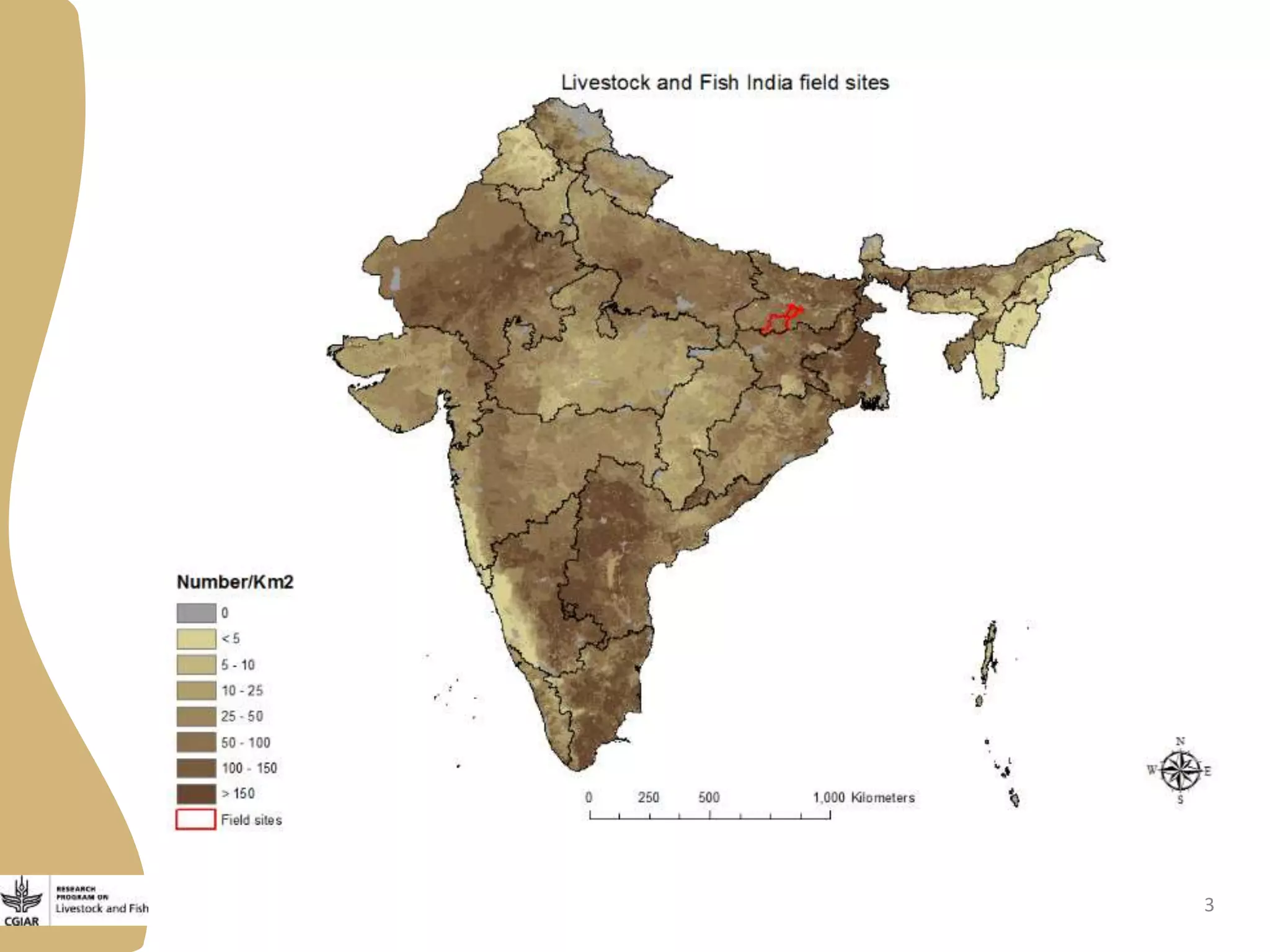
• Livestock and Fish CRP’s Dairy Value Chain Transformation in Bihar
• Value Chain Assessments as first characterisation step towards collecting
insights and evidence for successful value chain interventions.
• 4 selected locations in Nalanda district
• Assessment objectives:
– Characterize the dairy production systems and value chain in a
particular site
– Determine constraints, barriers to participation by poor men and
women
– Identify opportunities for value chain upgrading and expansion,
considering associated risks with particular regard to
feeds, breeding, animal health and food safety
– Develop solutions and opportunities for improvement
2
3
Selection of sites
• Locations selected to represent different conditions
Ekangarsarai block
Rural to Urban
value chain
Mahammadpur village
[with VC interventions]
Kesopur village
[without interventions]
Harnaut block
Urban to Urban
value chain
Kharuwara village
[with interventions]
Mushari village
[without interventions]
4
The Approach
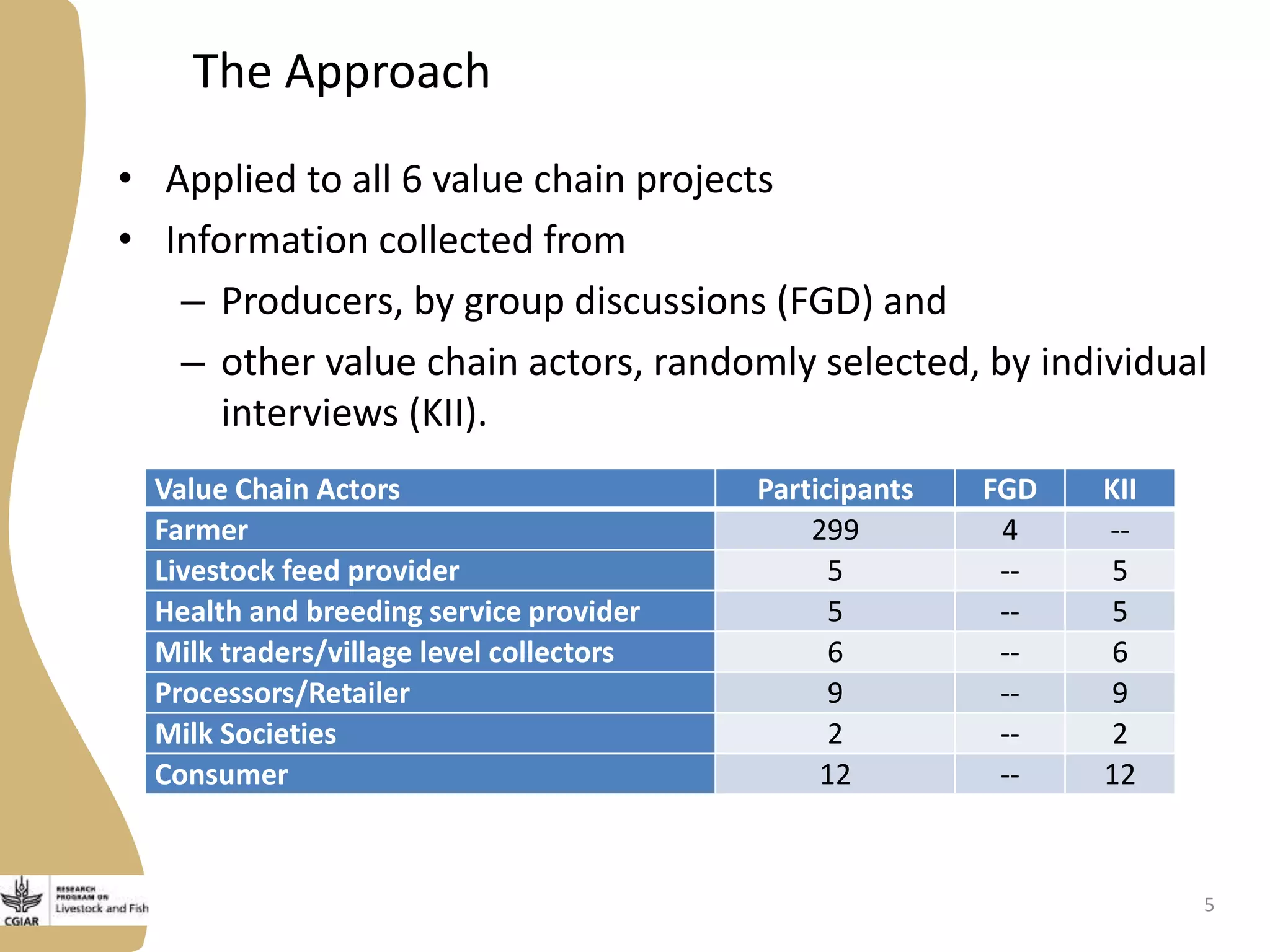
• Applied to all 6 value chain projects
• Information collected from
– Producers, by group discussions (FGD) and
– other value chain actors, randomly selected, by individual
interviews (KII).
Value Chain Actors Participants FGD KII
Farmer 299 4 --
Livestock feed provider 5 -- 5
Health and breeding service provider 5 -- 5
Milk traders/village level collectors 6 -- 6
Processors/Retailer 9 -- 9
Milk Societies 2 -- 2
Consumer 12 -- 12
5
The Tool for Value Chain Assessments
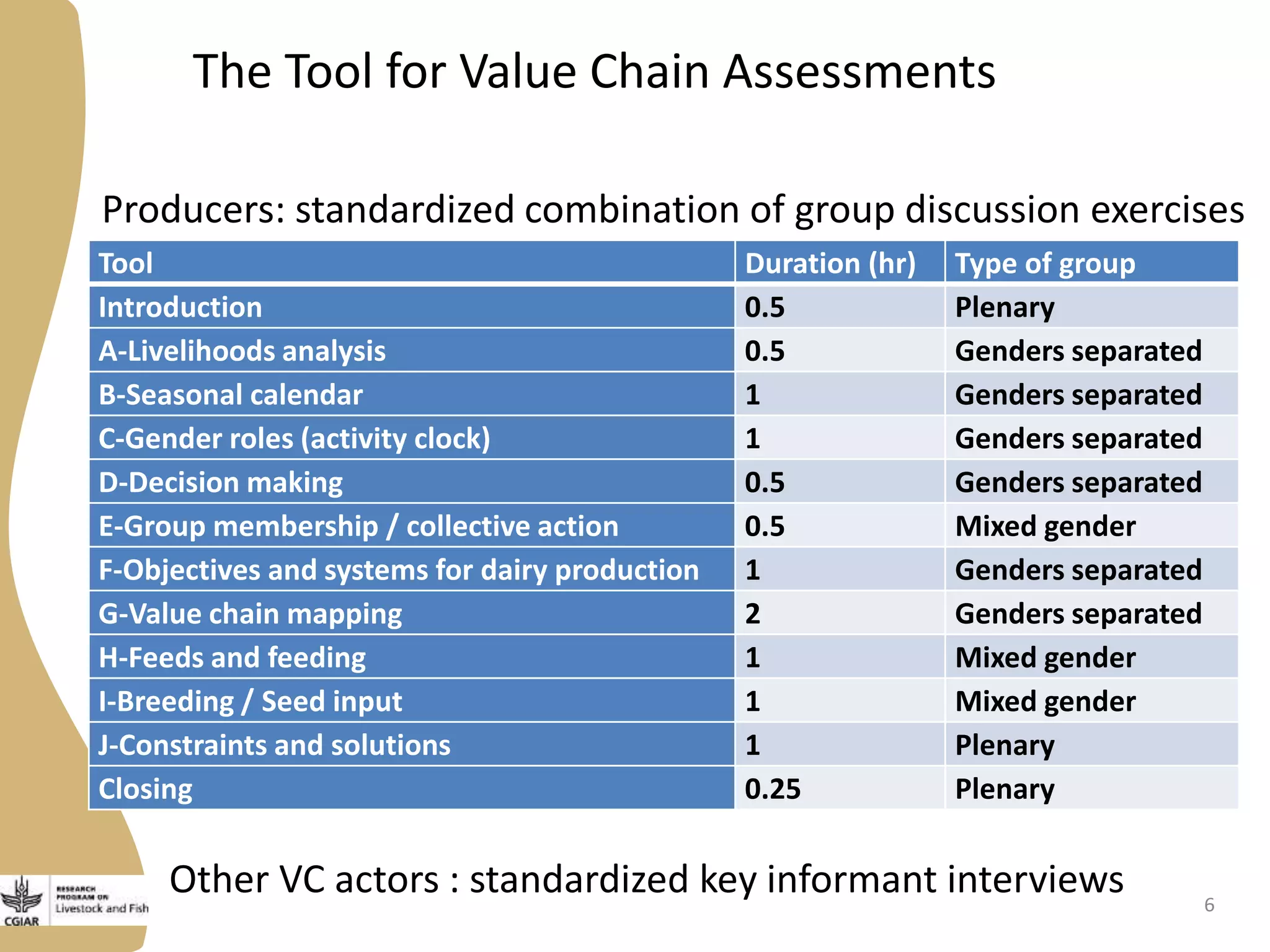
Producers: standardized combination of group discussion exercises
Tool Duration (hr) Type of group
Introduction 0.5 Plenary
A-Livelihoods analysis 0.5 Genders separated
B-Seasonal calendar 1 Genders separated
C-Gender roles (activity clock) 1 Genders separated
D-Decision making 0.5 Genders separated
E-Group membership / collective action 0.5 Mixed gender
F-Objectives and systems for dairy production 1 Genders separated
G-Value chain mapping 2 Genders separated
H-Feeds and feeding 1 Mixed gender
I-Breeding / Seed input 1 Mixed gender
J-Constraints and solutions 1 Plenary
Closing 0.25 Plenary
Other VC actors : standardized key informant interviews 6
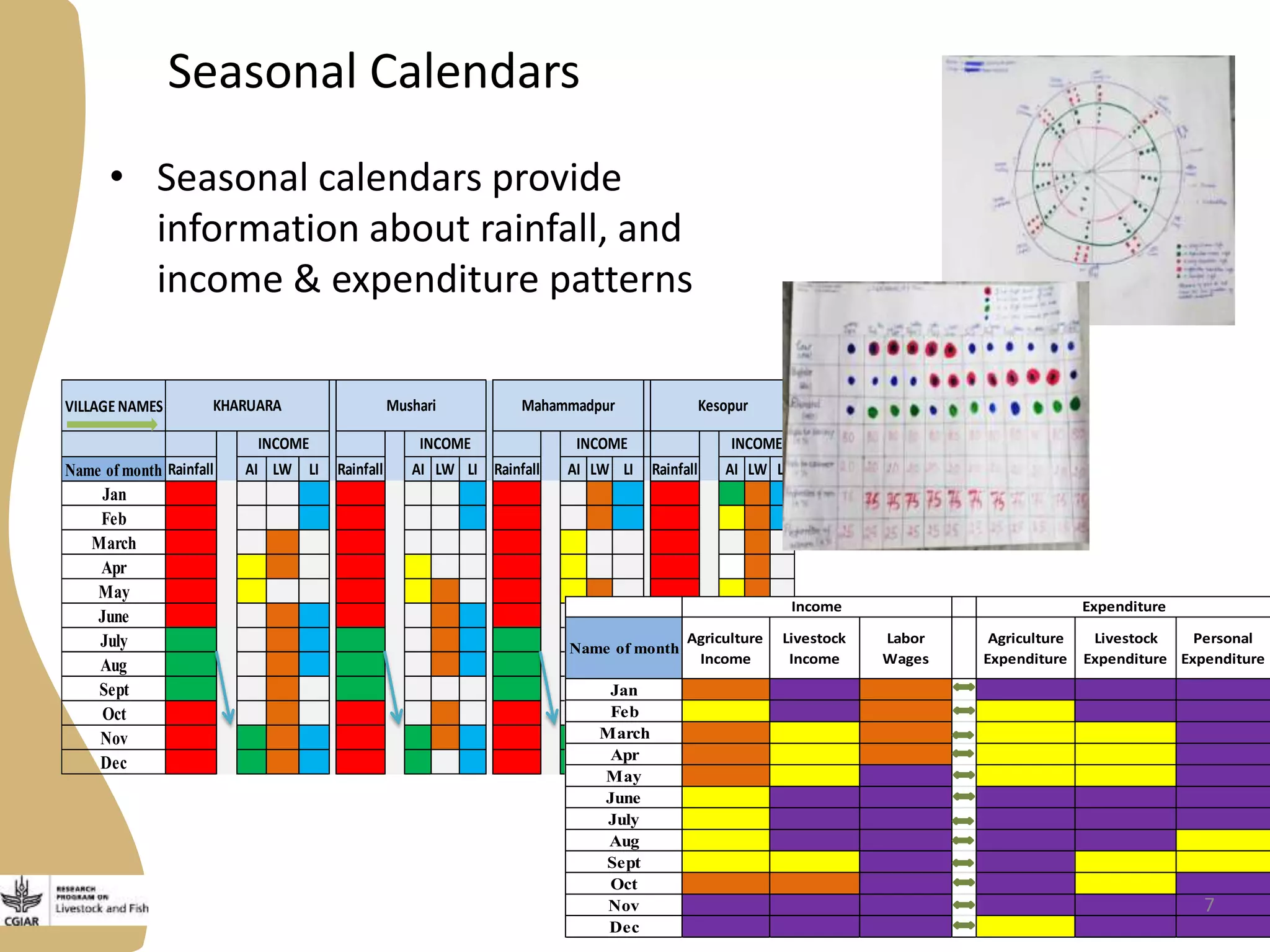
Seasonal Calendars
• Seasonal calendars provide
information about rainfall, and
income & expenditure patterns
VILLAGE NAMES
Name of month Rainfall AI LW LI Rainfall AI LW LI Rainfall AI LW LI Rainfall AI LW LI
Jan
Feb
March
Apr
May
June
July
Aug
Sept
Oct
Nov
Dec
INCOME INCOME INCOMEINCOME
KHARUARA Mushari Mahammadpur Kesopur
Name of month
Agriculture
Income
Livestock
Income
Labor
Wages
Agriculture
Expenditure
Livestock
Expenditure
Personal
Expenditure
Jan
Feb
March
Apr
May
June
July
Aug
Sept
Oct
Nov
Dec
Income Expenditure
7
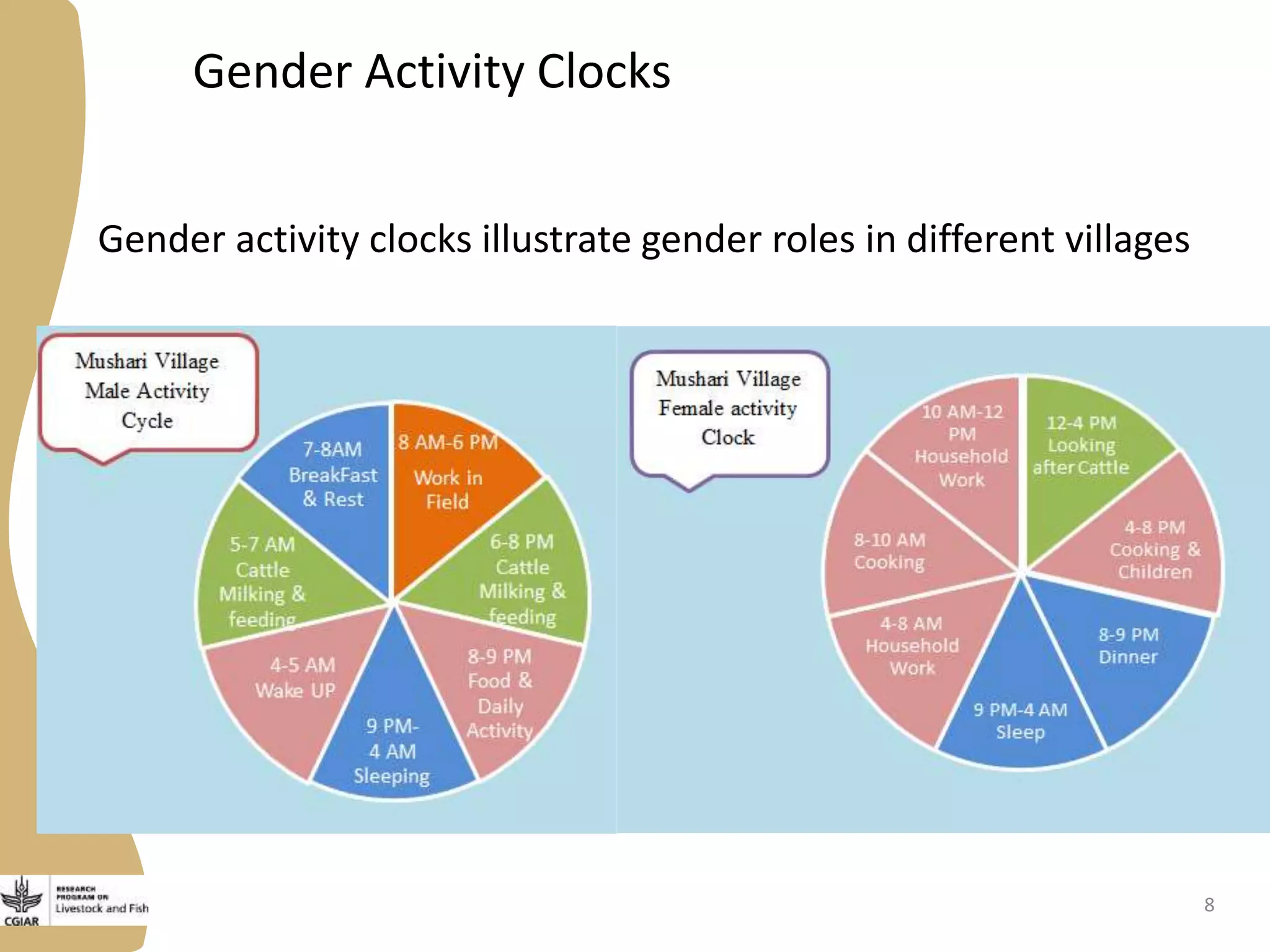
Gender Activity Clocks
Gender activity clocks illustrate gender roles in different villages
8
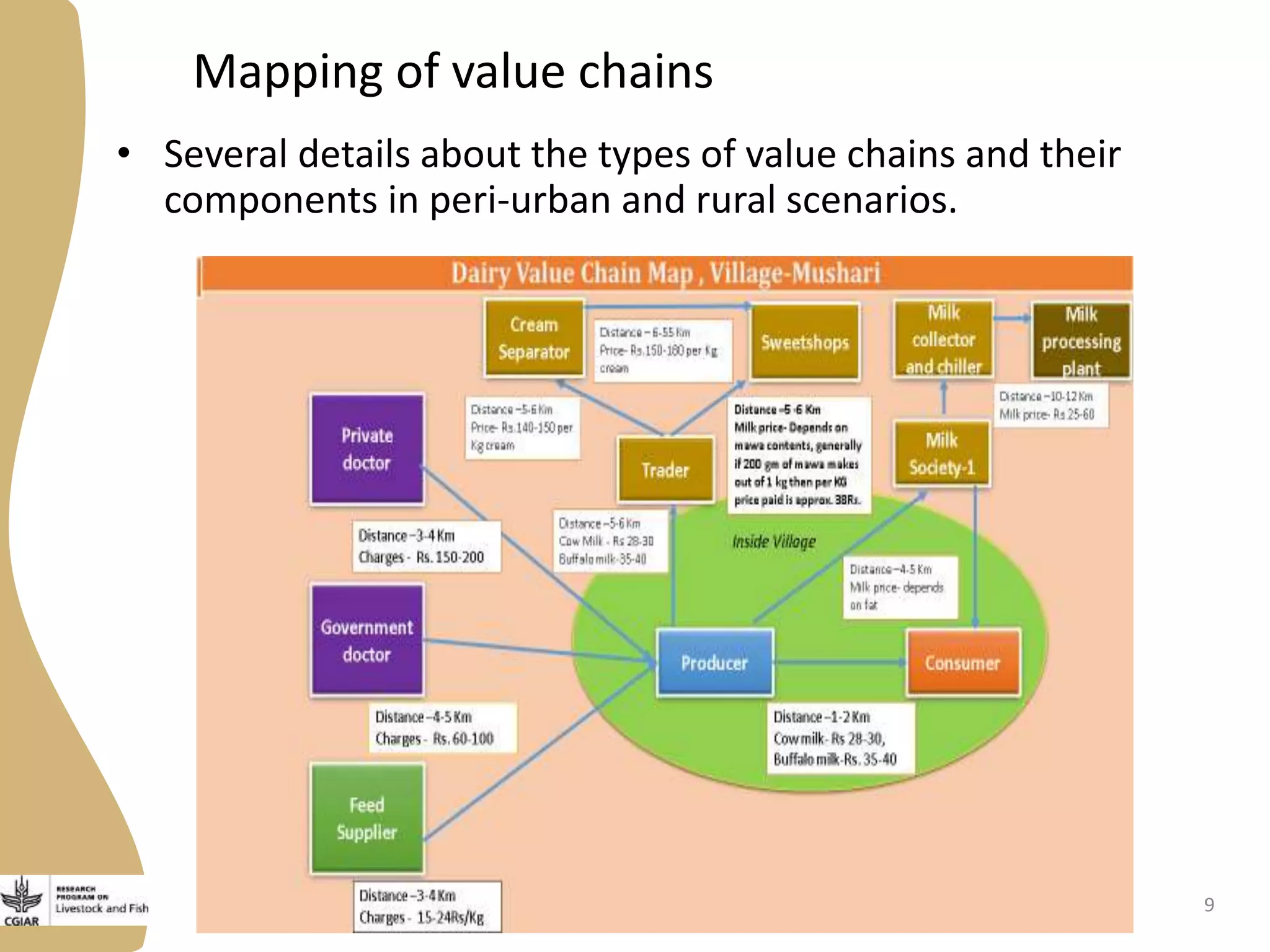
Mapping of value chains
• Several details about the types of value chains and their
components in peri-urban and rural scenarios.
9
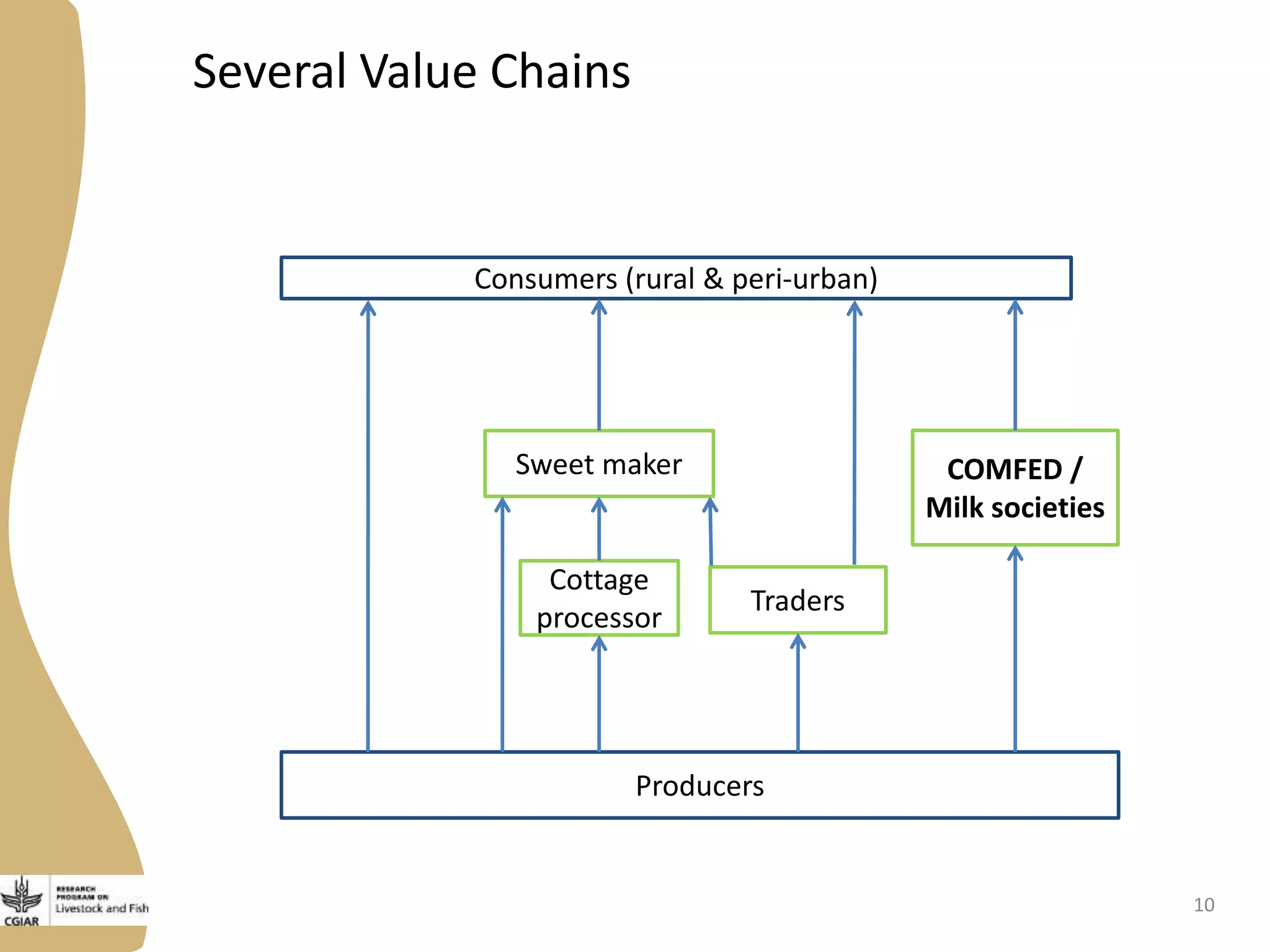
Several Value Chains
Consumers (rural & peri-urban)
Cottage
processor
Sweet maker
Traders
Producers
COMFED /
Milk societies
10
11
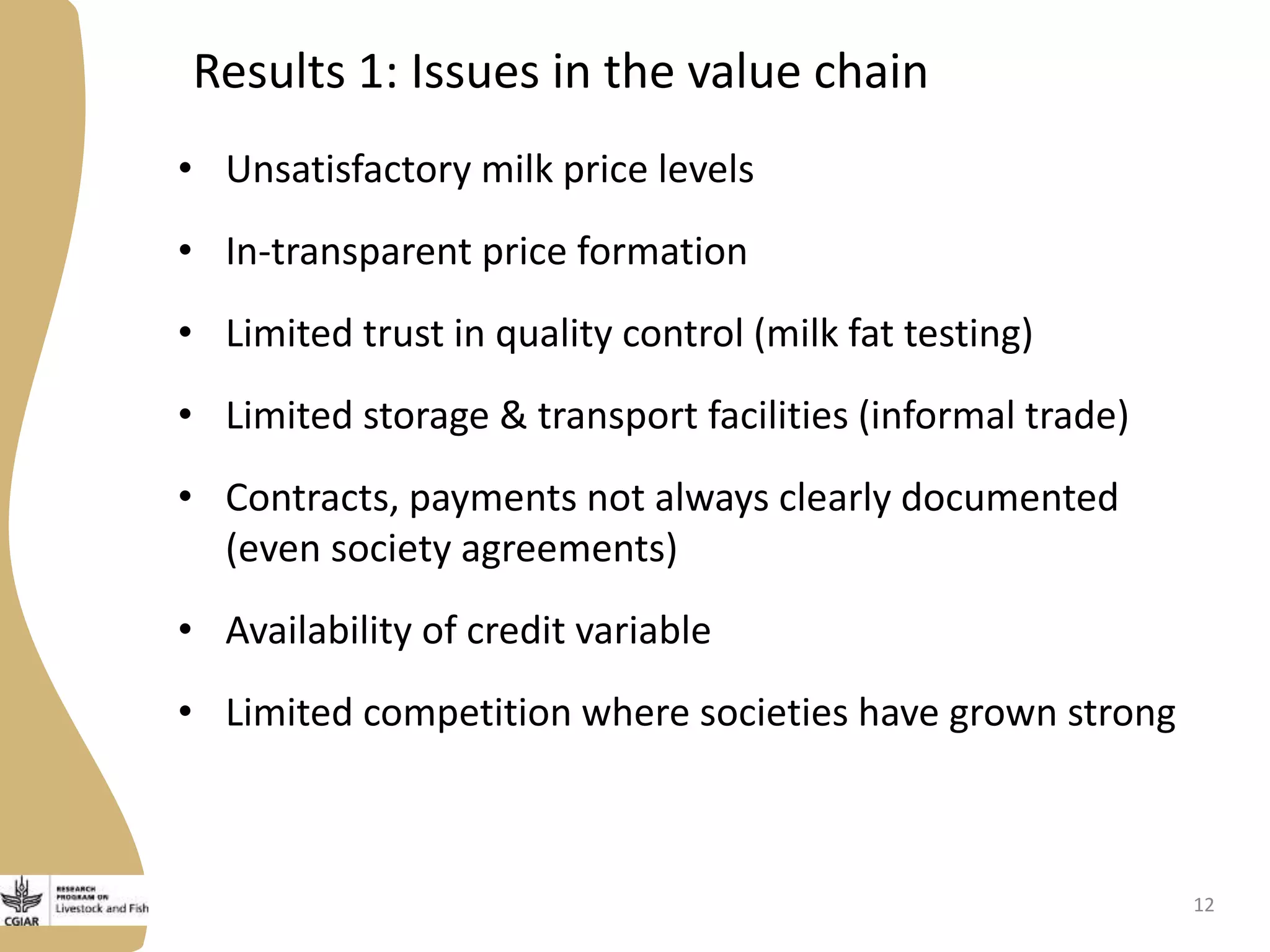
Results 1: Issues in the value chain
• Unsatisfactory milk price levels
• In-transparent price formation
• Limited trust in quality control (milk fat testing)
• Limited storage & transport facilities (informal trade)
• Contracts, payments not always clearly documented
(even society agreements)
• Availability of credit variable
• Limited competition where societies have grown strong
12
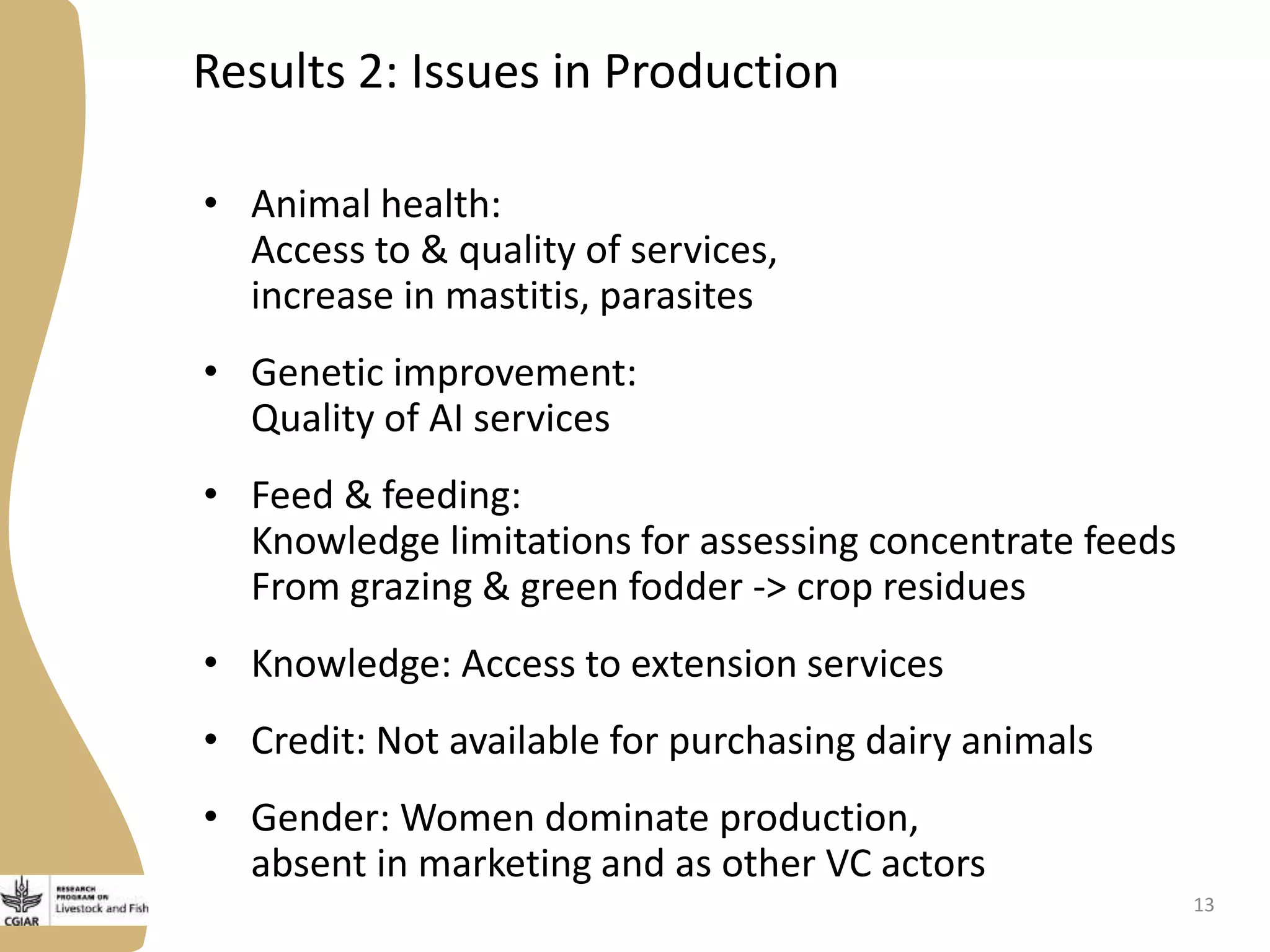
Results 2: Issues in Production
• Animal health:
Access to & quality of services,
increase in mastitis, parasites
• Genetic improvement:
Quality of AI services
• Feed & feeding:
Knowledge limitations for assessing concentrate feeds
From grazing & green fodder -> crop residues
• Knowledge: Access to extension services
• Credit: Not available for purchasing dairy animals
• Gender: Women dominate production,
absent in marketing and as other VC actors
13
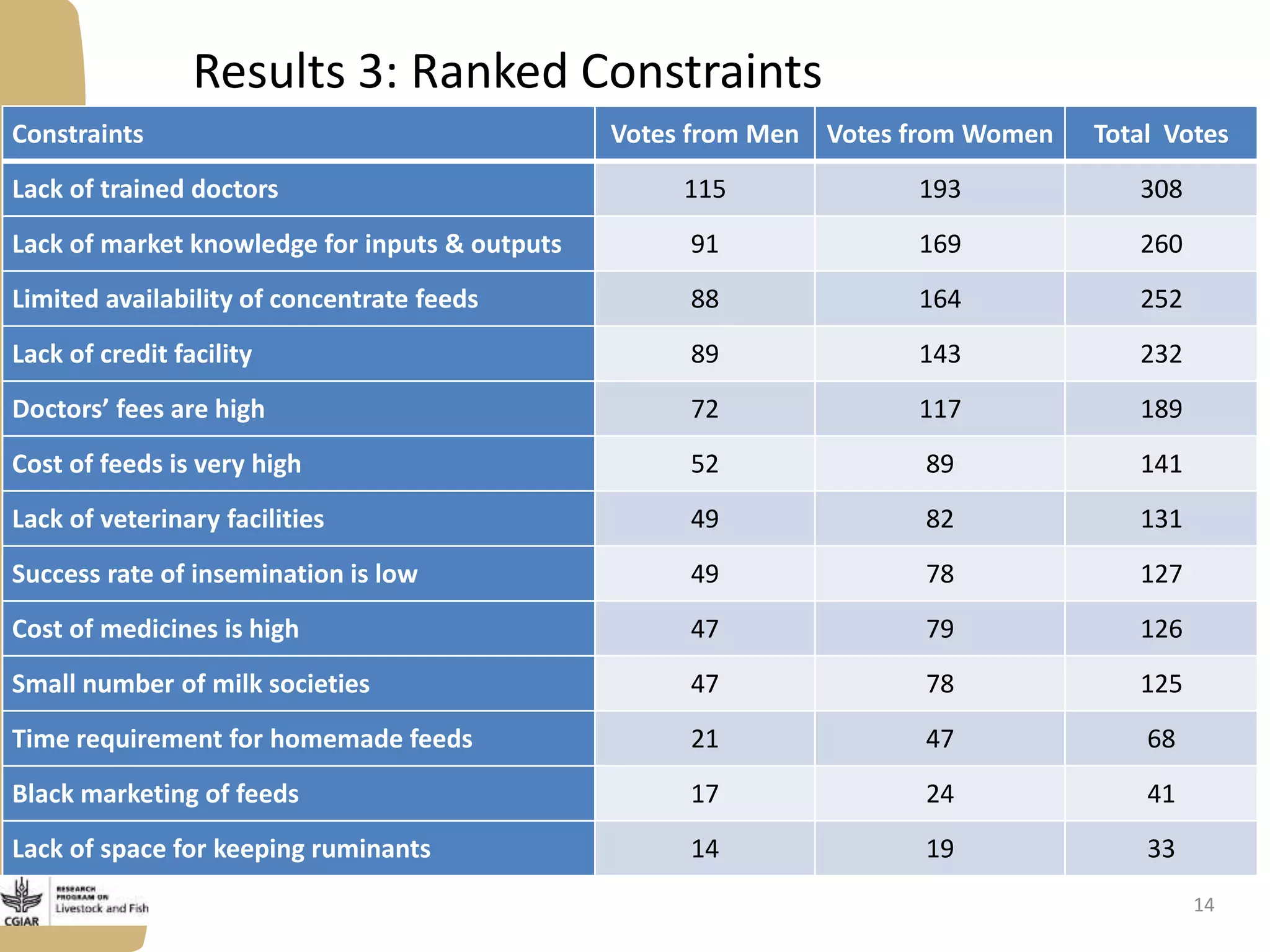
Results 3: Ranked Constraints
Constraints Votes from Men Votes from Women Total Votes
Lack of trained doctors 115 193 308
Lack of market knowledge for inputs & outputs 91 169 260
Limited availability of concentrate feeds 88 164 252
Lack of credit facility 89 143 232
Doctors’ fees are high 72 117 189
Cost of feeds is very high 52 89 141
Lack of veterinary facilities 49 82 131
Success rate of insemination is low 49 78 127
Cost of medicines is high 47 79 126
Small number of milk societies 47 78 125
Time requirement for homemade feeds 21 47 68
Black marketing of feeds 17 24 41
Lack of space for keeping ruminants 14 19 33
14
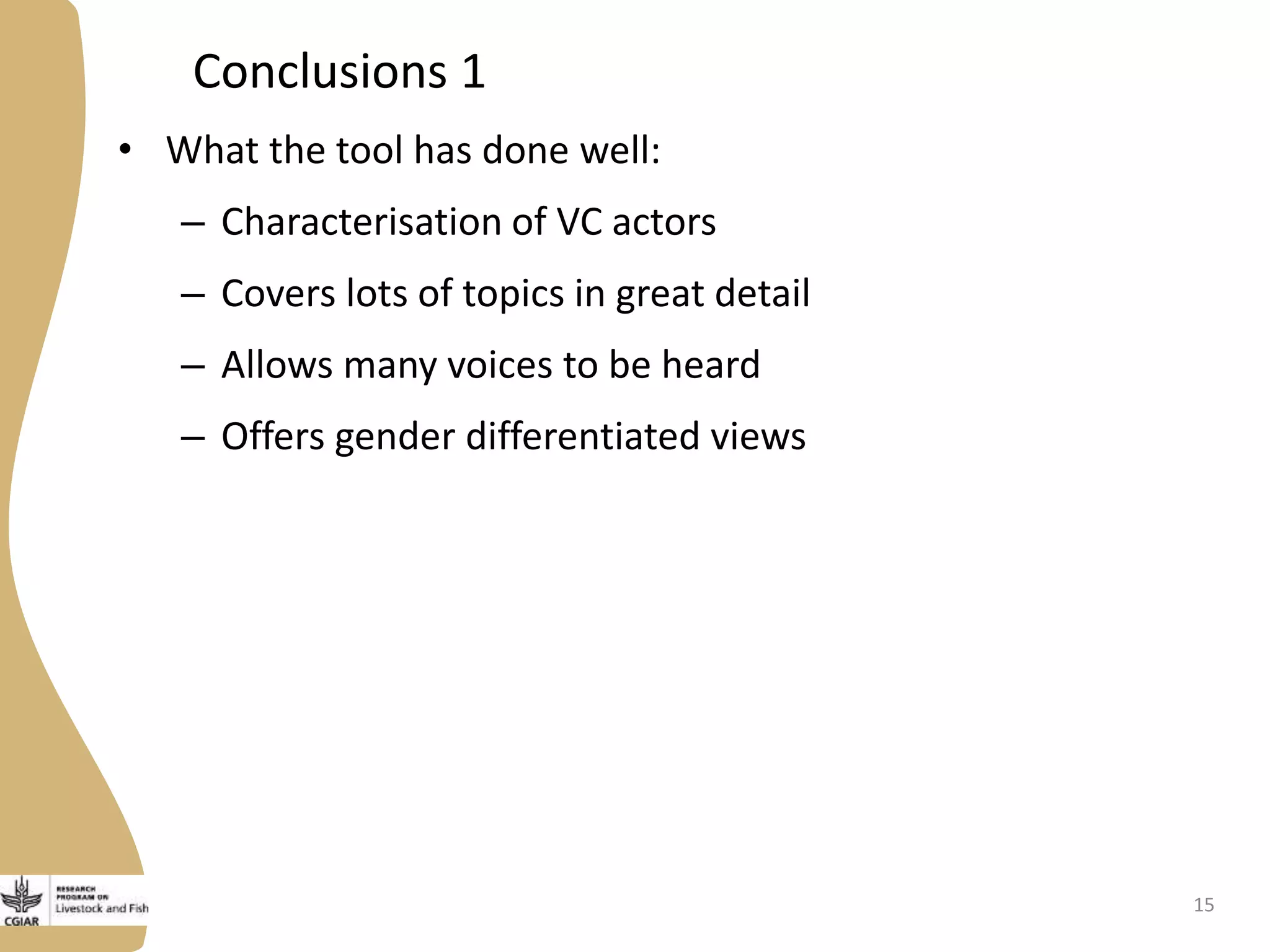
Conclusions 1
• What the tool has done well:
– Characterisation of VC actors
– Covers lots of topics in great detail
– Allows many voices to be heard
– Offers gender differentiated views
15
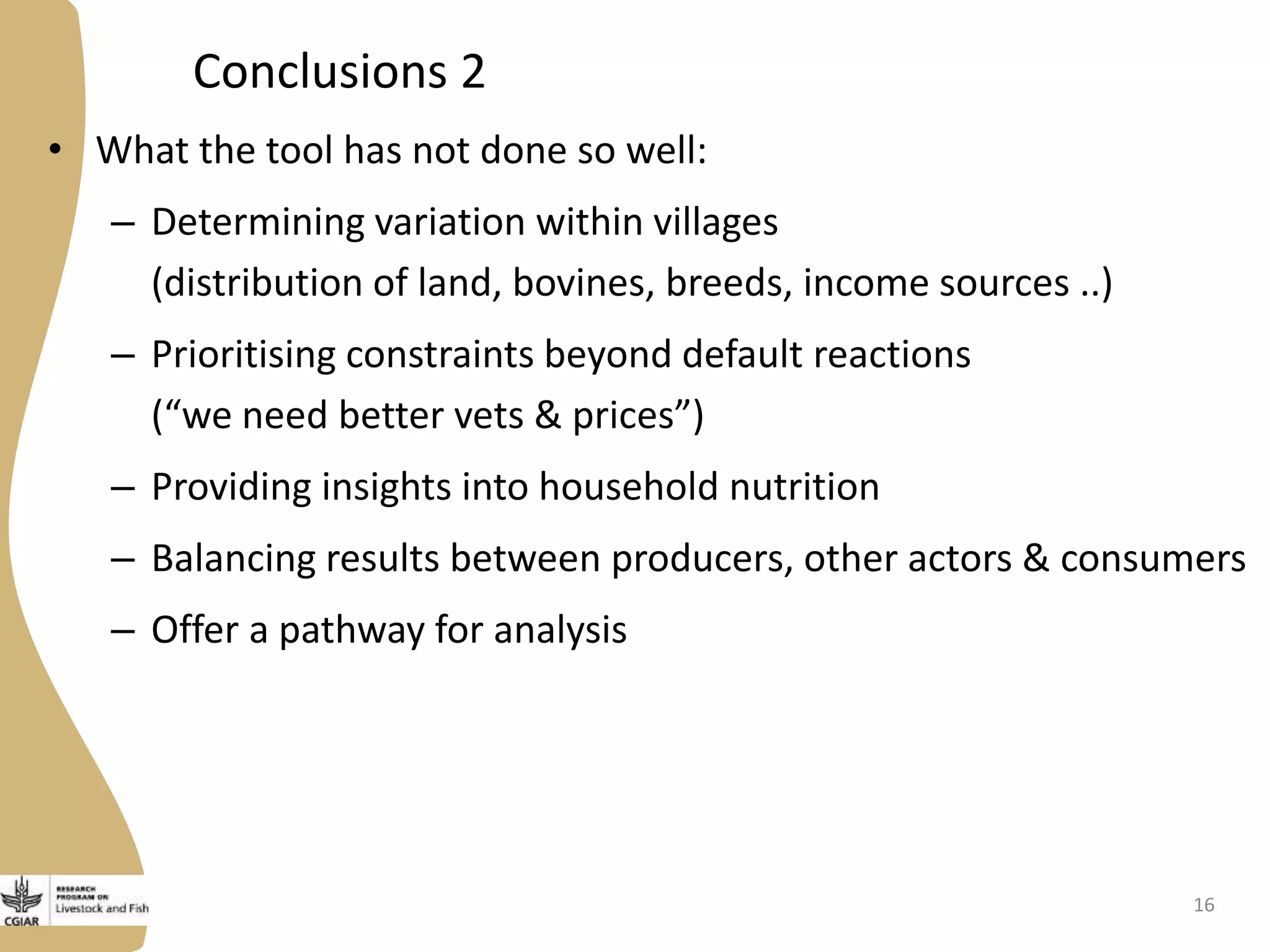
Conclusions 2
• What the tool has not done so well:
– Determining variation within villages
(distribution of land, bovines, breeds, income sources ..)
– Prioritising constraints beyond default reactions
(“we need better vets & prices”)
– Providing insights into household nutrition
– Balancing results between producers, other actors & consumers
– Offer a pathway for analysis
16
Conclusions 3
• What have the results provided for further steps?
(e.g. quantitative benchmarking survey, best bet identification)
– Basis for sampling of various actors
– Shortlist of issues to be considered (validated)
– Emphasis on gender differences
17
CGIAR is a global partnership that unites organizations engaged in research for a food secure future. The CGIAR
Research Program on Livestock and Fish aims to increase the productivity of small-scale livestock and fish systems
in sustainable ways, making meat, milk and fish more available and affordable across the developing world.
CGIAR Research Program on Livestock and Fish
livestockfish.cgiar.org

Issues in the development of dairy value chains in rural India

  • 1.
    Issues in thedevelopment of dairy value chains in rural India T.S. Vamsidhar Reddy, Isabelle Baltenweck, Rekha Kumari, A.K. Jha, Nils Teufel International Conference of Agricultural Economists (ICAE) Milan, Italy, 9-14 August 2015
  • 2.
    Background • Livestock andFish CRP’s Dairy Value Chain Transformation in Bihar • Value Chain Assessments as first characterisation step towards collecting insights and evidence for successful value chain interventions. • 4 selected locations in Nalanda district • Assessment objectives: – Characterize the dairy production systems and value chain in a particular site – Determine constraints, barriers to participation by poor men and women – Identify opportunities for value chain upgrading and expansion, considering associated risks with particular regard to feeds, breeding, animal health and food safety – Develop solutions and opportunities for improvement 2
  • 3.
  • 4.
    Selection of sites •Locations selected to represent different conditions Ekangarsarai block Rural to Urban value chain Mahammadpur village [with VC interventions] Kesopur village [without interventions] Harnaut block Urban to Urban value chain Kharuwara village [with interventions] Mushari village [without interventions] 4
  • 5.
    The Approach • Appliedto all 6 value chain projects • Information collected from – Producers, by group discussions (FGD) and – other value chain actors, randomly selected, by individual interviews (KII). Value Chain Actors Participants FGD KII Farmer 299 4 -- Livestock feed provider 5 -- 5 Health and breeding service provider 5 -- 5 Milk traders/village level collectors 6 -- 6 Processors/Retailer 9 -- 9 Milk Societies 2 -- 2 Consumer 12 -- 12 5
  • 6.
    The Tool forValue Chain Assessments Producers: standardized combination of group discussion exercises Tool Duration (hr) Type of group Introduction 0.5 Plenary A-Livelihoods analysis 0.5 Genders separated B-Seasonal calendar 1 Genders separated C-Gender roles (activity clock) 1 Genders separated D-Decision making 0.5 Genders separated E-Group membership / collective action 0.5 Mixed gender F-Objectives and systems for dairy production 1 Genders separated G-Value chain mapping 2 Genders separated H-Feeds and feeding 1 Mixed gender I-Breeding / Seed input 1 Mixed gender J-Constraints and solutions 1 Plenary Closing 0.25 Plenary Other VC actors : standardized key informant interviews 6
  • 7.
    Seasonal Calendars • Seasonalcalendars provide information about rainfall, and income & expenditure patterns VILLAGE NAMES Name of month Rainfall AI LW LI Rainfall AI LW LI Rainfall AI LW LI Rainfall AI LW LI Jan Feb March Apr May June July Aug Sept Oct Nov Dec INCOME INCOME INCOMEINCOME KHARUARA Mushari Mahammadpur Kesopur Name of month Agriculture Income Livestock Income Labor Wages Agriculture Expenditure Livestock Expenditure Personal Expenditure Jan Feb March Apr May June July Aug Sept Oct Nov Dec Income Expenditure 7
  • 8.
    Gender Activity Clocks Genderactivity clocks illustrate gender roles in different villages 8
  • 9.
    Mapping of valuechains • Several details about the types of value chains and their components in peri-urban and rural scenarios. 9
  • 10.
    Several Value Chains Consumers(rural & peri-urban) Cottage processor Sweet maker Traders Producers COMFED / Milk societies 10
  • 11.
  • 12.
    Results 1: Issuesin the value chain • Unsatisfactory milk price levels • In-transparent price formation • Limited trust in quality control (milk fat testing) • Limited storage & transport facilities (informal trade) • Contracts, payments not always clearly documented (even society agreements) • Availability of credit variable • Limited competition where societies have grown strong 12
  • 13.
    Results 2: Issuesin Production • Animal health: Access to & quality of services, increase in mastitis, parasites • Genetic improvement: Quality of AI services • Feed & feeding: Knowledge limitations for assessing concentrate feeds From grazing & green fodder -> crop residues • Knowledge: Access to extension services • Credit: Not available for purchasing dairy animals • Gender: Women dominate production, absent in marketing and as other VC actors 13
  • 14.
    Results 3: RankedConstraints Constraints Votes from Men Votes from Women Total Votes Lack of trained doctors 115 193 308 Lack of market knowledge for inputs & outputs 91 169 260 Limited availability of concentrate feeds 88 164 252 Lack of credit facility 89 143 232 Doctors’ fees are high 72 117 189 Cost of feeds is very high 52 89 141 Lack of veterinary facilities 49 82 131 Success rate of insemination is low 49 78 127 Cost of medicines is high 47 79 126 Small number of milk societies 47 78 125 Time requirement for homemade feeds 21 47 68 Black marketing of feeds 17 24 41 Lack of space for keeping ruminants 14 19 33 14
  • 15.
    Conclusions 1 • Whatthe tool has done well: – Characterisation of VC actors – Covers lots of topics in great detail – Allows many voices to be heard – Offers gender differentiated views 15
  • 16.
    Conclusions 2 • Whatthe tool has not done so well: – Determining variation within villages (distribution of land, bovines, breeds, income sources ..) – Prioritising constraints beyond default reactions (“we need better vets & prices”) – Providing insights into household nutrition – Balancing results between producers, other actors & consumers – Offer a pathway for analysis 16
  • 17.
    Conclusions 3 • Whathave the results provided for further steps? (e.g. quantitative benchmarking survey, best bet identification) – Basis for sampling of various actors – Shortlist of issues to be considered (validated) – Emphasis on gender differences 17
  • 18.
    CGIAR is aglobal partnership that unites organizations engaged in research for a food secure future. The CGIAR Research Program on Livestock and Fish aims to increase the productivity of small-scale livestock and fish systems in sustainable ways, making meat, milk and fish more available and affordable across the developing world. CGIAR Research Program on Livestock and Fish livestockfish.cgiar.org