El Verbo  “ GUSTAR ” En español  gustar  significa  “ to be pleasing ” In English, the equivalent is “to like”
Por ejemplo: In English we say:  “I like  Spanish.” En español decimos:  “To me, Spanish  is pleasing.”
I like the beach . In English: “ I”  is the subject “ like”  is the verb “ the beach”  is the  direct object En español: “ the beach”  is the  subject “ to please”  is the  verb “ me”  is the indirect  object
En Español…: The word order is actually  “backwards” : The indirect object comes first: Me Then the verb: gusta Finally the subject of the verb: la playa. Make it negative by adding  “no” at the beginning.
Who  is doing the “liking”? Indirect Object Pronouns: me te le nos os les
“ Gusta” = singular nouns  = infinitives “ Gustan” = plural nouns
Frases de clarificación : “ Le gusta nadar.” He likes to swim. She likes to swim. You like to swim. “ Les gusta la playa.” They like the beach. You like the beach.
Frases de clarificación : Me = a mí Te = a ti Le = a él a ella a Ud. (a Roberto) (a Lola) (a tu hermano) Nos = a nosotros Os = a vosotros Les = a ellos a ellas a Uds. (a Roberto y    a Luis) (a Lola y a    Carmen) (a mis amigos)
Me gusta… / Me gustan… Te gusta… / Te gustan… Le gusta… / Le gustan… Nos gusta… / Nos gustan… Os gusta… / Os gustan… Les gusta… / Les gustan… I like… You like… He / she / You like(s)… We like… You guys like… They / you like… =
¿ Cómo se dice ? “ I like coffee.” “ Coffee is pleasing to me.” el café. gusta Me
¿ Cómo se dice ? “ You like cars.” “ Cars  are pleasing  to you.” los coches. gusta n Te
¿ Cómo se dice ? “ He  doesn’t  like to dance.” “ To dance is  not  pleasing to him.” bailar. gusta No  le
¿ Cómo se dice ? “ We like our teachers.” “ Our teachers  please  us.” nuestros profesores. gusta n Nos
¿ Cómo se dice ? “ You (guys)  don’t  like to go to the movies.” “ To go to the movies is  not  pleasing to you (guys).” ir al cine. gusta No  os
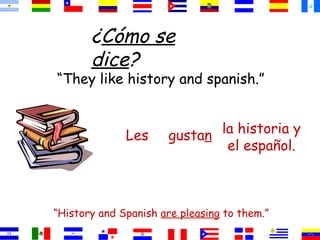
¿ Cómo se dice ? “ They like history and spanish.” “ History and Spanish  are pleasing  to them.” la historia y el español. gusta n Les
¿ Cómo se dice en español ? I like to study. Elena likes to watch television. We don’t like to do  homework. Carlos and Miguel like cars. Do you guys like to look at photos? You like to go shopping, right? Me gusta estudiar. (A Elena) le gusta ver la televisión. No nos gusta hacer la tarea. (A Carlos y a Miguel) les gustan los coches. ¿Os gusta mirar fotos? Te gusta ir de compras, ¿verdad?

Gustar2

  • 1.
    El Verbo “ GUSTAR ” En español gustar significa “ to be pleasing ” In English, the equivalent is “to like”
  • 2.
    Por ejemplo: InEnglish we say: “I like Spanish.” En español decimos: “To me, Spanish is pleasing.”
  • 3.
    I like thebeach . In English: “ I” is the subject “ like” is the verb “ the beach” is the direct object En español: “ the beach” is the subject “ to please” is the verb “ me” is the indirect object
  • 4.
    En Español…: Theword order is actually “backwards” : The indirect object comes first: Me Then the verb: gusta Finally the subject of the verb: la playa. Make it negative by adding “no” at the beginning.
  • 5.
    Who isdoing the “liking”? Indirect Object Pronouns: me te le nos os les
  • 6.
    “ Gusta” =singular nouns = infinitives “ Gustan” = plural nouns
  • 7.
    Frases de clarificación: “ Le gusta nadar.” He likes to swim. She likes to swim. You like to swim. “ Les gusta la playa.” They like the beach. You like the beach.
  • 8.
    Frases de clarificación: Me = a mí Te = a ti Le = a él a ella a Ud. (a Roberto) (a Lola) (a tu hermano) Nos = a nosotros Os = a vosotros Les = a ellos a ellas a Uds. (a Roberto y a Luis) (a Lola y a Carmen) (a mis amigos)
  • 9.
    Me gusta… /Me gustan… Te gusta… / Te gustan… Le gusta… / Le gustan… Nos gusta… / Nos gustan… Os gusta… / Os gustan… Les gusta… / Les gustan… I like… You like… He / she / You like(s)… We like… You guys like… They / you like… =
  • 10.
    ¿ Cómo sedice ? “ I like coffee.” “ Coffee is pleasing to me.” el café. gusta Me
  • 11.
    ¿ Cómo sedice ? “ You like cars.” “ Cars are pleasing to you.” los coches. gusta n Te
  • 12.
    ¿ Cómo sedice ? “ He doesn’t like to dance.” “ To dance is not pleasing to him.” bailar. gusta No le
  • 13.
    ¿ Cómo sedice ? “ We like our teachers.” “ Our teachers please us.” nuestros profesores. gusta n Nos
  • 14.
    ¿ Cómo sedice ? “ You (guys) don’t like to go to the movies.” “ To go to the movies is not pleasing to you (guys).” ir al cine. gusta No os
  • 15.
    ¿ Cómo sedice ? “ They like history and spanish.” “ History and Spanish are pleasing to them.” la historia y el español. gusta n Les
  • 16.
    ¿ Cómo sedice en español ? I like to study. Elena likes to watch television. We don’t like to do homework. Carlos and Miguel like cars. Do you guys like to look at photos? You like to go shopping, right? Me gusta estudiar. (A Elena) le gusta ver la televisión. No nos gusta hacer la tarea. (A Carlos y a Miguel) les gustan los coches. ¿Os gusta mirar fotos? Te gusta ir de compras, ¿verdad?