GUSTAR
GUSTAR
 Gustar is the verb we use to say like in Spanish.
 However, the translation isn’t quite the same
 In English you would say I like
but in Spanish you would NOT say yo gusto
(INCORRECT)
Se dice en Español
 In Spanish you would say Me gusta or Me gustan
 Me gusta el mercado (I like the market)
 Me gustan las verduras (I like vegetables)
 This is because instead of directly meaning like, it
actually means that something is pleasing for
you.
¿Cuándo usas Gusta o Gustan?
 Knowing whether to use gusta or gustan depends
on the words that come after it (the things that you
like).
 When we talk about liking things, then we use
GUSTA if that thing is in the singular form.
 A mí me gusta el postre. = I like dessert.
 A ellos les gusta la ensalada = They like salad.
¿Cuándo usas Gusta o Gustan?
 We use GUSTAN if we like something that is in the
plural form.
 A mí me gustan los libros =
 A nosotros nos gustan los huevos =
 A ellos les gustan las judías verdes =
I like books
We like eggs
They like green beans
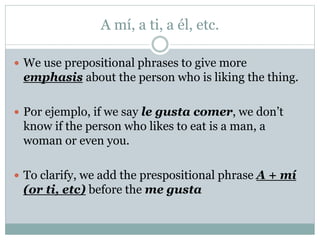
A mí, a ti, a él, etc.
 We use prepositional phrases to give more
emphasis about the person who is liking the thing.
 Por ejemplo, if we say le gusta comer, we don’t
know if the person who likes to eat is a man, a
woman or even you.
 To clarify, we add the prespositional phrase A + mí
(or ti, etc) before the me gusta
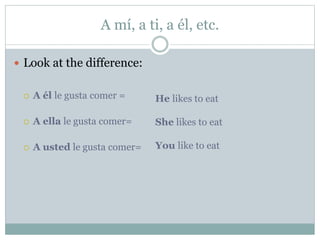
A mí, a ti, a él, etc.
 Look at the difference:
 A él le gusta comer =
 A ella le gusta comer=
 A usted le gusta comer=
He likes to eat
She likes to eat
You like to eat
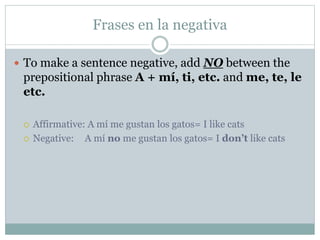
Frases en la negativa
 To make a sentence negative, add NO between the
prepositional phrase A + mí, ti, etc. and me, te, le
etc.
 Affirmative: A mí me gustan los gatos= I like cats
 Negative: A mí no me gustan los gatos= I don’t like cats
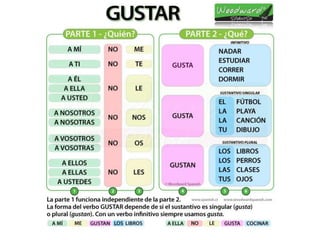
CONJUGA EL VERBO
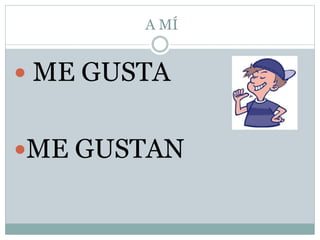
A MÍ
 ME GUSTA
ME GUSTAN
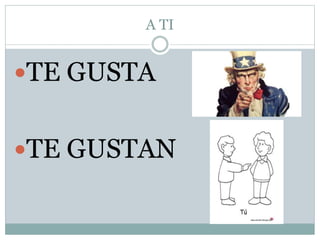
A TI
TE GUSTA
TE GUSTAN
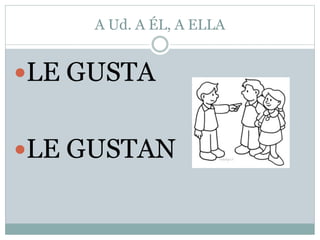
A Ud. A ÉL, A ELLA
LE GUSTA
LE GUSTAN
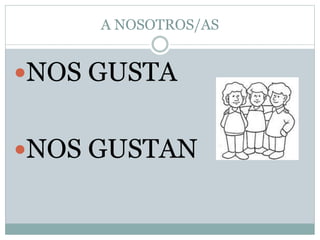
A NOSOTROS/AS
NOS GUSTA
NOS GUSTAN
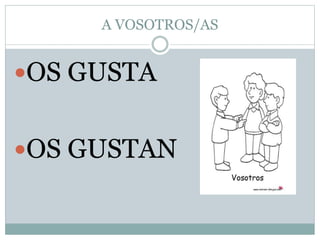
A VOSOTROS/AS
OS GUSTA
OS GUSTAN
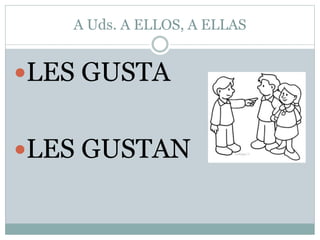
A Uds. A ELLOS, A ELLAS
LES GUSTA
LES GUSTAN
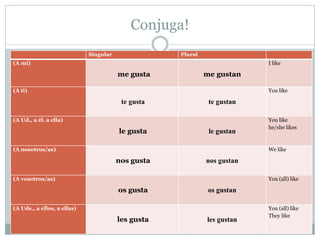
Conjuga!
Singular Plural
(A mí)
me gusta me gustan
I like
(A ti)
te gusta te gustan
You like
(A Ud., a él, a ella)
le gusta le gustan
You like
he/she likes
(A nosotros/as)
nos gusta nos gustan
We like
(A vosotros/as)
os gusta os gustan
You (all) like
(A Uds., a ellos, a ellas)
les gusta les gustan
You (all) like
They like
¡PRACTICAMOS!
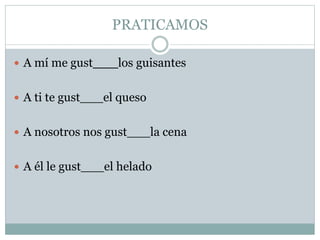
PRATICAMOS
 A mí me gust___los guisantes
 A ti te gust___el queso
 A nosotros nos gust___la cena
 A él le gust___el helado
Gustar

Gustar

  • 1.
  • 2.
    GUSTAR  Gustar isthe verb we use to say like in Spanish.  However, the translation isn’t quite the same  In English you would say I like but in Spanish you would NOT say yo gusto (INCORRECT)
  • 3.
    Se dice enEspañol  In Spanish you would say Me gusta or Me gustan  Me gusta el mercado (I like the market)  Me gustan las verduras (I like vegetables)  This is because instead of directly meaning like, it actually means that something is pleasing for you.
  • 4.
    ¿Cuándo usas Gustao Gustan?  Knowing whether to use gusta or gustan depends on the words that come after it (the things that you like).  When we talk about liking things, then we use GUSTA if that thing is in the singular form.  A mí me gusta el postre. = I like dessert.  A ellos les gusta la ensalada = They like salad.
  • 5.
    ¿Cuándo usas Gustao Gustan?  We use GUSTAN if we like something that is in the plural form.  A mí me gustan los libros =  A nosotros nos gustan los huevos =  A ellos les gustan las judías verdes = I like books We like eggs They like green beans
  • 6.
    A mí, ati, a él, etc.  We use prepositional phrases to give more emphasis about the person who is liking the thing.  Por ejemplo, if we say le gusta comer, we don’t know if the person who likes to eat is a man, a woman or even you.  To clarify, we add the prespositional phrase A + mí (or ti, etc) before the me gusta
  • 7.
    A mí, ati, a él, etc.  Look at the difference:  A él le gusta comer =  A ella le gusta comer=  A usted le gusta comer= He likes to eat She likes to eat You like to eat
  • 8.
    Frases en lanegativa  To make a sentence negative, add NO between the prepositional phrase A + mí, ti, etc. and me, te, le etc.  Affirmative: A mí me gustan los gatos= I like cats  Negative: A mí no me gustan los gatos= I don’t like cats
  • 9.
  • 10.
    A MÍ  MEGUSTA ME GUSTAN
  • 11.
  • 12.
    A Ud. AÉL, A ELLA LE GUSTA LE GUSTAN
  • 13.
  • 14.
  • 15.
    A Uds. AELLOS, A ELLAS LES GUSTA LES GUSTAN
  • 16.
    Conjuga! Singular Plural (A mí) megusta me gustan I like (A ti) te gusta te gustan You like (A Ud., a él, a ella) le gusta le gustan You like he/she likes (A nosotros/as) nos gusta nos gustan We like (A vosotros/as) os gusta os gustan You (all) like (A Uds., a ellos, a ellas) les gusta les gustan You (all) like They like
  • 17.
  • 18.
    PRATICAMOS  A míme gust___los guisantes  A ti te gust___el queso  A nosotros nos gust___la cena  A él le gust___el helado