Lección: Verbos

    gustar and encantar
regular –ar, -er, and –ir verbs
gustar and encantar
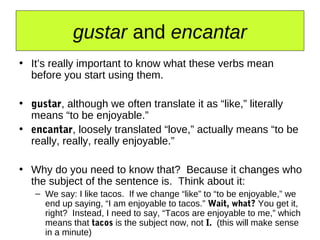
• It’s really important to know what these verbs mean
  before you start using them.

• gustar, although we often translate it as “like,” literally
  means “to be enjoyable.”
• encantar, loosely translated “love,” actually means “to be
  really, really, really enjoyable.”

• Why do you need to know that? Because it changes who
  the subject of the sentence is. Think about it:
   – We say: I like tacos. If we change “like” to “to be enjoyable,” we
     end up saying, “I am enjoyable to tacos.” Wait, what? You get it,
     right? Instead, I need to say, “Tacos are enjoyable to me,” which
     means that tacos is the subject now, not I. (this will make sense
     in a minute)
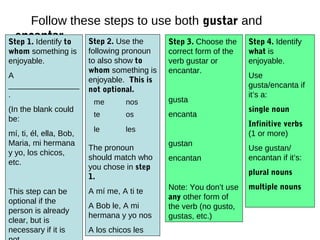
Follow these steps to use both gustar and
  encantar.
Step 1. Identify to Step 2. Use the Step 3. Choose the Step 4. Identify
whom something is        following pronoun    correct form of the   what is
enjoyable.               to also show to      verb gustar or        enjoyable.
                         whom something is    encantar.
A                                                                   Use
                         enjoyable. This is
________________                                                    gusta/encanta if
                         not optional.
.                                                                   it’s a:
                          me       nos        gusta
(In the blank could                                                 single noun
                          te       os         encanta
be:
                                                                    Infinitive verbs
                          le       les
mí, ti, él, ella, Bob,                                              (1 or more)
Maria, mi hermana                             gustan
                         The pronoun                                Use gustan/
y yo, los chicos,
                         should match who     encantan              encantan if it’s:
etc.
                         you chose in step
                                                                    plural nouns
                         1.
                                              Note: You don’t use   multiple nouns
This step can be         A mí me, A ti te
                                              any other form of
optional if the
                         A Bob le, A mi       the verb (no gusto,
person is already
                         hermana y yo nos     gustas, etc.)
clear, but is
necessary if it is       A los chicos les
Ejemplos con gustar and
              encantar
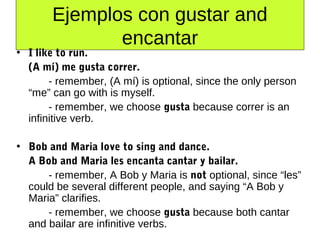
• I like to run.
  (A mí) me gusta correr.
       - remember, (A mí) is optional, since the only person
  “me” can go with is myself.
       - remember, we choose gusta because correr is an
  infinitive verb.

• Bob and Maria love to sing and dance.
  A Bob and Maria les encanta cantar y bailar.
      - remember, A Bob y Maria is not optional, since “les”
  could be several different people, and saying “A Bob y
  Maria” clarifies.
      - remember, we choose gusta because both cantar
  and bailar are infinitive verbs.
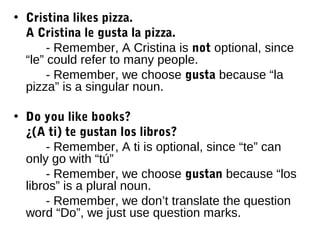
• Cristina likes pizza.
  A Cristina le gusta la pizza.
       - Remember, A Cristina is not optional, since
  “le” could refer to many people.
       - Remember, we choose gusta because “la
  pizza” is a singular noun.

• Do you like books?
  ¿(A ti) te gustan los libros?
      - Remember, A ti is optional, since “te” can
  only go with “tú”
      - Remember, we choose gustan because “los
  libros” is a plural noun.
      - Remember, we don’t translate the question
  word “Do”, we just use question marks.
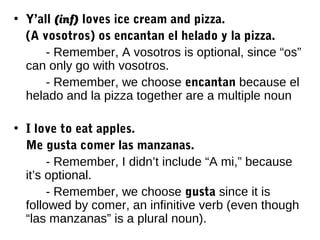
• Y’all (inf) loves ice cream and pizza.
  (A vosotros) os encantan el helado y la pizza.
      - Remember, A vosotros is optional, since “os”
  can only go with vosotros.
      - Remember, we choose encantan because el
  helado and la pizza together are a multiple noun

• I love to eat apples.
  Me gusta comer las manzanas.
       - Remember, I didn’t include “A mi,” because
  it’s optional.
       - Remember, we choose gusta since it is
  followed by comer, an infinitive verb (even though
  “las manzanas” is a plural noun).
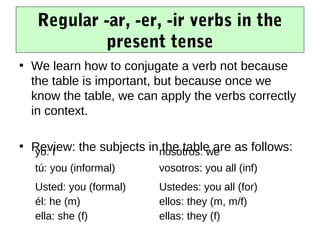
Regular -ar, -er, -ir verbs in the
            present tense
• We learn how to conjugate a verb not because
  the table is important, but because once we
  know the table, we can apply the verbs correctly
  in context.

• Review: the subjects in nosotros: we as follows:
  yo: I                   the table are
  tú: you (informal)     vosotros: you all (inf)
  Usted: you (formal)    Ustedes: you all (for)
  él: he (m)             ellos: they (m, m/f)
  ella: she (f)          ellas: they (f)
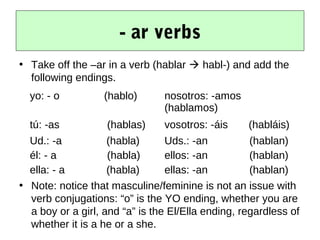
- ar verbs
• Take off the –ar in a verb (hablar  habl-) and add the
  following endings.
  yo: - o          (hablo)      nosotros: -amos
                                (hablamos)
  tú: -as          (hablas)     vosotros: -áis     (habláis)
  Ud.: -a           (habla)      Uds.: -an          (hablan)
  él: - a           (habla)      ellos: -an         (hablan)
  ella: - a         (habla)      ellas: -an         (hablan)
• Note: notice that masculine/feminine is not an issue with
  verb conjugations: “o” is the YO ending, whether you are
  a boy or a girl, and “a” is the El/Ella ending, regardless of
  whether it is a he or a she.
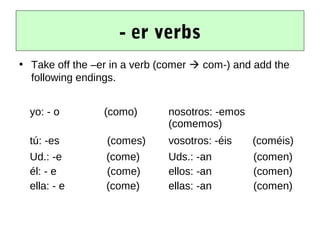
- er verbs
• Take off the –er in a verb (comer  com-) and add the
  following endings.


  yo: - o        (como)       nosotros: -emos
                              (comemos)
  tú: -es        (comes)      vosotros: -éis    (coméis)
  Ud.: -e        (come)       Uds.: -an         (comen)
  él: - e        (come)       ellos: -an        (comen)
  ella: - e      (come)       ellas: -an        (comen)
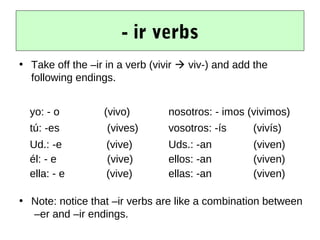
- ir verbs
• Take off the –ir in a verb (vivir  viv-) and add the
  following endings.


  yo: - o         (vivo)         nosotros: - imos (vivimos)
  tú: -es          (vives)       vosotros: -ís     (vivís)
  Ud.: -e          (vive)        Uds.: -an         (viven)
  él: - e          (vive)        ellos: -an        (viven)
  ella: - e        (vive)        ellas: -an        (viven)

• Note: notice that –ir verbs are like a combination between
  –er and –ir endings.
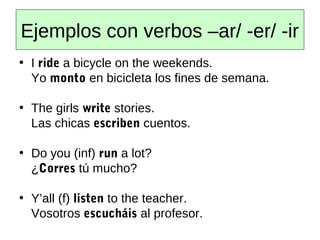
Ejemplos con verbos –ar/ -er/ -ir
• I ride a bicycle on the weekends.
  Yo monto en bicicleta los fines de semana.

• The girls write stories.
  Las chicas escriben cuentos.

• Do you (inf) run a lot?
  ¿Corres tú mucho?

• Y’all (f) listen to the teacher.
  Vosotros escucháis al profesor.
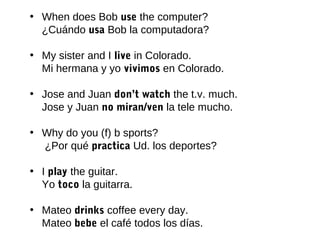
• When does Bob use the computer?
  ¿Cuándo usa Bob la computadora?

• My sister and I live in Colorado.
  Mi hermana y yo vivimos en Colorado.

• Jose and Juan don’t watch the t.v. much.
  Jose y Juan no miran/ven la tele mucho.

• Why do you (f) b sports?
  ¿Por qué practica Ud. los deportes?

• I play the guitar.
  Yo toco la guitarra.

• Mateo drinks coffee every day.
  Mateo bebe el café todos los días.

Gustar and Regular Present Tense Verbs Lesson

  • 1.
    Lección: Verbos gustar and encantar regular –ar, -er, and –ir verbs
  • 2.
    gustar and encantar •It’s really important to know what these verbs mean before you start using them. • gustar, although we often translate it as “like,” literally means “to be enjoyable.” • encantar, loosely translated “love,” actually means “to be really, really, really enjoyable.” • Why do you need to know that? Because it changes who the subject of the sentence is. Think about it: – We say: I like tacos. If we change “like” to “to be enjoyable,” we end up saying, “I am enjoyable to tacos.” Wait, what? You get it, right? Instead, I need to say, “Tacos are enjoyable to me,” which means that tacos is the subject now, not I. (this will make sense in a minute)
  • 3.
    Follow these stepsto use both gustar and encantar. Step 1. Identify to Step 2. Use the Step 3. Choose the Step 4. Identify whom something is following pronoun correct form of the what is enjoyable. to also show to verb gustar or enjoyable. whom something is encantar. A Use enjoyable. This is ________________ gusta/encanta if not optional. . it’s a: me nos gusta (In the blank could single noun te os encanta be: Infinitive verbs le les mí, ti, él, ella, Bob, (1 or more) Maria, mi hermana gustan The pronoun Use gustan/ y yo, los chicos, should match who encantan encantan if it’s: etc. you chose in step plural nouns 1. Note: You don’t use multiple nouns This step can be A mí me, A ti te any other form of optional if the A Bob le, A mi the verb (no gusto, person is already hermana y yo nos gustas, etc.) clear, but is necessary if it is A los chicos les
  • 4.
    Ejemplos con gustarand encantar • I like to run. (A mí) me gusta correr. - remember, (A mí) is optional, since the only person “me” can go with is myself. - remember, we choose gusta because correr is an infinitive verb. • Bob and Maria love to sing and dance. A Bob and Maria les encanta cantar y bailar. - remember, A Bob y Maria is not optional, since “les” could be several different people, and saying “A Bob y Maria” clarifies. - remember, we choose gusta because both cantar and bailar are infinitive verbs.
  • 5.
    • Cristina likespizza. A Cristina le gusta la pizza. - Remember, A Cristina is not optional, since “le” could refer to many people. - Remember, we choose gusta because “la pizza” is a singular noun. • Do you like books? ¿(A ti) te gustan los libros? - Remember, A ti is optional, since “te” can only go with “tú” - Remember, we choose gustan because “los libros” is a plural noun. - Remember, we don’t translate the question word “Do”, we just use question marks.
  • 6.
    • Y’all (inf)loves ice cream and pizza. (A vosotros) os encantan el helado y la pizza. - Remember, A vosotros is optional, since “os” can only go with vosotros. - Remember, we choose encantan because el helado and la pizza together are a multiple noun • I love to eat apples. Me gusta comer las manzanas. - Remember, I didn’t include “A mi,” because it’s optional. - Remember, we choose gusta since it is followed by comer, an infinitive verb (even though “las manzanas” is a plural noun).
  • 7.
    Regular -ar, -er,-ir verbs in the present tense • We learn how to conjugate a verb not because the table is important, but because once we know the table, we can apply the verbs correctly in context. • Review: the subjects in nosotros: we as follows: yo: I the table are tú: you (informal) vosotros: you all (inf) Usted: you (formal) Ustedes: you all (for) él: he (m) ellos: they (m, m/f) ella: she (f) ellas: they (f)
  • 8.
    - ar verbs •Take off the –ar in a verb (hablar  habl-) and add the following endings. yo: - o (hablo) nosotros: -amos (hablamos) tú: -as (hablas) vosotros: -áis (habláis) Ud.: -a (habla) Uds.: -an (hablan) él: - a (habla) ellos: -an (hablan) ella: - a (habla) ellas: -an (hablan) • Note: notice that masculine/feminine is not an issue with verb conjugations: “o” is the YO ending, whether you are a boy or a girl, and “a” is the El/Ella ending, regardless of whether it is a he or a she.
  • 9.
    - er verbs •Take off the –er in a verb (comer  com-) and add the following endings. yo: - o (como) nosotros: -emos (comemos) tú: -es (comes) vosotros: -éis (coméis) Ud.: -e (come) Uds.: -an (comen) él: - e (come) ellos: -an (comen) ella: - e (come) ellas: -an (comen)
  • 10.
    - ir verbs •Take off the –ir in a verb (vivir  viv-) and add the following endings. yo: - o (vivo) nosotros: - imos (vivimos) tú: -es (vives) vosotros: -ís (vivís) Ud.: -e (vive) Uds.: -an (viven) él: - e (vive) ellos: -an (viven) ella: - e (vive) ellas: -an (viven) • Note: notice that –ir verbs are like a combination between –er and –ir endings.
  • 11.
    Ejemplos con verbos–ar/ -er/ -ir • I ride a bicycle on the weekends. Yo monto en bicicleta los fines de semana. • The girls write stories. Las chicas escriben cuentos. • Do you (inf) run a lot? ¿Corres tú mucho? • Y’all (f) listen to the teacher. Vosotros escucháis al profesor.
  • 12.
    • When doesBob use the computer? ¿Cuándo usa Bob la computadora? • My sister and I live in Colorado. Mi hermana y yo vivimos en Colorado. • Jose and Juan don’t watch the t.v. much. Jose y Juan no miran/ven la tele mucho. • Why do you (f) b sports? ¿Por qué practica Ud. los deportes? • I play the guitar. Yo toco la guitarra. • Mateo drinks coffee every day. Mateo bebe el café todos los días.