Forensic analysis of explosives
Youngeun Choi, Dario Remmler, Maximilian Ries, Felix Rösicke, Radwan Sarhan, Felix Stete, Zhiyang Zhang
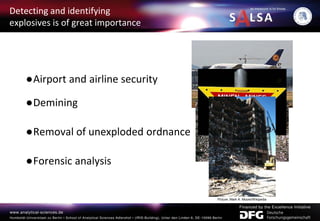
Detecting and identifying
explosives is of great importance
●Airport and airline security
●Demining
●Forensic analysis
●Removal of unexploded ordnance
Picture: Wo st 01/Wikipedia
Picture: MatthiasKabel/Wikipedia
Picture: Tom Oates/Wikipedia
Picture: Mark A. Moore/Wikipedia
Outline
●Forensic analysis
●Common explosives
■Inorganic explosives
● examples and sample preparation
● selected analytical techniques
■Organic explosives containing Nitro-moieties
● Principle of detection
● selected analytical techniques
■Other important explosives
Forensic analysis
After an incident with an explosion:
Where was the source of the explosion?
Which explosive was used?
Where did the explosive come from?
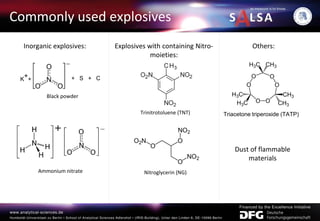
Commonly used explosives
Inorganic explosives: Explosives with containing Nitro-
moieties:
Others:
Ammonium nitrate
+ S + C
K
++
Black powder
Trinitrotoluene (TNT)
Nitroglycerin (NG)
Triacetone triperoxide (TATP)
Dust of flammable
materials
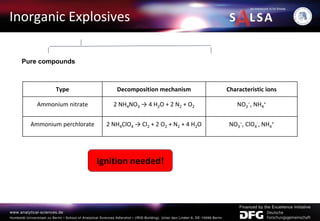
Inorganic Explosives
Type Decomposition mechanism Characteristic ions
Ammonium nitrate 2 NH4NO3 → 4 H2O + 2 N2 + O2 NO3
−, NH4
+
Ammonium perchlorate 2 NH4ClO4 → Cl2 + 2 O2 + N2 + 4 H2O NO3
−, ClO4
-, NH4
+
Pure compounds
Ignition needed!
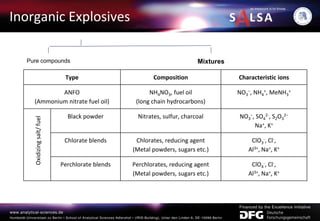
Inorganic Explosives
Type Composition Characteristic ions
ANFO
(Ammonium nitrate fuel oil)
NH4NO3, fuel oil
(long chain hydrocarbons)
NO3
−, NH4
+, MeNH3
+
Black powder Nitrates, sulfur, charcoal NO3
−, SO4
2-, S2O3
2−
Na+, K+
Chlorate blends Chlorates, reducing agent
(Metal powders, sugars etc.)
ClO3
-, Cl-,
Al3+, Na+, K+
Perchlorate blends Perchlorates, reducing agent
(Metal powders, sugars etc.)
ClO4
-, Cl-,
Al3+, Na+, K+
Pure compounds Mixtures
Oxidizing
salt/
fuel
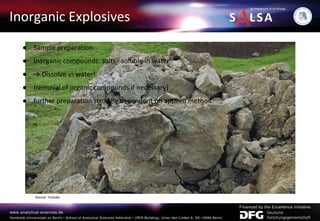
Inorganic Explosives
● Sample preparation:
● Inorganic compounds: salts - soluble in water
● → Dissolve in water!
● (removal of organic compounds if necessary)
● further preparation strongly dependent on applied method
Source: Youtube
Inorganic Explosives
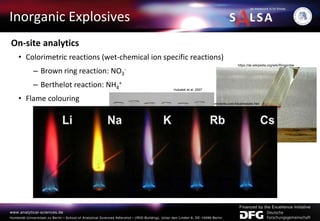
On-site analytics
• Colorimetric reactions (wet-chemical ion specific reactions)
– Brown ring reaction: NO3
-
– Berthelot reaction: NH4
+
• Flame colouring
https://de.wikipedia.org/wiki/Ringprobe
Reaction Ion LOD Source
Brown ring NO3
- 30 μg/ml Stevens 1966
Berthelot reaction NH4
+ 10 ng/ml Tsuboi et al. 2002
http://www.chemische-experimente.com/Alkalimetalle.htm
Hubalek et al. 2007
Inorganic Explosives
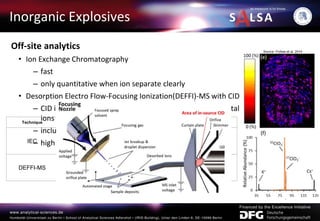
Off-site analytics
• Ion Exchange Chromatography
– fast
– only quantitative when ion separate clearly
• Desorption Electro Flow-Focusing Ionization(DEFFI)-MS with CID
– CID improves selectivity by breaking up adducts - elemental
ions can be preduced and detected more selectively
– includes mapping possibilities
– high instrumental effort
Technique Ion LOD Source
IEC
Al3+
ClO3
-
ClO4
-
0.95 ng/l
2 ng/ml
0.77 ng/ml
Gibson et al. 1991
Binghui et al. 2006
Tian et al. 2003
DEFFI-MS
K+
Pb+
ClO3
-
10 ng
1 ng
300 pg
Forbes et al. 2014
Source: Forbes et al. 2014
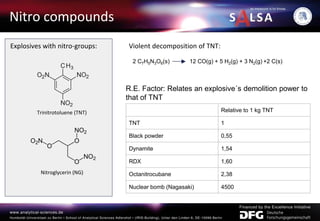
Nitro compounds
Trinitrotoluene (TNT)
Nitroglycerin (NG)
Explosives with nitro-groups:
2 C7H5N3O6(s) 12 CO(g) + 5 H2(g) + 3 N2(g) +2 C(s)
Violent decomposition of TNT:
Relative to 1 kg TNT
TNT 1
Black powder 0,55
Dynamite 1,54
RDX 1,60
Octanitrocubane 2,38
Nuclear bomb (Nagasaki) 4500
R.E. Factor: Relates an explosive´s demolition power to
that of TNT
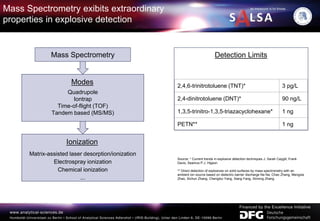
Mass Spectrometry exibits extraordinary
properties in explosive detection
Mass Spectrometry
Quadrupole
Iontrap
Time-of-flight (TOF)
Tandem based (MS/MS)
Modes
Ionization
Matrix-assisted laser desorption/ionization
Electrospray ionization
Chemical ionization
...
Detection Limits
2,4,6-trinitrotoluene (TNT)* 3 pg/L
2,4-dinitrotoluene (DNT)* 90 ng/L
1,3,5-trinitro-1,3,5-triazacyclohexane* 1 ng
PETN** 1 ng
Source: * Current trends in explosive detection techniques J. Sarah Caygill, Frank
Davis, Seamus P.J. Higson
** Direct detection of explosives on solid surfaces by mass spectrometry with an
ambient ion source based on dielectric barrier discharge Na Na, Chao Zhang, Mengxia
Zhao, Sichun Zhang, Chengdui Yang, Xiang Fang, Xinrong Zhang
Direct Analysis in Real Time is very useful for
examining surfaces
Direct Analysis in Real Time (DART)
Mechanism in Detail: Penning Ionization
M*+ S S+• + M + e-
He(23S) + H2O H2O+•+ He(11S) + electron
H2O+•+H2O H3O++ OH•
H3O++ n H2O [(H2O)nH]+
[(H2O)nH]++ S SH++nH2O
Source: Direct Analysis in Real Time (DARTtm) Mass Spectrometry Robert B. Cody, James A. Laramée, J. Michael Nilles, H. Dupont Durst
Sample
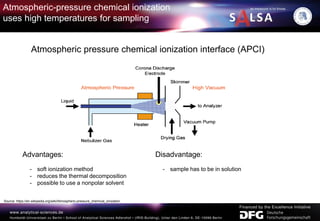
Atmospheric-pressure chemical ionization
uses high temperatures for sampling
Atmospheric pressure chemical ionization interface (APCI)
Advantages:
- soft ionization method
- reduces the thermal decomposition
- possible to use a nonpolar solvent
Source: https://en.wikipedia.org/wiki/Atmospheric-pressure_chemical_ionization
Disadvantage:
- sample has to be in solution
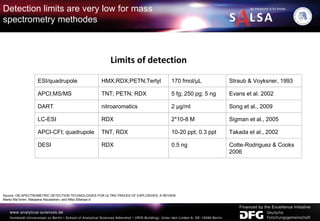
ESI/quadrupole HMX;RDX;PETN;Tertyl 170 fmol/μL Straub & Voyksner, 1993
APCI;MS/MS TNT; PETN; RDX 5 fg; 250 pg; 5 ng Evans et al. 2002
DART nitroaromatics 2 μg/ml Song et al., 2009
LC-ESI RDX 2*10-8 M Sigman et al., 2005
APCI-CFI; quadrupole TNT, RDX 10-20 ppt; 0.3 ppt Takada et al., 2002
DESI RDX 0.5 ng Cotte-Rodriguez & Cooks
2006
Detection limits are very low for mass
spectrometry methodes
Source: ON SPECTROMETRIC DETECTION TECHNOLOGIES FOR ULTRA-TRACES OF EXPLOSIVES: A REVIEW
Marko Ma¨kinen, Marjaana Nousiainen, and Mika Sillanpa¨a¨
Limits of detection
Raman Effect
Inelastic scattering at vibrational modes
• change in polarizability
• distinct signatures = selectivity
• low efficiency P≈10-7
– pulsed lasers
– UV higher QE (resonances)
– SERS
Raman Spectroscopy
Moore, Scharff 2008
Experimental Setup
Measuring the frequency-shift ωq=ωi±ωs
• portable solutions
• stand-off detection
Raman Spectroscopy
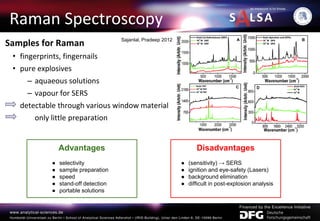
Samples for Raman
• fingerprints, fingernails
• pure explosives
– aquaeous solutions
– vapour for SERS
detectable through various window material
only little preparation
Sajanlal, Pradeep 2012
Advantages
● selectivity
● sample preparation
● speed
● stand-off detection
● portable solutions
Disadvantages
● (sensitivity) → SERS
● ignition and eye-safety (Lasers)
● background elimination
● difficult in post-explosion analysis
Raman Spectroscopy
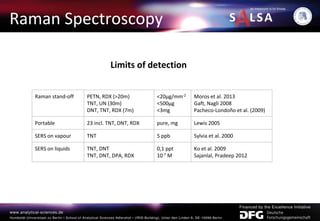
Raman stand-off PETN, RDX (>20m)
TNT, UN (30m)
DNT, TNT, RDX (7m)
<20μg/mm-2
<500μg
<3mg
Moros et al. 2013
Gaft, Nagli 2008
Pacheco-Londoño et al. (2009)
Portable 23 incl. TNT, DNT, RDX pure, mg Lewis 2005
SERS on vapour TNT 5 ppb Sylvia et al. 2000
SERS on liquids TNT, DNT
TNT, DNT, DPA, RDX
0,1 ppt
10-7 M
Ko et al. 2009
Sajanlal, Pradeep 2012
Limits of detection
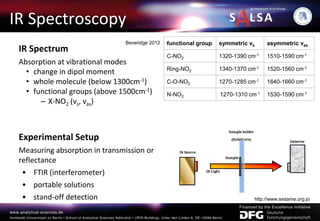
IR Spectrum
Absorption at vibrational modes
• change in dipol moment
• whole molecule (below 1300cm-1)
• functional groups (above 1500cm-1)
– X-NO2 (vs, vas)
IR Spectroscopy
Beveridge 2012 functional group symmetric vs asymmetric vas
C-NO2 1320-1390 cm-1 1510-1590 cm-1
Ring-NO2 1340-1370 cm-1 1520-1560 cm-1
C-O-NO2 1270-1285 cm-1 1640-1660 cm-1
N-NO2 1270-1310 cm-1 1530-1590 cm-1
http://www.sesame.org.jo
Experimental Setup
Measuring absorption in transmission or
reflectance
• FTIR (interferometer)
• portable solutions
• stand-off detection
IR Spectroscopy
Advantages
● selectivity
● stand-off detection
● portable solutions
● characteristic for functional
groups/inorganic atoms
Disadvantages
● ignition
● absorption by air/water
● difficult in post-explosion analysis
● IR spectra sometimes similar
● low sensitivity (typical LOD ≥ 1mg)
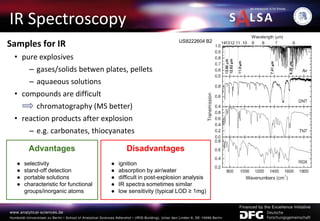
Samples for IR
• pure explosives
– gases/solids betwen plates, pellets
– aquaeous solutions
• compounds are difficult
chromatography (MS better)
• reaction products after explosion
– e.g. carbonates, thiocyanates
US8222604 B2
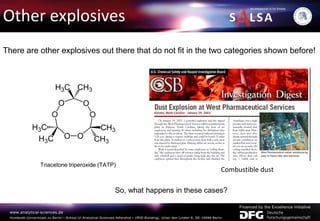
Triacetone triperoxide (TATP)
Combustible dust
Other explosives
There are other explosives out there that do not fit in the two categories shown before!
So, what happens in these cases?
Others - Organic Peroxides
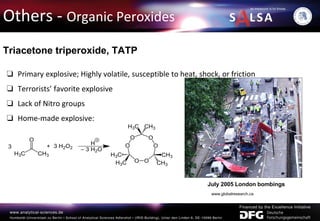
Triacetone triperoxide, TATP
❏ Primary explosive; Highly volatile, susceptible to heat, shock, or friction
❏ Terrorists’ favorite explosive
❏ Lack of Nitro groups
❏ Home-made explosive:
July 2005 London bombings
www.globalresearch.ca
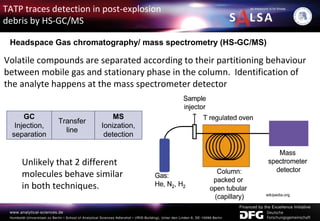
TATP traces detection in post-explosion
debris by HS-GC/MS
Volatile compounds are separated according to their partitioning behaviour
between mobile gas and stationary phase in the column. Identification of
the analyte happens at the mass spectrometer detector
Unlikely that 2 different
molecules behave similar
in both techniques.
Transfer
line
MS
Ionization,
detection
Headspace Gas chromatography/ mass spectrometry (HS-GC/MS)
GC
Injection,
separation
wikipedia.org
Headspace sampling:
analysis of the gas phase in the headspace above the sample.
Post-explosion debris (soil, glass and metals) collected from the
area of explosion in a glass container and heated. Then, a sample
from the headspace is injected to GC/MS.
m/z [M-1]
Detection limit of
1 nanogram
TATP traces detection in post-explosion
debris by HS-GC/MS
Stambouli A. et al., Forensic Sci
Int., 2004, 146S, S191
http://www.labhut.com/
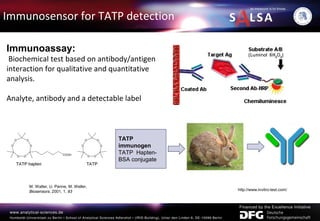
Immunosensor for TATP detection
Immunoassay:
Biochemical test based on antibody/antigen
interaction for qualitative and quantitative
analysis.
Analyte, antibody and a detectable label
TATP
immunogen
TATP Hapten-
BSA conjugate
M. Walter, U. Panne, M. Weller,
Biosensors, 2001, 1, 93 http://www.invitro-test.com/
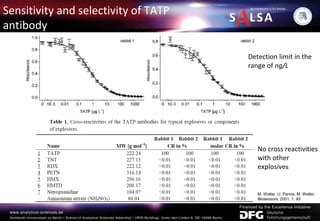
Sensitivity and selectivity of TATP
antibody
No cross reactivities
with other
explosives
M. Walter, U. Panne, M. Weller,
Biosensors, 2001, 1, 93
Detection limit in the
range of ng/L
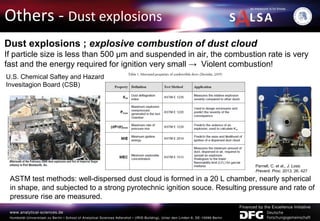
Others - Dust explosions
Dust explosions ; explosive combustion of dust cloud
If particle size is less than 500 μm and suspended in air, the combustion rate is very
fast and the energy required for ignition very small → Violent combustion!
ASTM test methods: well-dispersed dust cloud is formed in a 20 L chamber, nearly spherical
in shape, and subjected to a strong pyrotechnic ignition souce. Resulting pressure and rate of
pressure rise are measured.
U.S. Chemical Saftey and Hazard
Invesitagion Board (CSB)
Parnell, C. et al., J. Loss.
Prevent. Proc. 2013, 26, 427
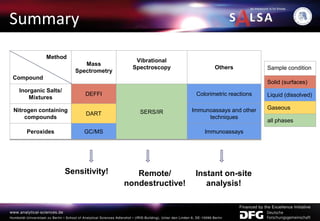
Summary
Method
Compound
Mass
Spectrometry
Vibrational
Spectroscopy Others
Inorganic Salts/
Mixtures
DEFFI
SERS/IR
Colorimetric reactions
Nitrogen containing
compounds
DART
Immunoassays and other
techniques
Peroxides GC/MS Immunoassays
Sample condition
Solid (surfaces)
Liquid (dissolved)
Gaseous
all phases
Sensitivity! Remote/
nondestructive!
Instant on-site
analysis!

031115-Presentation_chemistryExplosives.pdf

  • 1.
    Forensic analysis ofexplosives Youngeun Choi, Dario Remmler, Maximilian Ries, Felix Rösicke, Radwan Sarhan, Felix Stete, Zhiyang Zhang
  • 2.
    Detecting and identifying explosivesis of great importance ●Airport and airline security ●Demining ●Forensic analysis ●Removal of unexploded ordnance Picture: Wo st 01/Wikipedia Picture: MatthiasKabel/Wikipedia Picture: Tom Oates/Wikipedia Picture: Mark A. Moore/Wikipedia
  • 3.
    Outline ●Forensic analysis ●Common explosives ■Inorganicexplosives ● examples and sample preparation ● selected analytical techniques ■Organic explosives containing Nitro-moieties ● Principle of detection ● selected analytical techniques ■Other important explosives
  • 4.
    Forensic analysis After anincident with an explosion: Where was the source of the explosion? Which explosive was used? Where did the explosive come from?
  • 5.
    Commonly used explosives Inorganicexplosives: Explosives with containing Nitro- moieties: Others: Ammonium nitrate + S + C K ++ Black powder Trinitrotoluene (TNT) Nitroglycerin (NG) Triacetone triperoxide (TATP) Dust of flammable materials
  • 6.
    Inorganic Explosives Type Decompositionmechanism Characteristic ions Ammonium nitrate 2 NH4NO3 → 4 H2O + 2 N2 + O2 NO3 −, NH4 + Ammonium perchlorate 2 NH4ClO4 → Cl2 + 2 O2 + N2 + 4 H2O NO3 −, ClO4 -, NH4 + Pure compounds Ignition needed!
  • 7.
    Inorganic Explosives Type CompositionCharacteristic ions ANFO (Ammonium nitrate fuel oil) NH4NO3, fuel oil (long chain hydrocarbons) NO3 −, NH4 +, MeNH3 + Black powder Nitrates, sulfur, charcoal NO3 −, SO4 2-, S2O3 2− Na+, K+ Chlorate blends Chlorates, reducing agent (Metal powders, sugars etc.) ClO3 -, Cl-, Al3+, Na+, K+ Perchlorate blends Perchlorates, reducing agent (Metal powders, sugars etc.) ClO4 -, Cl-, Al3+, Na+, K+ Pure compounds Mixtures Oxidizing salt/ fuel
  • 8.
    Inorganic Explosives ● Samplepreparation: ● Inorganic compounds: salts - soluble in water ● → Dissolve in water! ● (removal of organic compounds if necessary) ● further preparation strongly dependent on applied method Source: Youtube
  • 9.
    Inorganic Explosives On-site analytics •Colorimetric reactions (wet-chemical ion specific reactions) – Brown ring reaction: NO3 - – Berthelot reaction: NH4 + • Flame colouring https://de.wikipedia.org/wiki/Ringprobe Reaction Ion LOD Source Brown ring NO3 - 30 μg/ml Stevens 1966 Berthelot reaction NH4 + 10 ng/ml Tsuboi et al. 2002 http://www.chemische-experimente.com/Alkalimetalle.htm Hubalek et al. 2007
  • 10.
    Inorganic Explosives Off-site analytics •Ion Exchange Chromatography – fast – only quantitative when ion separate clearly • Desorption Electro Flow-Focusing Ionization(DEFFI)-MS with CID – CID improves selectivity by breaking up adducts - elemental ions can be preduced and detected more selectively – includes mapping possibilities – high instrumental effort Technique Ion LOD Source IEC Al3+ ClO3 - ClO4 - 0.95 ng/l 2 ng/ml 0.77 ng/ml Gibson et al. 1991 Binghui et al. 2006 Tian et al. 2003 DEFFI-MS K+ Pb+ ClO3 - 10 ng 1 ng 300 pg Forbes et al. 2014 Source: Forbes et al. 2014
  • 11.
    Nitro compounds Trinitrotoluene (TNT) Nitroglycerin(NG) Explosives with nitro-groups: 2 C7H5N3O6(s) 12 CO(g) + 5 H2(g) + 3 N2(g) +2 C(s) Violent decomposition of TNT: Relative to 1 kg TNT TNT 1 Black powder 0,55 Dynamite 1,54 RDX 1,60 Octanitrocubane 2,38 Nuclear bomb (Nagasaki) 4500 R.E. Factor: Relates an explosive´s demolition power to that of TNT
  • 12.
    Mass Spectrometry exibitsextraordinary properties in explosive detection Mass Spectrometry Quadrupole Iontrap Time-of-flight (TOF) Tandem based (MS/MS) Modes Ionization Matrix-assisted laser desorption/ionization Electrospray ionization Chemical ionization ... Detection Limits 2,4,6-trinitrotoluene (TNT)* 3 pg/L 2,4-dinitrotoluene (DNT)* 90 ng/L 1,3,5-trinitro-1,3,5-triazacyclohexane* 1 ng PETN** 1 ng Source: * Current trends in explosive detection techniques J. Sarah Caygill, Frank Davis, Seamus P.J. Higson ** Direct detection of explosives on solid surfaces by mass spectrometry with an ambient ion source based on dielectric barrier discharge Na Na, Chao Zhang, Mengxia Zhao, Sichun Zhang, Chengdui Yang, Xiang Fang, Xinrong Zhang
  • 13.
    Direct Analysis inReal Time is very useful for examining surfaces Direct Analysis in Real Time (DART) Mechanism in Detail: Penning Ionization M*+ S S+• + M + e- He(23S) + H2O H2O+•+ He(11S) + electron H2O+•+H2O H3O++ OH• H3O++ n H2O [(H2O)nH]+ [(H2O)nH]++ S SH++nH2O Source: Direct Analysis in Real Time (DARTtm) Mass Spectrometry Robert B. Cody, James A. Laramée, J. Michael Nilles, H. Dupont Durst Sample
  • 14.
    Atmospheric-pressure chemical ionization useshigh temperatures for sampling Atmospheric pressure chemical ionization interface (APCI) Advantages: - soft ionization method - reduces the thermal decomposition - possible to use a nonpolar solvent Source: https://en.wikipedia.org/wiki/Atmospheric-pressure_chemical_ionization Disadvantage: - sample has to be in solution
  • 15.
    ESI/quadrupole HMX;RDX;PETN;Tertyl 170fmol/μL Straub & Voyksner, 1993 APCI;MS/MS TNT; PETN; RDX 5 fg; 250 pg; 5 ng Evans et al. 2002 DART nitroaromatics 2 μg/ml Song et al., 2009 LC-ESI RDX 2*10-8 M Sigman et al., 2005 APCI-CFI; quadrupole TNT, RDX 10-20 ppt; 0.3 ppt Takada et al., 2002 DESI RDX 0.5 ng Cotte-Rodriguez & Cooks 2006 Detection limits are very low for mass spectrometry methodes Source: ON SPECTROMETRIC DETECTION TECHNOLOGIES FOR ULTRA-TRACES OF EXPLOSIVES: A REVIEW Marko Ma¨kinen, Marjaana Nousiainen, and Mika Sillanpa¨a¨ Limits of detection
  • 16.
    Raman Effect Inelastic scatteringat vibrational modes • change in polarizability • distinct signatures = selectivity • low efficiency P≈10-7 – pulsed lasers – UV higher QE (resonances) – SERS Raman Spectroscopy Moore, Scharff 2008 Experimental Setup Measuring the frequency-shift ωq=ωi±ωs • portable solutions • stand-off detection
  • 17.
    Raman Spectroscopy Samples forRaman • fingerprints, fingernails • pure explosives – aquaeous solutions – vapour for SERS detectable through various window material only little preparation Sajanlal, Pradeep 2012 Advantages ● selectivity ● sample preparation ● speed ● stand-off detection ● portable solutions Disadvantages ● (sensitivity) → SERS ● ignition and eye-safety (Lasers) ● background elimination ● difficult in post-explosion analysis
  • 18.
    Raman Spectroscopy Raman stand-offPETN, RDX (>20m) TNT, UN (30m) DNT, TNT, RDX (7m) <20μg/mm-2 <500μg <3mg Moros et al. 2013 Gaft, Nagli 2008 Pacheco-Londoño et al. (2009) Portable 23 incl. TNT, DNT, RDX pure, mg Lewis 2005 SERS on vapour TNT 5 ppb Sylvia et al. 2000 SERS on liquids TNT, DNT TNT, DNT, DPA, RDX 0,1 ppt 10-7 M Ko et al. 2009 Sajanlal, Pradeep 2012 Limits of detection
  • 19.
    IR Spectrum Absorption atvibrational modes • change in dipol moment • whole molecule (below 1300cm-1) • functional groups (above 1500cm-1) – X-NO2 (vs, vas) IR Spectroscopy Beveridge 2012 functional group symmetric vs asymmetric vas C-NO2 1320-1390 cm-1 1510-1590 cm-1 Ring-NO2 1340-1370 cm-1 1520-1560 cm-1 C-O-NO2 1270-1285 cm-1 1640-1660 cm-1 N-NO2 1270-1310 cm-1 1530-1590 cm-1 http://www.sesame.org.jo Experimental Setup Measuring absorption in transmission or reflectance • FTIR (interferometer) • portable solutions • stand-off detection
  • 20.
    IR Spectroscopy Advantages ● selectivity ●stand-off detection ● portable solutions ● characteristic for functional groups/inorganic atoms Disadvantages ● ignition ● absorption by air/water ● difficult in post-explosion analysis ● IR spectra sometimes similar ● low sensitivity (typical LOD ≥ 1mg) Samples for IR • pure explosives – gases/solids betwen plates, pellets – aquaeous solutions • compounds are difficult chromatography (MS better) • reaction products after explosion – e.g. carbonates, thiocyanates US8222604 B2
  • 21.
    Triacetone triperoxide (TATP) Combustibledust Other explosives There are other explosives out there that do not fit in the two categories shown before! So, what happens in these cases?
  • 22.
    Others - OrganicPeroxides Triacetone triperoxide, TATP ❏ Primary explosive; Highly volatile, susceptible to heat, shock, or friction ❏ Terrorists’ favorite explosive ❏ Lack of Nitro groups ❏ Home-made explosive: July 2005 London bombings www.globalresearch.ca
  • 23.
    TATP traces detectionin post-explosion debris by HS-GC/MS Volatile compounds are separated according to their partitioning behaviour between mobile gas and stationary phase in the column. Identification of the analyte happens at the mass spectrometer detector Unlikely that 2 different molecules behave similar in both techniques. Transfer line MS Ionization, detection Headspace Gas chromatography/ mass spectrometry (HS-GC/MS) GC Injection, separation wikipedia.org
  • 24.
    Headspace sampling: analysis ofthe gas phase in the headspace above the sample. Post-explosion debris (soil, glass and metals) collected from the area of explosion in a glass container and heated. Then, a sample from the headspace is injected to GC/MS. m/z [M-1] Detection limit of 1 nanogram TATP traces detection in post-explosion debris by HS-GC/MS Stambouli A. et al., Forensic Sci Int., 2004, 146S, S191 http://www.labhut.com/
  • 25.
    Immunosensor for TATPdetection Immunoassay: Biochemical test based on antibody/antigen interaction for qualitative and quantitative analysis. Analyte, antibody and a detectable label TATP immunogen TATP Hapten- BSA conjugate M. Walter, U. Panne, M. Weller, Biosensors, 2001, 1, 93 http://www.invitro-test.com/
  • 26.
    Sensitivity and selectivityof TATP antibody No cross reactivities with other explosives M. Walter, U. Panne, M. Weller, Biosensors, 2001, 1, 93 Detection limit in the range of ng/L
  • 27.
    Others - Dustexplosions Dust explosions ; explosive combustion of dust cloud If particle size is less than 500 μm and suspended in air, the combustion rate is very fast and the energy required for ignition very small → Violent combustion! ASTM test methods: well-dispersed dust cloud is formed in a 20 L chamber, nearly spherical in shape, and subjected to a strong pyrotechnic ignition souce. Resulting pressure and rate of pressure rise are measured. U.S. Chemical Saftey and Hazard Invesitagion Board (CSB) Parnell, C. et al., J. Loss. Prevent. Proc. 2013, 26, 427
  • 28.
    Summary Method Compound Mass Spectrometry Vibrational Spectroscopy Others Inorganic Salts/ Mixtures DEFFI SERS/IR Colorimetricreactions Nitrogen containing compounds DART Immunoassays and other techniques Peroxides GC/MS Immunoassays Sample condition Solid (surfaces) Liquid (dissolved) Gaseous all phases Sensitivity! Remote/ nondestructive! Instant on-site analysis!