Guidelines to Effective
Presentations
“A survey of top executives who earned more
than $250,000 per year was conducted by a
large executive search firm. The survey found
that these executives believed their
communication skills were the number one
factor that carried them to the top”.
From Wake em Up , by Tom Antion
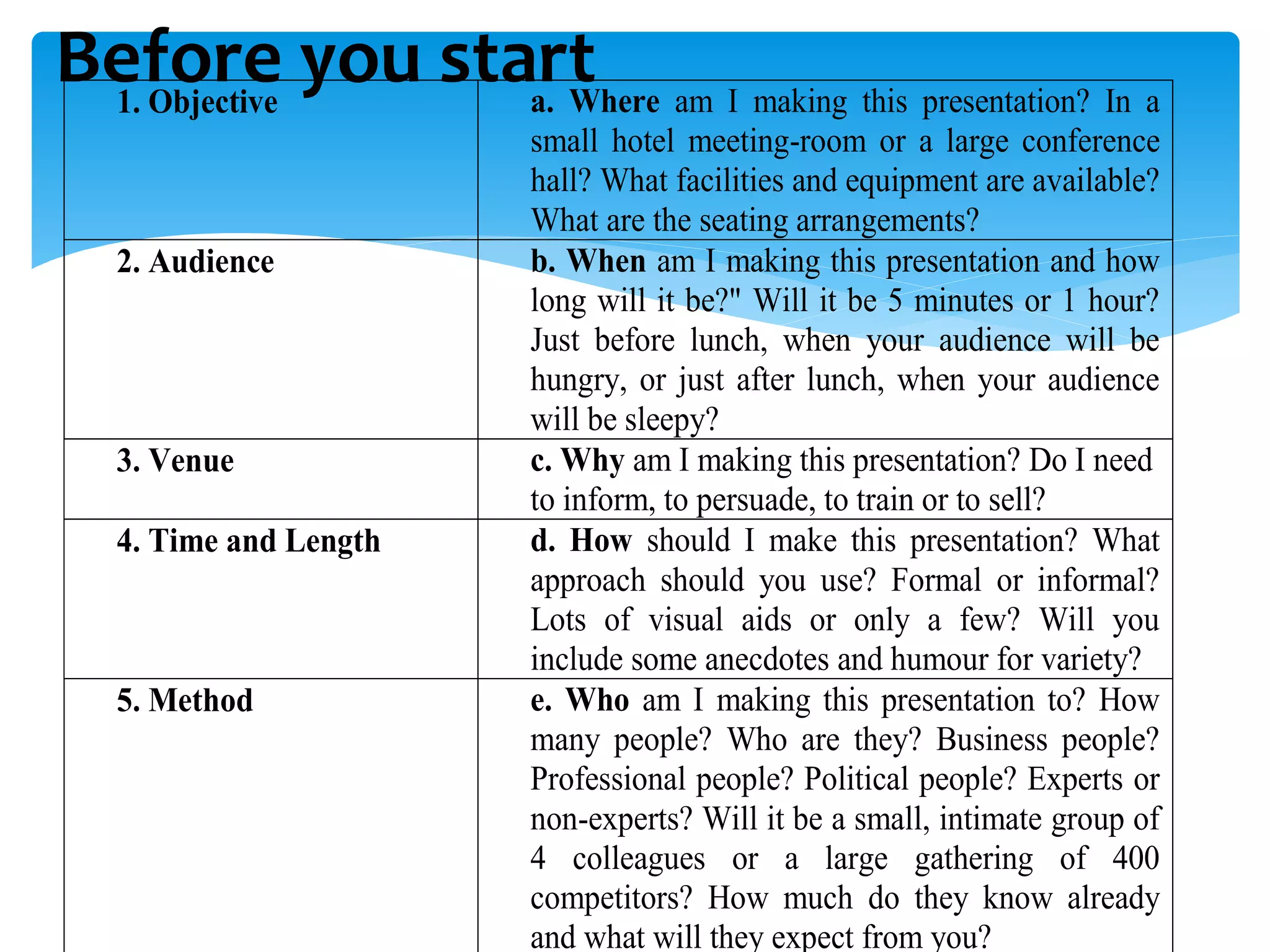
Before you start1. Objective a. Where am I making this presentation? In a
small hotel meeting-room or a large conference
hall? What facilities and equipment are available?
What are the seating arrangements?
2. Audience b. When am I making this presentation and how
long will it be?" Will it be 5 minutes or 1 hour?
Just before lunch, when your audience will be
hungry, or just after lunch, when your audience
will be sleepy?
3. Venue c. Why am I making this presentation? Do I need
to inform, to persuade, to train or to sell?
4. Time and Length d. How should I make this presentation? What
approach should you use? Formal or informal?
Lots of visual aids or only a few? Will you
include some anecdotes and humour for variety?
5. Method e. Who am I making this presentation to? How
many people? Who are they? Business people?
Professional people? Political people? Experts or
non-experts? Will it be a small, intimate group of
4 colleagues or a large gathering of 400
competitors? How much do they know already
and what will they expect from you?
A noted speaker was asked his secret of
success. “First,” he said, “you write an exciting
opening that will draw the attention of
everyone in the room. Then you compose a
dramatic summary and closing words that will
leave the audience spellbound. Then,” he
advised, “You put them as close together as
possible.”
Speech Organization
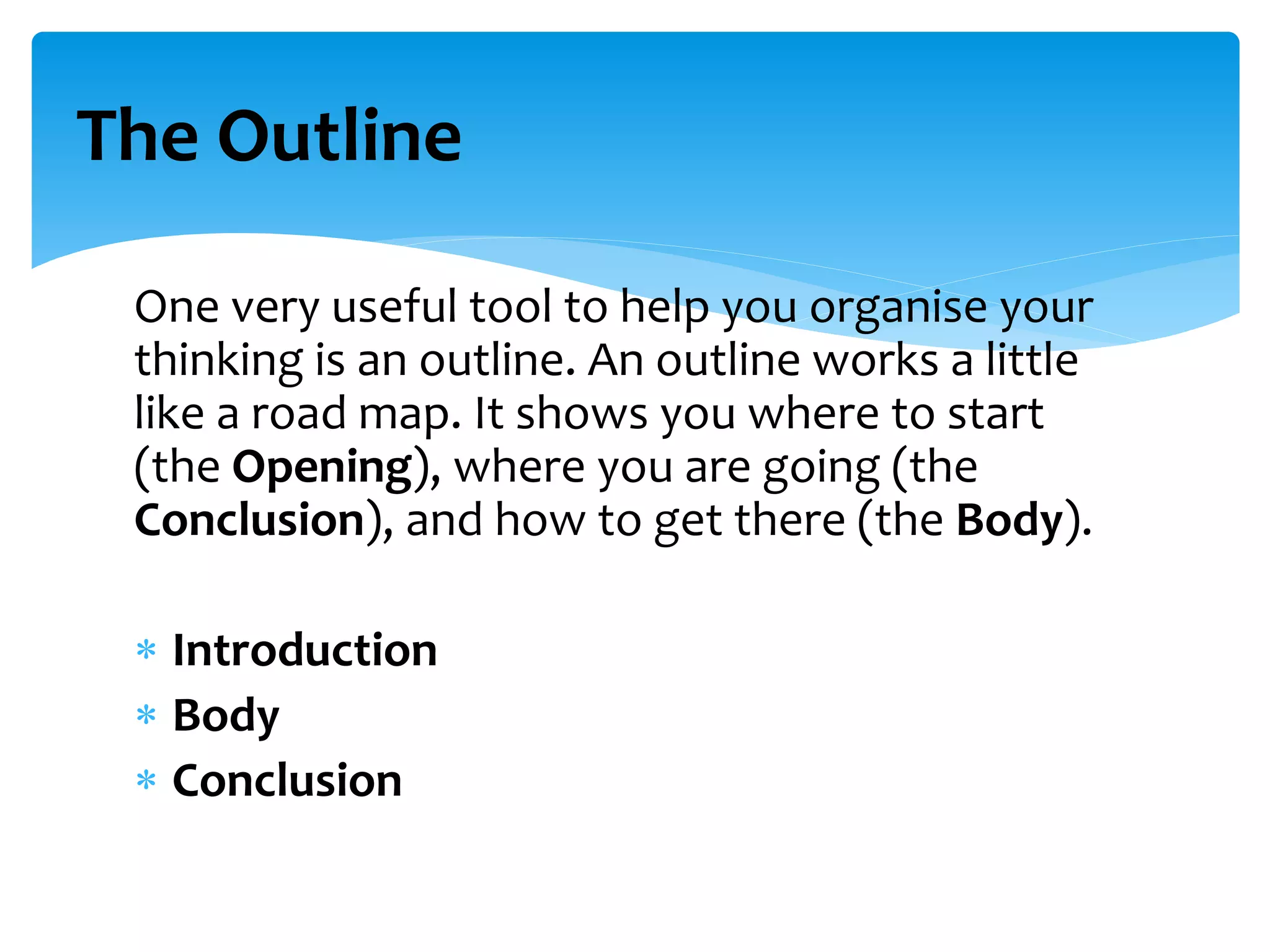
One very useful tool to help you organise your
thinking is an outline. An outline works a little
like a road map. It shows you where to start
(the Opening), where you are going (the
Conclusion), and how to get there (the Body).
 Introduction
 Body
 Conclusion
The Outline
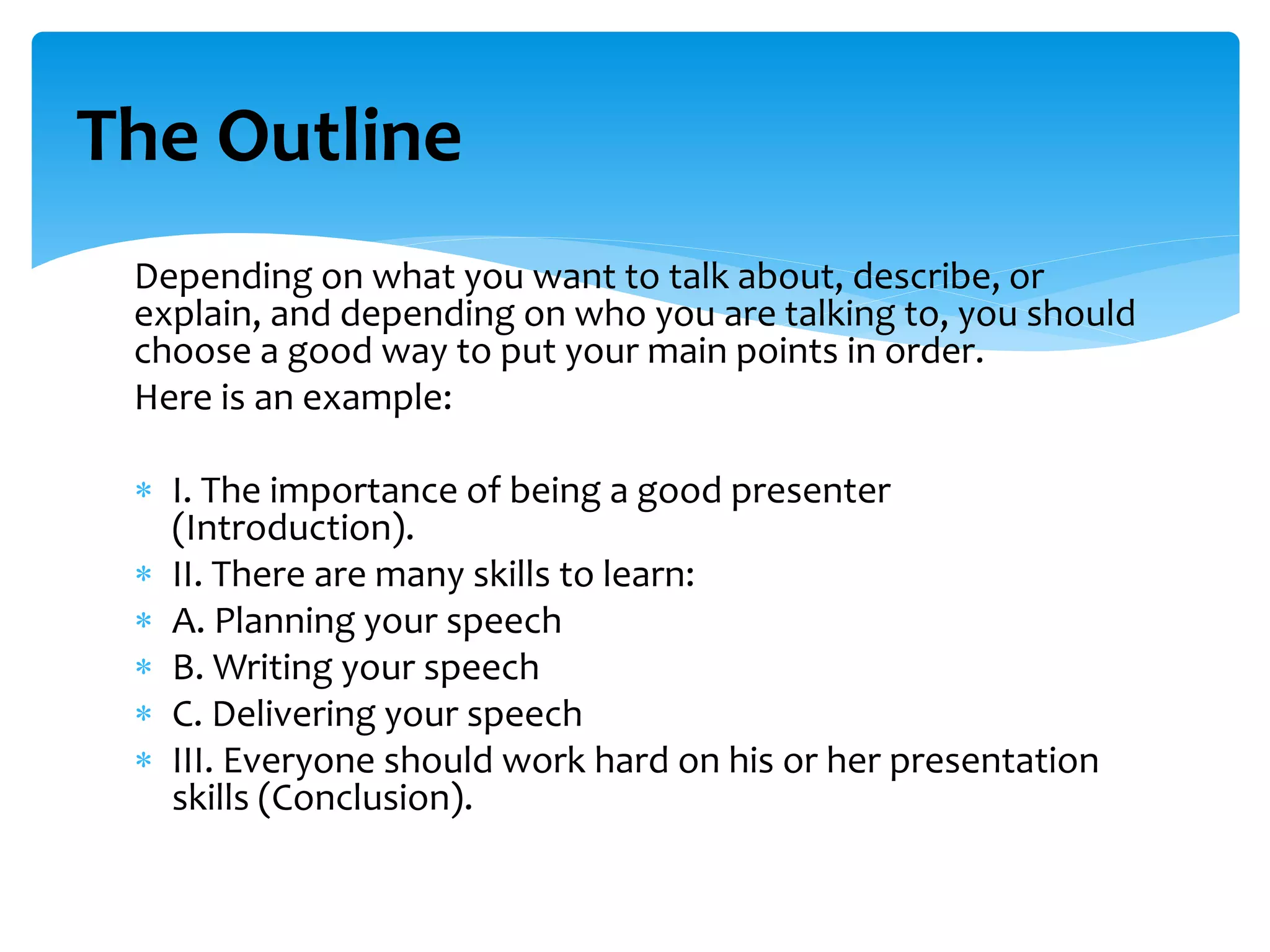
Depending on what you want to talk about, describe, or
explain, and depending on who you are talking to, you should
choose a good way to put your main points in order.
Here is an example:
 I. The importance of being a good presenter
(Introduction).
 II. There are many skills to learn:
 A. Planning your speech
 B. Writing your speech
 C. Delivering your speech
 III. Everyone should work hard on his or her presentation
skills (Conclusion).
The Outline
The Outline

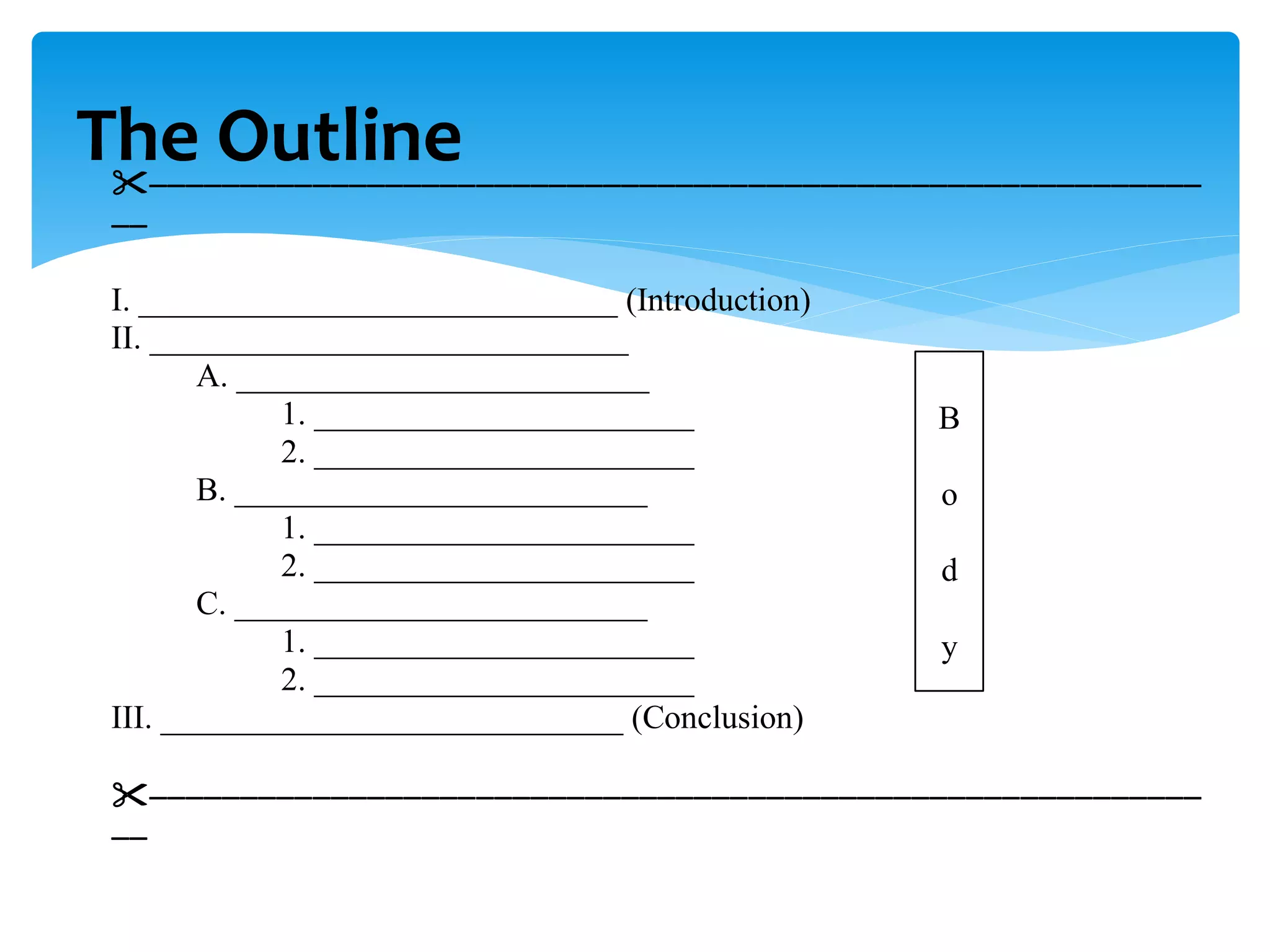
I. _____________________________ (Introduction)
II. _____________________________
A. _________________________
1. _______________________
2. _______________________
B. _________________________
1. _______________________
2. _______________________
C. _________________________
1. _______________________
2. _______________________
III. ____________________________ (Conclusion)


B
o
d
y
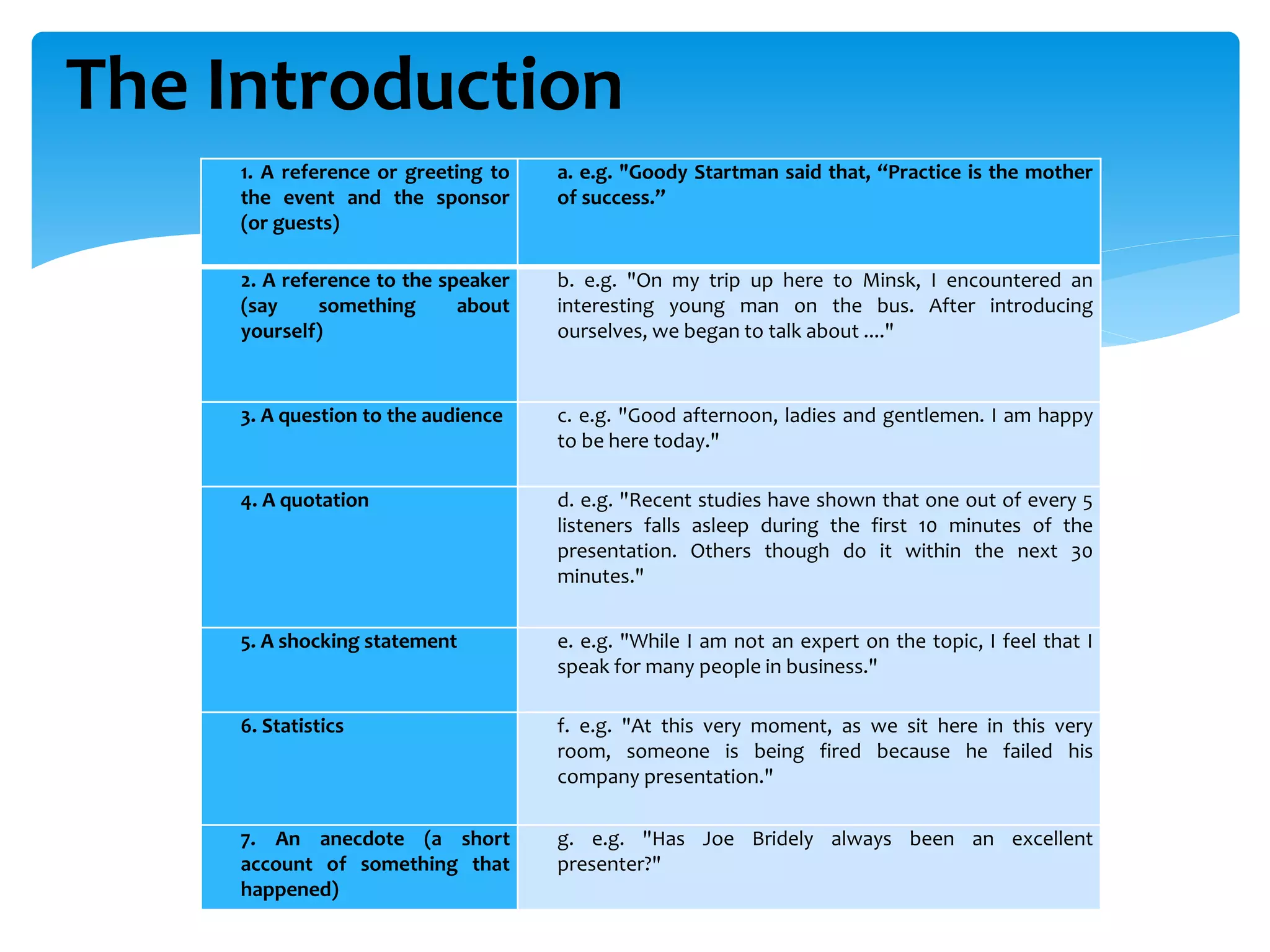
1. A reference or greeting to
the event and the sponsor
(or guests)
a. e.g. "Goody Startman said that, “Practice is the mother
of success.”
2. A reference to the speaker
(say something about
yourself)
b. e.g. "On my trip up here to Minsk, I encountered an
interesting young man on the bus. After introducing
ourselves, we began to talk about ...."
3. A question to the audience c. e.g. "Good afternoon, ladies and gentlemen. I am happy
to be here today."
4. A quotation d. e.g. "Recent studies have shown that one out of every 5
listeners falls asleep during the first 10 minutes of the
presentation. Others though do it within the next 30
minutes."
5. A shocking statement e. e.g. "While I am not an expert on the topic, I feel that I
speak for many people in business."
6. Statistics f. e.g. "At this very moment, as we sit here in this very
room, someone is being fired because he failed his
company presentation."
7. An anecdote (a short
account of something that
happened)
g. e.g. "Has Joe Bridely always been an excellent
presenter?"
The Introduction
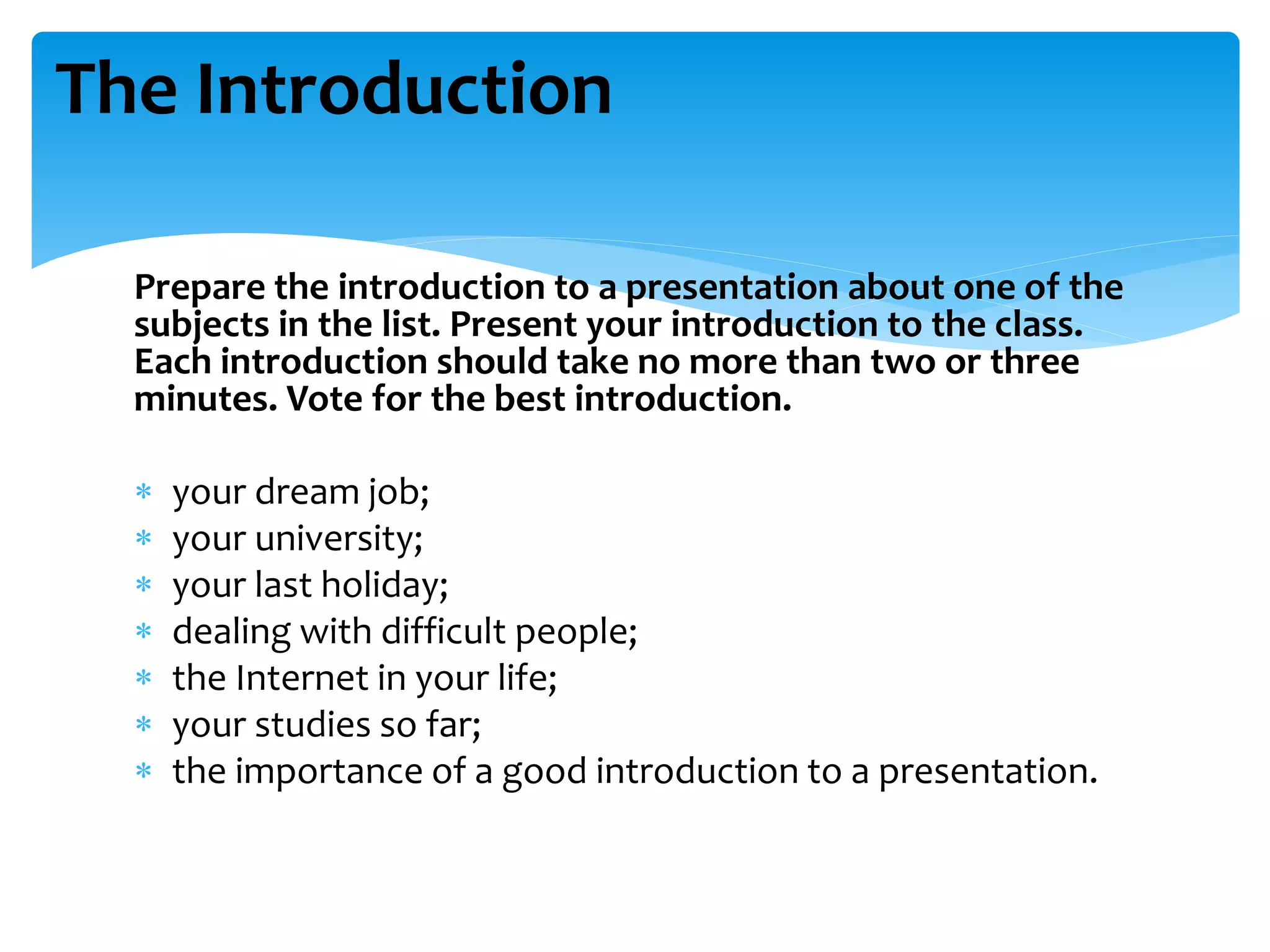
Prepare the introduction to a presentation about one of the
subjects in the list. Present your introduction to the class.
Each introduction should take no more than two or three
minutes. Vote for the best introduction.
 your dream job;
 your university;
 your last holiday;
 dealing with difficult people;
 the Internet in your life;
 your studies so far;
 the importance of a good introduction to a presentation.
The Introduction
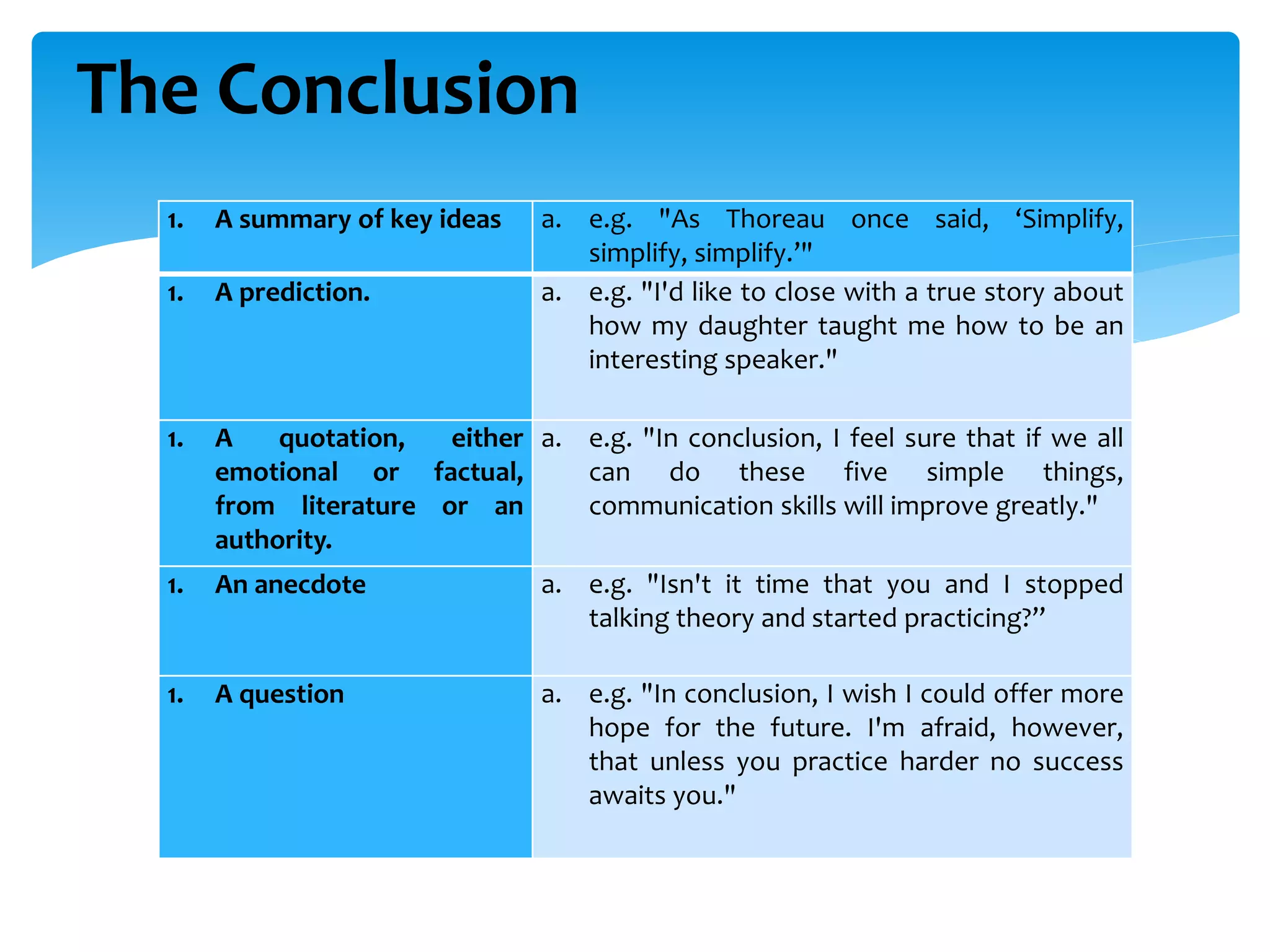
1. A summary of key ideas a. e.g. "As Thoreau once said, ‘Simplify,
simplify, simplify.’"
1. A prediction. a. e.g. "I'd like to close with a true story about
how my daughter taught me how to be an
interesting speaker."
1. A quotation, either
emotional or factual,
from literature or an
authority.
a. e.g. "In conclusion, I feel sure that if we all
can do these five simple things,
communication skills will improve greatly."
1. An anecdote a. e.g. "Isn't it time that you and I stopped
talking theory and started practicing?”
1. A question a. e.g. "In conclusion, I wish I could offer more
hope for the future. I'm afraid, however,
that unless you practice harder no success
awaits you."
The Conclusion
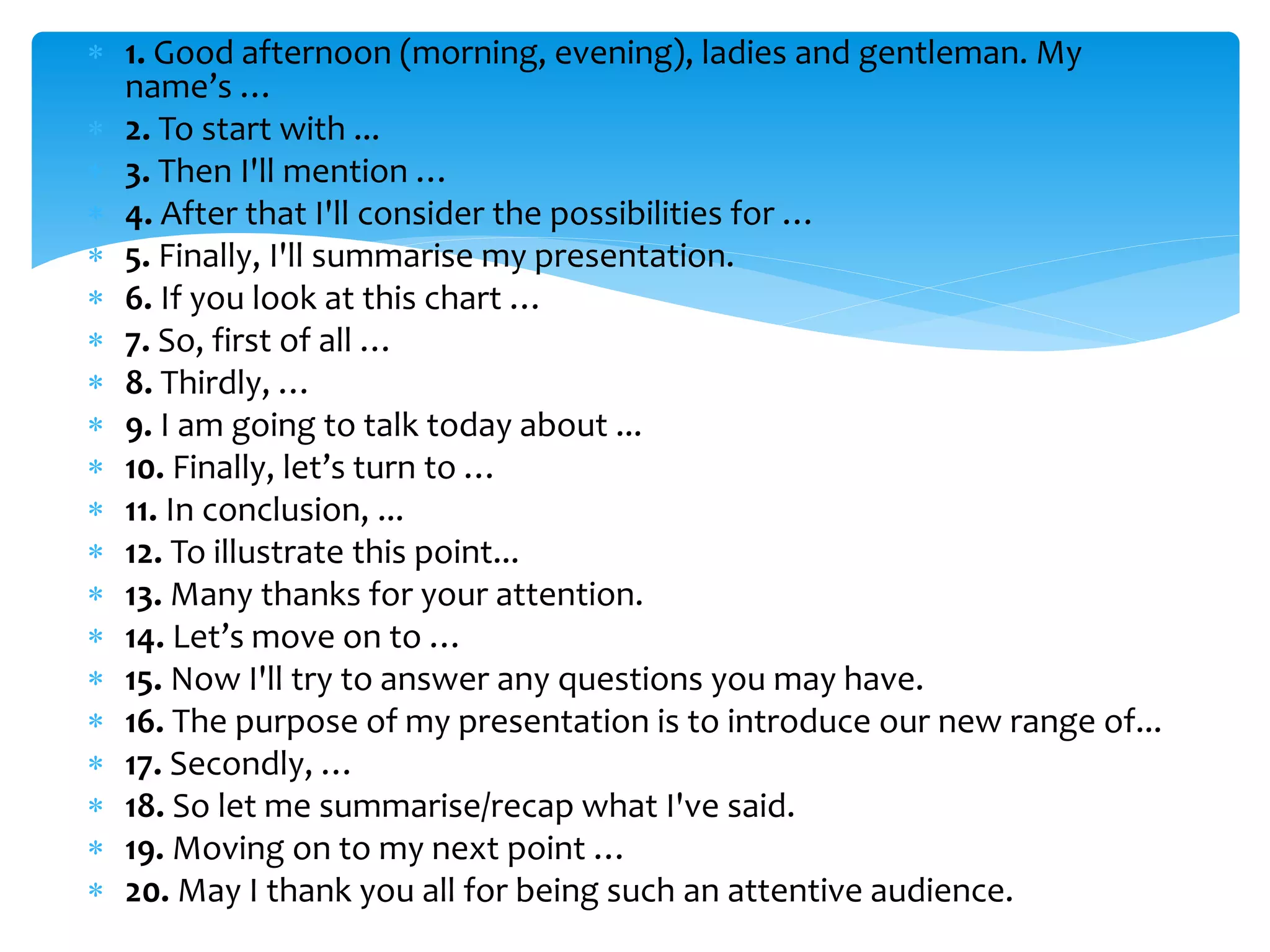
 1. Good afternoon (morning, evening), ladies and gentleman. My
name’s …
 2. To start with ...
 3. Then I'll mention …
 4. After that I'll consider the possibilities for …
 5. Finally, I'll summarise my presentation.
 6. If you look at this chart …
 7. So, first of all …
 8. Thirdly, …
 9. I am going to talk today about ...
 10. Finally, let’s turn to …
 11. In conclusion, ...
 12. To illustrate this point...
 13. Many thanks for your attention.
 14. Let’s move on to …
 15. Now I'll try to answer any questions you may have.
 16. The purpose of my presentation is to introduce our new range of...
 17. Secondly, …
 18. So let me summarise/recap what I've said.
 19. Moving on to my next point …
 20. May I thank you all for being such an attentive audience.
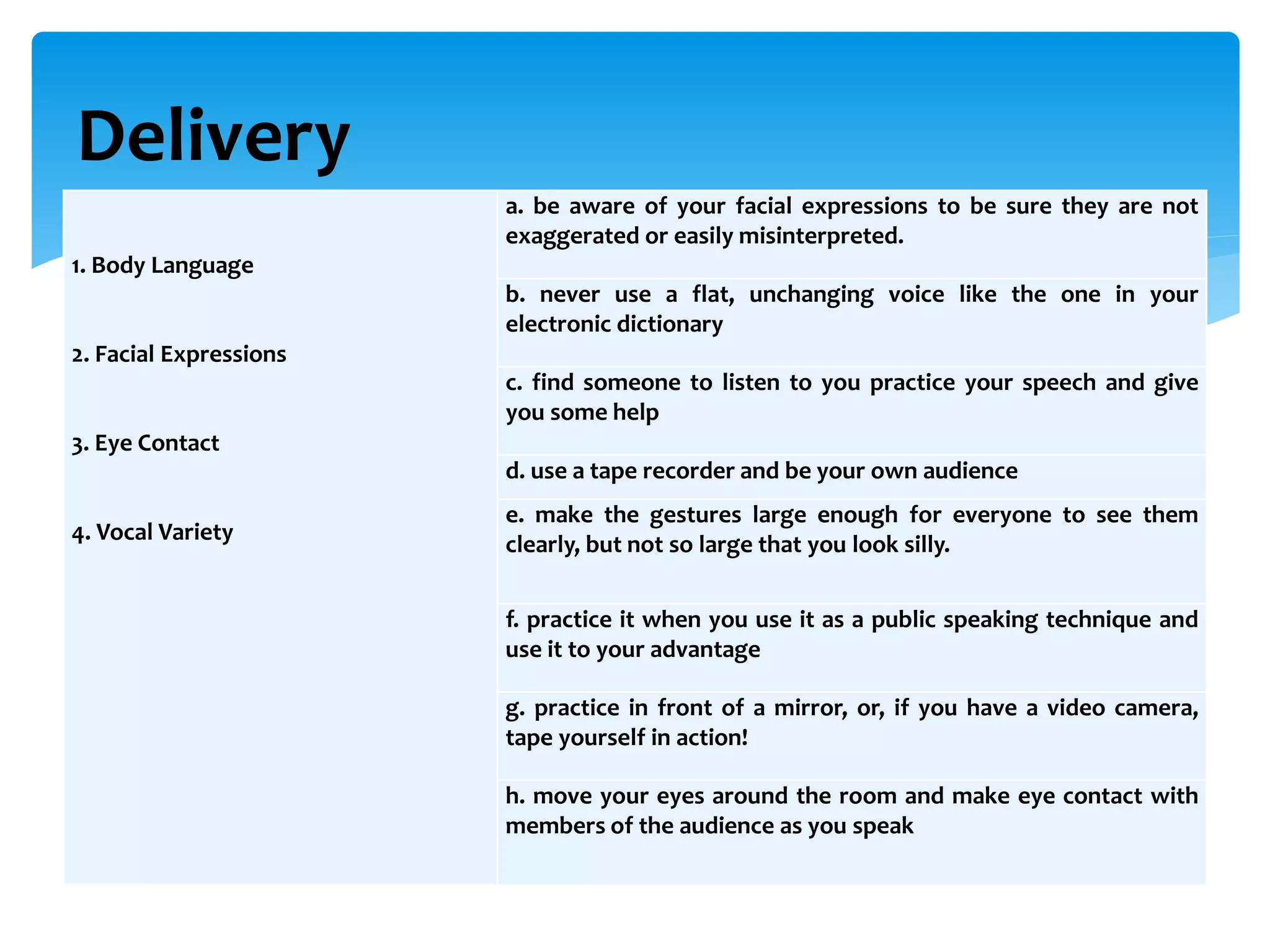
1. Body Language
2. Facial Expressions
3. Eye Contact
4. Vocal Variety
a. be aware of your facial expressions to be sure they are not
exaggerated or easily misinterpreted.
b. never use a flat, unchanging voice like the one in your
electronic dictionary
c. find someone to listen to you practice your speech and give
you some help
d. use a tape recorder and be your own audience
e. make the gestures large enough for everyone to see them
clearly, but not so large that you look silly.
f. practice it when you use it as a public speaking technique and
use it to your advantage
g. practice in front of a mirror, or, if you have a video camera,
tape yourself in action!
h. move your eyes around the room and make eye contact with
members of the audience as you speak
Delivery
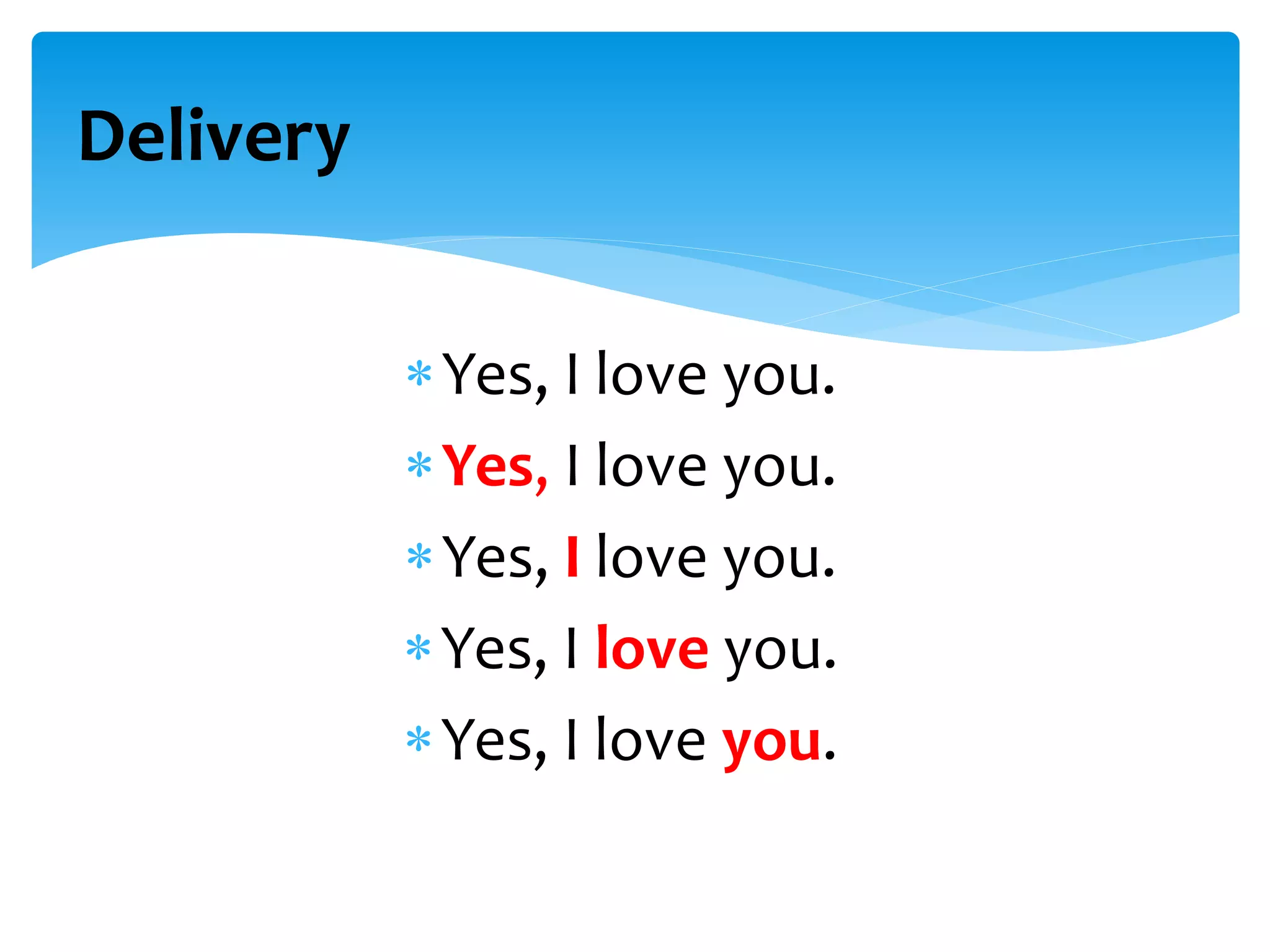
Yes, I love you.
Yes, I love you.
Yes, I love you.
Yes, I love you.
Yes, I love you.
Delivery
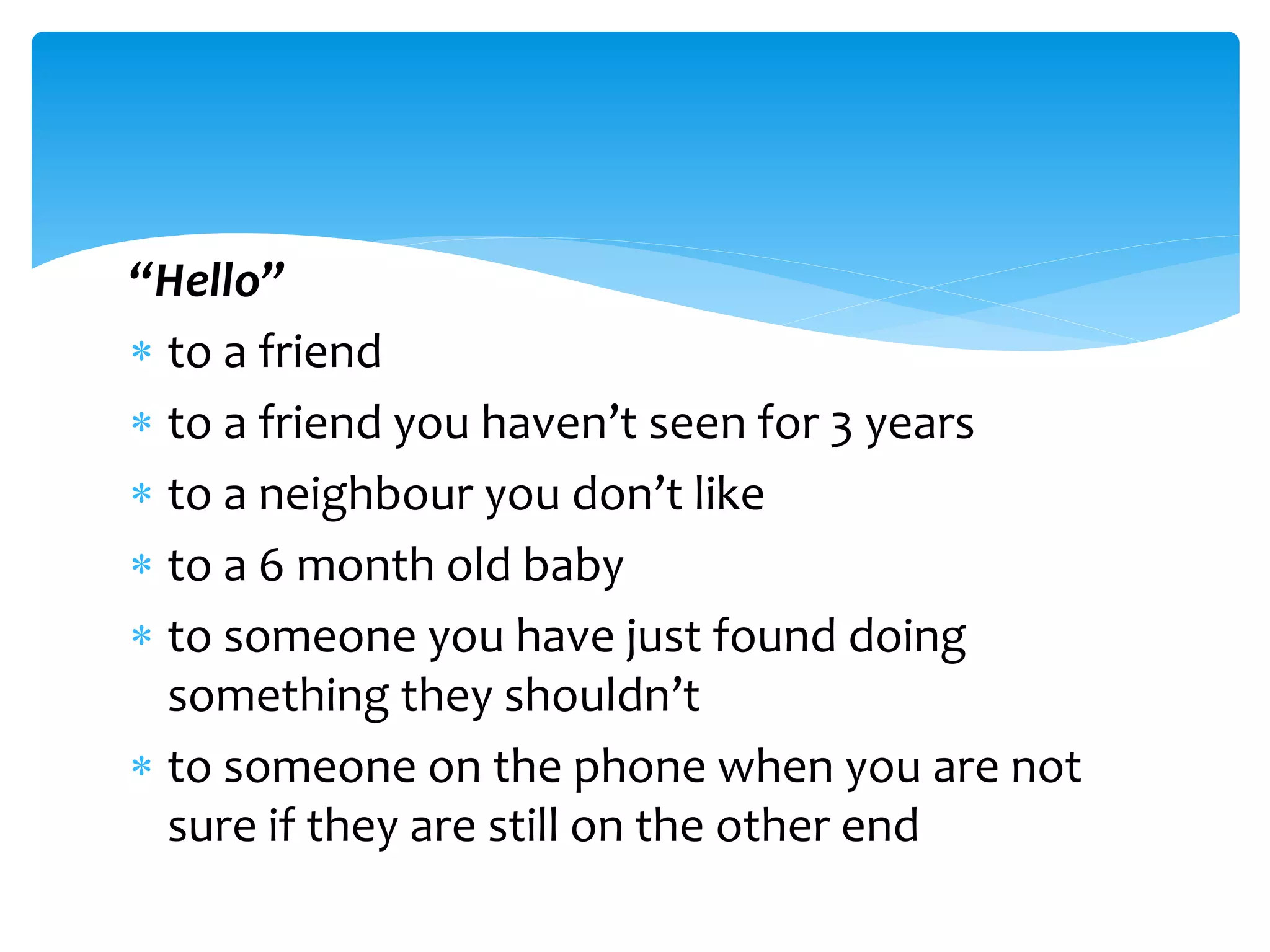
“Hello”
 to a friend
 to a friend you haven’t seen for 3 years
 to a neighbour you don’t like
 to a 6 month old baby
 to someone you have just found doing
something they shouldn’t
 to someone on the phone when you are not
sure if they are still on the other end
SWOT Analysis
Before the Presentation
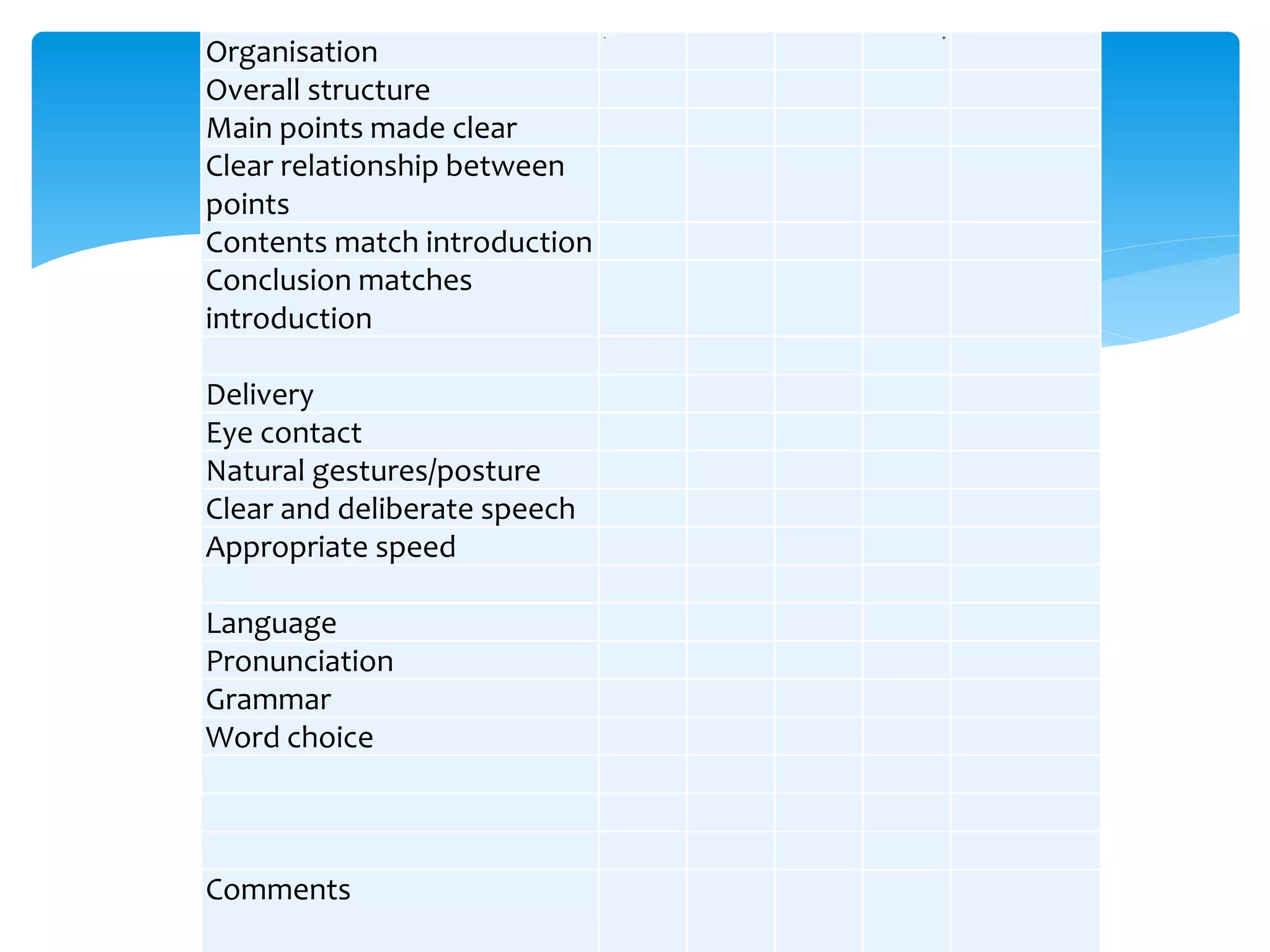
Organisation
- +
Overall structure
Main points made clear
Clear relationship between
points
Contents match introduction
Conclusion matches
introduction
Delivery
Eye contact
Natural gestures/posture
Clear and deliberate speech
Appropriate speed
Language
Pronunciation
Grammar
Word choice
Comments

Guidelines to effective presentation

  • 1.
  • 2.
    “A survey oftop executives who earned more than $250,000 per year was conducted by a large executive search firm. The survey found that these executives believed their communication skills were the number one factor that carried them to the top”. From Wake em Up , by Tom Antion
  • 3.
    Before you start1.Objective a. Where am I making this presentation? In a small hotel meeting-room or a large conference hall? What facilities and equipment are available? What are the seating arrangements? 2. Audience b. When am I making this presentation and how long will it be?" Will it be 5 minutes or 1 hour? Just before lunch, when your audience will be hungry, or just after lunch, when your audience will be sleepy? 3. Venue c. Why am I making this presentation? Do I need to inform, to persuade, to train or to sell? 4. Time and Length d. How should I make this presentation? What approach should you use? Formal or informal? Lots of visual aids or only a few? Will you include some anecdotes and humour for variety? 5. Method e. Who am I making this presentation to? How many people? Who are they? Business people? Professional people? Political people? Experts or non-experts? Will it be a small, intimate group of 4 colleagues or a large gathering of 400 competitors? How much do they know already and what will they expect from you?
  • 4.
    A noted speakerwas asked his secret of success. “First,” he said, “you write an exciting opening that will draw the attention of everyone in the room. Then you compose a dramatic summary and closing words that will leave the audience spellbound. Then,” he advised, “You put them as close together as possible.” Speech Organization
  • 5.
    One very usefultool to help you organise your thinking is an outline. An outline works a little like a road map. It shows you where to start (the Opening), where you are going (the Conclusion), and how to get there (the Body).  Introduction  Body  Conclusion The Outline
  • 6.
    Depending on whatyou want to talk about, describe, or explain, and depending on who you are talking to, you should choose a good way to put your main points in order. Here is an example:  I. The importance of being a good presenter (Introduction).  II. There are many skills to learn:  A. Planning your speech  B. Writing your speech  C. Delivering your speech  III. Everyone should work hard on his or her presentation skills (Conclusion). The Outline
  • 7.
    The Outline  I. _____________________________(Introduction) II. _____________________________ A. _________________________ 1. _______________________ 2. _______________________ B. _________________________ 1. _______________________ 2. _______________________ C. _________________________ 1. _______________________ 2. _______________________ III. ____________________________ (Conclusion)   B o d y
  • 8.
    1. A referenceor greeting to the event and the sponsor (or guests) a. e.g. "Goody Startman said that, “Practice is the mother of success.” 2. A reference to the speaker (say something about yourself) b. e.g. "On my trip up here to Minsk, I encountered an interesting young man on the bus. After introducing ourselves, we began to talk about ...." 3. A question to the audience c. e.g. "Good afternoon, ladies and gentlemen. I am happy to be here today." 4. A quotation d. e.g. "Recent studies have shown that one out of every 5 listeners falls asleep during the first 10 minutes of the presentation. Others though do it within the next 30 minutes." 5. A shocking statement e. e.g. "While I am not an expert on the topic, I feel that I speak for many people in business." 6. Statistics f. e.g. "At this very moment, as we sit here in this very room, someone is being fired because he failed his company presentation." 7. An anecdote (a short account of something that happened) g. e.g. "Has Joe Bridely always been an excellent presenter?" The Introduction
  • 9.
    Prepare the introductionto a presentation about one of the subjects in the list. Present your introduction to the class. Each introduction should take no more than two or three minutes. Vote for the best introduction.  your dream job;  your university;  your last holiday;  dealing with difficult people;  the Internet in your life;  your studies so far;  the importance of a good introduction to a presentation. The Introduction
  • 10.
    1. A summaryof key ideas a. e.g. "As Thoreau once said, ‘Simplify, simplify, simplify.’" 1. A prediction. a. e.g. "I'd like to close with a true story about how my daughter taught me how to be an interesting speaker." 1. A quotation, either emotional or factual, from literature or an authority. a. e.g. "In conclusion, I feel sure that if we all can do these five simple things, communication skills will improve greatly." 1. An anecdote a. e.g. "Isn't it time that you and I stopped talking theory and started practicing?” 1. A question a. e.g. "In conclusion, I wish I could offer more hope for the future. I'm afraid, however, that unless you practice harder no success awaits you." The Conclusion
  • 11.
     1. Goodafternoon (morning, evening), ladies and gentleman. My name’s …  2. To start with ...  3. Then I'll mention …  4. After that I'll consider the possibilities for …  5. Finally, I'll summarise my presentation.  6. If you look at this chart …  7. So, first of all …  8. Thirdly, …  9. I am going to talk today about ...  10. Finally, let’s turn to …  11. In conclusion, ...  12. To illustrate this point...  13. Many thanks for your attention.  14. Let’s move on to …  15. Now I'll try to answer any questions you may have.  16. The purpose of my presentation is to introduce our new range of...  17. Secondly, …  18. So let me summarise/recap what I've said.  19. Moving on to my next point …  20. May I thank you all for being such an attentive audience.
  • 12.
    1. Body Language 2.Facial Expressions 3. Eye Contact 4. Vocal Variety a. be aware of your facial expressions to be sure they are not exaggerated or easily misinterpreted. b. never use a flat, unchanging voice like the one in your electronic dictionary c. find someone to listen to you practice your speech and give you some help d. use a tape recorder and be your own audience e. make the gestures large enough for everyone to see them clearly, but not so large that you look silly. f. practice it when you use it as a public speaking technique and use it to your advantage g. practice in front of a mirror, or, if you have a video camera, tape yourself in action! h. move your eyes around the room and make eye contact with members of the audience as you speak Delivery
  • 13.
    Yes, I loveyou. Yes, I love you. Yes, I love you. Yes, I love you. Yes, I love you. Delivery
  • 14.
    “Hello”  to afriend  to a friend you haven’t seen for 3 years  to a neighbour you don’t like  to a 6 month old baby  to someone you have just found doing something they shouldn’t  to someone on the phone when you are not sure if they are still on the other end
  • 15.
  • 16.
    Organisation - + Overall structure Mainpoints made clear Clear relationship between points Contents match introduction Conclusion matches introduction Delivery Eye contact Natural gestures/posture Clear and deliberate speech Appropriate speed Language Pronunciation Grammar Word choice Comments