Some Very General Citation
Guidelines
The Bottom Line: The following will lose you
marks.
 No citations? Fail (see plagiarism)
 Citations in anything other than MLA, or consistent failure
to format correctly:? Automatic 10% deduction.
 Quotes not integrated or formatted incorrectly (long quote
not set off with hanging indent), treated as “serious error,”
three will lose you 10%
 Titles incorrectly formatted: automatic 5% deduction.
 Incorrect punctuation, treated as punctuation error. Five
will lose you 10%
Take Good Notes!
Always keep track of…
 Date you accessed material on web
 Author
 Title
 Publisher, and publishing details (place, date)
 Name of web page
 URL Address
 Date of material
 Page numbers beginning and end
 Page you got material from
 In your notes, use quotation marks on all exact
quotes
Part One: In Text
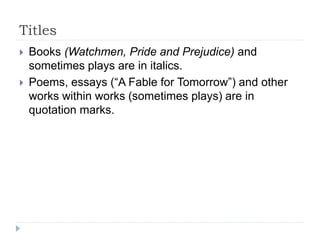
Titles
 Books (Watchmen, Pride and Prejudice) and
sometimes plays are in italics.
 Poems, essays (“A Fable for Tomorrow”) and other
works within works (sometimes plays) are in
quotation marks.
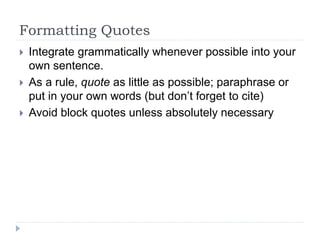
Formatting Quotes
 Integrate grammatically whenever possible into your
own sentence.
 As a rule, quote as little as possible; paraphrase or
put in your own words (but don’t forget to cite)
 Avoid block quotes unless absolutely necessary
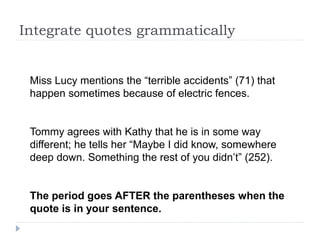
Integrate quotes grammatically
Miss Lucy mentions the “terrible accidents” (71) that
happen sometimes because of electric fences.
Tommy agrees with Kathy that he is in some way
different; he tells her “Maybe I did know, somewhere
deep down. Something the rest of you didn’t” (252).
The period goes AFTER the parentheses when the
quote is in your sentence.
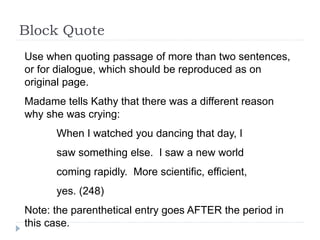
Block Quote
Use when quoting passage of more than two sentences,
or for dialogue, which should be reproduced as on
original page.
Madame tells Kathy that there was a different reason
why she was crying:
When I watched you dancing that day, I
saw something else. I saw a new world
coming rapidly. More scientific, efficient,
yes. (248)
Note: the parenthetical entry goes AFTER the period in
this case.
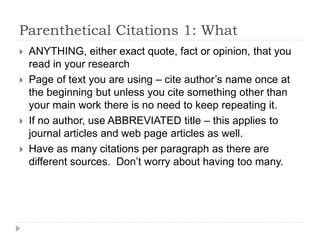
Parenthetical Citations 1: What
 ANYTHING, either exact quote, fact or opinion, that you
read in your research
 Page of text you are using – cite author’s name once at
the beginning but unless you cite something other than
your main work there is no need to keep repeating it.
 If no author, use ABBREVIATED title – this applies to
journal articles and web page articles as well.
 Have as many citations per paragraph as there are
different sources. Don’t worry about having too many.
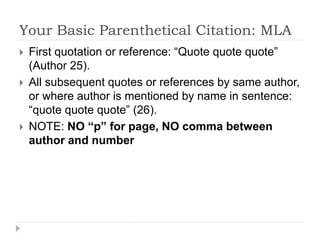
Your Basic Parenthetical Citation: MLA
 First quotation or reference: “Quote quote quote”
(Author 25).
 All subsequent quotes or references by same author,
or where author is mentioned by name in sentence:
“quote quote quote” (26).
 NOTE: NO “p” for page, NO comma between
author and number
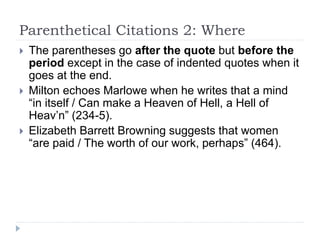
Parenthetical Citations 2: Where
 The parentheses go after the quote but before the
period except in the case of indented quotes when it
goes at the end.
 Milton echoes Marlowe when he writes that a mind
“in itself / Can make a Heaven of Hell, a Hell of
Heav’n” (234-5).
 Elizabeth Barrett Browning suggests that women
“are paid / The worth of our work, perhaps” (464).
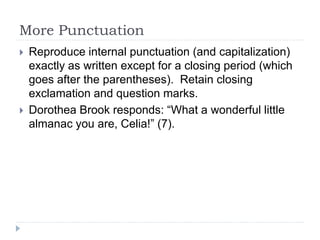
More Punctuation
 Reproduce internal punctuation (and capitalization)
exactly as written except for a closing period (which
goes after the parentheses). Retain closing
exclamation and question marks.
 Dorothea Brook responds: “What a wonderful little
almanac you are, Celia!” (7).
Part Two: List of References
What it’s Called
 In MLA, it’s a “Works Cited” list
 It’s not a bibliography
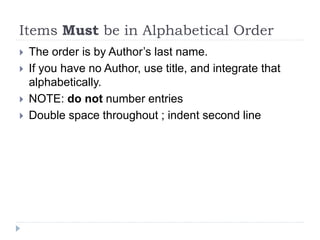
Items Must be in Alphabetical Order
 The order is by Author’s last name.
 If you have no Author, use title, and integrate that
alphabetically.
 NOTE: do not number entries
 Double space throughout ; indent second line
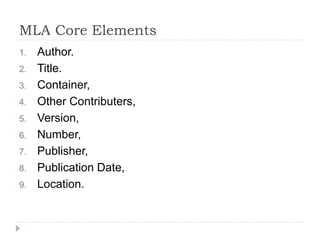
MLA Core Elements
1. Author.
2. Title.
3. Container,
4. Other Contributers,
5. Version,
6. Number,
7. Publisher,
8. Publication Date,
9. Location.
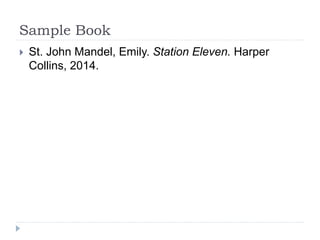
Sample Book
 St. John Mandel, Emily. Station Eleven. Harper
Collins, 2014.
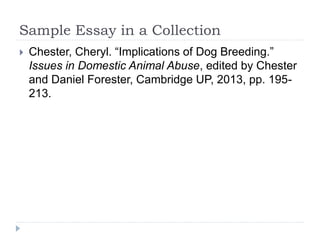
Sample Essay in a Collection
 Chester, Cheryl. “Implications of Dog Breeding.”
Issues in Domestic Animal Abuse, edited by Chester
and Daniel Forester, Cambridge UP, 2013, pp. 195-
213.
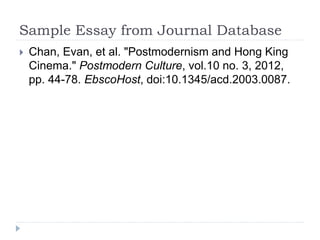
Sample Essay from Journal Database
 Chan, Evan, et al. "Postmodernism and Hong King
Cinema." Postmodern Culture, vol.10 no. 3, 2012,
pp. 44-78. EbscoHost, doi:10.1345/acd.2003.0087.

Works cited guidelines

  • 1.
    Some Very GeneralCitation Guidelines
  • 2.
    The Bottom Line:The following will lose you marks.  No citations? Fail (see plagiarism)  Citations in anything other than MLA, or consistent failure to format correctly:? Automatic 10% deduction.  Quotes not integrated or formatted incorrectly (long quote not set off with hanging indent), treated as “serious error,” three will lose you 10%  Titles incorrectly formatted: automatic 5% deduction.  Incorrect punctuation, treated as punctuation error. Five will lose you 10%
  • 3.
    Take Good Notes! Alwayskeep track of…  Date you accessed material on web  Author  Title  Publisher, and publishing details (place, date)  Name of web page  URL Address  Date of material  Page numbers beginning and end  Page you got material from  In your notes, use quotation marks on all exact quotes
  • 4.
  • 5.
    Titles  Books (Watchmen,Pride and Prejudice) and sometimes plays are in italics.  Poems, essays (“A Fable for Tomorrow”) and other works within works (sometimes plays) are in quotation marks.
  • 6.
    Formatting Quotes  Integrategrammatically whenever possible into your own sentence.  As a rule, quote as little as possible; paraphrase or put in your own words (but don’t forget to cite)  Avoid block quotes unless absolutely necessary
  • 7.
    Integrate quotes grammatically MissLucy mentions the “terrible accidents” (71) that happen sometimes because of electric fences. Tommy agrees with Kathy that he is in some way different; he tells her “Maybe I did know, somewhere deep down. Something the rest of you didn’t” (252). The period goes AFTER the parentheses when the quote is in your sentence.
  • 8.
    Block Quote Use whenquoting passage of more than two sentences, or for dialogue, which should be reproduced as on original page. Madame tells Kathy that there was a different reason why she was crying: When I watched you dancing that day, I saw something else. I saw a new world coming rapidly. More scientific, efficient, yes. (248) Note: the parenthetical entry goes AFTER the period in this case.
  • 9.
    Parenthetical Citations 1:What  ANYTHING, either exact quote, fact or opinion, that you read in your research  Page of text you are using – cite author’s name once at the beginning but unless you cite something other than your main work there is no need to keep repeating it.  If no author, use ABBREVIATED title – this applies to journal articles and web page articles as well.  Have as many citations per paragraph as there are different sources. Don’t worry about having too many.
  • 10.
    Your Basic ParentheticalCitation: MLA  First quotation or reference: “Quote quote quote” (Author 25).  All subsequent quotes or references by same author, or where author is mentioned by name in sentence: “quote quote quote” (26).  NOTE: NO “p” for page, NO comma between author and number
  • 11.
    Parenthetical Citations 2:Where  The parentheses go after the quote but before the period except in the case of indented quotes when it goes at the end.  Milton echoes Marlowe when he writes that a mind “in itself / Can make a Heaven of Hell, a Hell of Heav’n” (234-5).  Elizabeth Barrett Browning suggests that women “are paid / The worth of our work, perhaps” (464).
  • 12.
    More Punctuation  Reproduceinternal punctuation (and capitalization) exactly as written except for a closing period (which goes after the parentheses). Retain closing exclamation and question marks.  Dorothea Brook responds: “What a wonderful little almanac you are, Celia!” (7).
  • 13.
    Part Two: Listof References
  • 14.
    What it’s Called In MLA, it’s a “Works Cited” list  It’s not a bibliography
  • 15.
    Items Must bein Alphabetical Order  The order is by Author’s last name.  If you have no Author, use title, and integrate that alphabetically.  NOTE: do not number entries  Double space throughout ; indent second line
  • 16.
    MLA Core Elements 1.Author. 2. Title. 3. Container, 4. Other Contributers, 5. Version, 6. Number, 7. Publisher, 8. Publication Date, 9. Location.
  • 17.
    Sample Book  St.John Mandel, Emily. Station Eleven. Harper Collins, 2014.
  • 18.
    Sample Essay ina Collection  Chester, Cheryl. “Implications of Dog Breeding.” Issues in Domestic Animal Abuse, edited by Chester and Daniel Forester, Cambridge UP, 2013, pp. 195- 213.
  • 19.
    Sample Essay fromJournal Database  Chan, Evan, et al. "Postmodernism and Hong King Cinema." Postmodern Culture, vol.10 no. 3, 2012, pp. 44-78. EbscoHost, doi:10.1345/acd.2003.0087.