Short Literature Essays
For the thoughtful but nervous
student in English 161
Watch out for:
 Spelling the author’s or character’s name
incorrectly
 In James Joyce’s story “Eveline” he writes
(or says, which is worse)
 The story says (even worse)
Before you write anything
 READ
 READ
 READ
 READ
 And, oh yes, READ
 And take notes.
What to look for: the Obvious
 Plot (NOT interesting)
 Character (how is it PORTRAYED)
 Central conflict
What to look for (less obvious)
 Repeated imagery
 Repeated anything (it’s probably
significant)
 Context: social, intellectual, stylistic
 What do you know about the author?
 Irony
Organize your points
 Construct an outline
HAVE
 A thesis
 A conclusion that does not repeat the
thesis or the introduction
 Introduction of more than one sentence.
 T.E.A. paragraphs
AVOID
 Formulaic 3-point thesis
 Limiting yourself to only 5 paragraphs.
 Plot Summary
 Mechanical transitions
Helpful Hints
 Organize rhetorically rather than by order
in the plot.
 Don’t think of me (the teacher) as your
audience.
 Don’t limit the number of things you talk
about – show the reader (me) everything
you have thought about.
 Don’t be hesitant or equivocal – you are
the expert! (don’t tell me you didn’t
understand the story!)
Your Introduction
 Go from the general to the specific
 The specific should be your thesis.
 Must be more than one sentence.
 Three is a good rule of thumb
Your Thesis Must Be
 Arguable
 Arguable
 Arguable
 Not a statement of fact (hint – it should be
arguable)
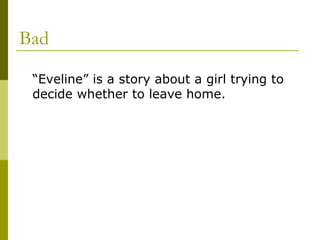
Bad
“Eveline” is a story about a girl trying to
decide whether to leave home.
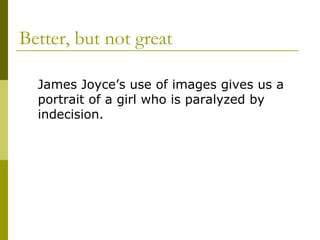
Better, but not great
James Joyce’s use of images gives us a
portrait of a girl who is paralyzed by
indecision.
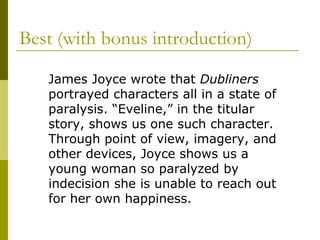
Best (with bonus introduction)
James Joyce wrote that Dubliners
portrayed characters all in a state of
paralysis. “Eveline,” in the titular
story, shows us one such character.
Through point of view, imagery, and
other devices, Joyce shows us a
young woman so paralyzed by
indecision she is unable to reach out
for her own happiness.

Literature essay guide

  • 1.
    Short Literature Essays Forthe thoughtful but nervous student in English 161
  • 2.
    Watch out for: Spelling the author’s or character’s name incorrectly  In James Joyce’s story “Eveline” he writes (or says, which is worse)  The story says (even worse)
  • 3.
    Before you writeanything  READ  READ  READ  READ  And, oh yes, READ  And take notes.
  • 4.
    What to lookfor: the Obvious  Plot (NOT interesting)  Character (how is it PORTRAYED)  Central conflict
  • 5.
    What to lookfor (less obvious)  Repeated imagery  Repeated anything (it’s probably significant)  Context: social, intellectual, stylistic  What do you know about the author?  Irony
  • 6.
    Organize your points Construct an outline
  • 7.
    HAVE  A thesis A conclusion that does not repeat the thesis or the introduction  Introduction of more than one sentence.  T.E.A. paragraphs
  • 8.
    AVOID  Formulaic 3-pointthesis  Limiting yourself to only 5 paragraphs.  Plot Summary  Mechanical transitions
  • 9.
    Helpful Hints  Organizerhetorically rather than by order in the plot.  Don’t think of me (the teacher) as your audience.  Don’t limit the number of things you talk about – show the reader (me) everything you have thought about.  Don’t be hesitant or equivocal – you are the expert! (don’t tell me you didn’t understand the story!)
  • 10.
    Your Introduction  Gofrom the general to the specific  The specific should be your thesis.  Must be more than one sentence.  Three is a good rule of thumb
  • 11.
    Your Thesis MustBe  Arguable  Arguable  Arguable  Not a statement of fact (hint – it should be arguable)
  • 12.
    Bad “Eveline” is astory about a girl trying to decide whether to leave home.
  • 13.
    Better, but notgreat James Joyce’s use of images gives us a portrait of a girl who is paralyzed by indecision.
  • 14.
    Best (with bonusintroduction) James Joyce wrote that Dubliners portrayed characters all in a state of paralysis. “Eveline,” in the titular story, shows us one such character. Through point of view, imagery, and other devices, Joyce shows us a young woman so paralyzed by indecision she is unable to reach out for her own happiness.